Comparative Political Systems
Begin
15 pages · ~30 min
Comparative Political Systems
Analyze governance structures, power dynamics, and administrative strategies across historical empires to understand how political systems shaped their rise and fall. Ideal for students and history enthusiasts.
What you’ll learn
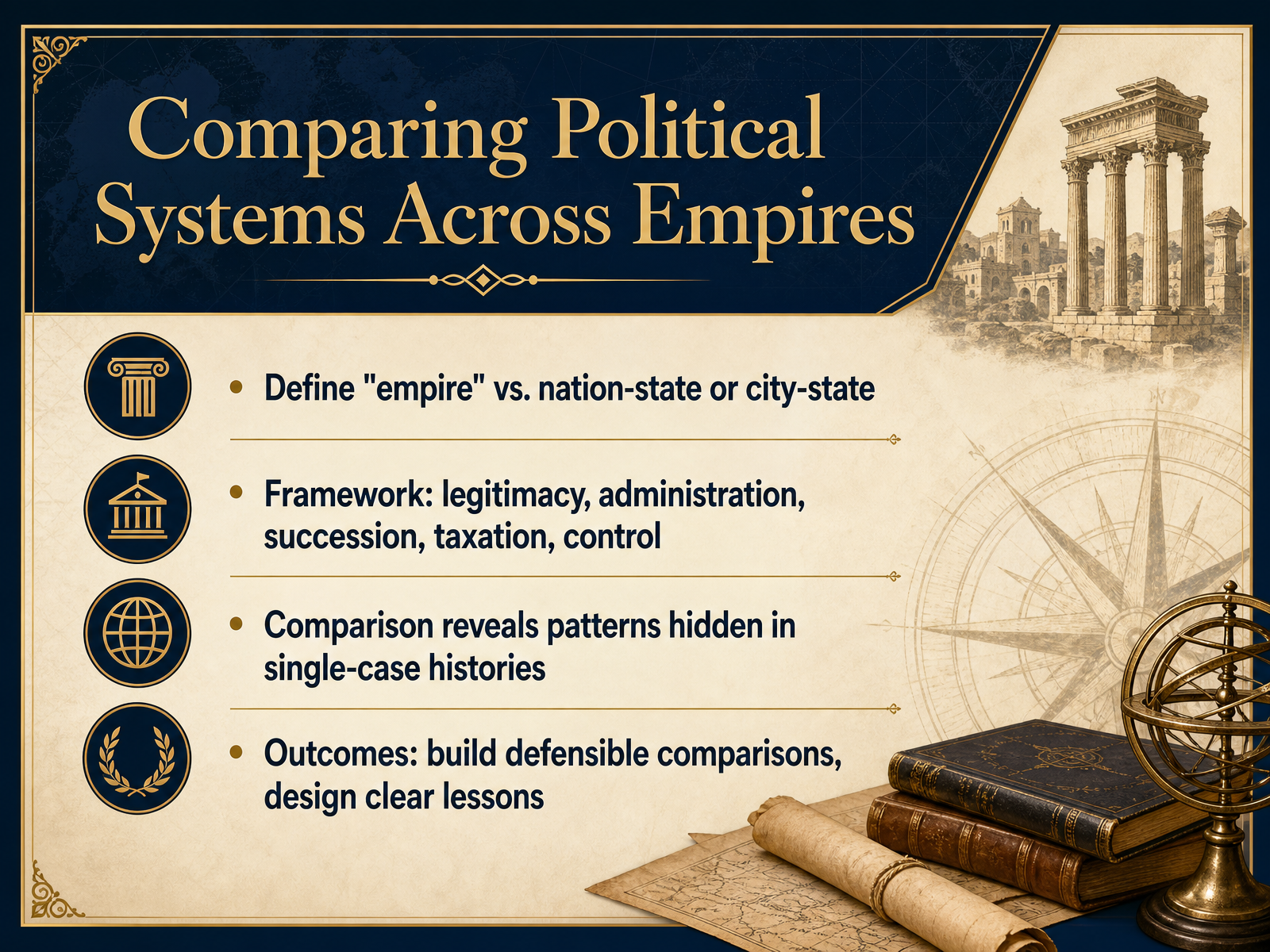
- 01Comparing Political Systems Across EmpiresWelcome. Today we are going to think like political scientists, not just storytellers. We will compare political systems across empires, treating each one as a case study rather than a legend. First, we need a working definition. An empire is a large, multi-ethnic state ruled from a center, where one authority controls diverse peoples and territories. That is different from a nation-state, which is tied to one dominant national identity, or a city-state, which is a single urban center. To compare fairly, we need a framework. We will examine five key features: legitimacy, how rulers justify their power; administration, how they organize governance; succession, how they pass power down; taxation, how they extract resources; and control, how they maintain order. This approach matters. If we study only one history, we see unique details. When we compare, patterns emerge that would otherwise stay hidden. Our goal is to build defensible comparisons and design clear lessons for understanding how power actually worked. So, let's begin. Why compare empires? That is our next question.
web.stanford.edunerd.wwnorton.comideas.repec.org+22 min
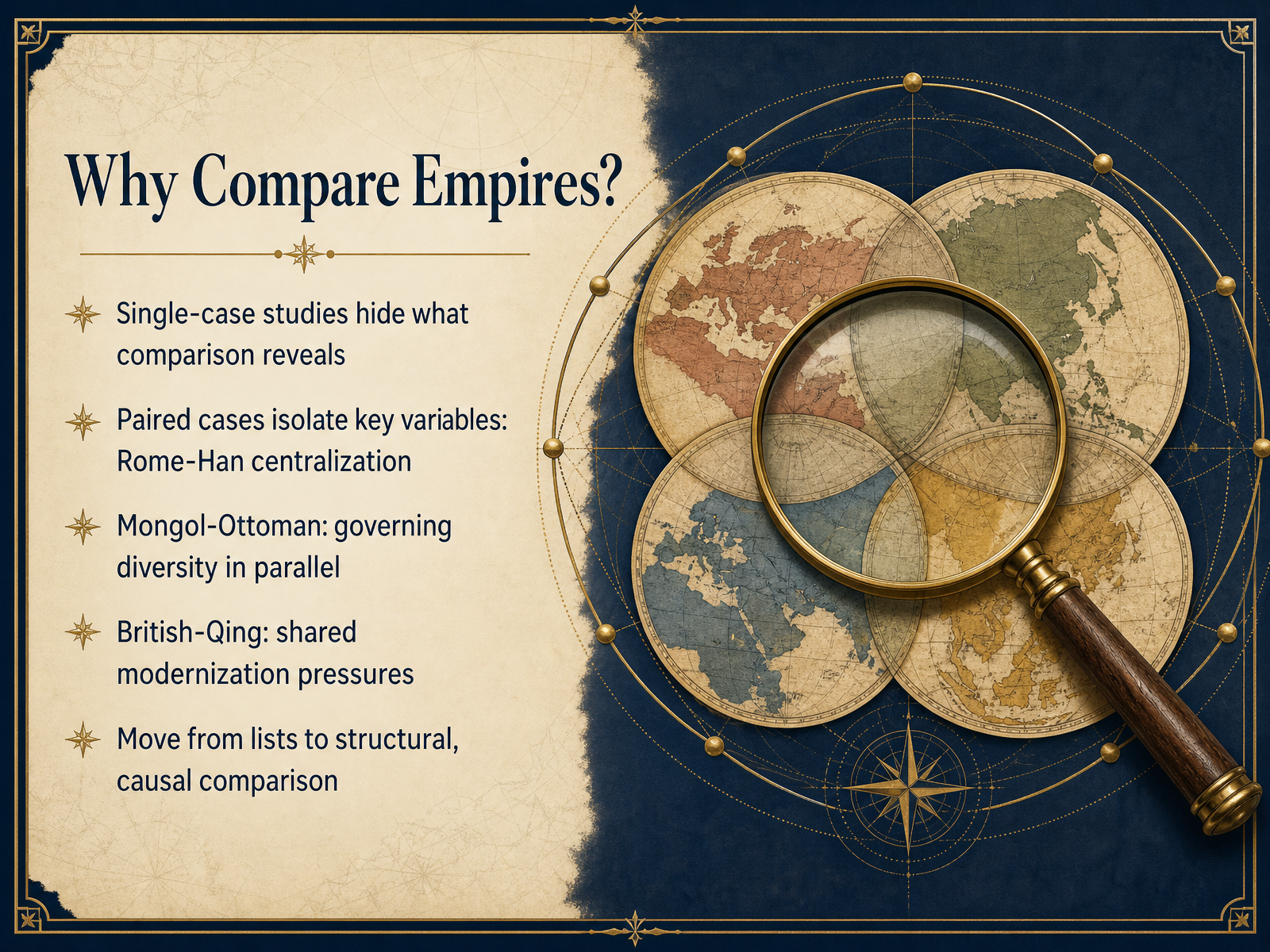
- 02Why Compare Empires?Let's start with a simple question: why compare empires at all? A single-case study, say of Rome alone, tells a rich story. But it cannot tell you which features were unique to Rome and which were shared responses to common pressures. Comparison reveals what a single story hides. Pairing cases helps isolate key variables. Take Rome and Han China. Both were vast, agrarian, and roughly contemporary. Yet Rome governed through a citizen-soldier ethos and legal pluralism, while Han China built a centralized bureaucracy, where officials qualified through Confucian learning. Comparing them lets us ask: did centralization drive their different trajectories? Now consider the Mongol and Ottoman empires. Both ruled enormous, culturally diverse populations. How did they manage that diversity? Through parallel strategies of indirect rule, local intermediaries, and religious toleration. Finally, look at the British and Qing empires in the nineteenth century. Both faced the pressures of global trade and industrial warfare. Both attempted modernization from above. Their successes and failures were strikingly parallel. So the goal here is to move from descriptive lists to structural, causal comparison. We treat each empire as a case study, not a narrative biography. This framework sets up the core concepts and the comparison matrix we will use throughout, which is where we head next.
 web.stanford.edunerd.wwnorton.comideas.repec.org+22 min
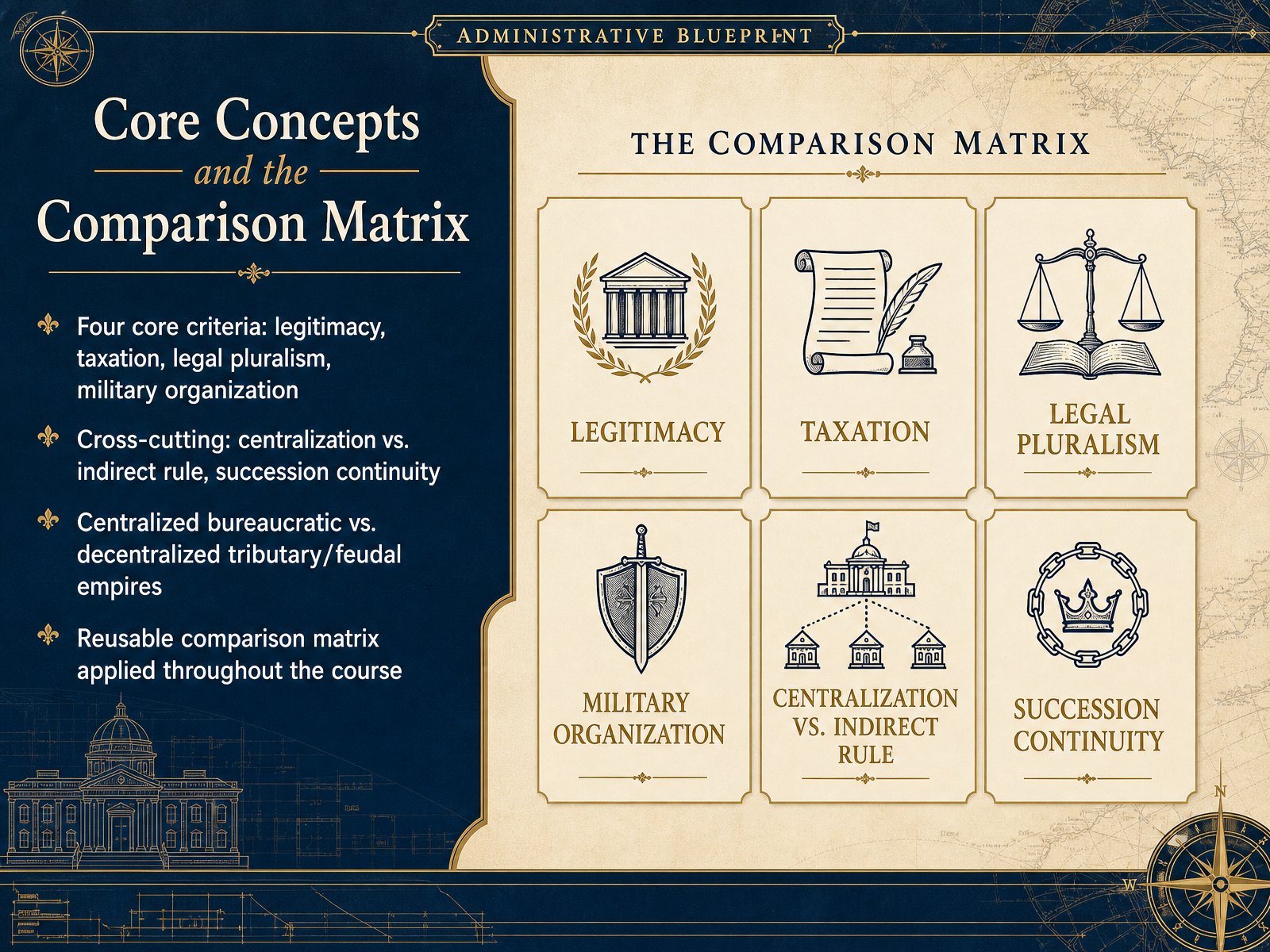
 - 03Core Concepts and the Comparison MatrixNow, let's build our toolkit. To compare empires fairly, we need a consistent framework. Every imperial system can be examined through four core criteria. First, legitimacy: the basis of the ruler's right to govern, whether divine mandate, military prowess, or election. Second, taxation: not just the rate, but the entire mechanism of extraction. Third, legal pluralism: the coexistence of multiple legal systems under one imperial umbrella. And fourth, military organization. Two cross-cutting themes accompany these: the balance between centralization and indirect rule, and the continuity of succession. These variables create a spectrum. At one end, centralized bureaucratic empires, like the Roman Empire after Augustus or the Ottoman classical age. At the other, decentralized tributary or feudal empires. Here, the center relies heavily on local intermediaries, as we see in the Mongol dual administrative system or Ottoman provincial arrangements. Tangible consequences follow. A centralized bureaucracy may standardize laws but stretch itself thin. Decentralized rule allows local autonomy but risks fragmentation. We'll apply this same reusable comparison matrix throughout the course to every empire we study. It keeps our analysis consistent and our contrasts sharp. With this framework in hand, we are ready to explore a method for defensible comparison.
 tandfonline.comcambridge.orghal.science+22 min
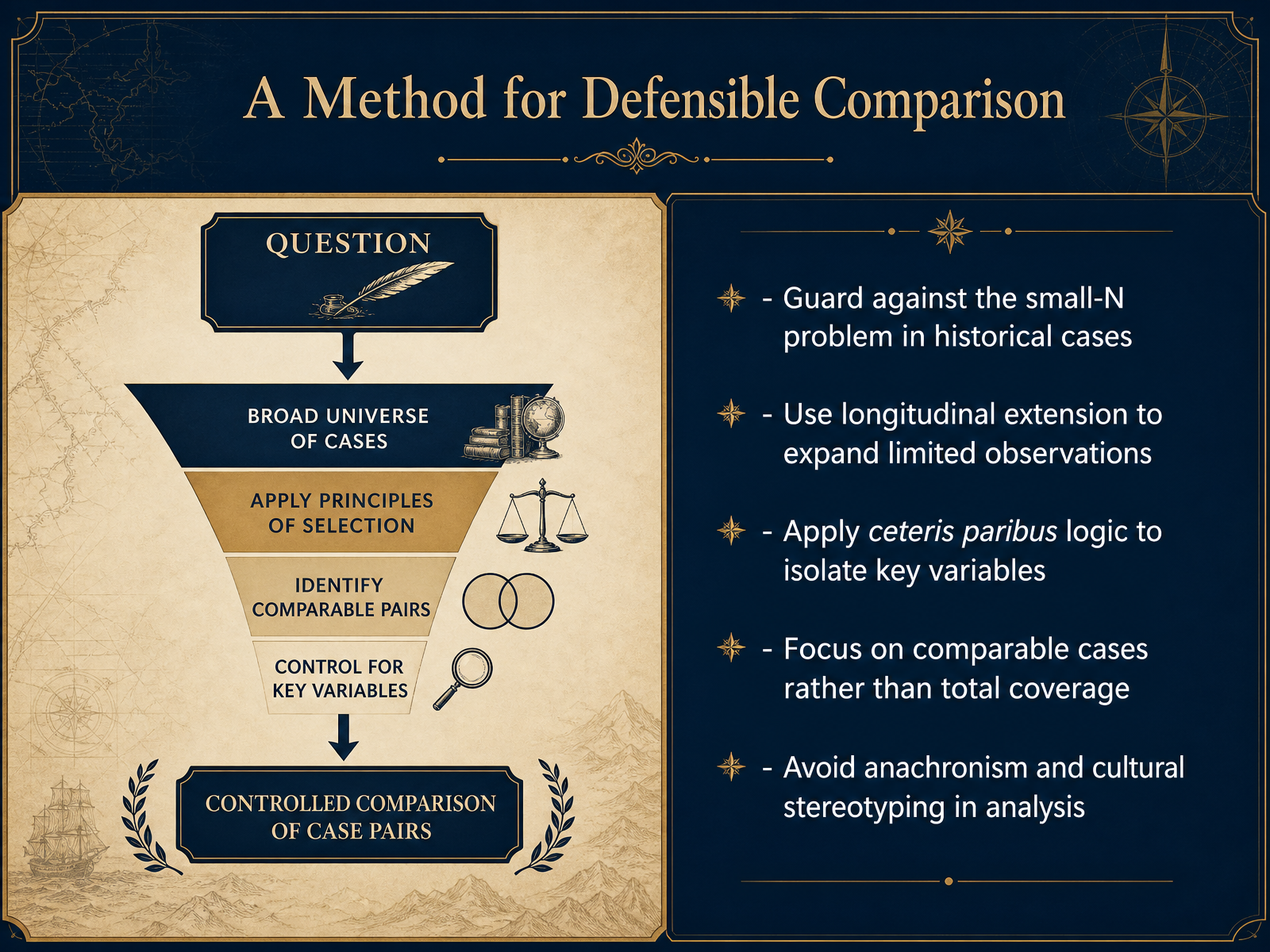
 - 04A Method for Defensible ComparisonSo how do we compare empires without falling into traps? First, guard against the small-N problem. We have only a handful of great empires to study, so any single case carries too much weight. Second, use longitudinal extension. Track a system across centuries — say, Rome from Republic to Dominate — to multiply your observations. Third, apply ceteris paribus logic. Hold other factors constant so you can isolate what actually drives change. Fourth, focus on comparable cases rather than total coverage. Compare Rome with Han China, not with every state that ever existed. Finally, avoid anachronism and cultural stereotyping. Don't impose modern categories on ancient actors, and resist the urge to label one system 'advanced' and another 'backward.' Each empire solved problems in its own context. Keep these guardrails in mind, and the comparison stays defensible. Now, let's turn to Rome and Han: two paths to centralization.
 cambridge.orgscience.lpnu.uacambridge.org+21 min
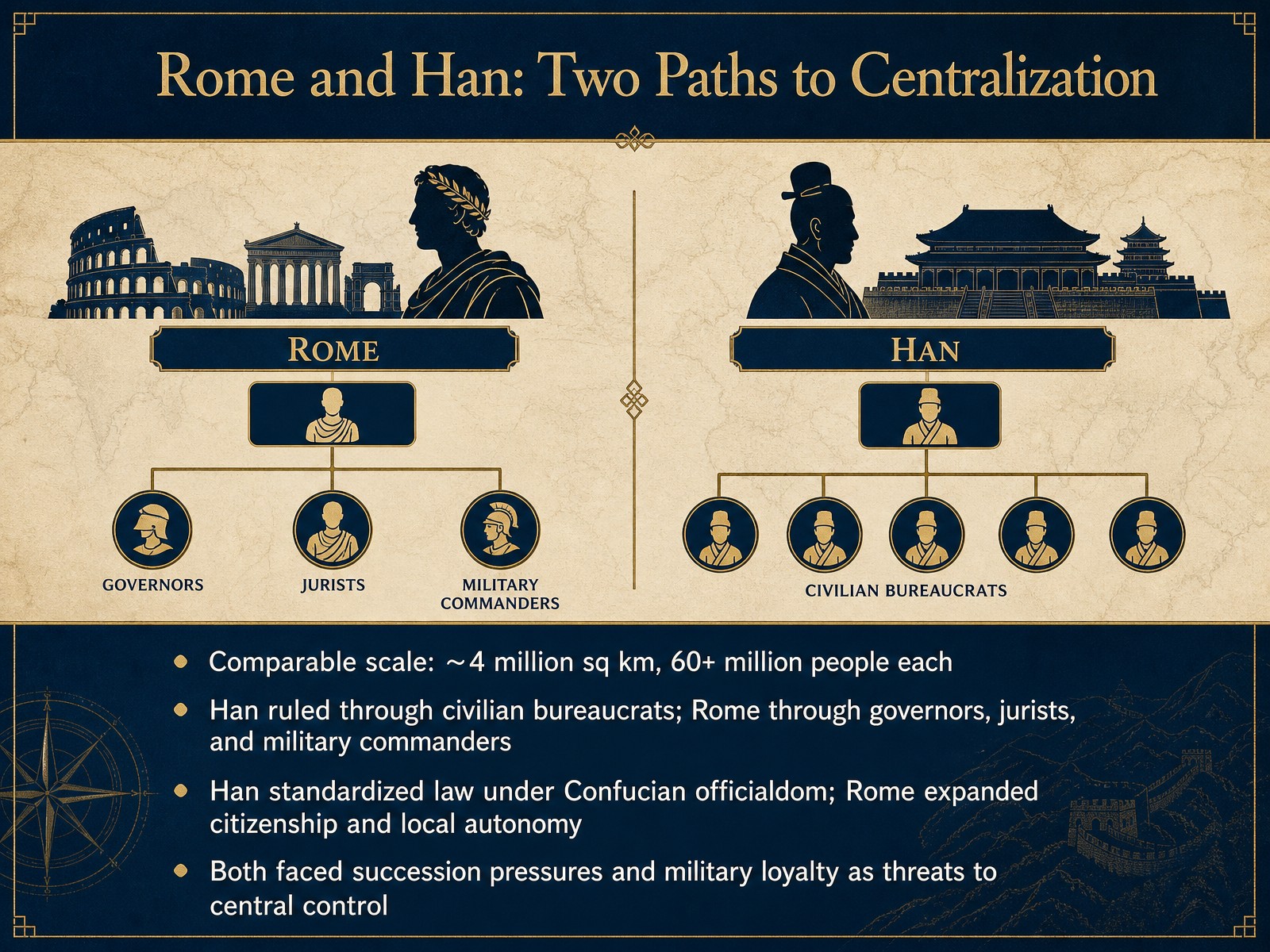
 - 05Rome and Han: Two Paths to CentralizationLet’s look now at Rome and Han China. The numbers alone are striking: each empire governed roughly four million square kilometers and over sixty million people. At their height, together they held nearly half the human species. But these two giants centralized power in very different ways. Han China leaned on civilian bureaucrats — administrators trained in Confucian classics who earned their posts through civil service exams. Rome, by contrast, leaned on governors, jurists, and military commanders. These were men whose authority often rested on military command and legal expertise rather than scholarly merit. Legal standardization followed those different paths too. Han unified law under a Confucian-trained officialdom, so that legal knowledge and administrative service merged into one career track. Rome expanded citizenship and local autonomy, allowing provincial elites to become Roman while keeping local customs intact. That was a flexible, layered system. Yet both empires shared a vulnerability: succession. In Rome, emperors struggled to secure heirs who could hold the loyalty of the legions. In Han China, court factions and regional commanders posed similar threats to the throne. The lesson is that scale alone did not determine outcomes — institutional choices mattered just as much. From Rome and Han, we turn now to the Mongol and Ottoman empires, where diversity itself became the central governing problem.
 web.stanford.edunerd.wwnorton.comideas.repec.org+22 min
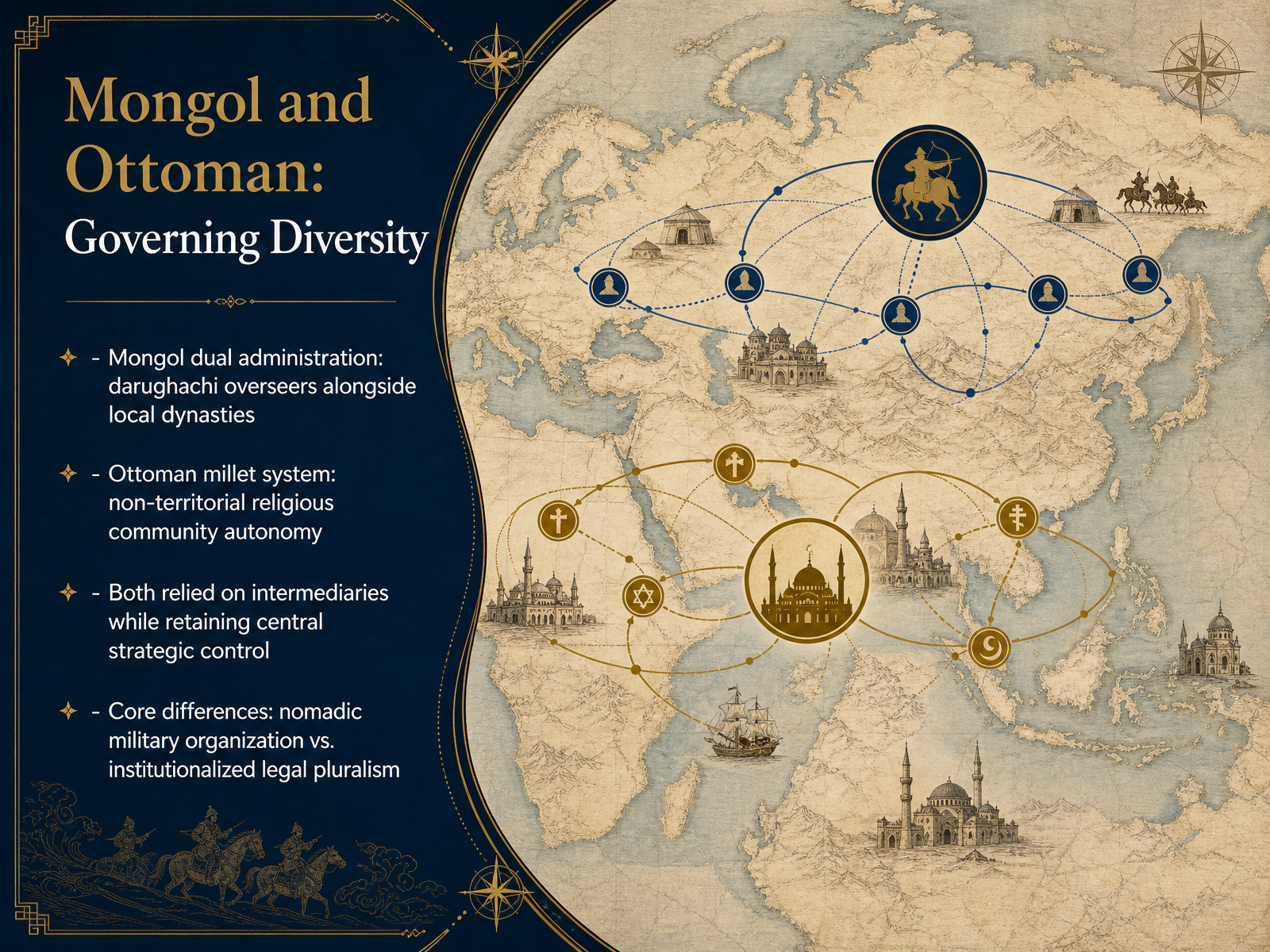
 - 06Mongol and Ottoman: Governing DiversityLet’s look at two very different answers to the same basic question: how do you rule an empire made up of many peoples? The Mongols built a dual administration. They placed their own overseers, the darughachi, alongside local rulers. These overseers handled taxes, kept an eye on local officials, and reported back to the Great Khan. The locals kept running their courts and collecting their customs, but the Mongols held the strategic levers. The Ottomans developed something different: the millet system. Yes, this is a non-territorial arrangement—a religious community, like the Greek Orthodox or the Armenian Christians, was granted autonomy over its own legal and personal affairs. Is it fair to compare these systems? Obviously, the Mongol approach grew from steppe military organization, while the Ottoman one was a more institutionalized form of legal pluralism—that is, recognizing different law codes for different groups within one state. But the shared logic is striking. Both empires retained a central strategic monopoly—on taxation, on foreign policy, on ultimate force—while accepting that day-to-day life must be negotiated locally. It’s tempting to call that pragmatism. Now, let’s shift to a very different model of managing diversity: the British and Qing empires, and their road to the modern state.
 tandfonline.comcambridge.orghal.science+22 min
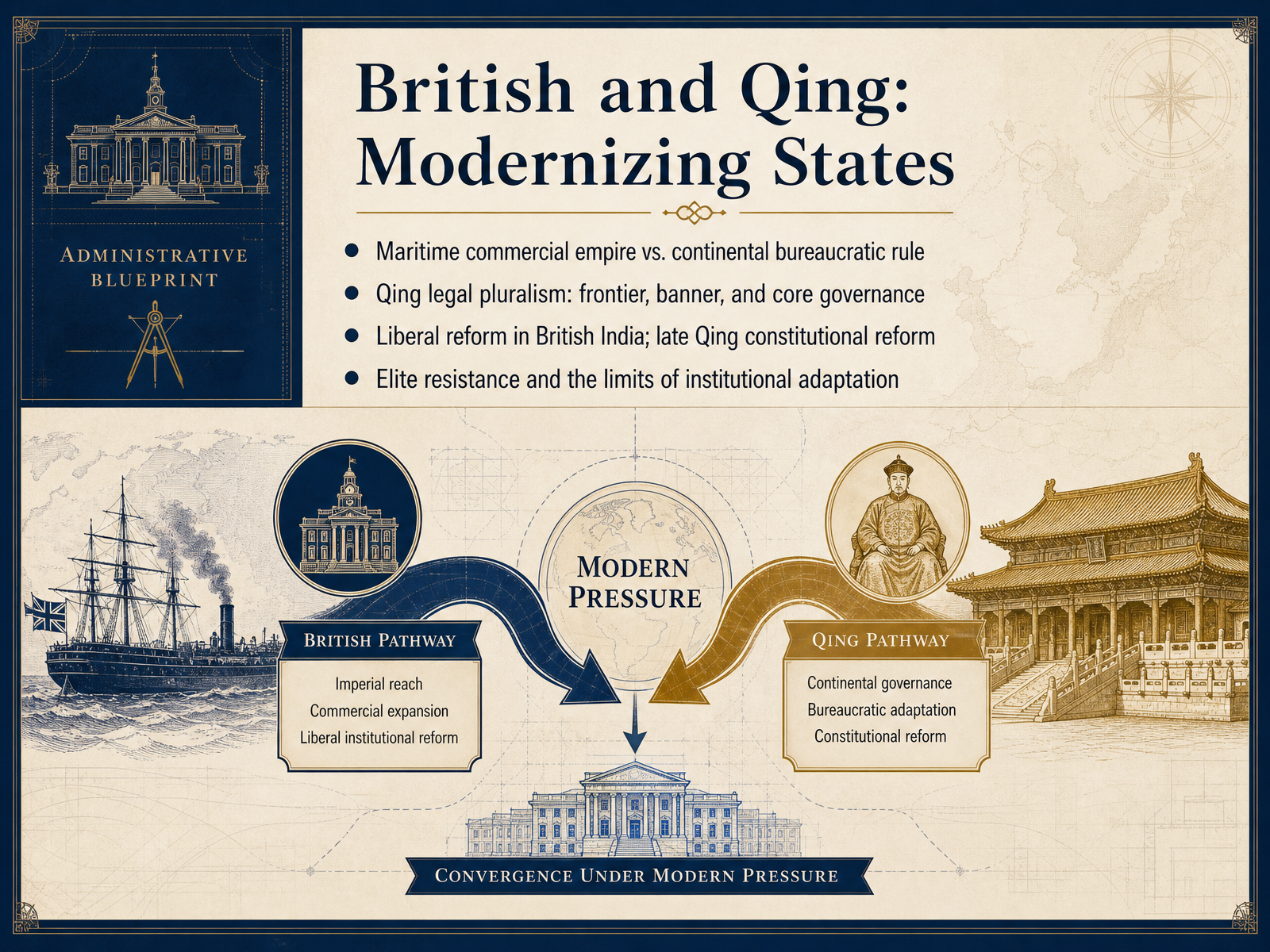
 - 07British and Qing: Modernizing StatesLet's turn now to two very different models of modernization: the British Empire and the Qing Dynasty. Britain was a maritime commercial power, while the Qing was a continental bureaucracy. Now, the Qing is often described as a single system, but it actually practiced legal pluralism—meaning different laws applied to different regions and peoples. Frontier areas, the Manchu banners, and the Chinese core each had distinct governance structures. This was not a unified code but a patchwork of authority. Meanwhile, the British experimented with liberal reform in India, intending to modernize society through law and education. The Qing, in its final years, attempted a constitutional reform, looking to models like Meiji Japan. But here is the key contrast: liberal reform in British India was imposed by a foreign power, whereas Qing constitutional reform came from within—yet both faced deep elite resistance. In the British case, reform threatened local elites' power. In China, change threatened the very foundation of imperial authority. What drove that shift? A profound tension between the need to adapt and the fear of losing control. So these empires, despite their differences, both discovered the limits of institutional adaptation when their own elites resisted the changes required to survive. That shared failure would set the stage for the question of legitimacy and ideology, which we turn to next.
 doi.orgtandfonline.comcambridge.org+22 min
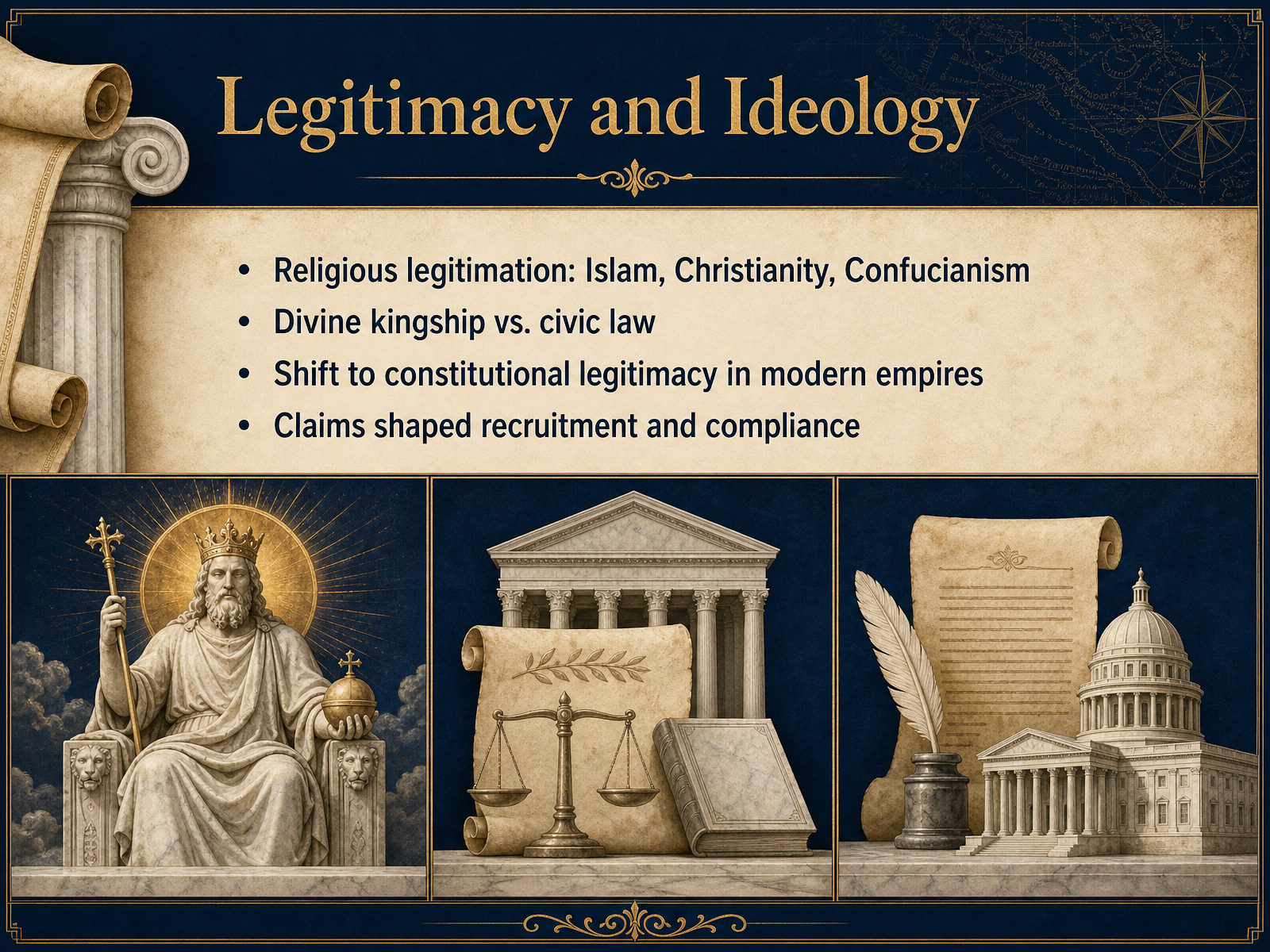
 - 08Legitimacy and IdeologyNow let's consider how empires justified their own power. Legitimacy is the claim that makes obedience feel like duty rather than coercion. And ideology is the story that supports that claim. Most premodern empires leaned heavily on religion. In the Islamic world, the caliph drew authority from his role as successor to the Prophet and guardian of Sharia. In Christian realms, rulers were crowned by bishops and anointed by God, making rebellion a sin as well as a crime. And in East Asia, Confucianism supplied a moral order where the emperor ruled by the Mandate of Heaven, a mandate that could be revoked if he failed his people. Now here is a key contrast. Divine kingship tended to tie legitimacy to a person's sacred status or lineage. But civic law grounded legitimacy in institutions, offices, and procedures. Roman emperors, for example, wrapped themselves in religious symbolism, yet their practical authority rested on law, courts, and an administrative bureaucracy. A system of appointed officials. Over time, even monarchies shifted toward constitutional legitimacy, where the ruler's power derived from a written document or a social contract rather than divine favor. And these claims mattered practically. They shaped who was recruited into government and why ordinary people complied with taxation, conscription, and legal judgments. When legitimacy weakened, compliance weakened with it. Next, we will examine the practical machinery of empire in taxation, communication, and control.
 cambridge.orgscience.lpnu.uacambridge.org+22 min
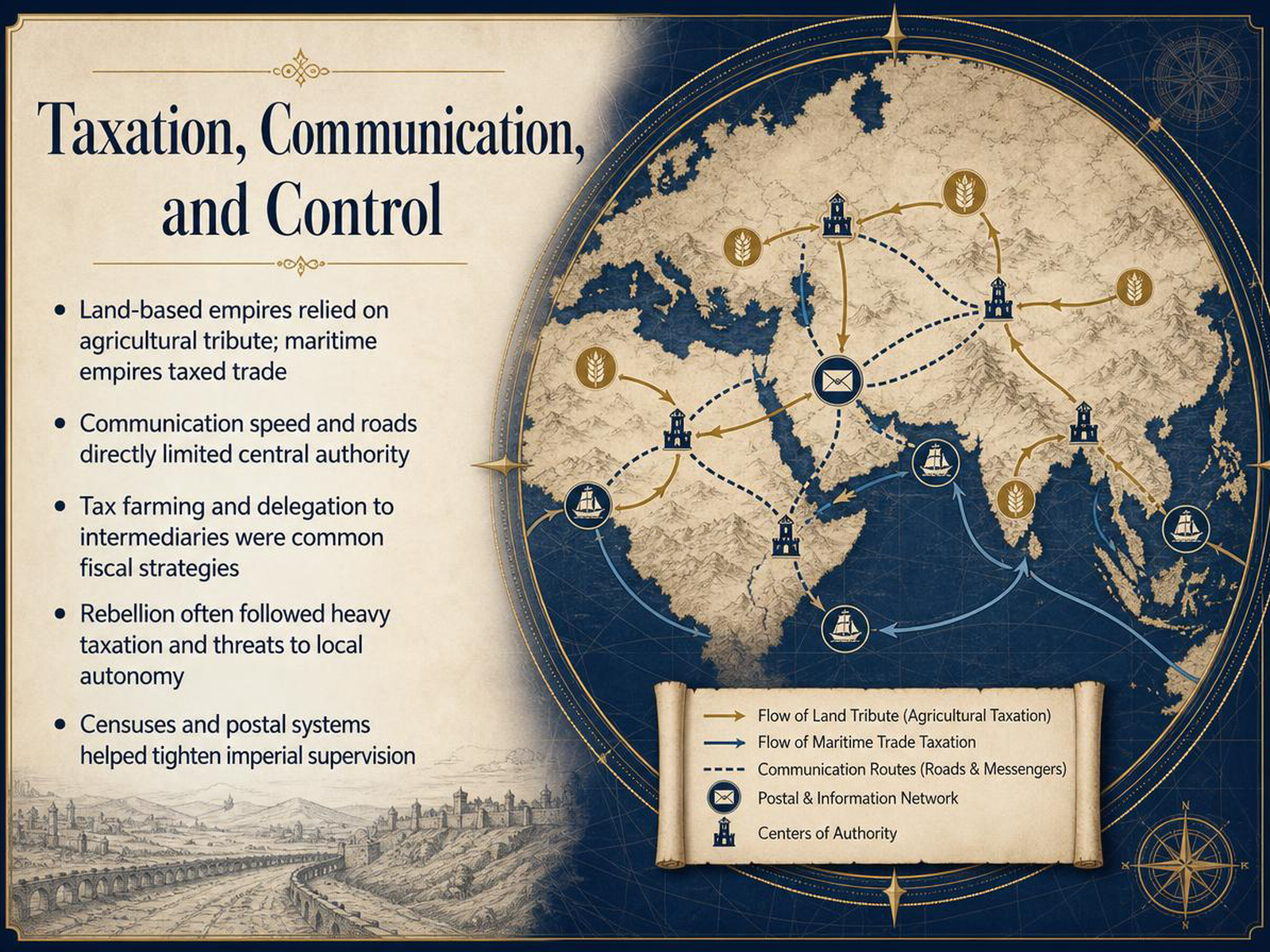
 - 09Taxation, Communication, and ControlLet's consider how empires actually held things together. It often came down to three things: taxation, communication, and control. Land-based empires, like the Ottomans or the Mughals, typically drew their wealth from agricultural tribute. Maritime empires, by contrast, taxed the flow of trade through their ports. That's a fundamental difference in their economic base. But there was a shared problem: the speed of communication directly limited central authority. If it takes weeks for a message to reach the capital, the capital simply cannot micromanage. That's why tax farming, where the right to collect taxes is sold to private contractors, was so common. It was a pragmatic solution for vast territories. Yet relying on intermediaries always carried a risk. Heavy taxation and threats to local autonomy often sparked rebellion. So, rulers invested in tools like censuses and postal systems to tighten their supervision. The Roman Empire, for instance, used censuses to monitor tax farming, while the Mongols used their yam, or postal relay system, to bind their territories together. These systems didn't just extract resources; they were the nervous system of the empire. This brings us to a critical question: what happens when a ruler dies, and who takes the throne? Let's examine succession and institutional stability next.
 tandfonline.comcambridge.orghal.science+22 min
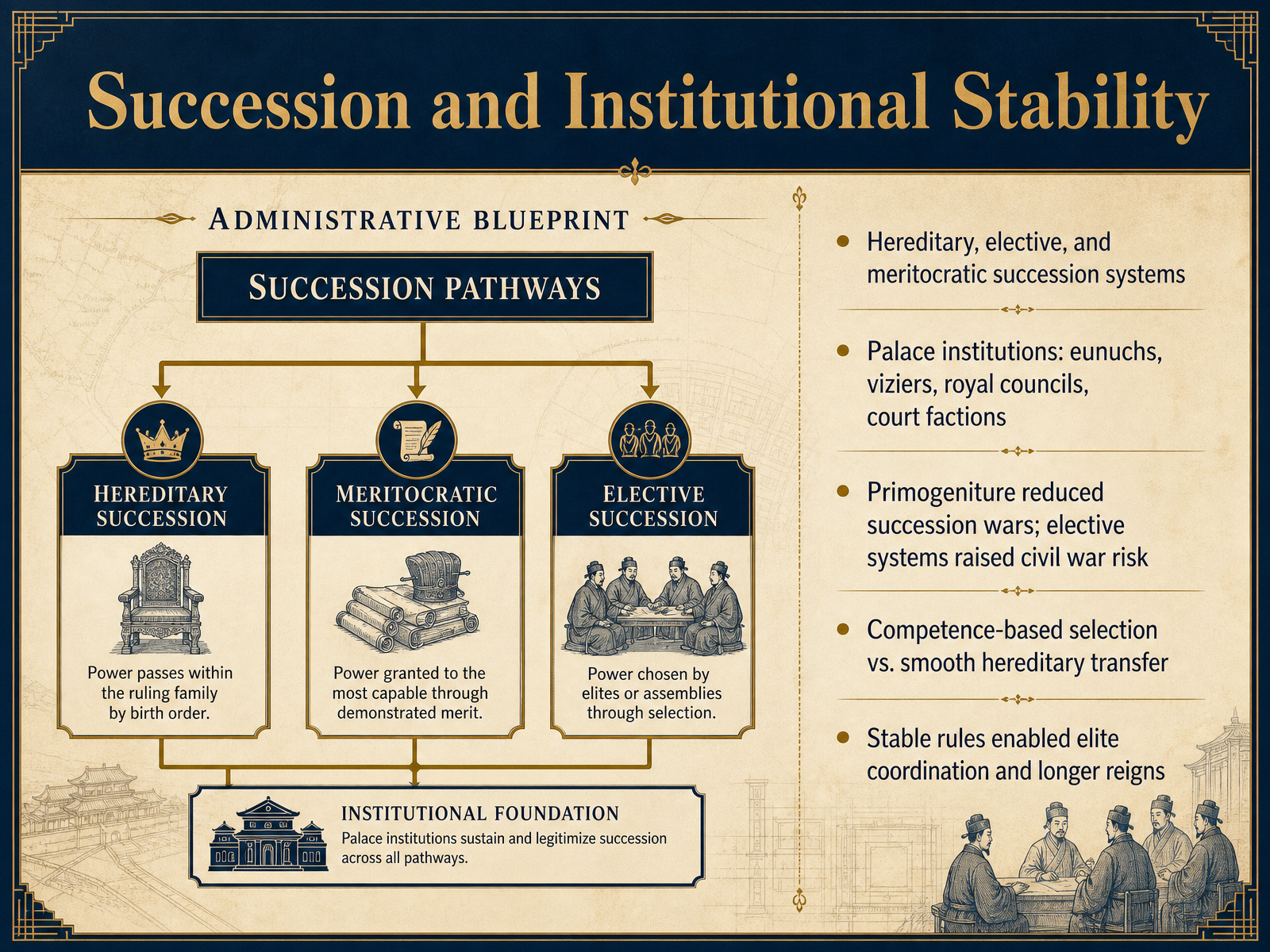
 - 10Succession and Institutional StabilityNow, let's turn to one of the most critical tests of any imperial system: the transfer of power. Succession was the moment when the entire political order could either hold firm or fracture. Broadly, we see three models. Hereditary systems, like those in Europe and China, followed clear bloodlines. Elective systems, which appeared in places like Poland, allowed elites to choose their ruler. And meritocratic systems, prized competence over lineage. Around these rules, powerful palace institutions emerged. Eunuchs, viziers, royal councils—these were the gatekeepers of empire. They could stabilize a reign or strangle it with court factions. The key variable was predictability. The innovation of primogeniture, where the eldest son inherits, gave elites a clear focal point for loyalty and drastically reduced succession wars. Elective systems, by contrast, often raised the risk of civil war. But competence has a price. A hereditary heir might be incompetent, while a meritocrat might destabilize the system. Ultimately, stable rules weren't just a formality—they were a mechanism for elite coordination. They promised longer reigns and greater institutional endurance. This brings us directly to our final and biggest question: how did these systems handle expansion, integration, and eventual collapse?
 2 min
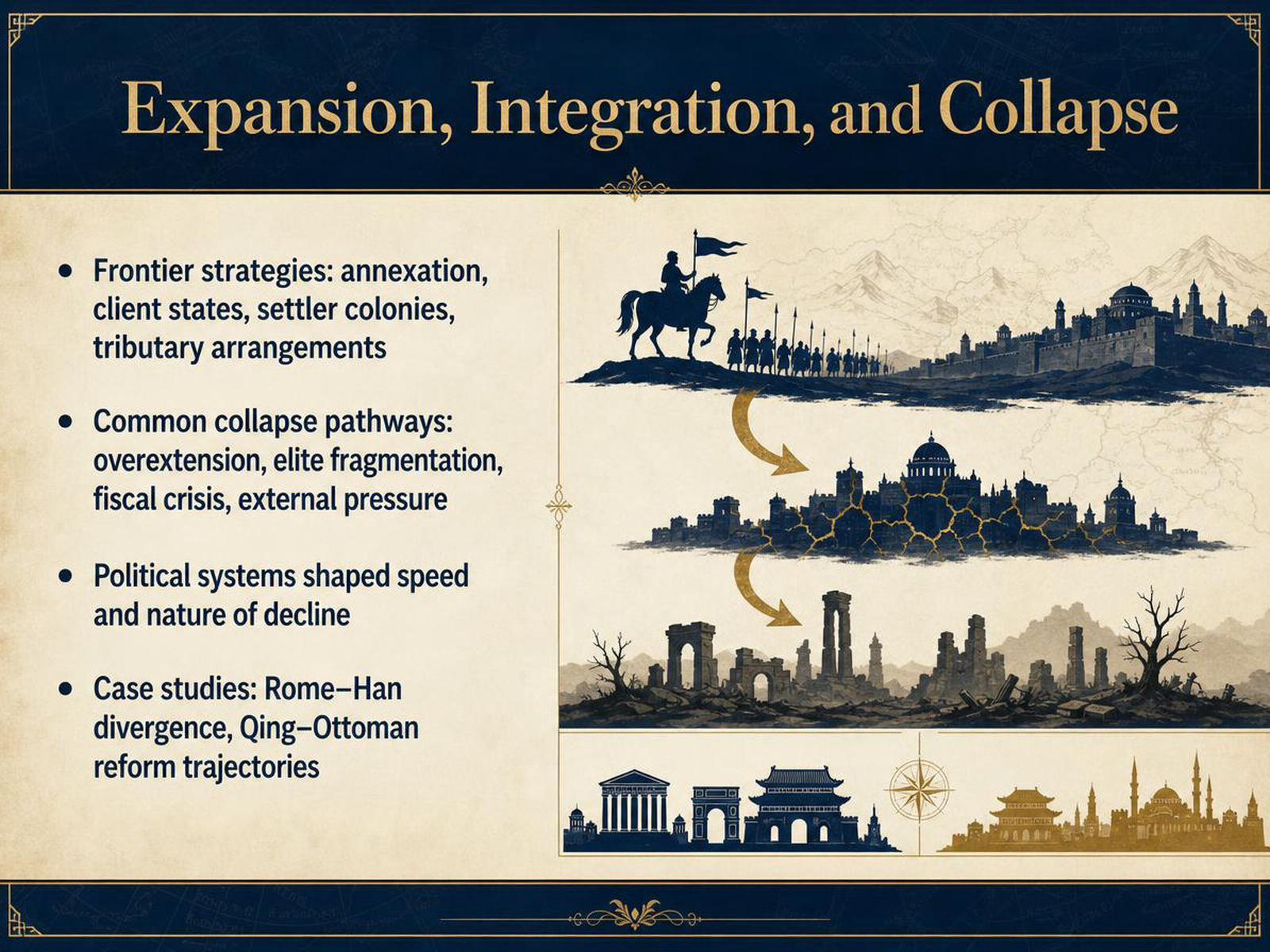
2 min - 11Expansion, Integration, and CollapseNow we turn to the last stage: expansion, integration, and collapse. Empires on the frontier had a menu of strategies. Some chose annexation, absorbing territory directly. Others preferred client states, where local rulers kept power in exchange for loyalty. Settler colonies pushed populations outward, while tributary arrangements extracted wealth without full governance. The Qing and Ottoman empires both ruled via complex frontier arrangements, often letting regional elites keep local authority. Collapse, when it came, tended to follow a few familiar paths. Overextension is one, when the cost of holding territory outweighs its return. Elite fragmentation is another, when the ruling class turns inward and competes. Fiscal crisis often follows, and external pressure can deliver the final blow. But here is the key insight: the political system shaped the speed and nature of decline. Rome and Han China are revealing case studies. Both were comparable in size and population, and both split under barbarian pressure. Yet Rome fragmented permanently in the West, while China reunited under the Sui and Tang. The difference lay in institutional resilience. Rome's reliance on military governors and elite competition made reunification nearly impossible. China's bureaucratic tradition preserved administrative continuity. The Qing and Ottoman reform efforts in the nineteenth century show a different pattern. Both faced overextension and fiscal strain, but their internal structures determined whether reform could be absorbed or would provoke collapse. So political architecture is not just about how an empire runs; it determines how it falls. Next, we'll pull these patterns together across all the empires we have examined.
 web.stanford.edunerd.wwnorton.comideas.repec.org+22 min
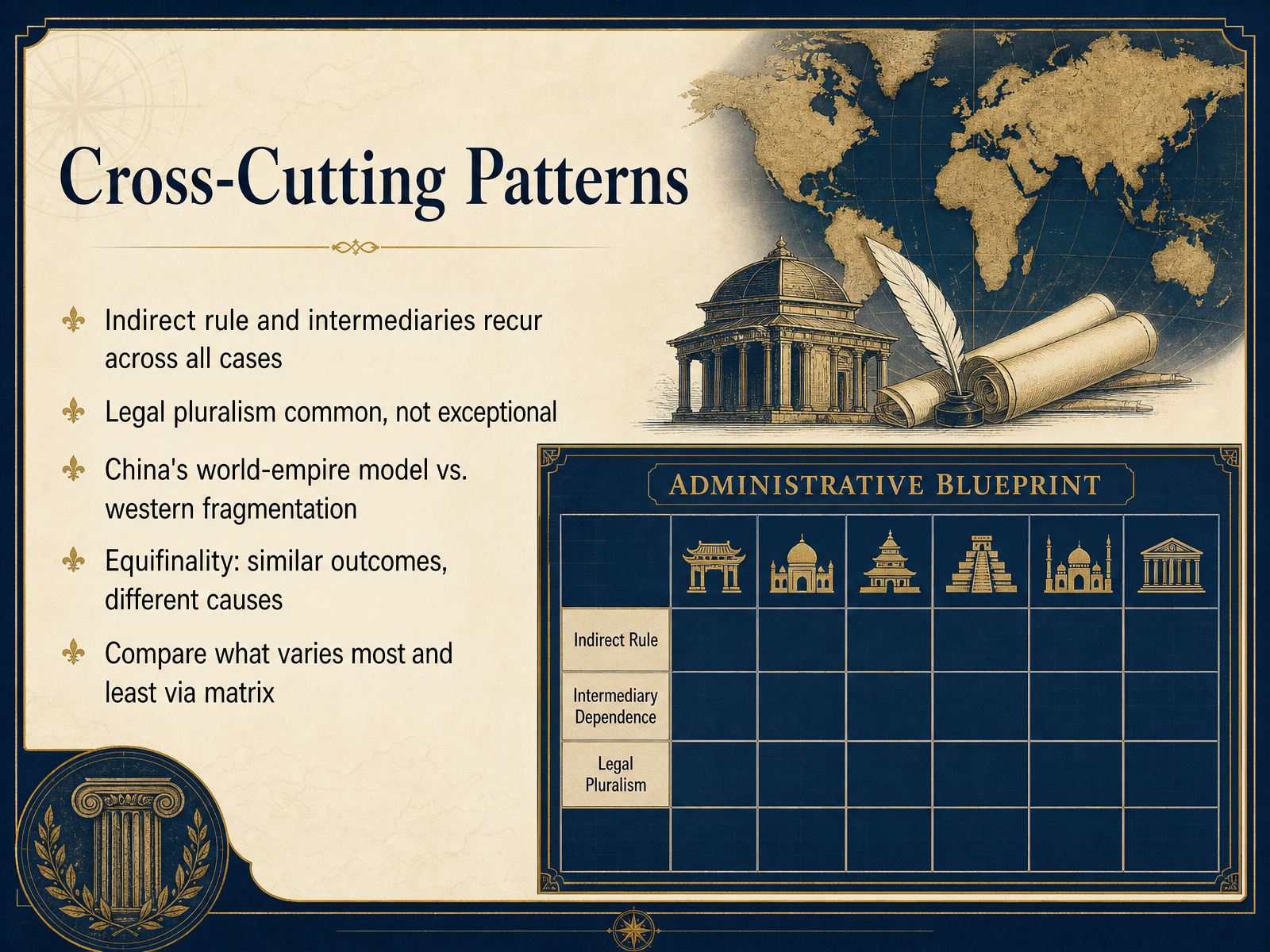
 - 12Cross-Cutting PatternsNow we step back and look across all these cases. What patterns actually recur? First, indirect rule. Virtually every empire ruled through local intermediaries rather than direct administration. Roman client kings, Han commandery officials, Ottoman millets—all were about managing diversity through local elites. Legal pluralism was common, not exceptional. Empires rarely imposed one uniform law code; they layered imperial law over local customs. Then there's the structural contrast. China sustained a world-empire model, repeatedly reunifying into a single bureaucratic state. The western Mediterranean fragmented after Rome's fall and never fully reunited. Same initial conditions? Remarkably similar. Divergent outcomes. That leads us to equifinality: different causes, similar outcomes. China reunified for different reasons than Rome failed to, yet both dynamics shaped a thousand years of political life. So the real analytical task is to compare what varies most and least. Use a comparison matrix. Rank each system on centralization, elite recruitment, legal integration, frontier management. That matrix reveals where the differences are real and where they're merely rhetorical. Keep these patterns in mind as we move to common misconceptions.
 web.stanford.edunerd.wwnorton.comideas.repec.org+22 min
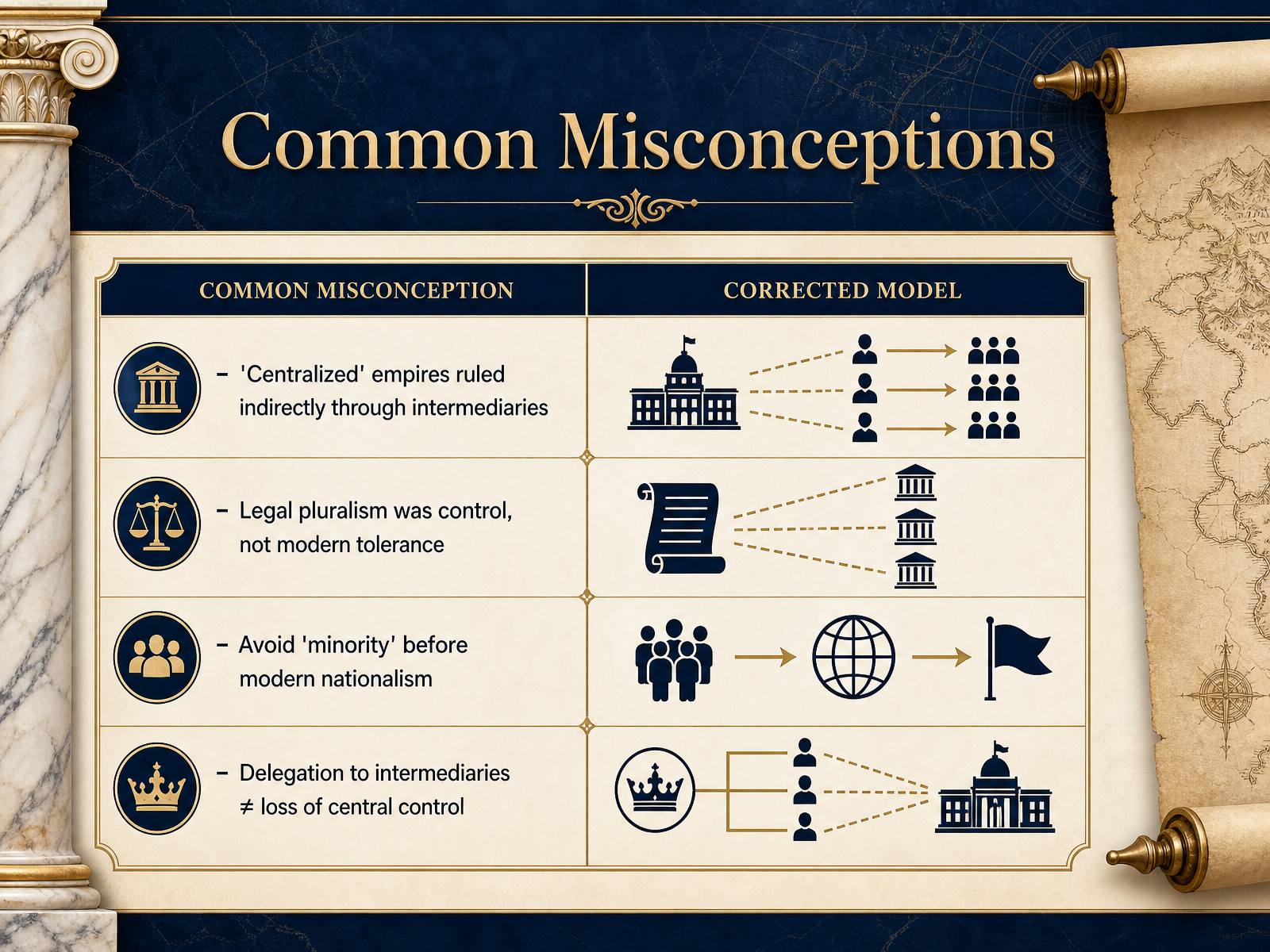
 - 13Common MisconceptionsLet’s clear up some common misconceptions. First, so-called centralized empires rarely ruled directly. They relied on intermediaries — local notables, tax farmers, religious leaders — to govern day to day. The Ottomans, for example, managed diverse communities through the millet system, where religious groups handled their own affairs under imperial oversight. That wasn't tolerance in the modern sense. It was controlled legal pluralism: a way to keep order and collect revenue. Similarly, when the Mongols governed Persia, they paired local officials with Mongol supervisors to watch them. Second, don't call these communities 'minorities' before modern nationalism existed. That term only appears in the 1920s, after the Ottoman Empire fell. Finally, delegating power did not mean losing control. In fact, it was often the only way to govern at all. Intermediaries could be risky, but their autonomy was a structural feature, not a failure. Now, let’s turn to designing lessons and content for teaching these comparisons.
 tandfonline.comcambridge.orghal.science+22 min
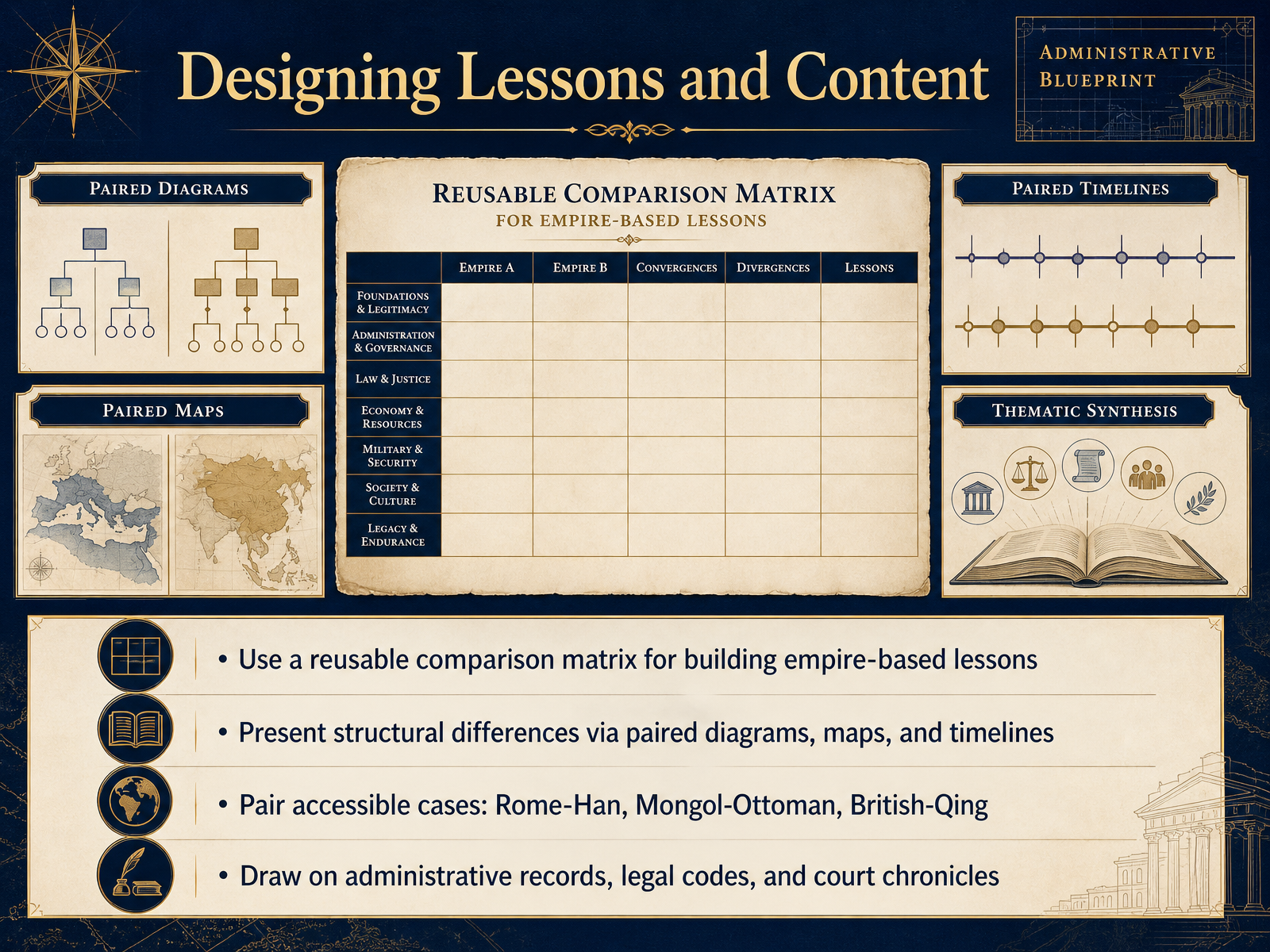
 - 14Designing Lessons and ContentNow let's turn theory into practice. When building lessons around empires, a reusable comparison matrix is your best friend. Place key variables—like succession rules, tax collection, or the role of religion—in columns, and let each empire fill the rows. This turns abstract structures into visible contrasts. Pair diagrams with maps and timelines, so students see how a bureaucratic system operated in Rome, and where it differed from the Han model. Choose accessible case pairs. Rome and Han China reveal how two giants solved similar problems differently. The Mongol and Ottoman empires show how steppe traditions blended with settled administration. And the British and Qing empires highlight the strains of governing vast, distant territories. Ground every comparison in primary sources: administrative records, legal codes, and court chronicles. These documents reveal decisions, not just structures. A tax register from Roman Egypt, a Qing legal case, an Ottoman court diary—these make systems tangible. Use them to provoke questions. What drove that shift in governance? Who really held power? From here, we can address the practical strategies and common pitfalls in building such lessons.
 cambridge.orgscience.lpnu.uacambridge.org+22 min
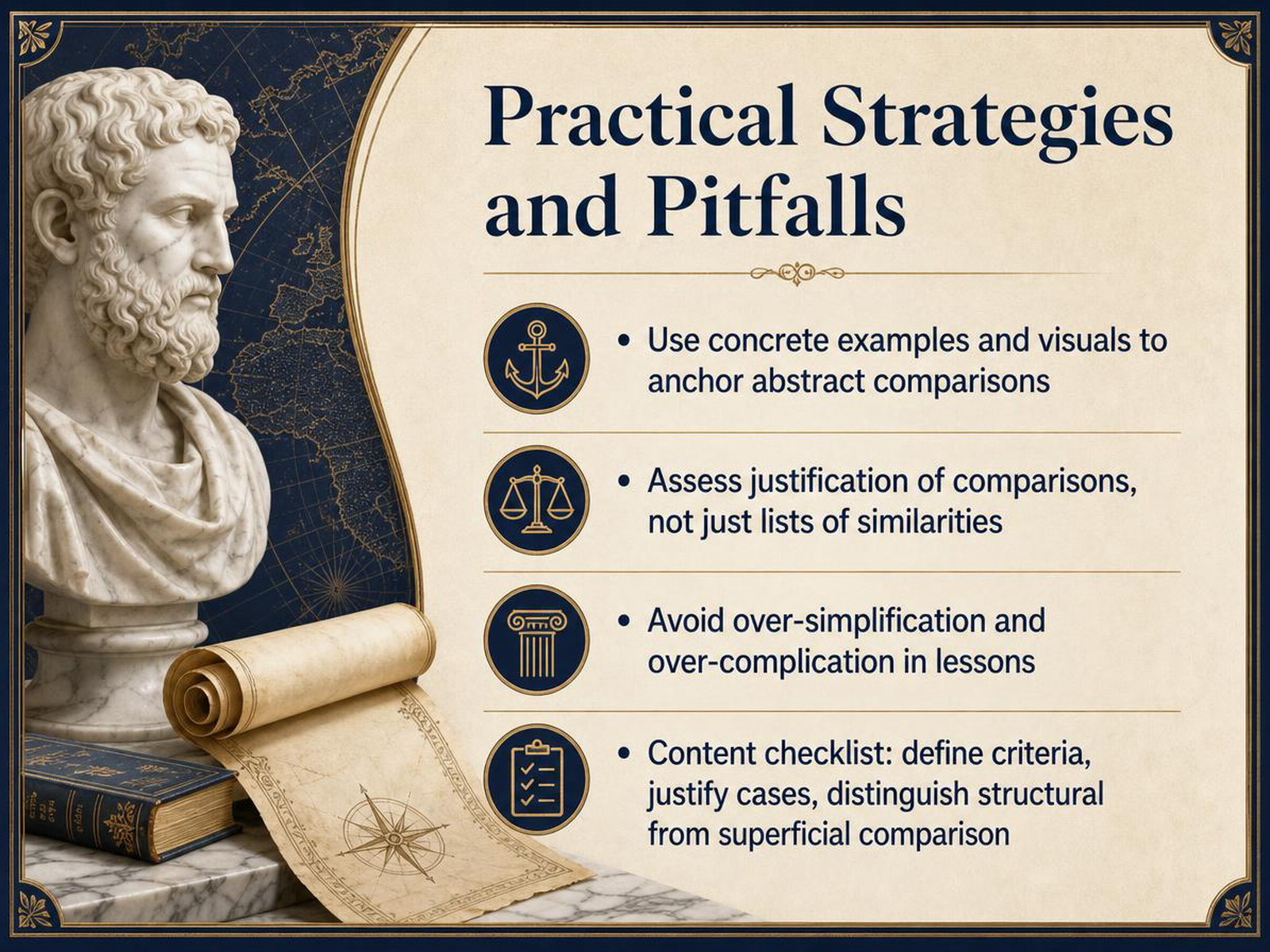
 - 15Practical Strategies and PitfallsLet's wrap up with some practical strategies and common pitfalls. First, always anchor abstract comparisons with concrete examples or visuals. A diagram of Rome's bureaucracy makes the concept tangible. Second, don't just list similarities. Assess whether the comparison is justified. Are you comparing the Roman and Han empires on meaningful criteria, or just superficial traits? Third, avoid over-simplifying and over-complicating. You want clarity without losing nuance. Finally, use a checklist: define your criteria, justify your cases, and distinguish structural comparisons from superficial ones. That's how you build a solid comparative analysis. Thank you for joining this course. You now have the tools to compare empires thoughtfully. Keep practicing, and you'll see history in a new light.
 cambridge.orgscience.lpnu.uacambridge.org+21 min
Take the deck with you
Download this course as a file — free, no sign-up needed.
- PDF handoutEvery slide page, ready to print or share.16 pages · 6.3 MBDownload
- Narrated PowerPointThe deck that presents itself — every slide carries the digital human's narration video.16 pages · 19.7 MBDownload
- PowerPoint slidesThe full deck as a .pptx — open it in PowerPoint, Keynote, or Google Slides.16 pages · 6.2 MBDownload
Free to use in your own training — please keep the PersonWise credit page at the end.
Have your own deck? Turn it into a course
Sources consulted
Web sources consulted while building this course.
- Rome and China: comparative perspectives on ancient world empires Edited by Walter Scheidel (Stanford University) Oxford University Press (New York) General background 2,000 years ago, up to one-half of the human species was contained within two political systems, the Roman empire in western Eurasia — web.stanford.edu
- Globalizing Empires: The Han Dynasty and Imperial Rome — nerd.wwnorton.com
- Federalism And The Balance Of Power: China'S Han And Tang Dynasties And The Roman Empire — ideas.repec.org
- 35.3.14.pdf — openyls.law.yale.edu
- World views and military policies in the early Roman and Western Han empires — scholarlypublications.universiteitleiden.nl
- The Ottoman Millet System: Non-Territorial Autonomy and its Contemporary Legacy — tandfonline.com
- The Quandary of Proliferating Intermediaries: Ottoman State Formation Beyond the De/Centralization Impasse | International Journal of Middle East Studies | Cambridge Core — cambridge.org
- Persia under Mongol domination. The effectiveness and and failings of a dual administrative system — hal.science
- Decentralized coercion and self-restraint in provincial taxation: The Ottoman Empire, 15th–16th centuries — sciencedirect.com
- Millet System in the Ottoman Empire by Efrat Aviv LAST REVIEWED: 28 November 2016 LAST MODIFIED: 28 November 2016 DOI: 10.1093/obo/9780195390155-0231 — oxfordbibliographies.com
- The Logic of Comparison: A Methodological Note on the Comparative Study of Political Systems — cambridge.org
- Eisenstadt's Comparative Historical Sociology of Empires — science.lpnu.ua
- Comparative Politics and the Comparative Method | American Political Science Review | Cambridge Core — cambridge.org
- The Dilemma of Depth Versus Breadth in Comparing Political Systems Empirically … and How to Overcome It | European Political Science | Cambridge Core — cambridge.org
- Explaining empire: models for ancient history Walter Scheidel (Stanford University) — web.stanford.edu
- Crises of Empire and the Reconstitution of International Orders in South and East Asia, 1820–1880 — doi.org
- Lamas, Empresses and Tea: Early Twentieth-Century Sino-British Encounters in Eastern Tibet: The Journal of Imperial and Commonwealth History: Vol 46, No 2 — tandfonline.com
- Best Practices and Elite Belief: International Competition and State Modernization in Qing China and Meiji Japan — cambridge.org
- “Learning to Walk”: Qing constitutional reform and Britain’s imperial pedagogy, 1901-1911 — repository.derby.ac.uk
- Negotiating Chinese modernity: British imperialism and the late Qing reforms = Negotiating Chinese modernity: British imperialism and the late Qing reforms|Airiti Library 華藝線上圖書館 — airitilibrary.com