Everyday English Vocabulary Builder
Begin
14 pages · ~28 min
Everyday English Vocabulary Builder
This training helps learners build practical, everyday English vocabulary for real-life conversations, improving confidence and fluency for daily communication.
What you’ll learn
- 01Building Everyday English VocabularyWelcome. I am glad you are here. This course is about building everyday English vocabulary. It is a practical path to words you can use today. Not just for a test, but for real conversations. Think about ordering coffee, talking about your day, or asking for help. Everyday words unlock these moments. They build your confidence. Today, we will learn a simple loop. You will notice new words, record them, review them, and use them. This is the core of our system. You will leave this course with a personal plan, clear weekly goals, and a simple two-week schedule. Do not worry about being perfect. Mistakes are a natural part of learning. Mistakes mean you are trying. Let us begin this journey together. Next, we will explore why everyday words are the best starting point for you.onemoreword.appvocabtech.compenguen.io+21 min
- 02Why Everyday Words Are the Best Starting PointNow, let’s look at why these everyday words are truly your best starting point. Here is a number that might surprise you. The most common one thousand words in English cover around eighty percent of daily conversation. Think about that. With just one thousand words, you can understand—and take part in—most everyday talk. If you grow that to about three thousand words, your understanding rises to ninety percent. These are the words you hear in shops, on the bus, and in small talk with neighbors. In other words, useful beats impressive every time. You don’t need fancy, complicated words to communicate. You need words you can rely on—words like get, make, go, take, and have. These simple verbs carry huge meaning. And here is the wonderful part: every time you use one successfully, confidence grows. Small wins matter. Ordering food in a café, asking for directions, or greeting someone in English—these moments add up quickly. Remember, you are not aiming for perfection right now. You are aiming for practical, powerful progress. Next, we will look at the specific word groups that will power your daily conversations.
 oxfordlearnersdictionaries.comoxfordlearnersdictionaries.comef.edu+22 min
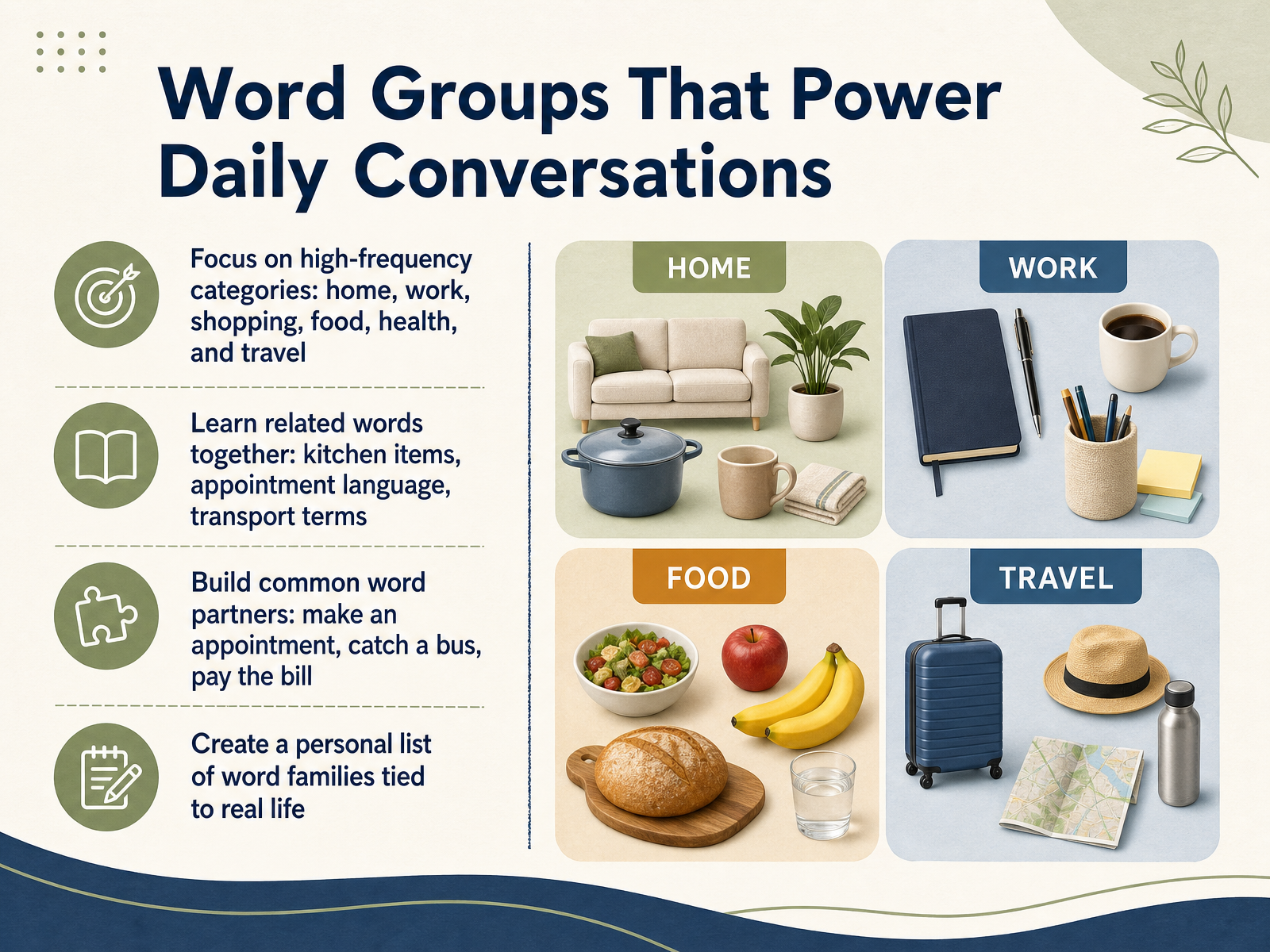
 - 03Word Groups That Power Daily ConversationsNow, let's talk about how to choose the right words to learn. Think of your daily life. Where do you spend your time? At home, at work, or maybe shopping for food? These are high-frequency categories, meaning these are the situations you meet again and again. Instead of learning random words, it helps to learn related words together. For example, if you are learning about the kitchen, you can learn words for the fridge, the stove, and the sink. Or, if you are learning about work, you can learn words for an appointment, a meeting, and a deadline. And here is a powerful trick. Don't learn single words alone. Learn word partners. We say "make an appointment" and "catch a bus". These word partners sound natural together. You should also create your own personal list of word families. A word family is a group of words that are connected to your real life. Maybe you want to talk about your hobby, or maybe you need English for your job. Focus on your needs. These everyday word groups will help you feel more confident in real conversations. Next up, we will look at the building blocks you need to start using these words. We will focus on nouns, verbs, and everyday phrases.
 oxfordlearnersdictionaries.comoxfordlearnersdictionaries.comef.edu+22 min
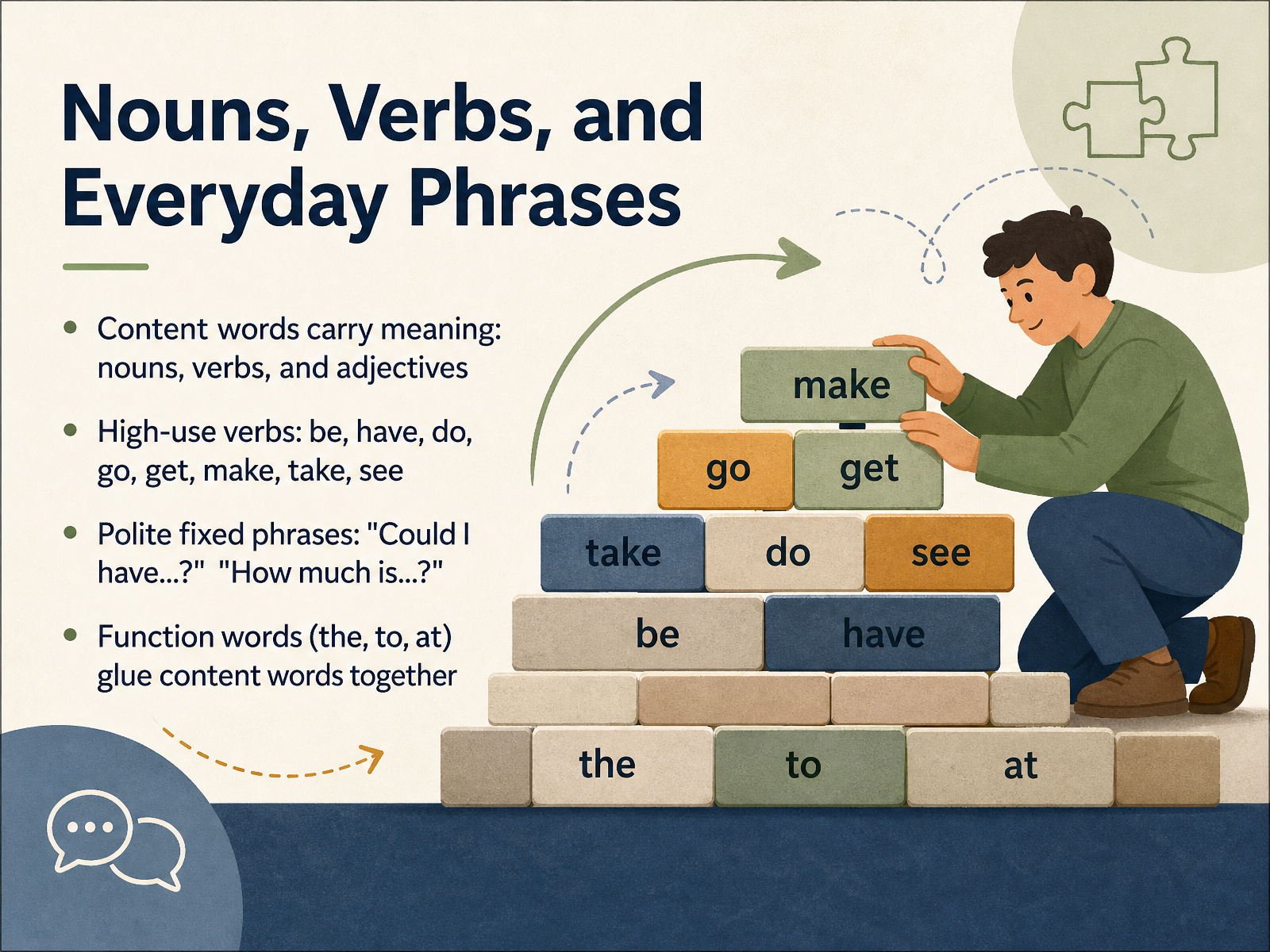
 - 04Nouns, Verbs, and Everyday PhrasesSo now let's look at the building blocks of everyday English: words. Some words carry the main meaning. We call these content words. They include nouns, which are words for people, places, and things, like home or friend. They also include verbs, which are action words, like go or make. And adjectives, which describe things, like big or happy. Then there are function words. These are small words like the, to, and at. On their own, they don't have much meaning, but they glue the content words together to make correct sentences. Here's a useful tip. Focus on high-use verbs. Verbs like be, have, do, go, get, make, take, and see. These appear again and again in daily life. Master these, and you can express a lot. You can also use polite fixed phrases. For example, in a shop, say, Could I have...? Or ask, How much is...? These ready-made phrases help you sound natural and respectful. Next, we'll look at how to find new words in real life. Stay with me.
 dictionary.cambridge.orgteflconcourse.combusuu.com+22 min
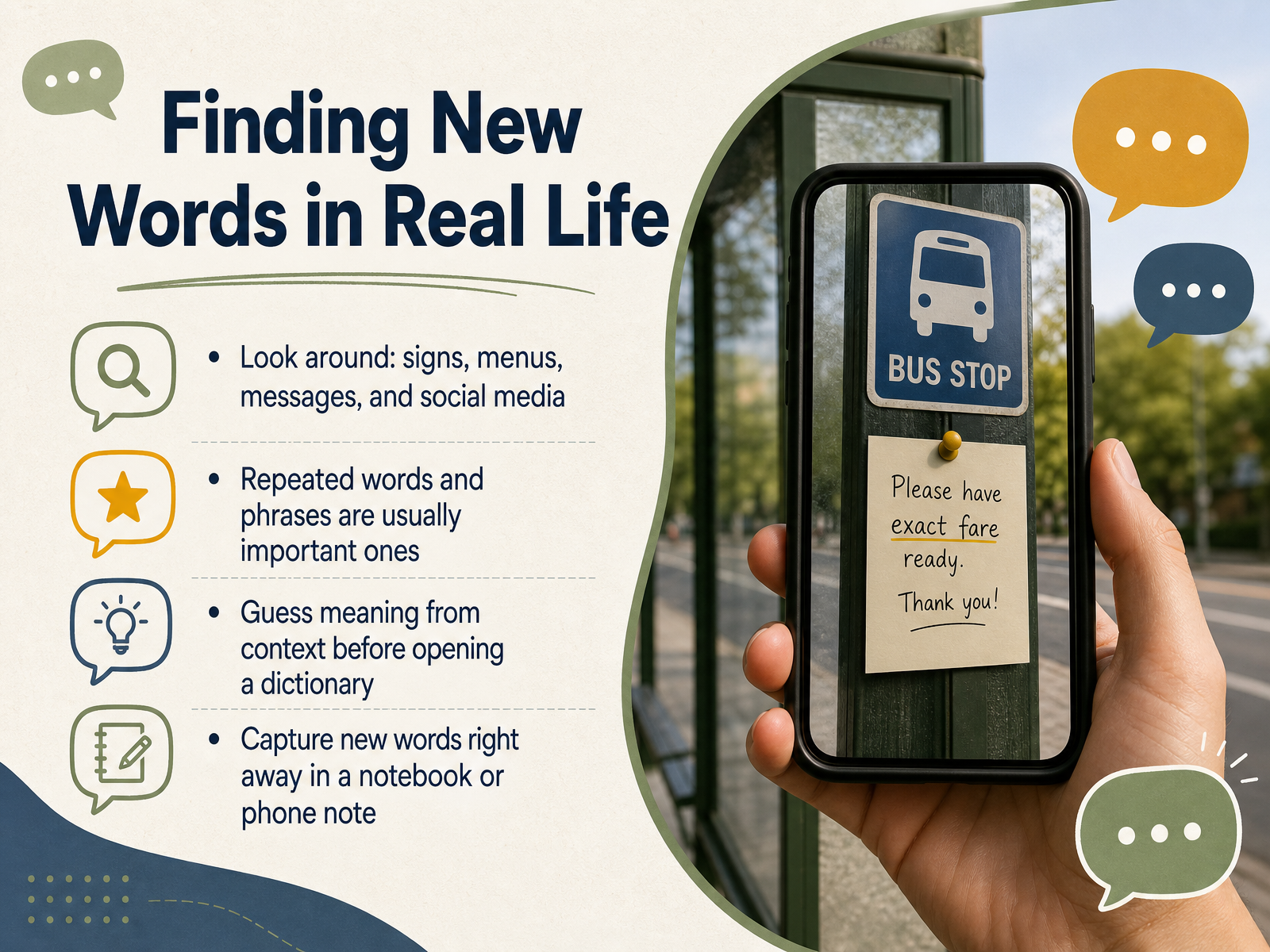
 - 05Finding New Words in Real LifeLet’s talk about one of the best ways to find new words. It happens right in your daily life. When you are out, look around you. Read signs, menus, and messages on your phone. Social media is also a great place to see everyday English in action. You will find that some words and phrases appear again and again. When a word shows up often, it is usually important. A good habit is to try to guess the meaning from the context. That means you use the other words around it to help you understand. Give it a try before you open a dictionary. Then, capture the word. Write it down quickly in a notebook. Or make a note on your phone. This simple act makes a big difference. Studies show that writing words down helps you remember them. Your future self will thank you. Next, let’s look at ways to record these words so they are truly ready to review.
 todoele.netcambridge.orggrdspublishing.org+22 min
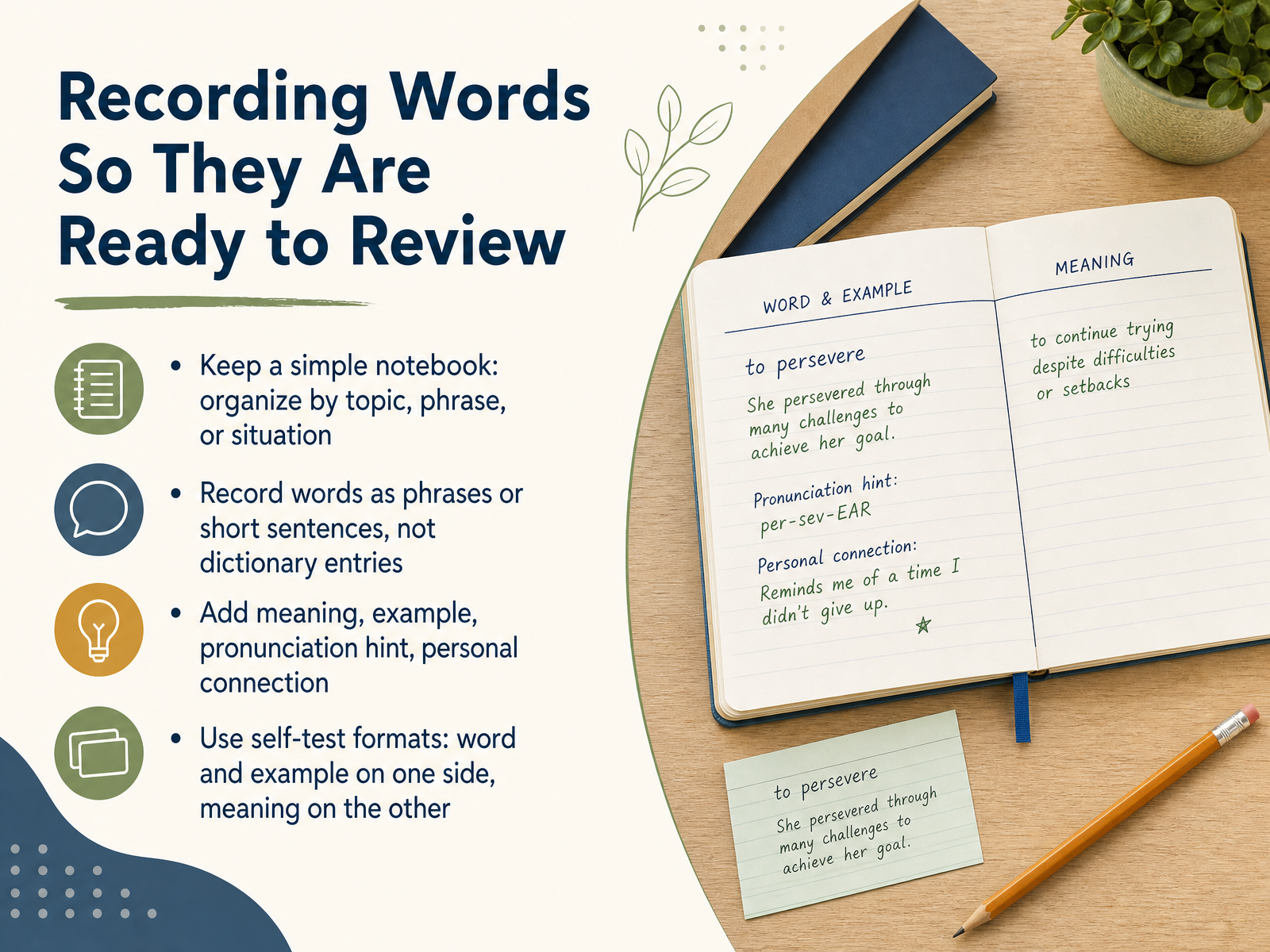
 - 06Recording Words So They Are Ready to ReviewSo now that you have noticed new words, let us talk about writing them down in a way that is ready for review. The simple act of writing a word in your notebook makes you much more likely to remember it. Research shows that learners who write down new words can remember them much better. But how you record them matters too. So avoid writing single words alone, like a dictionary entry. Instead, write a short phrase or a full sentence. For example, instead of writing the word "borrow," write "Can I borrow your pen?" This gives you context, which means the situation around the word, and that helps your brain understand and remember it better. Also add a few helpful pieces of information for each word. Write a simple meaning in English or your own language. Add a short example sentence. Include a small pronunciation hint, like how it sounds. And try to make a personal connection, such as "I use this word when I talk to my neighbor." This personal touch makes the word yours. Finally, set up your notes for self-testing. You can make flashcards with the word and example on one side, and the meaning on the other. This lets you quiz yourself and check your memory. A notebook organized this way becomes a powerful study tool, not just a list. Next, we will look at some powerful memory tricks we can use with these recorded words, including spaced repetition and using pictures.
 todoele.netcambridge.orggrdspublishing.org+22 min
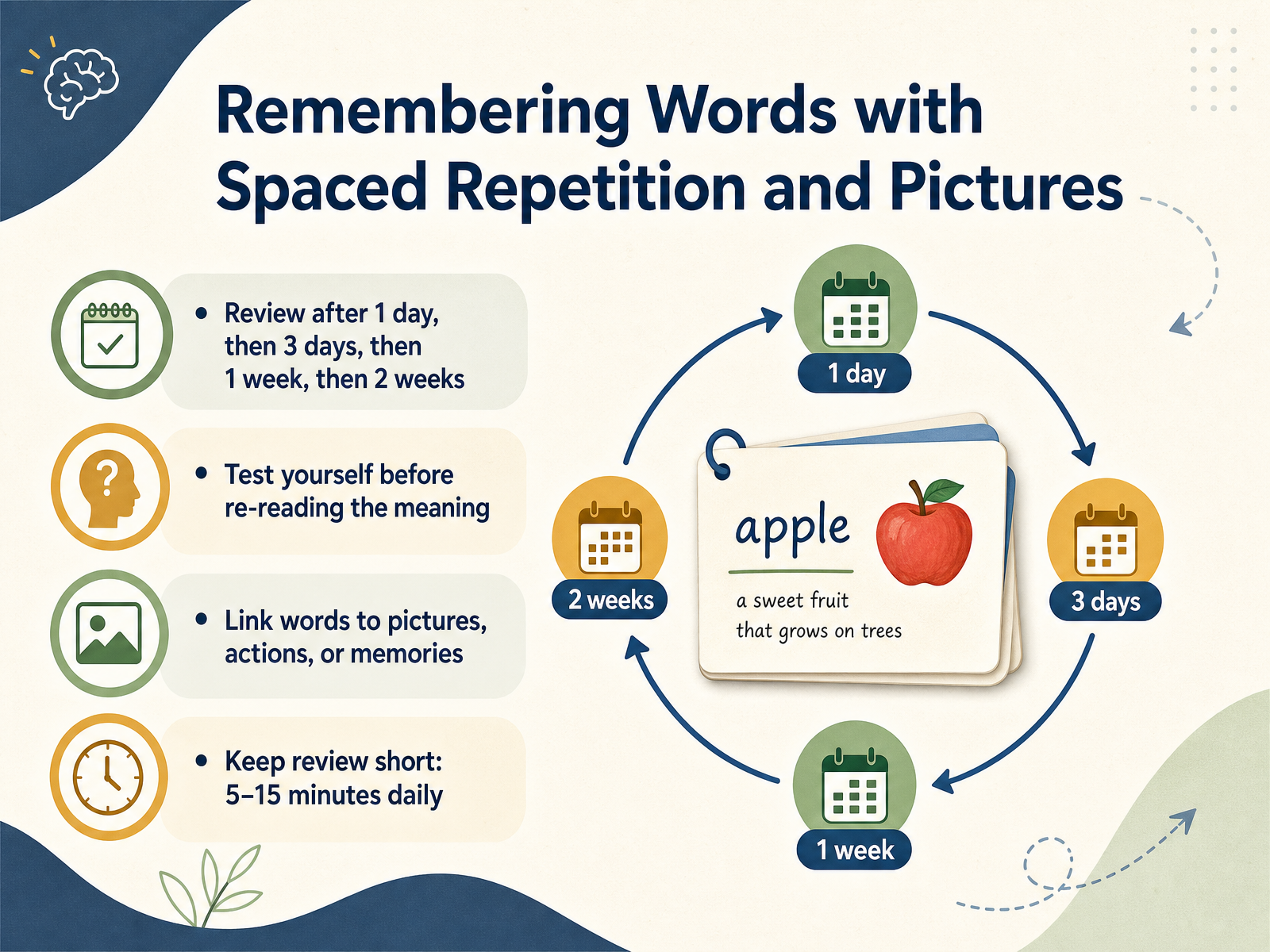
 - 07Remembering Words with Spaced Repetition and PicturesNow, let's talk about how to make words really stay in your memory. The secret is something called spaced repetition. That means you review a word after one day, then after three days, then after one week, and again after two weeks. Your brain needs to see the word again just before it starts to forget it. That way, the word moves into your long-term memory. Here is an important tip: when you review, test yourself first. Try to remember the meaning before you look at it again. This is called active recall, and it is much stronger than just re-reading the word. You can also link words to pictures, actions, or personal memories. For example, if you learn the word “bark,” picture a dog barking in your mind. That image creates a stronger connection. Keep your review sessions short. Just five to fifteen minutes a day is enough. Short and regular practice works better than a long session once a week. So, remember: review after one day and then three days later, test yourself first, use pictures or actions to help you remember, and keep it brief every day. These small steps will make a big difference. Now, let’s see how you can start using your new words in real settings.
 onemoreword.appvocabtech.compenguen.io+21 min
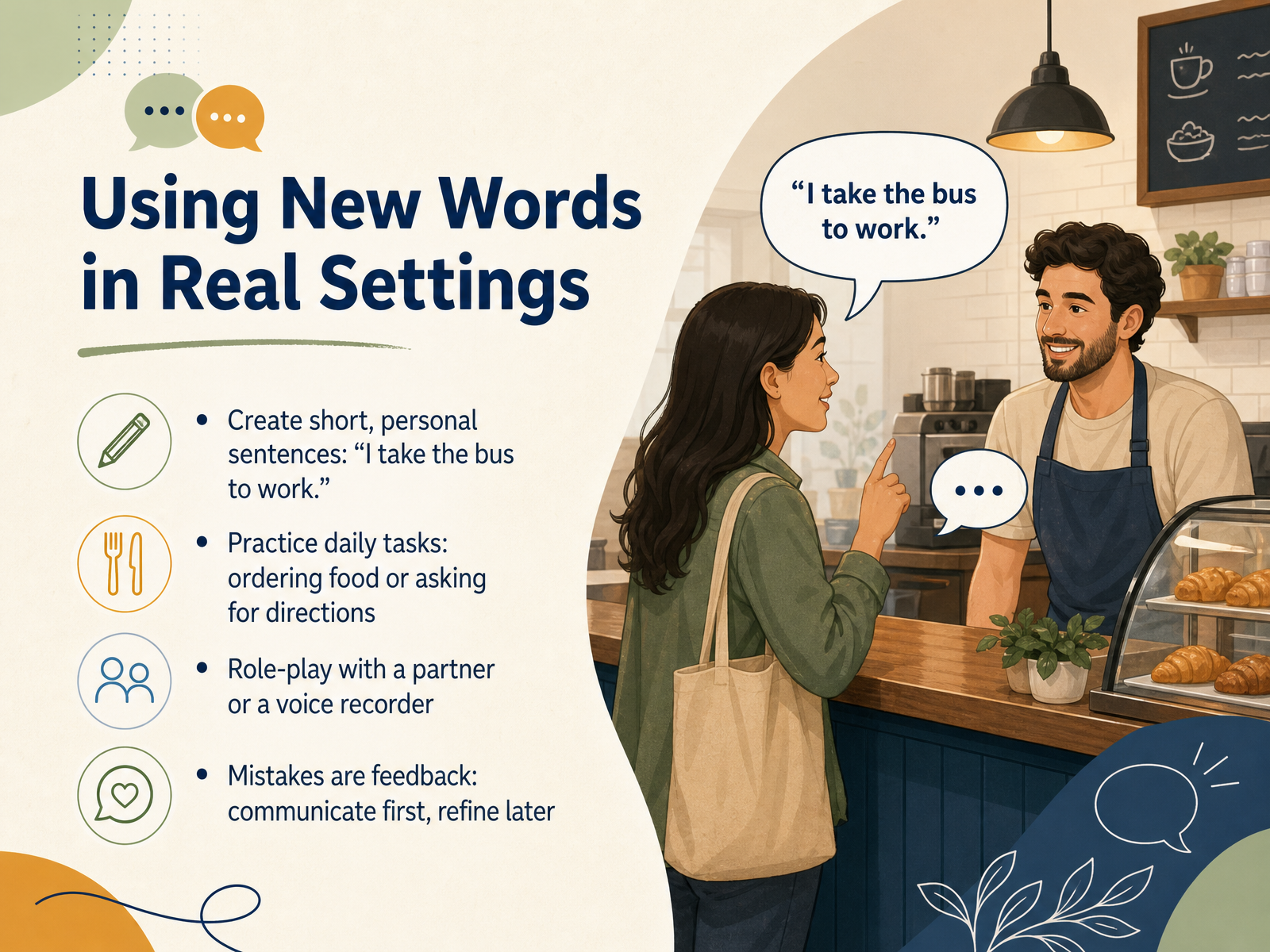
 - 08Using New Words in Real SettingsNow, let's think about using your English in real places. New words can feel alive when you put them into your own life. Start by making short, personal sentences. Say to yourself, "I take the bus to work." Or, "I order coffee every morning." These are true sentences about you, so they are easier to remember. Next, practice your daily tasks out loud. Imagine ordering food at a restaurant, or asking for directions on the street. You can do this alone, or with a friend. Role-play is a great way to practice. With a partner, you can pretend one of you is the customer and the other is the cashier. If you are learning by yourself, use a voice recorder. Listen to your voice, and try again. The most important idea here is that mistakes are not failures. Think of them as feedback. They show you what to practice next. Remember, the goal for now is to communicate your idea. You can perfect the grammar later. Keep it simple, keep it personal, and use your words every day. Coming up next, we'll look at what to do when you meet unfamiliar words or common mix-ups.
 2 min
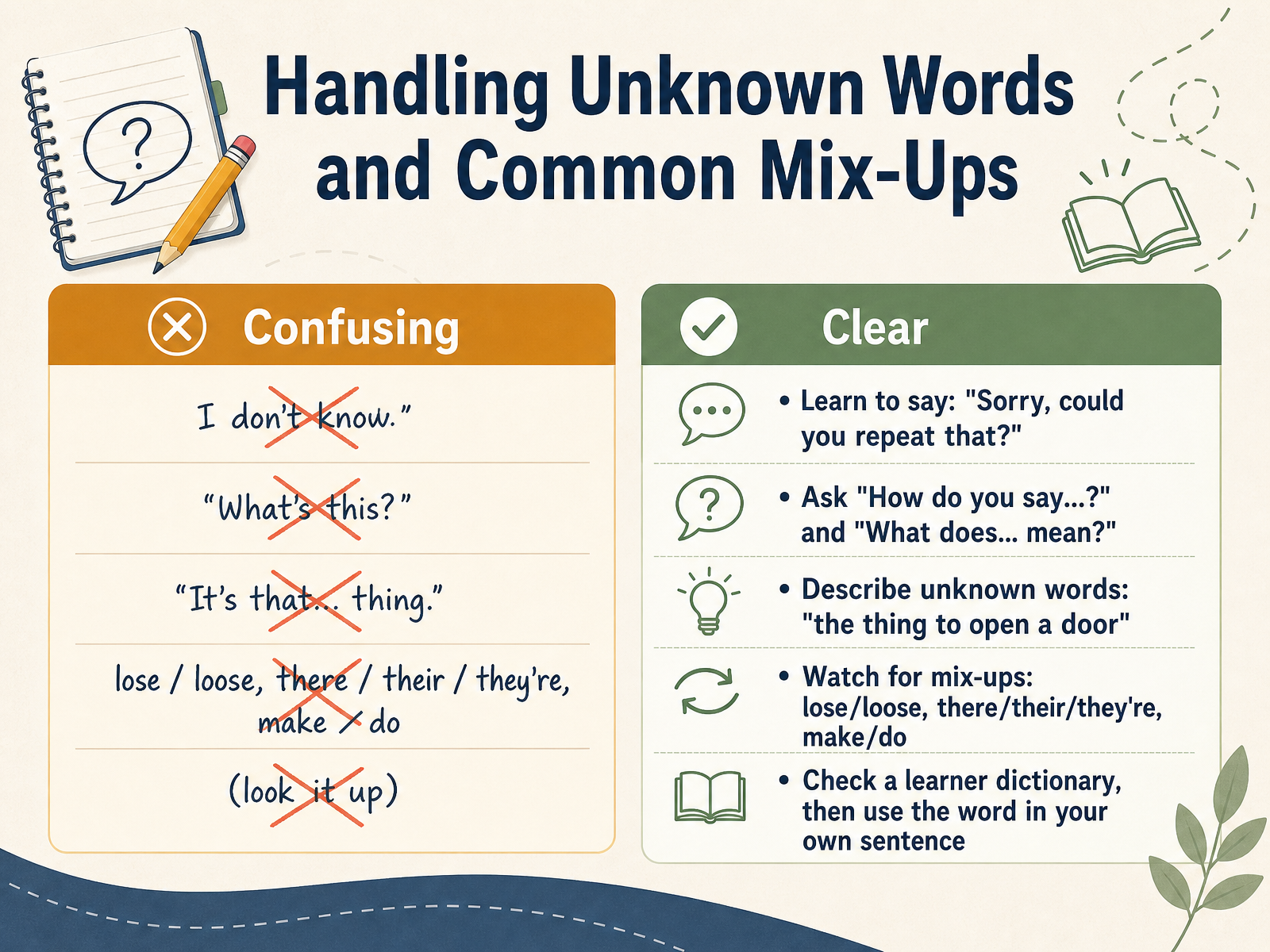
2 min - 09Handling Unknown Words and Common Mix-UpsNow let’s talk about what to do when you hear a word you don’t know, and how to handle words that look alike. First, it’s always okay to ask for help. You can simply say, sorry, could you repeat that? That’s a polite and natural way to ask someone to speak again. You can also ask, how do you say this in English? Or, what does this word mean? These questions will help you learn in the moment. And if you forget a word, don’t worry. You can describe it. Instead of saying handle, you might say the thing you use to open a door. That works. Now, some words are easy to mix up. For example, lose and loose. I don’t want to lose my keys. The ring is loose on my finger. There, their, and they’re also sound the same, but they have different meanings. Here means a place. The book is over there. Their shows ownership. That is their car. And they’re is short for they are. They’re happy. A great tip is to check a learner’s dictionary. Then use the new word in your own sentence. That will help you remember it better. With a little practice, you’ll handle these tricky situations with confidence. Next, we’ll look at how to build a simple weekly plan for learning new words.
 2 min
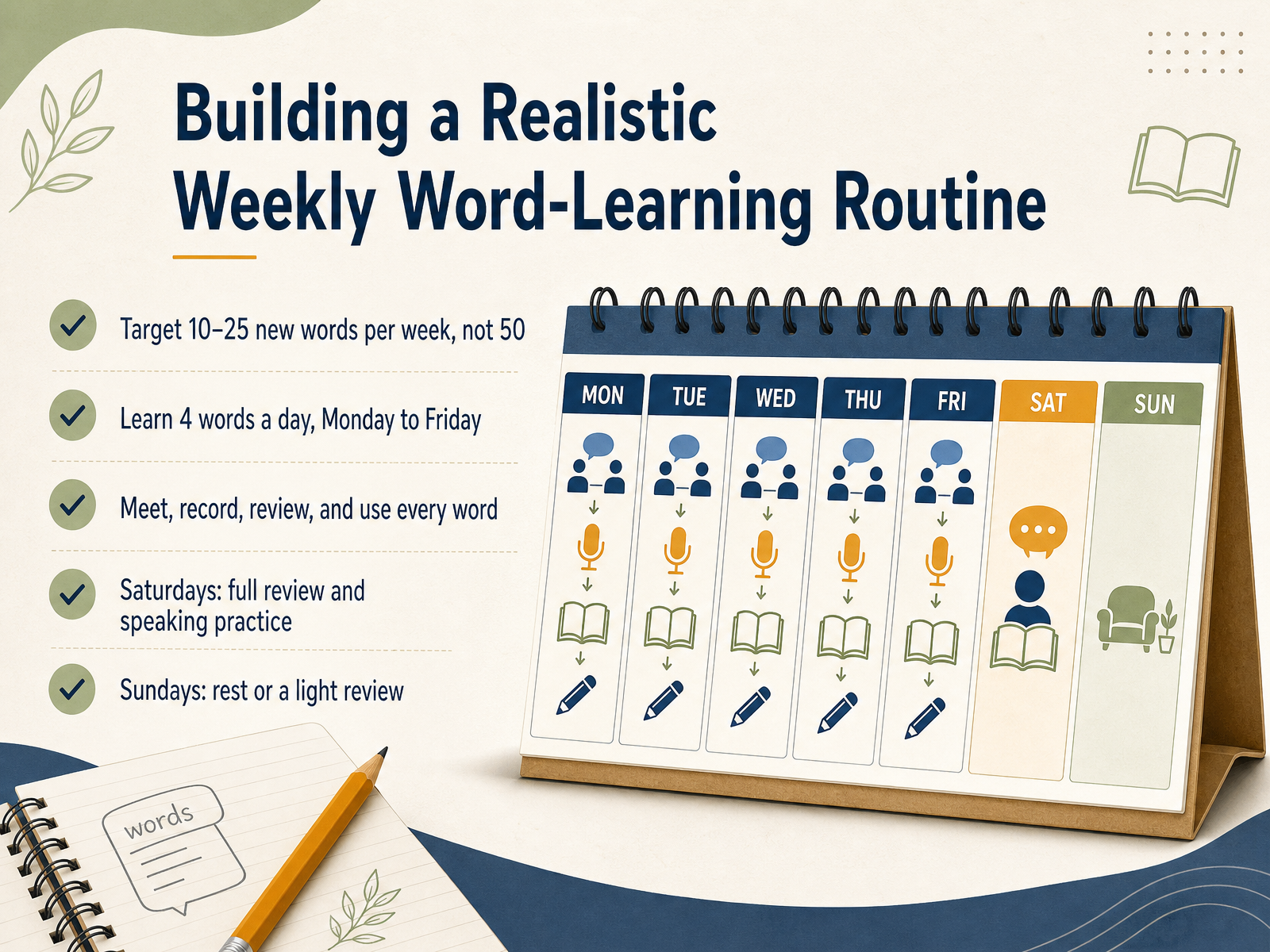
2 min - 10Building a Realistic Weekly Word-Learning RoutineLet’s turn that idea into a simple weekly plan. The goal is twenty to twenty-five new words each week. That may sound small, but it’s realistic and sustainable. Sustainable means you can keep doing it without burning out. So, don’t try to learn fifty words in one day. That’s too many, and you’ll forget most of them. Instead, focus on four words a day, Monday through Friday. For each word, do four things: meet it, record it, review it, and use it. Meet the word by reading or hearing it in a sentence. Record it in your notebook with an example. Review it the next day, and then use it in your own sentence out loud. That last step is very important because speaking a word makes it stick in your memory. On Saturday, do a full review. Go over all the words from the week and practice speaking them. Sunday is your rest day, or just a light review. This cycle gives your brain the repetition it needs. Five words used every day are better than twenty forgotten ones. Next, we’ll look at short practice sessions that fit into a busy day.
 onemoreword.appvocabtech.compenguen.io+22 min
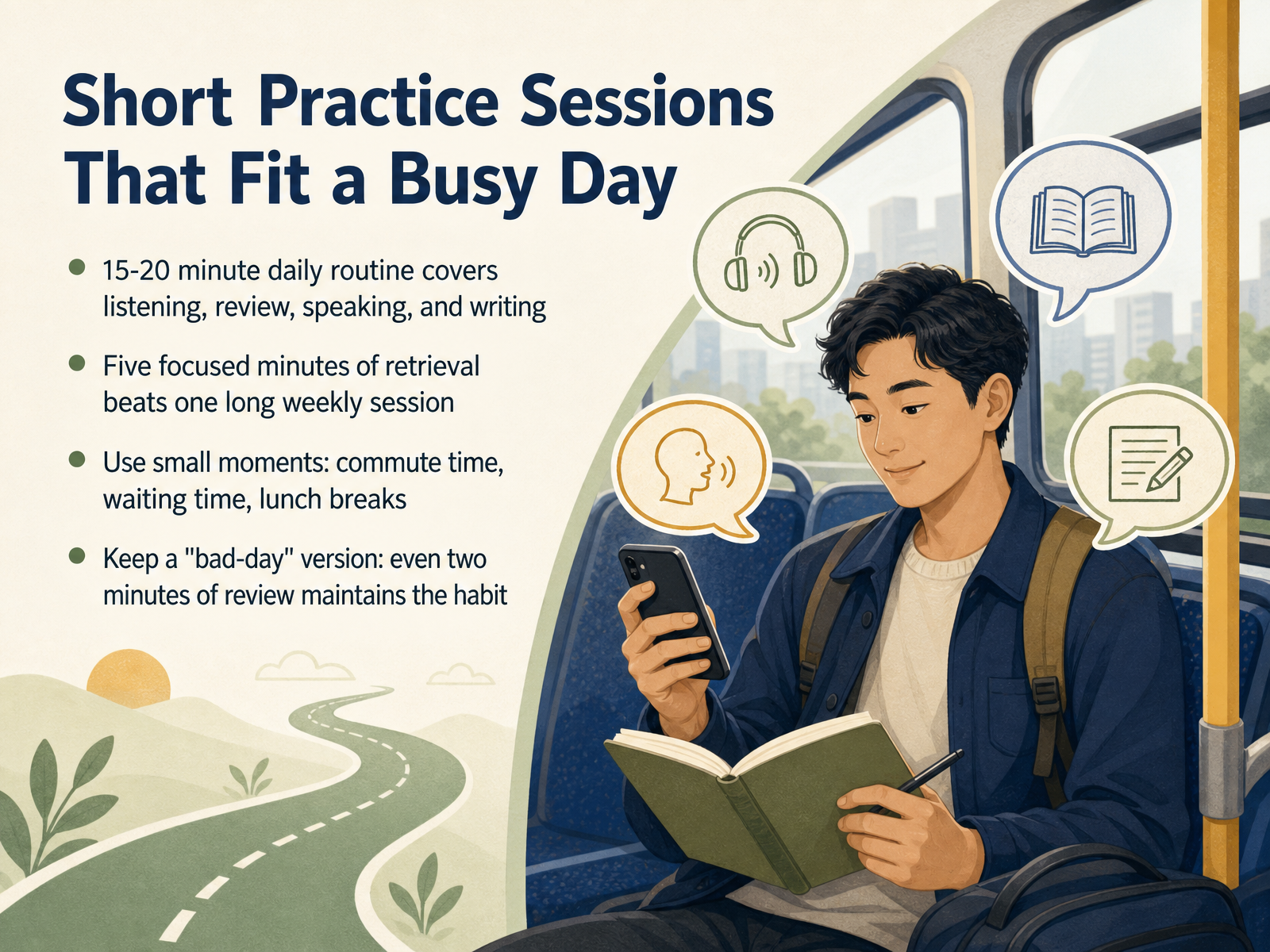
 - 11Short Practice Sessions That Fit a Busy DayLet's talk about fitting practice into your real day. The goal isn't to find hours of free time. The goal is to build a small routine that works with your life. Think about fifteen to twenty minutes each day. In that time, you can listen to something short, review your words, speak a few sentences, and write a little. That's a complete routine. And here's something interesting. Five focused minutes of review often works better than one long weekly session. Why? Because your brain learns through repetition over time, not through one big push. So look for small moments in your day. Your commute. Waiting in line. A lunch break. These are perfect practice times. Of course, some days are harder than others. That's why you should have a bad-day version. On a tough day, just two minutes of review is enough. It keeps the habit alive. You can do two minutes. So remember, short daily practice beats long rare sessions. And it's okay to start small. Small steps, taken every day, lead to real progress. Next, let's look at some digital tools and free resources that can make this even easier.
 todoele.netcambridge.orggrdspublishing.org+22 min
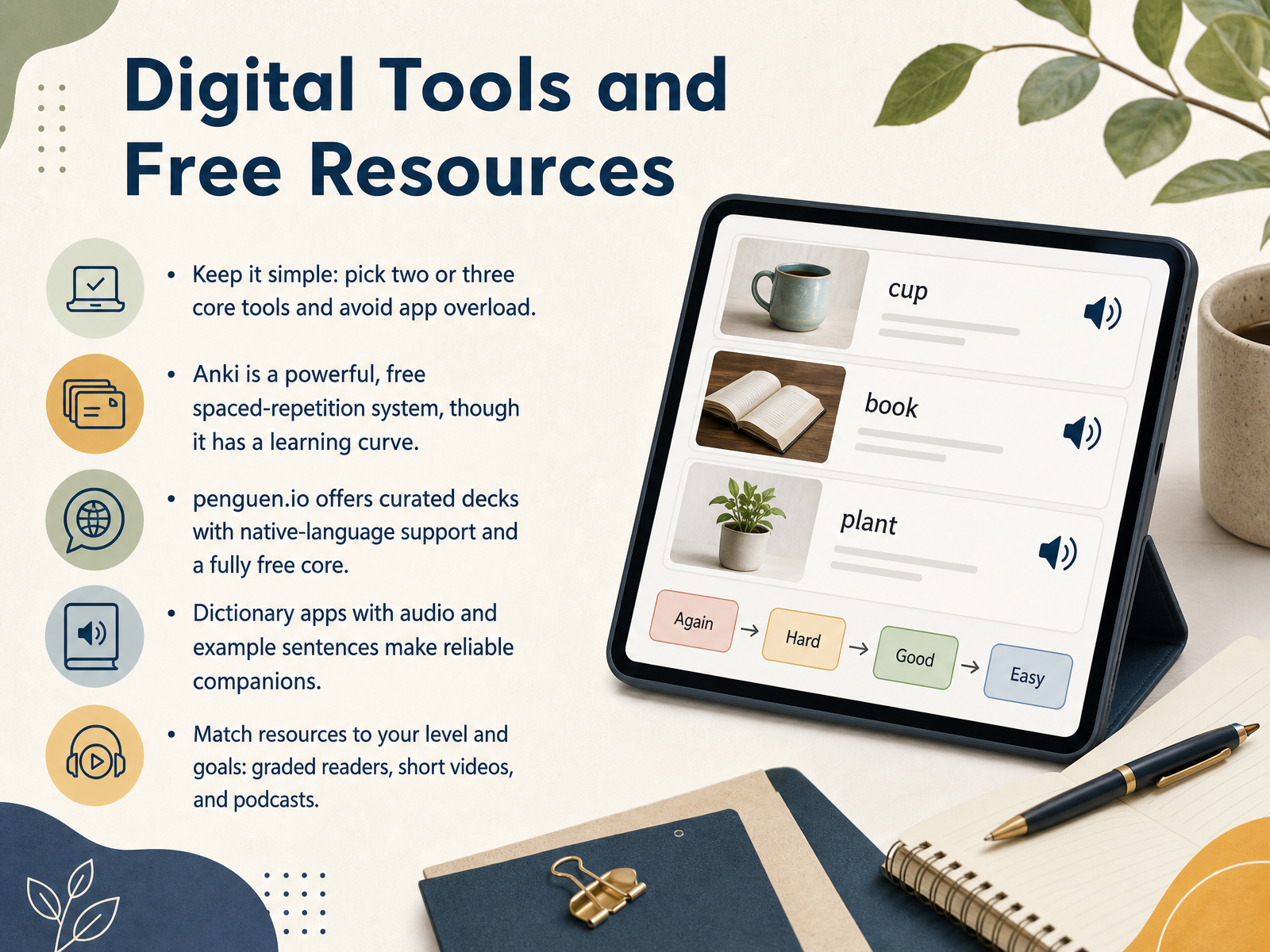
 - 12Digital Tools and Free ResourcesLet's talk about digital tools and free resources. The important thing to remember is to keep it simple. Choose just two or three tools that you like. Too many apps can make you feel confused and tired. Start with one, maybe two, and use them regularly. Anki is a powerful app. It is free and uses a system called spaced repetition. This means the app shows you words just before you are about to forget them. That helps you remember better. Anki is very strong, but it has a learning curve. That means it takes a little time to learn how to use it. Don't worry if it feels difficult at first. Another option is penguen.io. This website offers ready-to-use word decks. It also gives you support in your own language. The core features are completely free. For your daily study, also get a good dictionary app. Make sure it has audio for pronunciation and example sentences. This helps you see how words work in real life. Finally, match your resources to your level and your goals. If you are a beginner, try graded readers. These are simple books made for learners. You could also watch short videos or listen to podcasts made for your level. Next, we will talk about tracking your progress without feeling overwhelmed. It is an important step to keep you motivated. See you there.
 penguen.ioonemoreword.appvocabtech.com+22 min
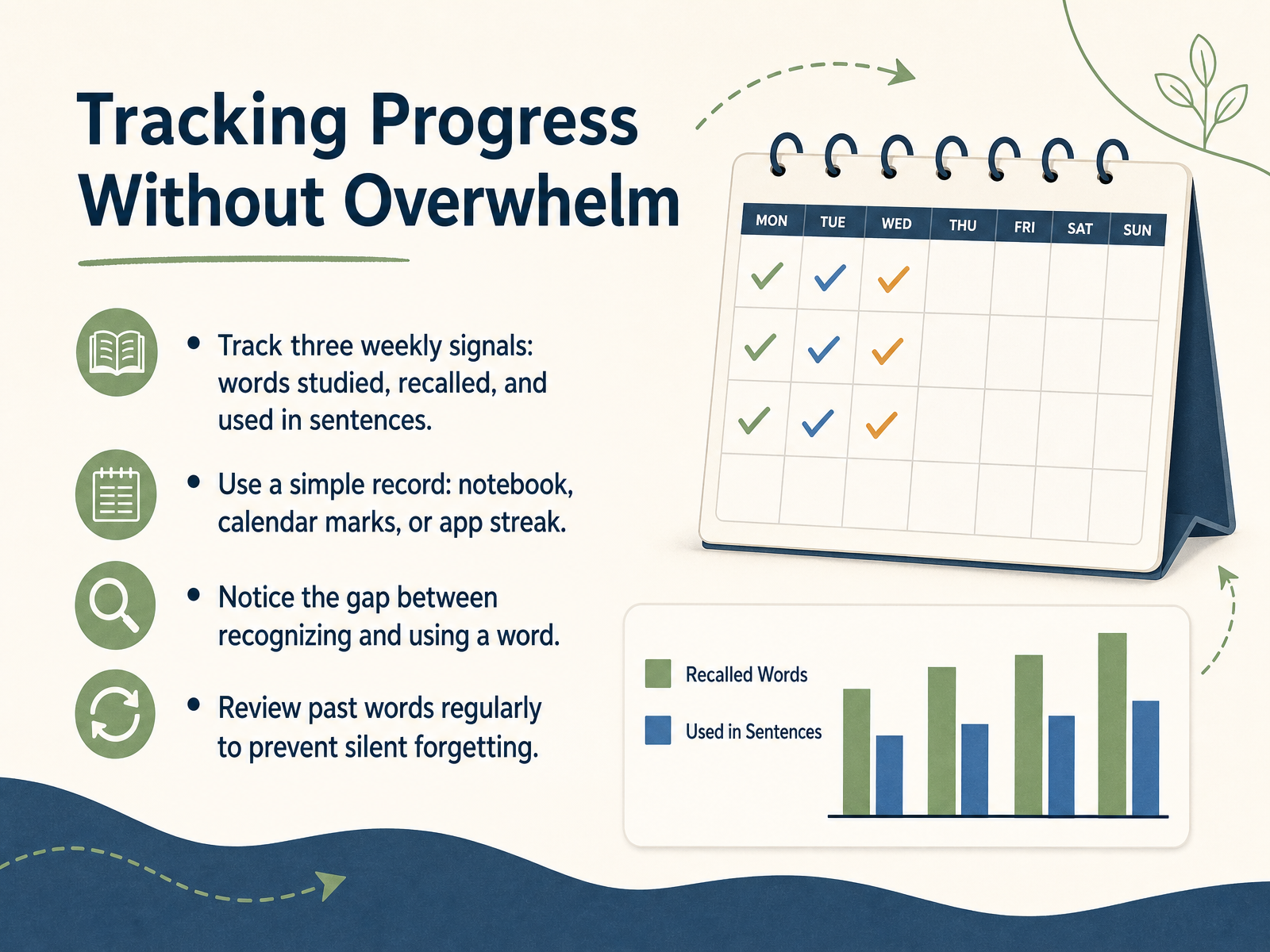
 - 13Tracking Progress Without OverwhelmNow let's talk about tracking your progress, but in a way that feels light, not heavy. You only need to watch three signals each week. First, how many words did you study? Second, how many could you recall from memory? And third, how many did you actually use in your own sentences? That third one is the real test. To keep it simple, use whatever record feels easy for you: a notebook, marks on a calendar, or an app that shows your streak. And here is something interesting you will notice: there is often a gap between recognizing a word and using it. You might read a word and think, yes, I know that one. But when you try to speak, it does not come out. That is completely normal. Do not worry about that gap. Just be aware of it. That awareness tells you which words need more review. Speaking of review, go back to older words regularly. This prevents what we call silent forgetting, when a word slips away quietly because you never looked at it again. A simple weekly check is enough. You are building a habit, not doing a final exam. Soon, we will turn all of this into your personal action plan and next steps.
 todoele.netcambridge.orggrdspublishing.org+22 min
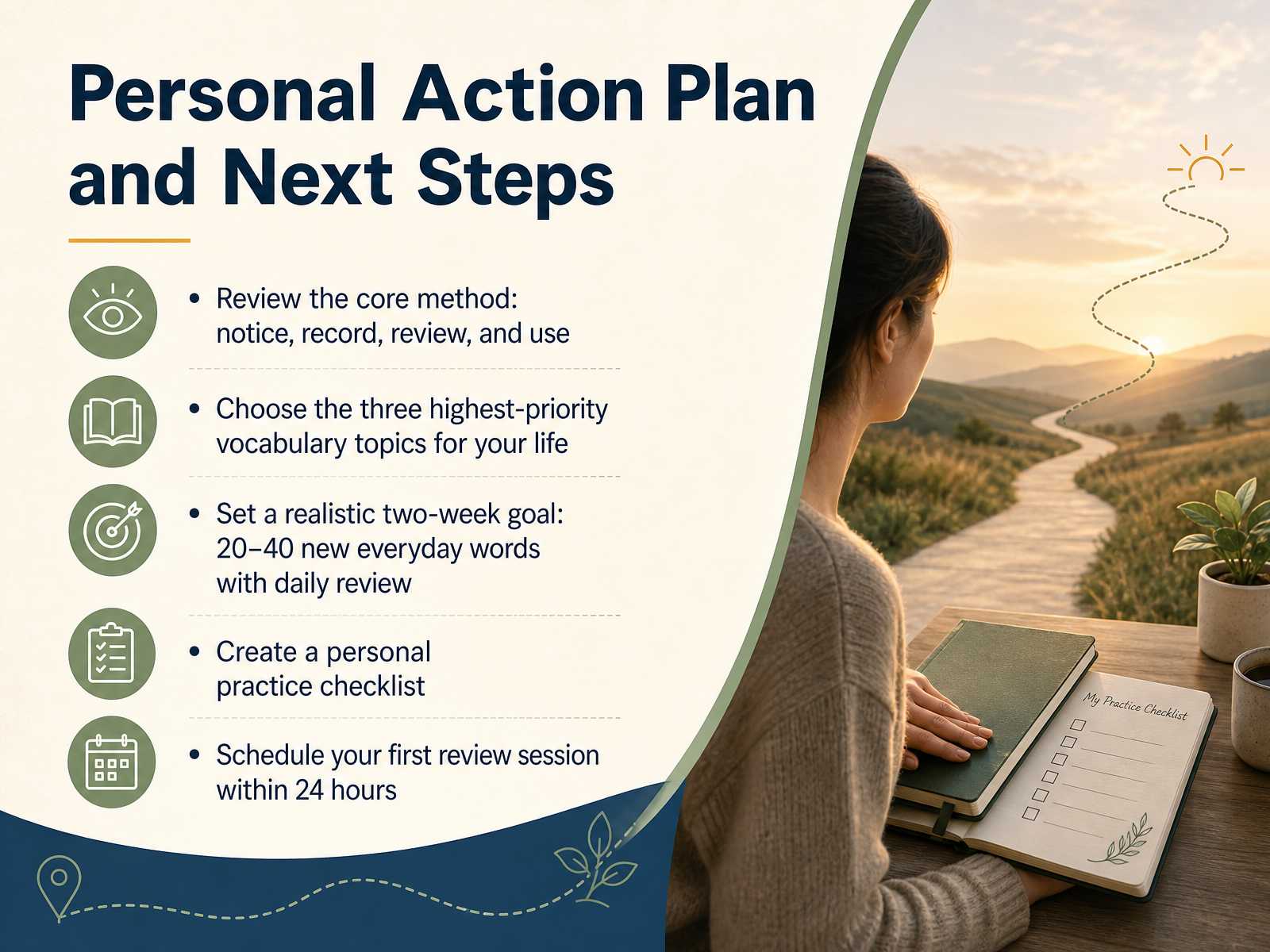
 - 14Personal Action Plan and Next StepsCongratulations on reaching the final step! Let's turn everything you've learned into a simple plan you can start today. First, remember the core method: notice, record, review, and use. Those four steps are your engine for growth. Now, pick three vocabulary topics that matter most in your daily life. Maybe it's work, shopping, or talking with friends. Choose what you will actually use. Next, set a realistic two-week goal. Research shows that learning about twenty to forty new everyday words, with daily review, is powerful and sustainable. That's just a few words each day. Create a simple practice checklist to track your progress. It could be a small notebook or an app on your phone. Finally, schedule your first review session within twenty-four hours. Don't let the moment pass. Look at the words you noted today. Say them out loud. The key is consistency, not perfection. If you miss a day, just start again the next day. You now have the tools and the roadmap. Thank you for your effort and curiosity. Start small, stay steady, and enjoy watching your English grow. You can do this!
 onemoreword.appvocabtech.compenguen.io+22 min
Take the deck with you
Download this course as a file — free, no sign-up needed.
- PDF handoutEvery slide page, ready to print or share.15 pages · 4.3 MBDownload
- Narrated PowerPointThe deck that presents itself — every slide carries the digital human's narration video.15 pages · 14.2 MBDownload
- PowerPoint slidesThe full deck as a .pptx — open it in PowerPoint, Keynote, or Google Slides.15 pages · 4.2 MBDownload
Free to use in your own training — please keep the PersonWise credit page at the end.
Have your own deck? Turn it into a course
Sources consulted
Web sources consulted while building this course.
- Learn English Words with Flashcards and Spaced Repetition — onemoreword.app
- https://www.vocabtech.com/en — vocabtech.com
- Free Vocabulary Builder — Learn English with Flashcards | penguen.io — penguen.io
- English Vocabulary Builder — Expand Your Word Bank Online | Learn With Masha — mashaenglish.com
- Small Universe - English Learning Game for Kids, Adults, and Families — smalluni.com
- The Oxford 3000™ — oxfordlearnersdictionaries.com
- Oxford 3000 and 5000 | OxfordLearnersDictionaries.com — oxfordlearnersdictionaries.com
- 3000 most common words in English | EF United States — ef.edu
- New General Service List Project | newgeneralservicelist.org — newgeneralservicelist.org
- 1000 most common words in English | EF United States — ef.edu
- Word classes and phrase classes - Cambridge Grammar — dictionary.cambridge.org
- ELT Concourse simple grammar: types of words — teflconcourse.com
- 75 Basic Words for Beginning English Learners - Busuu — busuu.com
- The 100 Most Common English Words (With Examples + Free PDF) — myenglishpages.com
- Basic English parts of speech | Wordy — wordy.com
- Does writing words in notes contribute to vocabulary learning? — todoele.net
- Learning to learn: Note-taking and vocabulary — cambridge.org
- THE USE OF VOCABULARY NOTEBOOKS AND ITS EFFECT ON WORD RETENTION | PUPIL: International Journal of Teaching, Education and Learning — grdspublishing.org
- International Journal of Interactive Mobile Technologies (iJIM) – Volume 3, Issue 2, April 2009 — online-journals.org
- The Use of Vocabulary Notebooks for EFL Non-majors' ESP Vocabulary Acquisition | ICTE Conference Proceedings — i-cte.org