Begin
14 pages · ~28 min
Project Portfolio Management Essentials
This Project Portfolio Management training equips managers and teams to prioritize, select, and govern projects that align with organizational strategy and deliver maximum value.
A digital instructor presents all 14 pages. Hold “Ask” at any point and ask out loud — the answer comes from this course. No sign-up needed.
What you’ll learn
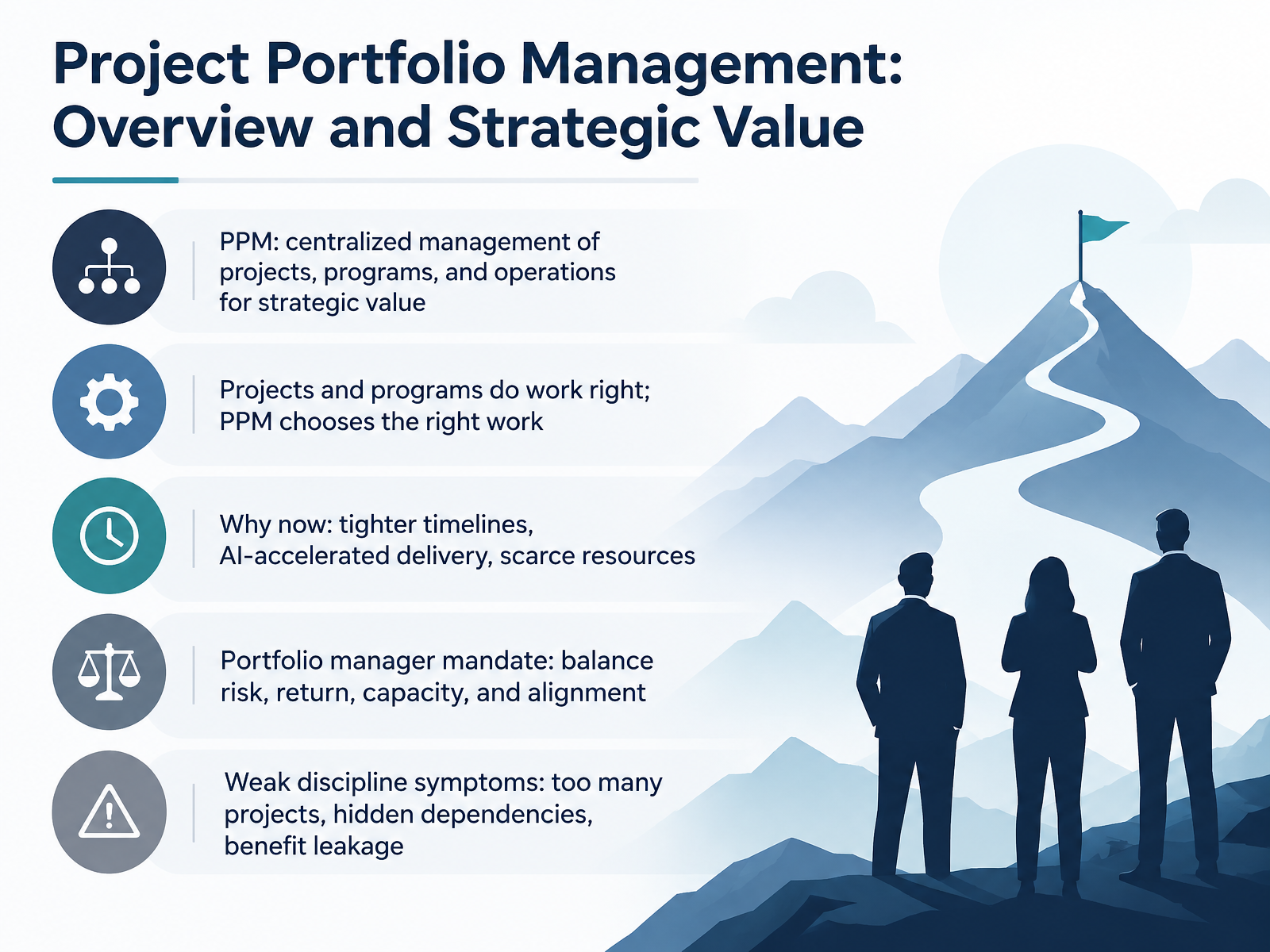
- 01Project Portfolio Management: Overview and Strategic ValueWelcome. This course is about project portfolio management, or P P M, and the strategic value it creates. You already run multiple initiatives, so we will skip the basics. Our goal is practical: better governance decisions, and portfolio-level visibility you can defend to executives. Start with the core distinction. Projects and programs do work right. Portfolio management chooses the right work. It is the centralized management of projects, programs, and operations to maximize strategic value. Why does this matter now? Timelines are tighter, AI is accelerating delivery, and skilled people remain scarce. That combination forces harder trade-offs. Your mandate as portfolio manager is to balance risk, return, capacity, and strategic alignment. In practice, that means funding decisions, sequencing, and stopping work that no longer earns its place. Watch for the symptoms of weak discipline. Too many active projects. Hidden dependencies across teams. And benefit leakage, where delivery succeeds but value never lands. Over the next slides, we will work through governance, prioritization, and value realization. Next, from projects to portfolio: governance and decision rights.gartner.comclarkstonconsulting.comkiplot.com+22 min
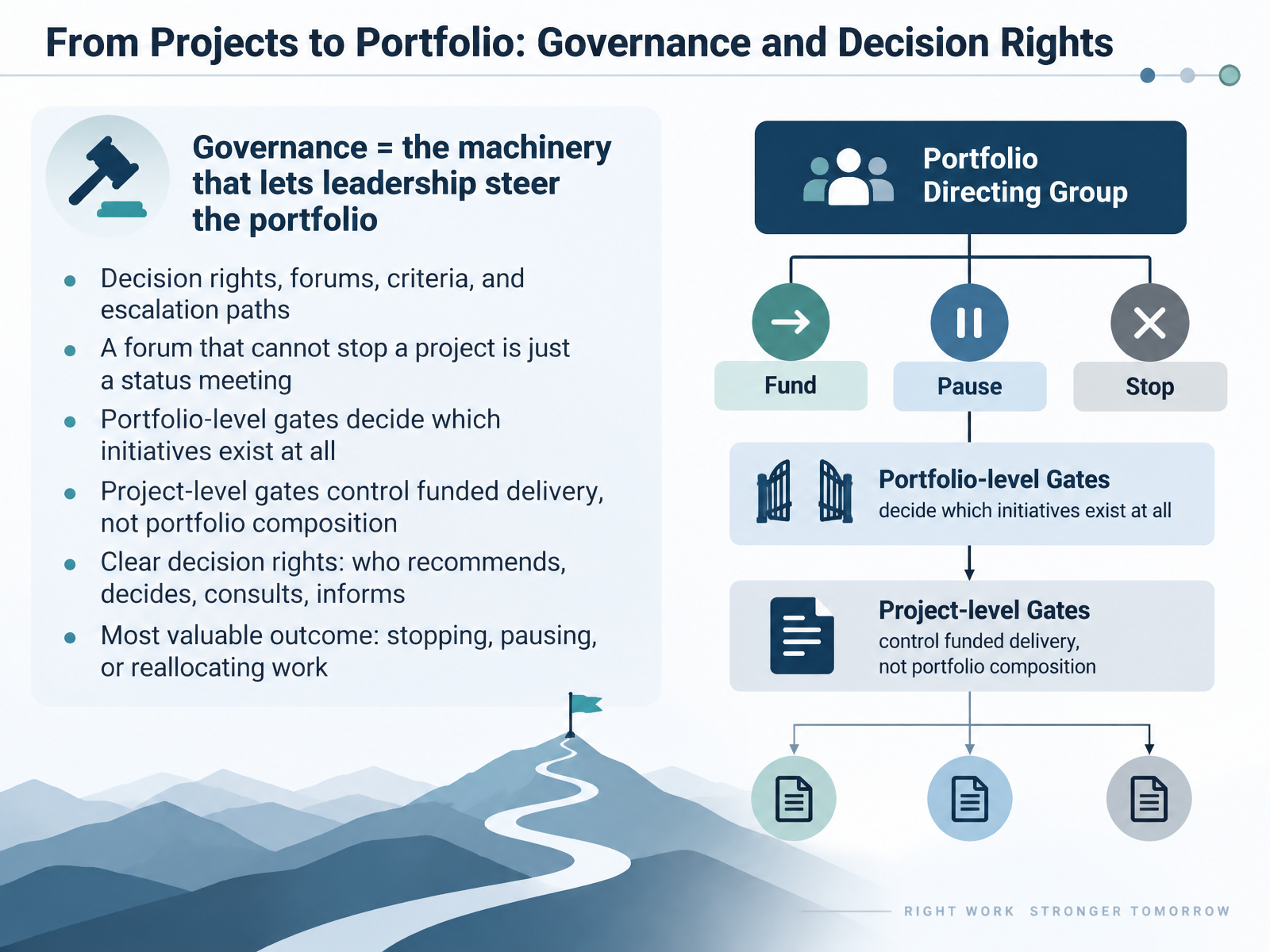
- 02From Projects to Portfolio: Governance and Decision RightsLet's look at where governance actually sits. Governance is the machinery that lets leadership steer the portfolio. That means decision rights, forums, criteria, and escalation paths. Here's the test that matters. A forum that cannot stop a project is just a status meeting. So you need two distinct layers. Portfolio-level gates decide which initiatives exist at all. Project-level gates control funded delivery, not portfolio composition. Keep those separate, or you end up steering the whole portfolio one project at a time. Then make the decision rights explicit: who recommends, who decides, who must be consulted, and who is simply informed. In a decision rights grid, the decides column names exactly one body. Two owners means the decision escalates. And the most valuable outcome of all is stopping, pausing, or reallocating work. If nothing ever gets killed, your gates are decorative. Next, we will look at strategic alignment and prioritization models.
 pmi.orgpublic.dhe.ibm.comcatedras.ugr.es+22 min
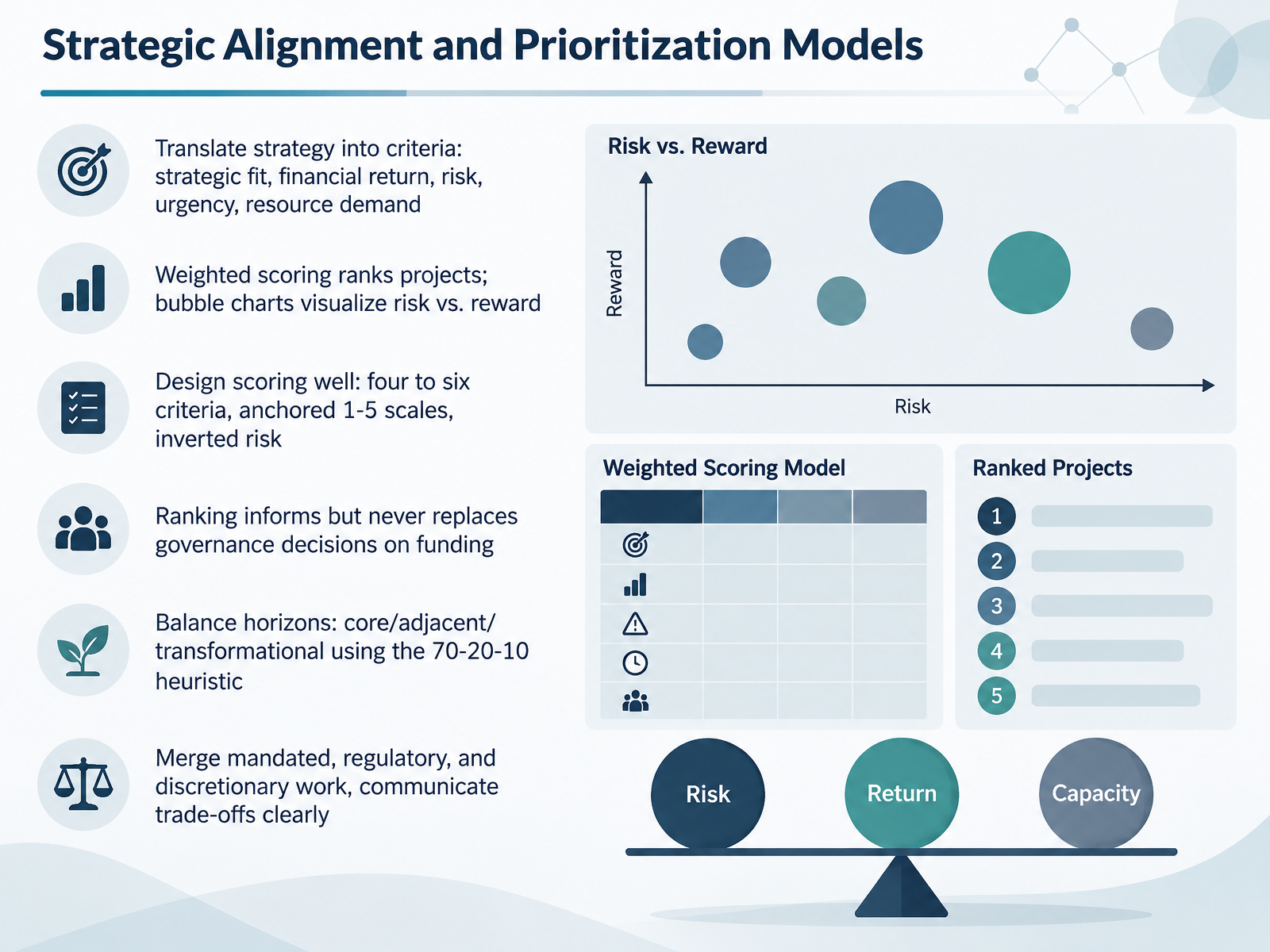
 - 03Strategic Alignment and Prioritization ModelsLet's start with strategic alignment and prioritization. The goal here is to turn strategy into criteria you can actually score: strategic fit, financial return, risk, urgency, and resource demand. Then use weighted scoring to rank projects, and a bubble chart to visualize risk versus reward. Keep the scoring model disciplined. Four to six criteria, a one to five scale with written anchors, and invert risk so a five means lower risk. And remember, ranking informs the decision. It never replaces governance. You still need leaders to weigh the trade-offs and make the funding call. Balance your horizons using the seventy twenty ten heuristic. Roughly seventy percent of resources to core work, twenty percent to adjacent, ten percent to transformational. Merge mandated, regulatory, and discretionary work into one view, and communicate those trade-offs clearly. Next, we look at demand, capacity, and resource management.
 iris.uniroma1.ithenricodolfing.chifm.eng.cam.ac.uk+21 min
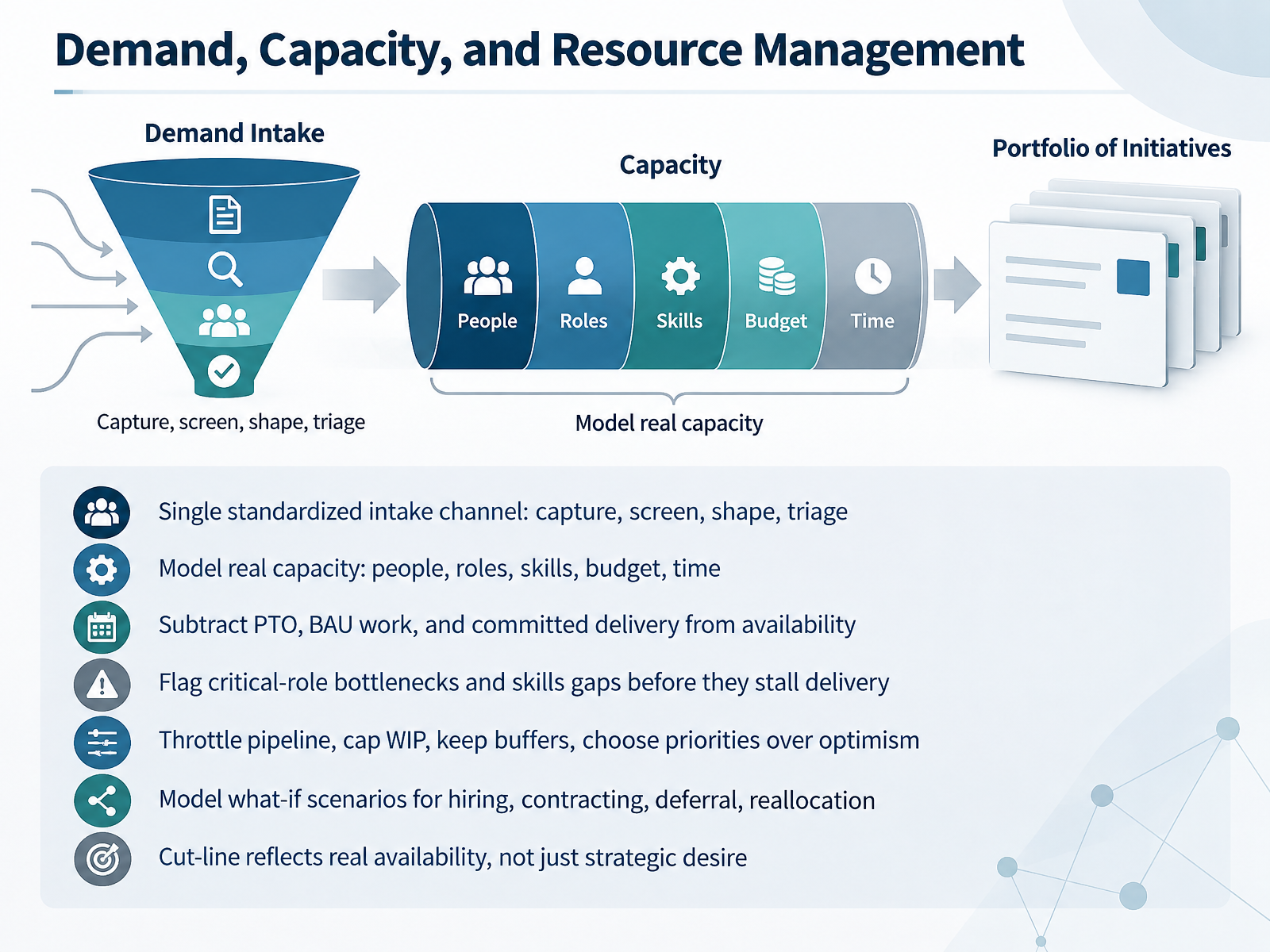
 - 04Demand, Capacity, and Resource ManagementLet's turn to demand, capacity, and resource management. This is where portfolio decisions meet reality. Start with one standardized intake channel: capture, screen, shape, and triage every request the same way. Then model real capacity by people, roles, skills, budget, and time. Subtract paid time off, business as usual work, and committed delivery from availability. If you skip that step, your capacity picture is too optimistic. Next, flag critical role bottlenecks and skills gaps before they stall delivery. For example, if only two architects can approve designs, that constraint caps your pipeline no matter how many developers you have. Throttle the pipeline, cap work in progress, keep buffers, and choose priorities over optimism. Model what if scenarios for hiring, contracting, deferral, and reallocation. That lets you compare options before you commit. And make sure your cut line reflects real availability, not just strategic desire. The principle is simple: capacity decisions protect what matters most. Coming up next: risk, dependency, and interdependency management.
 learning.sap.comprojectinsight.compmi.org+22 min
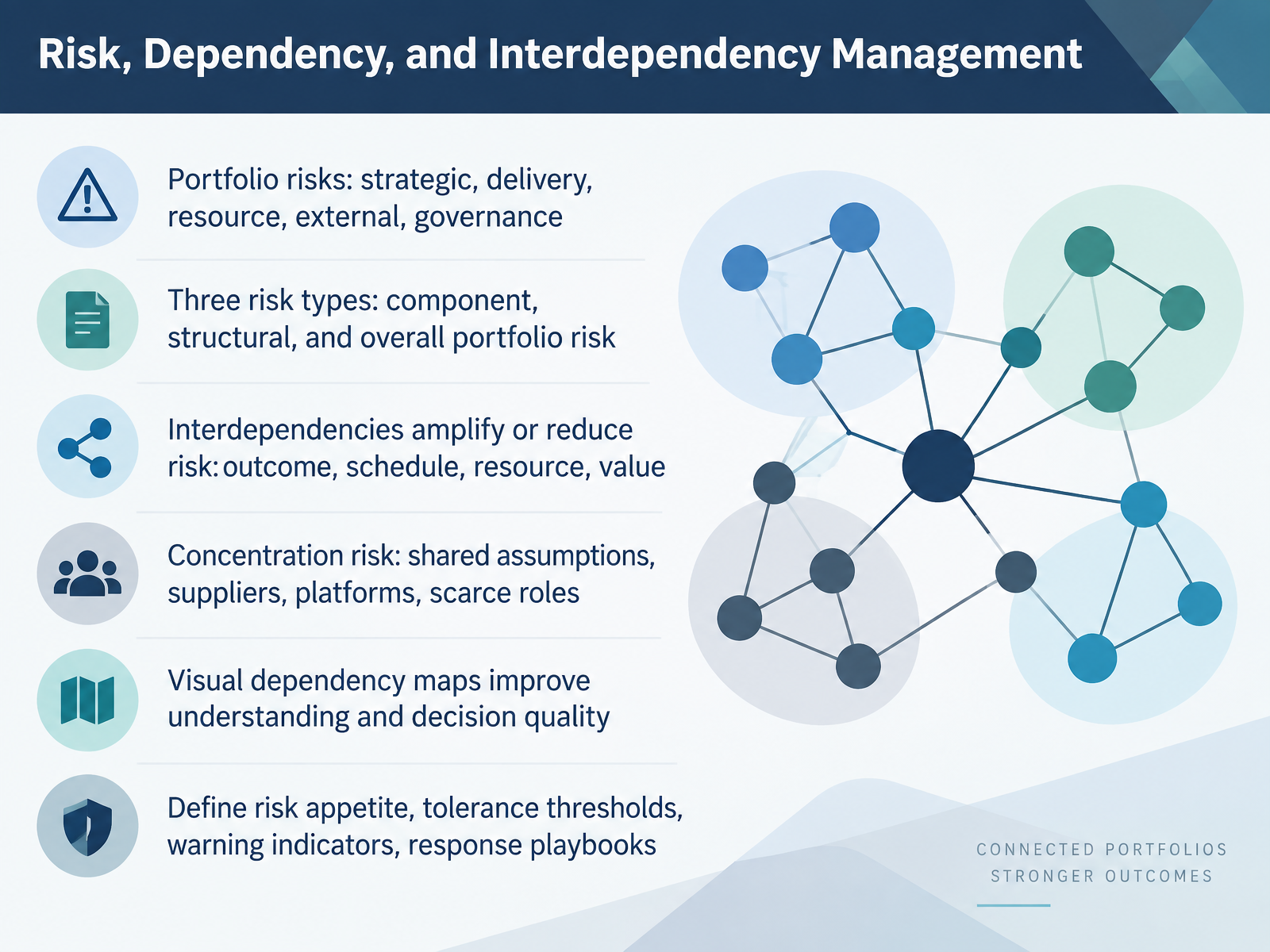
 - 05Risk, Dependency, and Interdependency ManagementLet us turn to risk, dependency, and interdependency management. Start with the portfolio risk lens. Strategic, delivery, resource, external, and governance risks behave differently at portfolio level. Then separate three types. Component risk sits inside one project. Structural risk comes from how the portfolio is composed. Overall portfolio risk emerges from interactions across components. Interdependencies are the amplifier. Outcome, schedule, resource, and value links either increase or reduce exposure. A delayed platform project can cascade into every product that depends on it. Next, watch concentration risk. Shared assumptions, shared suppliers, shared platforms, and scarce roles create single points of failure. Here is the practical move. Build a visual dependency map. Research shows network maps improve understanding and decision quality compared with tables alone. Finally, define risk appetite, tolerance thresholds, warning indicators, and response playbooks in advance. That turns debate into a decision. Next, Metrics, KPIs, and Value Realization.
 2 min
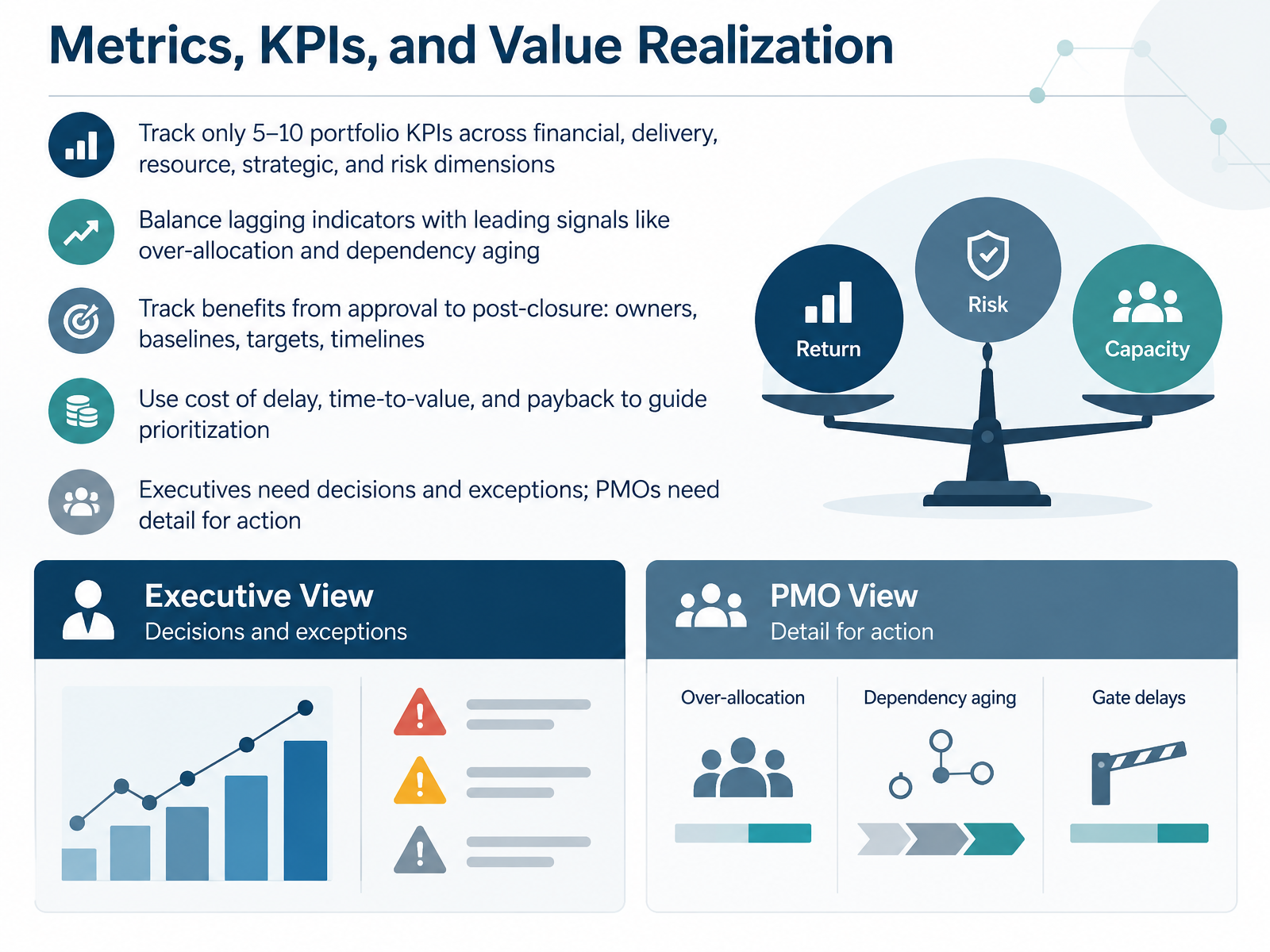
2 min - 06Metrics, KPIs, and Value RealizationLet's move on to metrics, KPIs, and value realization. This is where portfolio discipline either holds or quietly collapses. The first rule: track only five to ten portfolio KPIs, covering financial, delivery, resource, strategic, and risk dimensions. Forty metrics get ignored. Five drive decisions. For example, portfolio budget variance, on-time delivery, and over-allocation in the forward resource plan tell you very different things, and together, they tell you whether the portfolio is healthy. Balance lagging indicators with leading signals. Budget variance is lagging. Over-allocation and dependency aging are leading; they give you a quarter to act. Track benefits from approval through post-closure: named owner, baseline, target, timeline. Use cost of delay, time-to-value, and payback to guide prioritization. And keep audiences distinct. Executives need decisions and exceptions. PMOs need the detail to act. Next, let's look at how tools, data, and AI support this.
 1 min
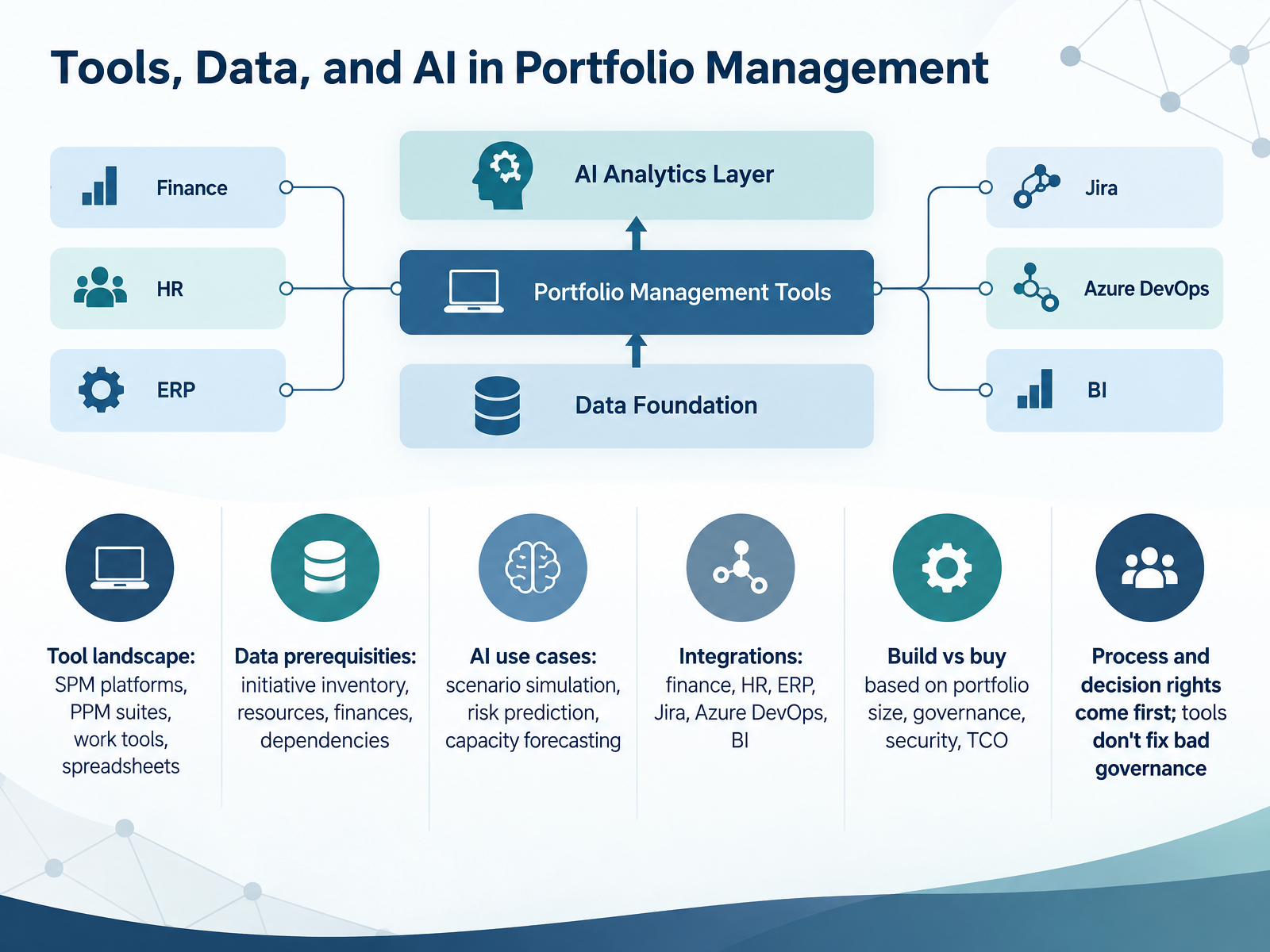
1 min - 07Tools, Data, and AI in Portfolio ManagementLet's look at the tooling layer, and be honest about what it can and cannot fix. The landscape runs from full strategic portfolio platforms, through PPM suites, down to work tools and spreadsheets. Spreadsheets still have a place. They just don't scale to portfolio-level trade-offs. Tools need clean inputs: an initiative inventory, resource data, financials, and dependencies. Without those, every dashboard you build is misleading. Where AI genuinely earns its keep is scenario simulation, risk prediction, and capacity forecasting. Feed it delivery history, and it flags capacity strain before it hits. You also need integrations: finance, HR, ERP, Jira, Azure DevOps, and BI. Confirm whether they are bidirectional and real time. One-way exports give you stale portfolio visibility. Then build versus buy. Decide on portfolio size, governance needs, security requirements, and three-year total cost of ownership. And here's the part that matters most. Process and decision rights come first. Tools don't fix bad governance. They simply automate it faster. Get intake, prioritisation, and decision rights defined, then select the tool that supports them. Next, we look at the operating rhythm that keeps this running: Operating Rhythm and Stakeholder Engagement.
 2 min
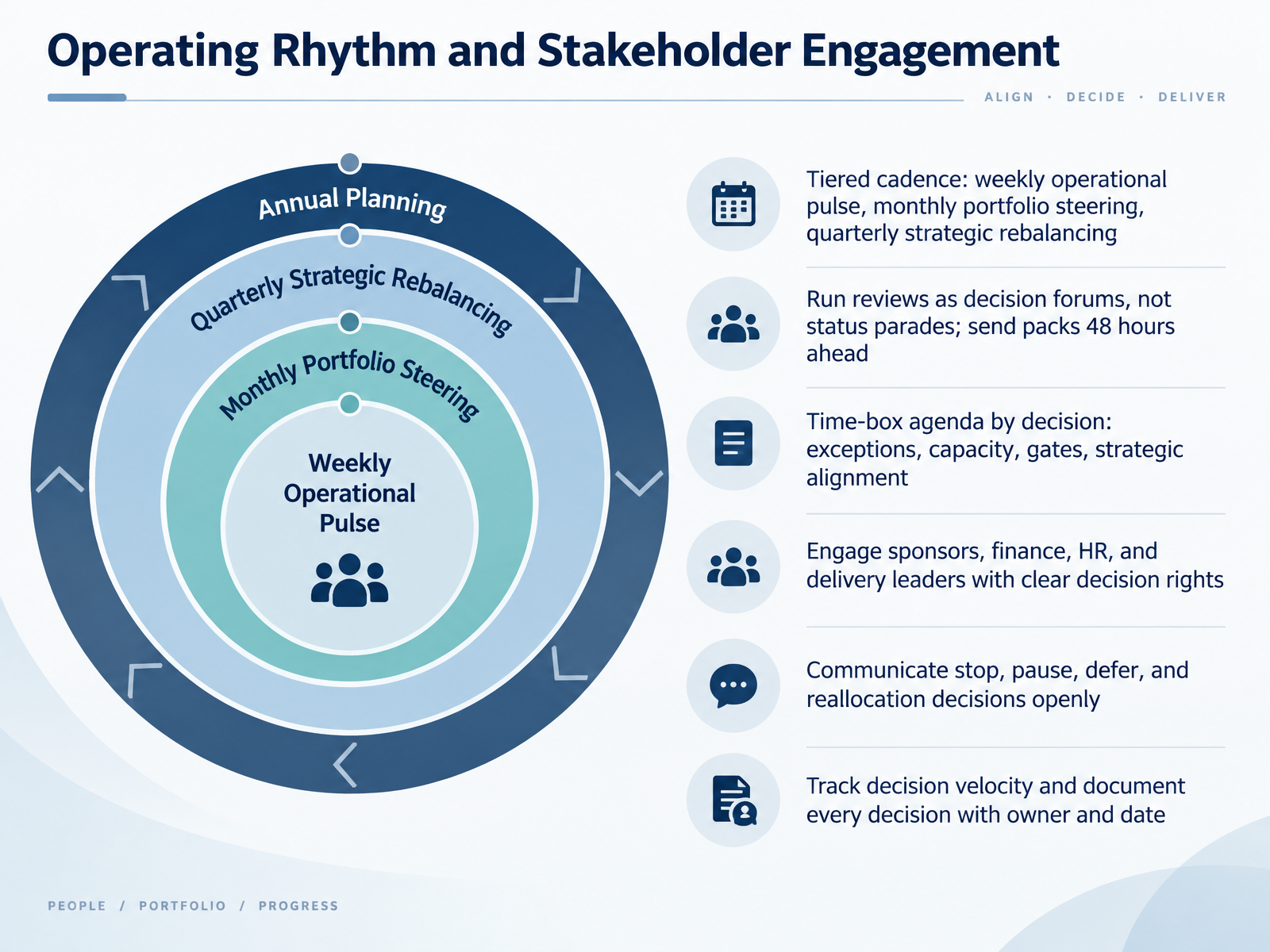
2 min - 08Operating Rhythm and Stakeholder EngagementNow let's talk about the operating rhythm that makes portfolio governance actually work. You need three tiers. A weekly operational pulse, thirty minutes, for blockers and resource conflicts. A monthly portfolio steering session, sixty to ninety minutes, where the real funding and reallocation calls get made. And a quarterly strategic rebalancing, half a day, to check whether the mix still matches strategy.
The critical shift: run these reviews as decision forums, not status parades. Send the pack forty-eight hours ahead. If a project is green, it gets zero airtime. Time-box the agenda by decision: exceptions first, then capacity, then gates, then strategic alignment.
Engage sponsors, finance, HR, and delivery leaders, and be explicit about who decides what. When you stop, pause, defer, or reallocate, communicate it openly. And track decision velocity. Every decision gets an owner and a date, read back before anyone leaves the room.
Next, we'll look at the implementation roadmap and maturity progression.
 2 min
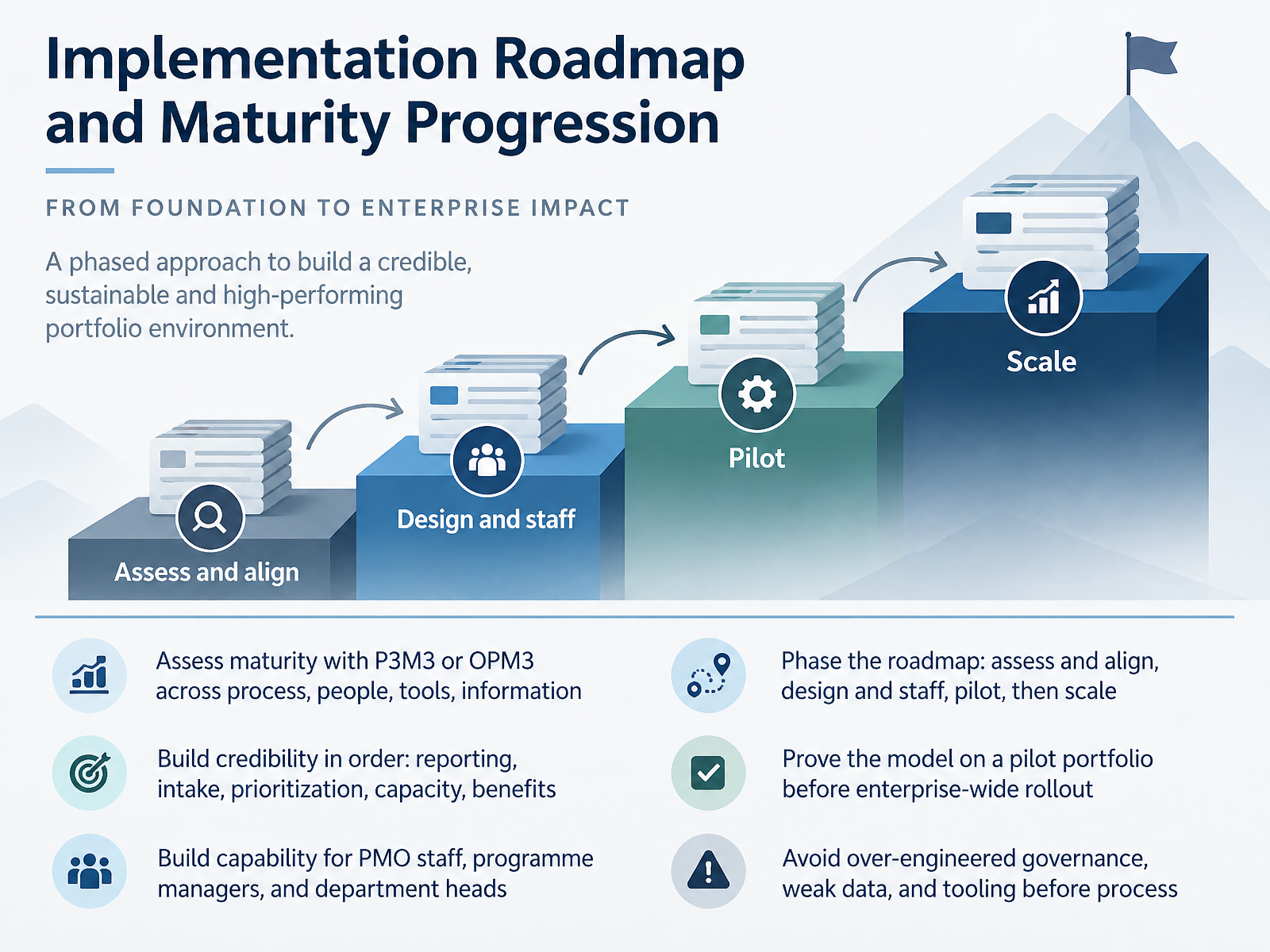
2 min - 09Implementation Roadmap and Maturity ProgressionNow let's talk implementation. Maturity comes before momentum. Start by assessing your current state with a maturity model like P3M3 or OPM3, looking across process, people, tools, and information. Then phase the roadmap. First, assess and align. Then design and staff. Pilot. Only then scale. Build credibility in a specific order: reporting first, then intake, then prioritization, then capacity, then benefits. Each step depends on the one before it. Prove the model on a pilot portfolio before you go enterprise wide. That single decision surfaces friction early and recruits the people who will carry adoption. Now, three traps to avoid. Over engineered governance, weak data, and tooling before process. Remember, the tool is only as good as the data and workflow behind it. Build capability deliberately across PMO staff, programme managers, and department heads, because the roadmap only delivers if the people running it can. Assess, phase, pilot, then scale. Next, we move into diagnosing your portfolio with a health check and pain point review.
 2 min
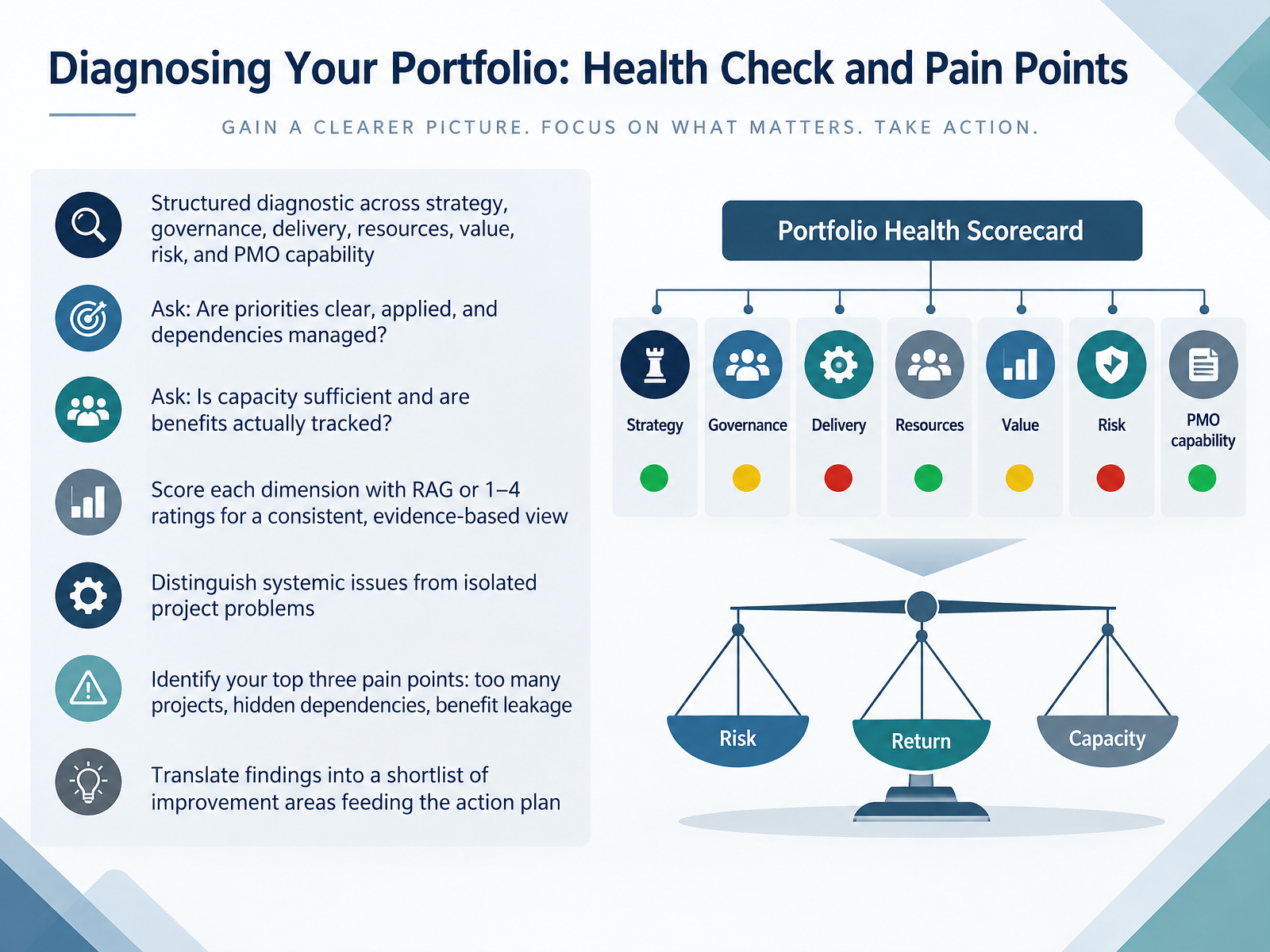
2 min - 10Diagnosing Your Portfolio: Health Check and Pain PointsLet us move into diagnosis. Before you commit resources to fixes, run a structured health check across seven dimensions: strategy, governance, delivery, resources, value, risk, and PMO capability. Across those, ask two hard questions. Are priorities clear, actively applied, and are dependencies managed? And is capacity sufficient, with benefits actually tracked after delivery? Score each dimension using RAG ratings, or a one to four scale. Keep the scale consistent. That gives you an evidence-based view instead of anecdotal reporting. Then separate systemic issues from isolated project problems. A single late project is noise. Three projects blocked by the same approval gate is a systemic pattern. When you look at your results, the most common pain points tend to cluster: too many projects in flight, hidden cross-project dependencies, and benefit leakage, where value quietly erodes after go-live. Pick your top three. Translate the findings into a shortlist of improvement areas, and feed that directly into the action plan. Next, we move from diagnosis to doing. Immediate Actions: Inventory, Prioritization Pilot, Dashboard Baseline.
 2 min
2 min - 11Immediate Actions: Inventory, Prioritization Pilot, Dashboard BaselineLet's move from principles to action. Six things to do now, not next quarter.
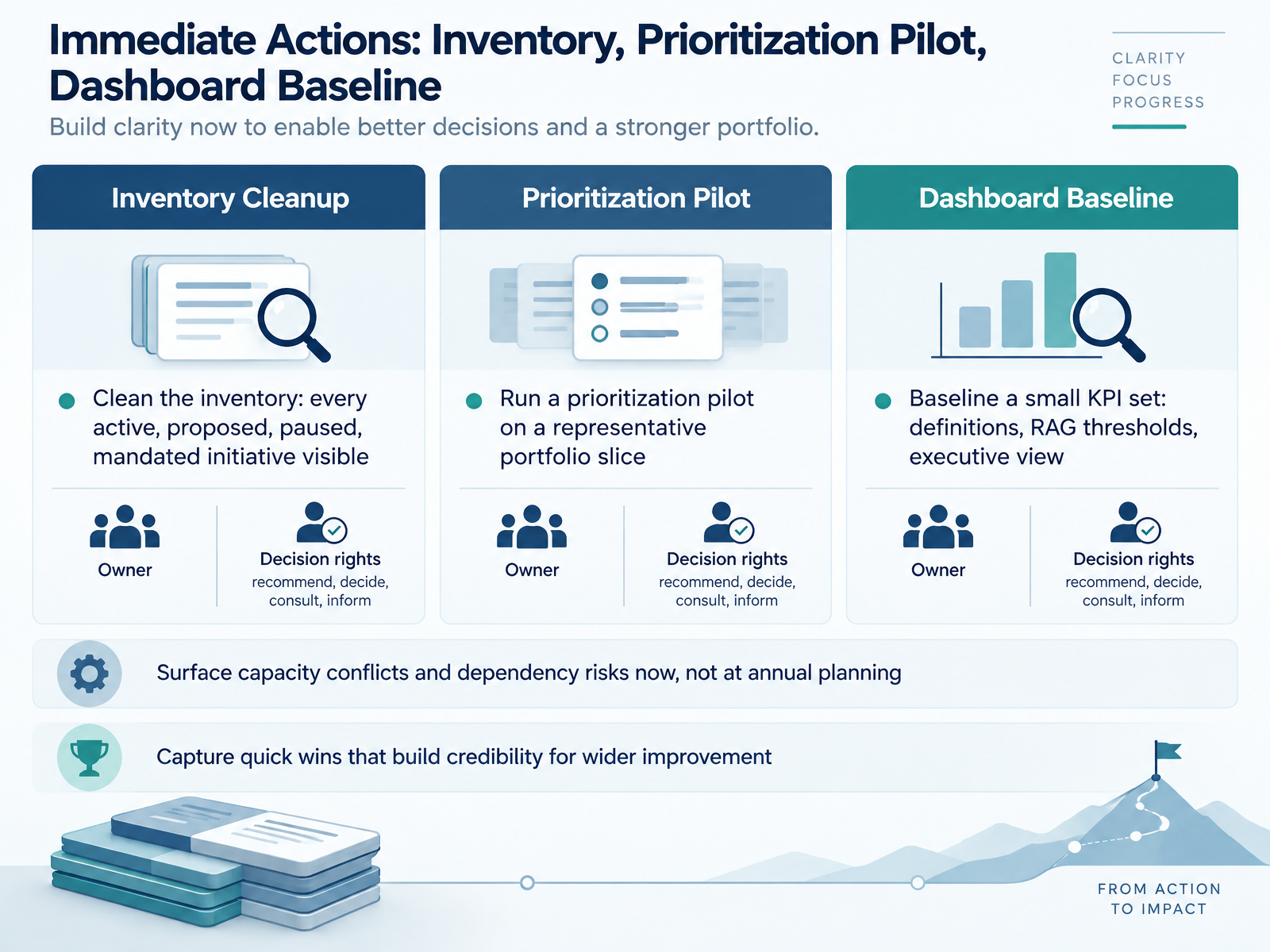
First, clean the inventory. Every active, proposed, paused, and mandated initiative must be visible in one place. You cannot govern what you cannot see.
Second, run a prioritization pilot. Pick a representative slice of the portfolio, agree criteria and weights before names are attached, and rank it together. One working session is enough to expose where your scoring drifts.
Third, baseline a small KPI set. Define each metric once. Set your red, amber, and green thresholds. Then build a single executive view. Five to ten indicators, no more, or nobody reads it.
Fourth, clarify decision rights for the pilot. Write down who recommends, who decides, who must be consulted, and who is informed. Exactly one body decides. That is what stops escalation.
Fifth, surface capacity conflicts and dependency risks now. If two initiatives need the same scarce team, better to see it today than at annual planning.
Sixth, capture quick wins. A stopped project, a visible dashboard, a resolved conflict. That credibility funds the wider rollout.
Start with the inventory and the pilot. Everything else follows. Building a 90-Day Portfolio Improvement Plan.
 pmi.orgpublic.dhe.ibm.comcatedras.ugr.es+22 min
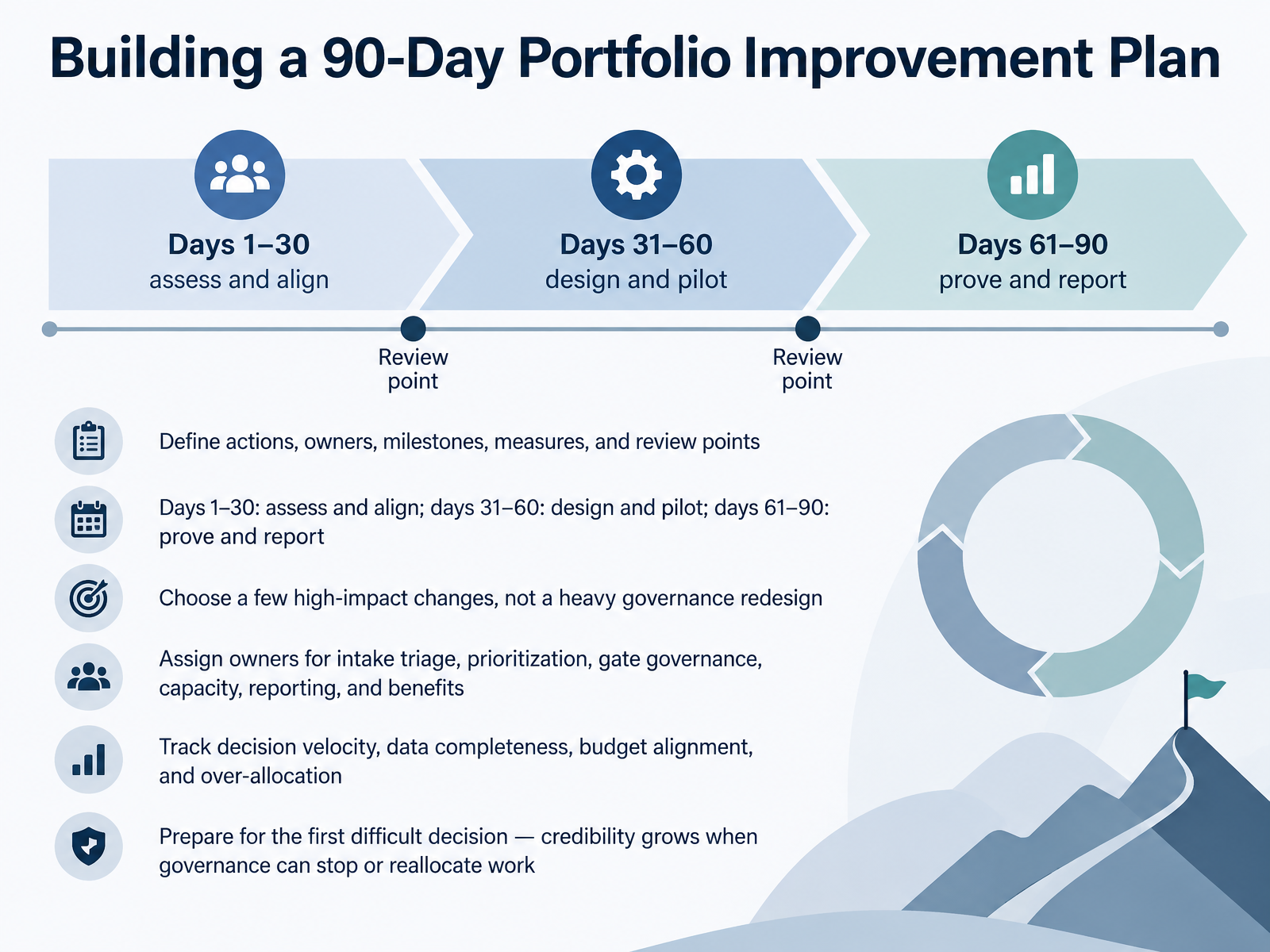
 - 12Building a 90-Day Portfolio Improvement PlanLet's turn this into a working ninety-day plan for your portfolio. Start by defining five things for every action: the action itself, the owner, the milestone, the measure, and the review point. Then phase the work. Days one to thirty, assess and align. Days thirty-one to sixty, design and pilot. Days sixty-one to ninety, prove and report. Resist a heavy governance redesign. Choose a few high-impact changes. Assign named owners for intake triage, prioritization, gate governance, capacity, reporting, and benefits. Track a small set of indicators: decision velocity, data completeness, budget alignment, and over-allocation. And prepare for the first difficult decision. Credibility grows when governance can actually stop or reallocate work. Next, we'll discuss how to adapt these practices to your own context.
 2 min
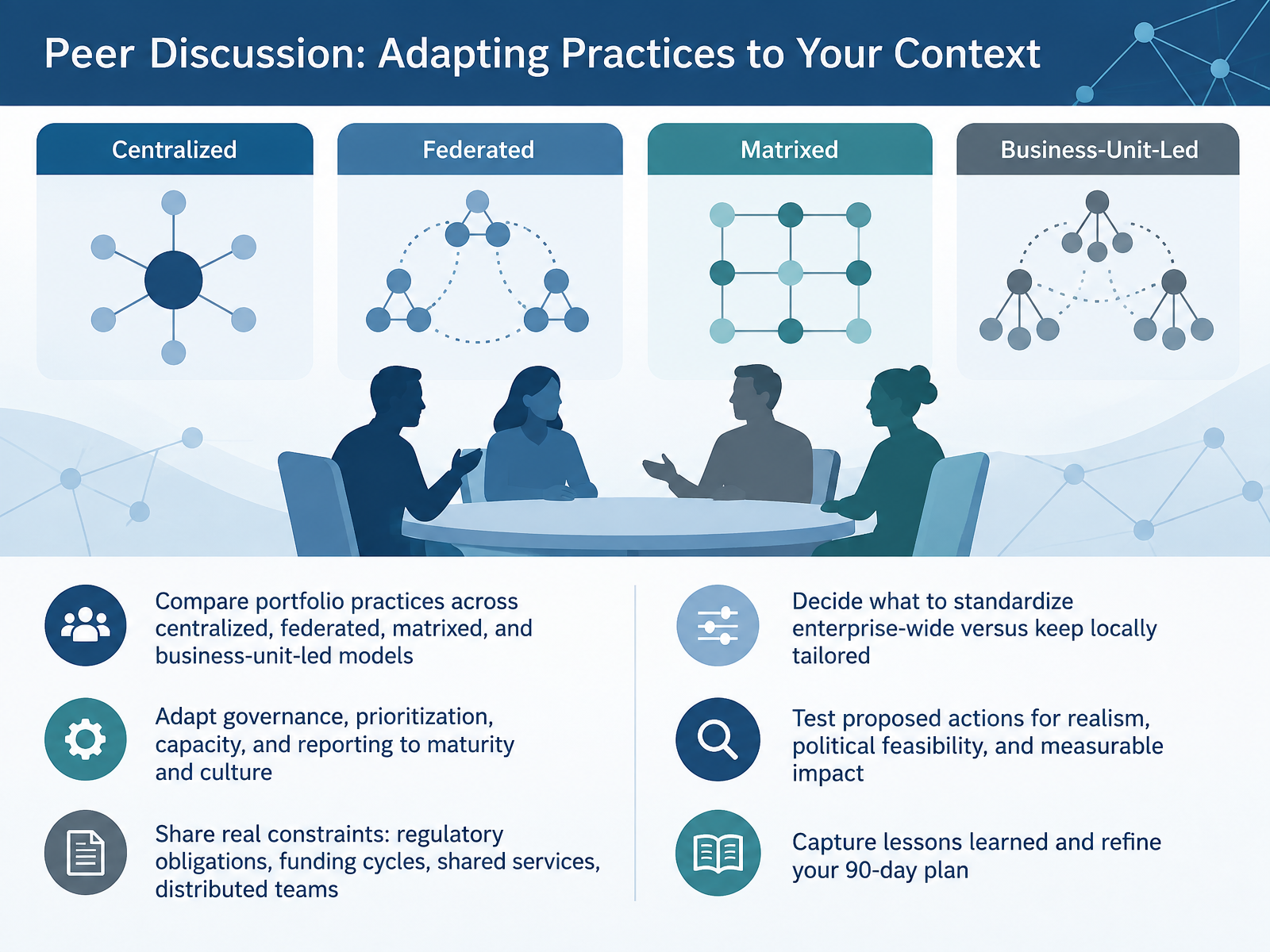
2 min - 13Peer Discussion: Adapting Practices to Your ContextLet's make this practical. Portfolio practices look different across centralized, federated, matrixed, and business-unit-led models. A centralized shop runs one intake and one funding board. A federated model keeps local portfolios under shared standards. Matrixed and business-unit-led models trade enterprise control for local speed. So adapt governance, prioritization, capacity, and reporting to your maturity and culture, not to a textbook. Name the real constraints in the room: regulatory obligations, funding cycles, shared services, distributed teams. Then make the call. Decide what gets standardized enterprise-wide, usually taxonomy, scoring criteria, and decision rights, and what stays locally tailored, like intake forums and reporting detail. Test every proposed action for realism, political feasibility, and measurable impact. Before you commit, ask three questions: Can we staff it? Will the executives support it? And will we see the difference in ninety days? Capture lessons learned after each cycle and fold them into your plan. That is how the model survives contact with your organization. Next, we'll move into commitment and follow-up: next steps for PMO practitioners.
 pmi.orgpublic.dhe.ibm.comcatedras.ugr.es+22 min
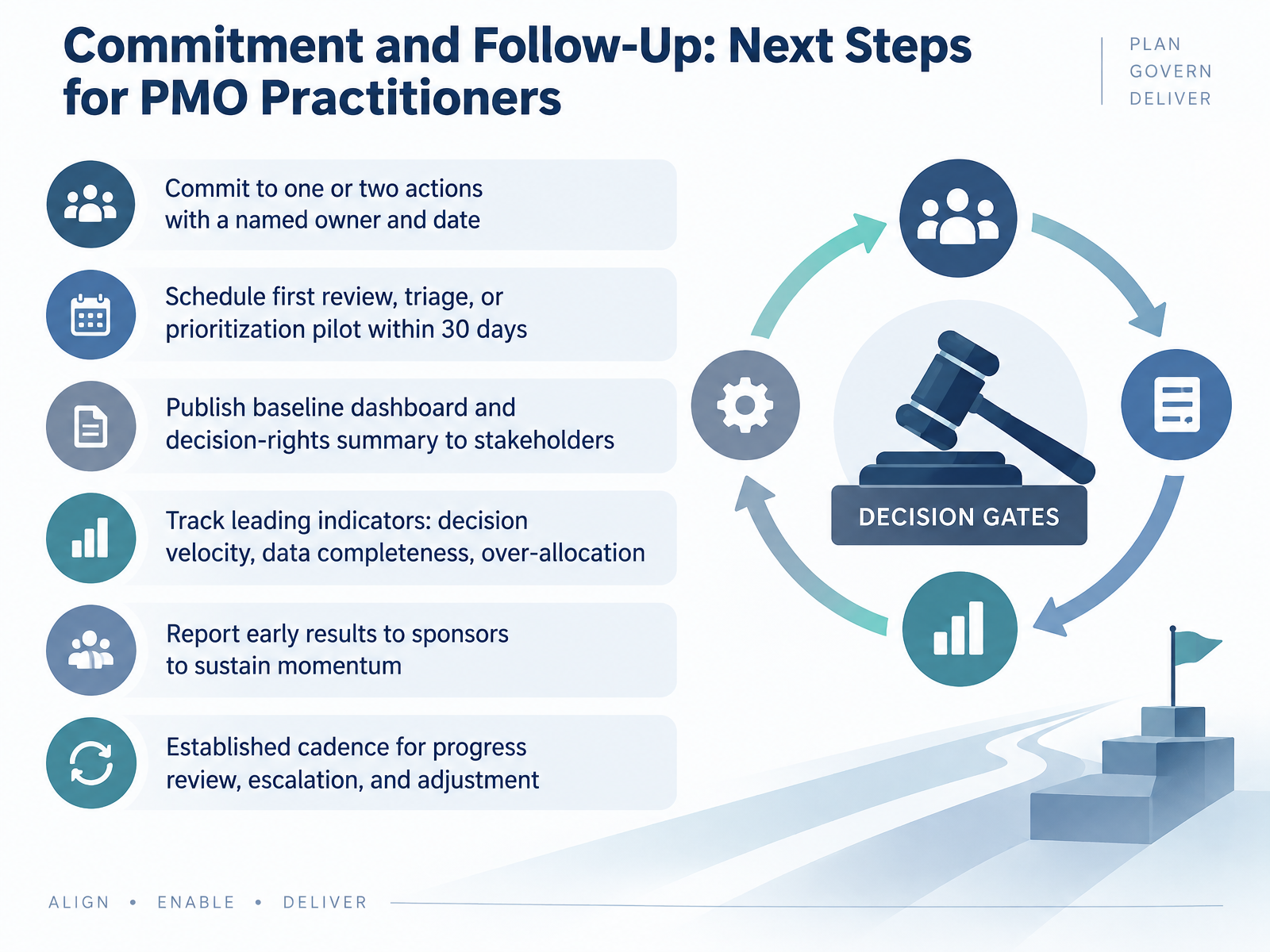
 - 14Commitment and Follow-Up: Next Steps for PMO PractitionersLet's close with what you actually commit to on Monday. First, keep it small. Choose one or two actions, each with a named owner and a date. Vague intentions are not commitments. Second, schedule your first review, triage, or prioritization pilot within thirty days. Momentum comes from a cadence, not a plan. Third, publish two artifacts to stakeholders: your baseline dashboard and a decision-rights summary. Be explicit about who decides, who recommends, and who must be consulted. Then track leading indicators, not lagging ones. Decision velocity, data completeness, and over-allocation. If decision velocity stalls, you are escalating instead of deciding. If data completeness is low, you are likely debating numbers rather than options. Report early results to your sponsors. Short, honest updates sustain the support you need. Finally, establish a recurring cadence for progress review, escalation, and adjustment. That rhythm is what keeps the portfolio steerable. Thank you for your attention, and good luck. Start with one decision, one owner, one date.
 pmi.orgpublic.dhe.ibm.comcatedras.ugr.es+22 min
Take the deck with you
Download this course as a file — free, no sign-up needed.
- PDF handoutEvery slide page, ready to print or share.15 pages · 3.3 MBDownload
- Narrated PowerPointThe deck that presents itself — every slide carries the digital human's narration video.15 pages · 27.2 MBDownload
- PowerPoint slidesThe full deck as a .pptx — open it in PowerPoint, Keynote, or Google Slides.15 pages · 3.2 MBDownload
Free to use in your own training — please keep the PersonWise credit page at the end.
Have your own deck? Turn it into a course
Sources consulted
Web sources consulted while building this course.
- Rethinking the PPM Operating Model: Top Trends for Portfolio Management Leaders in 2026 — gartner.com
- 2026 Program and Project Management Trends — clarkstonconsulting.com
- Project Portfolio Management and SPM Trends: H1 2026 Market View — kiplot.com
- The State of Project Management 2026 — pmsolutions.com
- Building a Future-Ready PMO: Project Management Trends for 2026 - Withum — withum.com
- Governance of Portfolios, Programs, and Projects: A Practice Guide — pmi.org
- Establishing portfolio management governance: key components. — public.dhe.ibm.com
- [Document title] [Document subtitle] — catedras.ugr.es
- Chapter 8: Governance Structure | IT Portfolio Management Handbook — zettai-seigi.github.io
- PORTFOLIO MANAGEMENT — gbv.de
- Project selection methodologies for reducing risks in project portfolio management(2) — iris.uniroma1.it
- The Difficult Act Of Balancing Your Project Portfolio - Henrico Dolfing — henricodolfing.ch
- Portfolios RP-RM 28-02-09 — ifm.eng.cam.ac.uk
- Balancing Priorities across the R&D Portfolio - IEEE Technology and Engineering Management Society — ieee-tems.org
- "Risk vs. Reward" Tightrope: How to Build a Resilient Innovation Portfolio — acceptmission.com
- Integrating Resource and Capacity Planning — learning.sap.com
- Resource & Capacity Tracking Playbook for PMO Leaders | Project Insight — projectinsight.com
- Portfolio resource management — pmi.org
- Anaplan Project Resource Planning Application — anaplan.com
- Resource Capacity Planning for IT PMOs: — prosymmetry.com