Begin
14 pages · ~28 min
Managing Team Capacity and Workload Trade-Offs
This training equips team leads and managers to assess workload, identify constraints, and make informed trade-offs for sustainable team capacity.
A digital instructor presents all 14 pages. Hold “Ask” at any point and ask out loud — the answer comes from this course. No sign-up needed.
What you’ll learn
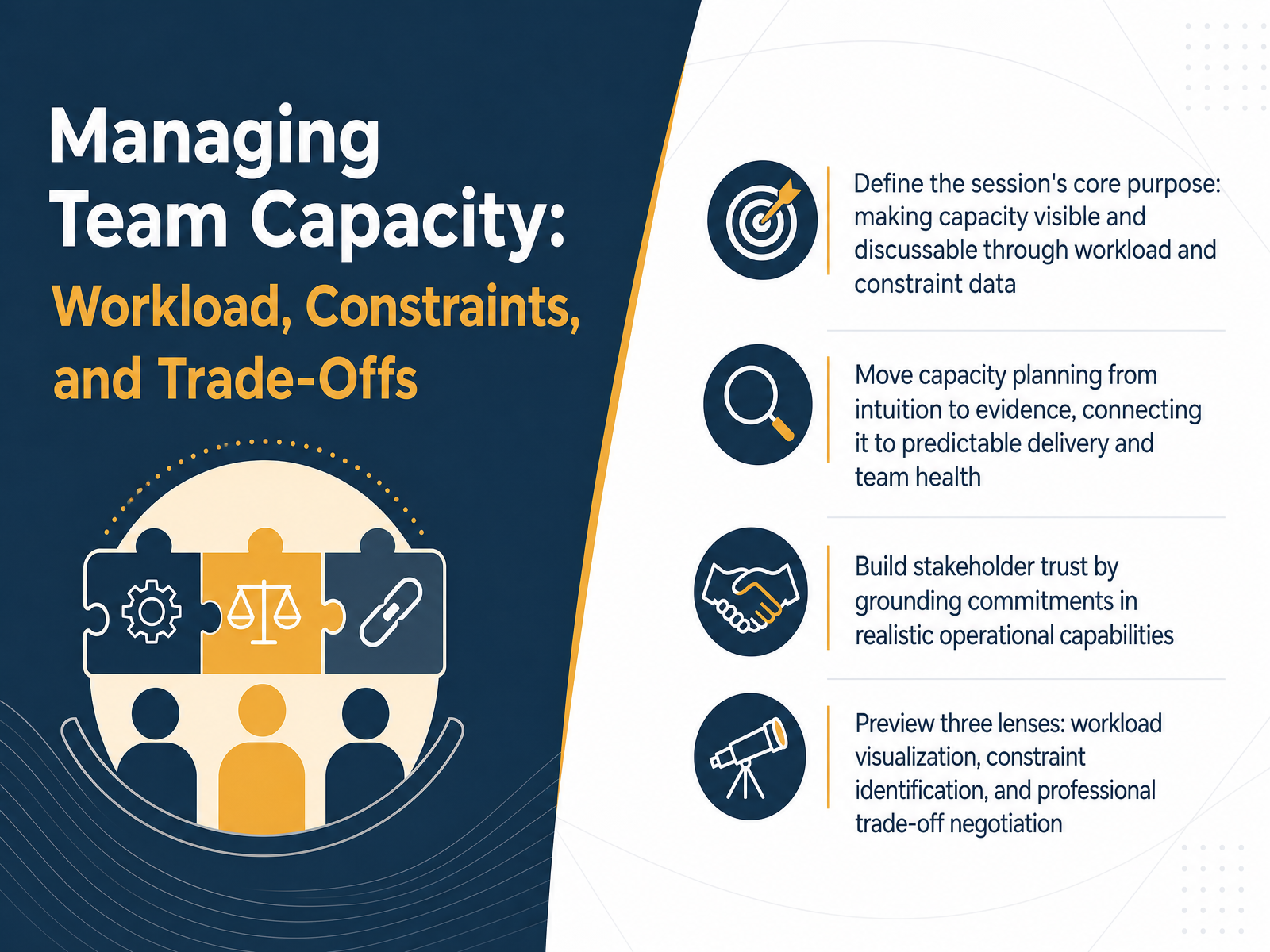
- 01Managing Team Capacity: Workload, Constraints, and Trade-OffsWelcome. Today we are talking about a skill that moves your planning from guesswork to control: managing team capacity through workload, constraints, and trade-offs. Here is what that means for you as a professional making real decisions every day. This session has one core purpose. We want to make your team’s capacity visible and discussable. Not a feeling. Not a hope. We want you to walk away grounding your commitments in numbers. We will cover three practical lenses. First, workload visualization. You will see exactly where your team’s hours are going, including the operational overhead most plans ignore. Second, constraint identification. We will pinpoint the real limits, whether it is a skill gap, a key person overallocated, or missing buffer. Third, professional trade-off negotiation. When demand exceeds capacity, you will have the language to discuss cut scope, adjusted timelines, or added help without scrambling. This is how you build stakeholder trust, protect your team’s health, and deliver on time. Let's get into the real cost of invisible capacity next.toggl.comatlassian.commonday.com+22 min
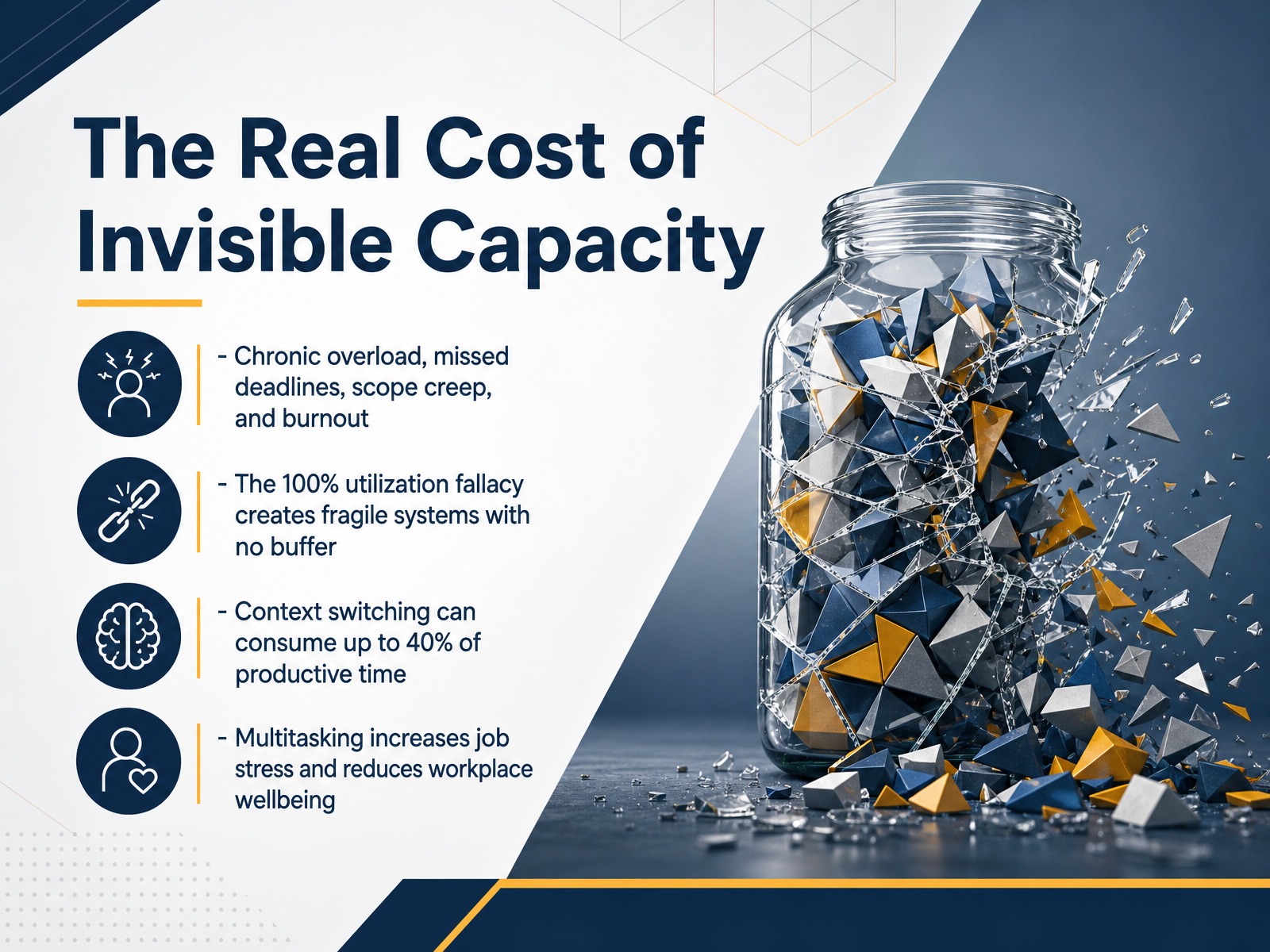
- 02The Real Cost of Invisible CapacityNow let's talk about what happens when capacity stays invisible. You see the same pattern everywhere: chronic overload, missed deadlines, scope that quietly expands while no one pushes back, and burnout. These aren't separate problems. They're symptoms of the same root cause. When you plan to 100 percent utilization, you create a fragile system with no buffer. One sick day, one urgent request, and the whole plan breaks. And here's a number that surprises most leaders: context switching can consume up to 40 percent of productive time. That's nearly half the day lost just to mental gear-shifting, not the work itself. Recent research confirms why this matters. Multitasking doesn't make people faster. It increases job stress and directly reduces workplace wellbeing. The more people switch between tasks, the more time they need just to recover their focus. And we see this in hard data: clinicians handling multiple concurrent conversations logged up to 55 extra minutes of screen time per day. The takeaway is simple. A team running at 95 percent isn't efficient. It's at risk. Invisible capacity isn't flexible. It's expensive. Next, let's define what capacity really means.
 frontiersin.orgjmir.orgte.sfedu.ru+22 min
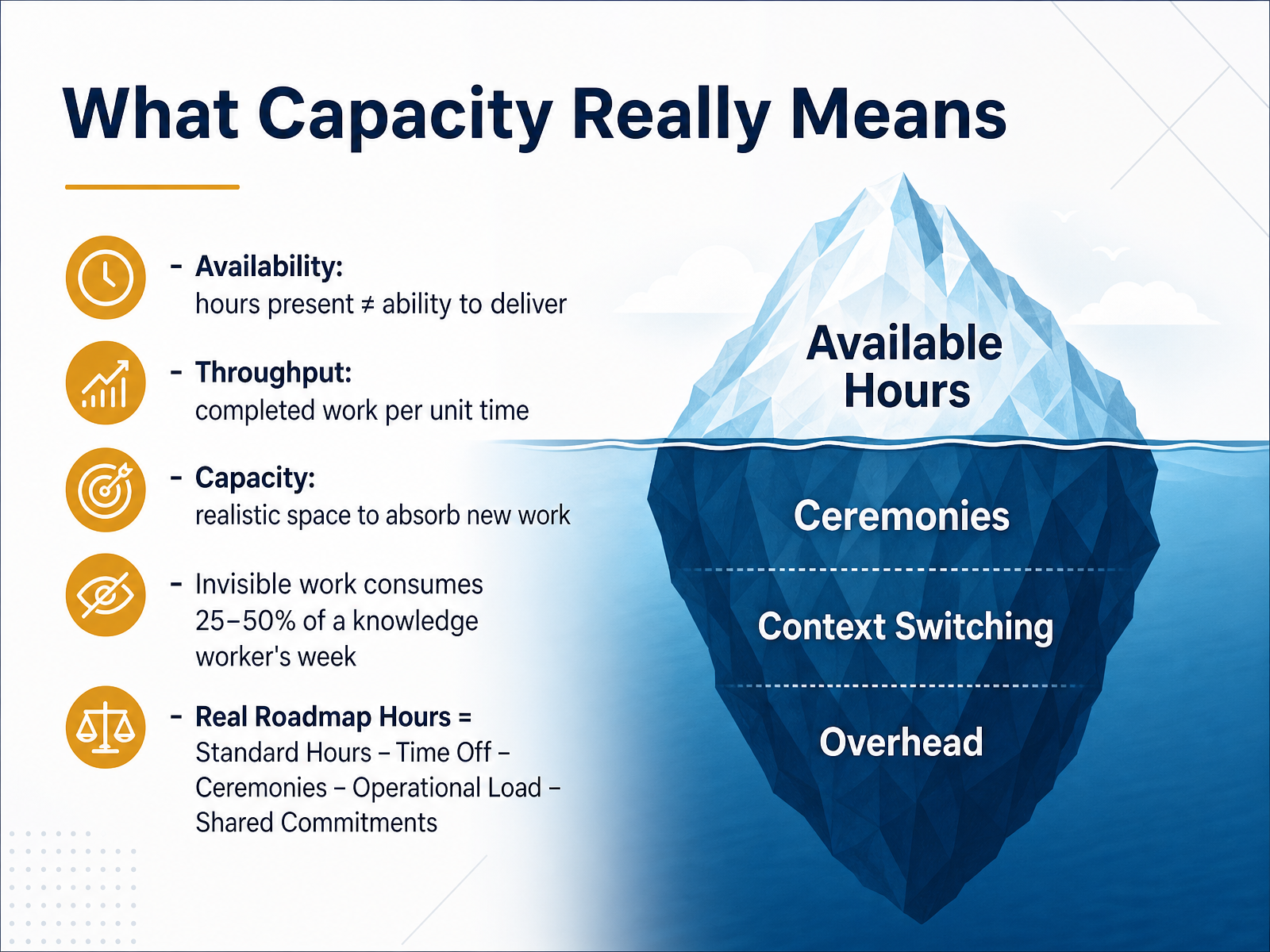
 - 03What Capacity Really MeansLet's get practical about what capacity actually means. First, availability. Just because someone is present for eight hours doesn't mean you have eight hours of delivery time. Throughput is a better measure. It's the work actually completed per unit of time. Capacity is the realistic space left to absorb new work. Here's the part most teams miss. Invisible work. Things like email, internal chats, tool maintenance, and ad-hoc questions. This consumes twenty-five to fifty percent of a knowledge worker's week. So to find your real roadmap hours, take the standard hours. Subtract time off, subtract recurring ceremonies, subtract operational load, and subtract shared commitments. That remainder is your true capacity. Next, we'll make that workload visible.
 1 min
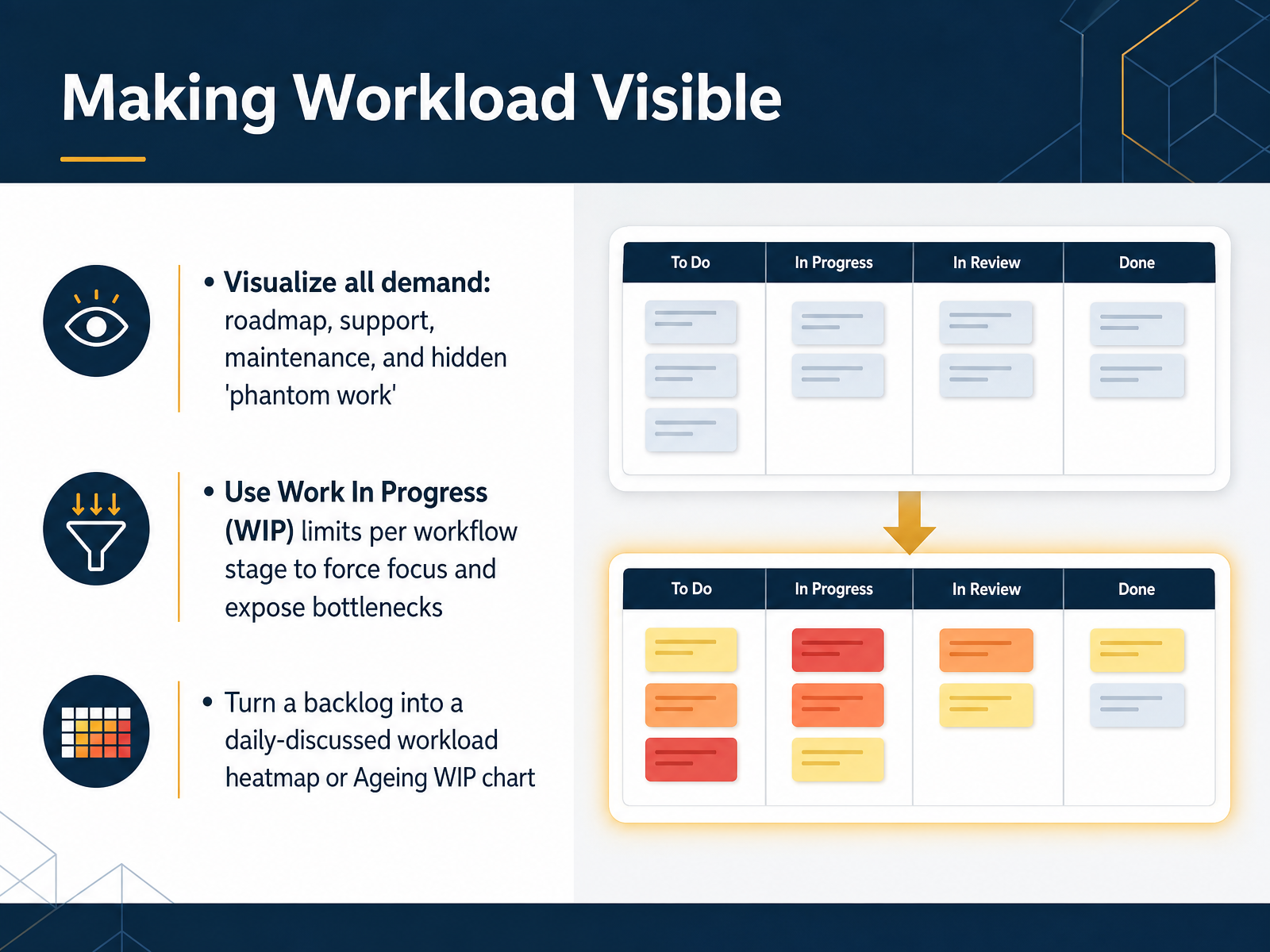
1 min - 04Making Workload VisibleLet's talk about making workload visible. Most teams track their roadmap items, but they miss the real weight they're carrying. We have support tickets, urgent maintenance, and what I call "phantom work"—those unplanned tasks that show up anyway and eat your capacity. Step one is to visualize all of it. Get it out of your inbox and onto the board. Next, use Work In Progress limits. Set a hard cap on how many items can sit in each workflow stage, and enforce it in your tools. When a column hits its limit, your team doesn't start something new. They swarm to clear the bottleneck. This turns your backlog from a wish list into a daily heatmap. You can use an Ageing WIP chart to see which items are creeping past your delivery expectations. That item sitting in development for twelve days with no movement? That's your signal to act. Visibility is what turns hope into a predictable delivery rhythm. Now, let's look at some specific visibility practices inspired by Kanban.
 routine.coatlassian.comblog.mikebowler.ca+21 min
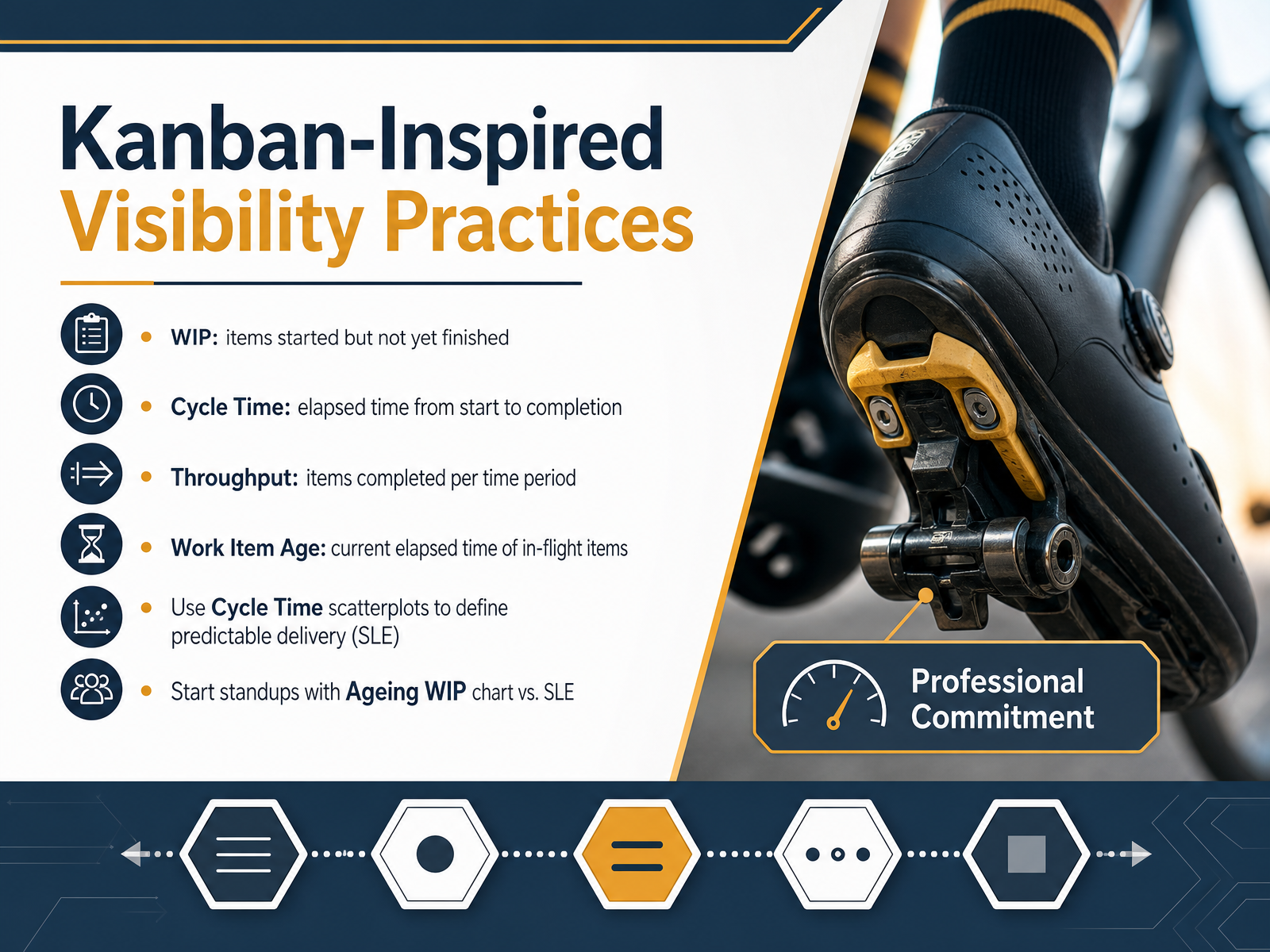
 - 05Kanban-Inspired Visibility PracticesLet's bring this to life with practices inspired by Kanban. These five metrics give your team a shared language for capacity. First, work in progress, or WIP. This is the count of items your team has started but not yet finished. It’s your most honest signal of current load. Second, cycle time. That’s the total elapsed time from when work starts to when it’s truly done. Third, throughput. Simply put, it’s how many items your team finishes per week or per sprint. And fourth, work item age. This is how long an in-flight item has been active right now. Not the average, the current age. Now, here’s where visibility turns into predictability. You plot your historical cycle times on a scatterplot and draw a percentile line, often the eighty-fifth. That line becomes your service level expectation, or SLE. It tells you what “on time” really means based on your actual data, not a guess. During standups, pull up your aging work in progress chart. Compare every active item against that SLE line. The conversation shifts instantly from status to risk. Now let’s apply this same honest eye to the real constraints blocking that flow.
 1 min
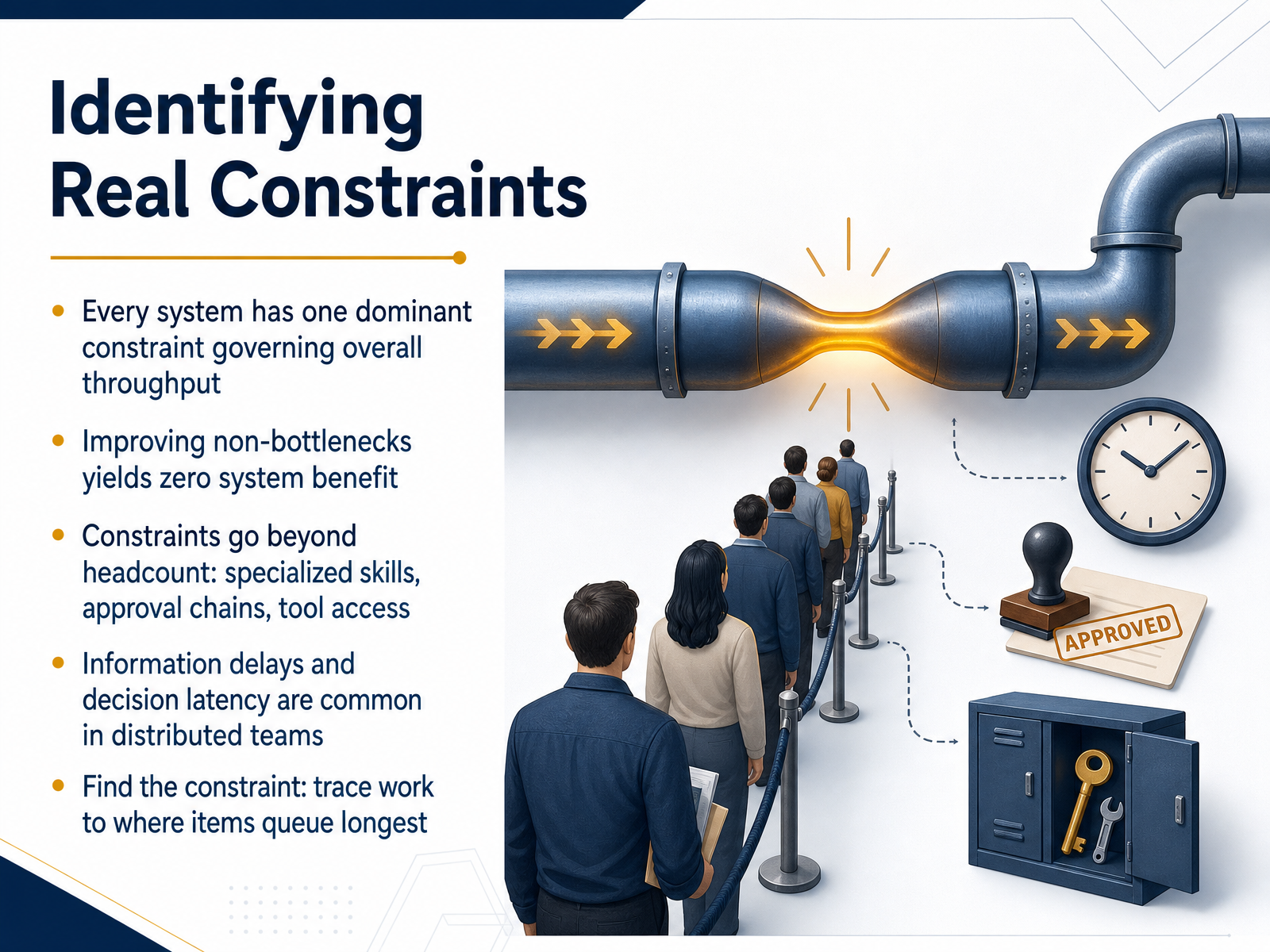
1 min - 06Identifying Real ConstraintsLet's talk about identifying the real constraint in your team's workflow. Here's the core idea. Every system, every team process, has exactly one dominant bottleneck. That single constraint is what ultimately governs your overall throughput. It sets the pace for everything else. So if you improve a non-bottleneck, you'll feel busy, but the system won't move any faster. Zero benefit. You're just piling up work in front of the real choke point. Now, constraints go far beyond a simple headcount problem. Look deeper. It could be one person with a specialized skill that every task must pass through. It could be a slow approval chain where decisions sit for days. Or maybe a critical software license only three people can access. In distributed teams, one of the sneakiest constraints is information delay. Work stalls not because people are overloaded, but because they're waiting for a reply in a different time zone. The queue isn't people. The queue is unanswered questions. To find your bottleneck, physically trace a piece of work from start to finish. Find the step where items pile up and wait the longest. That's your constraint. That's your leverage point. Next, we'll tackle the tricky part: putting numbers on things that feel impossible to measure, in 'Quantifying the Unquantifiable.'
 2 min
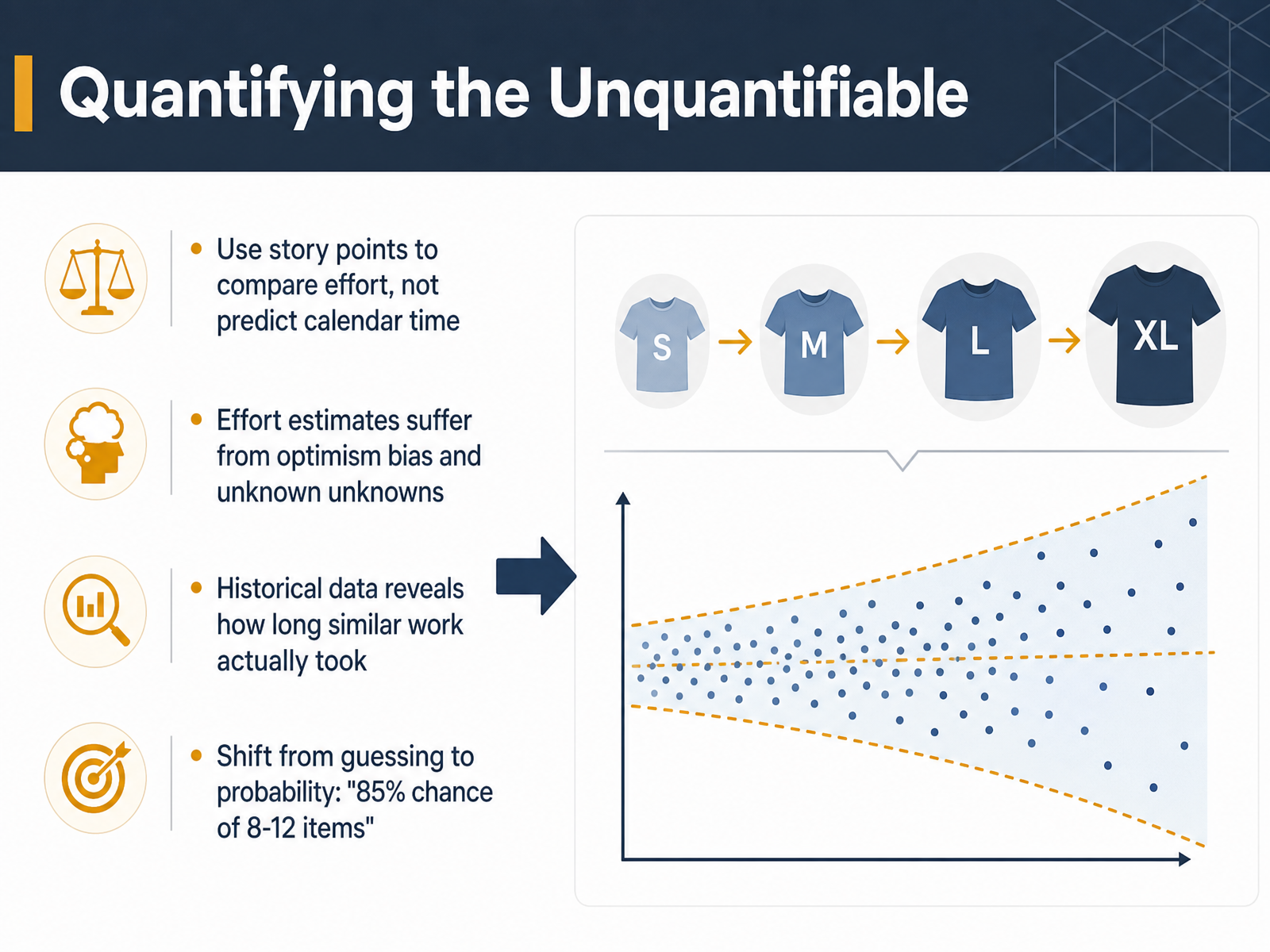
2 min - 07Quantifying the UnquantifiableNow, let's talk about how we can quantify something that feels a bit fuzzy: effort. We're not going to guess calendar dates. Instead, we use story points. A story point is a relative measure. It lets us compare one task to another. Is this feature twice as big as that one? That's a much more stable conversation than asking, 'How many hours will this take?' Because, honestly, effort estimates always have a problem. They suffer from optimism bias. We all think things will go smoothly. And then we hit those unknown unknowns, the surprises we couldn't have seen. So, forget the crystal ball. We use historical data. We look at what actually happened. How long did a task of a similar size really take last quarter? This shifts us from guessing to probability. Now you can say, 'Based on our history, there is an eighty-five percent chance we can deliver between eight and twelve of these items in this sprint.' That’s a confidence level you can build a plan around. Next, let's pull these concepts together and look at the critical trade-offs you have to balance. We'll explore the Trade-Off Triangle of scope, time, and quality.
 2 min
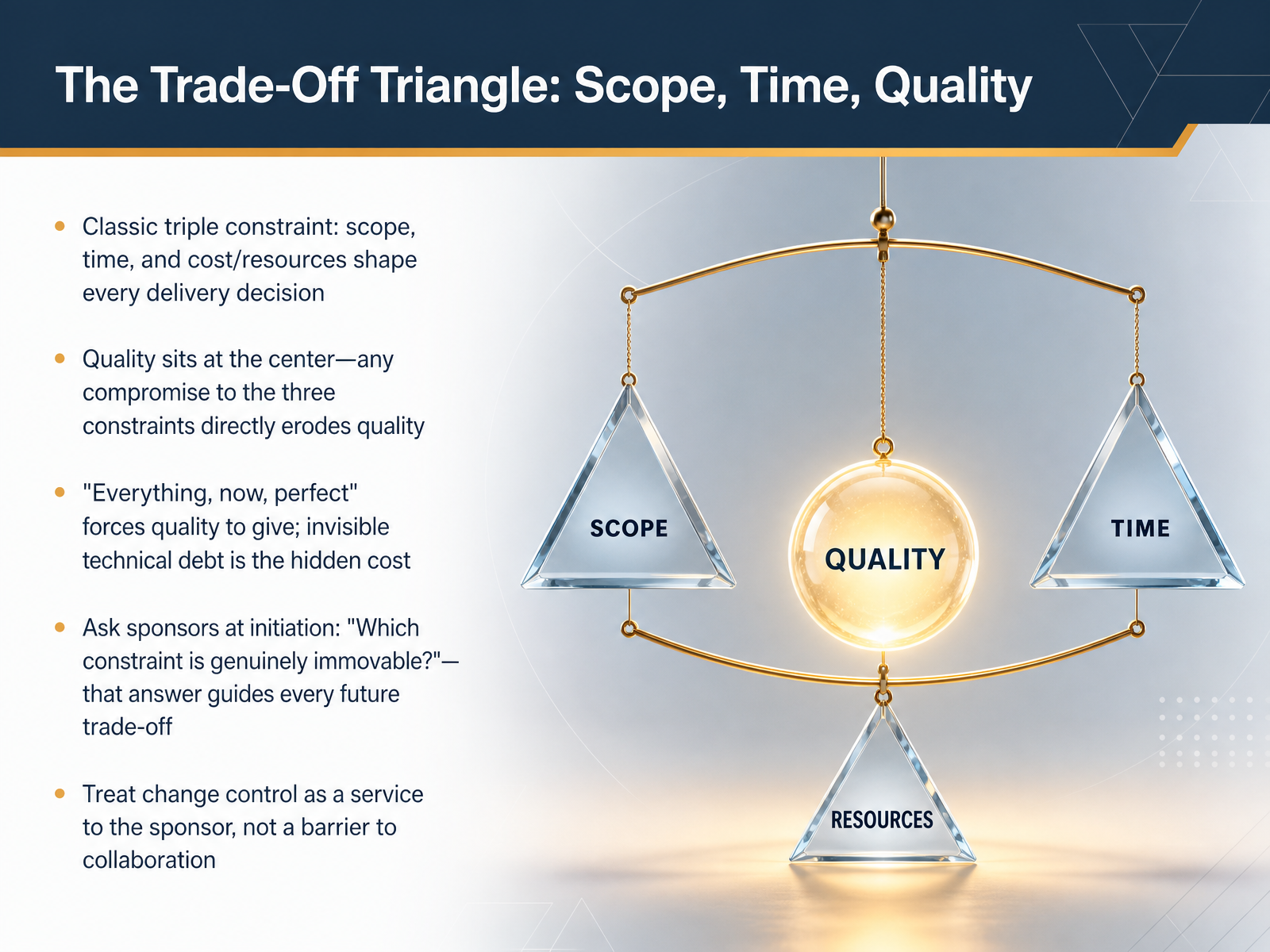
2 min - 08The Trade-Off Triangle: Scope, Time, QualityYou have probably heard the saying, "Fast, cheap, good—pick two." This is the classic triple constraint at work. Scope, time, and cost define every delivery decision. Quality sits right in the center, and if you compromise any one of those three constraints, quality is what gets eroded. The hidden cost is technical debt—deferred work that silently builds up and slows your team down later. As a PM, your job is to make these trade-offs visible. When a sponsor says, "I need everything, now, and perfect," that forces quality to give. So, early on, ask one simple question: "Which constraint is genuinely immovable?" That answer becomes your guide for every future trade-off. From there, treat change control as a service. You are not building a barrier to collaboration; you are helping the sponsor see the real cost of a change before they commit to it. Now, a big part of doing that well comes down to how you frame the conversation. Let's look at framing "no" as a professional trade-off discussion.
 coderslingo.compmctraining.compon.harvard.edu+22 min
 - 09Framing 'No' as a Professional Trade-Off DiscussionLet’s talk about one of the hardest moments for any team—saying no. But here’s the shift. You’re not refusing work. You’re framing a professional trade-off discussion. Scope negotiation means proposing alternatives and making the trade-offs explicit. So instead of a flat no, you say, “If we add this, we’ll need to drop that or extend the timeline.” Here is a concrete example: “We can deliver on time by descoping the reporting module. Is that acceptable?” The key is to present an option menu. You might define a Lean path, a Standard path, and a Full path, each with clear scope and time implications. This lets stakeholders choose with full awareness of the consequences. You are not the roadblock. You are the guide who makes the cost of every choice visible. Next, we’re going to look at how to put that into practice with the power of visible trade-offs.
 coderslingo.compmctraining.compon.harvard.edu+22 min
 - 10The Power of Visible Trade-OffsVisible trade-offs protect two things at once: the work itself, and the relationship with your stakeholder. When you make the cost of a change explicit, you stop being the person who says no. You become the person who provides real choices. The stakeholder gains ownership of the decision. Your team gains realistic terms they can actually deliver on. Here's a practical tool for that moment: the forty-eight hour rule. When a request lands, buy yourself time to assess the real impact before you commit. A simple line like, 'I need forty-eight hours to assess this properly before I give you a timeline,' keeps things professional and prevents a casual yes from becoming an unplanned crisis. Finally, frame your change control process as a service to the sponsor, not a barrier. Let them know you want to capture the change properly so it doesn't silently damage the timeline or budget without their sign-off. This keeps the conversation collaborative and the decisions transparent. Next, let's look at common pitfalls and anti-patterns that derail these conversations.
 coderslingo.compmctraining.compon.harvard.edu+21 min
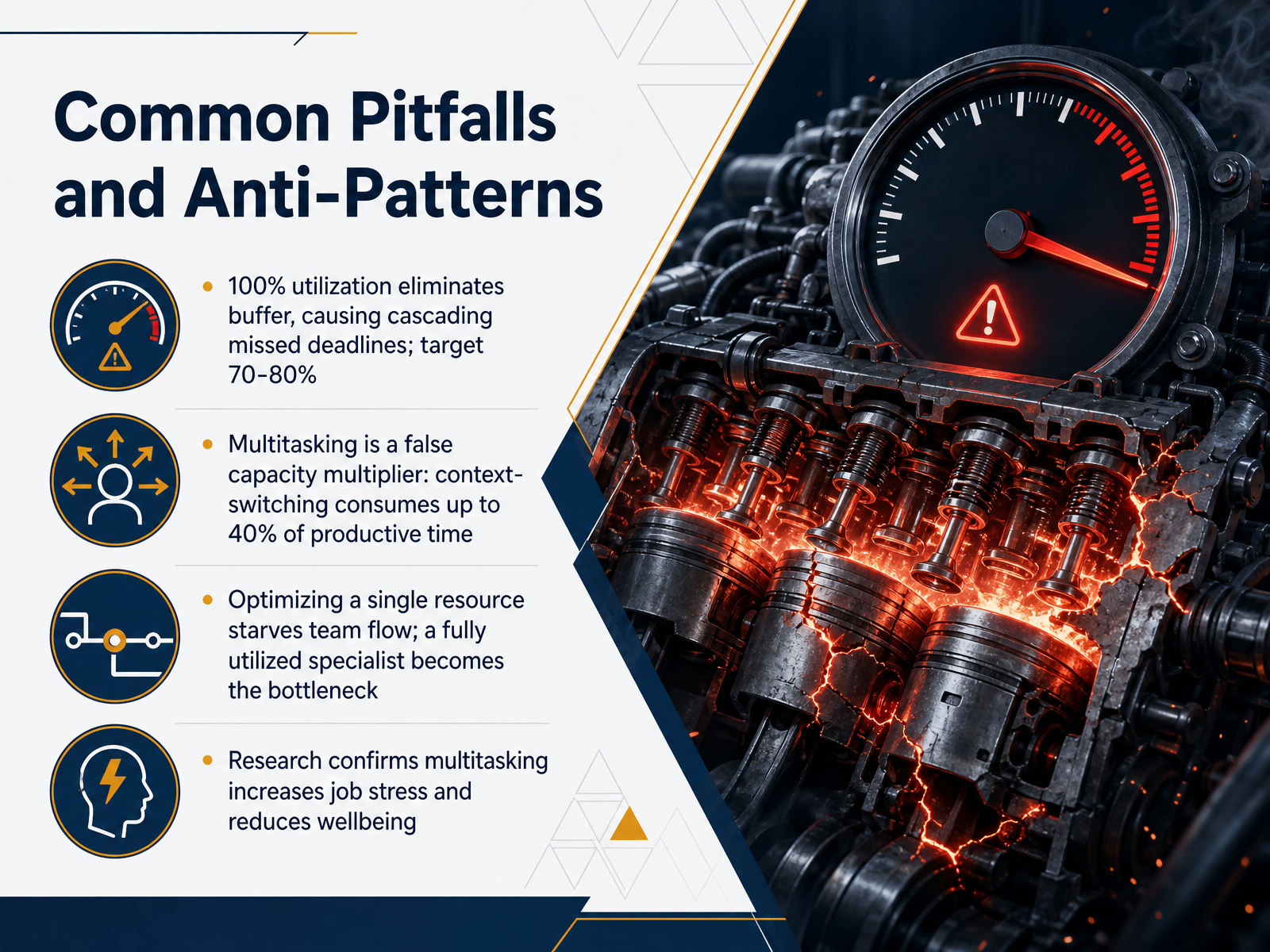
 - 11Common Pitfalls and Anti-PatternsLet's look at the patterns that break capacity plans. First, plan at one hundred percent utilization, and you eliminate every buffer. One sick day or urgent request creates a cascade of missed deadlines. Instead, target around seventy to eighty percent. That twenty percent buffer is not wasted. It is what absorbs the real world. Second, multitasking. Many people treat it as a productivity multiplier. The research is clear: it is not. Context switching can consume up to forty percent of productive time. A large 2025 study found that conversational multitasking alone increased electronic health record time by over fifty minutes per day. Another study confirmed that multitasking raises job stress and reduces wellbeing. The mental reset between tasks drains your team's real capacity. Third, optimizing a single resource starves the whole flow. When a specialist runs at full capacity, they become the bottleneck. No amount of available hours from other team members helps if the work cannot clear that single constraint. In short, capacity planning fails when we plan at one hundred percent, treat multitasking as a benefit, or ignore the bottleneck that a single fully utilized specialist creates. Next, let's talk about facilitating the capacity conversation with your team.
 frontiersin.orgjmir.orgte.sfedu.ru+22 min
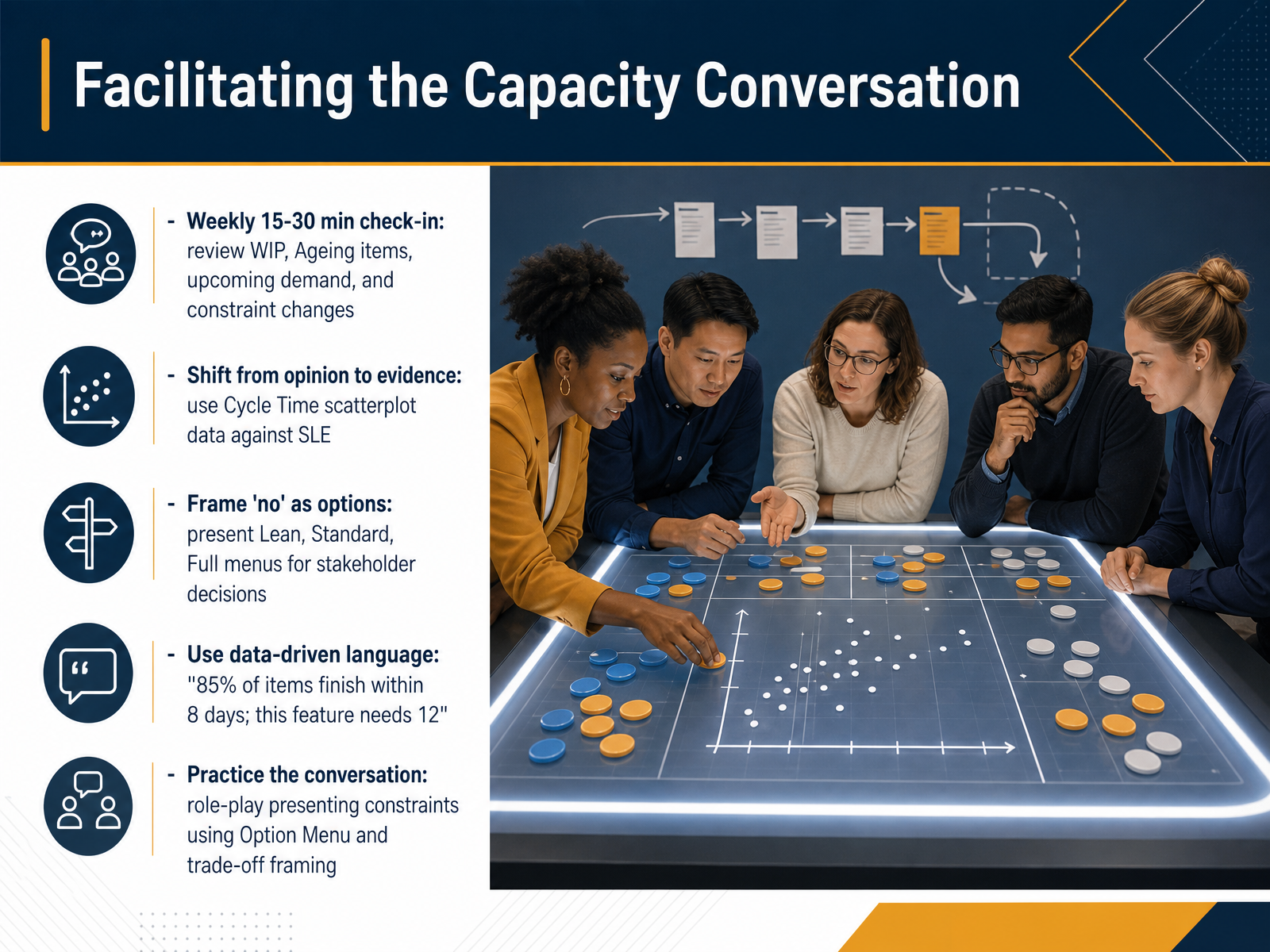
 - 12Facilitating the Capacity ConversationNow, let's talk about the capacity conversation itself—the weekly check-in that keeps everything visible. Keep it short, fifteen to thirty minutes. Review work in progress, items that are aging, upcoming demand, and any changes to your constraints. The goal is to shift the discussion from opinion to evidence. Use your cycle time scatterplot and compare the data against your service level expectation. When you need to say no, frame it as a set of options. Present a Lean, Standard, and Full menu so stakeholders can make the decision. Use data-driven language. Instead of saying something will take a while, say, "Eighty-five percent of items finish within eight days, and this feature needs twelve." That changes the conversation completely. Finally, practice this. Role-play presenting constraints using the option menu and trade-off framing before you need it in a heated moment. Next, we'll look at closing capacity gaps with the Buy, Build, Borrow, and Bot framework.
 coderslingo.compmctraining.compon.harvard.edu+22 min
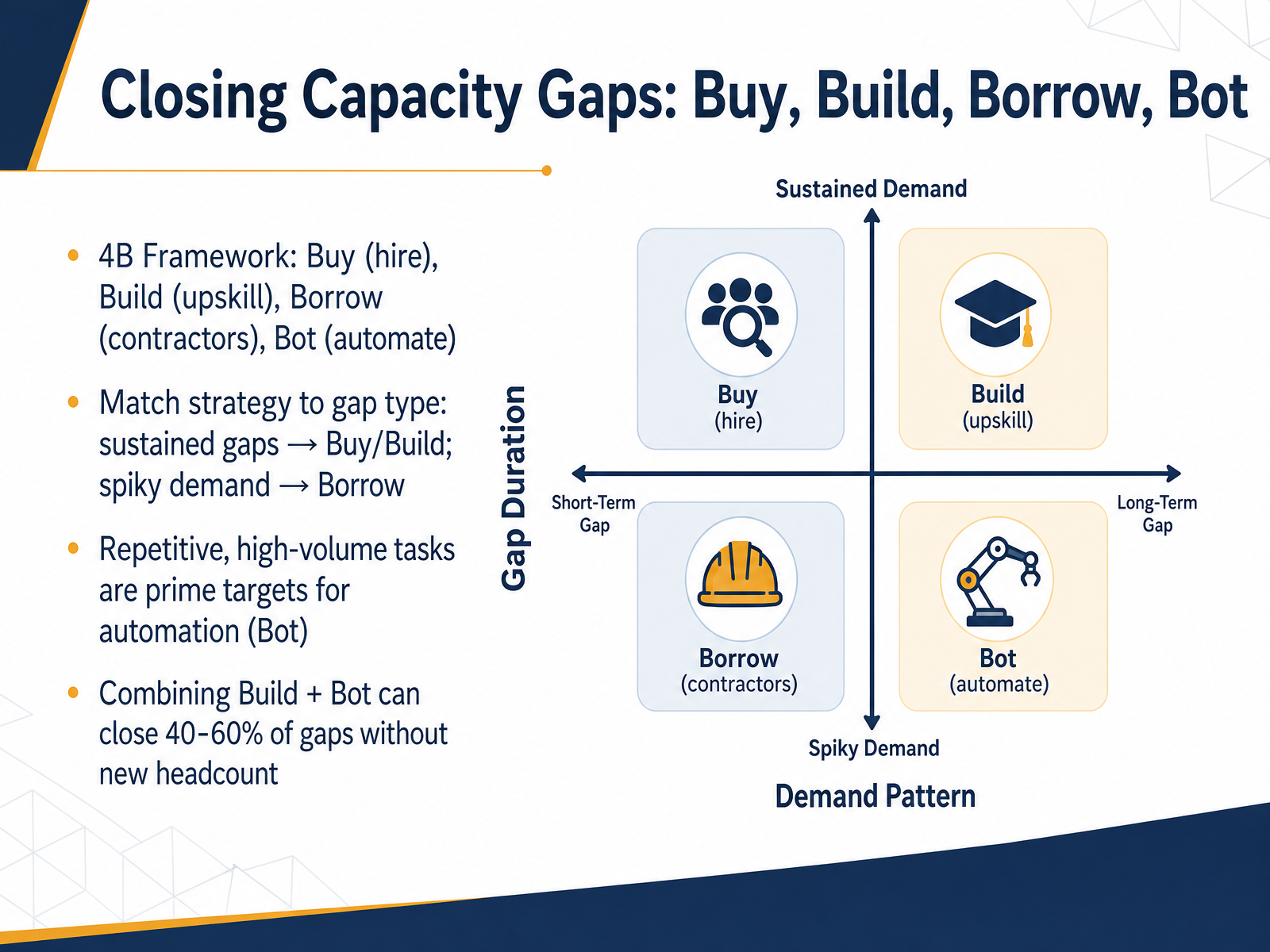
 - 13Closing Capacity Gaps: Buy, Build, Borrow, BotSo when we find a capacity gap, we have four main ways to close it. We call this the four B framework. Buy, that is hiring new people. Build, upskilling your current team. Borrow, bringing in contractors or temporary staff. And Bot, using automation to handle work without adding headcount. The trick is matching the strategy to the type of gap. If you have a sustained, long-term shortage, Buy and Build are your strongest moves. They add permanent capability. If the demand is spiky, a short burst, then Borrow is usually the smarter, faster choice. Now look at the Bot strategy. Repetitive, high-volume tasks are prime targets for automation. These are the activities that eat up hours but don't need complex human judgment every time. One more point. Combining Build and Bot is a powerful play. In many teams, upskilling people and automating the routine stuff together can close 40 to 60 percent of a capacity gap without hiring a single new person. That is real leverage. Let's move on and turn this framework into a concrete plan. From Insight to Action.
 2 min
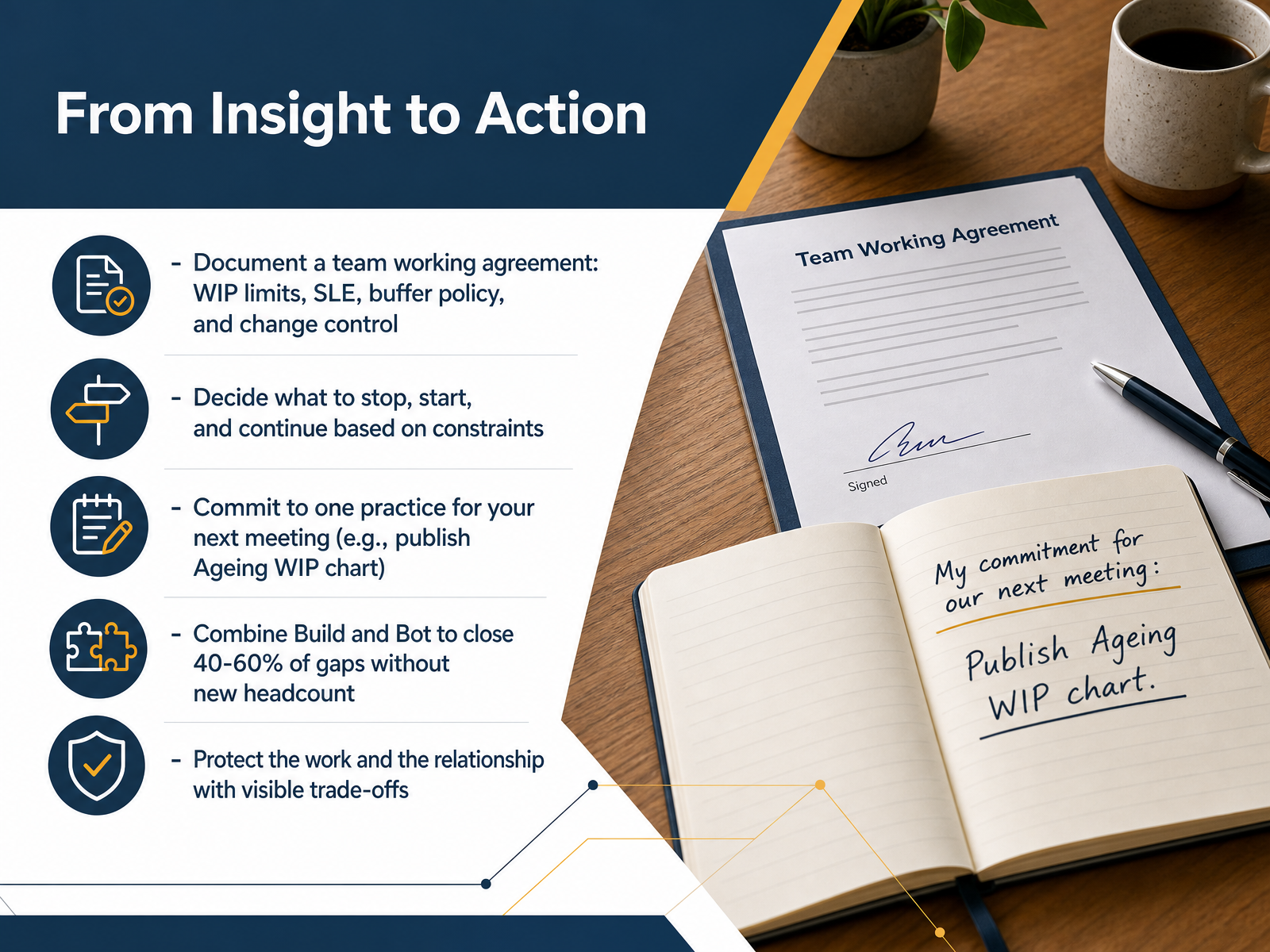
2 min - 14From Insight to ActionSo we have covered the why and the how. Now, let's lock in the action. The move from insight to impact starts with a single, concrete step. First, document a team working agreement. Write down your work-in-progress limits, your service level expectation, your buffer policy, and your change control process. This document is your shared reality. Second, make three lists. What will you stop doing? What will you start? And what will you continue, based on your visible constraints? These lists protect your team's focus. Third, pick one practice for your very next meeting. It could be publishing an aging work-in-progress chart for everyone to see. Do not overhaul everything overnight. Just commit to one visible change. Fourth, combine two strategies to close gaps. Build your people's skills, and bot, or automate, the repetitive work. Together, build and bot can close forty to sixty percent of your capacity gaps without a single new hire. Finally, and most importantly, protect both the work and the relationship. Make trade-offs visible. When a stakeholder sees the cost of adding scope to the timeline or quality, you are not saying no. You are giving them a real choice. That is how you build trust and deliver sustainably. Thank you for joining me. Now, go make your team's capacity visible, and lead with clarity.
 coderslingo.compmctraining.compon.harvard.edu+22 min
Take the deck with you
Download this course as a file — free, no sign-up needed.
- PDF handoutEvery slide page, ready to print or share.15 pages · 3.8 MBDownload
- Narrated PowerPointThe deck that presents itself — every slide carries the digital human's narration video.15 pages · 14.5 MBDownload
- PowerPoint slidesThe full deck as a .pptx — open it in PowerPoint, Keynote, or Google Slides.15 pages · 3.7 MBDownload
Free to use in your own training — please keep the PersonWise credit page at the end.
Have your own deck? Turn it into a course
Sources consulted
Web sources consulted while building this course.
- What Is Capacity Planning? A Practical Guide for Teams (2026) — toggl.com
- What is Capacity Planning? A Project Management Guide — atlassian.com
- Capacity Planning: Types, Strategies & Best Practices [2026] — monday.com
- Resource capacity planning: A complete guide for 2026 | ClickTime Resources — clicktime.com
- Capacity Management Best Practices for Engineers | Tempo — tempo.io
- Frontiers | Multitasking and workplace wellbeing: the roles of job stress and job autonomy — frontiersin.org
- Journal of Medical Internet Research - Association Between Conversational Multitasking and Clinician Work Behaviors at a Large US Health Care System: Cohort Study — jmir.org
- The impact of multitasking on labor productivity: An experimental evaluation - TERRA ECONOMICUS — te.sfedu.ru
- Multitasking: does task-switching add to the effect of dual-tasking on everyday-like driving behavior? | Cognitive Research: Principles and Implications | Springer Nature Link — link.springer.com
- From Efficiency to Overload: Examining the Impact of ICT Multitasking on Work Performance and Executive Functions - National Cheng Kung University — researchoutput.ncku.edu.tw
- How to Set Effective Work-in-Progress (WIP) Limits That Prevent Team Overload · Routine — routine.co
- Working with WIP limits for kanban — atlassian.com
- Visualizing WIP limits | Mike Bowler — blog.mikebowler.ca
- How Kanban Improves Team Capacity Allocation for a Better Performance — businessmap.io
- Professional Scrum with Kanban Curing Growing Pains at ambarics | Scrum.org — scrum.org
- How to Negotiate Technical Scope Professionally — English for IT — coderslingo.com
- Scope Creep: How Workplace Negotiation Helps Prevent It | PMC Training — pmctraining.com
- How to Defend Against "Scope Creep" at the Negotiation Table - PON - Program on Negotiation at Harvard Law School — pon.harvard.edu
- Negotiation Effective for Project Managers – Project Management Formula — projectmanagementformula.com
- Why Scope Creep Is a Negotiation Problem | KARRASS - KARRASS — karrass.com