Digital Marketing Strategy: Goals & Tradeoffs
Begin
14 pages · ~28 min
Digital Marketing Strategy: Goals & Tradeoffs
Develop strategic marketing plans by defining goals, making informed choices, and balancing tradeoffs in digital channels to drive business success.
What you’ll learn
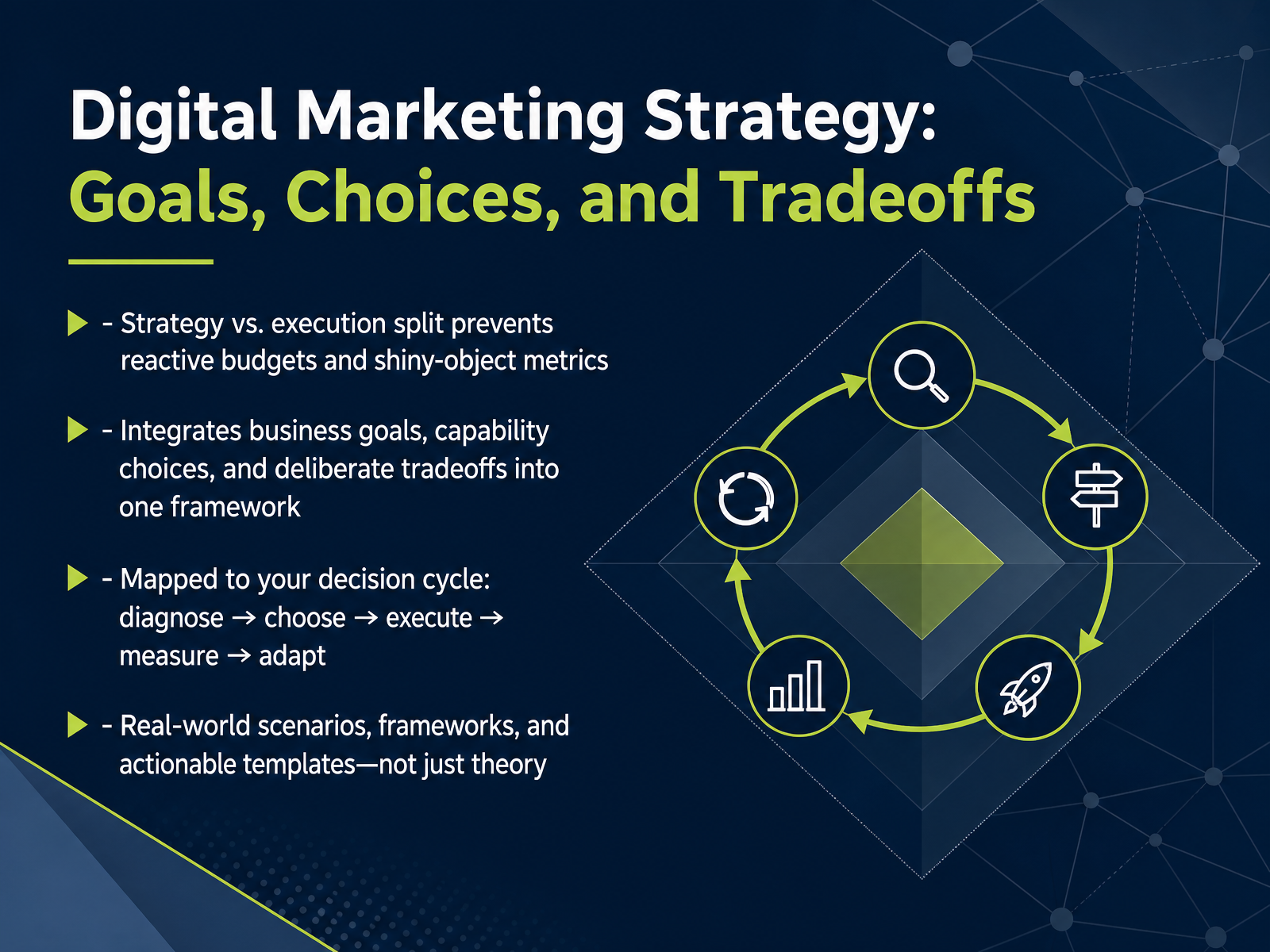
- 01Digital Marketing Strategy: Goals, Choices, and TradeoffsWelcome. I'm glad you're here. This course is about making strategic choices that turn a marketing budget into a growth engine, not just a list of campaigns. Most teams get trapped in reactive execution, chasing metrics that don't connect to revenue. We're going to fix that by separating strategy from execution. The goal is a single framework that links your business goals, your capability choices, and the deliberate tradeoffs you make. We'll follow your real decision cycle: diagnose, choose, execute, measure, and adapt. Everything here is built for real-world constraints. You'll get frameworks, scenarios, and actionable templates you can use immediately. This isn't theory. It's a practical planning system for marketing leaders who need to show results. Let's begin by looking at why a strategy-first approach matters and the problems it solves.hbr.orgoctopusmarketing.agencyjam7.com+22 min
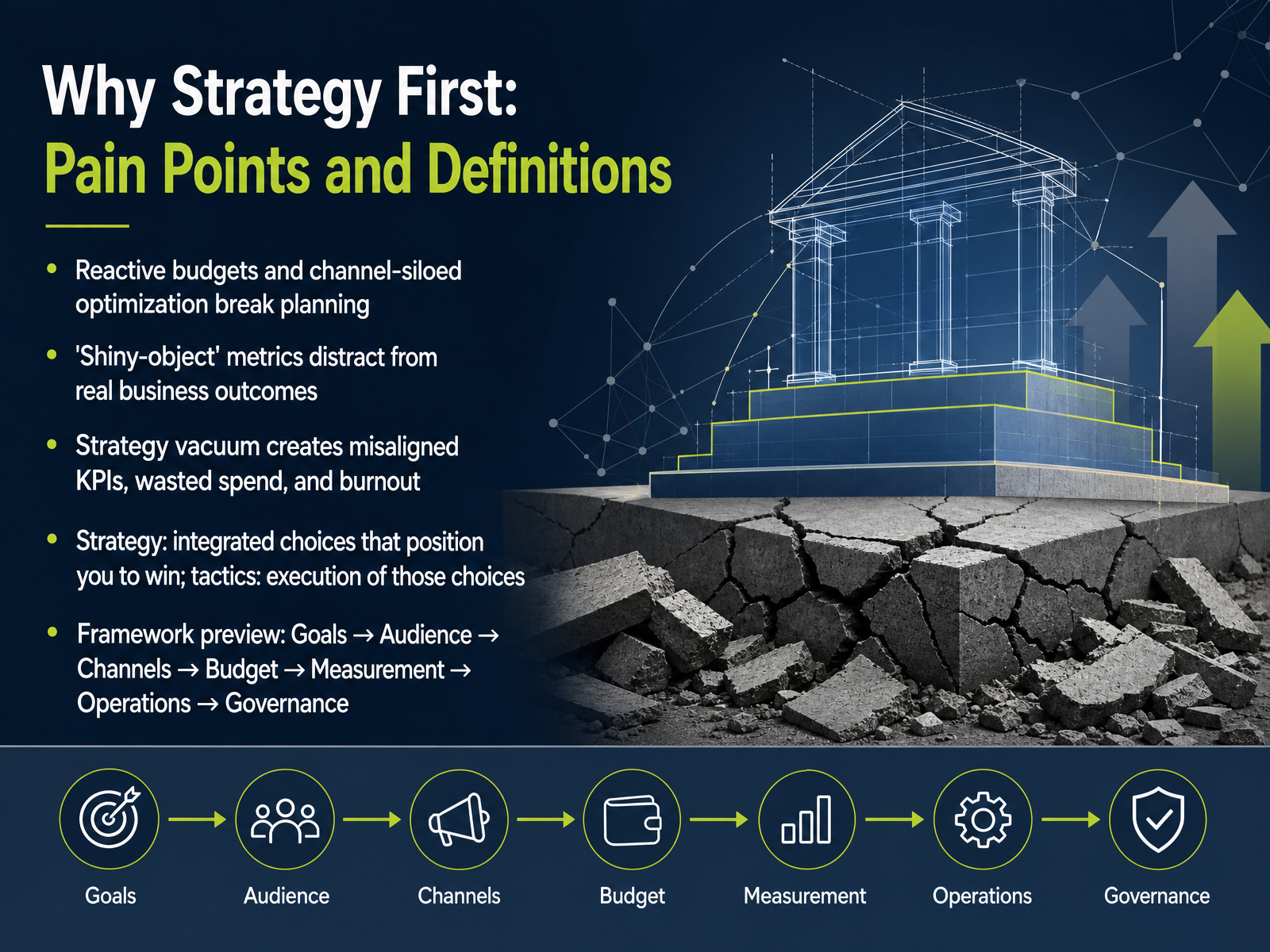
- 02Why Strategy First: Pain Points and DefinitionsLet's look at why starting with strategy isn't a luxury, it's a practical necessity. When planning is driven by reactive budgets or channel-siloed execution, the whole system breaks. Teams get pulled toward metrics that make a channel look good, what some call 'shiny-object' metrics, while real business outcomes get overlooked. That vacuum creates misaligned KPIs, wasted spend, and ultimately, team burnout. So let's define our terms. Strategy is the integrated set of choices that positions you to win. Tactics are the execution of those choices. To remove the guesswork, we'll use a clear framework. We'll move from Goals, to Audience, to Channels, to Budget, to Measurement, to Operations, and finally to Governance. Each step will clarify the tradeoffs you're really making. Next, we'll anchor this framework where it belongs, by aligning your strategic foundations so business objectives drive your channel goals.
 hbr.orgoctopusmarketing.agencyjam7.com+22 min
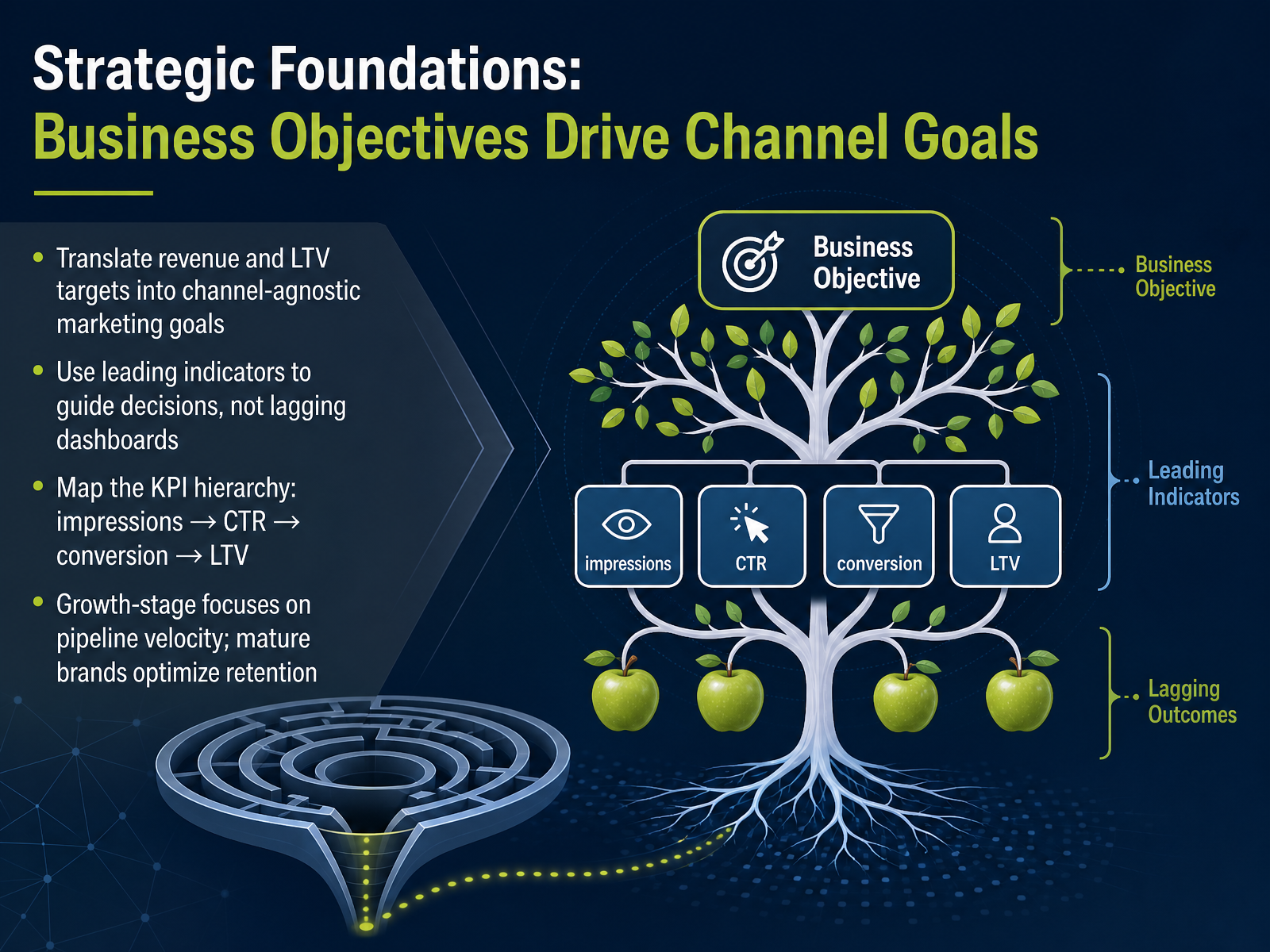
 - 03Strategic Foundations: Business Objectives Drive Channel GoalsLet's connect the dots from business targets down to the channels you actually activate. Your job here is to translate high-level revenue and lifetime value targets into goals that are channel-agnostic first. For example, instead of saying 'we need fifty thousand new installs from paid search,' articulate the real need: 'acquire high-intent users at a cost that aligns with a six-month payback period.' That frees your channel teams to find the best path. Next, prioritize leading indicators over lagging dashboards. A conversion rate change shows you what's happening now, whereas last month's revenue report just confirms what already occurred. To act quickly, map your KPI hierarchy. Start with impressions, then click-through rate, through to conversion, and finally lifetime value. This chain helps you spot exactly where demand is breaking down. And context matters. If you're in a growth-stage company, your immediate lever is pipeline velocity. But if you're leading a mature brand, the stronger bet is to double down on retention and increasing existing customer lifetime value. Align your measurement system with your actual stage of growth, not a generic template. Now, the ability to set these goals effectively depends on how well you segment and understand the people you're reaching. Up next, we'll explore the modern customer decision journey and how your audience and market shape it.
 2 min
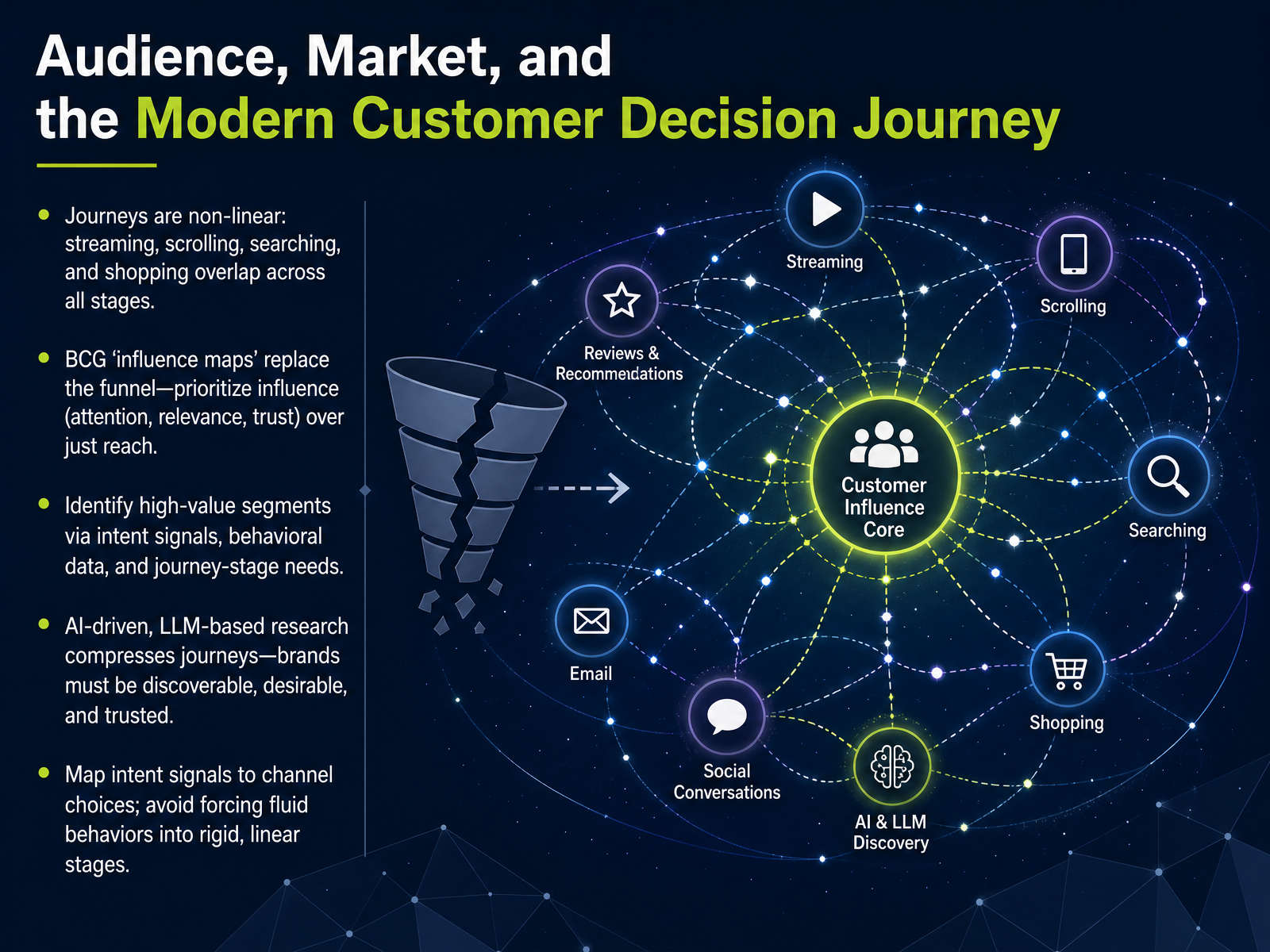
2 min - 04Audience, Market, and the Modern Customer Decision JourneyLet's focus on how today's audiences actually make decisions. The journey is no longer a neat, linear funnel. It's a fluid mix of streaming, scrolling, searching, and shopping that happens all at once. Because of this, our job has shifted from simply maximizing reach, to prioritizing influence. BCG's influence map framework captures this perfectly. Influence is a combination of attention, relevance, and trust. To act on this, we need to identify high-value segments using intent signals and behavioral data, not just demographics. We also have to account for a massive shift in search. AI-driven, LLM-based research is compressing the entire journey. Consumers can now ask a detailed question and get a synthesized, confident recommendation in seconds. For brands, this means we must be consistently discoverable, desirable, and trusted, not just visible. A practical takeaway is to map your key intent signals directly to your channel choices. Avoid the trap of forcing fluid, non-linear behaviors into rigid, linear campaign stages. Next, we will move from understanding the journey to making concrete investment decisions in 'Channel and Capability Choices: Scope, Investment, and Sequencing.'
 bcg.combusiness.google.combusiness.google.com+22 min
 - 05Channel and Capability Choices: Scope, Investment, and SequencingNow, let's move from strategy into execution. Choosing channels and building capabilities isn't about what's trendy. It's about where your audience actually is, and where you can clearly measure return. Think practically: build internal skills where they create a competitive advantage. Buy or partner for everything else, especially specialized data and martech functions. A common mistake is chasing new platforms too early. Before you diversify, double down on the channels that are already working. Prove they've hit a point of diminishing returns. And when you do plan the build-out, be honest about your resources. Map capability timelines against realistic benchmarks. If a new skill requires two dedicated hires over six months, don't plan for one generalist to do it in three. Now, these choices lead directly to the financial conversation. Let's turn to Budgeting as Strategy: Allocation, Incrementality, and Opportunity Cost.
 basis.comemarketer.comadlibrary.com+21 min
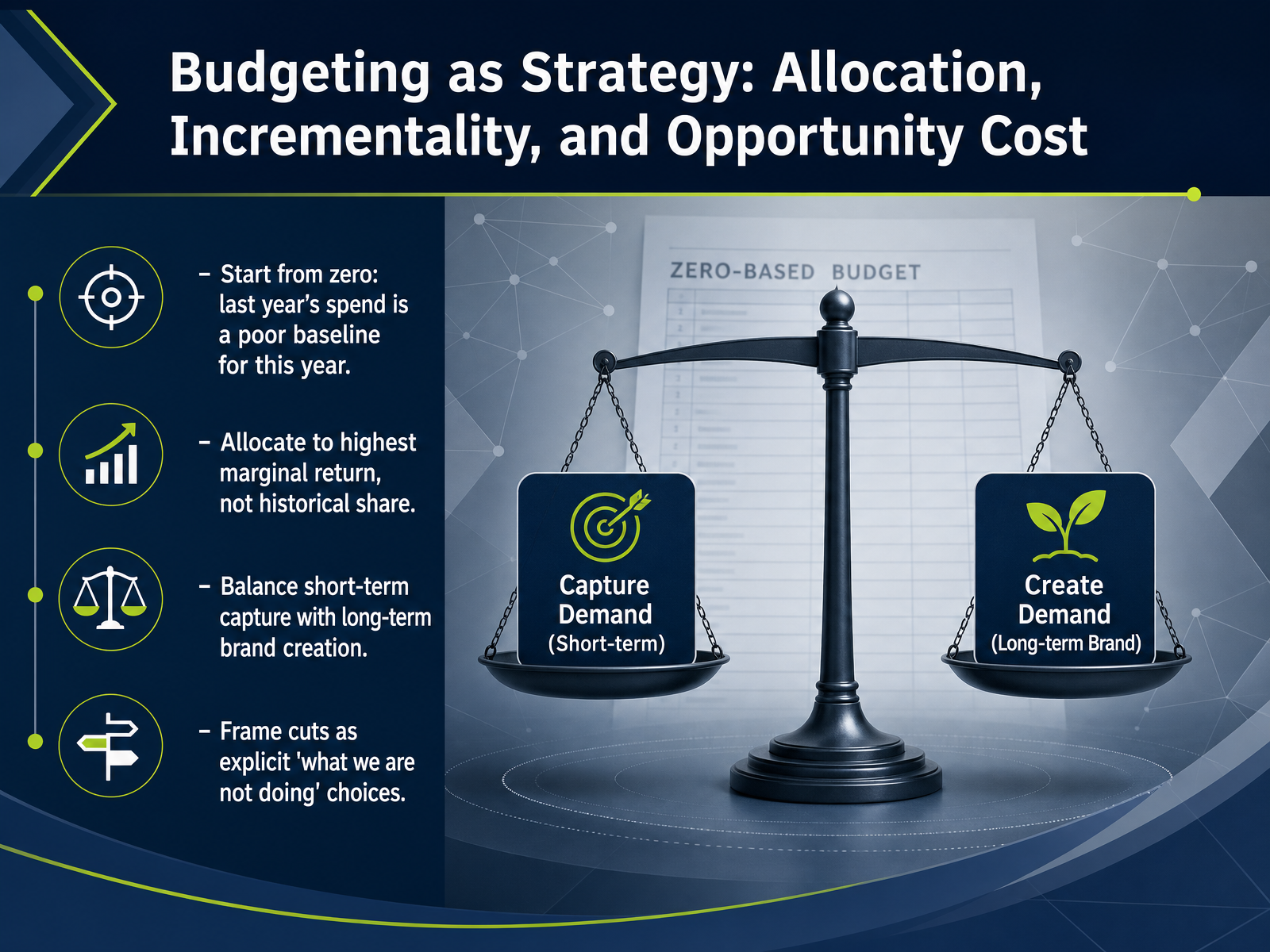
 - 06Budgeting as Strategy: Allocation, Incrementality, and Opportunity CostNow let's talk about where your money actually goes, and more importantly, why. Budgeting isn't a forecasting exercise. It is strategy, made visible. The biggest mistake I see is using last year's spend as a starting point. That just funds inertia. Instead, start from zero. Ask what you would invest in if you were launching today. This forces you to allocate to the highest marginal return, not to historical share. Next, you have to balance the math. Some spend captures demand that exists right now. Other spend creates future demand that doesn't yet exist. Both are necessary, but they compete for the same dollar. Acknowledge that tension directly. And finally, every choice to fund one activity is a choice not to fund another. Frame budget cuts explicitly as what you are choosing to stop doing. Naming the opportunity cost builds alignment and prevents those cuts from quietly creeping back in later. Let's carry that discipline into our next topic: Data, Attribution, and the Measurement Trap.
 hbr.orgoctopusmarketing.agencyjam7.com+22 min
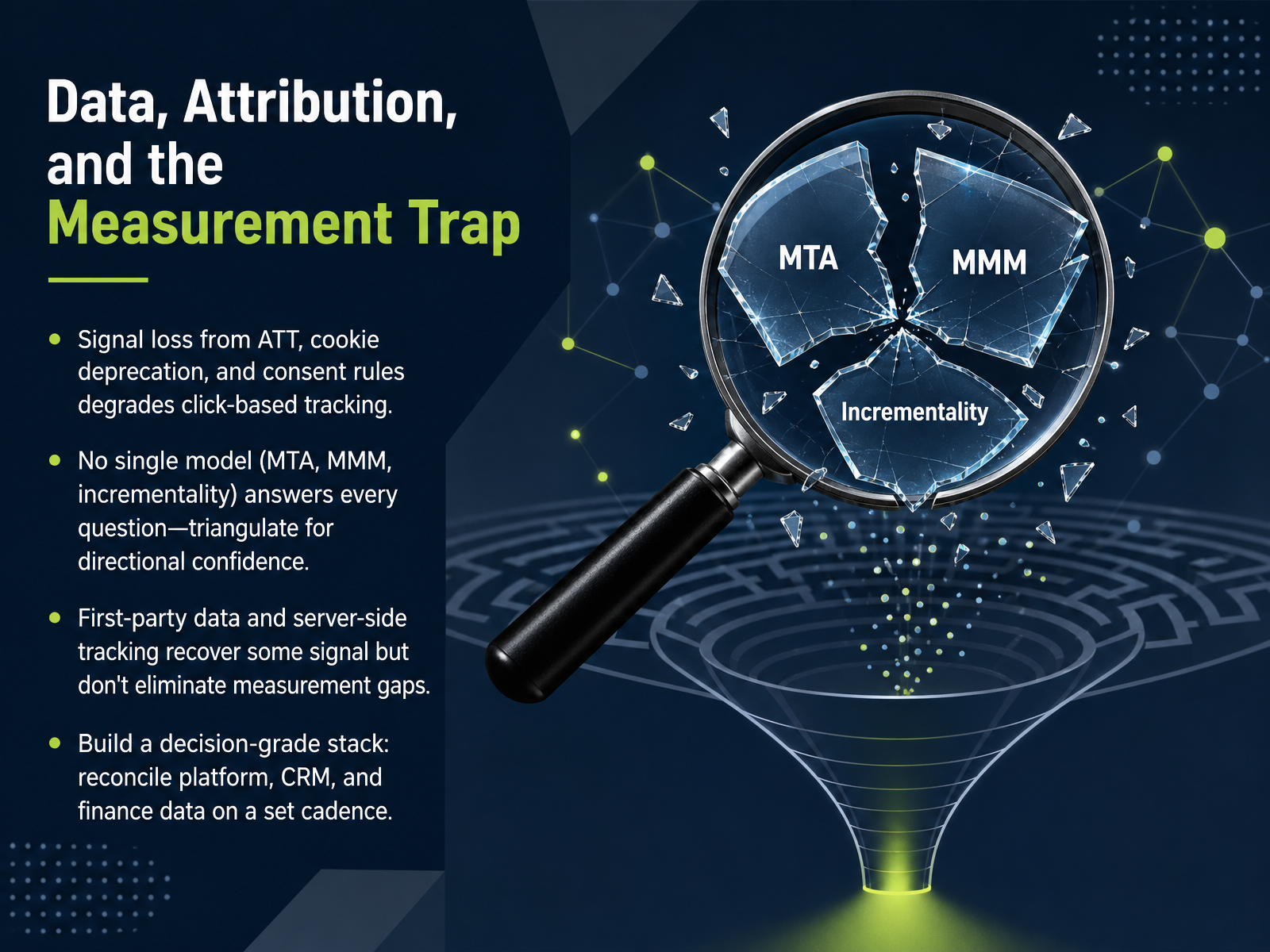
 - 07Data, Attribution, and the Measurement TrapLet's talk about the measurement challenge that clouds most planning conversations now: signal loss and the trap of chasing one perfect number. Privacy rules, consent banners, and platform policies have made click-based tracking far less complete than it was five years ago. The result is that attribution models often overcredit lower-funnel channels while upper-funnel investments look worse in the data. No single methodology—not multi-touch attribution, not marketing mix modeling, not incrementality tests—answers every question on its own. The practical path is triangulation. Use each approach for what it does best and compare them on a set rhythm to build directional confidence. You can recover some signal through first-party data and server-side tracking, but you won't close every gap. What matters is building a decision-grade stack that reconciles platform, CRM, and finance data regularly. That gives you a reliable bridge from marketing activity to business outcomes without pretending the data is perfect. Next, we'll shift from measurement to execution and see how creative and message strategy acts as a force multiplier for the choices you've just set.
 iab.comiab.comarxiv.org+22 min
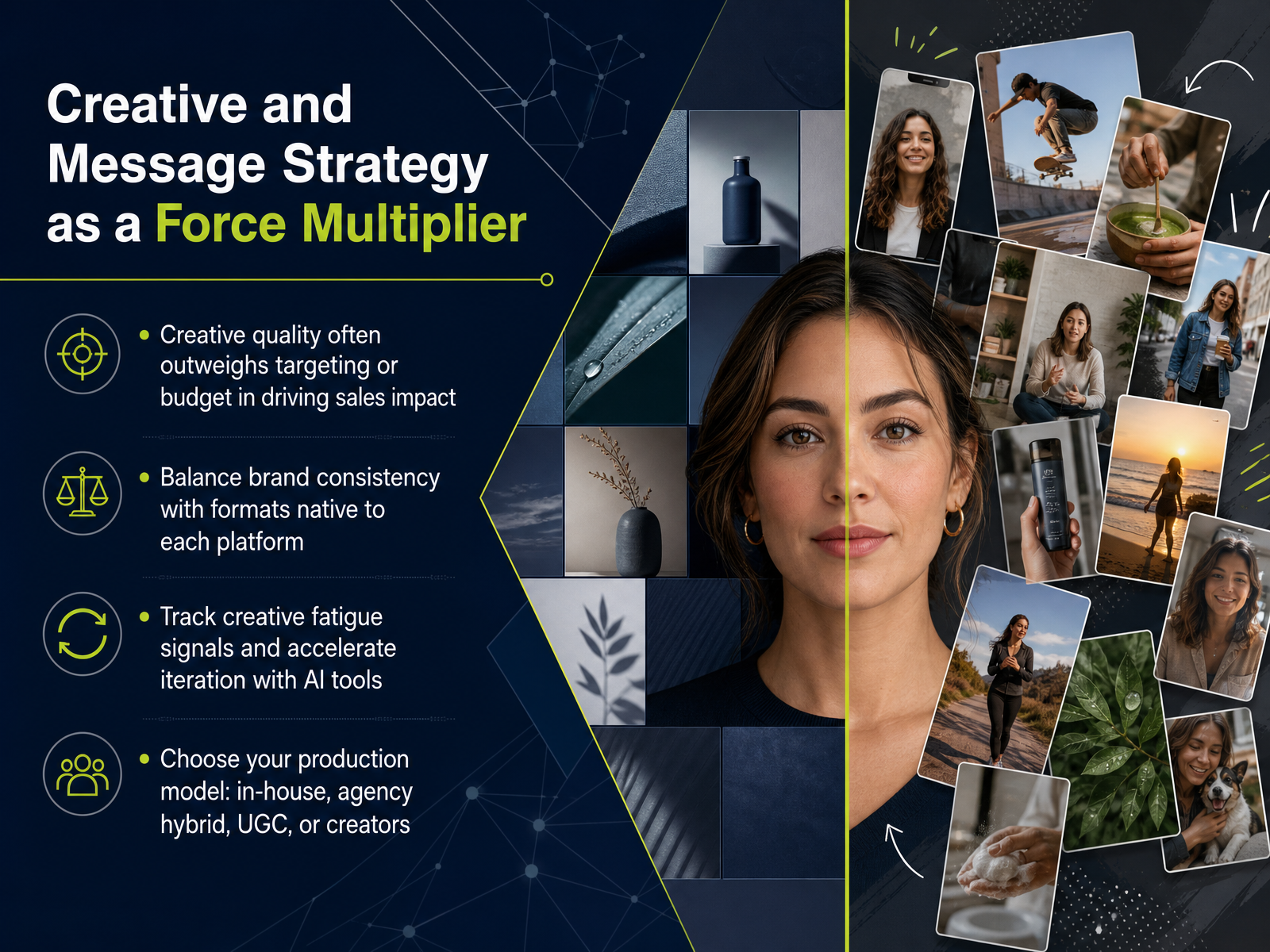
 - 08Creative and Message Strategy as a Force MultiplierLet's turn to creative and message strategy. This is where you convert budget into impact, and often it's the biggest lever you can pull. Research consistently shows creative quality outweighs targeting or even budget when it comes to driving sales. So prioritize the message itself. Next, balance brand consistency with what actually works on each platform. A polished corporate video feels safe, but a lo-fi native post might stop the scroll more effectively. You need to fit the format without losing your visual identity. Also, watch for creative fatigue. Monitor signals like declining click-throughs or rising frequency. When an asset tires, don't just schedule a reshoot. Use AI tools to generate and test fresh variations in days, not weeks. Finally, choose your production model deliberately. An in-house team gives you control. An agency hybrid adds specialized skill. UGC delivers authenticity, and independent creators bring niche influence. Pick the combination that matches your speed and budget constraints. That brings us to execution. Next, we'll align your operating model and team design to actually deliver this strategy.
 2 min
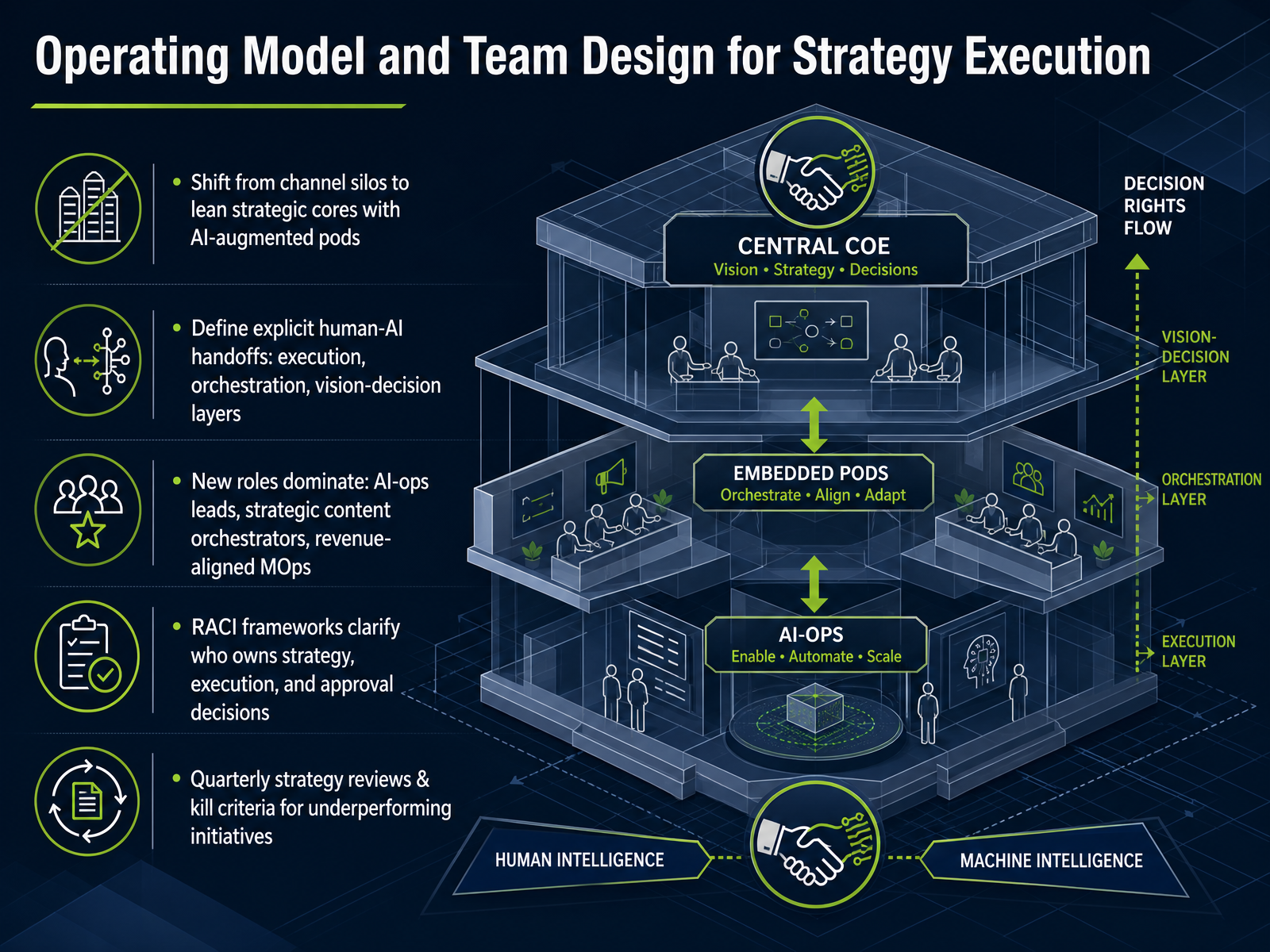
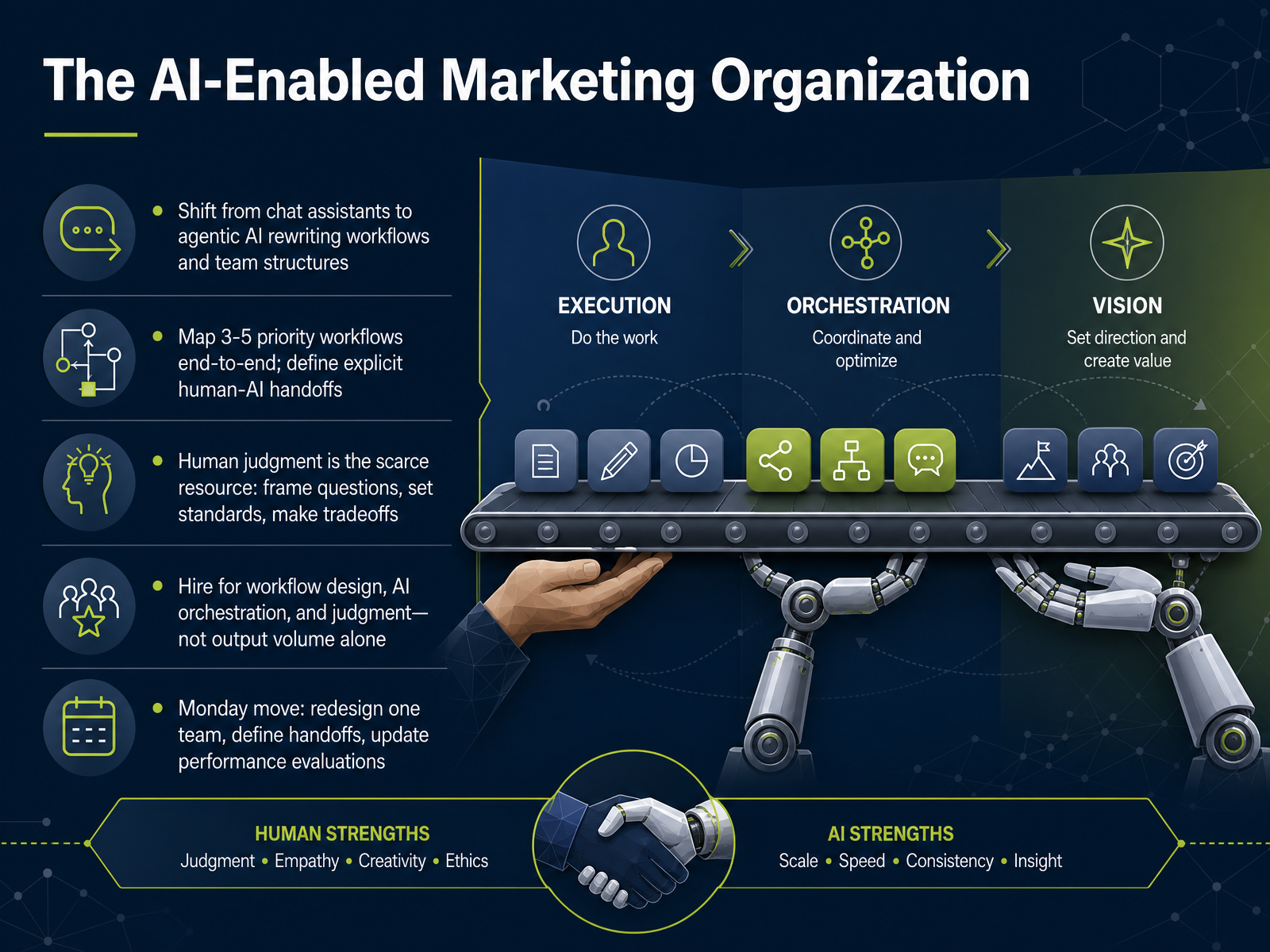
2 min - 09Operating Model and Team Design for Strategy ExecutionNow let's turn to the operating model and team design that make strategy actually work. The shift we're seeing is clear: moving from rigid channel silos to a lean strategic core supported by AI-augmented pods. No more separate teams for search, social, and email each defending their own backlog. Instead, small cross-functional groups own business outcomes end to end. Within this model, you must define explicit human-AI handoffs across three layers. The execution layer, where AI agents handle production at scale. The orchestration layer, where your people supervise workflows, enforce standards, and manage exceptions. And the vision-decision layer, where human judgment sets direction, weighs tradeoffs, and protects the brand. This creates new priority roles. You need AI-ops leads who govern the agentic workflows, strategic content orchestrators who direct quality rather than produce volume, and revenue-aligned marketing operations partners who own pipeline accountability, not just campaign execution. To avoid confusion, implement a RACI framework so everyone knows who is responsible, accountable, consulted, and informed on strategy, execution, and approval. Finally, lock in a quarterly strategy review cadence with clear kill criteria for underperforming initiatives. The goal isn't more activity. It's faster reallocation of budget and talent toward what's working. Next, we'll explore what the AI-enabled marketing organization looks like in practice.
 hbr.orgoctopusmarketing.agencyjam7.com+22 min
 - 10The AI-Enabled Marketing OrganizationLet’s bring this directly into how we organize our teams. Moving from chat assistants to agentic AI isn’t a tech upgrade—it’s an operating model redesign. Instead of layering AI onto old roles, start by mapping just three to five priority workflows end to end. For each stage, define the explicit human-AI handoff. Where does the agent execute, where does a human review, and where does judgment stay fully human? This shift makes human judgment the scarce resource. Your team’s value moves upstream: framing the right questions, setting quality standards, and making the hard tradeoffs. That changes hiring. You’re no longer optimizing for output volume. You need people skilled in workflow design, AI orchestration, and sound judgment. Your Monday move is practical. Pick one team where AI is already changing the work. Redesign that team first. Define the new handoffs, then update performance evaluations to reflect AI supervision and decision quality. Next, we’ll address the governance and ethical tradeoffs that must guide these decisions.
 hbr.orgoctopusmarketing.agencyjam7.com+22 min
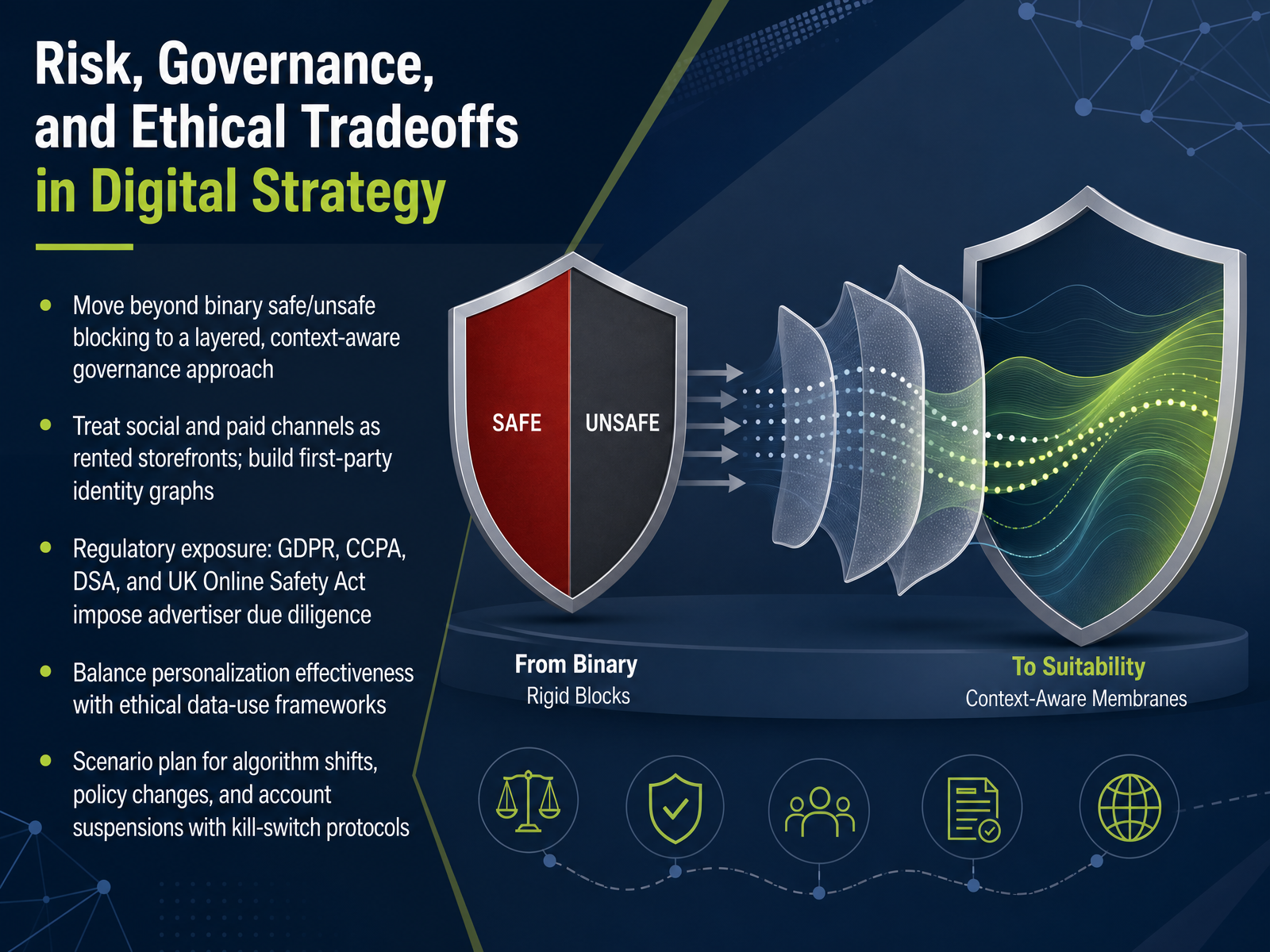
 - 11Risk, Governance, and Ethical Tradeoffs in Digital StrategyNow, let's address the governance and ethical tradeoffs that sit beneath every strategic choice. This isn't about blocking everything labeled unsafe. We need a layered, context-aware approach that separates binary brand safety from the broader, more nuanced brand suitability. Think of your social and paid channels as rented storefronts. You don't own the foot traffic there, which is why building your first-party identity graph is the only real asset you control. On the regulation side, frameworks like GDPR, CCPA, the Digital Services Act, and the UK Online Safety Act are actively pushing due diligence onto advertisers, not just platforms. That means the burden of verification is shifting to you. You'll also need to balance effective personalization with ethical data use, ensuring your targeting doesn't cross into consumer trust erosion. Practically, this all leads to scenario planning. You need kill-switch protocols ready for algorithm shifts and account suspensions, because in this landscape, it's not about if a platform policy changes, but when. Next, let's examine how to build resilience through diversification and platform risk management.
 basis.comemarketer.comadlibrary.com+22 min
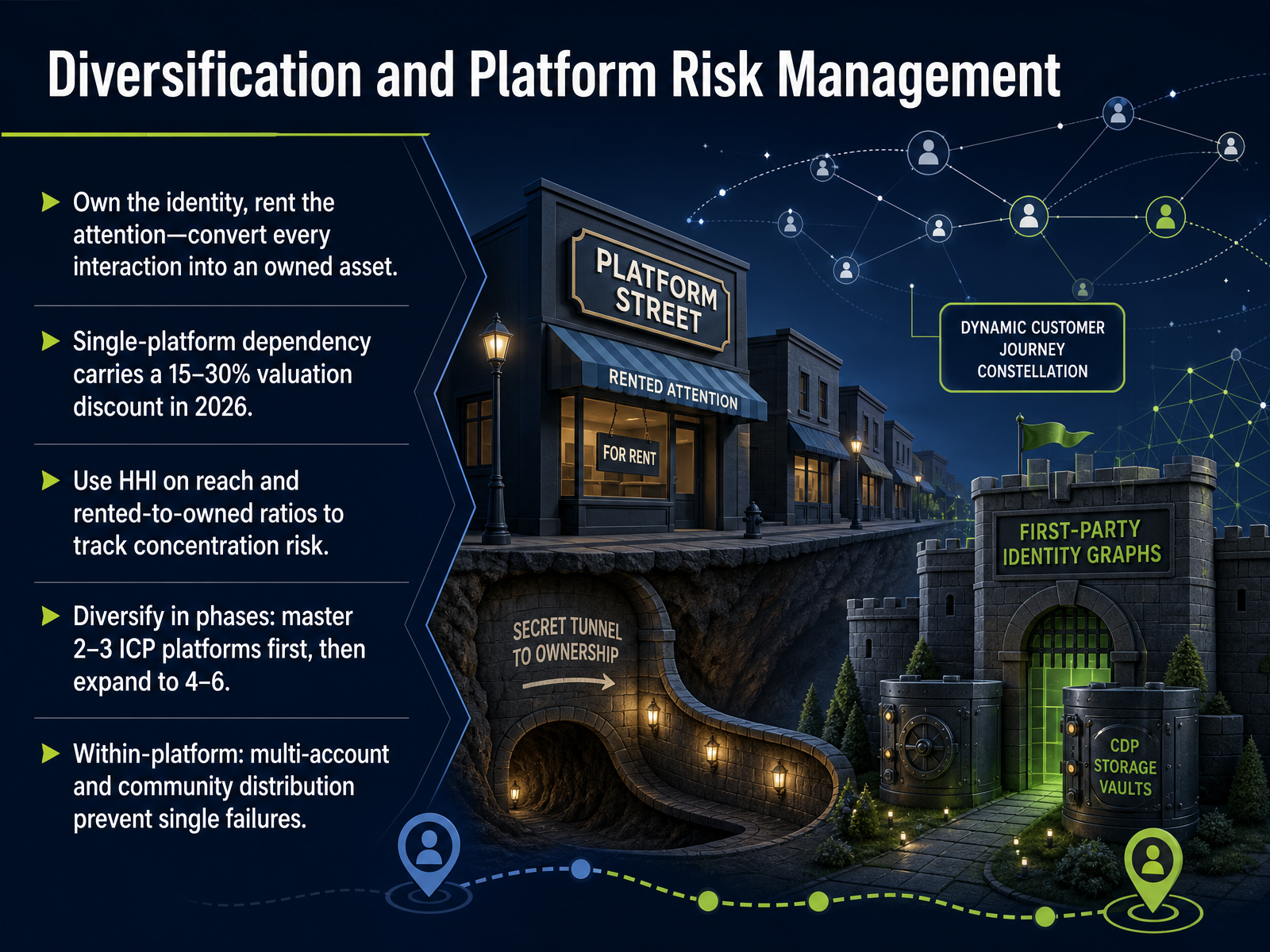
 - 12Diversification and Platform Risk ManagementLet’s move from external market analysis to the internal choices that protect your marketing spend. The guiding principle is simple: own the identity, rent the attention. Every interaction on a rented channel, whether it’s a social feed or a paid placement, should convert into an owned asset like an email address or a first-party profile. That’s how you make platform resilience a structural outcome, not a slogan. As of twenty twenty-six, investors are applying a fifteen to thirty percent valuation discount to companies that depend on a single platform for organic reach. This isn’t theoretical. The TikTok shutdown threat showed how fast concentration risk can materialize. To track it, measure your Herfindahl-Hirschman Index on reach and your rented-to-owned ratio quarterly. Diversify in phases. Master two to three platforms where your ideal customer is most active first, then expand to four to six. And within each platform, use multi-account and community distribution to avoid single points of failure. Up next, we’ll translate these metrics into a decision-grade stack in Measurement Architecture: Building a Decision-Grade Stack.
 basis.comemarketer.comadlibrary.com+22 min
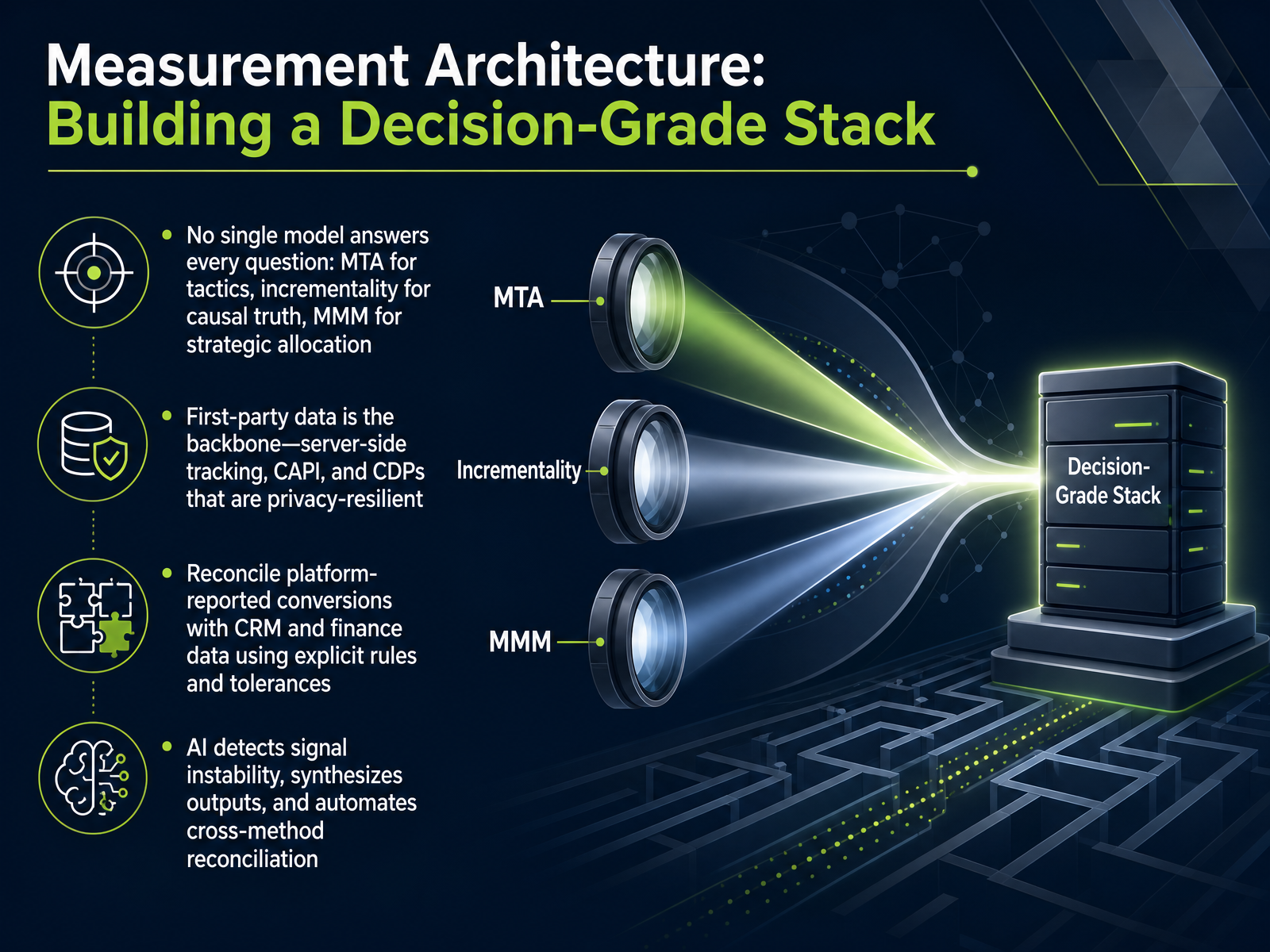
 - 13Measurement Architecture: Building a Decision-Grade StackLet's turn to measurement architecture: what it actually takes to build a stack you can make decisions from. The first principle is that no single model answers every question. You use multi-touch attribution for within-platform tactical signals, incrementality testing for causal truth, and marketing mix modeling for strategic allocation. The goal is not to pick one winner. It's to understand what each lens can see and what it cannot. Now, the backbone that makes all three work is first-party data. Server-side tracking, conversion APIs, and a well-governed customer data platform give you a privacy-resilient foundation that doesn't fall apart every time a browser policy changes. But raw collection isn't enough. You have to reconcile platform-reported conversions with what's in your CRM and finance systems, using explicit rules and documented tolerances. The point isn't to force the numbers to match. It's to build a reliable bridge that signals when something is off. Finally, AI has a practical role here beyond the hype. It's scanning for signal instability introduced by privacy updates, it's synthesizing outputs across your attribution, incrementality, and MMM tools, and it's automating the tedious cross-method reconciliation so your analysts can focus on what to do next rather than debating which number is right. This moves us directly to the final piece: turning all this into an actionable roadmap with documented tradeoffs and stakeholder alignment.
 iab.comiab.comarxiv.org+22 min
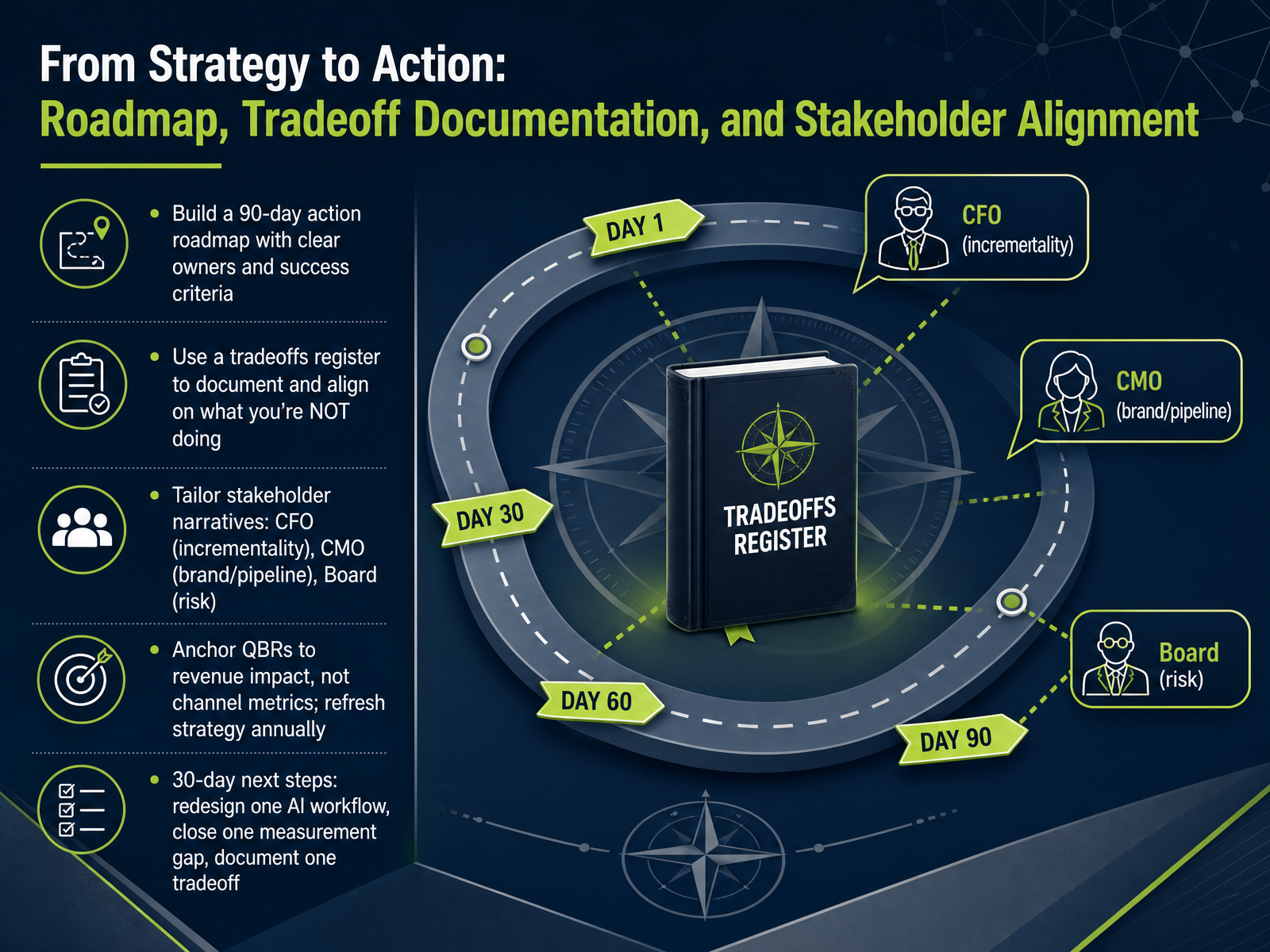
 - 14From Strategy to Action: Roadmap, Tradeoff Documentation, and Stakeholder AlignmentLet's land this with concrete next steps. First, build a ninety-day action roadmap. Name the owner for each initiative and define exactly what success looks like. Second, start a tradeoffs register. This is a simple document that captures what you are choosing not to do, and why. It protects your team’s focus and forces explicit alignment, especially with your CFO and CMO. Tailor those conversations carefully. When you meet with Finance, frame everything around incrementality. For your CMO, connect the choices back to brand and pipeline health. For the Board, frame it as a risk discussion: what bets are you making, and what are you deliberately avoiding? Anchor your quarterly business reviews to revenue impact, not channel metrics. Then refresh the full strategy annually. In the next thirty days, pick three concrete moves. First, redesign one workflow to work fully with an AI agent. Second, close one critical gap in your measurement. Third, document one important tradeoff. Strategy without action is just a document. The market rewards the teams that make clear choices and then execute with discipline. Thank you for taking this course. I look forward to seeing the decisions you make.
 hbr.orgoctopusmarketing.agencyjam7.com+22 min
Take the deck with you
Download this course as a file — free, no sign-up needed.
- PDF handoutEvery slide page, ready to print or share.15 pages · 4.2 MBDownload
- Narrated PowerPointThe deck that presents itself — every slide carries the digital human's narration video.15 pages · 17.3 MBDownload
- PowerPoint slidesThe full deck as a .pptx — open it in PowerPoint, Keynote, or Google Slides.15 pages · 4.2 MBDownload
Free to use in your own training — please keep the PersonWise credit page at the end.
Have your own deck? Turn it into a course
Sources consulted
Web sources consulted while building this course.
- Redesigning Your Marketing Organization for the Agentic Age — hbr.org
- Digital Marketing Team Structure & Roles (2026 Guide) — octopusmarketing.agency
- How to Build a Marketing Team That Scales: The Strategic vs Execution Split — jam7.com
- How CMOs should rewire their AI marketing team - Think with Google — business.google.com
- The New Marketing Team Structure in 2026: SaaS Org Charts — floowitalent.com
- It's Time for Marketers to Move Beyond a Linear Funnel | BCG — bcg.com
- The customer-decision journey and AI search - Think with Google — business.google.com
- Consumer journeys have changed. Find out how the 4S behaviors can redefine your marketing — business.google.com
- Map today’s customer journey with AI - Think with Google — business.google.com
- Mapping Consumer Touchpoints That Influence Decisions | BCG — bcg.com
- Transparent Programmatic Advertising Platforms: A 2026 Guide to Brand Safety and Fraud Protection — basis.com
- Brand Safety 2026 — emarketer.com
- Brand Safety in Paid Social: 2026 Practitioner Guide — adlibrary.com
- Platform Risk Marketing: Own Identity, Rent Attention — houseofmartech.com
- Reconceptualizing Brand Safety in Digital Environments: A Multidimensional Framework | IJRISS — rsisinternational.org
- IAB - State of Data 2026: The AI-Powered Measurement Transformation — iab.com
- IAB State of Data 2026_FINAL_2.2.26 — iab.com
- Privacy-Robust Incrementality Measurement for Advertising Systems under Signal Loss — arxiv.org
- How Has Signal Loss Changed Marketing Measurement — clickz.com
- Post-Cookie Attribution Playbook for 2026 - GrowthMarketer — growthmarketer.com