Begin
14 pages · ~28 min
Design Systems Roadmap Planning
Learn to build a scalable design system roadmap by setting priorities, defining milestones, and communicating effectively with stakeholders.
A digital instructor presents all 14 pages. Hold “Ask” at any point and ask out loud — the answer comes from this course. No sign-up needed.
What you’ll learn
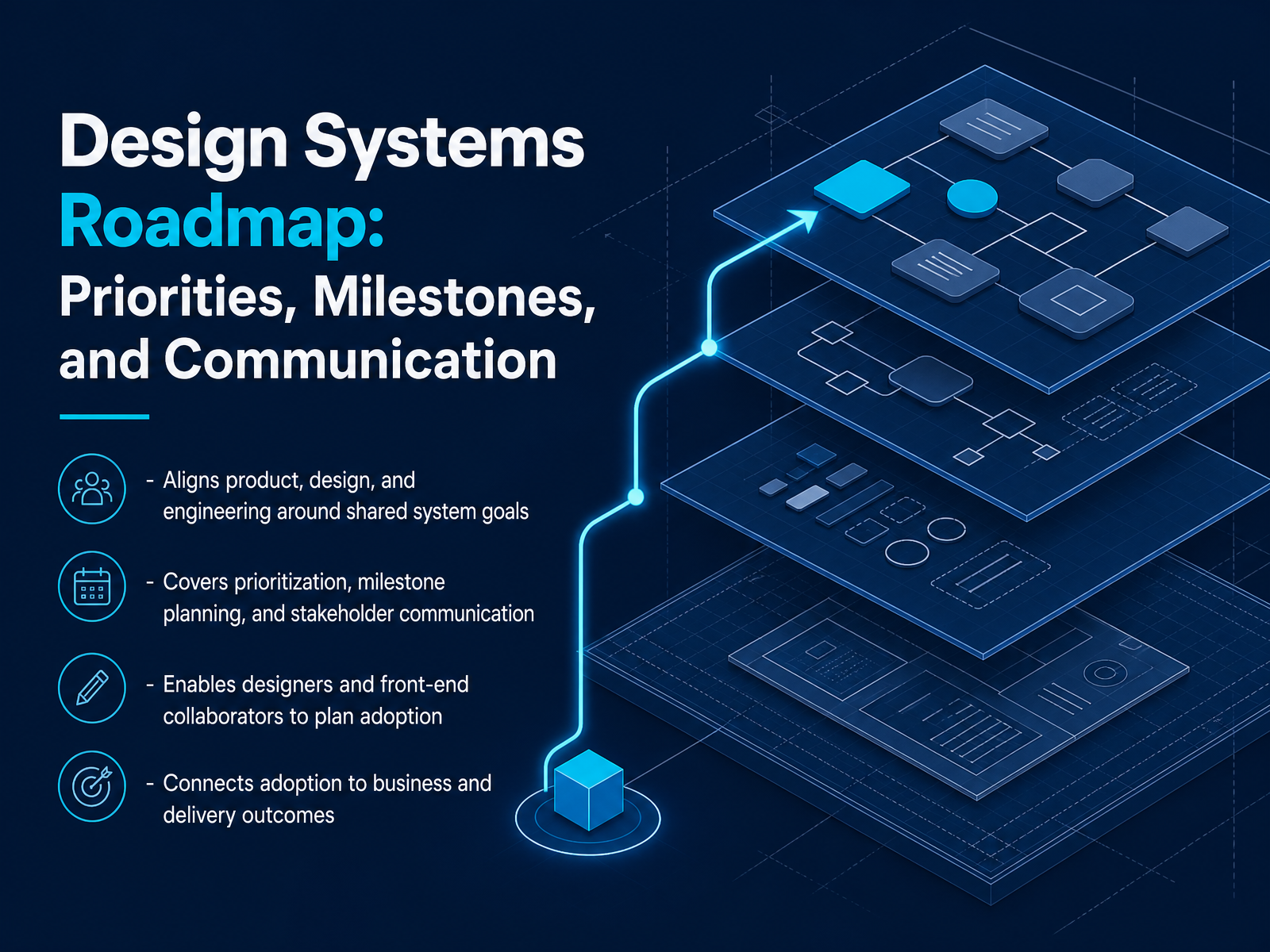
- 01Design Systems Roadmap: Priorities, Milestones, and CommunicationWelcome. This session is about building a design systems roadmap that actually works. Think of this as a planning conversation for your team, not a lecture. The goal is to move from scattered requests to clear priorities, milestones, and stakeholder alignment. A strong roadmap does four things. It aligns product, design, and engineering around shared system goals. It covers how we prioritize, how we plan milestones, and how we communicate those plans. It gives designers and front end collaborators a realistic path for adoption. And it connects that adoption to business and delivery outcomes. We are not building a wish list. We are building a sequenced plan that teams can trust. Let's start by looking at why so many design system roadmaps fail, before we map a better path forward.design-system.canada.cadesign.alberta.cadesign-system.service.gov.uk+21 min
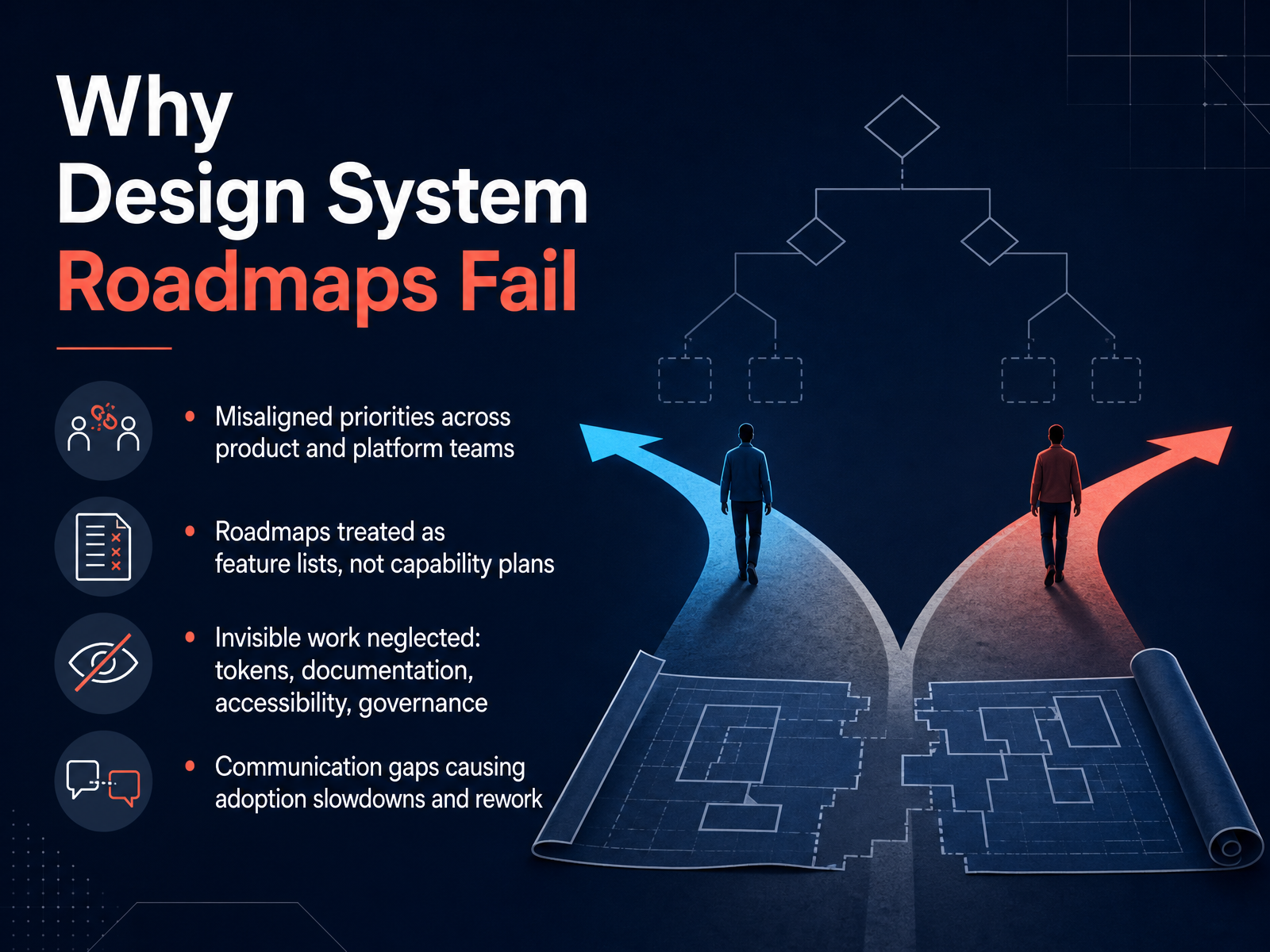
- 02Why Design System Roadmaps FailMost design system roadmaps fail for predictable reasons, and rarely because of design quality. The first issue is misalignment. Product teams and platform teams carry different priorities, and when those are not reconciled early, the system gets built around rather than adopted. A second pattern is treating the roadmap like a feature list. We fixate on shipping components, but a roadmap is really a capability plan. It should sequence foundation work, governance, and adoption support alongside the library itself. The third issue is invisible work. Tokens, documentation, accessibility, and governance are the scaffolding that keeps a system usable. When we under-resource them, the system drifts and trust erodes. Finally, communication gaps surface late as adoption slowdowns and rework. Teams do not resist standardization by default. They resist when the system creates local cost without clear local benefit. So the diagnosis here is organizational, not aesthetic. Once we name these failure modes, we can design the roadmap differently. Let's look at how to treat that roadmap as a strategic document.
 wandr.studiookoone.comrangle.io+21 min
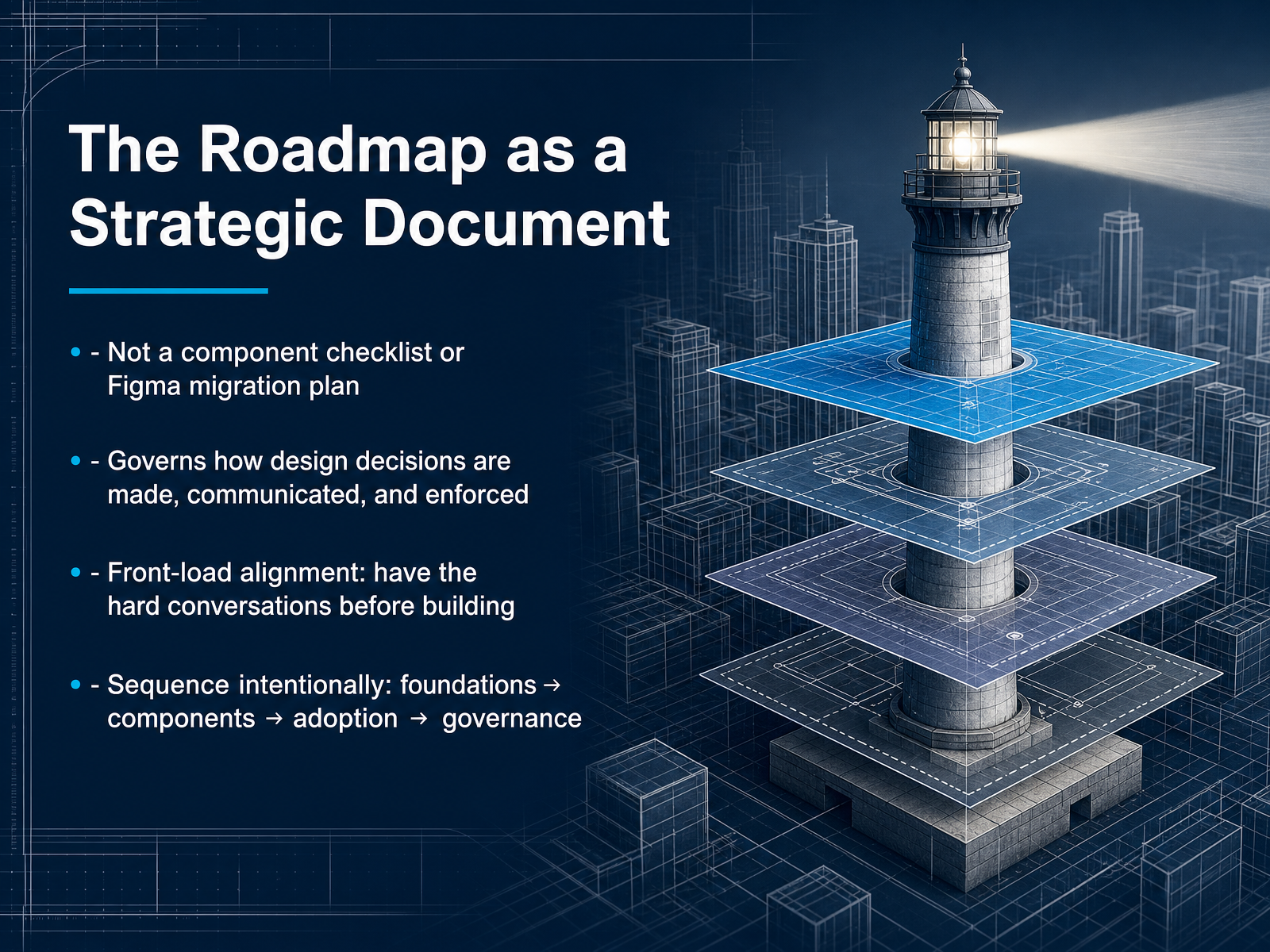
 - 03The Roadmap as a Strategic DocumentLet's look at what a roadmap actually is. This is not a component checklist. It is not a Figma migration plan. A roadmap is a strategic document. It dictates how design decisions get made, how they are communicated, and how they are enforced across the organization. The core function is to prevent the system from becoming just a shared library that teams ignore. We have to front-load the alignment. Have the hard conversations before we build, not after the components are locked in. If we do not align first on what problem we are solving, the system architecture gets driven by output rather than intent. And we need to sequence the work intentionally. Foundations first, like tokens and typography. Then components. Then adoption. Then governance. If we skip straight to components, we will rebuild them later when the foundations shift. This sequence is what protects us from the most common failure mode: a beautiful system that nobody uses. With that foundation in mind, let's move on to assessing your current maturity.
 design-system.canada.cadesign.alberta.cadesign-system.service.gov.uk+21 min
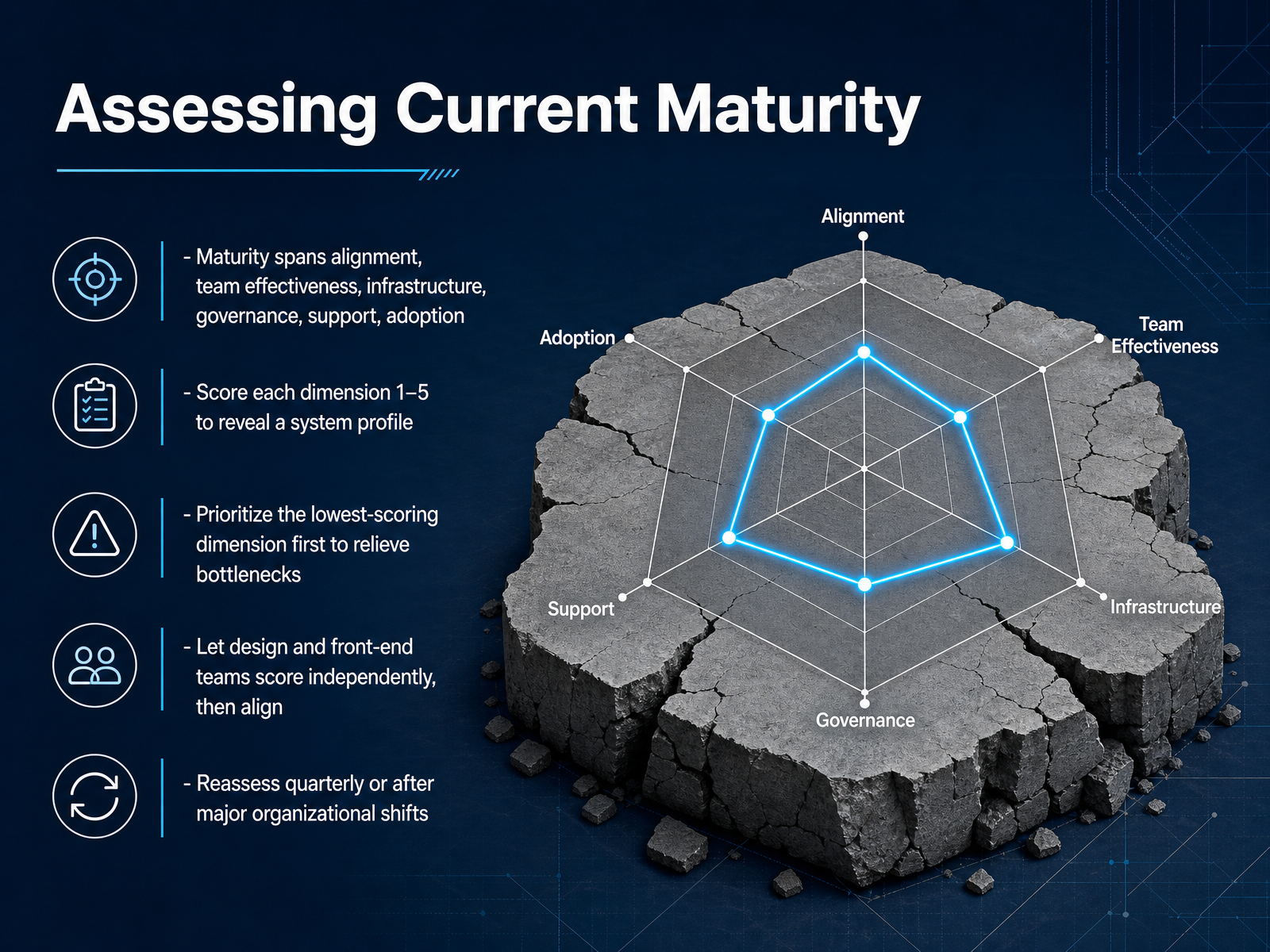
 - 04Assessing Current MaturityLet's talk about where the system actually stands today. Maturity here isn't a single rating. It spans six dimensions: alignment, team effectiveness, infrastructure, governance, support, and adoption. For each one, we assign a score from one to five. What emerges is a system profile, a shape that shows us where we're balanced and where we're constrained. The lowest-scoring dimension is usually our bottleneck, so that's where we prioritize first. And here's the important part: let design and front-end teams score independently. The gaps between those scores are often more revealing than the numbers themselves. We then come together to align on one profile, and we reassess on a regular cadence, typically quarterly, or after any major organization shift. This isn't a one-time audit. It becomes the evidence base for the roadmap. Next, we'll convert these maturity gaps into concrete roadmap inputs.
 nngroup.comatomize.toolszeroheight.com+21 min
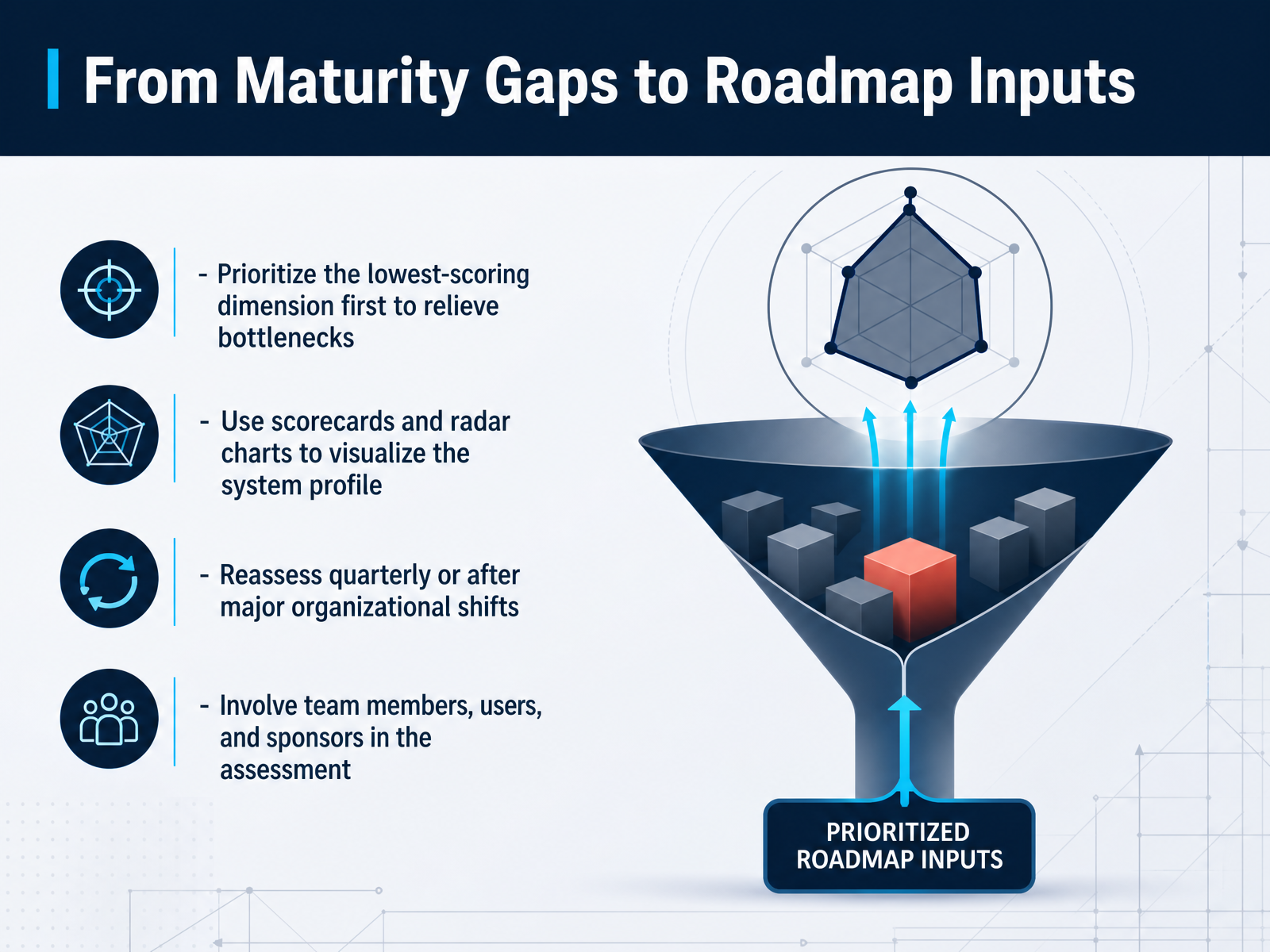
 - 05From Maturity Gaps to Roadmap InputsA maturity assessment is only useful if it feeds the roadmap. So here is how we turn gaps into inputs. Start with the lowest-scoring dimension. A single weak point, like governance or infrastructure, often creates pressure everywhere else. Address that bottleneck first. Then make the profile visible. Use scorecards and radar charts to plot the shape of the system, not just a total number. Seeing the full profile helps the team spot imbalances quickly. Next, set a reassessment rhythm. Quarterly works well, and it is also worth re-scoring after major changes like a reorg or a big release. Finally, keep the assessment collaborative. Include designers, engineers, users, and sponsors. Their different views surface alignment gaps that the scores alone miss. So the takeaway is simple: use the lowest score to set priority, make the profile visible, and revisit it on a regular cadence. That discipline gives us a steady stream of roadmap inputs. Let's move into prioritization frameworks for system work.
 nngroup.comatomize.toolszeroheight.com+21 min
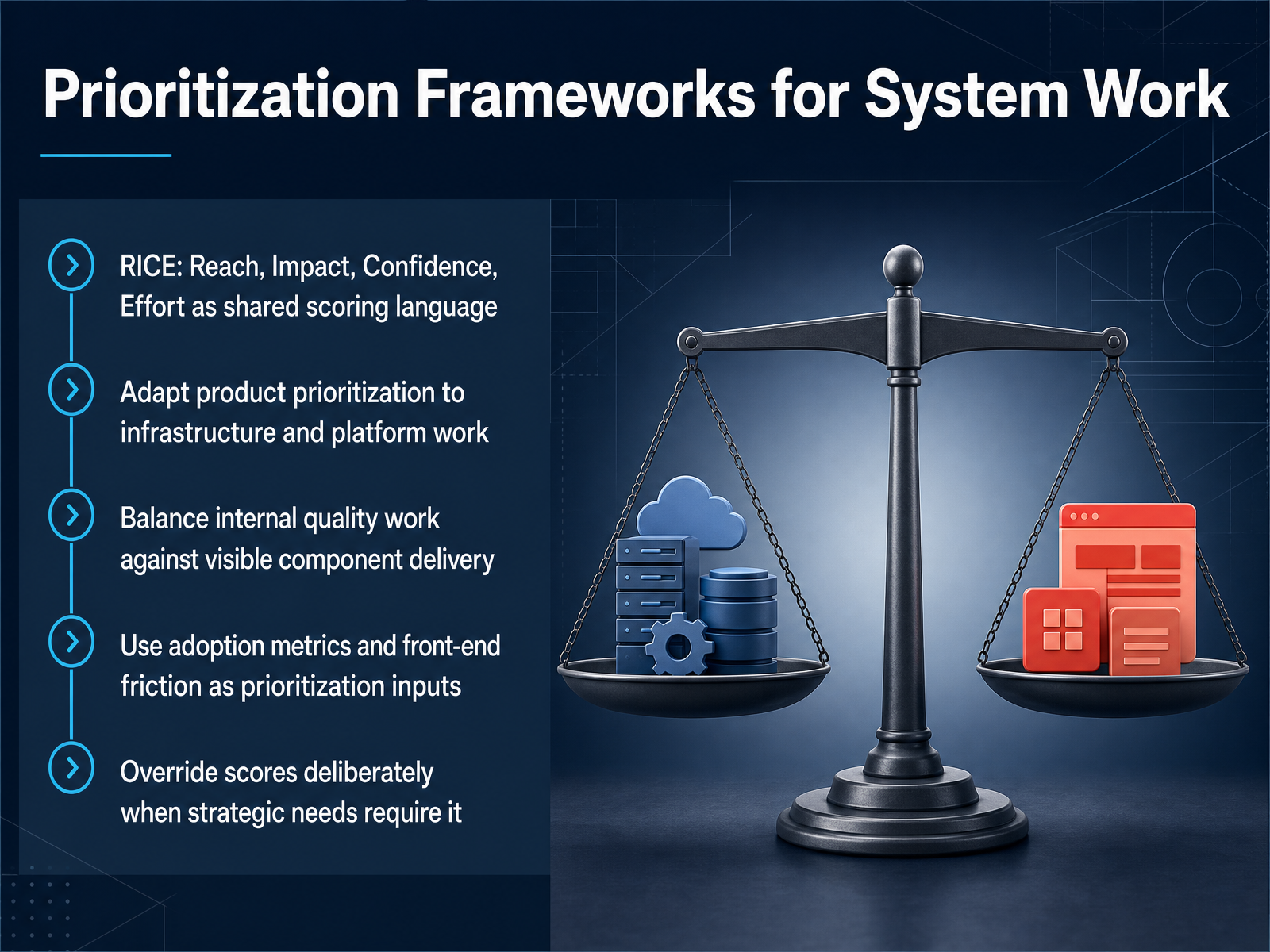
 - 06Prioritization Frameworks for System WorkNow let's talk about how we actually decide what to work on. RICE is our shared scoring language. It stands for Reach, Impact, Confidence, and Effort. We adapt this product framework for infrastructure work. So for a token refactor, reach might be every surface that uses color. Impact is how much friction it removes. Confidence is how sure we are about the payoff. And effort is the total person-months across design and engineering. But we also need to balance internal quality work against visible component delivery. That means using adoption metrics and front-end friction as real inputs, not just gut feel. If a component is hard to use, that friction should show up in the score. Finally, we override scores deliberately. Strategic needs, like a compliance deadline or a major platform migration, can move things up. The key is to document why. RICE structures the conversation, but we make the call. Next, we'll look at scoring together, with design and engineering in the same room.
 designsystems.oneintercom.comideaplan.io+21 min
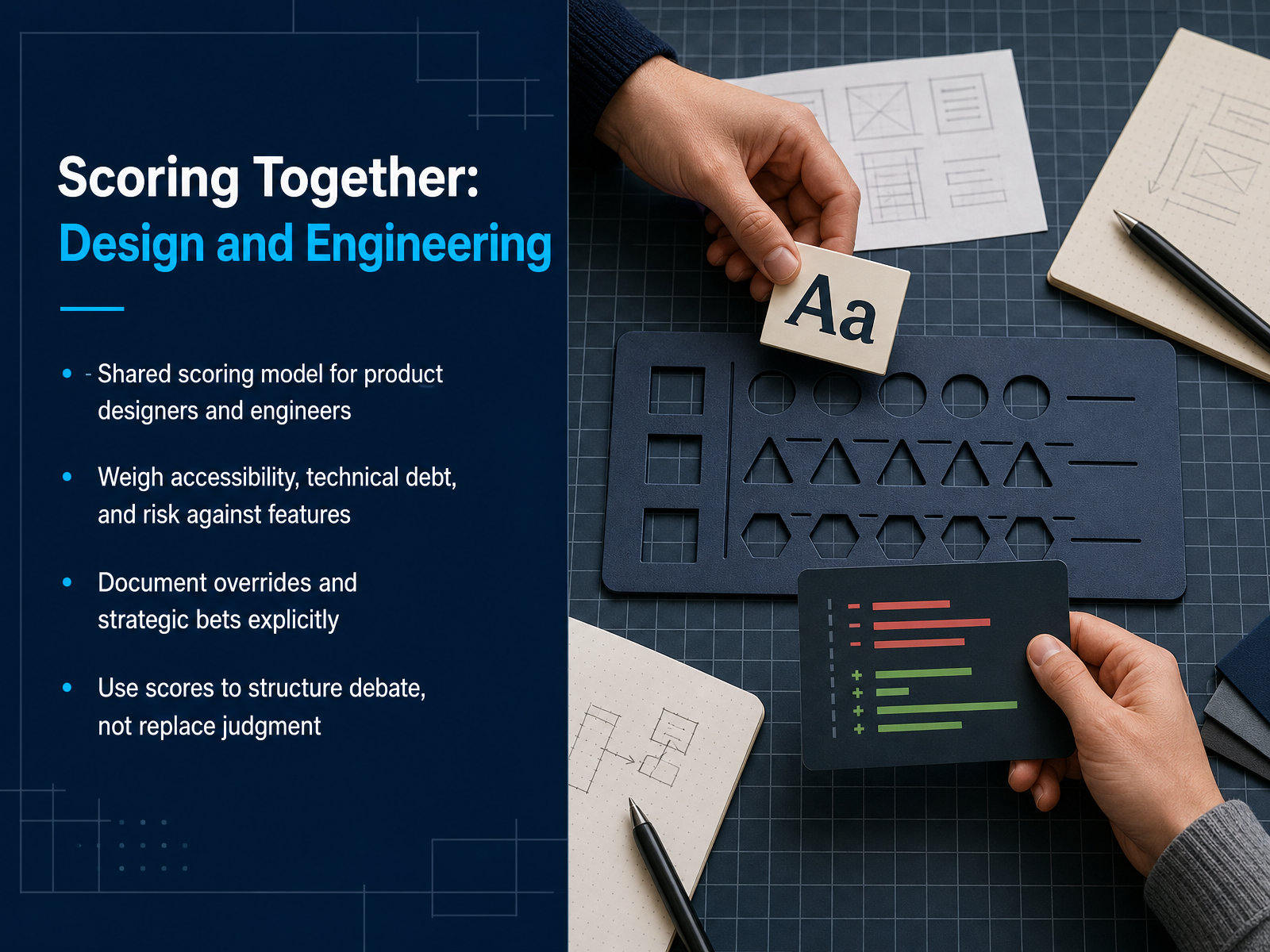
 - 07Scoring Together: Design and EngineeringScoring together means designers and engineers use one shared model to prioritize work. We weigh accessibility, technical debt, and risk right alongside feature requests. That keeps the conversation balanced. When we choose to override a score, we document it explicitly as a strategic bet. That override note becomes part of our decision record. Scores are here to structure the debate, not replace our judgment. The goal is a transparent, defensible sequence of work that both disciplines can stand behind with real confidence. Next, we'll move into defining milestones, from foundations to scale.
 designsystems.oneintercom.comideaplan.io+21 min
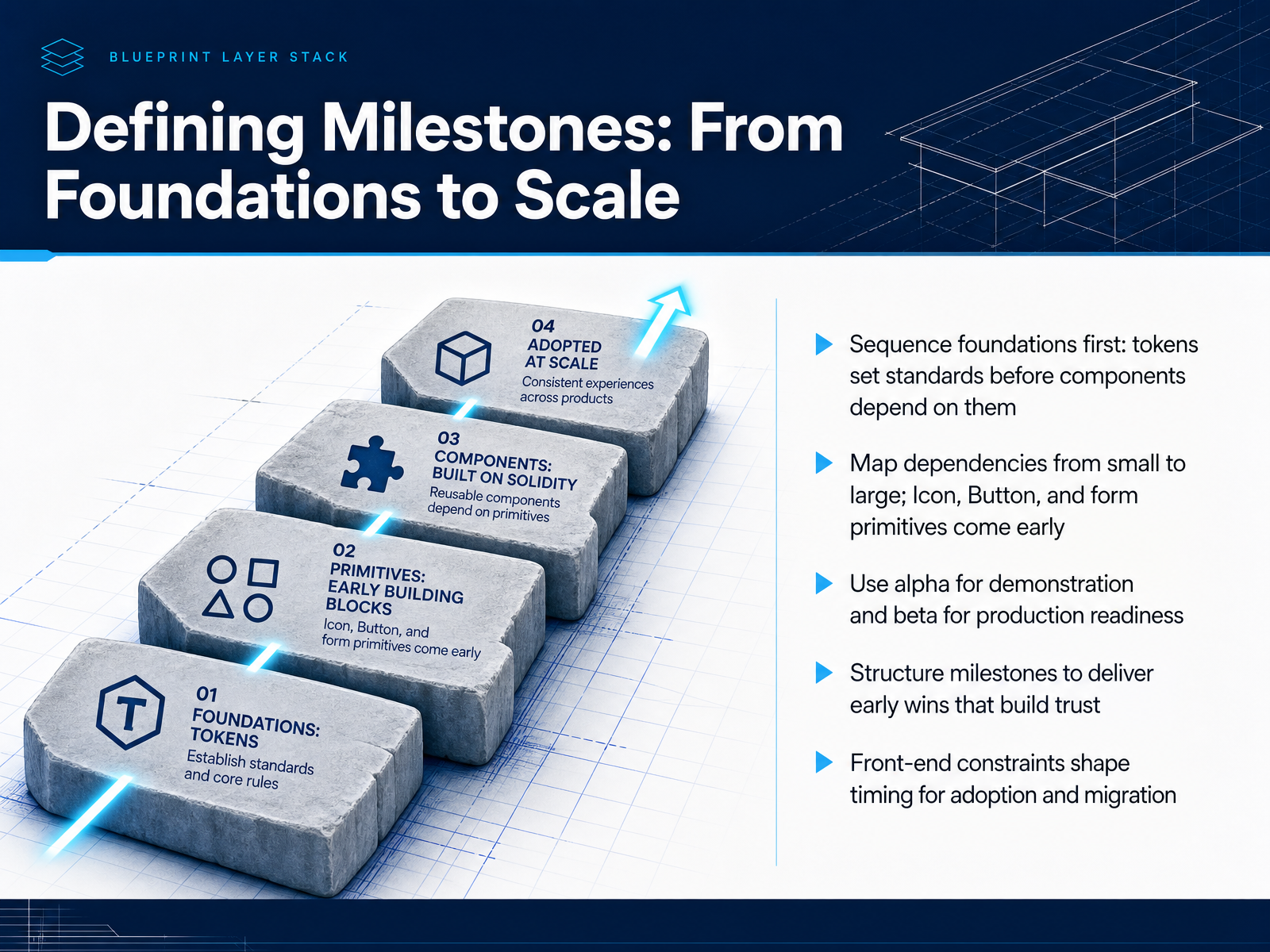
 - 08Defining Milestones: From Foundations to ScaleNow we come to defining milestones, and the guiding principle here is sequencing. We build from foundations to scale. That means tokens come first. Color, typography, and spacing need to be stable before components depend on them. After that, we map dependencies from small to large. Icon, Button, and core form primitives land early because so many larger components rely on them. We also use alpha and beta phases deliberately. Alpha is for demonstrating direction and gathering feedback. Beta is the signal that something is ready for production use. To build trust, we structure milestones to deliver early wins. Shipping a small set of dependable primitives does more for adoption than a large batch of half-finished components. And we align timing with front-end constraints. Migration windows, platform parity, and engineering capacity all shape when adoption becomes realistic. So the milestone plan is not just about what we build, it is about what teams can actually consume. Next, we will look at how to move from alpha through beta and beyond.
 nathanacurtis.substack.comnetguru.comwandr.studio2 min
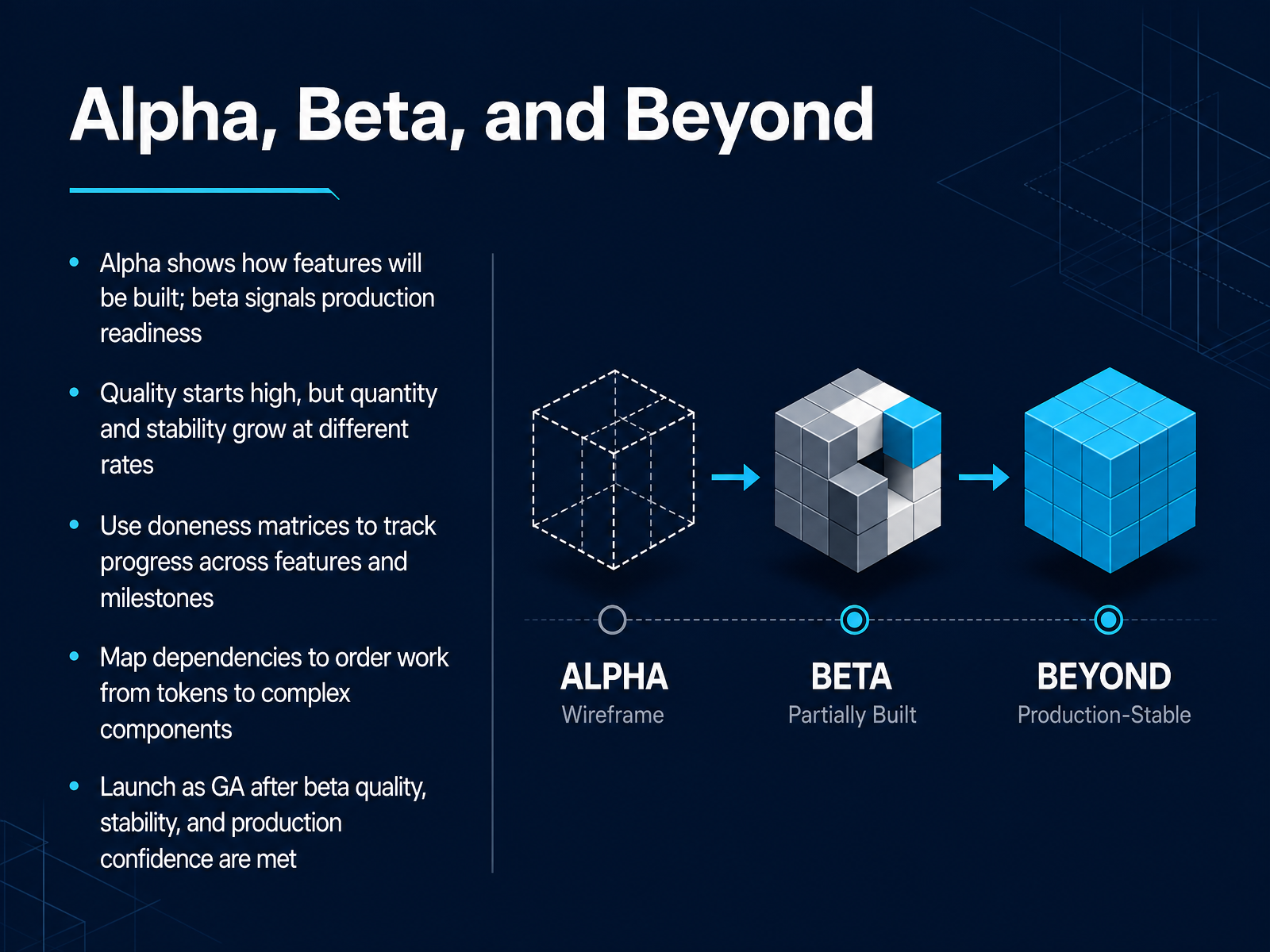
 - 09Alpha, Beta, and BeyondLet's move into how we sequence the work and mark real progress. Alpha is where we demonstrate how the system will be built, showing the core approach with a few key pieces. We don't expect full stability here; it's a working prototype. Beta shifts the focus to production readiness, where early adopters can start using the system with real confidence. Quality should start high, but the quantity and stability of the library will grow at different rates. To track that growth, we use a doneness matrix, which groups features by milestone and shows exactly what is ready. We also map dependencies to order the work, starting with foundational elements like tokens and icons before moving to complex components that rely on them. We reach general availability, or GA, only when we have achieved beta quality, proven stability, and verified production confidence. This ensures the system is truly ready for everyone. Now, let's look at how to build a roadmap structure around these outcomes.
 nathanacurtis.substack.comnetguru.comwandr.studio+21 min
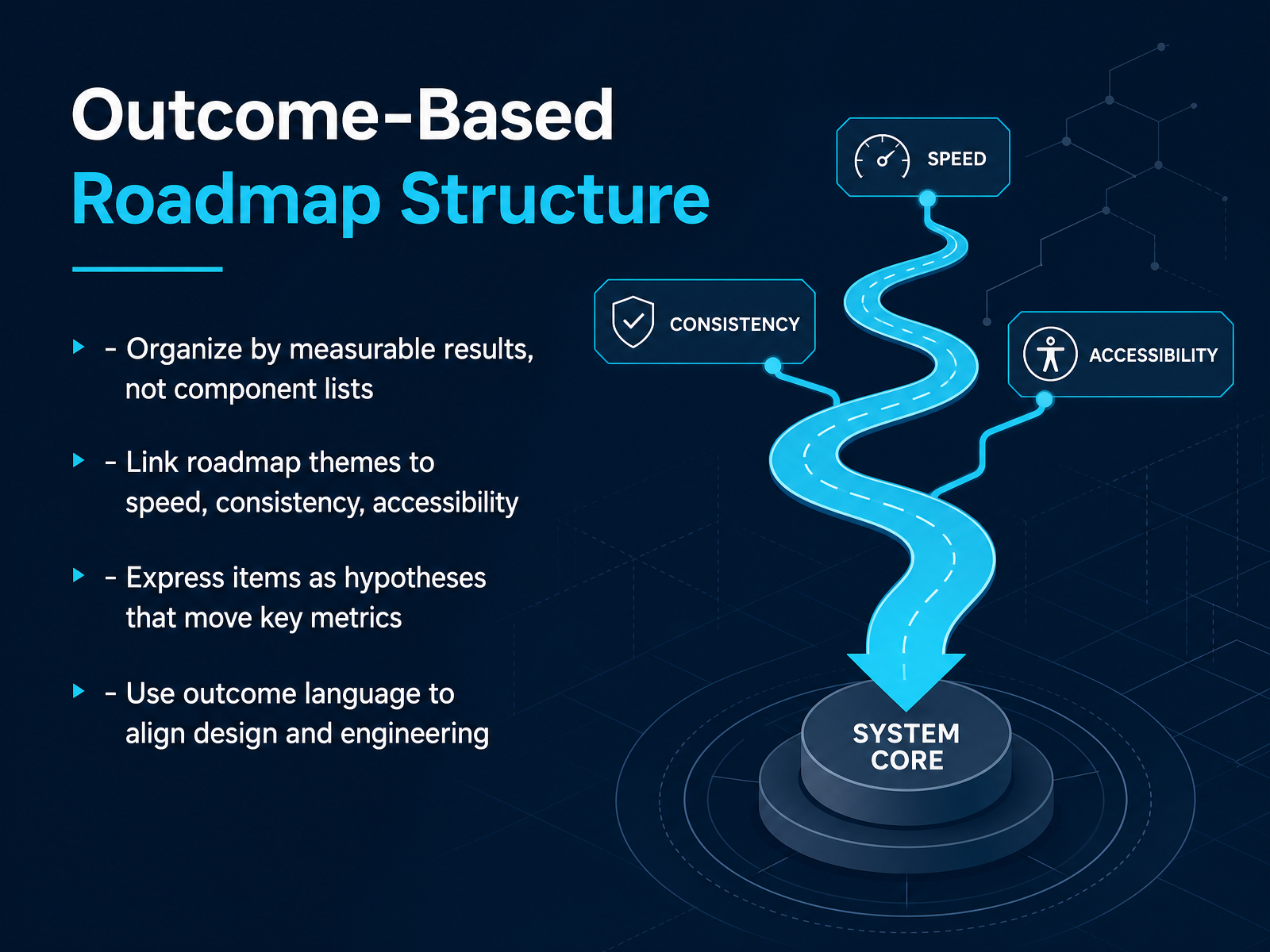
 - 10Outcome-Based Roadmap StructureNow let's talk about how we actually structure the roadmap itself. Instead of organizing around a list of components to build, we want to organize around the results we need to see. That shift changes every conversation we have. So rather than saying we'll deliver a new form library, we say we're going to reduce the time teams spend building forms by thirty percent. That is a measurable outcome, and it links directly to the themes of speed, consistency, and accessibility that we agreed on earlier. We can express each theme as a set of hypotheses. For example, we believe that standardizing our input components will reduce design time by two weeks per project. That framing lets us test the idea before we over-invest. It also gives us a shared language with engineering, because we're aligning on the problem we're solving together rather than debating a specific technical solution. This keeps our priorities focused on impact. Next, we'll look at how to communicate these priorities effectively to different audiences.
 wandr.studionetguru.com1 min
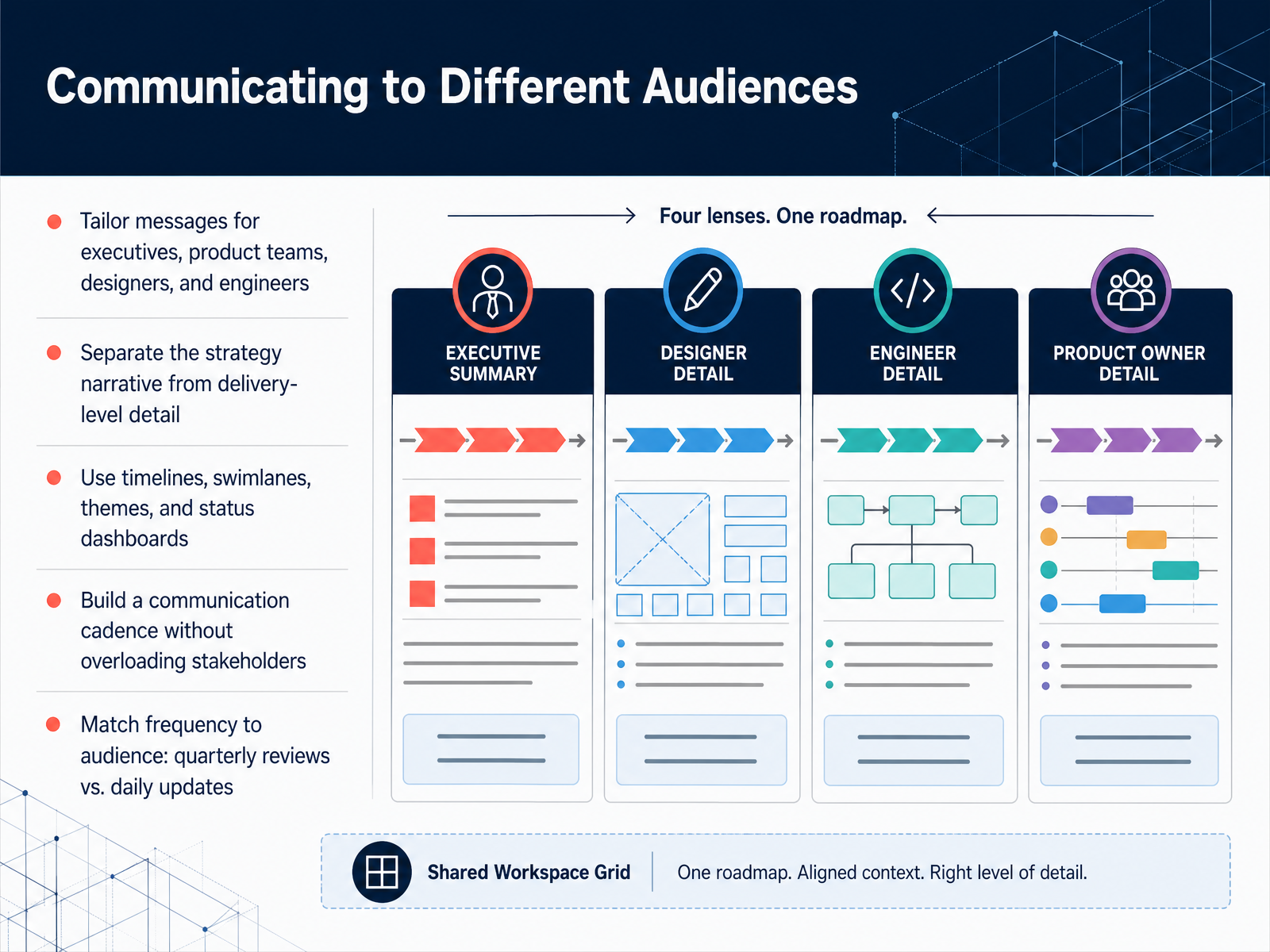
 - 11Communicating to Different AudiencesThe same roadmap doesn't work for everyone. Executives need to see the strategic narrative—outcomes, value, and major milestones. Engineers need delivery-level detail like dependencies and release timing. So the first step is to separate those two layers. Keep the strategy story high-level, and let the technical details live in a shared backlog or delivery dashboard. For artifacts, match the format to the audience. Use timelines and swimlanes for product teams to see cross-team handoffs. Use themes for executive summaries. And use a status dashboard for anyone who needs a quick pulse check. Cadence matters just as much as content. Quarterly reviews work well for leadership. Monthly updates can serve product teams. For engineers, a lightweight changelog or weekly channel update keeps everyone aligned without overloading them. The goal is clarity without noise. Every audience gets the right level of detail, at the right frequency, through the right channel. That's what turns a roadmap into a coordination tool rather than a static document. Next, we'll look at tracking progress and making adjustments based on what we learn.
 wandr.studionetguru.comdesign-system.canada.ca+21 min
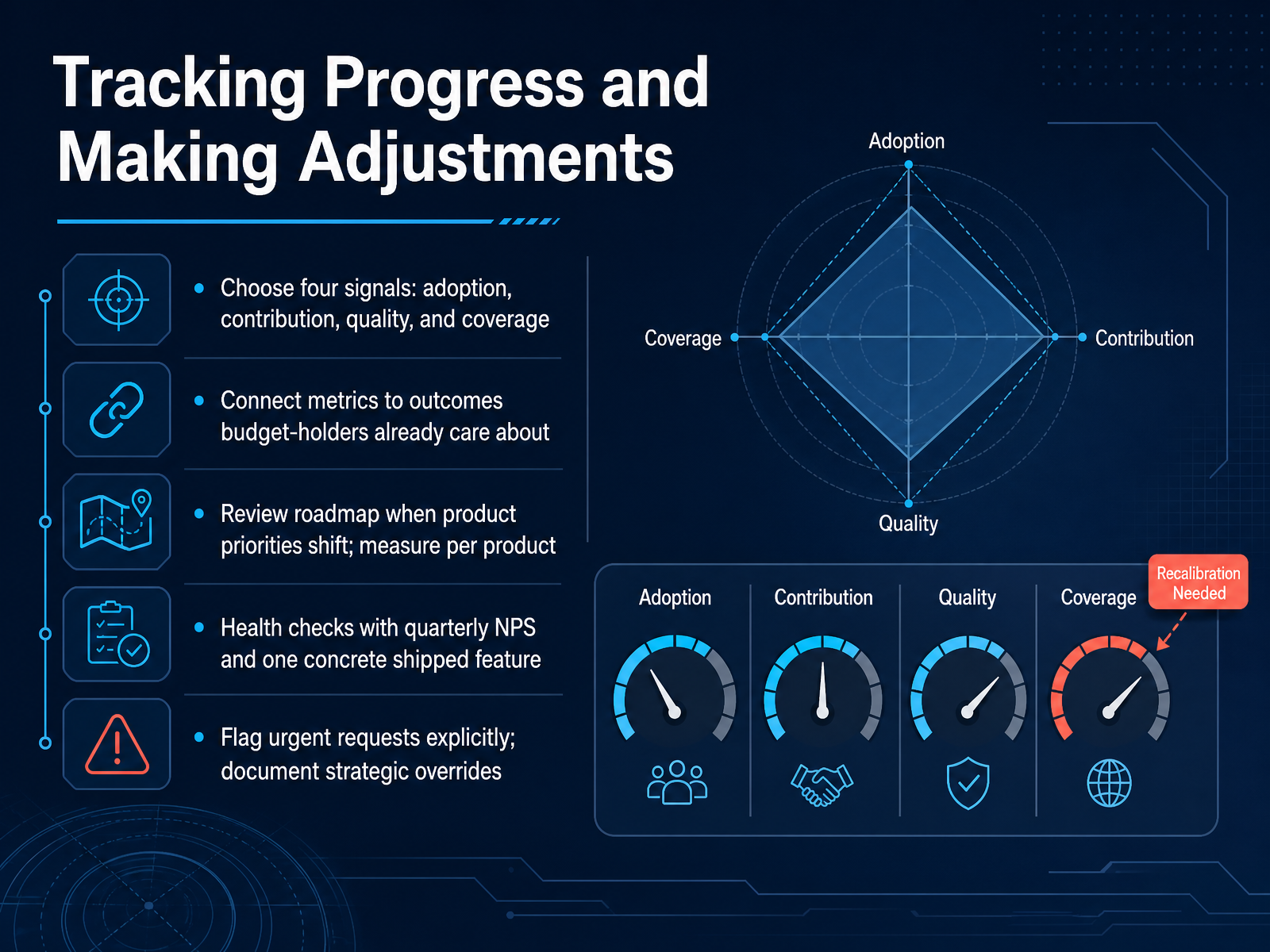
 - 12Tracking Progress and Making AdjustmentsNow let's talk about tracking progress, because a roadmap without honest feedback becomes decoration. We focus on four signals: adoption, contribution, quality, and coverage. Adoption tells us whether teams are actually using the system. Contribution shows whether teams are actively giving back. Quality tracks friction, like accessibility issues or component detachments. Coverage measures how many product surfaces actually run on our foundation. And here's the discipline: connect these metrics to outcomes budget-holders already care about. A number like thirty-eight percent faster shipping moves the conversation. Forty-seven components does not. When product priorities shift, we review the roadmap. We measure per product, not just in aggregate, because the aggregate hides laggards. Our quarterly health check pairs an NPS survey with one concrete shipped feature comparison. That real example keeps the value tangible. And when urgent requests come in, we flag them explicitly. Strategic overrides are fine, but we document why we made them. That discipline protects trust. In the next slide, we'll look at how collaboration and contribution models keep the system alive.
 designsystems.onenetguru.comintercom.com+21 min
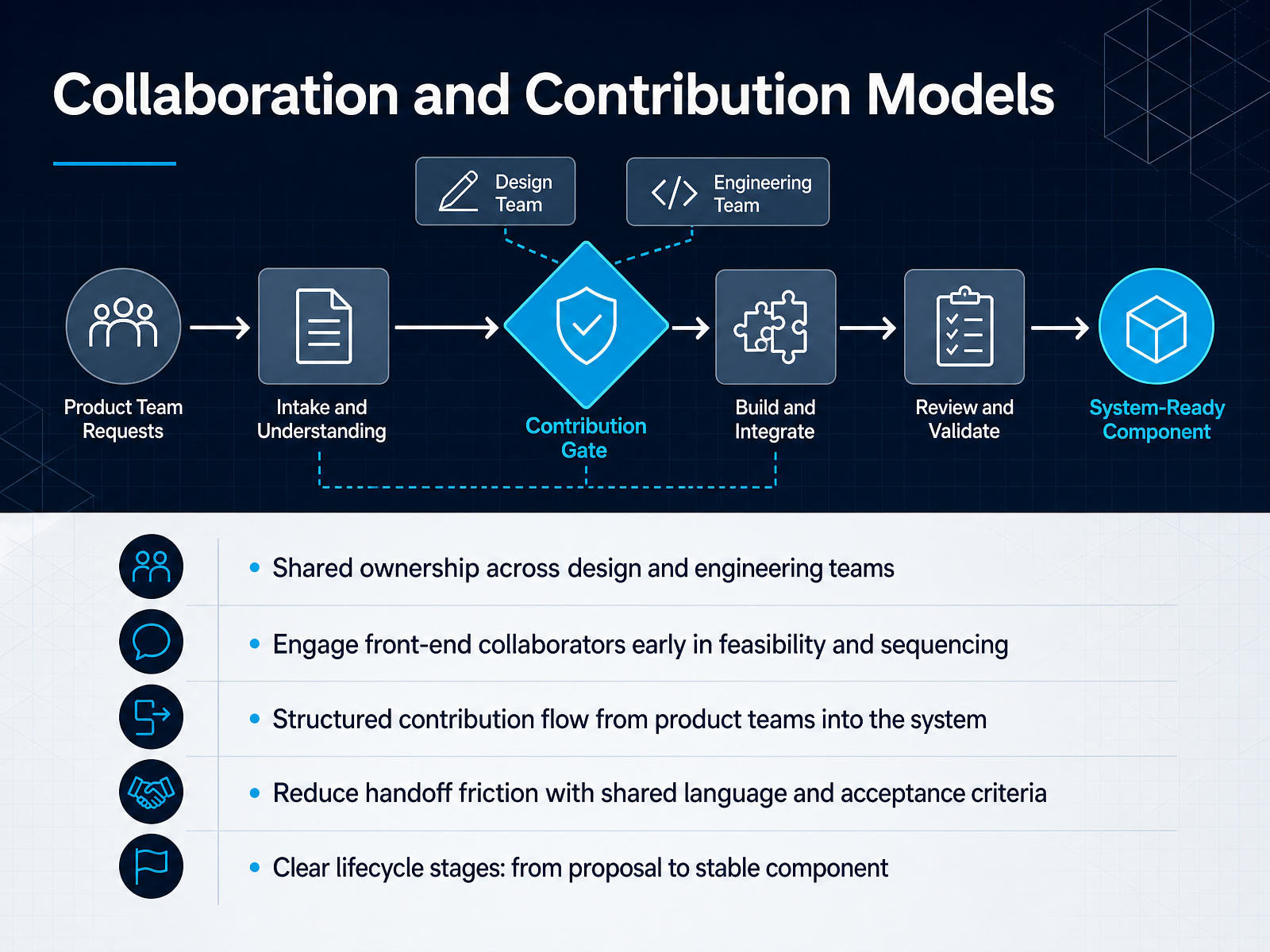
 - 13Collaboration and Contribution ModelsLet's move into the operating model for how this roadmap actually gets built. A system like this can't be owned by one team alone. We need shared ownership across design and engineering. That means bringing front end collaborators in early, when we're still figuring out feasibility and sequencing. It prevents rework later. We should also create a structured flow for product teams to contribute. This gives them a clear path to propose a new component or a change, rather than working around the system. To reduce handoff friction, we need a shared language and clear acceptance criteria. When a designer and a developer talk about a button, they should be describing the same thing. Finally, every component moves through clear lifecycle stages, from proposal all the way to a stable, documented part of the system. This makes the process predictable. Now, let's take these concepts and put them to work. In our next section, we'll walk through a hands-on workshop to build a practical roadmap draft.
 wandr.studionetguru.com1 min
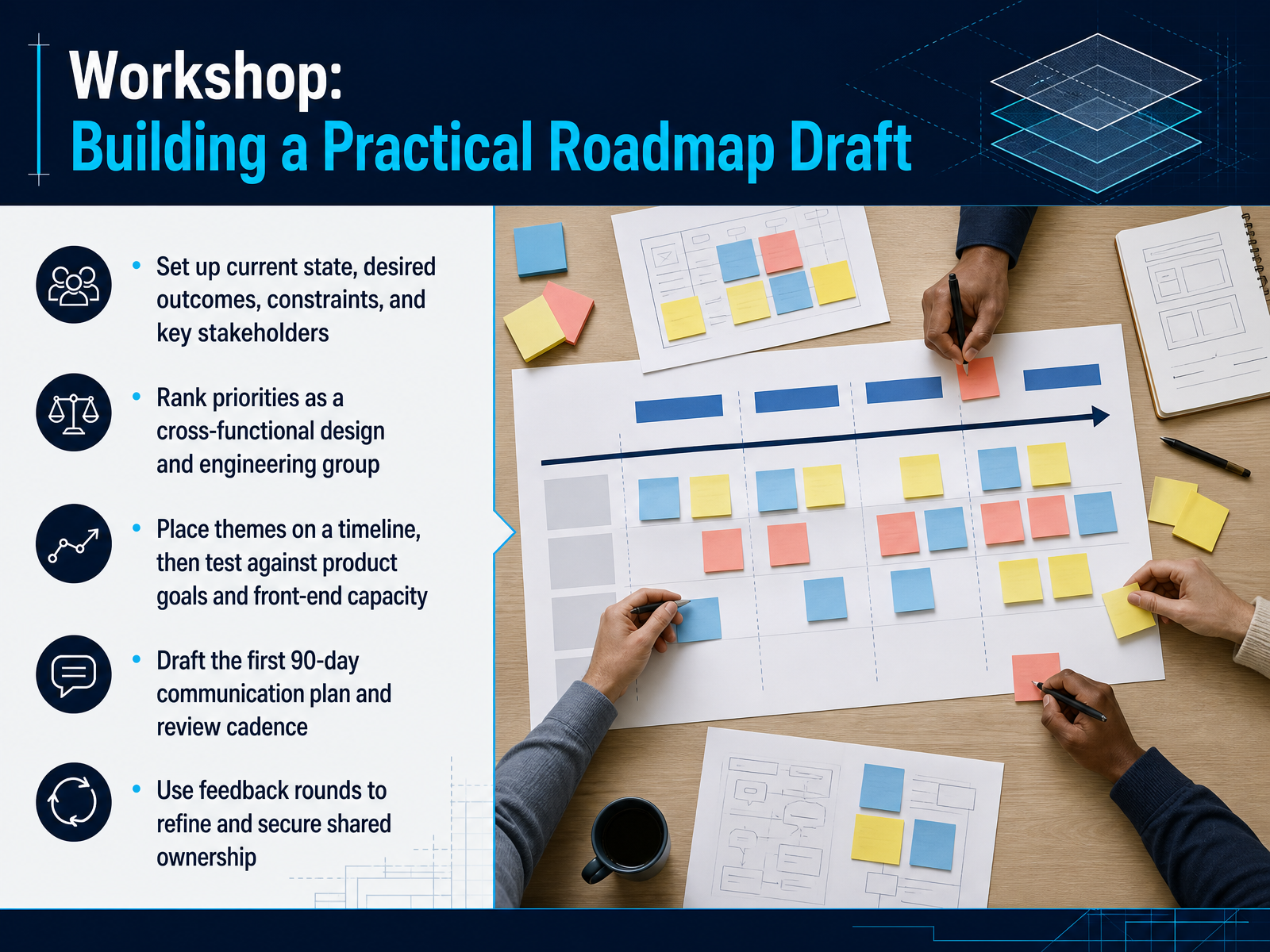
 - 14Workshop: Building a Practical Roadmap DraftLet’s close by turning all of this into a working draft we can actually use. In this final workshop, we’ll frame our current state, the outcomes we want, our real constraints, and the stakeholders who need to stay involved. Then we’ll rank priorities together, as one cross-functional group of designers and engineers. That shared ranking is where the real alignment happens. From there, we’ll place themes on a timeline and pressure-test them against product goals and front-end capacity. If something doesn’t fit, this is the moment to say so. We’ll also draft the first ninety-day communication plan and agree on our review cadence. Finally, we’ll use feedback rounds to refine the draft and secure shared ownership, because a roadmap only works when the people who build and consume the system stand behind it. Thank you for working through this together. You now have a practical path to a roadmap that is clear, prioritized, and measurable. Take the draft, test it with your teams, and keep adjusting. That is the work, and you are ready to lead it.
 netguru.comnathanacurtis.substack.comwandr.studio2 min
Take the deck with you
Download this course as a file — free, no sign-up needed.
- PDF handoutEvery slide page, ready to print or share.15 pages · 3.8 MBDownload
- Narrated PowerPointThe deck that presents itself — every slide carries the digital human's narration video.15 pages · 14.1 MBDownload
- PowerPoint slidesThe full deck as a .pptx — open it in PowerPoint, Keynote, or Google Slides.15 pages · 3.7 MBDownload
Free to use in your own training — please keep the PersonWise credit page at the end.
Have your own deck? Turn it into a course
Sources consulted
Web sources consulted while building this course.
- Roadmap - GC Design System — design-system.canada.ca
- Roadmap - GoA Design System — design.alberta.ca
- Roadmap – GOV.UK Design System — design-system.service.gov.uk
- The Sequencing and Strategy That Makes It Actually Work | WANDR — wandr.studio
- How to build a design system roadmap that teams actually use | Okoone — okoone.com
- Design System Product-Market Fit: Common design systems adoption pitfalls and how to avoid them | Rangle — rangle.io
- Design System Adoption Fails Without Product Team Incentives — pathtoproject.com
- Design System Scaling: Avoiding Mistakes at Scale | Figma — figma.com
- Design-System Maturity: A 6-Dimension Framework — nngroup.com
- Design System Maturity: 5 Levels + Scorecard (2026) - Atomize — atomize.tools
- A new design system maturity model — zeroheight.com
- Sparkbox's Design System Maturity Model Assessment — sparkbox.com
- USWDS maturity model | U.S. Web Design System (USWDS) — designsystem.digital.gov
- Measuring and proving value — Playbook 08 | DesignSystems.one | DesignSystems.one — designsystems.one
- RICE: Simple prioritization for product managers — intercom.com
- Most Popular PM Frameworks in 2026 (Usage Data) — ideaplan.io
- Prioritization frameworks — atlassian.com
- RICE Prioritization Framework: Guide to Data Roadmaps | SigOS Blog — sigos.io
- Planning a Design System Generation - Nathan Curtis — nathanacurtis.substack.com
- How to Build a Design System Roadmap That Actually Gets Adopted — netguru.com