Begin
13 pages · ~26 min
English for Travel Situations
This training helps travelers learn essential English for real-world travel situations, building confidence in communication.
A digital instructor presents all 13 pages. Hold “Ask” at any point and ask out loud — the answer comes from this course. No sign-up needed.
What you’ll learn
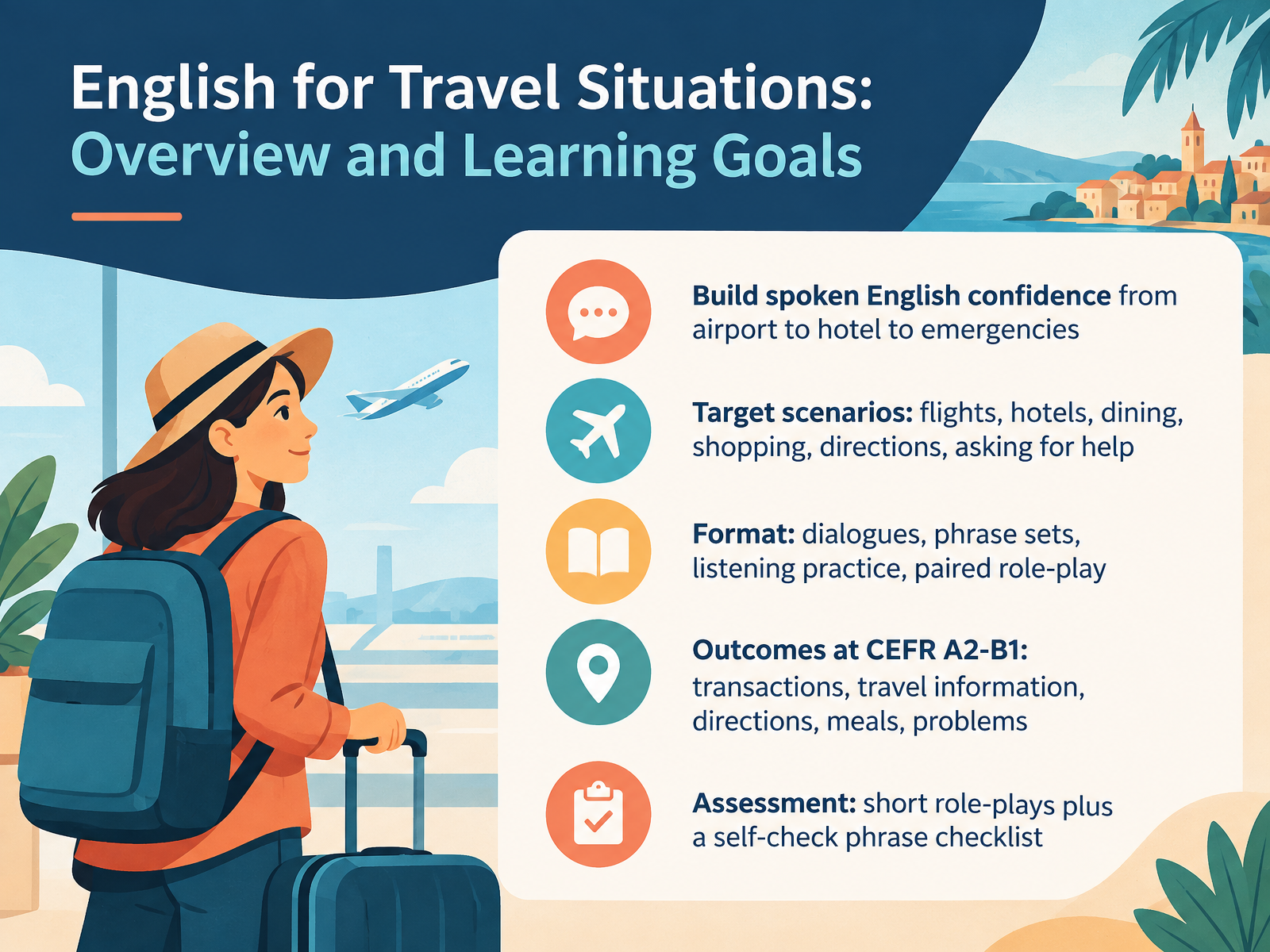
- 01English for Travel Situations: Overview and Learning GoalsHello, and welcome to English for Travel Situations. I am glad you are here. This course helps you speak with confidence on real trips, from the airport to the hotel, and even in emergencies. We will practice six common situations: flights, hotels, dining, shopping, directions, and asking for help. Each lesson uses short dialogues, useful phrase sets, listening practice, and paired role-play, so you can speak, not just study. By the end, at levels A2 to B1, you will handle simple transactions, ask for travel information, follow directions, order meals, and solve problems. For example, you will say, I would like to check in, please. Now try it when you check in. You will also ask, Could you help me, please? Now try it when you need help. Your assessment is a short role-play plus a self-check phrase checklist. Keep your goal simple: speak a little every day. Let us begin. What A2 and B1 Travelers Can Already Do.1 min
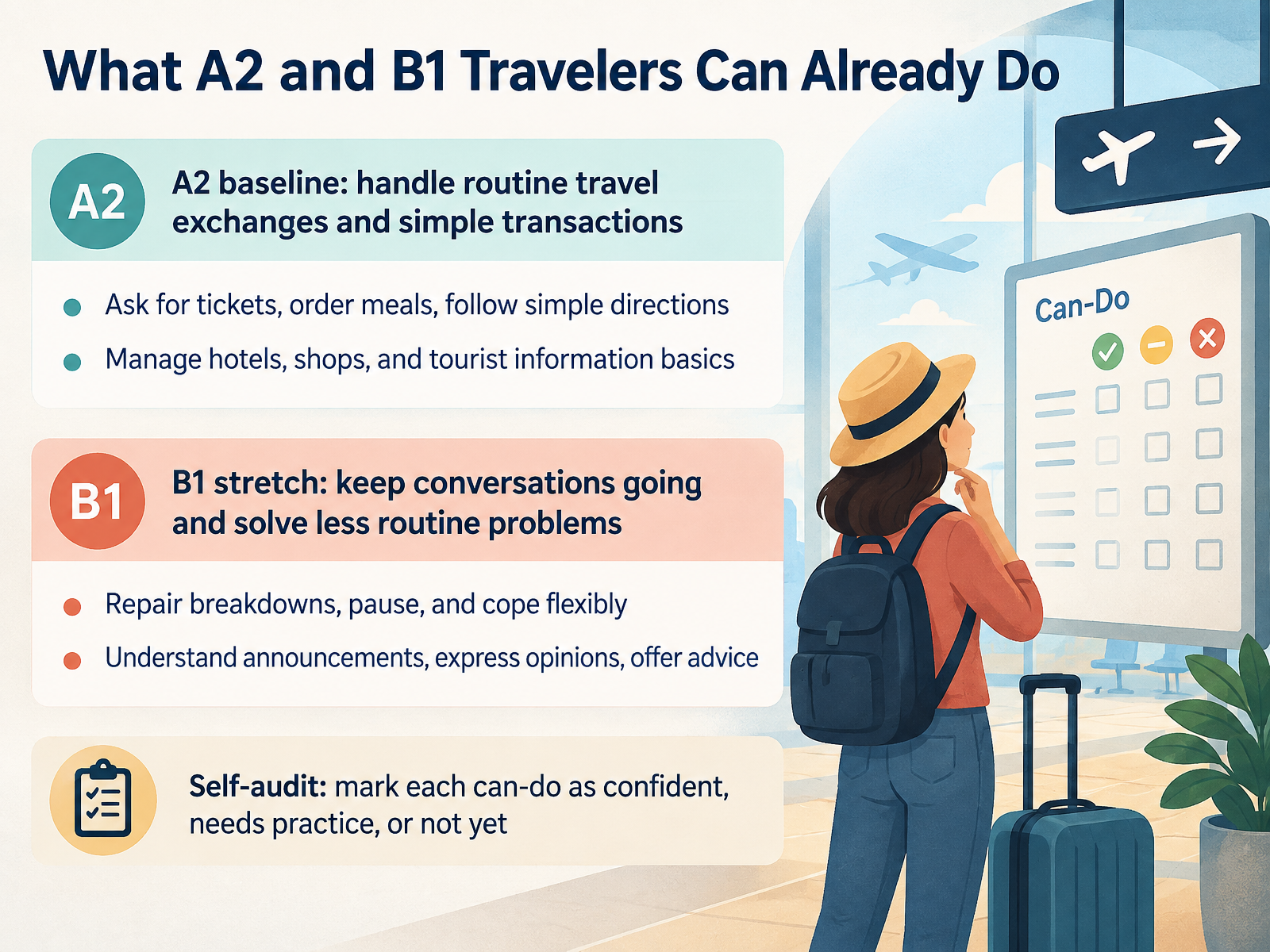
- 02What A2 and B1 Travelers Can Already DoLet's look at what you can already do. At A2 level, you handle routine travel exchanges and simple transactions. You can ask for tickets, order meals, and follow simple directions. You can manage hotels, shops, and basic tourist information. That is a solid foundation. At B1, you stretch further. You keep conversations going and solve less routine problems. You can repair breakdowns, pause, and cope flexibly. You understand announcements, express opinions, and offer advice. Here is a useful self-audit. For each can-do item, mark it as confident, needs practice, or not yet. Be honest with yourself. This helps you focus your practice where it matters most. Now, let's move on to airport check-in, security, and immigration.
 1 min
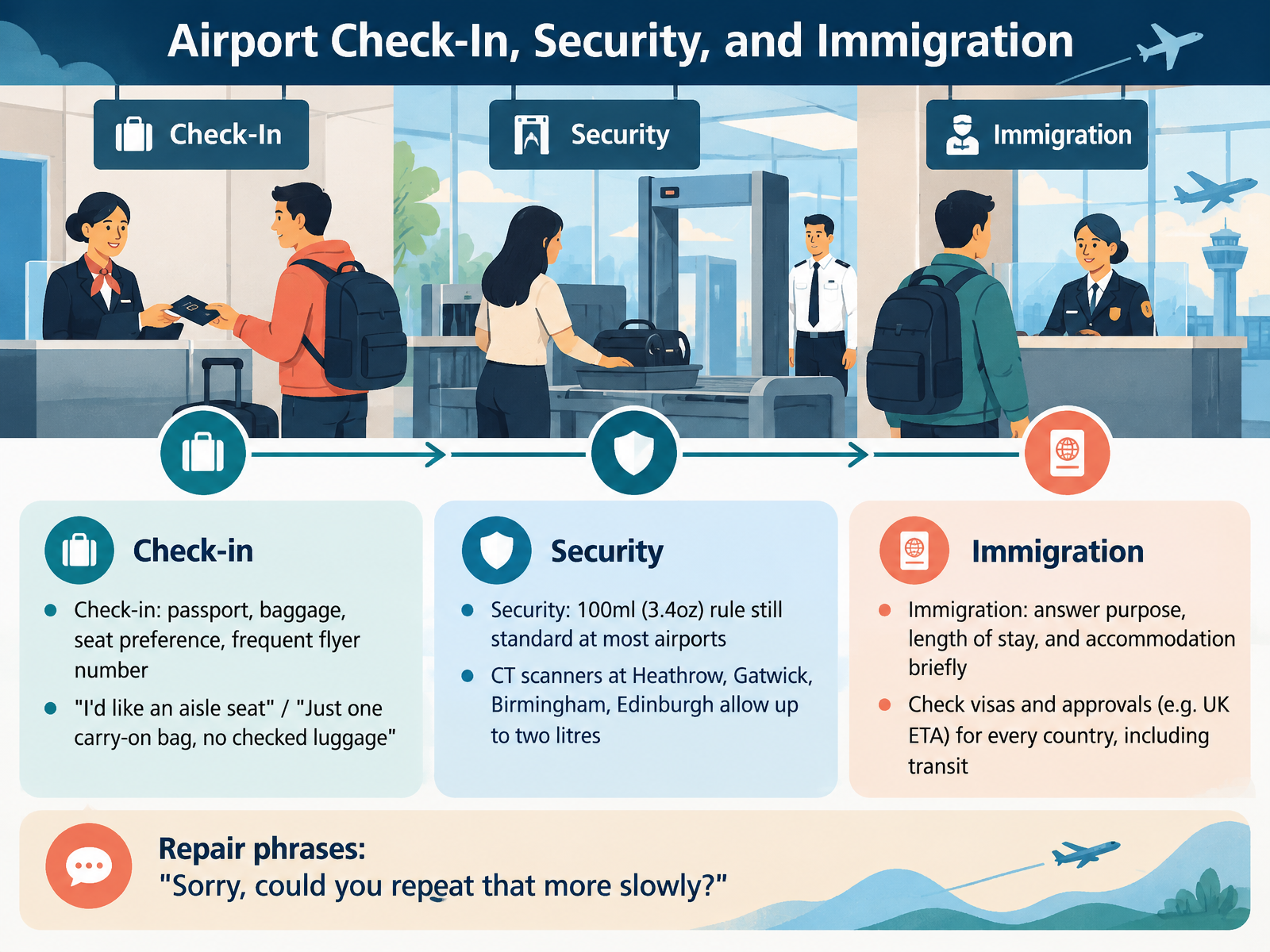
1 min - 03Airport Check-In, Security, and ImmigrationLet's move to the airport itself: check-in, security, and immigration. At check-in, have your passport ready, place your bag on the scale, and answer clearly. For example: "I'd like an aisle seat." Now try it when you check in. If you have no large suitcase, say: "Just one carry-on bag, no checked luggage." Give your frequent flyer number if you have one.
At security, the one hundred millilitre rule, that is three point four ounces, is still standard at most airports. At Heathrow, Gatwick, Birmingham, and Edinburgh, new scanners allow up to two litres. Rules still vary, so check before you fly.
At immigration, answer briefly: your purpose, your length of stay, and where you are staying. Also check visa and approval rules for every country, including transit, such as the UK ETA. If you do not understand, use a repair phrase: "Sorry, could you repeat that more slowly?"
Next, we look at delays, cancellations, and missed connections.
 bbc.comassets.publishing.service.gov.ukindependent.co.uk+22 min
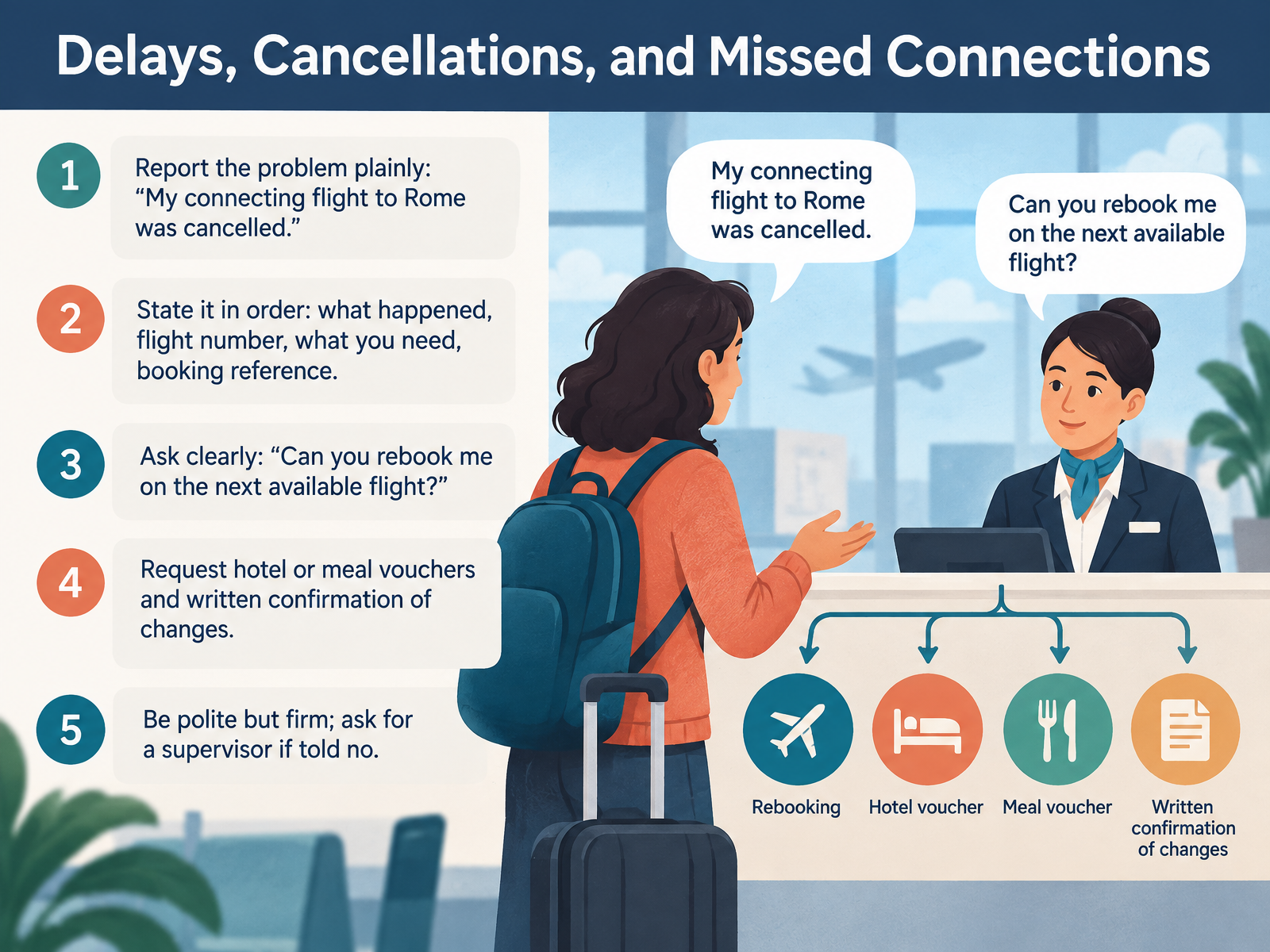
 - 04Delays, Cancellations, and Missed ConnectionsNow let's talk about delays, cancellations, and missed connections. These moments can feel stressful, so your English needs to be clear and calm. Start by reporting the problem plainly: "My connecting flight to Rome was cancelled." Then give the details in order. What happened, the flight number, what you need, and your booking reference. For example: "My flight to Rome was cancelled. It was flight BA two four six. I need to reach Rome tonight. My booking reference is A B C one two three." Next, ask clearly: "Can you rebook me on the next available flight?" Then request hotel or meal vouchers and written confirmation of the changes. Be polite but firm. If the answer is no, say: "I understand. Could I speak with a supervisor, please?" Now try it when you check in or speak to the airline desk. Keep your documents ready, and stay calm. Your goal is to be understood and get a solution. Next, we look at hotels: check-in, requests, and problems.
 bbc.comassets.publishing.service.gov.ukindependent.co.uk+21 min
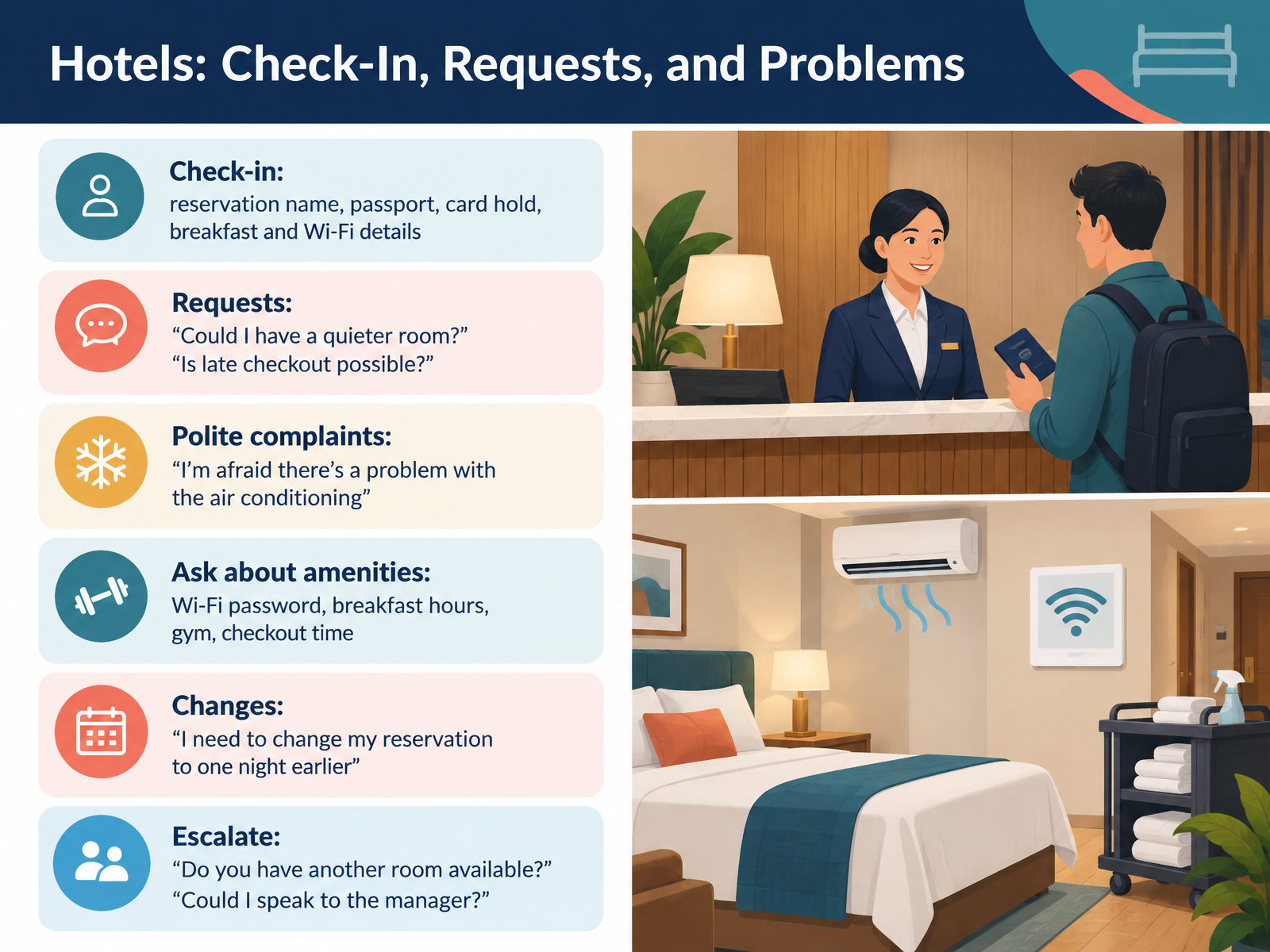
 - 05Hotels: Check-In, Requests, and ProblemsNow let's look at hotels, from check-in to solving problems. At the front desk, you'll usually give your reservation name and your passport. They may place a card hold for incidentals, so ask, is there a card hold? Then confirm the details. What time is breakfast? What is the Wi-Fi password? If you want a quiet stay, say, could I have a quieter room? For a later departure, ask, is late checkout possible? If something is wrong, stay polite. Try, I'm afraid there's a problem with the air conditioning. You can also ask about amenities, such as gym hours and checkout time. Need to adjust your booking? Say, I need to change my reservation to one night earlier. If the issue continues, ask, do you have another room available? Or, could I speak to the manager? Now try it when you check in. Next, we'll move on to getting around, public transport, taxis, and directions.
 2 min
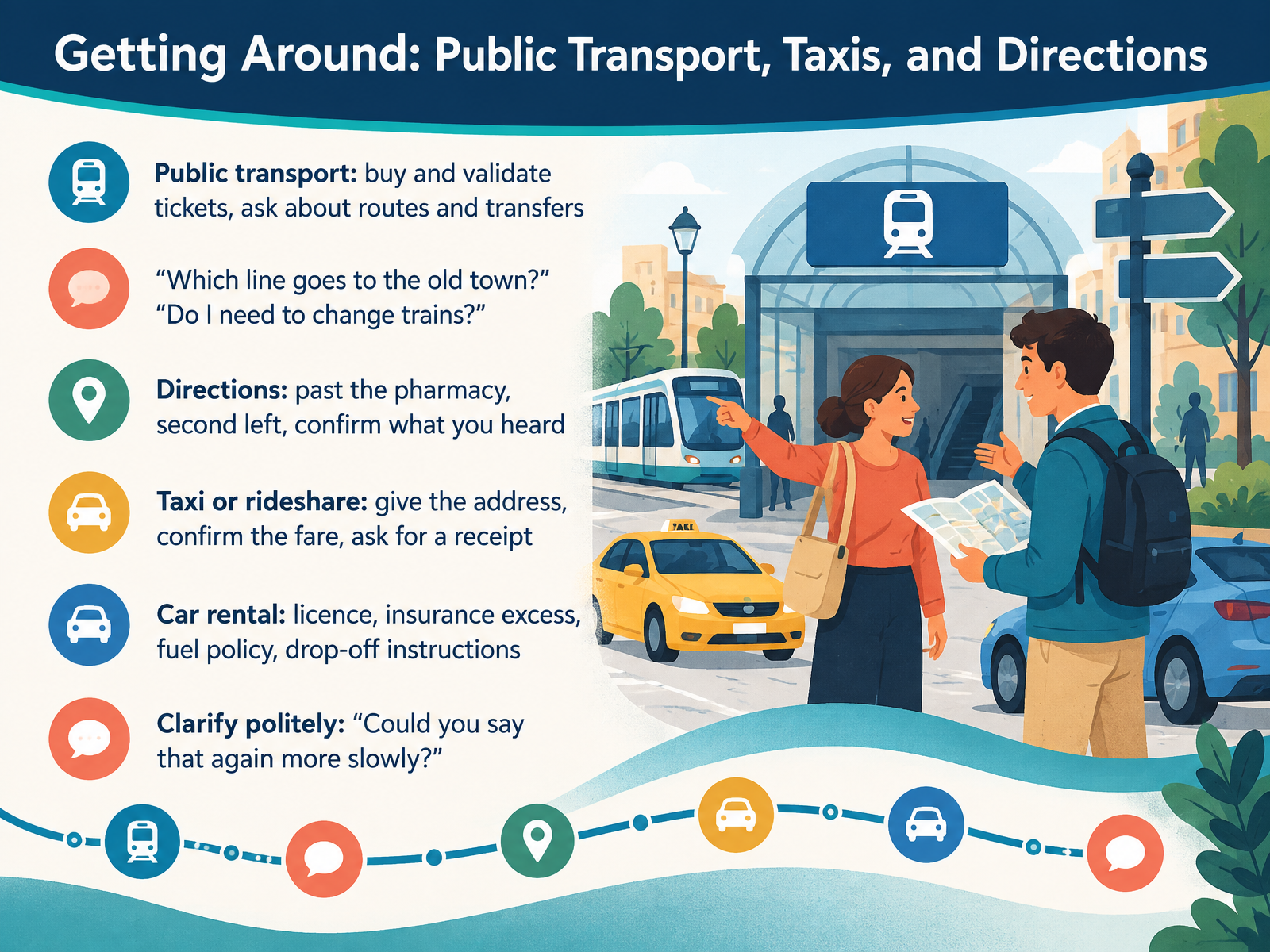
2 min - 06Getting Around: Public Transport, Taxis, and DirectionsNow let's talk about getting around. On public transport, first buy your ticket, then validate it. You can ask: "Which line goes to the old town?" and "Do I need to change trains?" That second question is useful when you need a transfer. Listen for the answer, then repeat it back to confirm. For directions, keep the language simple. "Past the pharmacy, then second left." After you hear it, check politely. "So, past the pharmacy and second left?" If you take a taxi or rideshare, give the full address, confirm the fare, and ask for a receipt. For car rental, be ready to show your licence and ask about insurance excess, fuel policy, and drop-off instructions. And if anything is unclear, say: "Could you say that again more slowly?" That one phrase can save you time and stress. Now try it when you check in. Next, we move to out and about: shops, sightseeing, and small talk.
 2 min
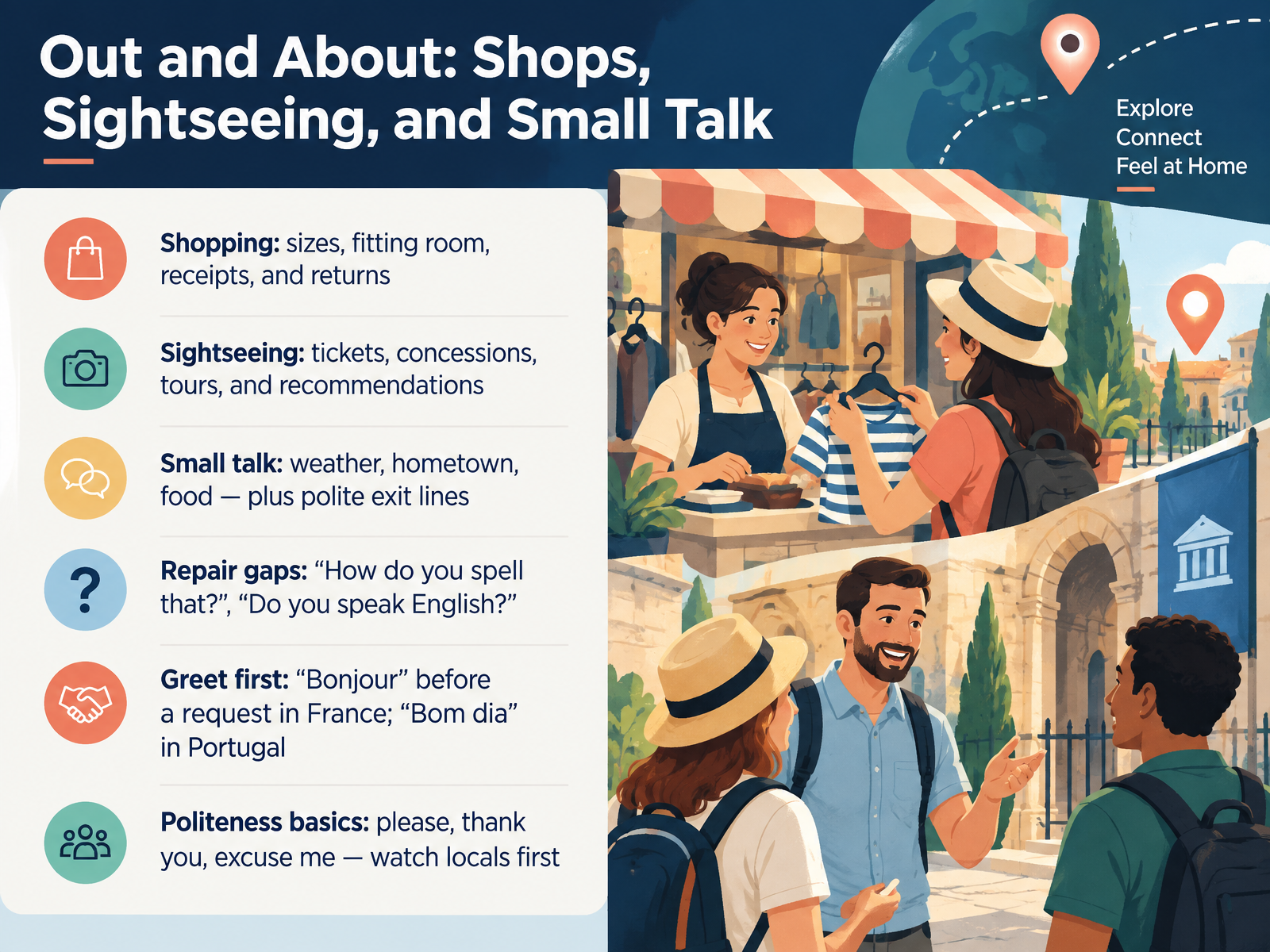
2 min - 07Out and About: Shops, Sightseeing, and Small TalkLet's step outside now, into shops, sights, and friendly small talk. Start with shopping. If you need a different size, say, "Do you have this in a medium?" Then ask, "May I try it on?" At the counter, request a receipt. If something is wrong later, you can say, "I'd like to return this, please." Now try it when you buy clothes. For sightseeing, keep it simple. "One adult ticket, please." Ask about discounts with, "Is there a concession for students or seniors?" And for local tips, "What would you recommend seeing nearby?" Small talk is short and warm. Weather, hometown, food. "Is this your first time here?" "Where are you from?" "What dish should I try?" To leave politely, say, "It was nice talking with you. Enjoy your day." If you get stuck, use repair lines. "How do you spell that?" or "Do you speak English?" In France, greet with "Bonjour" before any request. In Portugal, "Bom dia" works the same way. Watch locals first, then use please, thank you, and excuse me. Next, Dining Out: Ordering, Allergies, and Paying.
 tapsay.mephraselog.comwandervox.app+22 min
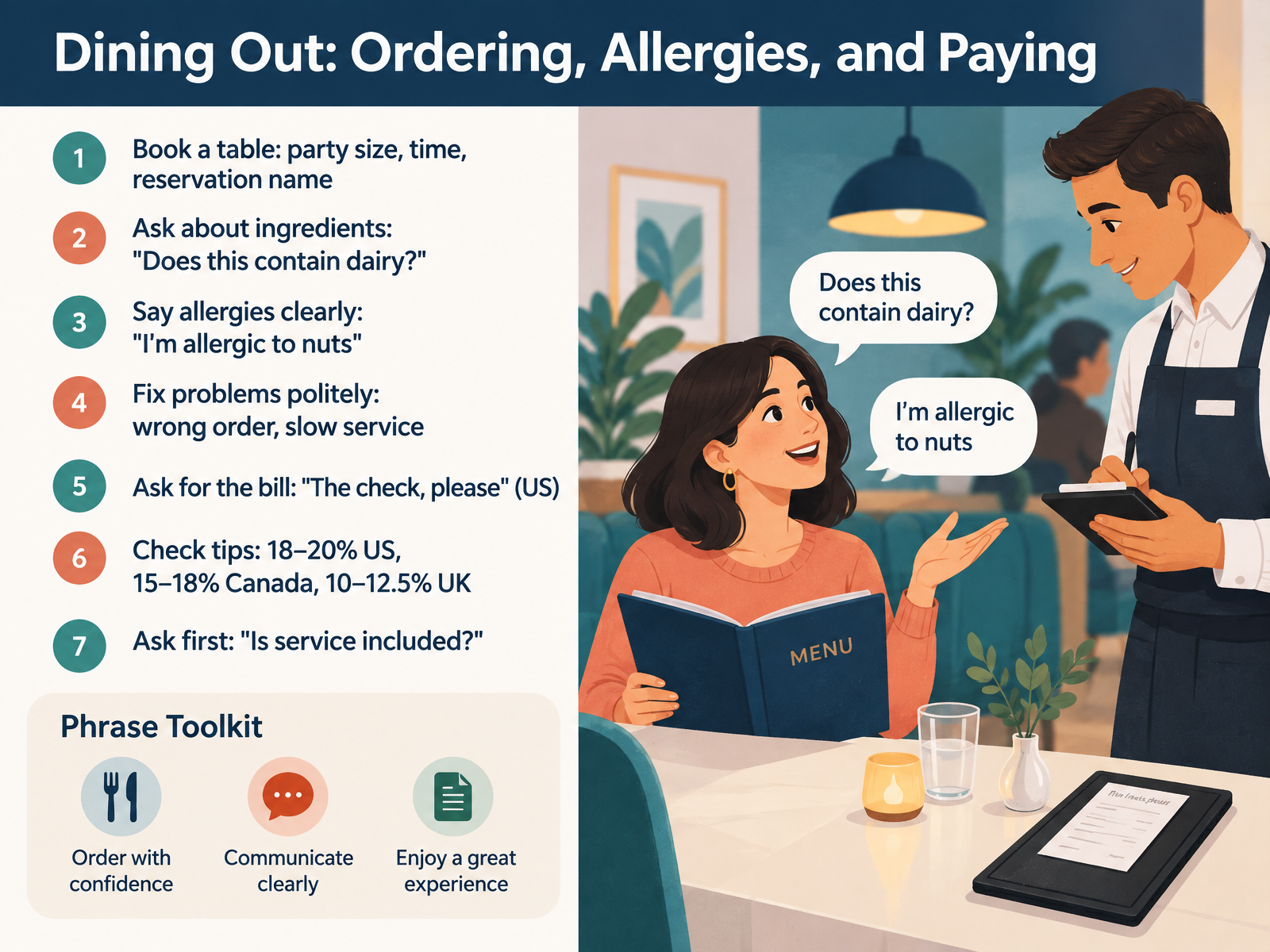
 - 08Dining Out: Ordering, Allergies, and PayingNow let's move on to dining out. First, book a table. You'll say something like: "A table for two at seven, under the name Lee." Give the party size, the time, and the reservation name. Next, ask about ingredients. "Does this contain dairy?" And say allergies clearly: "I'm allergic to nuts." Keep that sentence short and direct. If something goes wrong, stay polite. "Excuse me, I think this is the wrong order." Or, "Could we have a little more time, please?"
When you're ready to pay, say: "The check, please." That's the common phrase in the United States. In the United Kingdom, say "the bill, please." Then think about the tip. In the United States, eighteen to twenty percent is expected. In Canada, fifteen to eighteen percent. In the United Kingdom, ten to twelve and a half percent. But first, always ask: "Is service included?" If it is, you don't need to add more.
So remember, book with key details, speak up about allergies, stay polite, and check the bill before you tip. Next, let's look at health, pharmacy, and medical help.
 dineopen.comusatoday.comnationalgeographic.com+22 min
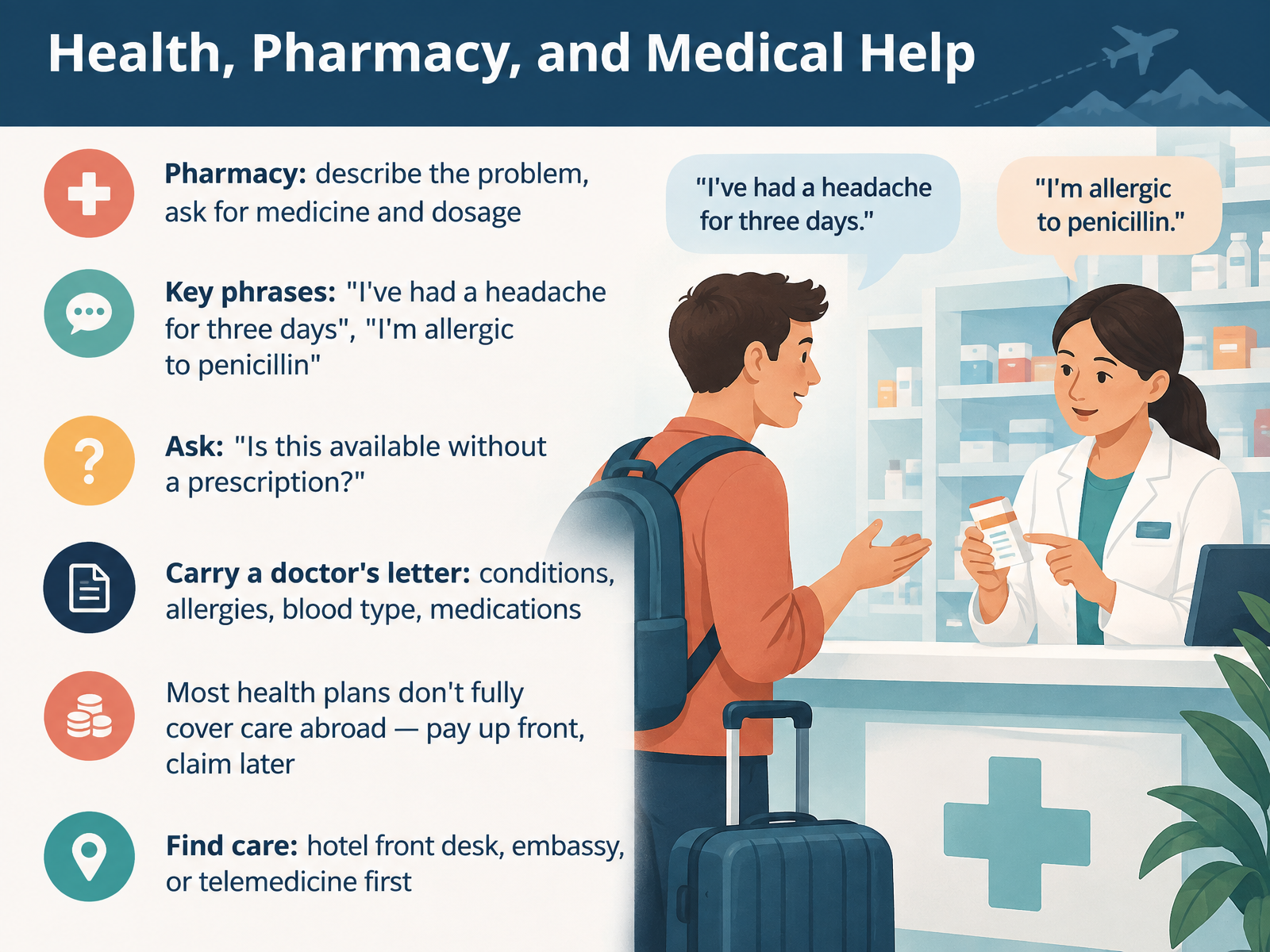
 - 09Health, Pharmacy, and Medical HelpNow let's talk about health, pharmacy, and medical help. At a pharmacy, describe your problem clearly, then ask for medicine and dosage. For example, say: I've had a headache for three days. Could you recommend something? And if you have an allergy, say it plainly: I'm allergic to penicillin. Then ask: Is this available without a prescription? Now try it when you visit a pharmacy. Also, carry a doctor's letter listing your conditions, allergies, blood type, and medications, using generic names where possible. Remember, most health plans do not fully cover care abroad. Be ready to pay up front and claim later, so keep your receipts. If you need care, start with your hotel front desk, your embassy, or a telemedicine service. Next, we'll look at emergencies, lost items, and calling for help.
 travel.state.govcdc.govhealth4travel.com+22 min
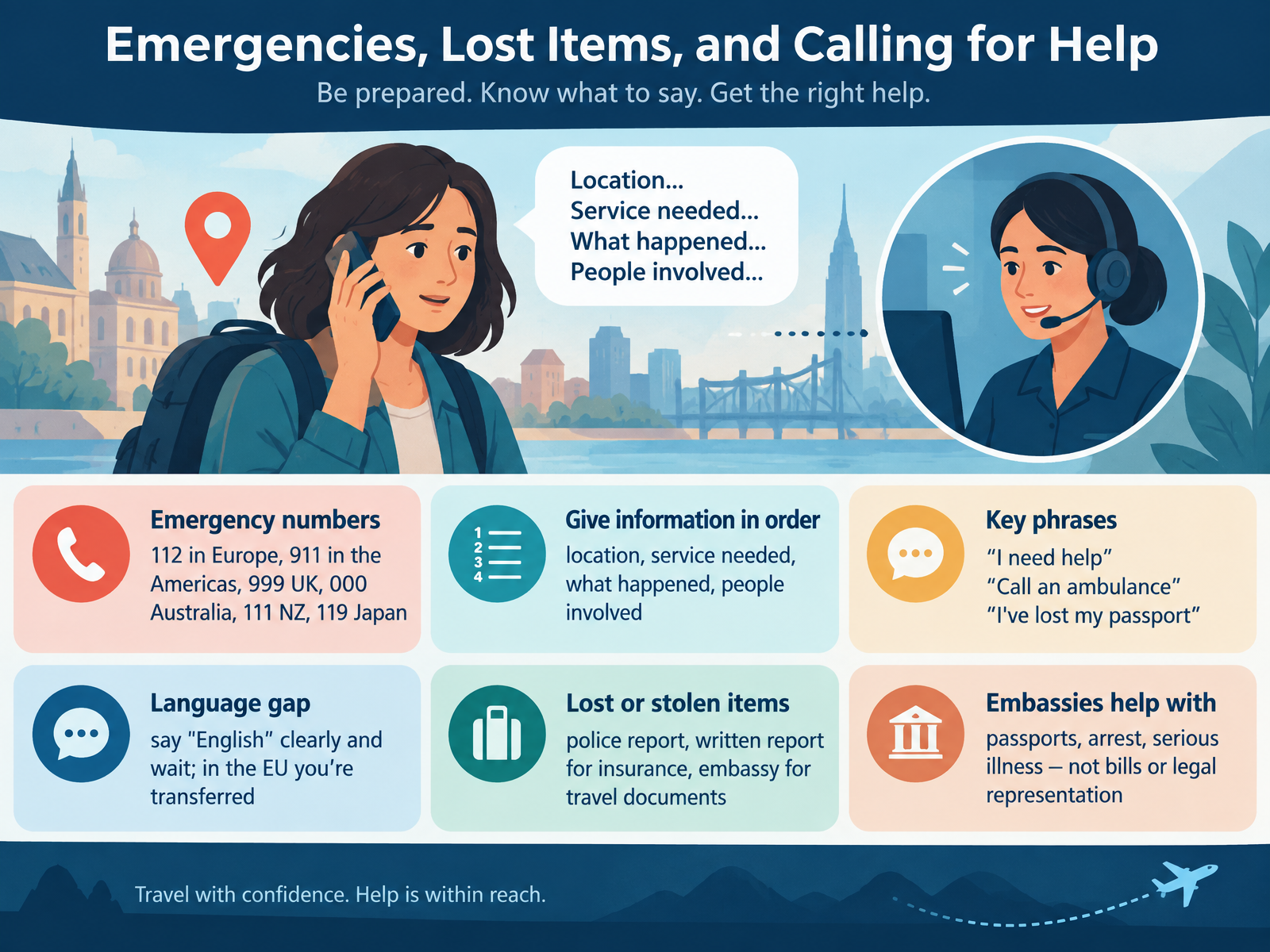
 - 10Emergencies, Lost Items, and Calling for HelpNow let's talk about emergencies and lost items. First, save the local emergency number before you fly. In Europe, dial 112. In the Americas, 911. The United Kingdom uses 999. Australia uses 000. New Zealand uses 111. And in Japan, 119 reaches an ambulance. When you call, give information in order. Say your location first. Then say what service you need. Then explain what happened, and how many people are involved. Keep these phrases ready. I need help. Call an ambulance. I've lost my passport. If the operator does not speak English, say the word English clearly, then wait. In the European Union, you are usually transferred. For lost or stolen items, file a police report. Ask for a written report for your insurance. For travel documents, contact your embassy. Embassies help with passports, arrest, and serious illness. They do not pay bills or provide legal representation. So save the numbers, stay calm, and speak slowly. Next, we look at cultural etiquette and communication repair.
 travel.state.govcdc.govhealth4travel.com+22 min
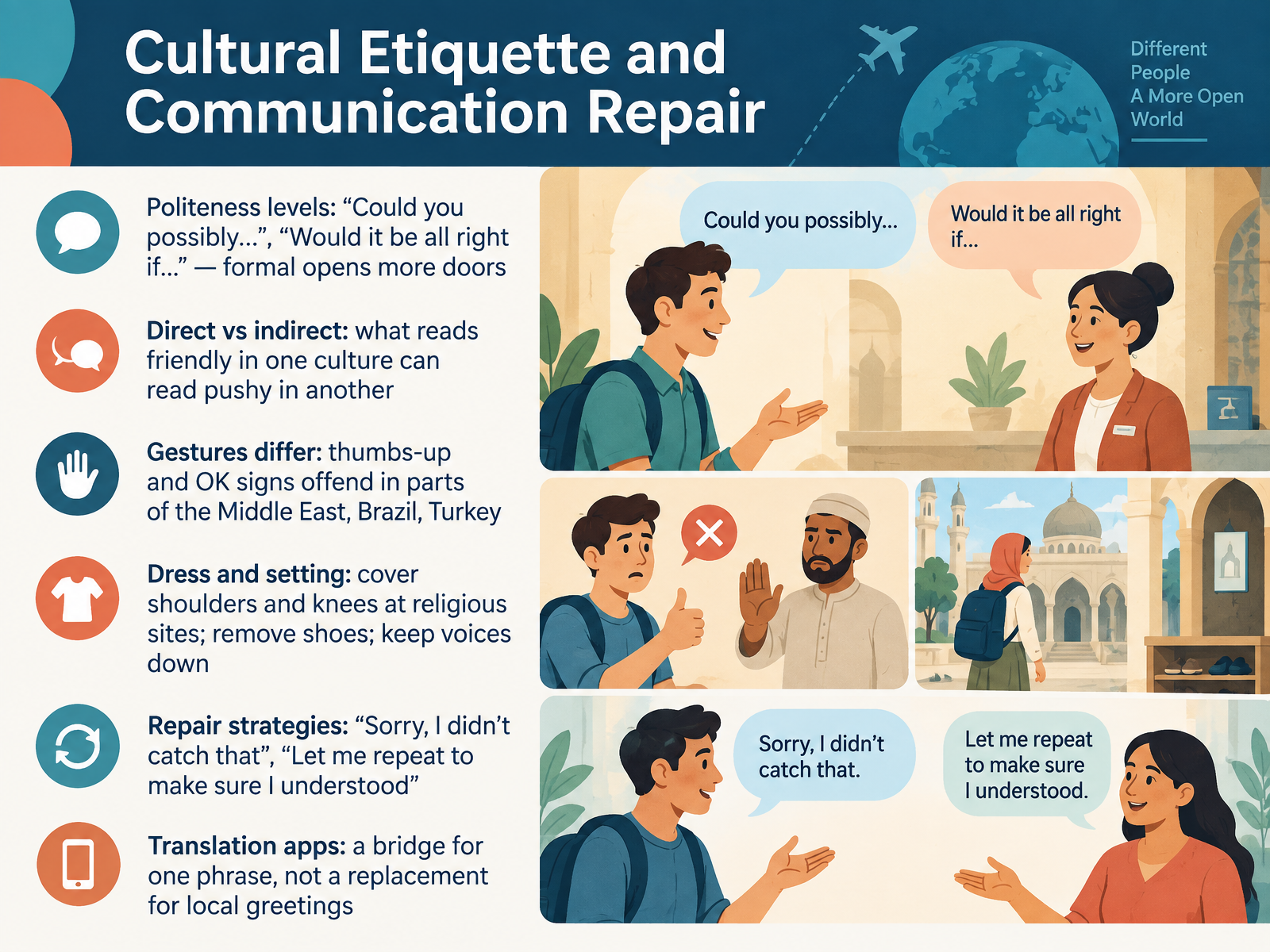
 - 11Cultural Etiquette and Communication RepairNow let's talk about cultural etiquette and repairing communication when it breaks down. Politeness opens doors. Saying, Could you possibly help me, sounds softer than a direct request. Now try it when you check in. What reads friendly in one culture can read pushy in another, so watch and mirror. Gestures differ too. A thumbs-up or the OK sign can offend in parts of the Middle East, Brazil, and Turkey, so keep your hands calm when unsure. Dress and setting matter. At religious sites, cover shoulders and knees, remove your shoes, and keep your voice down. When you miss something, use repair phrases. Say, Sorry, I did not catch that, then, Let me repeat to make sure I understood. Translation apps are a bridge for one phrase, not a replacement for local greetings. Learn hello and thank you first. Next, we will bring these skills together in role-play practice. Role-Play Practice: Integrated Travel Scenarios.
 tapsay.mephraselog.comwandervox.app+21 min
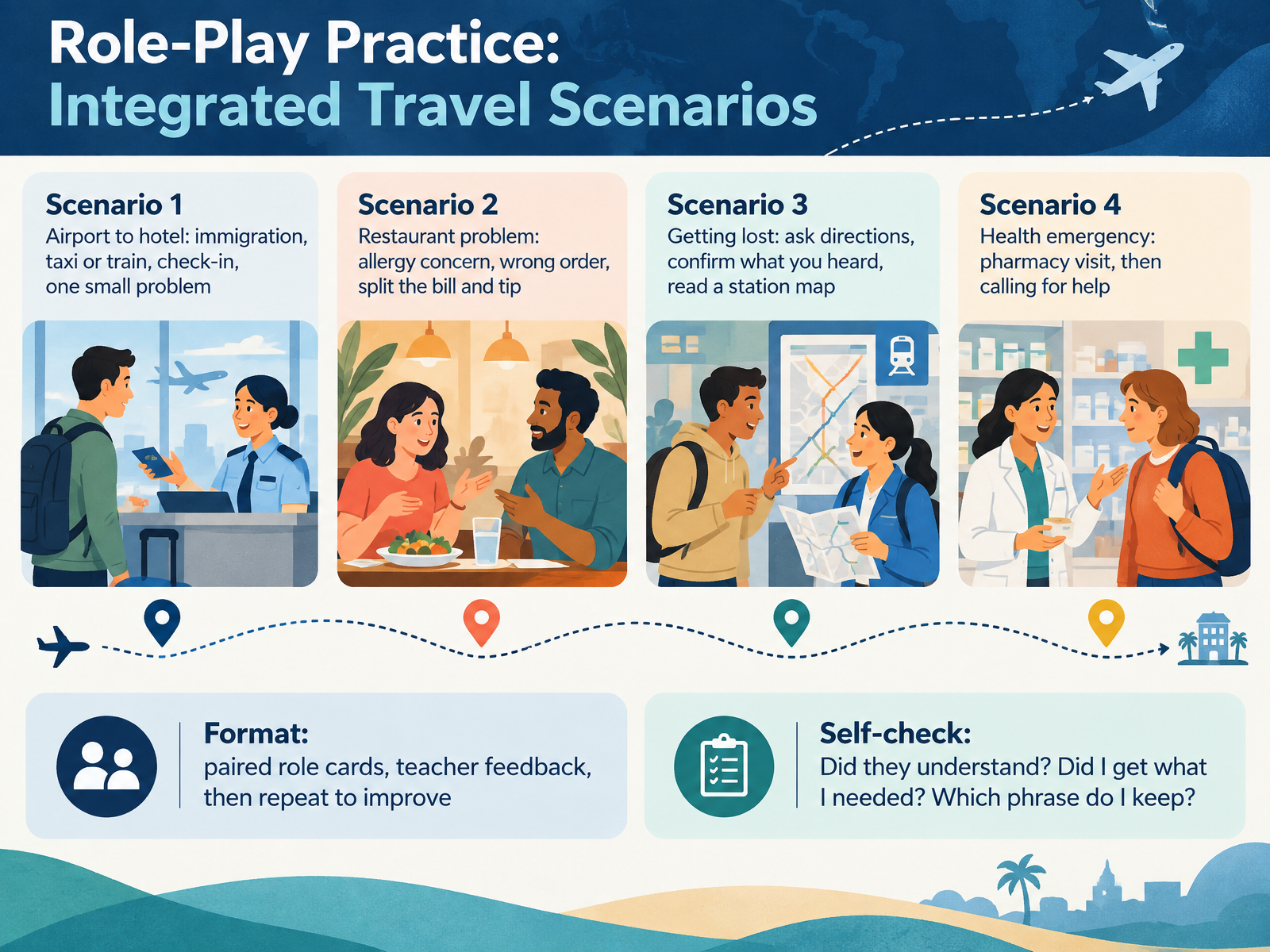
 - 12Role-Play Practice: Integrated Travel ScenariosNow let's put everything together with role-play practice. Work in pairs, and take turns. First, one of you is the traveler, and one is the local person. Then swap.
Scenario one, airport to hotel. You go through immigration, take a taxi or a train, check in, and solve one small problem. Try phrases like, "Could you take me to this address?" and "I think there's a mistake with my room."
Scenario two, a restaurant problem. There's an allergy concern, a wrong order, splitting the bill, and a tip. Ask, "Does this contain nuts?" or "We'd like to split the bill, please." Remember, in the United States, tip about eighteen to twenty percent. In the United Kingdom, check whether service is included first.
Scenario three, getting lost. Ask for directions, confirm what you heard, and read a station map. Say, "Could you repeat that more slowly?"
Scenario four, a health emergency. Visit a pharmacy, then call for help. In Europe, dial one one two. In the United States, dial nine one one.
After each role card, give your partner feedback. Use the self-check. Did they understand? Did I get what I needed? Which phrase do I keep?
Then repeat the scene to improve. Keep the phrases that help you most. Next, we'll move on to Review, Quick-Reference Phrase Toolkit, and Next Steps.
 dineopen.comusatoday.comnationalgeographic.com+22 min
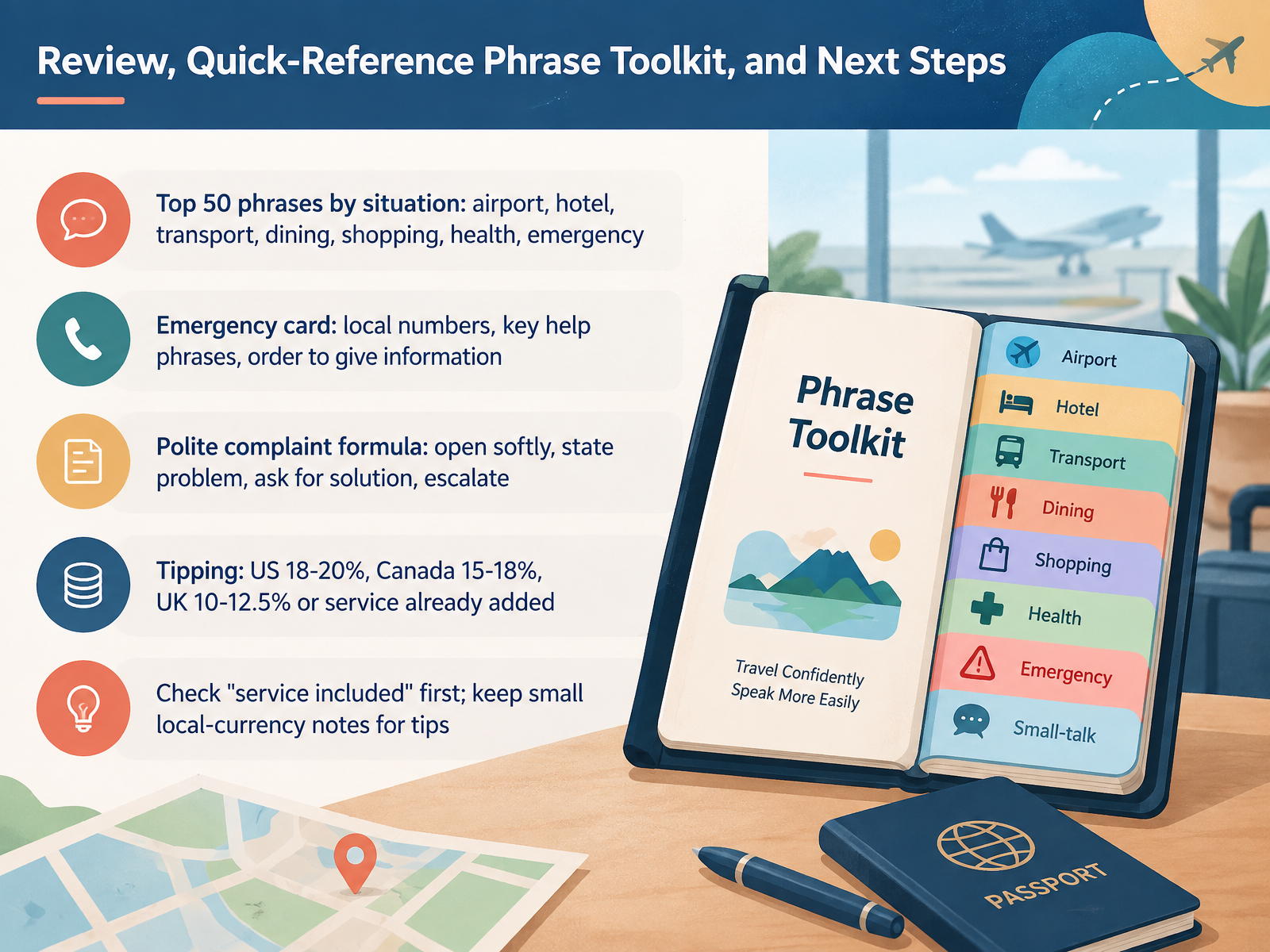
 - 13Review, Quick-Reference Phrase Toolkit, and Next StepsLet's bring everything together. Keep your top fifty phrases grouped by situation, so your airport words stay separate from hotel, transport, dining, shopping, health, and emergency phrases. Next, build a small emergency card. Write the local police, ambulance, and fire numbers, add key help phrases, and note the order to give information: your location first, then what happened, then how many people need help. For problems, use a polite complaint formula. Open softly. Say, excuse me, I think there may be a mistake. Then state the problem clearly, and ask for a solution. If needed, escalate calmly to a manager. Finally, tipping. In the United States, expect eighteen to twenty percent. In Canada, fifteen to eighteen percent. In the United Kingdom, ten to twelve and a half percent, or service may already be added. So always check whether service is included first, and keep small local notes for tips. You now have a practical toolkit. Review it before you travel, adapt each phrase to your own trip, and use it with confidence. Thank you for learning with me, and enjoy every journey ahead.
 dineopen.comusatoday.comnationalgeographic.com+22 min
Take the deck with you
Download this course as a file — free, no sign-up needed.
- PDF handoutEvery slide page, ready to print or share.14 pages · 3.9 MBDownload
- Narrated PowerPointThe deck that presents itself — every slide carries the digital human's narration video.14 pages · 13.6 MBDownload
- PowerPoint slidesThe full deck as a .pptx — open it in PowerPoint, Keynote, or Google Slides.14 pages · 3.9 MBDownload
Free to use in your own training — please keep the PersonWise credit page at the end.
Have your own deck? Turn it into a course
Sources consulted
Web sources consulted while building this course.
- Heathrow scraps 100ml liquid container limit — bbc.com
- UK Visa Requirements: August 2026 — assets.publishing.service.gov.uk
- 100ml liquid limits and electronics: The UK airport security rule changes you need to know in 2026 | The Independent — independent.co.uk
- The Immigration (Form and Manner of Passenger and Service Information) Direction 2026 (accessible) - GOV.UK — gov.uk
- Customs on Multi-Country Flights: What to Expect So You Don’t Miss Your Connection | Kiwi.com Magazine — kiwi.com
- TapSay — Offline Travel Translator | No Internet, No Typing — tapsay.me
- PhraseLog - Travel Phrasebook App — phraselog.com
- WanderVox: AI Photo and Voice Translator for Travelers — wandervox.app
- OffLingua - Offline Translator App - App Store — apps.apple.com
- Roam Offline - Travel App | MWM — mwm.ai
- Restaurant Tipping in 2026: USA vs Canada vs UK — What Changed and What's Coming | DineOpen Blog — dineopen.com
- Is tipping down? Why the gold standard of 20% tips may be slipping — usatoday.com
- The 'tipflation': U.S. tipping has changed—here's what you should know | National Geographic — nationalgeographic.com
- The 2026 Restaurant Tipping Guide — pos.toasttab.com
- Here's how much to tip at restaurants, fast food, takeout in 2026- Fast Company — fastcompany.com
- https://travel.state.gov/content/dam/students-abroad/pdfs/911_ABROAD.pdf — travel.state.gov
- What To Do When Sick Abroad | Yellow Book | CDC — cdc.gov
- https://health4travel.com/emergency-numbers — health4travel.com
- What To Do When Sick Abroad - CDC Yellow Book, 2026 edition - NCBI Bookshelf — ncbi.nlm.nih.gov
- Emirates travel requirements by destination — mofa.gov.ae