Begin
14 pages · ~28 min
Starting Product Management: Practical Workflow
This training teaches aspiring and new product managers a practical end-to-end workflow for starting product management, from discovery to delivery.
A digital instructor presents all 14 pages. Hold “Ask” at any point and ask out loud — the answer comes from this course. No sign-up needed.
What you’ll learn
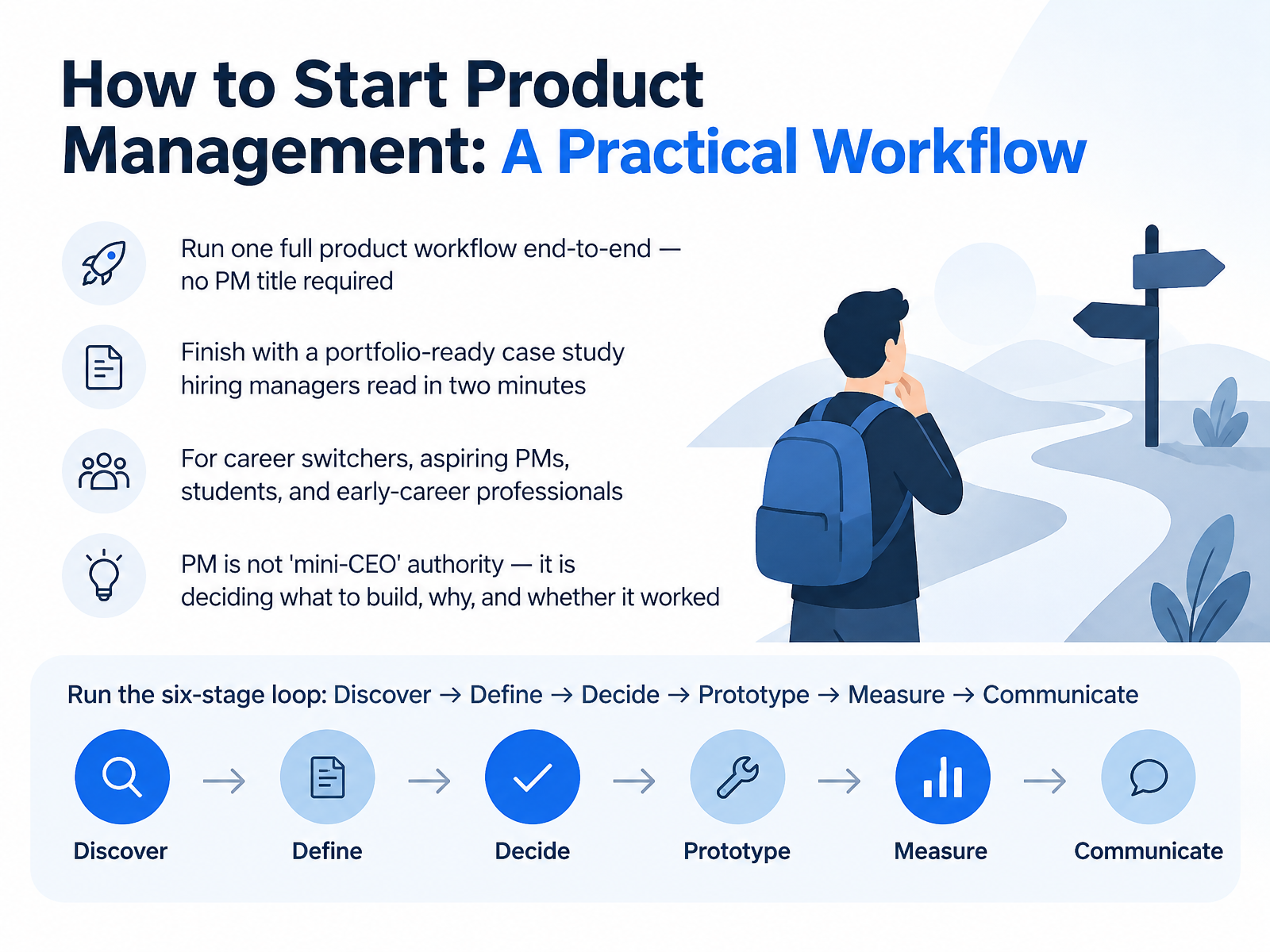
- 01How to Start Product Management: A Practical WorkflowWelcome. If you want to become a product manager but you do not have the title, this course is for you. Over the next fourteen slides, you will run one full product workflow, end to end, and finish with a portfolio-ready case study that a hiring manager can read in two minutes. Here is the mindset that makes this work. Product management is not mini-CEO authority. It is deciding what to build, why, and whether it actually worked. So we will run a six-stage loop together. Discover, to find a real problem. Define, to make it specific. Decide, to choose what to build first. Prototype, to test it cheaply. Measure, to see if it moved. And Communicate, to explain your decisions clearly. This is built for career switchers, aspiring PMs, students, and early-career professionals. Let's start with what the job really is, and the realistic paths in.productinterview.comlearnanything.propigment.is+21 min
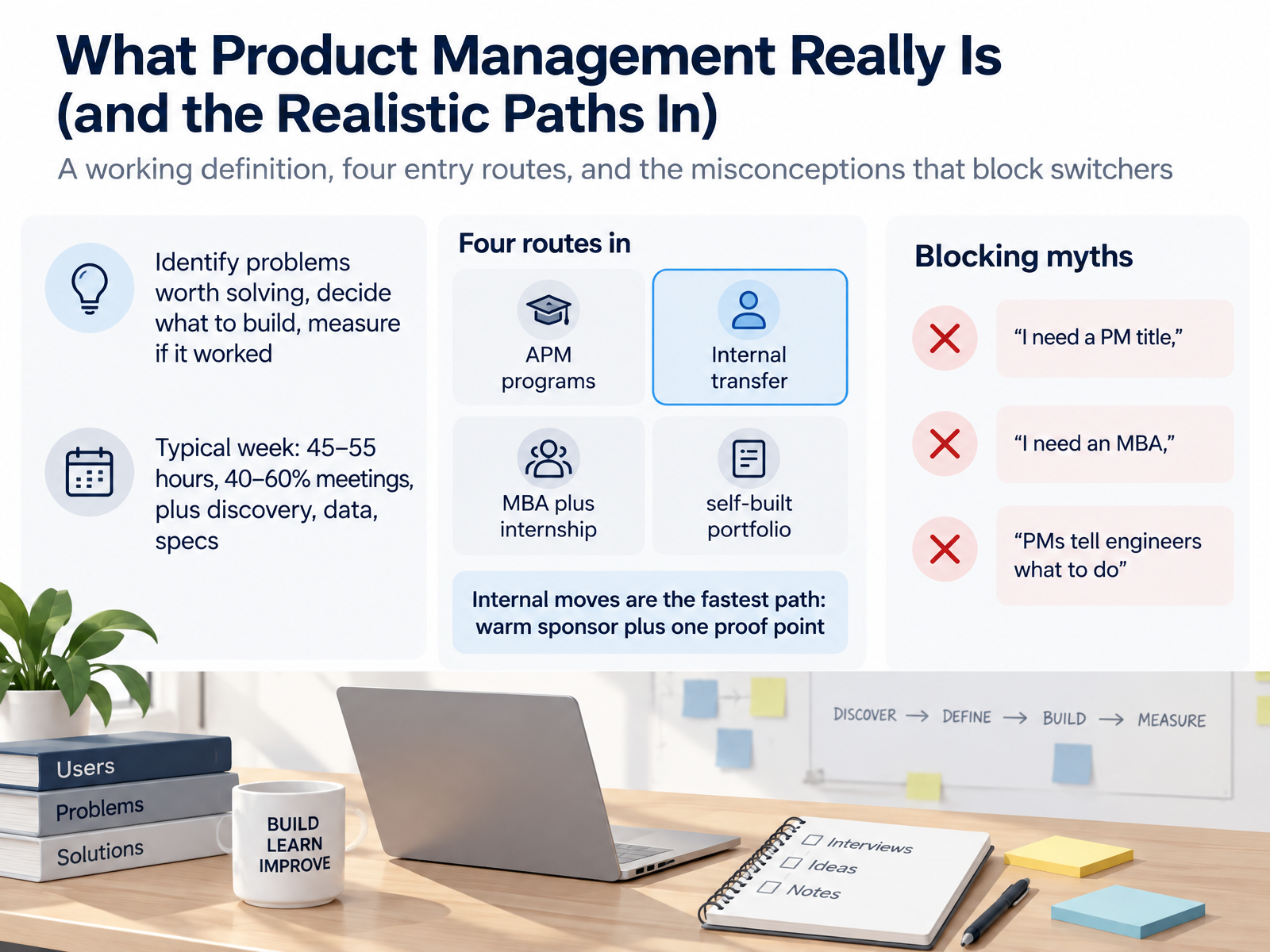
- 02What Product Management Really Is (and the Realistic Paths In)Let's start with what product management really is. In one line: a product manager identifies problems worth solving, decides what to build, and measures whether it worked. That is the whole loop. Notice it does not say write code or manage people. Now, how do people actually get in? There are four realistic routes. Structured associate product manager programs, usually for early-career candidates. An internal transfer at your current company. An MBA with a product internship. Or a self-built portfolio of shipped work. Here is the key point. Internal moves are the fastest path, and they account for a large share of first product roles. You need two things: a warm sponsor, and one concrete proof point, like a spec you wrote or a feature you shipped. What does the job feel like week to week? Expect forty-five to fifty-five hours, with forty to sixty percent of your time in meetings. The rest goes to discovery, data, and specs. Finally, let go of three blocking myths. You do not need a product manager title to do product work. You do not need an MBA. And product managers do not tell engineers what to do. They align the team around a problem. The Six-Stage Workflow at a Glance.
 productinterview.comlearnanything.propigment.is+22 min
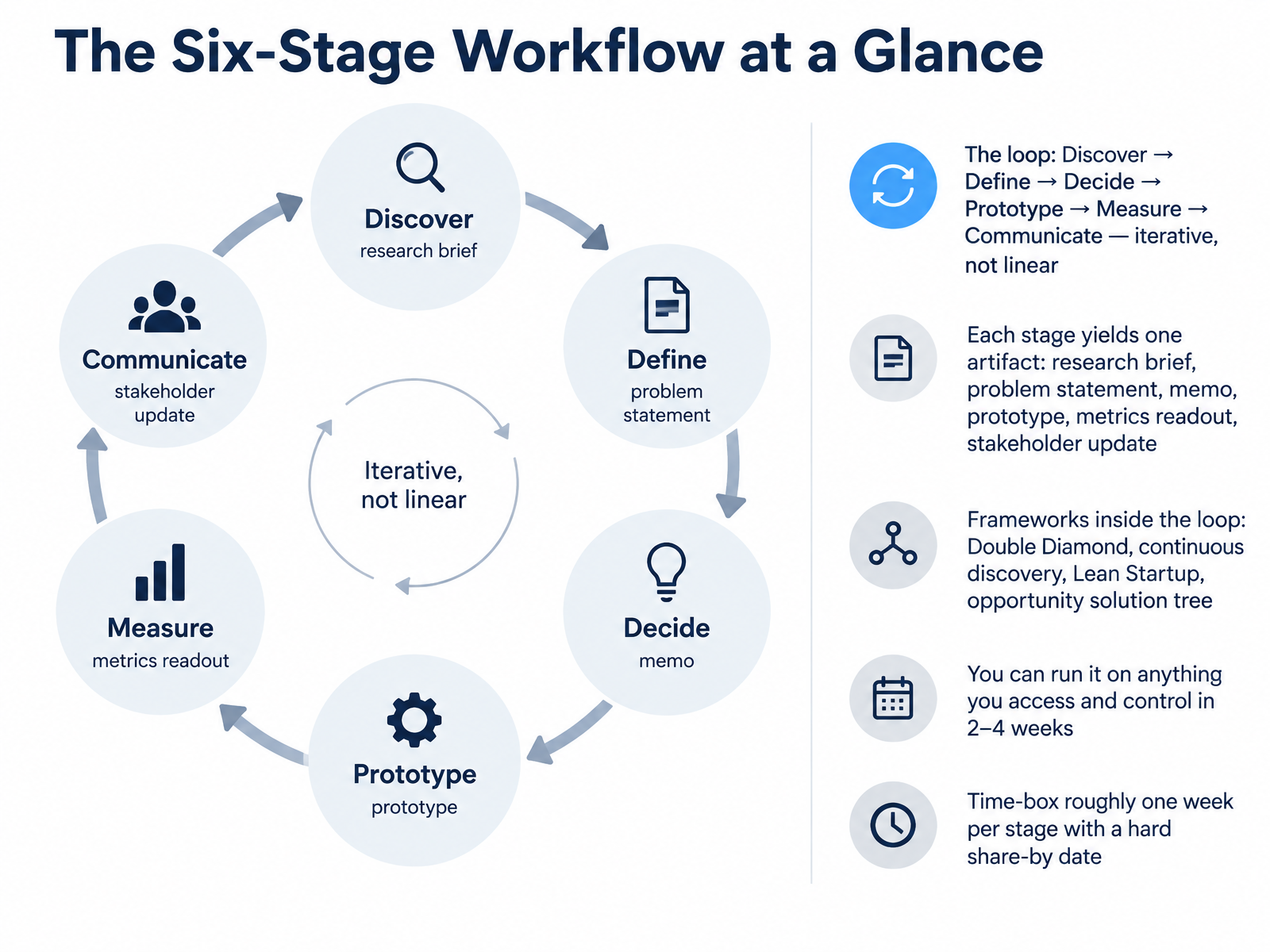
- 03The Six-Stage Workflow at a GlanceLet's look at the whole workflow before we walk through it stage by stage. There are six stages, and they form a loop: Discover, Define, Decide, Prototype, Measure, and Communicate. It is a loop because it repeats. You will often circle back as you learn. Each stage produces one artifact. Discovery gives you a research brief. Define gives you a problem statement. Decide gives you a memo that records your choice. Prototype gives you a testable prototype. Measure gives you a metrics readout. And Communicate gives you a stakeholder update. Four frameworks live inside this loop. The Double Diamond helps you explore and then focus. Continuous discovery keeps you talking to users every week. Lean Startup encourages small experiments. And the opportunity solution tree connects outcomes to opportunities to solutions. Here is the practical part. You can run this loop on anything you can access and control in two to four weeks. Time-box roughly one week per stage, and set a hard share-by date so each artifact actually leaves your desk. Now let's begin with the first stage: Discover, finding a real problem.
 gainhq.comdevpulse.comdacard.mintlify.app+22 min
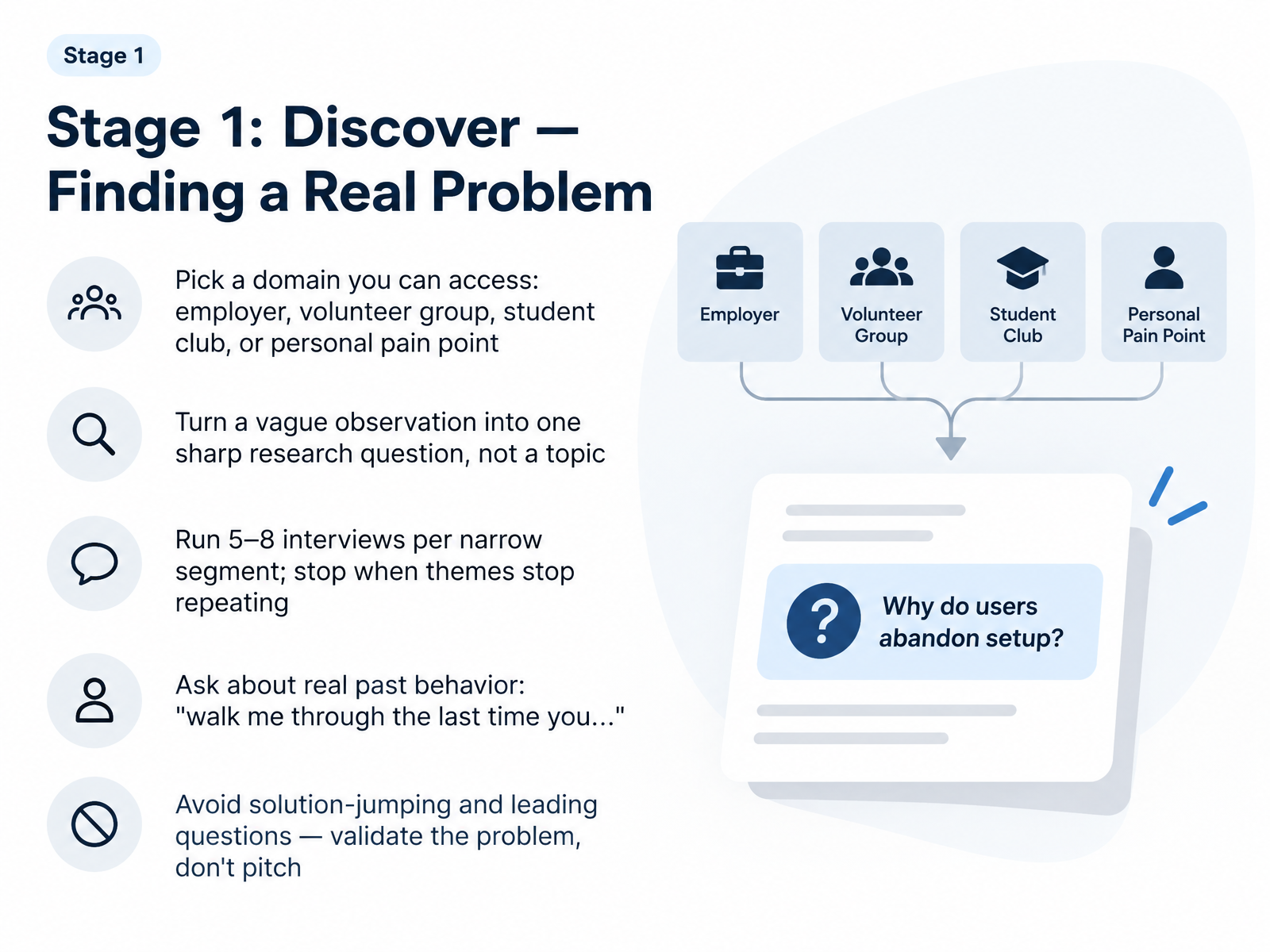
- 04Stage 1: Discover — Finding a Real ProblemNow let's move into Stage One: Discovery, finding a real problem. Start with a domain you can actually access, like your employer, a volunteer group, a student club, or a personal pain point. Next, turn a vague observation into one sharp research question, not just a topic. For example, instead of "onboarding is confusing," ask, "why do new users abandon setup in their first week?" Then run five to eight interviews per narrow segment. Stop when themes stop repeating. Ask about real past behavior, with questions like, "walk me through the last time you did this." Avoid solution-jumping and leading questions. Your job here is to validate the problem, not pitch a fix. That keeps your evidence honest and useful.
 nngroup.commindtheproduct.comtheatomicproduct.com+21 min
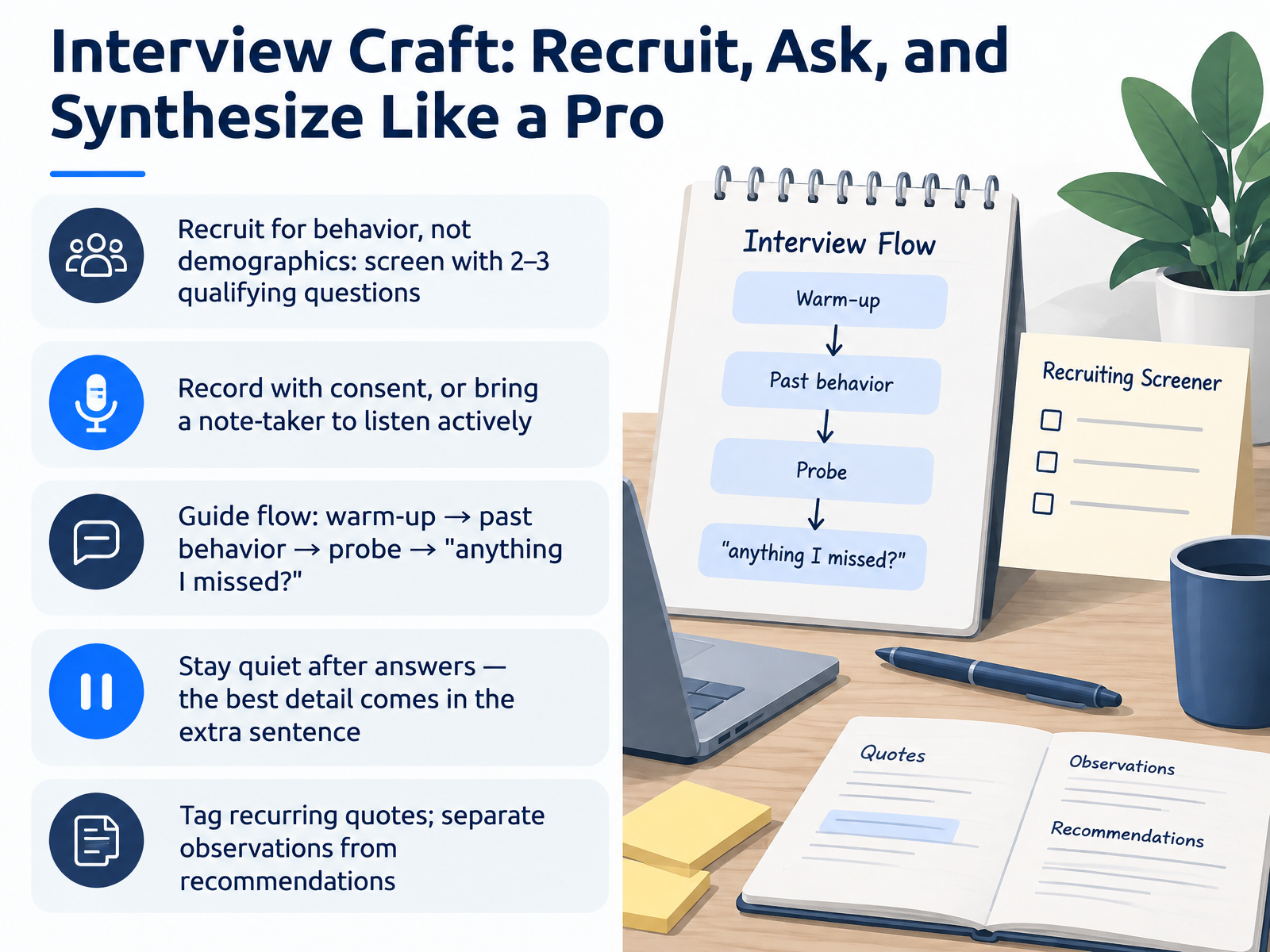
- 05Interview Craft: Recruit, Ask, and Synthesize Like a ProNext, let's look at interview craft, because this is where beginners either gather real evidence or accidentally collect polite guesses. A user interview is a research method, not a friendly chat. So recruit for behavior, not demographics. Screen with two or three qualifying questions, like: when did you last do this task? Then, record with consent, or bring a note-taker, so you can listen actively instead of writing. Guide the flow: warm up, ask about past behavior, probe deeper, then ask, anything I missed? After each answer, stay quiet. The best detail often arrives in the extra sentence. Finally, tag recurring quotes, and separate observations from recommendations. So your evidence stays clean. Now we move to Stage 2: Define, turning evidence into a problem statement.
 nngroup.commindtheproduct.comtheatomicproduct.com+21 min
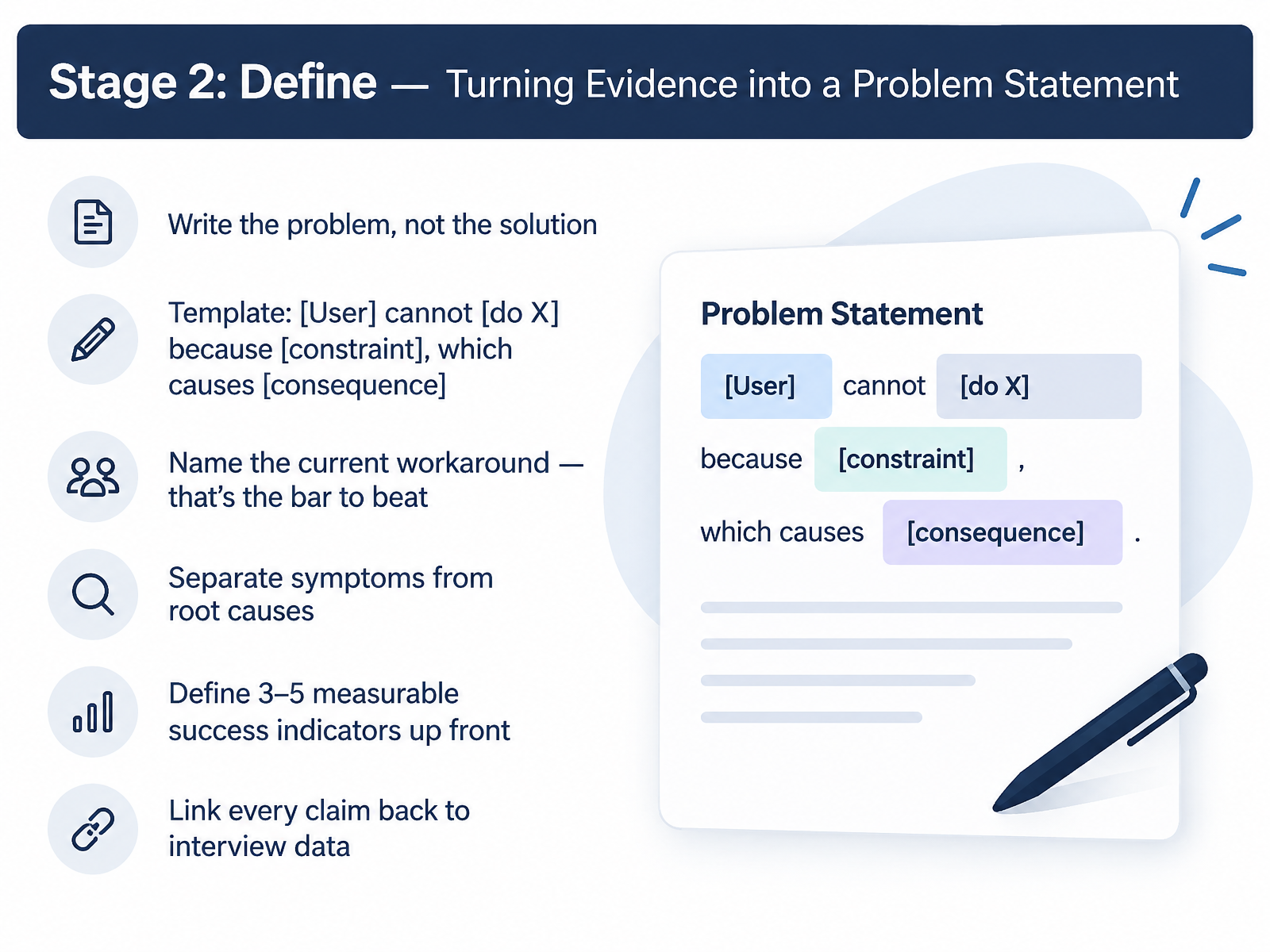
- 06Stage 2: Define — Turning Evidence into a Problem StatementNow that you've gathered raw interview evidence, it's time to turn it into a clear problem statement. This is Stage Two: Define. Write the problem, not the solution. A simple template helps you stay disciplined: User cannot do X because constraint, which causes consequence. For example, an operations manager cannot reconcile invoices quickly because data lives in three systems, which causes late payments. If you can't fill in all four parts, you don't understand the problem yet. Next, name the current workaround. If people are using a spreadsheet and four hours, write that down. That spreadsheet is the bar you need to beat. Also, separate symptoms from root causes. The symptom might be missed deadlines. The root cause may be a manual approval step. Then define three to five measurable success indicators up front, so you know what improvement looks like. Finally, link every claim back to interview data. A problem statement without evidence is just an opinion. Keep it short, specific, and anchored in what you actually heard. With a defined problem in hand, the next stage is Stage Three: Decide, prioritizing options with lightweight evidence.
 blog.logrocket.compmread.orggithub.com+22 min
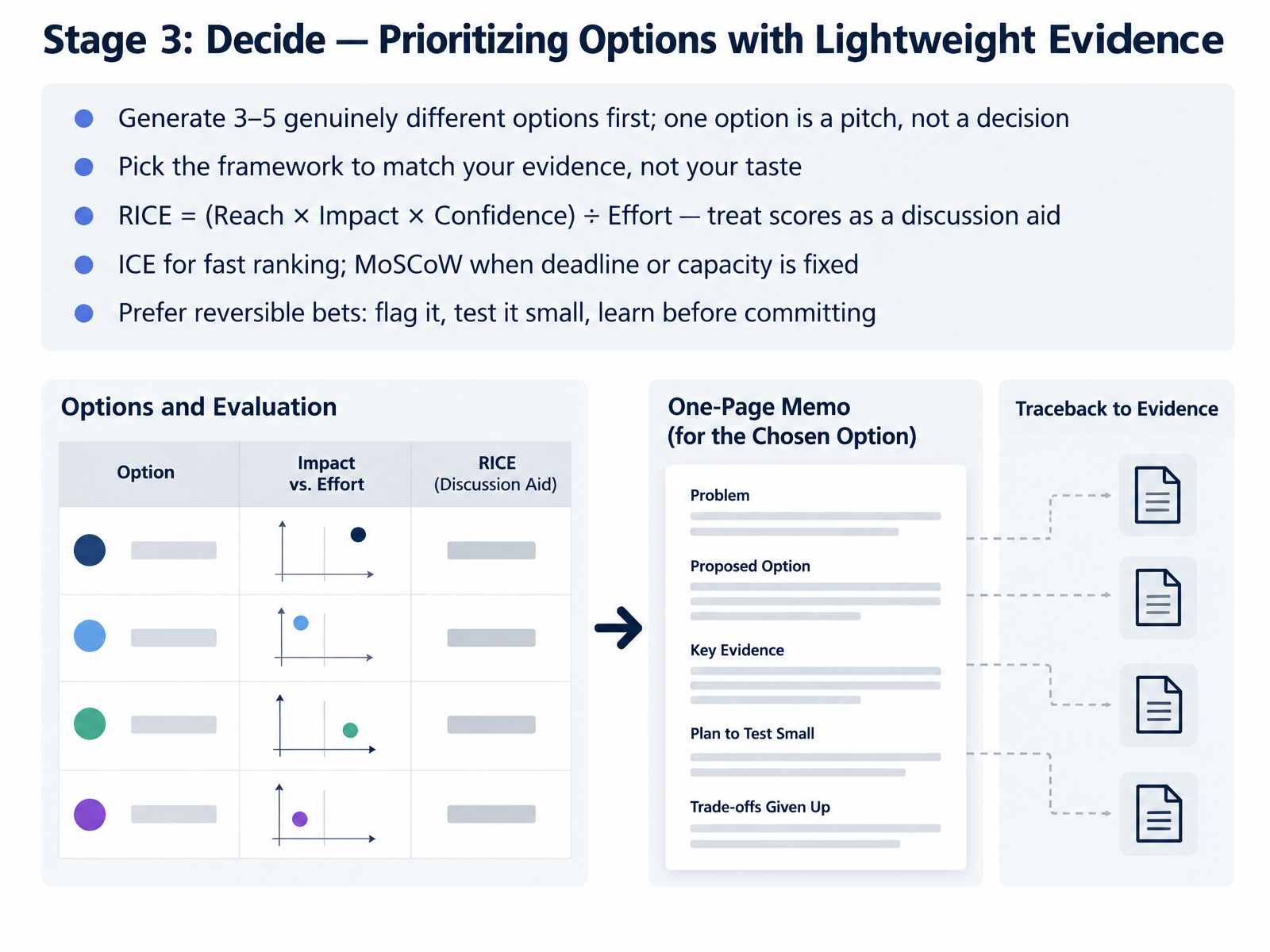
- 07Stage 3: Decide — Prioritizing Options with Lightweight EvidenceNow let's talk about deciding. Your first job in Stage Three is to generate three to five genuinely different options. One option is a pitch, not a decision. Next, pick your framework to match your evidence, not your taste. RICE stands for Reach, Impact, Confidence, and Effort. The formula is Reach times Impact times Confidence, divided by Effort. Treat the score as a discussion aid, not a verdict. Use ICE for fast ranking when you lack reach data. Use MoSCoW when a deadline or capacity is fixed. And when possible, prefer reversible bets. Flag the risk, test it small, and learn before you commit. For example, a checkout bug fix and a new AI assistant may score very differently, which helps you see why. Coming up next, Stage Four, Prototype, making the idea tangible.
 1 min
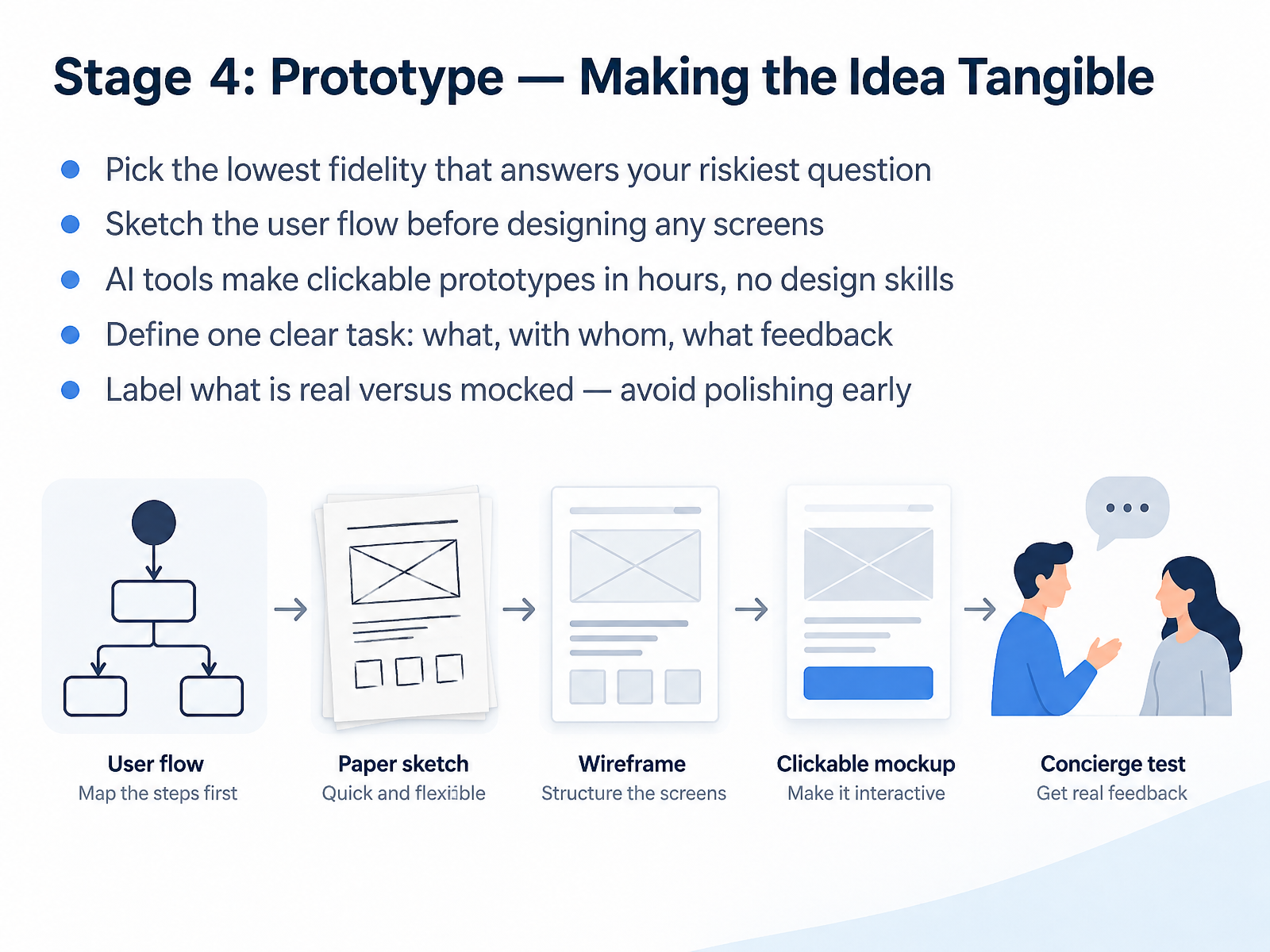
- 08Stage 4: Prototype — Making the Idea TangibleLet's move into Stage Four: Prototype, where we make the idea tangible. A prototype is just a rough version of your product you can show and click, so people react to something real instead of a description. Here's your first decision. Pick the lowest fidelity that answers your riskiest question. Low fidelity means sketches and simple wireframes. High fidelity means something that looks finished. You usually do not need finished. Ask yourself what you are most unsure about, then build only enough to test that. Next, sketch the user flow before designing any screens. Draw the steps a user takes, in order, on paper or a whiteboard. That takes minutes and saves hours. Then you can turn your flow into a clickable prototype. Tools like Figma, Uizard, Chattee, and Visily let you describe your idea in plain language and generate screens in hours, with no design skills. For your first test, define one clear task: what the user does, with whom, and what feedback you will collect. Five people is plenty for a first round. Finally, label what is real versus mocked. Say plainly which parts are live and which are sample data. This keeps feedback honest and stops you from polishing something that is still just a guess. So remember: low fidelity, flow first, one task, and clear labels. That is your prototype. Now let's turn to Stage Five: Measure, testing, feedback, and iteration.
 gainhq.comdevpulse.comdacard.mintlify.app+22 min
- 09Stage 5: Measure — Testing, Feedback, and IterationNow let's move into Stage Five: Measure. This is where testing, feedback, and iteration turn your assumptions into evidence. Start by running three to five moderated think-aloud sessions with target users. Five users typically surface about eighty-five percent of major problems. Give each person a realistic, goal-based task, then stay quiet. Your only prompt is, what are you thinking right now? Track five signals: task completion, time on task, errors, perceived difficulty, and verbatim quotes. Watch what people do, not what they say they prefer. Document findings, surprises, and changes, then make a clear call: iterate, pivot, or stop. Next, we will look at prioritizing what to fix using severity, frequency, and the next iteration.
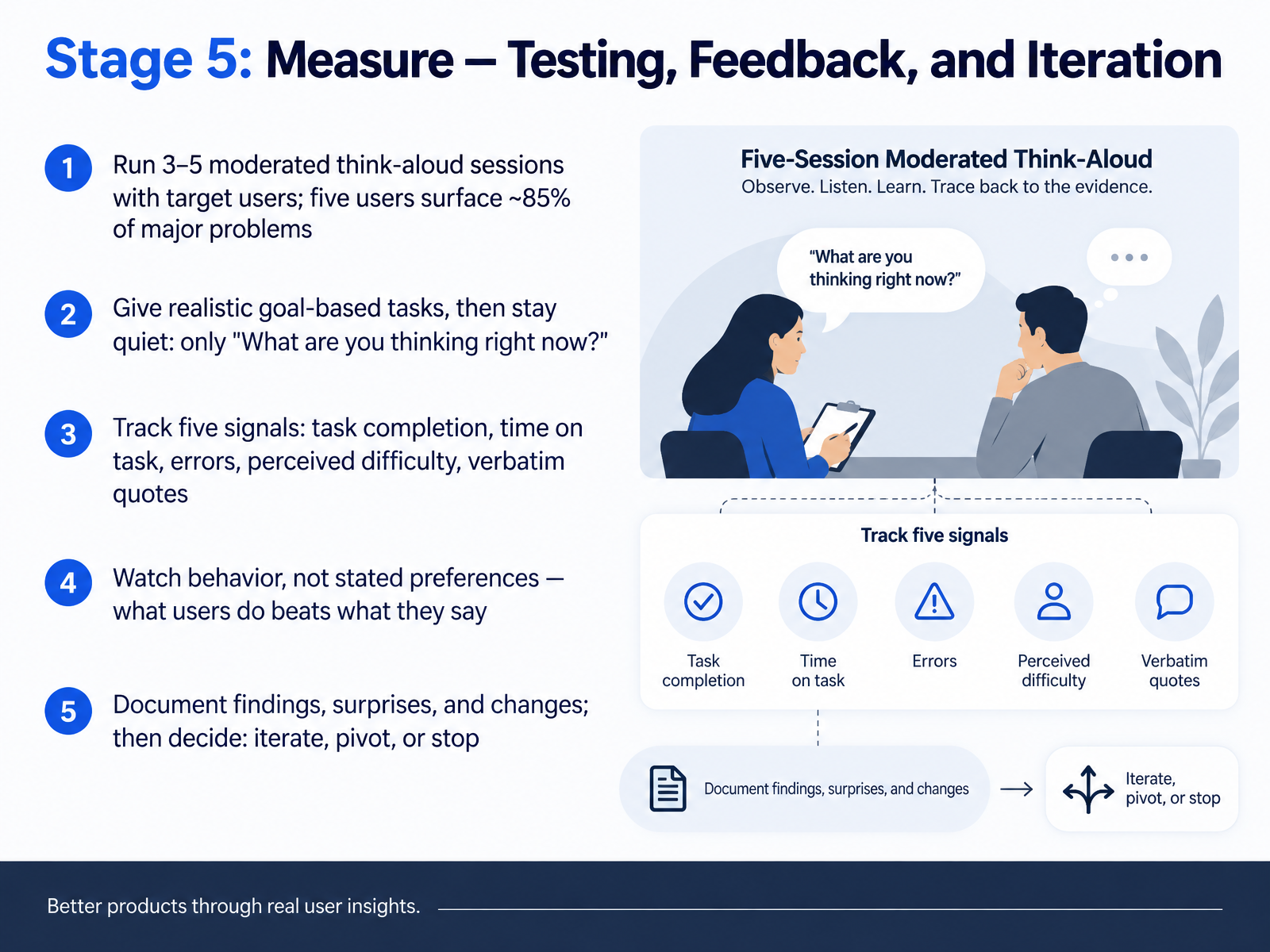 gainhq.comdevpulse.comdacard.mintlify.app+22 min
- 10Prioritizing What to Fix: Severity, Frequency, and the Next IterationNow let's talk about prioritizing what to fix. First, log observations, not opinions. Instead of writing that the checkout is confusing, write that three of five users missed the promo code field. That is evidence a developer can act on. Next, prioritize on two axes: how badly the problem hurts the user, and how many users it affects. A critical UX bug blocks the task for many users, so fix it now. A cosmetic preference from one person goes to the backlog. After you ship fixes, retest with a fresh round of five people to confirm the fixes worked. And keep an issue log tied to your decisions and roadmap items, so findings stay visible instead of forgotten. That is how a first-time PM turns messy feedback into clear, defensible priorities. Next, we move to Stage Six: Communicate, packaging your work as evidence.
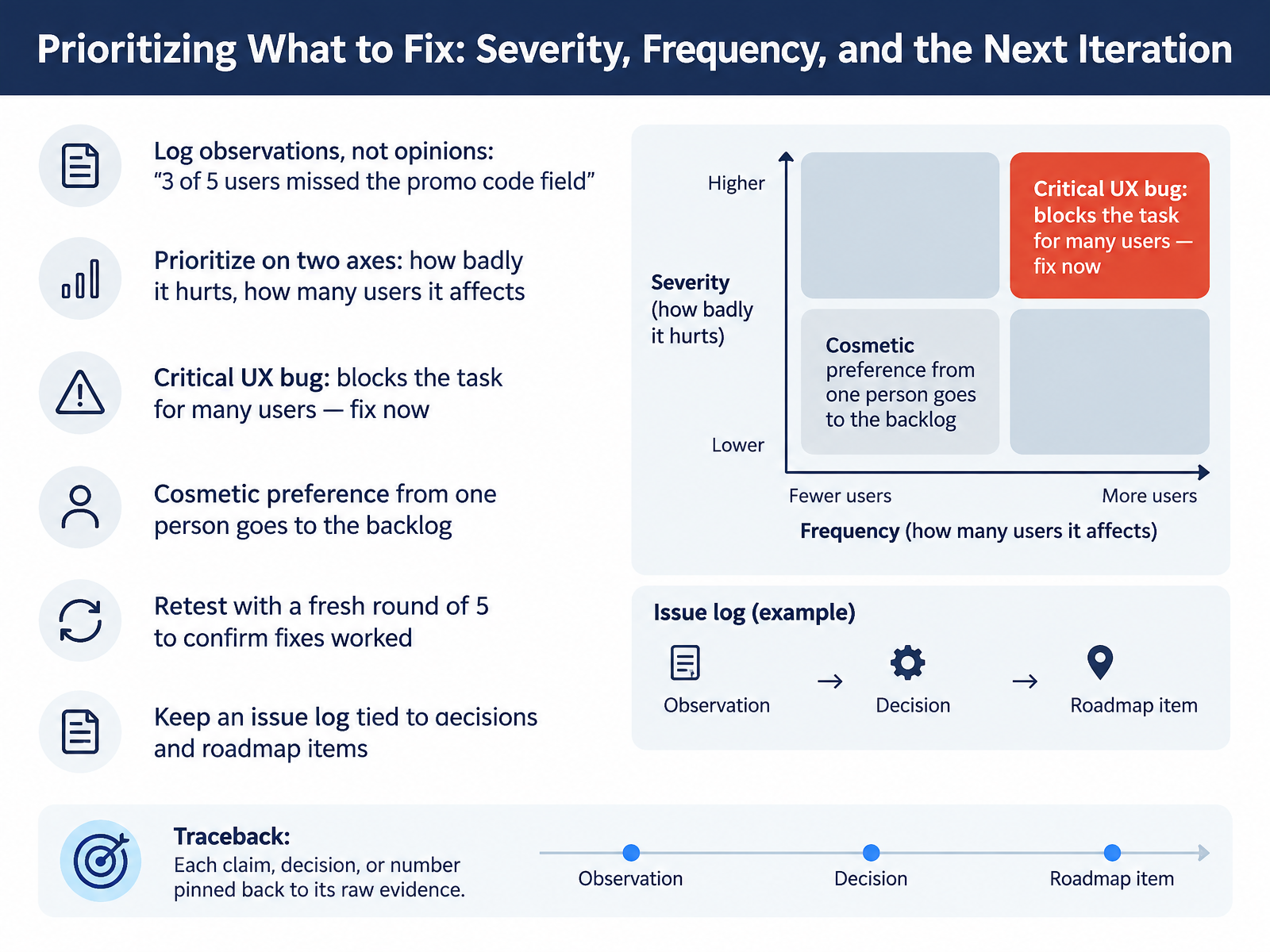 gainhq.comdevpulse.comdacard.mintlify.app+22 min
- 11Stage 6: Communicate — Packaging Your Work as EvidenceNow let's package that work so other people can see your judgment. Stage Six is Communicate. Write a one-page case study with seven beats: result, context, problem, evidence, decision, outcome, and learning. Lead with the number. For example, activation up twenty-five percent in three months. Always state the baseline and the timeframe, because a percentage with no baseline is just noise. Next, name at least one rejected option. Saying we chose staged rollout over a national launch, because supply varied by region, shows trade-offs, and trade-offs are what separate product management work from a feature list. Keep a short stakeholder update ready: what I did, what I learned, what I recommend next. Finally, write one honest reflection line. What changed your mind? That single sentence signals seniority more than any polished result. Next, we'll look at adapting this same story for different audiences.
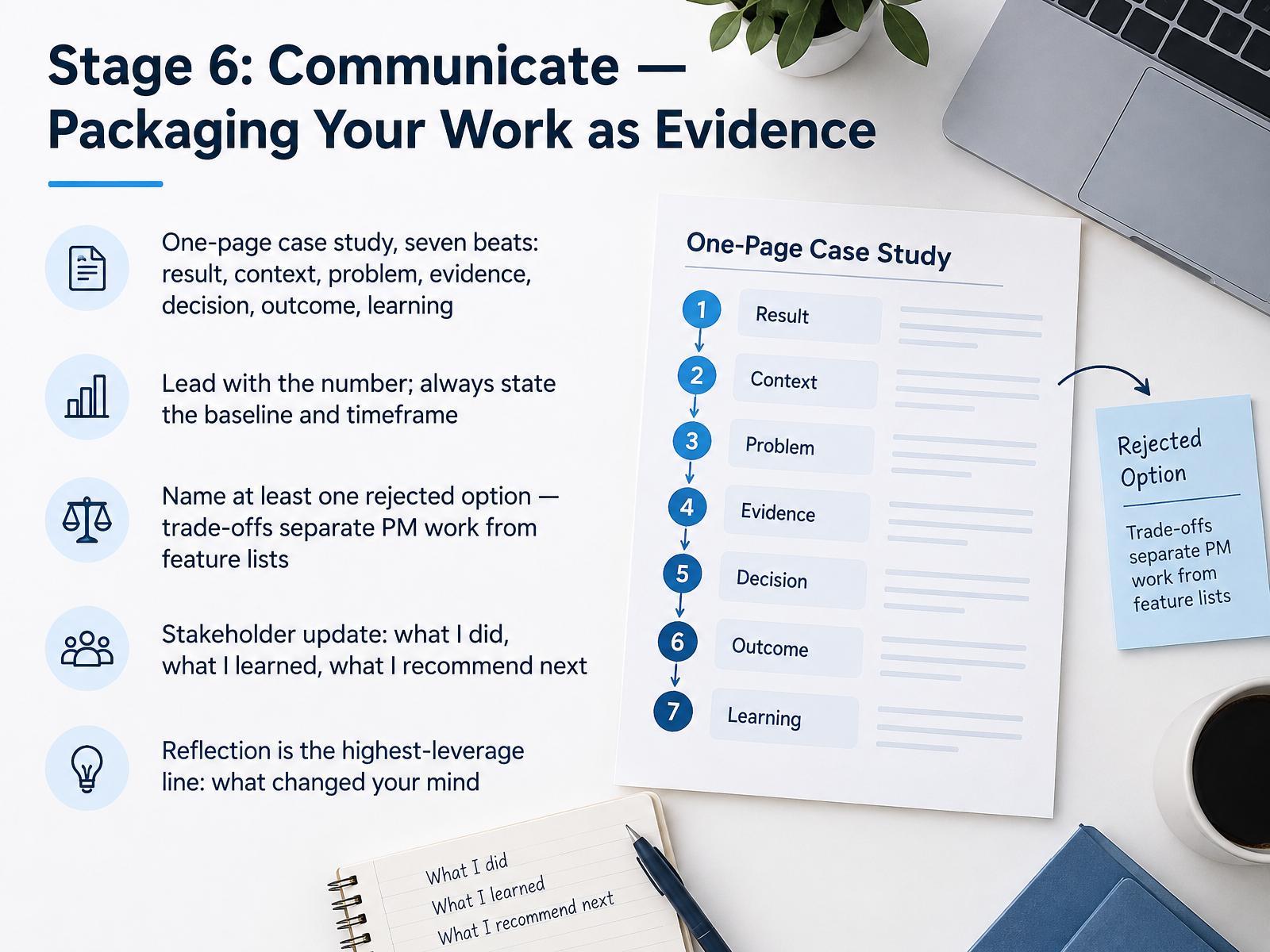 2 min
- 12Adapting the Story: Portfolio, Internal Transfer, and InterviewsNow let's turn that work into a story you can tell. For your portfolio, aim for two to four strong case studies, not ten thin ones. Clarity beats polish every time. If your work is under an NDA, anonymize the company, use relative numbers like up two times, and redraw any artifacts yourself. If you are moving internally, bring a sponsor and one concrete proof point, and ask early before the role opens publicly. You can also reframe your current role as product outcomes. Support, analyst, marketing, and teaching all involve user problems, prioritization, and results. This preparation sets you up for product sense questions, execution trade-offs, prioritization, and your transition story. Next, let's build your first thirty days into a practical action plan.
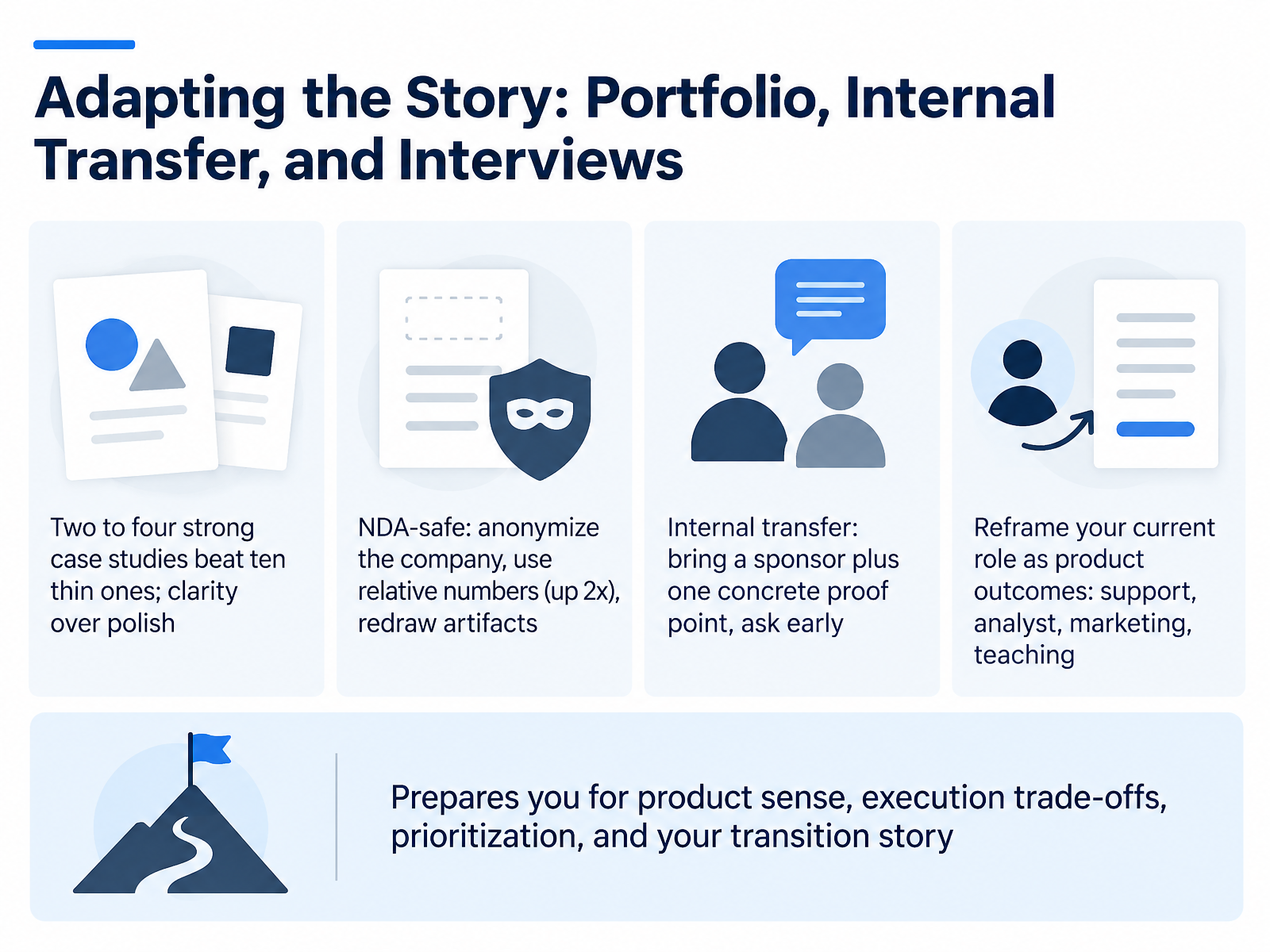 productinterview.comlearnanything.propigment.is+21 min
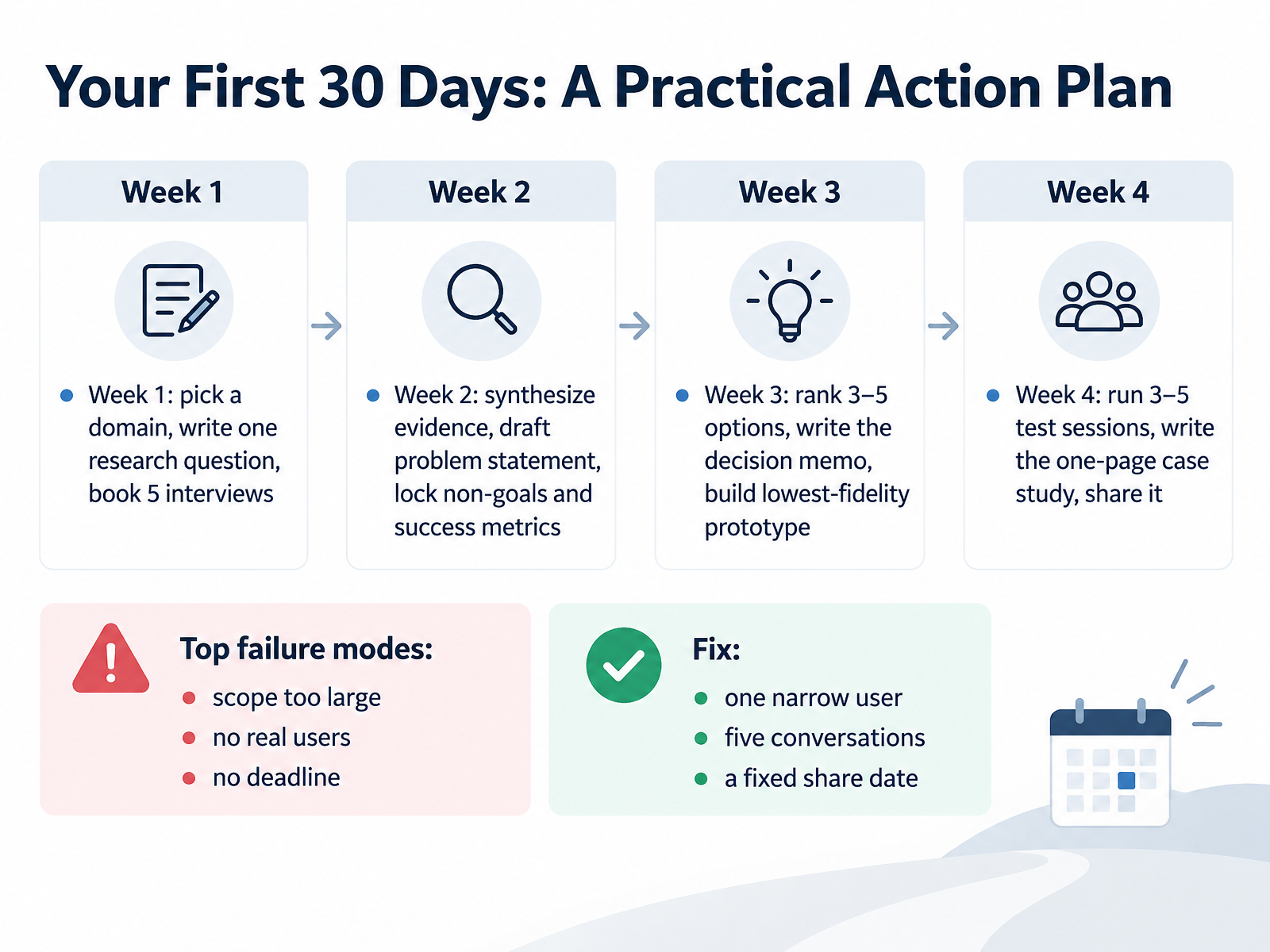
- 13Your First 30 Days: A Practical Action PlanNow let's turn all of this into a concrete four-week plan. In week one, pick a domain and a single user. Then write one research question, and book five interviews with real people in that domain. Five genuine conversations, not friends or family. In week two, synthesize your evidence by clustering repeated themes and quotes. Then draft your problem statement, and lock your non-goals and success metrics. Week three is about making a decision. Rank three to five options, and write a short decision memo explaining why you chose one. Then build the lowest-fidelity prototype you can, like a sketch or a click-through in a design tool, because it is for learning, not for launch. In week four, run three to five test sessions and watch where people hesitate. Then write a one-page case study and share it publicly on a fixed date. Be aware of three common failure modes: scope too large, no real users, and no deadline. The fix is simple: one narrow user, five conversations, and a fixed share date. Next, keep going: repeating the loop and building momentum.
 productinterview.comlearnanything.propigment.is+22 min
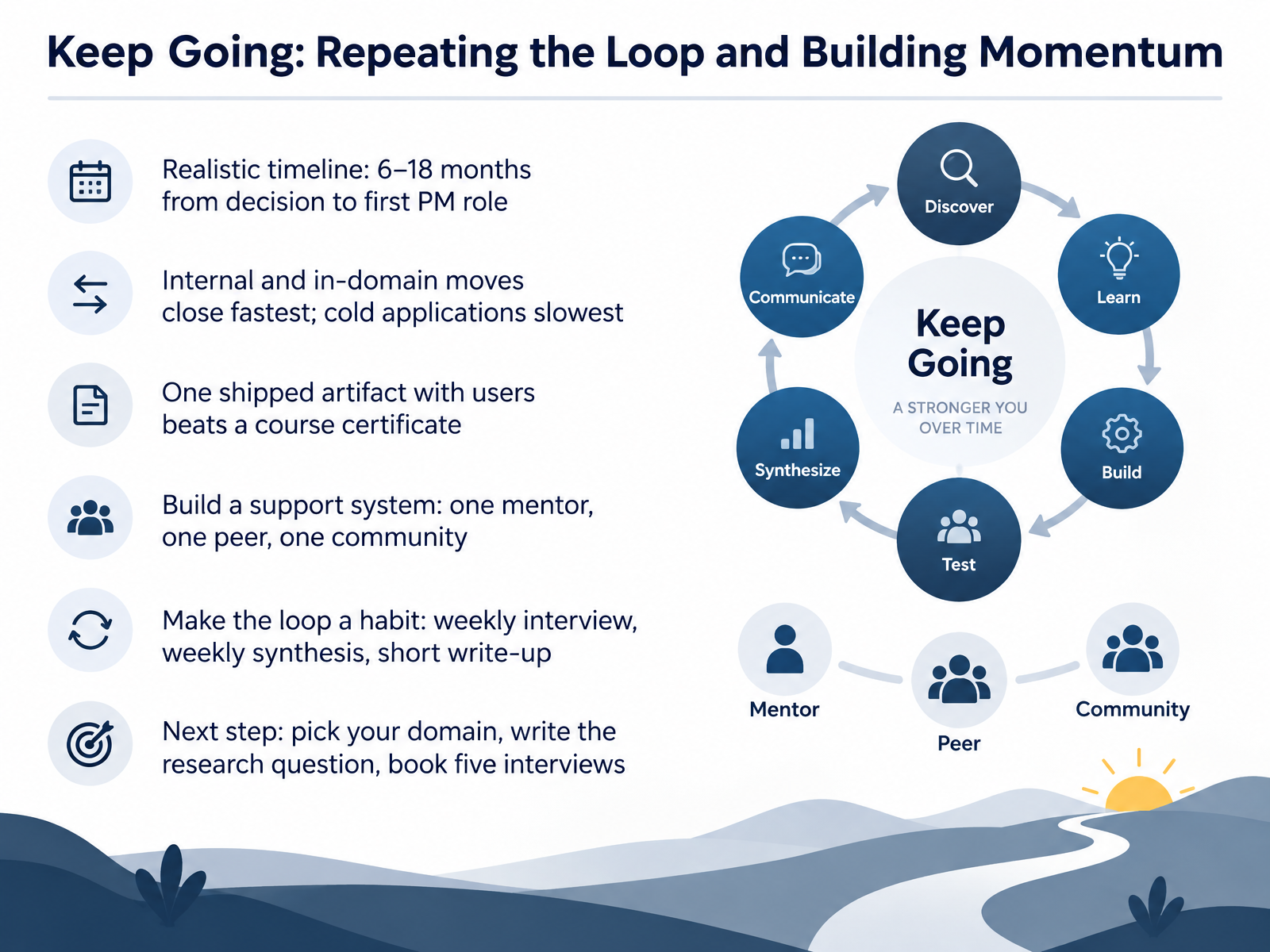
- 14Keep Going: Repeating the Loop and Building MomentumLet's bring this all together and finish with realistic expectations. A switch into product management usually takes six to eighteen months from your decision to your first role. Internal moves and staying in your own industry close fastest. Cold applications to unfamiliar companies are the slowest. And one shipped artifact with real users beats a course certificate every time. So build a support system: one mentor, one peer, and one community. Then make the loop a habit. Each week, run one user interview and synthesize what you heard into a short write-up. The write-ups compound into a portfolio. Your next step is simple. Pick your domain, write your research question, and book five interviews this week. You do not need permission to start. You need evidence, and you can create it. Thank you for working through this with me. Keep the loop going, and good luck.
 productinterview.comlearnanything.propigment.is+21 min
Take the deck with you
Download this course as a file — free, no sign-up needed.
- PDF handoutEvery slide page, ready to print or share.15 pages · 3.2 MBDownload
- Narrated PowerPointThe deck that presents itself — every slide carries the digital human's narration video.15 pages · 12.6 MBDownload
- PowerPoint slidesThe full deck as a .pptx — open it in PowerPoint, Keynote, or Google Slides.15 pages · 3.1 MBDownload
Free to use in your own training — please keep the PersonWise credit page at the end.
Have your own deck? Turn it into a course
Sources consulted
Web sources consulted while building this course.
- How to become a PM in 2026 (no prior title) · productinterview.com — productinterview.com
- How to Transition to Product Management (2026) — Engineer, Designer, MBA | PM Streak — learnanything.pro
- Career Change to Product Management: Use What You Know – Pigment — pigment.is
- How to Transition Into Product Management in 2026 — Orvo — getorvo.com
- How to Switch to Product Management After 5-6 Years in Industry (No MBA, No Starting Over) - HelloPM How to Switch to Product Management With Industry Experience (No MBA) — hellopm.co
- Product Discovery Phases Framework - GainHQ — gainhq.com
- Product Discovery Process in Agile: A 2026 Guide — devpulse.com
- https://dacard.mintlify.app/knowledge-base/framework-pom — dacard.mintlify.app
- The Definitive Guide to Product Discovery and Frameworks — productschool.com
- What Is Product Discovery in the AI Era? The Ultimate Guide for PMs (2026) — productcompass.pm
- User Interviews 101 — nngroup.com
- Conducting User Interviews: A Practical Guide — mindtheproduct.com
- Practical Guide to User Interviews — Part 1: Preparation & Execution — theatomicproduct.com
- How to Conduct User Interviews (Step-by-Step Guide for PMs) — theproductflow.com
- The Ultimate Guide to Customer Interviews | ProductPlan — productplan.com
- How to write a problem statement: Template and examples - LogRocket Blog — blog.logrocket.com
- Free Problem Statement Canvas for Product Managers | PMRead — pmread.org
- skills/problem-statement/SKILL.md at HEAD · deanpeters/Product-Manager-Skills — github.com
- Customer Problem Statement for Product Managers | Gensudo — gensudo.com
- Framing The Problem Statement | A Proven AI Prompt for General for product managers | Engify.ai — engify.ai