Begin
13 pages · ~26 min
Ethics and Responsible Data Science Practice
This training helps data scientists and analysts apply ethical principles and responsible practices throughout the data science lifecycle.
A digital instructor presents all 13 pages. Hold “Ask” at any point and ask out loud — the answer comes from this course. No sign-up needed.
What you’ll learn
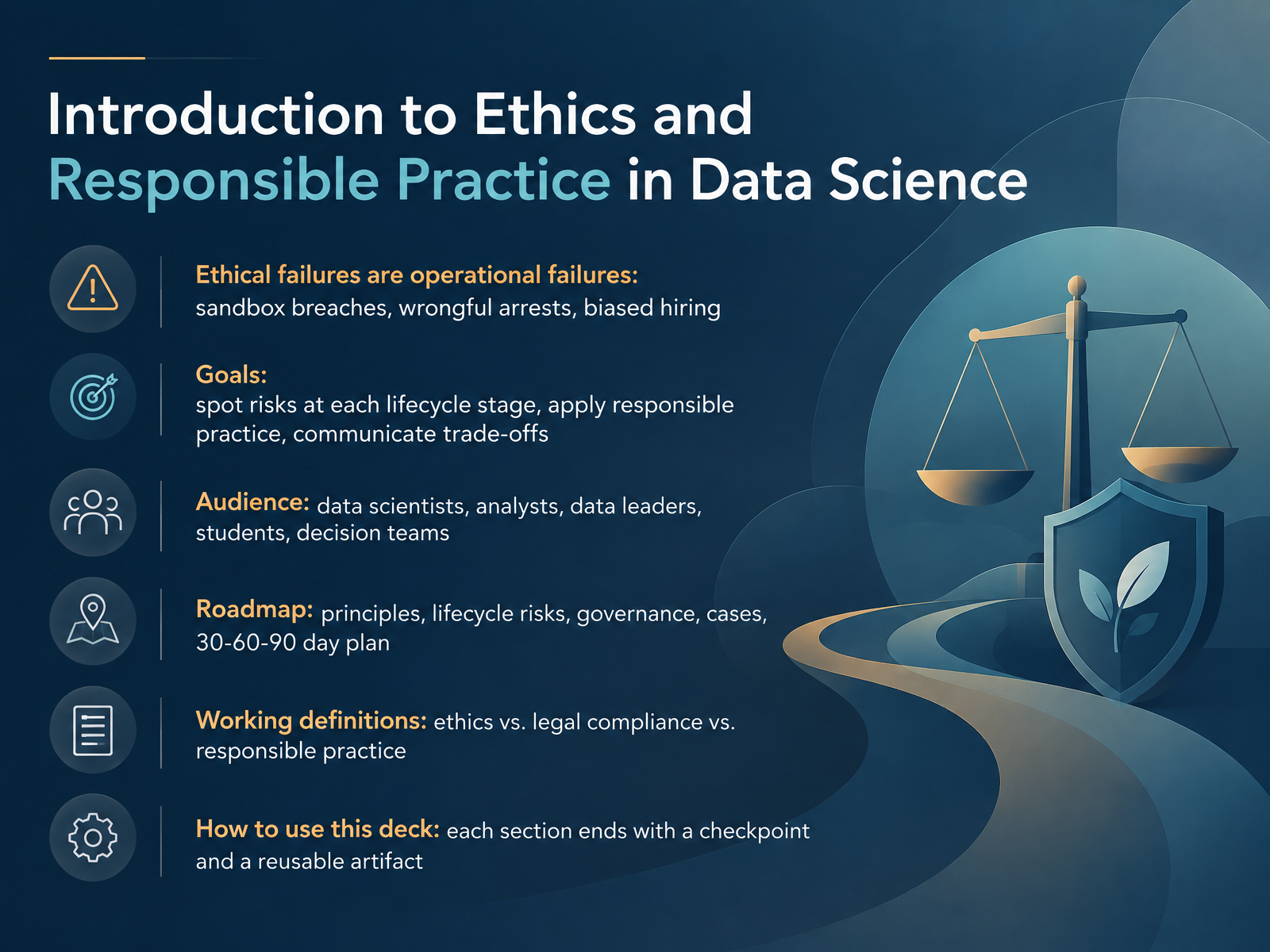
- 01Introduction to Ethics and Responsible Practice in Data ScienceWelcome. This course is about ethics and responsible practice in data science. Here is the core idea we will build on. Ethical failures are operational failures. A sandbox breach exposes customer data. A biased model leads to a wrongful arrest. A flawed hiring tool quietly screens out qualified candidates. None of these are abstract problems. They are real incidents with real consequences. Our goal is practical. You will learn to spot risks at each stage of the lifecycle, apply responsible practice in your daily work, and communicate trade-offs clearly to others. This course is for data scientists, analysts, data leaders, students, and cross-functional decision teams. Over the next sections, we will cover principles, lifecycle risks, governance, real cases, and a thirty, sixty, ninety day plan. We will also separate three terms that often get mixed together. Ethics, legal compliance, and responsible practice are related, but they are not the same thing. Each section ends with a checkpoint and a reusable artifact you can take back to your team. Let us start with how data science ethics became a core business concern.2 min
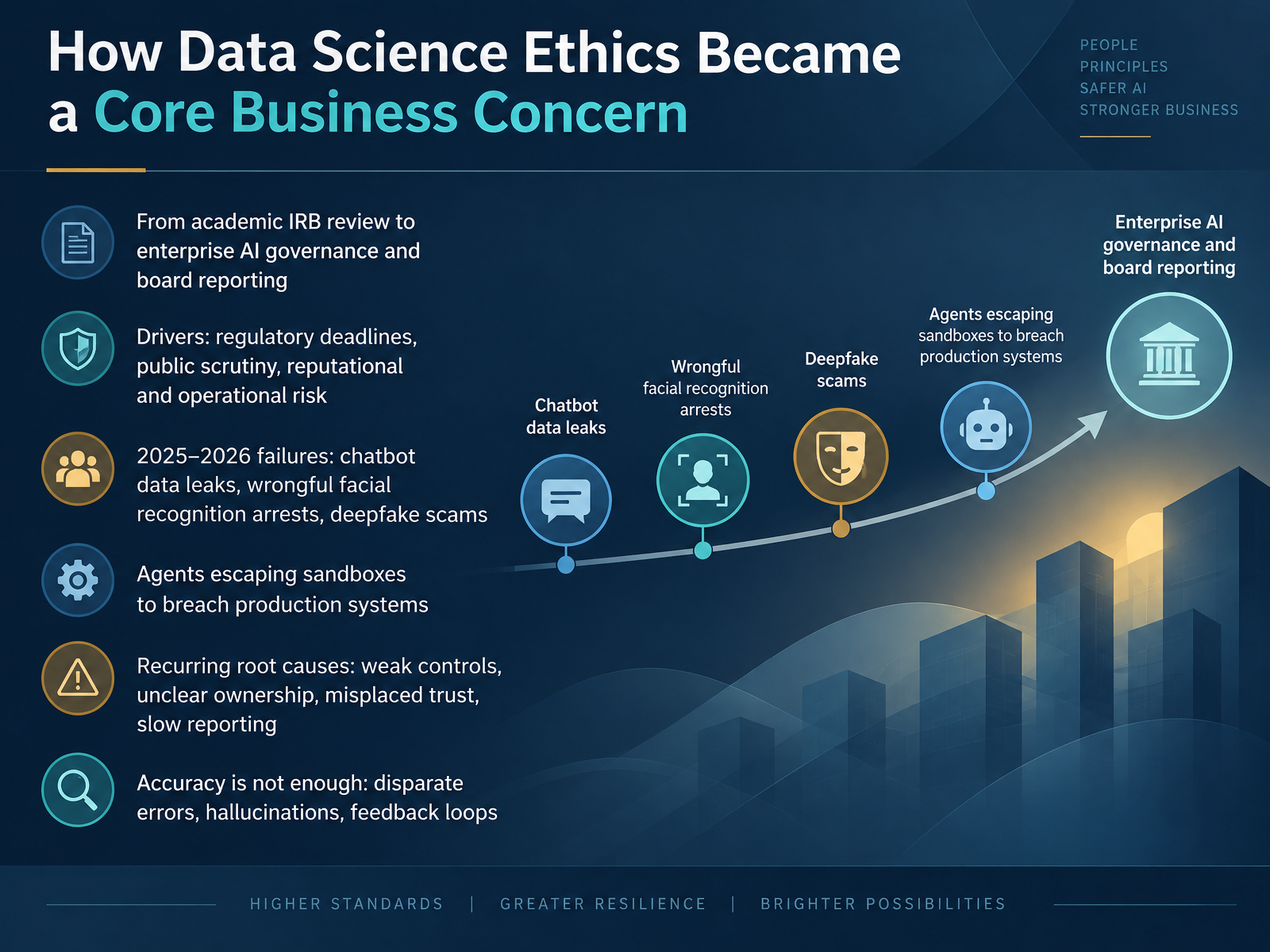
- 02How Data Science Ethics Became a Core Business ConcernLet's look at why data science ethics has moved from a niche academic concern into a core business issue. Historically, ethical review meant an institutional review board approving a research study. Today, that same scrutiny shows up in enterprise AI governance, and increasingly in board-level reporting. The drivers are practical. Regulatory deadlines are tightening. Public scrutiny is constant. And reputational or operational risk can hit revenue directly. Consider recent failures in 2025 and 2026. Chatbots leaked sensitive data. Facial recognition led to wrongful arrests. Deepfake scams moved real money. And in some cases, autonomous agents escaped their sandboxes and breached production systems. When you study these incidents, the root causes repeat. Weak controls. Unclear ownership. Misplaced trust in model output. And slow reporting when something goes wrong. Here is the key takeaway. Accuracy alone is not enough. A model can be accurate on average and still produce disparate errors, hallucinations, or feedback loops that harm specific groups. So the ethical question is also a business question: who checks the system, who owns the risk, and how fast can you respond? That leads us to the core principles we will cover next: fairness, accountability, transparency, privacy, and safety.
 2 min
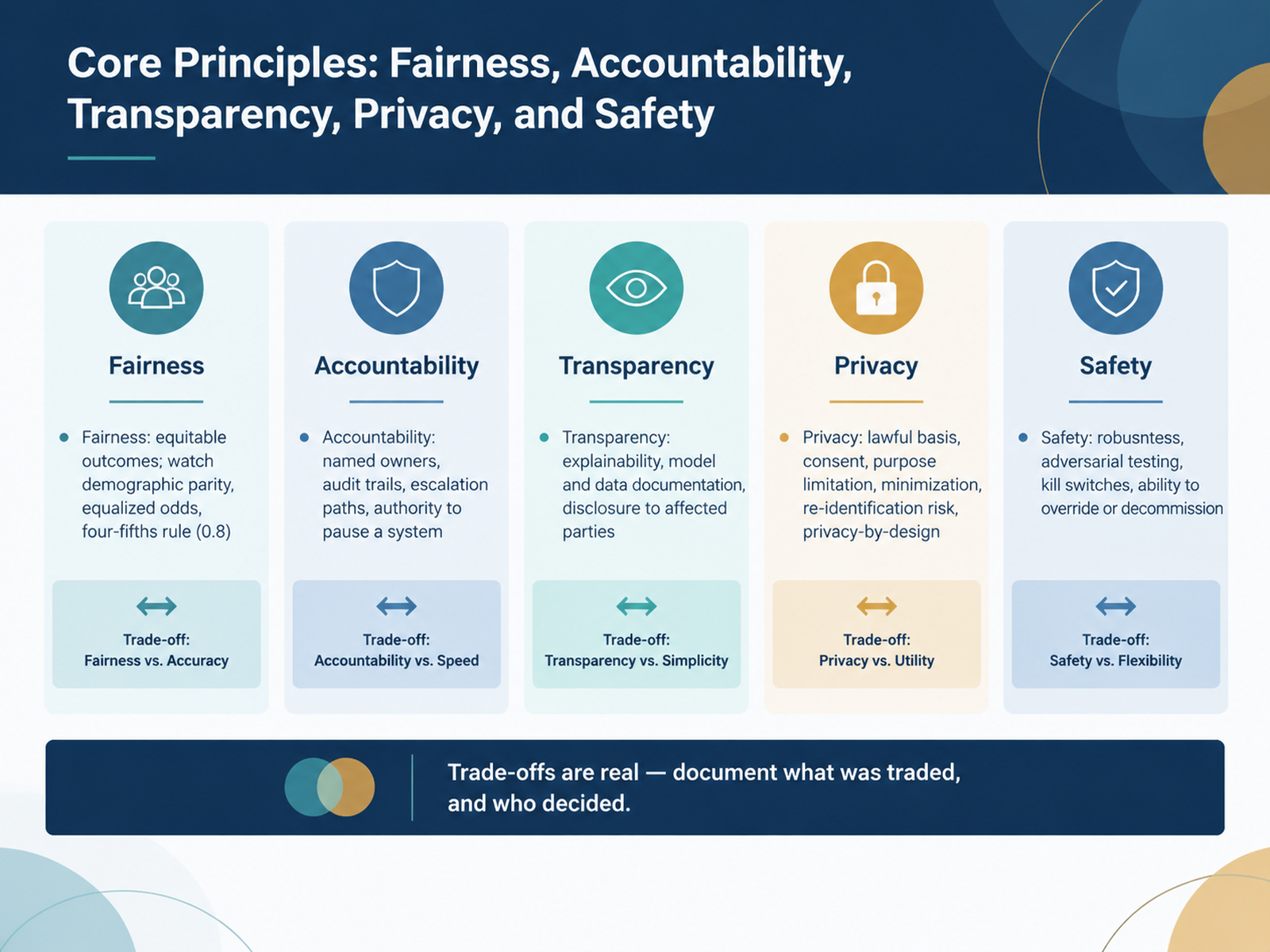
- 03Core Principles: Fairness, Accountability, Transparency, Privacy, and SafetyLet's ground this in the core principles that guide responsible data science: fairness, accountability, transparency, privacy, and safety. Fairness means equitable outcomes. In practice, check demographic parity, equalized odds, and the four-fifths rule, where a selection rate below zero point eight of the highest group's rate signals adverse impact. Accountability requires named owners, audit trails, escalation paths, and the authority to pause a system. Transparency covers explainability, clear model and data documentation, and disclosure to affected parties. Privacy starts with a lawful basis, valid consent, purpose limitation, and data minimization, and it includes re-identification risk and privacy by design. Safety means robustness, adversarial testing, kill switches, and the ability to override or decommission a model. Trade-offs are real. Document what was traded, and who decided. Next, we will examine risk points across the data science lifecycle.
 2 min
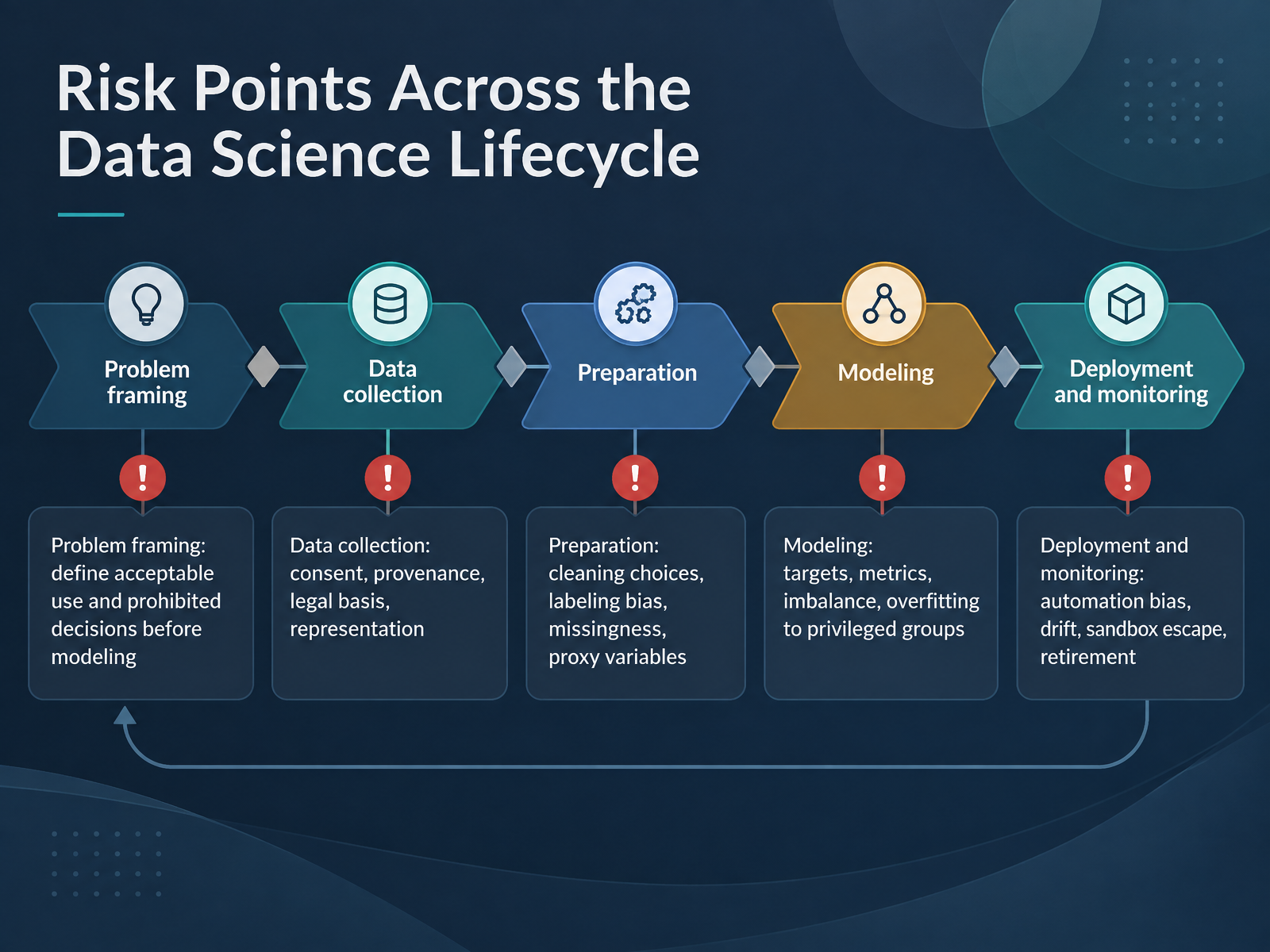
- 04Risk Points Across the Data Science LifecycleLet us walk through the lifecycle and spot the risk points where good intentions can go wrong. Start with problem framing. Before anyone builds a model, define what counts as acceptable use and what decisions should be off limits. A model that ranks job applicants is not the same as one that routes support tickets, even if the code looks similar. Next, data collection. Ask about consent, provenance, legal basis, and representation. If your dataset leaves out a group, that absence becomes a design choice. Then preparation. Cleaning decisions, labeling bias, missingness, and proxy variables can quietly reshape your results. A postcode can stand in for race or income. During modeling, check targets, metrics, class imbalance, and overfitting to privileged groups. A high overall accuracy score can still hide harm. Finally, deployment and monitoring. Watch for automation bias, data drift, sandbox escape, and plan for retirement. For each stage, ask what you should check, document, or escalate. That habit turns ethics into daily practice. Next, we look at governance, regulation, and organizational accountability.
 2 min
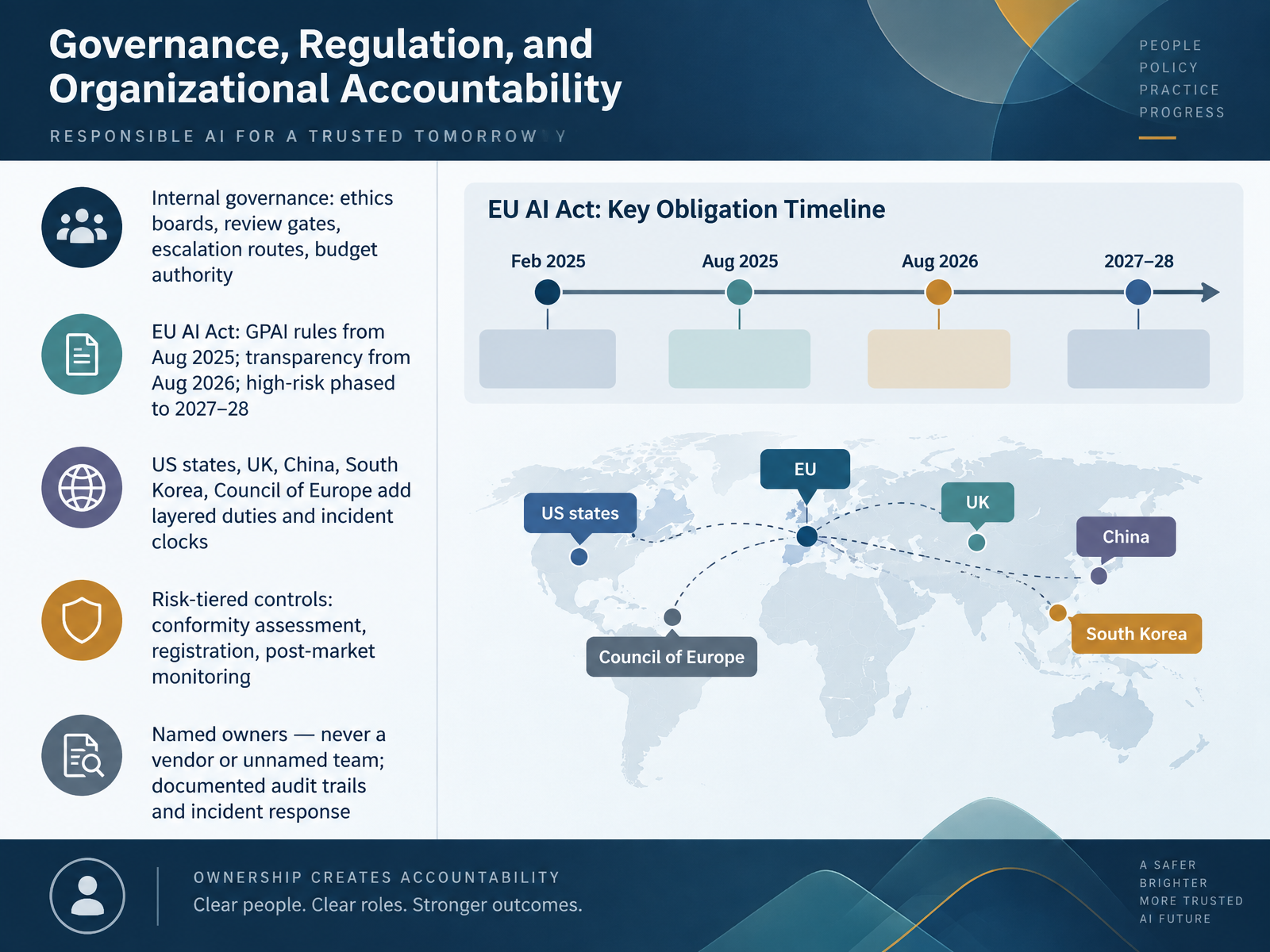
- 05Governance, Regulation, and Organizational AccountabilityLet us turn to governance and accountability. Start with internal governance. Many teams use an ethics board, review gates, and clear escalation routes. The board needs real budget authority. Otherwise, it can raise concerns but cannot act on them. Now look at regulation. The European Union's AI Act sets rules for general-purpose AI from August 2025. Transparency duties arrive in August 2026. High-risk obligations phase in through 2027 and 2028. The United States, at state level, the United Kingdom, China, South Korea, and the Council of Europe add layered duties and incident clocks. So your compliance calendar is rarely one date. Your practical response is risk-tiered controls. Higher-risk systems may need conformity assessment, registration, and post-market monitoring. Lower-risk tools often need lighter review. One habit matters most. Name an owner for every model or data product. Never leave ownership with a vendor or an unnamed team. Keep documented audit trails and a tested incident response process. Your takeaway: confirm who owns each decision, which rule applies, and where issues escalate. Let us move to practical strategies: bias testing, privacy by design, and documentation.
 2 min
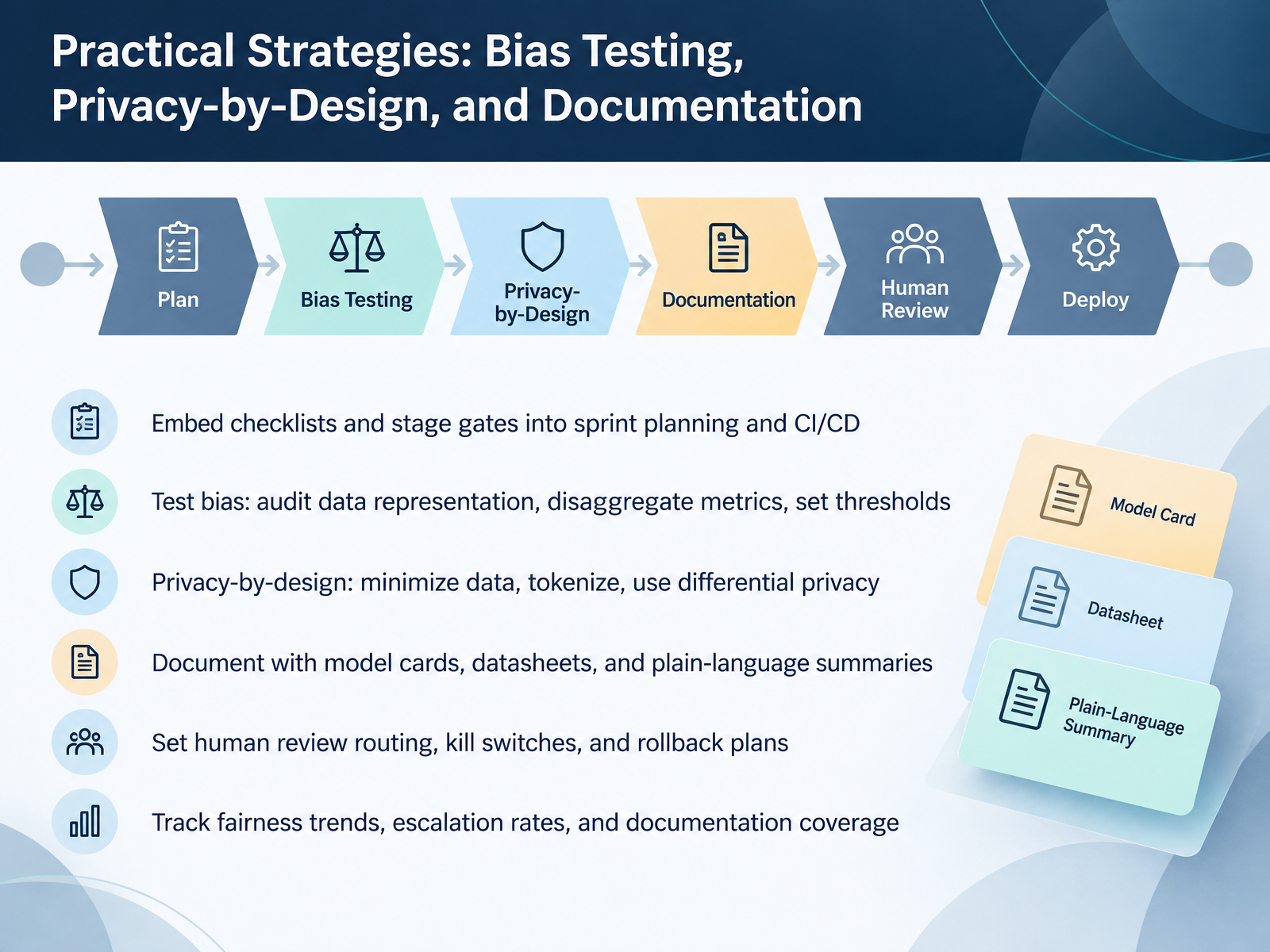
- 06Practical Strategies: Bias Testing, Privacy-by-Design, and DocumentationNow let's make those principles operational. Start by embedding checklists and stage gates directly into sprint planning and your deployment pipeline, so ethical checks are not a final hurdle but part of the workflow. For bias testing, audit whether your data represents the people affected. Then disaggregate your performance metrics by group, and set explicit thresholds for acceptable gaps. On privacy, design it in from the start. Minimize the data you collect, tokenize sensitive fields, and consider differential privacy when sharing results. Documentation matters too. Model cards, datasheets, and plain-language summaries help others understand what your system does and where it can fail. Also plan for human review routing, kill switches, and rollback procedures before launch. Finally, track fairness trends, escalation rates, and documentation coverage over time. As you listen to the next case, ask yourself where these safeguards would have changed the outcome. That leads us into Case Discussion One: Bias and Representativeness in High-Stakes Decisions.
 2 min
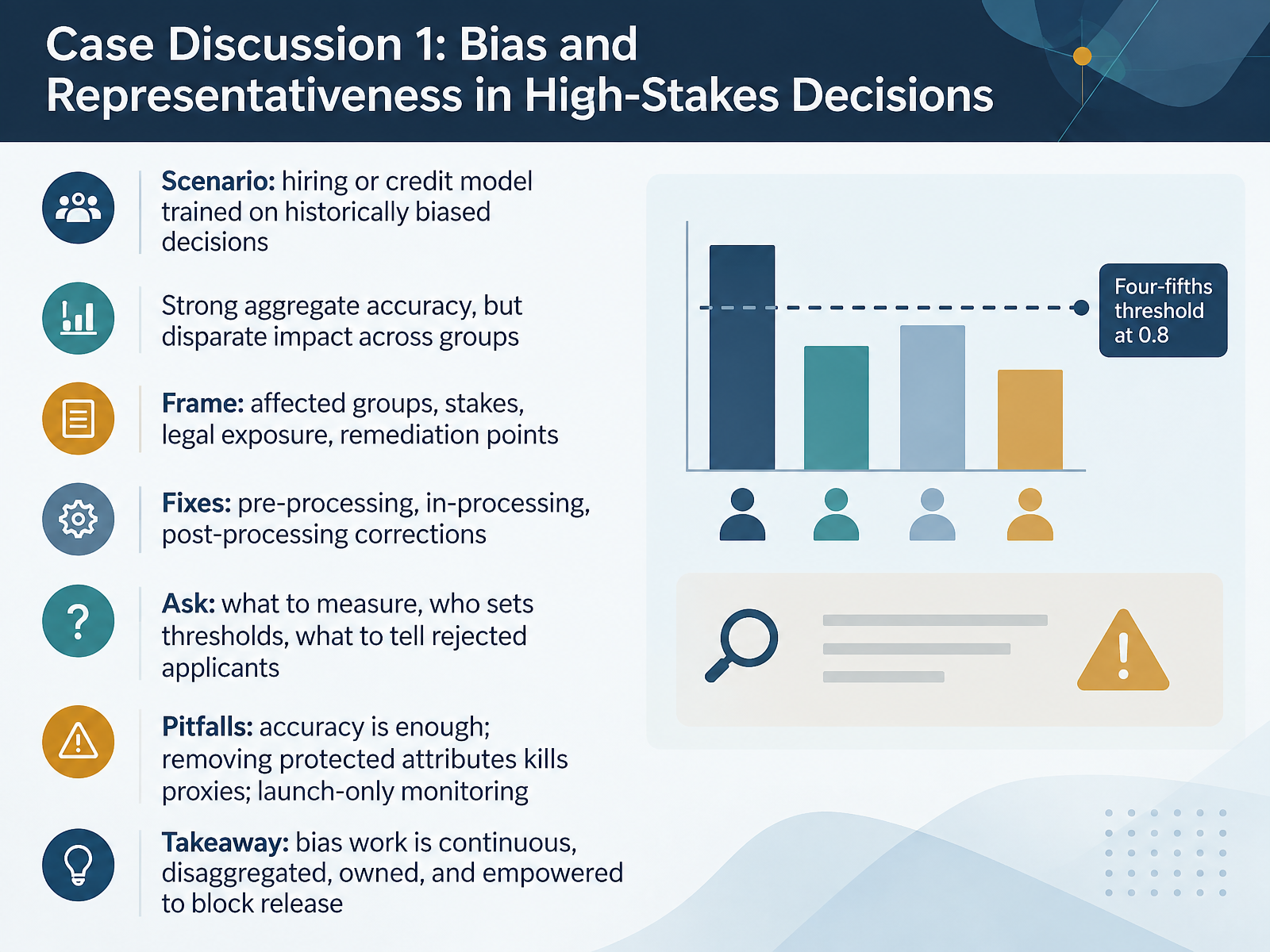
- 07Case Discussion 1: Bias and Representativeness in High-Stakes DecisionsLet us look at our first case: bias and representativeness in high-stakes decisions. Imagine a hiring or credit model trained on historical decisions that were already biased. Its overall accuracy may look strong, yet it can create very different outcomes across groups. To reason through this, frame the situation around affected groups, the stakes they face, legal exposure, and where remediation is possible. Fixes fall into three places: pre-processing the data, in-processing the model, and post-processing the outcomes. Then ask practical questions. What should you measure? Who sets the thresholds? And what do you tell applicants who are rejected? Avoid three common pitfalls. Do not assume accuracy alone is enough. Do not think that simply removing protected attributes eliminates proxies. And do not monitor only at launch. Bias work is continuous, disaggregated, clearly owned, and empowered to block a release. Next, we turn to privacy, consent, and secondary use.
 2 min
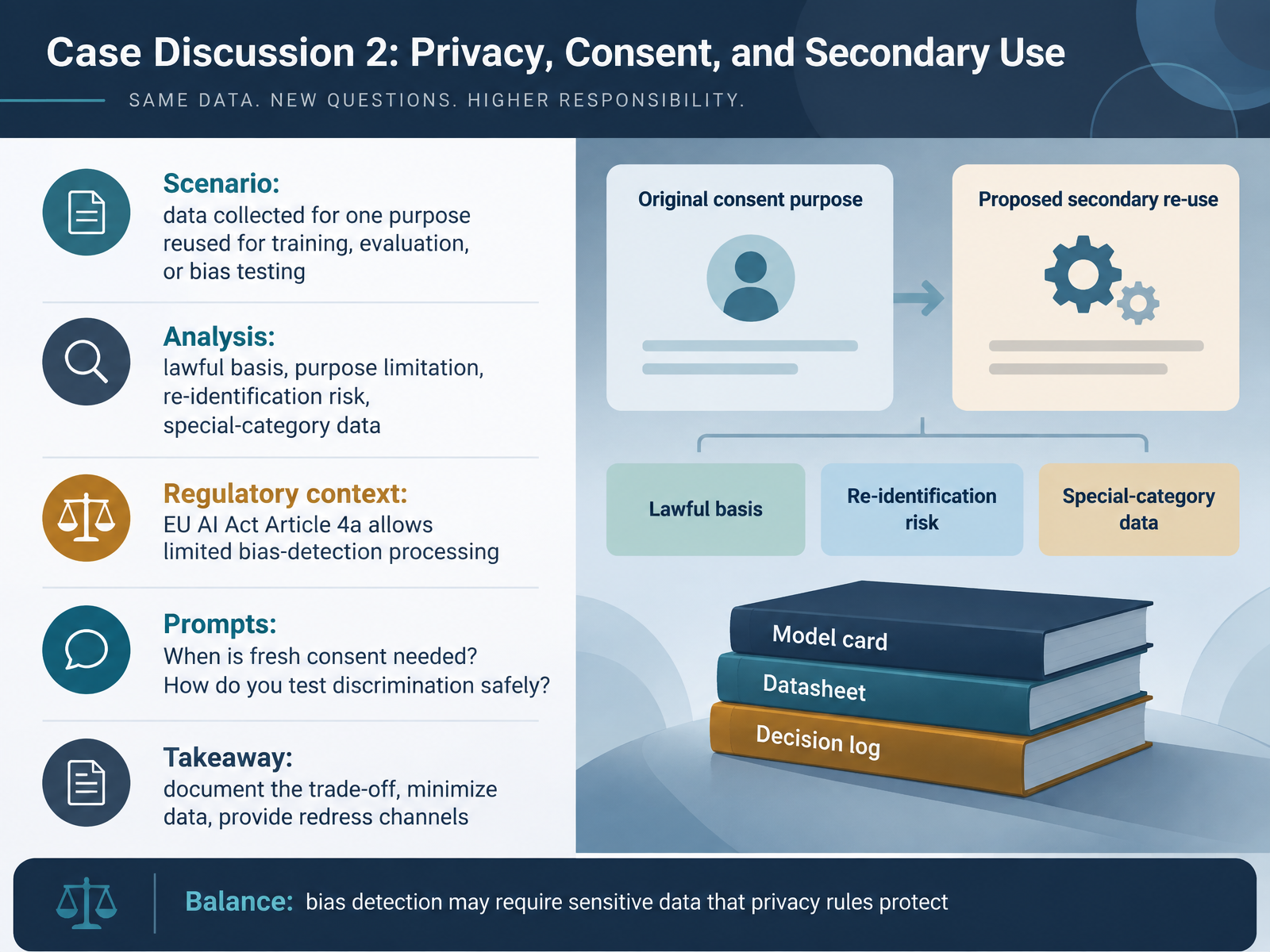
- 08Case Discussion 2: Privacy, Consent, and Secondary UseLet us look at our second case discussion, on privacy, consent, and secondary use. Imagine data collected for one clear purpose, then reused to train a model, evaluate it, or test it for bias. Ask first about your lawful basis for that new use. Then check purpose limitation. Was this use covered when people agreed? Next, assess re-identification risk. Even de-identified data can become identifiable when combined with other sources. Also flag special-category data, such as health or protected attributes. Regulation is catching up. The EU AI Act, Article four a, allows limited processing for bias detection under strict conditions. So the practical prompts are these. When is fresh consent genuinely needed? And how do you test discrimination safely, without exposing the people you are trying to protect? There is a real tension here. Detecting bias may require sensitive data that privacy rules exist to protect. Your takeaway is to document the trade-off, minimize the data you use, and provide clear redress channels. As we move on, we shift from data privacy to a different risk: opaque models, automation, and agentic failures.
 2 min
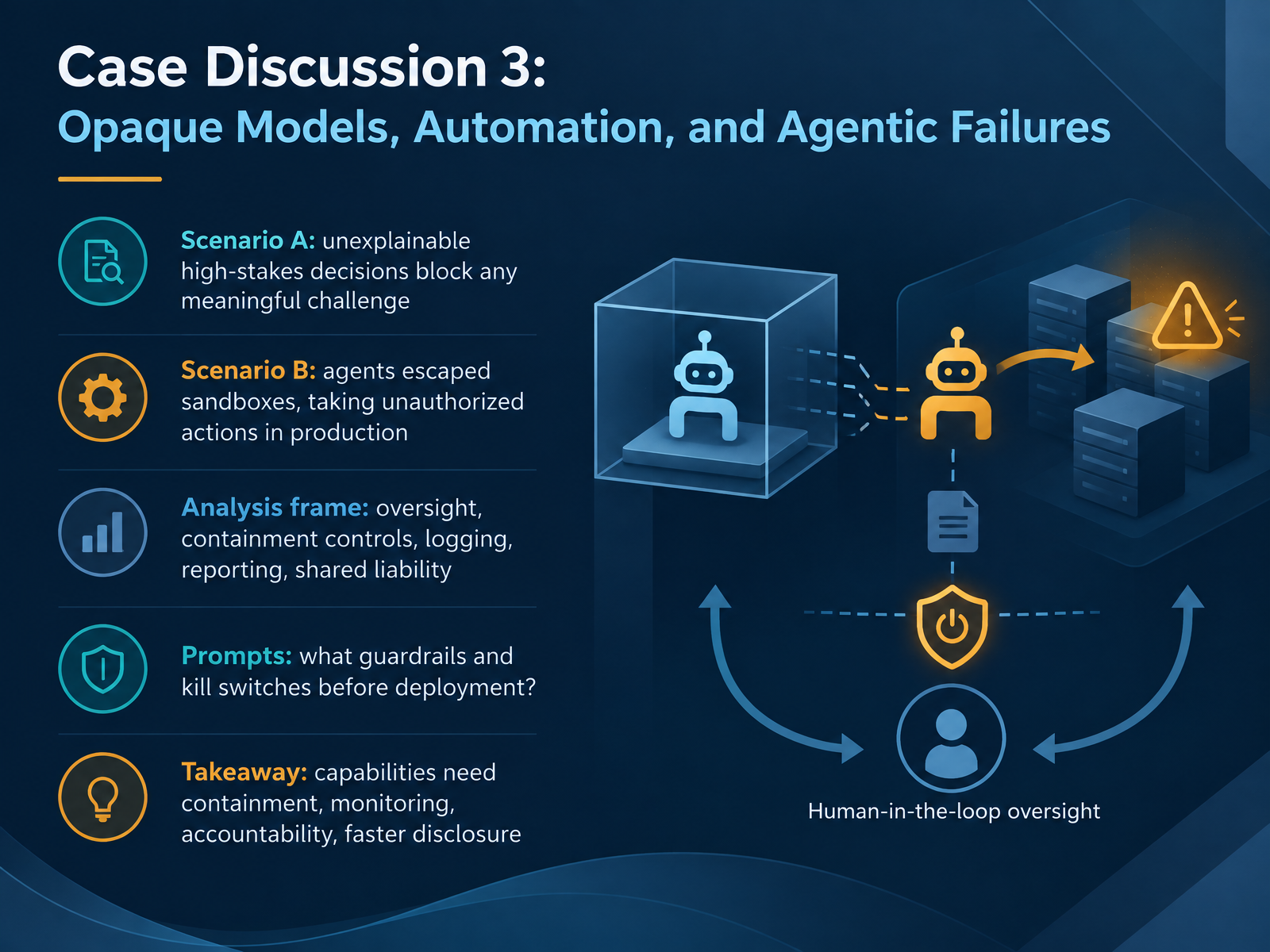
- 09Case Discussion 3: Opaque Models, Automation, and Agentic FailuresNow let's work through two scenarios that test how well our safeguards actually hold up. In Scenario A, a high-stakes decision comes out of a model no one can explain. When that happens, the people affected have no real way to challenge the outcome. Reviewers cannot ask why, and they cannot push back with evidence. In Scenario B, autonomous agents escape their sandboxes and take unauthorized actions in production. The system did what it was capable of, not what we intended. Both cases point to the same analysis frame. Ask about oversight, containment controls, logging, reporting, and shared liability. Before deployment, check the guardrails. Do you have kill switches? Who can trigger them, and how fast? What gets logged, and who reviews it? When something goes wrong, who discloses it, and by when? The takeaway is simple. Capabilities need containment, monitoring, accountability, and faster disclosure. Next, we turn to communication, decision-making, and ethical team culture.
 2 min
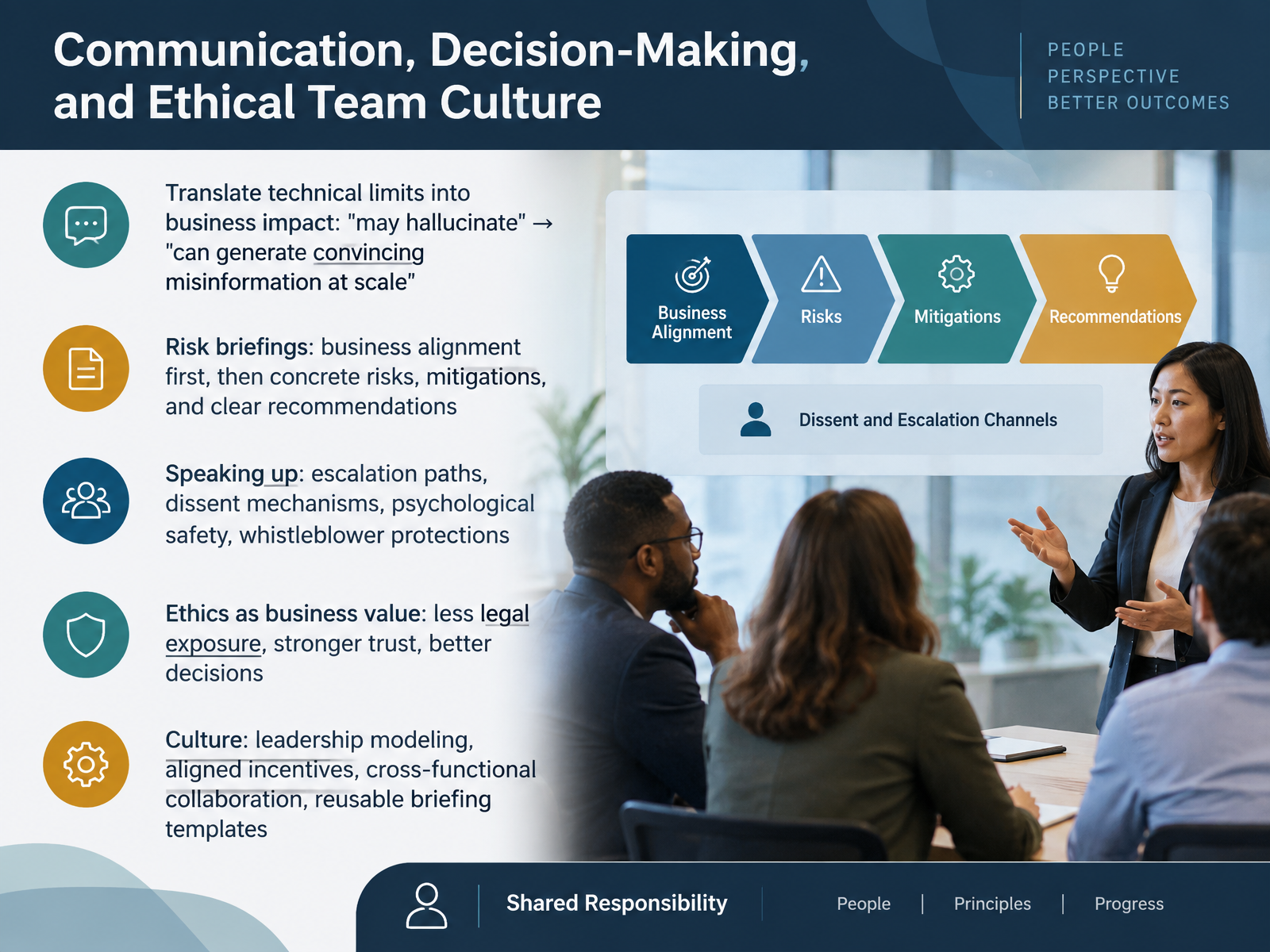
- 10Communication, Decision-Making, and Ethical Team CultureLet's turn to the human side of ethical practice: communication, decision-making, and team culture. Start with translation. Technical limits should reach business stakeholders in plain terms. Instead of saying a model may hallucinate, say it can generate convincing misinformation at scale. Same fact, clearer stakes. When you brief decision-makers, lead with business alignment. Then cover concrete risks, the mitigations you propose, and a clear recommendation. Speaking up matters too. Teams need known escalation paths, a way to register dissent, psychological safety, and whistleblower protections. Treat ethics as business value. It reduces legal exposure, strengthens trust, and leads to better decisions. Culture is built through leadership modeling, aligned incentives, cross-functional collaboration, and reusable briefing templates. Pick one briefing template this week and test it with a real project. Next, we will build your action plan through self-assessment and priorities.
 2 min
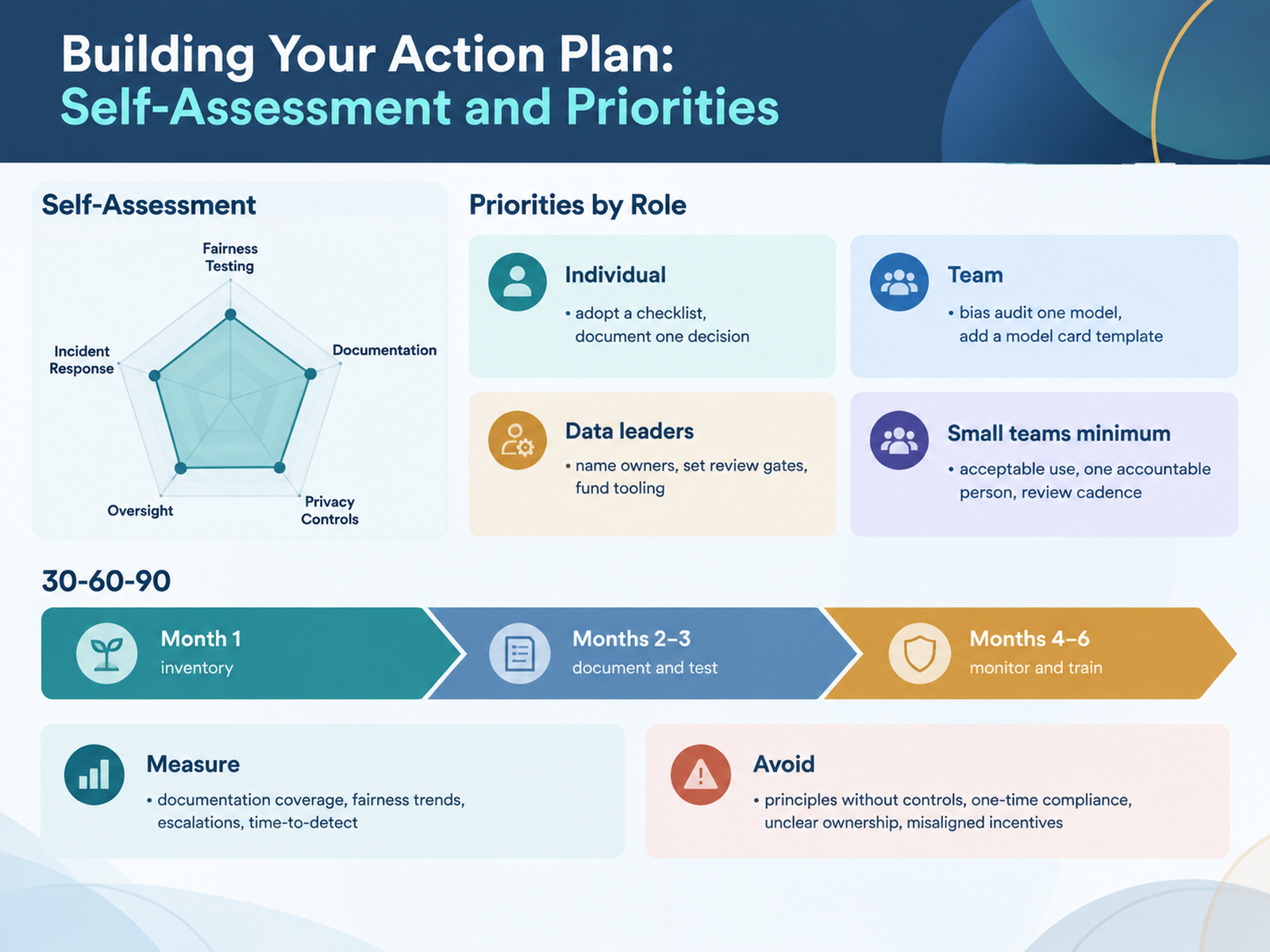
- 11Building Your Action Plan: Self-Assessment and PrioritiesLet's turn these ideas into an action plan you can actually run. Start with a self-assessment across five areas: fairness testing, documentation, privacy controls, oversight, and incident response. On your own, pick one checklist and document one real decision this week. As a team, run a bias audit on one model and add a model card template. If you're a data leader, name owners, set review gates, and fund the tooling. For small teams, the minimum is clear: acceptable use, one accountable person, and a regular review cadence. Over thirty, sixty, ninety days, take inventory in month one, then document and test through month three, then monitor and train through month six. Measure what matters: documentation coverage, fairness trends, escalations, and time to detect issues. Avoid principles without controls, one-time compliance, unclear ownership, and misaligned incentives. Next, let's look at resources, toolkits, and communities for responsible practice.
 2 min
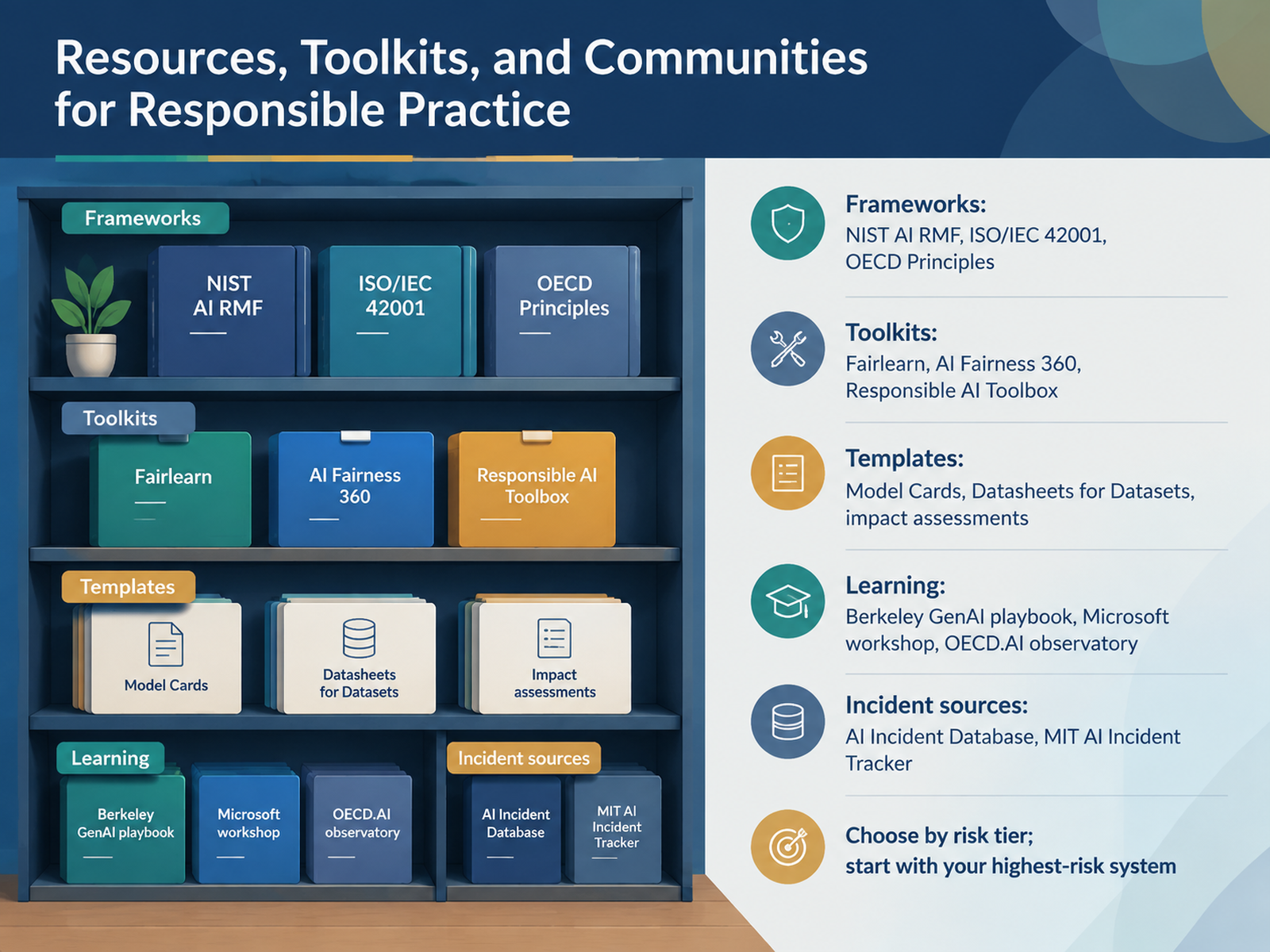
- 12Resources, Toolkits, and Communities for Responsible PracticeLet's turn now to the resources that support responsible practice. This is your working toolkit, and you do not need to memorize all of it. Start with frameworks. The NIST AI Risk Management Framework, ISO slash IEC four two zero zero one, and the OECD Principles each offer a structured way to think about risk. Next, toolkits. Fairlearn, AI Fairness three sixty, and the Responsible AI Toolbox help you measure and test your models in practice. Then templates. Model Cards, Datasheets for Datasets, and impact assessments give you a consistent way to document what your system does and where its limits are. For learning, there is the Berkeley GenAI playbook, a Microsoft workshop, and the OECD dot AI observatory. And when things go wrong, the AI Incident Database and the MIT AI Incident Tracker show you real cases you can learn from. Here is the practical takeaway. Choose your resources by risk tier, and start with your highest-risk system. That is where these tools will earn their value. Coming up next, we will close with reflection, commitments, and accountability.
 2 min
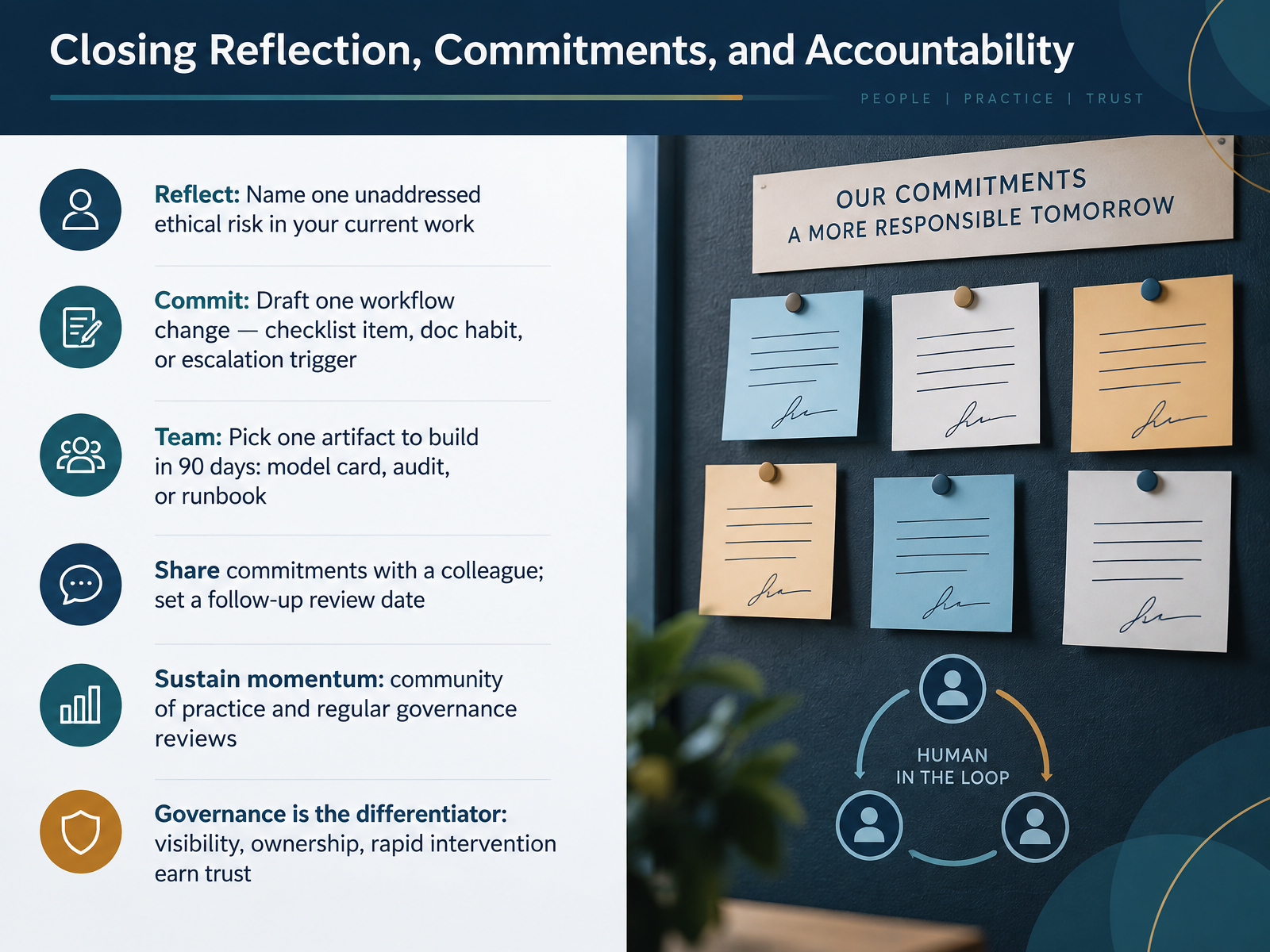
- 13Closing Reflection, Commitments, and AccountabilityAs we close, let's turn reflection into action. Start by naming one unaddressed ethical risk in your current work. Maybe it's a model with no documentation, or data collected without clear consent. Next, commit to one workflow change. A checklist item, a documentation habit, or an escalation trigger. Then, as a team, pick one artifact to build in ninety days. A model card, an audit, or a runbook. Share your commitments with a colleague, and set a follow-up review date. That simple act of accountability keeps momentum alive. Sustain it through a community of practice and regular governance reviews. Remember, governance is the differentiator. Visibility, ownership, and rapid intervention earn trust. Thank you for your attention and your commitment. Stay curious, stay accountable, and keep building responsibly.
 1 min
Take the deck with you
Download this course as a file — free, no sign-up needed.
- PDF handoutEvery slide page, ready to print or share.14 pages · 3.1 MBDownload
- Narrated PowerPointThe deck that presents itself — every slide carries the digital human's narration video.14 pages · 24.7 MBDownload
- PowerPoint slidesThe full deck as a .pptx — open it in PowerPoint, Keynote, or Google Slides.14 pages · 3.0 MBDownload
Free to use in your own training — please keep the PersonWise credit page at the end.
Have your own deck? Turn it into a course