Managing Project Escalations
Begin
14 pages · ~28 min
Managing Project Escalations
Learn to effectively manage project escalations by identifying root causes, communicating with stakeholders, and implementing resolution strategies.
What you’ll learn
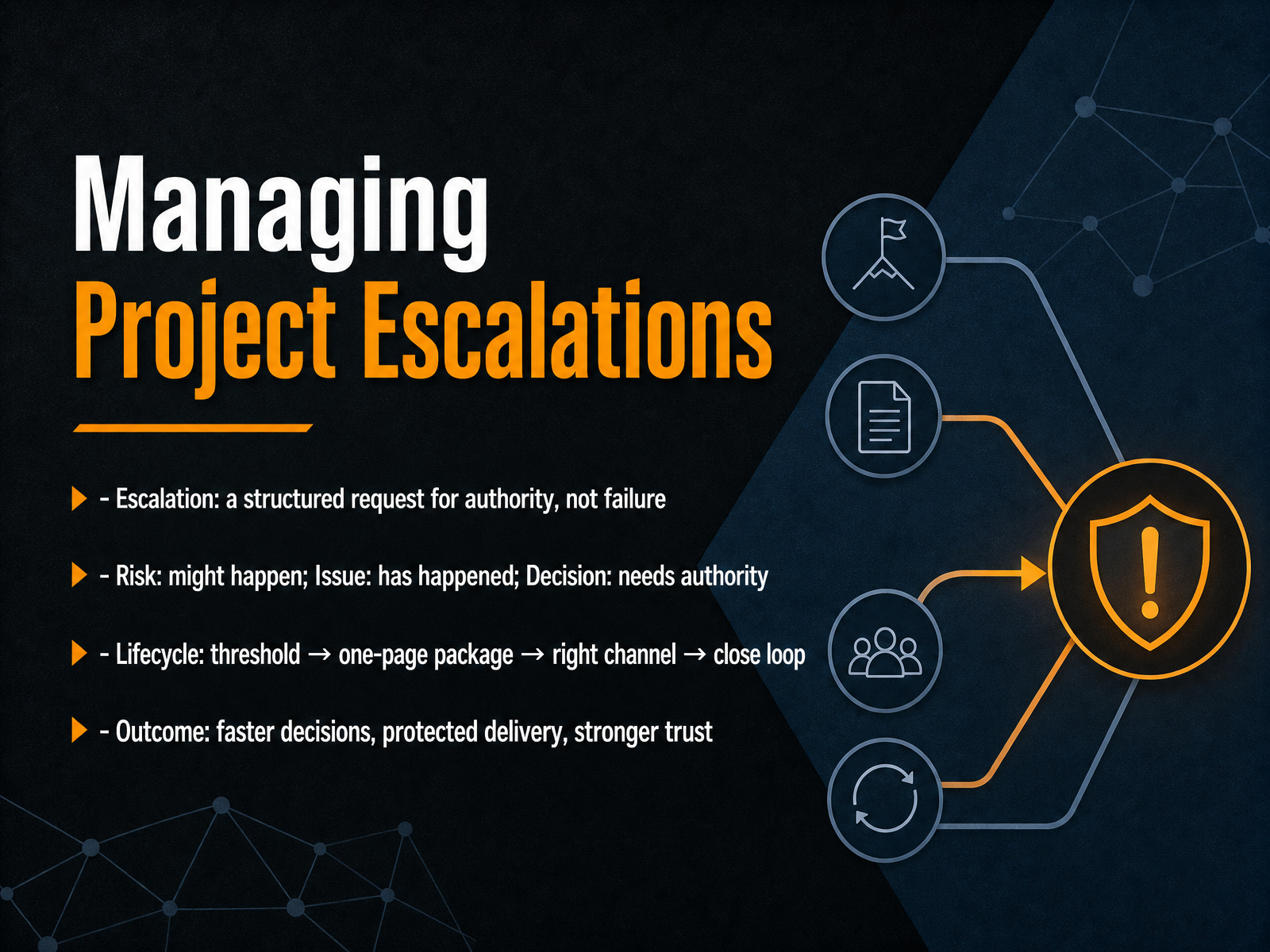
- 01Managing Project EscalationsWelcome to Managing Project Escalations. This course will give you a clear, repeatable method to get the right decisions, protect your timeline, and build trust with your stakeholders. Let's start by clarifying what an escalation really is. An escalation is a structured request for authority. It is not a sign of failure; it is a professional tool. To use it well, you need to make one key distinction. Separate what might happen from what has happened. A risk is something that might happen. An issue is something that has already happened. When you need authority to move forward, you are facing a decision. These are three different things. The escalation lifecycle has four clear steps. First, cross a defined threshold. Second, prepare a one-page package that states the background, the impact, and the decision you need. Third, send it through the right channel. And fourth, close the loop so everyone knows it is resolved. This gives you faster decisions, protects the delivery of your project, and builds stronger trust across your team. Up next, we will look at Why Escalation Fails—and Why It Matters.1 min
- 02Why Escalation Fails—and Why It MattersLet's look at why many escalations fail before they even reach the right person. The first mistake is silence. When you avoid sharing a problem, it doesn't go away. It grows quietly in the background until it becomes a crisis that is much harder to fix. On the other hand, flagging every small issue creates a different problem. If you escalate too often, your sponsors learn to tune you out. They stop hearing the signal because of all the noise. This is where psychological safety makes a critical difference. In a team where people feel safe to speak up, problems are detected and named very early. You catch them while they are still manageable. So how should you think about escalation? Reframe it completely. Don't see it as a failure or a complaint. See it as a professional safeguard. It is a project tool you deploy with precision to protect the outcome. Escalation isn't about raising alarms. It's about making sure the right decision gets made at the right level before it's too late. Next, we'll get practical and discuss the skill of distinguishing true escalations from routine problems.
 2 min
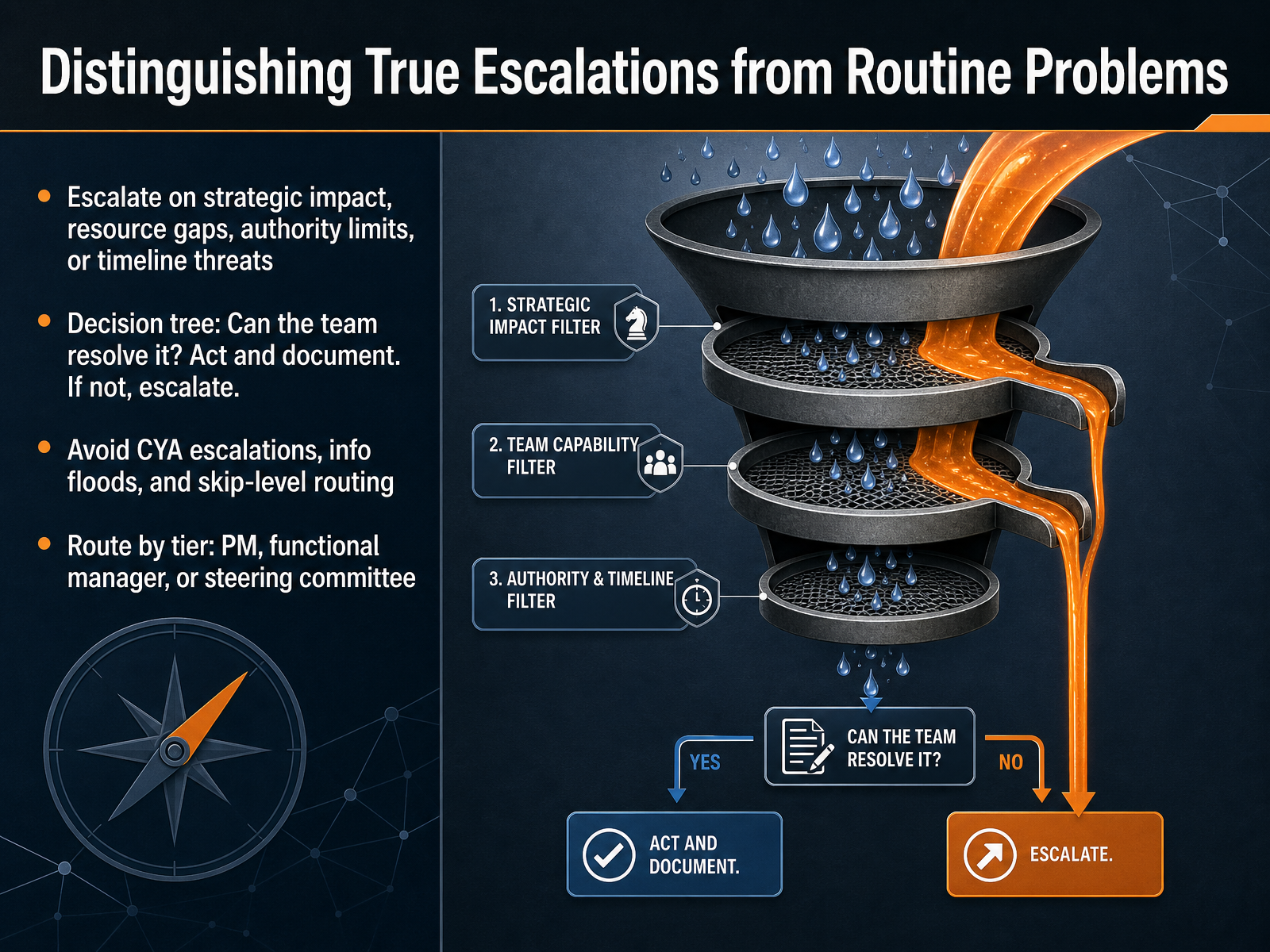
2 min - 03Distinguishing True Escalations from Routine ProblemsNow, let's distinguish a true escalation from a routine problem. A true escalation isn't just any issue. You escalate when something threatens strategic impact, creates a resource gap you can't fill, exceeds your authority, or puts a hard timeline at risk. Think of it as a simple decision tree. First, ask: can the team resolve this internally? If yes, act and document it. That's not an escalation. If no, you must escalate. State clearly what's blocked and what decision you need. There are behaviors to avoid. Do not escalate just to cover yourself. Do not flood leadership with raw data. And do not skip levels without informing your direct manager. Finally, route the escalation to the right tier. A resourcing snag might go to the program manager. A technical trade-off decision might need the functional manager. A budget or scope change goes to the steering committee. Route it to the group that holds the authority to decide. Next, we'll look at defining concrete escalation triggers.
 1 min
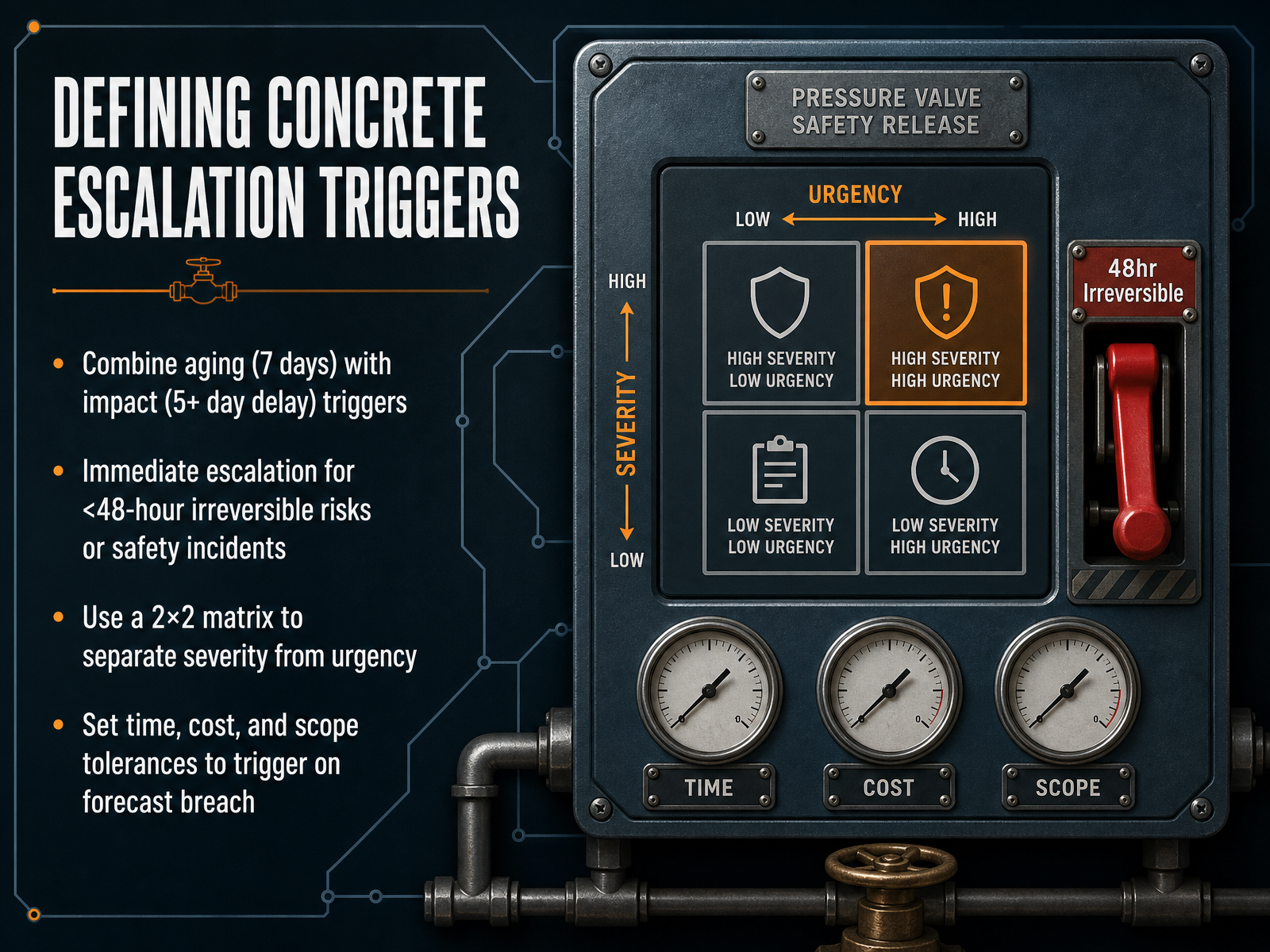
1 min - 04Defining Concrete Escalation TriggersLet's define concrete triggers so you know exactly when to escalate. First, combine aging with impact. A task sitting for seven days that will also cause a delay of five or more days is a clear signal. Escalate immediately for anything irreversible that will hit in less than forty-eight hours, or any safety incident. No exceptions. Use a two-by-two matrix to separate urgency from severity. Urgency is 'how soon.' Severity is 'how bad.' This stops you from treating every fire drill like a catastrophe. Then, set clear tolerances for time, cost, and scope. When a forecast shows you'll breach a tolerance, that is your trigger to act. To communicate why you escalated, you need a clear structure. Next, we'll look at the three-part skeleton: Background, Impact, and the Decision Needed.
 1 min
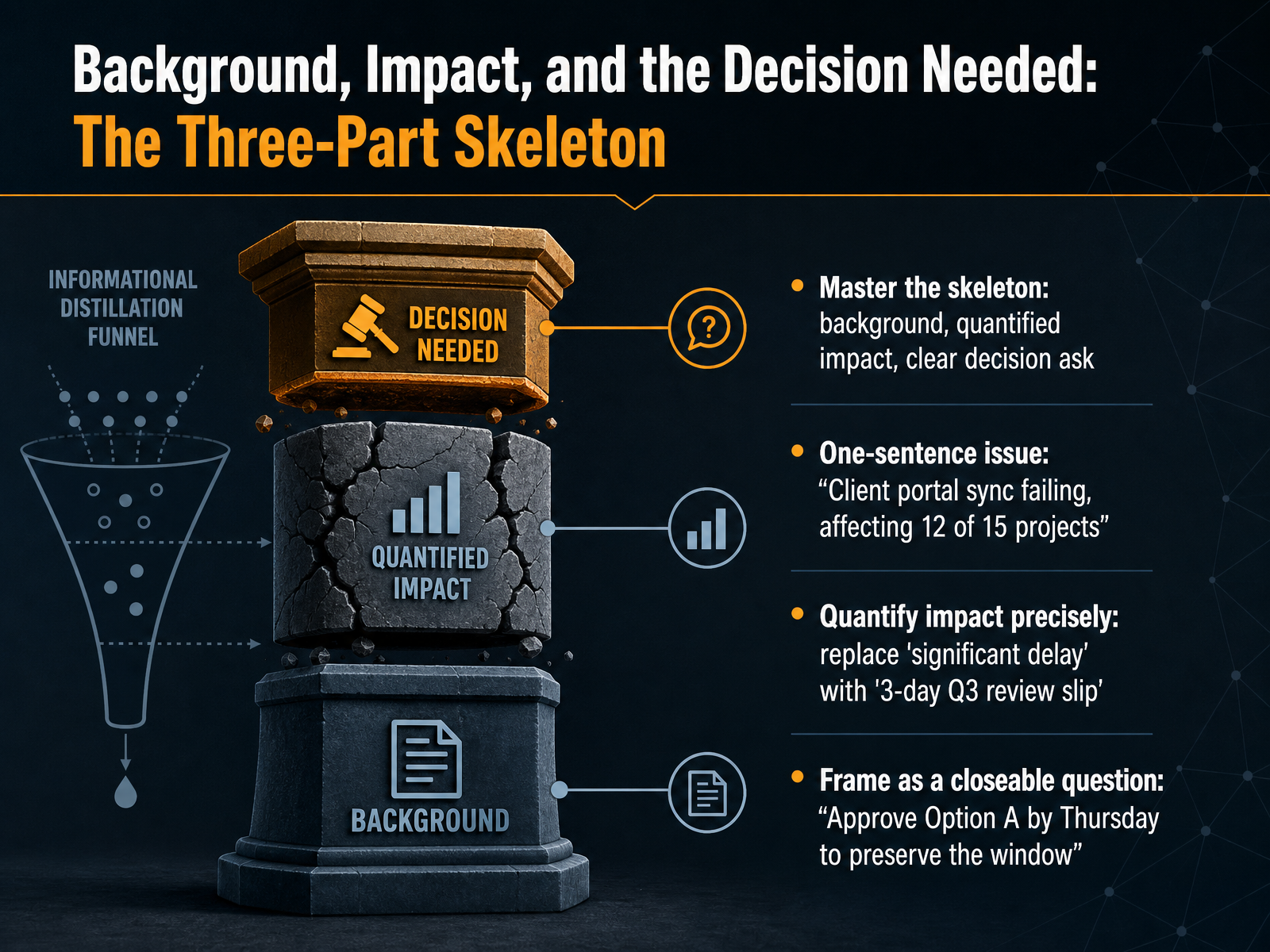
1 min - 05Background, Impact, and the Decision Needed: The Three-Part SkeletonNow let's structure the escalation itself. Think of it as a three-part skeleton: background, impact, and the decision needed. Start with a single sentence that captures the background. For example, 'Client portal sync is failing, affecting twelve of fifteen projects.' That's clear and immediate. Next, quantify the impact precisely. Don't say 'significant delay.' Say 'a three-day slip in the Q3 review.' This turns a vague feeling into a concrete business consequence. Finally, frame your request as a closeable question. State exactly what you need, like 'Approve Option A by Thursday to preserve the window.' This makes it easy for a decision-maker to say yes. Now let's apply this to building a compelling escalation narrative.
 1 min
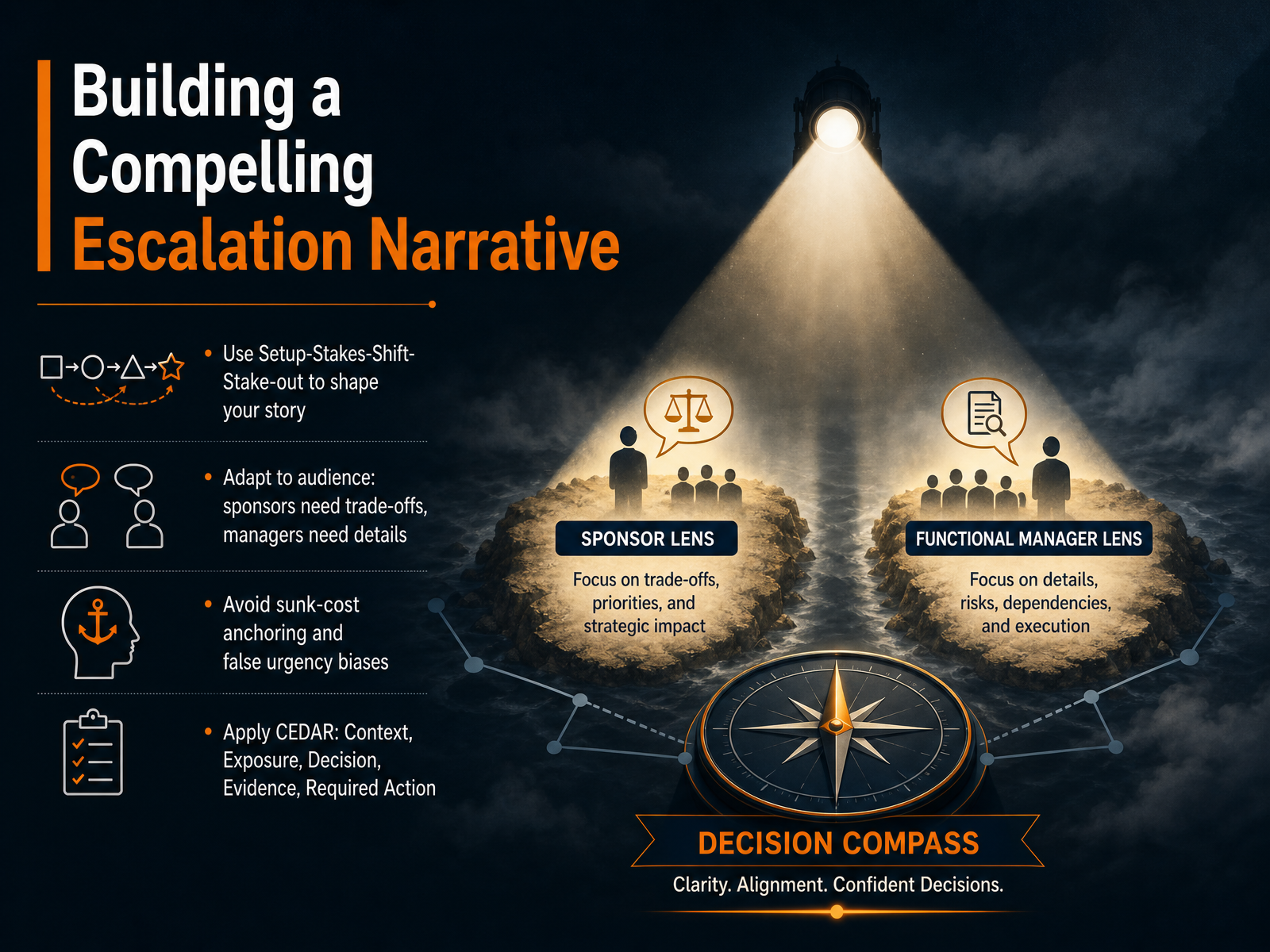
1 min - 06Building a Compelling Escalation NarrativeNow let's shape a clear escalation message. Use Setup, Stakes, Shift, and Stake-out to structure your story. Start with Setup: state the original plan and what changed. Then define the Stakes: explain what is at risk if we do nothing. Next, describe the Shift: clarify what decisions or resources you need to remove the blocker. Finally, make your Stake-out: recommend the best path forward. Adapt this narrative to your audience. Sponsors need a clear trade-off analysis. Managers need operational details and timelines. Watch out for two common biases. First, avoid sunk-cost anchoring. Do not defend a direction just because time was already spent. Second, avoid false urgency. Escalate based on real impact, not anxiety. Use the CEDAR model to stay factual. Give Context. State the Exposure. Name the Decision required. Provide Evidence. And specify the Required Action. In our next topic, we will assemble these pieces into a concise one-page escalation package.
 2 min
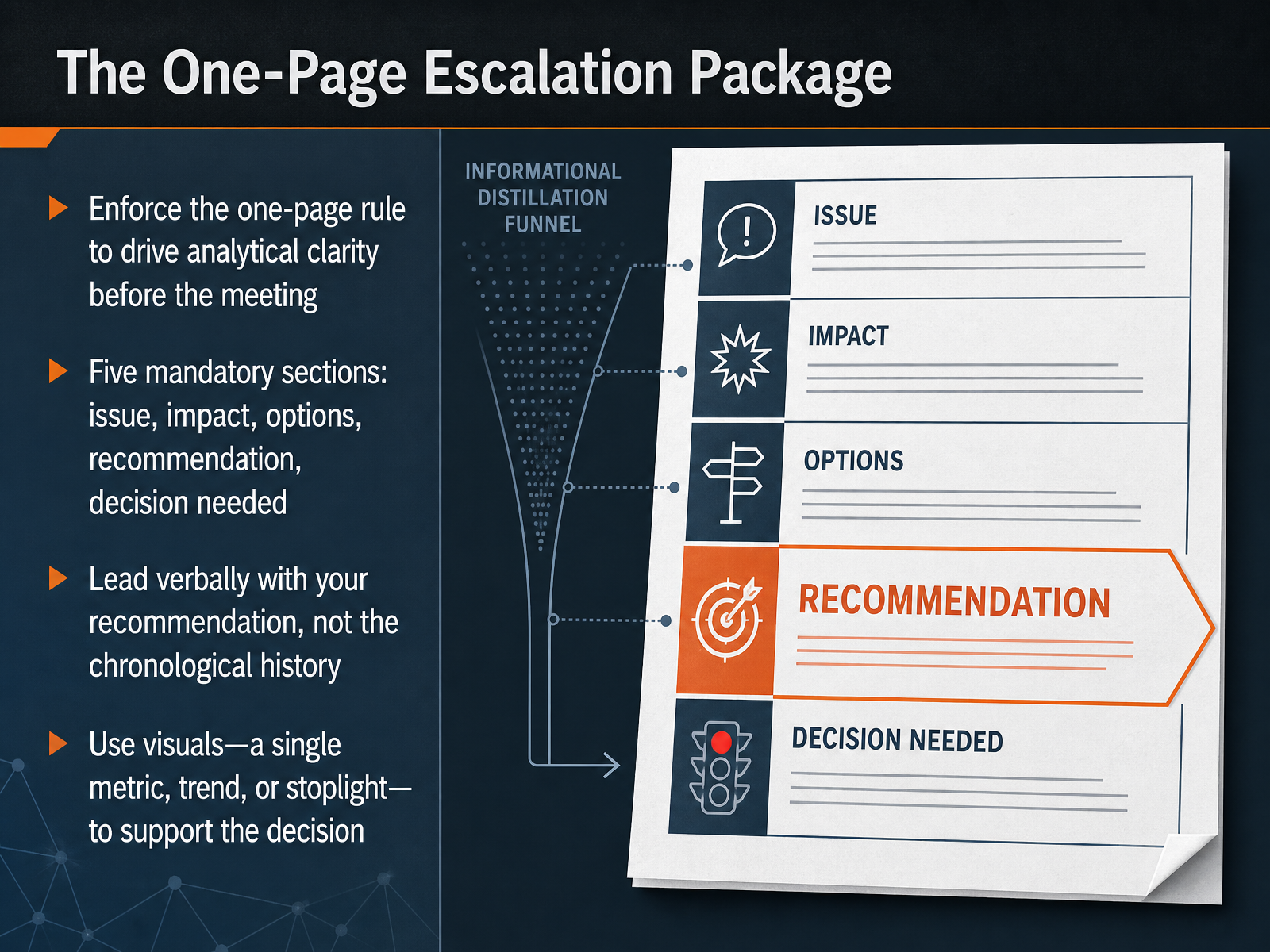
2 min - 07The One-Page Escalation PackageWhen you escalate, enforce a simple but powerful rule: the one-page package. This rule drives analytical clarity. It forces you to think, not just report. Include five mandatory sections. First, state the issue in one sentence. Second, describe the specific business impact: lost revenue, delayed timeline, or customer risk. Third, list two or three viable options. Fourth, present your clear recommendation. Fifth, and most critically, define the exact decision you need. When you lead the conversation, start verbally with your recommendation. Do not walk through a chronological history of the problem. Your stakeholders need your conclusion first, the context second. To support the decision, use a visual. A single metric, a trend line, or a red, yellow, green stoplight is enough. It anchors the discussion in data, not just opinion. Now, after you prepare this package, you must deliver it through the right channel at the right time. Let's talk about choosing the channel and timing.
 2 min
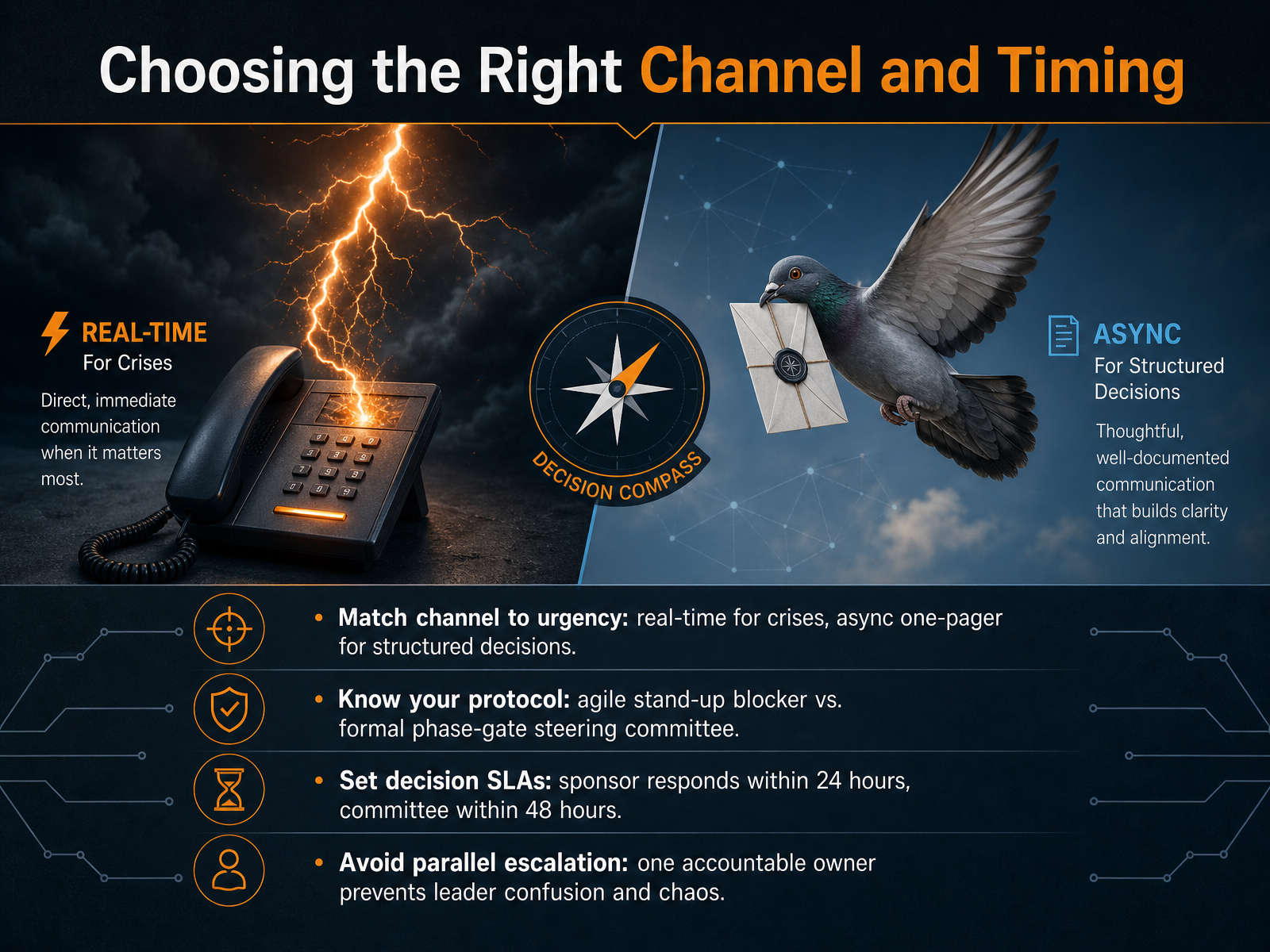
2 min - 08Choosing the Right Channel and TimingNow let's look at choosing the right channel and timing. This is where structure prevents chaos. First, match your channel to the urgency. For a live crisis, use a real-time channel like a call or a war room. For a decision that needs structured input, send an async one-pager with a clear recommendation. Second, know your protocol. A blocker raised in an agile stand-up is not the same as a formal request to a phase-gate steering committee. Use the path your organization has defined. Third, set decision SLAs. State a clear deadline. For example, ask the sponsor for a response within twenty-four hours. For a committee, allow up to forty-eight hours. This creates accountability and stops the clock from drifting. Finally, avoid parallel escalation. Assign one accountable owner who drives the process. When multiple people escalate the same issue, leaders get confused and chaos follows. Next, we'll put this into practice by running the escalation meeting.
 1 min
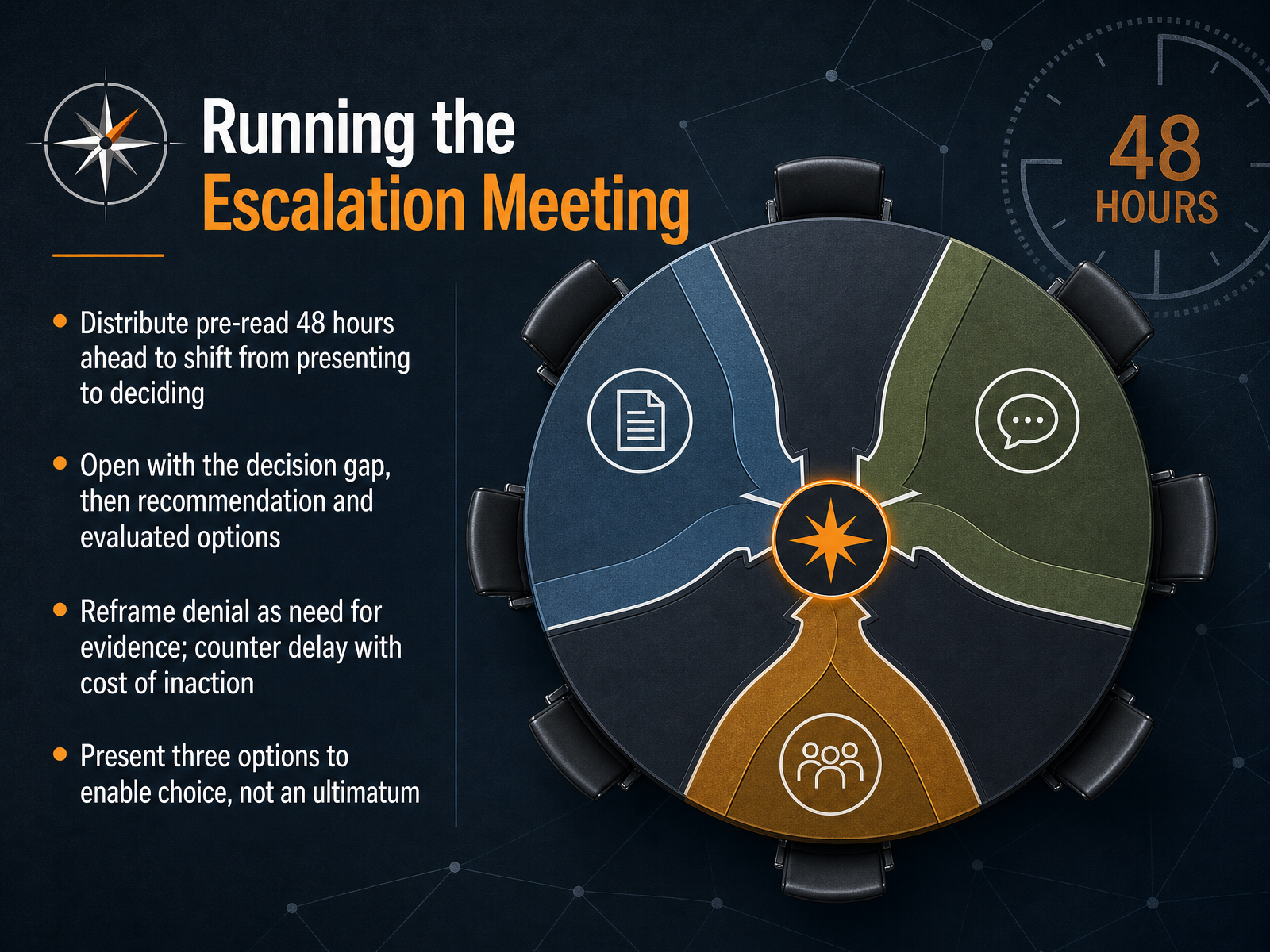
1 min - 09Running the Escalation MeetingYour preparation pays off here, because you have already shifted the meeting from presenting to deciding. Open the conversation by stating the decision gap. Clearly name what is blocked and why. Then share your recommendation and the options you evaluated. Leaders need to see that a sound process backs your ask. If you hear a denial, reframe it not as a no, but as a need for more evidence. And if someone suggests delaying, counter with the concrete cost of inaction. Always present three options. This enables choice and avoids the feeling of an ultimatum. Be direct, be brief, and keep the focus on the decision that must be made. Next, we will cover how to turn this clarity into a written escalation that gets results.
 1 min
1 min - 10Written Escalation that Gets ResultsNow let's turn that structure into a written escalation that actually gets results. Start with answer-first. State your recommended course of action immediately. Follow it with the two or three strongest reasons, then end with your specific ask. This respects your reader's time and makes the decision path clear. Adapt this format to the channel. A one-page email can become a dashboard alert or a slide in a governance report. The core logic stays the same. When you include data, tell a story. Show what the chart means, not just what it shows. Connect the numbers directly to the business impact and the decision required. And be ruthless with precision. Replace words like 'soon' or 'critical' with exact dates and measurable facts. For example, say 'delivery will slip five business days to March fourteenth' instead of 'there may be a significant delay.' Clarity builds trust and drives faster decisions. Next, we'll talk about closing the loop and following through.
 2 min
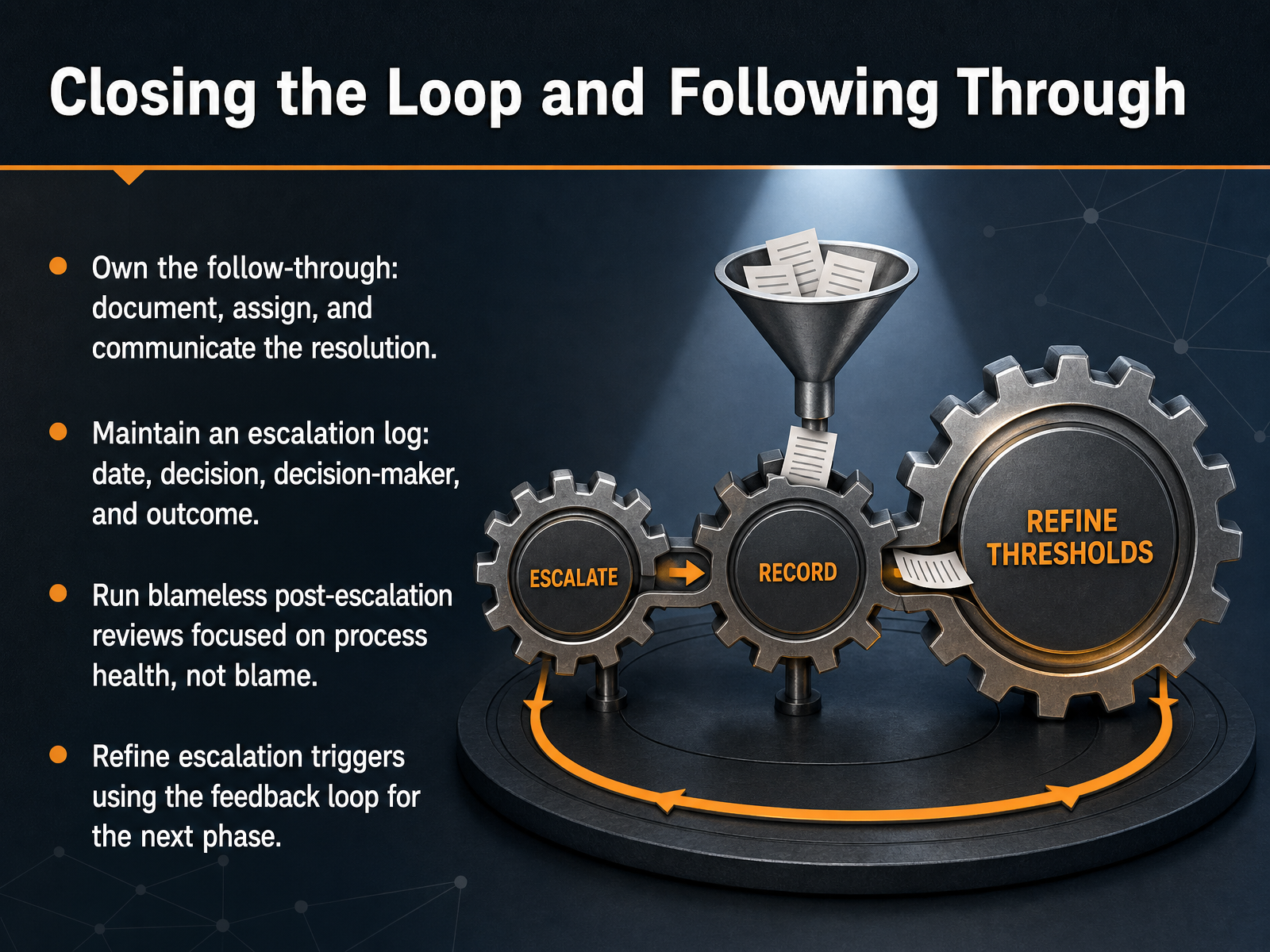
2 min - 11Closing the Loop and Following ThroughNow, let's look at how you close the loop and follow through. Your role doesn't end when the decision is made. You must own the follow-through. Document the resolution clearly. Assign each action item to a specific person. Then, communicate the outcome to everyone involved. Next, maintain an escalation log. For each entry, record the date, the final decision, the decision-maker, and the outcome. This log becomes a powerful tool for spotting patterns over time. After the escalation is resolved, run a blameless post-escalation review. Focus the discussion on your process health. You are looking at how the system handled the work, not assigning fault to people. Finally, use this feedback loop. Refine your escalation triggers. The insights you gain now will make your next escalation faster and cleaner. With a closed loop, you transform a single event into lasting team improvement. Next, we will discuss building a healthy organizational escalation culture.
 2 min
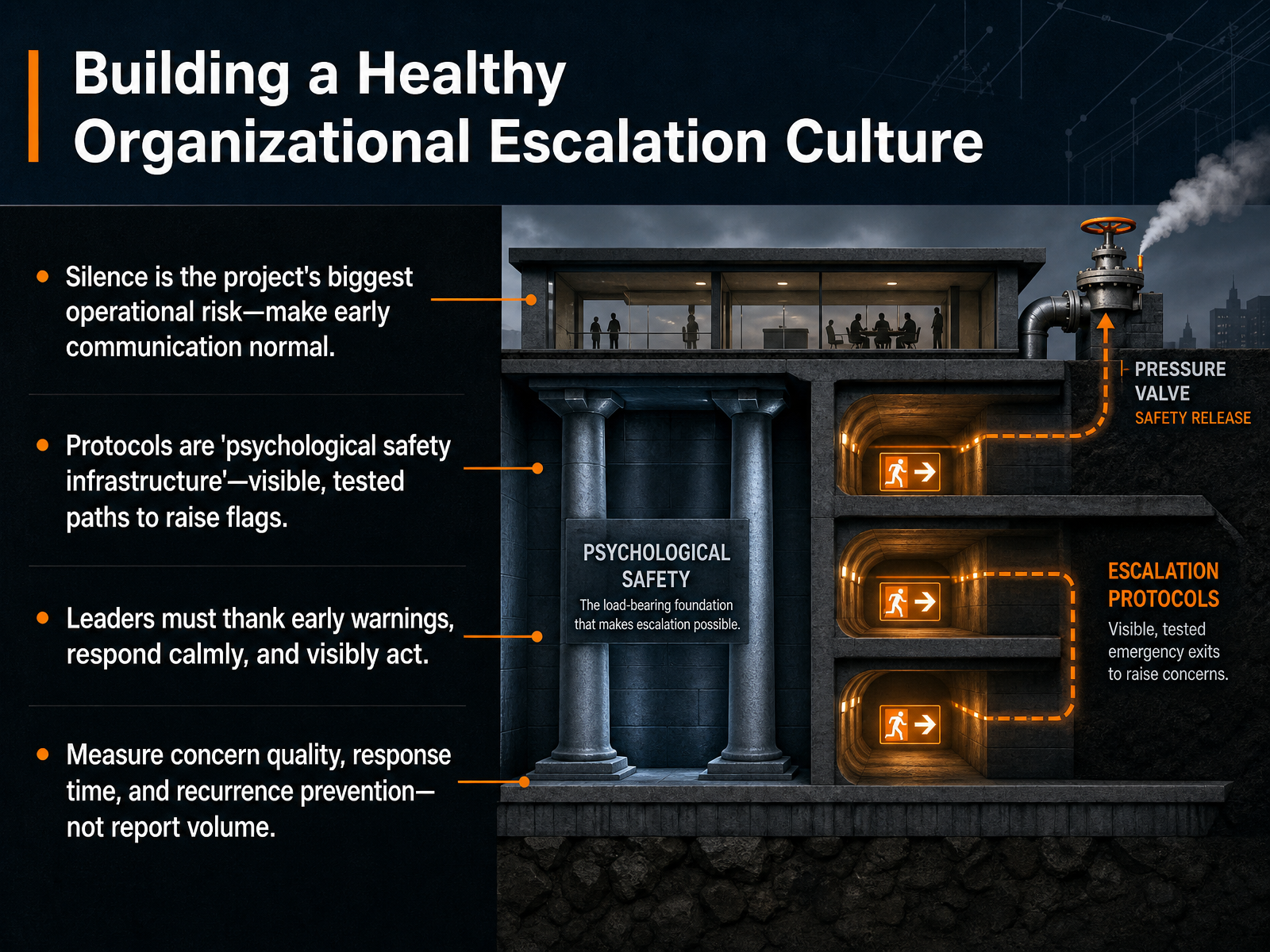
2 min - 12Building a Healthy Organizational Escalation CultureNow let's look at how to build a healthy escalation culture across the organization. The biggest operational risk on any project is silence. Make early communication the normal, expected behavior, not an exception. Think of your escalation protocols as psychological safety infrastructure. They are visible, tested paths that give people permission to raise flags without fear. For leaders, the response matters more than the rule. Thank people for early warnings. Stay calm. And most importantly, act visibly on what you hear. When you measure success, don't count report volume. Measure the quality of the concerns raised, your response time, and whether the same blocker recurs. That's how you build a culture that catches problems before they catch you. Next, we'll apply this directly with a practical session on identifying and preparing an escalation.
 2 min
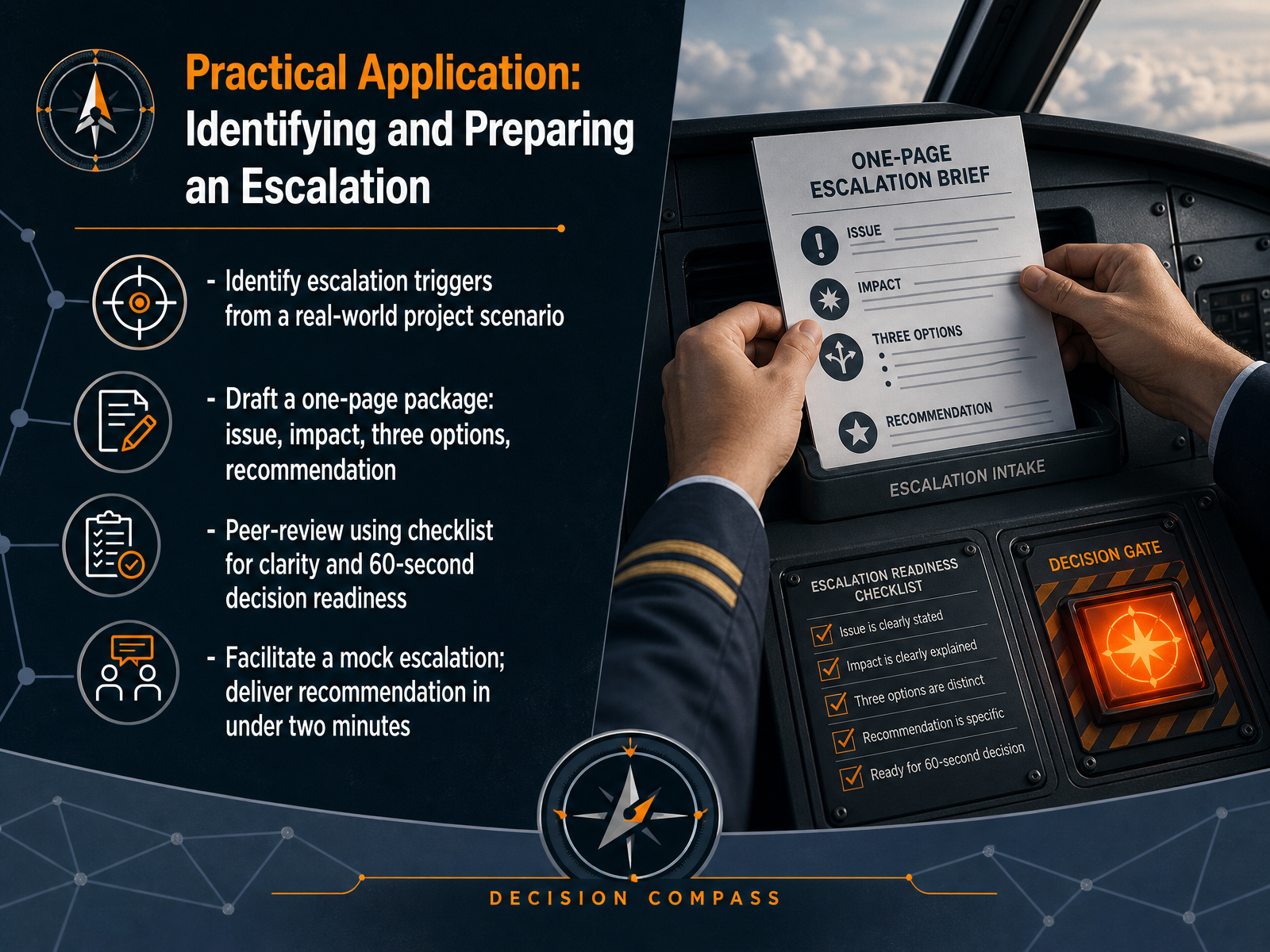
2 min - 13Practical Application: Identifying and Preparing an EscalationNow, let's put everything into practice with a real-world simulation. You'll start by identifying escalation triggers in a detailed project scenario. Your task is to draft a one-page package. State the core issue, outline the business impact, present three clear options, and make one direct recommendation. Then, you'll participate in a peer review. Use your checklist to verify clarity and confirm the package supports a 60-second decision. Finally, you will facilitate a mock escalation. Deliver your recommendation concisely in under two minutes. This is where you translate the framework into confident, decisive action. Next, we'll bring it all together with your action plan and key takeaways.
 1 min
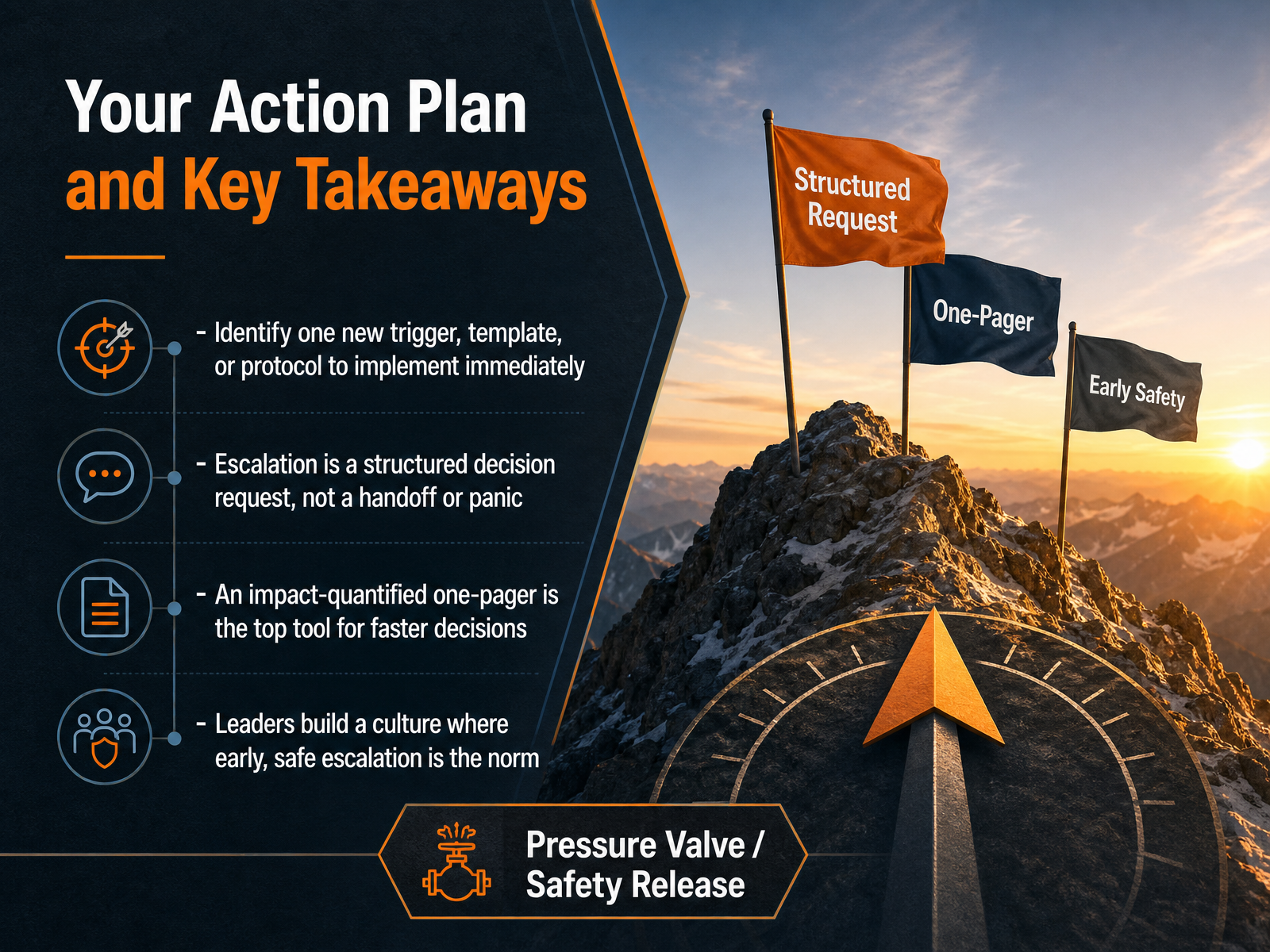
1 min - 14Your Action Plan and Key TakeawaysHere is your immediate action plan. First, identify one new trigger, template, or protocol you will implement today. Choose a single concrete item so it sticks. Next, reframe how you see escalation. It is a structured decision request, not a handoff and not a panic signal. When you do escalate, lead with a one-pager that quantifies the impact. This remains your top tool for getting faster decisions and building leadership trust. Finally, remember that strong leaders build a culture where early, safe escalation is the norm. Thank you for completing this course. You now have a clear, repeatable method to manage project escalations with confidence. Go put it into practice.
 1 min
1 min
Take the deck with you
Download this course as a file — free, no sign-up needed.
- PDF handoutEvery slide page, ready to print or share.15 pages · 4.5 MBDownload
- Narrated PowerPointThe deck that presents itself — every slide carries the digital human's narration video.15 pages · 13.3 MBDownload
- PowerPoint slidesThe full deck as a .pptx — open it in PowerPoint, Keynote, or Google Slides.15 pages · 4.5 MBDownload
Free to use in your own training — please keep the PersonWise credit page at the end.
Have your own deck? Turn it into a course