Creating a Project Roadmap
Begin
14 pages · ~28 min
Creating a Project Roadmap
A training on creating a project roadmap, designed for project managers and team leads to plan, visualize, and communicate key milestones and deliverables.
What you’ll learn
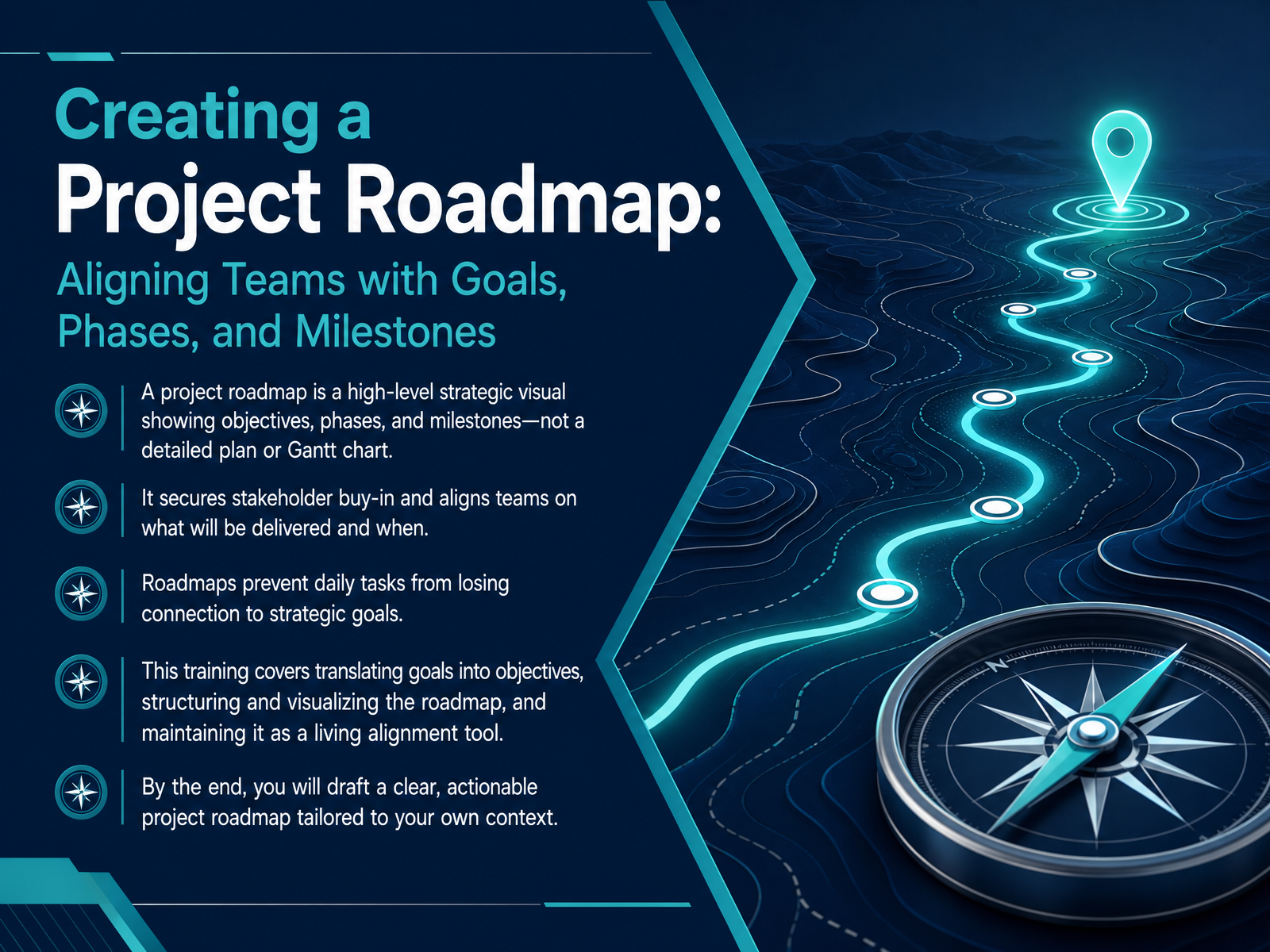
- 01Creating a Project Roadmap: Aligning Teams with Goals, Phases, and MilestonesWelcome. I'm glad you're here. Over the next few minutes, we'll build a skill that sits at the center of project leadership: creating a roadmap that truly aligns teams. Think of a project roadmap as a high-level strategic visual. It shows your objectives, phases, and milestones. It is not a detailed plan or a Gantt chart. Instead, it's the tool you'll use to secure stakeholder buy-in and align everyone on what gets delivered and when. A strong roadmap prevents daily tasks from drifting away from your strategic goals. In this training, you'll translate goals into clear objectives, structure and visualize the roadmap, and maintain it as a living alignment tool. By the end, you'll draft a clear, actionable project roadmap tailored to your own context. Let's start by clarifying exactly what a roadmap is, and what it isn't.productboard.comrock.soprojectstrategizer.com+22 min
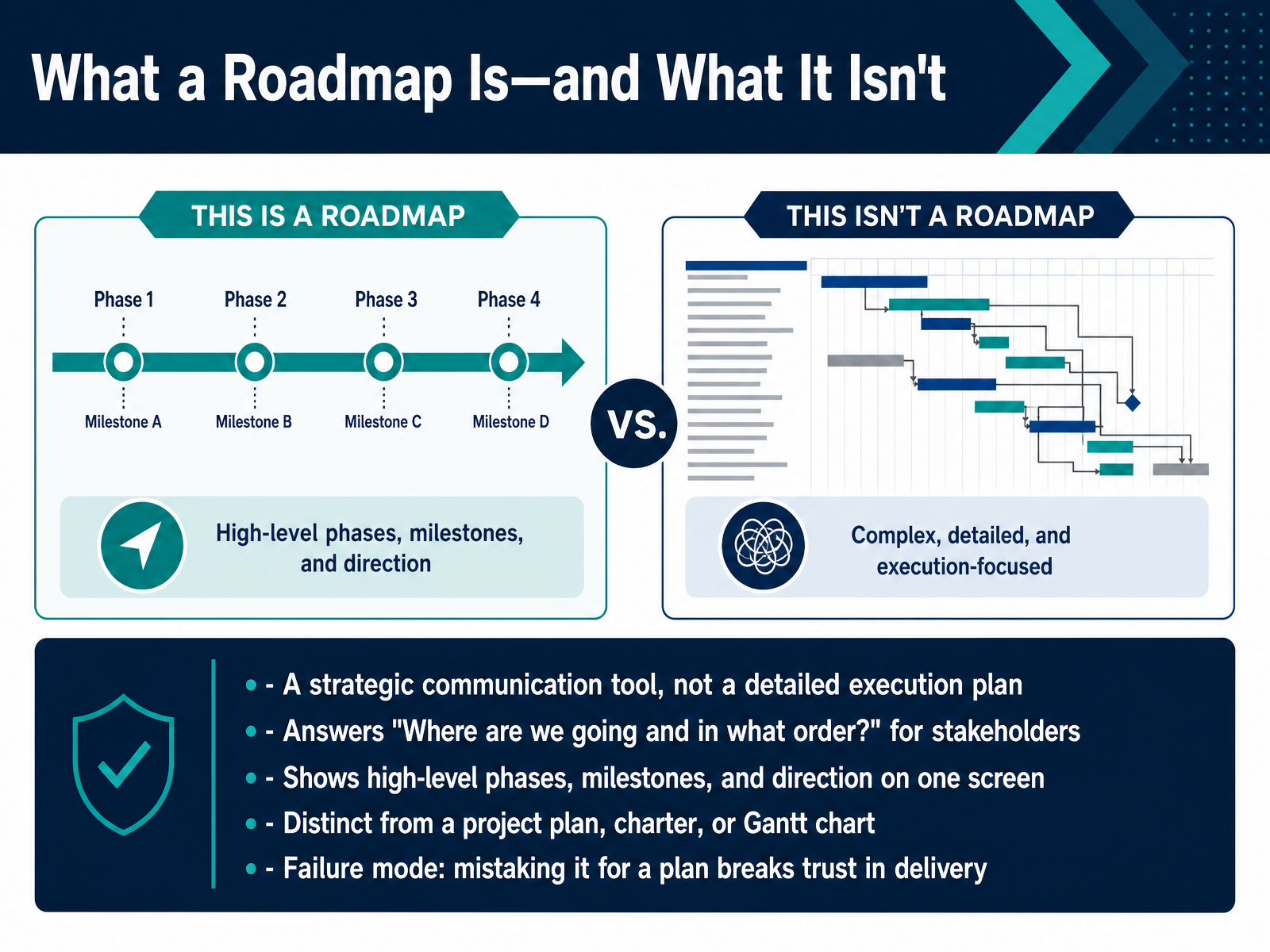
- 02What a Roadmap Is—and What It Isn'tLet's get clear on what a project roadmap actually is, and just as importantly, what it isn't. Think of a roadmap as a strategic communication tool, designed for a single, focused job. It answers the big question for your stakeholders: 'Where are we going, and in what order?' It does this by showing high-level phases, key milestones, and the overall direction of the project, all on a single screen. This is not a detailed execution plan. It is distinct from a project plan that lists every task, a charter that authorizes the work, or a Gantt chart that schedules individual activities. A critical failure mode happens when someone mistakes the roadmap for a delivery commitment. Treating those high-level phases as hard deadlines breaks trust the moment a date inevitably shifts. You protect your credibility by being explicit: the roadmap aligns us on direction. The detailed plan, which comes next, manages delivery. That distinction is the foundation we build on. Next, we'll place this tool in context by comparing project roadmaps to product roadmaps, two tools built for very different jobs.
 productboard.comrock.soprojectstrategizer.com+22 min
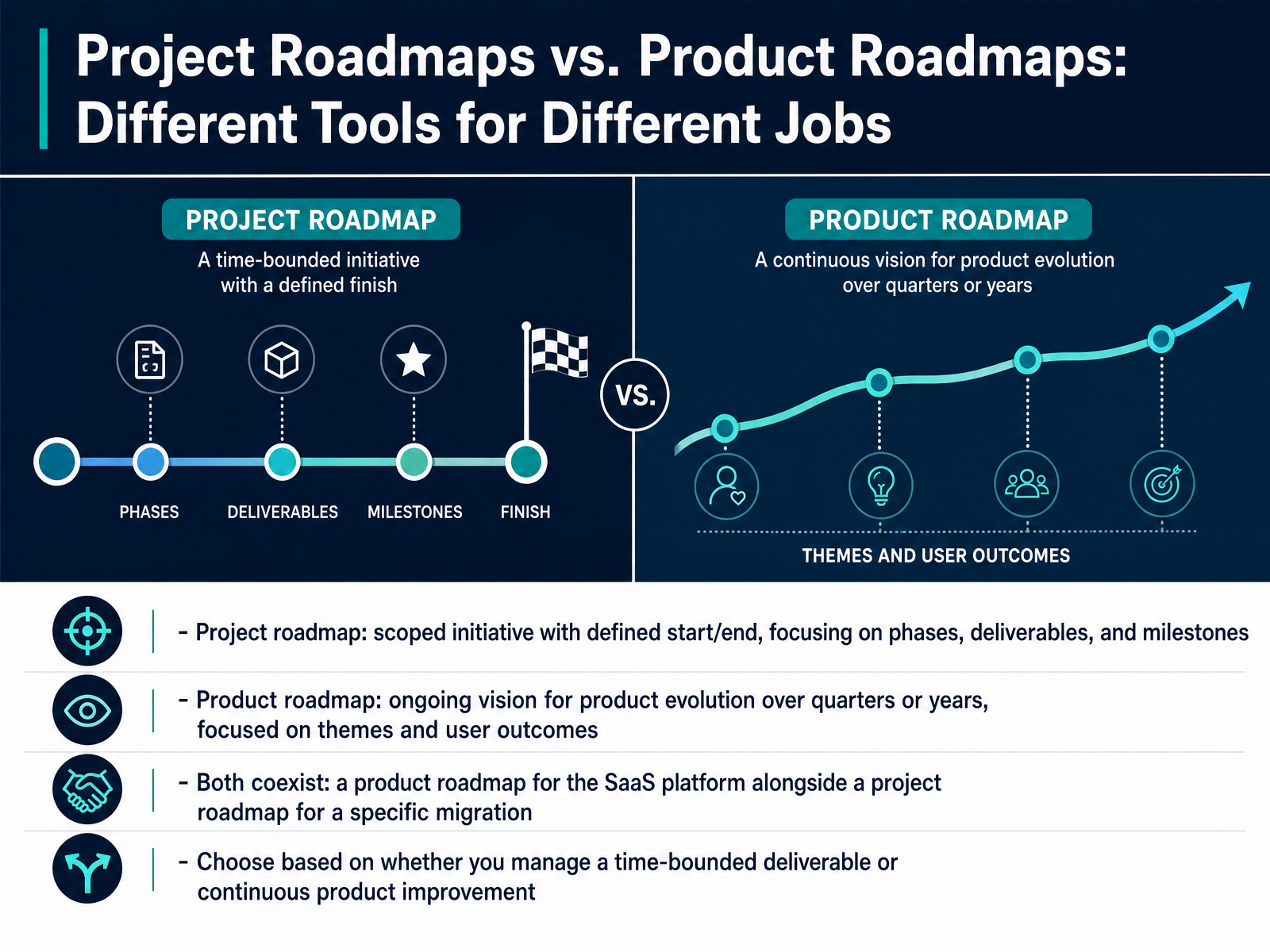
 - 03Project Roadmaps vs. Product Roadmaps: Different Tools for Different JobsLet's clear up a common point of confusion: the difference between a project roadmap and a product roadmap. They serve distinct purposes, and using the right tool makes a significant difference. Think of a project roadmap as the blueprint for a scoped initiative with a clear start and end. It's focused on phases, key deliverables, and specific milestones. Its core question is, 'What are we building, in what order, and when will it be done?' A product roadmap, on the other hand, is an ongoing strategic vision. It charts the evolution of a product over quarters or even years, centered on themes and user outcomes. This tool asks, 'Where is this product going, and what are our priorities?' In practice, these two documents often coexist. You might be managing a product roadmap for your entire SaaS platform, while simultaneously using a project roadmap for a specific migration initiative happening alongside it. Your choice comes down to what you're managing: a time-bounded deliverable calls for a project roadmap, while continuous product improvement calls for a product roadmap. Next, we'll build on this by translating high-level strategic goals into concrete, actionable roadmap objectives.
 productboard.comrock.soprojectstrategizer.com+22 min
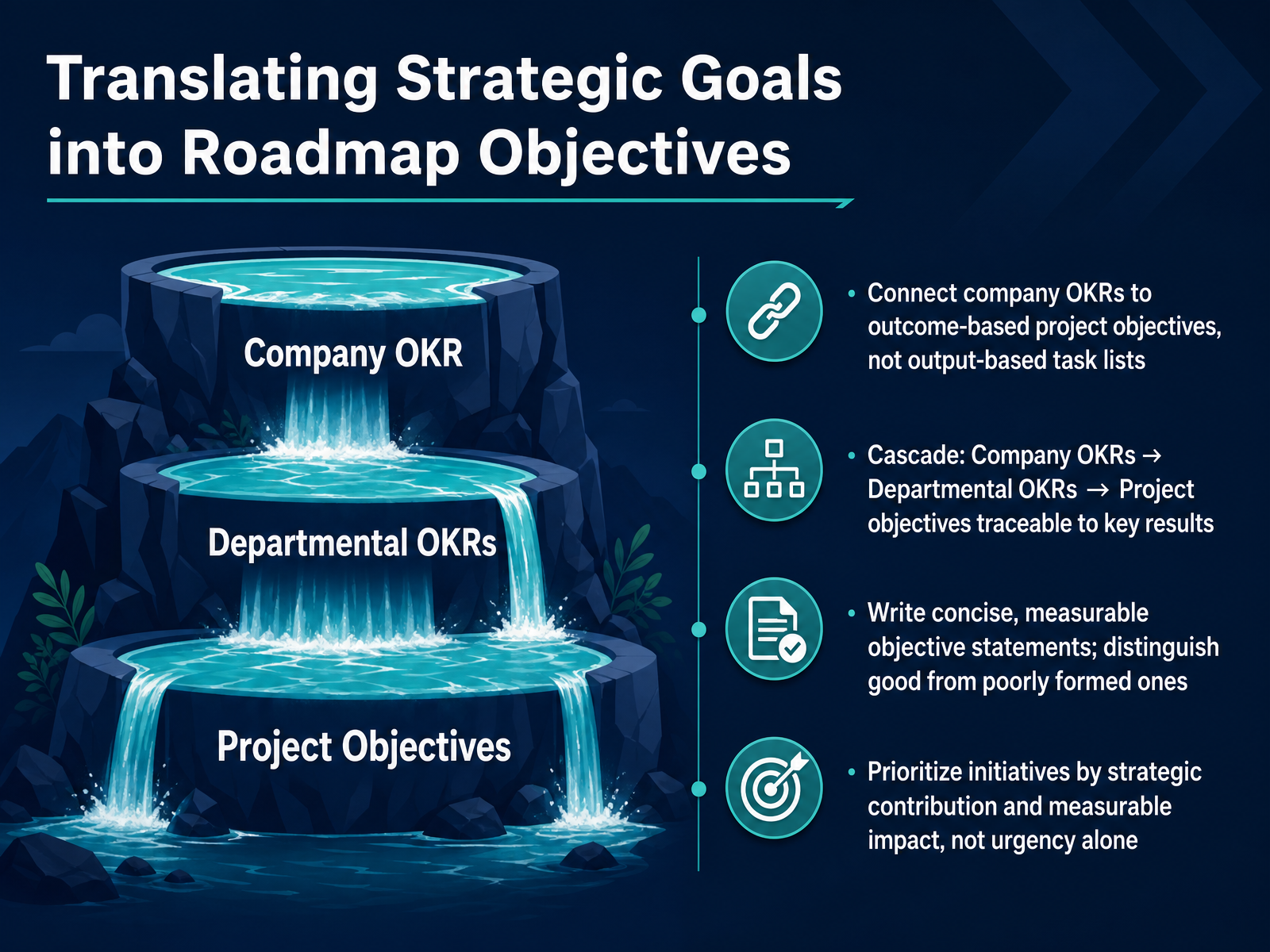
 - 04Translating Strategic Goals into Roadmap ObjectivesNow, let’s take those high-level goals and translate them into clear, outcome-based objectives for your roadmap. This isn’t just about listing tasks. You’ll define what success looks like by connecting company OKRs directly to the project’s intended impact. Think of it as a cascade. Company-level OKRs flow down into departmental OKRs, and your project objectives must trace back to those key results. This traceability proves that every effort moves the organization forward. As you write these objectives, be concise and measurable. A poorly formed objective names an activity, like ‘conduct user interviews.’ A strong one focuses on the outcome, for example, ‘uncover three key drop-off points to raise the completion rate above 85 percent.’ To prioritize, you’ll rank initiatives by their strategic contribution and measurable impact, not by urgency alone. The highest-value work is what demonstrably moves a key result. This discipline prevents your roadmap from becoming just a feature wish list and transforms it into a deliberate plan for outcomes. Up next, we’ll structure these prioritized objectives into a real roadmap with clear themes, workstreams, and time horizons.
 sharpcloud.comones.comthinkinsights.net+22 min
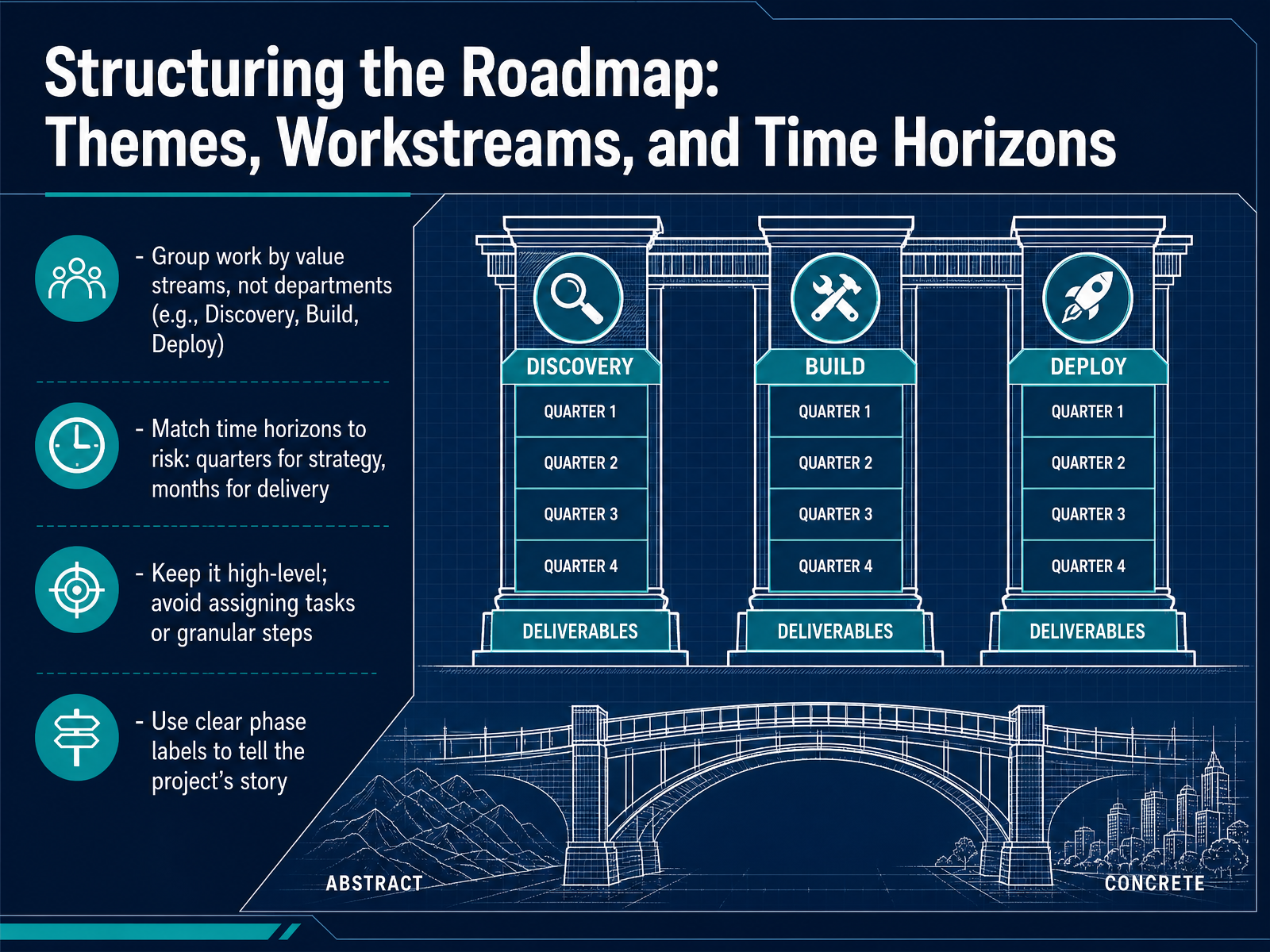
 - 05Structuring the Roadmap: Themes, Workstreams, and Time HorizonsNow let's talk about how you actually structure the roadmap. When you group the work, organize it by value streams, not by department. Think in terms of Discovery, Build, and Deploy. This keeps everyone focused on delivering complete solutions, not just handing off functional pieces. For the time horizons, match the level of detail to the level of risk. Use quarterly buckets for strategic direction, where things are naturally less certain, and monthly views when you get closer to delivery commitments. Remember to keep this view high-level. You are defining outcomes and major phases here, not assigning individual tasks or granular steps. And finally, use clear phase labels that tell a story. Names like 'Exploration,' 'Alpha Delivery,' and 'Scale' instantly communicate the project's journey better than 'Phase One,' 'Phase Two,' or 'Quarter Three.' This structure turns a list of features into a cohesive plan. Next, we'll apply a powerful framing technique to manage uncertainty. Let's move into the Now-Next-Later Framework: Planning with Confidence, Not Fixed Dates.
 2 min
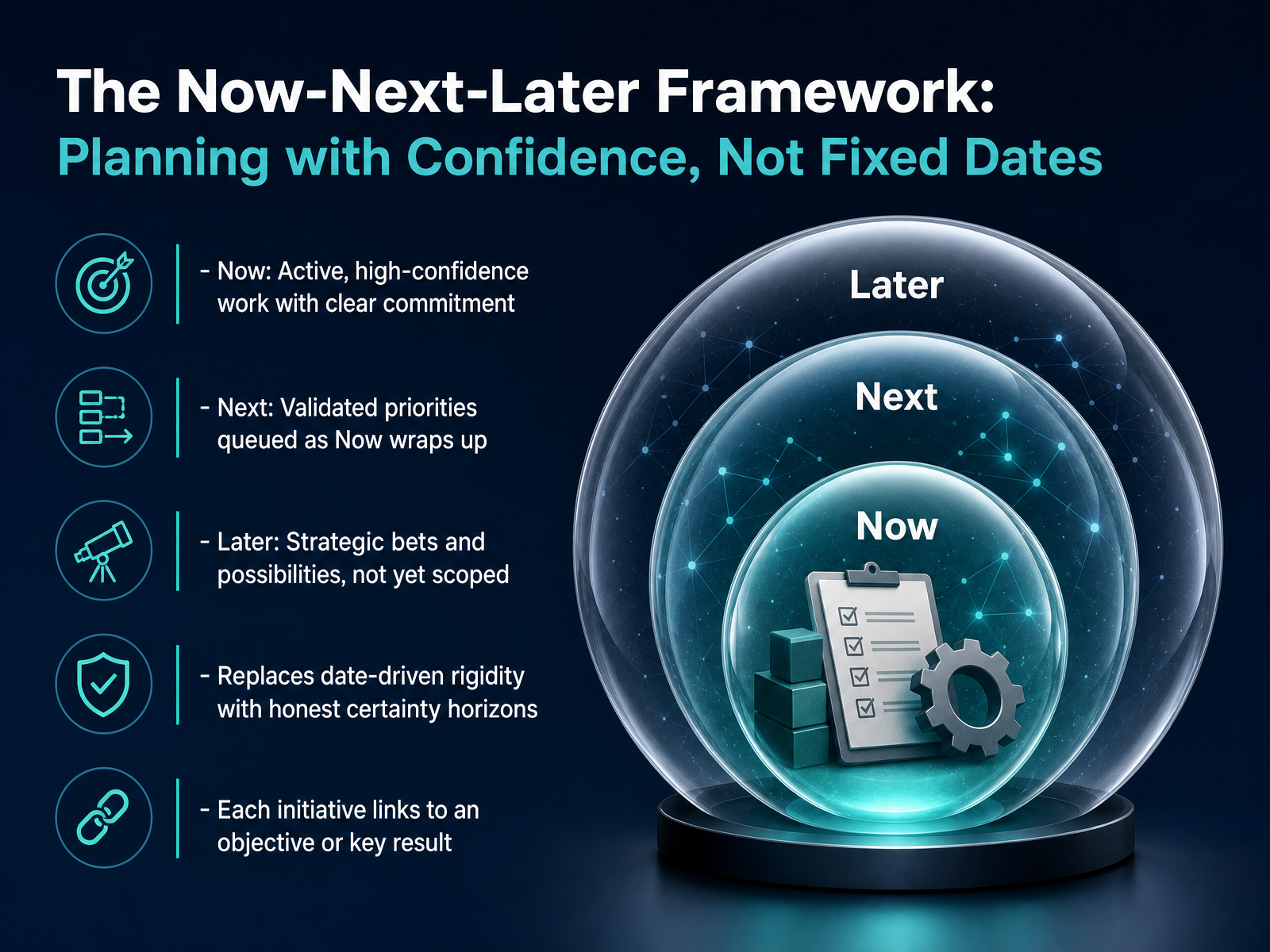
2 min - 06The Now-Next-Later Framework: Planning with Confidence, Not Fixed DatesLet's shift our perspective from dates to confidence, using a framework called Now-Next-Later. It replaces rigid timelines with honest certainty horizons. Think of it as three active zones on your roadmap. The 'Now' column holds work you're actively building—high-confidence items with clear commitment. 'Next' is your validated priority queue. As Now wraps up, these opportunities are ready to be pulled in. 'Later' captures strategic bets and possibilities that are worth investigating, but not yet scoped. Crucially, each initiative in every column links directly to a business objective or a key result. This keeps the roadmap's focus on outcomes, not just a list of features. You're not guessing dates for fuzzy ideas in Later; you're protecting your team's credibility by being transparent about what's certain and what's still being explored. This structure lets you plan with confidence, adapting as you learn, without breaking promises. Up next, we'll see how to anchor this fluid plan with concrete, decision-driving milestones.
 prodpad.comprodpad.comdovetail.com+22 min
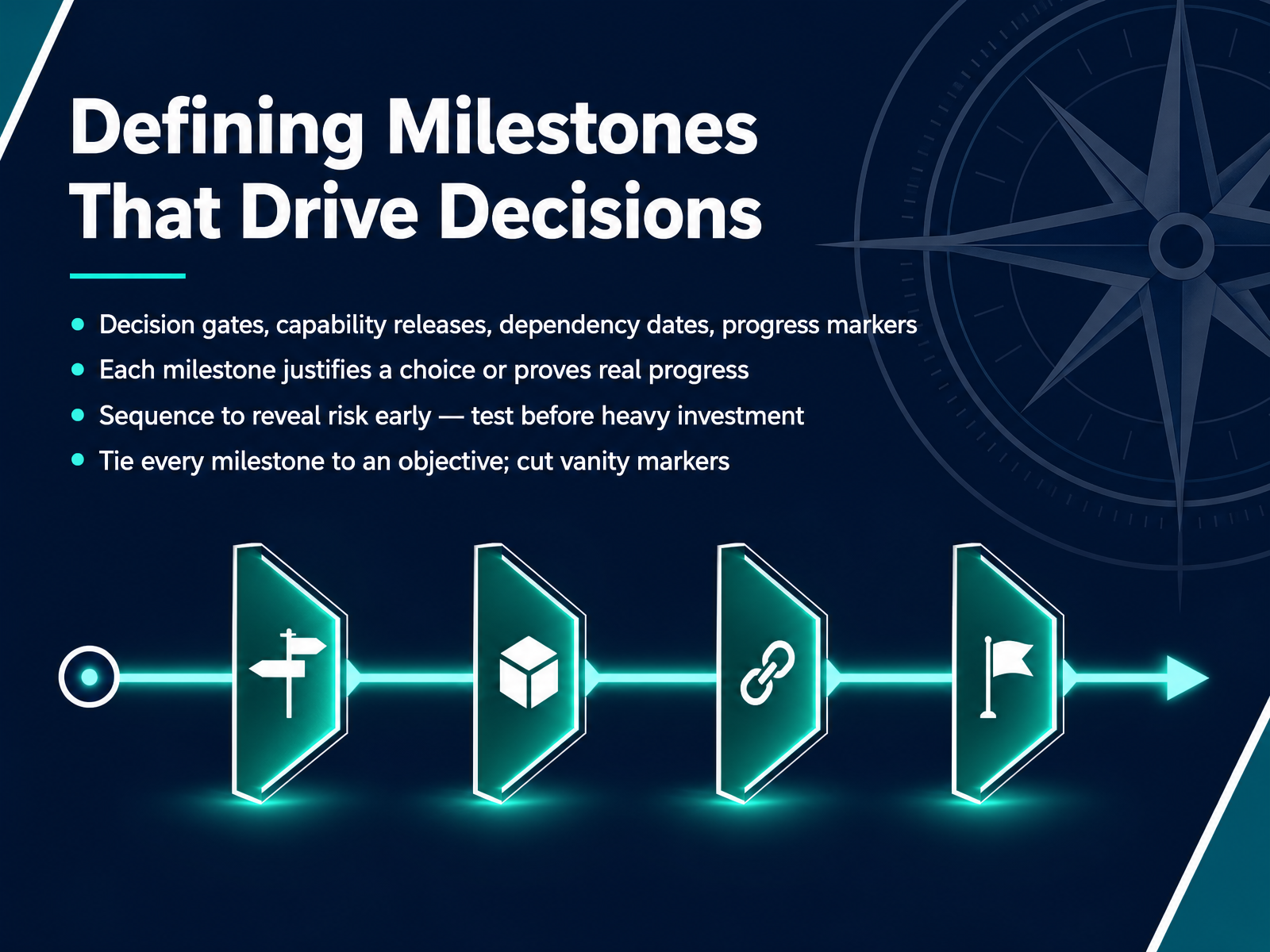
 - 07Defining Milestones That Drive DecisionsNow let’s turn milestones into real decision points, not just dates on a calendar. A true milestone justifies a choice or proves real progress. Think about it in four categories: decision gates, capability releases, dependency dates, and progress markers. A decision gate makes you confirm scope or approve a budget. A capability release demonstrates a working feature, not just a document. Dependency dates alert you to what other teams need from you, and by when. And progress markers let you calibrate speed and resource burn before it’s too late. Sequence these to reveal risk early. For example, run a technical spike before committing to a large build. Validate a design prototype before locking the full backlog. This way you test assumptions when changes are still cheap. And here’s the key discipline: tie every milestone directly to a stated objective. If a milestone doesn’t influence a decision or prove forward motion, it’s a vanity marker. Cut it. Keep only the moments that drive the project forward. Next, we’ll take these milestones and visualize them for executive and team audiences.
 2 min
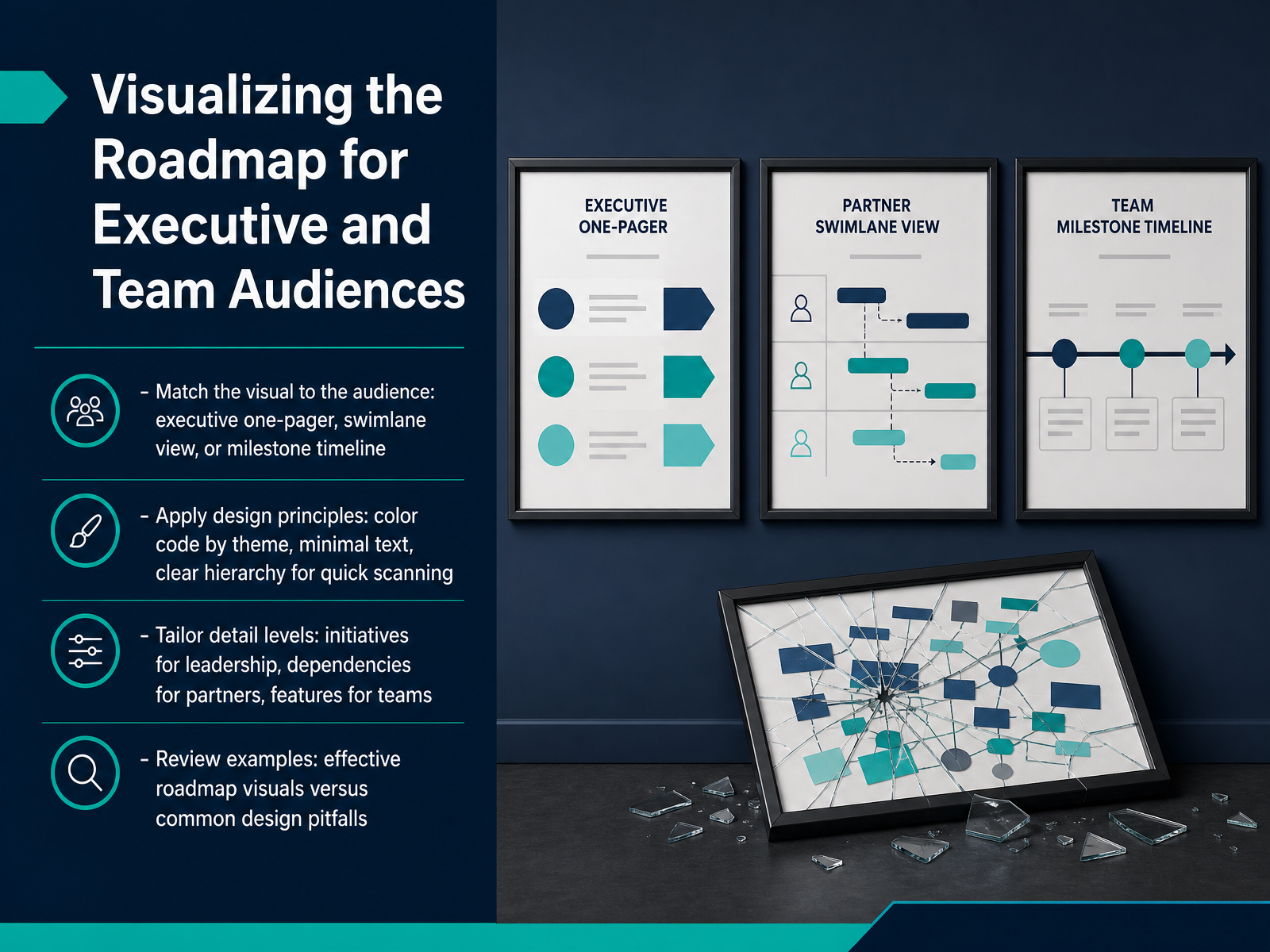
2 min - 08Visualizing the Roadmap for Executive and Team AudiencesLet's now focus on how to visualize your roadmap so it really connects with different audiences. The same underlying plan needs to look different for an executive than it does for your engineering partners. For leadership, a crisp one-pager that highlights strategic initiatives and key milestones works best. When you're collaborating with other department leads, a swimlane view helps clarify who owns what and when handoffs occur. And for the teams doing the building, a milestone timeline with the next few sprints of features is what keeps everyone aligned. As you build these views, apply a few core design principles. Use color coding by theme, keep text to an absolute minimum, and maintain a clear visual hierarchy so the eye immediately knows where to go. Tailor the level of detail intentionally: discuss major initiatives with executives, map cross-team dependencies for your partner leads, and get specific about features and capabilities with your immediate teams. Let's contrast a common pitfall with an effective visual. A cluttered Gantt chart with forty lines and tiny font requires stakeholders to squint and decipher. An effective roadmap uses grouping, generous white space, and clear labels so the answer to 'where are we going' is visible in seconds. Next, we'll put these concepts into action when we explore Roadmapping Tools and Platforms in Practice.
 roadmapplanner.appstoryflow.soappcues.com+22 min
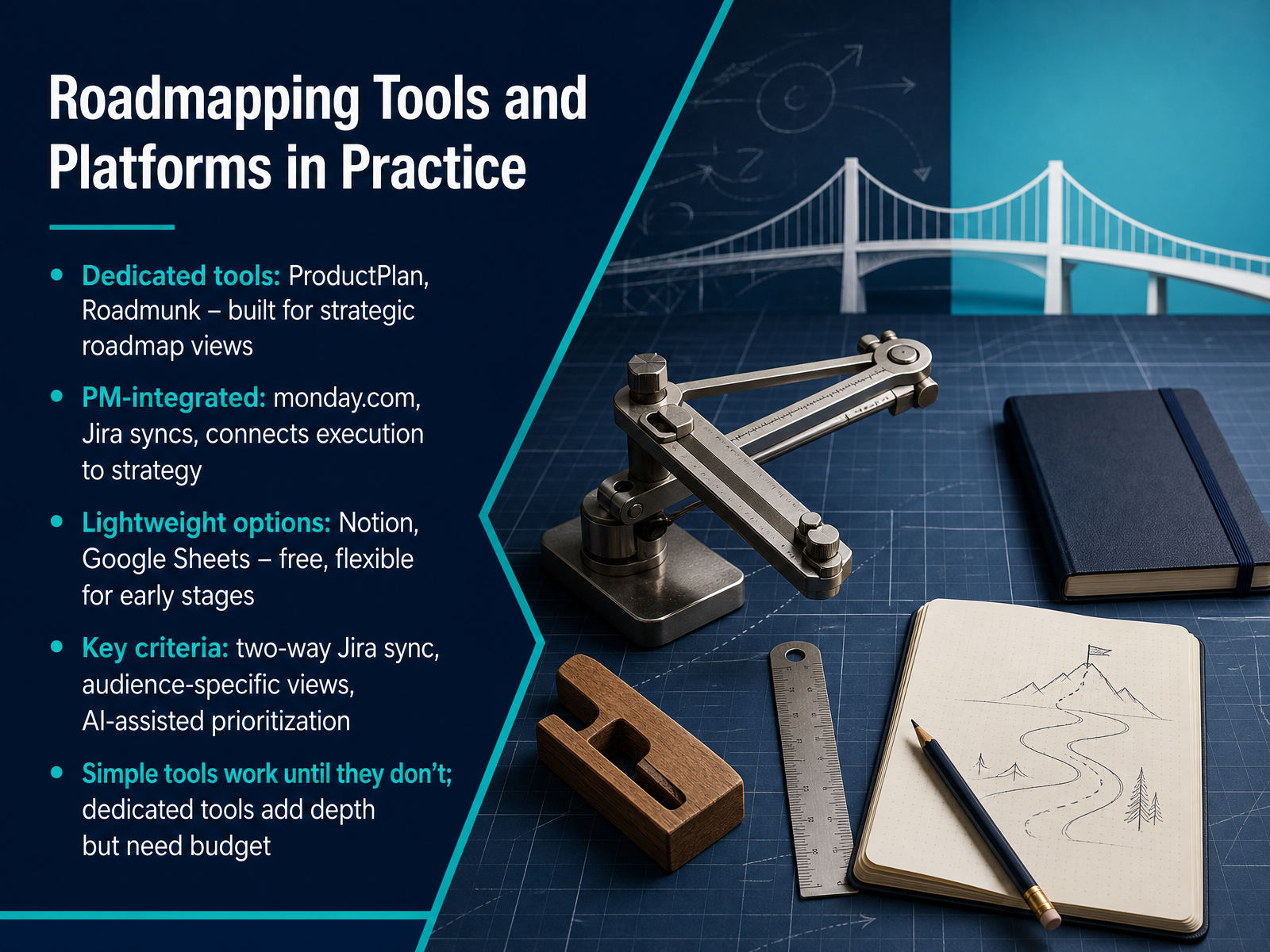
 - 09Roadmapping Tools and Platforms in PracticeWhen you're ready to put the roadmap into practice, the right platform makes a big difference. For a pure, strategic view, purpose-built tools like ProductPlan or Roadmunk are hard to beat. If your team lives inside a work management tool, platforms like monday.com or Jira can bridge execution with strategy, provided you have a solid two-way sync that keeps the roadmap connected to the actual work. For teams just starting out, lightweight options like Notion or collaborative spreadsheets offer all the flexibility you need without any budget conversations. But here's the pattern we see repeatedly: simple tools work wonderfully until your stakeholder group grows. When you suddenly need audience-specific views, or you want the tool to assist with AI-driven prioritization, the lightweight solution starts to break. That's the moment when a dedicated platform earns back its investment. Choose based on clarity, sync requirements, and who needs to see what. Next, let's talk about maintaining that alignment without micromanaging your teams.
 prodpad.comprodpad.comdovetail.com+22 min
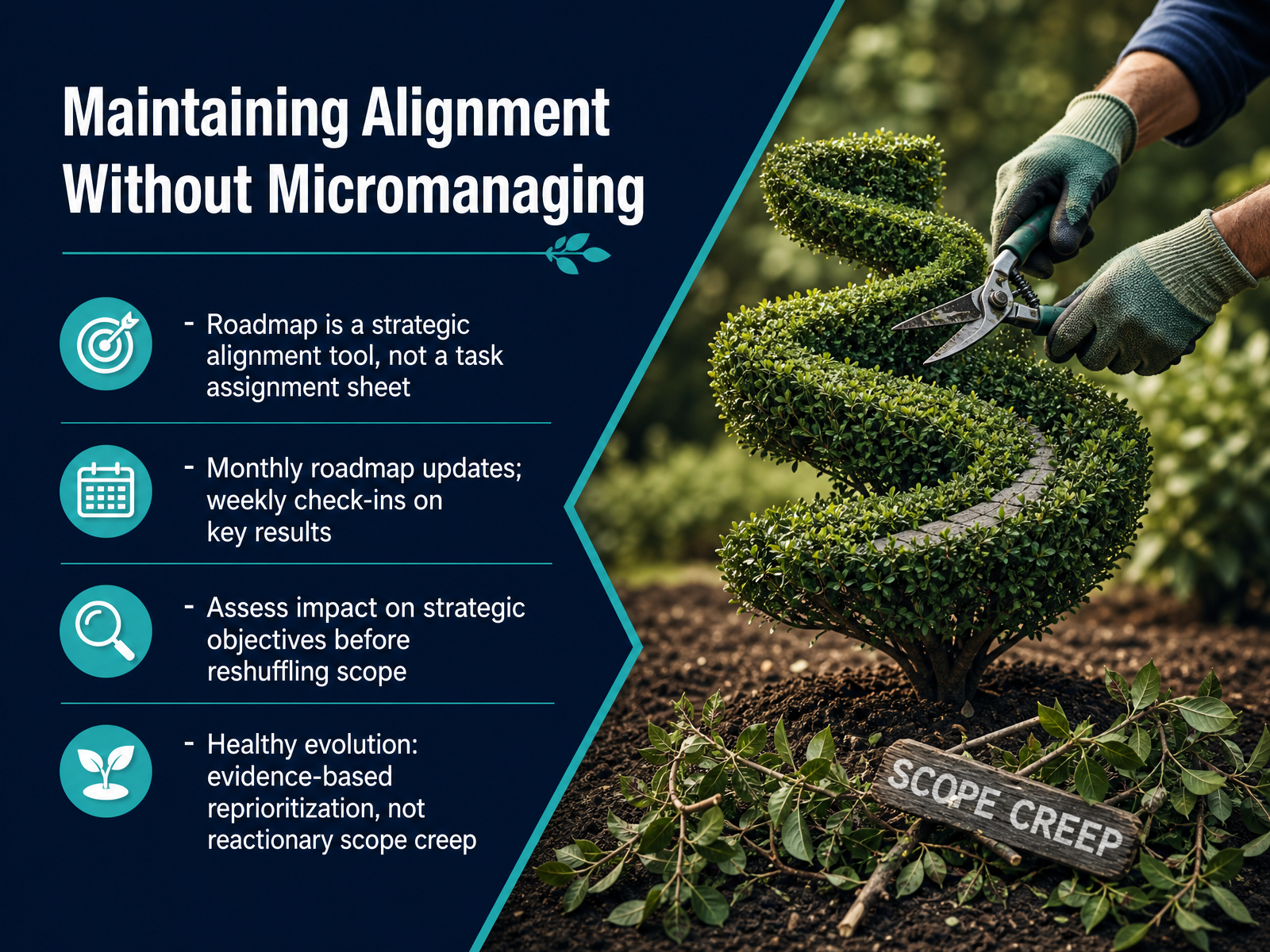
 - 10Maintaining Alignment Without MicromanagingNow, let’s talk about keeping the team aligned without falling into the trap of micromanagement. Think of your roadmap as a strategic alignment tool, not a detailed task assignment sheet. It’s there to guide decisions, not to manage every click and keystroke. You’ll establish a sustainable rhythm: plan for a substantial roadmap update once a month, while running brief, weekly check-ins specifically focused on key results. This keeps the focus on outcomes, not just activity. Before you ever consider reshuffling scope, always pause to assess the real impact on your strategic objectives. Ask whether a change strengthens your primary goals or just reacts to the loudest voice in the room. You want a healthy, evidence-based evolution of the plan. That means practicing reprioritization based on data and learning, and firmly resisting reactionary scope creep that pulls you away from agreed outcomes. When you treat the roadmap as a living agreement on strategic intent, you give teams the clarity and autonomy to execute their best work. Next, we’ll close the loop by looking at how integrating OKRs and the roadmap creates a dynamic feedback system.
 sharpcloud.comones.comthinkinsights.net+22 min
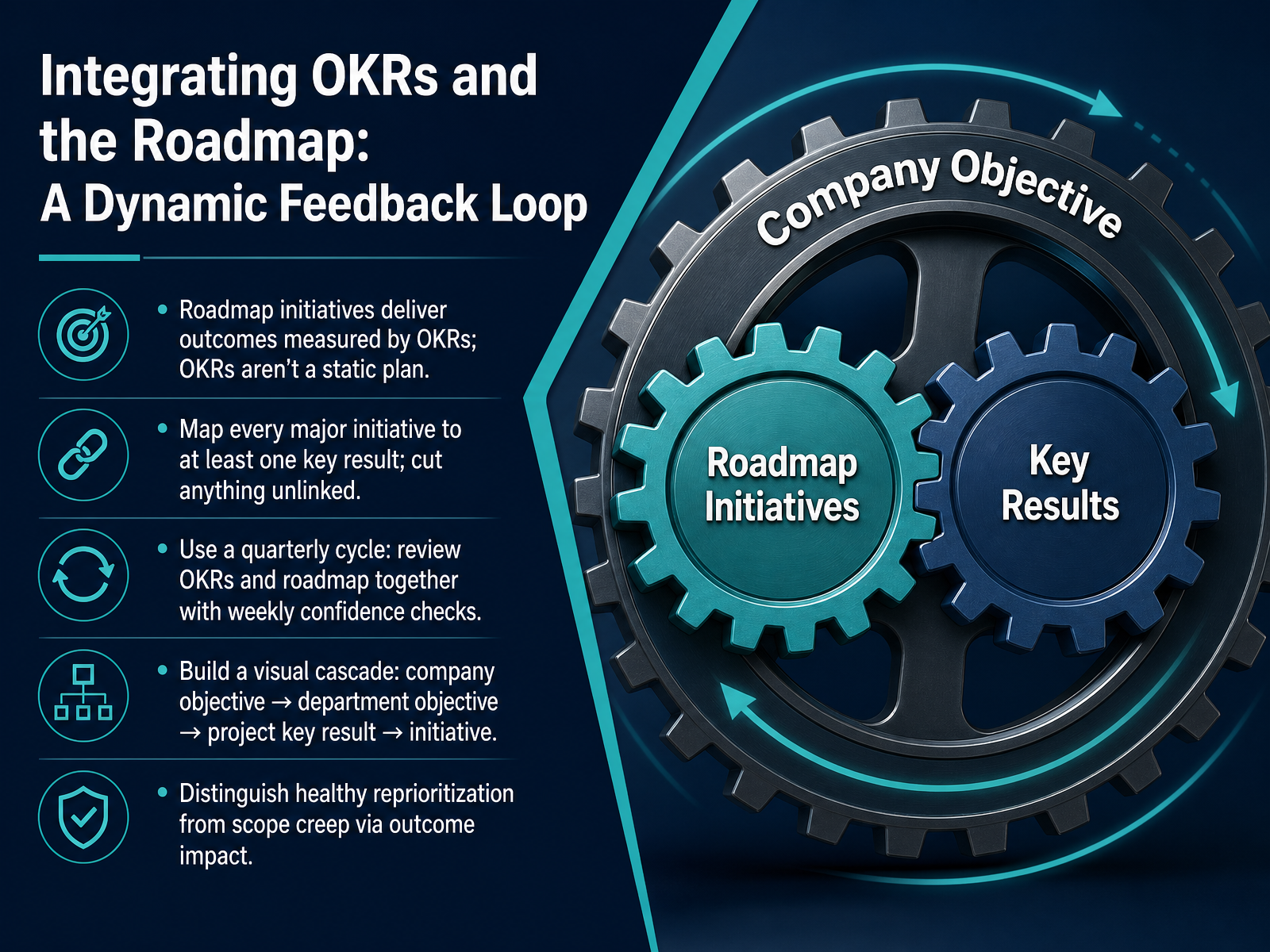
 - 11Integrating OKRs and the Roadmap: A Dynamic Feedback LoopNow let's connect these pieces into a living system. Your roadmap initiatives aren't just a plan, they're how you deliver the outcomes your OKRs measure. A static list of features won't help you. Instead, map every major initiative directly to at least one key result. If an initiative can't trace itself to a measurable outcome, it's a candidate for removal. This single filter often clears thirty percent of a backlog. We'll operationalize this through a quarterly cycle, where you review both the roadmap and OKR progress together, using weekly confidence checks to keep things honest. To build transparency, create a visual cascade. Start with the company objective, then the department objective, then the project key result, and finally the initiative. This shows everyone exactly how their work contributes. With this clear link, you can distinguish healthy reprioritization from scope creep by simply asking, 'What outcome impact does this change have?' If the impact isn't clear, hold the line.
 sharpcloud.comones.comthinkinsights.net+21 min
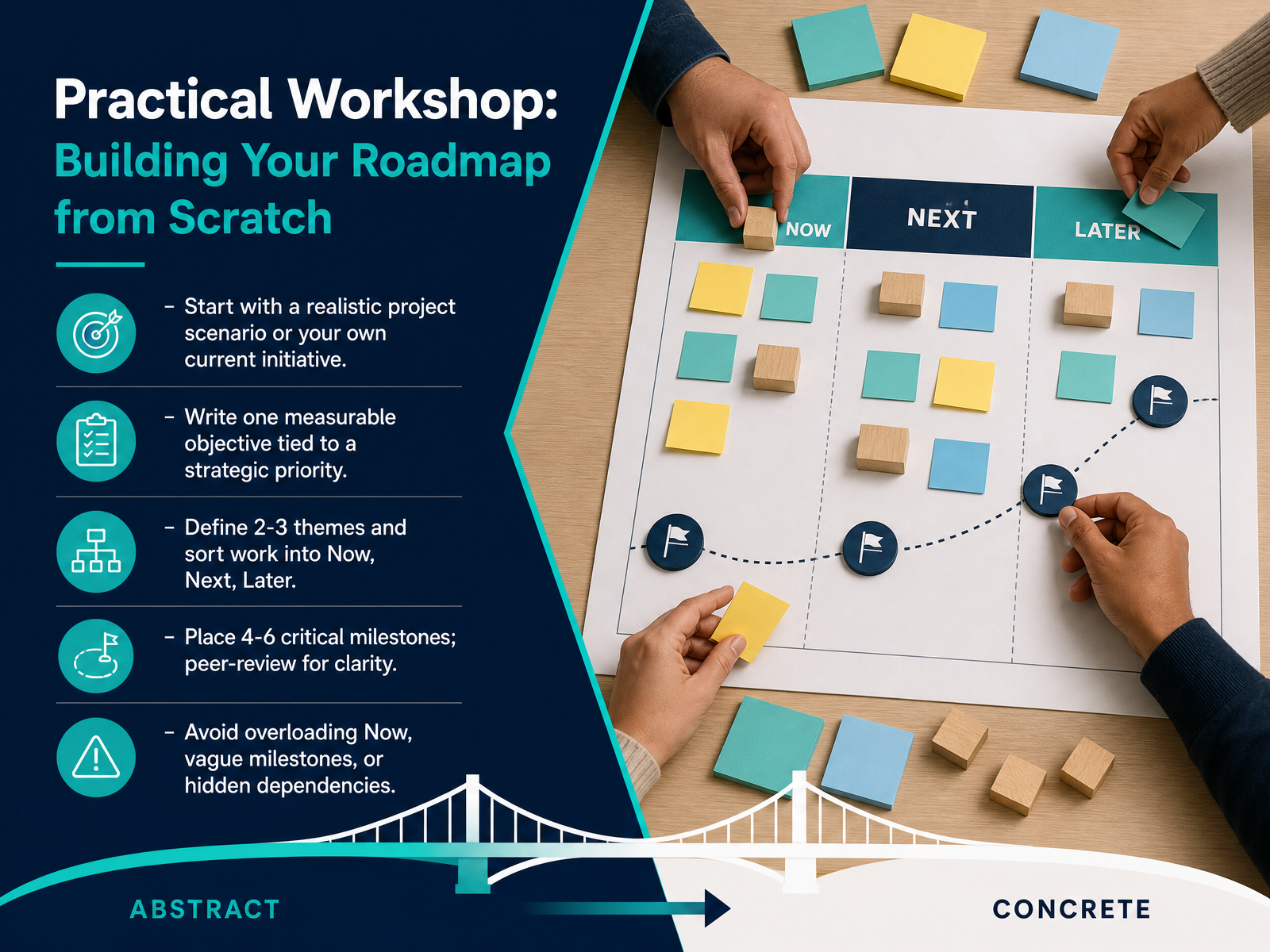
 - 12Practical Workshop: Building Your Roadmap from ScratchLet's move from theory to practice and build a roadmap outline together. You'll start with a realistic project scenario or even better, your own current initiative. First, write one measurable objective that ties directly to a strategic priority. For example, 'Increase user activation by fifteen percent in Q three.' Next, define two to three themes like User Experience or Platform Stability. Then, sort your work into now, next, and later buckets. Place four to six critical milestones across these phases. For instance, 'Beta launch' under now or 'Architecture review' under next. Peer-review these milestones for clarity. Ask a colleague, 'Is this specific and measurable?' Finally, watch for three common traps. Avoid overloading the 'now' bucket with too much work. Avoid vague milestones like 'Improve performance' without a target. And watch for hidden dependencies that could stall progress. Setting clear milestones now builds the alignment your project needs.
 2 min
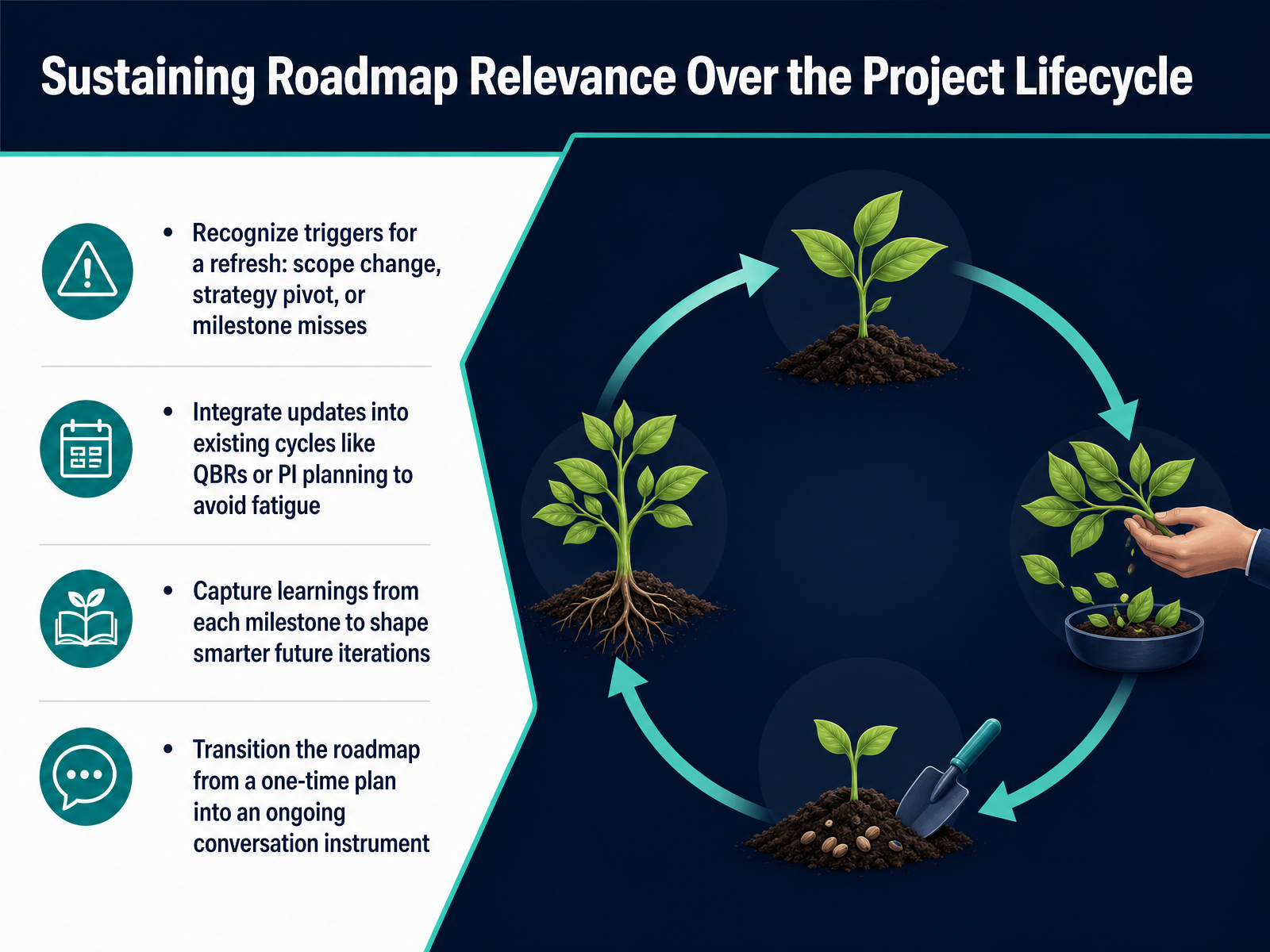
2 min - 13Sustaining Roadmap Relevance Over the Project LifecycleA project roadmap only creates value if it stays relevant. Let’s talk about how to keep yours alive throughout the entire project lifecycle. First, recognize the triggers for a refresh. Maybe the scope changes, leadership pivots the strategy, or a key milestone is missed. Any of these signals mean it’s time to revisit the plan, not ignore it. To avoid change fatigue, integrate updates into existing cycles you’re already running, like quarterly business reviews or PI planning sessions. This prevents the roadmap from feeling like extra overhead. Next, capture learnings from each milestone you complete. Ask what worked and what didn’t, and use those insights to shape smarter iterations going forward. Over time, this practice transitions your roadmap from a one-time static plan into an ongoing conversation instrument. It becomes a tool teams actually use to align, decide, and adapt. Next, we’ll wrap up with our key takeaways and action plan.
 sharpcloud.comones.comthinkinsights.net+22 min
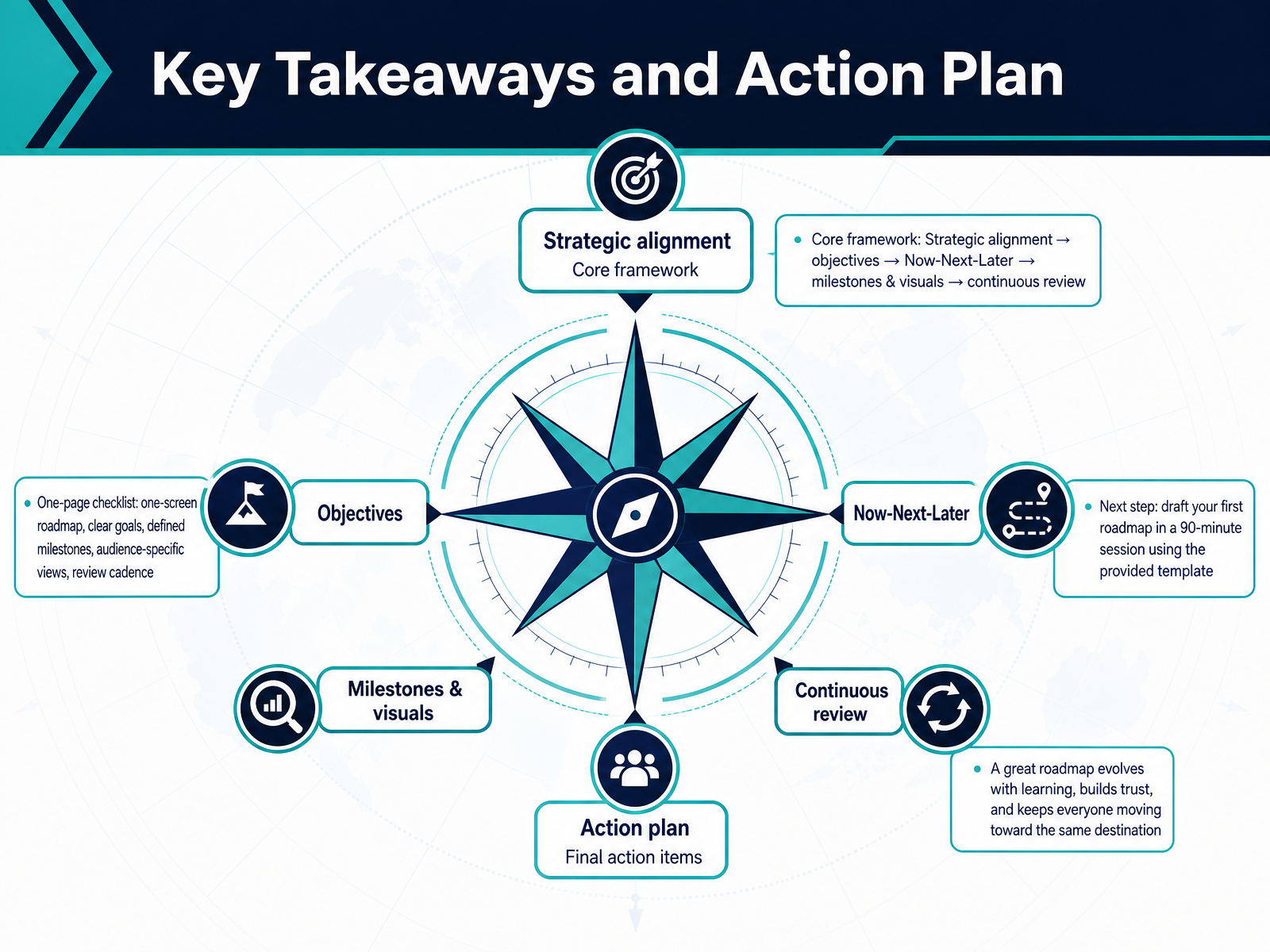
 - 14Key Takeaways and Action PlanWe have covered a lot of ground together. Let's anchor it with a quick recap and your immediate next step. The core workflow we built sits on a tight frame: start with strategic alignment, crystallize your objectives, structure the path with a Now-Next-Later view, surface milestones visually, and commit to a continuous review rhythm. To keep your roadmap honest, use the one-page checklist. That means a single-screen view, clear goals, defined milestones, audience-specific perspectives, and a standing review cadence. Now, here is your call to action. Block a ninety-minute session, pull up the template, and draft your first roadmap. You will not get it perfect, and that is the point. A great roadmap is a living instrument. It builds trust, absorbs what you learn, and keeps everyone moving toward the same destination. Start today.
 productboard.comrock.soprojectstrategizer.com+22 min
Take the deck with you
Download this course as a file — free, no sign-up needed.
- PDF handoutEvery slide page, ready to print or share.15 pages · 4.1 MBDownload
- Narrated PowerPointThe deck that presents itself — every slide carries the digital human's narration video.15 pages · 14.3 MBDownload
- PowerPoint slidesThe full deck as a .pptx — open it in PowerPoint, Keynote, or Google Slides.15 pages · 4.0 MBDownload
Free to use in your own training — please keep the PersonWise credit page at the end.
Have your own deck? Turn it into a course
Sources consulted
Web sources consulted while building this course.
- Project Roadmap vs. Product Roadmap — productboard.com
- Project Roadmap (2026): Templates, Examples, How to Build — rock.so
- What Is a Project Roadmap? How It Differs from a Product Roadmap and When to Use It | Project Strategizer — projectstrategizer.com
- Product Roadmap vs Project Plan: Why Teams Keep Confusing Them — iau-tech.com
- Project Roadmap vs Product Roadmap: Key Differences — slideegg.com
- Integrating Roadmaps with OKRs: A Practical Guide — sharpcloud.com
- OKR Project Management: A Step-by-Step Framework for 2026 — ones.com
- Corporate Strategy: From Vision to Executable Roadmap | Think Insights — thinkinsights.net
- PQP Strategy: Using OKRs in Project-Driven Organizations - Caroli.org — caroli.org
- Implementing OKRs in project management 2026 strategy — monday.com
- What Is a Now-Next-Later Roadmap? Examples, Templates & Best Practices — prodpad.com
- Why I Invented the Now-Next-Later Roadmap — prodpad.com
- Master Your Projects with the Now-Next-Later Roadmap — dovetail.com
- How to Create a Now-Next-Later Roadmap for a Product in Its Early Stages — netguru.com
- The Now-Next-Later Framework — nalpeiron.com
- Roadmap Planner 2026 – Free Online Gantt Chart Tool (No Login) — roadmapplanner.app
- The 12 Best Roadmap Tools in 2026 (We Tested Them All) — storyflow.so
- 15 Best Product Roadmap Tools (2026): Free and Paid Compared — appcues.com
- Best product roadmap tools of 2026 — techradar.com
- Visualization And Collaboration Tool For Product Owners - Visor — visor.us