Brand Strategy Development Workflow
Begin
14 pages · ~28 min
Brand Strategy Development Workflow
Learn a practical workflow for developing an effective brand strategy, ideal for marketers and business leaders seeking to define brand positioning, messaging, and differentiation.
What you’ll learn
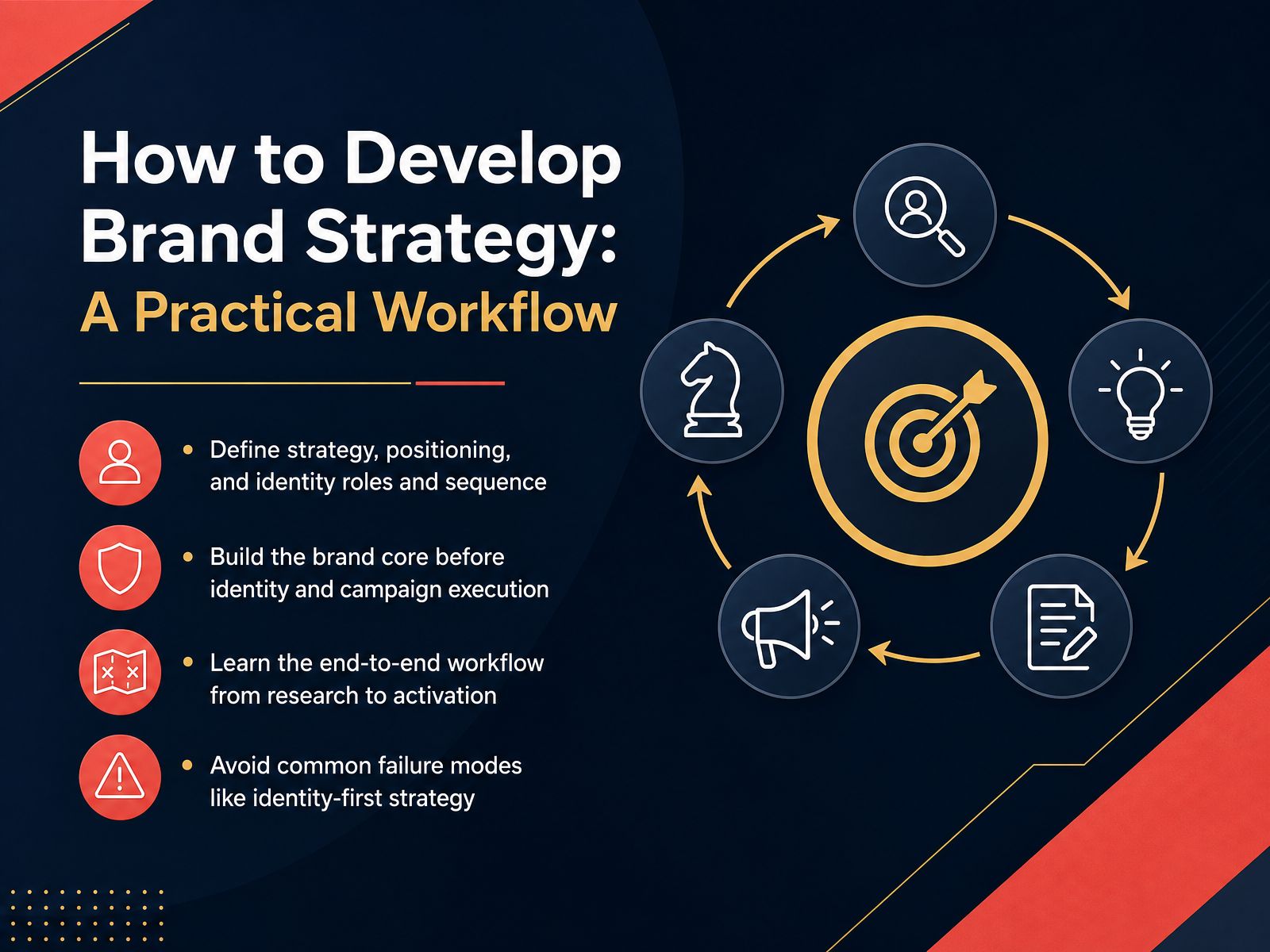
- 01How to Develop Brand Strategy: A Practical WorkflowWelcome. This course is about making brand strategy a practical discipline, not a creative exercise. We will define the roles of strategy, positioning, and identity, and the order in which they should be built. We will establish the brand core before committing to any identity or campaign work. We will walk through a workflow that takes you from research all the way to activation. And we will call out the failure modes that waste the most budget, especially starting with identity instead of strategy. Here is the principle behind everything that follows: strategy sets direction, positioning claims the competitive space, and identity expresses both. When you skip ahead to identity, you get aesthetic clarity and strategic confusion. A new logo on an undefined position is a paint job on a cracked foundation. In the next slide, we will get clear on what brand strategy actually is, and what it is not.chapterdesign.studioatla.designeverything.design+22 min
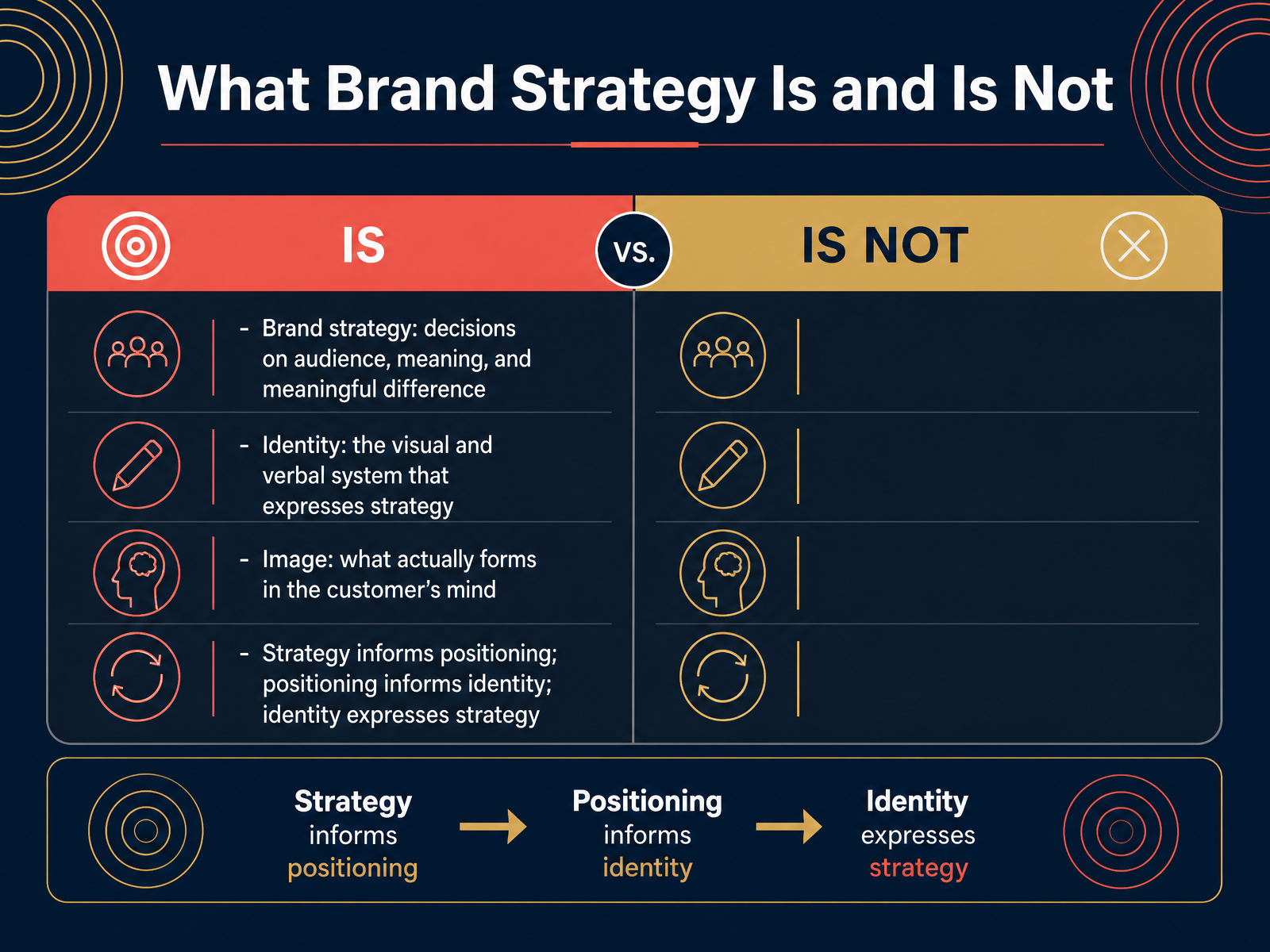
- 02What Brand Strategy Is and Is NotBefore we map out the workflow, let's get clear on definitions, because these terms get thrown around interchangeably, and that confusion costs real money. Brand strategy is the decision layer. It's where you choose your audience, the meaning you want to hold in their minds, and the meaningful difference you'll own. Identity is the expression layer, the visual and verbal system that carries those decisions outward. Image is the perception layer, what actually forms in the customer's mind after they experience you. Here's the sequence that matters. Strategy informs positioning. Positioning informs identity. Identity expresses strategy. When teams skip that order and start with design, they usually end up with what I call aesthetic clarity and strategic confusion. It looks polished but still feels impossible to explain. So keep those three layers separate, because each one gets fixed differently when something breaks. With that frame in place, let's look at how we start any strategy engagement, by grounding it in business and customer reality.
 chapterdesign.studioatla.designeverything.design+21 min
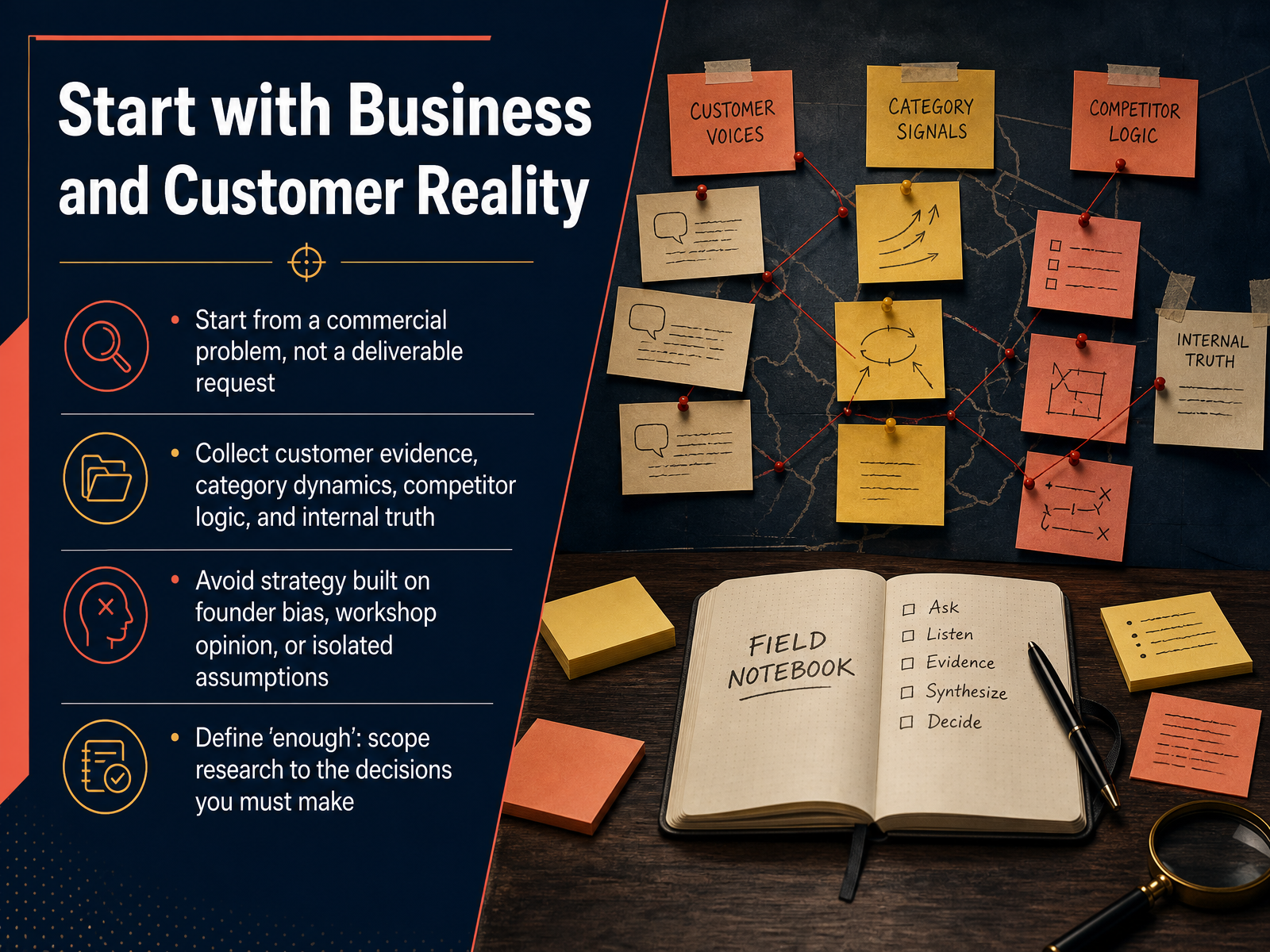
 - 03Start with Business and Customer RealityLet's get practical about where strategy actually starts. It starts with a commercial problem, not a deliverable request. If you don't know what business outcome the strategy needs to drive, every finding looks equally relevant and the strategy ends up trying to respond to too many things at once. So before anything else, get specific about the problem. Then gather what I call the four inputs: customer evidence, category dynamics, the logic underneath competitor positioning, and the honest truth about what your own business can credibly deliver. Here's the discipline that separates real strategy from theater. Avoid building on founder bias, workshop opinion, or isolated assumptions. Workshop exercises are useful for alignment, but they are not evidence. And finally, define what enough means. Scope your research to the decisions you must make. Ask yourself two questions before commissioning anything: Is the decision reversible, and does the answer change the spend? If not, don't run the study. Over-researching delays strategy and creates the illusion of certainty. Next, let's look at how to gather customer evidence that actually creates insight.
 rampstack.coprovokeinsights.comthemarketingjuice.com+22 min
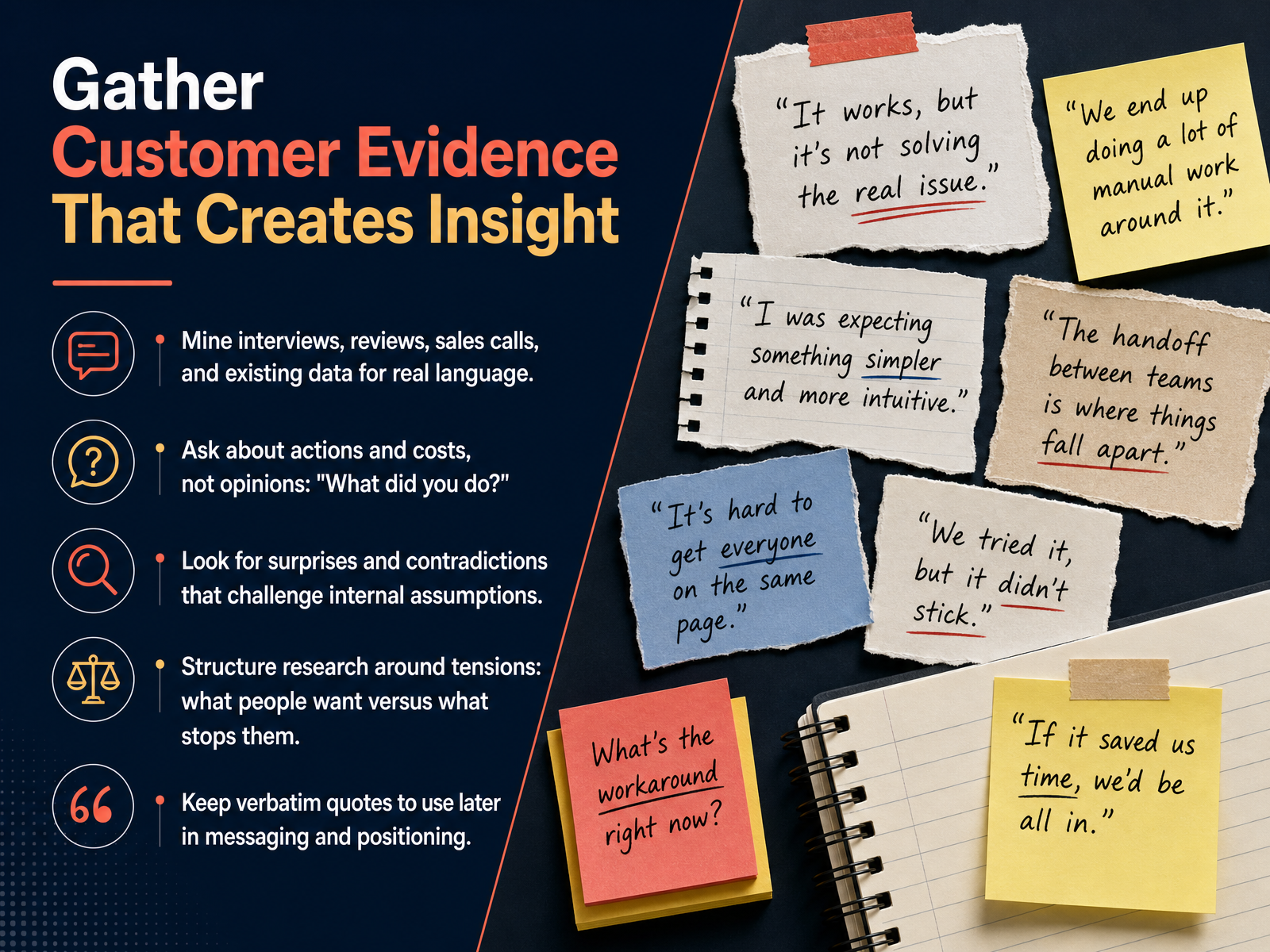
 - 04Gather Customer Evidence That Creates InsightGood research doesn't start with a survey, it starts with evidence you already have but haven't listened to. Pull up sales call recordings, support tickets, reviews, even your own team's notes. What you're mining for here isn't demographic data. It's real language, the exact words customers use to describe the problem, the decision process, and what almost stopped them. When you interview, do not ask what people want. That gets you polite nonsense. Ask what they did and what it cost them. A customer who tells you they spent three weekends building a manual workaround, that's insight. A customer who says they value efficiency, that's noise. The most useful evidence is surprise. If everything you hear confirms what the leadership team already believes, you have not done research. You have done a rehearsal. Look for the contradictions, the moments where behavior does not match the story. Structure your notes around tension, what the customer wanted versus what actually stood in the way. And keep a verbatim quote file. Every phrase you save now becomes raw material for messaging and positioning later. If the language isn't in the customer's own voice, you're writing for yourself. Up next, we take this evidence and use it to Define the Brand Core.
 rampstack.coprovokeinsights.comthemarketingjuice.com+22 min
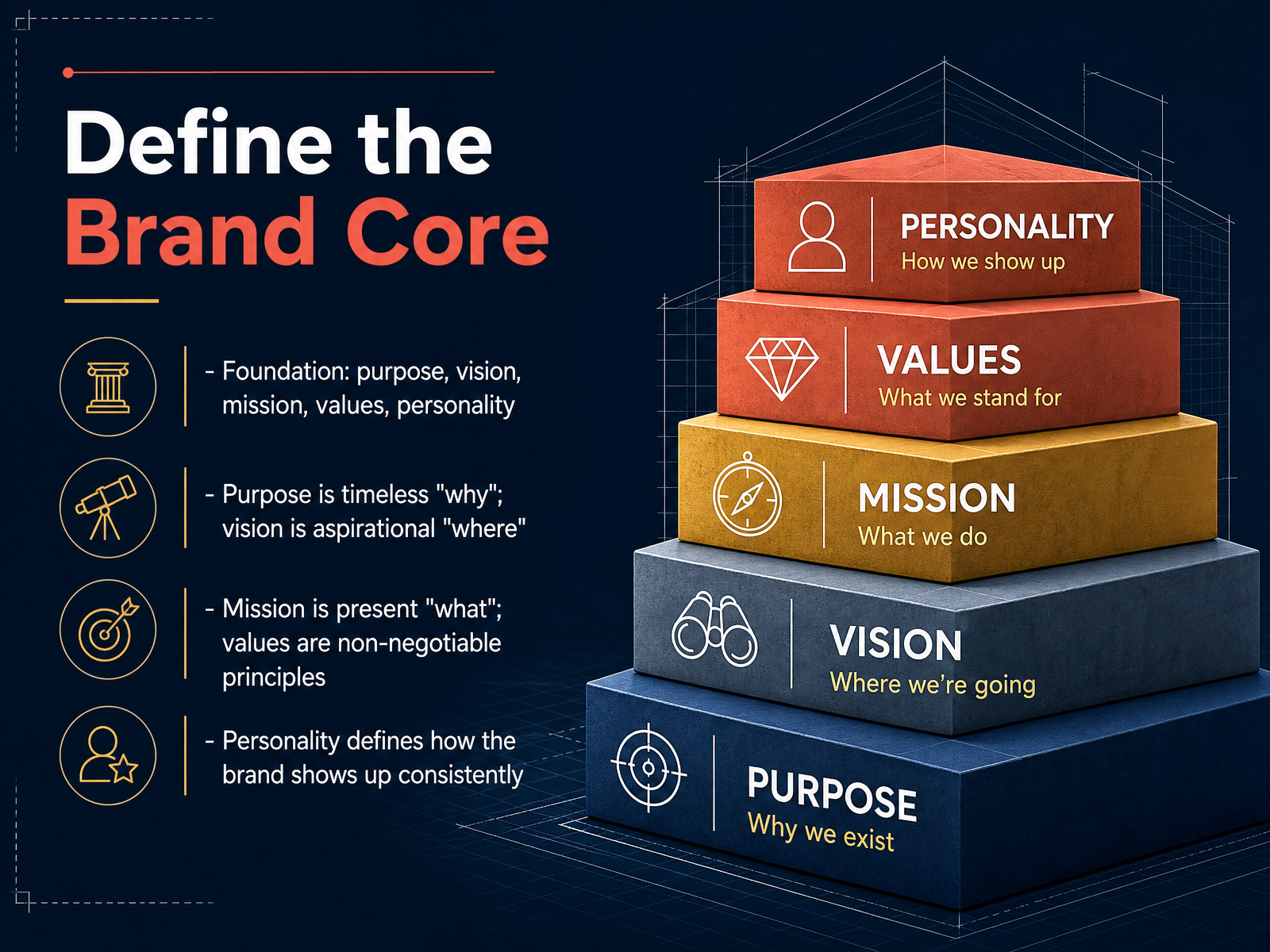
 - 05Define the Brand CoreNow we get to the part that separates a real strategy from a list of nice words: the brand core. You have five components to lock down here. Purpose, vision, mission, values, and personality. Each one answers a different question, and if they blur together, you will feel it later in every campaign and every hiring decision. Purpose is your timeless why. It is the reason the business exists beyond this quarter's revenue. Patagonia says they are in business to save our home planet. That is purpose. Vision is aspirational. It is where you are heading, the future state you are building toward. Mission is present tense. It is what you do today and for whom. Values are non-negotiable. They are the principles you hold even when they cost you something. And personality is how the brand shows up consistently across touchpoints. My advice: do not let a committee wordsmith these into sounding impressive. Test them. If a value does not change a real decision, it is decoration. Next, we will use this core to identify audience segments and decision drivers.
 magnt.comhp.commapandfire.com+21 min
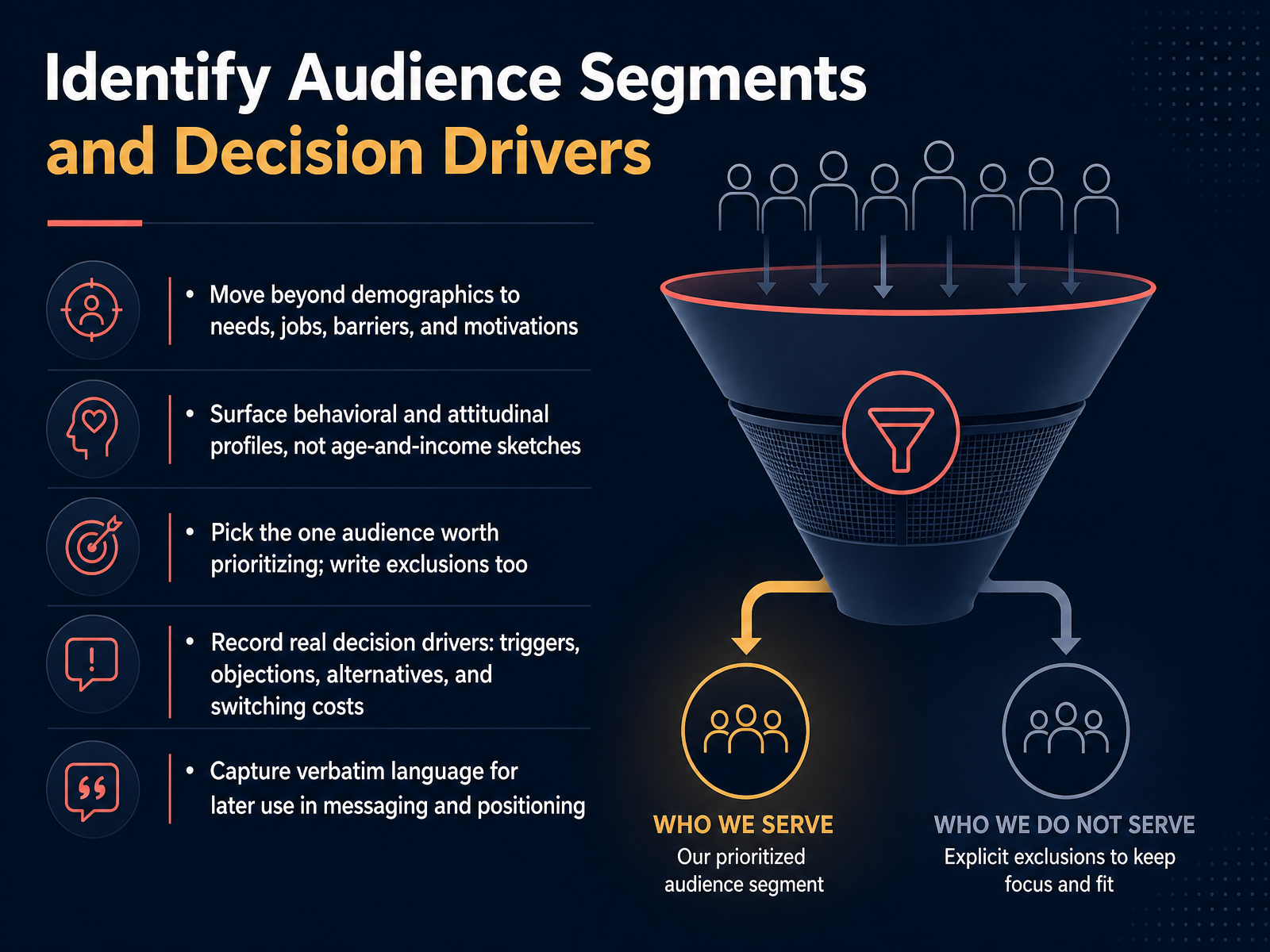
 - 06Identify Audience Segments and Decision DriversNow let's get specific about who we're actually serving. This is where strategy gets uncomfortable, because it's about making choices. Don't build profiles around age and income. Instead, map out what people are trying to accomplish, what's blocking them, and what motivates them to change. You want behavioral profiles, not demographic sketches. And here's the hard part: pick the one audience worth prioritizing right now. Write down who you are excluding just as clearly as who you are including. If your strategy can't tell you which customer to walk away from, it isn't a strategy yet.
Next, document their actual decision drivers. What triggers them to finally start looking? What objections nearly stop them from buying? What alternatives are they comparing you against, including doing nothing? And what are the switching costs? Finally, capture their verbatim language. The exact words they use to describe their problem are the words you'll want to use later in your messaging and positioning.
Once you understand the decision drivers of your priority audience, you're ready to analyze the competitive landscape.
 rampstack.coprovokeinsights.comthemarketingjuice.com+22 min
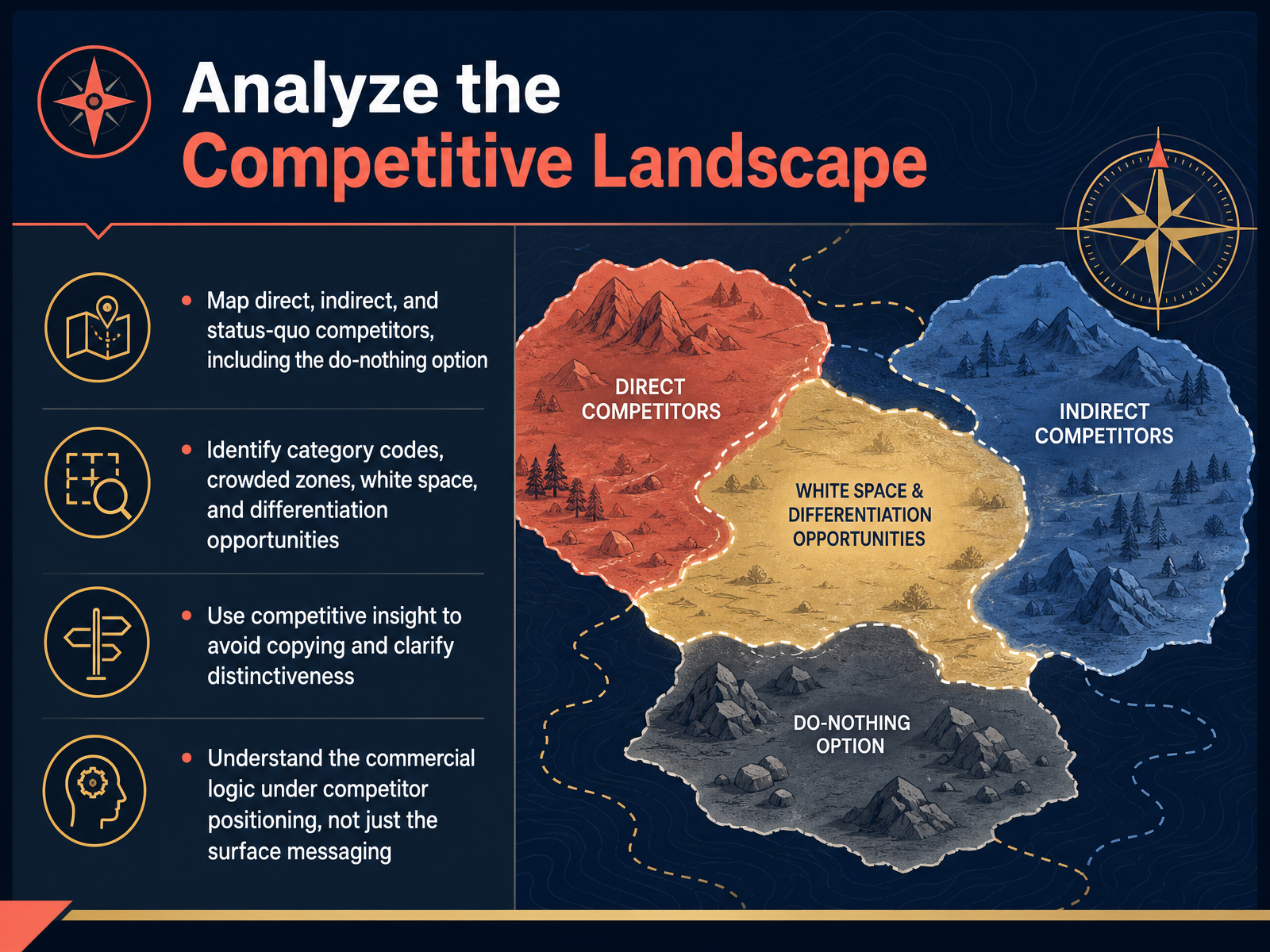
 - 07Analyze the Competitive LandscapeNow we move from internal alignment to the outside world. This step is about building a competitive landscape that actually informs decisions. Start by widening the lens. Map your direct competitors, the indirect ones solving the same problem differently, and the status quo. The do nothing option, or the spreadsheet and manual workaround, is often your biggest rival. Then look for patterns. Where are the category codes everyone repeats? Where are the crowded zones where brands cluster and margins compress? And where is the white space? But treat empty space with caution. It might be open because there is real unmet demand, or because nobody actually wants to buy there. Go beyond surface messaging. A competitor saying innovation is not the same as having a position they can defend. Understand the commercial logic behind their claim. That is what reveals where they are vulnerable. The goal here is not a bigger competitor list. It is insight that stops you from copying the market and forces you to clarify your own distinctiveness. With that landscape in place, we can use positioning maps to make your space concrete.
 themarketingjuice.comresources.rework.comoscom.ai+21 min
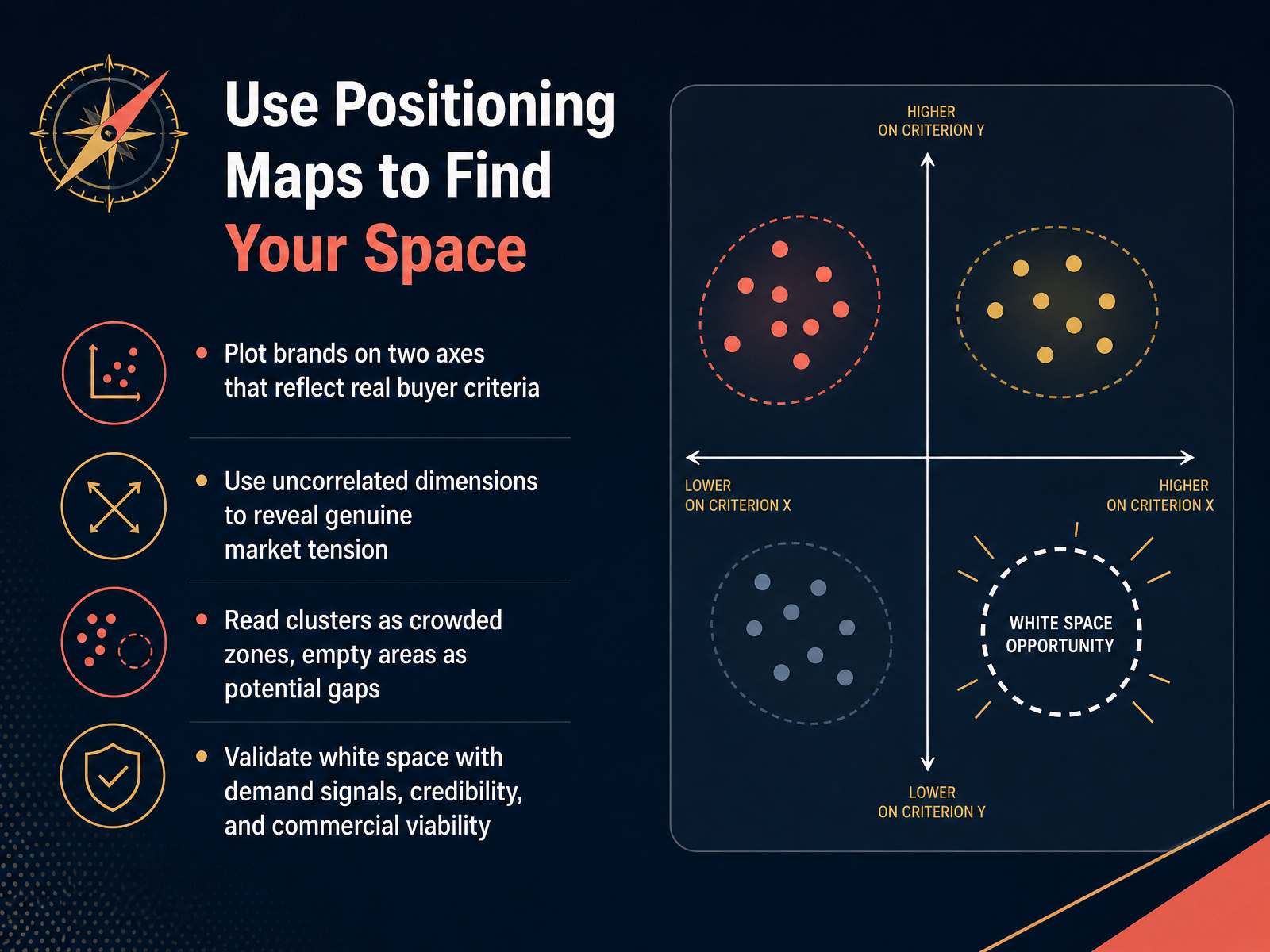
 - 08Use Positioning Maps to Find Your SpaceNow we turn to positioning maps, the visual tool that makes your competitive landscape concrete. The goal is to find a space you can actually defend. Start by plotting the brands a buyer genuinely considers in your category, but choose your two axes carefully. The axes must reflect real purchase criteria, and they must be uncorrelated. That means they should reveal genuine market tension. Price versus quality is the classic, but it is often a trap because the two are correlated and brands just line up on a diagonal. Better pairs might be ease of use versus depth of features, or speed of implementation versus customization. Once you plot the brands, read the map. A cluster of dots means a crowded zone where buyers see little difference, and competing there usually means a fight on price or execution. Empty areas are potential white space, but treat them as hypotheses, not answers. Ask whether that space is empty because no one has tried it, because competitors tried and failed, or because it is operationally impossible for you to deliver. Validate any attractive gap against demand signals, your credibility to occupy it, and the commercial case for building there. A useful map should also make you slightly uncomfortable. If your brand sits neatly in the best quadrant with no rivals, you have probably built a fantasy, not a discovery. Use this map to anchor the next decision. That brings us to crafting a positioning statement.
 themarketingjuice.comresources.rework.comoscom.ai+22 min
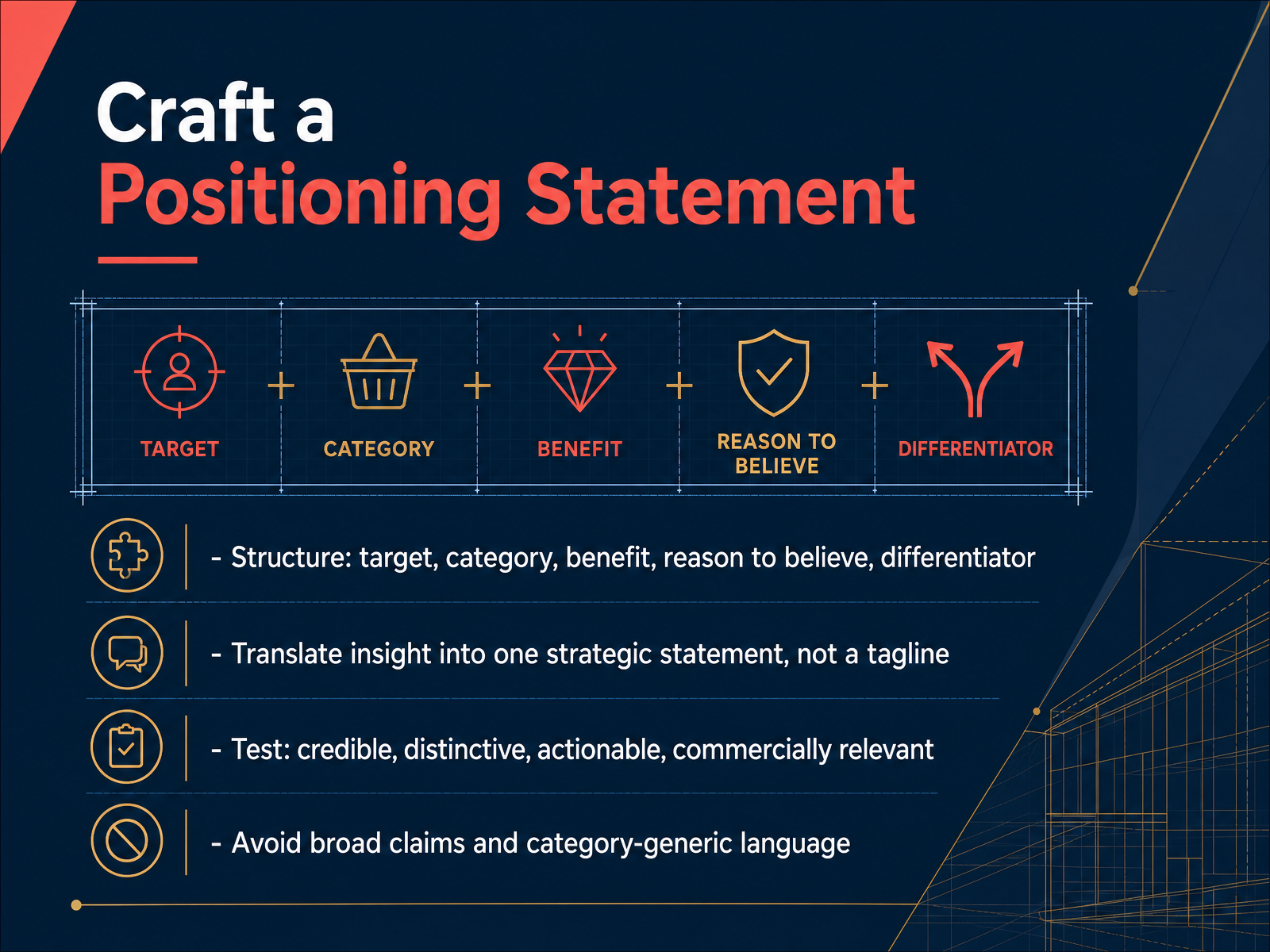
 - 09Craft a Positioning StatementNow, let’s turn that insight into a positioning statement. This is not a tagline. It’s the internal strategic spine that guides decisions on product, pricing, and messaging. Use a simple structure: target, category, key benefit, reason to believe, and a differentiator. The differentiator is where most teams go soft. It must be something a competitor cannot credibly claim back. Test it against four filters. Is it credible given your actual operations? Is it distinctive, or could a rival paste their name on it? Is it actionable enough to guide this week’s decisions? And is it commercially relevant, meaning it drives a choice a buyer already wants to make? Finally, avoid broad claims like delivering excellence or building trust, because category-generic language undoes all the work your earlier research did. Once this statement is solid, we can move into the next step: developing message architecture and brand voice.
 themarketingjuice.comresources.rework.comoscom.ai+21 min
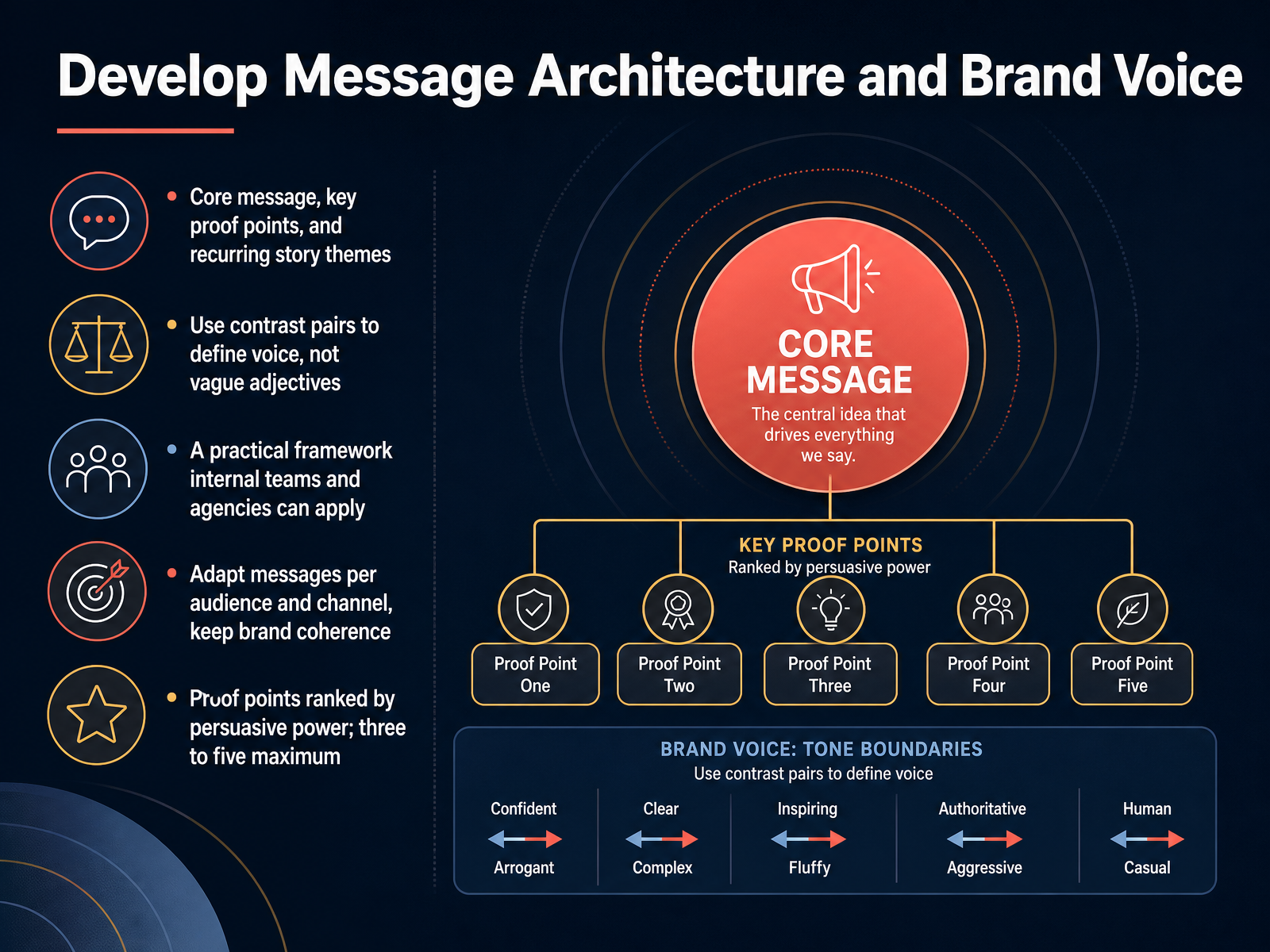
 - 10Develop Message Architecture and Brand VoiceNow we turn strategy into something creatives can actually use. Message architecture is where positioning becomes language. Start with one core message. Not three. One idea you want a buyer to remember after a single exposure. Then back it with proof points, but rank them. Lead with your most concrete fact, end with the most emotional one. Three to five maximum. More than that and your team has a feature list, not an argument. For voice, drop the vague adjectives. No one knows what to do with the word innovative. Use contrast pairs instead. Define what you are and what you are not. For example, we are direct but never dismissive. Confident but not slick. Each pair needs one example sentence that fits and one that violates it. That turns a four page tone guide into half a page that keeps fifty writers consistent. Then adapt the message per audience and channel. The core idea stays fixed, but the proof point you lead with and the tone you use shifts. A founder reading a white paper and a procurement lead scanning a landing page are not looking for the same thing. Coherence lives in the architecture, not in repeating the same paragraph everywhere. That operating discipline is what carries strategy into every brief your team writes next.
 magnt.comhp.commapandfire.com+22 min
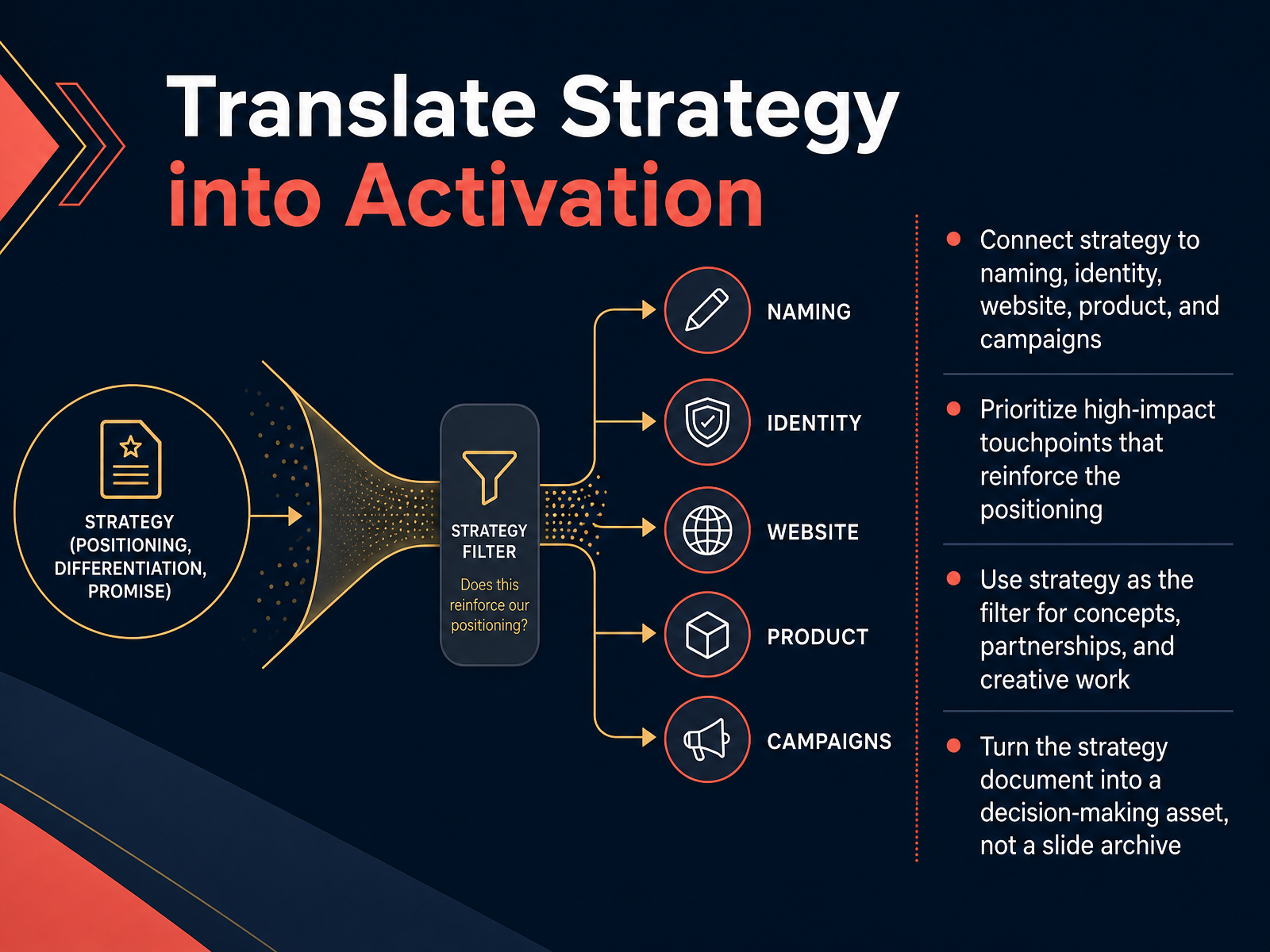
 - 11Translate Strategy into ActivationHere is where strategy either becomes a real market force or stays a document nobody opens. Activation means translating the positioning into every concrete choice, from naming and identity to the website, product experience, and campaign language. You cannot be everywhere at once, so pick the touchpoints that carry the most weight for the decision your buyer is making, and reinforce the positioning there first. Then use the strategy as a filter. Every concept, partnership, or creative idea gets one question before it moves forward: does this sharpen the position, distract from it, or quietly contradict it? If the answer is not a clear yes, that is a no. This also means rescuing the strategy document from the slide archive. It should sit inside every brief, every naming review, and every campaign check. The strategy is only worth what it stops you from doing. Let me take that into the next step and show how to brief creative teams from the strategy.
 magnt.comhp.commapandfire.com+21 min
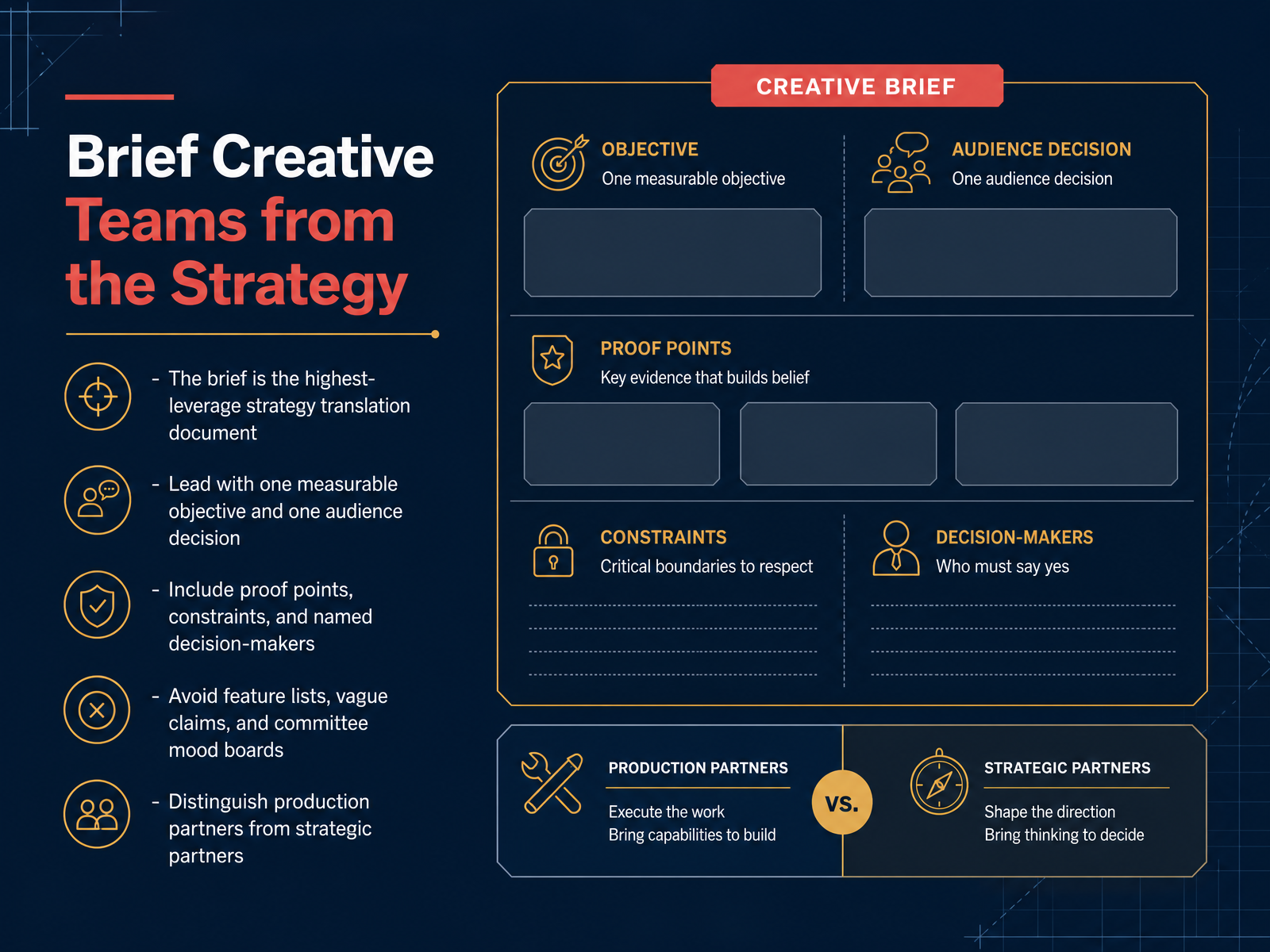
 - 12Brief Creative Teams from the StrategyNow, let's talk about the brief. This is still the highest-leverage document you will produce. It's the moment your business problem gets translated into a creative problem, and that translation is where most campaigns go right, or wrong. First, lead with one measurable objective and one audience decision. If you give a creative team three objectives, you are asking for split work that underperforms on all fronts. Tell them the single action you need the audience to take. Then, back it up. Include proof points, ranked by persuasive power. Name the hard constraints, like budget, legal, or a platform spec. And crucially, name the final decision-maker. Not a committee. One name. Avoid the traps we all know too well: feature lists instead of an argument, vague claims like make it go viral, and mood boards built by committee. Those get ignored. Finally, be honest about who you are hiring. A production partner executes your specs. A strategic partner solves the problem. Your brief should reflect which relationship you are paying for. And that leads us directly into how you actually run this workflow, from planning to facilitation to validation.
 2 min
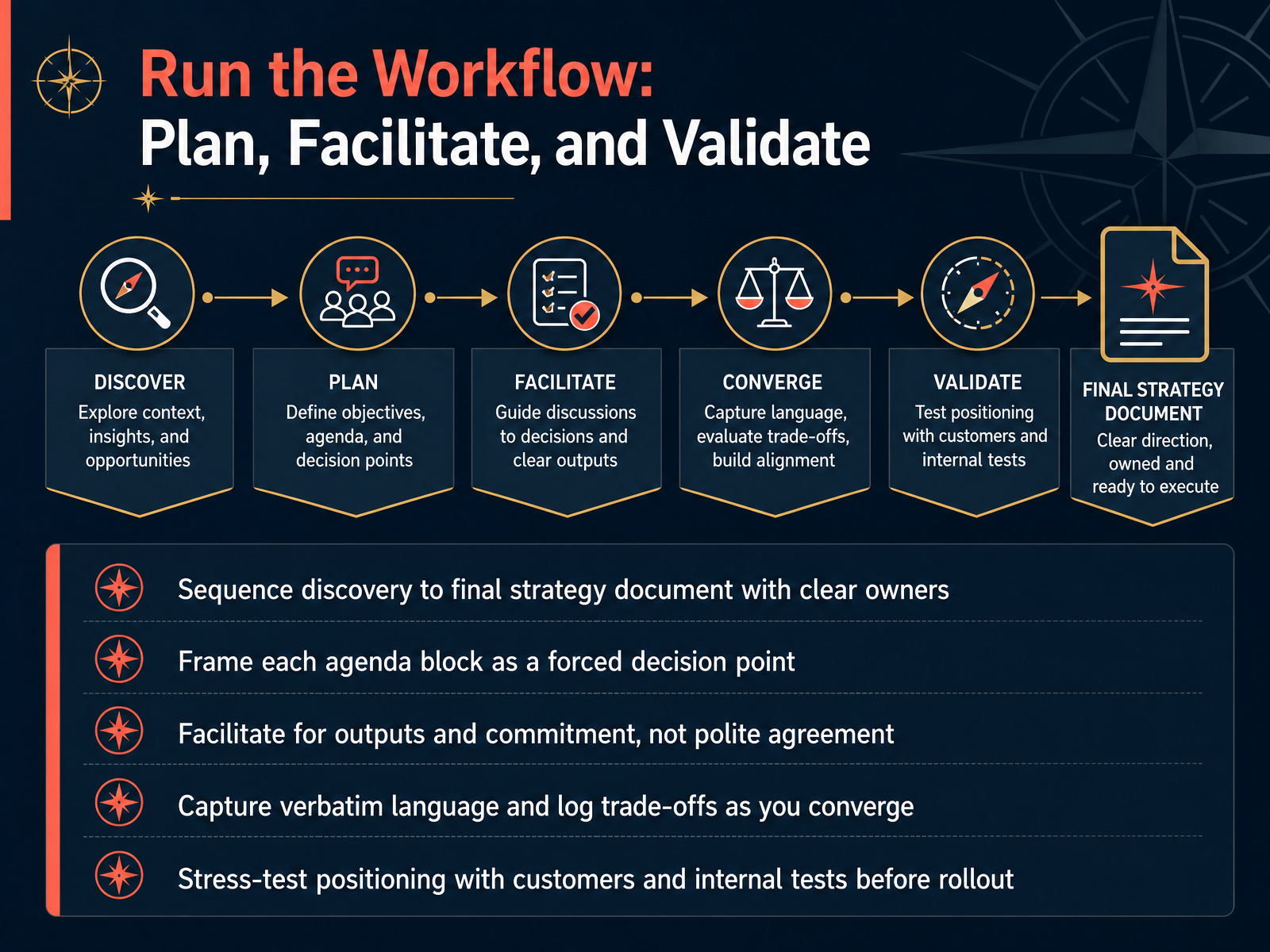
2 min - 13Run the Workflow: Plan, Facilitate, and ValidateSo at this point, you have the inputs. The real work now is running the process itself. Think of this workflow as a sequence of forced decisions, not a chain of casual brainstorming sessions. Each agenda block should be framed so the room has to choose something. For example, instead of saying we will discuss values, you say, we are here to decide which three values we will resource against, and which two we will explicitly set aside. That pressure is what turns conversation into commitment. Assign clear owners for every step from discovery to the final strategy document. Without an owner, a decision is just a preference. Facilitate for outputs, not polite agreement. Polite agreement feels productive but leaves you with nothing you can defend later. Capture the verbatim language people use, especially pushback and hesitations, because those trade offs are where the real strategy lives. And before you roll anything out, stress test the positioning with actual customers and an internal test. Run it past sales, run it past product, run it past someone who will have to execute it. If they cannot use it to settle a real argument, it is not done yet. Next, we will look at how to operationalize the strategy so it actually holds up inside the business.
 rampstack.coprovokeinsights.comthemarketingjuice.com+22 min
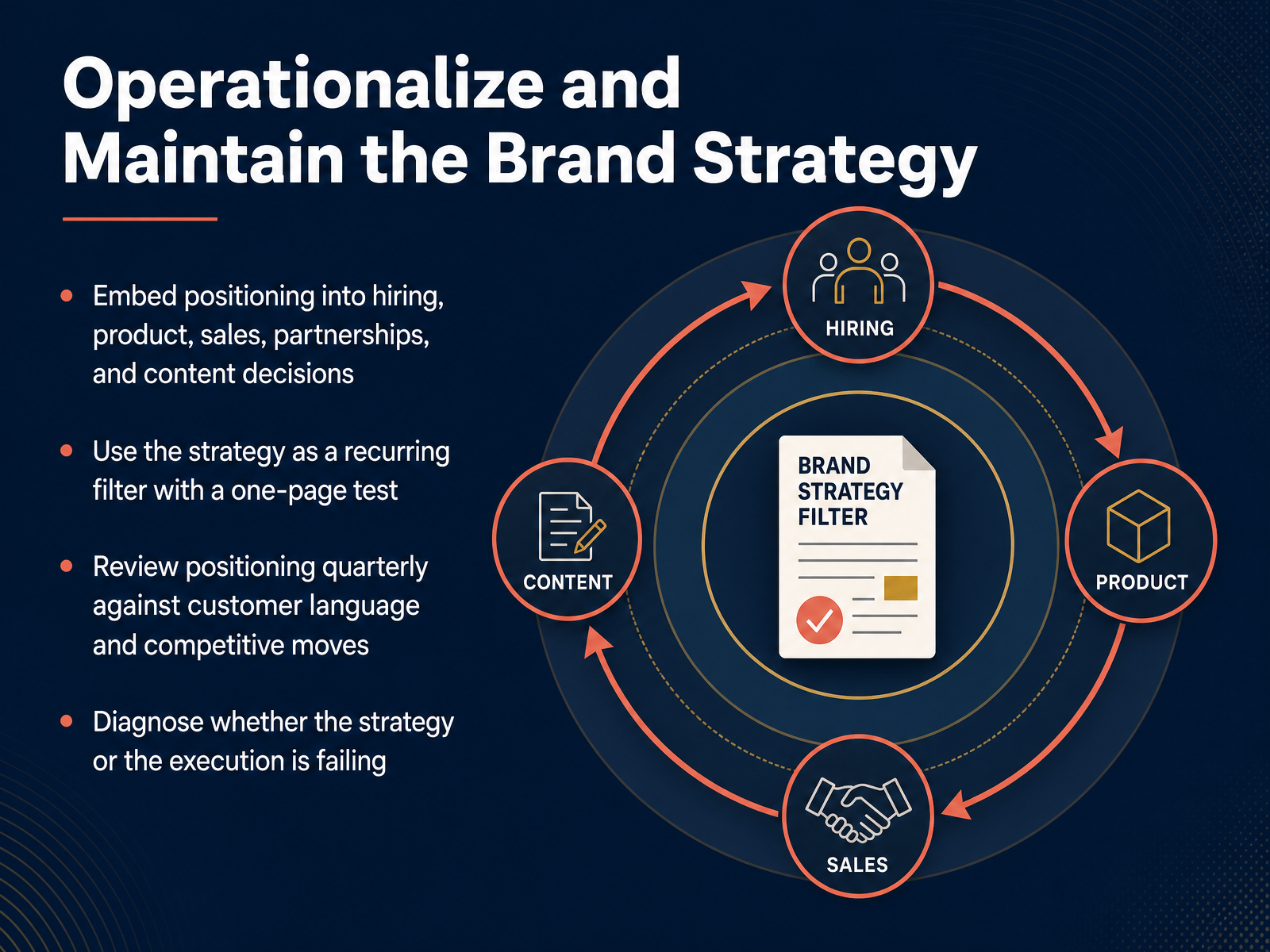
 - 14Operationalize and Maintain the Brand StrategyHere's the part that separates a strategy that endures from one that quietly dies in a deck. Brand positioning isn't a marketing document. It's a decision filter. So embed it where decisions actually happen. Hiring. Product roadmaps. Sales conversations. Partnership choices. Content themes. When someone at your company asks why the brand feels inconsistent, the answer is usually that the strategy lives in marketing's folder, not in the company's operating rhythm. Create a one-page test. Before approving a hire, a feature, a campaign, or a partnership, ask one question. Does this reinforce the position or dilute it? If you need three paragraphs to justify it, it's a no. Then review quarterly. Not to rewrite the strategy on a whim, but to check the market hasn't moved. Listen for shifts in customer language. Watch whether competitors have changed their claims. And when performance lags, diagnose honestly. Is the strategy wrong, or is the execution weak? Those are two different problems with two different fixes. If the strategy is sound and execution is failing, fix the brief, the training, or the creative. If the strategy itself no longer matches the market, change it. But don't confuse boredom with broken. A stable position is an asset. Operationalize it, filter decisions through it, and review it with discipline. That's how a brand strategy becomes a competitive advantage instead of a slide. Thanks for working through this. Go make the position real.
 rampstack.coprovokeinsights.comthemarketingjuice.com+22 min
Take the deck with you
Download this course as a file — free, no sign-up needed.
- PDF handoutEvery slide page, ready to print or share.15 pages · 3.9 MBDownload
- Narrated PowerPointThe deck that presents itself — every slide carries the digital human's narration video.15 pages · 14.7 MBDownload
- PowerPoint slidesThe full deck as a .pptx — open it in PowerPoint, Keynote, or Google Slides.15 pages · 3.8 MBDownload
Free to use in your own training — please keep the PersonWise credit page at the end.
Have your own deck? Turn it into a course
Sources consulted
Web sources consulted while building this course.
- Brand Positioning Strategy for Growing Businesses — chapterdesign.studio
- Brand Strategy vs Brand Identity (2026): The Difference — atla.design
- Brand Strategy vs Identity vs Rebranding: The 2026 Guide — everything.design
- What Is Brand Strategy? A Definitive Guide for Modern Leaders - Vivaldi Group — vivaldigroup.com
- Brand Strategy vs Brand Identity Explained - Muse & Motif — museandmotif.com
- Brand Discovery: Before the Brief | RampStack — rampstack.co
- Research Before Building a Brand Strategy — provokeinsights.com
- Brand Research and Strategy: What Separates Them — themarketingjuice.com
- Brand Market Research: What You're Measuring and Missing — themarketingjuice.com
- How to Build a Brand Strategy (Step by Step) | ThisCom — thiscom.com
- Brand Foundation: 5 Pillars, Framework & Template - Magnt — magnt.com
- HP Brand Framework | HP® Official Site — hp.com
- Brand Core Purpose, Vision, Mission, Values Examples & ... — mapandfire.com
- Brand Key: The 8-Part Model, Template & Examples | Selfstorming — selfstorming.com
- How to Build a Brand That Unifies Mission, Vision, Values, and UVP | StrataVera Learn Platform — learn.strataveraconsulting.com
- Competitive Positioning Map: Build One That Works — themarketingjuice.com
- "Perceptual Mapping: How to Position Your Brand (With Examples)" — resources.rework.com
- How to Build a Competitive Positioning Map That Reveals Market Gaps — oscom.ai
- How to Build a Strategic Brand Positioning Map | The Miller Group | Advertising Agency Los Angeles CA — millergroup.com
- Brand Positioning Map: What It Is & How to Build One (With Examples) — theglobalbrandacademy.com