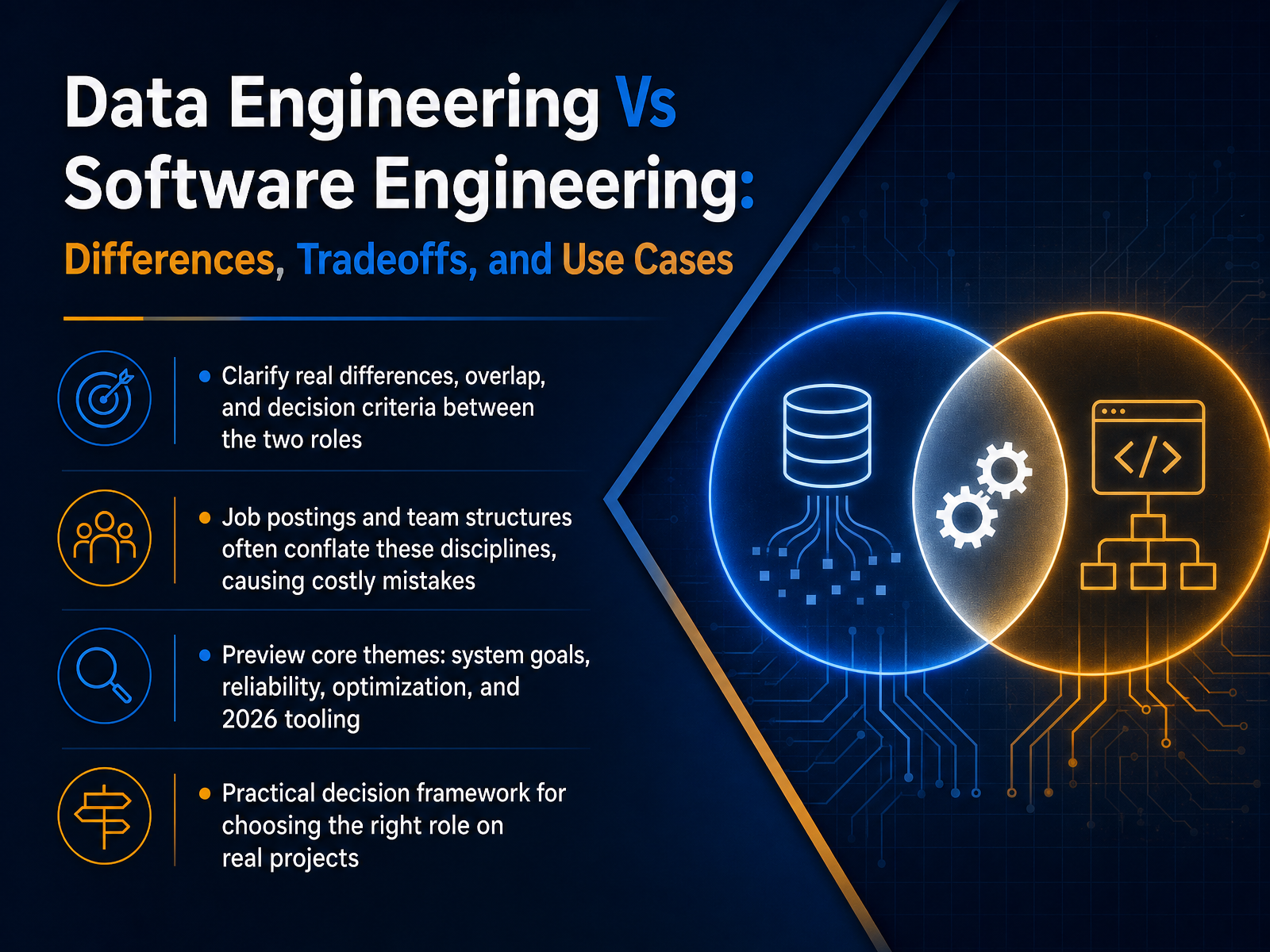
Data Engineering vs Software Engineering
Begin
14 pages · ~28 min
Data Engineering vs Software Engineering
This training explains the key differences, tradeoffs, and use cases of data engineering versus software engineering, helping learners identify which discipline fits their project needs and career goals.
What you’ll learn
- 01Data Engineering Vs Software Engineering: Differences, Tradeoffs, and Use CasesWelcome. In this course, we are going to tackle a distinction that causes real friction in hiring decisions, team design, and even system architecture: the difference between data engineering and software engineering. Job postings often blur these two roles together, and that conflation leads to costly mistakes. Someone gets hired to build pipelines but is evaluated on application uptime. Or a team is staffed like a software product team when the real bottleneck is messy, unowned source data. Over the next several minutes, I want to give you a practical framework for separating these disciplines, not just by job title, but by what each role actually builds, owns, and optimizes. We will look at system goals, reliability expectations, and how the tooling landscape is shifting in 2026. The goal is not to pick a winner. The goal is to help you make better decisions on real projects. Let's start by looking at why these two roles are so often confused.educatingengineers.comintuit.comcoursera.org+21 min
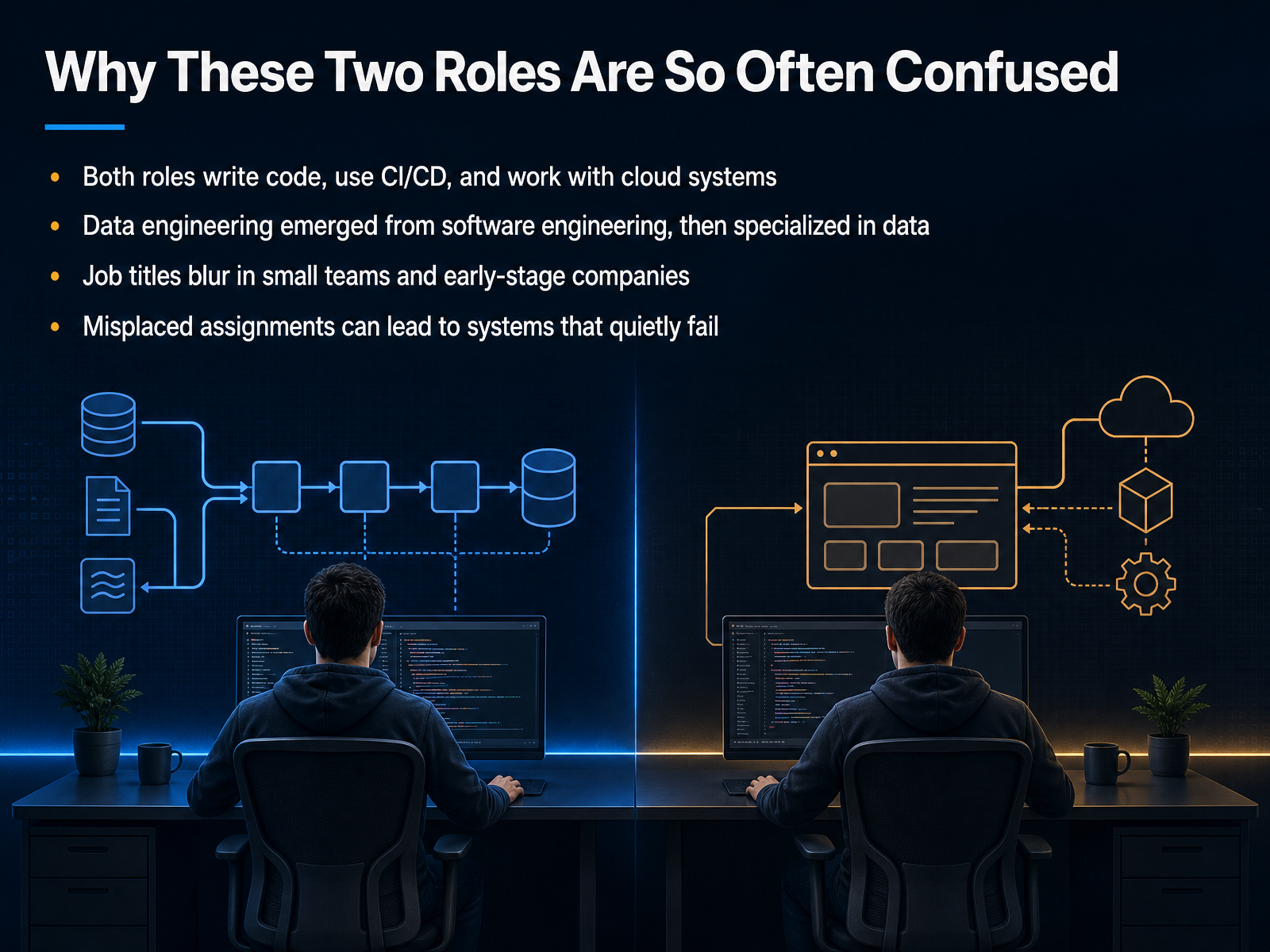
- 02Why These Two Roles Are So Often ConfusedSo why do these two roles get confused so often? A big part of it is practical. Both roles write code, both ship through CI/CD pipelines, and both build on cloud infrastructure. If you looked at two engineers side by side on any given day, the tools would look nearly identical. There is also a historical reason. Data engineering grew out of software engineering, then gradually specialized around a different set of problems. Many data engineers were software engineers first, and that shared origin still shows up in how teams are organized. In small teams, especially early-stage companies, titles blur even more. The same person may ship product features in the morning and fix a broken ingestion job in the afternoon. That flexibility is fine, as long as the actual ownership is clear. The real risk shows up when an assignment gets misplaced quietly. A strong application engineer can build a data pipeline that runs, but fails silently on bad records, drifts from source schemas, or gives the business numbers that are close but wrong. That is the kind of failure these two roles need to be separated to prevent. Most of the confusion does not come from lack of skill. It comes from the fact that the work looks similar on the surface, while the operational contract is different underneath. That is exactly where the next slide picks up: the shared foundations, and the conceptual fork between them.
 educatingengineers.comintuit.comcoursera.org+21 min
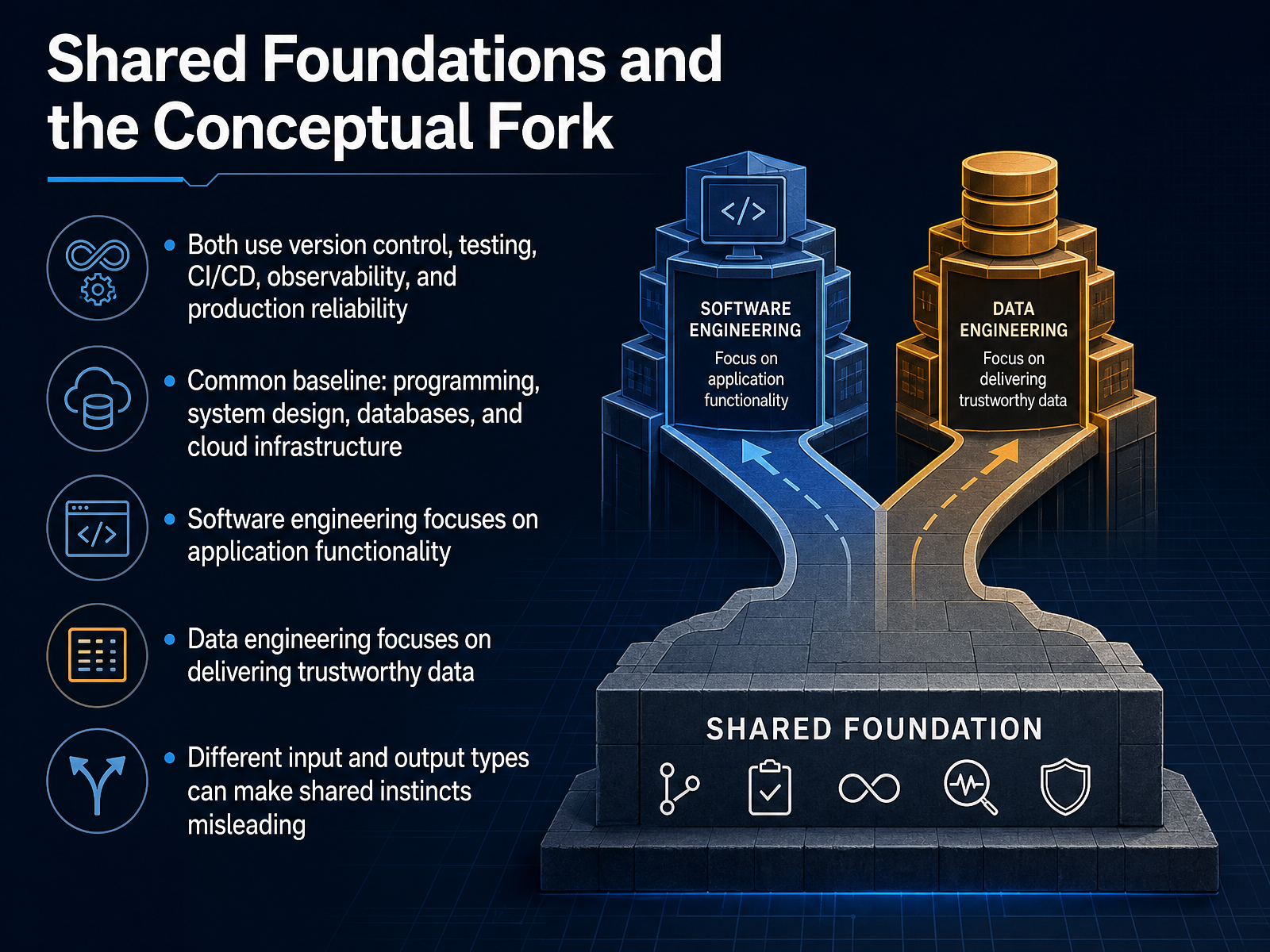
 - 03Shared Foundations and the Conceptual ForkBefore the two roles diverge, they share a substantial foundation. Both disciplines rely on version control, automated testing, CI/CD pipelines, observability, and production reliability. If you come from either background, you already think in terms of repeatable builds and measurable system health. The conceptual fork happens in what each role ultimately optimizes. Software engineering focuses on application functionality. The deliverable is a product or service that behaves correctly for its users. Data engineering focuses on delivering trustworthy data. The deliverable is information that downstream systems can rely on. This distinction is subtle because the tools look similar. Both write code. Both design systems. Both work with databases and cloud infrastructure. But the input and output types are different. A software engineer often controls the data model inside an application. A data engineer inherits data from systems they do not own, which changes the kind of problems they solve. That is why shared instincts can sometimes be misleading. Next, we will look at the core objectives more directly.
 educatingengineers.comintuit.comcoursera.org+22 min
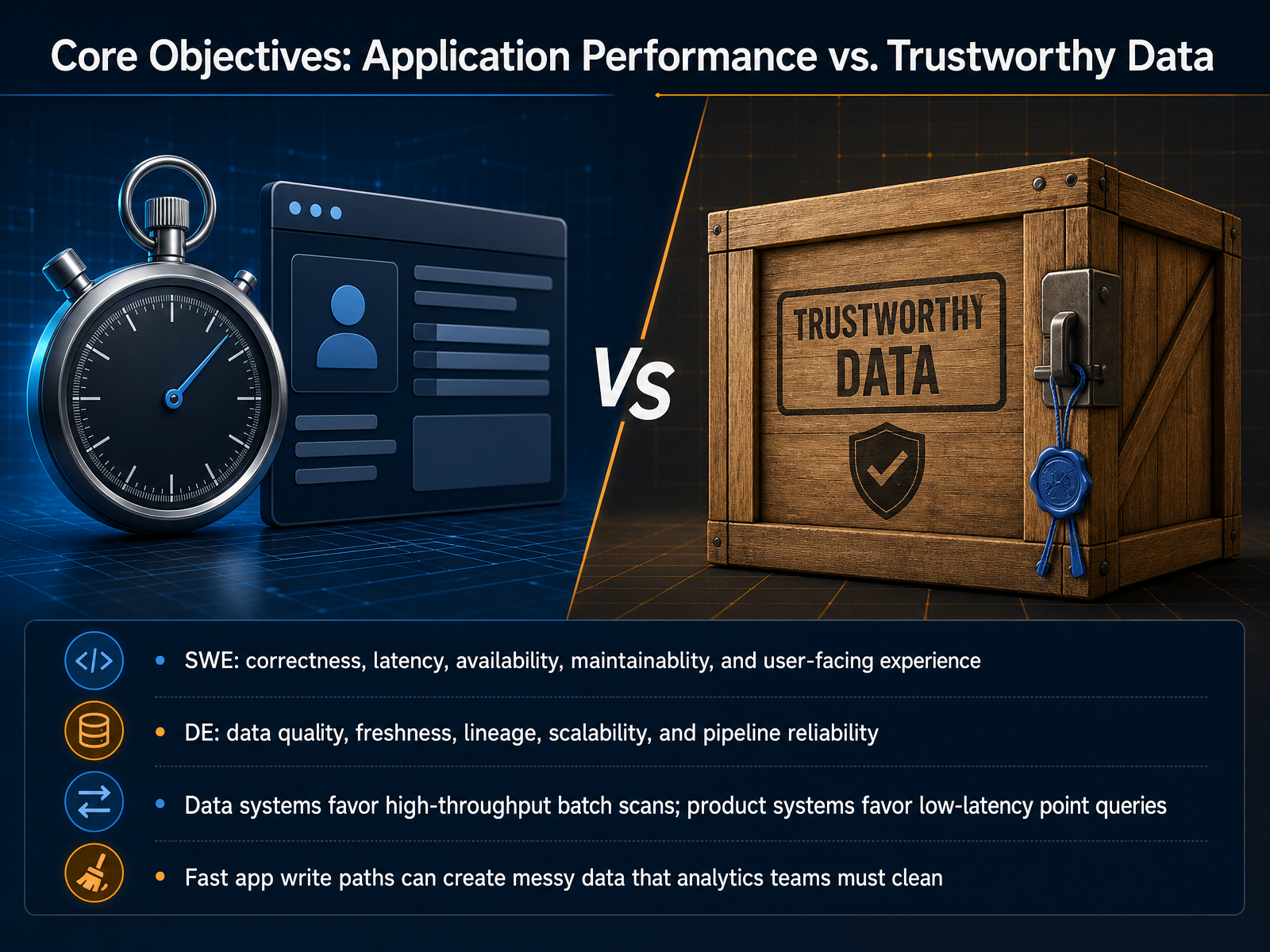
 - 04Core Objectives: Application Performance vs. Trustworthy DataNow let's get to the heart of the difference: what each role is actually optimizing for. For a software engineer, success usually means an application that is correct, fast, and available. Latency matters, as does maintainability. You're focused on the experience of a single user completing a task right now. A data engineer, on the other hand, is trusted with a different outcome. The priorities are data quality, freshness, and lineage. Can an analyst trust this number? Can they trace where it came from? That changes the technical choices. Data systems often favor high-throughput batch scans over large datasets, while product systems favor low-latency point queries for individual records. This is why the write paths differ. A fast application write path might accept a slightly messy record to keep the user moving, but that messy record often becomes a cleanup problem for analytics later. These are both valid engineering decisions, just aimed at different objectives. Next, let's look at deliverables and how success is measured.
 educatingengineers.comintuit.comcoursera.org+21 min
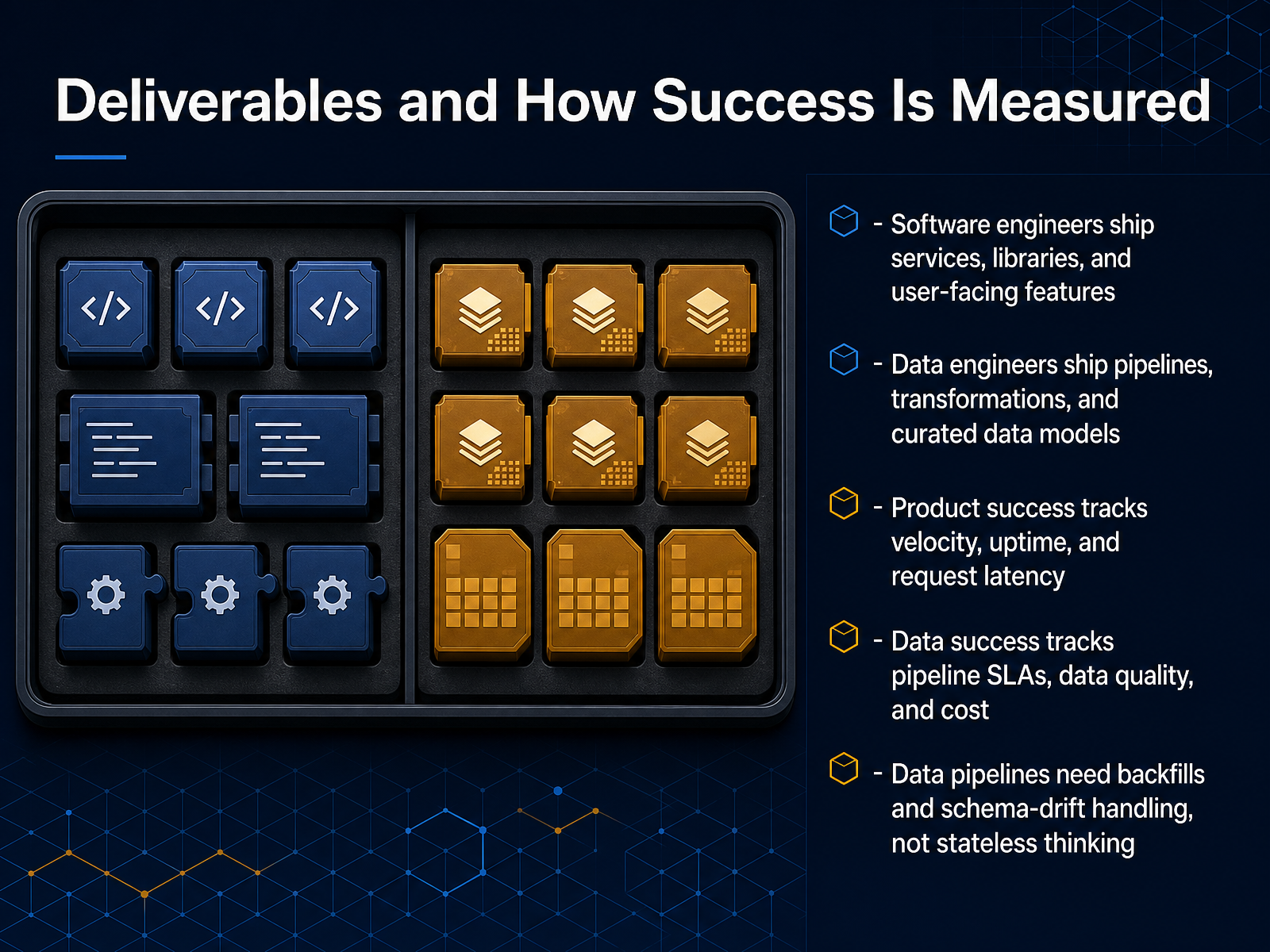
 - 05Deliverables and How Success Is MeasuredNow let's look at deliverables, and how each discipline measures success. Software engineers ship things with product-facing shape. Think services, libraries, endpoints, or features a user can click. Their success metrics tend to follow the product itself. You track velocity, uptime, and request latency. In other words, is the system fast, available, and delivering value on a predictable cadence? Data engineers ship a different kind of artifact. Our deliverables are pipelines, transformations, and curated data models. The things we build are often invisible to end users, but they are load-bearing for every downstream decision. So success is measured differently. We care about pipeline SLAs, data quality thresholds, and cost. A pipeline that runs on time but produces wrong numbers is a failed pipeline. A model that is perfectly accurate but costs ten times more than it should is also a problem. There is one more practical difference worth internalizing. Software services are often designed around stateless thinking. You handle a request, return a response, and move on. Data pipelines live in a stateful world. Source systems change their schema without warning. Historical data needs to be reprocessed. Backfills, schema-drift handling, and idempotency are not edge cases. They are part of the normal operating model. Keep that in mind as we turn to the key technical differences in daily work.
 intuit.comfwctecnologia.commedium.com+22 min
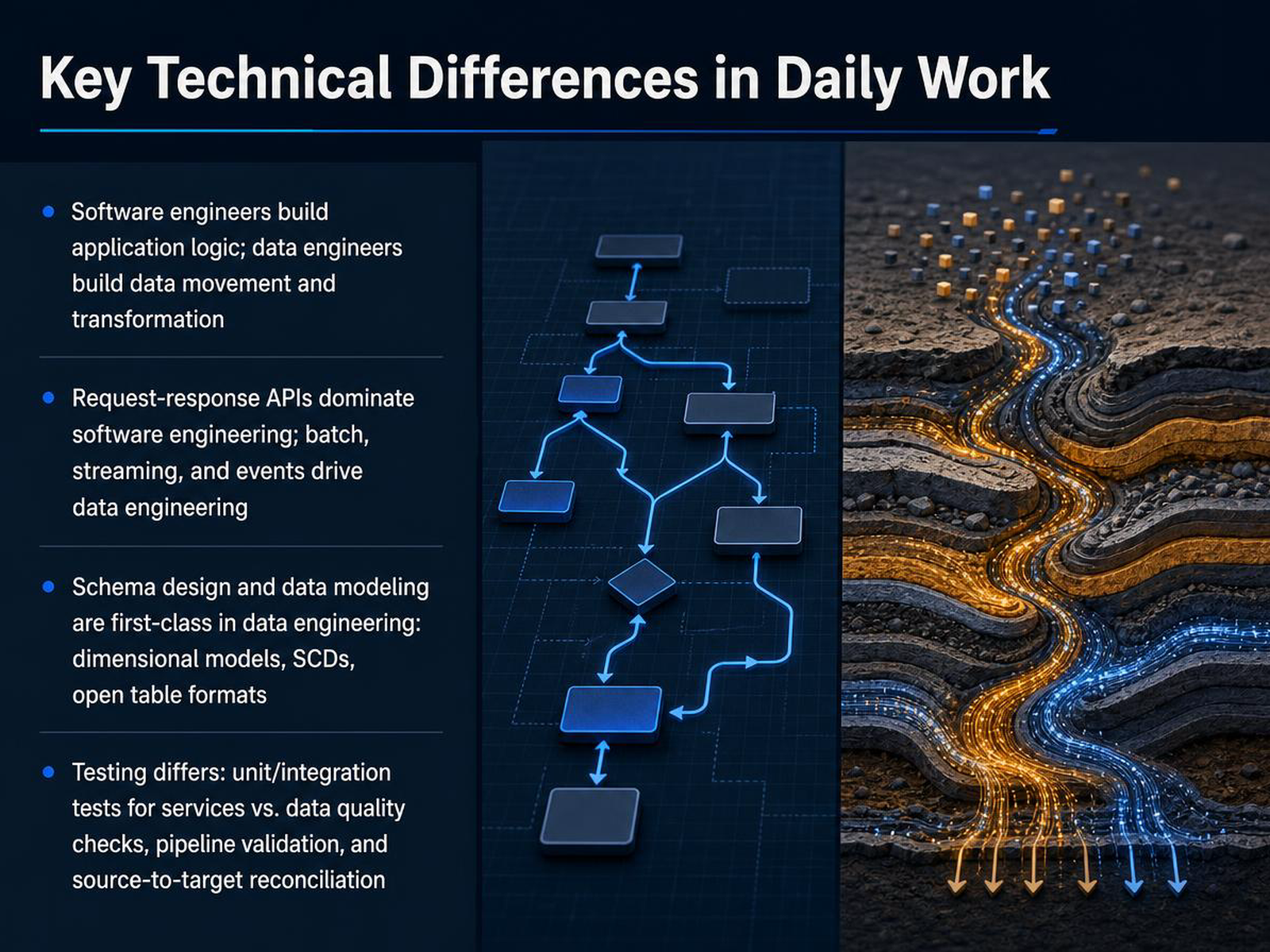
 - 06Key Technical Differences in Daily WorkLet's move from the high-level comparison into what actually differs in daily work. Software engineers spend most of their time building application logic and request-response APIs. Data engineers, by contrast, are concerned with data movement and transformation, which usually means working with batch jobs, streaming pipelines, or event-driven systems rather than synchronous calls. This leads to different design priorities. Schema design and data modeling are first-class concerns in data engineering. You are regularly making decisions about dimensional models, slowly changing dimensions, and open table formats, because those choices directly affect how downstream teams can query and trust the data. Testing also looks different. A software engineer thinks in terms of unit tests and integration tests for a service. A data engineer thinks about data quality checks, pipeline validation, and source-to-target reconciliation. The failure modes are different too. A service bug might return a bad response, but a pipeline bug can silently corrupt millions of records. With those daily differences in mind, let's look at what tools define the 2026 data engineering landscape.
 makewithdata.techlinkedin.comdev.to+22 min
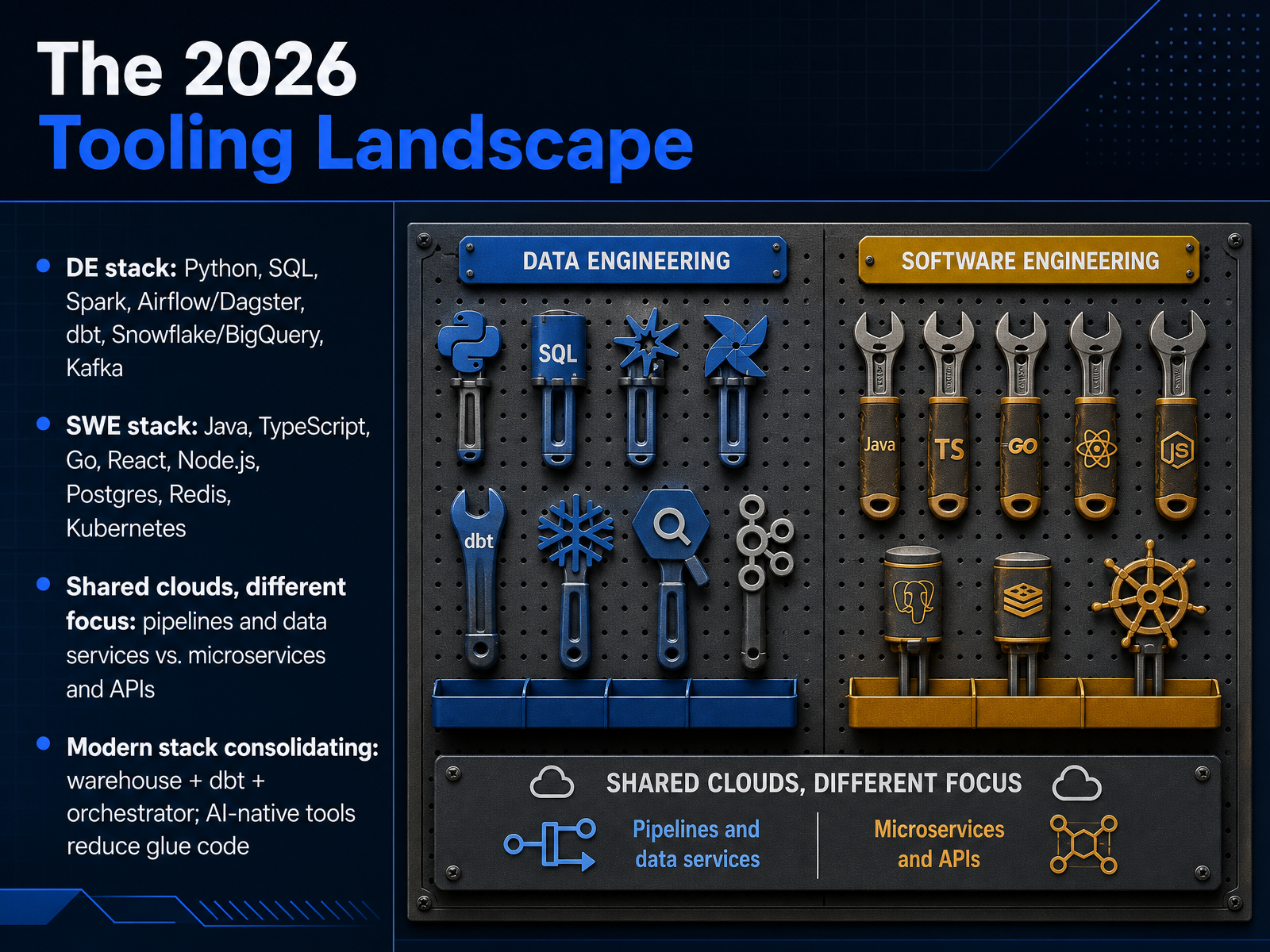
 - 07The 2026 Tooling LandscapeNow let's look at the tooling landscape in 2026, because the daily technology choices reveal a lot about what each role optimizes for. A typical data engineer works primarily in Python and SQL, using tools like Spark for distributed processing, Airflow or Dagster for orchestration, dbt for transformation, and a cloud warehouse like Snowflake or BigQuery. Kafka often sits in the mix for streaming. A software engineer, by contrast, might work in Java, TypeScript, or Go, building services with Node.js, React, Postgres, Redis, and Kubernetes. Both roles live on the same clouds, but they focus on different layers. Data engineers build pipelines and data services. Software engineers build microservices and APIs. We're also seeing a consolidation in the modern stack. The warehouse, dbt, and an orchestrator have become a stable core, and AI-native tools are increasingly reducing the amount of glue code teams have to write. With that landscape in mind, let's turn to the design and operational tradeoffs each path presents.
 makewithdata.techlinkedin.comdev.to+22 min
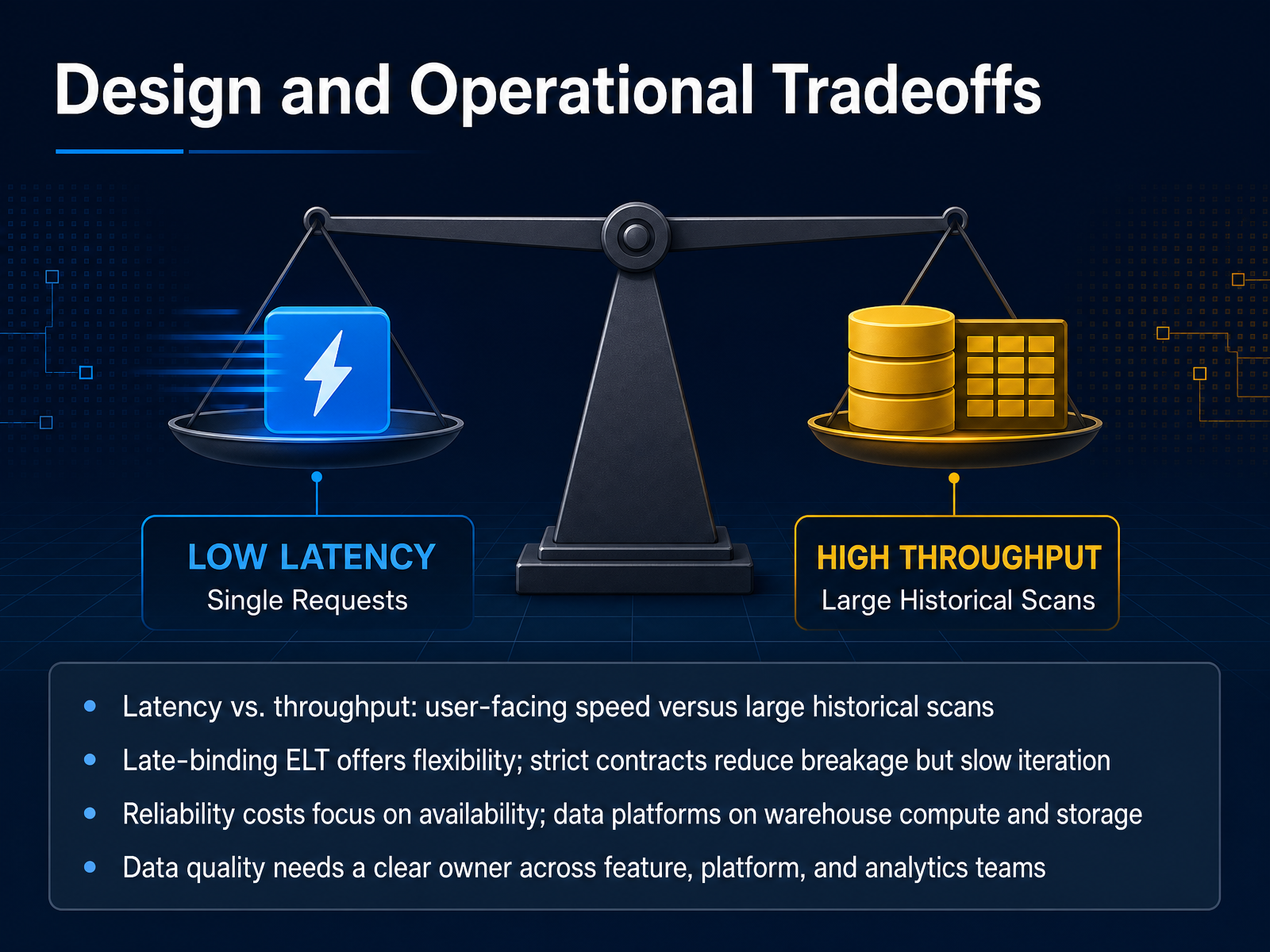
 - 08Design and Operational TradeoffsNow let's look at where the design and operational tradeoffs actually differ between these two disciplines. The first one to internalize is the performance profile. Software engineers typically optimize for latency, the speed of a single user-facing request. Data engineers, on the other hand, usually design for throughput, scanning and aggregating massive historical datasets over long periods. These are fundamentally different optimization targets.
Next, consider ELT versus strict contracts. Late-binding ELT gives data teams flexibility. You load raw data first, then transform it, which preserves information and accelerates iteration. But if you enforce strict schemas and data contracts, you reduce breakage when systems change, at the cost of slowing down how fast you can move.
Then there is reliability focus. Software engineering spends that reliability budget on availability and uptime. Data engineering spends it on warehouse compute, storage, and the integrity of pipelines themselves.
Finally, data quality needs a named owner. If that responsibility sits only between feature, platform, and analytics teams, it belongs to no one. In practice, someone has to explicitly own quality for it to exist at all.
These tradeoffs lead us directly to one of the most common sources of friction, the source-of-truth boundary.
 educatingengineers.comintuit.comcoursera.org+22 min
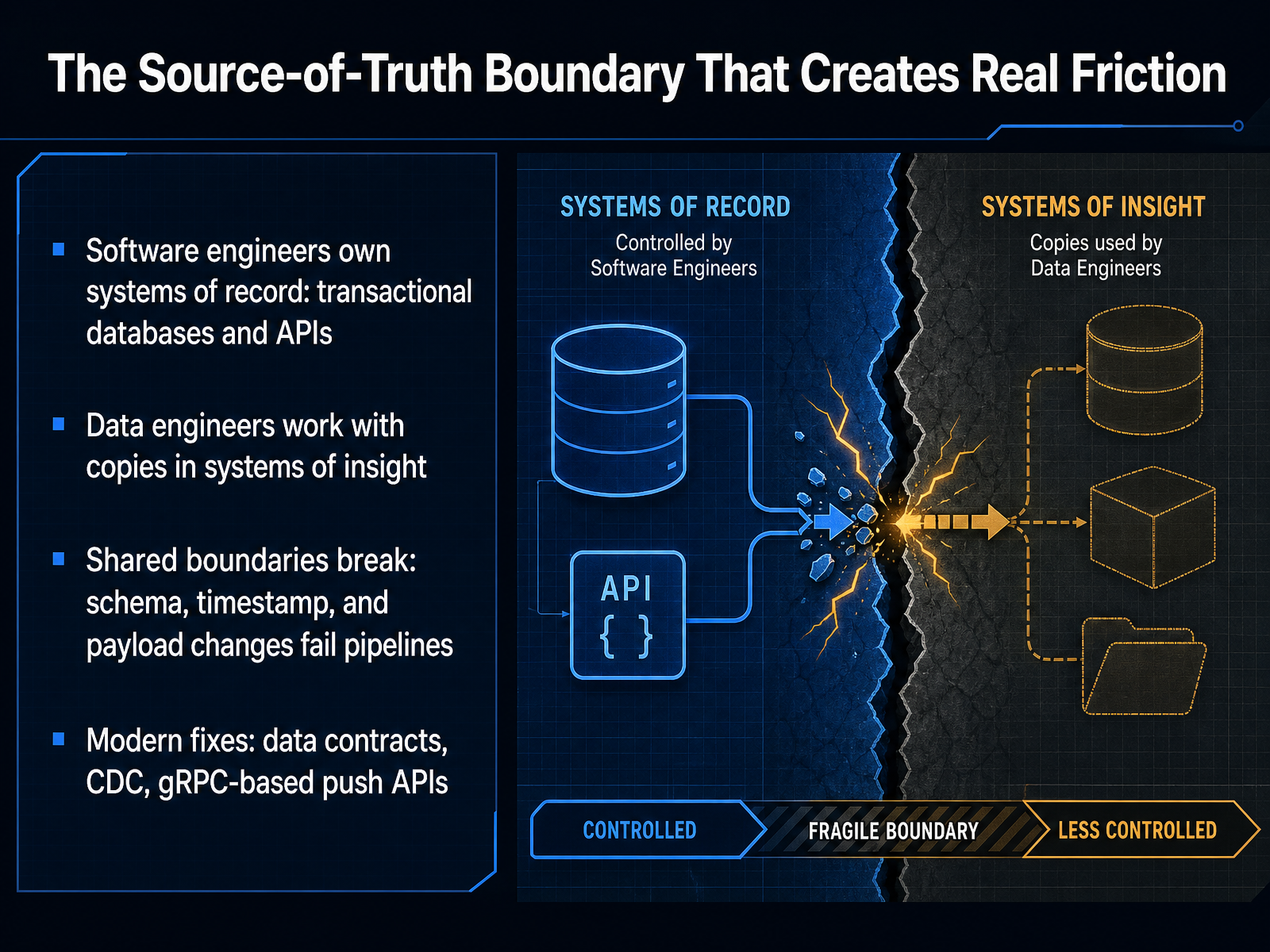
 - 09The Source-of-Truth Boundary That Creates Real FrictionThis is the boundary where a lot of real friction comes from, because the two roles operate against different sources of truth. Software engineers own the systems of record, the transactional databases and APIs where data is born and changed. Data engineers, on the other hand, usually work with copies of that data, moved into systems of insight for analytics and modeling. The problem is that the shared boundary between the two is fragile. A schema change, a timestamp format shift, or even a renamed payload field can silently break a downstream pipeline. The modern fixes are about making that boundary explicit and governed. Data contracts define the expected shape and meaning of data. Change data capture, or CDC, lets data platforms observe changes without invasive polling. And gRPC based push APIs give the producer a clear, versioned contract from the start. In practice, these approaches move teams away from guessing and toward a shared, enforceable interface. That shift matters most when we look at where each role adds the clearest value, which is exactly what the next section covers with use cases and decision criteria.
 educatingengineers.comintuit.comcoursera.org+21 min
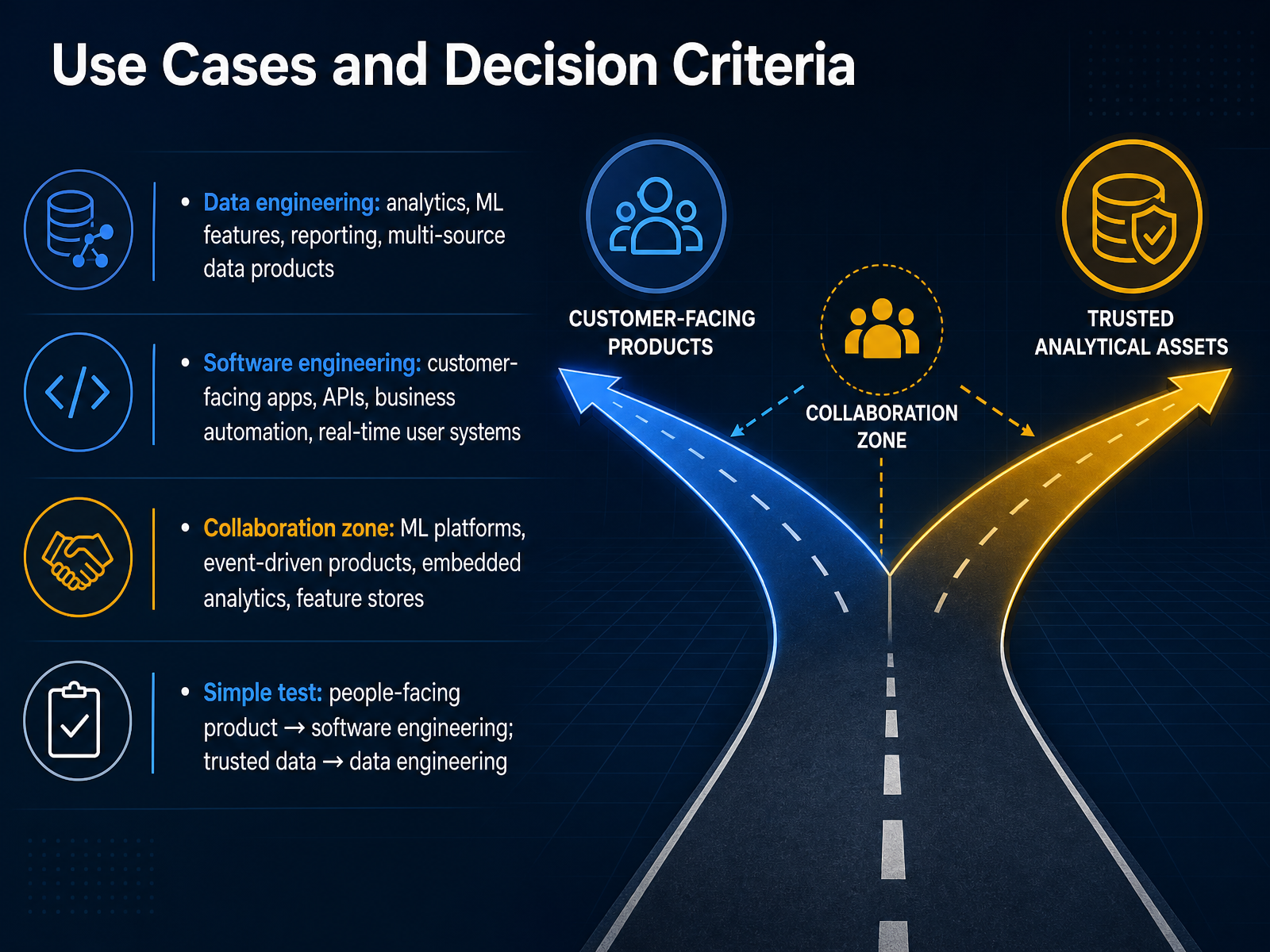
 - 10Use Cases and Decision CriteriaWhen deciding between these two disciplines, the use case is usually the clearest signal. If the primary output is analytics, reporting, machine learning features, or a data product that combines multiple sources, that points to data engineering. If the primary output is a customer-facing application, a public API, business automation, or a real-time user system, that is software engineering. The interesting work, though, happens in the overlap. Modern ML platforms, event-driven products, embedded analytics, and feature stores require both disciplines to collaborate closely. In those zones, the data engineer owns the reliability and lineage of the inputs, while the software engineer owns the user experience and system behavior. A simple test can help you choose. If the problem is fundamentally people-facing, like a checkout flow or a mobile app, start with software engineering. If the problem is fundamentally about trusted data, like reconciling revenue across systems or preparing features for a model, start with data engineering. Next, we will look at how the skills, tools, and career mobility between these two fields continue to shift.
 intuit.comfwctecnologia.commedium.com+21 min
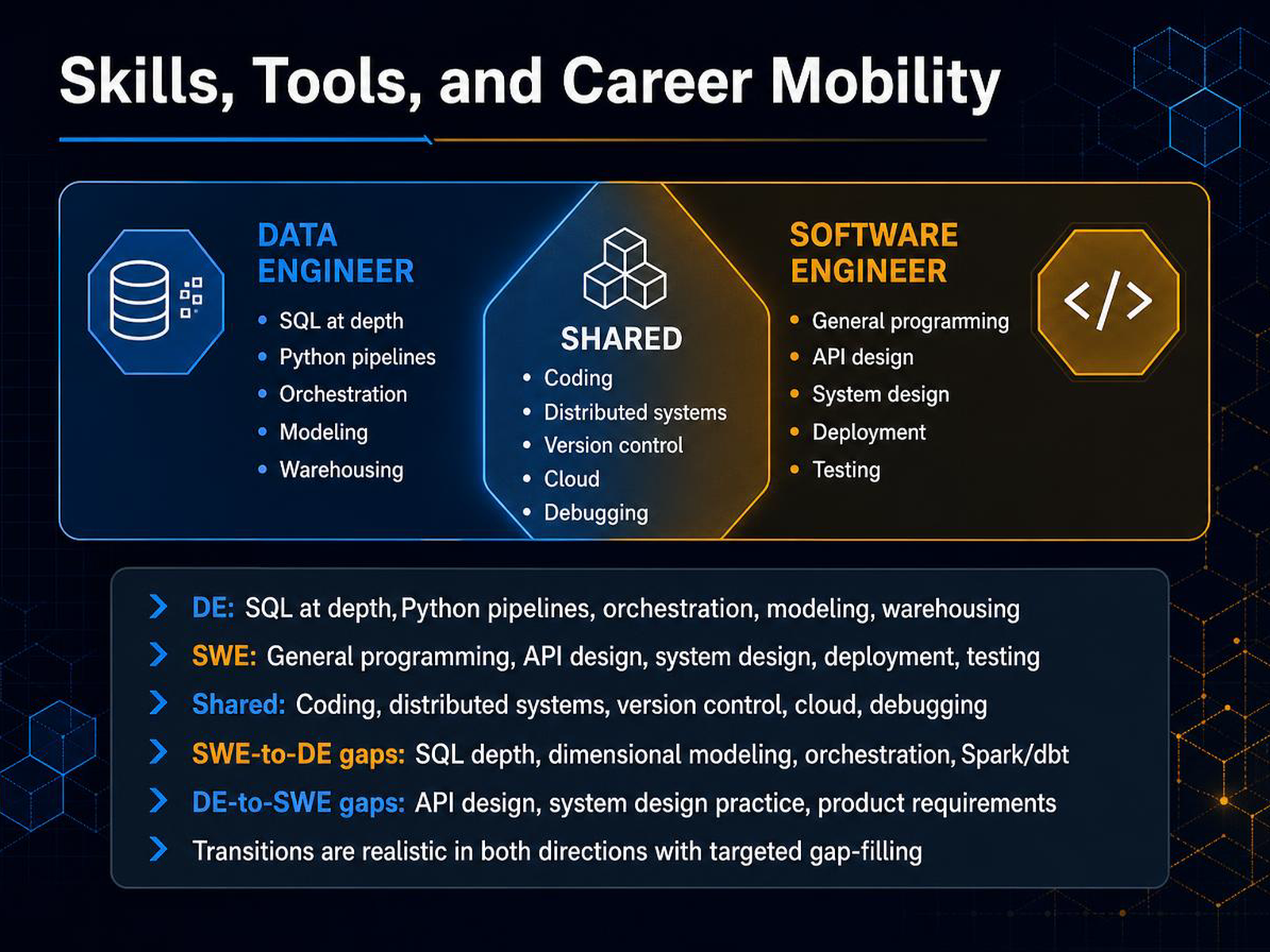
 - 11Skills, Tools, and Career MobilityLet’s move from responsibilities to the concrete skills and tools that define these two roles. Data engineers go deep on SQL and Python, but their daily work also centers on pipeline orchestration, data modeling, and warehouse platforms like Snowflake or BigQuery. Software engineers spend more time on general programming, API design, system architecture, deployment, and testing. Both share a strong foundation in coding, distributed systems, version control, cloud services, and debugging. When a software engineer moves toward data engineering, the common gaps are analytical SQL depth, dimensional modeling, orchestration with tools like Airflow, and experience with Spark or dbt. Moving the other direction, data engineers often need to strengthen API design, practice formal system design interviews, and get closer to product requirements. The key point is that neither transition means starting from zero. These paths overlap enough that a focused plan to fill the specific gaps is usually much faster than a full reset. Next, we’ll look at career paths and current market realities.
 coursera.orgintuit.comdataengineeracademy.com+22 min
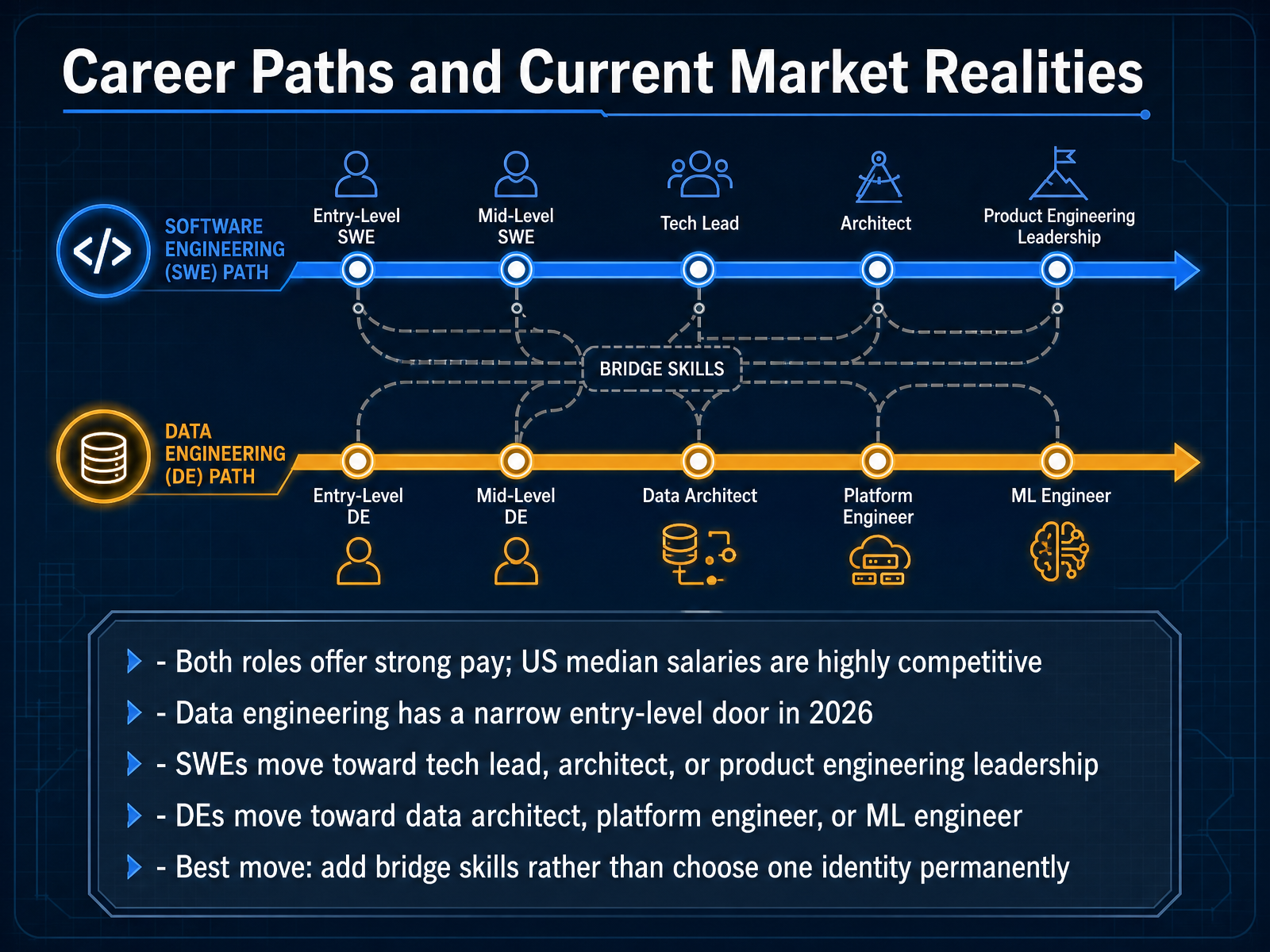
 - 12Career Paths and Current Market RealitiesNow let us talk about careers. The short version is that both paths pay well. US median salaries are highly competitive, so compensation alone will not make this decision for you. What differs is the shape of the entry point and the direction of growth. In 2026, data engineering has a narrow entry-level door. Only a small fraction of postings target juniors, and most teams expect production pipeline experience before they hire. Software engineering still offers broader on-ramps, but the role is also evolving. From there, the ladders look different. Software engineers typically move toward tech lead, architect, or product engineering leadership. Data engineers often grow toward data architect, platform engineer, or machine learning engineer. Those destinations are not mutually exclusive. The strongest positioning is not picking one identity forever. It is adding bridge skills. A software engineer who learns SQL and data modeling becomes more valuable. A data engineer who strengthens system design and testing becomes more valuable. The market rewards the overlap. Next, we will look at common misconceptions and failure patterns.
 coursera.orgintuit.comdataengineeracademy.com+22 min
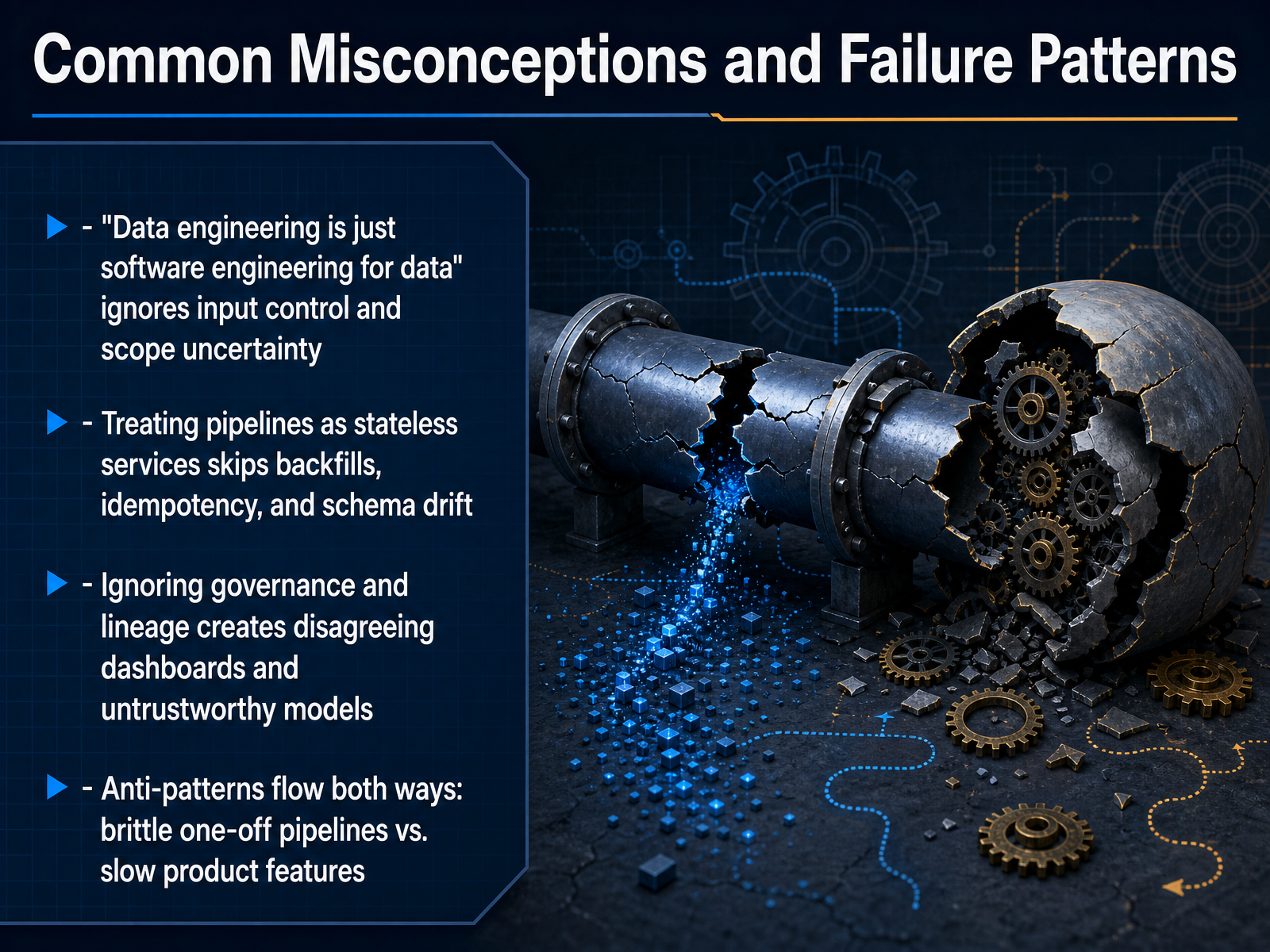
 - 13Common Misconceptions and Failure PatternsLet's move on to where this comparison gets misapplied. The first misconception is that data engineering is just software engineering for data. That framing misses two structural realities. Data engineers often lack control over their inputs. They consume data from systems they don't own, and that data arrives messy or undocumented. That leads to the second issue, scope uncertainty. The real cost of a pipeline hides in exploration and rework, not in the initial code. Another failure pattern is treating pipelines as stateless services. A pipeline without backfill support, idempotency, or a plan for schema drift will fail the first time a source changes or history needs a reload. Equally damaging is ignoring governance and lineage. When two dashboards compute revenue differently and neither traces back to a single definition, trust erodes quickly. And the anti-patterns flow both ways. A software engineer dropped into data work might build brittle one-off pipelines. A data engineer dropped into product features might move too slowly on iteration. Let's close with practical takeaways and a decision framework.
 educatingengineers.comintuit.comcoursera.org+22 min
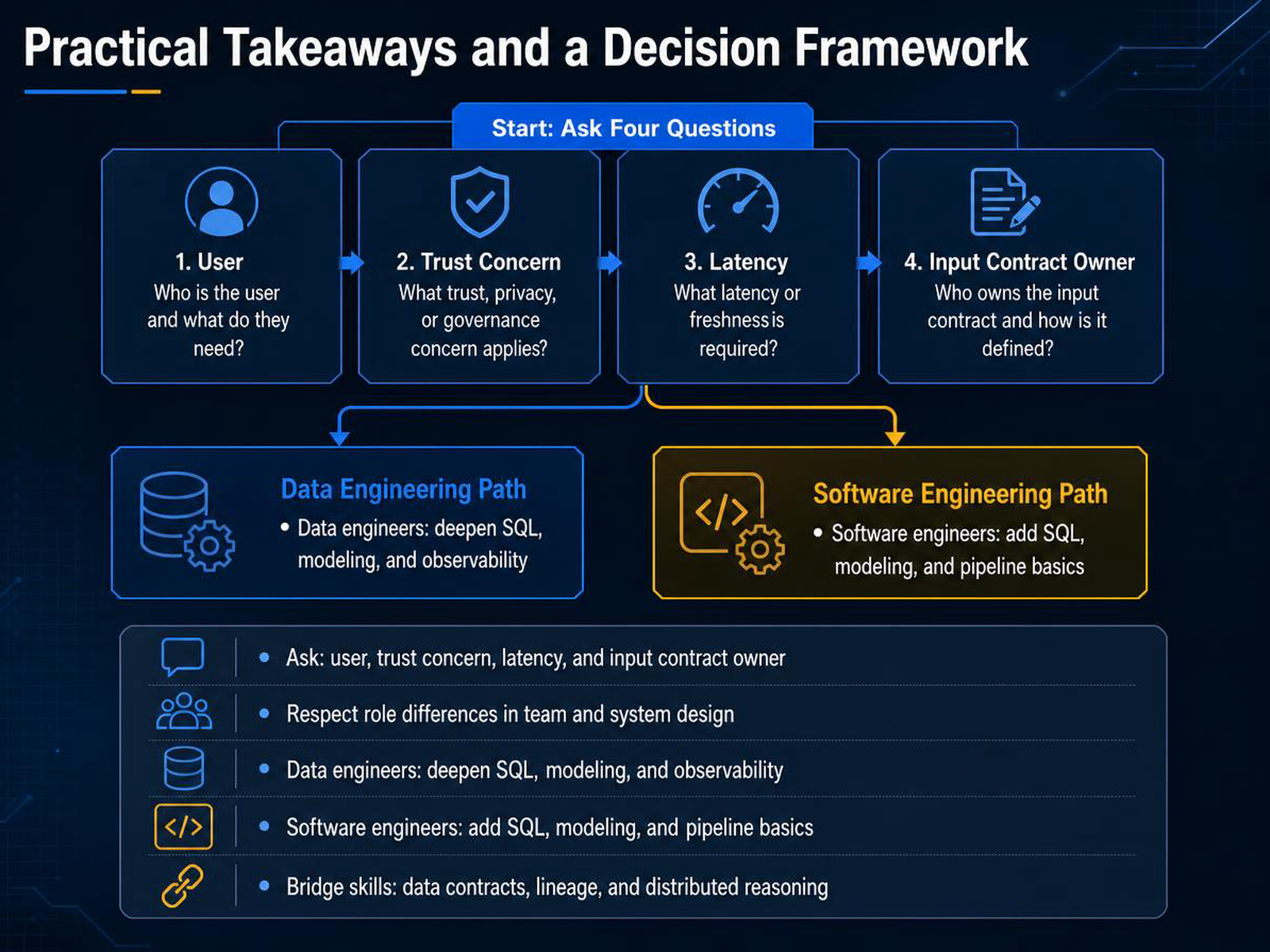
 - 14Practical Takeaways and a Decision FrameworkAs we close, let's turn these distinctions into a simple decision framework. Before choosing an approach, ask four questions. Who is the end user? What are the trust and latency requirements? And who owns the input contract? The answers will point you clearly toward a product system or a data platform. Respect what each role builds and optimizes. Data engineers deepen SQL, modeling, and observability. Software engineers add SQL, modeling, and pipeline basics to their existing system design skills. The bridge skills that keep both sides honest are data contracts, lineage, and distributed reasoning. Thank you for joining this course. Keep building, keep asking good questions, and keep that data trustworthy.
 intuit.comfwctecnologia.commedium.com+22 min
Take the deck with you
Download this course as a file — free, no sign-up needed.
- PDF handoutEvery slide page, ready to print or share.15 pages · 4.3 MBDownload
- Narrated PowerPointThe deck that presents itself — every slide carries the digital human's narration video.15 pages · 15.3 MBDownload
- PowerPoint slidesThe full deck as a .pptx — open it in PowerPoint, Keynote, or Google Slides.15 pages · 4.2 MBDownload
Free to use in your own training — please keep the PersonWise credit page at the end.
Have your own deck? Turn it into a course
Sources consulted
Web sources consulted while building this course.
- Data Engineering vs. Software Engineering: What's the Difference? — educatingengineers.com
- Data Engineer vs. Software Engineer - Intuit Blog — intuit.com
- Data Engineer vs. Software Engineer: Choosing the Right Career Path — coursera.org
- Bridging the Gap: Software vs. Data Engineering — makewithdata.tech
- The Distinction between Data Engineering and Software Engineering Roles | by Julien Kervizic | Hacking Analytics | Medium — medium.com
- Software Development Deliverables: Milestones &... — fwctecnologia.com
- Data Engineering is not Software Engineering | by Hugo Lu — medium.com
- Data Engineers vs Software Engineers: Key Tech Stack ... — linkedin.com
- What is Data Engineering? Role, Stack, Day-in-the-Life (2026) - DEV Community — dev.to
- The Data Engineer Roadmap for 2026: Pipelines, Warehouses, and the Modern Data Stack | BirJob — birjob.com
- Modern Data Stack 2026: Complete Guide to Tools & Architecture | Modern DataTools — modern-datatools.com
- How to Transition From Software Engineer to Data Engineer — dataengineeracademy.com
- How to Become a Data Engineer in 2026: Complete Roadmap | DataDriven — datadriven.io