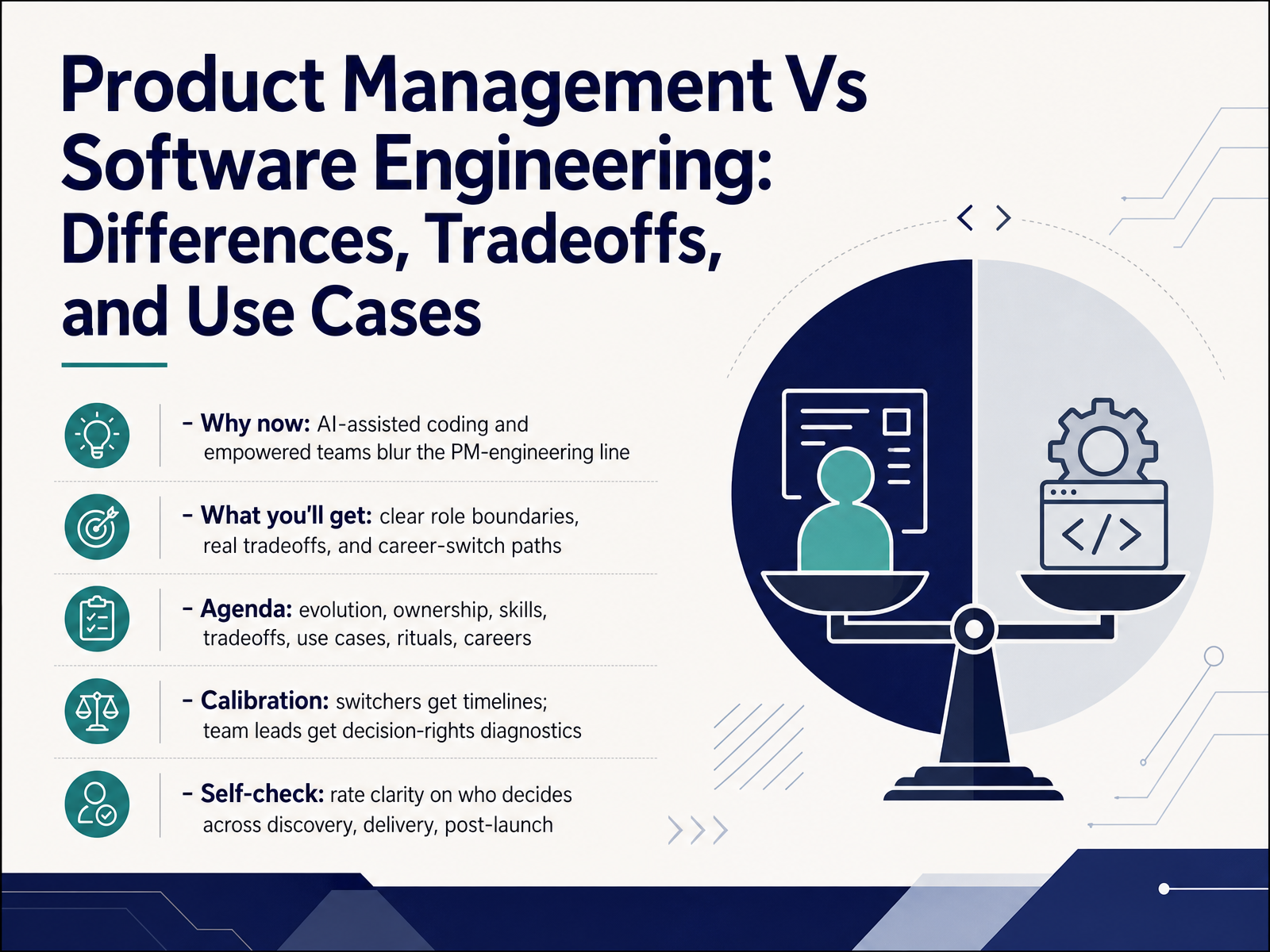
Product Management vs Software Engineering
Begin
11 pages · ~22 min
Product Management vs Software Engineering
This training explains the key differences and tradeoffs between product management and software engineering, helping cross-functional teams choose the right approach for each use case.
What you’ll learn
- 01Product Management Vs Software Engineering: Differences, Tradeoffs, and Use CasesWelcome. I am glad you are here. Today we are comparing product management and software engineering, not to pick a winner, but to understand the real tradeoffs between them. So why now? AI assisted coding and empowered teams are blurring the line between these roles. That blur can create speed, or it can create confusion. In the next hour, you will get clear role boundaries, real tradeoffs, and practical pathways for career switchers. Here is our agenda. We will cover how these roles evolved, who owns what, the skills that matter, key tradeoffs, use cases, team rituals, and career moves. A quick note on calibration. If you are switching careers, you will get timelines and skill maps. If you lead a team, you will get diagnostics for decision rights. Before we move on, rate your own clarity on one question. Who decides across discovery, delivery, and post launch? Keep that rating in mind. We will return to it. Next, how these two roles evolved and why the boundary keeps moving.2 min
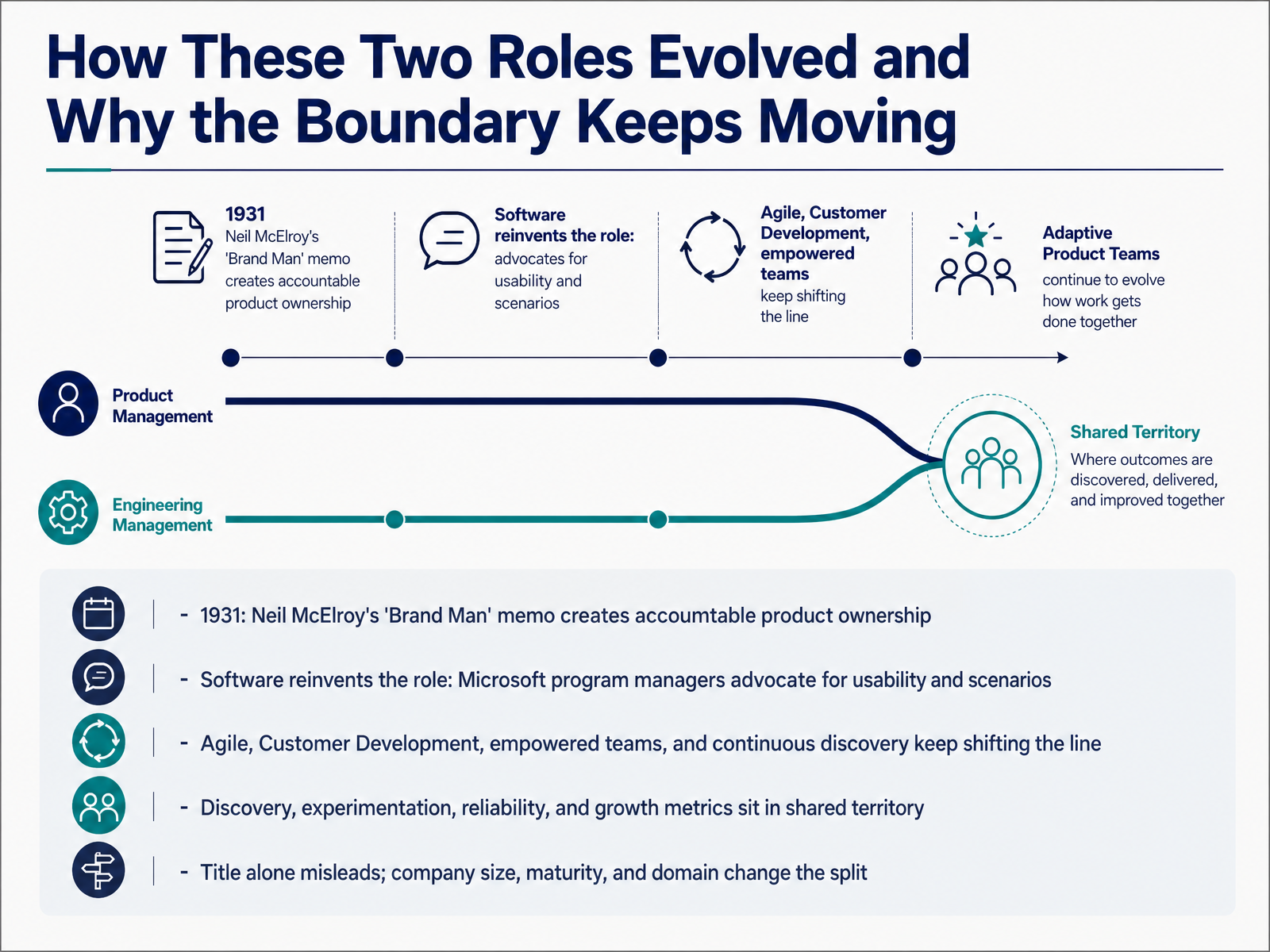
- 02How These Two Roles Evolved and Why the Boundary Keeps MovingSo why does the line between product management and engineering keep moving? Because it's never been fixed. In nineteen thirty-one, Neil McElroy's Brand Man memo created accountable product ownership at Procter and Gamble. One person owned the brand's results. Then software reinvented the role. At Microsoft, program managers became the voice of usability and user scenarios, translating what customers needed into what engineers built. Agile and Customer Development pushed decisions closer to the team. Empowered teams and continuous discovery blurred ownership further. Now discovery, experimentation, reliability, and growth metrics sit in shared territory. Both roles touch them, and both feel accountable. Which means titles alone mislead you. A startup PM might write specs and talk to users daily. A PM at a large enterprise might coordinate roadmaps and stakeholders. Same title, very different job. The split depends on company size, maturity, and domain. So hold the boundary loosely. Next, let's look at core concepts and what each role actually owns.
 1 min
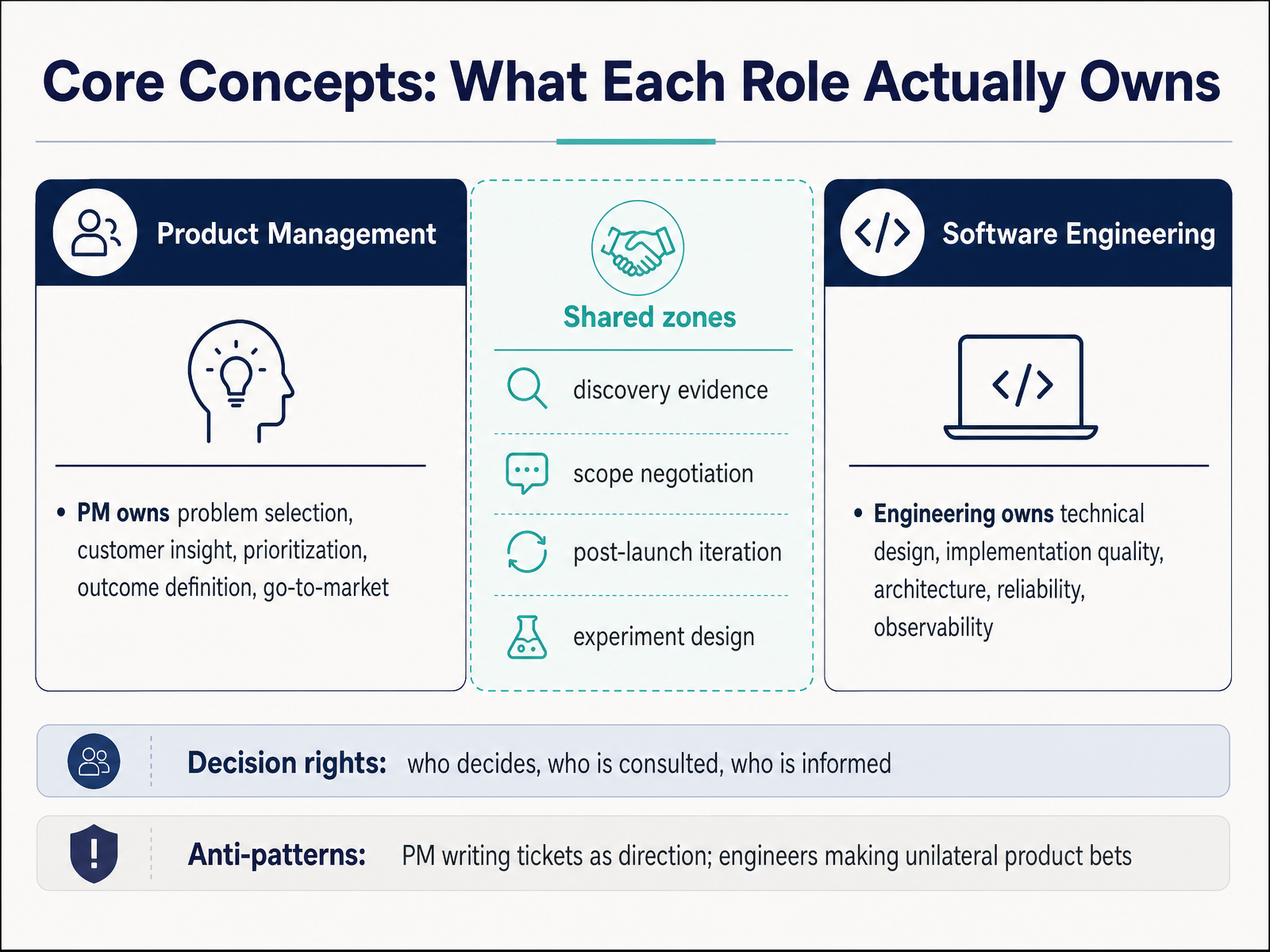
1 min - 03Core Concepts: What Each Role Actually OwnsLet us break down what each role actually owns. The product manager owns problem selection. That means choosing which customer problem is worth solving now. They also own customer insight, prioritization, outcome definition, and go to market. Engineering owns technical design, implementation quality, architecture, reliability, and observability. For example, a PM decides that faster onboarding matters most this quarter. Engineering decides whether that means refactoring a service or building a new flow. Some zones are shared. Discovery evidence, scope negotiation, experiment design, and post launch iteration belong to both. Then there are decision rights. Who decides, who is consulted, and who is informed. Get this wrong, and trust erodes fast. Watch for two anti patterns. A PM writing tickets as direction, which strips engineers of ownership. Or engineers making unilateral product bets, which sidelines the roadmap. So the takeaway is simple. Clear ownership, shared evidence, and explicit decision rights. That is what keeps roadmaps, sprints, and stakeholders aligned. Next, we look at skill sets and mindsets, where the two disciplines diverge.
 2 min
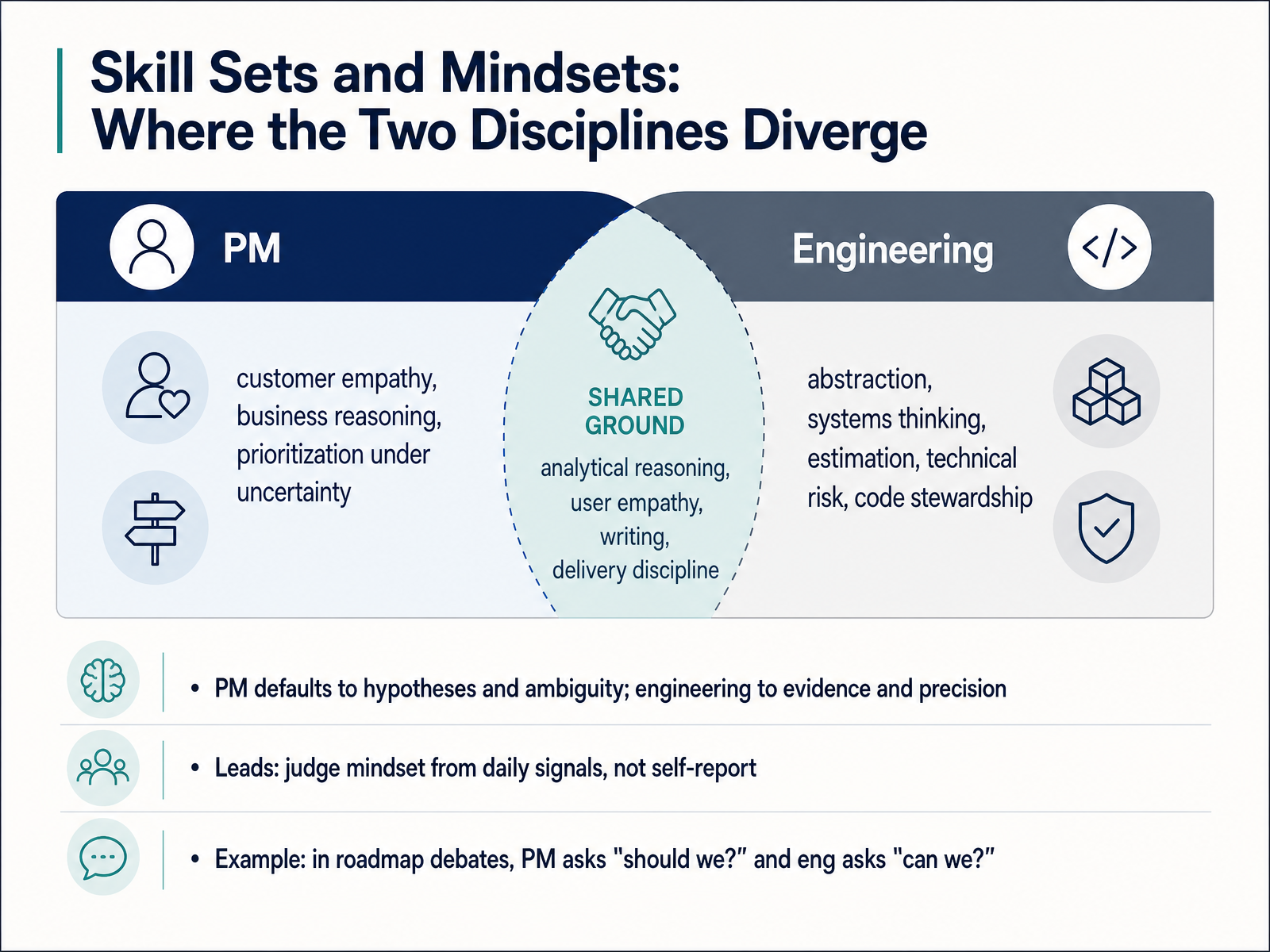
2 min - 04Skill Sets and Mindsets: Where the Two Disciplines DivergeLet's look at where the two disciplines actually diverge. Product managers bring customer empathy, business reasoning, and prioritization under uncertainty. Engineers bring abstraction, systems thinking, estimation, technical risk, and code stewardship. Notice the different defaults. A PM starts with hypotheses and ambiguity. An engineer starts with evidence and precision. But there's real shared ground too. Analytical reasoning, user empathy, writing, and delivery discipline. If you lead a team, judge mindset from daily signals, not self-report. Listen to how people frame problems. Here's a clean example. In a roadmap debate, a PM asks, should we? An engineer asks, can we? Both questions are necessary. One without the other leads to fantasy or stagnation. Next, let's explore the tradeoff frameworks around speed, quality, scope, and technical debt.
 1 min
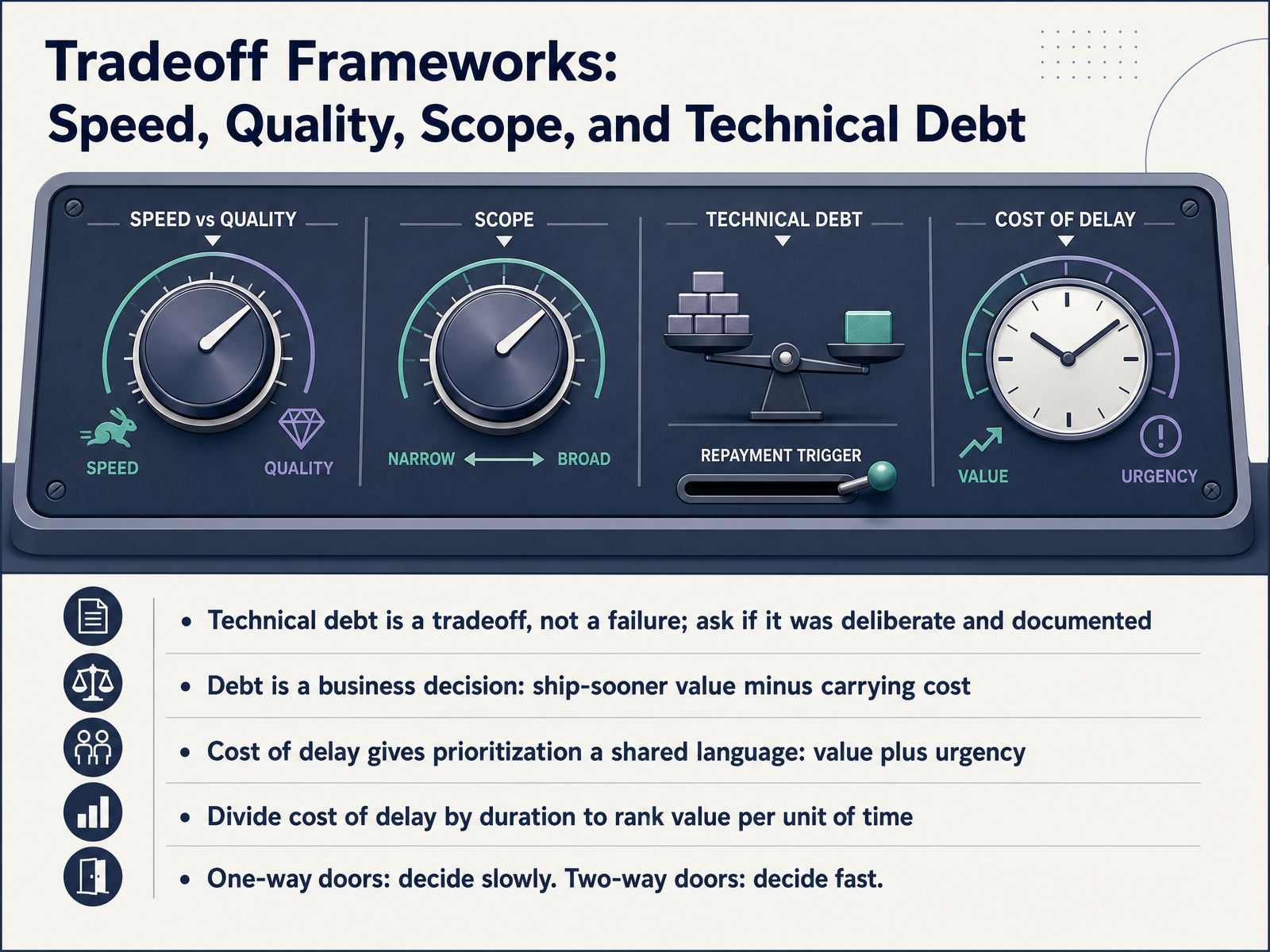
1 min - 05Tradeoff Frameworks: Speed, Quality, Scope, and Technical DebtNow let's look at a framework you'll use constantly: speed, quality, scope, and technical debt. First, technical debt is a tradeoff, not a failure. The real question is whether it was deliberate and documented. If you knowingly cut a corner to hit a launch date, that's a business decision. Second, debt is a business decision. Think of it as ship-sooner value minus carrying cost. A quick hack might save two weeks now, but if it slows every future sprint, that cost compounds. Third, cost of delay gives prioritization a shared language. It combines value plus urgency. Divide cost of delay by duration, and you get value per unit of time, which helps you rank work when everything feels urgent. Finally, one-way doors deserve slow decisions. Two-way doors, decide fast and move. So ask yourself: is this a debt you're choosing, and can you reverse it cheaply? That framing keeps trust high across product and engineering. Next, we'll look at roles in practice: when each leads, supports, or stays out.
 1 min
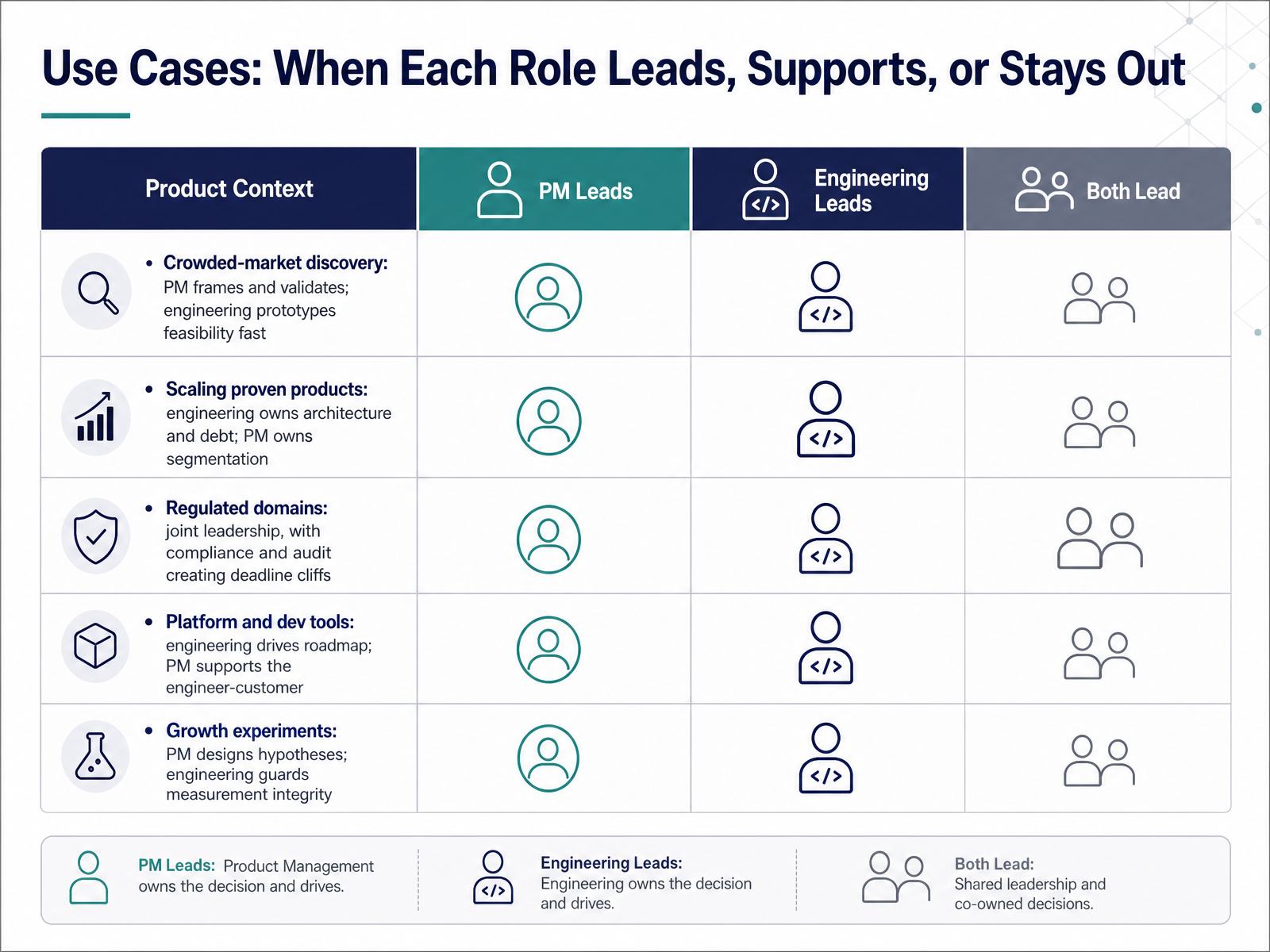
1 min - 06Use Cases: When Each Role Leads, Supports, or Stays OutSo let's get concrete. When does each role actually lead, support, or step back?
Take crowded-market discovery. The product manager frames the problem and validates demand, while engineering prototypes fast to test what's feasible. You learn whether you can build it before you commit the roadmap.
When scaling a proven product, the balance flips. Engineering owns architecture and technical debt. The product manager owns segmentation, deciding which customers to serve next.
In regulated domains, it's joint leadership. Compliance and audit create deadline cliffs, so both roles move together, and neither can go quiet.
For platforms and developer tools, engineering often drives the roadmap. The product manager supports by treating the engineer as the customer, understanding their workflow and pain points.
And with growth experiments, the product manager designs the hypothesis, while engineering guards measurement integrity. If the tracking is wrong, the experiment lies, and stakeholder trust drops.
The takeaway: leadership shifts with context, not hierarchy. The next slide covers how these roles work together through rituals, artifacts, and communication norms.
 2 min
2 min - 07Working Together: Rituals, Artifacts, and Communication NormsSo how do product and engineering actually work together day to day? It comes down to rituals, artifacts, and clear communication norms.
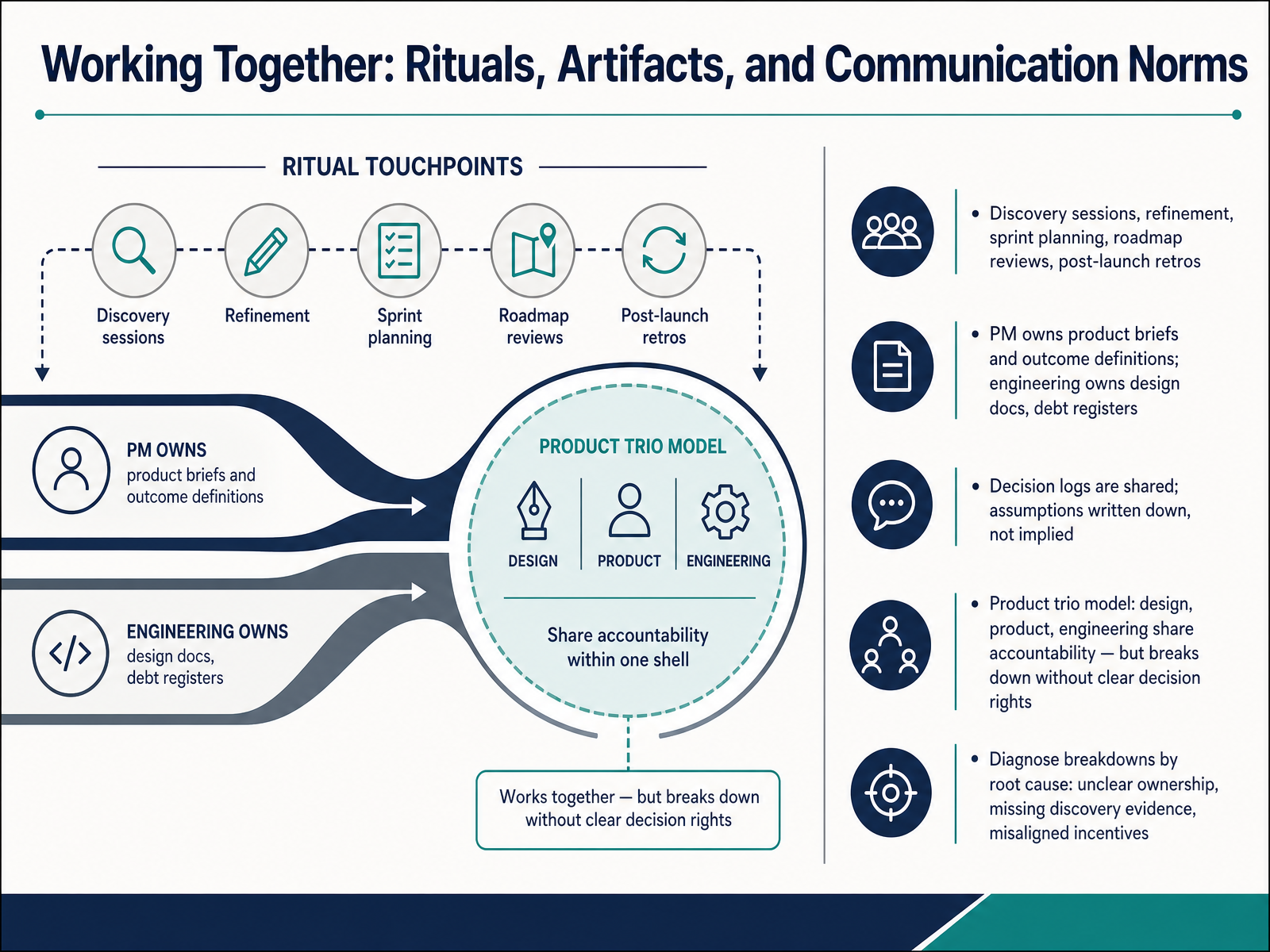
On the ritual side, you have discovery sessions, refinement, sprint planning, roadmap reviews, and post-launch retrospectives. Each one has a purpose. Discovery tests whether a problem is worth solving. Refinement checks whether a solution is buildable. Sprints and roadmap reviews keep the work moving in the same direction. Retros close the loop after launch.
Ownership matters just as much. Product owns the product brief and the outcome definitions. Engineering owns design docs and the debt register. That split keeps accountability clear.
Decision logs are shared. Write assumptions down instead of leaving them implied. A team that writes assumptions down can revisit them later without guesswork.
The product trio model brings design, product, and engineering together with shared accountability. It holds up well when decision rights are explicit. Without clear decision rights, it breaks down fast.
When collaboration falters, diagnose the root cause. Is ownership unclear? Is discovery evidence missing? Are incentives misaligned? Fix the cause, not just the symptom.
Next, we will look at career paths and what it takes to switch between product and engineering.
 2 min
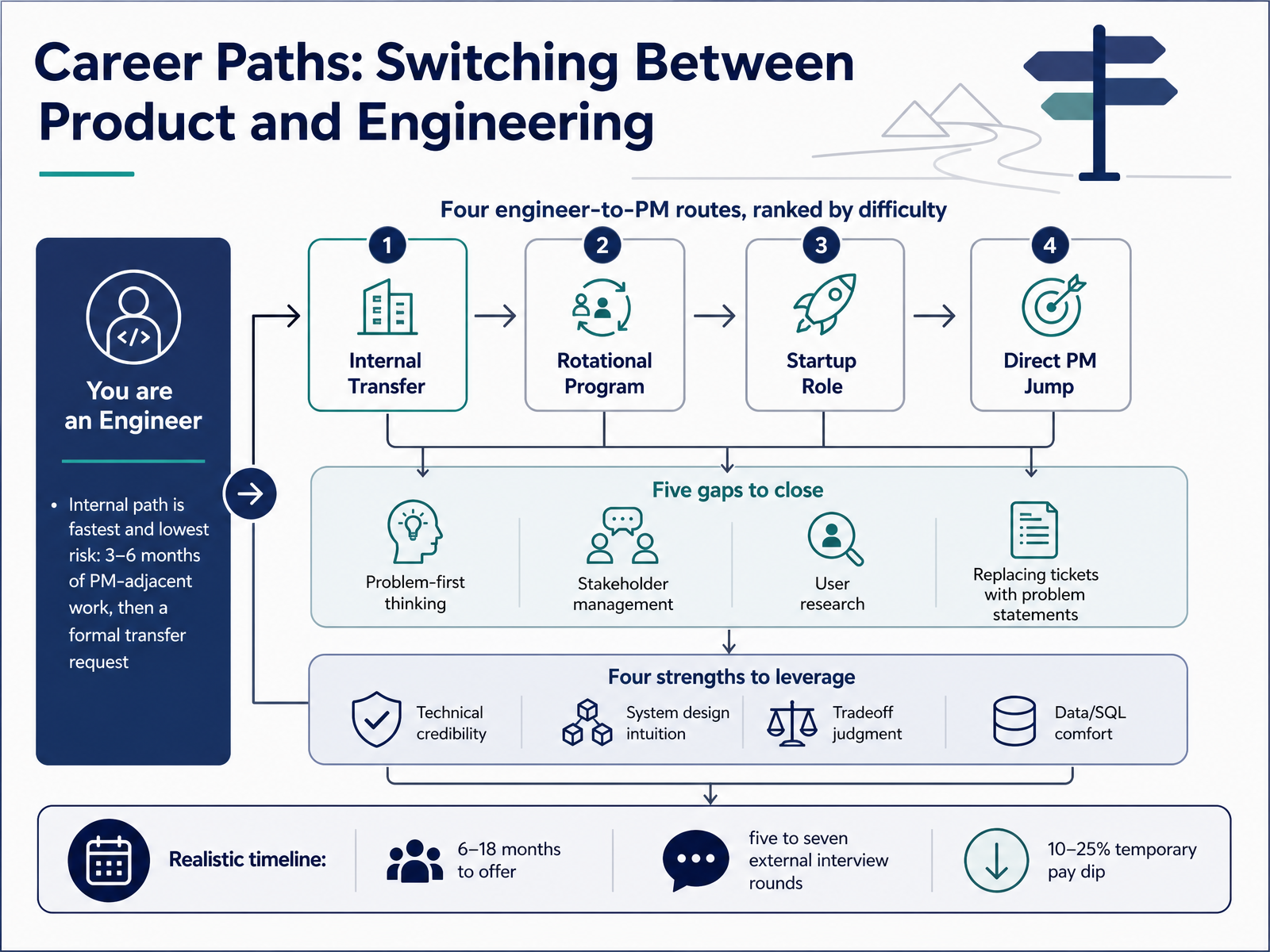
2 min - 08Career Paths: Switching Between Product and EngineeringLet's talk about switching sides, from engineering into product, or the reverse. There are four engineer-to-product routes, ranked by difficulty. First and easiest is an internal transfer. Then a rotational program. Then joining a startup as a PM. And hardest, a direct external jump. The internal path is fastest and lowest risk. Spend three to six months on PM-adjacent work, then make a formal transfer request. You'll need to close five gaps: problem-first thinking, stakeholder management, user research, and replacing tickets with problem statements. But you also bring four real strengths: technical credibility, system design intuition, tradeoff judgment, and comfort with data and SQL. So be realistic about the timeline. Six to eighteen months to an offer, five to seven interview rounds, and often a temporary pay dip of ten to twenty-five percent. It's a real tradeoff, not a quick pivot. Next, we'll look at common misconceptions and failure modes.
 2 min
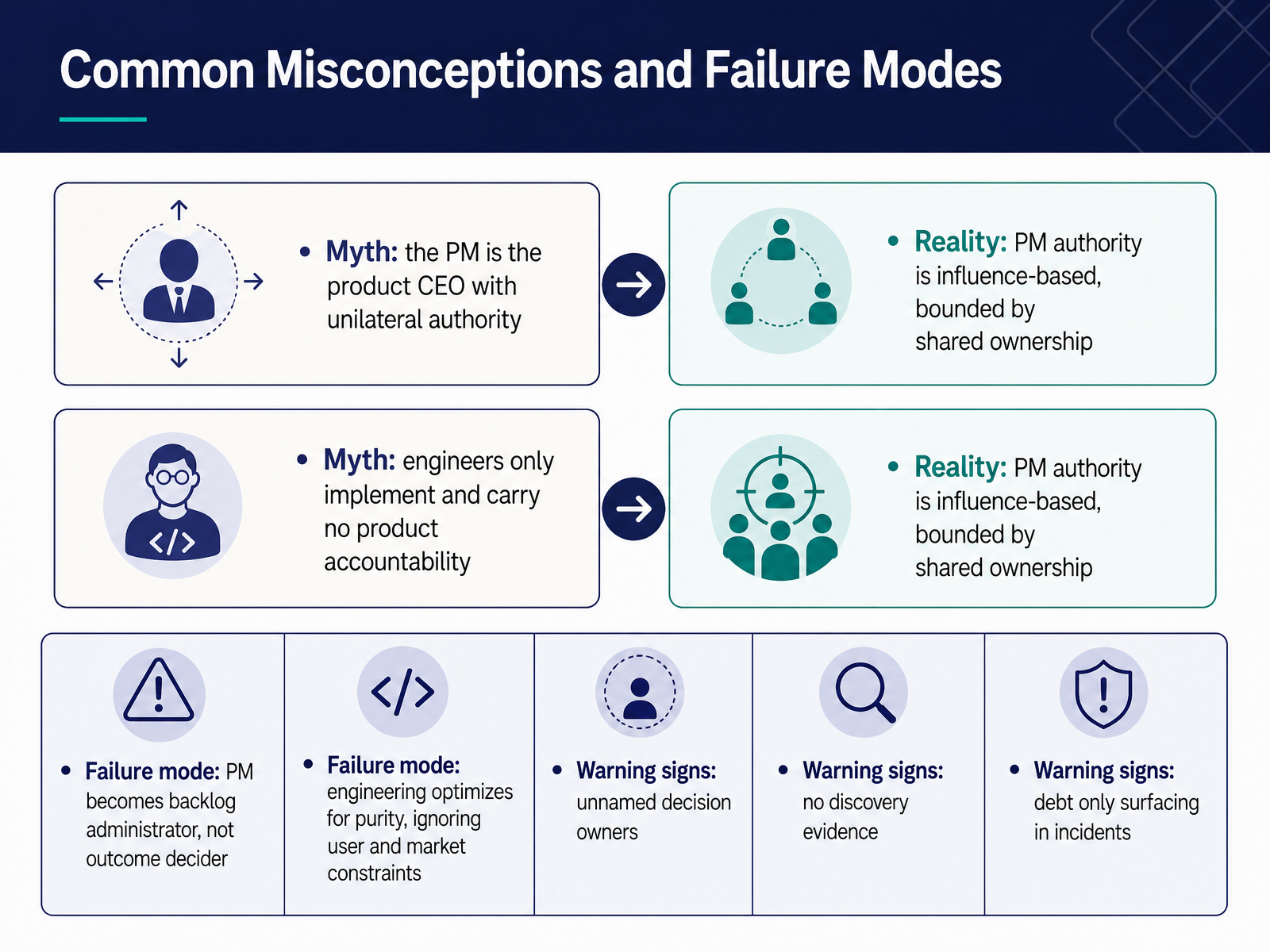
2 min - 09Common Misconceptions and Failure ModesLet us clear up a few stubborn myths about these roles. Myth one: the product manager is the product CEO, with unilateral authority. Reality? Product management authority is influence-based. It is bounded by shared ownership across design, engineering, data, and leadership. When a PM forgets that, decisions stall and trust erodes.
Myth two: engineers only implement and carry no product accountability. But engineering choices shape what users actually experience. For example, a performance shortcut can quietly break onboarding, and that is a product outcome, not just a technical one.
Now, failure modes. A PM can become a backlog administrator instead of an outcome decider. Grooming tickets forever while never choosing what matters. Meanwhile, engineering can optimize for purity, ignoring user and market constraints. Perfect architecture, zero adoption.
Watch for warning signs: unnamed decision owners, no discovery evidence, and technical debt that only surfaces during incidents. If you see these, fix decision rights before adding more process. Next, we will look at assessing team fit through decision rights and collaboration health.
 2 min
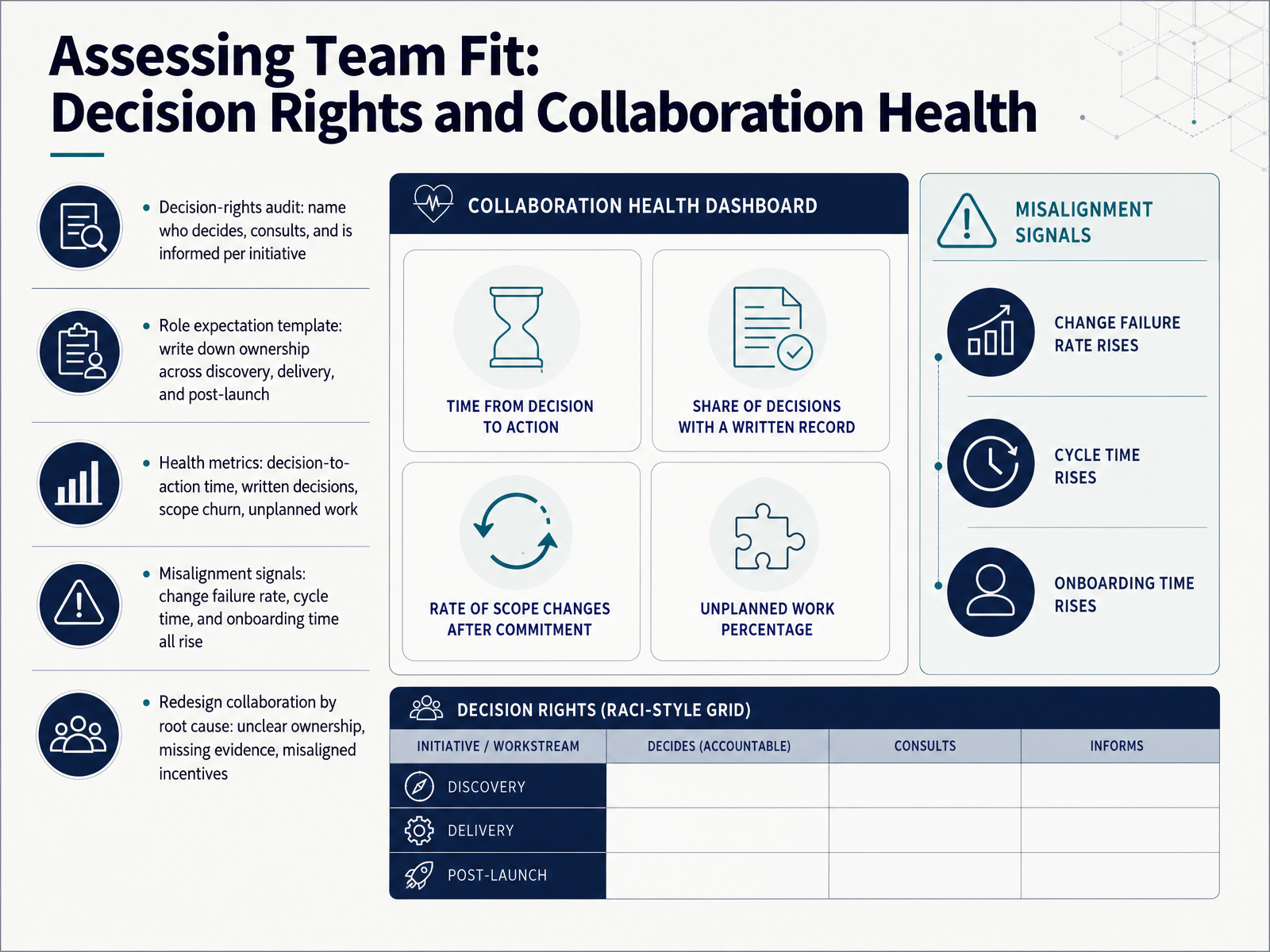
2 min - 10Assessing Team Fit: Decision Rights and Collaboration HealthNow, how do you know whether your team actually fits the way it works? Start with a decision-rights audit. For each initiative, name who decides, who consults, and who is informed. Write it down. Ambiguity here is where trust quietly erodes.
Next, build a role expectation template. Spell out ownership across discovery, delivery, and post-launch. For example, who talks to customers, and who owns the rollout?
Then track health metrics. Decision-to-action time, written decisions, scope churn, and unplanned work. Watch for misalignment signals. Change failure rate, cycle time, and onboarding time all rise together when roles blur.
Redesign collaboration by root cause. Is ownership unclear, evidence missing, or incentives misaligned? Fix that, not the symptom. With clearer decision rights and healthier collaboration, you can move from diagnosing fit to changing it. Let's turn this into your action plan.
 1 min
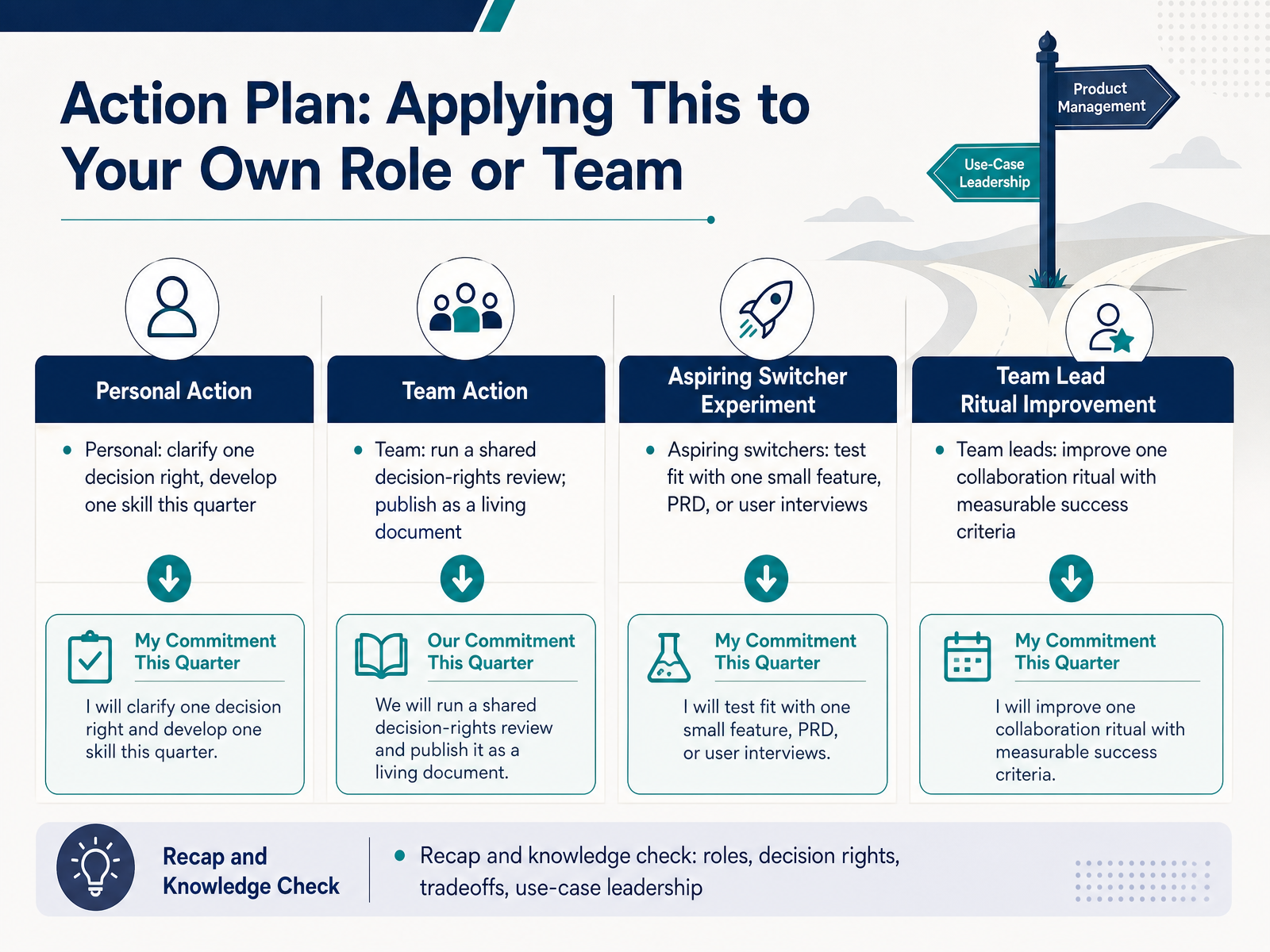
1 min - 11Action Plan: Applying This to Your Own Role or TeamLet's turn all of this into an action plan. If you're working on your own skills, pick one decision right to clarify this quarter, and one skill to build. For example, agree with your tech lead on who owns scope changes, then practice writing a short product requirements document. If you're on a team, run a shared decision-rights review. Publish it as a living document, so it stays useful instead of going stale. If you're considering a switch, test the fit with one small feature, one product requirements document, or a few user interviews. That gives you real signal before you commit. Team leads, improve one collaboration ritual and define success criteria you can measure. Maybe it's sprint planning, or how you review tradeoffs together. So here's the recap. Roles differ, but decision rights, tradeoffs, and use-case leadership are what connect them. Thank you for your attention, and keep applying this in your own role. You've got this.
 2 min
2 min
Take the deck with you
Download this course as a file — free, no sign-up needed.
- PDF handoutEvery slide page, ready to print or share.12 pages · 2.9 MBDownload
- Narrated PowerPointThe deck that presents itself — every slide carries the digital human's narration video.12 pages · 11.3 MBDownload
- PowerPoint slidesThe full deck as a .pptx — open it in PowerPoint, Keynote, or Google Slides.12 pages · 2.7 MBDownload
Free to use in your own training — please keep the PersonWise credit page at the end.
Have your own deck? Turn it into a course