Begin
14 pages · ~28 min
Apotheke Wellness Brand Strategy
This training introduces pharmacy teams to Apotheke's brand strategy in wellness, helping them align daily practice with brand values and deliver a consistent, customer-focused wellness experience.
A digital instructor presents all 14 pages. Hold “Ask” at any point and ask out loud — the answer comes from this course. No sign-up needed.
What you’ll learn
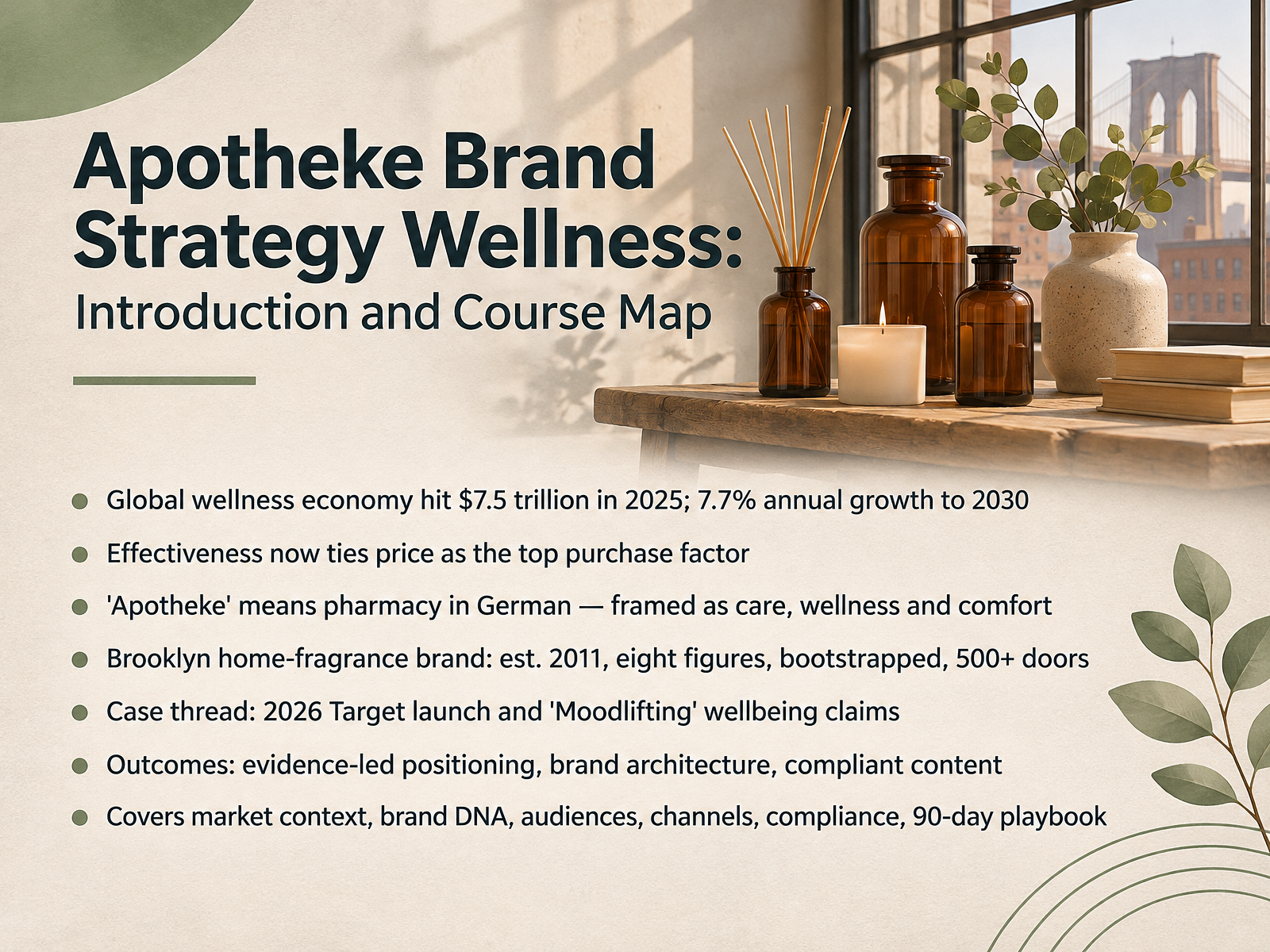
- 01Apotheke Brand Strategy Wellness: Introduction and Course MapWelcome. In this course, we look at how a wellness brand turns meaning into strategy. Our case study is Apotheke, the Brooklyn home-fragrance brand. The goal is practical. By the end, you should be able to build an evidence-led positioning, design a clear brand architecture, and produce compliant content with confidence. First, some market context. The global wellness economy reached seven point five trillion dollars in twenty twenty-five, and it is projected to grow seven point seven percent annually through twenty thirty. Consumer behavior is shifting too. Effectiveness now ties price as the top purchase factor for wellness products. Now the brand itself. Apotheke is the German word for pharmacy, and the brand frames that heritage as care, wellness, and comfort. Founded in twenty eleven, it is a bootstrapped, eight-figure business selling through more than five hundred retail doors. Across fourteen slides, we move from market context and brand DNA to audience segmentation, channel strategy, compliance, and a ninety-day playbook, using the twenty twenty-six Target launch and the Moodlifting wellbeing claims as our running thread. My takeaway for you is this. Treat every wellness claim as a positioning decision that must be proven, not just stated. Let us start by unpacking the name itself, with Deconstructing the Apotheke Name: Pharmacy Heritage as Brand Equity.apothekeco.comapothekeco.comcapitalone.com+22 min
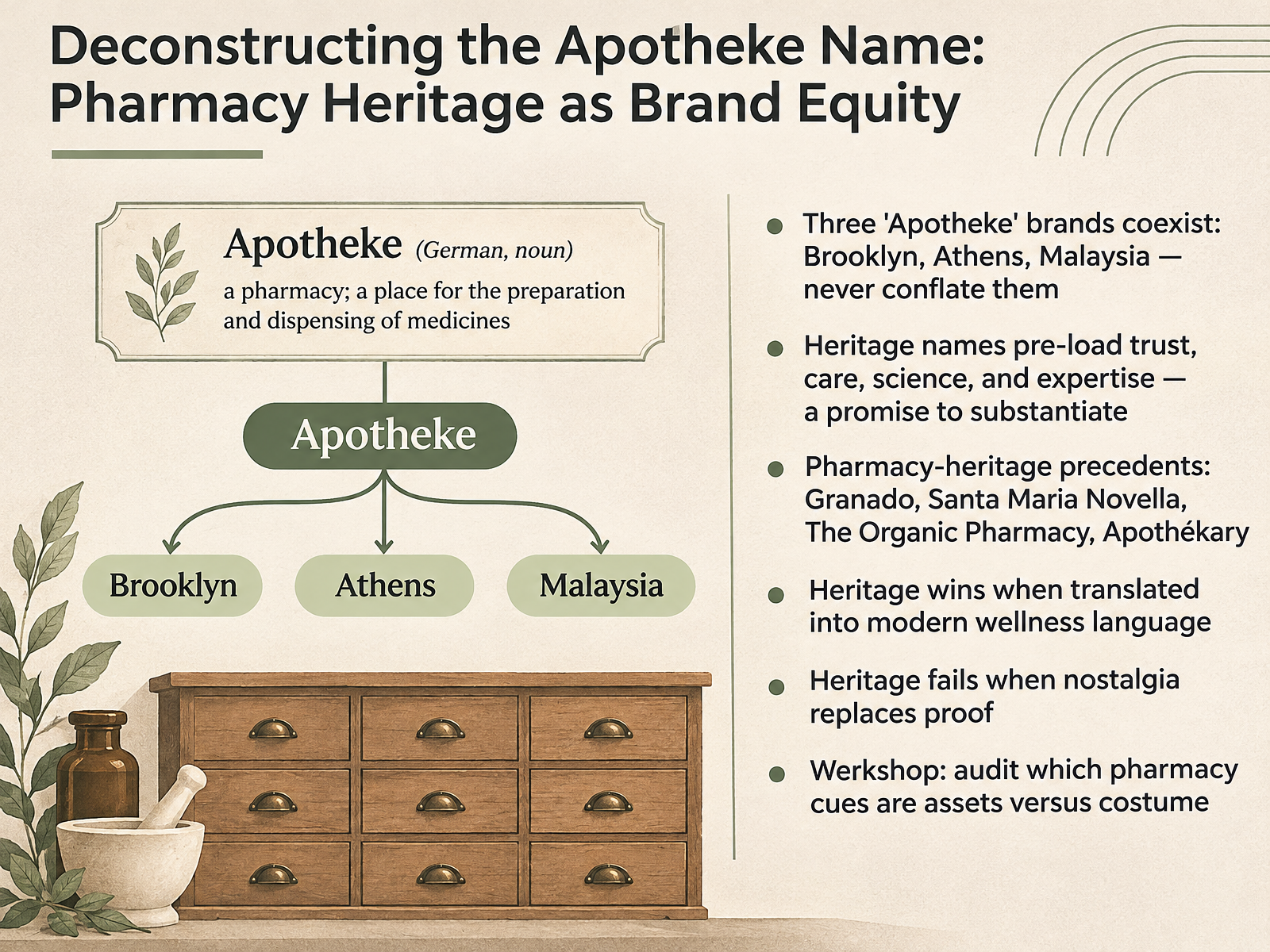
- 02Deconstructing the Apotheke Name: Pharmacy Heritage as Brand EquityLet's break down the Apotheke name, because the word itself is doing strategic work. First, a crucial distinction. Three Apotheke brands coexist: one in Brooklyn, one in Athens, and one in Malaysia. Never conflate them. They are separate businesses with separate positioning. Second, heritage names like Apotheke pre-load trust, care, science, and expertise. Think of it as a promise your brand must substantiate. Precedents include Granado, Santa Maria Novella, The Organic Pharmacy, and Apothékary. Here's the rule. Heritage wins when you translate it into modern wellness language. It fails when nostalgia replaces proof. So for your workshop, audit which pharmacy cues are assets and which are costume. Keep only what you can back with evidence. That sets up our next topic: the 2026 wellness market context.
 1 min
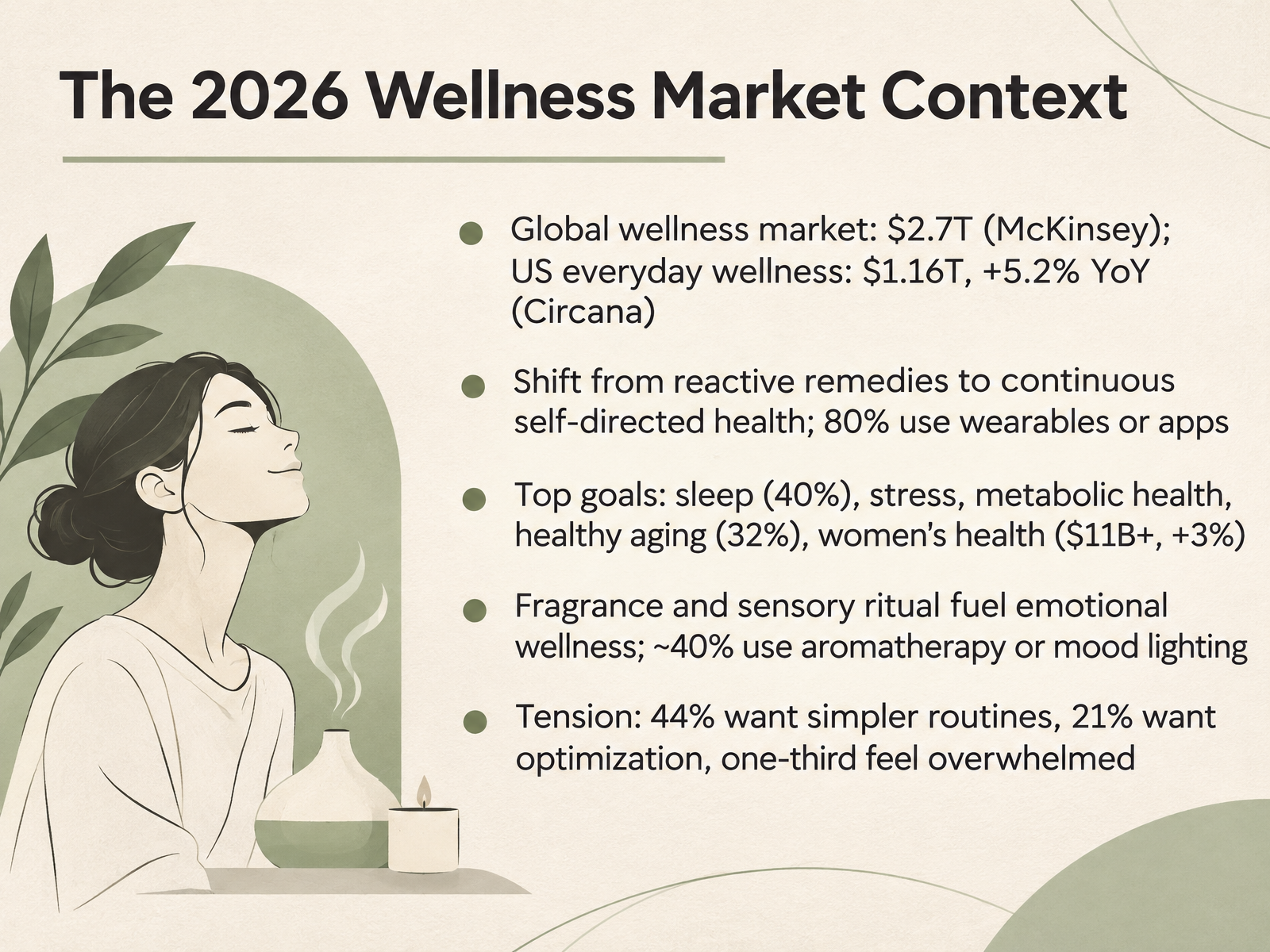
- 03The 2026 Wellness Market ContextLet's ground this in the numbers that shape the 2026 wellness market. Globally, wellness is a two point seven trillion dollar market, according to McKinsey. In the US, everyday wellness alone is one point one six trillion dollars, growing five point two percent year over year, per Circana. The bigger shift is behavioral: consumers are moving from reactive remedies to continuous, self-directed health. About eighty percent now use wearables or health apps to track something. Their top goals are sleep at forty percent, then stress, metabolic health, healthy aging at thirty two percent, and women's health, an eleven billion dollar category growing three percent. Fragrance and sensory ritual are fueling emotional wellness too, with roughly forty percent using aromatherapy or mood lighting. But here's the tension you need to design around. Forty four percent want simpler routines, twenty one percent want optimization, and one third feel overwhelmed. So your positioning must reduce friction while still signaling efficacy. Next, let's clarify who Apotheke is actually fighting in this landscape.
 2 min
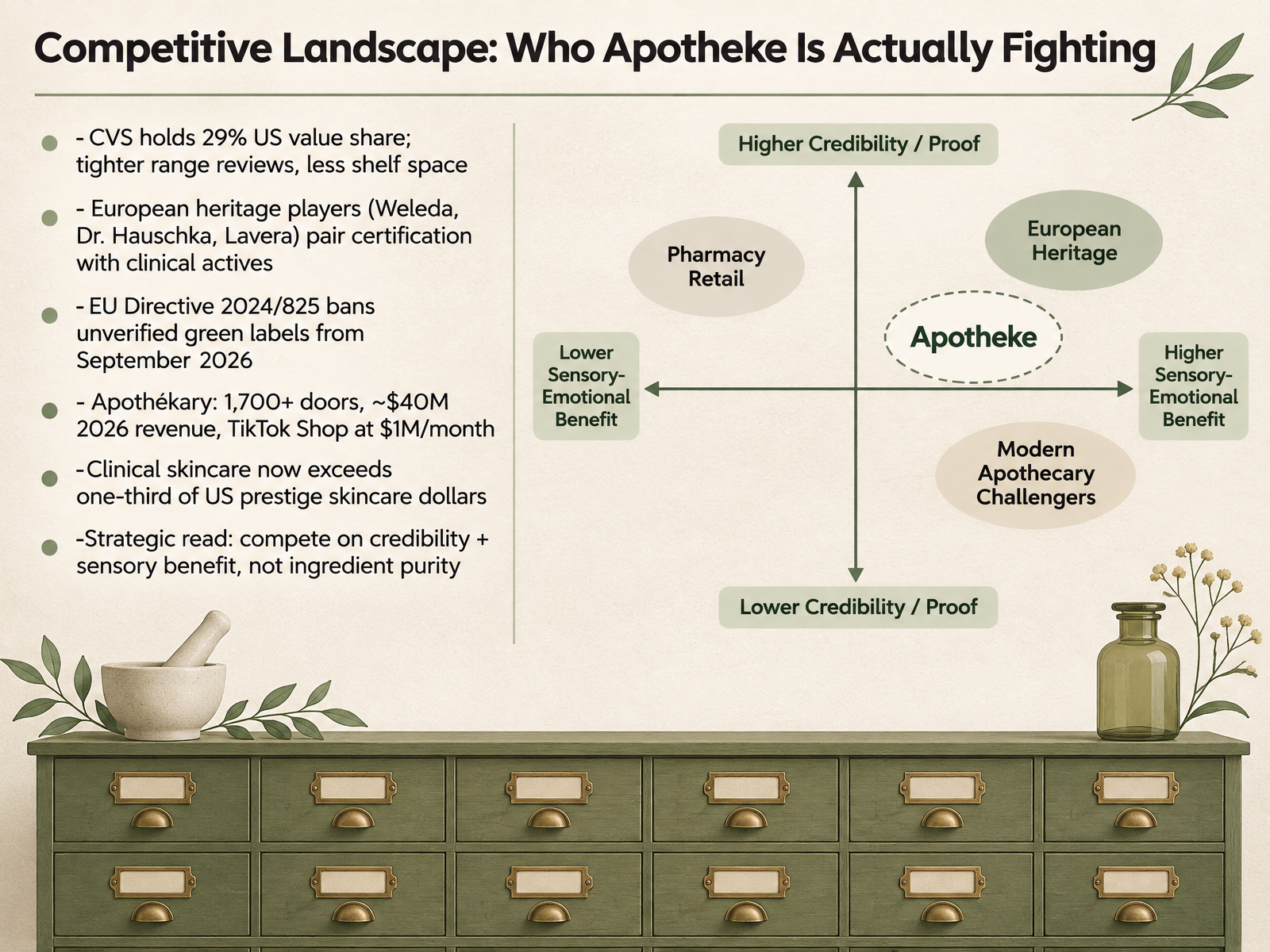
- 04Competitive Landscape: Who Apotheke Is Actually FightingLet's map the competitive landscape, because Apotheke is not fighting everyone. Start with retail. C V S holds twenty-nine percent of U S value share, and that means tighter range reviews and less shelf space for challenger brands. So winning there requires a sharper story, not more S K U s. Next, European heritage players like Weleda, Dr. Hauschka, and Lavera pair certification with clinical actives. They prove that natural and effective can coexist. Then there's regulation. E U Directive twenty twenty-four slash eight twenty-five bans unverified green labels starting September twenty twenty-six. That raises the bar on every sustainability claim you make. Meanwhile, Apothekery shows the scale of the opportunity: over one thousand seven hundred doors, roughly forty million dollars in twenty twenty-six revenue, and TikTok Shop at one million dollars a month. But note the shift: clinical skincare now exceeds one third of U S prestige skincare dollars. So the strategic read is simple. Compete on credibility plus sensory benefit, not ingredient purity. Purity is table stakes. Credibility and experience are the differentiators. Let's look at who you're actually serving next, in The Five Wellness Consumer Segments.
 2 min
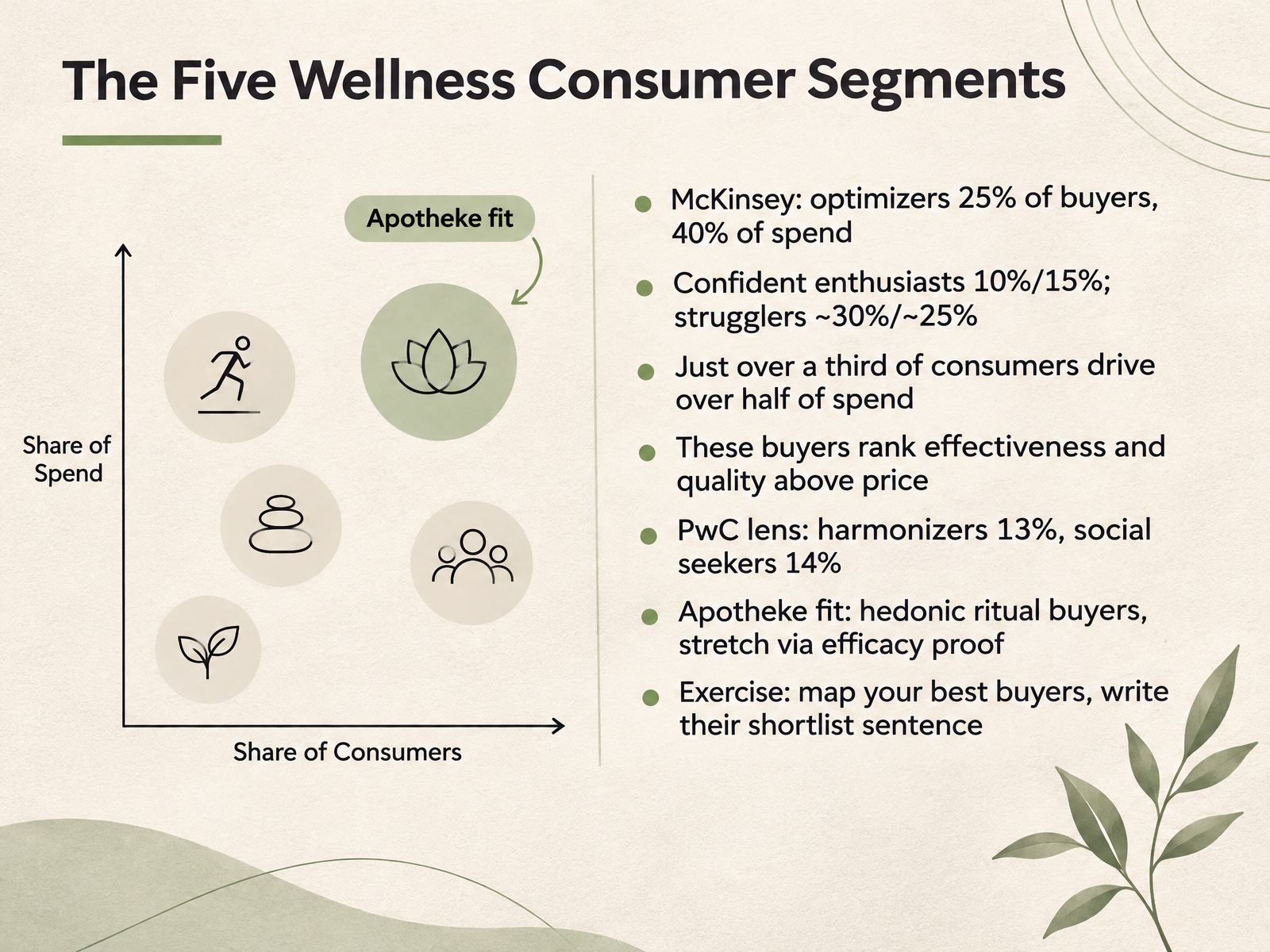
- 05The Five Wellness Consumer SegmentsLet's talk about the five wellness consumer segments. McKinsey's data shows that optimizers make up about twenty-five percent of buyers but drive forty percent of spend. Confident enthusiasts are ten percent of buyers and fifteen percent of spend. Strugglers, meanwhile, are roughly thirty percent of buyers and a quarter of spend. Put simply, just over a third of consumers drive over half of the category's spending. And these high-value buyers rank effectiveness and quality above price. Through a PwC lens, harmonizers are thirteen percent and social seekers fourteen percent. So where does Apotheke fit? Its sweet spot is hedonic ritual buyers, and you can stretch to adjacent segments with clear efficacy proof. Here is your exercise. Map your own best buyers and write their shortlist sentence, the one line that states why they would choose you. Next, we will look at Apotheke audience personas and content triggers.
 1 min
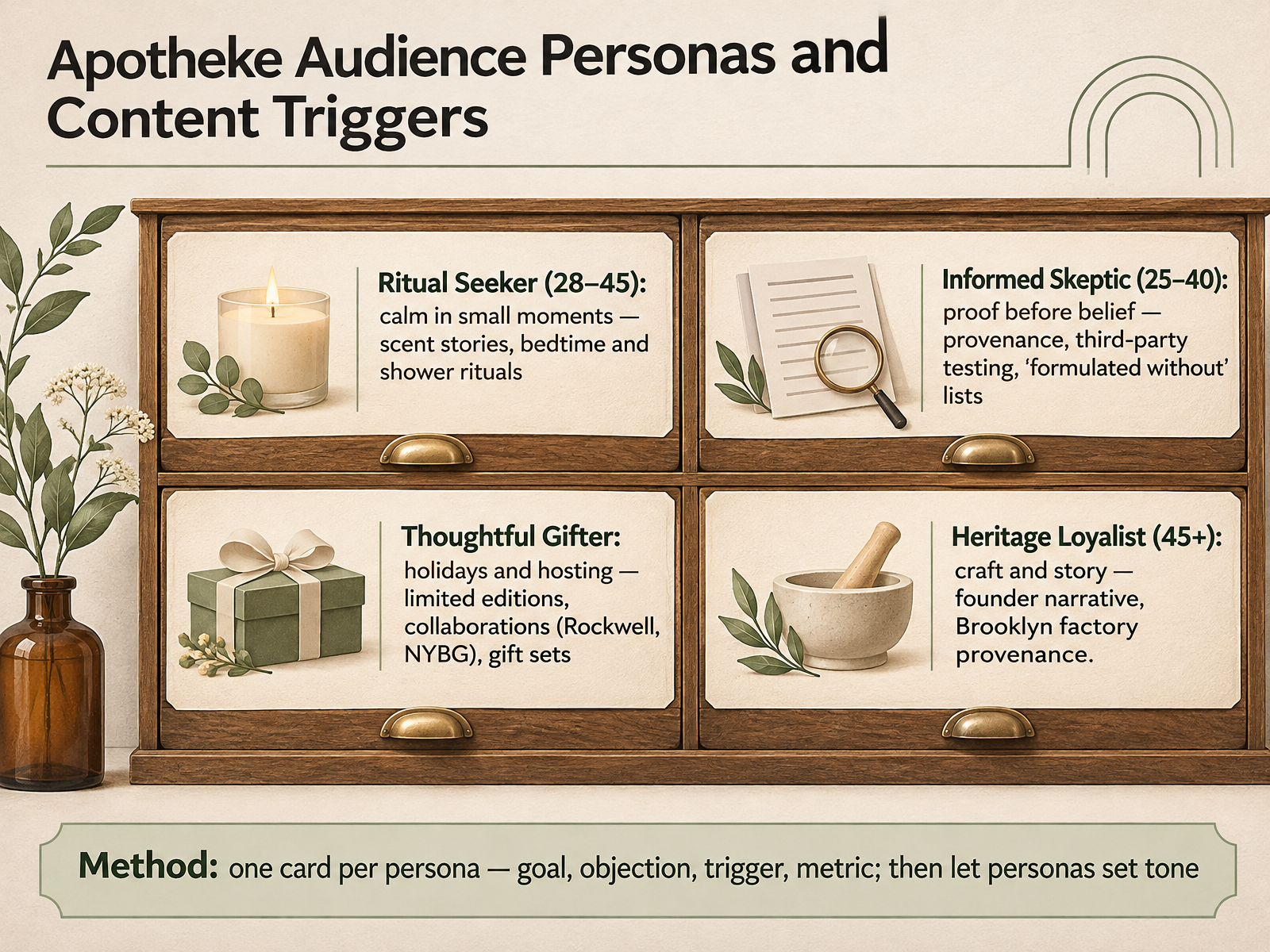
- 06Apotheke Audience Personas and Content TriggersNow let's put that audience segmentation to work with personas. Think of a persona as a stand-in for a real buyer: one goal, one main objection, one content trigger, one metric you track. Apotheke's four core personas illustrate this well. The Ritual Seeker, aged twenty-eight to forty-five, wants calm in small moments, so scent stories and bedtime or shower rituals speak to her. The Informed Skeptic, twenty-five to forty, needs proof before belief, so lead with provenance, third-party testing, and formulated-without lists. The Thoughtful Gifter shows up around holidays and hosting, which is where limited editions, gift sets, and collaborations like Rockwell and the New York Botanical Garden earn attention. And the Heritage Loyalist, forty-five and up, responds to craft and story, like the founder narrative and Brooklyn factory provenance. Build one card per persona, then let the personas set the tone of your content. Next, we move into Positioning and Brand DNA.
 morninghoney.comapothekeco.commonocle.com+22 min
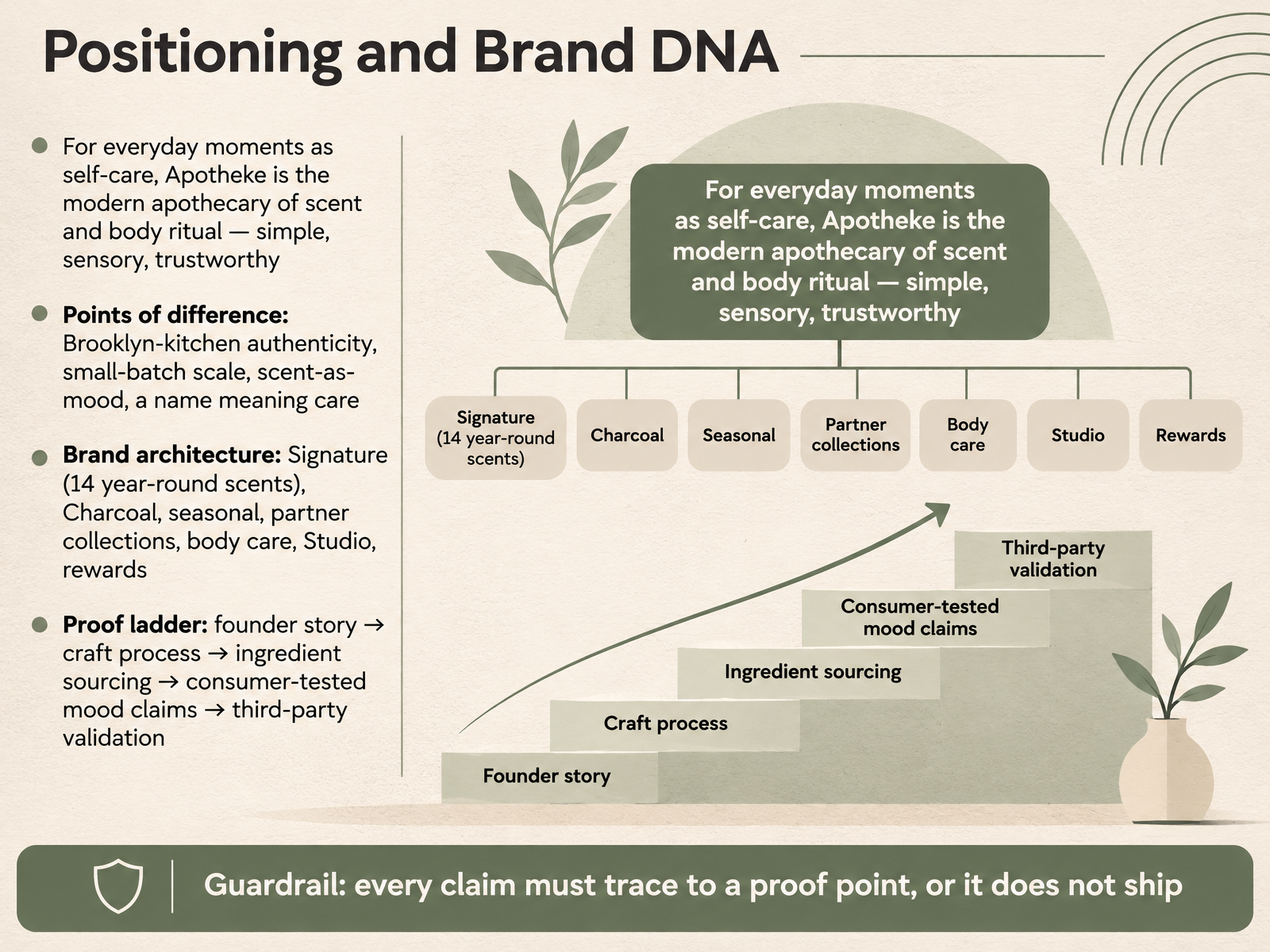
- 07Positioning and Brand DNALet's move into positioning and brand DNA. Positioning is the one sentence that stakes your space in a customer's mind. For Apotheke, it's this. For everyday moments as self-care, Apotheke is the modern apothecary of scent and body ritual, simple, sensory, and trustworthy. Note the deliberate limits. Everyday moments, not luxury escapes. Now the points of difference. Brooklyn-kitchen authenticity, small-batch scale, scent-as-mood, and a name that literally means care. Brand architecture means how your lines fit together. Here that's Signature with fourteen year-round scents, Charcoal, seasonal, partner collections, body care, Studio, and rewards. Then build a proof ladder. Founder story, craft process, ingredient sourcing, consumer-tested mood claims, and third-party validation. Each rung earns the next claim. So hold one guardrail. Every claim must trace to a proof point, or it doesn't ship. Apply that test to your next message. Well, let's look at Wellness Storytelling and Content Pillars.
 morninghoney.comapothekeco.commonocle.com+22 min
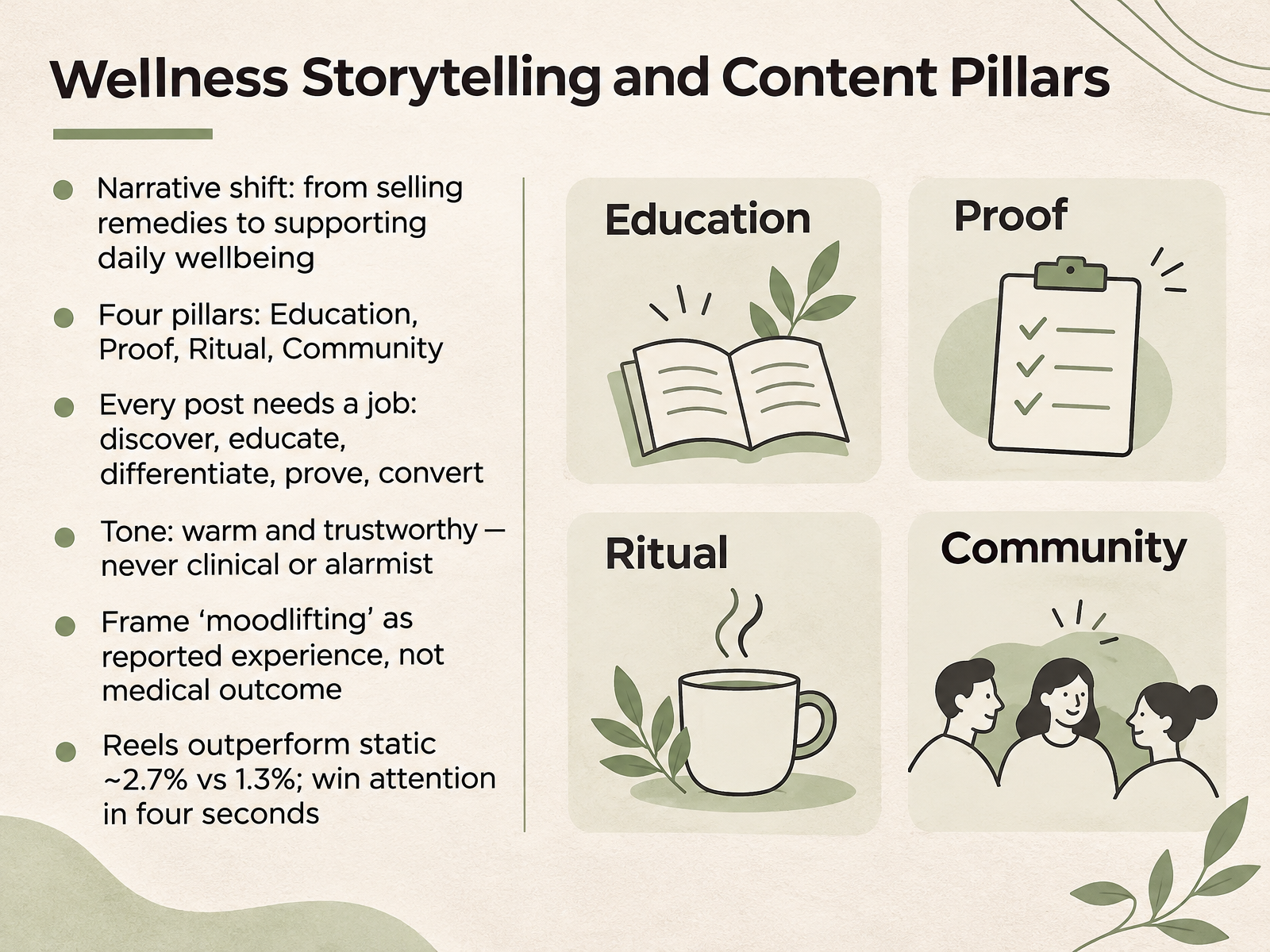
- 08Wellness Storytelling and Content PillarsNow, let's turn to wellness storytelling and your content pillars. The core narrative shift is simple. Stop selling remedies, and start supporting daily wellbeing. To do that, build four pillars: Education, Proof, Ritual, and Community. Education teaches a need. Proof shows real results. Ritual anchors the product in a daily habit. Community makes people feel part of something. And every post needs a clear job: help people discover you, educate them, differentiate your brand, prove the claim, or convert. Name that job before you write the caption. Keep your tone warm and trustworthy, never clinical or alarmist. When you talk about moodlifting, frame it as reported experience, not a medical outcome. Say what customers say they feel, not what the product treats. On format, short video is winning attention, performing at about two point seven percent versus one point three percent for static. But the real rule is this: win attention in the first four seconds. So, give each post one job and one strong opening. Next, we'll look at creative identity, packaging, and the senses.
 2 min
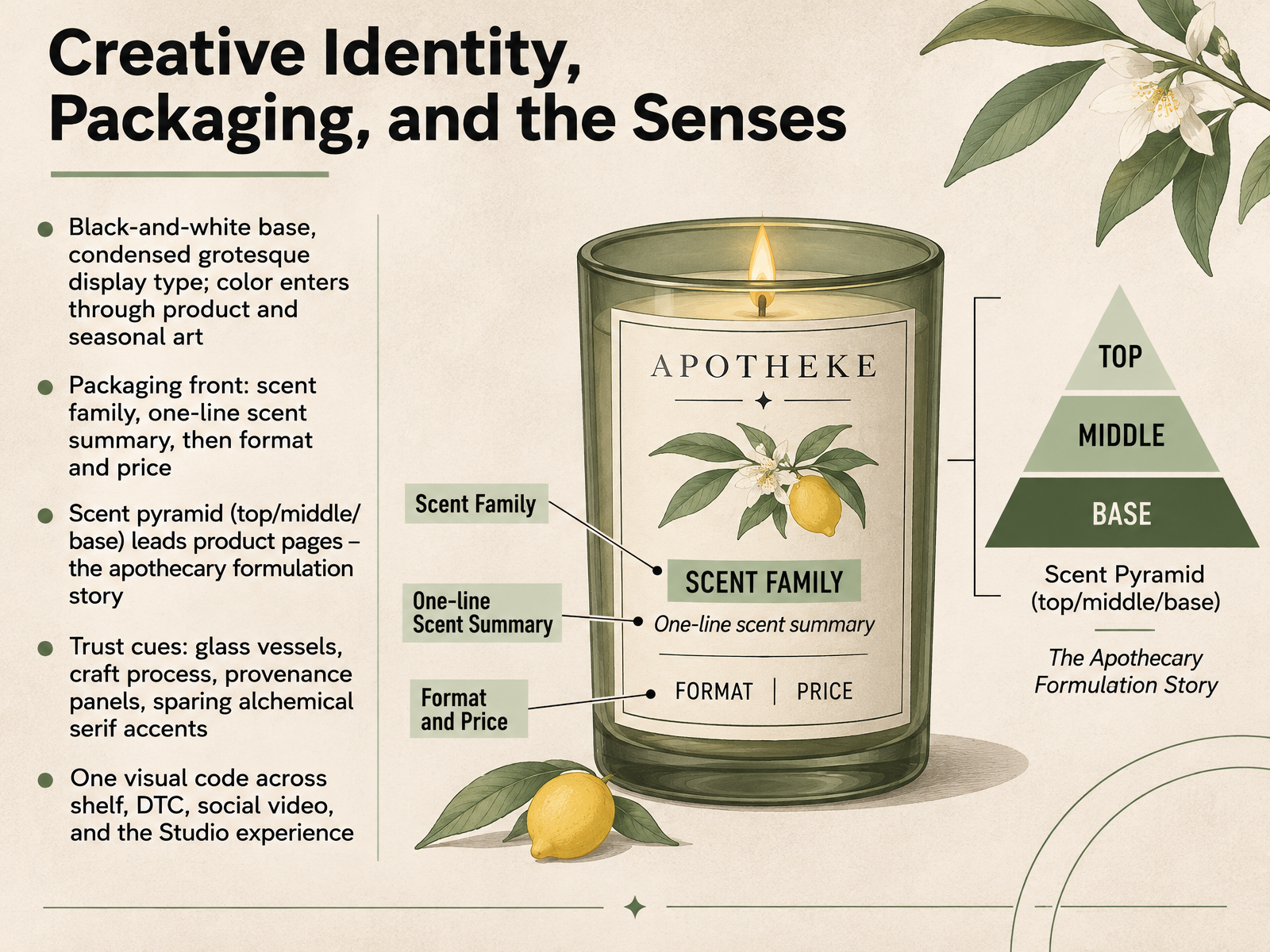
- 09Creative Identity, Packaging, and the SensesNow let's talk about creative identity, packaging, and the senses. The system starts with restraint. A black-and-white base, condensed grotesque display type, and color entering only through the product and seasonal art. That discipline keeps every new scent and collaboration on brand. The packaging front follows a fixed order: scent family, a one-line scent summary, then format and price. On product pages, lead with the scent pyramid. Top, middle, and base notes. That's the apothecary formulation story. Trust cues do the quiet work: glass vessels, craft process, provenance panels, and sparing alchemical serif accents. And one visual code carries across shelf, direct-to-consumer, social video, and the Studio experience. Your takeaway: build one code, then let color and art flex. This brings us to channels and go-to-market.
 apothekeco.comapothekeco.comstudiopaquette.com+21 min
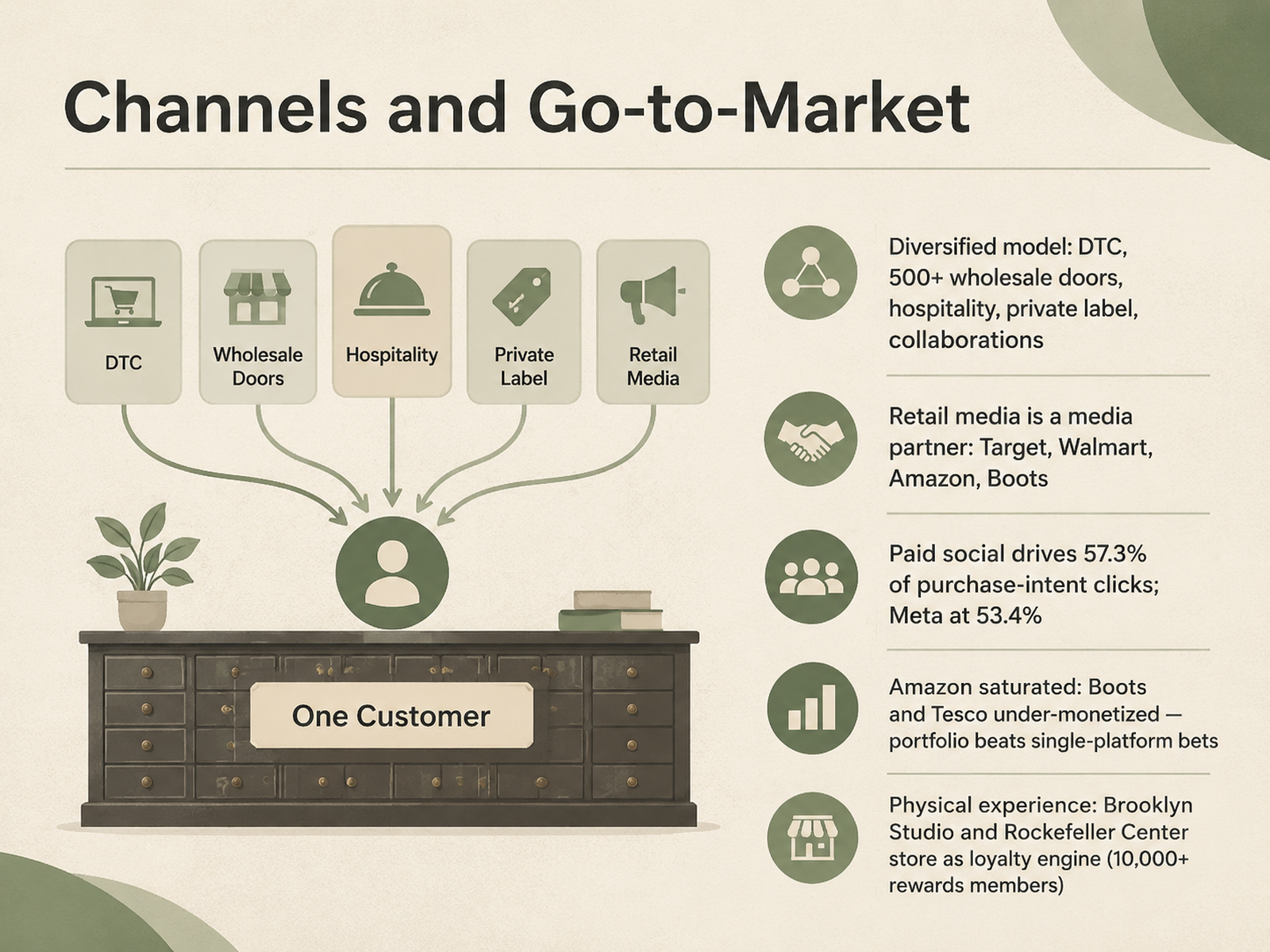
- 10Channels and Go-to-MarketNow let's talk go-to-market. Apotheke runs a diversified channel model: direct-to-consumer online, more than five hundred wholesale doors, hospitality partnerships, private label, and collaborations. That mix spreads risk across formats and audiences.
Retail media is not advertising to retailers. It is treating them as media partners, and here the key platforms are Target, Walmart, Amazon, and Boots. When you buy retail media, you place your brand inside the shopping environment where purchase intent already exists.
Paid social still drives about fifty seven percent of purchase-intent clicks, with Meta alone at fifty three point four percent. So social remains the primary discovery engine. But Amazon is saturated, while Boots and Tesco are under-monetized. A portfolio of platforms beats a single-platform bet every time.
Finally, physical experience is a loyalty engine. The Brooklyn Studio and the Rockefeller Center store have built more than ten thousand rewards members. Your takeaway: map every channel to a job, then fund the under-used ones that compound loyalty. Next, we look at Trust, Science, and Claims Compliance.
 2 min
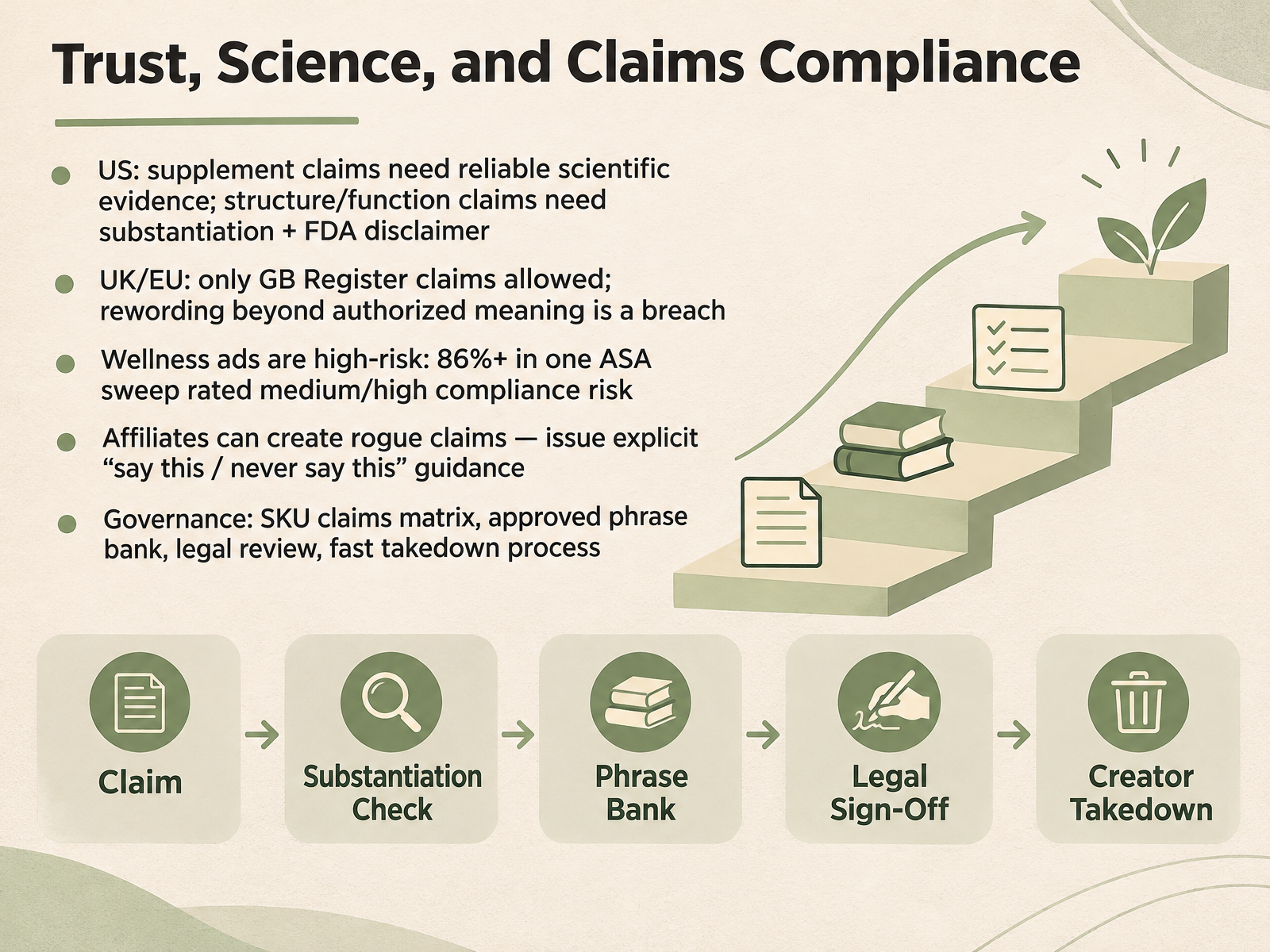
- 11Trust, Science, and Claims ComplianceNext, let's talk about trust, science, and claims compliance. This is where brand ambition meets legal reality. In the US, supplement claims need reliable scientific evidence. Structure function claims need substantiation, plus the F D A disclaimer. In the UK and EU, only claims on the G B Register are allowed. Rewording a claim beyond its authorized meaning is a breach. Wellness ads are high risk. In one Advertising Standards Authority sweep, more than eighty six percent of ads were rated medium or high compliance risk. Affiliates can create rogue claims, so issue explicit say this, never say this guidance. Build governance around it. A claims matrix by S K U, an approved phrase bank, legal review, and a fast takedown process. The takeaway is simple. Treat every claim as a promise you must defend. That discipline also protects the partnerships we'll cover next, in Community, Partnerships, and Advocacy.
 2 min
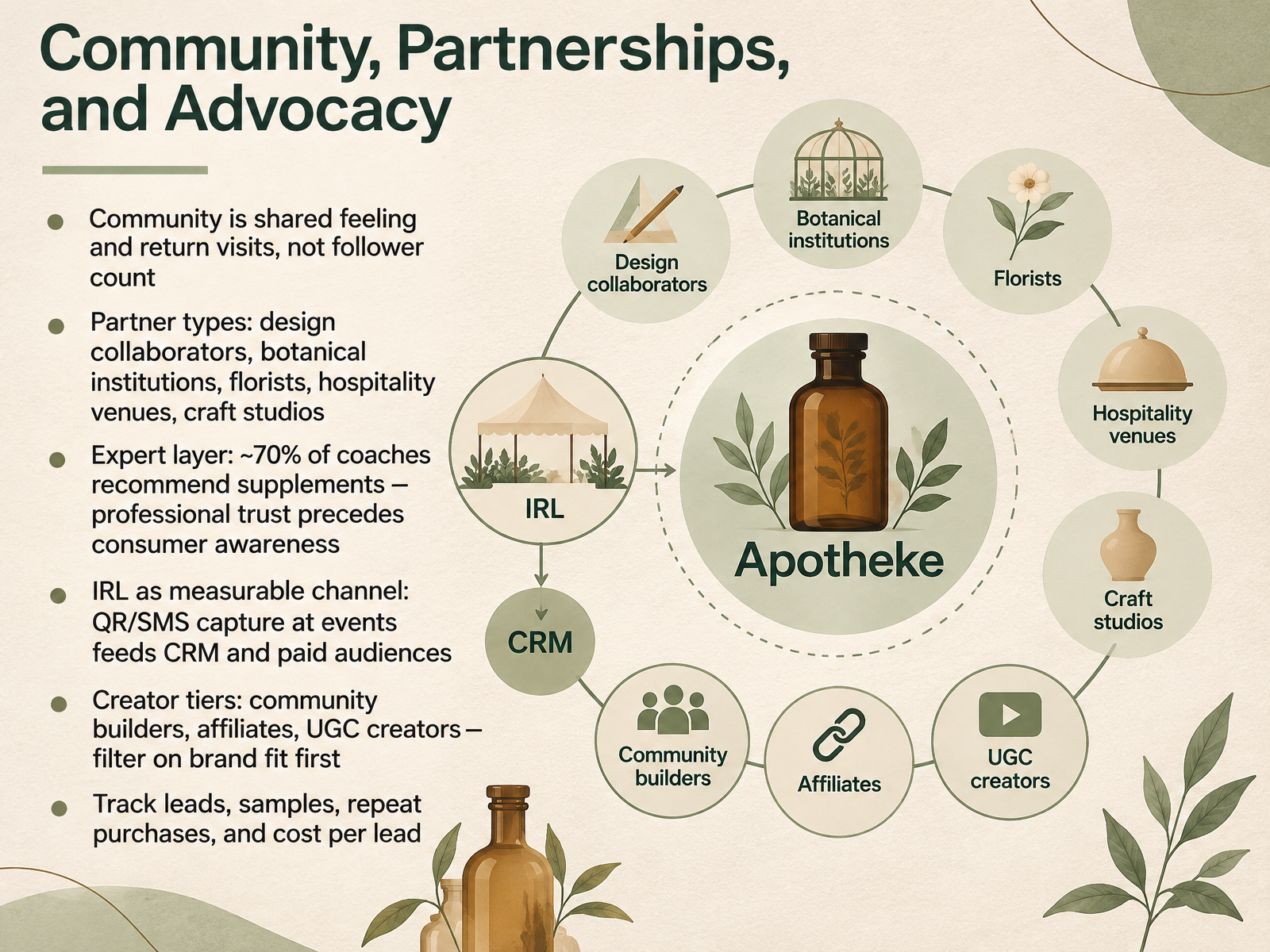
- 12Community, Partnerships, and AdvocacyLet's move on to community, partnerships, and advocacy. Community is a shared feeling and a pattern of return visits. It is not your follower count. So measure it through repeat engagement, not reach. For partners, think in types: design collaborators, botanical institutions, florists, hospitality venues, and craft studios. Choose partners whose audience and values overlap with yours. Then respect the expert layer. About seventy percent of coaches recommend supplements. That means professional trust often precedes consumer awareness, so earn expert credibility early. Treat in-person events as a measurable channel. Capture contact details with a QR code or text message sign-up, and feed that data into your CRM and paid audiences. With creators, separate community builders, affiliates, and user-generated content creators. Filter on brand fit before you look at audience size. Finally, track leads, samples, repeat purchases, and cost per lead. Those numbers tell you which partnerships deserve more investment. Next, we move to measurement: brand health and the KPI tree.
 2 min
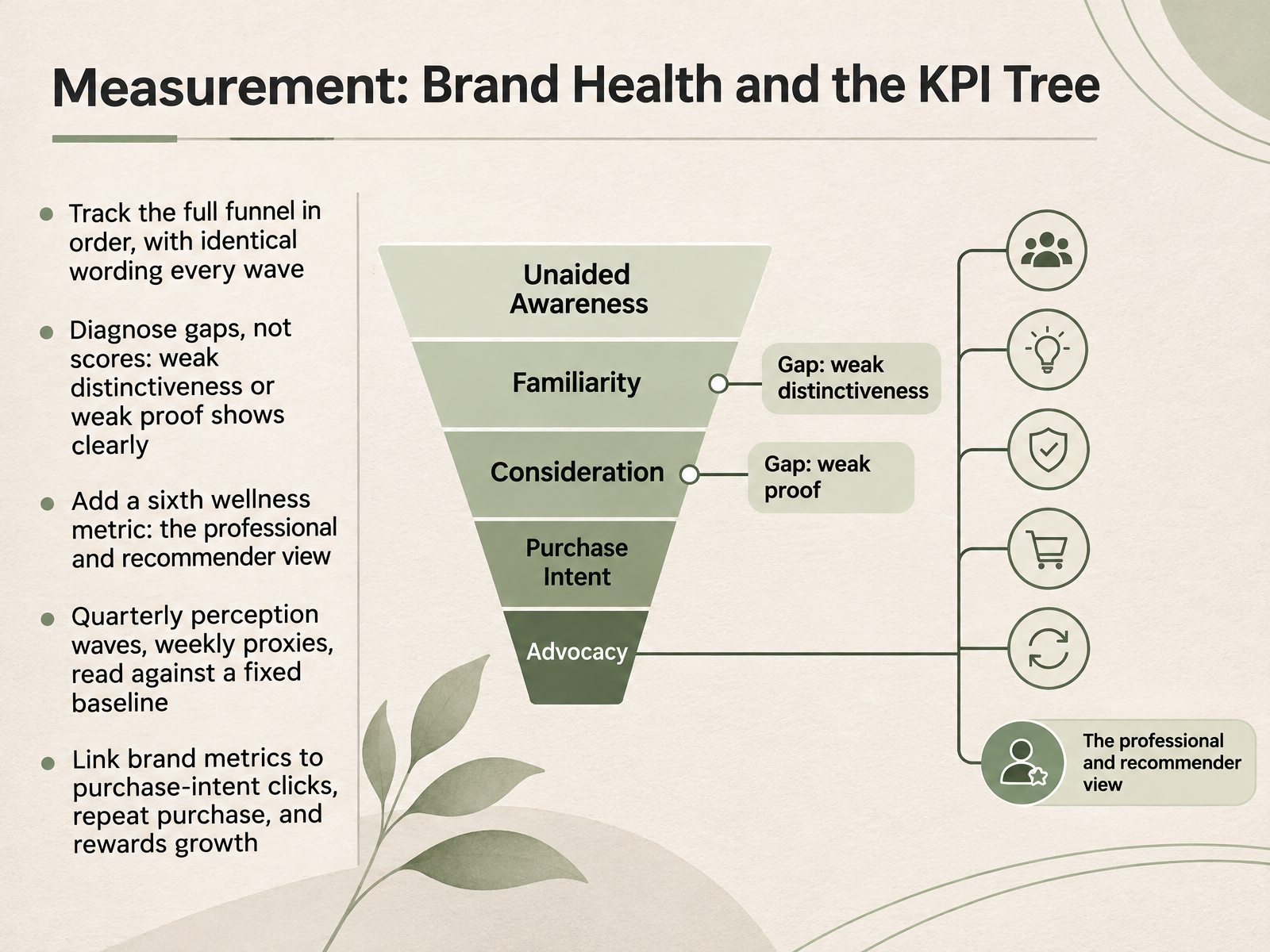
- 13Measurement: Brand Health and the KPI TreeNow let's talk about measurement. Brand health only helps if you track it consistently. So run the full funnel in order, using identical wording every wave. Same questions, same scale, same order. Otherwise, you can't tell real movement from a wording change. And diagnose gaps, not scores. A weak distinctiveness score or weak proof points tell you exactly where to act. For the wellness positioning, add a sixth metric: the professional and recommender view. That means pharmacists, wellness advisors, and other trusted voices. Cadence matters too. Run quarterly perception waves, use weekly proxies for early signals, and read everything against a fixed baseline. Finally, link brand metrics to business outcomes: purchase-intent clicks, repeat purchase, and rewards growth. That connection is what makes the KPI tree useful. Next, we'll move into the ninety-day implementation playbook and the pitfalls to avoid.
 2 min
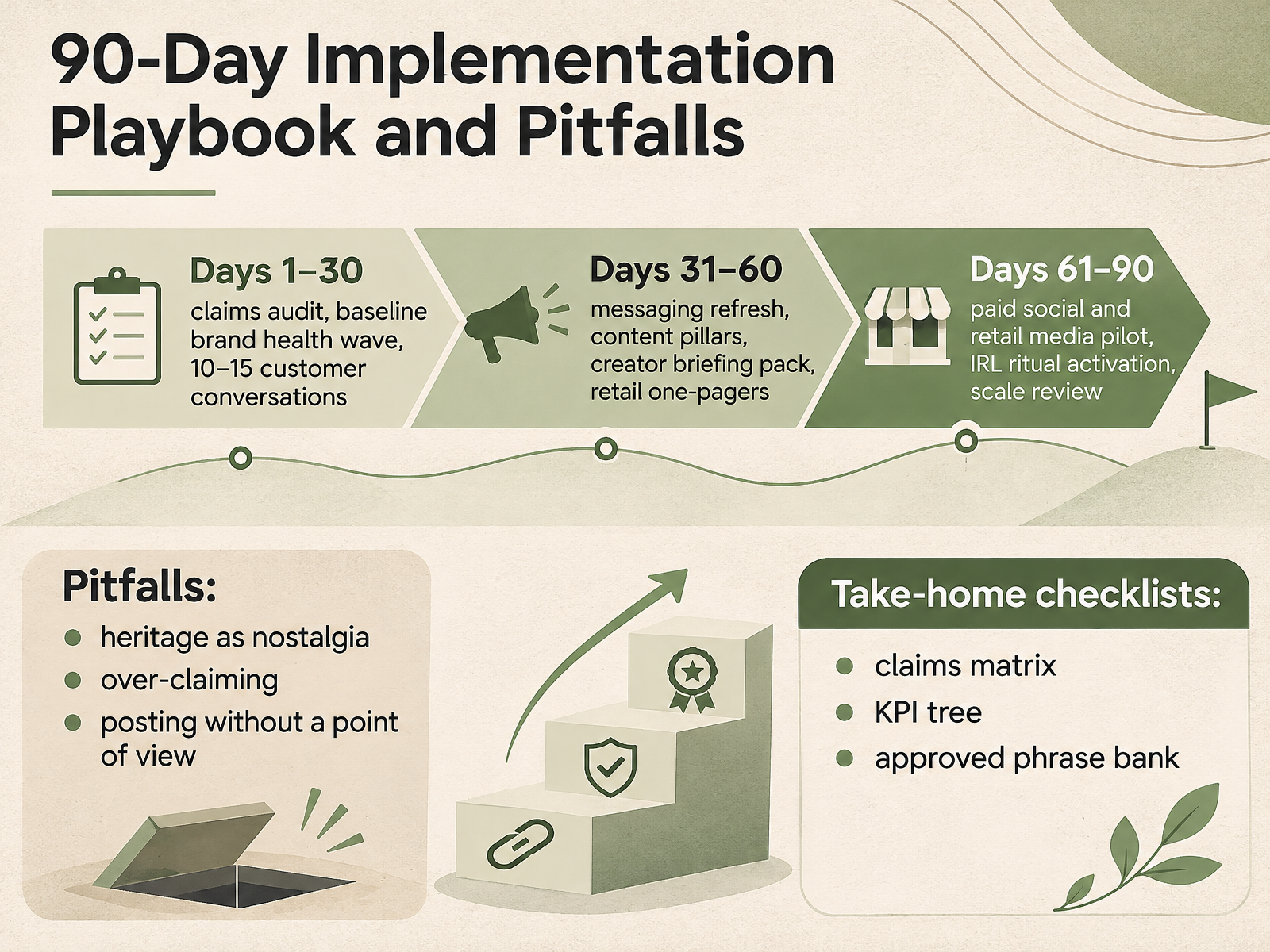
- 1490-Day Implementation Playbook and PitfallsLet's close with your ninety-day playbook, and the traps to avoid along the way. In days one to thirty, audit every claim, run a baseline brand health wave, and hold ten to fifteen real customer conversations. That baseline matters, because awareness, consideration, and trust only make sense read against a fixed competitive set over time. Days thirty-one to sixty are about build: refresh your messaging, define content pillars, assemble a creator briefing pack, and produce retail one-pagers. Days sixty-one to ninety, pilot paid social and retail media, activate one in-person ritual, then hold a scale review. Now the pitfalls. Heritage used as nostalgia just sells the past instead of the promise. Over-claiming breaks trust and often the rules, so keep every claim substantiated. And posting without a point of view is just filling a calendar. Take three checklists with you: a claims matrix, a KPI tree, and an approved phrase bank. That is the whole course. Thank you for your attention, and go build something worth remembering.
 pages.dashsocial.comemarketer.comuliann.com+22 min
Take the deck with you
Download this course as a file — free, no sign-up needed.
- PDF handoutEvery slide page, ready to print or share.15 pages · 4.9 MBDownload
- Narrated PowerPointThe deck that presents itself — every slide carries the digital human's narration video.15 pages · 15.7 MBDownload
- PowerPoint slidesThe full deck as a .pptx — open it in PowerPoint, Keynote, or Google Slides.15 pages · 4.9 MBDownload
Free to use in your own training — please keep the PersonWise credit page at the end.
Have your own deck? Turn it into a course
Sources consulted
Web sources consulted while building this course.
- Apotheke's Founder Story: Soap, Struggle, and Scale – APOTHEKE — apothekeco.com
- APOTHEKE x Target: From a Brooklyn Kitchen to Your Neighborhood Target — apothekeco.com
- Building a wellness brand, organically — capitalone.com
- apotheke — linkedin.com
- Apothékary: Liquid Herbal Supplements Scaling Into Whole Foods and Ulta | BeautyMatter — beautymatter.com
- Apotheke CEO/Founder Chrissy Fichtl Dishes On Her Career, The Brand — morninghoney.com
- About Us – APOTHEKE — apothekeco.com
- Apotheke, the Athenian natural cosmetics brand taking beauty back to basics - Monocle — monocle.com
- Ho Wah Genting optimistic of its venture into booming organic skincare market — focusmalaysia.my
- APOTHEKE | Home Fragrances To Elevate Your Everyday | Scented Candles — apothekeco.com
- STUDIO PAQUETTE — Apotheke — studiopaquette.com
- Collections – APOTHEKE — apothekeco.com
- Products – APOTHEKE — apothekeco.com
- health-wellness-industry — pages.dashsocial.com
- Wellness brands are racking up TikTok views — emarketer.com
- Instagram Content Strategy for Wellness | Uliann — uliann.com
- What's working in health and wellness on TikTok this week (November 2026): viral formats and hooks — tryvolume.app
- FAQ on wellness marketing: Who shapes health choices now and how brands earn trust — emarketer.com