CRO Tools Selection and Workflow
Begin
14 pages · ~28 min
CRO Tools Selection and Workflow
Learn to select and implement the right CRO tools and design effective optimization workflows to improve website conversion rates.
What you’ll learn
- 01Conversion Rate Optimization Tools: Selection and Workflow DesignWelcome. This course is designed for teams that already understand the fundamentals of conversion optimization and now need a practical approach to choosing and operationalizing the right tools. Our goal is not to review every vendor. Instead, we will focus on how to evaluate options, build a defensible selection framework, and design a workflow that actually gets used by growth, product, and analytics teams. We will cover the tool landscape, evaluation criteria, and the mechanics of workflow design. We will also spend real time on testing rigor, governance, and building an activation plan that avoids shelfware. Think of this as the operating system for your CRO stack, not a product demo. Let's begin with why tool selection is often the quiet predictor of CRO success.2 min
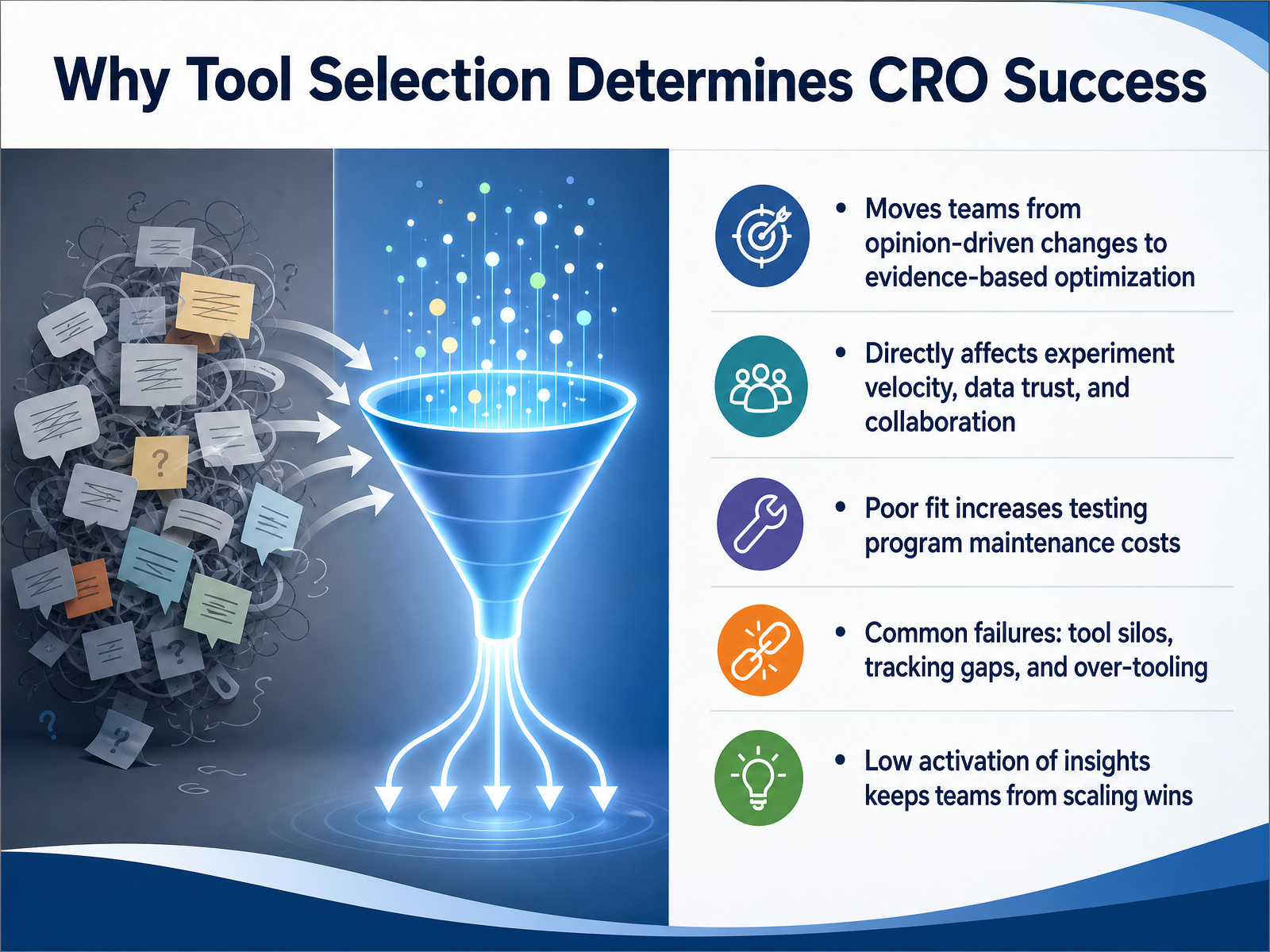
- 02Why Tool Selection Determines CRO SuccessTool selection is where most optimization programs either scale or stall. It moves your team from opinion-driven changes to evidence-based decisions. The right stack directly affects experiment velocity, data trust, and how well your team collaborates. A poor fit, on the other hand, quietly increases maintenance costs. You spend more time fixing integrations than running tests. The most common failures we see are tool silos, tracking gaps, and over-tooling. Teams buy multiple point solutions that don't talk to each other, so insights stay locked in dashboards. Low activation of those insights is the real killer. It keeps you from scaling wins across the organization, even when the data is there. What this means for your team is simple. Before adding another tool, audit whether your current stack actually supports a clean, repeatable testing workflow. With that filter in mind, let's look at the CRO tool landscape.
 2 min
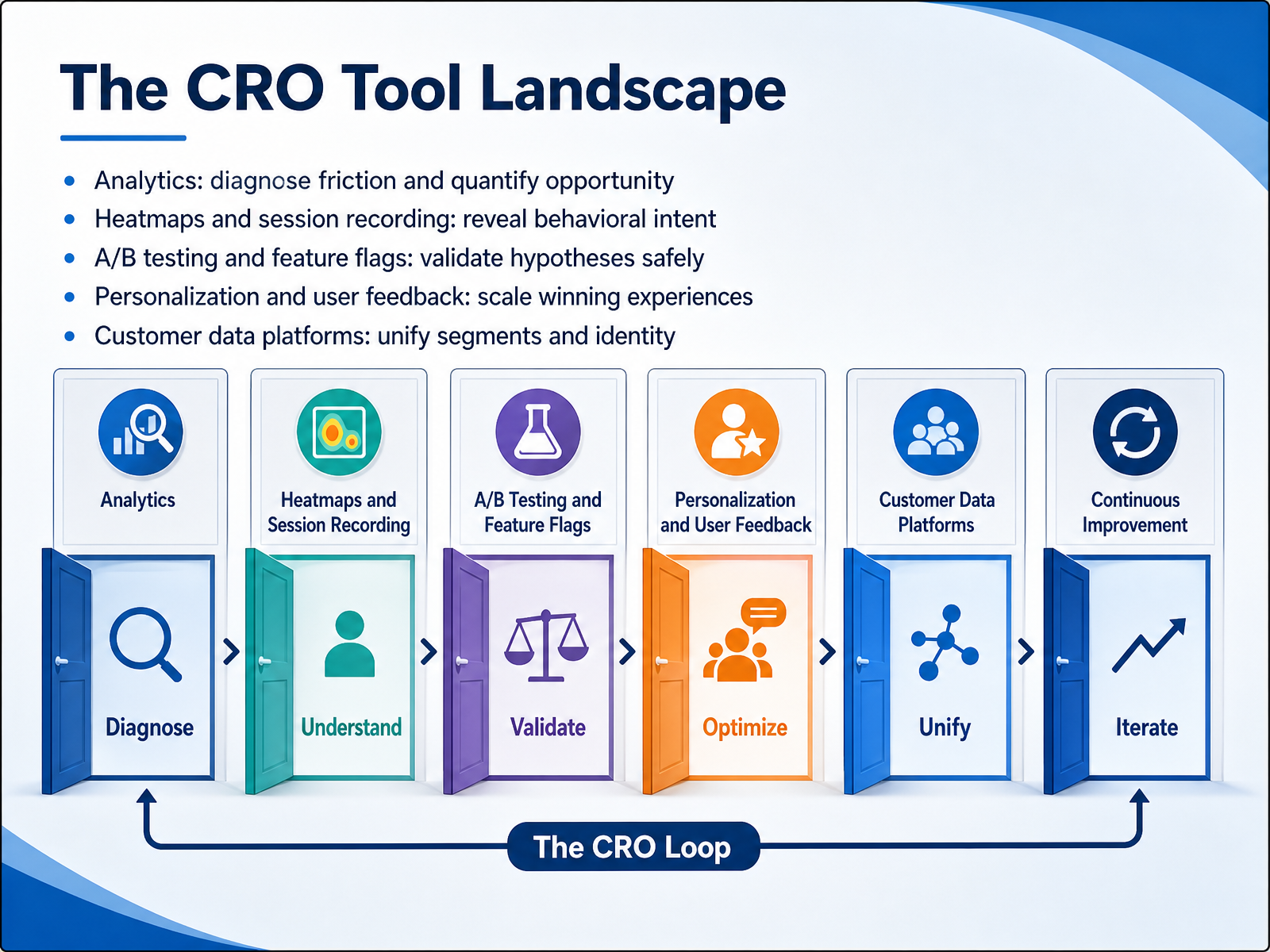
2 min - 03The CRO Tool LandscapeThe CRO tool landscape looks crowded, but it becomes easier to manage when you group tools by the job they actually perform. Start with analytics. This is where you diagnose friction and quantify opportunity before making changes. Next, heatmaps and session recording reveal behavioral intent, showing where users hesitate, scroll, or abandon. Then A/B testing and feature flags let you validate hypotheses safely, without overcommitting to an untested idea. Personalization and user feedback tools help you scale winning experiences once you know what works. Finally, customer data platforms unify segments and identity, so your insights stay consistent across channels. What this means for your team is that no single category replaces another. Each layer answers a different question in the same workflow. With that framing in place, let’s move into the core concepts for evaluation.
 1 min
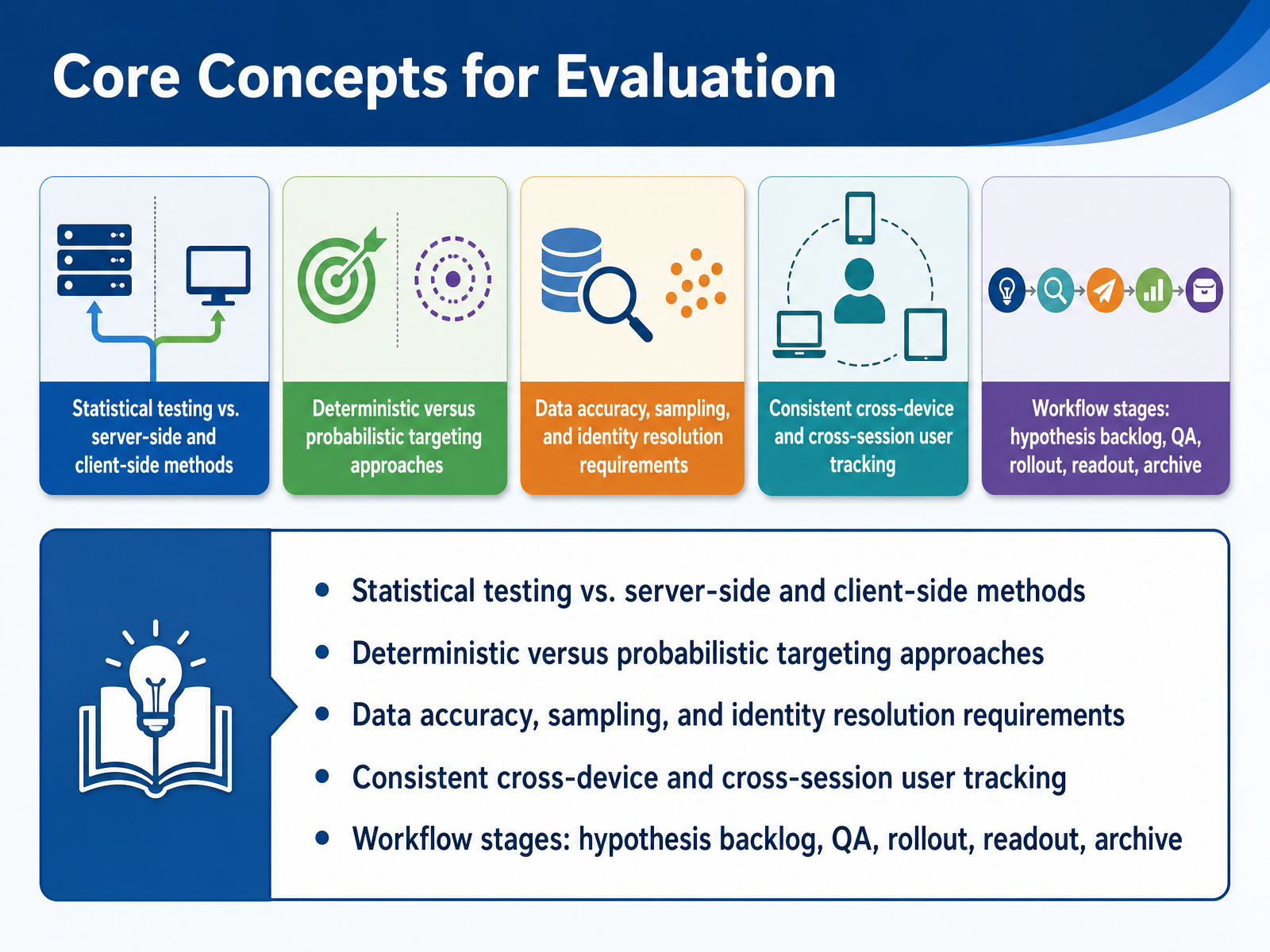
1 min - 04Core Concepts for EvaluationWith core tooling mapped, let’s align on the concepts that determine whether a tool actually fits your testing program. Start with how you deploy tests. Statistical testing still matters, but your decision point is really client-side versus server-side delivery. Client-side supports fast iteration, while server-side gives you more control for complex experiments. Next, consider deterministic versus probabilistic targeting. If your team relies on first-party data or logged-in users, deterministic targeting gives you precision. Probabilistic methods work better for broad prospecting, but expect more noise. Data accuracy, sampling, and identity resolution are not back-office details. They directly affect how quickly you can trust a result, especially when resolving users across devices and sessions. Inconsistent tracking creates false winners and wasted roadmap time. So ask whether the tool maintains a stable user ID across touchpoints. Finally, map your workflow before buying. You need a place for a hypothesis backlog, QA checks, controlled rollout, readout, and archiving. If a tool cannot support that full loop, your team will create manual workarounds. These concepts set the baseline for the selection criteria we’ll cover next.
 2 min
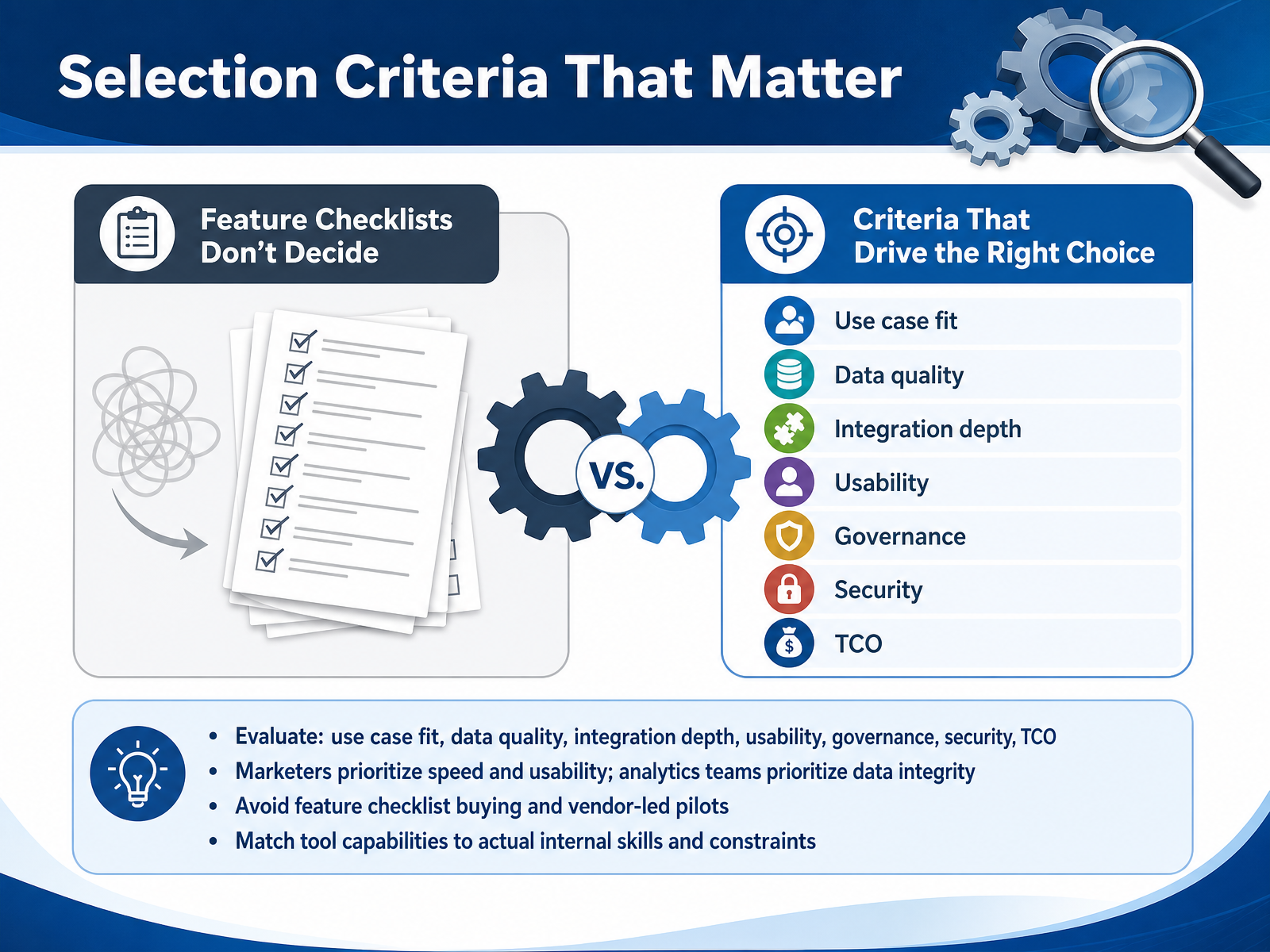
2 min - 05Selection Criteria That MatterSelection criteria need to be more than a surface-level checklist. Start with use case fit. The tool should solve the specific testing and personalization problems your team actually has. Then look at data quality and integration depth. If the tool cannot connect cleanly to your product analytics or CRM, the insights it produces will be limited. Usability matters differently by function. Marketers will prioritize speed and ease of launching tests. Analytics teams will prioritize data integrity, sampling controls, and reliable significance calculations. Both perspectives are valid, so surface these trade-offs during evaluation, not after purchase. Also weigh governance, security, and total cost of ownership. A tool that creates compliance risk or hidden technical overhead will slow adoption. Avoid feature checklist buying. Large feature lists often hide weak core workflows. And be cautious with vendor-led pilots, because they tend to showcase best-case scenarios rather than your real operating constraints. Match the tool to internal skills and constraints. If your team cannot build custom experiments or manage complex integrations, choose something simpler and more supportable. What this means for your team is that tool adoption depends on fit, not on vendor promises. Next, we will look at building a structured selection process.
 2 min
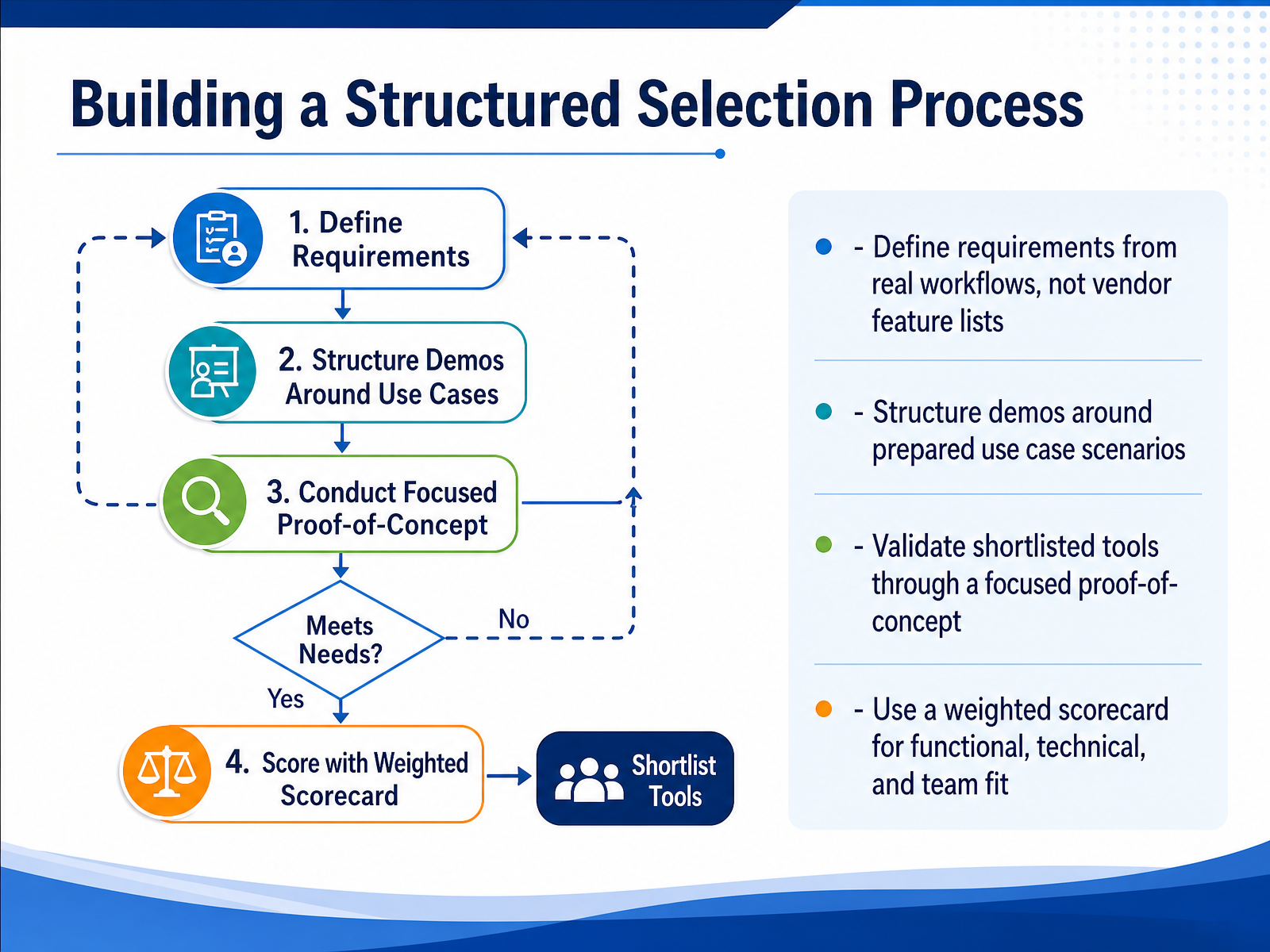
2 min - 06Building a Structured Selection ProcessNow let's turn selection into a structured process rather than a preference contest. Start by defining requirements from your actual workflows, not from a vendor's feature list. What does your team truly need to run tests, analyze sessions, and act on insights? That becomes your baseline. Then structure demos around prepared use case scenarios. Ask each vendor to show how their tool handles your specific challenges, like segmenting returning visitors or diagnosing a checkout drop-off. This keeps demos comparable. After that, run a focused proof of concept with two or three shortlisted tools. Have your analysts use them on real data for a limited time and document friction points. Finally, score each option with a weighted scorecard. Assign weights to functional fit, technical integration, and team usability before you see the results. This removes recency bias and makes the final decision defensible. Next, we'll move into designing the CRO workflow around whichever tool you select.
 1 min
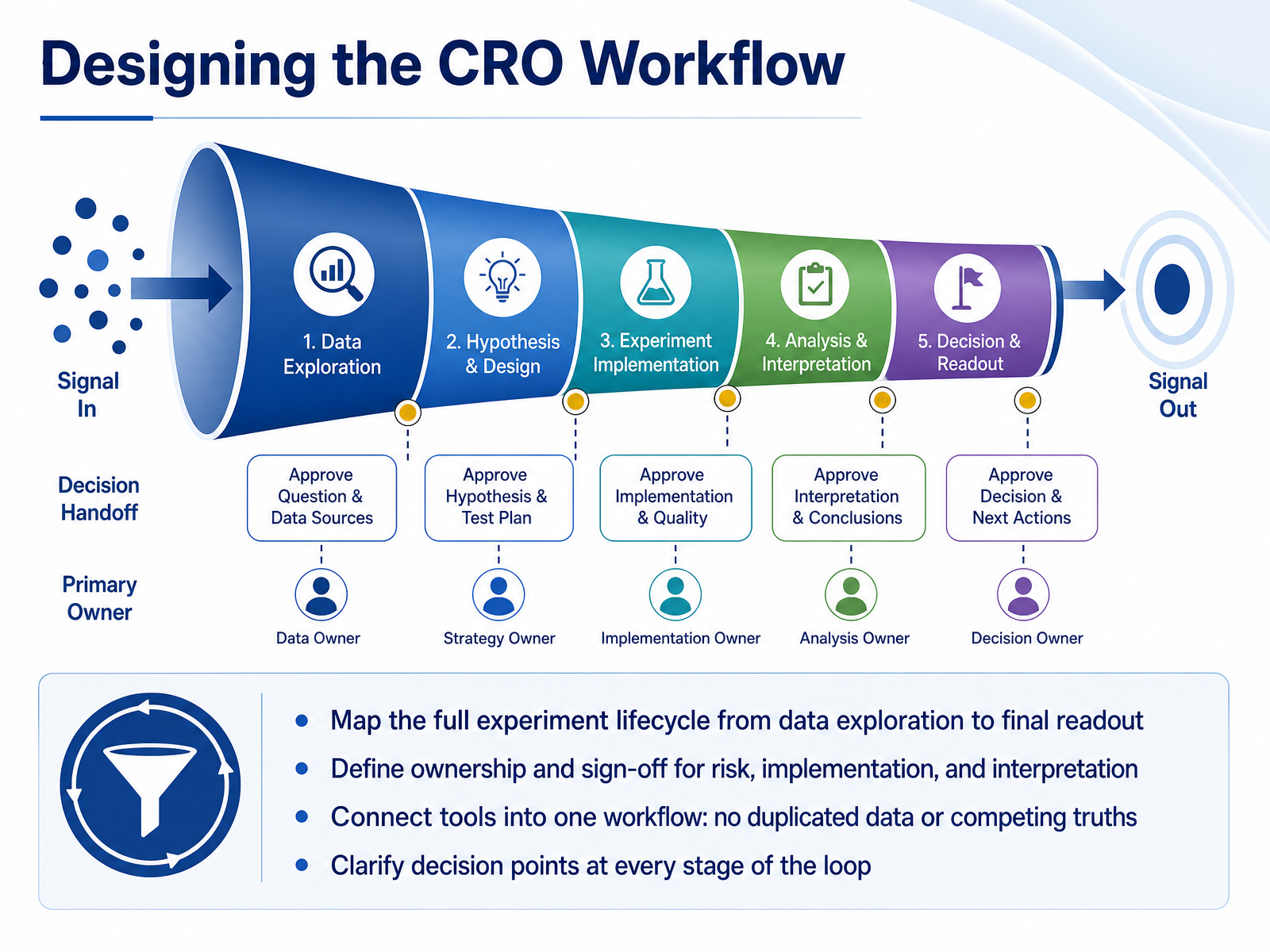
1 min - 07Designing the CRO WorkflowNow let's turn that tool selection into a structured workflow. Start by mapping the full experiment lifecycle, from initial data exploration and hypothesis generation, all the way to final readout and next-step recommendations. The goal is to see every stage on one page. Next, define ownership explicitly. Someone needs to own risk, someone owns implementation, and someone owns interpretation. Without that clarity, decisions stall at the worst possible moment. Then connect your tools into a single workflow. Avoid duplicated data or competing versions of the truth. For example, your analytics platform and your testing tool should feed the same source for visitor segments. That keeps your team aligned on what actually changed. Finally, make decision points explicit at each stage of the loop. At every gate, decide whether to continue, pivot, or stop. This prevents low-value tests from consuming engineering time. What this means for your team is fewer handoffs, fewer surprises, and faster learning cycles. Next, we'll look at integrating tools across the CRO stack.
 1 min
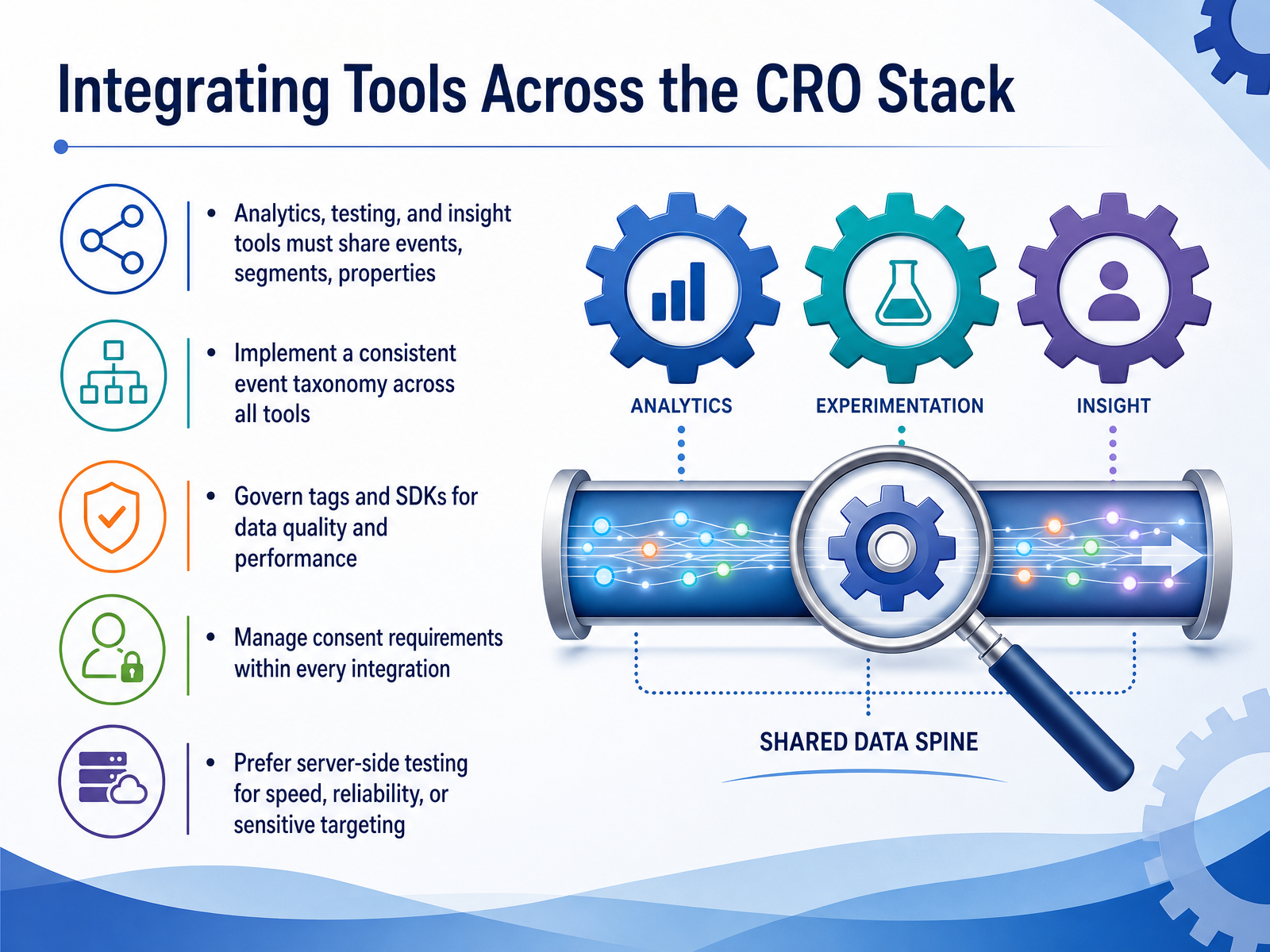
1 min - 08Integrating Tools Across the CRO StackNow let's look at how these tools connect. The real value comes when analytics, testing, and insight tools share the same events, segments, and user properties. That only works if your team commits to one event taxonomy across the entire stack. It sounds simple, but without it you'll spend more time reconciling data than acting on it. Governance matters too. Treat tags and SDKs like production code, versioned and reviewed. This protects data quality and keeps page performance under control. Consent requirements belong inside every integration, not just your analytics tool, because any vendor script can expose user data. Where speed or sensitive targeting is involved, prefer server-side testing. It reduces client-side load and gives you more control over what gets sent. That's the foundation for reliable experiments. Next, we'll turn that foundation into action with hypothesis design and experiment prioritization.
 1 min
1 min - 09Hypothesis Design and Experiment PrioritizationNow let's talk about turning observed problems into structured experiments. A useful hypothesis has four parts: the evidence you're seeing, the change you'll make, the impact you expect, and the primary metric you'll measure. If any of those pieces is vague, the test is not ready. Use a prioritization model like ICE or PIE to rank the backlog by potential impact, confidence, and effort. Keep that backlog in your testing tool so the team can see what is queued and why. Weak evidence or unclear decision rules create low-quality experiments that waste traffic and analyst time. And be careful with segmentation. Sound segments prevent false positives, but overlapping or loosely defined segments will make results unreadable. Next, we'll move into measurement, statistical rigor, and result readout.
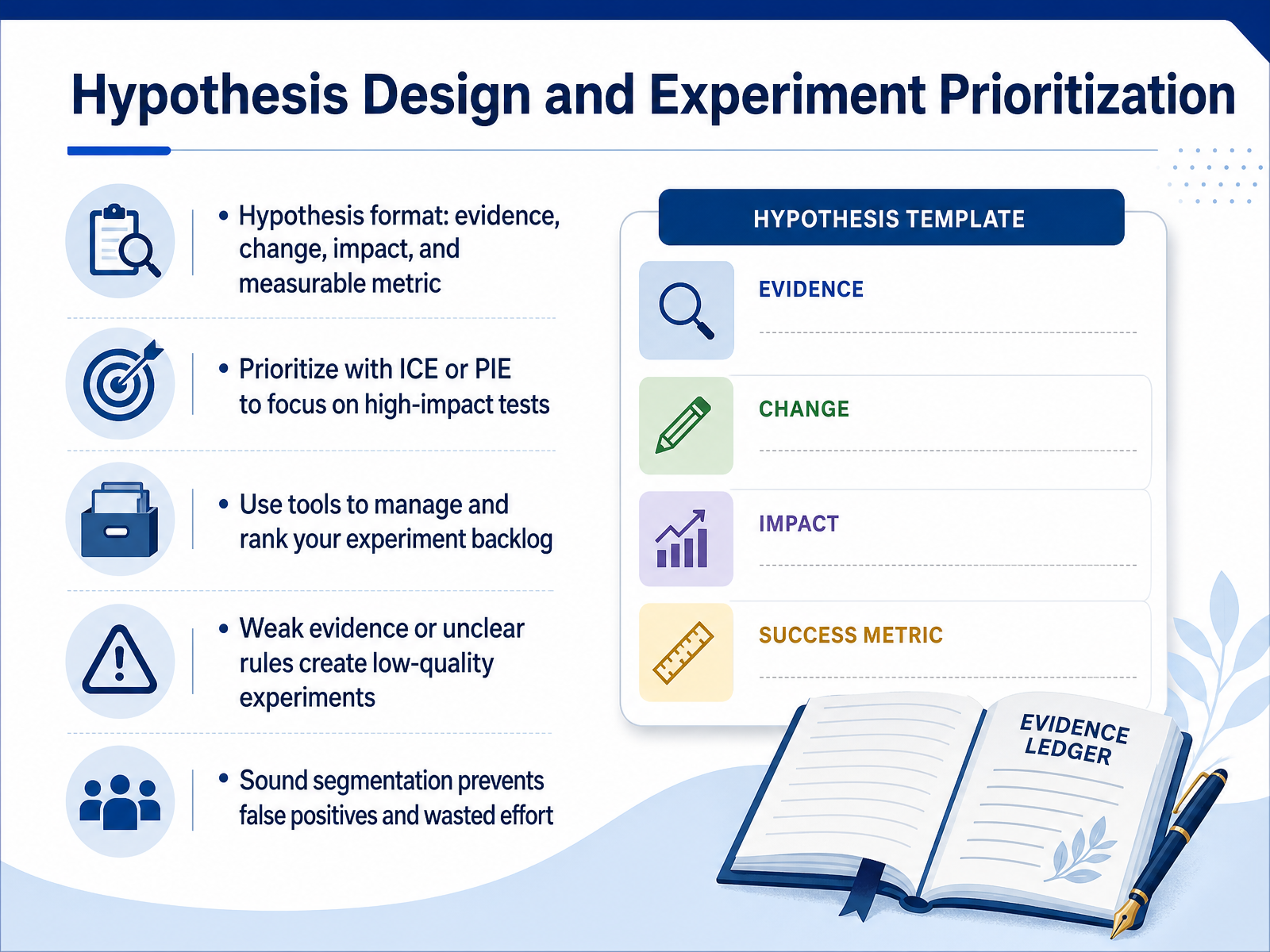 1 min
1 min - 10Measurement, Statistical Rigor, and Result ReadoutNow let's turn to measurement, statistical rigor, and how we read out results. Every test needs three metric layers. The primary metric is the success measure tied directly to your hypothesis. A guardrail protects revenue, risk, and customer trust, things you absolutely cannot trade away. And a diagnostic metric explains why the primary metric moved. Before you launch, pre-plan your sample size, duration, significance level, and confidence intervals. That pre-commitment is what prevents random noise from masquerading as a real finding. No peeking before the agreed readout point. Early stopping inflates false positives and makes your roadmap worse. When the test ends, use a structured decision. You ship, iterate, investigate, or kill. Whatever the outcome, that clarity is the real return on your CRO investment. Up next, we apply this discipline to governance, risk, and the team operating model.
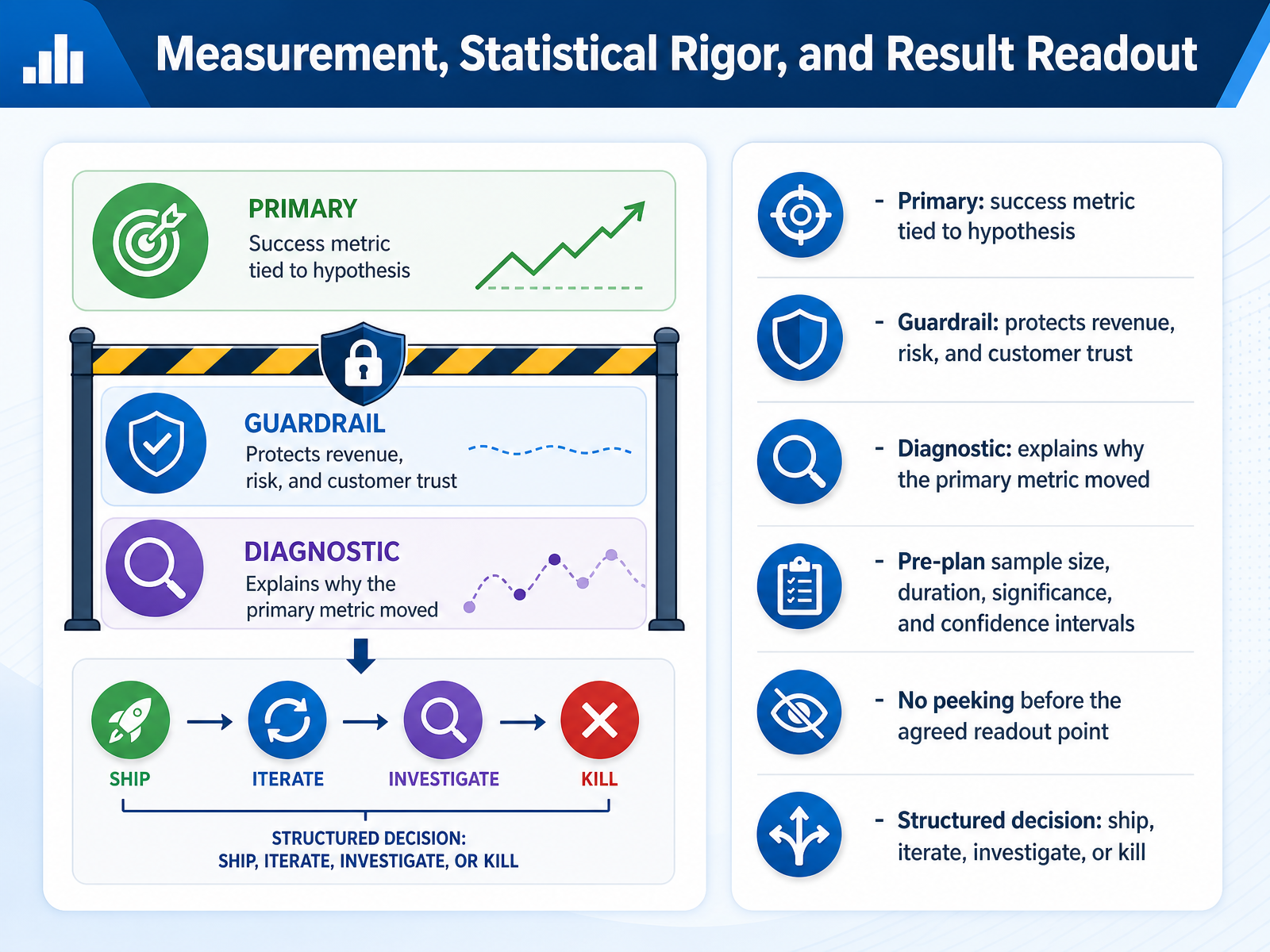 1 min
1 min - 11Governance, Risk, and Team Operating ModelNow let's talk about governance and team operating models. This is where a strong tool stack either scales, or quietly becomes a reporting liability. First, define clear roles. Growth owns hypothesis development, product manages the build, analytics validates measurement, engineering controls implementation, and privacy reviews consent and data handling. If these boundaries are vague, experiment velocity slows down and data quality degrades. Second, keep a centralized experiment registry and standardized QA checklists. Every test needs the same pre-launch checks for tracking, audience logic, and variant rendering. This cuts down on false results and makes audits much easier. Third, enforce consent requirements and controlled rollout practices. Start with small traffic splits and expand only after results look stable. That protects the user experience and keeps your compliance team comfortable. Finally, balance self-serve experimentation with centralized oversight. Let teams move fast with their own tools, but keep one owner responsible for data definitions and integration quality. What this means for your team is a clear operating cadence, fewer invalid tests, and faster decision making. Next, we will apply this to practice scenarios and common pitfalls.
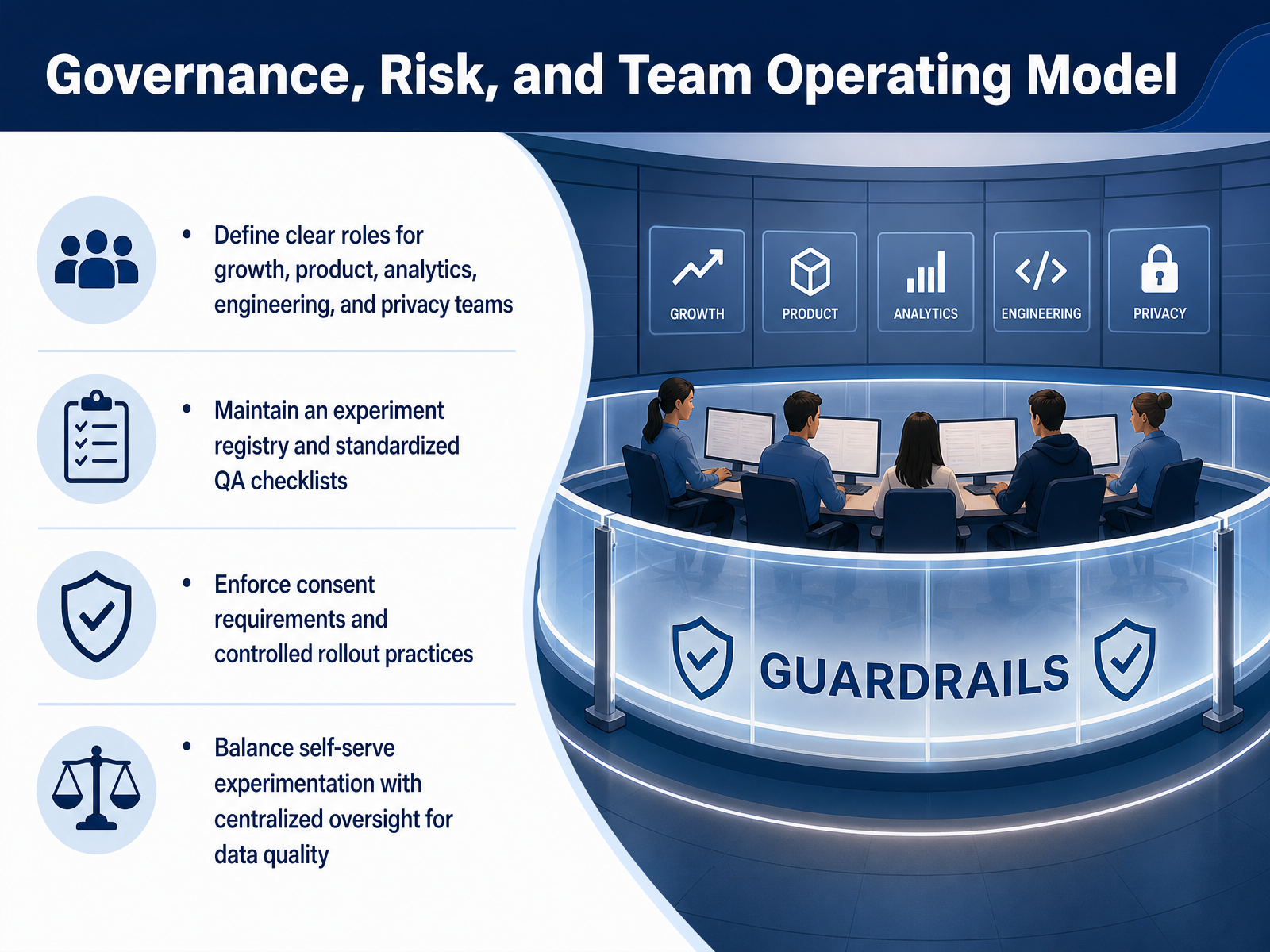 2 min
2 min - 12Practice Scenarios and Common PitfallsNow let’s turn these frameworks into real decisions. A common starting point is choosing between a lightweight tool and an enterprise platform. If your team runs a handful of experiments each month and owns product analytics elsewhere, a focused tool is often faster. If experimentation is central and compliance or scale matters, enterprise tooling earns its cost. What this means for your team is avoiding a purchase based on feature count alone. Another frequent issue is inconsistent event tracking. When naming or taxonomy drifts across teams, test data becomes unreliable before analysis even starts. Fixing tracking standards is usually higher leverage than adding another tool. Low-velocity testing programs usually have a process problem, not a tool problem. The fix is a smaller, defined testing roadmap with clear owners. And never launch a test without a written hypothesis. A test without a hypothesis is just a random change with no lesson attached. Finally, watch guardrail metrics and sample size. Declaring a winner from a tiny sample or while key metrics degrade creates false confidence. In practice, one clean learning cycle beats five noisy tests. Next, we’ll look at activating CRO insights across the organization.
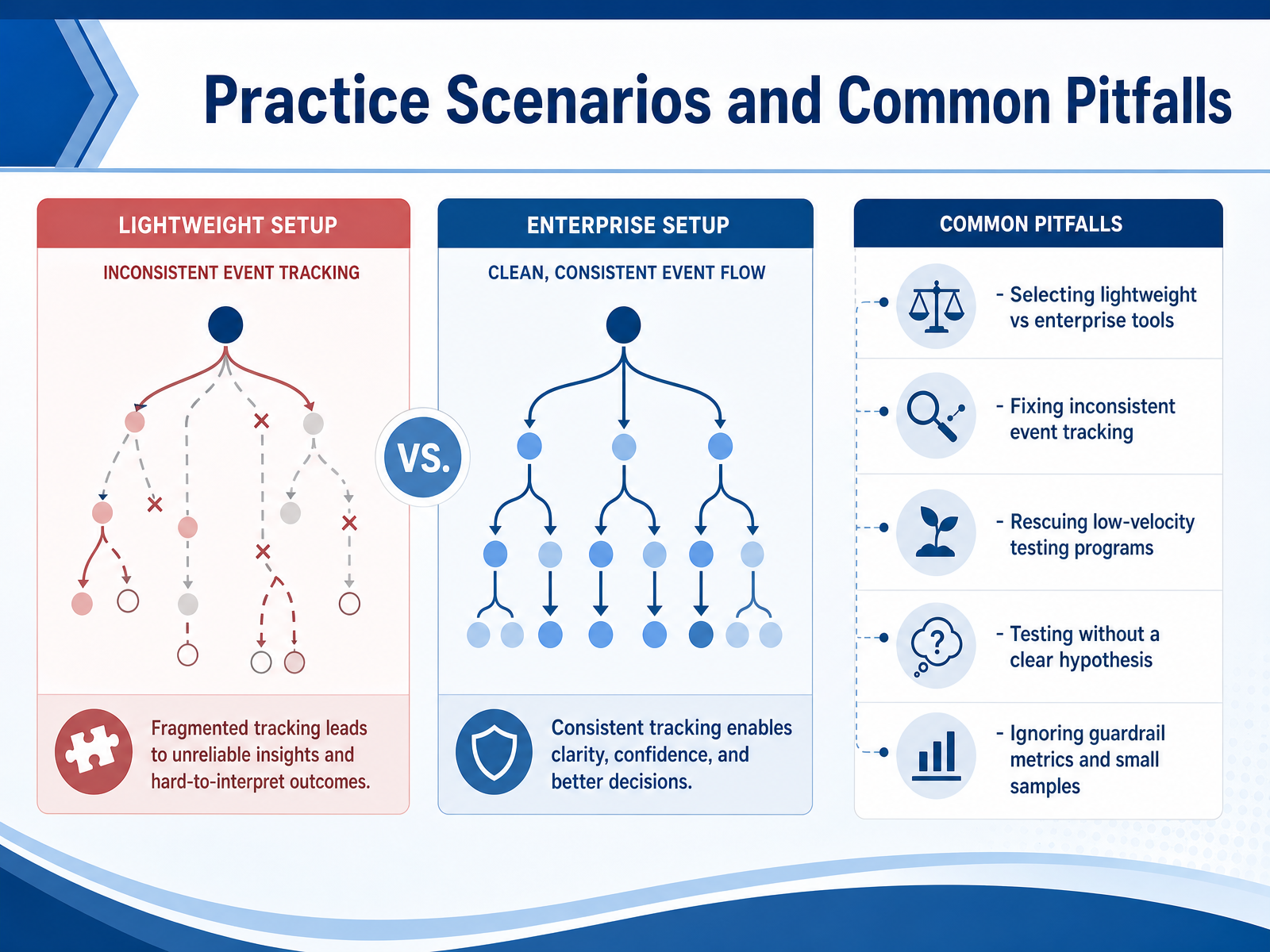 2 min
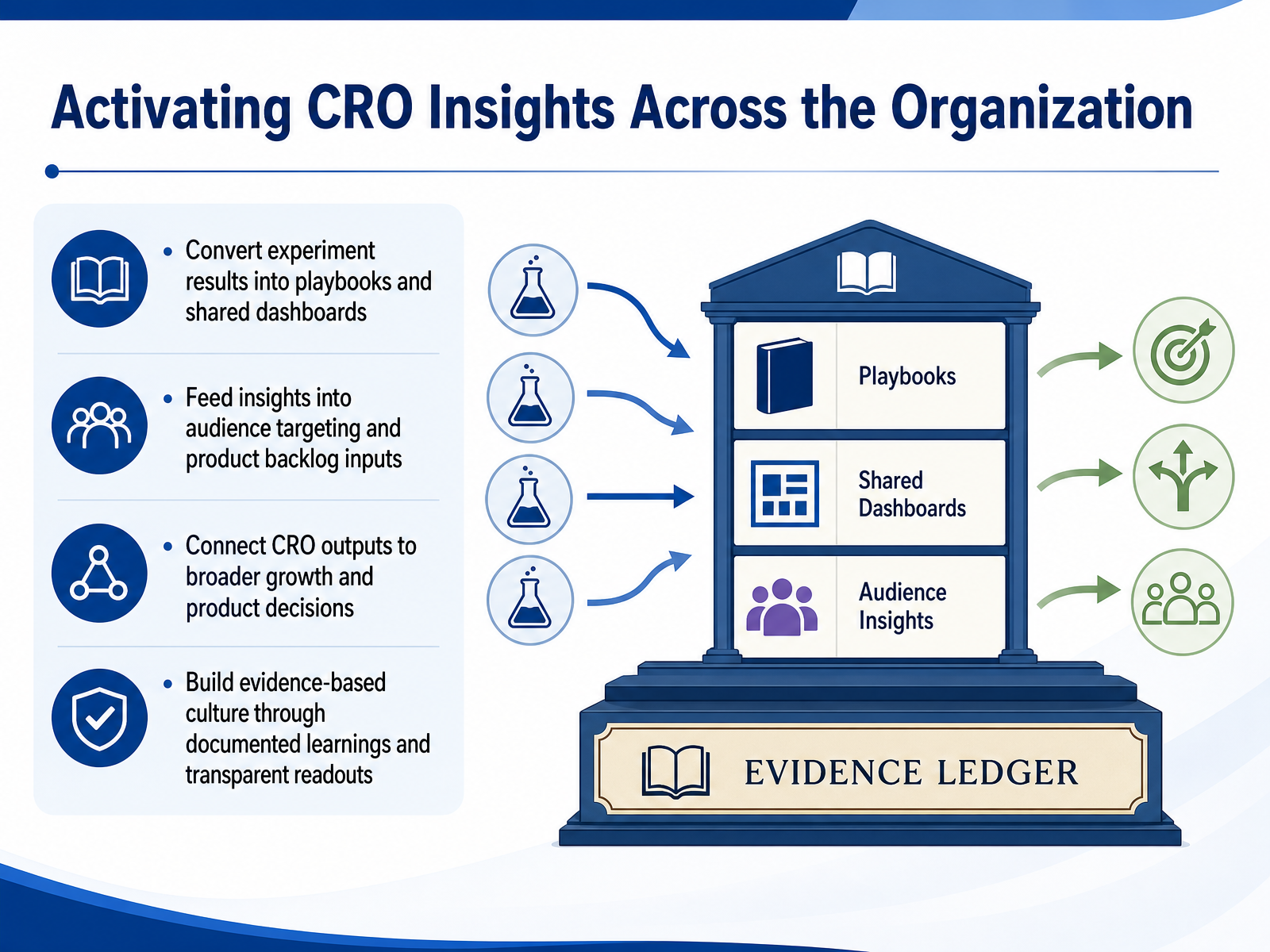
2 min - 13Activating CRO Insights Across the OrganizationNow let's talk about making your CRO insights work outside the experimentation team. The value grows when results move beyond a single test readout and into the rest of the organization. Start by converting what you learn into reusable playbooks and shared dashboards. That way, a winning messaging change or checkout flow adjustment becomes a reference point, not a one-time artifact. Next, feed those insights into audience targeting and product backlog inputs. For example, if a test shows that first-time buyers respond to proof points rather than discounts, your paid media team should know that, and your product team should record the friction you uncovered for a future release. Connect CRO outputs to broader growth and product decisions. This means the experimentation team is not just running tests in isolation, it is providing evidence that shapes prioritization elsewhere. Finally, build an evidence-based culture through documented learnings and transparent readouts. Share both wins and losses openly, because a failed test still tells you something about the customer. What this means for your team is that CRO becomes a system for learning, not just a list of experiments. In the next slide, we will pull this together with a summary and next actions.
 2 min
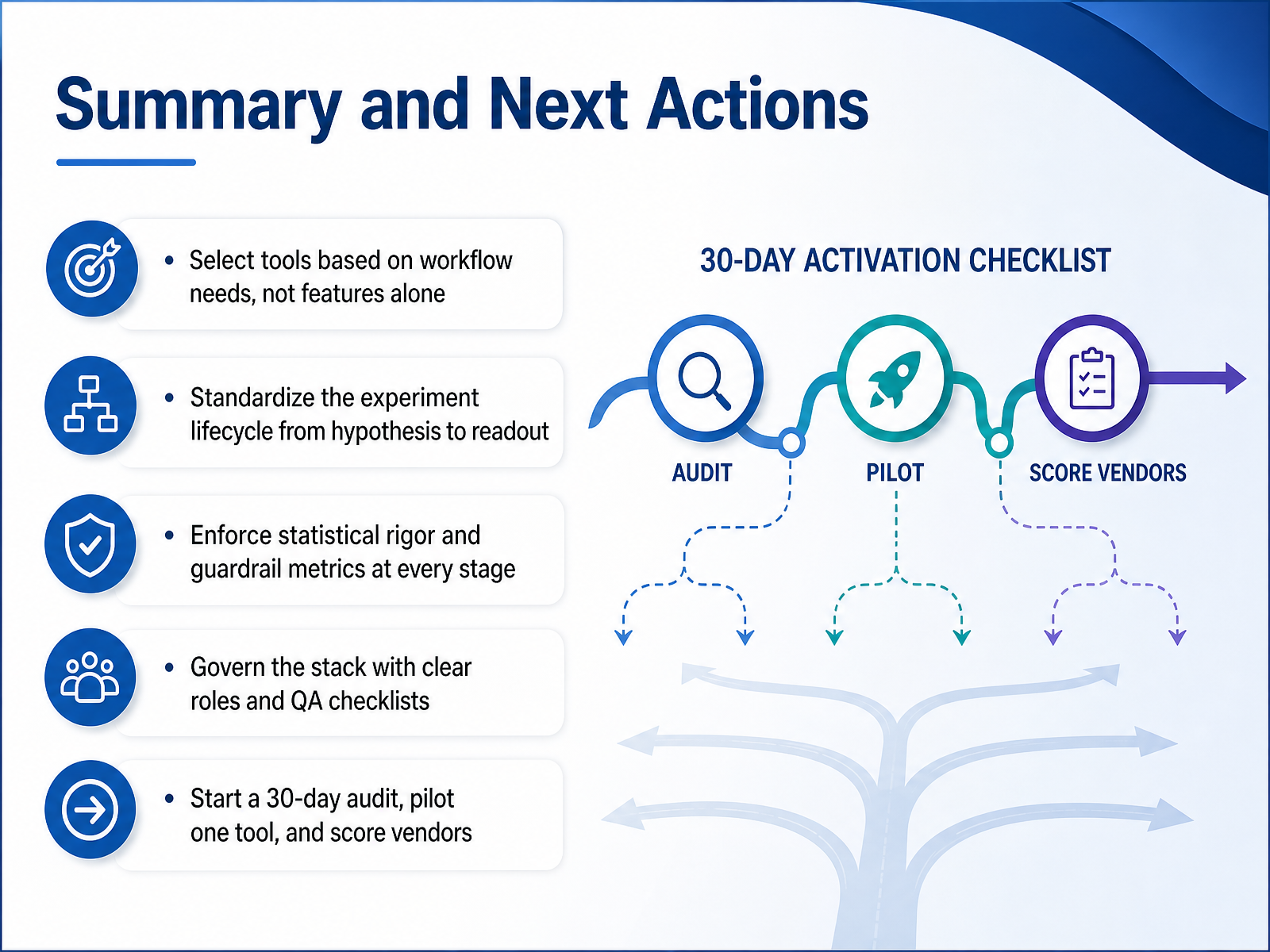
2 min - 14Summary and Next ActionsLet’s pull this together. Tool selection should start with your workflow, not a feature list. Map the experiment lifecycle first, then choose tools that reduce handoffs and keep your data consistent. Standardize every stage from hypothesis through readout, and make statistical rigor non-negotiable. That means agreed sample sizes, guardrail metrics, and no early stopping without a plan. Governance matters too. Assign clear tool roles, document QA checklists, and review stack performance quarterly so the system stays lean. For your next step, run a thirty-day audit of your current stack. Identify one workflow gap, pilot one tool against a scored vendor shortlist, and measure whether it actually improves experiment velocity and decision quality. The goal is not more tools. It is a faster, cleaner path from insight to test to revenue impact. Thank you for joining, and good luck building a CRO stack your team can actually trust.
 2 min
2 min
Take the deck with you
Download this course as a file — free, no sign-up needed.
- PDF handoutEvery slide page, ready to print or share.15 pages · 3.7 MBDownload
- Narrated PowerPointThe deck that presents itself — every slide carries the digital human's narration video.15 pages · 13.7 MBDownload
- PowerPoint slidesThe full deck as a .pptx — open it in PowerPoint, Keynote, or Google Slides.15 pages · 3.6 MBDownload
Free to use in your own training — please keep the PersonWise credit page at the end.
Have your own deck? Turn it into a course