Begin
14 pages · ~28 min
Digital Marketing Maturity Models
A concise overview of digital marketing maturity models for marketers and business leaders seeking to assess and advance their organization's digital marketing capabilities.
A digital instructor presents all 14 pages. Hold “Ask” at any point and ask out loud — the answer comes from this course. No sign-up needed.
What you’ll learn
- 01Digital Marketing Maturity Models ExplainedWelcome. I'm glad you're here. Over the next few minutes, we're going to make digital marketing maturity models genuinely useful for you. Not as an academic exercise, but as a practical diagnostic tool.
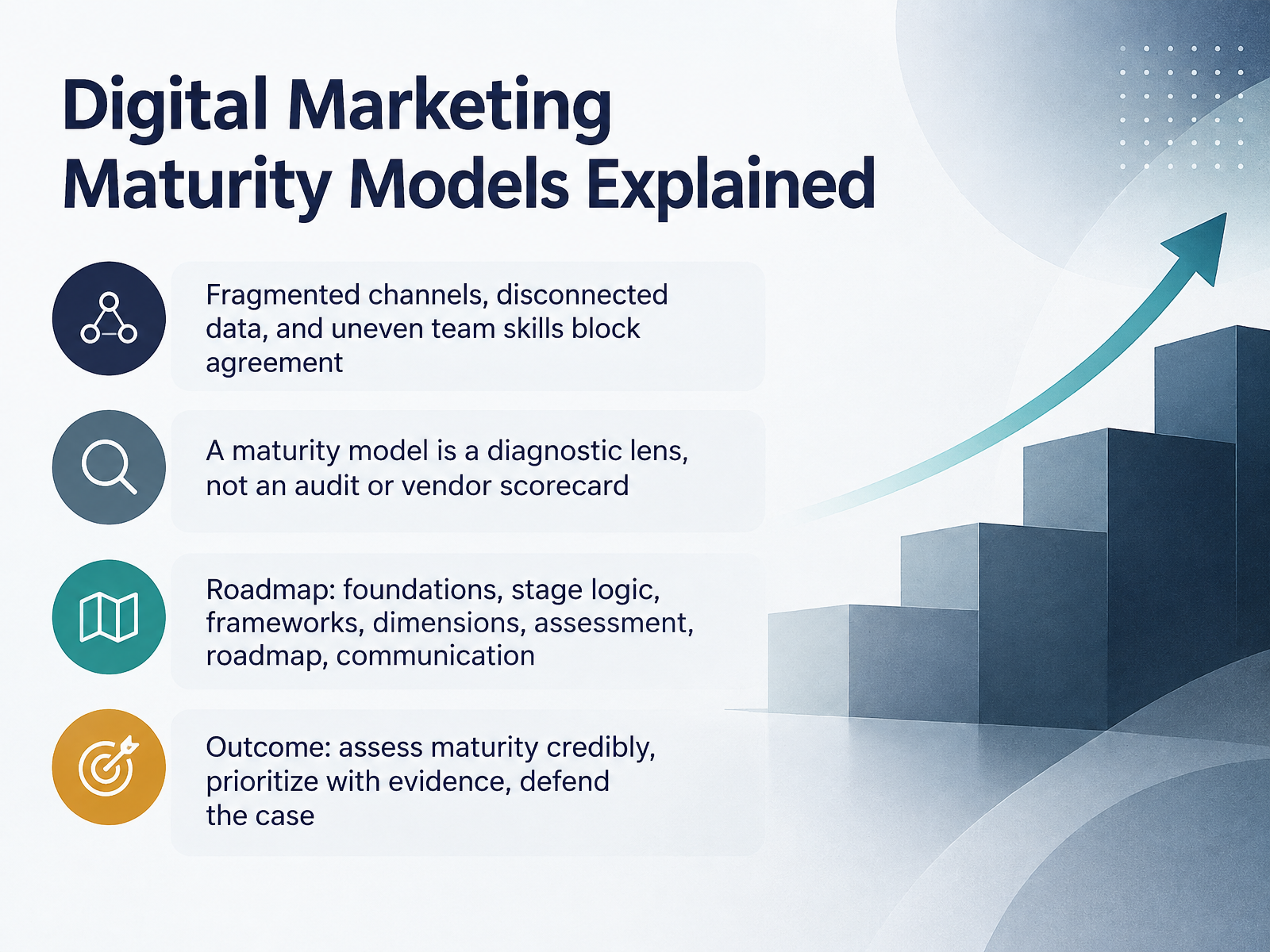
You already know the symptoms. Fragmented channels. Disconnected data. Uneven skills across your team. And when you try to fix all of it at once, agreement stalls. Everyone has a different view of what to prioritize.
Here's the reframe for this course. A maturity model is a diagnostic lens. It's not an audit, and it's not a vendor scorecard. You're not grading your team. You're looking for where capability is thin so you can invest with evidence.
Across these slides, we'll cover foundations, the logic behind maturity stages, the major frameworks, key capability dimensions, how to assess your organization, how to build a realistic roadmap, and how to communicate the case to stakeholders.
The outcome? You'll be able to assess your maturity credibly, prioritize the next capability to build, and defend that choice with evidence.
Let's start with the core concepts and a few common misconceptions.dunnixer.comforrester.nitro-digital.comblog.adobe.com+22 min
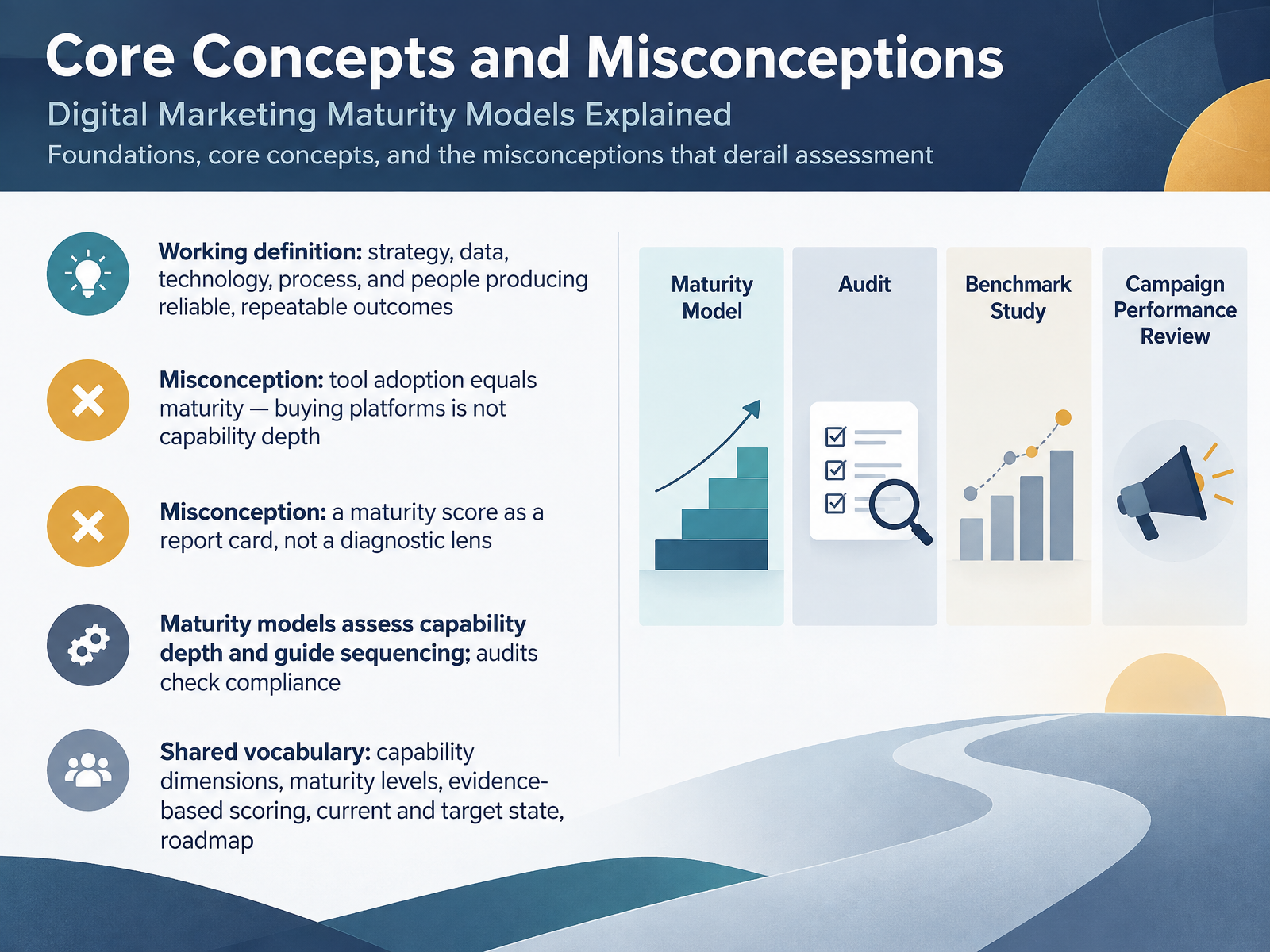
- 02Core Concepts and MisconceptionsLet's ground this in some core concepts, and clear up a few misconceptions that can quietly derail your assessment. First, a working definition. Digital marketing maturity is the degree to which strategy, data, technology, process, and people work together to produce reliable, repeatable outcomes. Not one-time wins. Repeatable results. Now the misconceptions. The most common one is treating tool adoption as maturity. Buying a platform is not the same as building capability depth. A new automation stack in the hands of an undisciplined team just produces faster chaos. Next, a maturity score is not a report card. It is a diagnostic lens. Its job is to show you where capability is thin and what to sequence next, not to grade your team. And keep the distinction clear. A maturity model assesses capability depth and guides sequencing. An audit checks compliance. You use both, but for different reasons. Finally, build a shared vocabulary across your stakeholders: capability dimensions, maturity levels, evidence-based scoring, current and target state, and roadmap. That common language is what makes the conversation productive. Next, we'll walk the arc itself, from ad hoc to predictive.
 progress.comsmartinsights.comoctopusmarketing.agency+22 min
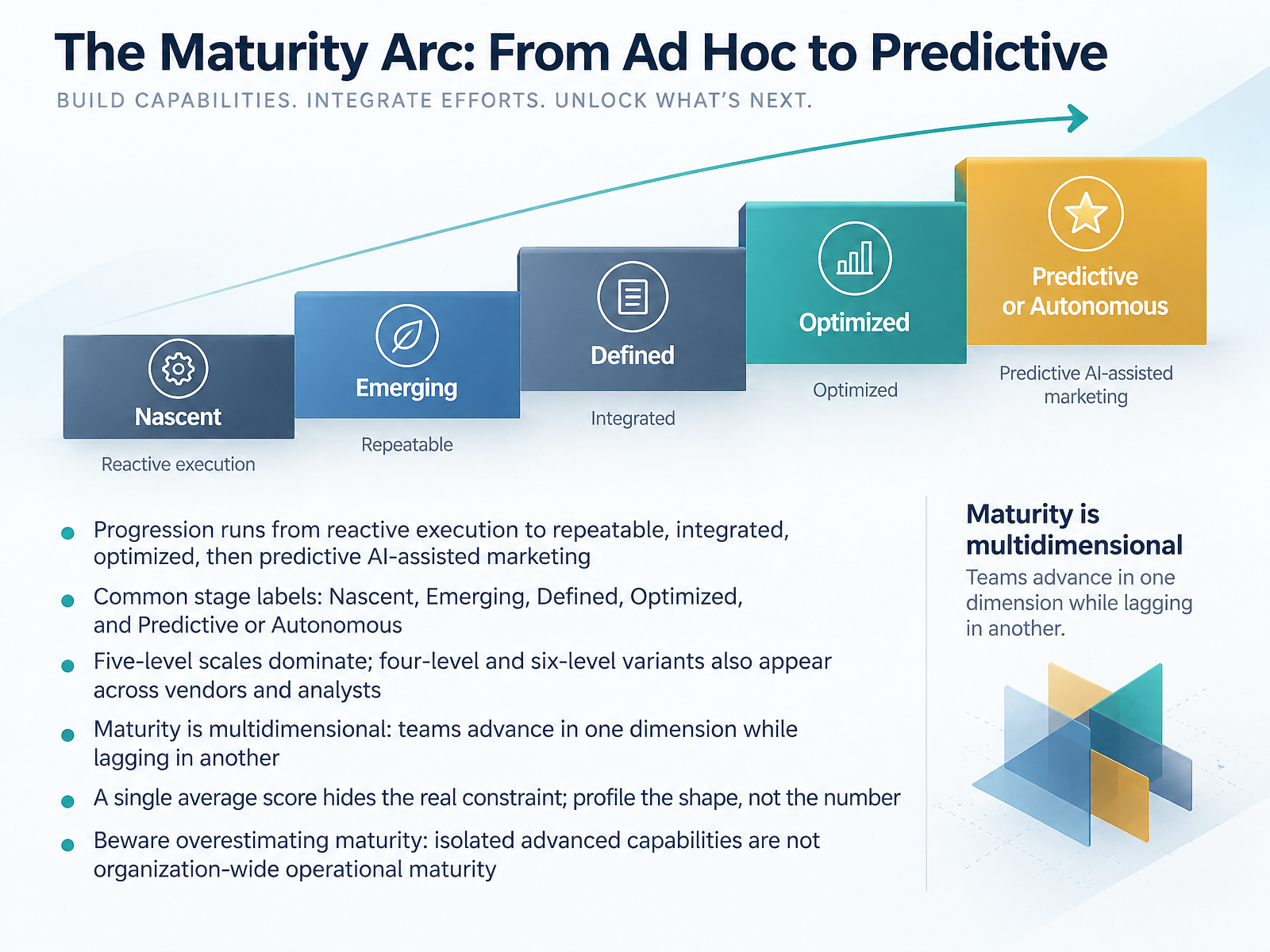
 - 03The Maturity Arc: From Ad Hoc to PredictiveLet's look at how maturity typically unfolds. The arc moves from reactive execution to repeatable processes, then integrated, then optimized, and finally predictive, where AI assists decisions. You will see different labels for these stages. Nascent, Emerging, Defined, Optimized, and Predictive or Autonomous are common. Five levels dominate, but four and six level variants exist too. Here is the important part. Maturity is multidimensional. Your team can be strong in analytics while lagging in content operations. A single average score hides your real constraint. Profile the shape, not the number. And beware overestimating maturity. Isolated advanced capabilities are not organization wide operational maturity. So when you assess, ask what to measure, where teams typically stall, and which capability to build next. That is how you turn a model into a decision. Dominant Frameworks: Gartner, Forrester, and BCG and Google Side by Side.
 iage.netdigitalapplied.comumbrex.com+21 min
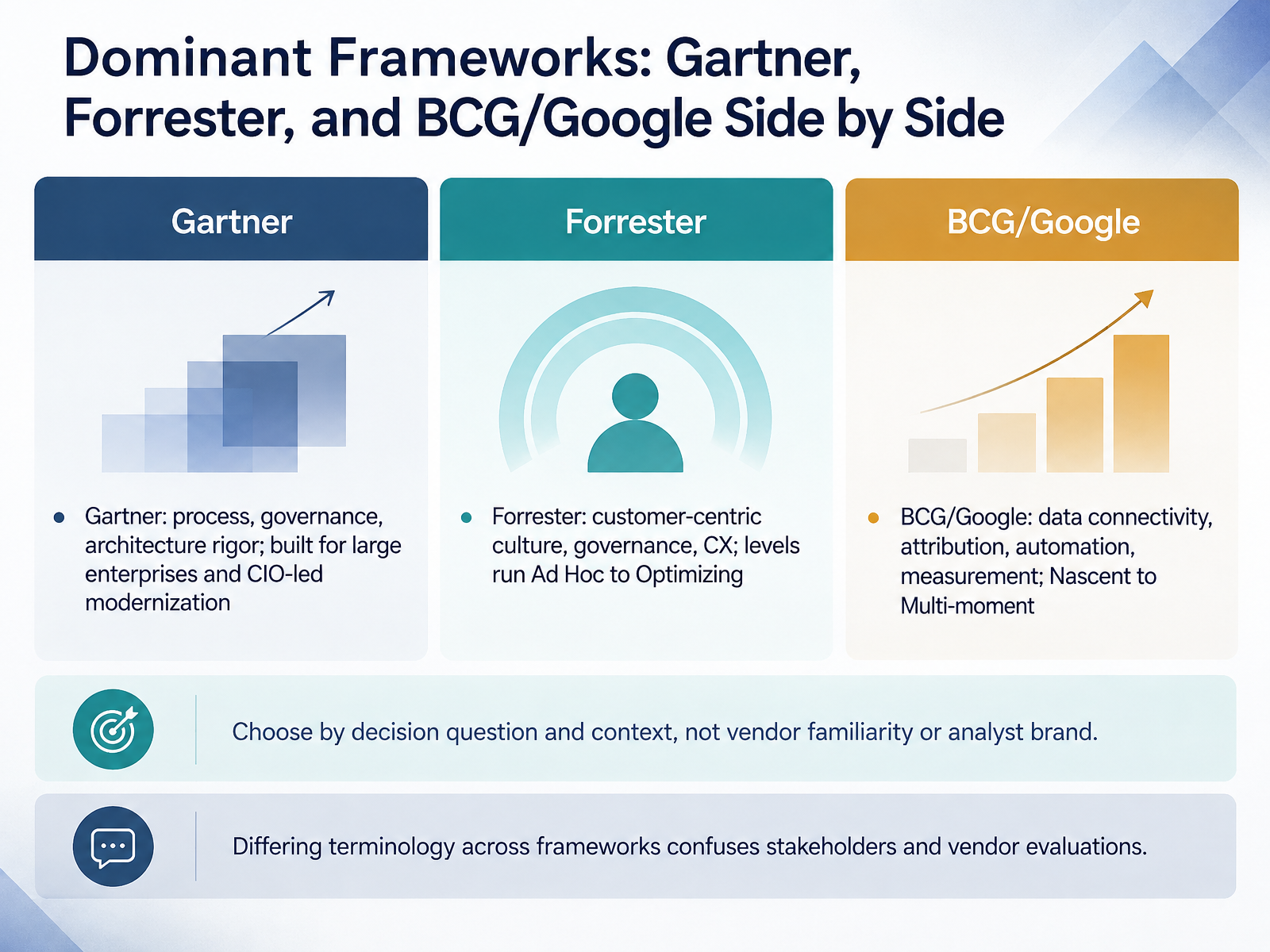
 - 04Dominant Frameworks: Gartner, Forrester, and BCG/Google Side by SideLet's compare the three frameworks you'll see most often, side by side. Gartner emphasizes process, governance, and architecture rigor. It's built for large enterprises and CIO-led modernization. So if your decision question is about platform foundations, Gartner fits. Forrester centers on customer-centric culture, governance, and customer experience, with levels running from Ad Hoc to Optimizing. Use it when CX and operating culture are your priority. BCG and Google focus on data connectivity, attribution, automation, and measurement, moving from Nascent to Multi-moment. That's your lens for performance marketing decisions. Here's the practical point. Choose by decision question and context, not vendor familiarity or analyst brand. And watch for a common stall: differing terminology across frameworks confuses stakeholders and skews vendor evaluations. Align on one vocabulary early. Now let's look at the capability dimensions underneath these models: data, technology, talent, process, and customer.
 dunnixer.comforrester.nitro-digital.comblog.adobe.com+22 min
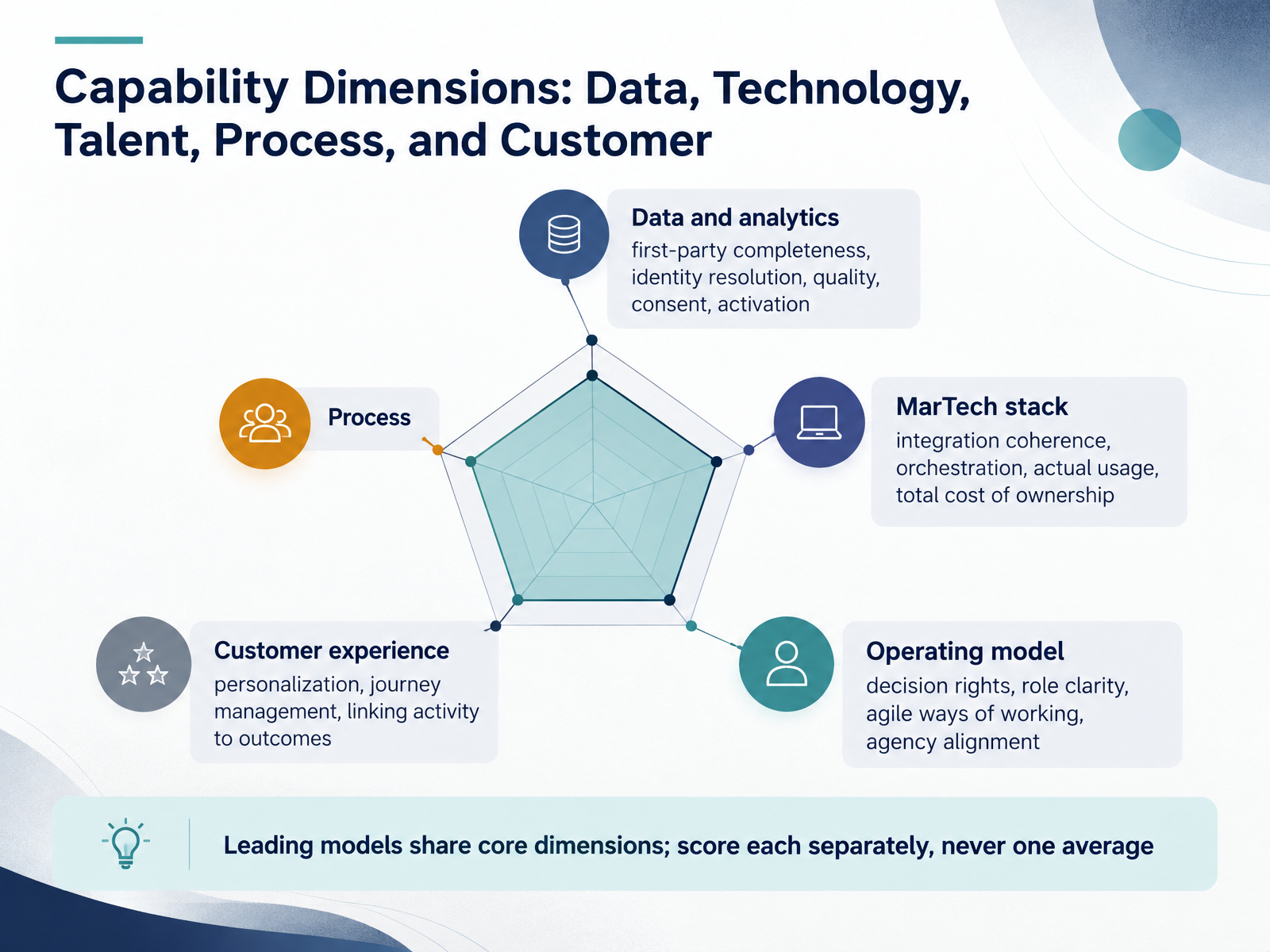
 - 05Capability Dimensions: Data, Technology, Talent, Process, and CustomerNow let's break maturity down into the dimensions you actually assess. Five show up across most leading models: data and analytics, marketing technology, the operating model, customer experience, and talent. Take data first. What matters is first-party completeness, identity resolution, data quality, consent, and whether that data actually reaches activation. Next, your martech stack. Judge it on integration coherence, orchestration, real usage, and total cost of ownership. A smaller stack that people genuinely use beats a large one that doesn't. Then the operating model: who decides, who owns what, how agile your teams really are, and how well agencies align to your goals. Customer experience covers personalization, journey management, and linking activity to outcomes. Here's the point. Leading models share these core dimensions, but you score each one separately. Never collapse them into a single average. The lowest score is usually your real constraint. And that leads into choosing the right model for your context.
 christopholivierconsulting.comprogress.comthinkwithgoogle.com+22 min
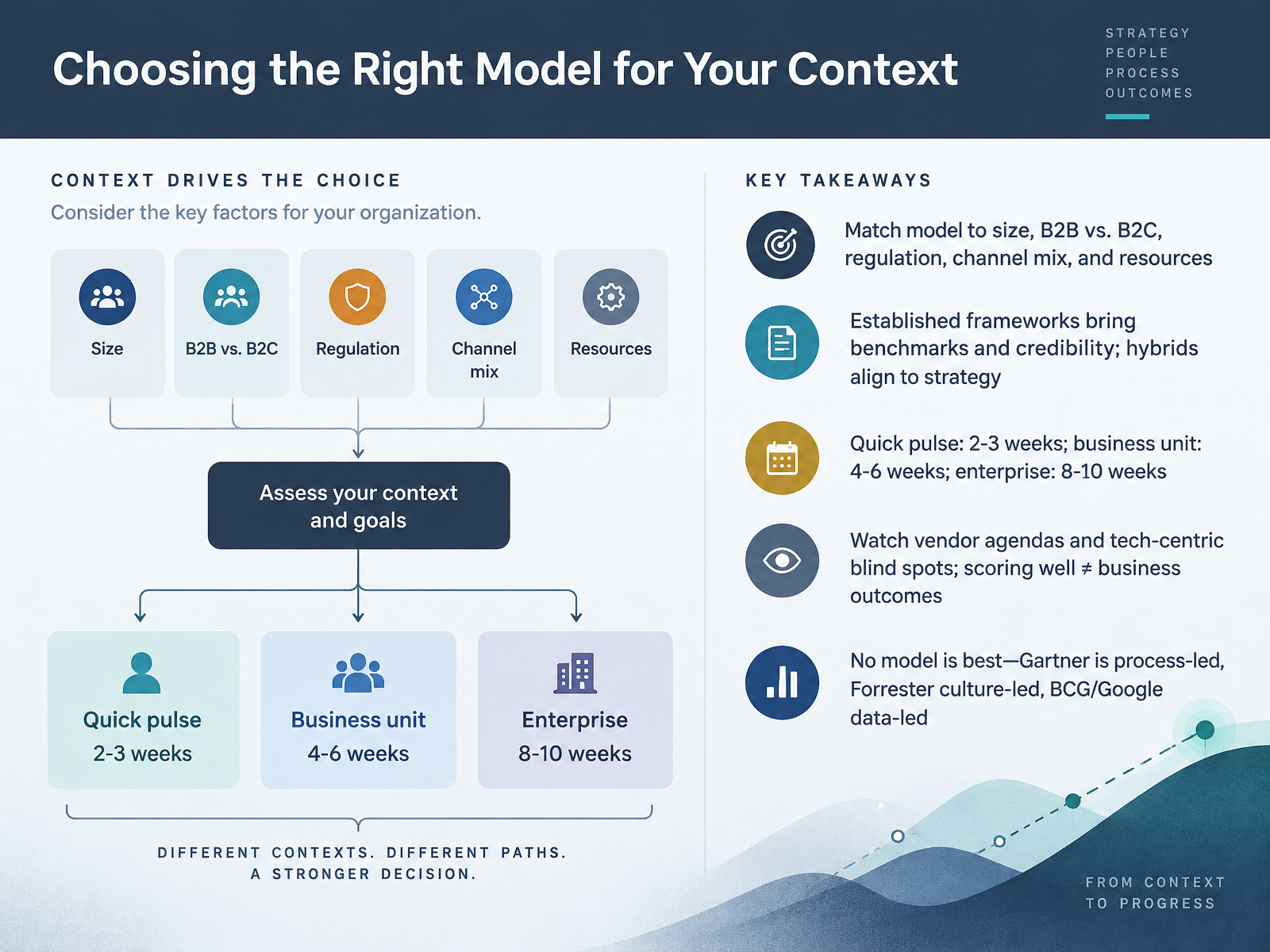
 - 06Choosing the Right Model for Your ContextLet's talk about choosing the right model for your context. There is no single best framework. It comes down to fit. Match the model to your size, whether you're business to business or business to consumer, your regulatory load, your channel mix, and your resources. Established frameworks bring benchmarks and credibility with leadership. Hybrids let you align the model to your actual strategy. On timing, be realistic. A quick pulse takes two to three weeks. A business unit assessment runs four to six weeks. A full enterprise effort takes eight to ten weeks. Also watch for vendor agendas and tech-centric blind spots. Scoring well is not the same as achieving business outcomes. And remember the emphases differ. Gartner is process led. Forrester is culture led. BCG and Google are data led. Pick the lens that matches the decisions you need to make. Next, we'll look at running a maturity assessment, covering methods, evidence, and scoring.
 dunnixer.comforrester.nitro-digital.comblog.adobe.com+21 min
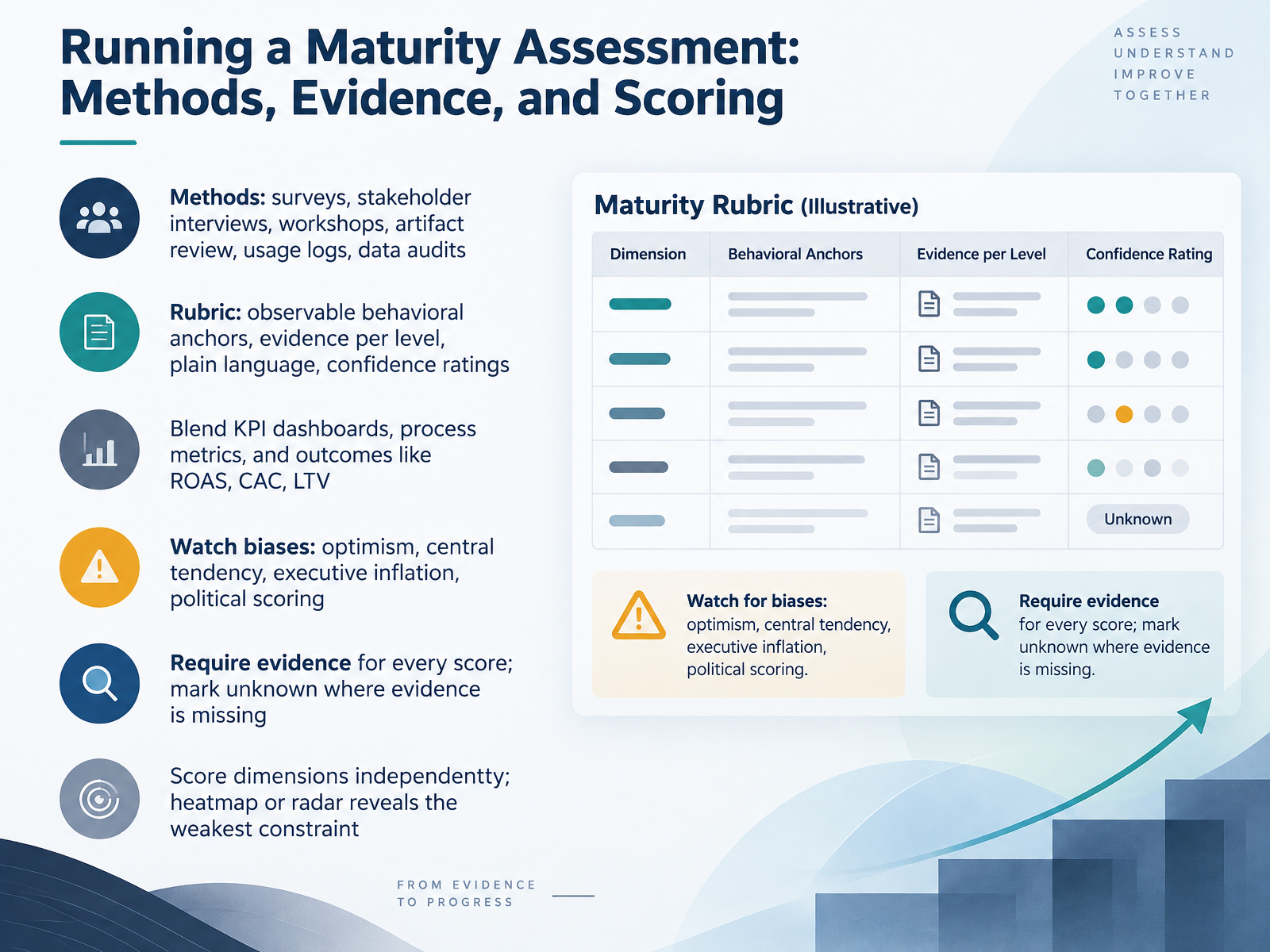
 - 07Running a Maturity Assessment: Methods, Evidence, and ScoringLet's talk about how you actually run the assessment. Start with methods. Surveys and workshops are fast, but they capture perception. Interviews, artifact review, usage logs, and data audits show what's really happening. Use a mix, and let the evidence carry more weight than the opinion. Then build your rubric with observable behavioral anchors. For every level, define what good looks like in plain language, and add a confidence rating. So a high score with low confidence is a flag, not a win. Pull your numbers from KPI dashboards, process metrics, and outcomes like return on ad spend, customer acquisition cost, and lifetime value. Watch the common biases. Optimism, central tendency, executive inflation, and political scoring all distort results. The fix is simple. Require evidence for every score, and mark unknown where evidence is missing. Score each dimension independently. A heatmap or radar chart will show you the weakest constraint, and that is where your next investment belongs. Next, we'll move from assessment to roadmap, prioritizing improvements.
 pedowitzgroup.comforrester.comchristopholivierconsulting.com+22 min
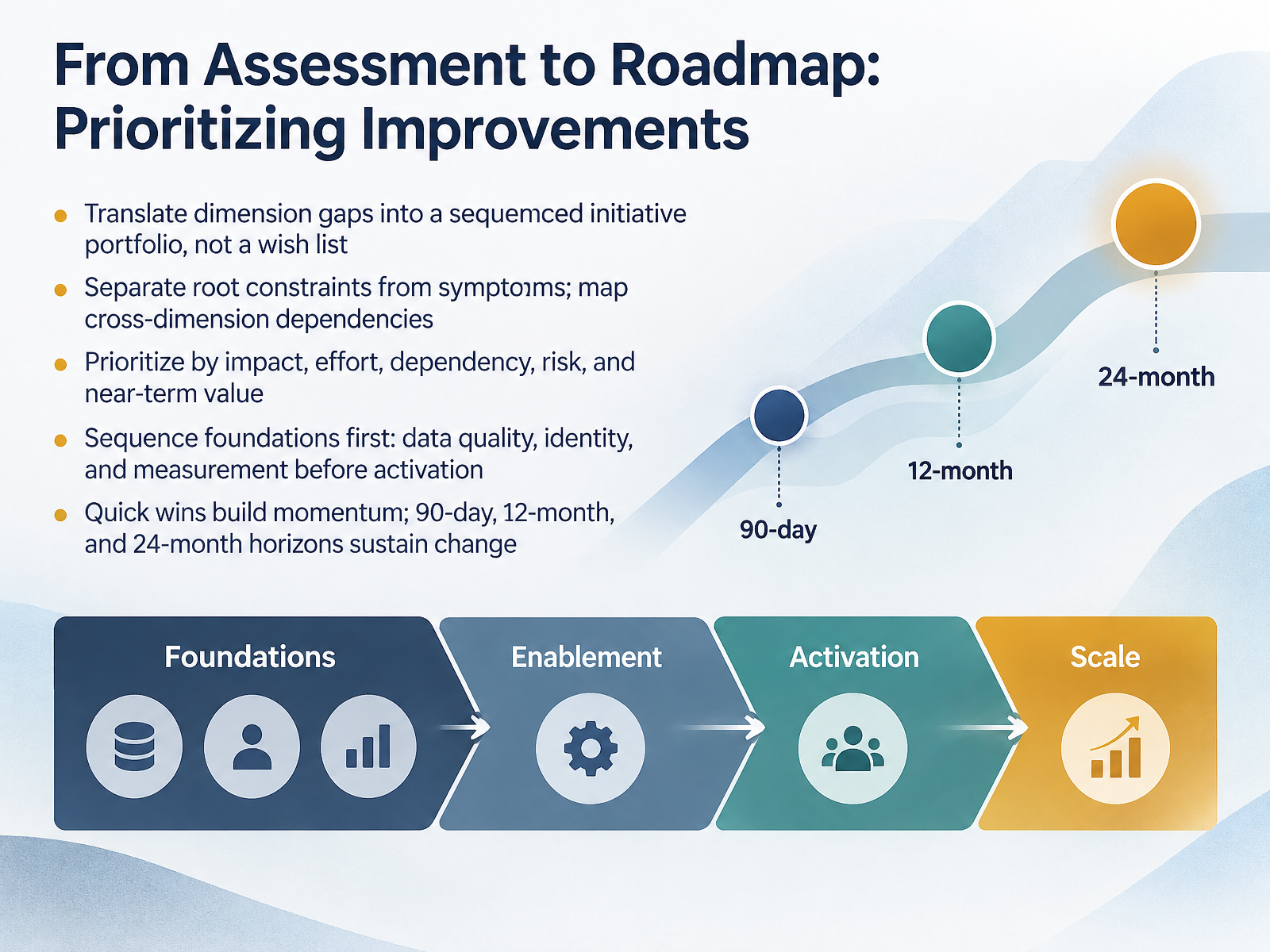
 - 08From Assessment to Roadmap: Prioritizing ImprovementsNow let's turn your assessment into an actual roadmap. The goal is a sequenced portfolio of initiatives, not a wish list. First, separate root constraints from symptoms, and map dependencies across dimensions. A weak identity resolution problem, for example, will undermine every personalization effort you build on top of it. Then prioritize by impact, effort, dependency, risk, and near-term value. Sequence foundations first. Data quality, identity, and measurement come before activation, because activation built on broken data just scales the problem. Use quick wins to build momentum, but hold them inside three horizons: ninety days, twelve months, and twenty-four months. That rhythm keeps your team credible with stakeholders while the bigger work matures. Next, we'll look at communicating maturity to executives and securing investment.
 1 min
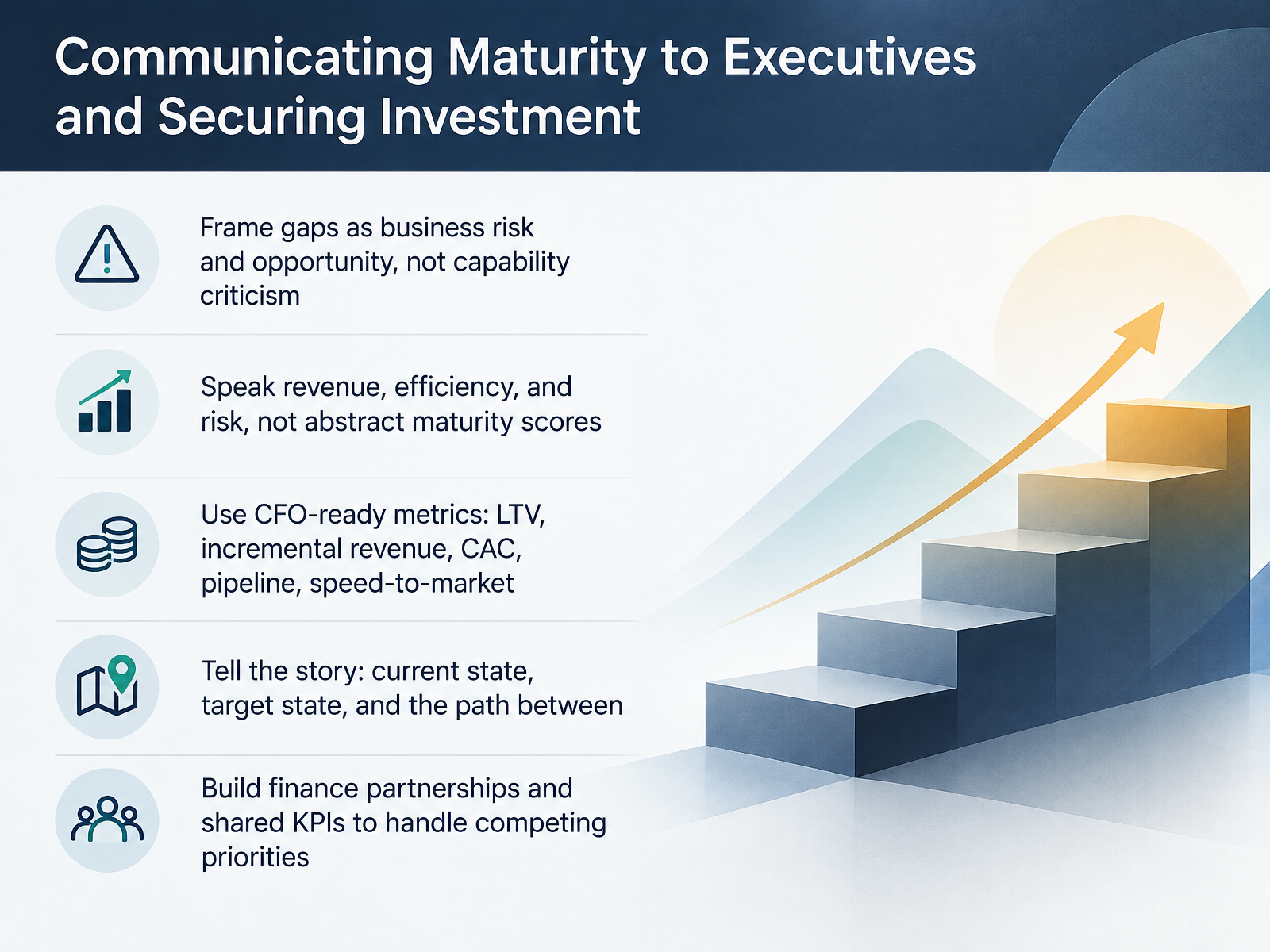
1 min - 09Communicating Maturity to Executives and Securing InvestmentNow let's talk about how you actually get maturity funded. Your executive audience doesn't need a score. They need a decision. So frame every gap as business risk or opportunity, never as criticism of your team. Speak revenue, efficiency, and risk. Not abstract maturity levels. Bring metrics your CFO already trusts. Lifetime value. Incremental revenue. Customer acquisition cost. Pipeline. Speed to market. Then tell a simple story. Here is where we are. Here is where we need to be. Here is the path between those two points. That path is your investment case. Build finance partnerships early. Agree on shared KPIs before you ask for money. When finance owns the same numbers you do, competing priorities become a joint conversation instead of a negotiation. One practical tip. If your weakest dimension is measurement, say so plainly, and show what that blind spot costs you in wasted spend. That is a fundable problem. Coming up next, common pitfalls, maturity theater, and how to avoid them.
 pedowitzgroup.comforrester.comchristopholivierconsulting.com+22 min
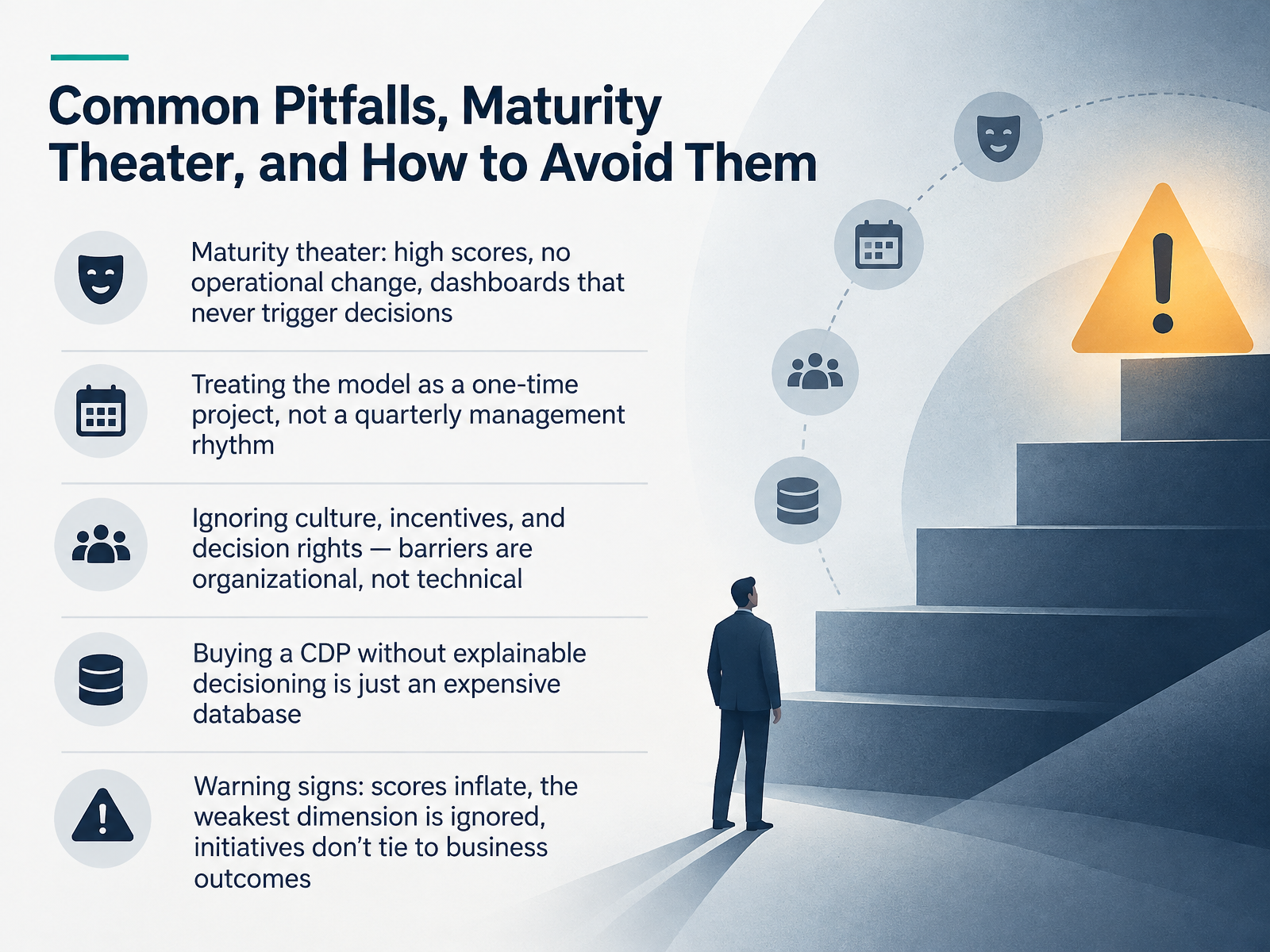
 - 10Common Pitfalls, Maturity Theater, and How to Avoid ThemLet's talk about the pitfalls that derail maturity work. The first is maturity theater. High scores, no operational change. Dashboards that look impressive but never trigger a decision. If a metric can't shift budget or change a campaign, it's still just a report. The second pitfall is treating the model as a one-time project. Maturity is a quarterly management rhythm, not an annual audit you file away. Third, teams ignore culture, incentives, and decision rights. The real barriers are organizational, not technical. Fourth, buying a customer data platform without explainable decisioning is just an expensive database. And watch for the warning signs: scores inflate, the weakest dimension gets ignored, and initiatives don't tie to business outcomes. Fix those, and you avoid the theater. Next, we'll work through a case exercise on assessing and advancing a marketing organization.
 christopholivierconsulting.comiage.net2 min
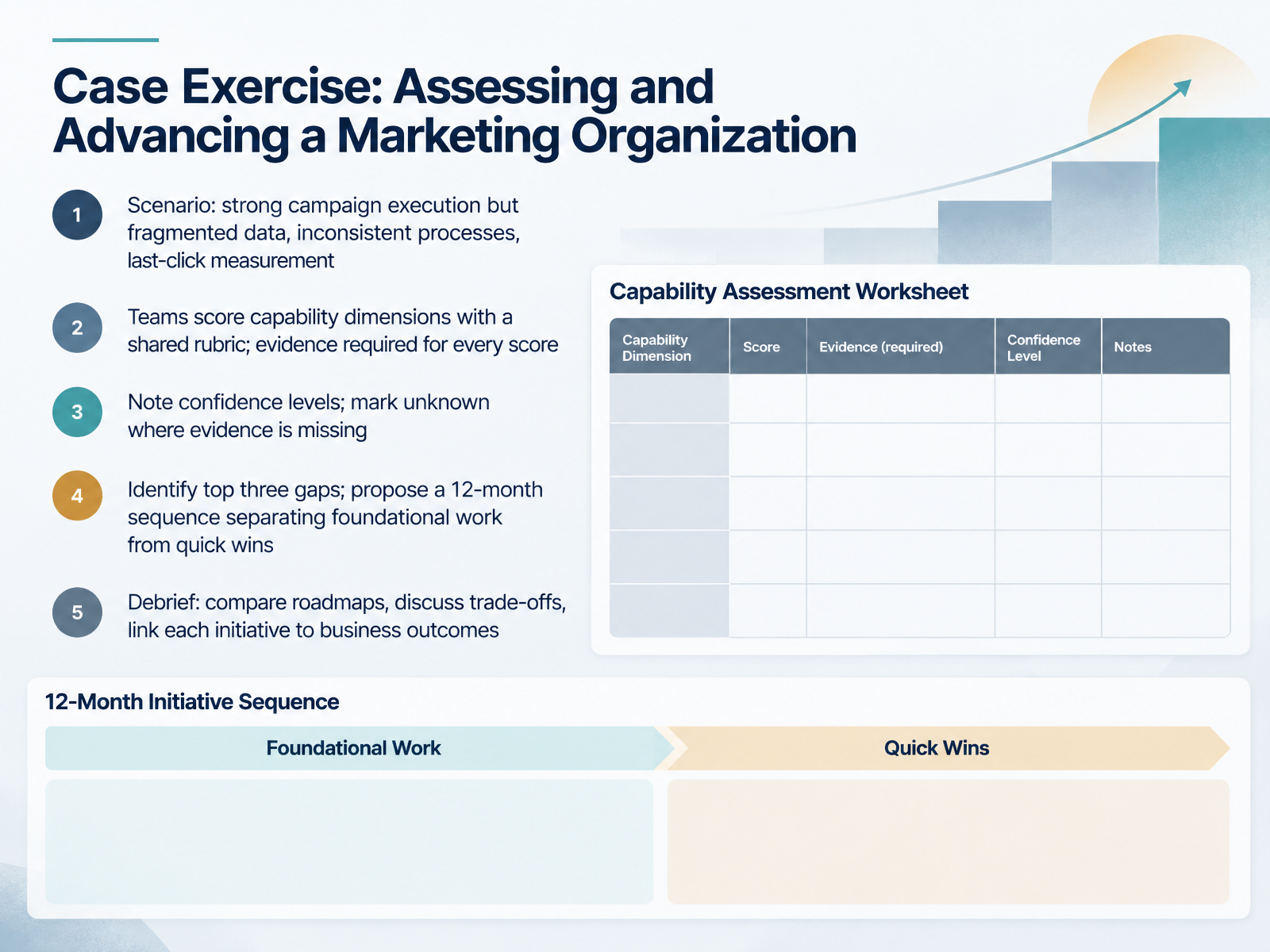
 - 11Case Exercise: Assessing and Advancing a Marketing OrganizationNow let's put all of this into practice with a case exercise. Picture an organization with strong campaign execution. The campaigns run well. But the data is fragmented, processes differ team to team, and measurement stops at last click. Sound familiar? Your task is to assess this organization and recommend a path forward. First, score each capability dimension using a shared rubric. Here is the discipline that matters: evidence is required for every score. If you cannot point to a document, a dashboard, or a process, do not assign a high score. Second, note your confidence level for each rating, and mark unknown where evidence is missing. Unknown is an honest answer, not a failure. Third, identify the top three gaps. Then propose a twelve-month sequence that separates foundational work from quick wins. Foundations fix the data and the process. Quick wins build momentum and stakeholder trust. In the debrief, compare roadmaps across teams, discuss the trade-offs you made, and link every initiative to a business outcome. That link is what earns continued investment. Next, building a continuous maturity practice.
 2 min
2 min - 12Building a Continuous Maturity PracticeLet's talk about turning maturity from a one-time audit into a continuous practice. The goal is simple. Make reassessment a normal part of how your team plans and reviews work.
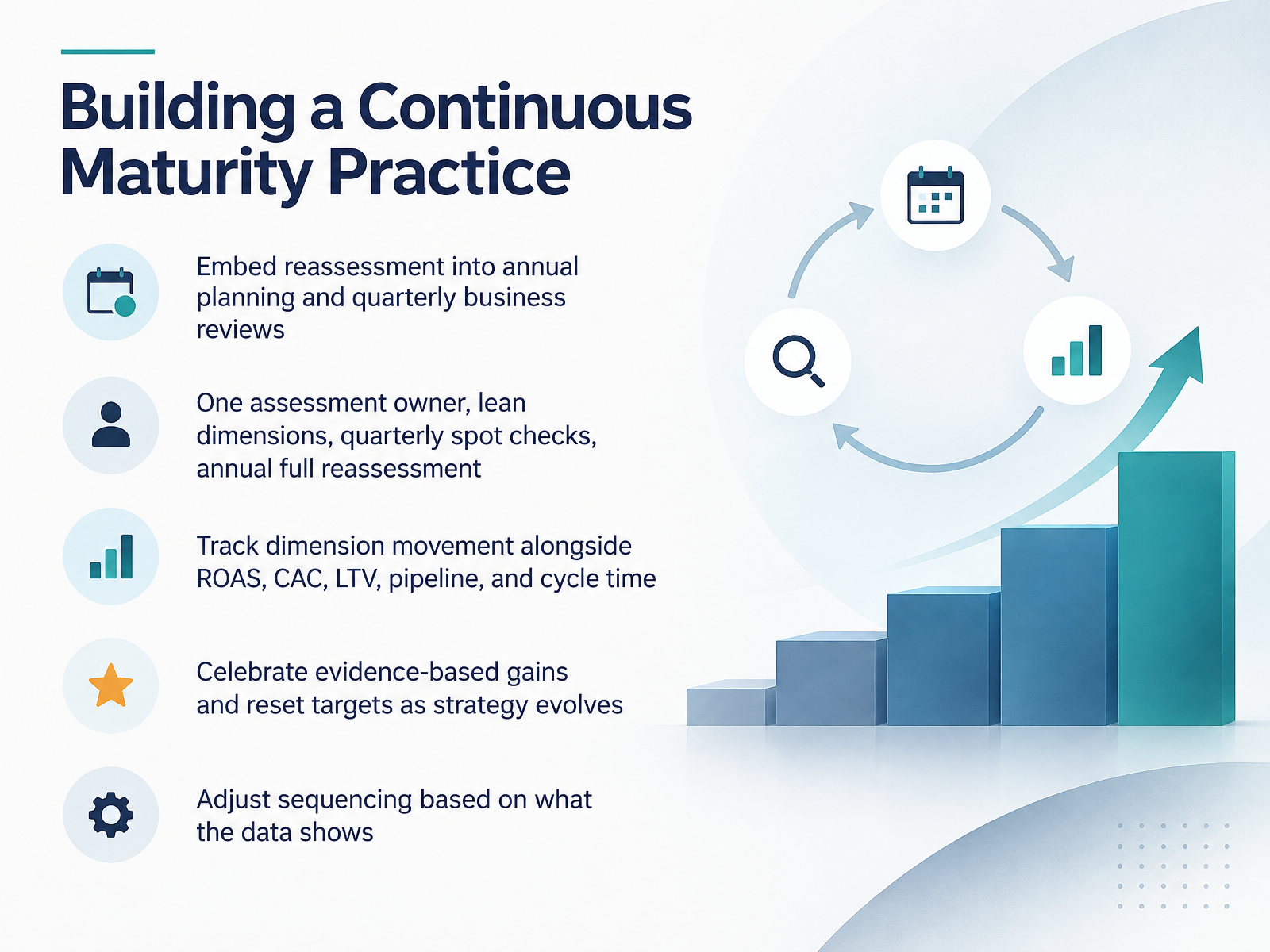
Start by embedding it into your annual planning cycle and your quarterly business reviews. Keep one assessment owner, lean dimensions, quarterly spot checks, and a fuller reassessment once a year. More frequent measurement often creates noise, not insight.
Then connect maturity movement to the numbers your leadership already trusts. Track it alongside ROAS, CAC, LTV, pipeline, and cycle time. That is how capability gains stay credible. When a dimension improves, celebrate the evidence, not the score. And reset targets as strategy evolves.
Finally, stay flexible. Adjust your sequencing based on what the data shows. Maybe data foundations come first. Maybe the next constraint is measurement clarity. Let the evidence choose the next capability, not the calendar.
So keep it light, keep it regular, and let the trend guide you.
Next, we'll bring it together in Key Takeaways and Action Planning.
 iage.netdigitalapplied.comumbrex.com+22 min
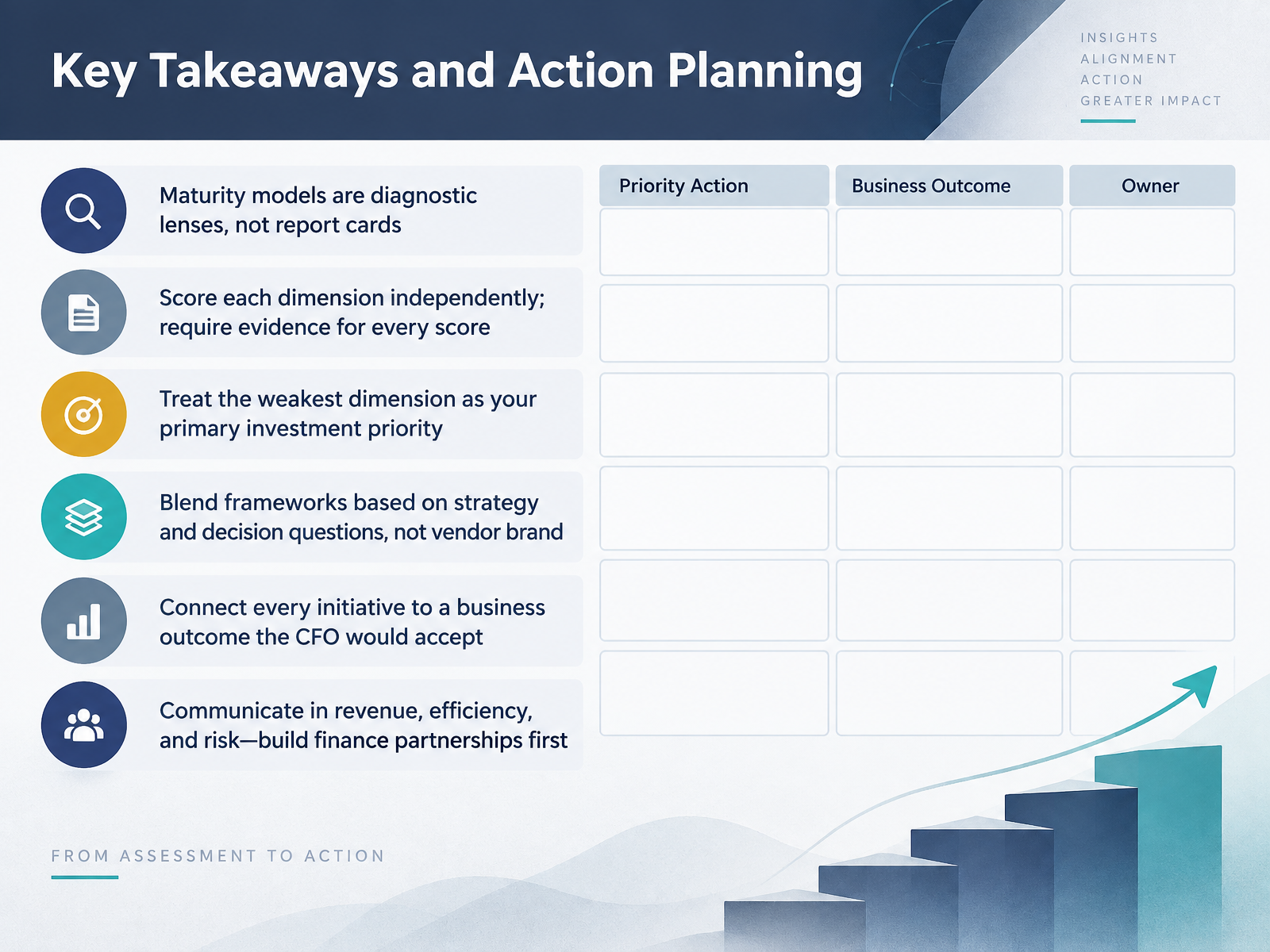
 - 13Key Takeaways and Action PlanningLet's bring this together with the takeaways and how to turn them into action. First, remember that maturity models are diagnostic lenses, not report cards. They tell you where to look, not how you rank. So score each dimension independently, and require real evidence for every score. A dashboard, a playbook, a process metric. No artifact, no credit. Here's the key move. Treat your weakest dimension as your primary investment priority. If your channel execution is strong but your measurement is weak, fix measurement first. Otherwise, every channel decision rests on data you can't trust. When you choose a framework, blend based on your strategy and your decision questions, not vendor brand. Gartner, Forrester, McKinsey, and BCG each emphasize different things, and blending is common. Then connect every initiative to a business outcome your CFO would accept. Not impressions, but revenue, efficiency, or risk. Build finance partnerships first, and speak their language. That is what turns a maturity score into funded change. Up next, we'll close with the glossary and reference guide.
 dunnixer.comforrester.nitro-digital.comblog.adobe.com+22 min
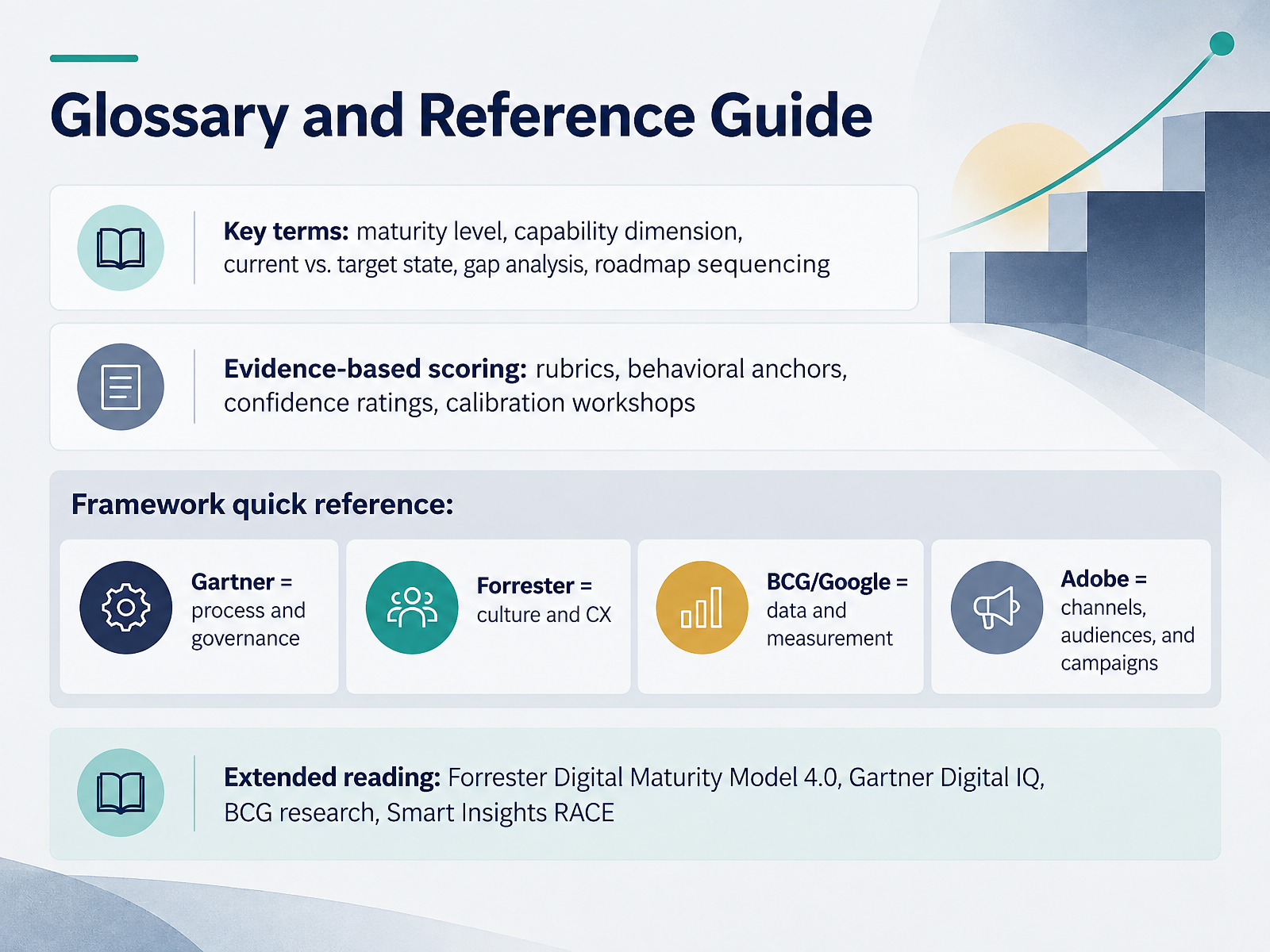
 - 14Glossary and Reference GuideAs we close out, let's lock in the vocabulary you'll use back at your desk. A maturity level is where your capabilities sit today. A capability dimension is the slice you're measuring, like data, channels, or governance. Current versus target state shows the distance you need to travel. Gap analysis tells you which dimension to fix first. And roadmap sequencing decides the order you build in, because dependencies matter more than urgency.
On scoring, anchor every rating in evidence. Use rubrics, behavioral anchors, confidence ratings, and calibration workshops so two reviewers reach the same number.
For the frameworks, Gartner leans toward process and governance. Forrester leans toward culture and customer experience. BCG and Google center on data and measurement. Adobe organizes around channels, audiences, and campaigns.
If you want to go deeper, start with Forrester's Digital Maturity Model four point oh, Gartner's Digital IQ, BCG's research, and Smart Insights RACE.
Thank you for working through this. Pick one dimension, score it honestly, and sequence your next capability deliberately. That's how maturity moves.
 dunnixer.comforrester.nitro-digital.comblog.adobe.com+22 min
Take the deck with you
Download this course as a file — free, no sign-up needed.
- PDF handoutEvery slide page, ready to print or share.15 pages · 3.4 MBDownload
- Narrated PowerPointThe deck that presents itself — every slide carries the digital human's narration video.15 pages · 14.3 MBDownload
- PowerPoint slidesThe full deck as a .pptx — open it in PowerPoint, Keynote, or Google Slides.15 pages · 3.3 MBDownload
Free to use in your own training — please keep the PersonWise credit page at the end.
Have your own deck? Turn it into a course
Sources consulted
Web sources consulted while building this course.
- Digital Maturity Models: McKinsey, BCG, Gartner and ... — dunnixer.com
- The Digital Maturity Model 4.0 — forrester.nitro-digital.com
- What's Your Score? Assessing Your Digital Marketing ... — blog.adobe.com
- One-Page Digital Commerce Maturity Framework for CMOs — gartner.com
- Assessing Your Digital Maturity — What Does Excellence ... — forrester.com
- DIGITAL MARKETING — progress.com
- What is your digital marketing maturity? — smartinsights.com
- Digital Marketing Maturity Models (2026): Frameworks, Levels & Growth Strategy - Octopus Marketing Agency — octopusmarketing.agency
- Enhance Skills with Digital Marketing Capability Maturity — umbrex.com
- Digital Marketing Maturity Models: A Comprehensive Literature Review — exa.ai
- Marketing Maturity Model and Assessment | iAge — iage.net
- The Digital Maturity Score: 50-Point Assessment 2026 — digitalapplied.com
- Digital Marketing Governance & Maturity Guide 2026 — octopusmarketing.agency
- Digital Marketing Maturity Model: 5 Stages with Funnel Framework — houseofmartech.com
- Marketing Maturity Model: Stages & Self-Assessment — christopholivierconsulting.com
- Marketing Maturity — thinkwithgoogle.com
- The Fast Track to Digital Marketing Maturity — bcg.com
- How do you assess marketing maturity across organizations? — pedowitzgroup.com
- Gauge Your B2B Marketing Maturity | Forrester — forrester.com
- Marketing & martech maturity assessment | Celeredge — celeredge.com