Begin
14 pages · ~28 min
Sales Enablement vs Sales Operations
Clarify the roles and goals of sales enablement versus sales operations, helping sales and ops professionals apply the right approach to drive performance.
A digital instructor presents all 14 pages. Hold “Ask” at any point and ask out loud — the answer comes from this course. No sign-up needed.
What you’ll learn
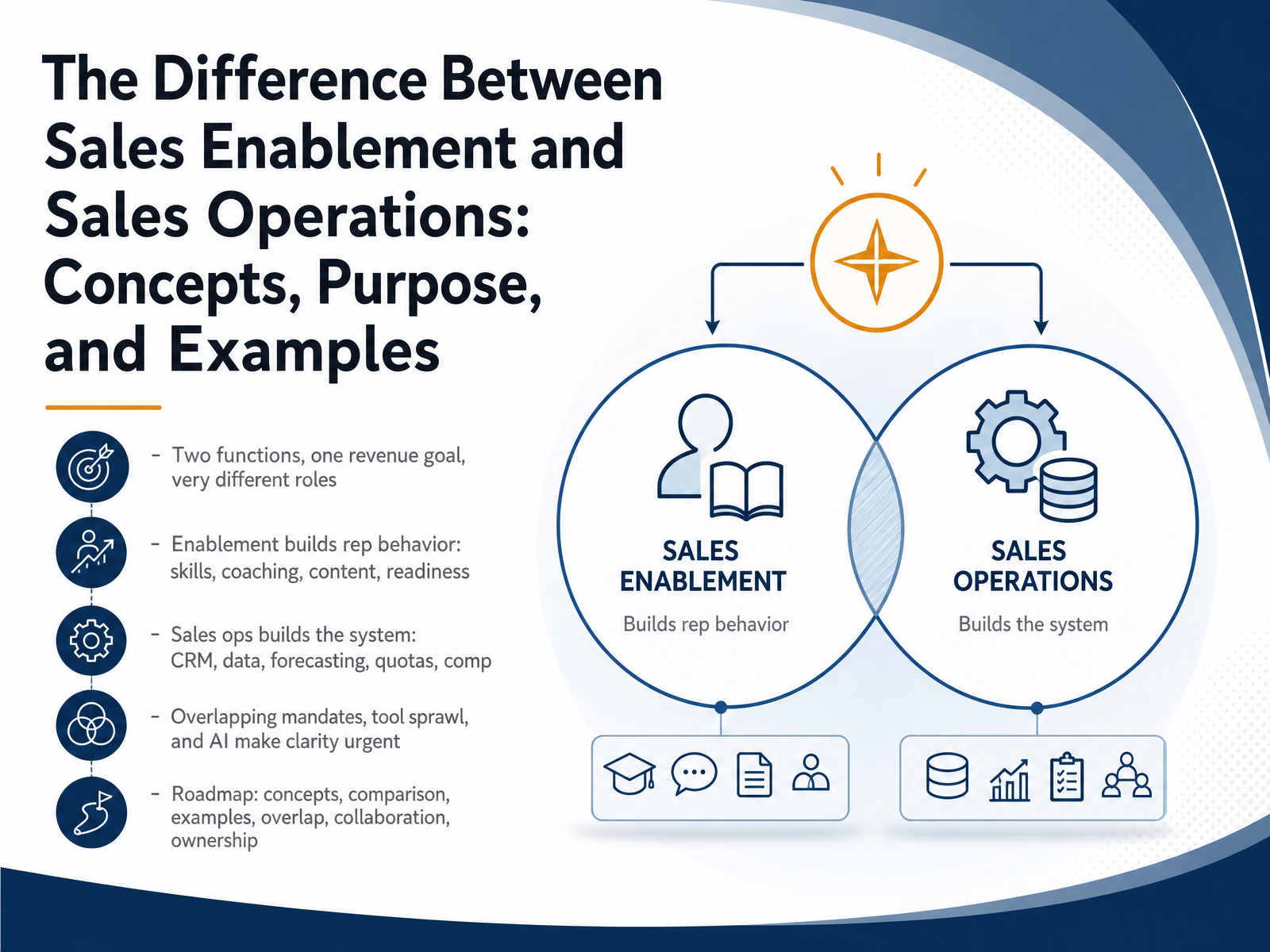
- 01The Difference Between Sales Enablement and Sales Operations: Concepts, Purpose, and ExamplesWelcome. In this course, we will clarify the difference between sales enablement and sales operations, and why that distinction matters in your day to day. Both functions serve one revenue goal, but they build different things. Enablement builds rep behavior: skills, coaching, content, and readiness. Sales operations builds the system: CRM, data, forecasting, quotas, and compensation. Let me make it concrete. If your reps cannot run a discovery call, that is an enablement gap. If your forecast keeps missing because the CRM data is unreliable, that is a sales ops gap. In practice, the two overlap, and tool sprawl and AI make the ownership lines even more urgent. Over the next slides, we will cover the core concepts, a side by side comparison, real examples, the overlap zones, how the two teams collaborate, and how to assign ownership cleanly. Here is the goal: by the end, you should be able to place a problem in the right lane, and know when to solve it together. Next, let us look at the background. Why did sales enablement and sales operations emerge as separate functions?2 min
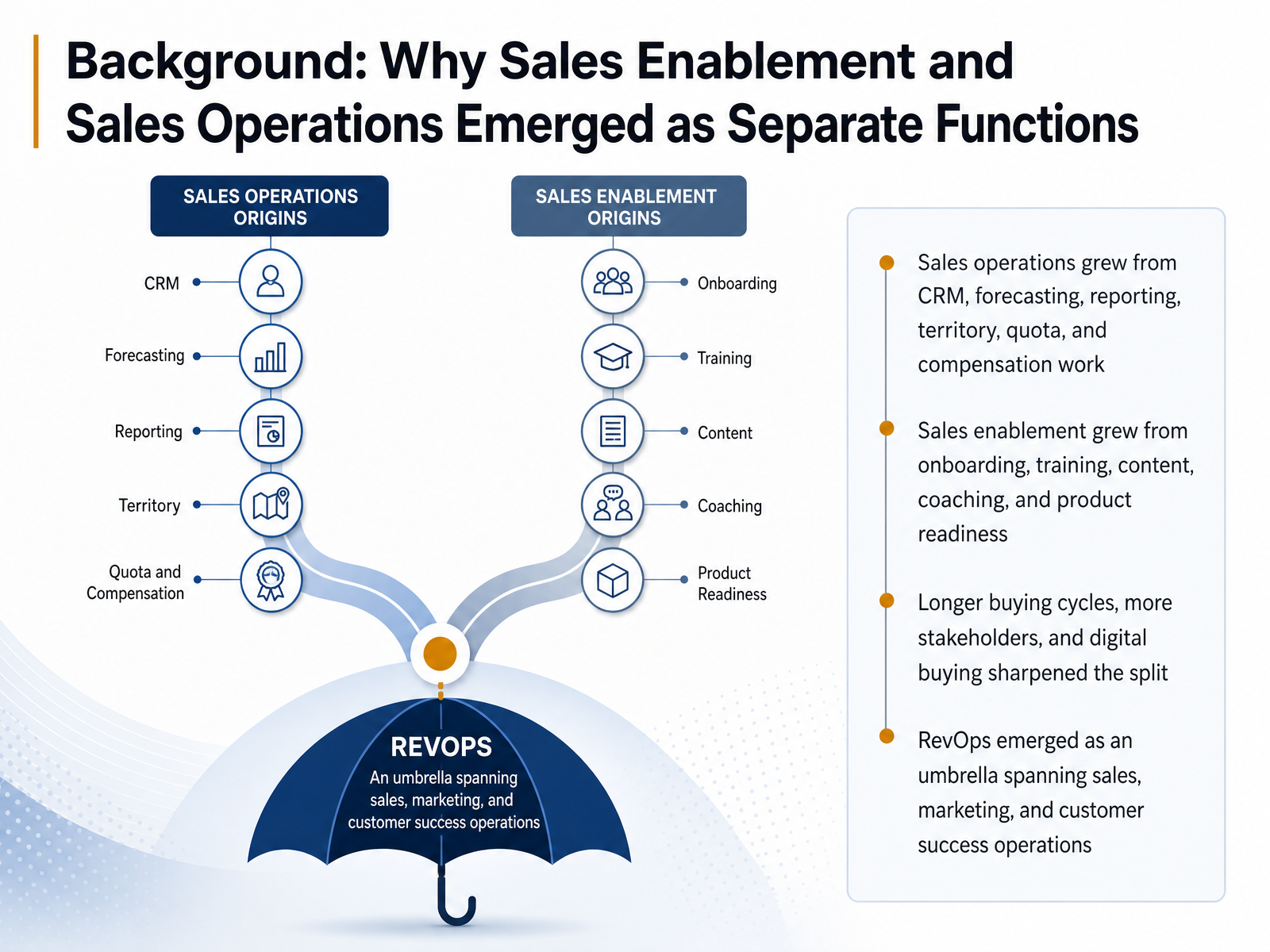
- 02Background: Why Sales Enablement and Sales Operations Emerged as Separate FunctionsLet's look at why these two functions split in the first place. Sales operations grew out of the systems layer. Think CRM administration, forecasting, reporting, territory design, quota setting, and compensation. If a sales leader needed the numbers to run the business, that work landed in sales ops. Sales enablement grew from the other direction. Onboarding, training, content, coaching, and product readiness. If a rep needed to be ready for a customer conversation, that work landed in enablement. Then the buying environment shifted. Longer cycles, more stakeholders, and digital-first buying sharpened the split. Each function needed deeper specialized focus. More recently, revenue operations emerged as an umbrella spanning sales, marketing, and customer success operations. The takeaway here is simple. These functions split because the work genuinely diverged. Next, let's dig into what sales enablement actually owns.
 1 min
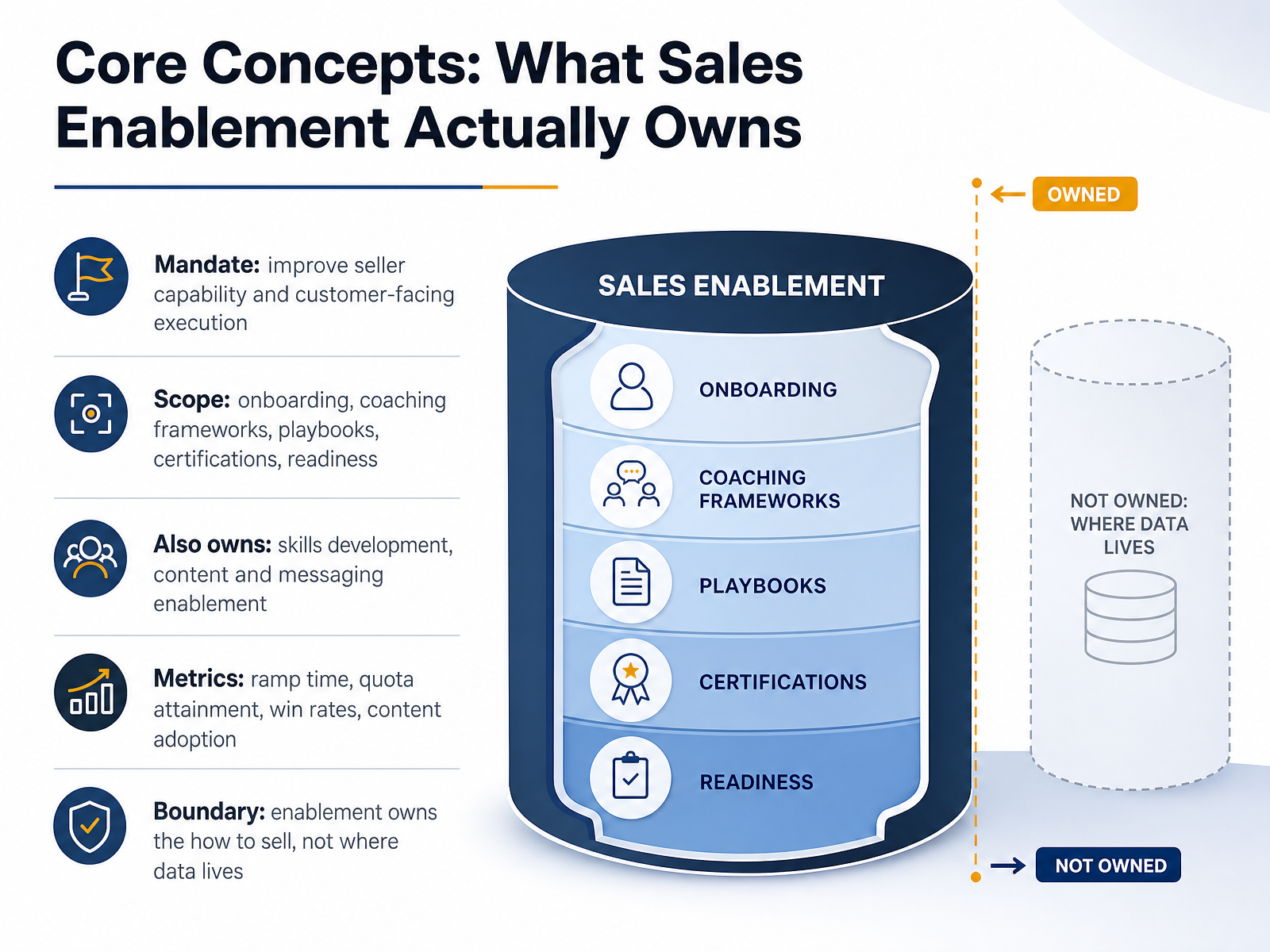
- 03Core Concepts: What Sales Enablement Actually OwnsLet's look at what sales enablement actually owns. Put simply, enablement's mandate is to improve seller capability and customer-facing execution. So when a rep struggles to run a discovery call, enablement owns fixing that. Scope covers onboarding, coaching frameworks, playbooks, certifications, and readiness programs. You also typically own skills development plus content and messaging enablement. On metrics, you're accountable for ramp time, quota attainment, win rates, and content adoption. That's a different scoreboard than operations. Here's the boundary that matters: enablement owns the how to sell. Operations owns where the data lives, how the CRM is configured, and how forecasting runs. So when a handoff gets fuzzy, ask which of those two questions you're really solving, then split the work cleanly. Next, let's flip the lens and define what sales operations owns.
 1 min
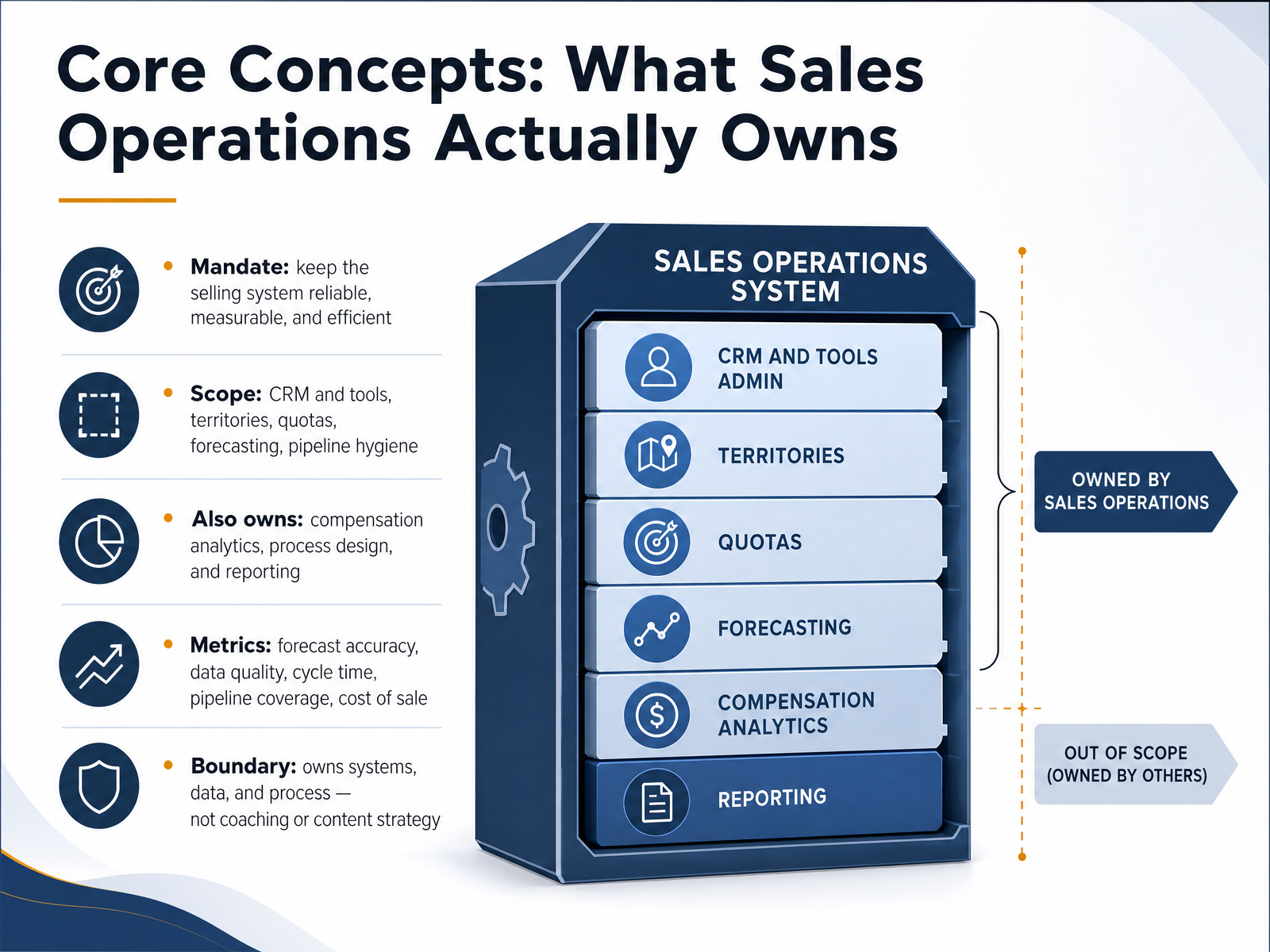
- 04Core Concepts: What Sales Operations Actually OwnsLet's get specific about what Sales Operations actually owns. Its mandate is straightforward: keep the selling system reliable, measurable, and efficient. That mandate shows up in scope you'll recognize. Sales Ops runs the CRM and the surrounding tools. It sets territories and quotas, owns forecasting, and enforces pipeline hygiene, which means keeping deal stages, dates, and values accurate enough to trust. It also owns compensation analytics, process design, and reporting. The metrics follow directly from that work: forecast accuracy, data quality, cycle time, pipeline coverage, and cost of sale. The boundary matters here. Sales Ops owns systems, data, and process. It does not own coaching or content strategy. So when a rep misses quota, Sales Ops asks whether the data and process worked. Sales Enablement asks whether the rep had the skills and content to succeed. That split keeps accountability clean and the handoffs clear. Next, we'll connect each function to the business value it produces, in Purpose and Business Outcomes: Translating Each Function into Value.
 1 min
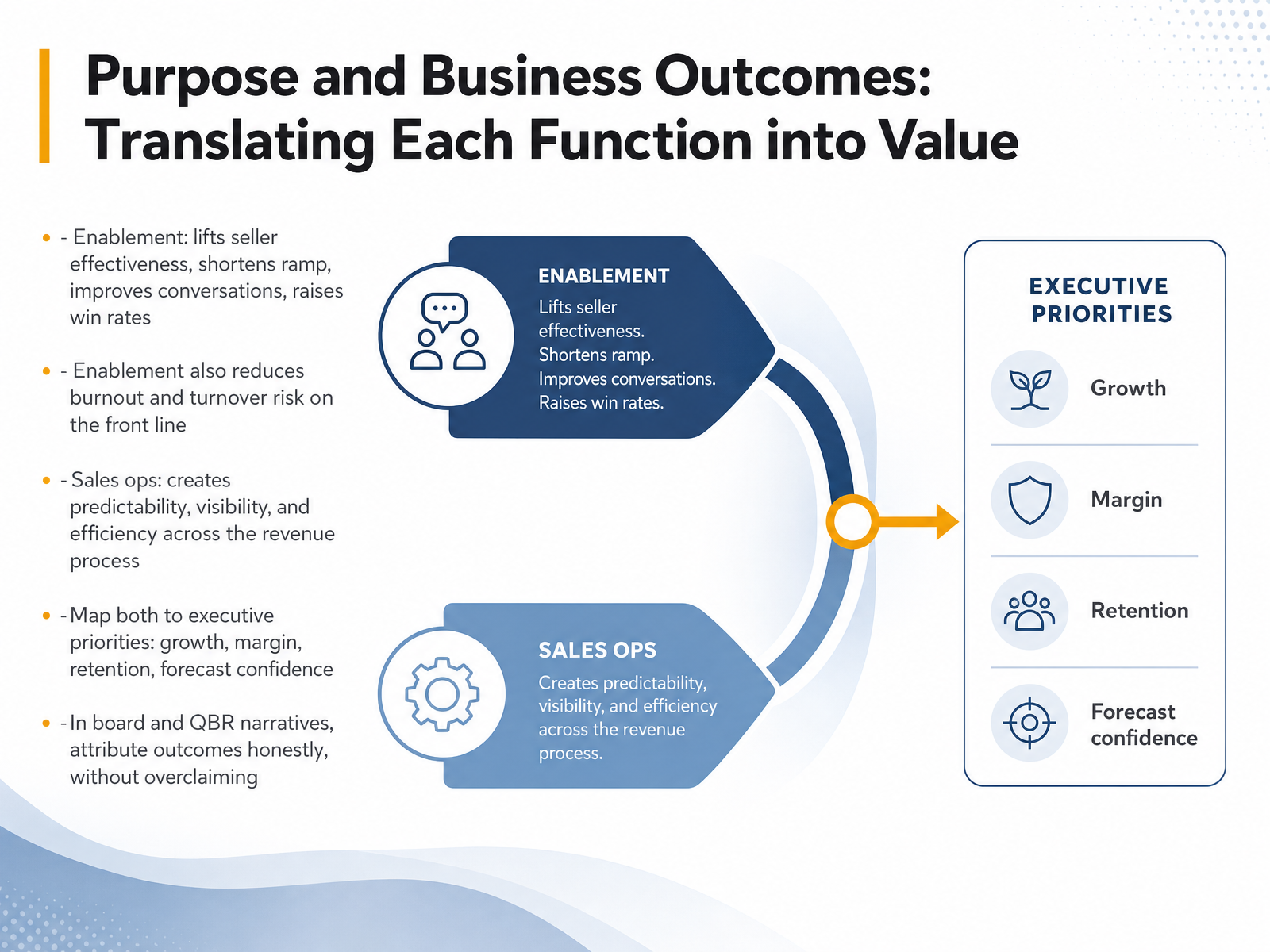
- 05Purpose and Business Outcomes: Translating Each Function into ValueNow let's translate each function into value. Enablement lifts seller effectiveness. It shortens ramp for new hires, improves customer conversations, and raises win rates. It also reduces burnout and turnover risk on the front line. Sales ops delivers something different: predictability, visibility, and efficiency across the revenue process. Here's a concrete example. Your chief revenue officer needs to forecast next quarter with confidence. Sales ops owns the data model, the pipeline hygiene, and the reporting cadence that make that number trustworthy. Enablement, meanwhile, owns whether reps can actually execute the motion that produces those numbers. To connect both to executive priorities, map enablement to growth and retention, and map sales ops to margin and forecast confidence. One caution for board and QBR narratives: attribute outcomes honestly. If win rates climb because of better messaging, say so. If forecast accuracy improves because of cleaner data, say that. Overclaiming erodes credibility for both functions. Next, we'll put them side by side and compare scope, inputs, outputs, and metrics.
 2 min
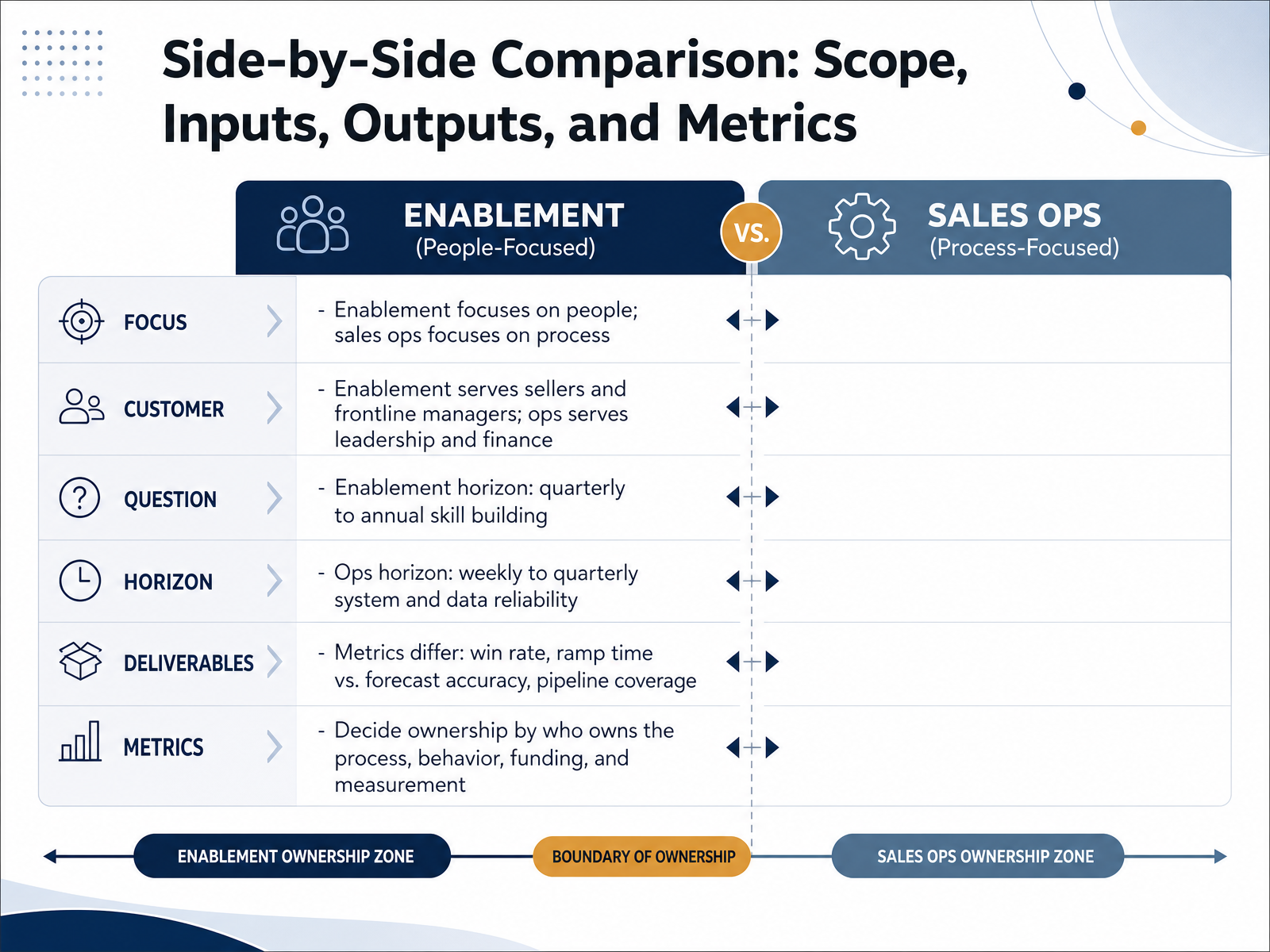
- 06Side-by-Side Comparison: Scope, Inputs, Outputs, and MetricsLet's put the two functions side by side so the boundary gets concrete. Enablement focuses on people. Sales ops focuses on process. Enablement serves sellers and frontline managers. Ops serves leadership and finance. Notice the horizons differ too. Enablement works on a quarterly to annual cycle, building skills that compound over time. Ops works weekly to quarterly, keeping systems and data reliable right now. So the metrics split accordingly. Enablement owns signals like win rate and ramp time. Ops owns forecast accuracy and pipeline coverage. Here's the decision point for you as a leader. When ownership is unclear, ask four questions. Who owns the process? Who owns the behavior change? Who owns the funding? And who owns the measurement? That is how you assign accountability without creating friction. Next, we'll walk through practical examples of what each function does in a typical quarter.
 2 min
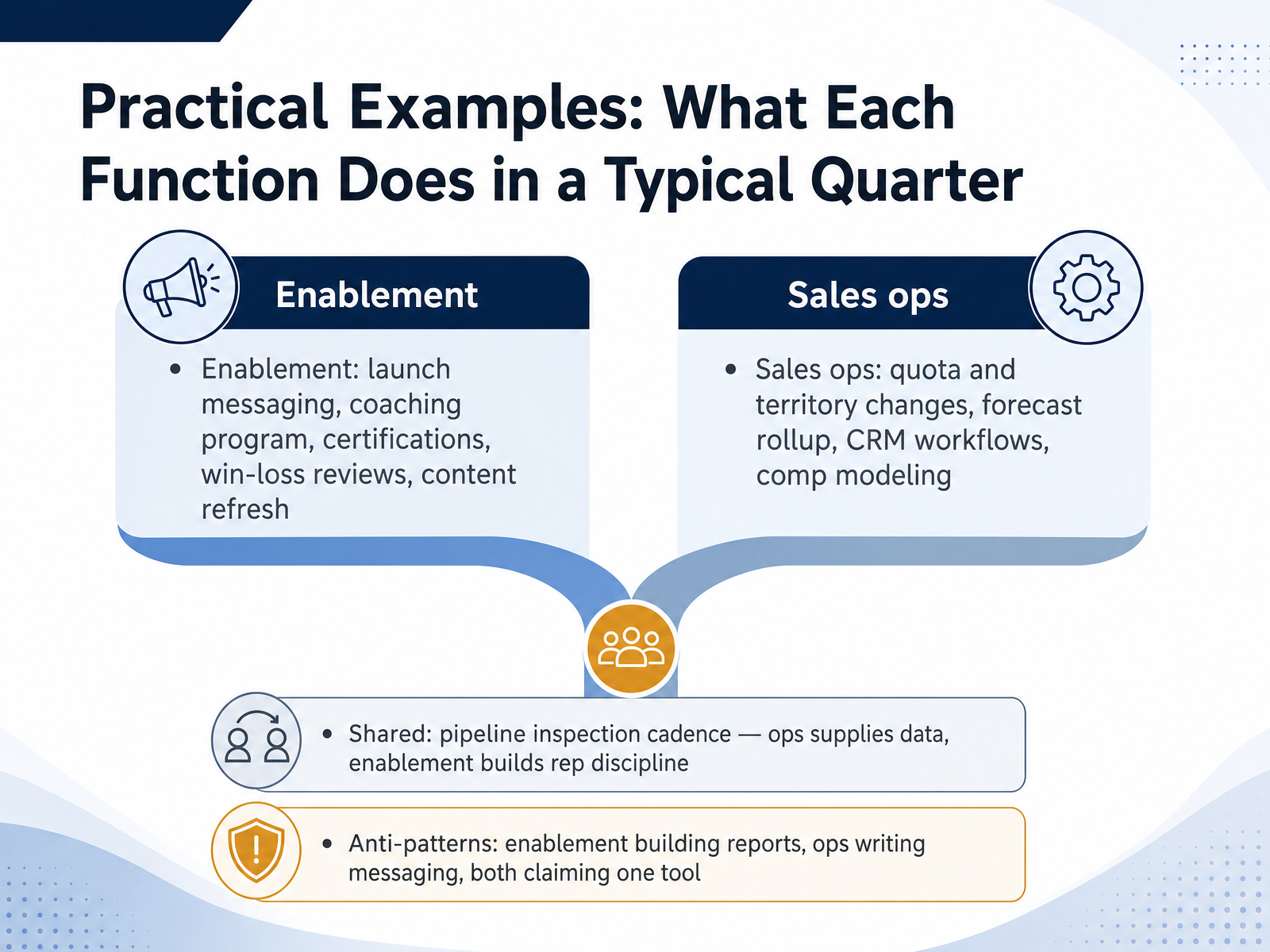
- 07Practical Examples: What Each Function Does in a Typical QuarterLet's make this concrete by looking at what each function actually does in a typical quarter. Enablement owns launch messaging, the coaching program, certifications, win-loss reviews, and content refreshes. So when a new product ships, enablement writes the talk track, trains the reps, and refreshes the battle cards. Sales ops owns quota and territory changes, forecast rollups, CRM workflows, and comp modeling. When the quarter flips, ops resets territories, adjusts quotas, and keeps the forecast clean. Notice the split. Enablement builds capability. Ops builds the system. Then there is shared work. Pipeline inspection cadence is the clearest example. Ops supplies the data and the dashboards. Enablement builds the rep discipline to work that pipeline consistently. One without the other does not hold. Now the anti-patterns. Enablement building reports, ops writing messaging, and both claiming ownership of one tool. Those create friction, duplicated effort, and confused reps. Keep the handoff clear. Ops provides the data, enablement builds the behavior. Next, we will look at where the lines blur and how to make ownership decisions.
 2 min
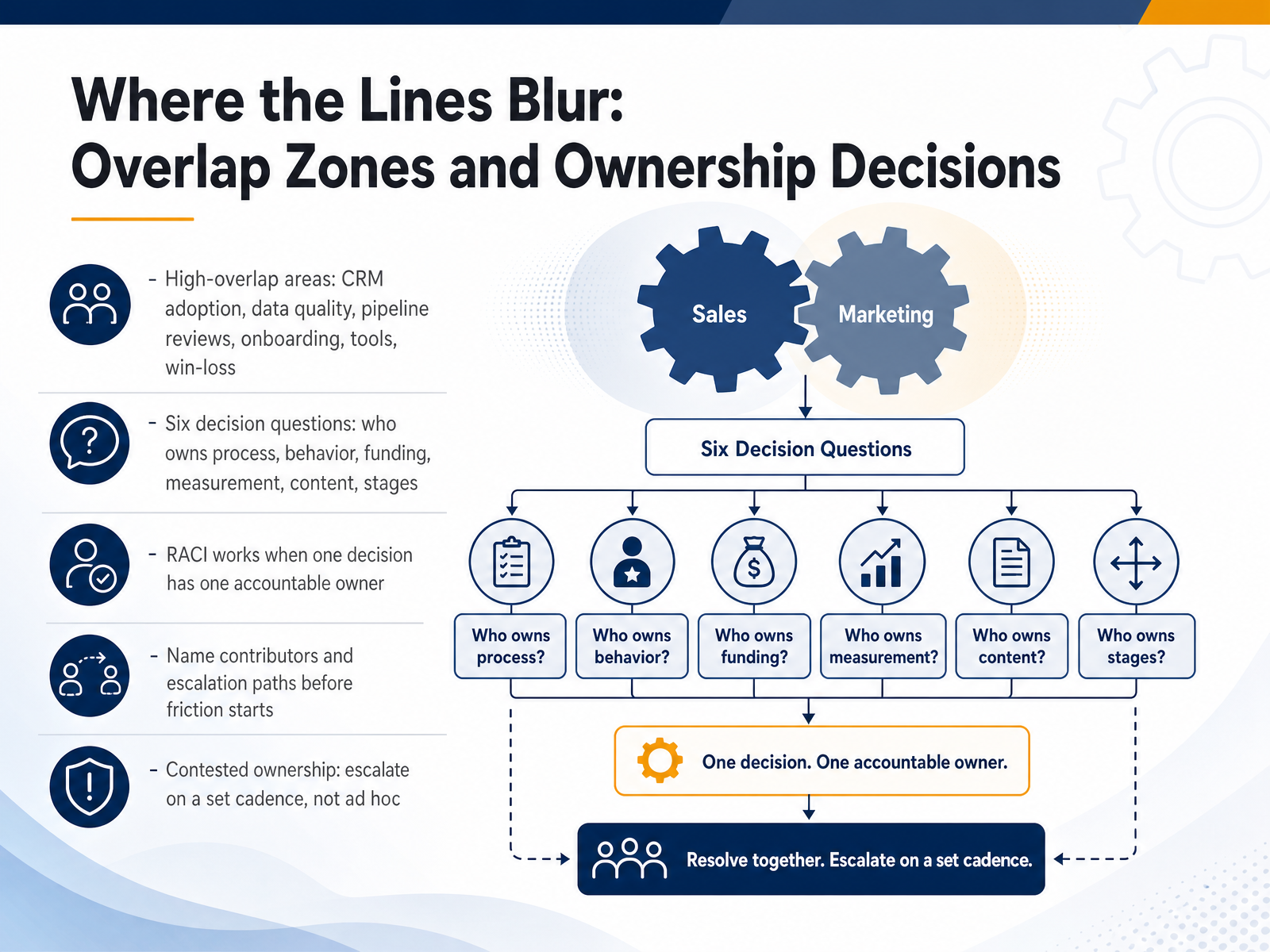
- 08Where the Lines Blur: Overlap Zones and Ownership DecisionsLet's look at where the lines blur. Start with the high-overlap zones: CRM adoption, data quality, pipeline reviews, onboarding, tools, and win-loss analysis. Both teams touch these, so ownership gets murky fast. Ask six questions for each: who owns the process, the behavior, the funding, the measurement, the content, and the stage definitions? A RACI model only works when one decision has one accountable owner. If two names share that column, you don't have a decision, you have a dispute waiting to surface. So name your contributors and your escalation paths before friction starts, not after. When ownership is contested, escalate on a set cadence, say a weekly revenue standup, rather than ad hoc. That keeps the conversation about the work, not the politics. Next, we'll walk through a practical collaboration model that puts this into practice.
 1 min
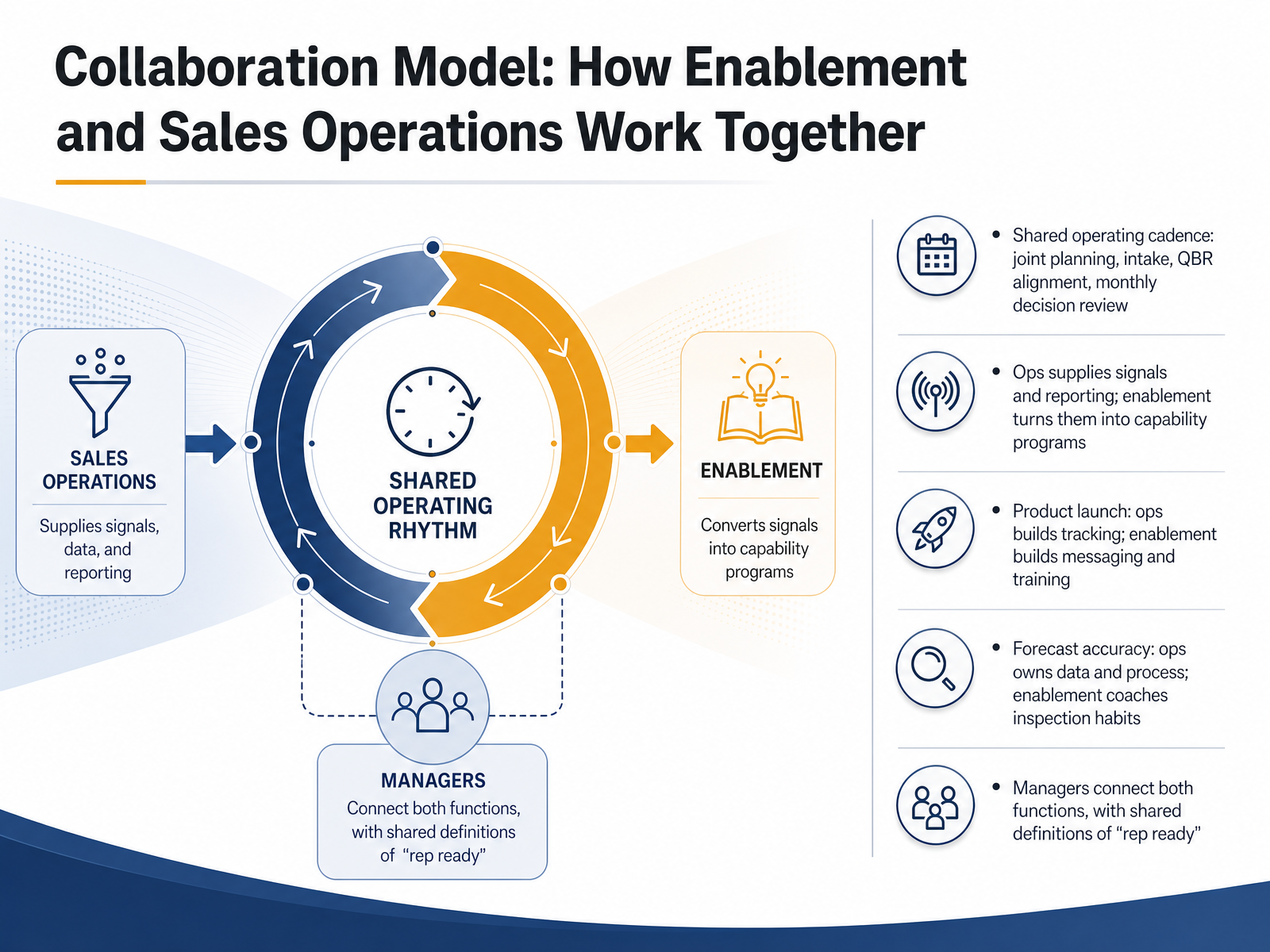
- 09Collaboration Model: How Enablement and Sales Operations Work TogetherLet's walk through the collaboration model, because this is where enablement and sales operations create leverage together. First, shared operating cadence. You run joint planning, one intake process, quarterly business review alignment, and a monthly decision review. One prioritized list, two execution tracks. Second, ops supplies the signals and reporting. Enablement turns those signals into capability programs. Take a product launch. Ops builds the tracking and dashboards. Enablement builds the messaging and the training. For forecast accuracy, ops owns the data and the process, while enablement coaches inspection habits. Managers connect both functions, and everyone shares one definition of rep ready. Here is the takeaway: agree on the cadence, split the work by strength, and let managers close the loop. Next, how revenue operations changes the picture.
 1 min
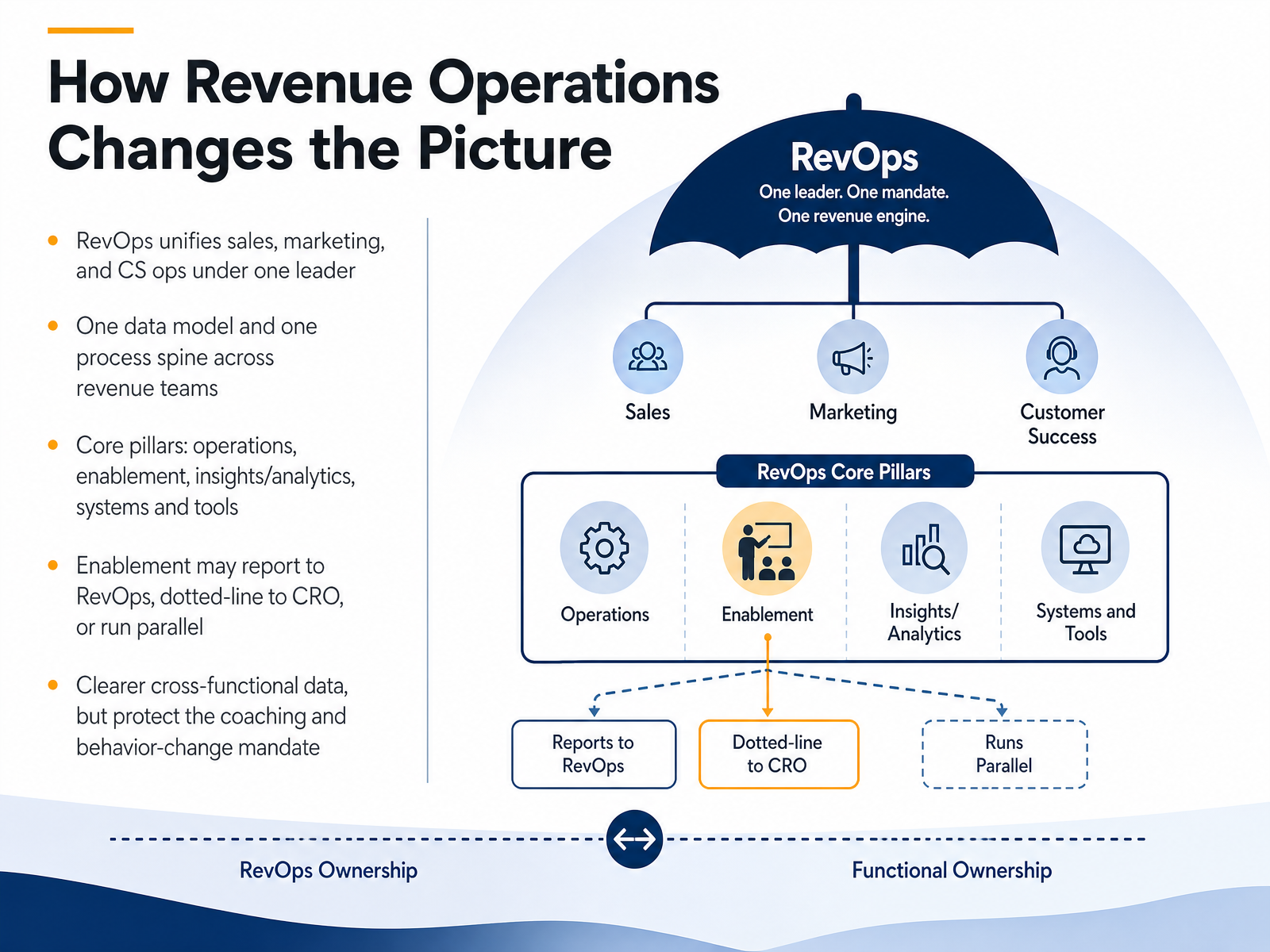
- 10How Revenue Operations Changes the PictureNext, let us look at how Revenue Operations changes the picture. The simplest way to think about RevOps is unification. Sales, marketing, and customer success operations stop running as separate islands and report under one leader with one shared plan. That means one data model and one process spine across the revenue teams, so a deal stage, a lead status, or a renewal milestone means the same thing everywhere. Most RevOps organizations build on four core pillars: operations, enablement, insights and analytics, and systems and tools. So where does enablement sit? It depends. Enablement may report directly to RevOps, it may keep a dotted line to the Chief Revenue Officer, or it may run parallel to RevOps. All three models exist in healthy companies. The tradeoff is this. You get cleaner cross-functional data and fewer competing priorities, but you must protect the coaching and behavior-change mandate. Otherwise enablement becomes a reporting function and quota-carrying reps lose the floor support they need. Keep that balance in mind as we move into common misconceptions and failure modes.
 2 min
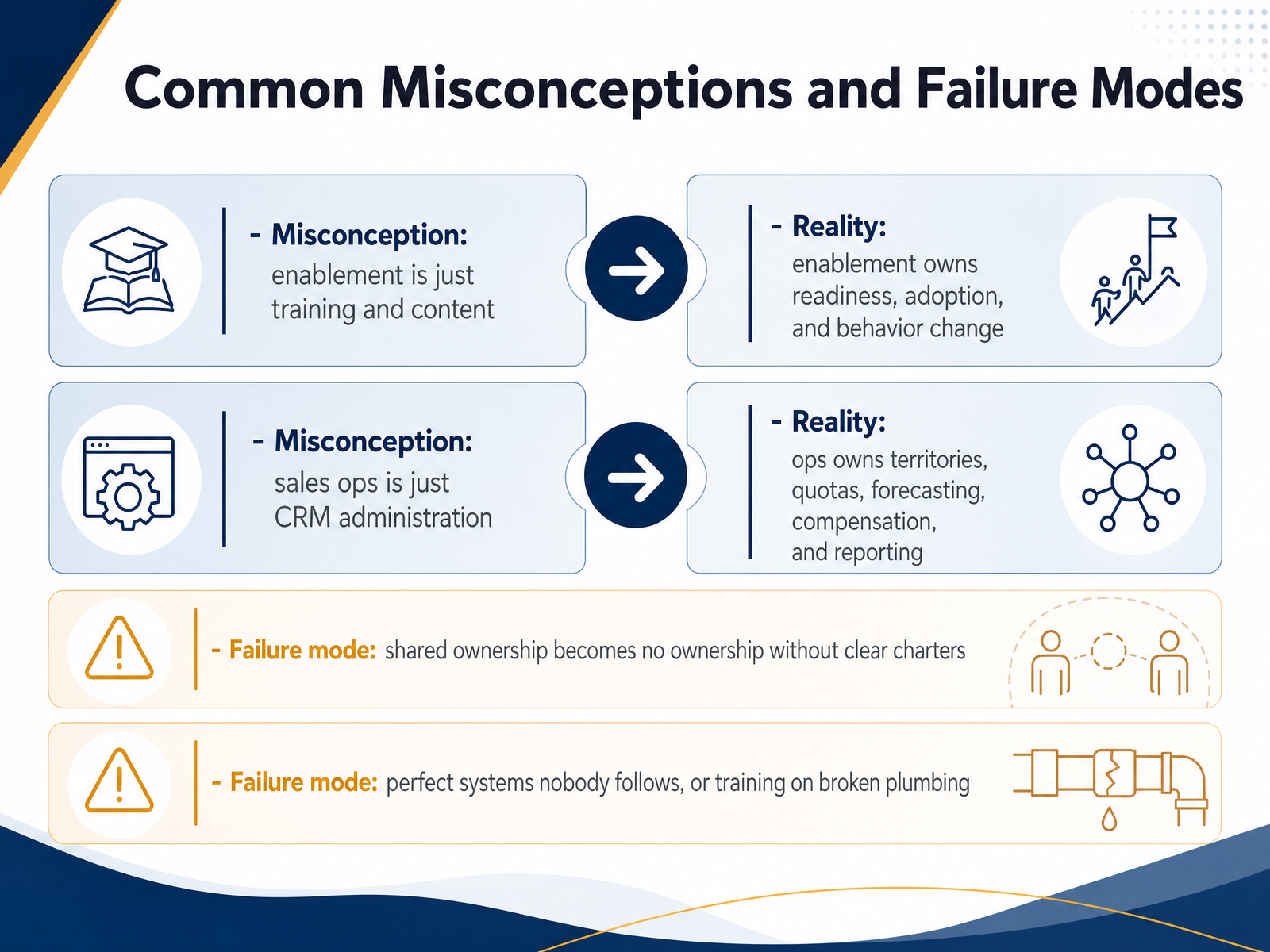
- 11Common Misconceptions and Failure ModesLet's clear up the two misconceptions that cause the most friction. Misconception one: enablement is just training and content. Reality: enablement owns readiness, adoption, and behavior change. If reps complete the course but don't change how they sell, enablement isn't done. Misconception two: sales ops is just CRM administration. Reality: ops owns territories, quotas, forecasting, compensation, and reporting. Those are decisions that shape the business, not ticket queues. Now the failure modes. Shared ownership becomes no ownership without clear charters. Write down who decides, who consults, and who executes for each motion. And watch for perfect systems nobody follows, or training on broken plumbing. If the process is broken, fix the process first. Then enable the behavior. Next, let's look at maturity signals and what good looks like at each stage.
 2 min
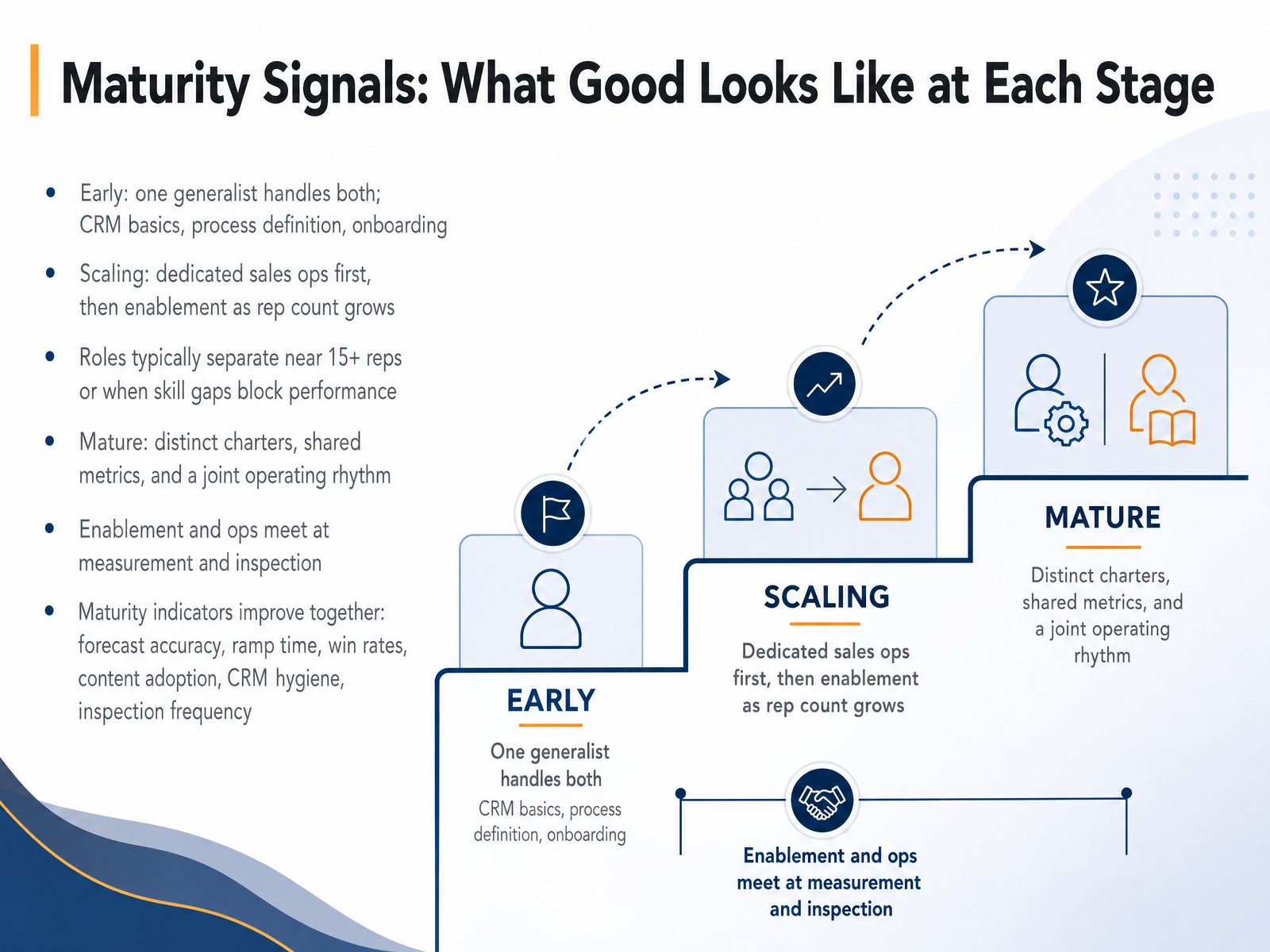
- 12Maturity Signals: What Good Looks Like at Each StageNow let's look at maturity signals, so you can place your own organization on the curve. In the early stage, one generalist handles both enablement and operations. They set up CRM basics, define process, and run onboarding. That works, but it does not scale. As you grow, sales ops typically becomes a dedicated role first, because pipeline, forecasting, and CRM hygiene break before onboarding does. Enablement usually follows as rep count climbs. In practice, roles tend to separate around fifteen or more reps, or sooner when skill gaps directly block performance. At the mature stage, you see distinct charters, shared metrics, and a joint operating rhythm. Enablement and ops meet at measurement and inspection. And the indicators improve together: forecast accuracy, ramp time, win rates, content adoption, CRM hygiene, and inspection frequency. So the takeaway is simple. Maturity is not headcount. It is clarity of ownership plus a shared scoreboard. Next, we will turn to clarifying ownership in your organization, diagnostics and first actions.
 2 min
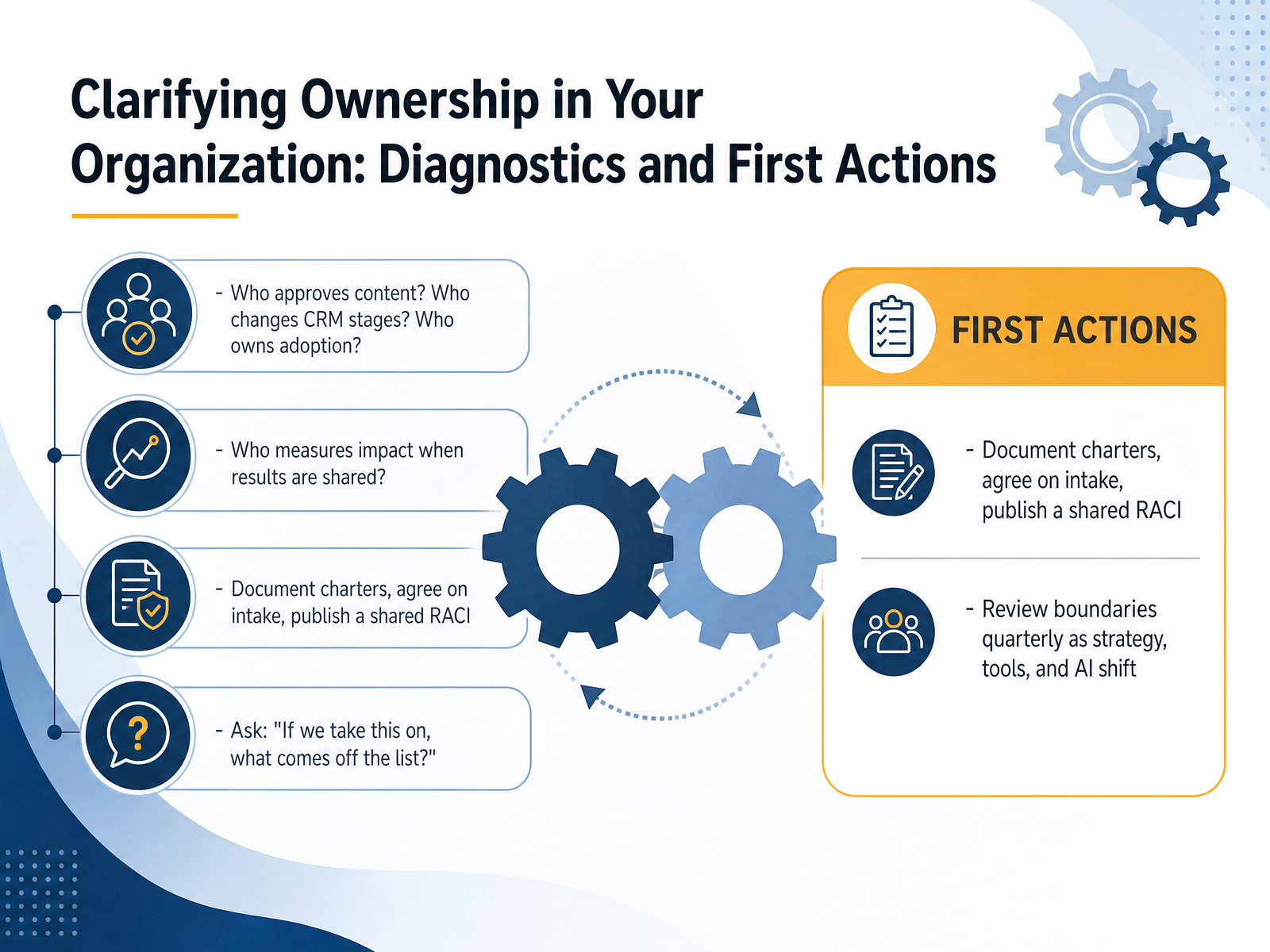
- 13Clarifying Ownership in Your Organization: Diagnostics and First ActionsLet's make ownership concrete. Start with three diagnostic questions. Who approves content? Who changes C R M stages? Who owns adoption? If you get three different answers in one room, that's not a people problem. That's a boundary problem. Take adoption. Enablement may build the training and drive behavior change, while operations owns the reporting and the C R M fields that make adoption visible. Now name who measures impact when results are shared. Ambiguity there turns a quarterly business review into a debate about credit instead of a decision about the next move. So take three first actions. Document charters, agree on intake, and publish a shared R A C I. Then review those boundaries quarterly. Strategy shifts, tools change, and AI is already moving pieces across the line. And keep one question in every planning conversation. If we take this on, what comes off the list? That single question protects capacity and keeps the partnership honest. Next, we'll move into discussion prompts and next steps for sales leaders, enablement, ops, and L and D.
 2 min
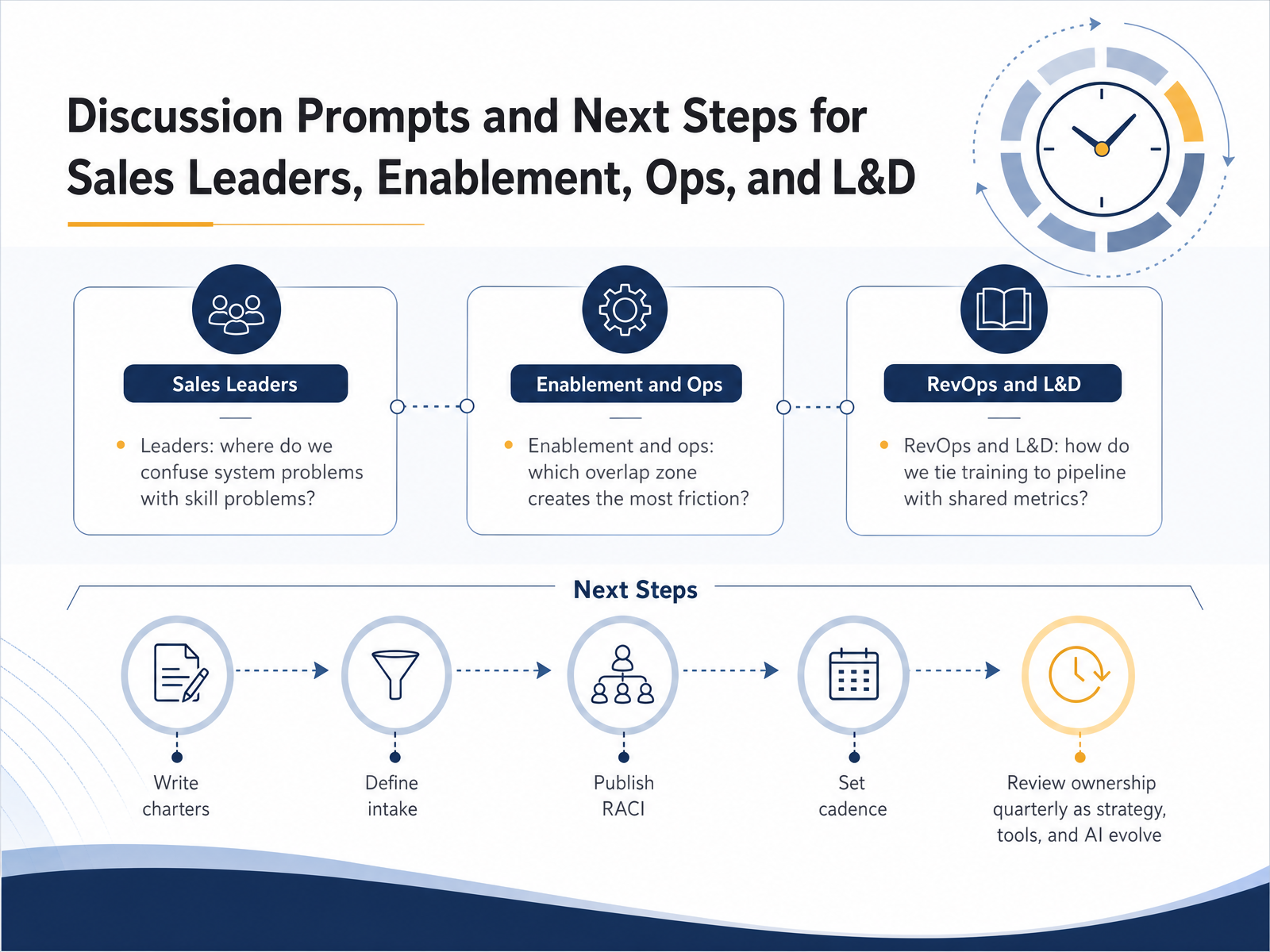
- 14Discussion Prompts and Next Steps for Sales Leaders, Enablement, Ops, and L&DLet's close by turning the concepts into conversations you can run this quarter. Leaders, start here. Where do you confuse system problems with skill problems? If reps have clean data and clear steps but still stall, that's a skill gap. If they know exactly what to do but the CRM fights them, that's a systems issue, and enablement alone cannot fix it. Enablement and ops, which overlap zone creates the most friction? Name it out loud, whether that's onboarding, tool adoption, or forecast hygiene, and assign one owner per deliverable. RevOps and L and D, tie training to pipeline with shared metrics, like stage conversion or ramp time, so you can prove impact together. Next steps. Write charters, define intake, publish a RACI, and set a review cadence. Then revisit ownership quarterly, because strategy, tools, and AI keep shifting. Thank you for your attention. Keep these boundaries clear, keep collaborating, and you will move the number together.
 1 min
Take the deck with you
Download this course as a file — free, no sign-up needed.
- PDF handoutEvery slide page, ready to print or share.15 pages · 3.4 MBDownload
- Narrated PowerPointThe deck that presents itself — every slide carries the digital human's narration video.15 pages · 14.2 MBDownload
- PowerPoint slidesThe full deck as a .pptx — open it in PowerPoint, Keynote, or Google Slides.15 pages · 3.3 MBDownload
Free to use in your own training — please keep the PersonWise credit page at the end.
Have your own deck? Turn it into a course