Begin
14 pages · ~28 min
Neolithic Revolution: Farming's Impact on Humanity
This training explores how the Neolithic Revolution and the rise of farming transformed human life, society, and civilization. Ideal for learners interested in early human history and agricultural origins.
A digital instructor presents all 14 pages. Hold “Ask” at any point and ask out loud — the answer comes from this course. No sign-up needed.
What you’ll learn
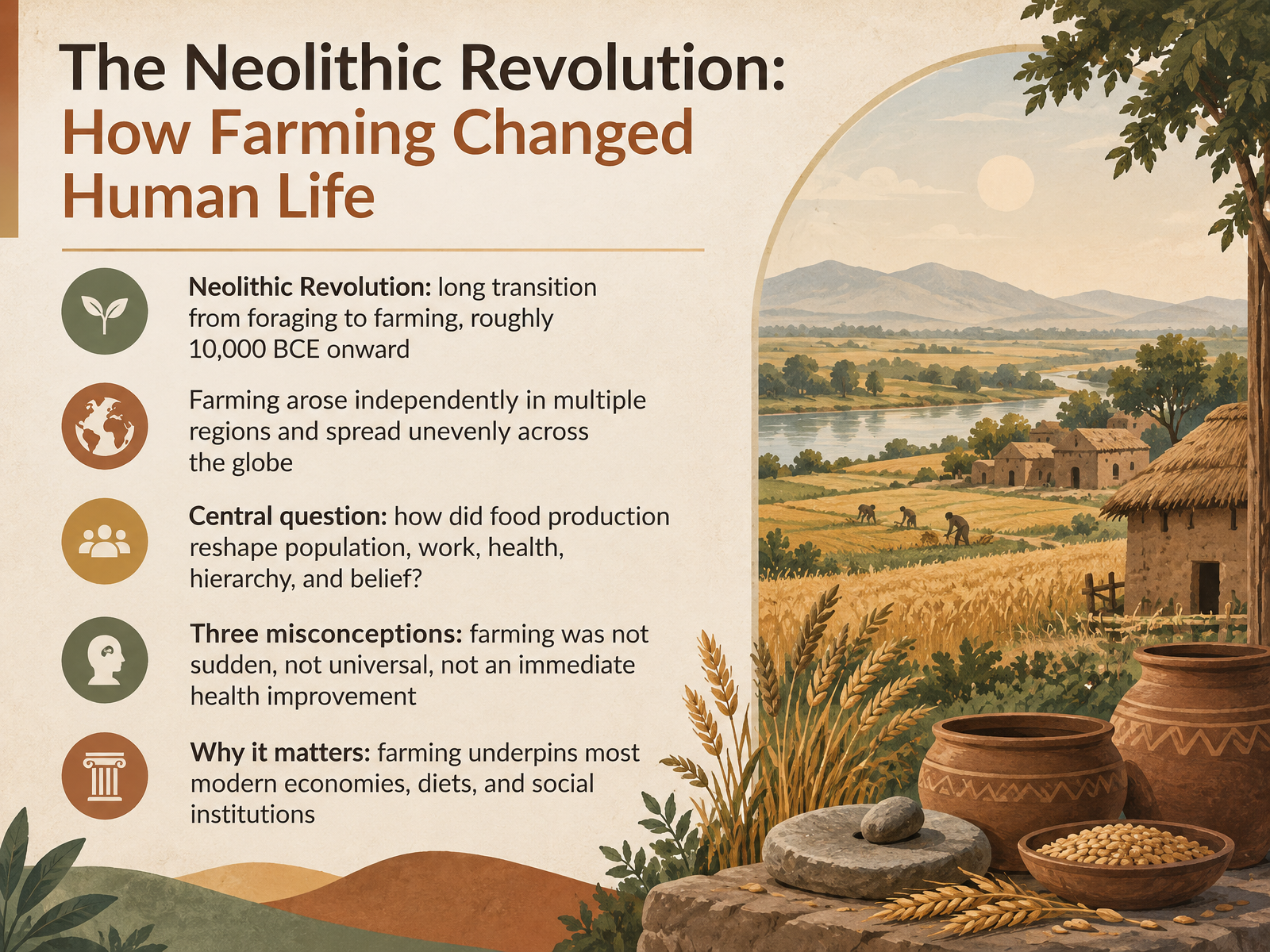
- 01The Neolithic Revolution: How Farming Changed Human LifeWelcome. I'm glad you're here, because we're about to look at one of the biggest turning points in human history: the Neolithic Revolution, the long shift from foraging to farming that began roughly ten thousand years before the common era. Before we go further, two quick terms. Domestication means humans selectively breeding and tending plants and animals over generations. Sedentism means living in one settled place instead of moving with the seasons. Now, here's the surprising part. Farming didn't happen once, in one place. It arose independently in several regions, from the Fertile Crescent to China, New Guinea, Africa, and the Americas, and it spread unevenly. Our guiding question is this: how did food production reshape population, work, health, hierarchy, and belief? Along the way, we'll challenge three common misconceptions. Farming was not sudden, it was not universal, and it was not an immediate health improvement. Why does this matter? Because farming still underpins most modern economies, diets, and social institutions. To see how it all began, let's go back to the world of Ice Age foragers.en.wikipedia.orgworldhistory.orgworldhistory.org+22 min
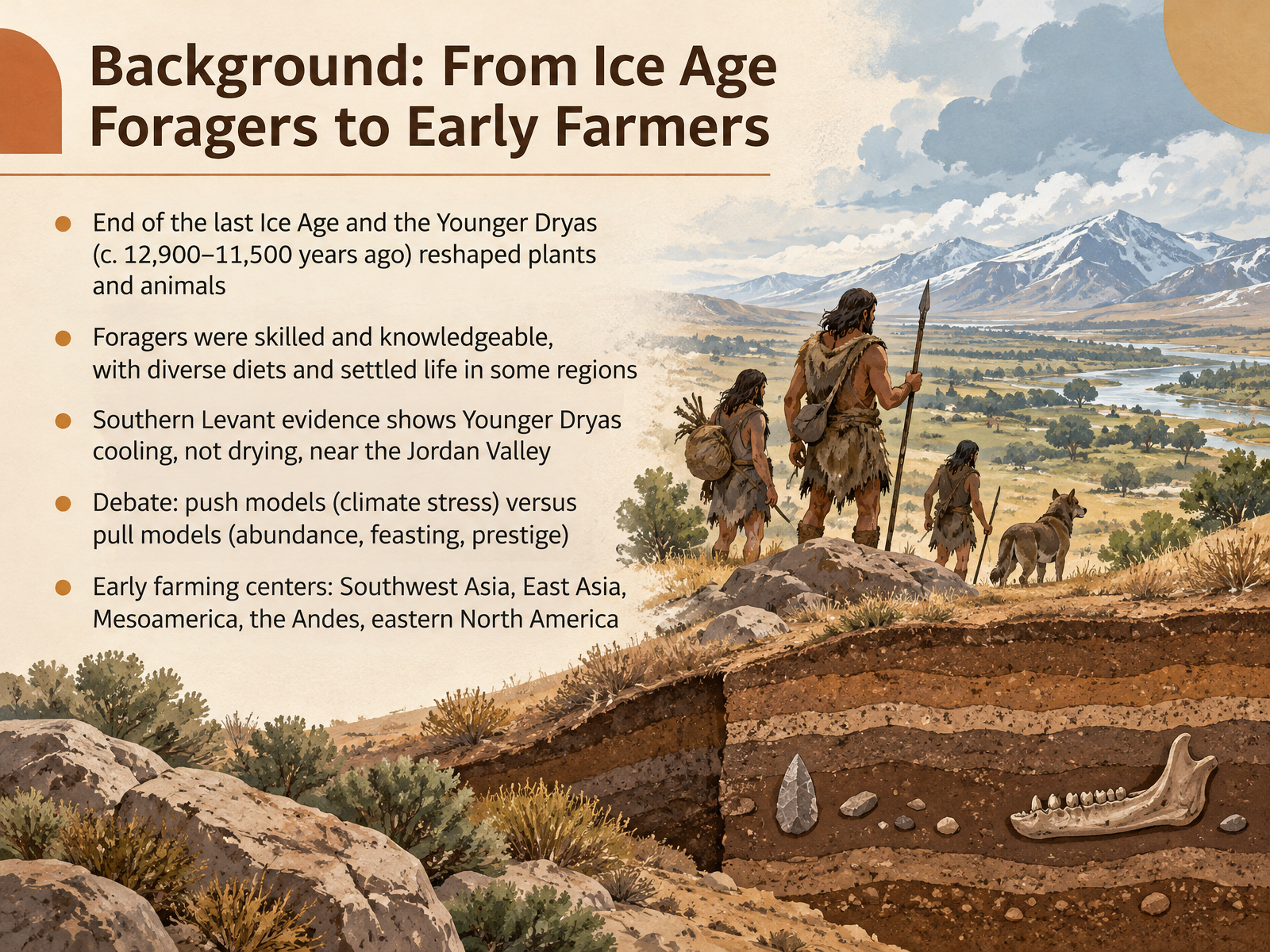
- 02Background: From Ice Age Foragers to Early FarmersLet's set the stage. Before farming, there was a long, remarkable era of foraging, and it did not end because foragers failed. Around twelve thousand nine hundred years ago, the last Ice Age was ending, and then came a sharp cold snap called the Younger Dryas. It reshaped plants and animals across much of the world. Yet foragers were skilled and knowledgeable, with varied diets, and in some regions they already lived in settled villages. Evidence from the southern Levant, near the Jordan Valley, suggests the Younger Dryas brought cooling, not drying, which may have pushed people toward warmer, more stable places where wild cereals grew well. That feeds a lively debate. Push models blame climate stress. Pull models point to abundance, feasting, and prestige. And farming did not begin in one spot. It emerged independently in Southwest Asia, East Asia, Mesoamerica, the Andes, and eastern North America. Next, we'll define the core concepts, domestication, sedentism, and agriculture.
 pnas.orgjournals.sagepub.comtandfonline.com+21 min
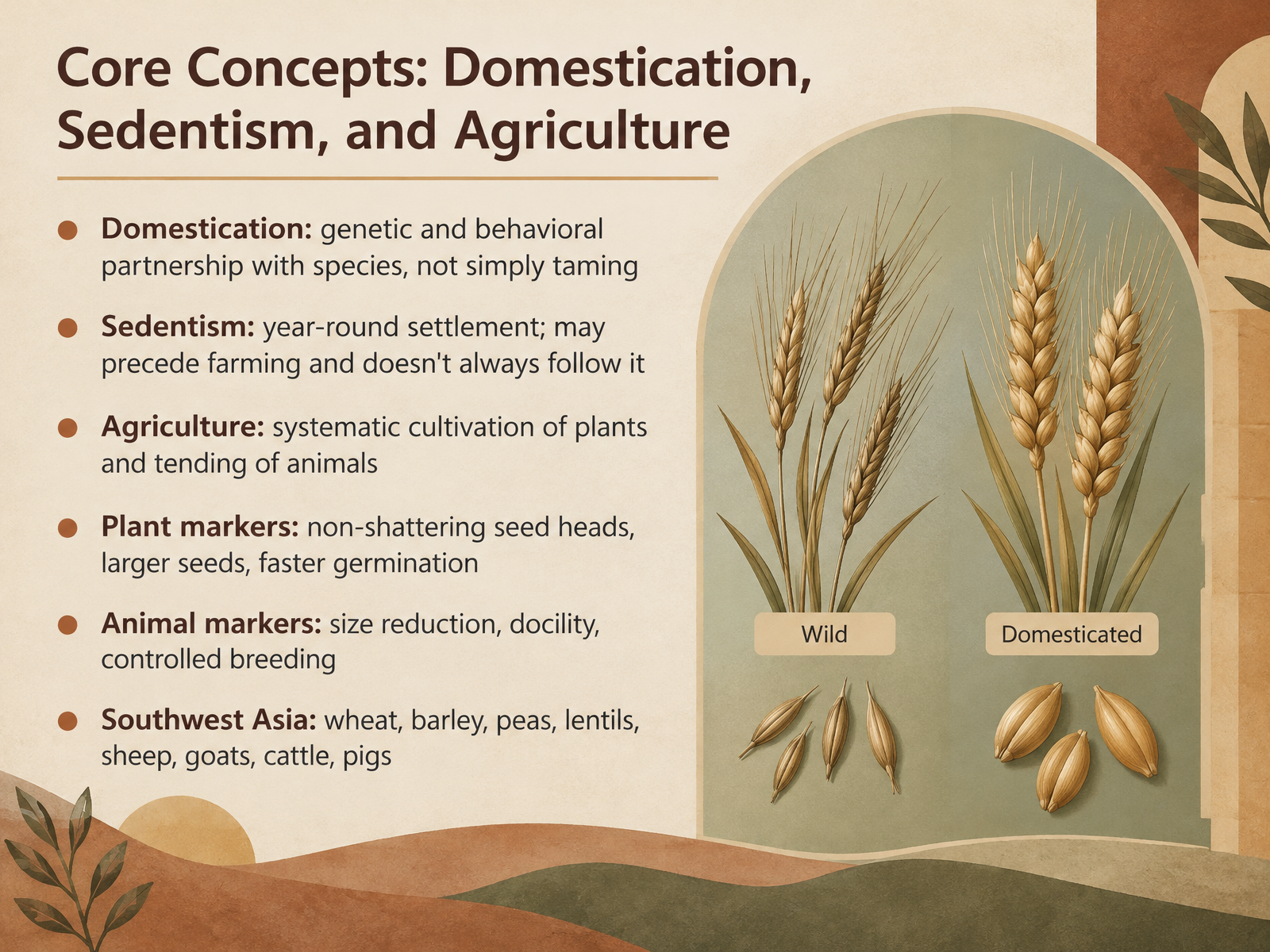
- 03Core Concepts: Domestication, Sedentism, and AgricultureNow let's define three ideas we'll keep coming back to. Domestication is a genetic and behavioral partnership between people and other species, not just taming. Over generations, the plants and animals themselves change. Sedentism means living in one place year round, and it doesn't always follow farming. Some communities settled first, then began cultivating. Agriculture is the systematic cultivation of plants and the tending of animals. Picture the evidence. In plants, we look for non-shattering seed heads, so ripe grain stays on the stalk, along with larger seeds and faster germination. In animals, we often see size reduction, docility, and controlled breeding. In Southwest Asia, this package arrived with wheat, barley, peas, and lentils, plus sheep, goats, cattle, and pigs. So domestication is a partnership, while sedentism is a choice about where to live. Next, let's see how farming actually worked: tools, crops, and daily labor.
 pnas.orgpmc.ncbi.nlm.nih.govnature.com+21 min
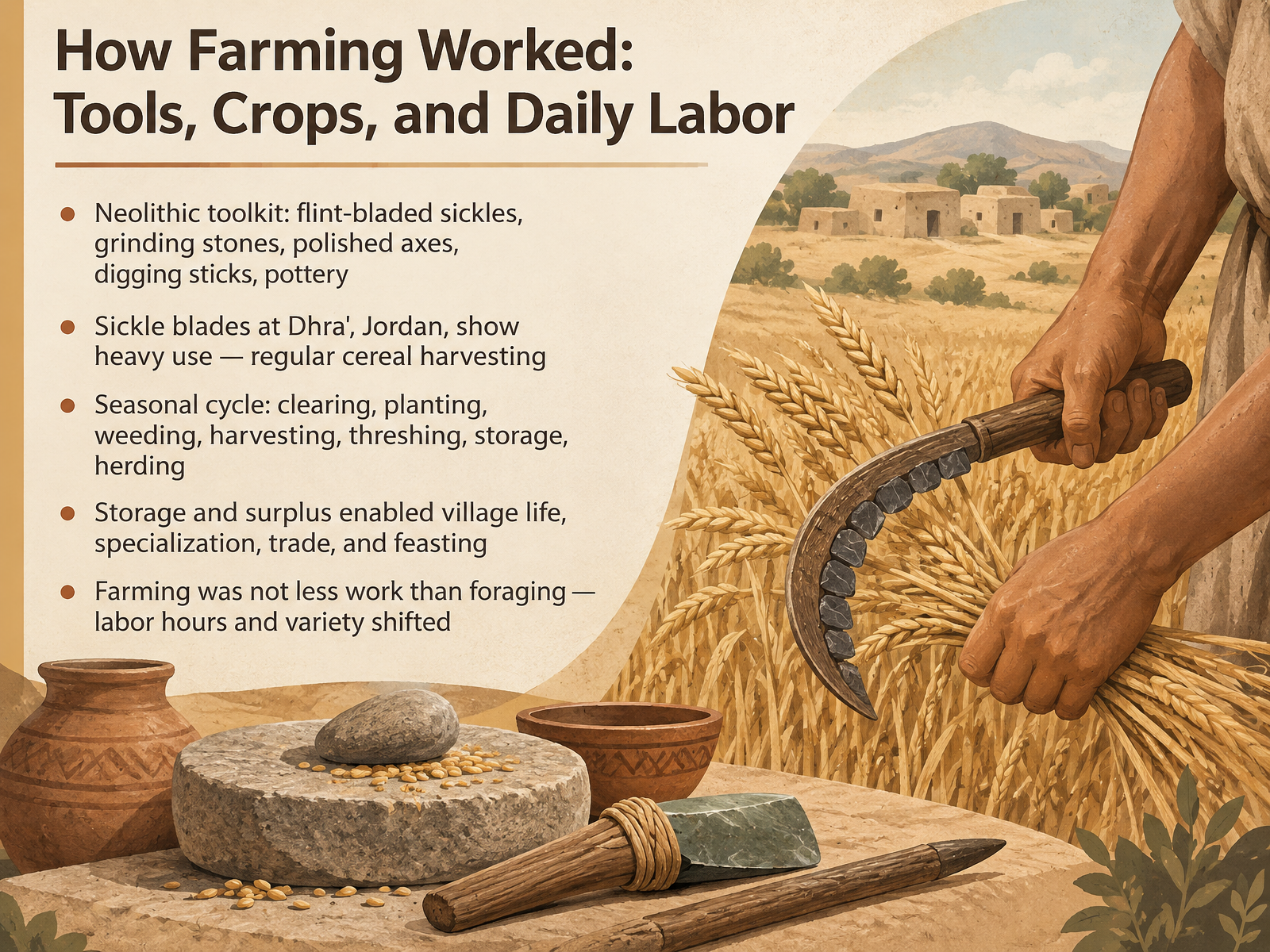
- 04How Farming Worked: Tools, Crops, and Daily LaborSo how did farming actually work, day to day? Picture the toolkit: flint-bladed sickles for cutting grain, grinding stones for turning it into flour, polished axes for clearing land and working wood, digging sticks, and pottery for storing and cooking. The sickles tell us something important. At a site called Dhra', in Jordan, the blades show heavy, repeated use, evidence of regular cereal harvesting. Farming followed a seasonal cycle: clearing, planting, weeding, harvesting, threshing, and storage, alongside herding animals. That stored surplus was the key. It allowed villages to grow, supported specialists who did not farm, encouraged trade, and even made feasts possible. But here is the trade-off worth imagining: farming was not less work than foraging. The labor hours shifted, and the variety of tasks changed. So ask yourself, would you have made that bargain? Next, we look at the consequences for population and health.
 sciencedirect.comjournals.plos.orgcambridge.org+22 min
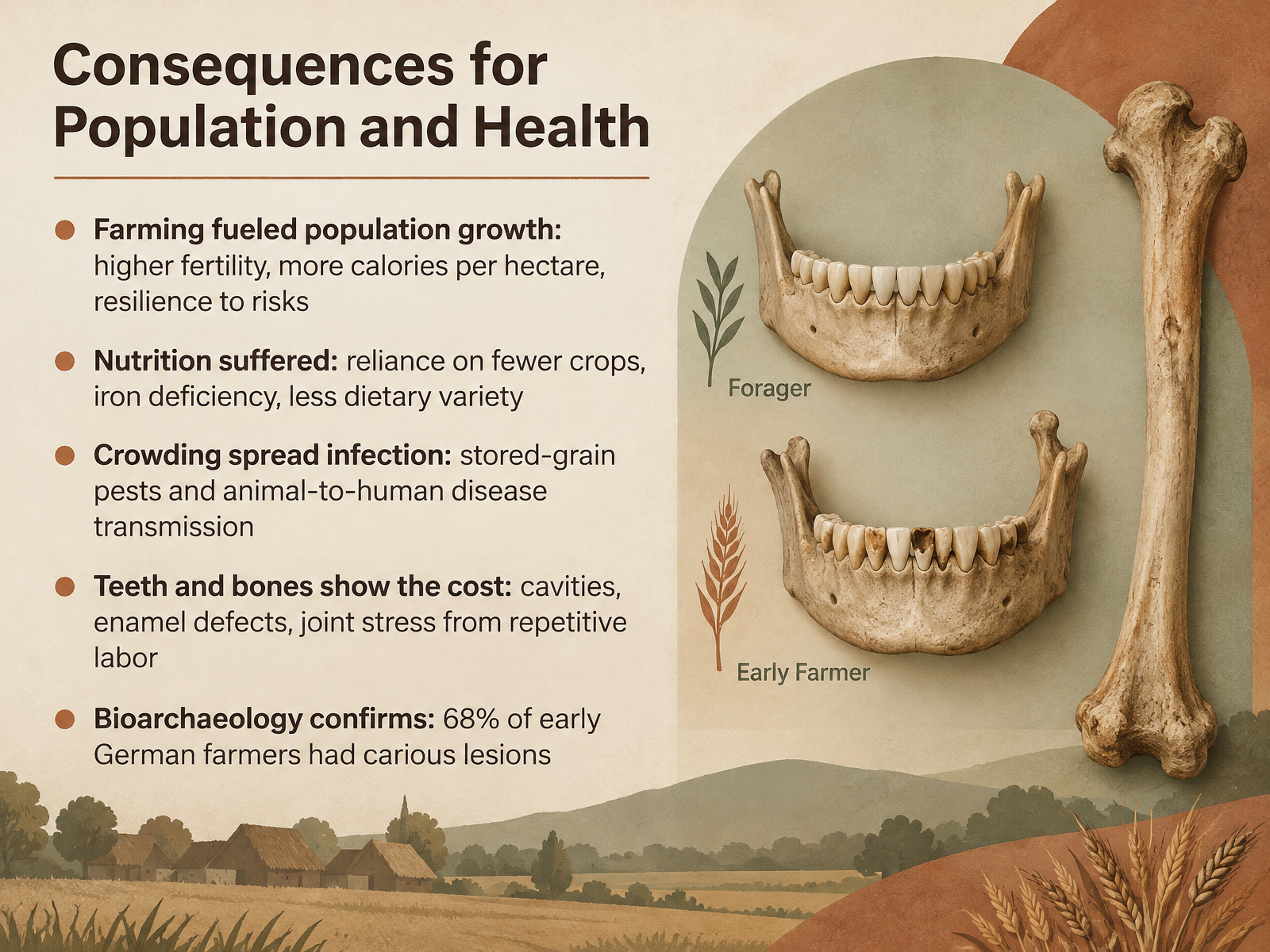
- 05Consequences for Population and HealthSo now let's turn to the consequences of farming — for population, and for health. Because here's the surprise: farming spread, and populations surged, but the human body often paid a price.
First, the growth. Farming produced more calories per hectare than foraging, and stored grain buffered against bad years. Higher fertility followed. More food, more people. But abundance had a cost.
Nutrition narrowed. Early farmers relied on a handful of crops, mainly cereals, which are starchy and low in iron. Less variety meant more deficiency, and sometimes less protein.
Then there's crowding. Villages packed people together with stored grain and animals. Pests, parasites, and animal-to-human infections spread easily — what we would call zoonotic disease.
And the skeleton keeps the record. Bioarchaeologists, scientists who study ancient bones, find cavities, enamel defects that signal childhood stress, and joint wear from repetitive labor. In one study of early farmers in central Germany, sixty-eight percent of adults had carious lesions — cavities.
So farming fed more people, but often fed them less well. Next, we look at how these changes reshaped society itself: inequality, property, and community.
 2 min
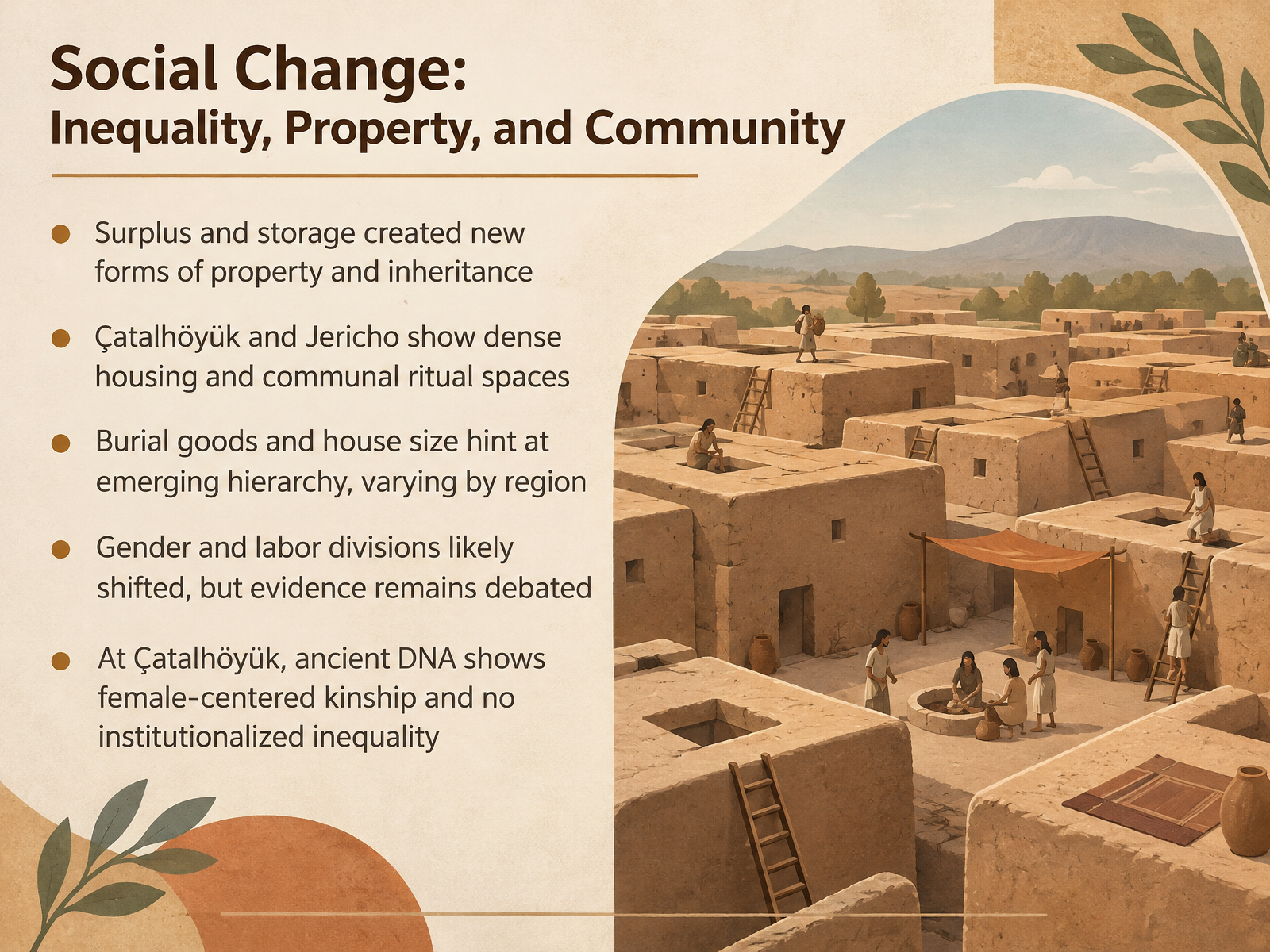
- 06Social Change: Inequality, Property, and CommunityNow let's look at how farming reshaped society itself. Once people could store grain, they had surplus. And surplus brought something new: property that could be passed down, and inheritance. At settlements like Çatalhöyük and Jericho, we see densely packed houses and shared spaces for ritual. In some burials, certain people were laid to rest with more goods, and some houses grew larger, hinting that hierarchy was beginning to emerge, though it varied from region to region. Did men and women's roles shift? Probably yes, but the evidence is debated. One striking finding at Çatalhöyük comes from ancient DNA: kinship ran mainly through women, and there's no sign of deep, institutionalized inequality. So early farming communities weren't simply stepping stones to kings and classes. They were experiments, and some of them held onto fairness. Next, we explore how ritual and monumental architecture gave these communities lasting identity.
 1 min
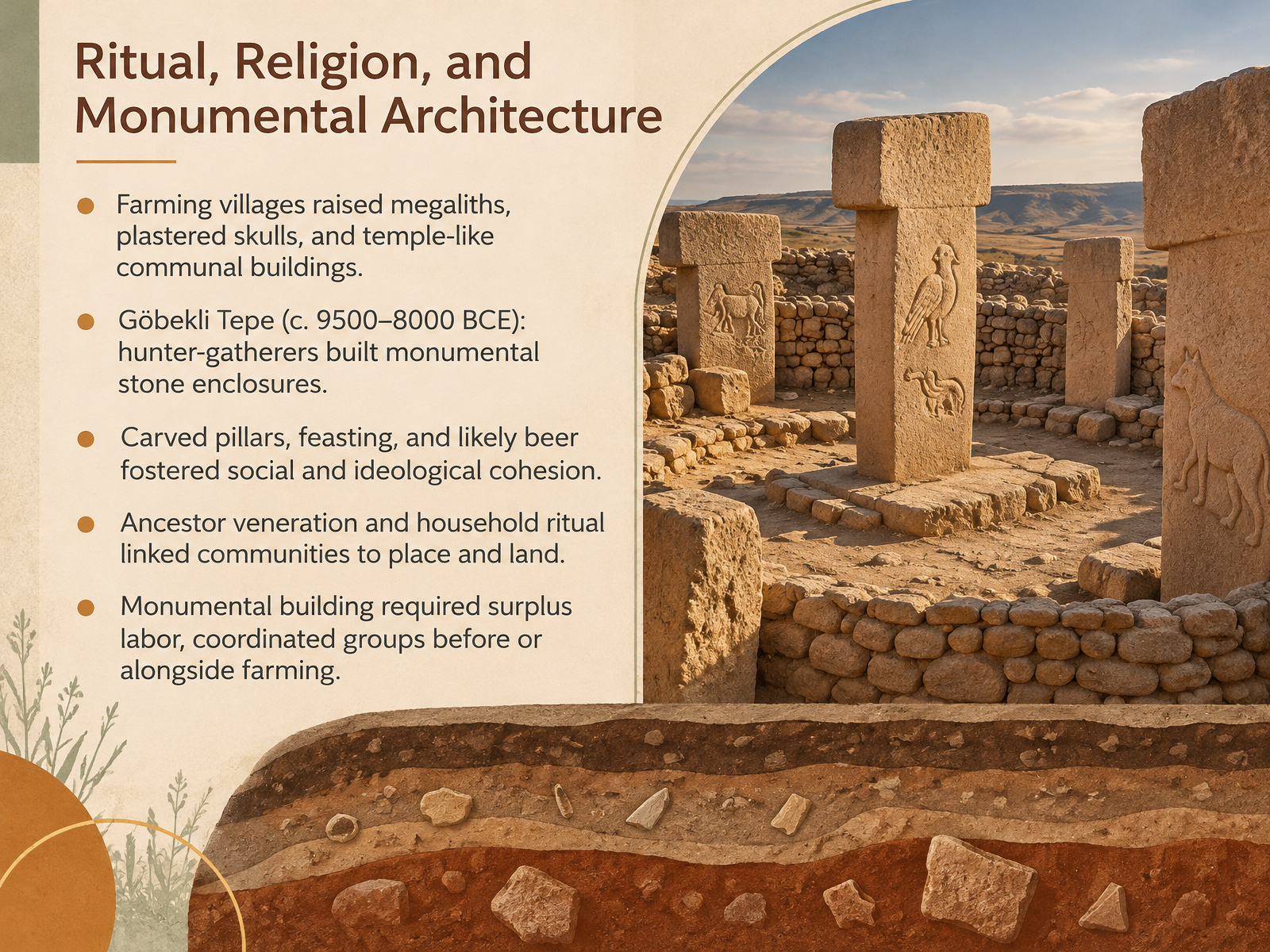
- 07Ritual, Religion, and Monumental ArchitectureNow let's look at something that surprises many people: the urge to build big, sacred places came before farming. Across early farming villages, we find megaliths, large standing stones, plastered human skulls, and temple-like communal buildings. Take Göbekli Tepe, in southeastern Turkey, dated roughly ninety-five hundred to eight thousand B C E. Here, hunter-gatherers, not farmers, raised monumental stone enclosures with carved pillars. Feasting, dancing, and almost certainly beer helped bind these scattered groups together. Ancestor veneration, honoring the dead, and household rituals tied communities to a particular place and to the land itself. And think about the labor: quarrying, moving, and raising those pillars demanded surplus food, planning, and coordination. Some scholars argue this organized ritual came before farming, or alongside it. So the trade-off early farmers and foragers faced was real: more work, more rules, but also stronger communities and a deeper sense of home. That sets the stage for our next topic, the spread and regional variation of this new way of life.
 2 min
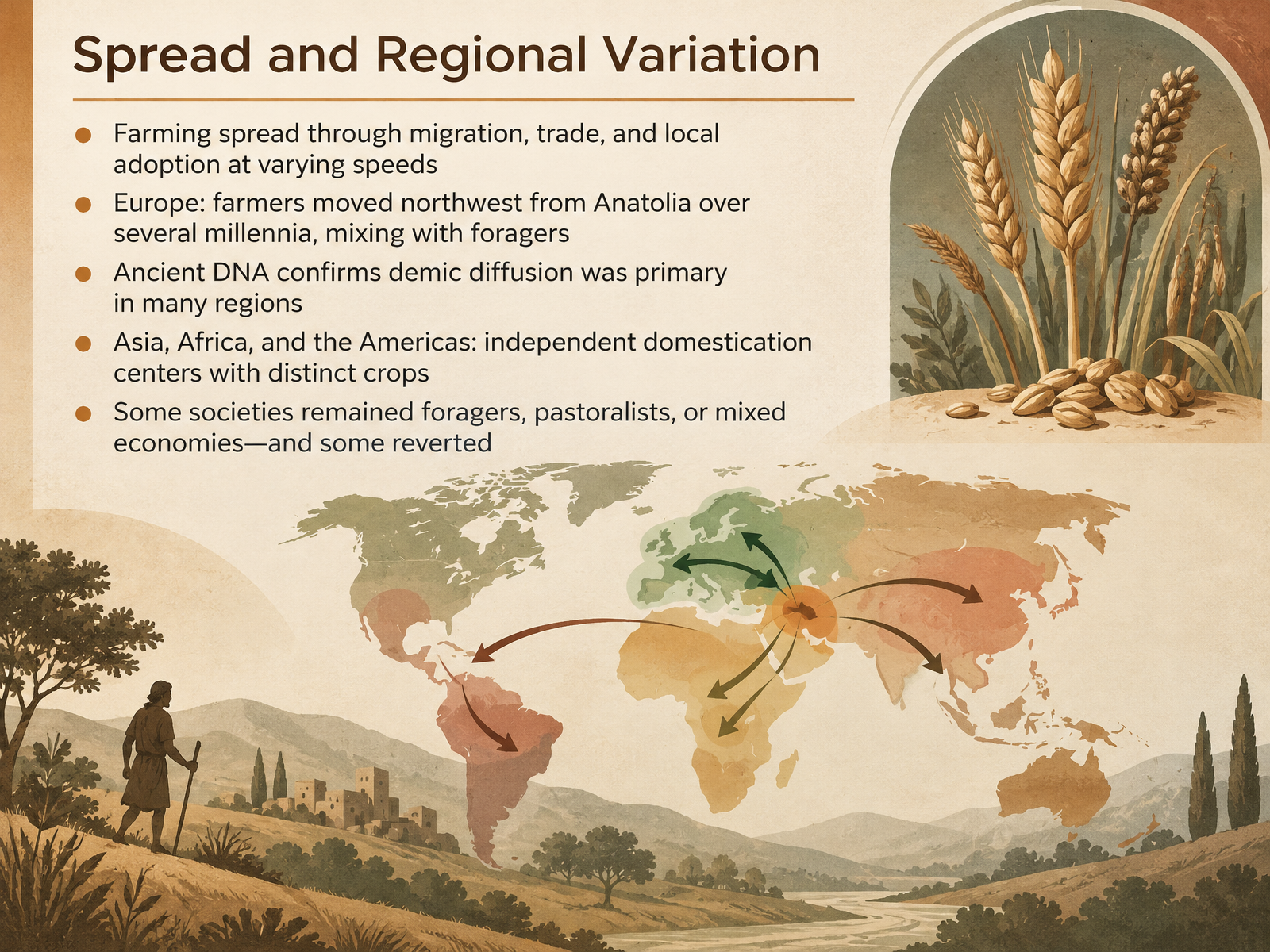
- 08Spread and Regional VariationSo farming didn't appear everywhere at once, and it didn't travel one way. Picture it spreading along several paths at once, through migration, through trade, and through local communities simply deciding to adopt it. And the speed varied enormously. In Europe, farmers moved northwest from Anatolia over several thousand years, mixing with the foragers already living there. Ancient DNA confirms that this movement of people, called demic diffusion, was the main engine in many regions. But other parts of the world tell a different story. Asia, Africa, and the Americas each had their own independent centers of domestication, with their own distinct crops. And not every society became farmers. Some remained foragers, some herded animals, some blended all three, and a few even reverted to older ways. So ask yourself, what would make a community adopt farming, and what would make them walk away from it? To understand how we know all this, let's turn to evidence and methods, and how we know.
 en.wikipedia.orgworldhistory.orgworldhistory.org+21 min
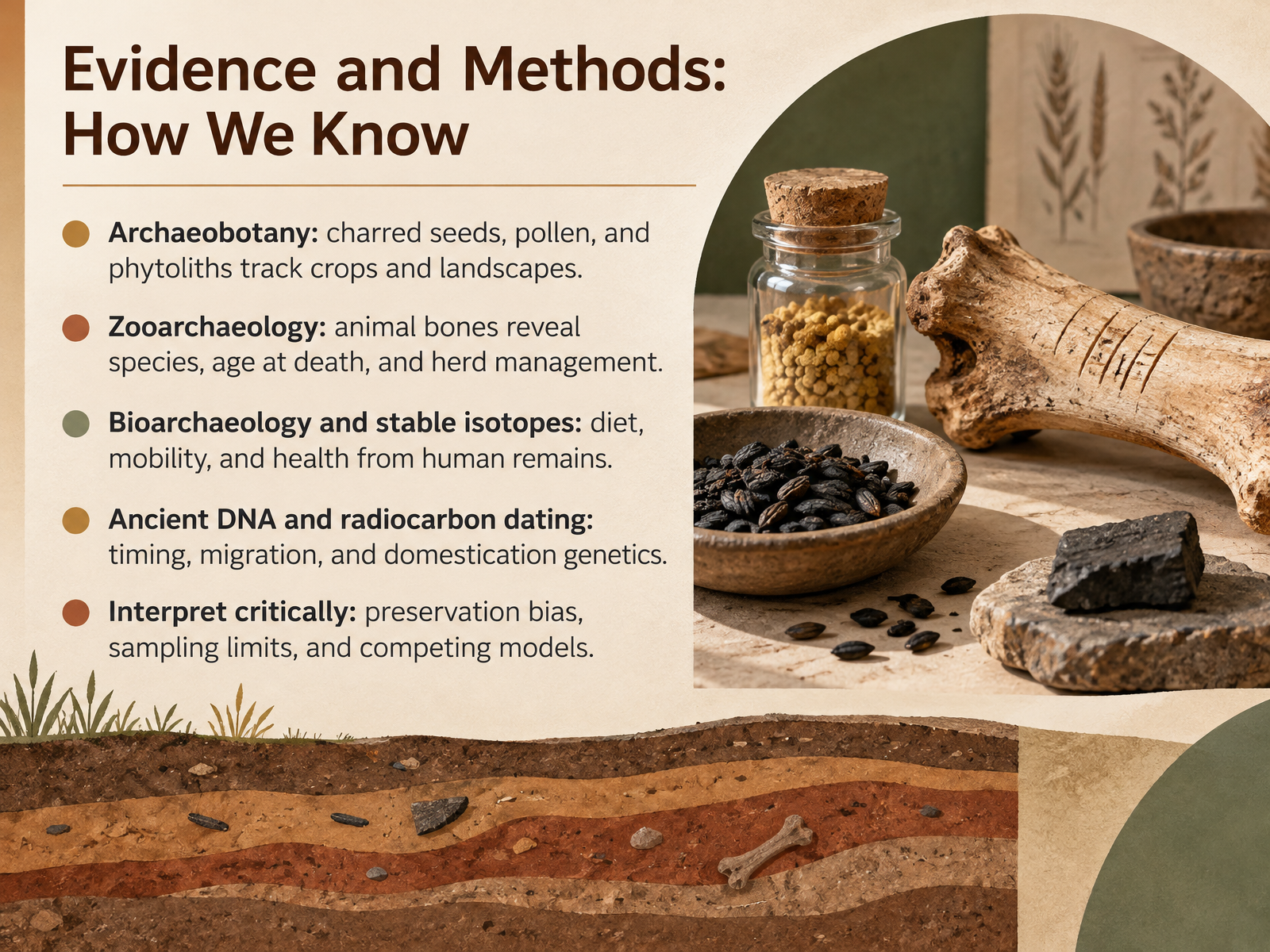
- 09Evidence and Methods: How We KnowSo how do we actually know all this? Archaeology is detective work, and each technique answers a different question.
Archaeobotany is the study of plant remains. Charred seeds, pollen grains, and phytoliths, which are tiny silica particles that plants leave behind in soil, all track which crops were grown and how the landscape changed. We can even measure seed size over time to watch domestication unfold, slowly.
Zooarchaeology looks at animal bones. Species, the age at death, and signs of herd management tell us how people kept and culled their livestock.
Bioarchaeology and stable isotopes read diet, mobility, and health from human remains. Ancient DNA and radiocarbon dating pin down timing, migration, and the genetics of domestication.
But here is the honest part. Preservation is biased. Sampling is limited. And competing models often fit the same evidence. So the real skill is weighing these lines together before drawing conclusions.
Now let us see this in action at two famous sites: Çatalhöyük and Jericho.
 pnas.orgpmc.ncbi.nlm.nih.govnature.com+22 min
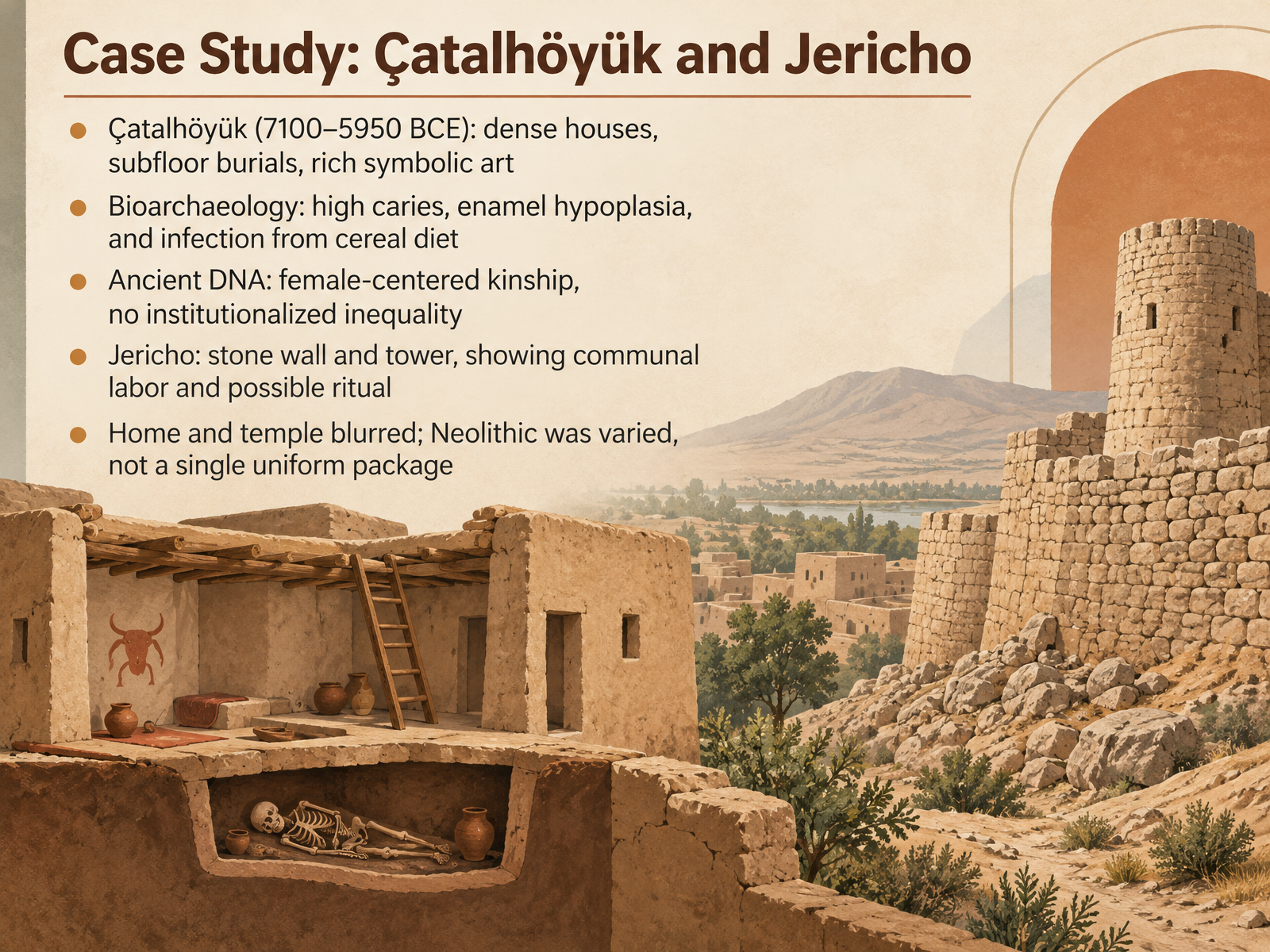
- 10Case Study: Çatalhöyük and JerichoLet's look at two very different sites to see how varied the Neolithic really was. Çatalhöyük, occupied from 7100 to 5950 BCE, was a dense cluster of houses with no streets. People entered through the roof and buried their dead beneath the floors, surrounded by rich symbolic art. Bioarchaeology shows the human cost: high rates of dental cavities, enamel hypoplasia from childhood stress, and infection, all linked to a cereal-heavy diet. Ancient DNA adds another layer. Female-centered kinship ties held households together, and there's no sign of institutionalized inequality. Jericho tells a different story. Its stone wall and tower, over eight meters high, point to communal labor and possible ritual. Across these sites, home and temple blended, and the Neolithic was not one uniform package. Now let's widen the lens in The Neolithic in Global Context: Comparisons and Contrasts.
 2 min
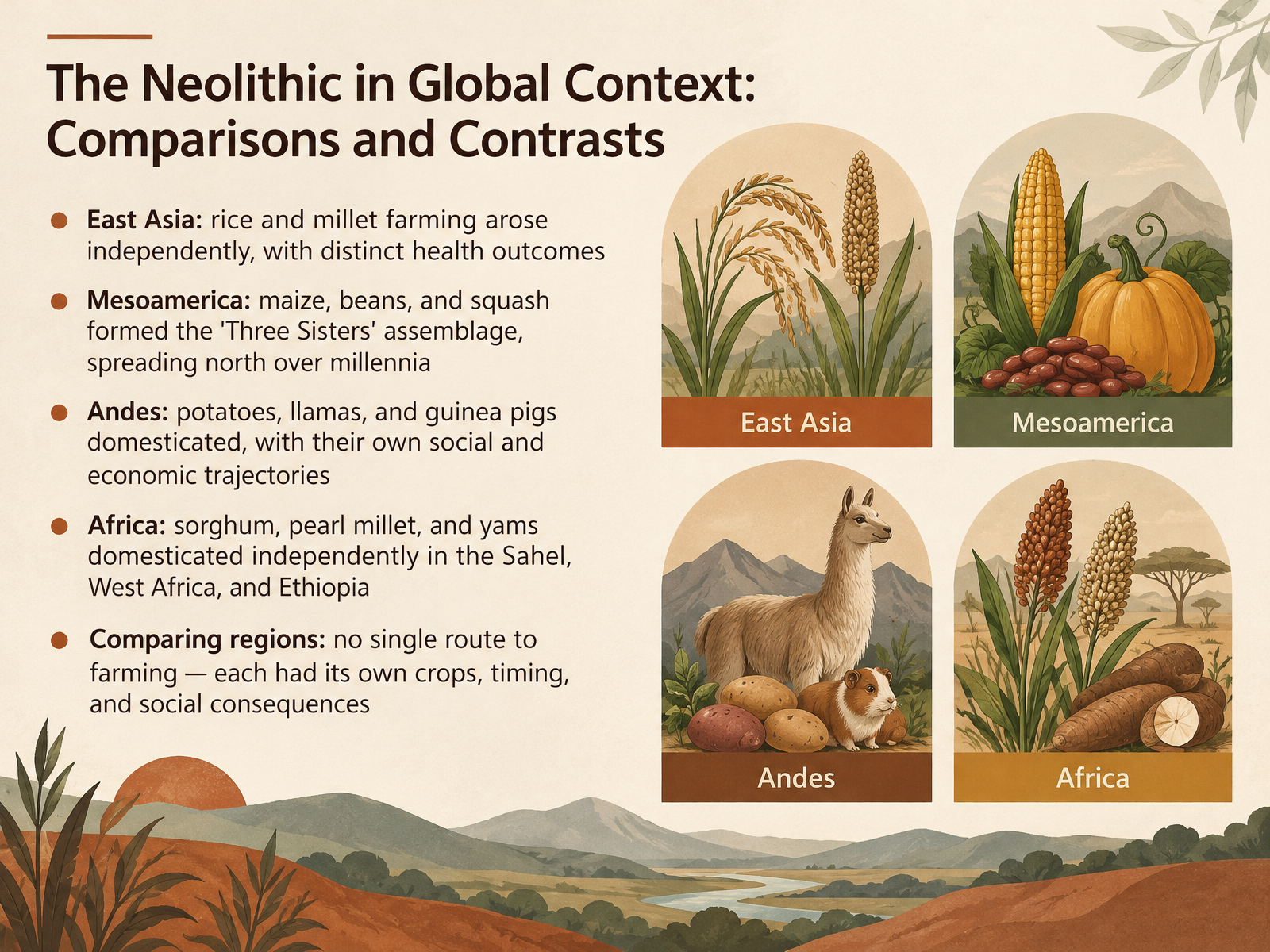
- 11The Neolithic in Global Context: Comparisons and ContrastsNow let's pull back and see the bigger picture, because farming didn't happen just once. It happened independently in several parts of the world, and each region took its own path. In East Asia, rice and millet were domesticated separately, with distinct health outcomes for those populations. In Mesoamerica, maize, beans, and squash came together as the Three Sisters, an assemblage that slowly spread north over thousands of years. In the Andes, people domesticated potatoes, llamas, and guinea pigs, building their own social and economic trajectories. In Africa, sorghum, pearl millet, and yams were domesticated independently across the Sahel, West Africa, and Ethiopia. So when we compare these regions, one thing becomes clear. There was no single route to farming. Each had its own crops, its own timing, and its own social consequences. Next, we'll explore why this still matters and what lessons we can take away.
 en.wikipedia.orgworldhistory.orgworldhistory.org+22 min
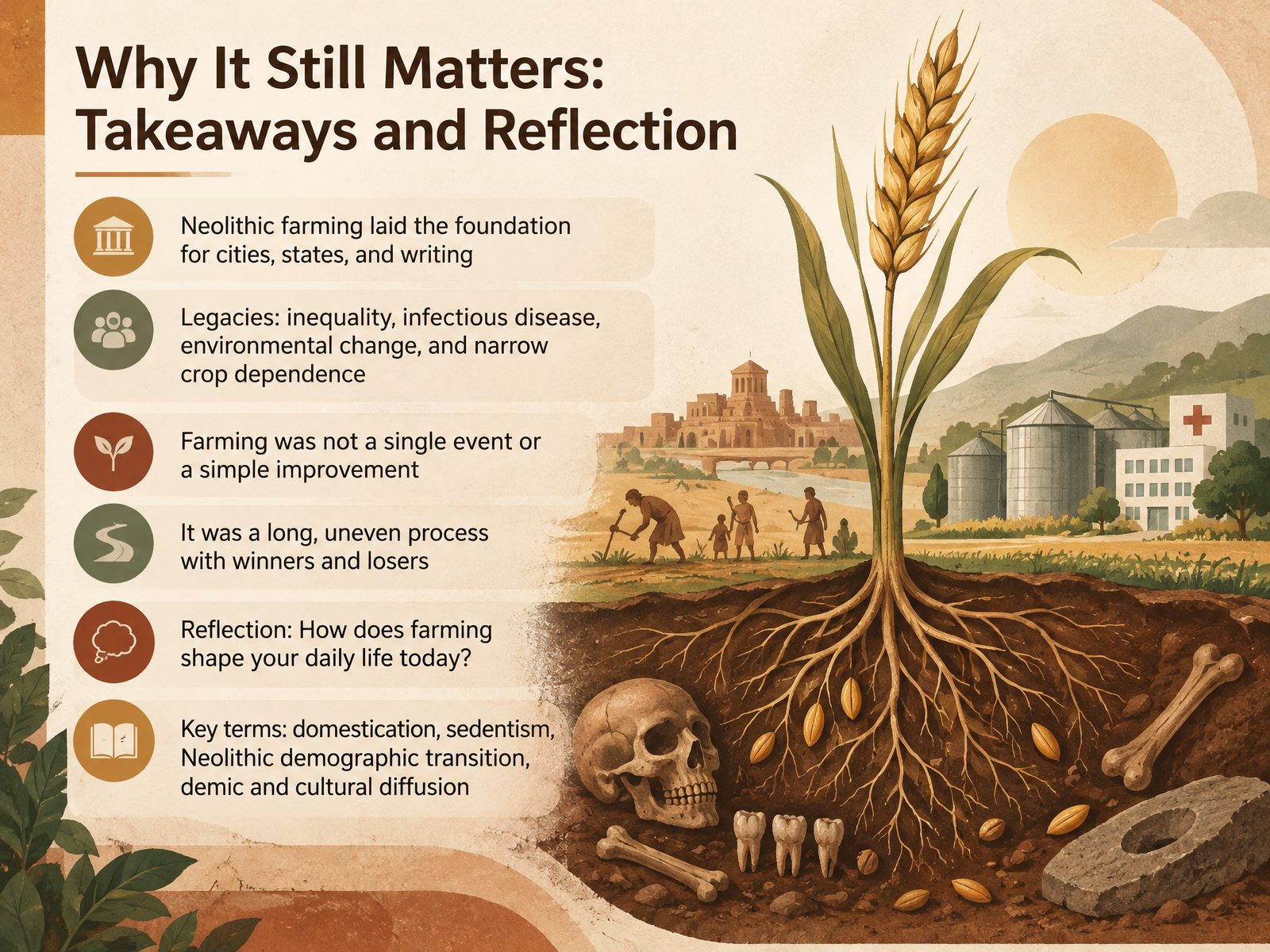
- 12Why It Still Matters: Takeaways and ReflectionSo let's pull this together, because the Neolithic Revolution still lives in your day. Farming gave us the foundation for cities, states, and writing. It also left harder legacies: inequality, infectious diseases that jumped from animals to people, environmental change, and a narrow dependence on just a few crops. And remember the key terms here. Domestication means selectively breeding plants and animals for human use. Sedentism means settling in one place year round. The Neolithic demographic transition describes the population growth that followed. And this change spread through both demic diffusion, the movement of farming peoples, and cultural diffusion, the spread of ideas and practices. Most importantly, farming was not a single event and not simply an improvement. It was a long, uneven process with winners and losers. So here is your reflection. How does farming shape your daily life right now, from the food in your kitchen to the city you live in? Next, we will look at how to teach all of this to adult learners, students, and museum visitors.
 onlinelibrary.wiley.comen.wikipedia.orgworldhistory.org+22 min
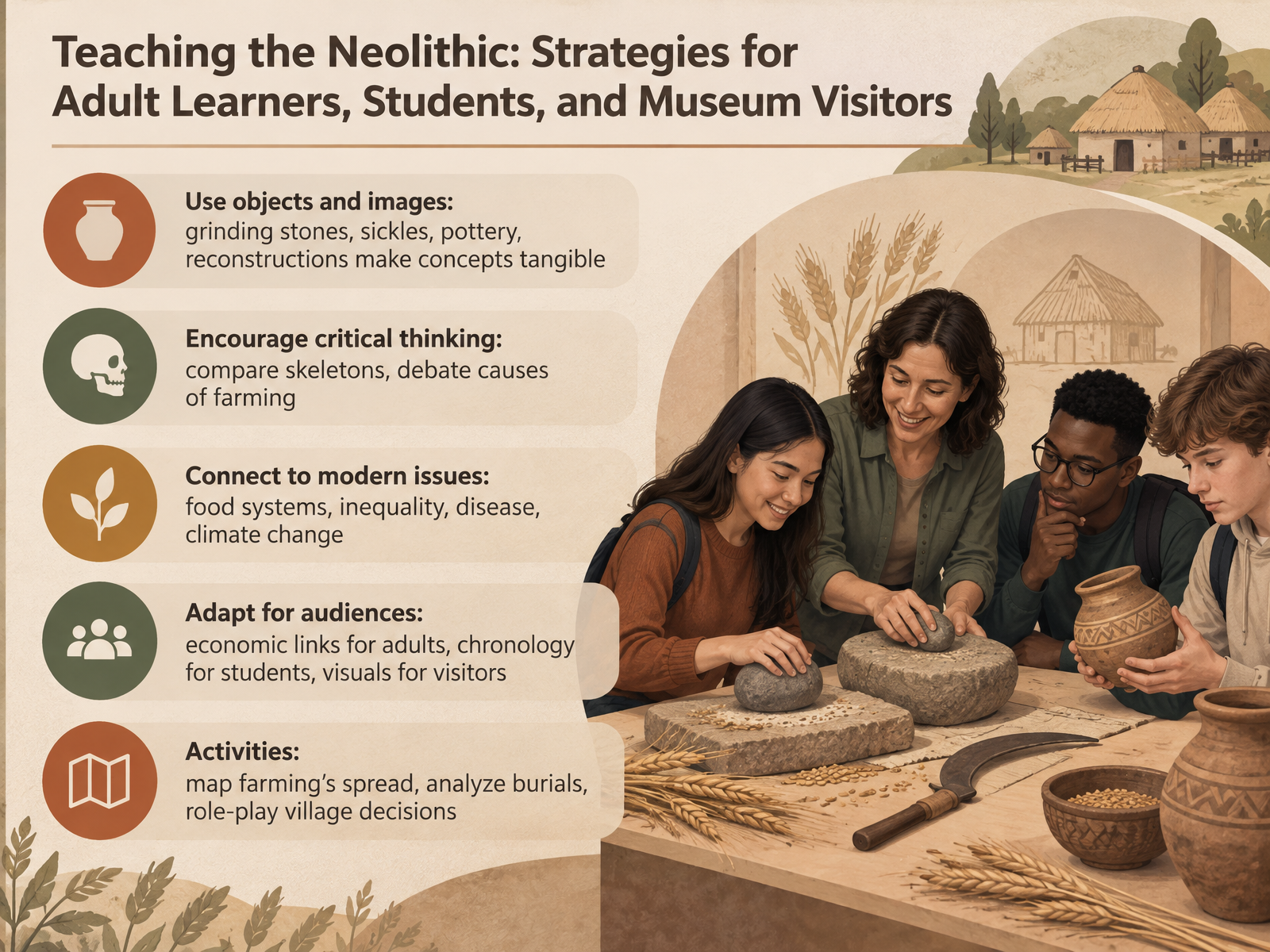
- 13Teaching the Neolithic: Strategies for Adult Learners, Students, and Museum VisitorsNow let's turn to teaching this material. How do you make the Neolithic feel real to adults, students, and museum visitors alike? Start with objects and images. A grinding stone, a sickle, a pot, or a village reconstruction turns an abstract idea into something you can almost touch. Then encourage critical thinking. Compare skeletons and ask what the bones reveal about health. Debate why people took up farming at all. Was it a choice, or a pressure? Connect it to modern issues too: food systems, inequality, disease, and climate change all have roots in this shift. And adapt to your audience. Adults respond to economic links, students need a clear chronology, visitors need visuals. Finally, give people something to do: map farming's spread, analyze a burial, or role-play a village decision. Let them weigh the trade-offs themselves. Next, we move to assessment and review, checking understanding of the Neolithic Revolution.
 onlinelibrary.wiley.comen.wikipedia.org2 min
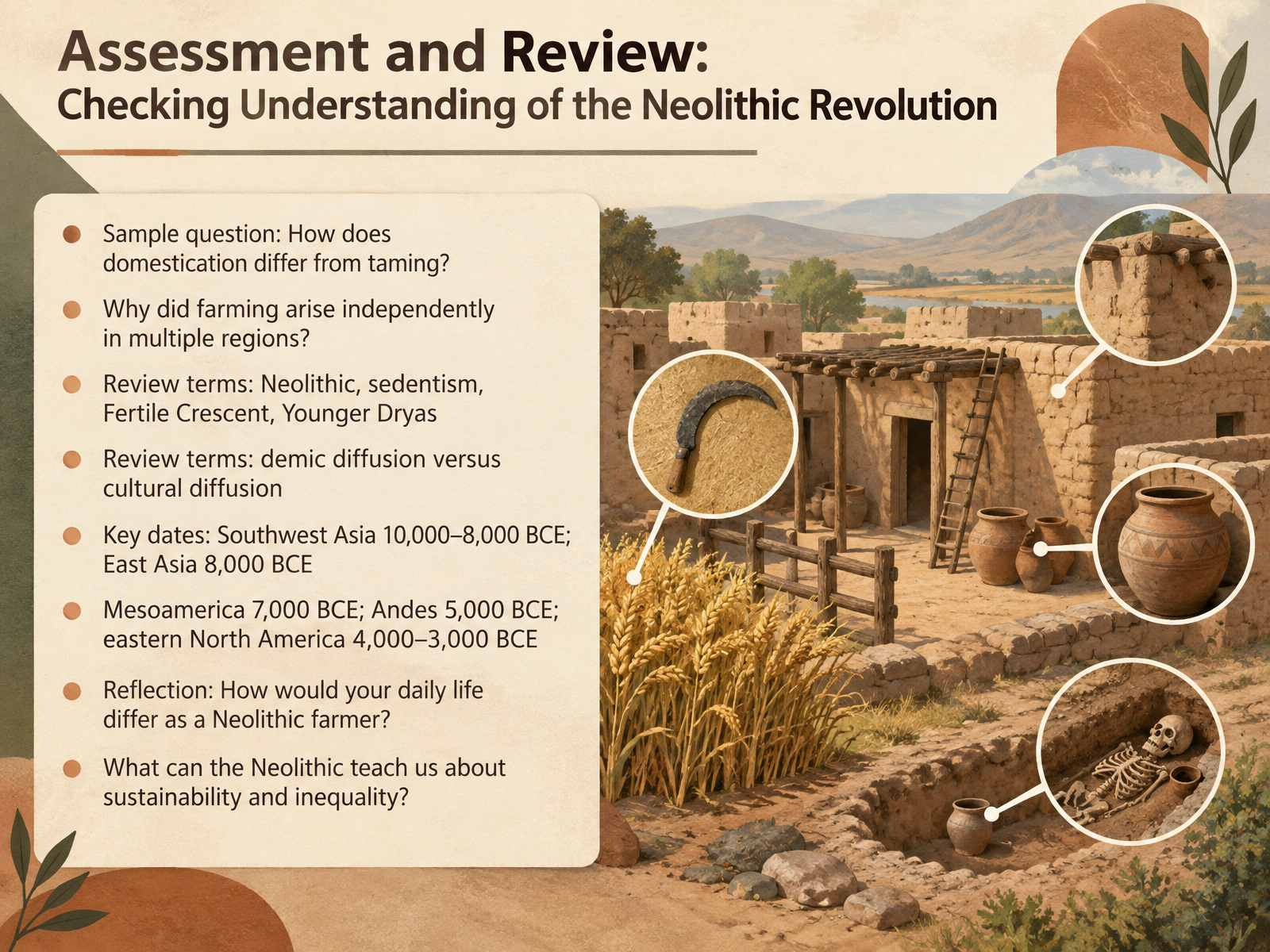
- 14Assessment and Review: Checking Understanding of the Neolithic RevolutionLet's pull the big ideas together. Domestication is not the same as taming. Taming changes one animal's behavior; domestication changes a species over generations, until it depends on us. Farming arose independently in several regions, likely in response to local climate stress and population pressure, not from one single invention. Remember these terms: Neolithic, the New Stone Age; sedentism, settling in one place; the Fertile Crescent; and the Younger Dryas, a sharp cold snap that may have pushed people toward planting. Also keep the two models of spread distinct. Demic diffusion means farmers moved and took agriculture with them. Cultural diffusion means neighboring hunter-gatherers adopted farming themselves. As for dates, Southwest Asia around ten thousand to eight thousand B C E, East Asia around eight thousand, Mesoamerica around seven thousand, the Andes around five thousand, and eastern North America around four thousand to three thousand. So here is your final reflection. If you were a Neolithic farmer, how would your daily life change? And what might this transition teach us about sustainability and inequality? That question is yours to carry forward. Thank you for joining this journey through the Neolithic Revolution. Keep asking how ordinary choices reshape whole worlds.
 en.wikipedia.orgworldhistory.orgworldhistory.org+22 min
Take the deck with you
Download this course as a file — free, no sign-up needed.
- PDF handoutEvery slide page, ready to print or share.15 pages · 5.8 MBDownload
- Narrated PowerPointThe deck that presents itself — every slide carries the digital human's narration video.15 pages · 18.5 MBDownload
- PowerPoint slidesThe full deck as a .pptx — open it in PowerPoint, Keynote, or Google Slides.15 pages · 5.8 MBDownload
Free to use in your own training — please keep the PersonWise credit page at the end.
Have your own deck? Turn it into a course
Sources consulted
Web sources consulted while building this course.
- Neolithic Revolution — en.wikipedia.org
- Dynamics of the Neolithic Revolution — worldhistory.org
- https://www.worldhistory.org/article/1886/origins-of-world-agriculture/ — worldhistory.org
- https://onlinelibrary.wiley.com/doi/10.1111/ehr.13307 — onlinelibrary.wiley.com
- 1.2.4: The Neolithic Revolution - Humanities LibreTexts — human.libretexts.org
- Hunted gazelles evidence cooling, but not drying, during the Younger Dryas in the southern Levant | PNAS — pnas.org
- New evidence of Lateglacial cereal cultivation at Abu Hureyra on the Euphrates — journals.sagepub.com
- Reassessing the evidence for the cultivation of wild crops during the Younger Dryas at Tell Abu Hureyra, Syria — tandfonline.com
- The Pleistocene to Holocene Transition and Human Economy in Southwest Asia: The Impact of the Younger Dryas — cambridge.org
- Climatic Fluctuations and Early Farming in West and East Asia — journals.uchicago.edu
- Convergent evolution and parallelism in plant domestication revealed by an expanding archaeological record | PNAS — pnas.org
- Contrasting Patterns in Crop Domestication and Domestication Rates: Recent Archaeobotanical Insights from the Old World — pmc.ncbi.nlm.nih.gov
- Rice Domestication Revealed by Reduced Shattering of Archaeological rice from the Lower Yangtze valley | Scientific Reports — nature.com
- ARCHAEOLOGICAL DATA REVEAL SLOW RATES OF ... — onlinelibrary.wiley.com
- Pathways to plant domestication in Southeast Anatolia based on new data from aceramic Neolithic Gusir Höyük | Scientific Reports — nature.com
- Sickle blade life-history and the transition to agriculture: an early Neolithic case study from Southwest Asia — sciencedirect.com
- Migration, adaptation, innovation: The spread of Neolithic harvesting technologies in the Mediterranean | PLOS One — journals.plos.org
- Harvest time: crop-reaping technologies and the Neolithisation of the Central Mediterranean | Antiquity | Cambridge Core — cambridge.org
- Composite Sickles and Cereal Harvesting Methods at 23,000-Years-Old Ohalo II, Israel | PLOS One — journals.plos.org
- STONE TOOL-USE EXPERIMENTS TO DETERMINE THE FUNCTION OF GRINDING STONES AND DENTICULATE SICKLES — exa.ai