
Inter-Team Handoff Management
Begin
12 pages · ~24 min
Inter-Team Handoff Management
Learn to manage seamless team handoffs, reducing delays and errors for smoother cross-team collaboration.
What you’ll learn
- 01Managing Handoffs Between TeamsWelcome to Managing Handoffs Between Teams. If you have ever picked up work from another team and felt like you were missing half the story, you are in the right place. Cross-team handoffs are those critical moments where responsibility, context, and authority move from one group to another. When they go wrong, information gets lost, ownership gets blurry, and teams end up redoing work nobody expected. That silent erosion damages trust and pushes timelines out. Research shows that thirty to fifty percent of delays and revenue leaks can be traced back to weak handoff design. In this course, we will walk through a roadmap together. We will diagnose the hidden costs, design a shared handoff model, and build a reliable handoff culture that actually sticks. Let us start by looking at exactly what those hidden costs look like.resources.rework.comqualitysafety.bmj.comcognativ.com+21 min
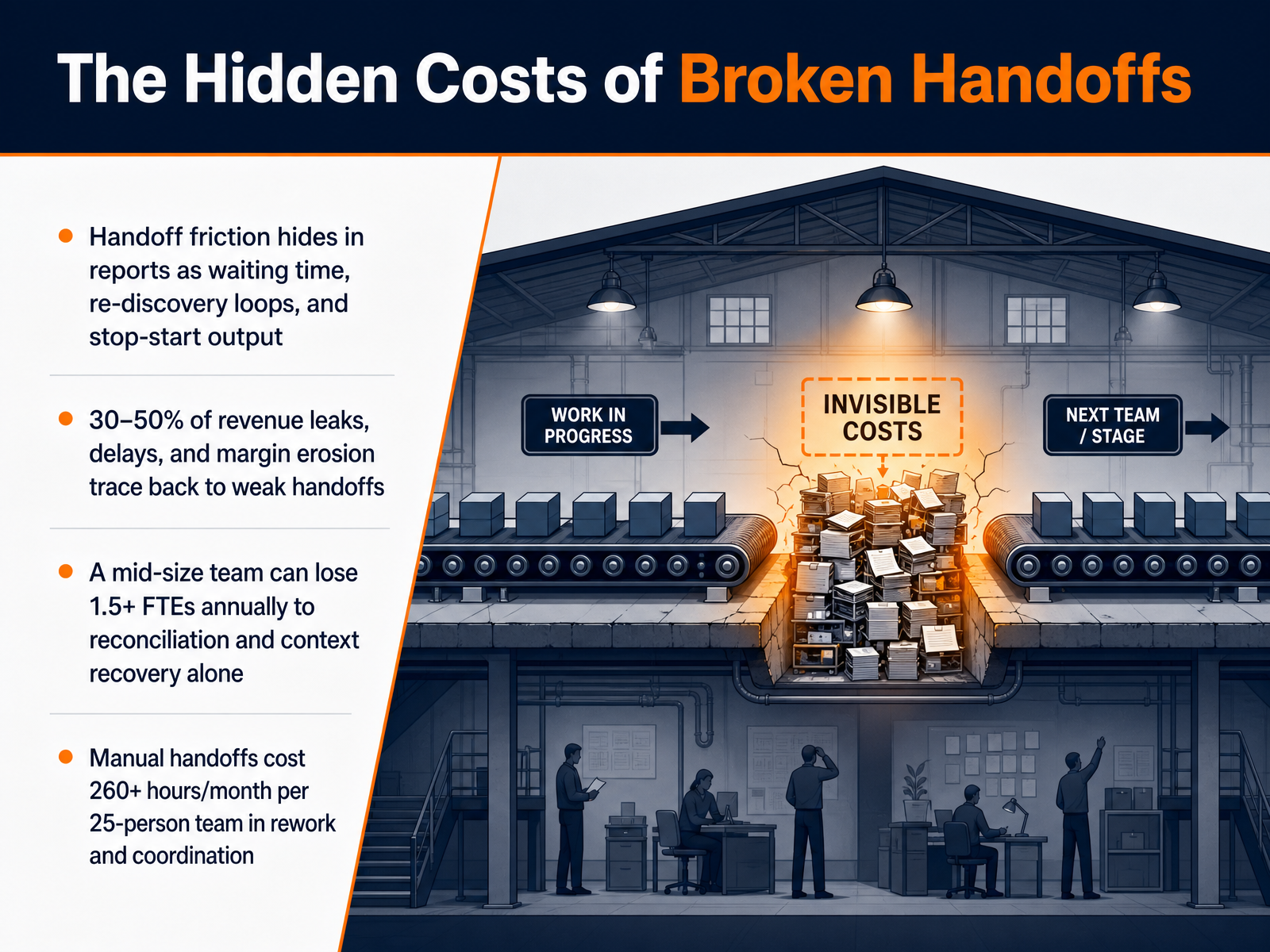
- 02The Hidden Costs of Broken HandoffsNow let's look at the price tag hidden in broken handoffs. When a handoff is weak, the cost doesn't show up as a line item. It hides in waiting time, rediscovery loops, and stop-start output. Research across engineering teams shows that 30 to 50 percent of revenue leaks, delays, and margin erosion trace right back to these weak transition points. For a mid-size team, that adds up fast. One study of 25-person teams found over 260 hours lost every month to reconciliation and context recovery alone. That's more than one and a half full-time employees doing nothing but handoff work. It's not about blame. It's about recognizing that every broken handoff is a recurring tax on your team's time and output. Next, we'll unpack why these handoffs are so hard to get right by exploring the cognitive and structural barriers that trigger the breakdowns you just saw.
 apphandoff.comlink.springer.comgetathenic.com+21 min
 - 03Why Handoffs Are So Hard: Cognitive and Structural BarriersLet's look at what makes handoffs so hard. It's not just about people forgetting to pass along details. The real barriers are cognitive and structural. First, there's a cognitive cost. When your team hands work over, the receiving team has to reconstruct the missing context and rationale from scratch. That mental load spikes their error risk. Structurally, we get gaps. Things like absent rationale, ambiguous criteria, implicit knowledge that stays in someone's head, and tools that don't require an acknowledgment. Psychologically, there's a barrier too. People often hesitate to question upstream work, and overconfidence in a clean pass hides silent failures. We also know from research that team interactions are essential for real team cognition, but the system design often limits how often and how well those interactions happen. So the friction isn't a personal failure; it's built into the workflow. Up next, we'll begin building a better system with a shared handoff model: Prepare, Transfer, Confirm.
 journals.sagepub.comdoi.orgdoi.org+21 min
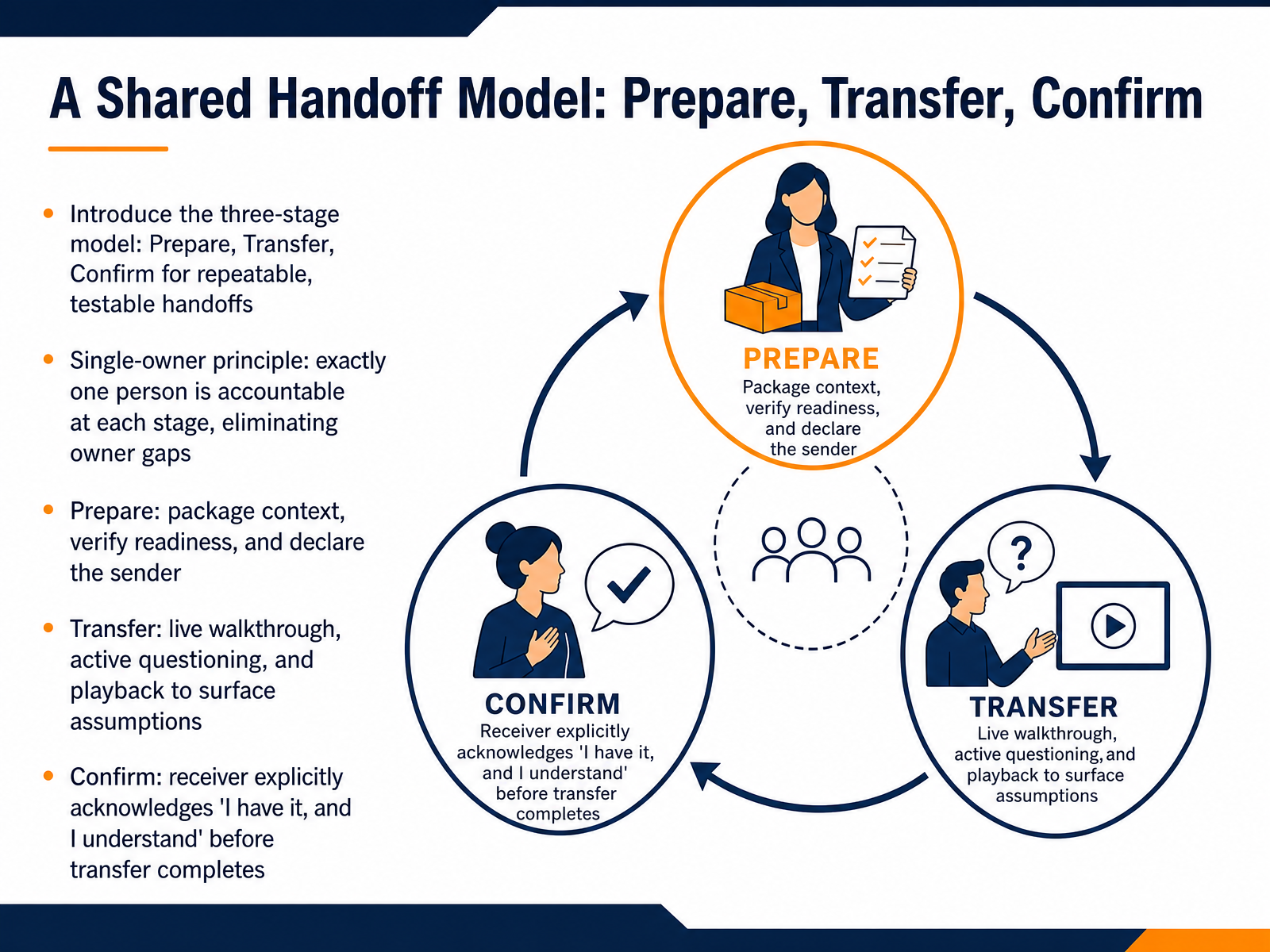
 - 04A Shared Handoff Model: Prepare, Transfer, ConfirmNow let's look at a repeatable model you can actually use: Prepare, Transfer, Confirm. Think of it as a minimum viable handoff. The first rule here is single owner. Exactly one person is accountable at each stage, so nothing falls into the gap between 'I thought you had it' and 'I thought you had it.' In the Prepare stage, your team packages the context, verifies readiness, and names the sender. You're not just dumping files; you're declaring who is handing off. The Transfer stage is a live walkthrough. The receiving team asks active questions and plays back what they heard to surface hidden assumptions. Finally, the Confirm stage requires the receiver to explicitly say, 'I have it, and I understand.' The handoff is not complete until that acknowledgment happens. This three-stage model gives you a testable, repeatable structure. Next, we'll dig into the exact items that package should contain, in Designing the Minimum Viable Handoff Package.
 github.compmlifehacks.commonday.com+21 min
 - 05Designing the Minimum Viable Handoff PackageNow, let's look at what you actually need to include when you hand work over. We call this the Minimum Viable Handoff Package, and it's made up of five simple items. Purpose, so the receiving team knows the why. Current state, where the work actually stands right now. Constraints, the rules the work must follow. Dependencies, who or what the work is waiting on. And open questions, the unresolved items that matter to execution. The goal is not to dump everything you know. It's to include only what the receiver needs to act independently. To make this repeatable, standardize the structure with a template but leave room for context-specific details. A quick readiness test is to ask someone on the receiving team to restate the purpose or name the biggest constraint. If they can't, the handoff isn't ready. And remember, the handoff is not complete until the receiver confirms they can access, locate, and understand everything. A sent file is not a done handoff. Next, we'll break down the live handoff conversation itself.
 github.compmlifehacks.commonday.com+22 min
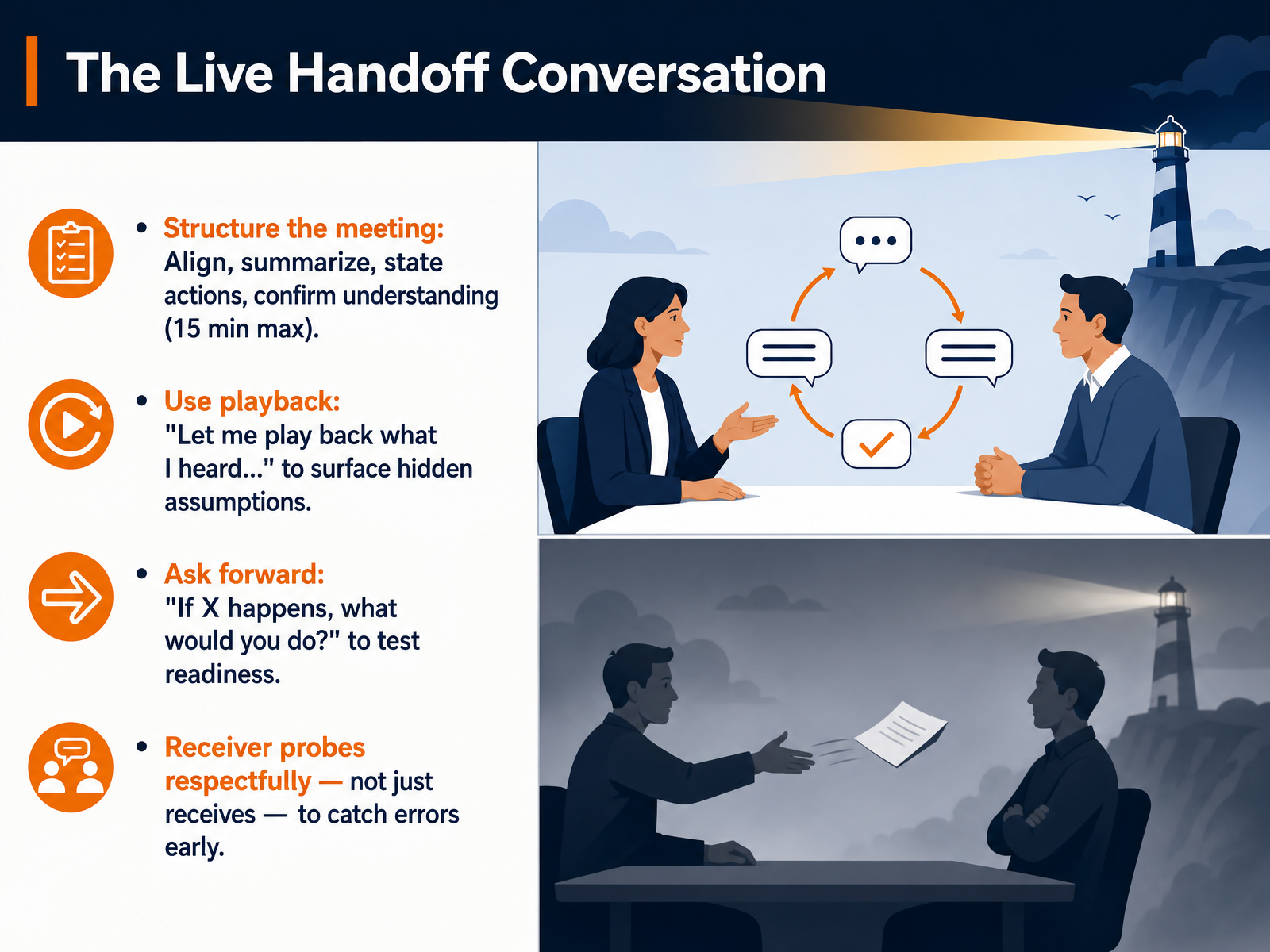
 - 06The Live Handoff ConversationNow let's talk about the live handoff conversation itself. This is where the transfer actually happens, so keep it focused and tight. Aim for fifteen minutes max. Start by aligning on the priority, then summarize the key status, state the next actions, and confirm understanding before you end. Use a playback technique to surface hidden assumptions. Say something like, 'Let me play back what I heard.' This lets the receiver catch any gaps right away. Next, test readiness with a forward-looking question. Ask, 'If X happens, what would you do?' This checks whether the receiver can handle likely scenarios without you. Finally, the receiver should probe respectfully. Don't just receive the information quietly. Ask questions early to catch errors before they become problems. This conversation is a two-way street. When both sides engage actively, you close the handoff with real confidence. Up next, we'll walk through the Handoff Readiness Checklist to make sure nothing falls through the cracks.
 resources.rework.comqualitysafety.bmj.comcognativ.com+21 min
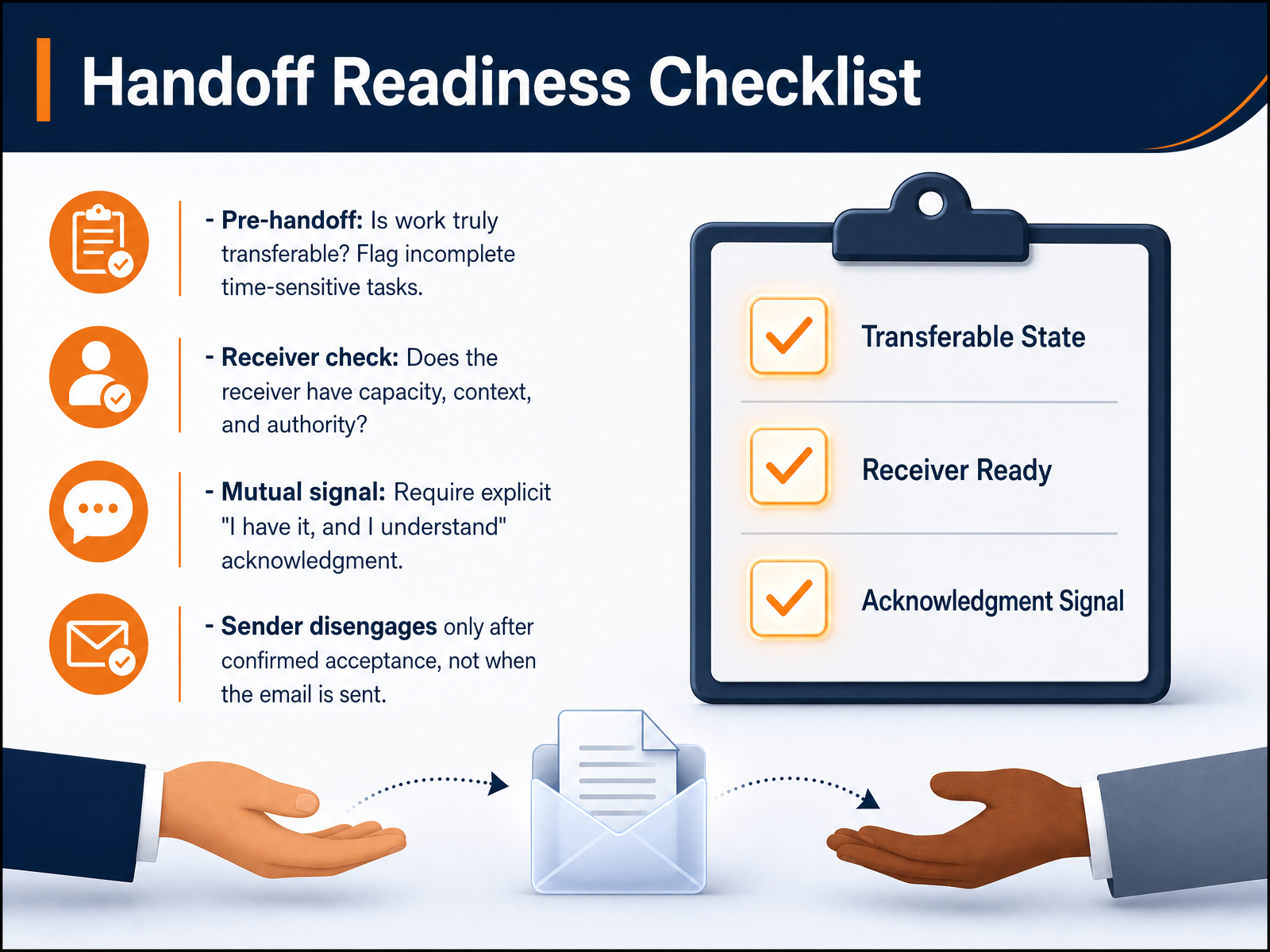
 - 07Handoff Readiness ChecklistLet's walk through a quick readiness checklist so no handoff moves forward before it's solid. First, before the handoff, ask yourself: is this work truly transferable? Flag any time-sensitive tasks that are still incomplete. The receiving team needs to know what can't wait. Second, check the receiver's side. Do they have the capacity, the full context, and the authority to own this work? If not, the handoff just creates a bottleneck. Now for the mutual signal. This is the part that prevents work from falling into a gap. Don't rely on a sent email. Require an explicit acknowledgment from the receiver, something like 'I have it, and I understand.' Only after that confirmed acceptance should the sender disengage. The old owner keeps responsibility until the new owner accepts it, not a moment before. Up next, we'll look at common anti-patterns and how to fix them.
 github.compmlifehacks.commonday.com+21 min
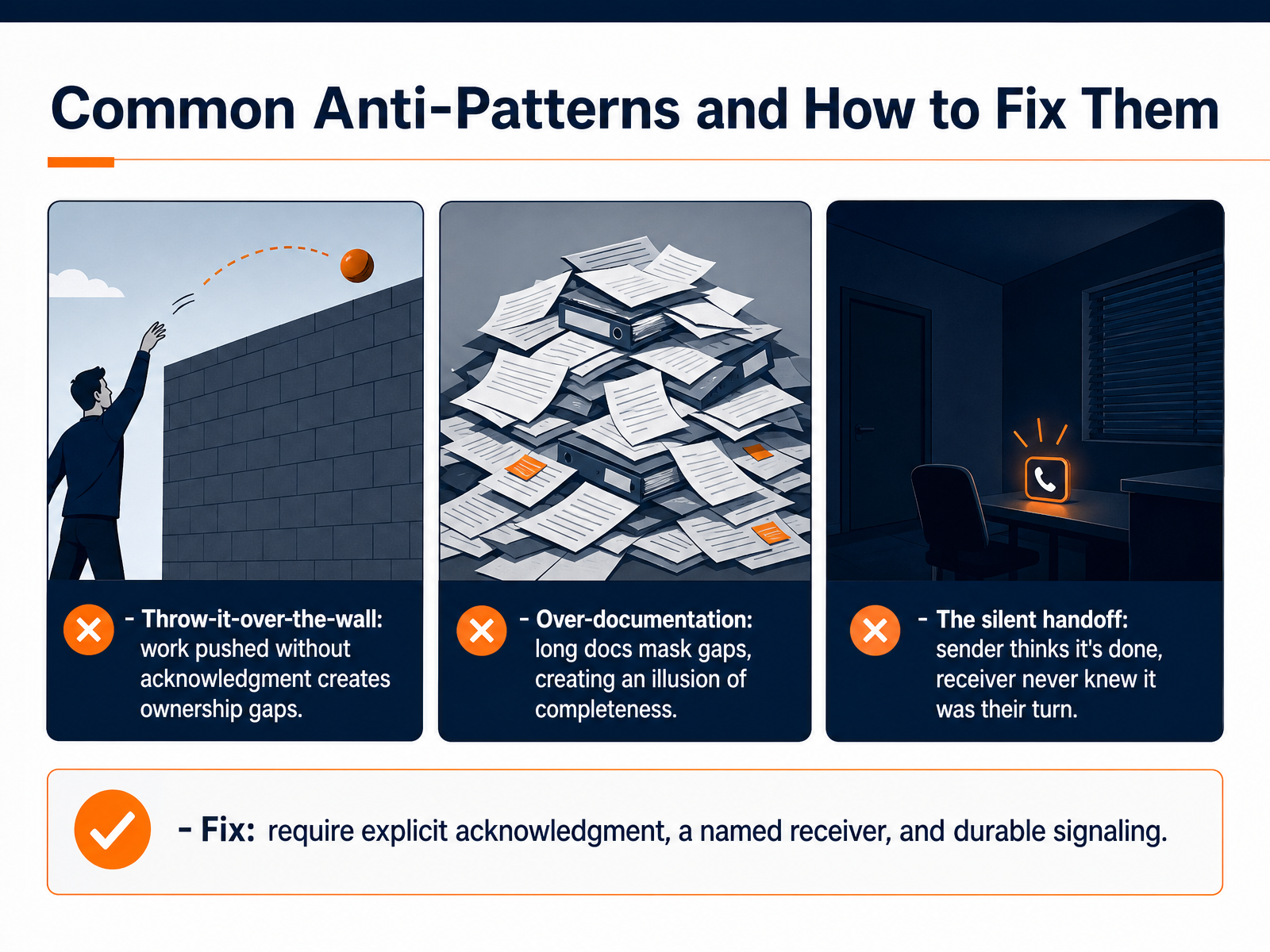
 - 08Common Anti-Patterns and How to Fix ThemNow let's look at the patterns that quietly break handoffs, and what you can do about them. The first one is throw-it-over-the-wall. Your team finishes its part and sends the work forward without confirmation. The receiving team may not even know it's arrived, and ownership sits in a gap. The fix is simple: require an explicit acknowledgment. Someone on the receiving team needs to say, "I've got it, and I'm moving forward." The second anti-pattern is over-documentation. Teams create long, dense documents that hide missing details behind a wall of words. It looks complete, but the receiving team still has to guess. Instead, focus on a structured handoff packet. Just the status, the priority, and the one clear next action. The third is the silent handoff. The sender marks it done, but the receiver never knew it was their turn. The work sits untouched. To fix this, name the receiver, set a visible status change, and require that acknowledgment again. The core idea is that every handoff needs a named person, a clear signal, and a durable record. When you build those three things into your process, you close the gaps that cause most delays. Coming up next, we'll look at how to make these handoffs observable with simple metrics that matter.
 consultevo.com2 min
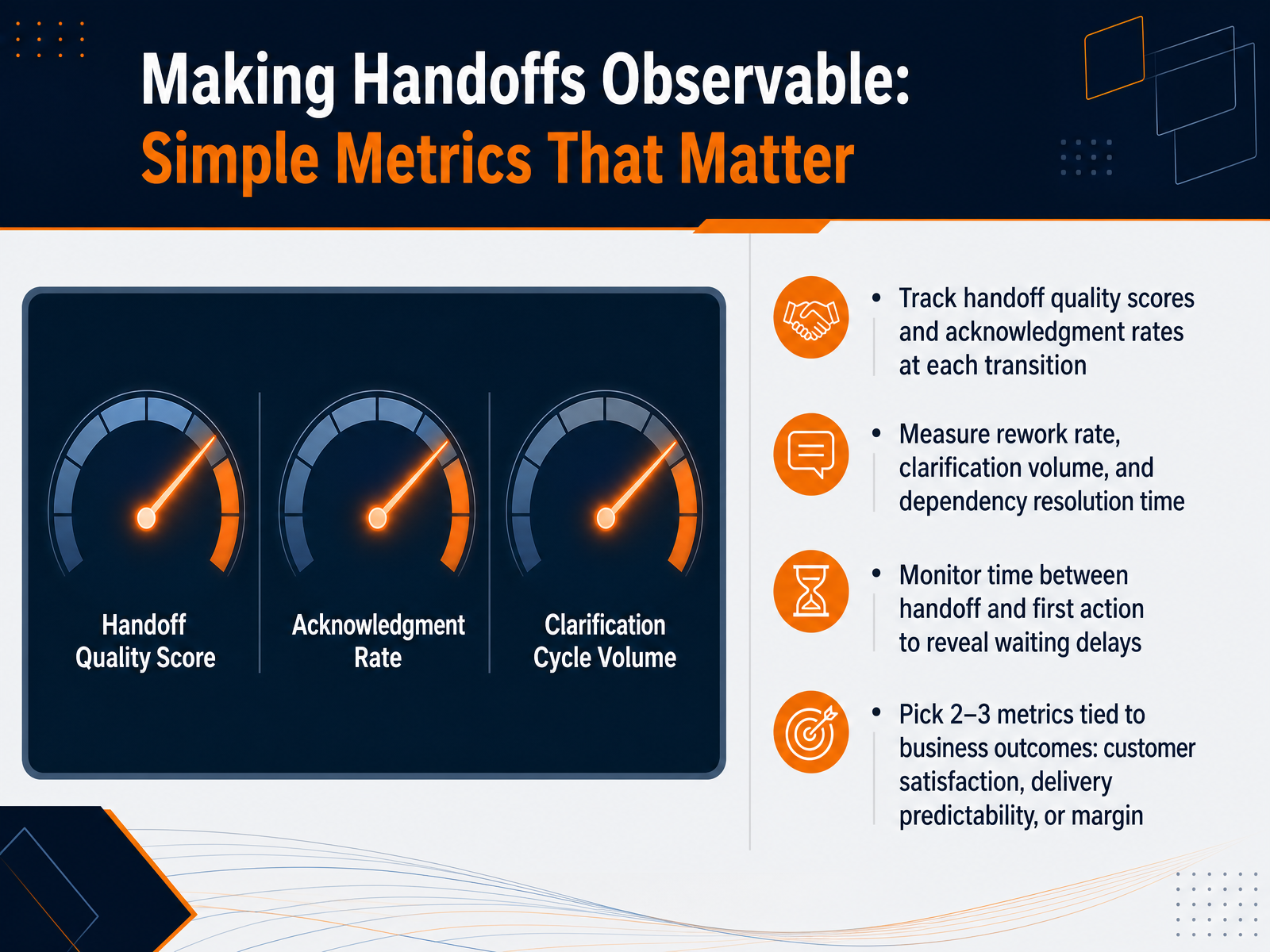
 - 09Making Handoffs Observable: Simple Metrics That MatterNow let's make handoffs observable with a few simple metrics that actually matter. You don't need a dashboard with twenty numbers. Pick two or three signals that tie directly to a business outcome your team cares about, like customer satisfaction, delivery predictability, or margin. Start by tracking handoff quality scores and acknowledgment rates at each transition. A quick scoring rubric, even a simple one, tells both teams whether the receiving side got what they needed. Next, measure rework rate, clarification volume, and dependency resolution time. Rework and repeated questions after a handoff are the clearest sign that context was lost in the transfer. Also, watch the time between the handoff and the first real action. When that gap is large, it usually means the receiving team is reverse-engineering missing information instead of moving forward. The key is to treat these metrics as conversation starters, not report cards. Cross-check them with your output metrics. If velocity is fine but rework is climbing, the handoff is hiding a problem. Pick your two or three metrics, set a baseline, and review them as a routine part of your handoff practice. Next, we'll look at building a handoff culture that sticks.
 2 min
2 min - 10Building a Handoff CultureLet's shift our focus from fixing individual handoffs to building a handoff culture. This means changing the default mindset from 'my part is done' to 'the work is safely received and understood.' It starts with leaders. Leaders model explicit acknowledgment. They protect transition time instead of treating it as wasted space. They also celebrate clean handoffs as real wins, not invisible events nobody talks about. When a breakdown happens, a strong culture treats it as a system design opportunity, not a trigger for blame. If the same mistake repeats across different people, the workflow is the problem, not the person. So ask your team: where does our process depend on memory or heroics instead of a clear contract? Fix that system, and you prevent the same failure from happening again. Next, we'll look at how to measure that progress with handoff scorecards and continuous improvement.
 consultevo.com1 min
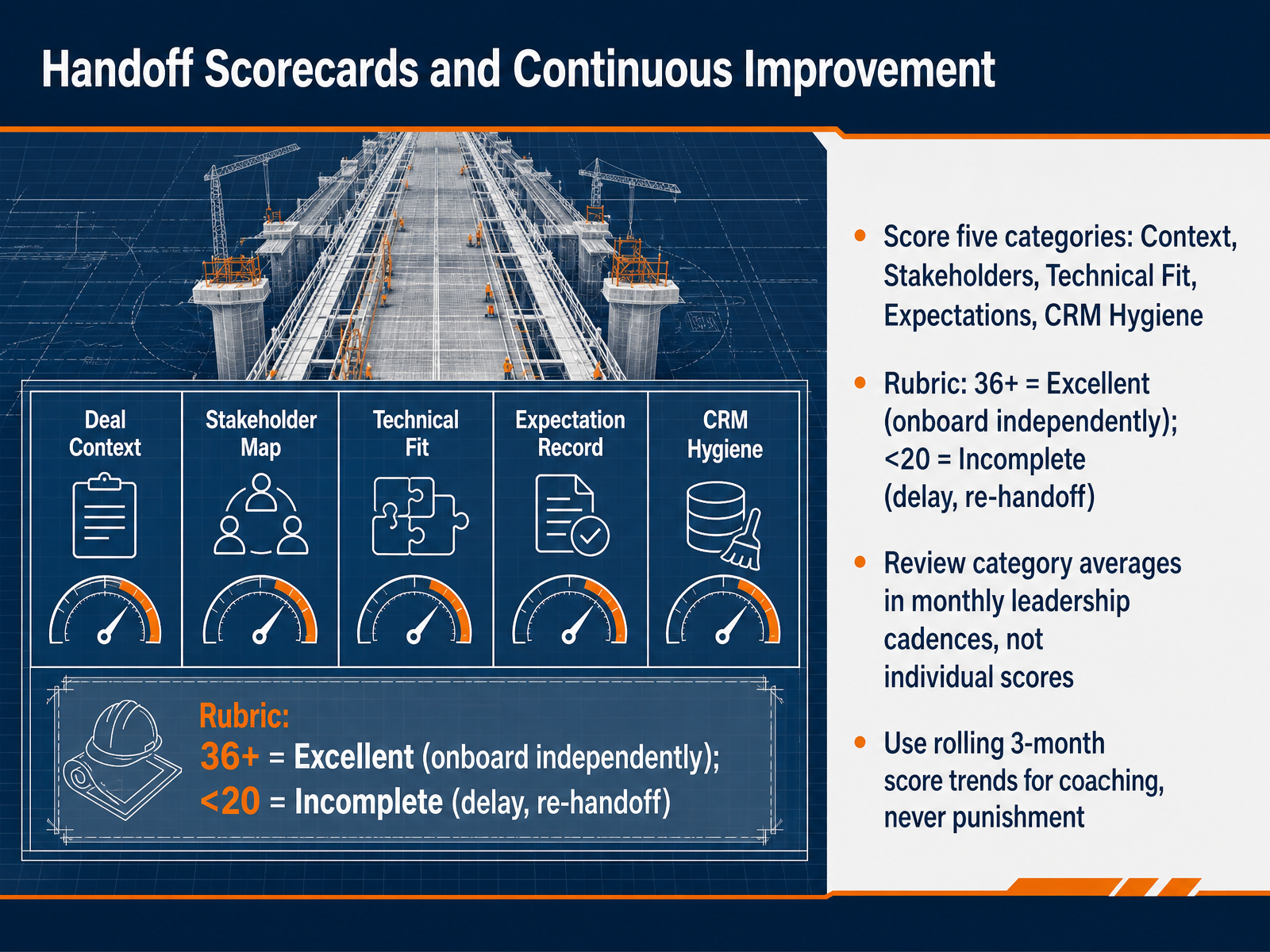
 - 11Handoff Scorecards and Continuous ImprovementNow let’s talk about the handoff scorecard and how you turn it into a continuous improvement tool. Think of the scorecard as a shared lens, not a report card. You score five categories: Context, Stakeholders, Technical Fit, Expectations, and CRM Hygiene. Each category gets a simple zero, one, or two. A total score of thirty-six or above means the receiving team can onboard independently. A score below twenty means the handoff is incomplete, so you delay the kickoff and request a re-handoff. Here’s the critical part. In your monthly leadership cadences, you review category averages across the whole team, not individual scores. You look at rolling three-month score trends to spot coaching patterns. Never use these numbers for punishment. The goal is to make the invisible friction visible so both teams can improve the process together. Up next, we’ll build your action plan and define your next steps.
 1 min
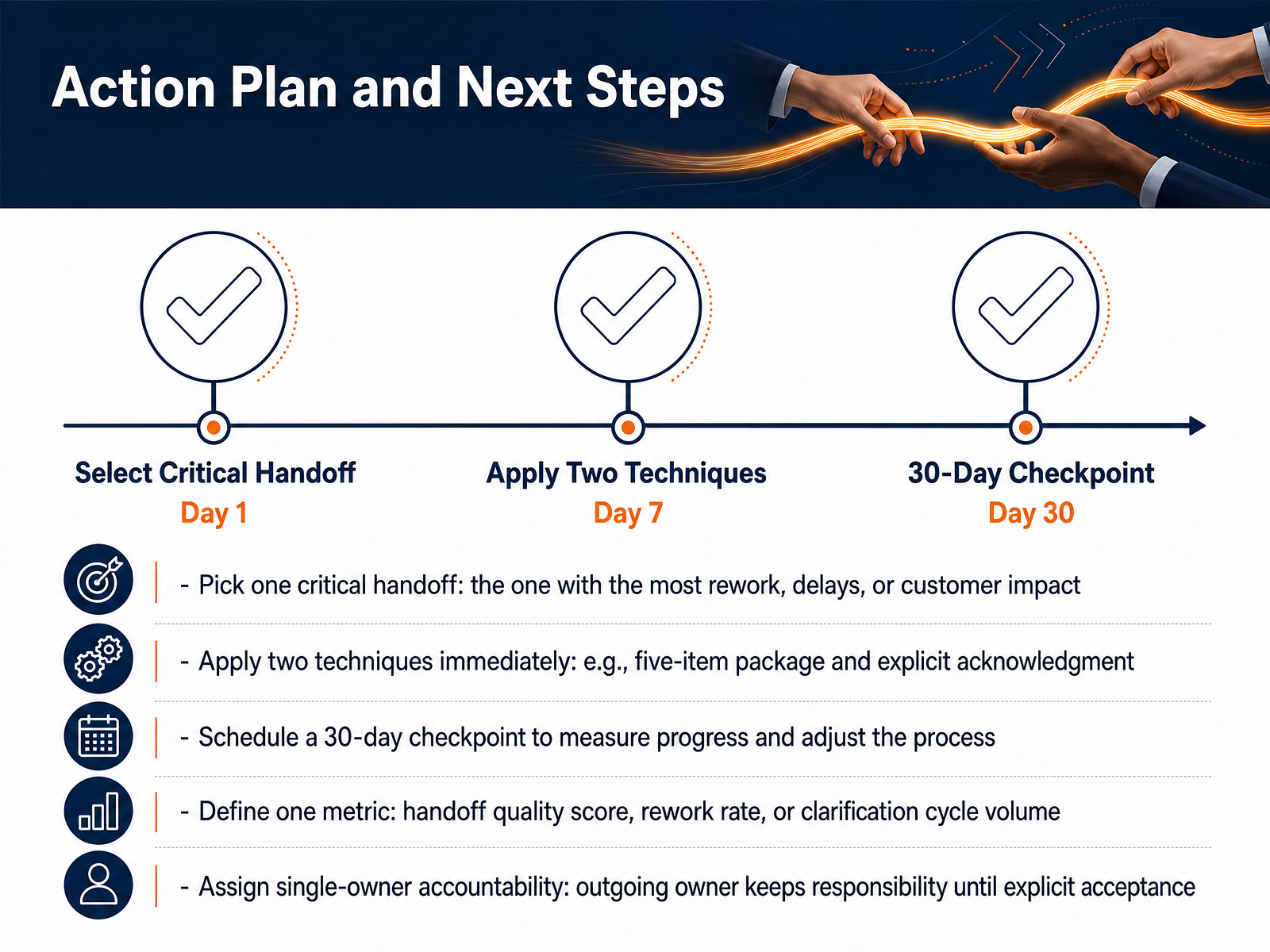
1 min - 12Action Plan and Next StepsWe've covered the framework, the tools, and the techniques. Now let's turn all of that into a concrete action plan you can start using today. First, pick one critical handoff, the one that causes the most rework, the biggest delays, or the most direct customer impact. Don't try to fix everything at once. Start there. Apply two techniques immediately. Package your context using the five-item format we discussed, and make sure the receiving team explicitly acknowledges and accepts the transfer. Remember, the outgoing owner keeps responsibility until that acceptance is confirmed. Next, define one metric. You could track your handoff quality score, measure the rework rate, or simply count how many clarification messages you get after a transfer. Pick one number that tells you if the handoff is getting better. Then, schedule a thirty-day checkpoint. In thirty days, review that metric, talk about what's working, and adjust the process. Finally, assign single-owner accountability. One person hands off, one person accepts. There is no gap. You now have a minimum viable handoff process. Start small, measure the impact, and build from there. Thank you for taking this course. Good luck fixing your handoffs.
 github.compmlifehacks.commonday.com+22 min
Take the deck with you
Download this course as a file — free, no sign-up needed.
- PDF handoutEvery slide page, ready to print or share.13 pages · 3.3 MBDownload
- Narrated PowerPointThe deck that presents itself — every slide carries the digital human's narration video.13 pages · 11.3 MBDownload
- PowerPoint slidesThe full deck as a .pptx — open it in PowerPoint, Keynote, or Google Slides.13 pages · 3.2 MBDownload
Free to use in your own training — please keep the PersonWise credit page at the end.
Have your own deck? Turn it into a course
Sources consulted
Web sources consulted while building this course.
- "Deal Closing Handoff Protocol: 6-Step Checklist" — resources.rework.com
- Use of structured handoff protocols for within-hospital unit transitions: a systematic review from Making Healthcare Safer IV | BMJ Quality & Safety — qualitysafety.bmj.com
- Handoff Mapping Checklist and Efficient Project Transitions — cognativ.com
- "Deal Closing Handoff Protocol: 6-Step Checklist" — resources.rework.com
- Project handoff process: 8 steps for seamless transitions (2026) — monday.com
- The Hidden Cost of Manual Handoffs | AppHandoff — apphandoff.com
- Understanding nursing handoff errors in clinical practice: trends and contributing factors based on a systematic review and meta-analysis | BMC Nursing | Springer Nature Link — link.springer.com
- Agent Handoff Patterns: A Case Study in Multi-Step Workflows | OpenHelm Blog | OpenHelm — getathenic.com
- 42% of Revenue Leaks at Handoffs. Here's Where and How to Plug It – Signal Blog — signalb2b.io
- Financial Impact of Medical Miscommunication — mplassociation.org
- Team Task Switching: A Conceptual Framework for Understanding Functional Work Shifts — journals.sagepub.com
- Team Cognition in Handoffs: Relating System Factors, Team Cognition Functions and Outcomes in Two Handoff Processes — doi.org
- Overloaded: How task switching, information synthesis, and poor relational trust make interhospital transfers challenging — doi.org
- Unpacking the Complexity of Patient Handoffs Through the Lens of Cognitive Load Theory — doi.org
- Measuring the cognitive effort associated with task switching in ... — sciencedirect.com
- playbooks/project-handoff.md at main · fom-dev/company-in-a-box — github.com
- Project-to-Ops Handoff Toolkit | PM LifeHacks — pmlifehacks.com
- Handoff checklist template for smooth transitions - Tallyfy — tallyfy.com
- Cross-Discipline Handoffs: The 5-Item Package That Saves Days of Rework — linkedin.com
- Why Handoff Mistakes Between Teams Are a Systems Problem - — consultevo.com