English for Business Collaboration
Begin
14 pages · ~28 min
English for Business Collaboration
Professional English communication course for non-native speakers to improve meeting participation, teamwork collaboration, and workplace interaction skills.
What you’ll learn
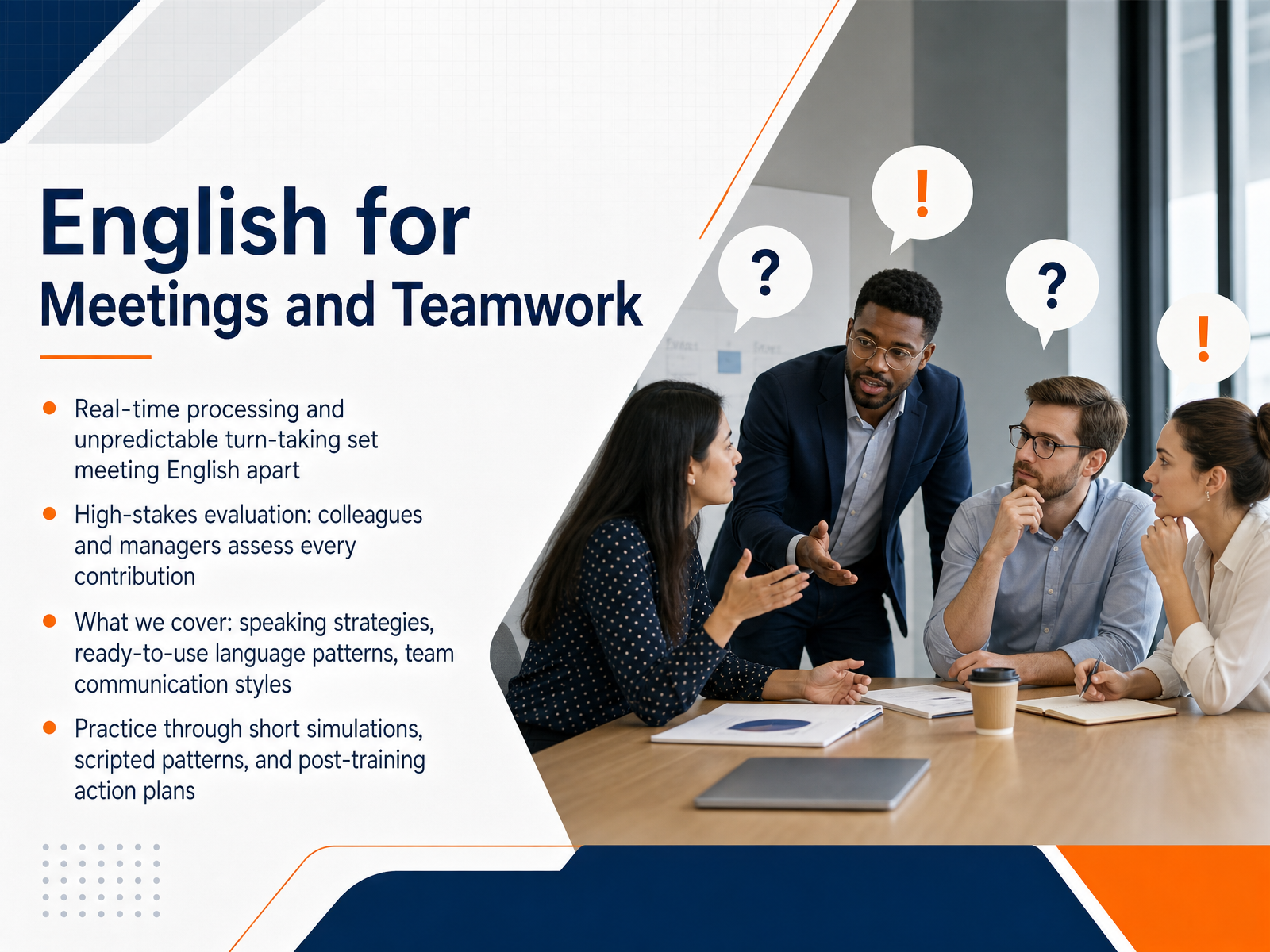
- 01English for Meetings and TeamworkWelcome, everyone. I'm so glad you're here. This course is designed to help you feel more confident and capable when speaking English in meetings and working with international teams. We know that meetings can feel fast and unpredictable, and it can sometimes seem like everyone else knows exactly when to jump in. But here's the good news: with the right strategies, you can participate fully and make your voice heard. Today, we'll focus on practical speaking techniques, ready-to-use language patterns, and ways to understand different team communication styles. We'll practice through short simulations and scripted patterns you can use right away. We'll also create action plans so you can apply what you learn in your very next meeting. Remember, the goal isn't perfection. It's clear, effective communication. Let's get started by understanding the real challenges you might face in these high-stakes situations. doi.orgfluentatdesk.comspeakingenie.com+22 min
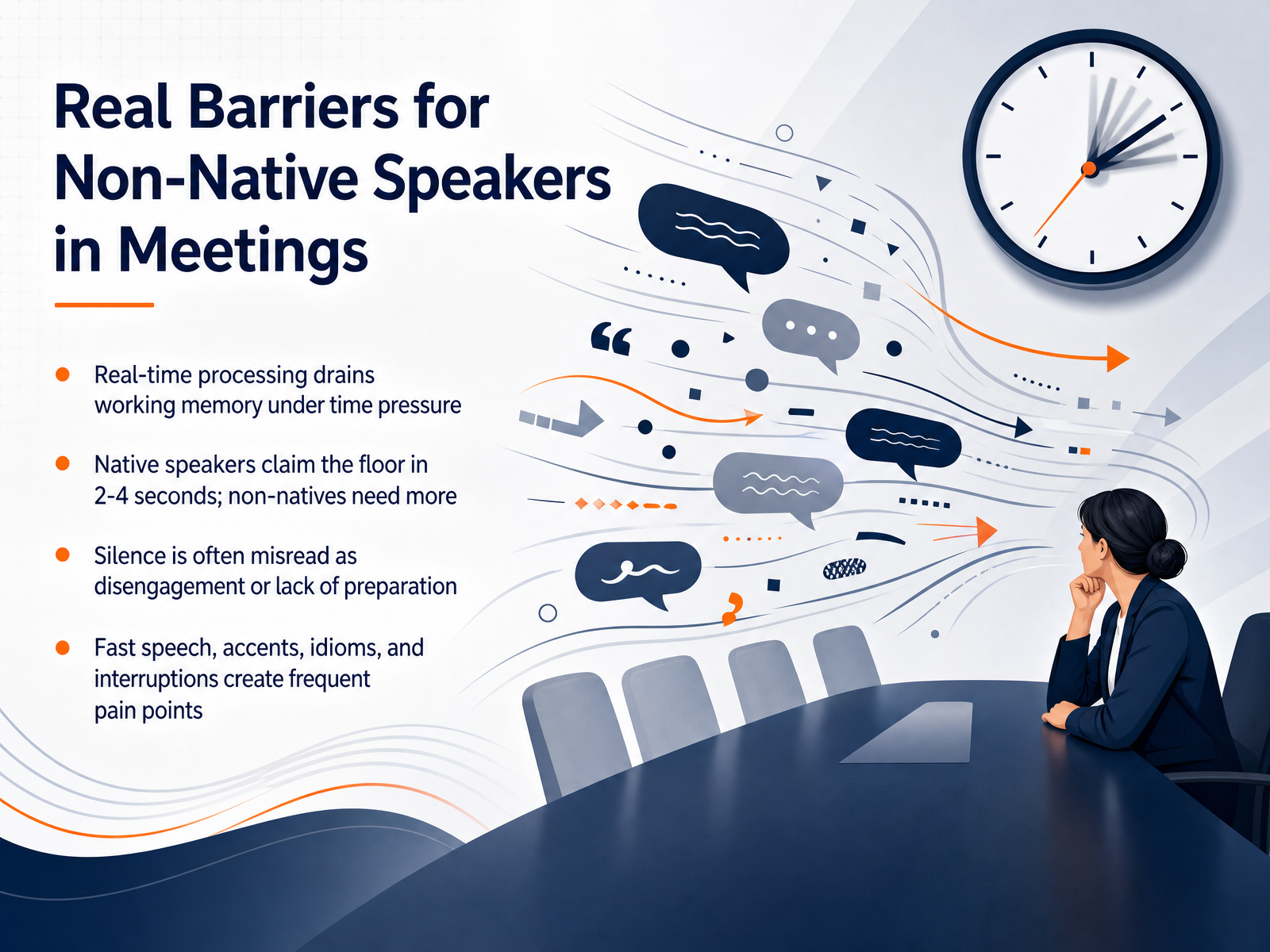
- 02Real Barriers for Non-Native Speakers in MeetingsLet’s take a closer look at the real barriers that many non-native speakers face in meetings. First, think about real-time processing. When you’re in a live discussion, your brain is working extra hard to listen, translate, and form a response all at once. That uses a lot of working memory, especially under time pressure. It’s not about ability—it’s about speed. Here’s a common challenge: native speakers often jump in within two to four seconds after someone finishes. Non-native speakers typically need a bit more time to process and prepare. By the time you’re ready, the moment has passed. Another barrier is how silence is perceived. In some cultures, silence shows respect and careful thought. But in many English-speaking work environments, silence can be seen as disengagement or being unprepared. That can create a wrong impression. Also, fast speech, unfamiliar accents, idioms, and interruptions can add more friction. Simple phrases like “That’s a great point” can be hard to catch when they’re spoken quickly. The good news? These barriers are not fixed. With the right strategies, you can work around them. And that’s exactly what we’ll explore next, as we look at the power of prepared language patterns.
 doi.orgfluentatdesk.comspeakingenie.com+21 min
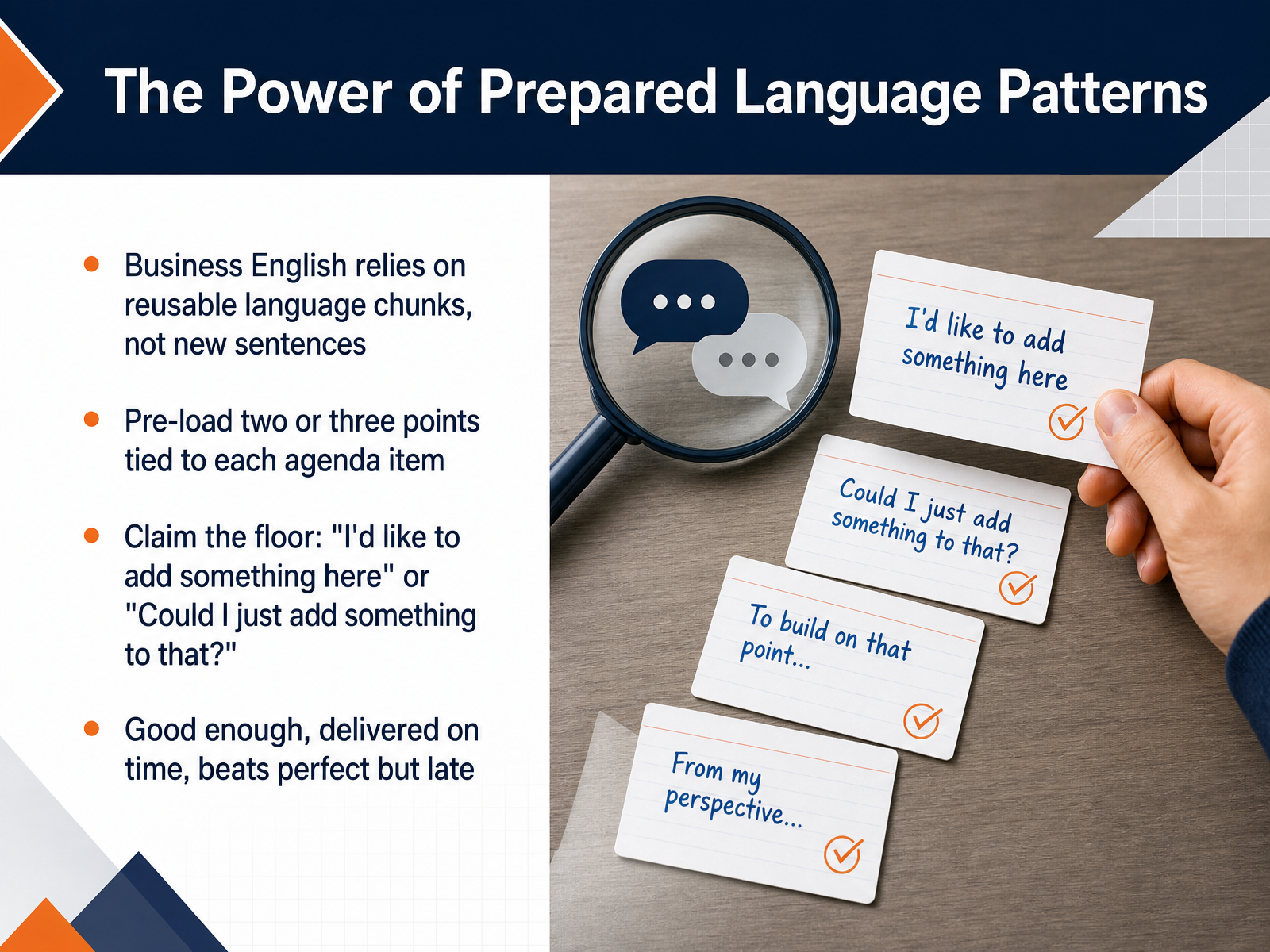
 - 03The Power of Prepared Language PatternsNow, let’s talk about one of the most powerful tools you can bring to any meeting: prepared language patterns. In business English, you don’t need to create new sentences every time you speak. Instead, you reuse ready-made chunks of language. Think of them as your verbal toolkit. Before each meeting, look at the agenda and prepare two or three points you could contribute for each item. Write them down. Practice saying them out loud. This way, when the moment comes, you’re not composing in real time—you’re just retrieving what you already prepared. Also, memorize a few simple phrases to claim the floor. For example: “I’d like to add something here,” or “Could I just add something to that?” These phrases signal that you have something to say, even while you’re still forming your full thought. Remember, in meetings, good enough and delivered on time beats perfect but late. You don’t need flawless grammar. You need to be present and participate. So prepare your patterns, use them confidently, and your voice will be heard. Next, we’ll look at common meeting roles and essential phrases you can use right away.
 doi.orgfluentatdesk.comspeakingenie.com+21 min
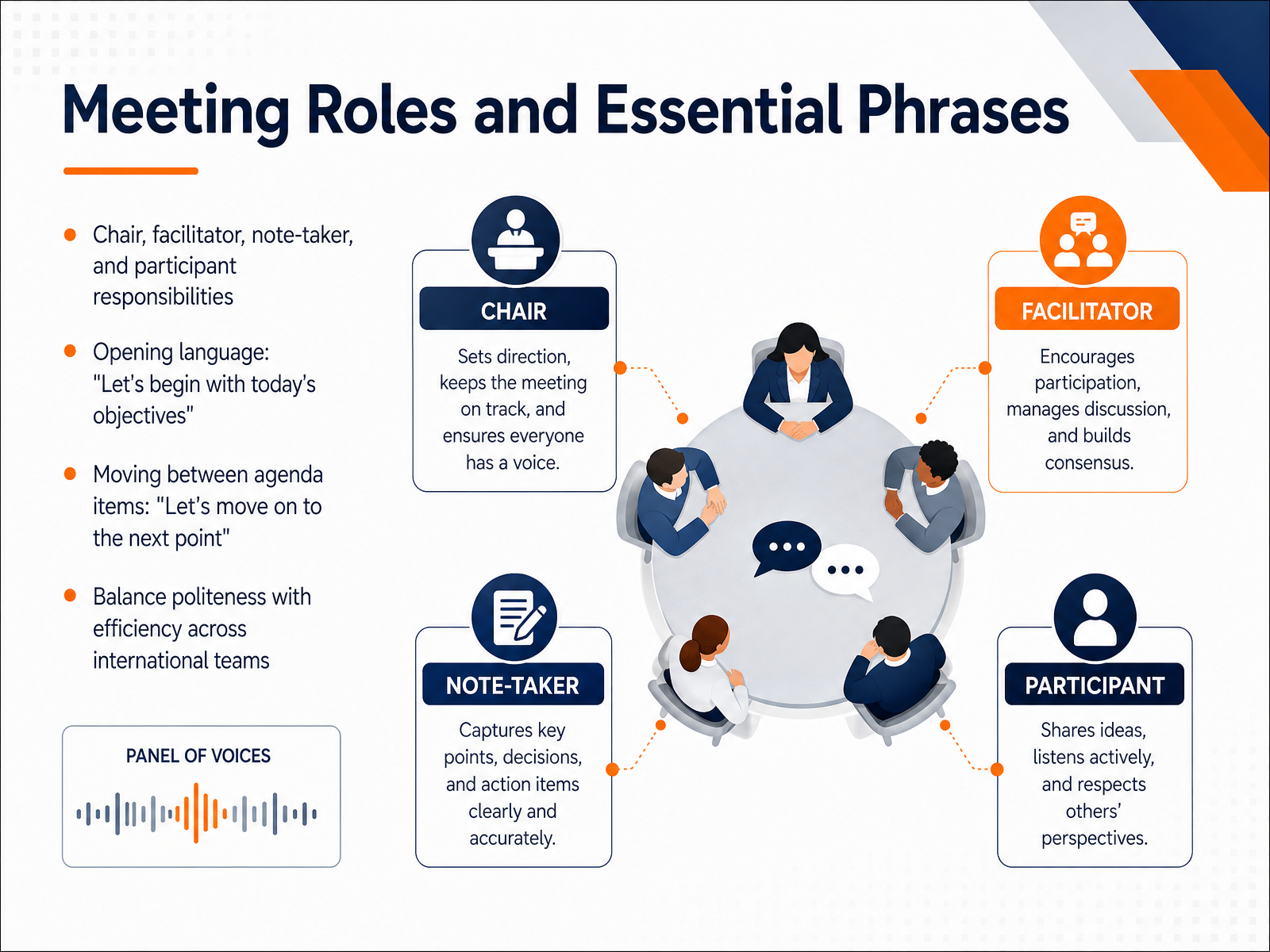
 - 04Meeting Roles and Essential PhrasesNow, let's look at meeting roles and the phrases that go with them. Every effective meeting has a chair, a facilitator, a note-taker, and participants. Each role has a clear responsibility. The chair guides the conversation, the facilitator keeps it moving, the note-taker records decisions, and participants contribute ideas. You'll often hear the chair say, 'Let's begin with today's objectives.' This sets the focus. To move forward smoothly, you might hear, 'Let's move on to the next point.' This keeps the meeting on track. In international teams, remember that communication styles vary. Some cultures value directness and clarity, while others prefer a more indirect, relationship-focused approach. Balance politeness with efficiency by using clear, respectful phrases. For example, instead of saying 'That's wrong,' you can say, 'I see it differently.' This keeps the conversation constructive. Your takeaway is this: knowing your role and having the right phrases helps you participate with confidence. Next, we'll look at structuring meetings with signposting language.
 culturalq.comwebuser.bus.umich.eduglobalmindfulsolutions.com+22 min
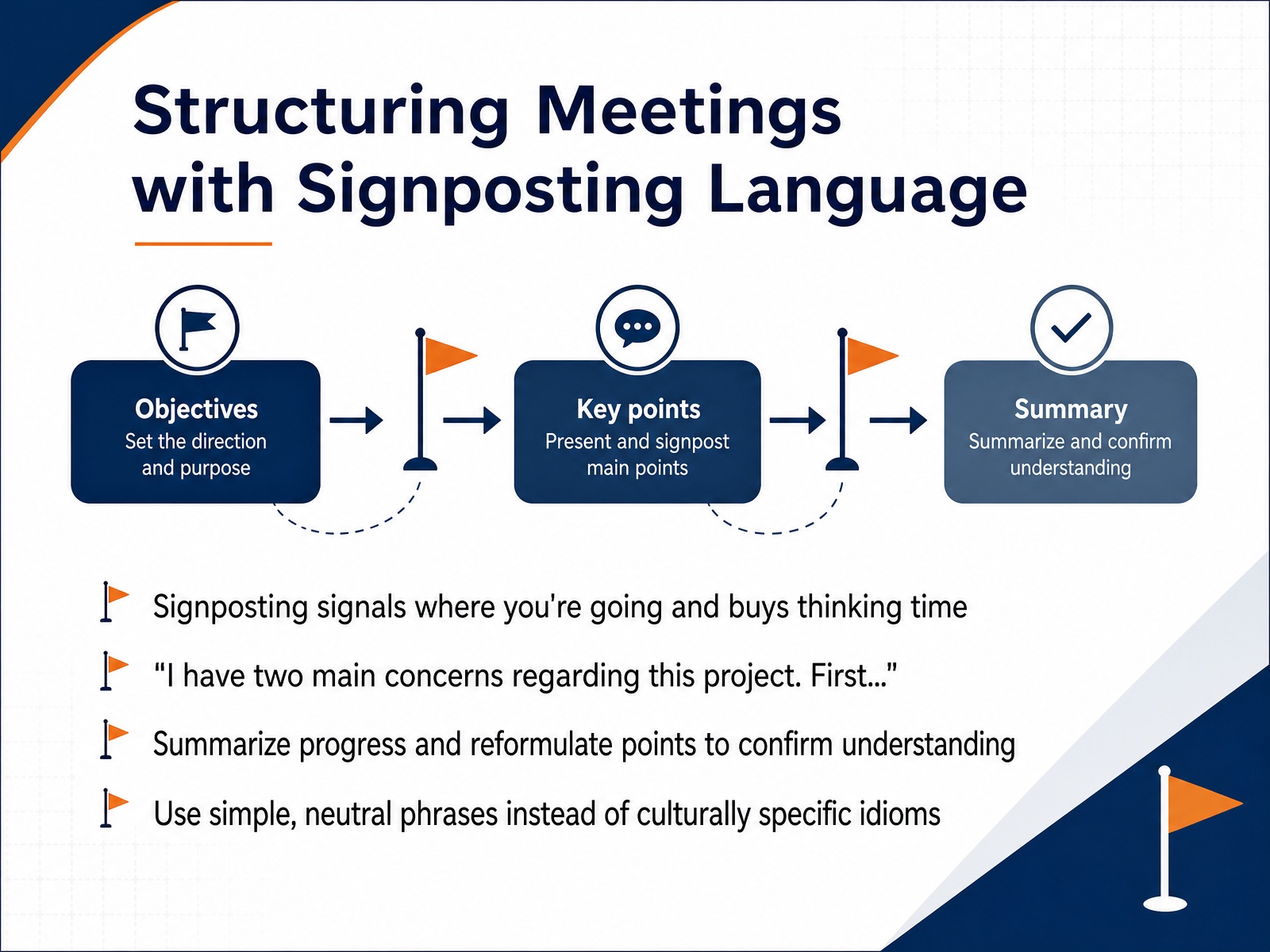
 - 05Structuring Meetings with Signposting LanguageNow let's talk about structuring your meetings with signposting language. Signposting means telling your listeners where you are going before you get there. For example, you might say, "I have two main concerns regarding this project. First..." This simple phrase does two things. It signals your structure, and it gives you valuable thinking time. When you pause after saying "First," your listeners know a second point is coming, so they won't interrupt you. You can also summarize progress to keep everyone aligned. Say, "So far, we've agreed on the budget, and next we'll discuss the timeline." This confirms understanding and prevents confusion. And when a point is unclear, reformulate it in your own words: "Just to make sure we're on the same page, are you saying we need to extend the deadline?" It's a smart habit. Also, choose simple, neutral phrases instead of idioms. Idioms like "let's bite the bullet" can confuse international colleagues. Say "let's face the difficult decision" instead. Your goal is clarity. Practice using one signposting phrase in your next meeting, and you will feel more in control. That naturally leads us to our next topic: asking for and giving opinions.
 doi.orgfluentatdesk.comspeakingenie.com+21 min
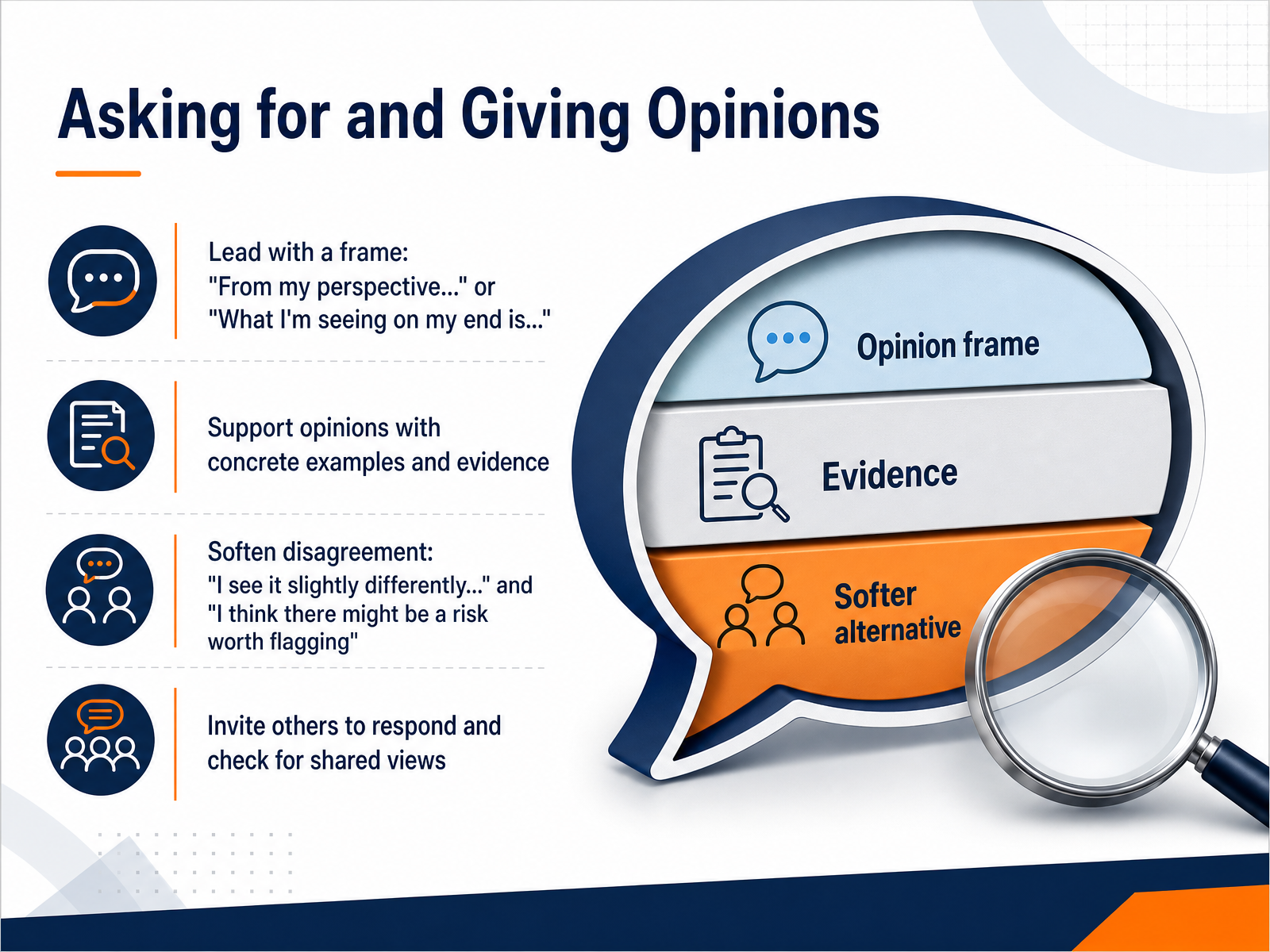
 - 06Asking for and Giving OpinionsNow let’s look at how to ask for and give opinions with confidence. Start with a simple frame like: From my perspective, or: What I’m seeing on my end is. These phrases give you time to think and make your point sound clear and professional. Always support your opinion with a concrete example or evidence. Instead of just saying you disagree, soften it. Try: I see it slightly differently, or: I think there might be a risk worth flagging. This keeps the conversation respectful and open. Finally, invite others to respond. Ask: Does anyone see it differently? or: Are we on the same page here? This shows you value collaboration and helps the team reach a shared view. Remember, your opinion matters. Using these simple structures makes it easier to be heard and understood. Next, we’ll cover how to clarify and interrupt politely.
 doi.orgfluentatdesk.comspeakingenie.com+21 min
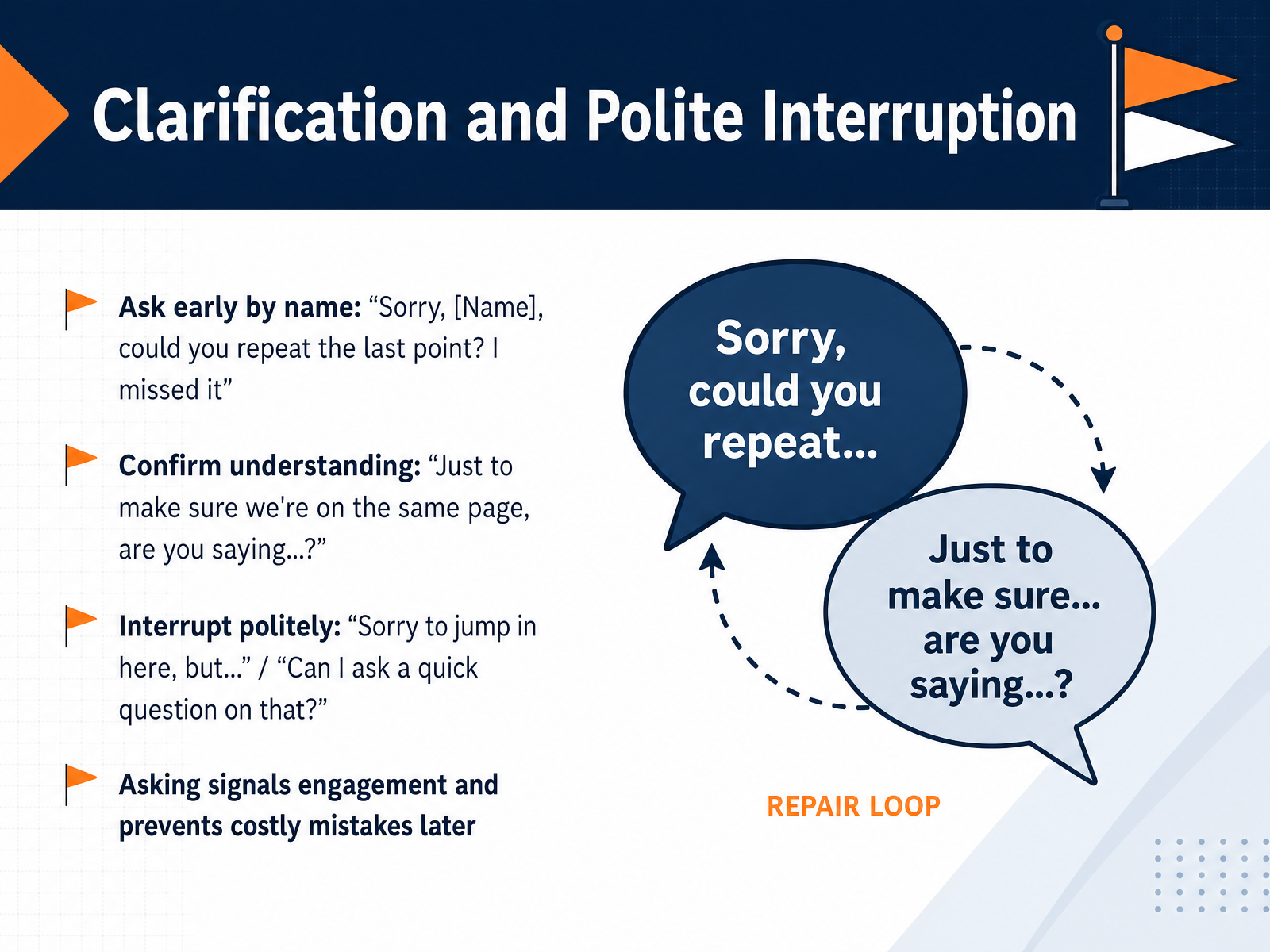
 - 07Clarification and Polite InterruptionLet's turn now to two essential meeting skills: asking for clarification and interrupting politely. Many professionals worry that asking a question makes them look weak. In reality, it shows you are engaged and precise. If you miss a point, ask early. Use the person's name: "Sorry, Maria, could you repeat the last point? I missed it." This simple sentence is friendly, respectful, and much safer than guessing later. Next, confirm your understanding with phrases like "Just to make sure we're on the same page, are you saying that...?" This is a great way to check your understanding without stopping the flow. And when you need to speak up, interrupt politely. Try "Sorry to jump in here, but..." or "Can I ask a quick question on that?" These phrases are professional and give you space to contribute. Remember, asking signals engagement and prevents costly mistakes later. Now, let's look at managing disagreement and conflict.
 doi.orgfluentatdesk.comspeakingenie.com+21 min
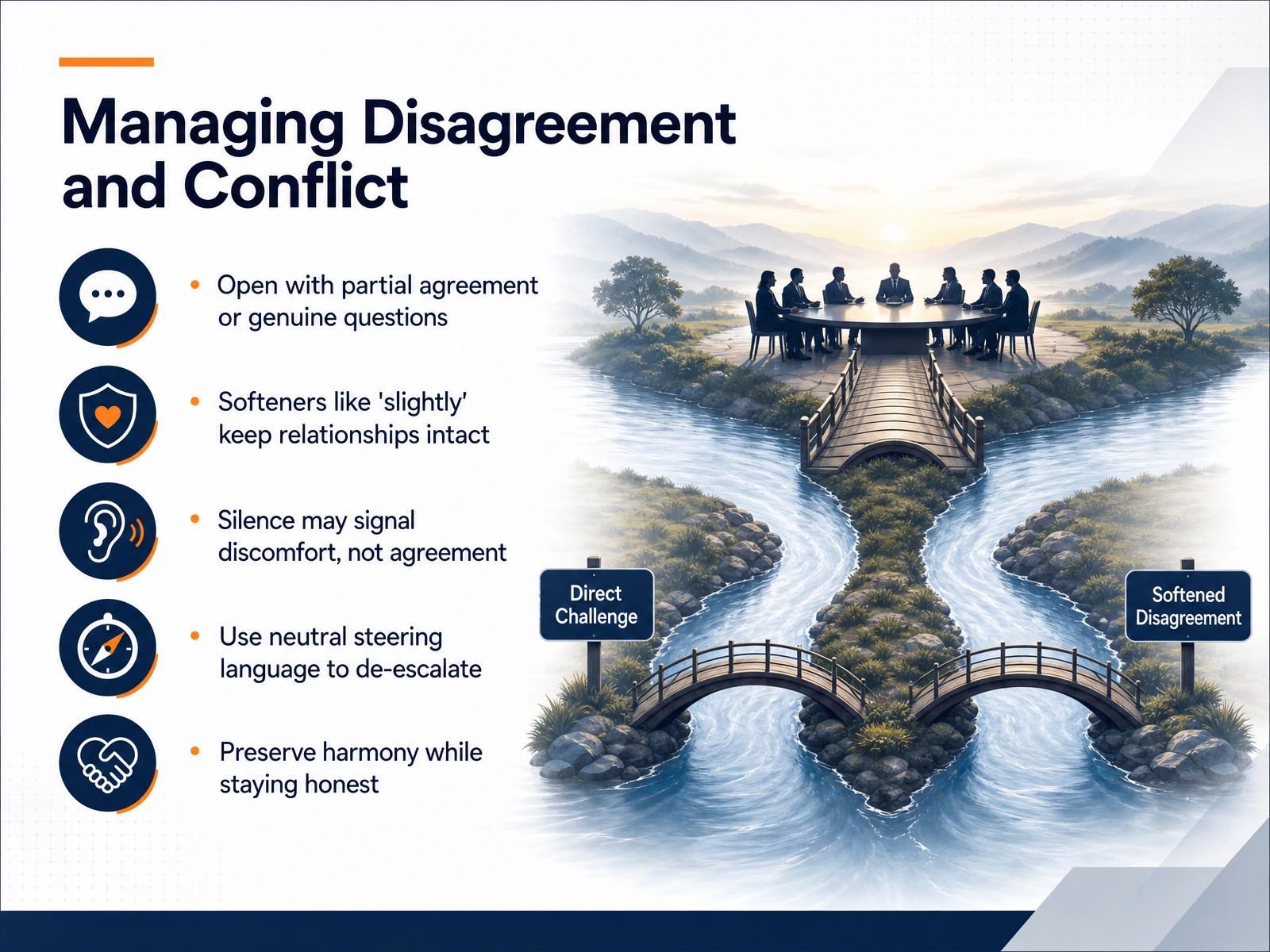
 - 08Managing Disagreement and ConflictLet's talk about handling disagreement in a way that keeps relationships strong. One powerful technique is to start with partial agreement. Instead of saying "you're wrong," you could say, "I see your point, and I'd like to add a different perspective." This shows respect while still sharing your view. Another helpful habit is using softeners. Words like "slightly" or "perhaps" can reduce tension. For example, "I'm slightly concerned about the timeline" is easier to hear than "This timeline is impossible." It's also important to remember that silence doesn't always mean agreement. In some cultures, people stay quiet when they disagree, to show respect. So, don't assume silence means consent. Instead of pushing for a direct answer, you could check in privately later. If a situation becomes tense, use neutral steering language to de-escalate. Try saying, "Let's take a step back and look at the facts together." This shifts the focus from blame to problem-solving. The goal is to be honest while preserving harmony. You can disagree with an idea without damaging the relationship. Next, we'll look at the broader picture of direct and indirect communication styles in meetings.
 culturalq.comwebuser.bus.umich.eduglobalmindfulsolutions.com+22 min
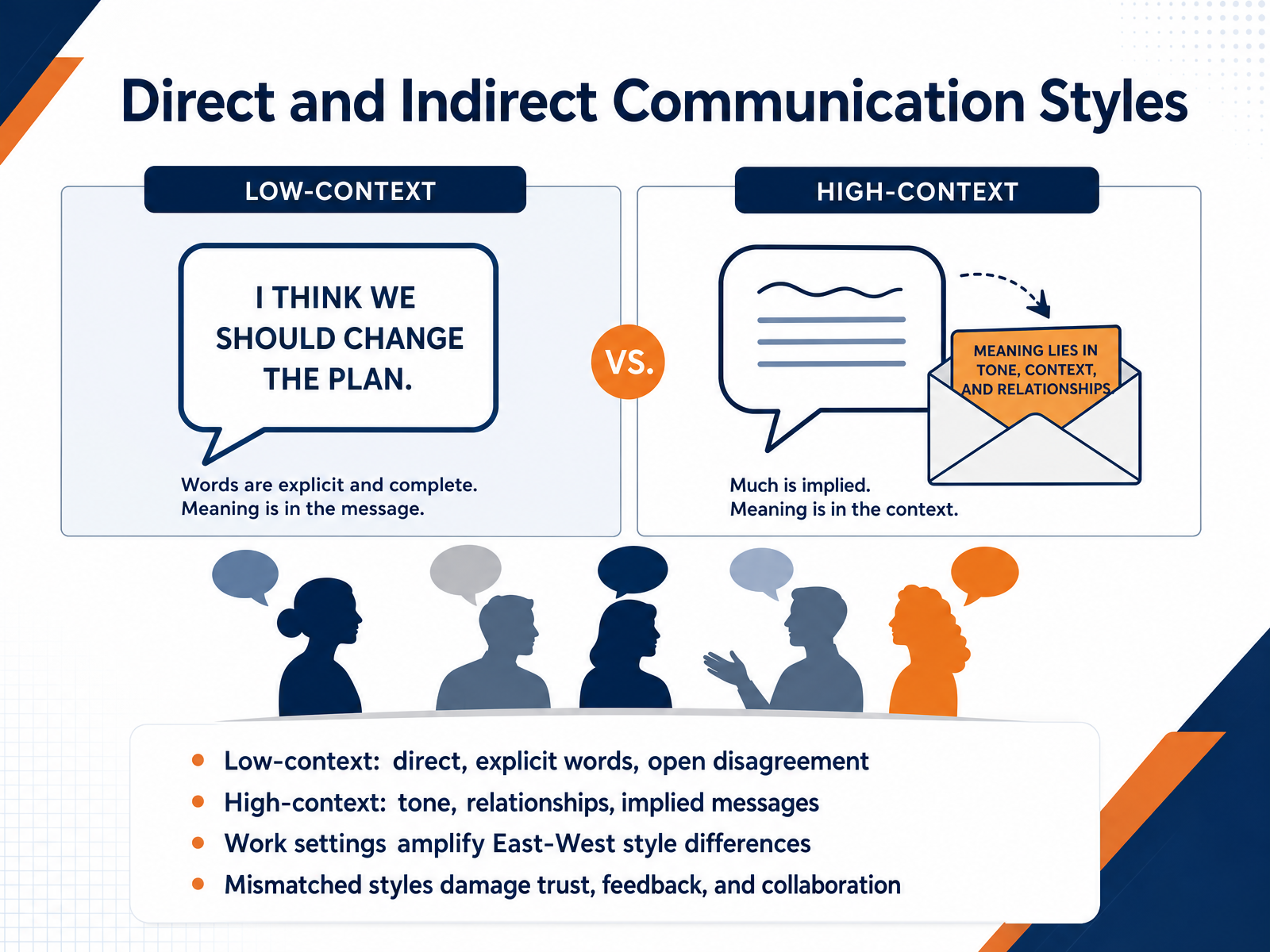
 - 09Direct and Indirect Communication StylesNow, let's explore a key difference in how we communicate: direct and indirect styles. In low-context cultures, like the US or Germany, people value explicit words. They say exactly what they mean, and open disagreement is seen as honest and professional. But in high-context cultures, like Japan or many Arab nations, meaning often comes through tone, relationships, and what's left unsaid. Messages are softened to preserve harmony and respect. Here's the important part: research shows these differences become even stronger in work settings. When styles clash, trust can break down, feedback can feel harsh or vague, and collaboration suffers. So, remember: neither style is better. The key is to notice which style you prefer, and to stay curious about your colleagues' styles. Next, let's look at how to adapt across these communication styles.
 culturalq.comwebuser.bus.umich.eduglobalmindfulsolutions.com+21 min
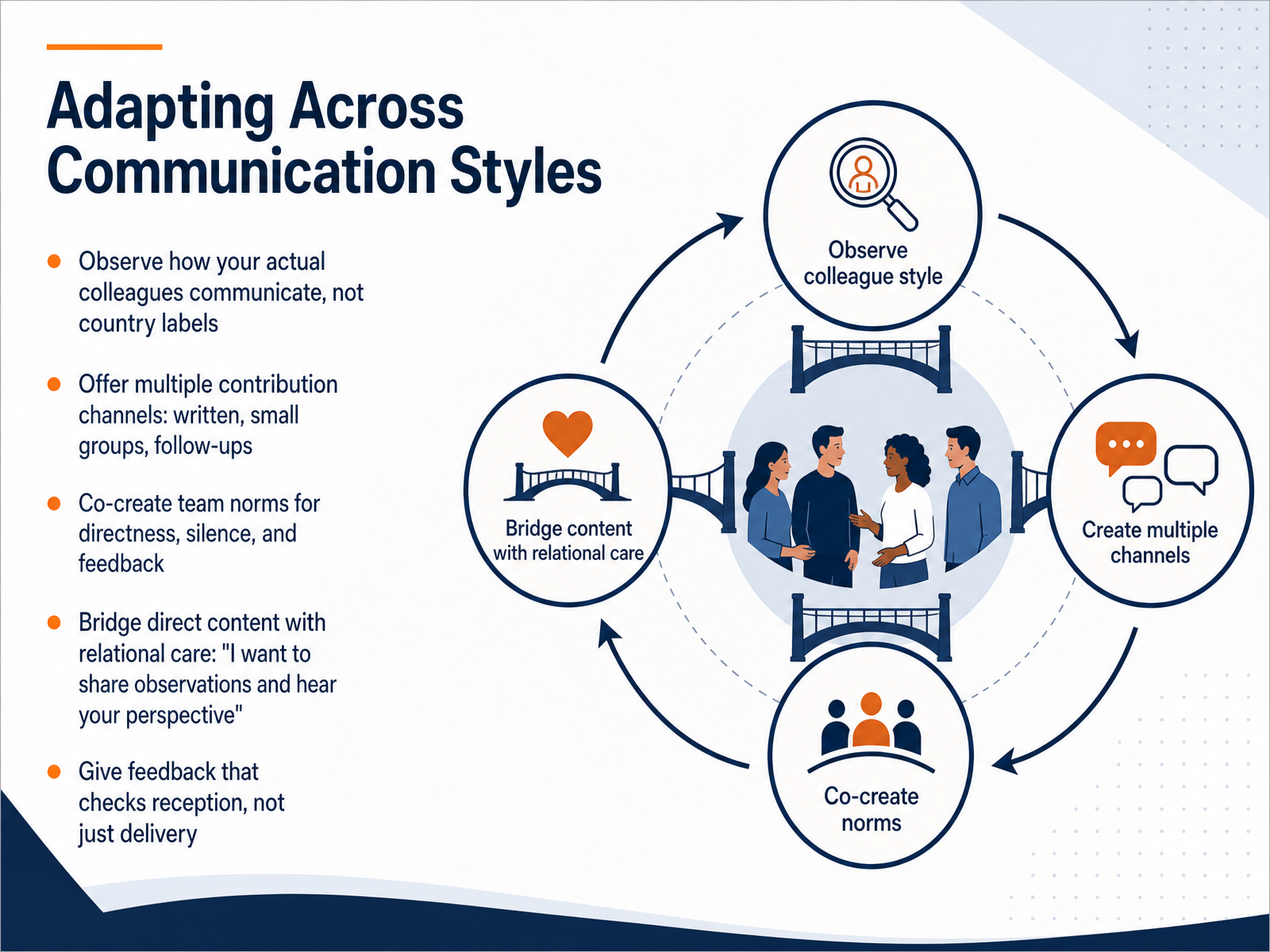
 - 10Adapting Across Communication StylesNow let's talk about adapting across communication styles. The most important shift is to stop relying on country labels and start observing how your actual colleagues communicate. People vary widely, even within the same culture. So watch how they disagree, give feedback, or use silence. Offer multiple ways for people to contribute, such as written input, small group discussions, or follow-up one-on-ones. That way, everyone has a channel that feels comfortable. Next, co-create your team's norms around directness, silence, and feedback. Discuss how you will interpret these signals instead of assuming everyone shares the same default. When you need to be direct, bridge it with relational care. You might say, I want to share some observations and hear your perspective. This invites dialogue rather than confrontation. Finally, when giving feedback, always check how it was received, not just how you delivered it. Ask a follow-up question to confirm shared understanding. Your takeaway: flexible communication creates a team where every voice can contribute and be understood, regardless of style. Next, we'll explore constructive feedback and inclusive team language.
 culturalq.comwebuser.bus.umich.eduglobalmindfulsolutions.com+22 min
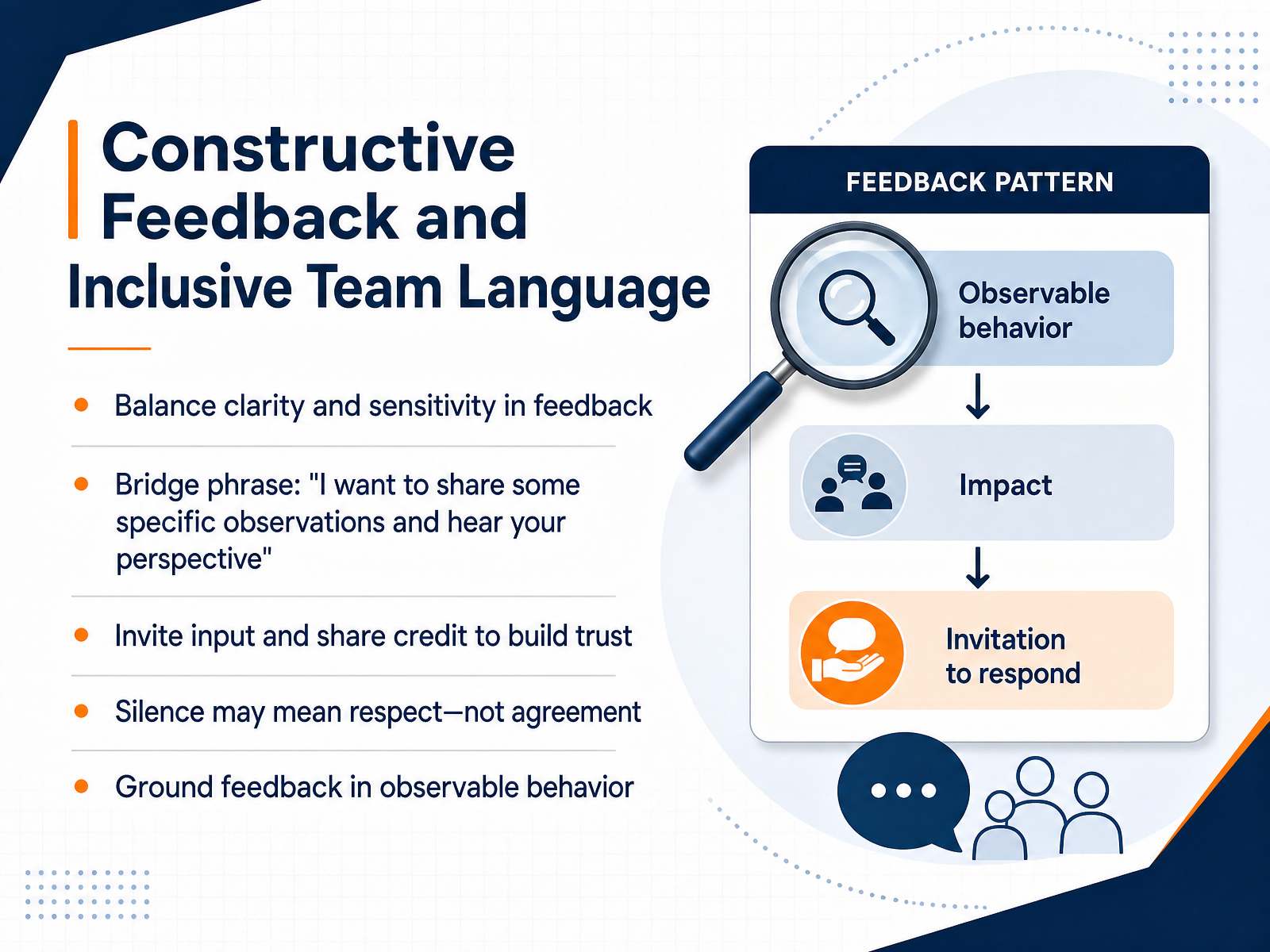
 - 11Constructive Feedback and Inclusive Team LanguageNow let's talk about giving feedback in a way that's both clear and respectful, especially in international teams. The goal is to balance honesty with sensitivity. One powerful bridge phrase is: 'I want to share some specific observations and hear your perspective.' This invites dialogue instead of just delivering a verdict. For example, instead of saying 'Your part was weak,' you might say, 'I noticed the report didn't include the budget figures. Can we review that together?' Always ground your feedback in observable behavior, not personality. This makes it easier for the other person to understand and act on it. Also, remember that silence doesn't always mean agreement. In some cultures, silence shows respect or careful thinking. So, create space for written input or one-on-one conversations. And when a team succeeds, share credit openly. This builds trust and encourages everyone to contribute. Your takeaway: give feedback that is specific, invite the other person's view, and never assume silence means consent. Up next, we'll look at written follow-ups and team messaging to keep the conversation going.
 culturalq.comwebuser.bus.umich.eduglobalmindfulsolutions.com+21 min
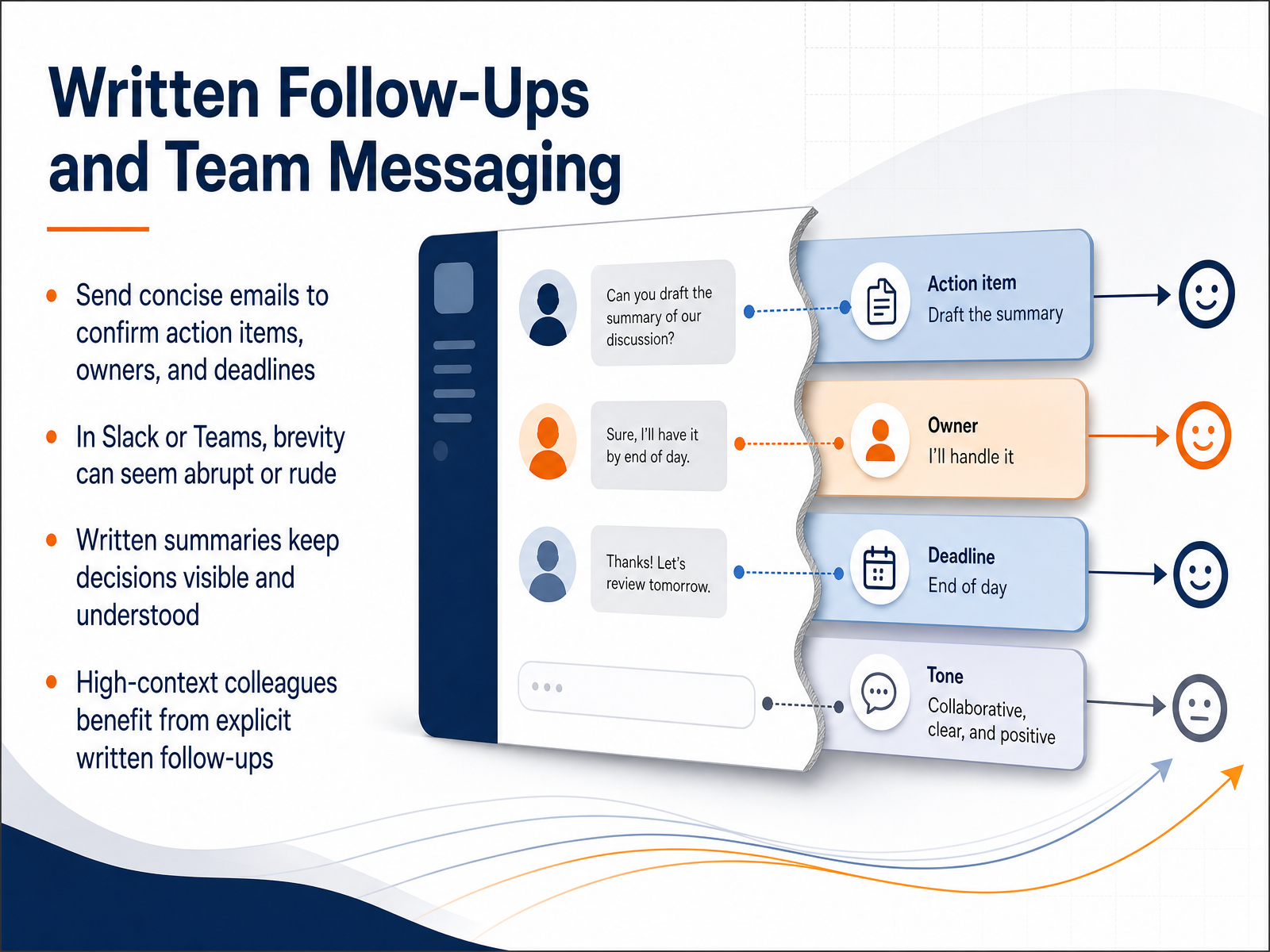
 - 12Written Follow-Ups and Team MessagingLet’s talk about written follow-ups and team messaging. After a meeting, sending a concise email to confirm action items, owners, and deadlines is one of the most effective ways to keep everyone aligned. But there is a delicate balance. In tools like Slack or Microsoft Teams, being too brief can sometimes come across as abrupt or even rude. For colleagues from high-context cultures, who rely on tone and relationship, a very short written message may feel cold. That is why adding a quick greeting or a polite closing phrase makes a big difference. At the same time, written summaries are powerful because they make decisions visible and understood by everyone, especially those who prefer indirect communication. They give people time to review and reflect. So here is your takeaway: after any important discussion, send a clear and polite summary. It keeps the team connected and ensures nothing gets lost.
 culturalq.comwebuser.bus.umich.eduglobalmindfulsolutions.com+21 min
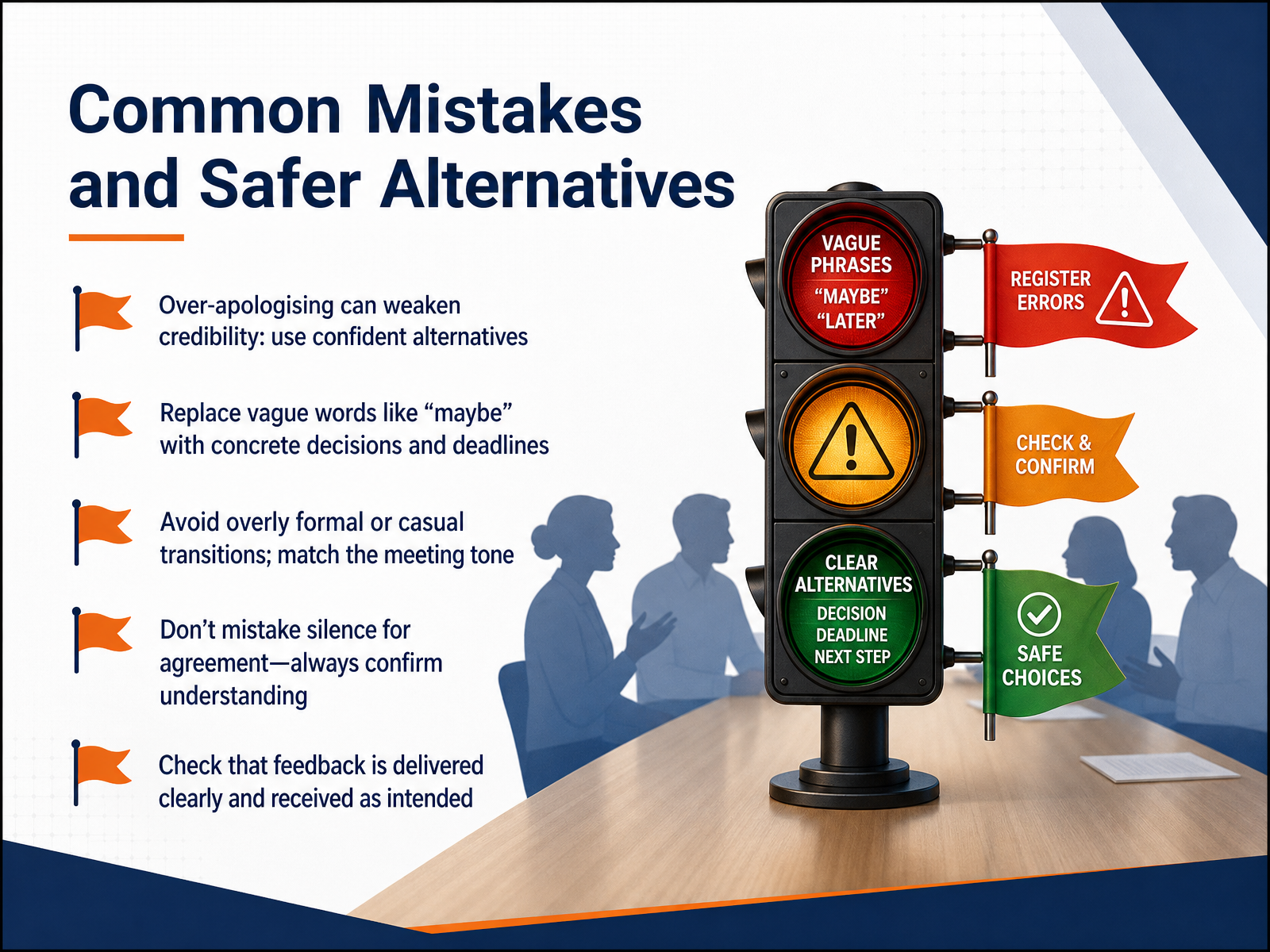
 - 13Common Mistakes and Safer AlternativesLet's look at some common mistakes in meetings and the safer alternatives you can use. First, over-apologising can weaken your credibility. Instead of saying 'I'm sorry, but I have a point,' try 'I'd like to add something here.' Second, replace vague words like 'maybe' with concrete decisions. For example, instead of 'Maybe we can finish by Friday,' say 'Let's agree to finish by Friday.' Third, avoid overly formal or casual transitions. Match the tone of the meeting. If it's a formal review, say 'I'd like to propose the following,' not 'So, yeah.' Fourth, don't mistake silence for agreement. Always confirm understanding. You can ask, 'Does everyone agree with this approach?' or 'Can I check that we're all on the same page?' And finally, check that feedback is delivered clearly and received as intended. Ask, 'Does that make sense?' or 'What are your thoughts on this?' These small changes build clarity and confidence. Next, we'll practice these scenarios with an action plan.
 culturalq.comwebuser.bus.umich.eduglobalmindfulsolutions.com+21 min
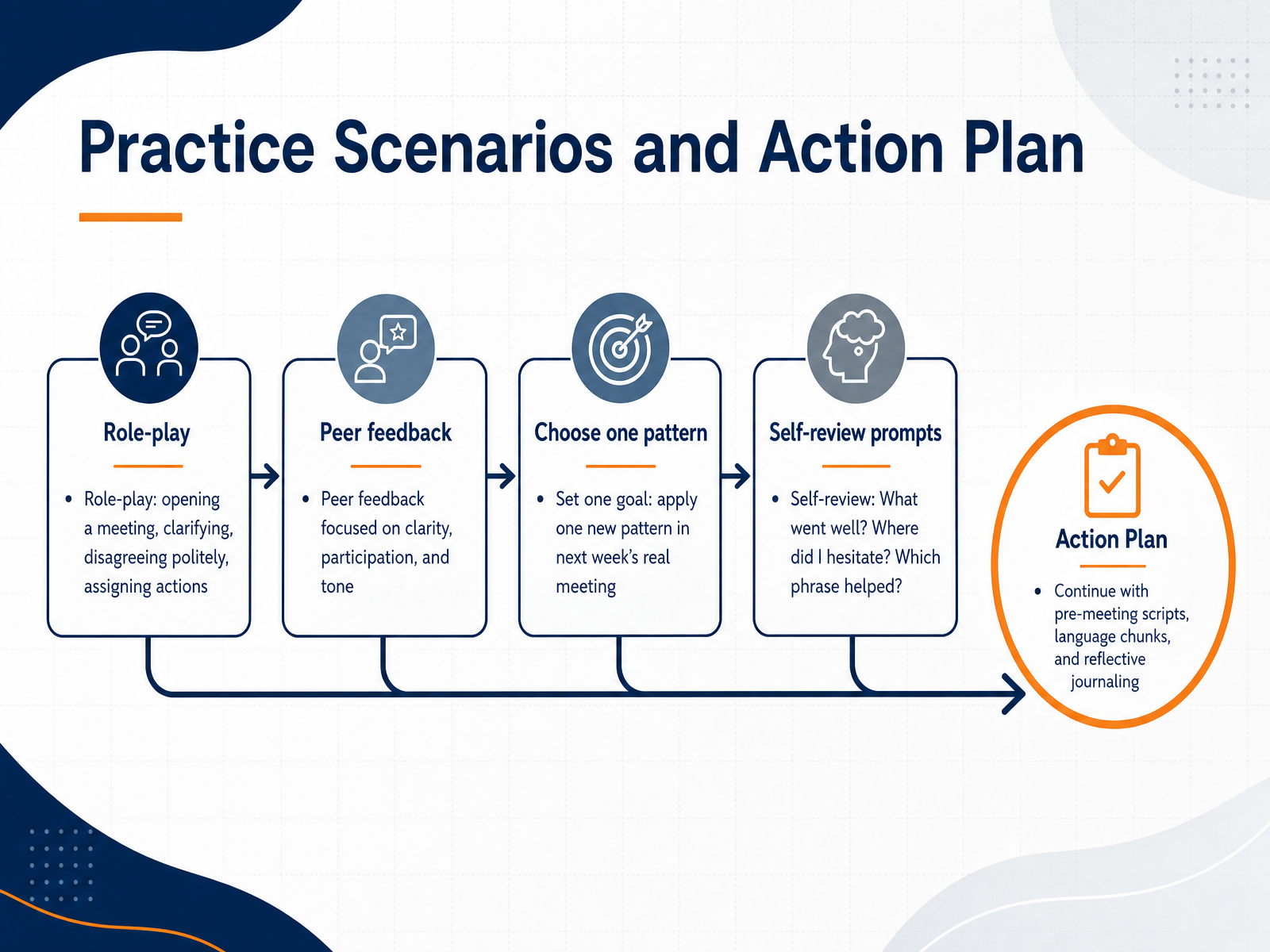
 - 14Practice Scenarios and Action PlanWe've reached the final, and most important, part of our journey: putting it all into practice. Let's begin with a simple role-play. Practice opening a meeting, asking a clarifying question, disagreeing politely, and assigning actions. This is your safe space to try. After each practice, give peer feedback focused on three things: clarity, participation, and tone. Was the message clear? Did everyone contribute? And did the tone feel respectful? Now, your action plan. Set one single goal for your next real meeting. Choose one new phrase pattern you learned and commit to using it. It could be as simple as, "I'd like to add something here." After that meeting, do a quick self-review. Ask yourself: What went well? Where did I hesitate? Which phrase helped me most? Finally, continue building your skills with three habits. Prepare a small script before meetings. Learn language chunks, not just words. And keep a reflective journal of your progress. You have the tools and the strategies. Now, take that first step with confidence. Thank you for your commitment, and I look forward to seeing you shine in your next meeting.
 doi.orgfluentatdesk.comspeakingenie.com+22 min
Take the deck with you
Download this course as a file — free, no sign-up needed.
- PDF handoutEvery slide page, ready to print or share.15 pages · 3.6 MBDownload
- Narrated PowerPointThe deck that presents itself — every slide carries the digital human's narration video.15 pages · 15.9 MBDownload
- PowerPoint slidesThe full deck as a .pptx — open it in PowerPoint, Keynote, or Google Slides.15 pages · 3.5 MBDownload
Free to use in your own training — please keep the PersonWise credit page at the end.
Have your own deck? Turn it into a course
Sources consulted
Web sources consulted while building this course.
- Participation and performance in international business meetings — doi.org
- How to Speak Up in Meetings as a Non-Native Speaker | FluentAtDesk — fluentatdesk.com
- How to Improve Business English for Non-Native Speakers in Meetings | Speaking Genie — speakingenie.com
- Business skills bank: Managing international meetings | Article | Onestopenglish — onestopenglish.com
- Why You Struggle to Speak English in Meetings — nyenglishteacher.com
- Direct vs Indirect Communication: A CQ Perspective — culturalq.com
- Conversing Across Cultures: East–West Communication Styles in Work and Nonwork Contexts — webuser.bus.umich.edu
- Direct vs. Indirect Communication at Work | Managing Cultural Differences — globalmindfulsolutions.com
- 15.4 Differences in Language: Directness vs. Indirectness – Communication in Practice — open.lib.umn.edu
- Styles of Communication: Direct and Indirect - Peace Corps — files.peacecorps.gov