Begin
14 pages · ~28 min
English Job Interview Answering Skills
This training helps non-native English speakers prepare clear, confident answers to common job interview questions, improving fluency and performance in English-language interviews.
A digital instructor presents all 14 pages. Hold “Ask” at any point and ask out loud — the answer comes from this course. No sign-up needed.
What you’ll learn
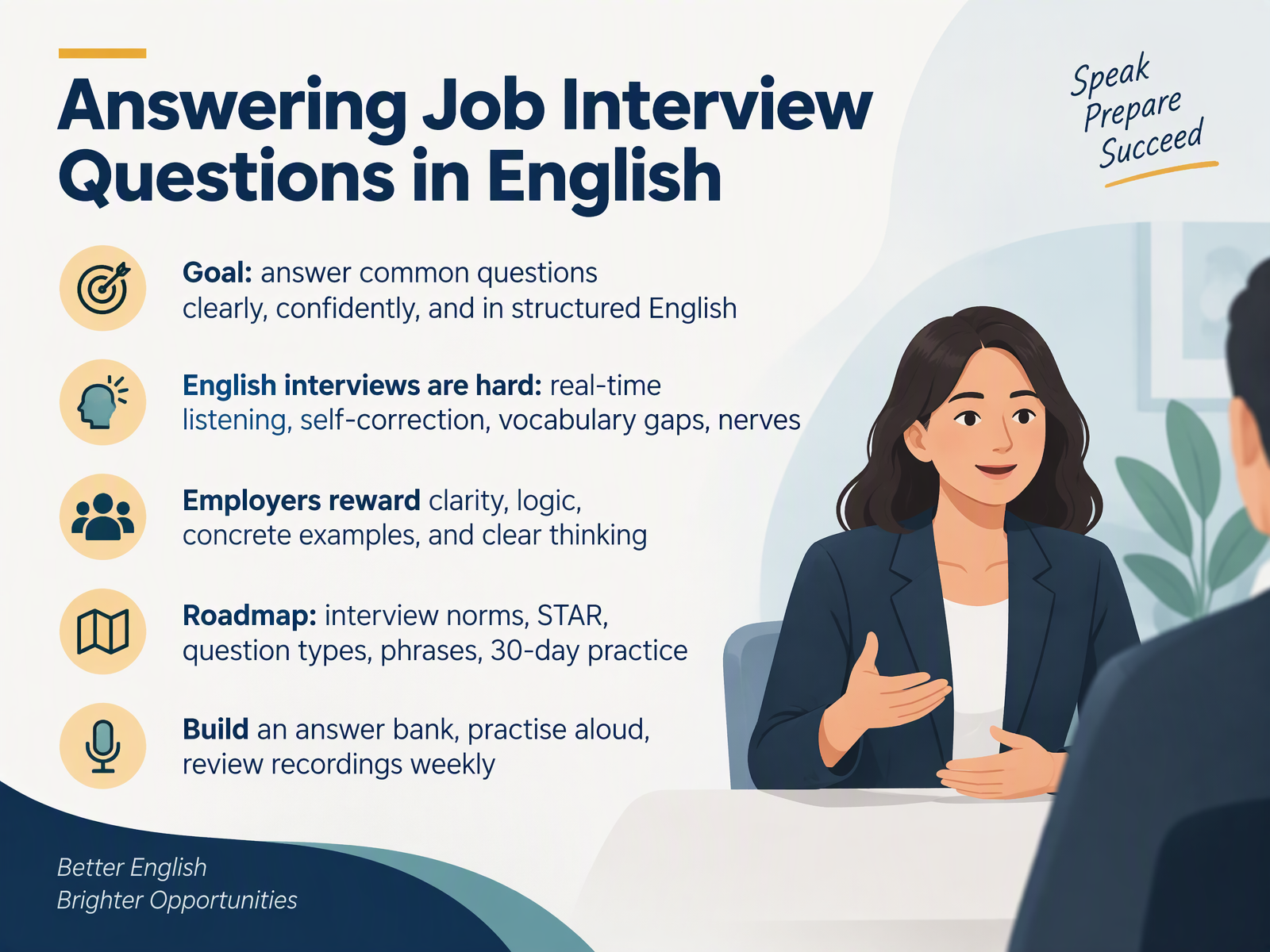
- 01Answering Job Interview Questions in EnglishWelcome. In this course, you will learn how to answer common job interview questions in English. Our goal is simple. You will answer clearly, confidently, and in structured English.
Let's be honest. English interviews are hard. You listen in real time. You correct yourself. You look for the right word. And your nerves make it harder. That is normal, and it is fixable.
Here is the good news. Employers do not expect perfect grammar. They reward clarity, logic, and concrete examples. They want to see how you think. A clear answer at B1 level beats a confusing answer at B2 level.
So here is our roadmap. We will cover interview norms, the STAR method, common question types, useful phrases, and a thirty-day practice plan. You will also build an answer bank, practise aloud, and review recordings every week.
Let's begin. First, how English interviews differ from local-language interviews.businessenglishtalks.comddd.uab.catjobs.theguardian.com+22 min
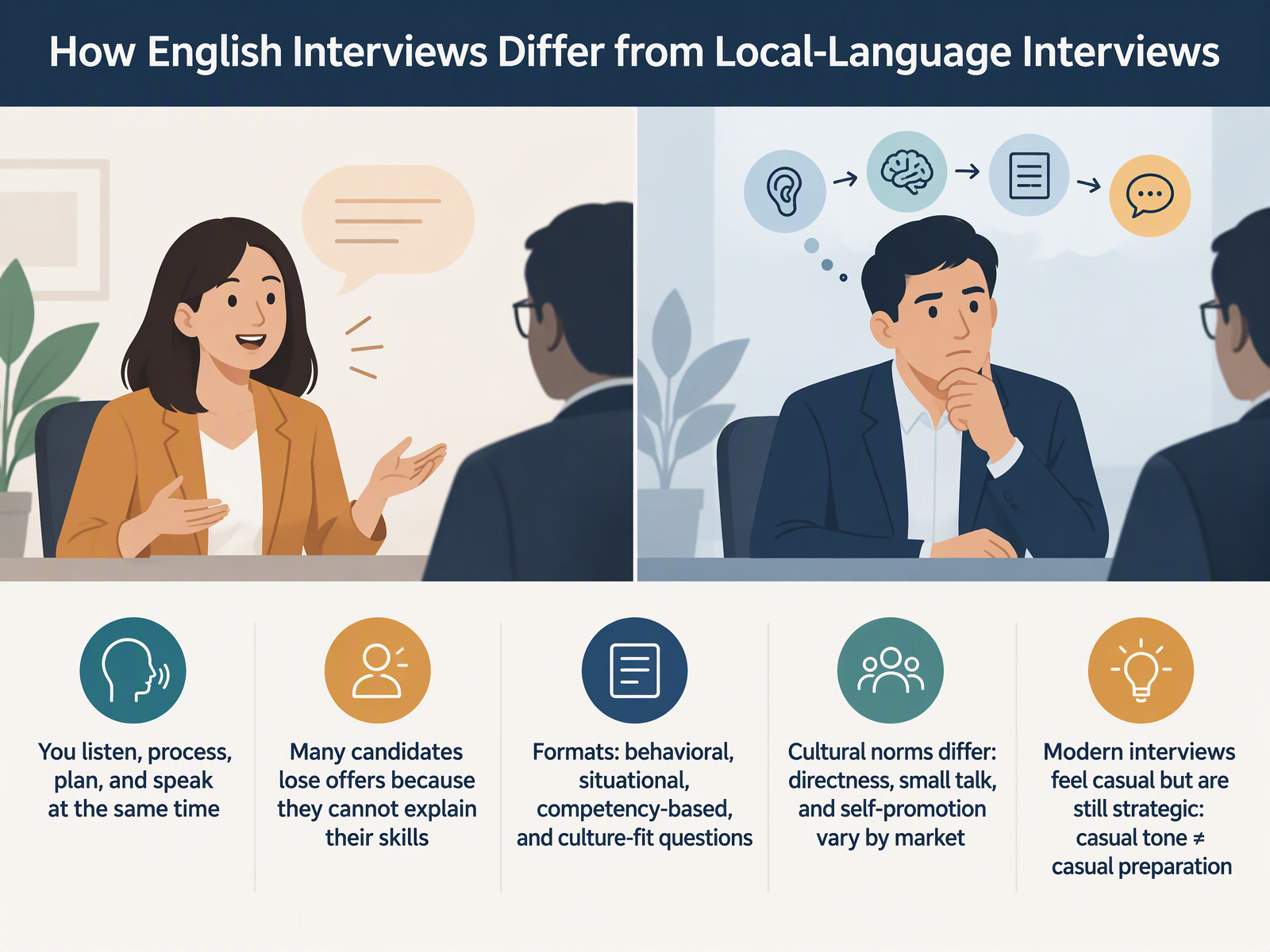
- 02How English Interviews Differ from Local-Language InterviewsLet's look at why English interviews feel different from interviews in your local language. First, you listen, process, plan, and speak at the same time. That takes practice, not perfect grammar. Here's what to say next, not just what to think. Second, many candidates lose offers not because they lack skills, but because they cannot explain their skills clearly in English. Clarity matters more than fancy words. Third, expect different formats: behavioral questions about past examples, situational questions about a scenario, competency-based questions about specific skills, and culture-fit questions about how you work with others. Recall the term behavioral means the interviewer asks for a real story from your past. Fourth, cultural norms differ. Directness, small talk, and self-promotion vary by market. In some markets, you should state your results clearly. In others, you connect your work to the team. Finally, modern interviews feel casual, but they are still strategic. Casual tone does not mean casual preparation. One quick fix: prepare two short stories about your skills, and practice saying them out loud in English. Now let's look at the STAR framework for structured answers.
 businessenglishtalks.comddd.uab.catjobs.theguardian.com+22 min
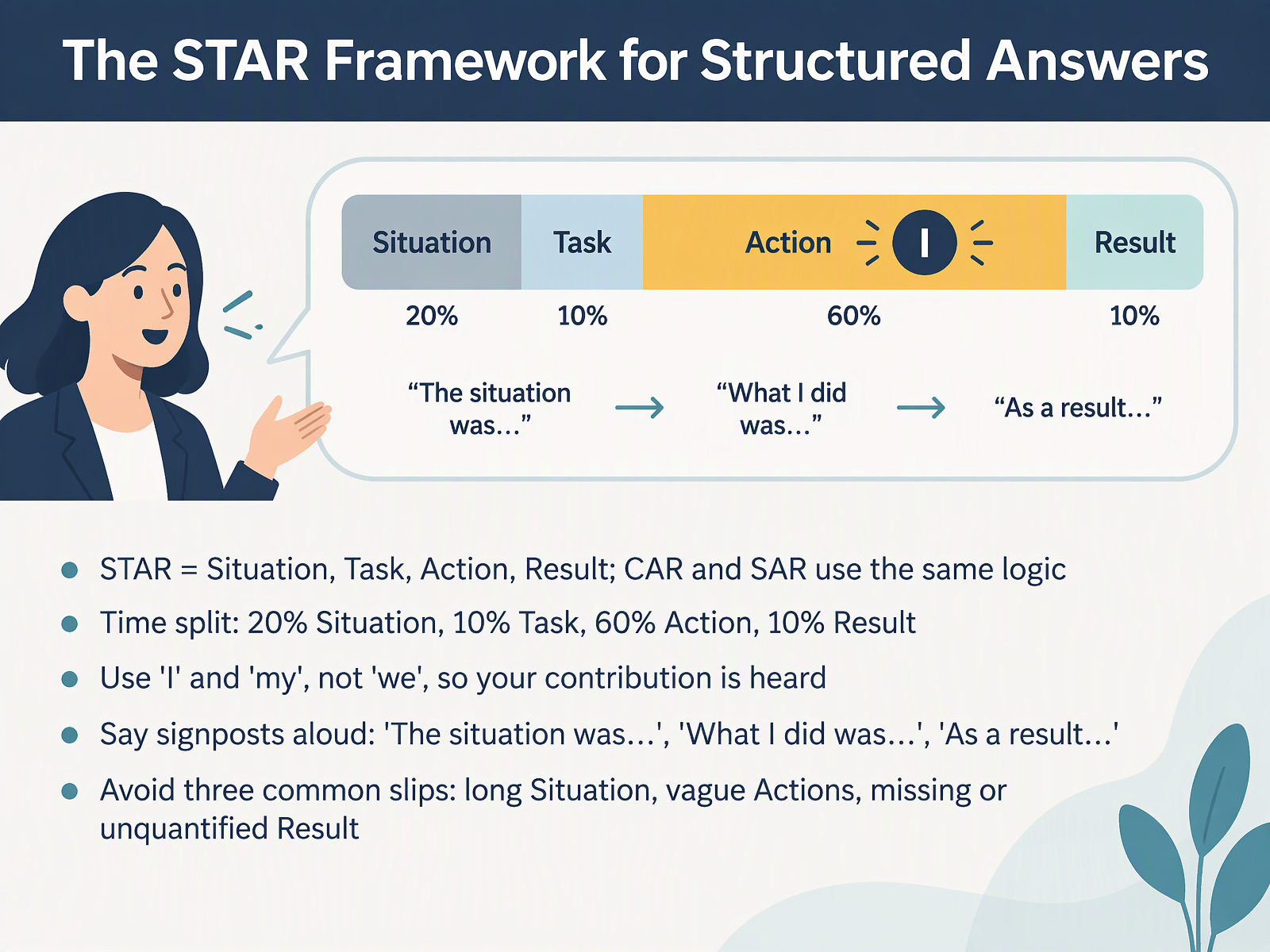
- 03The STAR Framework for Structured AnswersNow let's look at the structure behind your answer, and that is S T A R. S T A R stands for Situation, Task, Action, and Result. Here is the time split. Keep the Situation short, about twenty percent. The Task takes about ten percent. The Action is the biggest part, about sixty percent. The Result takes about ten percent. Use I and my, not we, so your contribution is heard. Say signposts aloud, like, the situation was, what I did was, and as a result. Avoid three common slips: a long Situation, vague Actions, and a missing or unquantified Result. One quick fix is to add a number. So, next, let's move on to answering tell me about yourself and background questions.
 nationalcareers.service.gov.ukaula54.comsvtechenglish.com+21 min
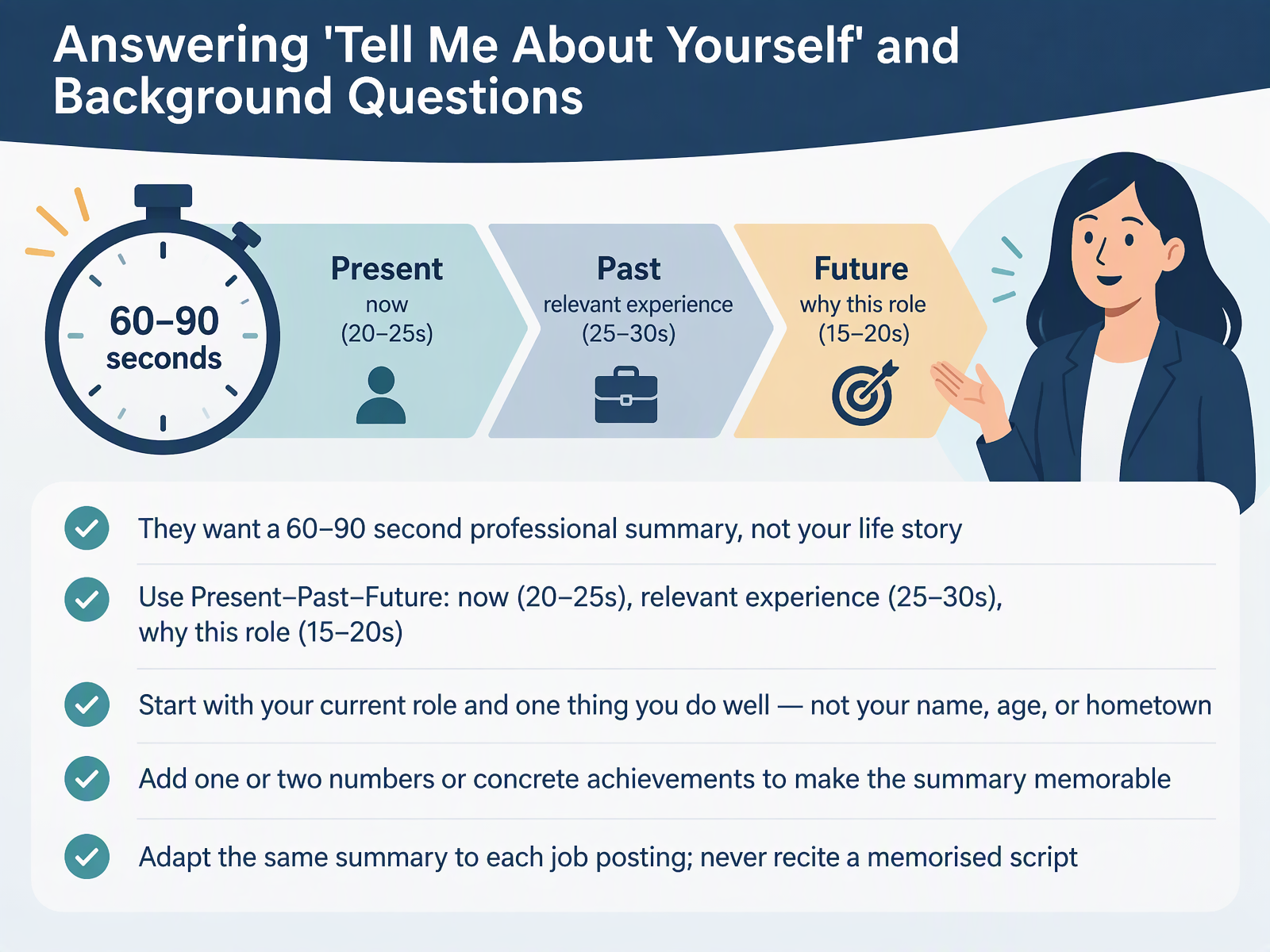
- 04Answering 'Tell Me About Yourself' and Background QuestionsNow let's look at the most common opening question: tell me about yourself. The interviewer wants a professional summary of sixty to ninety seconds. Not your life story. Use a simple structure: present, past, future. Start with your current role and one thing you do well. That takes about twenty to twenty-five seconds. Then give the most relevant experience from your past, about twenty-five to thirty seconds. End with why you want this specific role, fifteen to twenty seconds. One quick fix: don't begin with your name, age, or hometown. Instead of saying, I was born in a small city, say, right now I'm a project coordinator at a logistics company, where I manage schedules for about thirty shipments a month. That number makes you memorable. Add one or two numbers or concrete results. And adapt the same summary to each job posting. Never recite the exact same script. Tailor it so the answer fits the role. Next, we'll look at discussing strengths, weaknesses, and motivation.
 biginterview.combreakers.academyaimockinterview.app+22 min
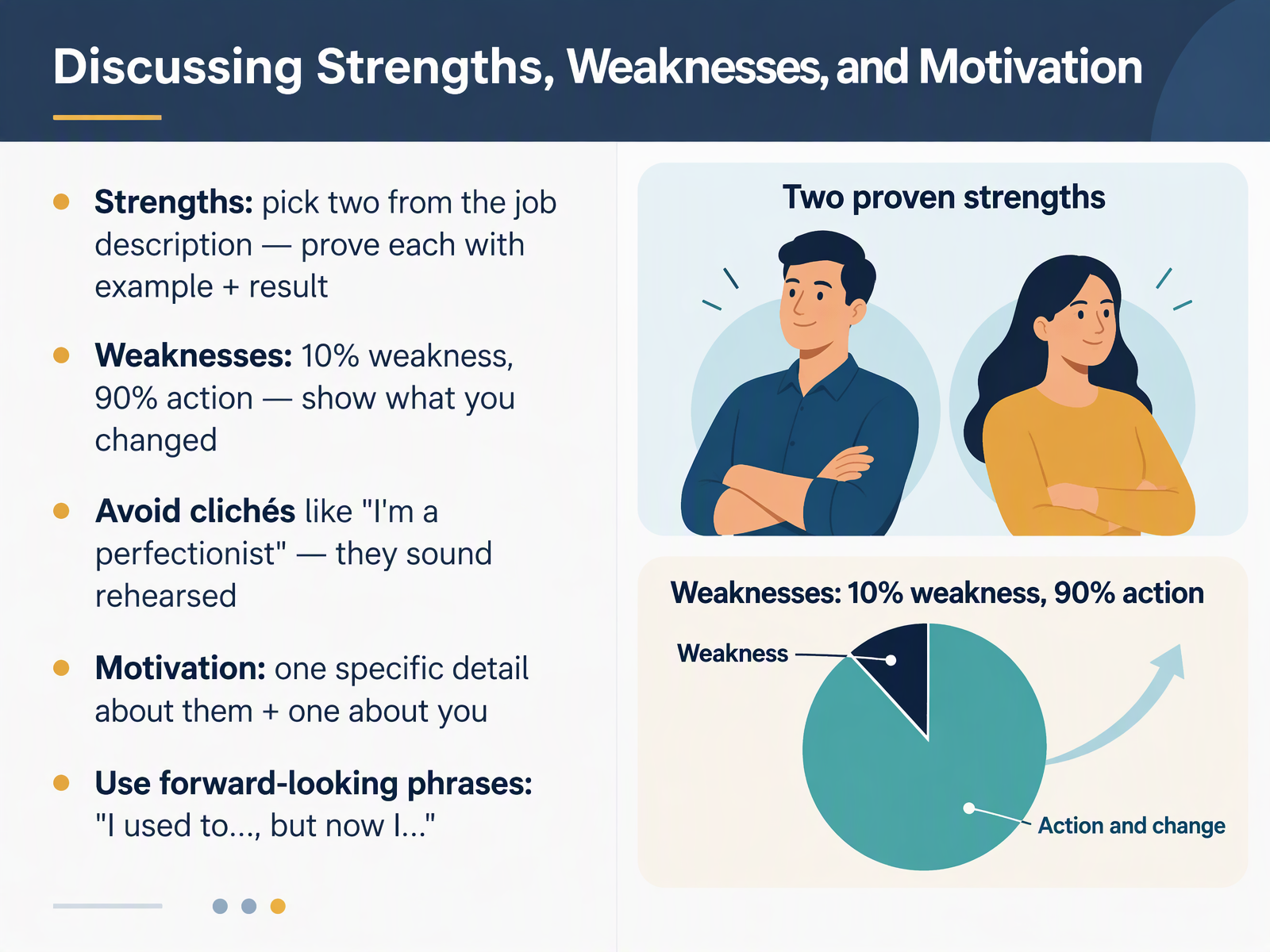
- 05Discussing Strengths, Weaknesses, and MotivationNow let's talk about strengths, weaknesses, and motivation. For strengths, pick two skills from the job description. Then prove each one with an example and a result. Here's what to say next: 'One of my strengths is organization. In my last job, I created a weekly plan, and we never missed a deadline.' For weaknesses, use the ten percent rule. Spend ten percent of your answer on the weakness, and ninety percent on what you changed. Say: 'I used to wait too long to ask for help, but now I check in with my manager early.' Avoid clichés like 'I'm a perfectionist.' They sound rehearsed. For motivation, give one specific detail about them and one about you. For example: 'Your team works with international clients, and I want to use my English every day.' Use forward-looking phrases like 'I used to, but now I.' This shows growth. Next, we'll look at handling behavioral and situational questions.
 themuse.comielts.idp.comcnbc.com+22 min
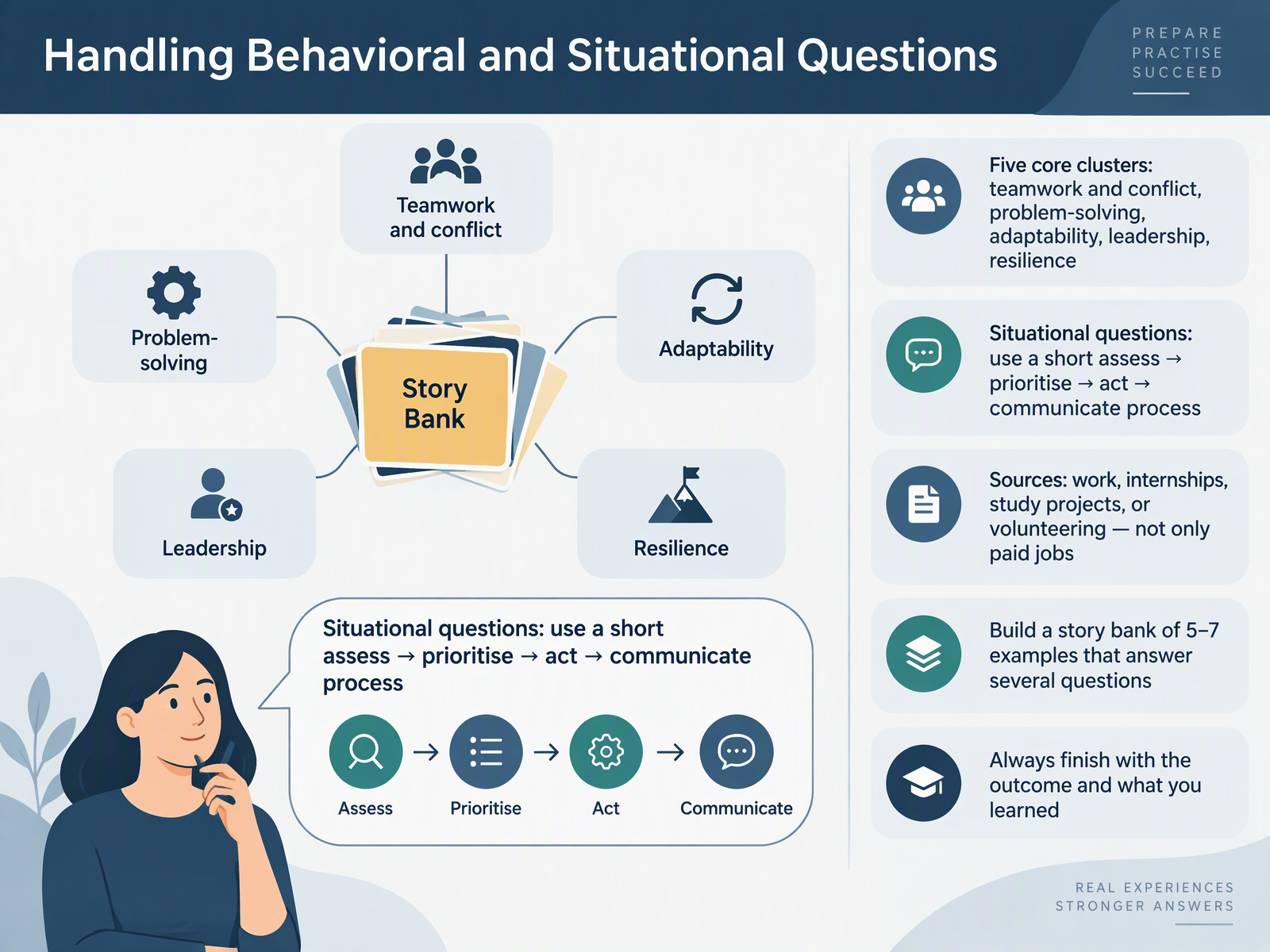
- 06Handling Behavioral and Situational QuestionsNow let's look at behavioral and situational questions. Behavioral questions ask about a real example from your past. They usually begin with, Tell me about a time when. Situational questions describe a problem and ask what you would do. Most behavioral questions fall into five groups: teamwork and conflict, problem-solving, adaptability, leadership, and resilience. For situational questions, use a short process. Assess the situation, prioritize what matters most, act, then communicate what you did. Your examples can come from work, internships, study projects, or volunteering. Not only paid jobs. Build a story bank. Prepare five to seven examples, and each one can answer several different questions. Always finish with the outcome and what you learned. That final part shows the interviewer you can reflect and improve. Next, we move on to talking about experience, skills, and gaps.
 nationalcareers.service.gov.ukaula54.comsvtechenglish.com+22 min
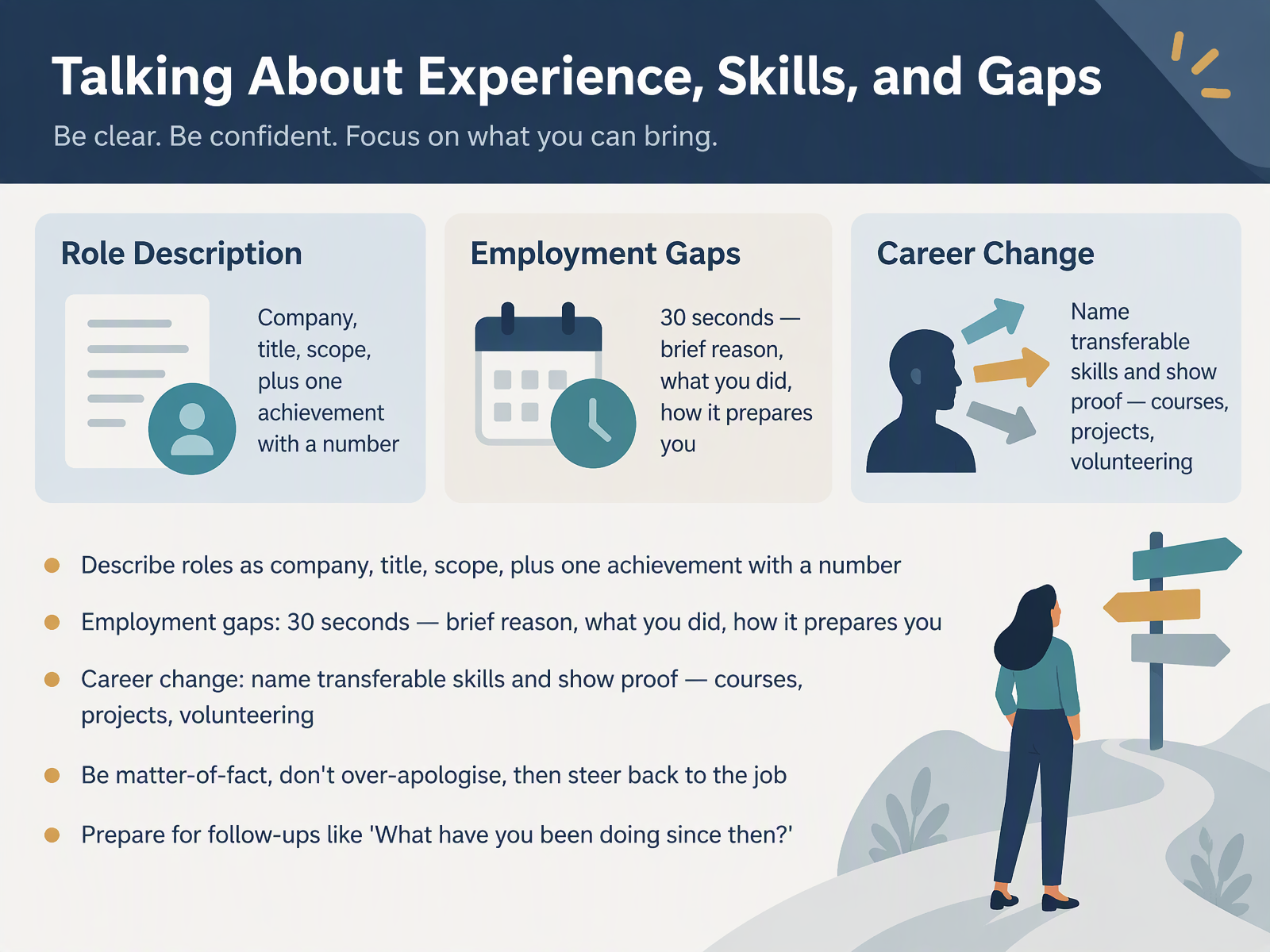
- 07Talking About Experience, Skills, and GapsNow let's talk about your experience, your skills, and any gaps. When you describe a role, give four things: the company, your job title, the scope, meaning how big the team or budget was, and one achievement with a number. For example, "I managed a team of six and cut delivery time by two weeks."
For an employment gap, keep it to about thirty seconds. Give a brief reason, say what you did, and connect it to this job. Here's a quick fix. Instead of "I'm sorry, I was unemployed for a year," say, "I took a career break to care for a family member. During that time I kept my skills current with an online course, and now I'm ready to return."
For a career change, name your transferable skills, the ones that work in any job, and show proof through courses, projects, or volunteering. Be matter-of-fact. Don't over-apologise. Answer, then steer back to the role. And prepare for follow-ups like, "What have you been doing since then?" Next, we'll look at answering questions about the company and the role.
 businessenglishtalks.com3000talk.com2 min
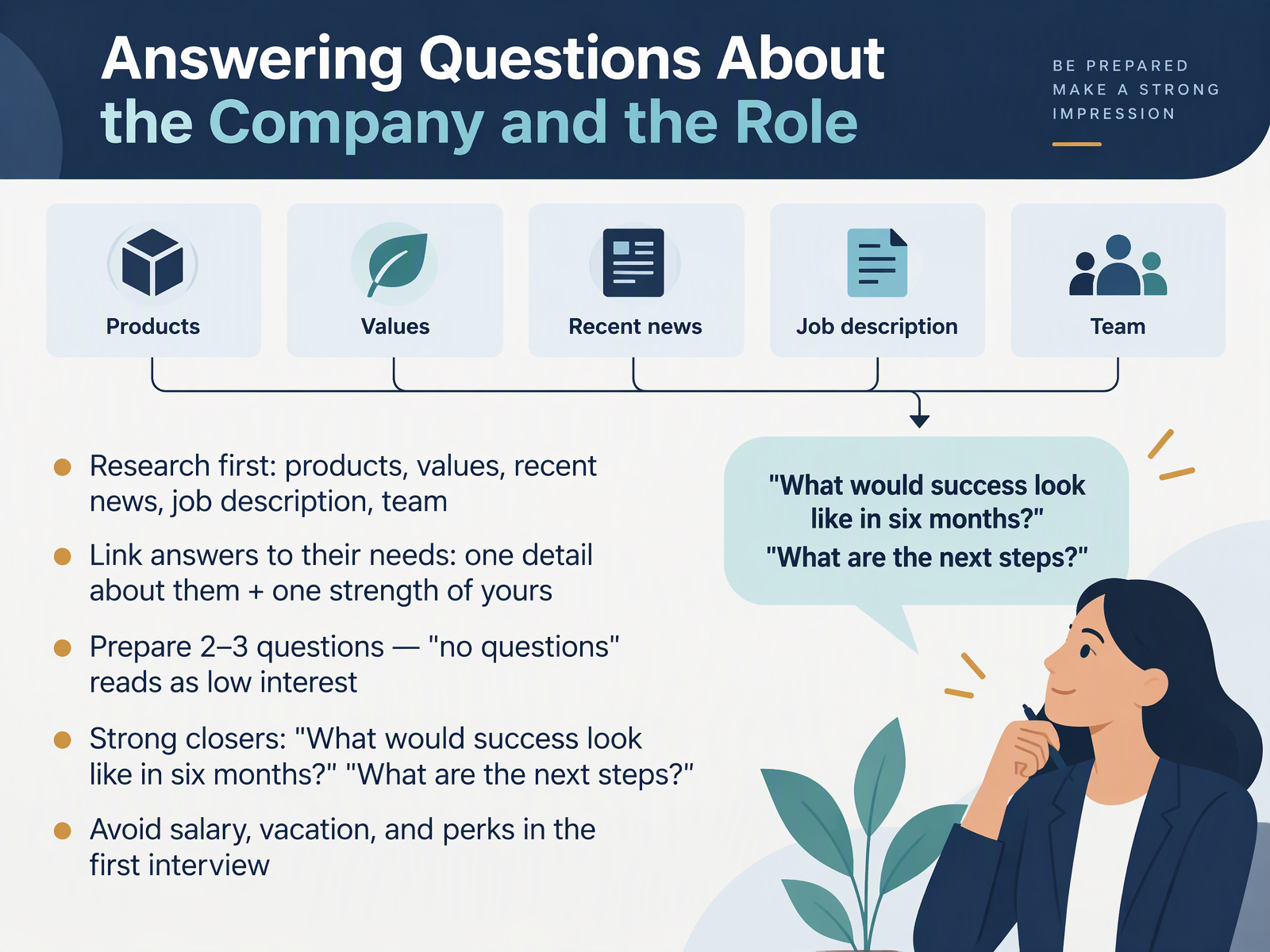
- 08Answering Questions About the Company and the RoleNow let's talk about questions about the company and the role. First, research. Look at their products, their values, recent news, the job description, and the team. When they ask why you want the job, link your answer to their needs. Use one detail about them plus one strength of yours. For example, "I saw you are opening new markets in Asia, and my experience with international clients fits that." Next, prepare two or three questions to ask them. Saying "no questions" reads as low interest. Strong closers include, "What would success look like in six months?" and "What are the next steps?" One quick fix: avoid salary, vacation, and perks in the first interview. Save those for the offer. Next, we look at language tools: signposting, buying time, and clarifying.
 businessenglishtalks.com3000talk.com1 min
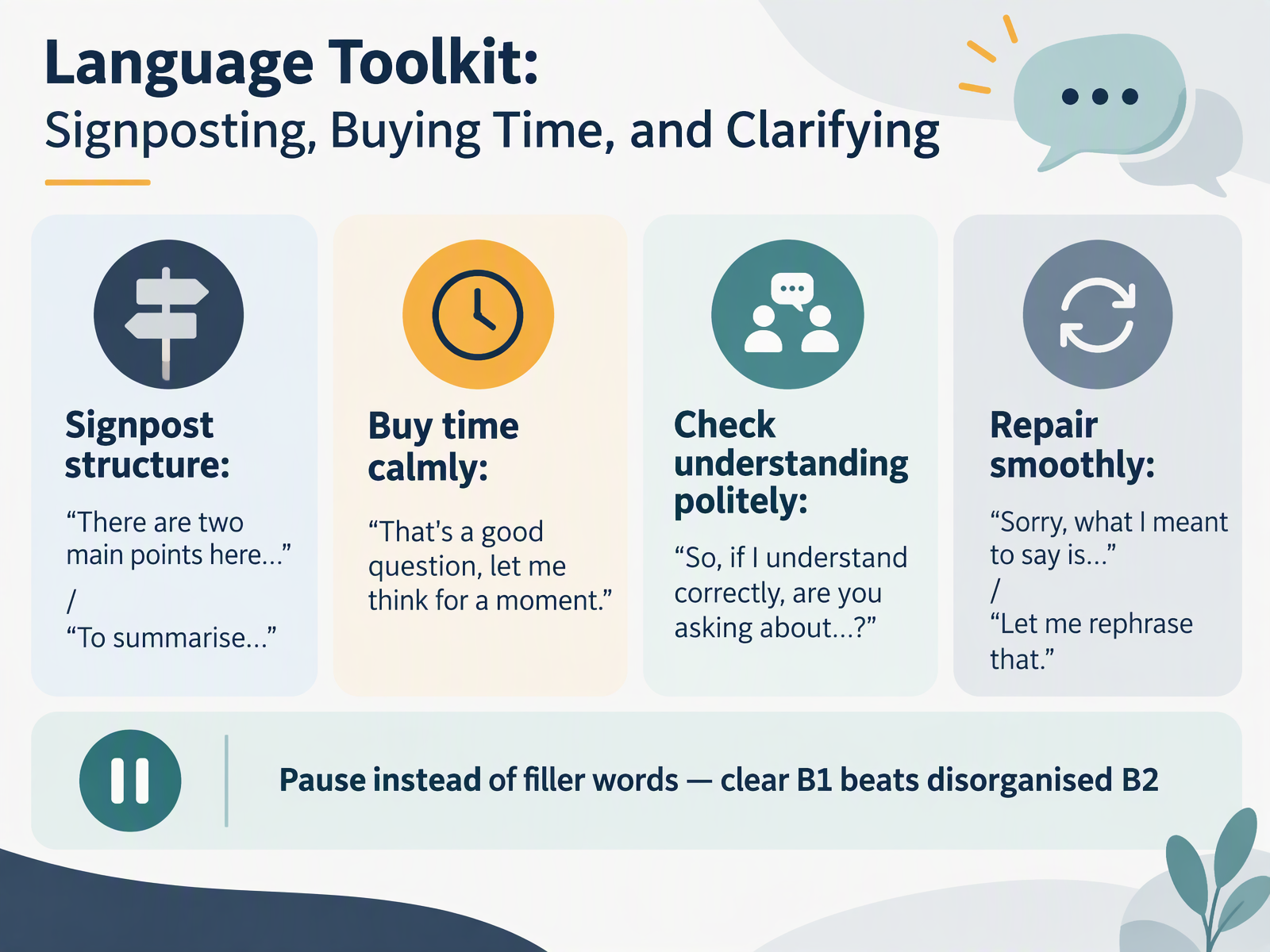
- 09Language Toolkit: Signposting, Buying Time, and ClarifyingNow let's build your language toolkit. These are short phrases that keep your answer clear and calm under pressure.
First, signpost your structure. Say, "There are two main points here," then give them. Or close with, "To summarise." This tells the interviewer where your answer is going.
Second, buy time calmly. Say, "That's a good question, let me think for a moment." It sounds natural, and it gives you a few seconds.
Third, check understanding politely. "So, if I understand correctly, are you asking about?" Then finish the question in your own words.
Fourth, repair smoothly. If a sentence goes wrong, say, "Sorry, what I meant to say is," or, "Let me rephrase that." Then continue.
One quick fix. Instead of filler sounds like um and er, use a short pause. Clear B1 speech beats disorganised B2 speech every time.
Next, we will put these phrases to work in practical drills, with the same answer at B1 and B2.
 biginterview.combreakers.academyaimockinterview.app+22 min
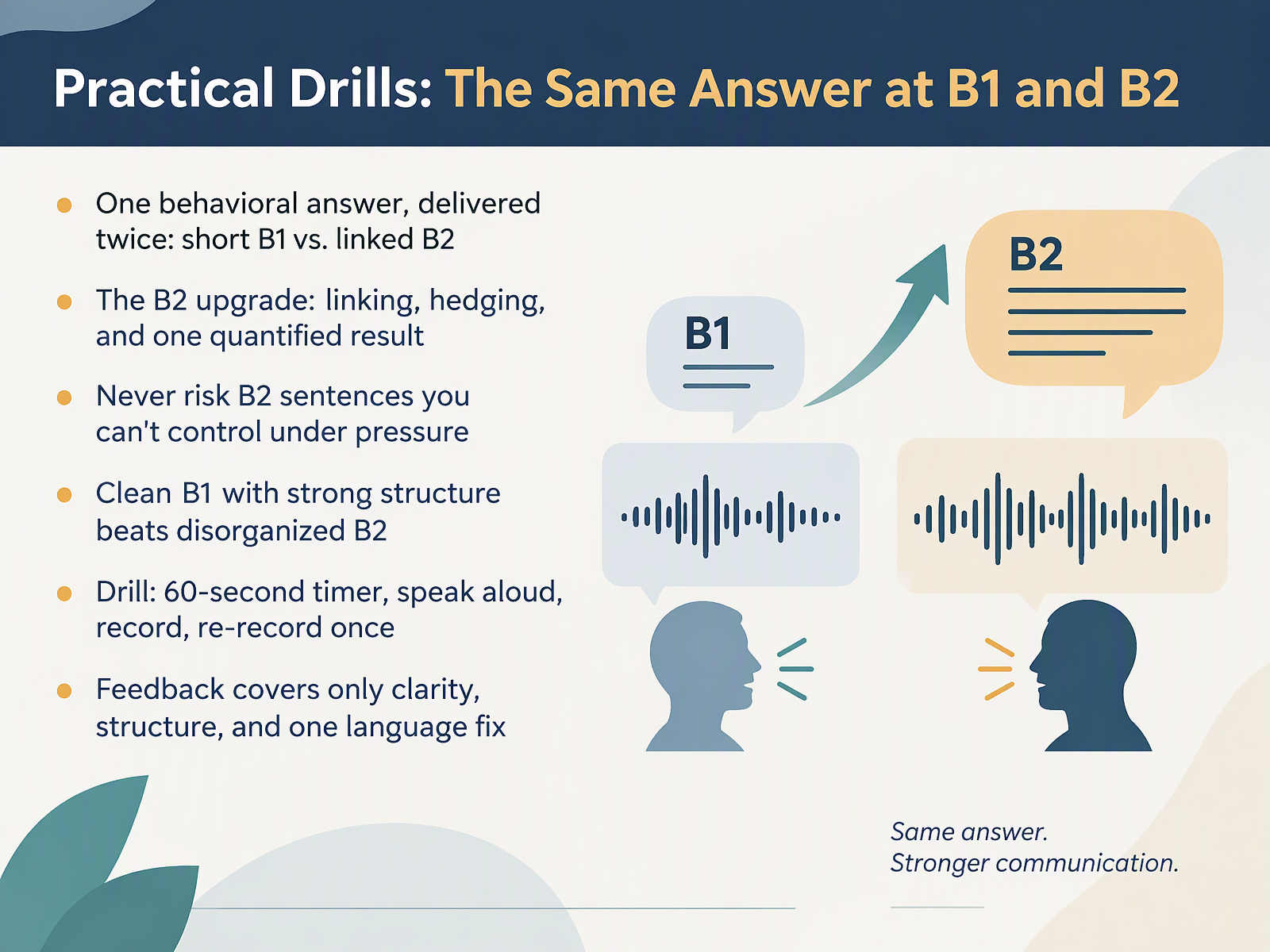
- 10Practical Drills: The Same Answer at B1 and B2Now let's put this into practice with one answer, delivered twice. You tell the same behavioral story in short, clear B1, then upgrade it to B2. The upgrade has three parts. You link ideas with words like because and from there. You hedge calmly, with phrases like I suspected. And you add one result with a number. Here's the point. Never risk B2 sentences you can't control under pressure. Clean B1 with strong structure beats disorganized B2 every time. For the drill, set a sixty-second timer. Speak your answer aloud. Record it. Then re-record it once. When you listen back, check only three things. Clarity, structure, and one language fix. Keep it simple, and your answer will stay strong.
 businessenglishtalks.com3000talk.comnationalcareers.service.gov.uk+22 min
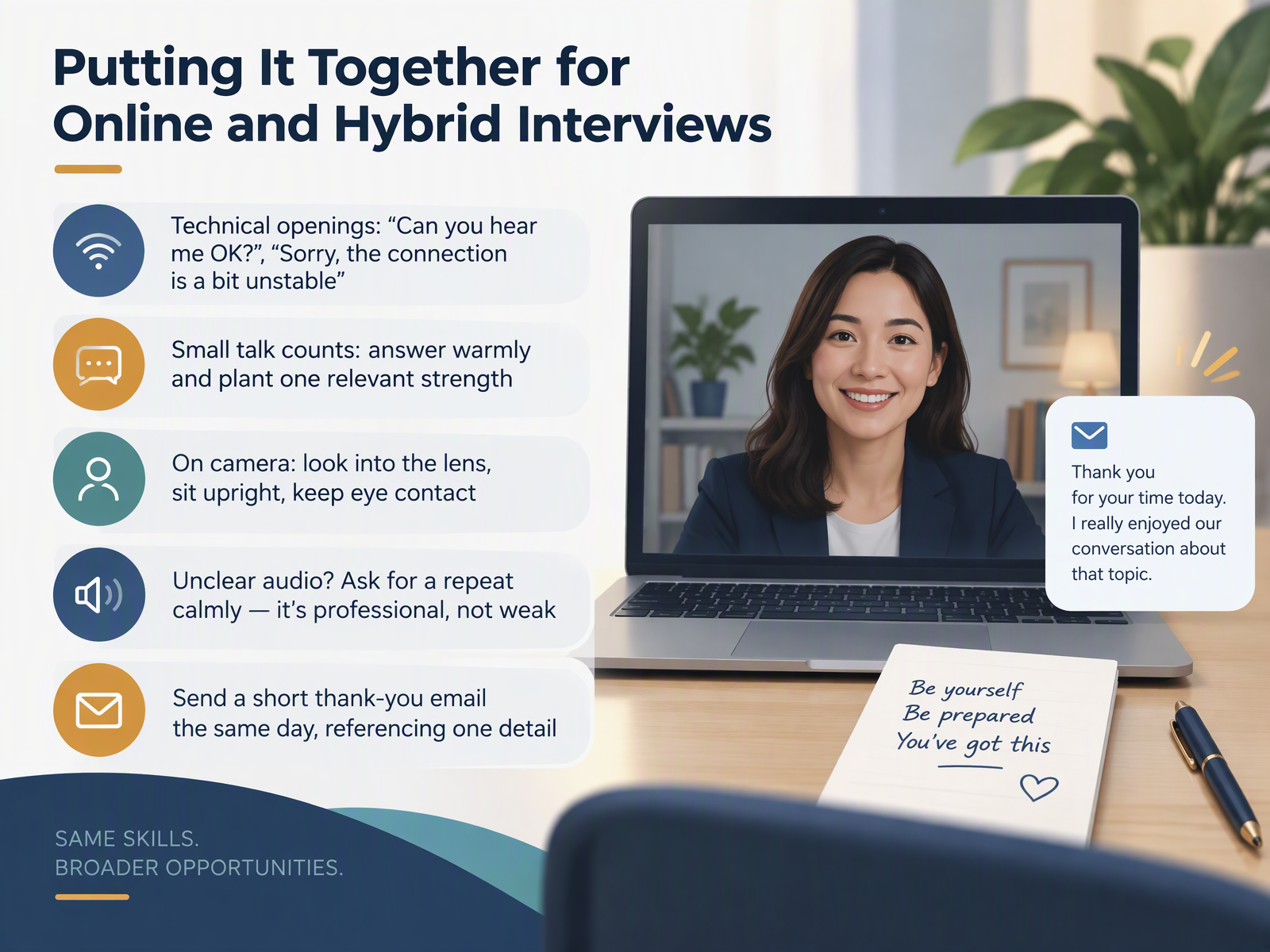
- 11Putting It Together for Online and Hybrid InterviewsNow let's bring everything together for online and hybrid interviews. Start with the basics. Check your sound at the beginning with a simple question: Can you hear me OK? If the connection drops, stay calm and say: Sorry, the connection is a bit unstable. These short phrases keep you in control.
Next, small talk counts. When the interviewer asks how you are, answer warmly, then plant one relevant strength. For example: I'm doing well, thank you. I'm looking forward to talking about the project work I enjoy.
On camera, look into the lens, not at the screen. Sit upright and keep eye contact. If the audio is unclear, ask for a repeat calmly, like: Sorry, could you repeat the last part? That is professional, not weak.
After the interview, send a short thank-you email the same day. Mention one detail from the conversation. For example: Thank you for the talk about your new product launch. Small steps like this leave a strong impression.
Your 30-Day Practice Plan and Self-Assessment.
 businessenglishtalks.com3000talk.com2 min
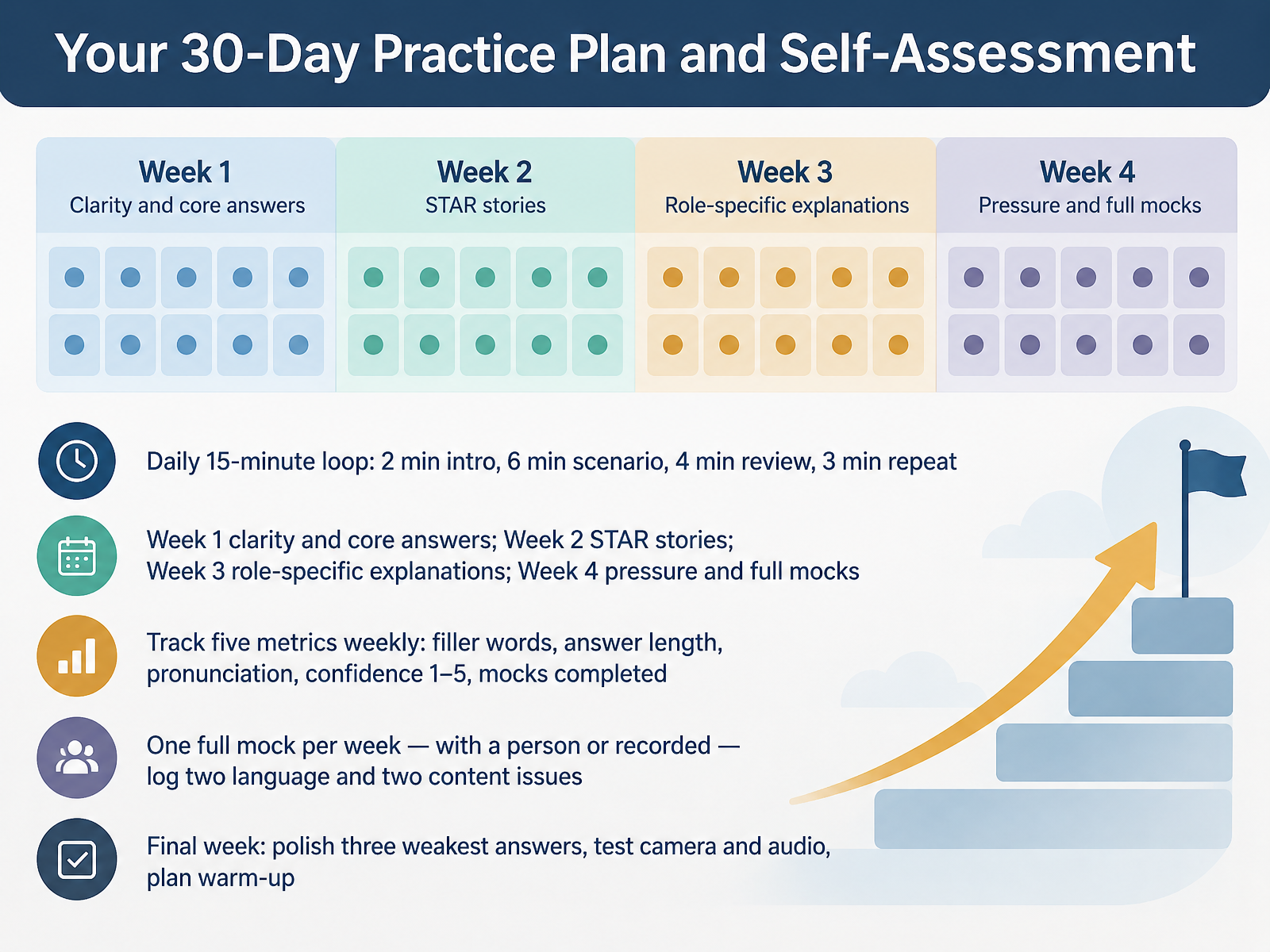
- 12Your 30-Day Practice Plan and Self-AssessmentNow let's put everything into a practice plan you can actually follow. The core is a daily fifteen-minute loop: two minutes for your introduction, six minutes on one interview scenario, four minutes to review and rewrite weak lines, and three minutes to repeat it better. Week one is clarity and core answers. Week two, S T A R stories for behaviour questions. Week three, role-specific explanations. Week four, pressure and full mocks. Each week, track five numbers: filler words per answer, answer length, pronunciation, your confidence from one to five, and mocks completed. Do one full mock per week, with a person or recorded, and log two language issues and two content issues. In the final week, polish your three weakest answers, test your camera and audio, and plan a short warm-up before the real interview. Next, we look at common pitfalls that cost offers.
 biginterview.combreakers.academyaimockinterview.app+21 min
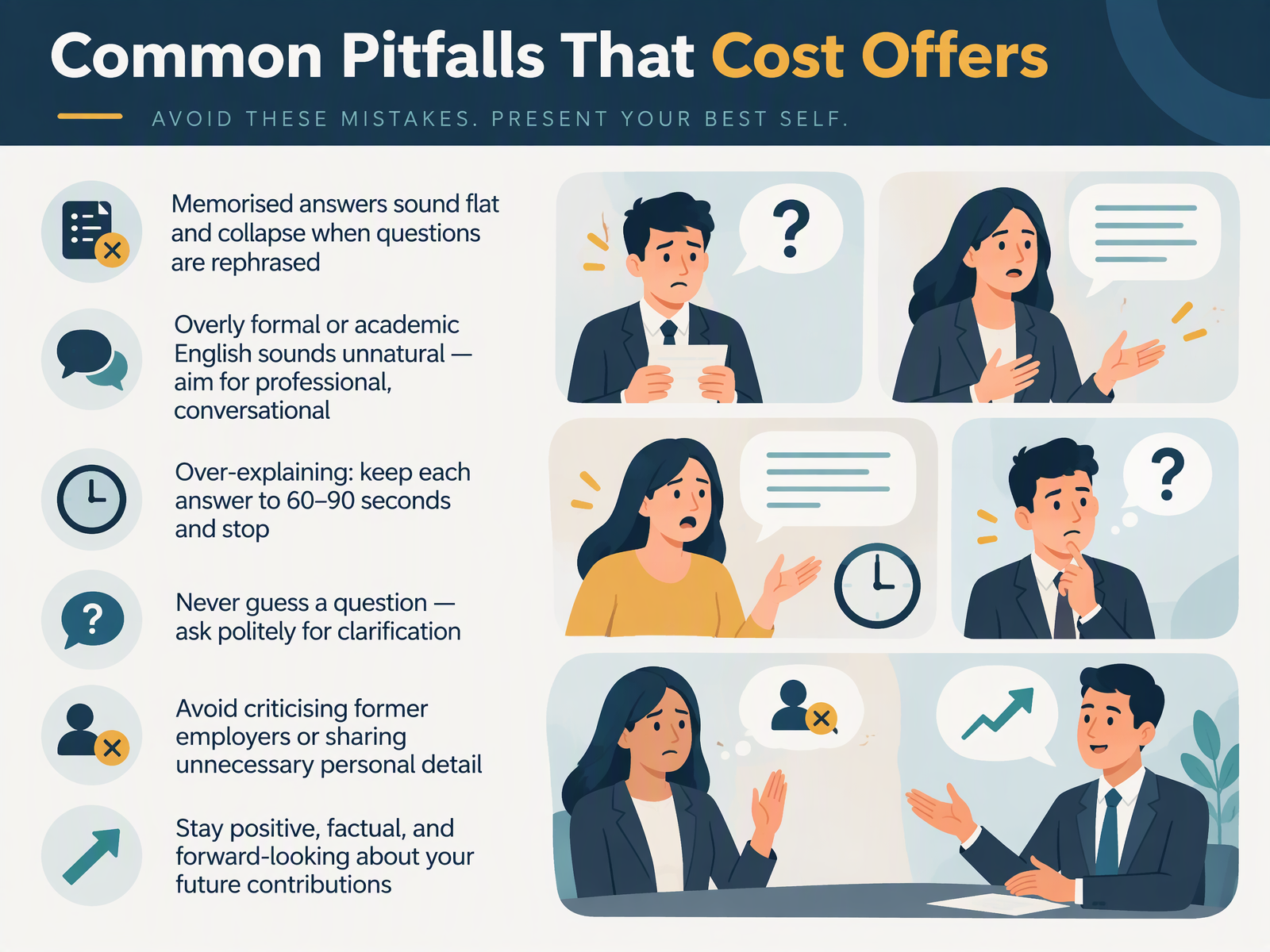
- 13Common Pitfalls That Cost OffersNow let's look at common pitfalls that cost offers, so you can avoid them. First, don't memorise answers word for word. Memorised answers sound flat, and they collapse when the question is rephrased. Learn your key points and phrases instead. Second, avoid overly formal or academic English. Aim for professional but conversational. For example, say, I'm excited about this role because my experience fits your team, not, I would be most grateful to utilise my competencies. Third, don't over-explain. Keep each answer to sixty to ninety seconds, then stop. If the interviewer wants more, they will ask. Fourth, never guess a question. Ask politely, like, just to check, are you asking about my last project? Fifth, avoid criticising former employers and sharing unnecessary personal detail. Stay positive, factual, and forward-looking about what you can contribute. Next, we'll go through your interview-day checklist and next steps.
 businessenglishtalks.com3000talk.com1 min
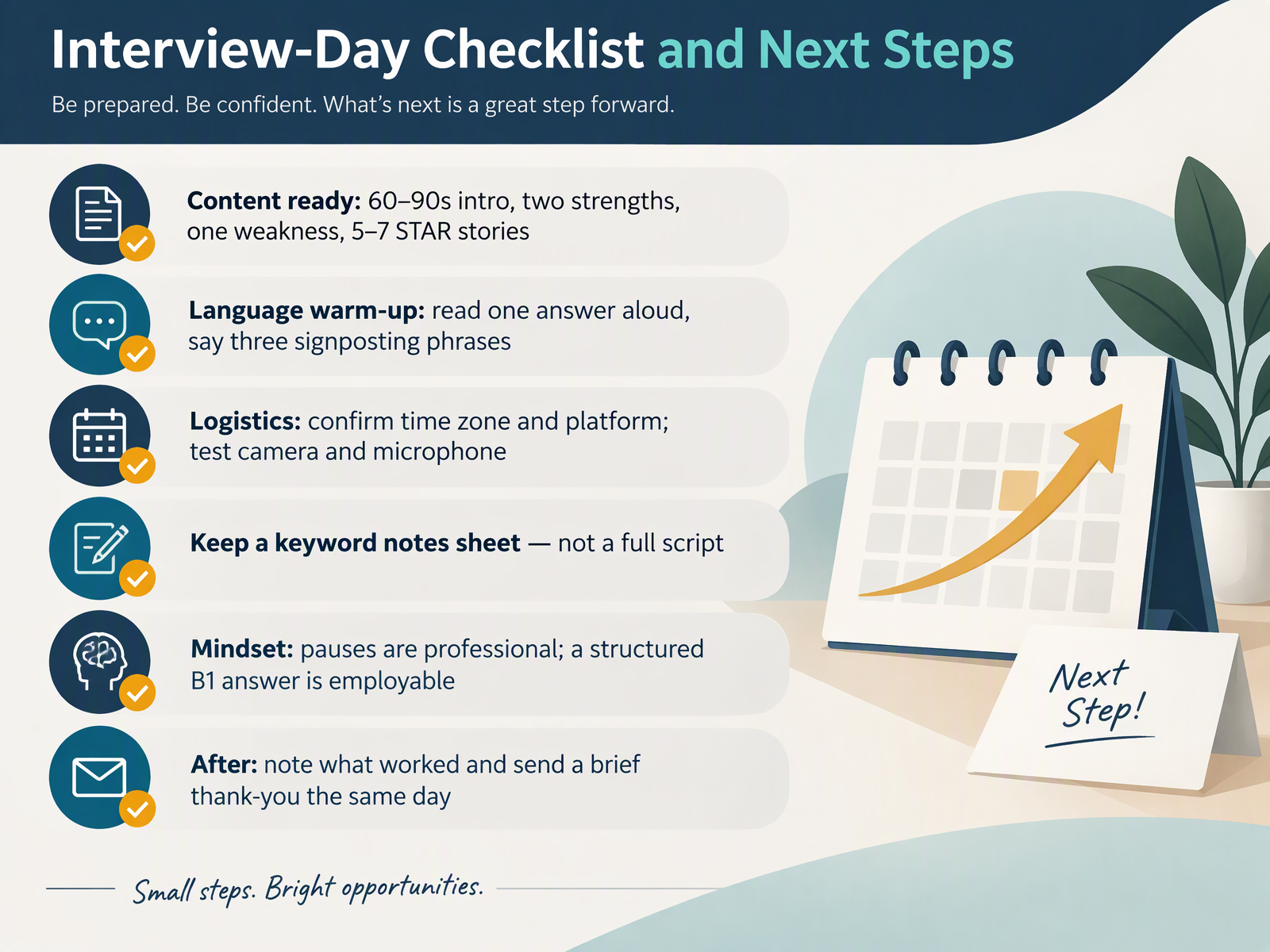
- 14Interview-Day Checklist and Next StepsHere is your final checklist. Before the interview, make sure your content is ready: a sixty to ninety second introduction, two strengths, one weakness, and five to seven STAR stories. STAR means Situation, Task, Action, Result. For a quick language warm-up, read one answer aloud and say three signposting phrases, like first, then, and as a result. Check the logistics too: confirm the time zone and platform, and test your camera and microphone. Keep a keyword notes sheet, not a full script. And remember this: pauses are professional. A structured B1 answer is employable. After the interview, note what worked, and send a brief thank-you the same day. You have done the work, so speak clearly and calmly. Good luck. You are ready.
 businessenglishtalks.com3000talk.com1 min
Take the deck with you
Download this course as a file — free, no sign-up needed.
- PDF handoutEvery slide page, ready to print or share.15 pages · 3.2 MBDownload
- Narrated PowerPointThe deck that presents itself — every slide carries the digital human's narration video.15 pages · 12.8 MBDownload
- PowerPoint slidesThe full deck as a .pptx — open it in PowerPoint, Keynote, or Google Slides.15 pages · 3.1 MBDownload
Free to use in your own training — please keep the PersonWise credit page at the end.
Have your own deck? Turn it into a course
Sources consulted
Web sources consulted while building this course.
- Job Interviews in 2025–2026: Global Trends and Practical Business English Tips for Job Seekers — businessenglishtalks.com
- Communicating Across Cultures: Mastering International Job Interviews in English. A workshop — ddd.uab.cat
- Behavioural interview questions and answers preparation — jobs.theguardian.com
- The Unspoken Rules of International Job Interviews (And How to Ace Them) — hunterglobalcoach.com
- Master Interview Skills for Multinational Companies: Behavioral Questions and STAR Answers - Jobb8.com — jobb8.com
- The STAR method | National Careers Service — nationalcareers.service.gov.uk
- Telling STAR Stories in Competency Interviews — aula54.com
- The STAR Method: Structuring Your | Business English Lesson | SV English — svtechenglish.com
- Interview English — 3000talk.com
- Using the STAR method for your next behavioral interview ... — capd.mit.edu
- Tell Me About Yourself” 20+ Sample Answers + How-to | Big Interview — biginterview.com
- Tell Me About Yourself Answer: A Script for Immigrants — breakers.academy
- 面试 英文: Answer 'Tell Me About Yourself' Right | AI Mock Interview — aimockinterview.app
- Job Interview Tips for Non-Native English Speakers — magoosh.com
- Tell Me About Yourself (Part 1) – NorQuest LINCWorks – Interviews Workbook CLB 5 — pressbooks.openeducationalberta.ca
- What are Your Strengths and Weaknesses? 40+ Examples for Job Interviews | The Muse | The Muse — themuse.com
- Common English Interview Questions — ielts.idp.com
- How to ace the 3 most commonly asked interview questions — cnbc.com
- 19 strengths and weaknesses for job interviews — careers.societegenerale.com
- Top 5 Video Interview Questions + How to Answer | HireVue — hirevue.com