Generative AI Learning Risks
Begin
14 pages · ~28 min
Generative AI Learning Risks
This training explores how generative AI can negatively impact learning and growth.
What you’ll learn
- 01Generative AI Can Harm LearningWelcome. I'm glad you're here. Today we're going to talk about something that matters to all of us who care about learning: the moments when generative AI can actually do harm. Not because AI is bad, but because some uses, especially without structure, can quietly undermine the very skills we're trying to build. You already know your learners and your context. So we'll treat this as professionals, looking at evidence about how and when AI hurts learning, and what we can do about it. The goal is not to ban tools, but to use them wisely. Over the next several minutes, we'll explore the central tension: AI can boost productivity in the moment, yet reduce durable understanding. Let's begin.cepr.orgfrontiersin.orgfrontiersin.org+21 min
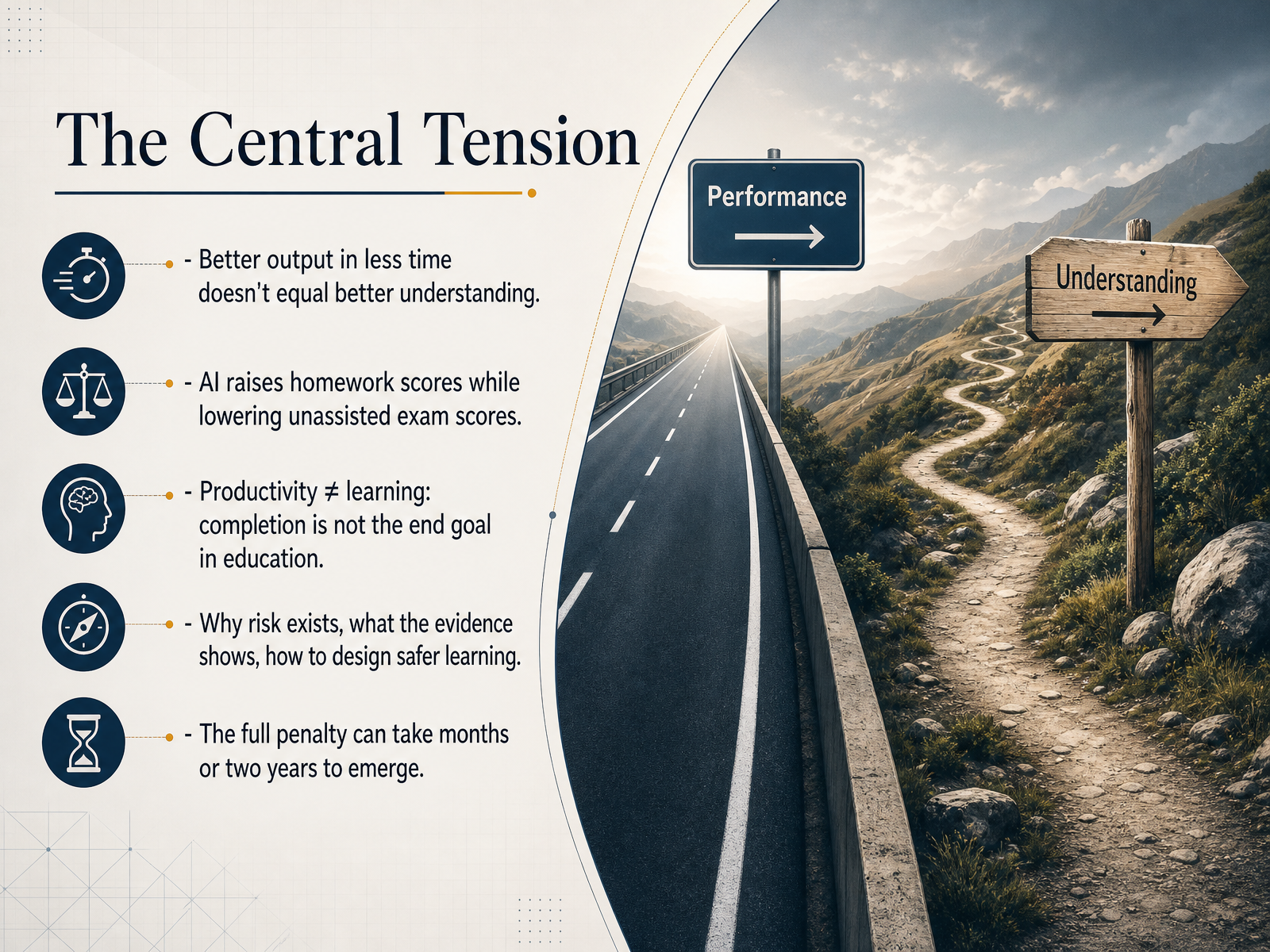
- 02The Central TensionLet's look at the central tension at the heart of this issue. Generative AI can produce better output in less time, but that does not mean it produces better understanding. In fact, the evidence shows these two things often move in opposite directions. One large study of secondary students found that after adopting AI, homework scores rose by eighteen percent while completion time dropped by thirty percent. Yet those same students saw their closed-book exam scores fall by twenty percent within six months. The pattern is consistent across multiple studies. When learners outsource the cognitive work to AI, they perform better on the assignment itself, but worse when they have to perform unassisted. Productivity and learning are not the same thing. Completion of a task is not the end goal in education; the durable understanding the learner builds is. That is why this risk exists, and why it matters for how we design courses and assessments. Keep in mind that the full penalty can take months or even two years to emerge. Short-term gains can hide long-term losses. This sets up our next question: what exactly is happening cognitively when learners offload their thinking? Let's explore that next.
 cepr.orgfrontiersin.orgfrontiersin.org+22 min
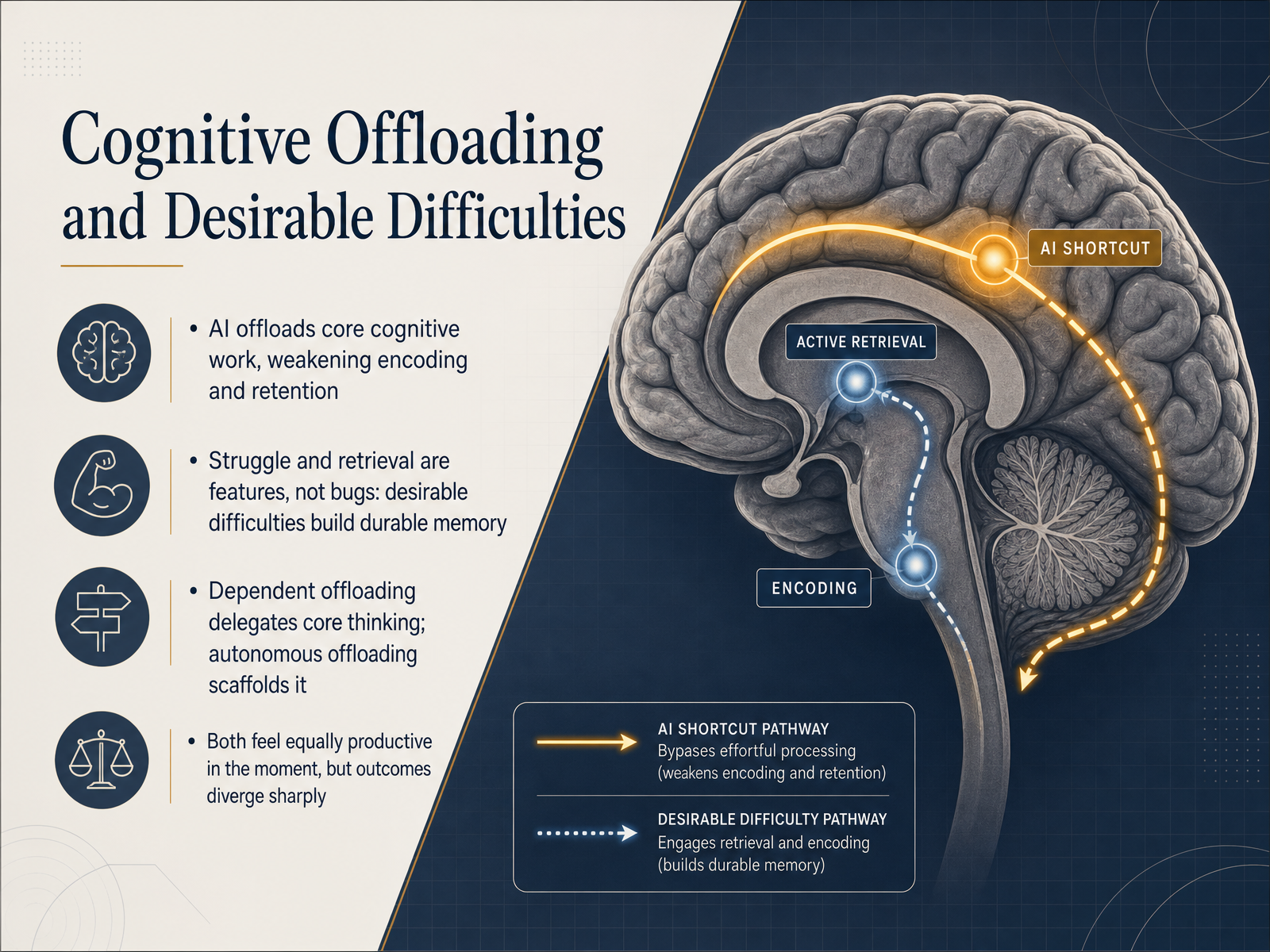
 - 03Cognitive Offloading and Desirable DifficultiesLet's look at why this happens, starting with cognitive offloading and desirable difficulties. When learners delegate core cognitive work to AI, they often weaken encoding and retention. The struggle to retrieve information is a feature, not a bug. These desirable difficulties build durable memory. The key distinction is how offloading happens. Dependent offloading delegates core thinking to AI. Autonomous offloading uses AI as a scaffold while keeping the learner in control. Both feel equally productive in the moment, and that's the trap. The outcomes diverge sharply downstream. One study found that students using AI scored notably lower on a retention test after a delay compared to peers who studied traditionally. Another found that higher offloading predicted weaker delayed retention, even when immediate performance looked fine. For your course design, the practical takeaway is this: when you design AI-assisted tasks, ask whether the AI is doing the generative work or supporting it. If learners can complete the task without practicing the core reasoning, you may be training them to delegate rather than to learn. Next, let's consider how learners actually use AI in practice.
 doi.orgdoi.orgcsueastbay.edu+21 min
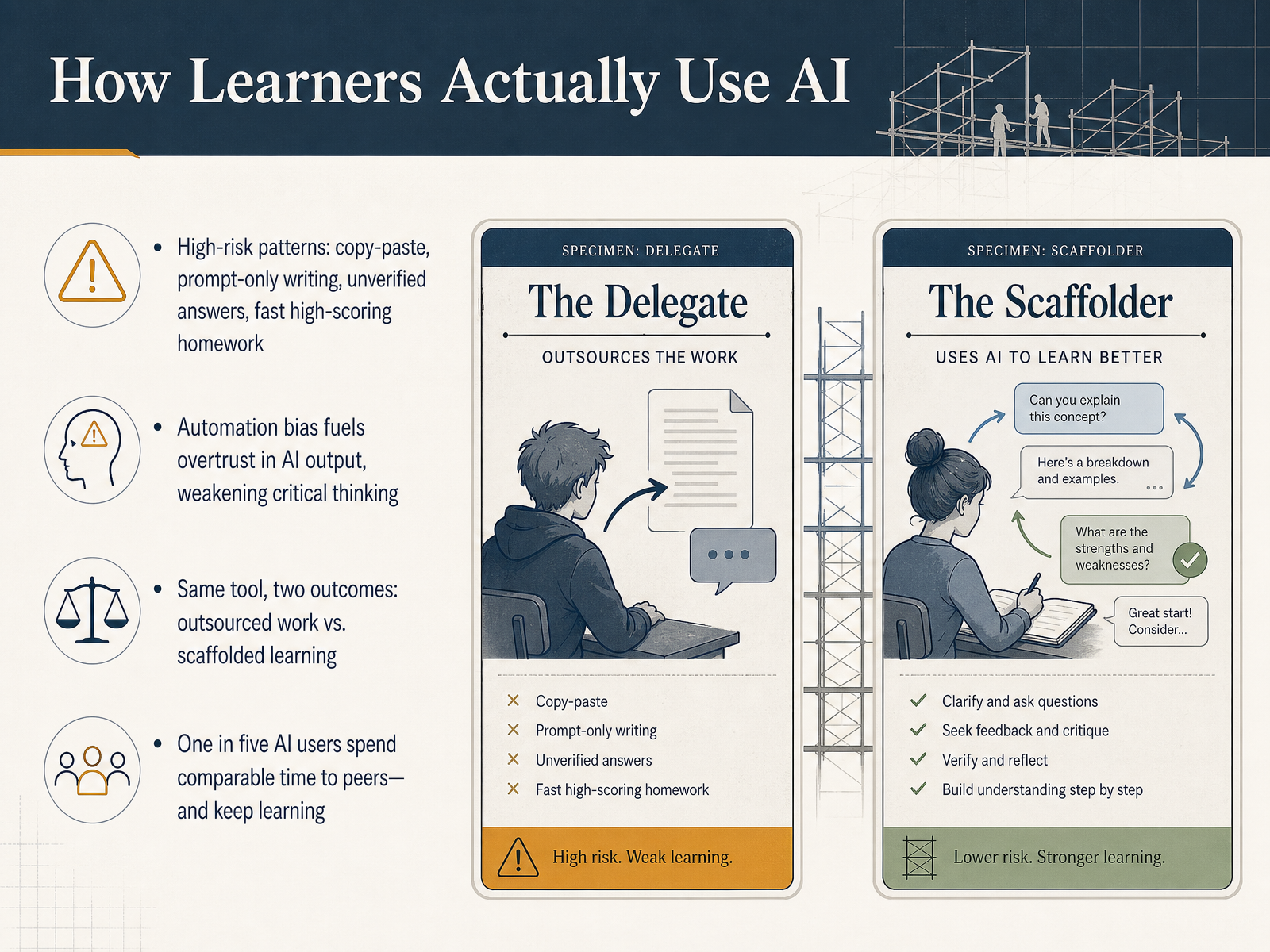
 - 04How Learners Actually Use AILet's look at what learners actually do with these tools. The research points to some clear, high-risk patterns. Learners copy and paste generated text, they prompt the AI to write entire responses, they accept answers without verification, and they turn in homework that scores high remarkably fast. This speed creates a powerful illusion. Automation bias leads them to overtrust the output, and that trust quietly displaces their own critical thinking. The same tool produces two very different outcomes depending on how it's used. On one hand, we see fully outsourced work, where the machine does the thinking. On the other, we see scaffolded learning, where the AI acts as a coach. Here's the encouraging part, and it's worth repeating: about one in five AI users spend time comparable to their peers on homework. Those learners keep learning. The data shows they experience only small learning losses. This tells us the outcome is not determined by the technology. It's determined by behavior. So as we look at our own learners, we need to ask which pattern we are designing for. That distinction will frame everything we discuss next.
 cepr.orgfrontiersin.orgfrontiersin.org+21 min
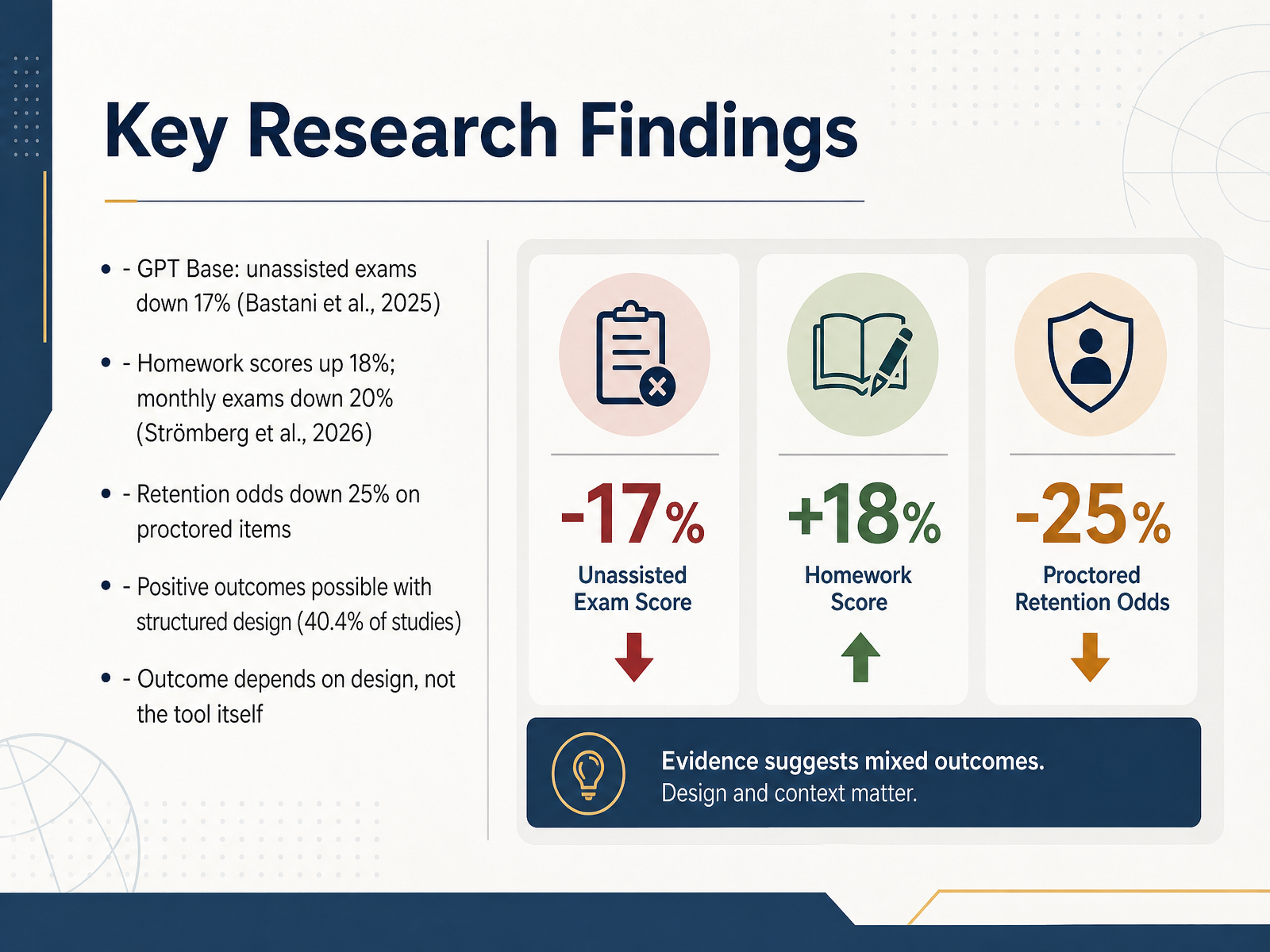
 - 05Key Research FindingsLet us turn to what the evidence actually shows. In a randomized trial, students using a standard AI tutor saw their unassisted exam scores drop by seventeen percent. In a much larger study tracking over twenty-six thousand students, homework scores rose by eighteen percent, yet monthly exam scores fell by twenty percent within six months. Another large-scale analysis found retention odds fell by twenty-five percent on proctored items. But before we overgeneralize, note that roughly forty percent of studies report positive outcomes. The pattern is clear: learning outcomes depend on how the tool is designed and how it is used, not on the tool itself. This leads us directly to the role of guardrails and scaffolding.
 cepr.orgfrontiersin.orgfrontiersin.org+21 min
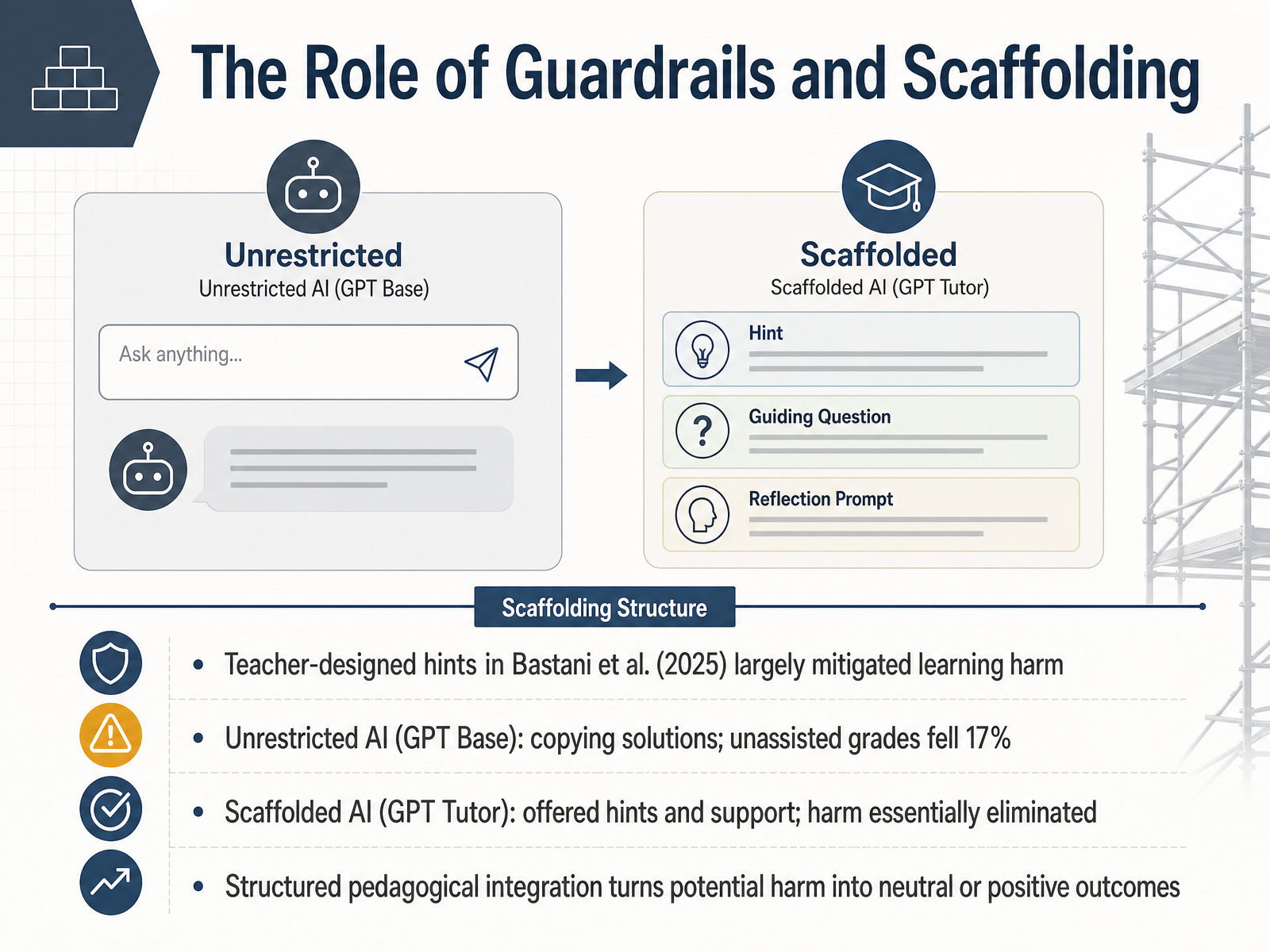
 - 06The Role of Guardrails and ScaffoldingLet’s focus on what the evidence actually shows about design choices. In a large-scale field experiment, nearly a thousand high school students were given access to one of two AI tutors. The first, called GPT Base, mimicked a standard open chatbot. The second, GPT Tutor, was built with guardrails based on teacher input. During practice, both groups improved dramatically. GPT Base students scored forty-eight percent better, and GPT Tutor students scored a hundred and twenty-seven percent better. But here is the crucial finding. When access was removed, students who used the unrestricted tool performed seventeen percent worse on an unassisted exam than students who never used AI. They had been copying solutions, effectively using the AI as a crutch. The students using the scaffolded tutor showed essentially no learning harm. The difference was not the technology, but the structure around it. When AI gives hints and prompts independent attempts, it preserves learning. When it simply gives answers, it undermines it. So the question for you is not whether to integrate AI, but how. Next, we’ll examine where this harm is greatest.
 doi.orgdoi.orgcsueastbay.edu+22 min
 - 07Where the Harm Is GreatestNow let's look at where the research shows the harm is greatest. A large study of secondary students found that exam scores fell most sharply in social science subjects—by about 27 percent. Junior students, high achievers, and male students faced larger penalties than their peers. The pattern makes sense when you consider that foundational skills and problem-solving practice are exactly what gets outsourced. The risk is most acute in K-12 and early undergraduate years, when core competencies are still forming. And the same dynamic appears in workplace training when AI replaces hands-on practice of essential skills. The key insight is that the damage isn't uniform—it hits the building blocks of expertise hardest. That means our design choices matter more in these foundational stages. We can protect what matters most, but only if we know where the vulnerabilities are.
 cepr.orgfrontiersin.orgfrontiersin.org+21 min
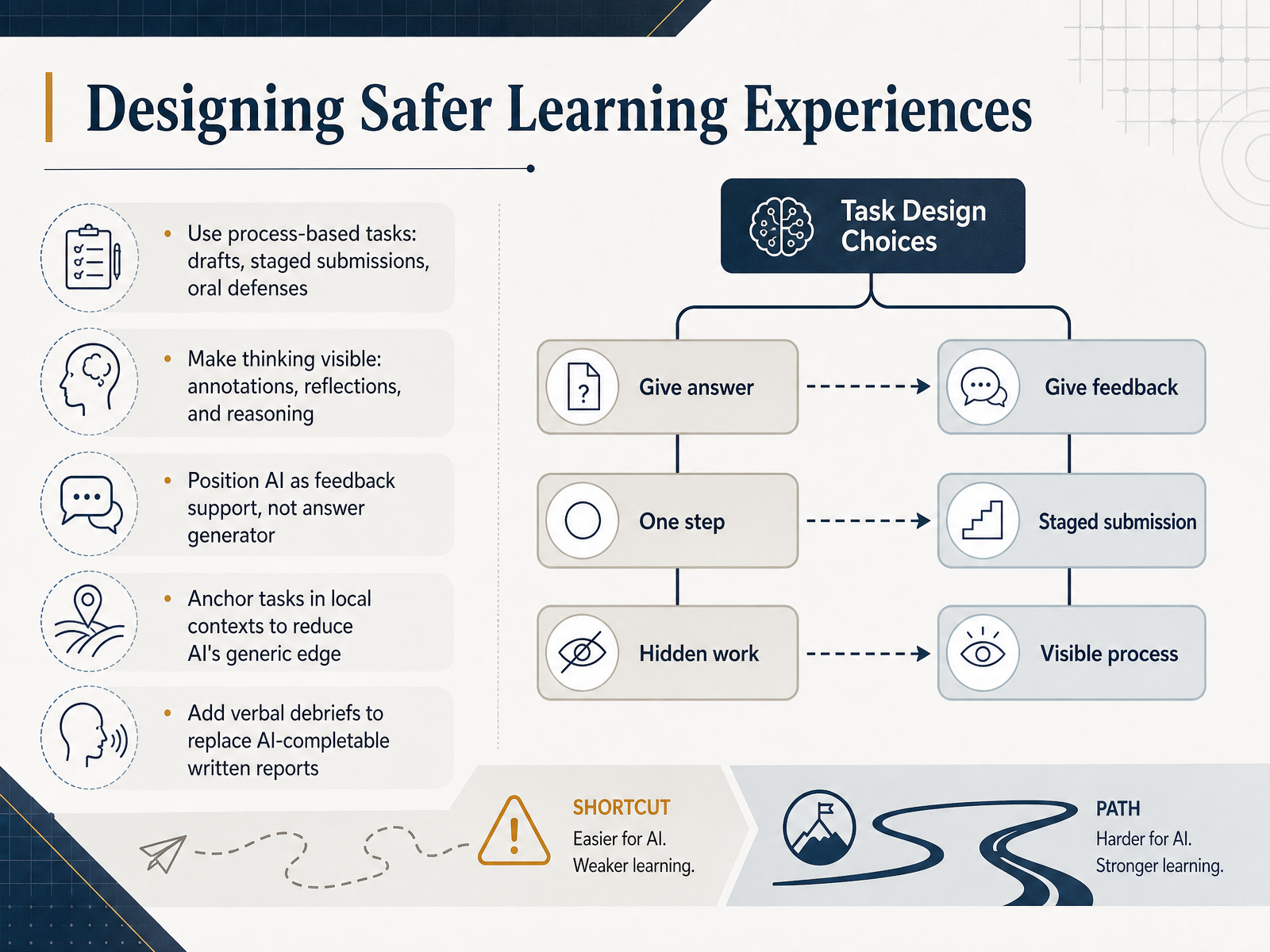
 - 08Designing Safer Learning ExperiencesSo what does safer design actually look like in practice? It starts by shifting our focus from the product to the process. Instead of a single final submission, build in drafts, staged submissions, or an oral defense. This makes the thinking visible and gives you multiple points of evidence. You can also ask learners to annotate their sources, write brief reflections, or explain their reasoning. These artifacts are hard for AI to fabricate convincingly. Another key move is repositioning AI in the assignment itself. Frame it as a feedback tool, not an answer generator. Have learners use it to test an argument, then critique the output. Anchoring tasks in local contexts also helps. Tie the assignment to a specific class discussion, a local dataset, or a personal experience. This removes AI's generic advantage. And where you can, replace written reports with a short verbal debrief. An unscripted conversation reveals understanding far more reliably than a polished document. The common thread here is that you are designing for evidence of learning, not just the final artifact. And that evidence gives you the confidence to assess fairly in an AI-rich world. Next, let's look at a practical framework for building these strategies into your assessments.
 frontiersin.orgrethinkassessment.orgarxiv.org+22 min
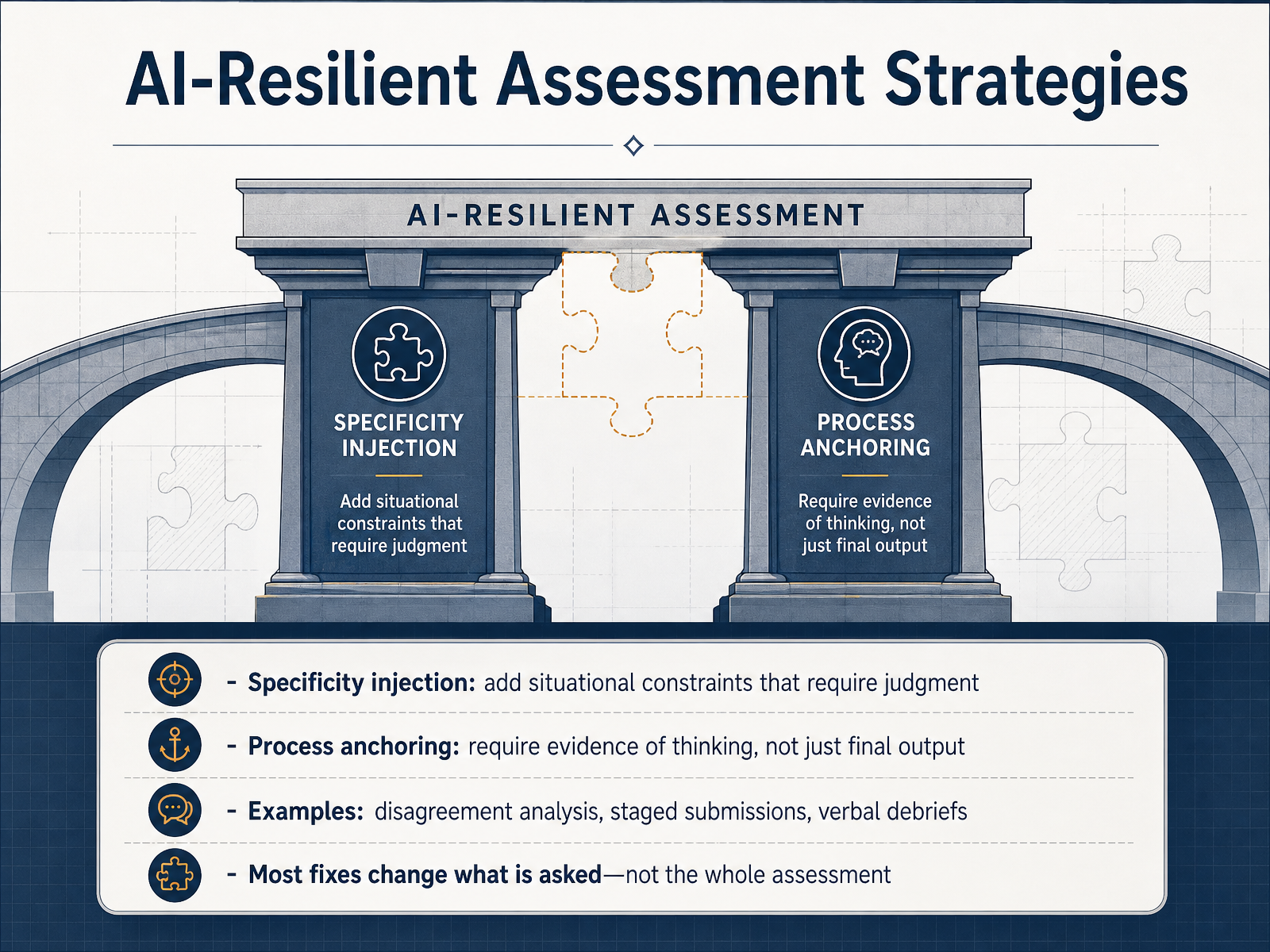
 - 09AI-Resilient Assessment StrategiesLet's shift now to assessment strategies that hold up when AI is in play. The good news is, most fixes don't require rebuilding your assessments from scratch. They change what you ask for, not the whole structure. Two strategies cover most redesign cases. First is specificity injection. Add a constraint that requires contextual judgment. For example, instead of asking students to explain a concept, give them a specific scenario with a time constraint or a missing resource, and ask them to identify what breaks and why. AI can recite theory, but it struggles to reason about a unique trade-off. Second is process anchoring. Require evidence of thinking, not just the final output. This could mean staged submissions, where students submit a thesis, then annotations, then a final paper that revises their original claim. Or it could mean a verbal debrief after a simulation, replacing a written report that AI could easily generate. Disagreement analysis is another strong option. Provide two or three source texts that take different positions and ask students to identify the disagreement, explain each view, and argue which the evidence better supports. The key is that AI can't complete these tasks without access to your specific materials, and even then, the judgment and personal reasoning are human. So remember, the most effective changes are about adding constraints and making thinking visible. Next, let's explore how to design for visible thinking in practice.
 frontiersin.orgrethinkassessment.orgarxiv.org+22 min
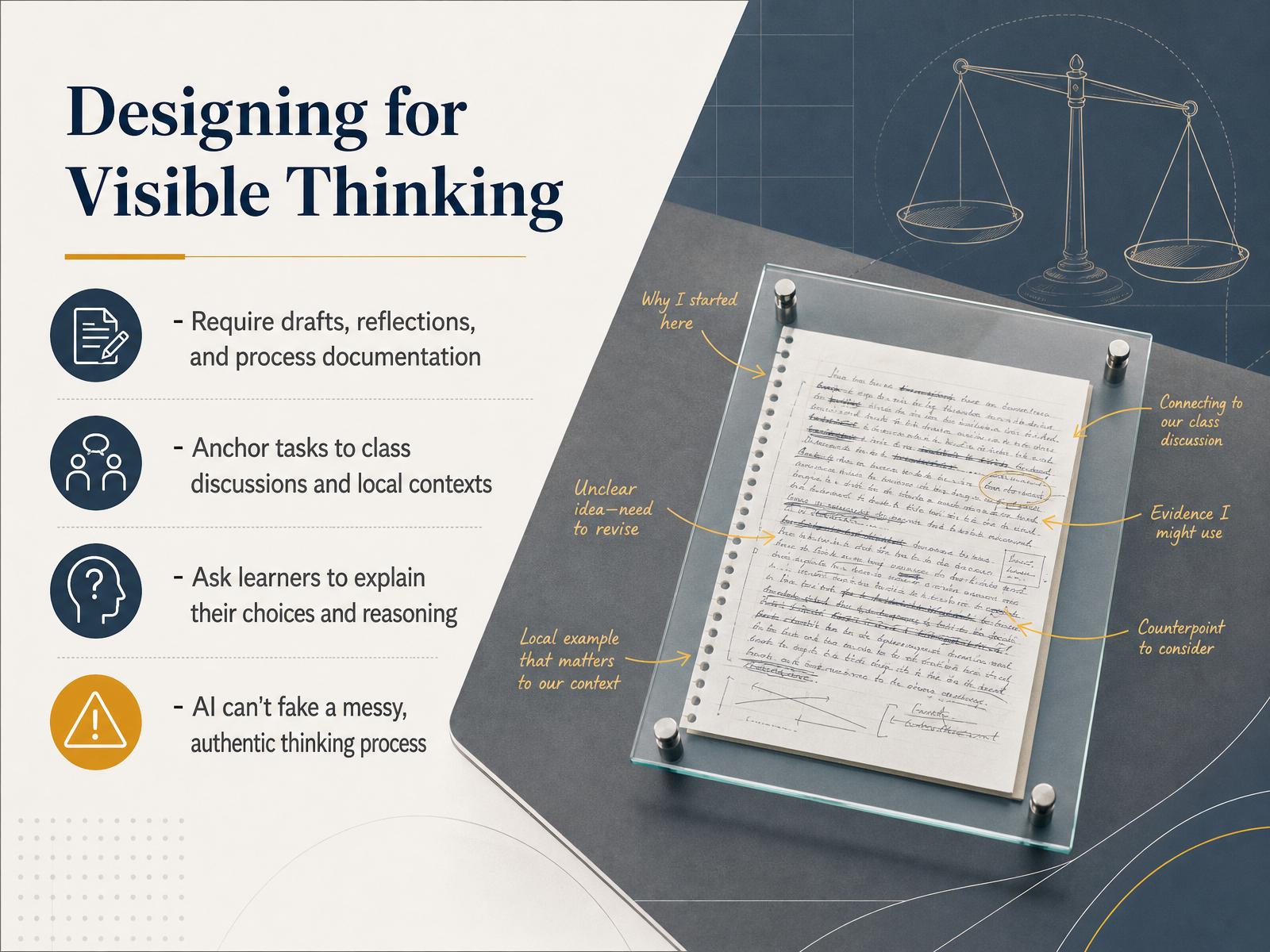
 - 10Designing for Visible ThinkingSo how do we design for visible thinking? Start by requiring the artifacts that make thinking legible: drafts, reflections, and process documentation. AI produces polished final products effortlessly, but it cannot fake a messy, authentic thinking process. If you ask for an annotated bibliography plus a reflection on how the sources shifted the student's position, the process becomes the evidence. Second, anchor tasks to your class discussions and local contexts. AI does not know what happened in your session on Tuesday or which case study sparked disagreement. Ask learners to apply a framework to the specific scenario you explored together, and the generic AI output stops being sufficient. Third, ask learners to explain their choices and reasoning. Why did you structure it this way? What trade-off did you weigh here? These questions are hard to fake because they require judgement tied to a specific moment in their work. A code file can be generated, but a recorded walkthrough of the decisions behind it cannot. The principle is simple: make the thinking visible and you make the learning assessable. Now let's turn to the institutional layer with policy and guardrails for organizations.
 frontiersin.orgrethinkassessment.orgarxiv.org+21 min
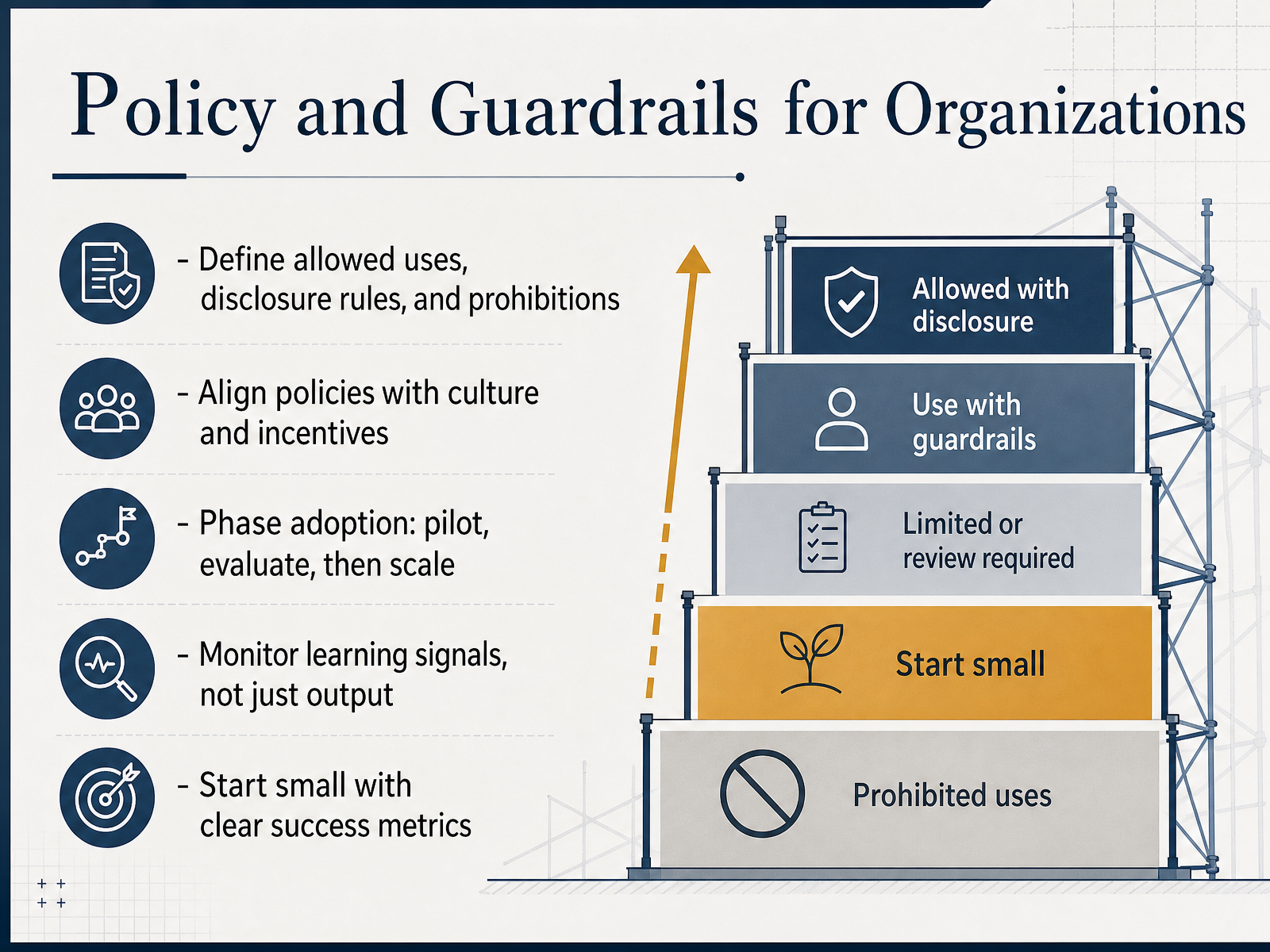
 - 11Policy and Guardrails for OrganizationsNow let’s translate your classroom principles into organizational policy. This isn’t about a one-page ban list; it’s about building a system that supports good judgment. Start by defining allowed uses, disclosure rules, and clear prohibitions. For example, specify when learners may cite AI assistance and when it’s considered academic misconduct. But remember: policies only work if they align with your culture and incentives. If you forbid AI while rewarding speed that tempts shortcuts, your guardrails will fail. Instead, phase adoption deliberately. Pilot with one cohort or course, evaluate the learning outcomes, then scale what works. And when you evaluate, monitor learning signals, not just output quality. Look at performance on subsequent assessments, learner reflections, even error patterns. These tell you whether understanding grew or was only simulated. Finally, start small with clear success metrics. Choose three indicators that matter to you—like improved transfer, reduced overreliance, or better revision quality—and measure them from day one. That data will guide your next move. Up next, we’ll look at how leadership and culture shape whether these guardrails take root.
 2 min
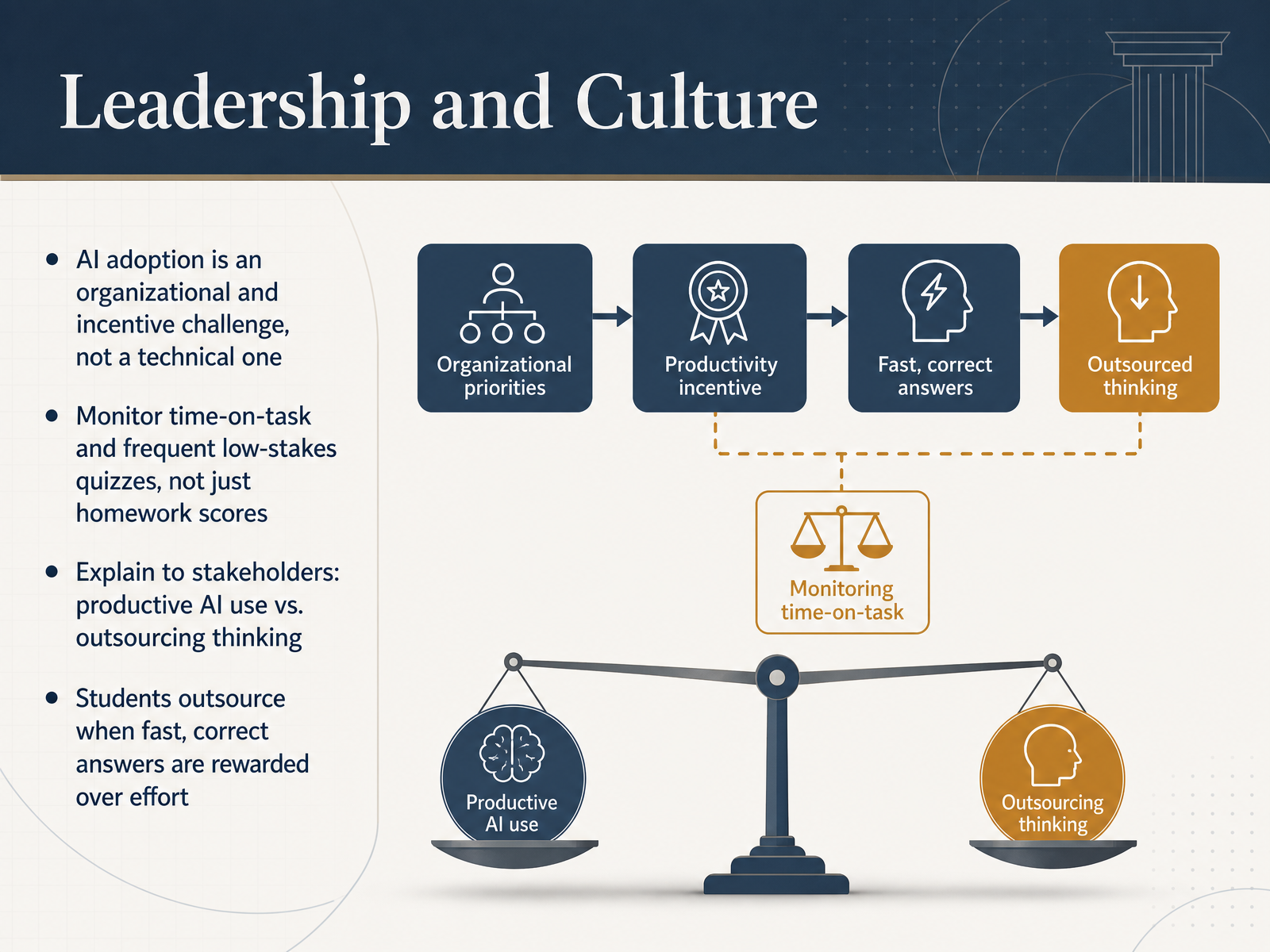
2 min - 12Leadership and CultureLet's widen the lens, from course design to leadership and culture. The evidence consistently points to a core truth: successful AI adoption is not primarily a technical problem. It's an organizational and incentive challenge. The research shows that students outsource their thinking when fast, correct answers are rewarded over genuine effort. So, the signals we send matter enormously. If homework scores alone carry the weight, we may be rewarding the wrong behavior. As a leader, you have tools to correct this. Monitor time-on-task and deploy frequent, low-stakes quizzes to check actual understanding, rather than relying solely on graded outputs. And be clear with parents, administrators, and students themselves. Explain the difference between productive AI use—where the tool acts as a coach or a scaffold—and outsourcing, where it replaces the learner's own cognitive work. The data from large-scale studies is stark. An eighteen percent rise in homework scores came alongside a twenty percent drop in exam performance. That gap is the hidden cost of efficiency. Your role is to make sure the path of least resistance is also the path of real learning. That's the cultural shift only leadership can drive. Now, let's turn to a practical instrument: a decision guide for evaluating AI use in your own context.
 cepr.orgfrontiersin.orgfrontiersin.org+22 min
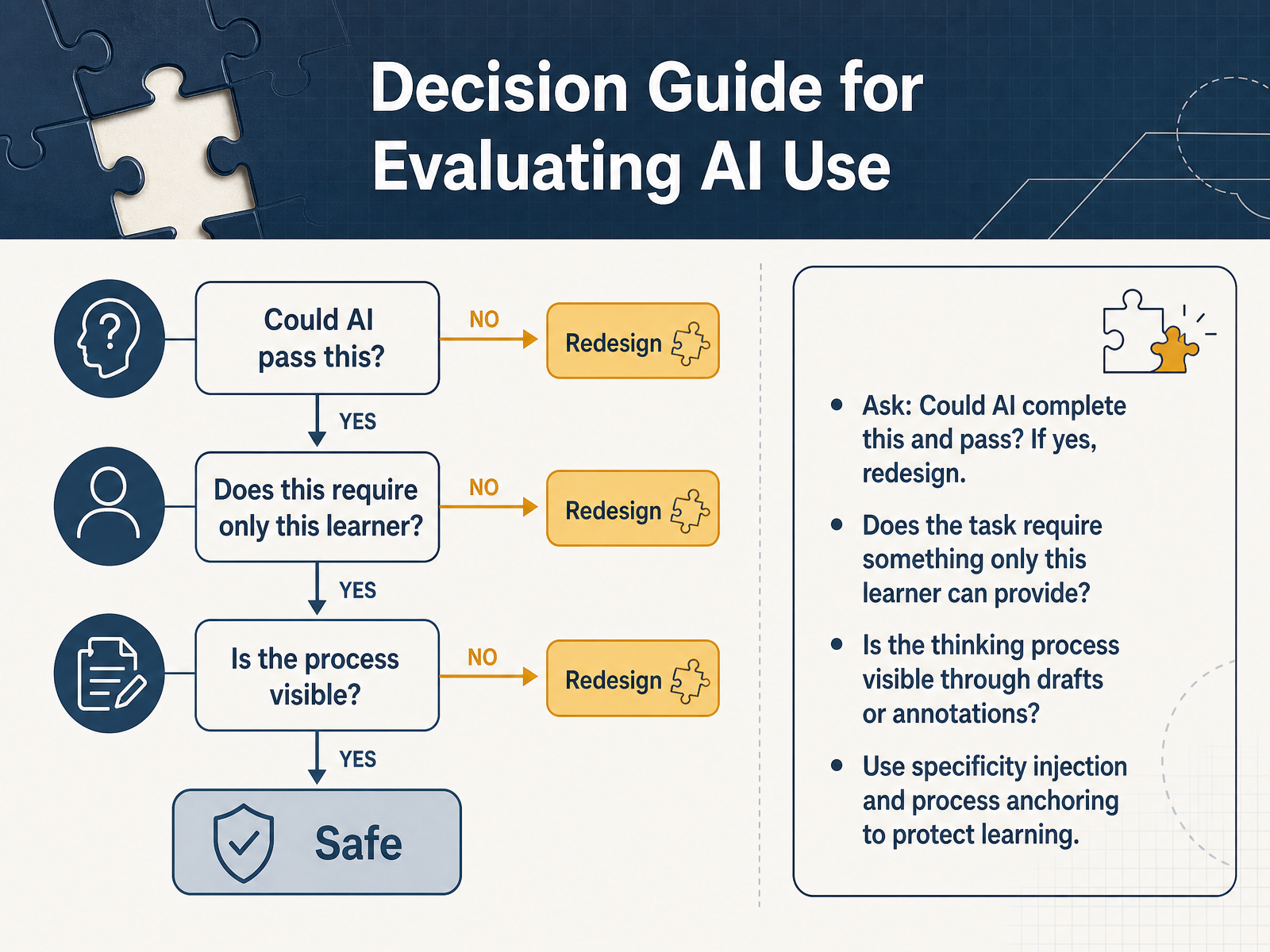
 - 13Decision Guide for Evaluating AI UseLet's turn this evidence into a quick decision guide you can use before you finalize any assignment. First, ask the blunt question: could generative AI complete this and pass? If the answer is yes, the task is too generic, and it needs redesign. Second, ask whether the task requires something only this specific learner can provide. Does it pull from a class discussion, a local case study, or their own experience? If not, add that anchor. Third, make sure the thinking process is visible through drafts, annotated sources, or staged submissions. If you only see a final polished product, you cannot verify the learning. Finally, apply the two proven techniques: specificity injection, which means adding a constraint that demands contextual judgment, and process anchoring, which requires evidence of the thinking itself. These will protect the learning while keeping AI as a productive tool. Now, let's move to defining your own action commitments and next steps.
 frontiersin.orgrethinkassessment.orgarxiv.org+22 min
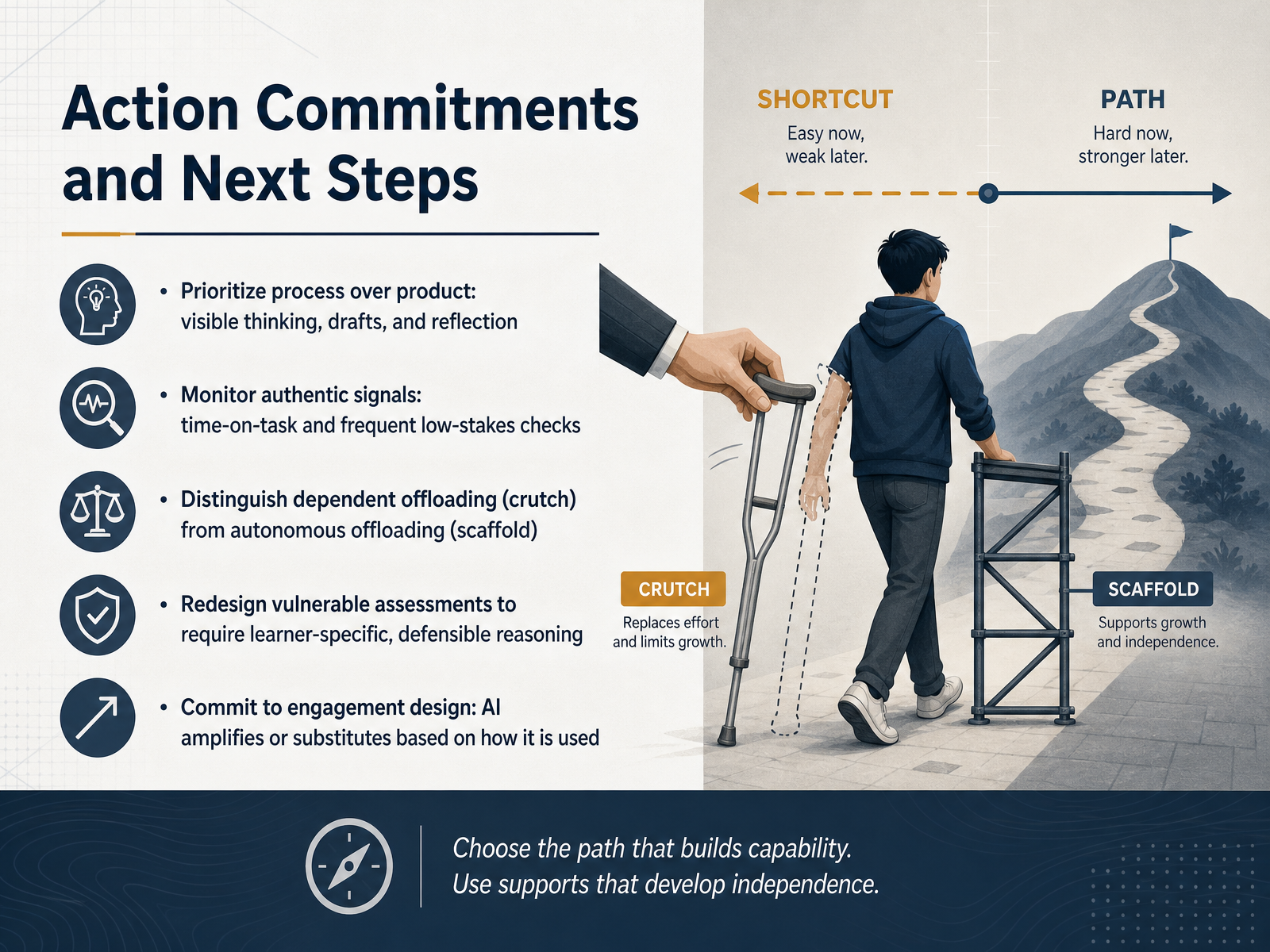
 - 14Action Commitments and Next StepsLet's turn all of that evidence into action. First, prioritize process over product. Make visible thinking, early drafts, and honest reflection part of the grade, not just the final answer. Second, monitor authentic signals like time-on-task and build in frequent low-stakes checks. One study found that when homework time stayed the same, learning losses nearly disappeared. Those signals tell you more than output quality ever will. Third, know the difference between a crutch and a scaffold. Dependent offloading asks AI to do the thinking. Autonomous offloading keeps the learner in charge. Train yourself and your students to spot the difference. Fourth, audit your assessments. If a task can be completed by pasting the prompt into a chatbot, it is vulnerable. Redesign those tasks to demand learner-specific, defensible reasoning. Finally, commit to engagement design. AI amplifies whatever learning culture you build. It is not the tool that decides the outcome, it is how you design for its use. You now have the evidence and the strategies. Thank you for taking your role as a learning professional seriously. The risk is real, but so is your agency. Go design with intent.
 doi.orgdoi.orgcsueastbay.edu+22 min
Take the deck with you
Download this course as a file — free, no sign-up needed.
- PDF handoutEvery slide page, ready to print or share.15 pages · 4.0 MBDownload
- Narrated PowerPointThe deck that presents itself — every slide carries the digital human's narration video.15 pages · 14.6 MBDownload
- PowerPoint slidesThe full deck as a .pptx — open it in PowerPoint, Keynote, or Google Slides.15 pages · 3.9 MBDownload
Free to use in your own training — please keep the PersonWise credit page at the end.
Have your own deck? Turn it into a course
Sources consulted
Web sources consulted while building this course.
- https://cepr.org/publications/dp21577 — cepr.org
- Frontiers | From enhancement to over-reliance: a mixed-method study of generative AI and sustainable learning performance — frontiersin.org
- Frontiers | Amplifier or substitute? A systematic review of generative AI’s impact on higher-order cognitive skills among university students — frontiersin.org
- The generative AI learning penalty in secondary school — cepr.org
- Experimental Evidence on the Learning Impact of Generative AI — arxiv.org
- Impact of Generative AI on Self-Regulated Learning and Cognitive Offloading — doi.org
- AI Dependency and Cognitive Offloading: Effects of Generative Artificial Intelligence on Memory Retention, Critical Thinking, and Decision-Making among University Students — doi.org
- ChatGPT as a cognitive crutch: Evidence from a randomized controlled trial on knowledge retention — csueastbay.edu
- Frontiers | Not all cognitive offloading is equal: distinguishing dependent and autonomous offloading to generative AI — frontiersin.org
- Generative AI as a Cognitive Offloader in Higher Education: A Systematic Review of Cognitive Load and Higher-Order Thinking Outcomes — doi.org
- AI-resistant assessments in higher education: practical ... — frontiersin.org
- Designing AI-Resilient Assessments — Rethink Assessment — rethinkassessment.org
- Designing AI-Resilient Assessments Using Interconnected Problems: A Theoretically Grounded and Empirically Validated Framework — arxiv.org
- Strategies for Designing AI-Resistant Assignments — genai.uchicago.edu
- Towards AI-resilient assessment: Applying design thinking in assessment redesign – SIG-AILTA — sigailta.com