Begin
14 pages · ~28 min
OECD AI Literacy Framework: Components and Use
This training explores the OECD AI Literacy Framework's components and practical application, helping educators, policymakers, and professionals understand and apply AI literacy concepts.
A digital instructor presents all 14 pages. Hold “Ask” at any point and ask out loud — the answer comes from this course. No sign-up needed.
What you’ll learn
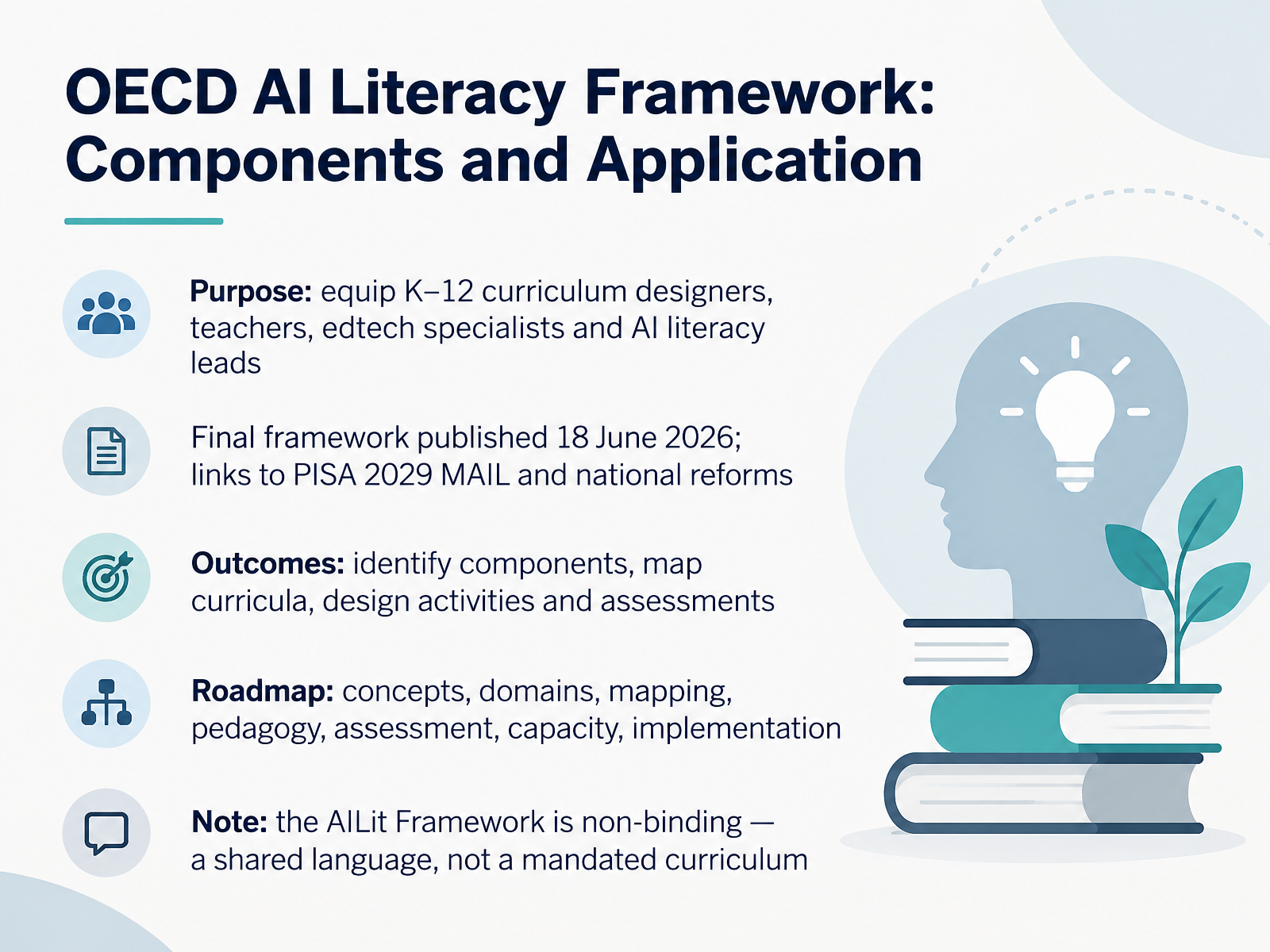
- 01OECD AI Literacy Framework: Components and ApplicationWelcome. This course walks you through the OECD and European Commission AI Literacy Framework, known as the AILit Framework, and how to apply it in your own schools. It is written for K to 12 curriculum designers, teachers, education technology specialists, and AI literacy leads. The final framework was published on the eighteenth of June, 2026. It contributes to the PISA 2029 Media and Artificial Intelligence Literacy assessment, and it connects to national curriculum reforms already underway. By the end, you will be able to identify the framework's core components, map them onto your curriculum, and design classroom activities and assessments around them. Our roadmap runs through concepts, the four domains, curriculum mapping, pedagogy, assessment, capacity building, and implementation. One point first. This framework is non-binding. Treat it as a shared language for your teams, not a mandated curriculum. Next, we look at the background and policy context.oecd.orgoecd.orgailiteracyframework.org+22 min
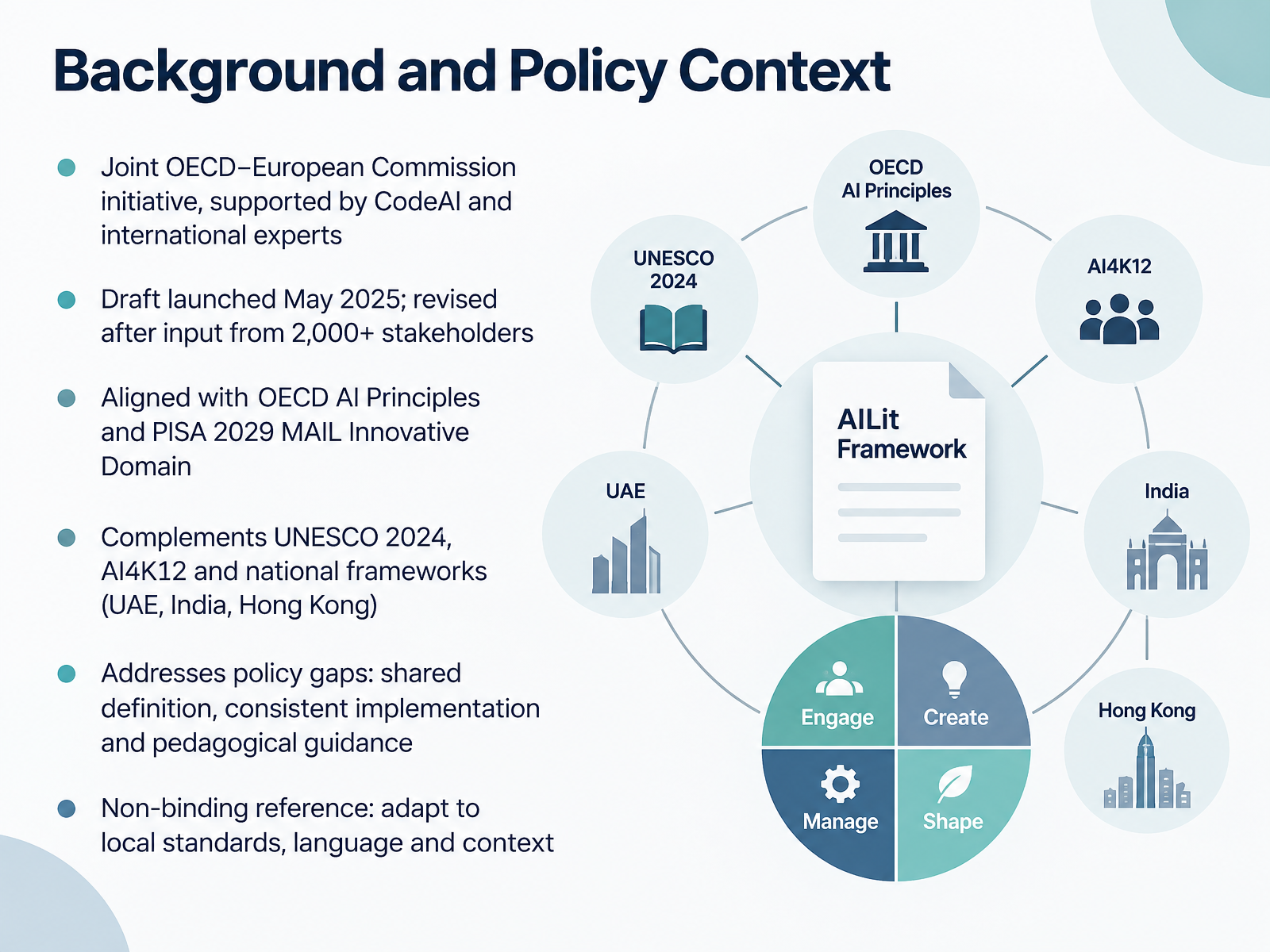
- 02Background and Policy ContextSo where does this framework come from? It's a joint initiative of the OECD and the European Commission, supported by CodeAI, formerly Code.org, and leading international experts. A draft was launched in May 2025, then revised after more than two thousand stakeholders gave feedback. Two alignments matter for your planning. First, the framework builds on the OECD AI Principles. Second, it feeds directly into the PISA 2029 Media and Artificial Intelligence Literacy assessment, often called MAIL. It also complements UNESCO's 2024 frameworks, AI4K12, and national approaches such as those in the UAE, India and Hong Kong. Why does this matter at school level? Because it addresses three real policy gaps: no shared definition of AI literacy, inconsistent implementation across systems, and thin pedagogical guidance. One important caveat. The framework is non-binding. You adapt it to your own standards, language and local context. Think of it as a common reference point, not a mandate. Next, we'll look at its core concepts and definitions.
 oecd.orgoecd.orgailiteracyframework.org+22 min
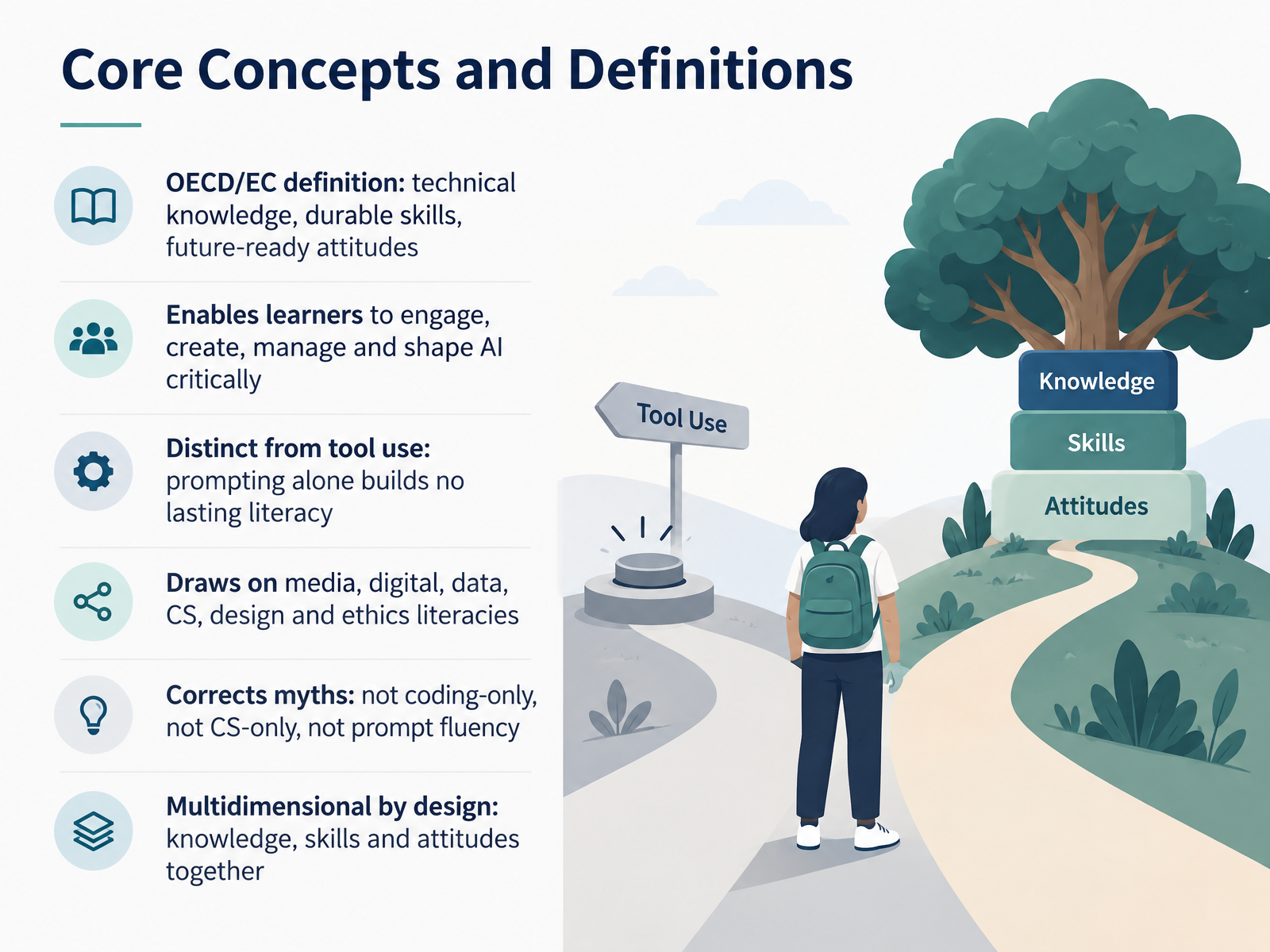
- 03Core Concepts and DefinitionsSo what exactly counts as AI literacy? The OECD and European Commission define it as the technical knowledge, durable skills, and future-ready attitudes learners need to thrive in a world shaped by AI. That combination lets students engage with, create with, manage, and shape AI, while critically weighing its benefits, risks, and ethical implications. And note this distinction: AI literacy is not the same as tool use. Prompting a chatbot builds no lasting literacy on its own. Instead, AI literacy draws on media, digital, data, computer science, design, and ethics literacies. It also corrects common myths. It is not coding only, not computer science only, and not prompt fluency. It is multidimensional by design, with knowledge, skills, and attitudes developed together. As you review your curriculum maps, ask which of those three dimensions your current lessons actually address. Next, we look at the framework architecture and its four domains.
 oecd.orgoecd.orgoecd.org+22 min
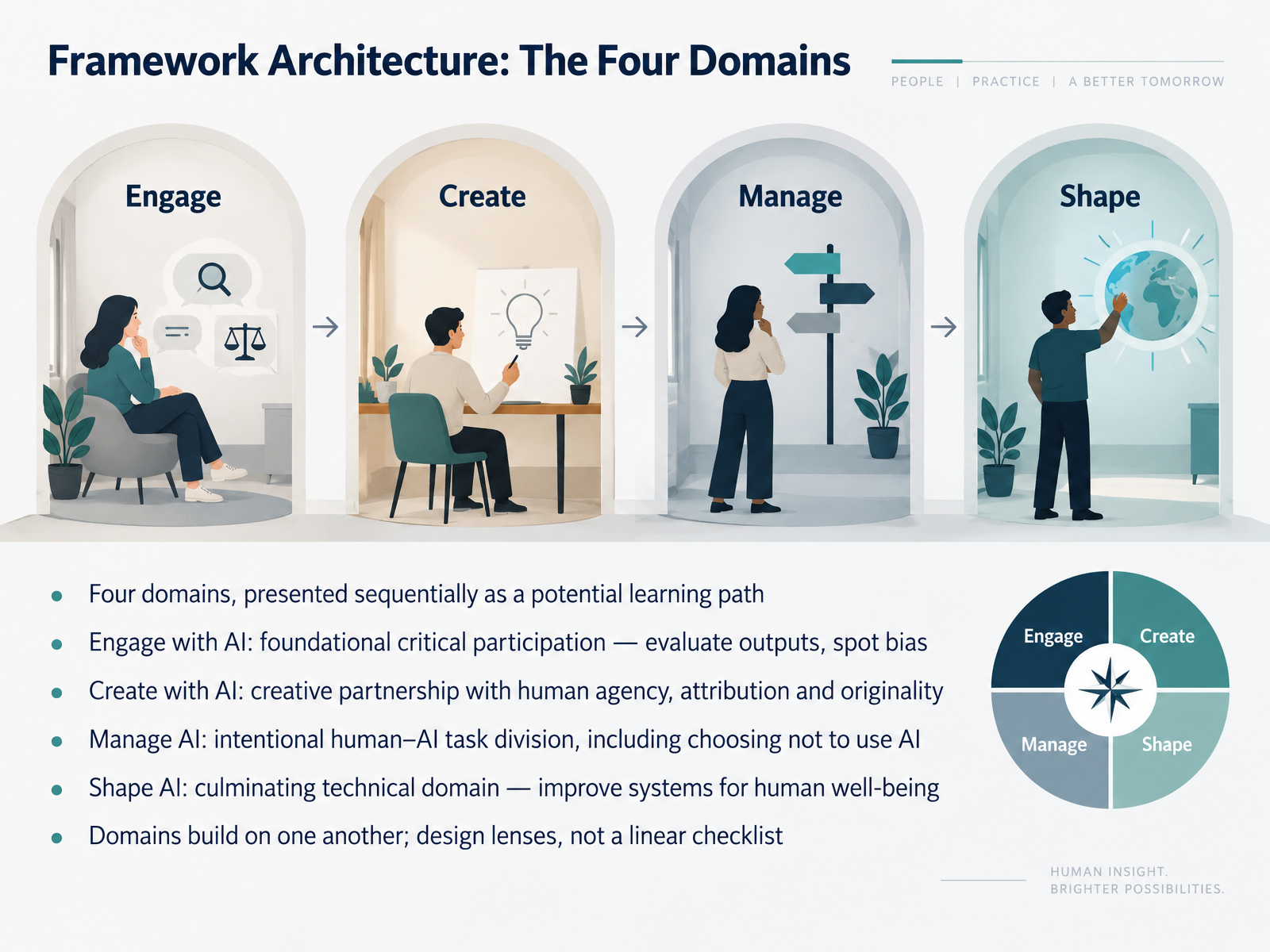
- 04Framework Architecture: The Four DomainsLet's look at how the framework is built. It organizes AI literacy into four domains, presented in sequence as a potential learning path. First, Engage with AI. This is the foundation. Learners become critical participants: they evaluate AI outputs, spot bias, and question what a system tells them. For example, a class might compare two chatbot answers and ask which one is more accurate, and why. Second, Create with AI. Here students use AI as a creative partner while keeping human agency. That means they set the vision, and they address attribution and originality openly. A simple classroom practice is having students document which ideas came from the AI and which came from them. Third, Manage with AI. This is about deliberate task division between humans and machines. It includes a genuinely valid choice, deciding not to use AI at all. Ask students, what should be done by you, and why? Fourth, Shape AI. This is the culminating, more technical domain, where learners investigate how systems work and propose improvements for human well-being. One important design note. The domains build on one another, but use them as design lenses, not a linear checklist. A media literacy unit might sit mostly in Engage, while a coding project reaches Shape. Your job as curriculum designers is to decide which lenses your learners need, and when. Next, we unpack the building blocks inside each domain: Knowledge, Skills, Attitudes and the 19 Competences.
 oecd.orgoecd.orgailiteracyframework.org+22 min
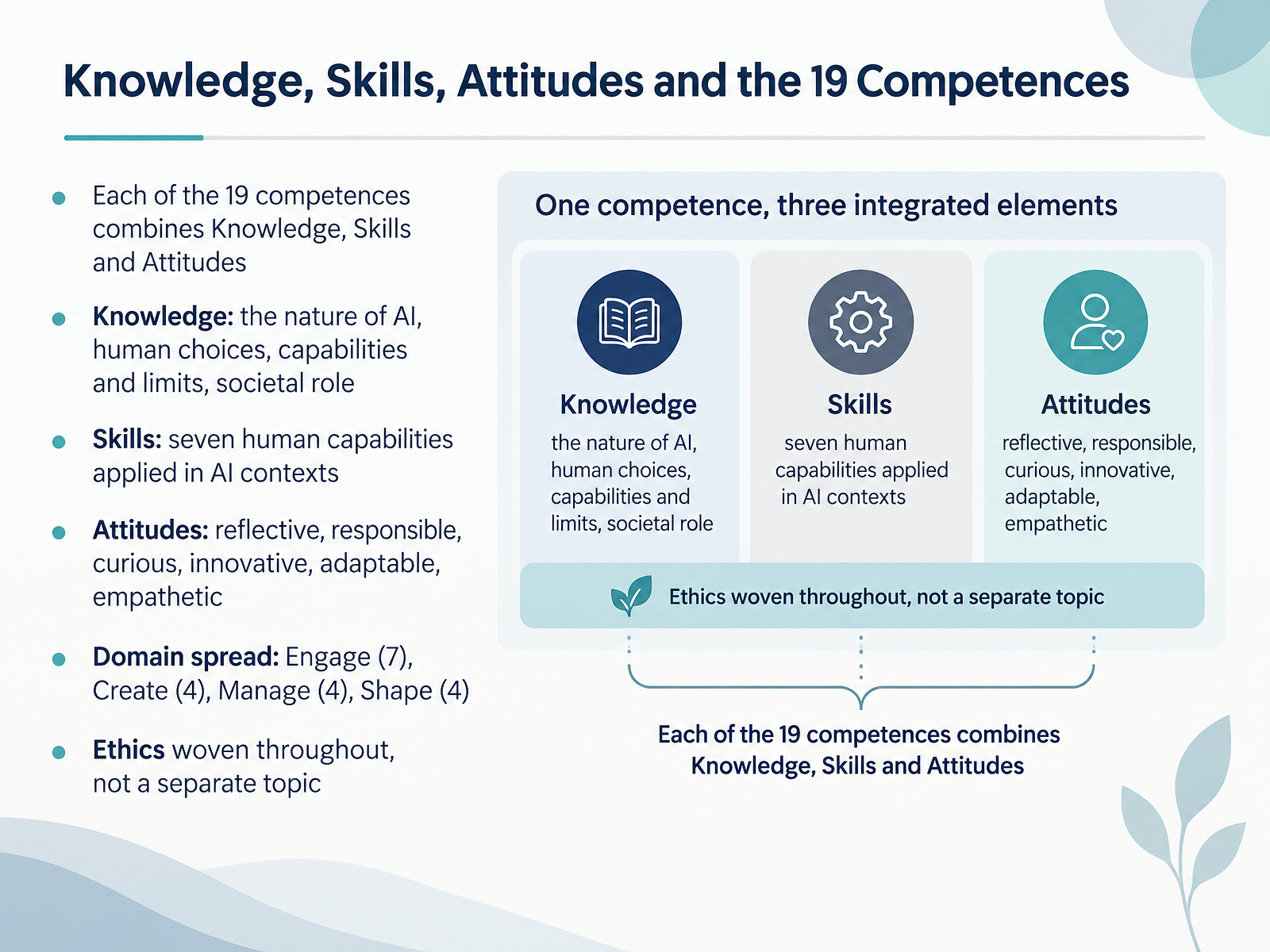
- 05Knowledge, Skills, Attitudes and the 19 CompetencesLet's look at how the nineteen competences are built. Each one combines three elements: knowledge, skills and attitudes. Knowledge covers four areas: the nature of AI, how AI reflects human choices and perspectives, what AI can and cannot do, and AI's role in society. Skills are seven human capabilities applied in AI contexts, such as critical thinking, collaboration, creativity, and computational thinking. Attitudes are the mindsets we want to cultivate: reflective, responsible, curious, innovative, adaptable and empathetic. Now look at how the competences spread across the domains. Engage with AI holds seven, as the foundation. Create with AI, Manage AI and Shape AI each hold four. And note this: ethics is woven throughout every competence, not treated as a separate topic. So when you design a unit, check that it develops knowledge, exercises a skill, and fosters an attitude, all at once. Next, we turn to progression: learner expectations and learning scenarios.
 oecd.orgoecd.orglearn.aiforglobaleducation.org+22 min
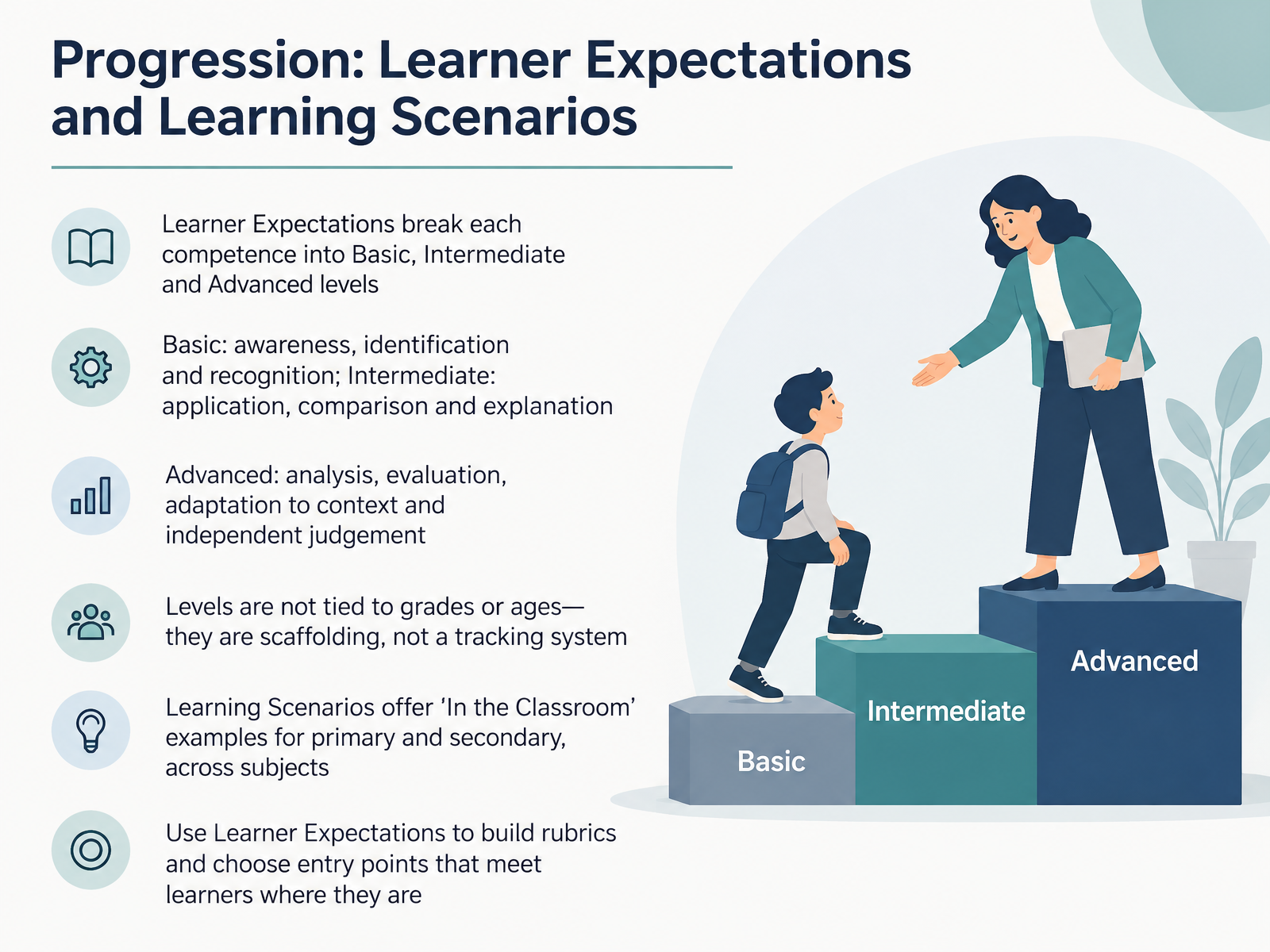
- 06Progression: Learner Expectations and Learning ScenariosNow let's look at how progress actually shows up. Learner Expectations take each competence and break it into three levels: Basic, Intermediate, and Advanced. At the Basic level, learners show awareness, identification, and recognition. At Intermediate, they apply, compare, and explain. At Advanced, they analyse, evaluate, adapt to context, and exercise independent judgement. One important point: these levels are not tied to grades or ages. They are scaffolding, not a tracking system, because learners arrive with very different exposure to AI. Treat them as a way to meet students where they are. Learning Scenarios then give you In the Classroom examples for primary and secondary, across subjects, so you can see what a level looks like in practice. Use Learner Expectations to build rubrics and choose sensible entry points. Next, we look at Mapping the Framework to K through 12 Curricula.
 oecd.orgoecd.orglearn.aiforglobaleducation.org+21 min
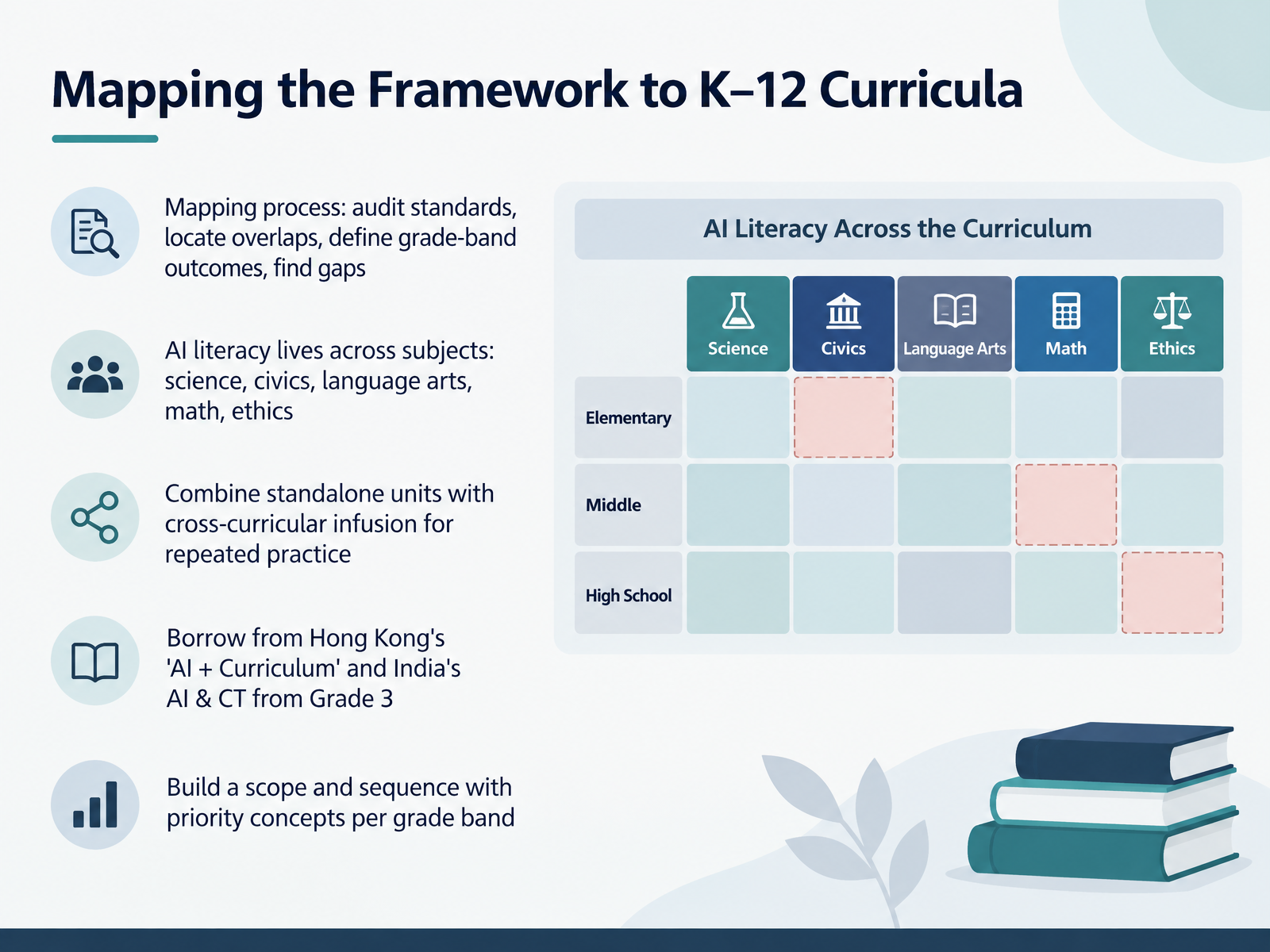
- 07Mapping the Framework to K–12 CurriculaNow let's look at how the framework connects to your actual curriculum. Start with an audit. Review your existing standards, locate overlaps, define grade-band outcomes, then name the gaps. AI literacy lives across subjects. Science can teach data and pattern recognition. Civics can take on bias and accountability. Language arts suits media verification, math suits algorithms, and ethics suits all of them. Combine short standalone units with cross-curricular infusion, so students practice repeatedly rather than once a year. Two useful references: Hong Kong's AI plus Curriculum model, and India's decision to begin AI and computational thinking in Grade three. Then build a scope and sequence with priority concepts for each grade band. In the next session, we turn those priorities into concrete objectives.
 d70schools.orgai4k12.orglibraryready.ai+22 min
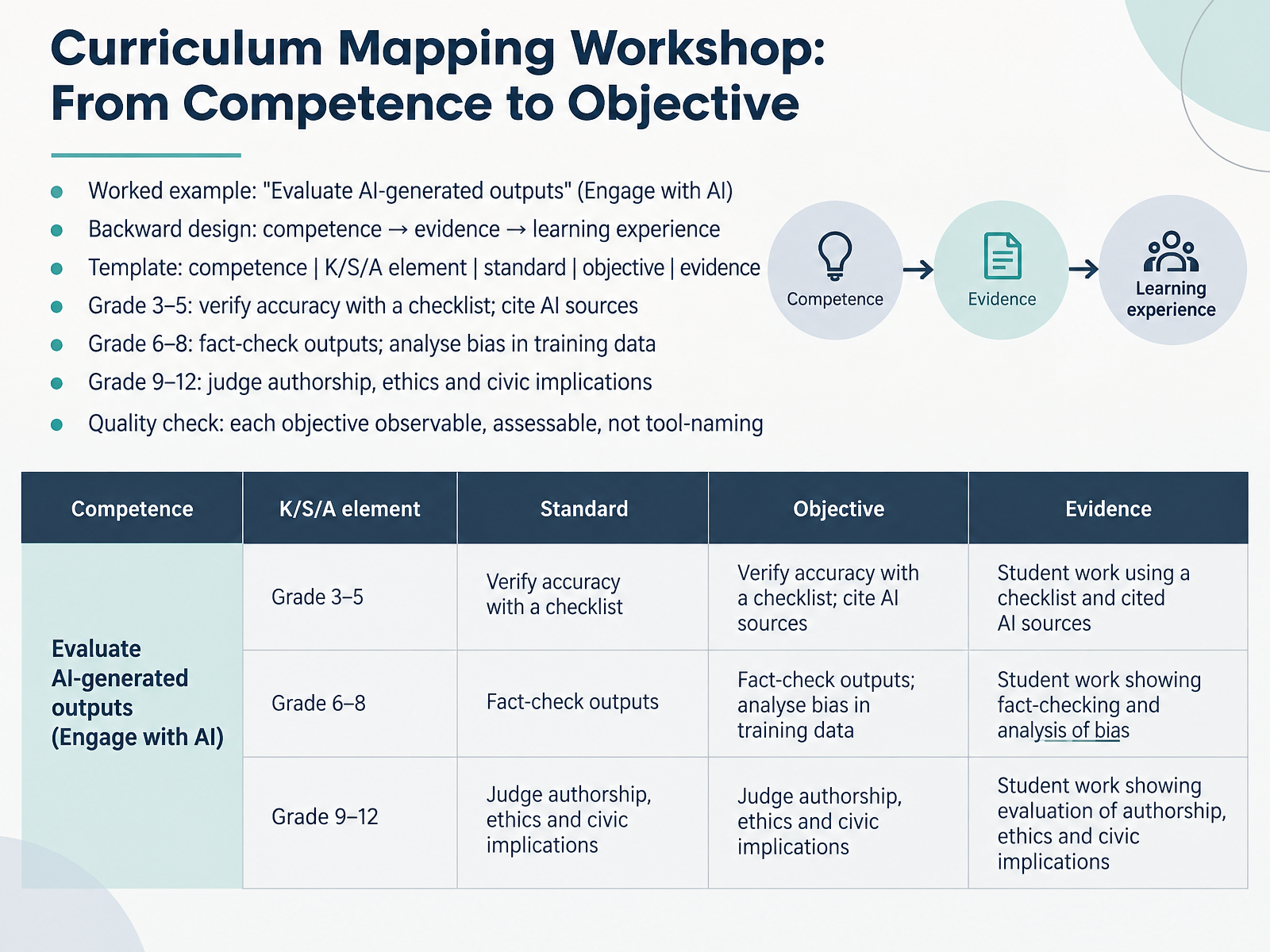
- 08Curriculum Mapping Workshop: From Competence to ObjectiveLet's move from framework to practice with a curriculum mapping workshop. Start with one competence from Engage with AI, evaluate AI-generated outputs. Then work backward: identify the evidence students must show, then design the learning experience that produces it. Use a simple template with five columns: competence, the knowledge, skills, or attitudes element, the standard, the objective, and the evidence. In grades three to five, students verify accuracy with a checklist and cite AI sources. In grades six to eight, they fact-check outputs and analyse bias in training data. In grades nine to twelve, they judge authorship, ethics, and civic implications. Before finalising, run a quality check. Each objective should be observable, assessable, and not tied to naming a specific tool. Next, we look at Pedagogy and Classroom Strategies.
 d70schools.orgai4k12.orglibraryready.ai+22 min
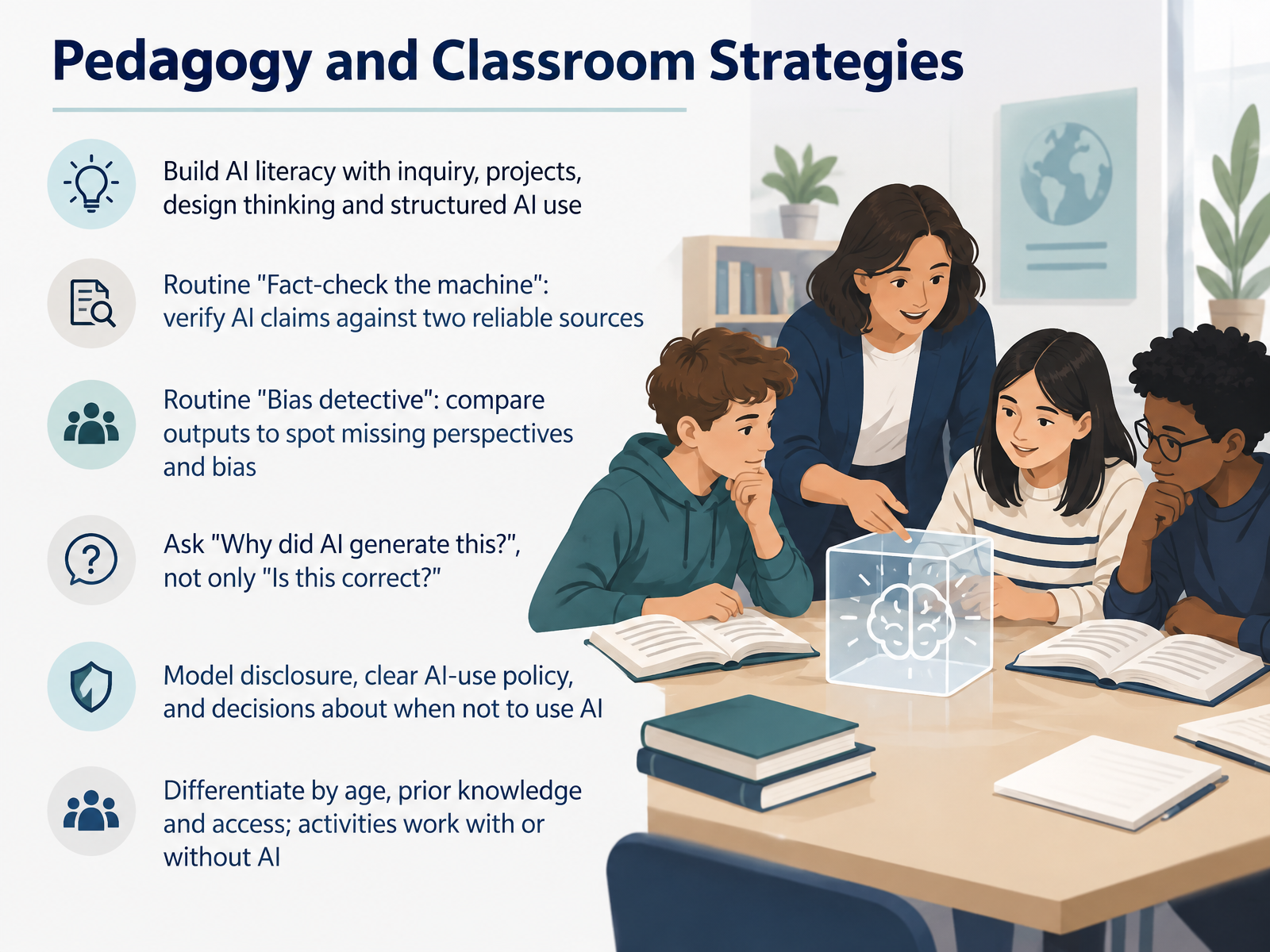
- 09Pedagogy and Classroom StrategiesLet's move from framework to practice. How do you actually build AI literacy in a classroom? Start with inquiry and projects, and use structured AI tasks rather than open-ended tool time. Two routines do most of the work. First, Fact-check the machine. Students verify an AI claim against two reliable sources, then mark it correct, incorrect, or unverifiable, and explain why. Second, Bias detective. Compare outputs to the same prompt and look for missing perspectives. Then push further. Ask why did the AI generate this, not only is it correct. Model disclosure yourself, set a clear AI-use policy, and name the moments when students should not use AI at all. Finally, differentiate by age, prior knowledge, and access. Design activities that work with or without a device, so no student is left out. Next, we look at Assessing AI Literacy.
 school-education.ec.europa.euteachingchannel.compbs.org+21 min
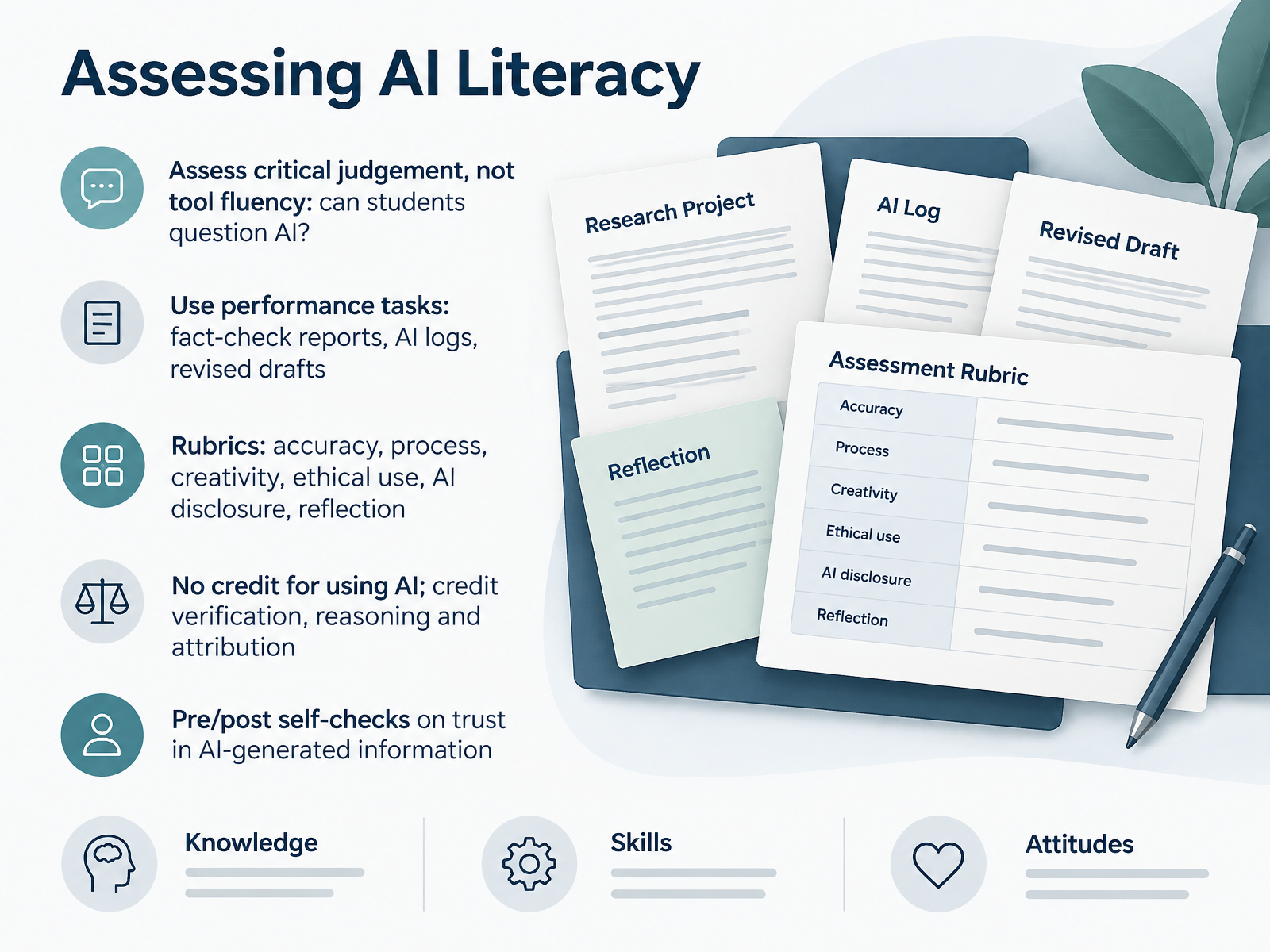
- 10Assessing AI LiteracyNow let's look at how you actually assess AI literacy. The core principle is to assess critical judgement, not tool fluency. Ask whether students can question AI, not just operate it. Use performance tasks: have students fact-check a report, keep an AI log of prompts and outputs, and submit revised drafts showing what they changed and why. Keep a short rubric with clear criteria: accuracy, process, creativity, ethical use, AI disclosure, and reflection. Make one rule explicit to students: no credit for using AI. Credit verification, reasoning, and attribution instead. Finally, run pre and post self-checks on how much students trust AI-generated information. Comparing the two rounds shows you their growth. In short, assess the thinking behind the tool. That naturally raises the question of what teachers need, which brings us to Teacher Capacity and Professional Learning.
 school-education.ec.europa.euoecd.org2 min
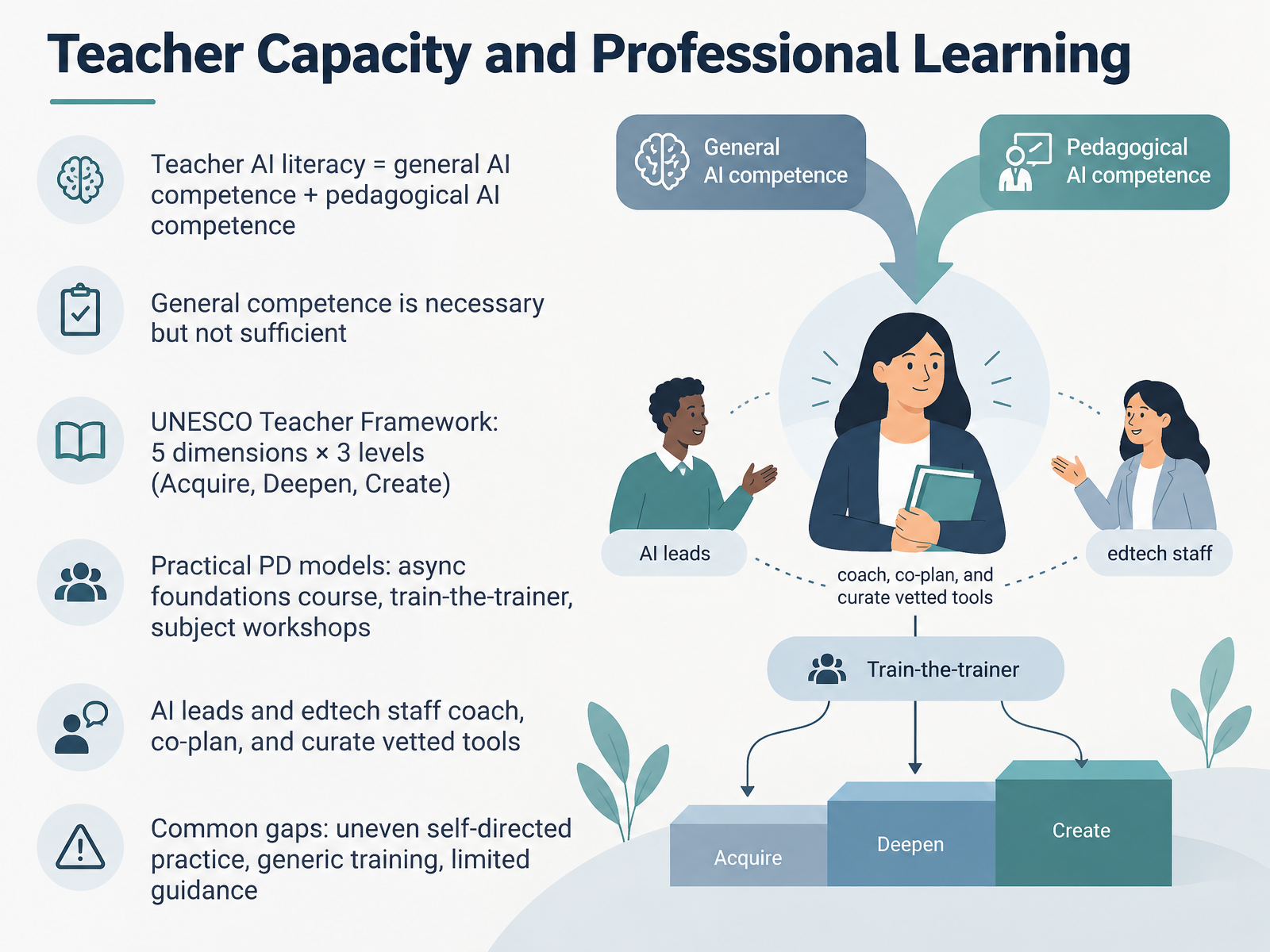
- 11Teacher Capacity and Professional LearningLet's turn now to teacher capacity and professional learning. A useful way to define teacher AI literacy is to split it in two. General AI competence means understanding and using AI technologies. Pedagogical AI competence means teaching about AI and designing learning with it. General competence is necessary, but not sufficient. You also need subject-specific design skill. UNESCO's Teacher Framework gives you a shared map: five dimensions across three levels, named Acquire, Deepen, and Create. Use it to place teachers and plan the next step, not to rank them. Practically, combine an asynchronous foundations course with train-the-trainer sessions and subject workshops. Your AI leads and edtech staff then coach, co-plan, and curate vetted tools. Watch for three common gaps: uneven self-directed practice, generic training, and limited guidance. Next, we look at implementation planning for schools and districts.
 oecd.org2 min
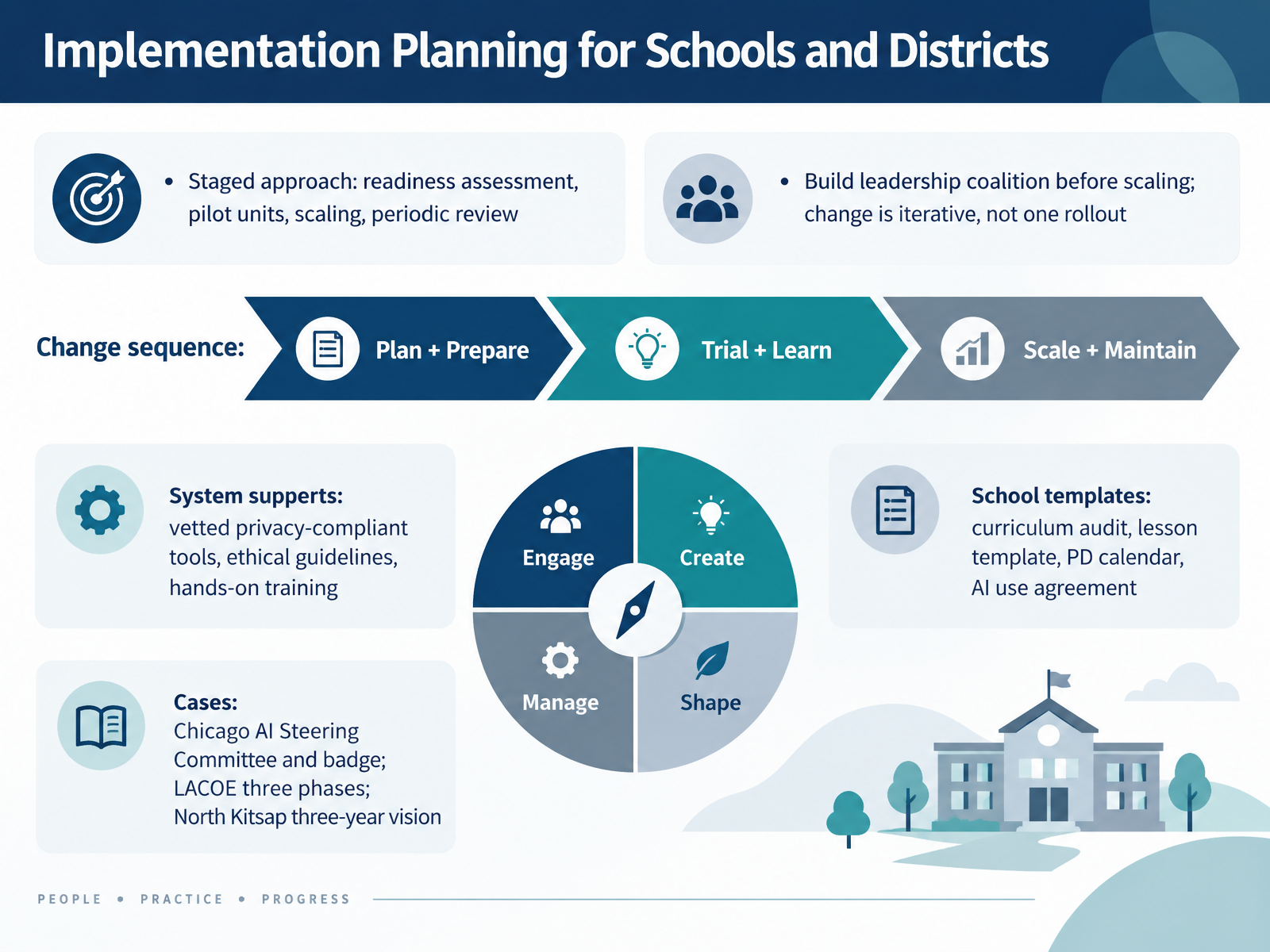
- 12Implementation Planning for Schools and DistrictsLet's turn to implementation planning. Treat this as a staged approach, not one rollout. Start with a readiness assessment, run small pilot units, scale what works, and review periodically. A practical sequence is Plan and Prepare, then Trial and Learn, then Scale and Maintain. Build your leadership coalition before scaling, because change is iterative. Back it with system supports: vetted privacy-compliant tools, ethical guidelines, and hands-on training. Three cases show this in practice. Chicago Public Schools formed an AI Steering Committee and used an AI Foundations Badge as a common starting point. Los Angeles County Office of Education organized change into three phases. North Kitsap set a three-year vision, moving from teacher readiness to classroom adoption, then student AI literacy by grade level. For your own planning, adapt four templates: a curriculum audit, a lesson template, a professional development calendar, and an AI use agreement. Choose one stage to strengthen this term, and document your decision. Next, we look at Monitoring, Evaluation and Quality Assurance.
 oecd.org2 min
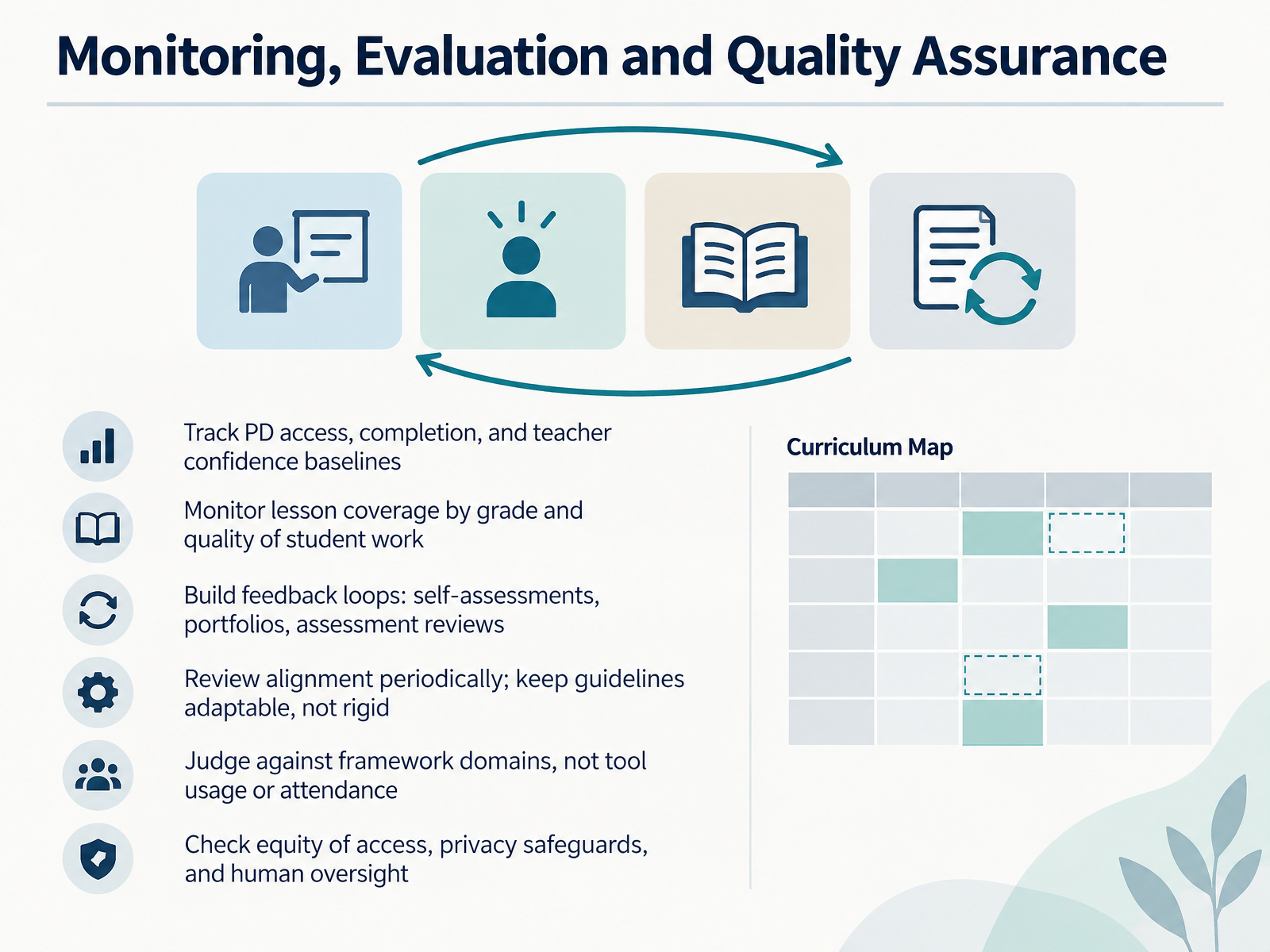
- 13Monitoring, Evaluation and Quality AssuranceLet's turn now to monitoring, evaluation and quality assurance. Start with professional learning: track who has access to training, who completes it, and record a baseline of teacher confidence. A short confidence survey at the start of the year gives you something honest to compare against. Next, monitor lesson coverage by grade and look at the quality of student work. Are students in every grade actually encountering AI literacy, and can they evaluate AI output critically? Build feedback loops through self-assessments, portfolios and periodic assessment reviews, so evidence comes from practice, not just surveys. Review alignment on a regular schedule, and keep your guidelines adaptable rather than rigid. A useful test: judge against the framework's domains, such as knowledge, practice and ethics, not tool usage or attendance. Finally, check equity of access, privacy safeguards and human oversight. Ask whether every school has the same access, and whether an adult reviews AI-supported decisions. That keeps quality assurance grounded in learning. Next, we move to reflection and action planning.
 school-education.ec.europa.eu2 min
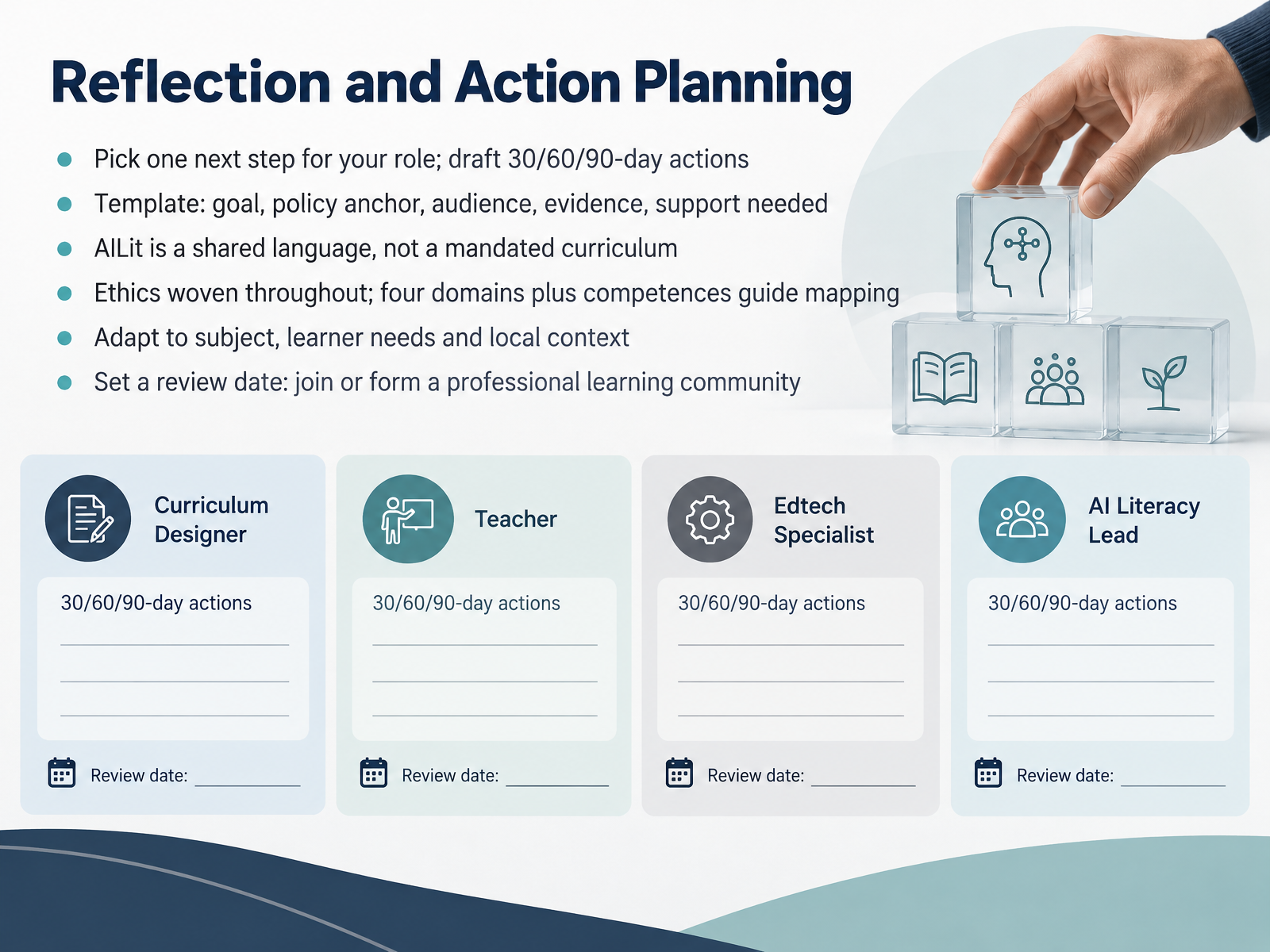
- 14Reflection and Action PlanningLet's close by turning ideas into action. Pick one next step that fits your role, then draft actions for thirty, sixty, and ninety days. Use a simple template. State the goal, the policy anchor it connects to, the audience, the evidence you will collect, and the support you need. And keep one thing in mind. The AILit Framework gives you a shared language, not a mandated curriculum. Ethics are woven throughout, and the four domains plus the nineteen competences help you map existing work. Adapt to your subject, your learners, and your local context. Set a review date now, and join or form a professional learning community. Thank you for your work on this, and good luck taking that first step.
 oecd.orgoecd.orgailiteracyframework.org+21 min
Take the deck with you
Download this course as a file — free, no sign-up needed.
- PDF handoutEvery slide page, ready to print or share.15 pages · 3.3 MBDownload
- Narrated PowerPointThe deck that presents itself — every slide carries the digital human's narration video.15 pages · 15.5 MBDownload
- PowerPoint slidesThe full deck as a .pptx — open it in PowerPoint, Keynote, or Google Slides.15 pages · 3.2 MBDownload
Free to use in your own training — please keep the PersonWise credit page at the end.
Have your own deck? Turn it into a course
Sources consulted
Web sources consulted while building this course.
- Empowering Learners for the Age of AI (EN) — oecd.org
- Empowering Learners for the Age of AI — oecd.org
- Home | AILit Framework — ailiteracyframework.org
- New AI Literacy Framework helps schools prepare learners for ... — education.ec.europa.eu
- New AI Literacy Framework: a common reference for integrating AI literacy in education - Malta Digital Innovation Authority — digitalskills.mdia.gov.mt
- World — oecd.org
- AILit Framework — oecd.org
- Empowering Learners for the Age of AI: AI Literacy Framework, AIFGE Learn — learn.aiforglobaleducation.org
- Improving AI capabilities among adult teachers and educators | EPALE — epale.ec.europa.eu
- OECD and EU launch AI literacy framework for schools — winssolutions.org
- K–8 AI Literacy & Digital Citizenship Scope and Sequence - Libertyville District 70 — d70schools.org
- Grade Band Progression Charts – AI4K12 — ai4k12.org
- AI SCOPE AND SEQUENCE PREK-12 CONCEPTS FOR TEACHING ABOUT AI — libraryready.ai
- K–12 Learning Roadmap for Digital Citizens - Arlington Public Schools — apsva.us
- Curriculum Map — everyday-ai.org
- AI literacy: explore, create and think critically | European School Education Platform — school-education.ec.europa.eu
- 3 Activities for AI Literacy — teachingchannel.com
- Lesson plan: AI Unlocked — evaluating and testing AI tools | PBS News Hour Classroom — pbs.org
- AI Literacy Starts Here: Practical Classroom Approaches for Middle School - TeachersFirst Blog — teachersfirst.org
- AI Literacy Lessons for Grades K–12 | Common Sense Education — commonsense.org