Begin
14 pages · ~28 min
Waterfall Project Management Essentials
This training introduces Waterfall project management for teams and project managers, covering its sequential phases and practical application to structured projects.
A digital instructor presents all 14 pages. Hold “Ask” at any point and ask out loud — the answer comes from this course. No sign-up needed.
What you’ll learn
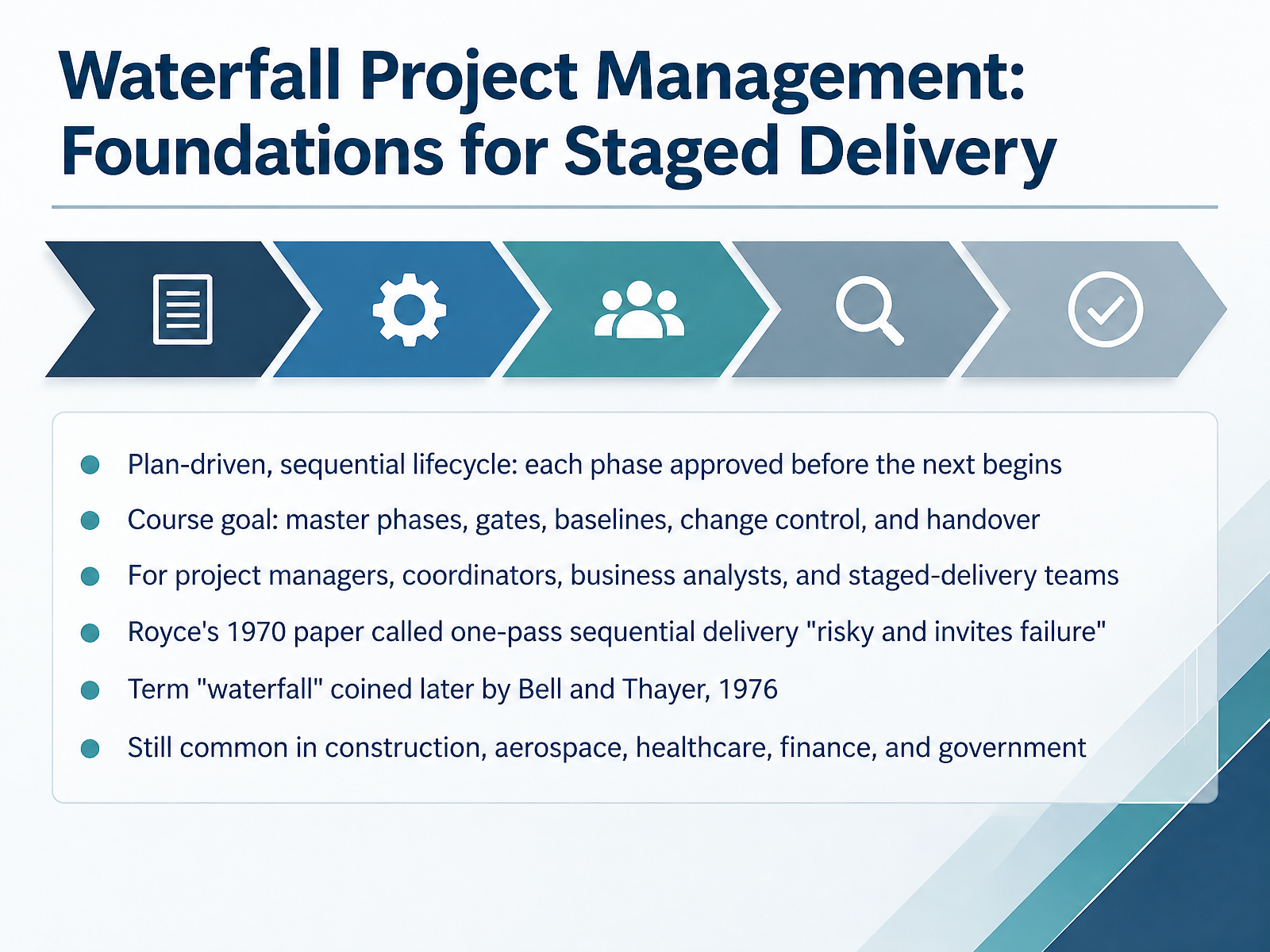
- 01Waterfall Project Management: Foundations for Staged DeliveryWelcome. Let's talk about Waterfall project management, and why it still matters for staged delivery.
If you have ever signed off a requirements document before design could start, you have run a plan-driven, sequential lifecycle. Each phase gets approved before the next one begins. That is the core idea we will work with.
Our goal for this course is practical. We will master phases, gates, baselines, change control, and handover, so you can run them with confidence. This is built for project managers, coordinators, business analysts, and teams delivering in stages.
Here is a piece of history worth knowing. Royce's 1970 paper called a one-pass sequential approach risky and invites failure. The term waterfall itself came later, from Bell and Thayer in 1976. So the label and the original caution are not the same thing.
Even so, the model is still common in construction, aerospace, healthcare, finance, and government, where approval and traceability matter. On your current project, find one phase gate and confirm what evidence is required to pass it. That single check will sharpen your control.
Next, let's look at A Brief History and the Persistent Misconception.cs.huji.ac.ilmartinfowler.comholub.com+22 min
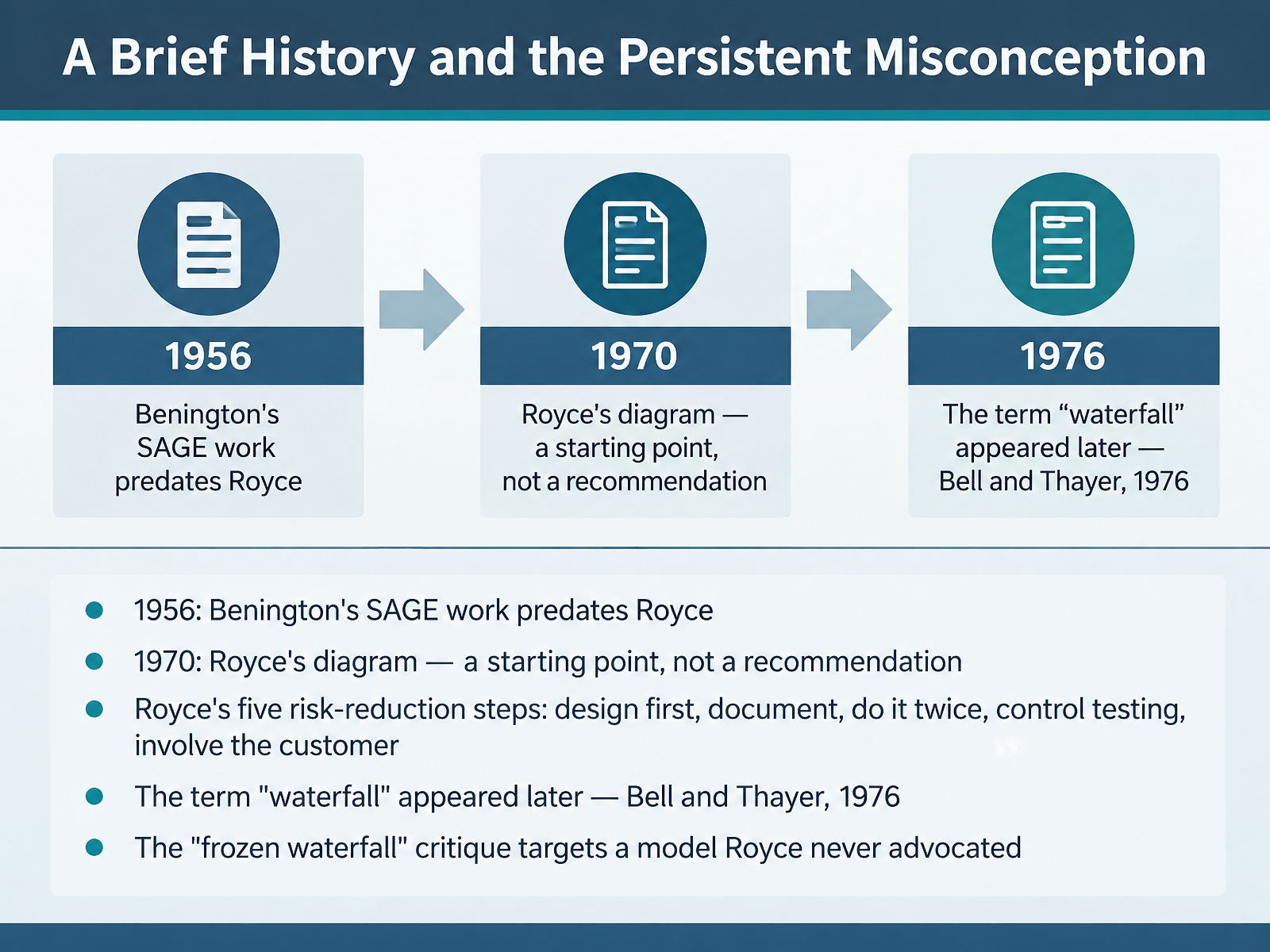
- 02A Brief History and the Persistent MisconceptionLet's clear up where this model actually came from. A lot of us were taught that Winston Royce invented the waterfall in nineteen seventy. But Herbert Benington's work on SAGE dates back to nineteen fifty-six, well before Royce. And Royce's paper was never a recommendation. He said the single-pass approach was risky and invites failure. His five risk-reduction steps were design first, document the design, do it twice, control and monitor testing, and involve the customer. The word waterfall didn't appear until Bell and Thayer in nineteen seventy-six. So when someone criticizes the frozen waterfall, they're attacking a model Royce never advocated. On your current project, pull up your methodology docs and check which of his five steps you actually follow today. Next, we look at core concepts: phases, gates, and baselines.
 cs.huji.ac.ilmartinfowler.comholub.com+21 min
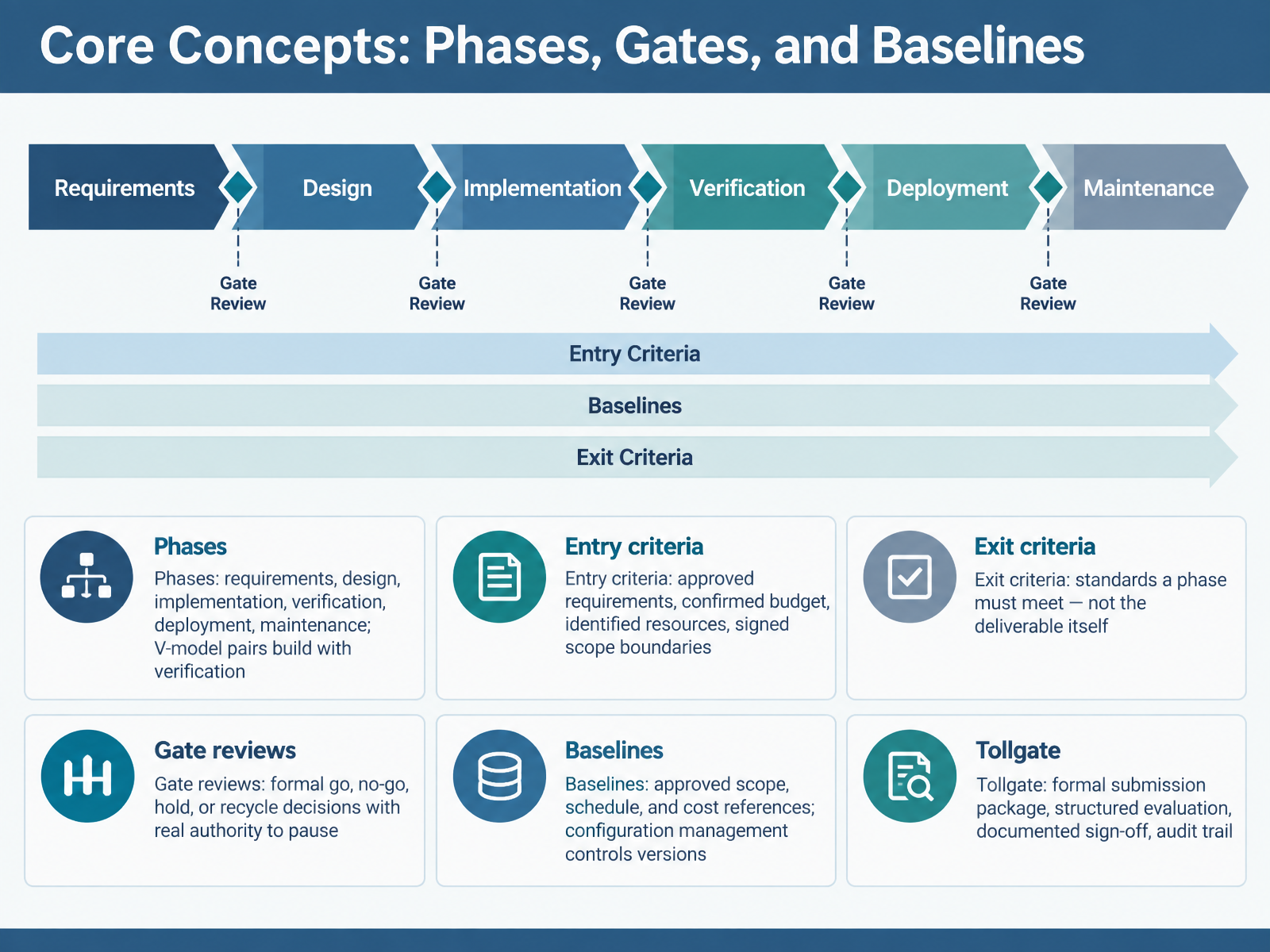
 - 03Core Concepts: Phases, Gates, and BaselinesLet's look at the core concepts that hold a staged delivery together: phases, gates, and baselines. Think about a recent project where design started before requirements were fully signed off. We all know how that ends. Rework. So each phase, from requirements through design, implementation, verification, deployment, and maintenance, needs clear entry criteria. Approved requirements, confirmed budget, identified resources, and signed scope boundaries. On the V-model, each build activity pairs with a matching verification activity, so testing is planned, not improvised. Now, exit criteria are the standards a phase must meet, not the deliverable itself. A test report is a deliverable. The exit criterion might be that all severity-one defects are closed. Gate reviews are formal decision points with real authority to decide go, no-go, hold, or recycle. If a gate can never say no, it is a ceremony, not a gate. Baselines lock approved scope, schedule, and cost, and configuration management controls versions. A tollgate goes further than a gate review. It requires a formal submission package, structured evaluation, documented sign-off, and an audit trail. Here's your action. On your current project, write down the entry criteria, deliverables, and exit criteria for the next phase, and get your sponsor to agree before that phase begins. That single step prevents most late-stage surprises. Next, we'll look at roles, responsibilities, and governance.
 projectmanagementformula.comprojectmanagementformula.comasana.com+22 min
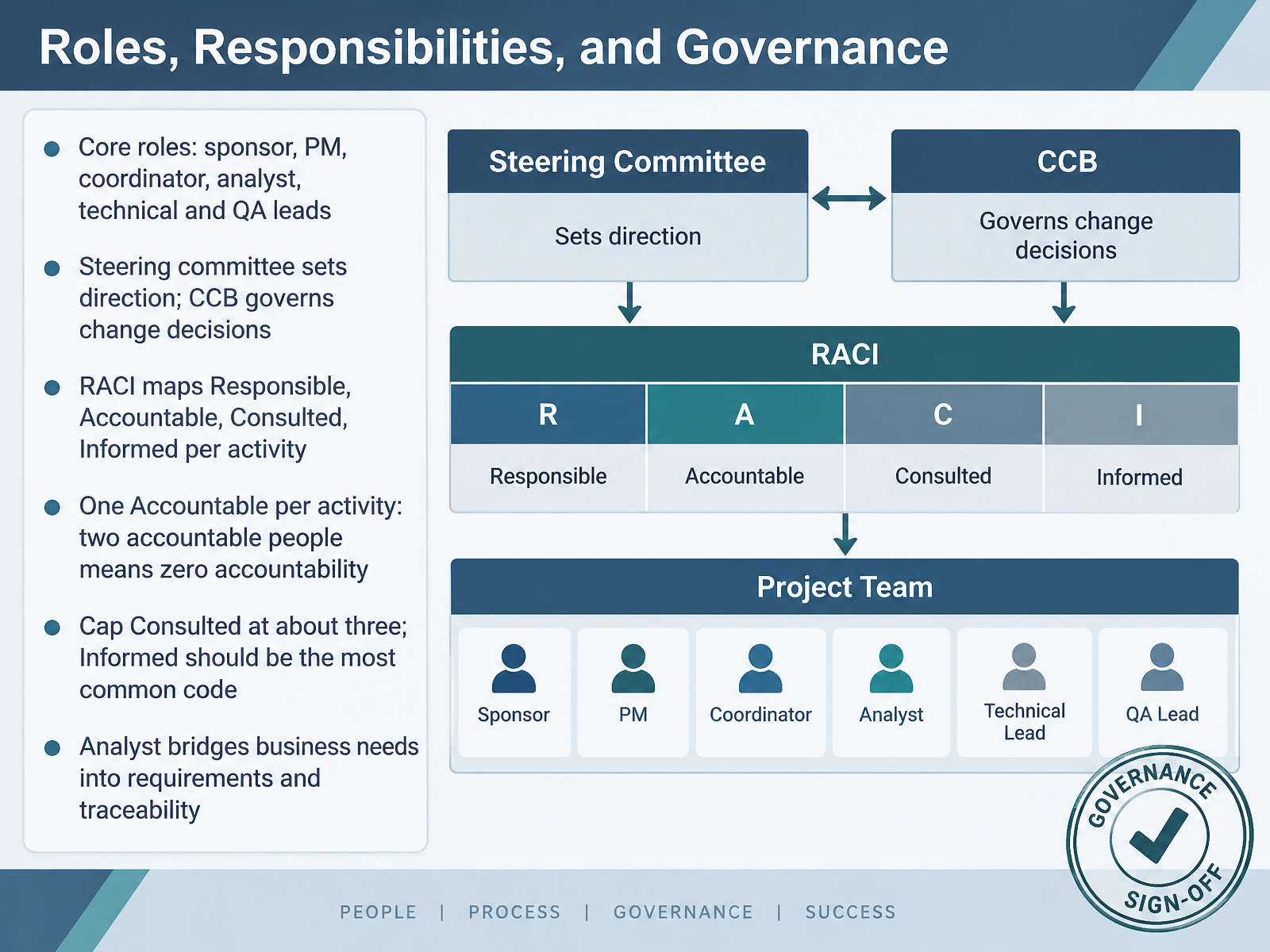
 - 04Roles, Responsibilities, and GovernanceLet's talk about roles, responsibilities, and governance, because in staged delivery, ambiguity here is where projects quietly fail. Picture your last status meeting: an issue sits unresolved because three people assumed someone else owned it. That's a RACI problem, not a people problem. The core roles are the sponsor, project manager, coordinator, business analyst, and your technical and quality assurance leads. The steering committee sets direction, while the change control board governs change decisions. A RACI map assigns Responsible, Accountable, Consulted, and Informed for each activity. Here is the rule we never bend: exactly one person is Accountable per activity. Two accountable people means zero accountability. Cap Consulted at about three, otherwise you build a veto structure instead of a decision structure. Informed should be your most common code, because most people just need to know what's happening. Your analyst is the bridge from business needs into requirements and traceability. So pick one high-risk activity on your current project this week and confirm it has a single named owner. Next, we'll move into requirements and design in staged delivery.
 linkedin.comprojectmanagementformula.comresources.finalsite.net+22 min
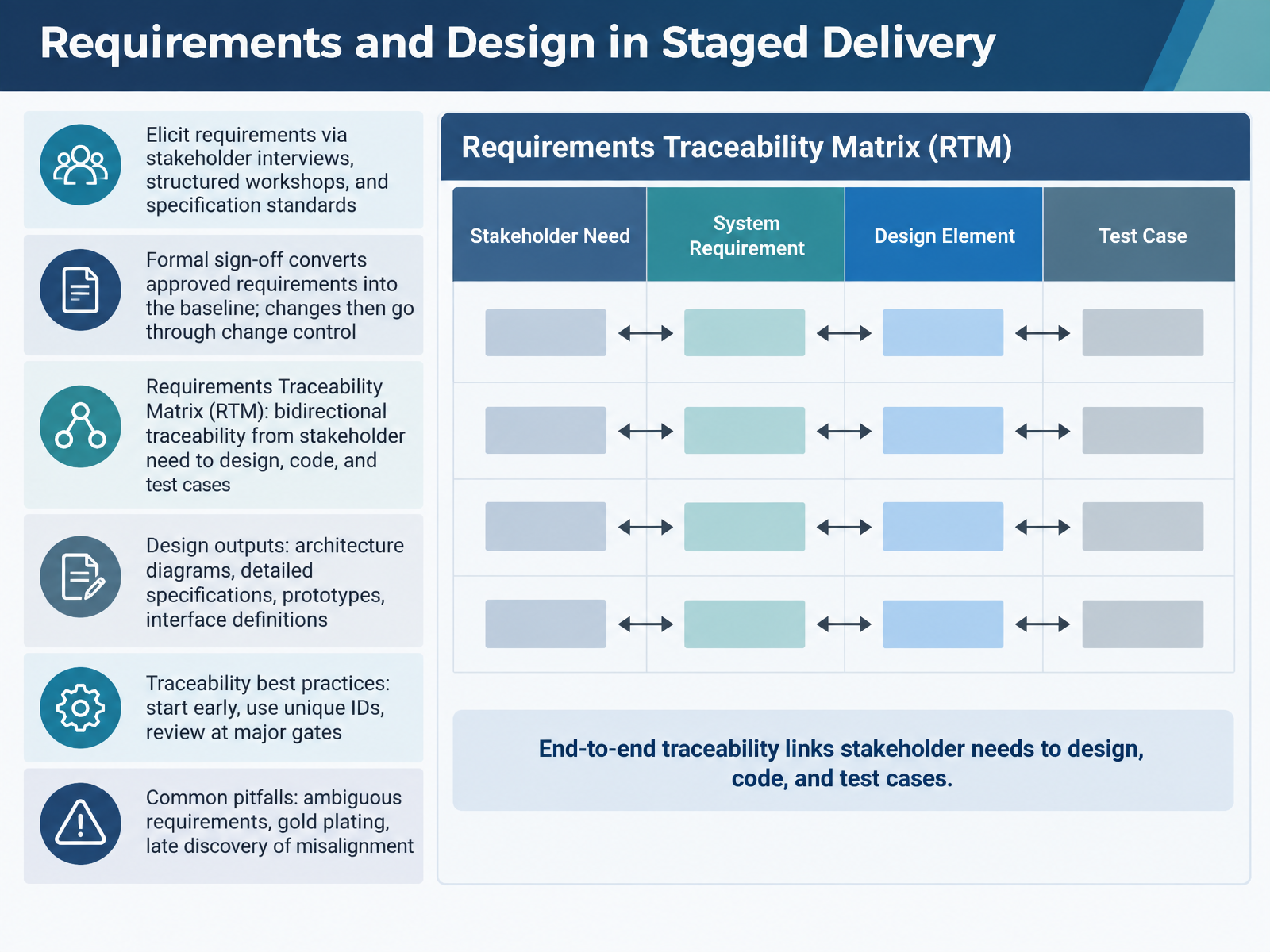
 - 05Requirements and Design in Staged DeliveryLet's talk about requirements and design in staged delivery. Picture this: a business analyst sits with operations staff in a workshop to capture how a claims process should actually work. That is elicitation. We interview stakeholders, run structured workshops, and record everything against our specification standards. Then comes formal sign-off. Approval converts those requirements into the baseline, and from that point every change goes through change control. We cannot quietly edit the document anymore. Next, the Requirements Traceability Matrix. It gives us bidirectional traceability from the stakeholder need to design, code, and test cases. Trace backward and we prove every requirement has a reason. Trace forward and we prove nothing was forgotten. Design produces architecture diagrams, detailed specifications, prototypes, and interface definitions. Three best practices: start early, assign unique IDs, and review at major gates. Watch for common pitfalls too. Ambiguous requirements, gold plating, and misalignment discovered late are the ones that hurt most. Here is your action. Open your current project's traceability matrix this week and check that every baseline requirement links forward to a design element. Now let's move on to planning, scheduling, and estimation.
 swehb.nasa.govbusiness-analysis-excellence.comquicksearch.dla.mil+22 min
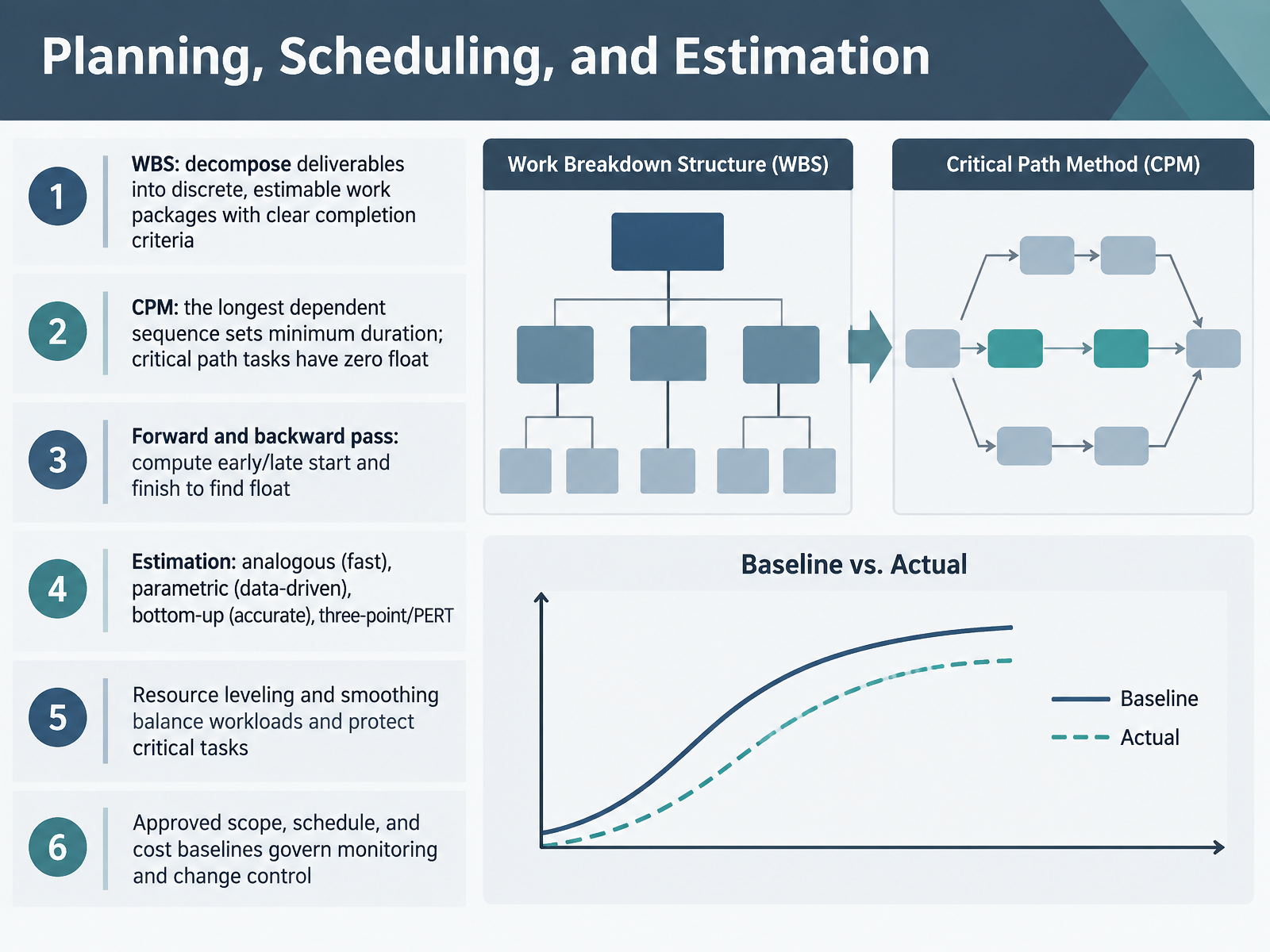
 - 06Planning, Scheduling, and EstimationNow let's talk about planning, scheduling, and estimation, because this is where staged delivery either holds together or quietly falls apart. Everything starts with the work breakdown structure. We decompose deliverables into discrete work packages that we can actually estimate, each with clear completion criteria. If you cannot estimate a task's duration, it is not defined well enough yet. Next comes the critical path method. The longest dependent sequence sets the minimum project duration, and tasks on that path have zero float. We confirm that by running a forward pass for early start and finish, then a backward pass for late start and finish. Float equals late start minus early start, so zero float marks the critical path. For durations, we choose the estimating technique that fits: analogous is fast, parametric uses data, bottom-up is most accurate, and three-point PERT gives a weighted average of optimistic, most likely, and pessimistic. Then resource leveling and smoothing balance workloads and protect critical tasks. Finally, we freeze the approved scope, schedule, and cost baselines, because those baselines govern monitoring and change control. Here is your action: check today that every critical path task in your schedule has a named owner and a verified duration estimate. Let's move on to execution, monitoring, and control.
 2 min
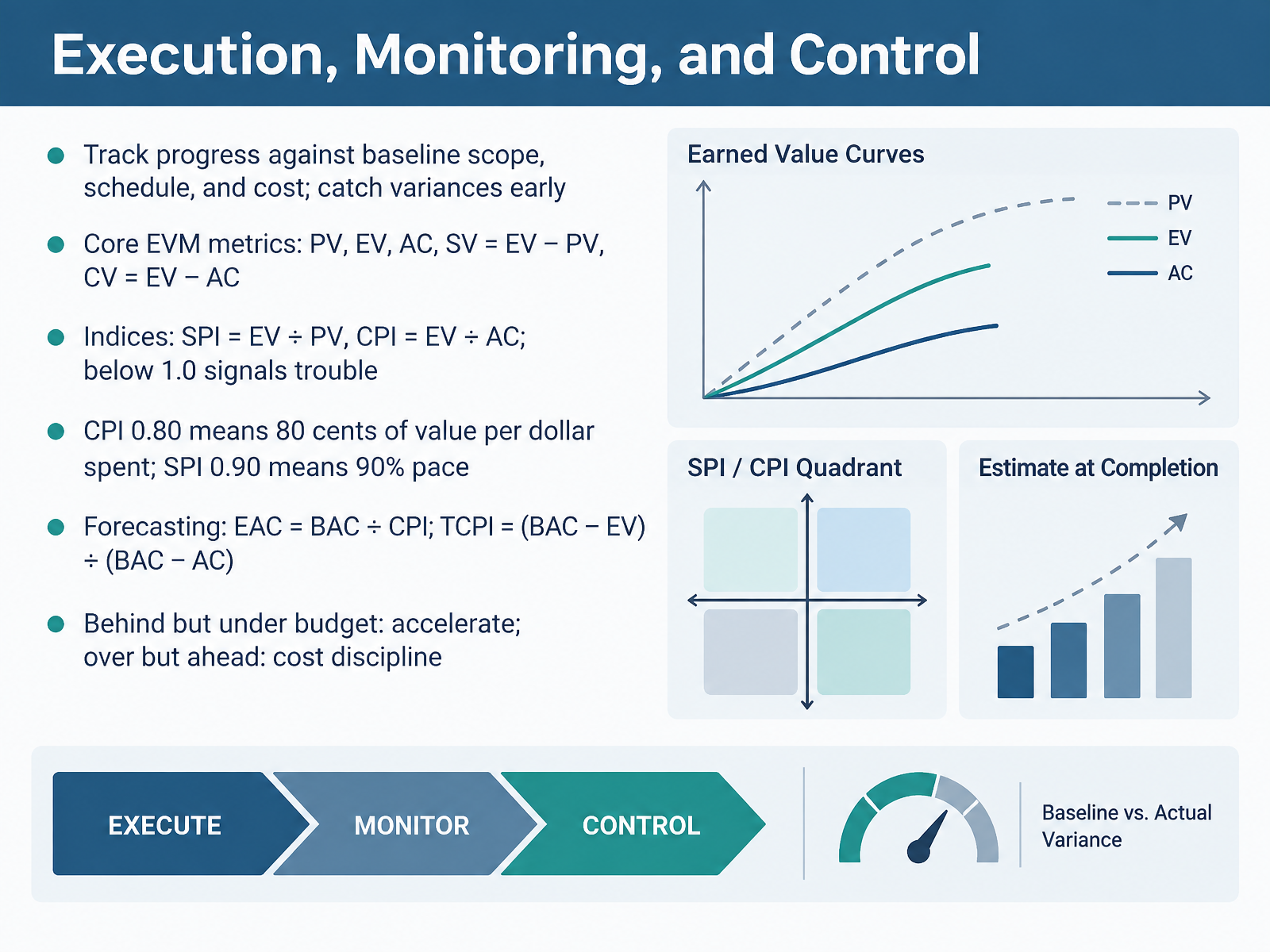
2 min - 07Execution, Monitoring, and ControlNow let's look at Execution, Monitoring, and Control. In staged delivery, this is where we track progress against the baseline for scope, schedule, and cost, and catch variances early. Say we're four months into a one hundred thousand dollar project. Planned value is forty thousand, earned value is thirty six thousand, and actual cost is forty five thousand. Our schedule variance is earned value minus planned value, negative four thousand. Our cost variance is earned value minus actual cost, negative nine thousand. We're a little behind and meaningfully over budget. The indices tell the efficiency story. Schedule Performance Index is earned value divided by planned value, which gives zero point nine zero. Cost Performance Index is earned value divided by actual cost, which gives zero point eight zero. Below one point zero signals trouble. A CPI of zero point eight zero means eighty cents of value for every dollar spent. An SPI of zero point nine zero means we're working at ninety percent of the planned pace. For forecasting, Estimate at Completion is budget at completion divided by CPI. Here, one hundred thousand divided by zero point eight zero projects one hundred twenty five thousand, a twenty five thousand dollar overrun visible now, not at month ten. The to complete performance index is budget at completion minus earned value, divided by budget at completion minus actual cost. When it climbs well above current CPI, the original target is probably out of reach without a real change. Read the quadrant. Behind but under budget means accelerate. Over budget but ahead means cost discipline. On your current project, check the trend for three consecutive periods, name the driver in plain terms, and assign one decision owner. Next, we'll look at Change Control and Scope Management.
 2 min
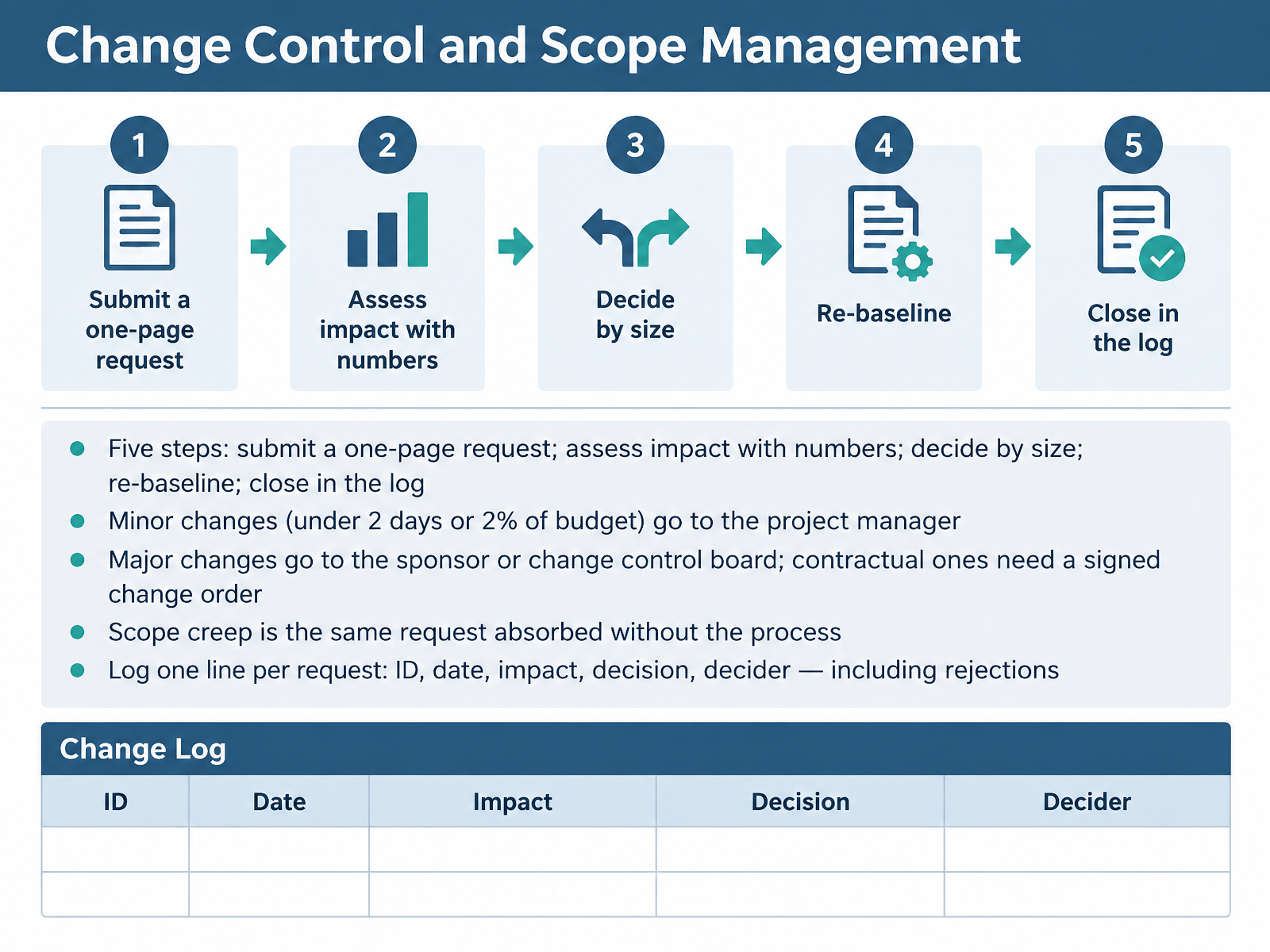
2 min - 08Change Control and Scope ManagementLet's talk about change control and scope management. Picture a stakeholder messaging you on a Tuesday: can we also swap the homepage banner? It's only two hours. Now imagine that favour never gets written down. Multiply it across eight months, and that's how baselines die. So we run five steps. Submit the request on one page. Assess the impact with numbers: scope, schedule in days, budget in money, and risk. Decide by size. Minor changes, under two days or two percent of the budget, the project manager decides and logs them. Major changes go to the sponsor or the change control board. Contractual ones need a signed change order before anyone starts work. Then re-baseline the plan, budget, and dates so people hear about it the same day. Finally, close it in the log: one line per request with the ID, date, impact, decision, and decider, including the rejections. Scope creep is the same request absorbed without any of that, which is why the log is how we tell them apart. This week, check your current project's change log. If a request isn't in it, it's creep. Next, we look at risk and issue management in stage-gated projects.
 2 min
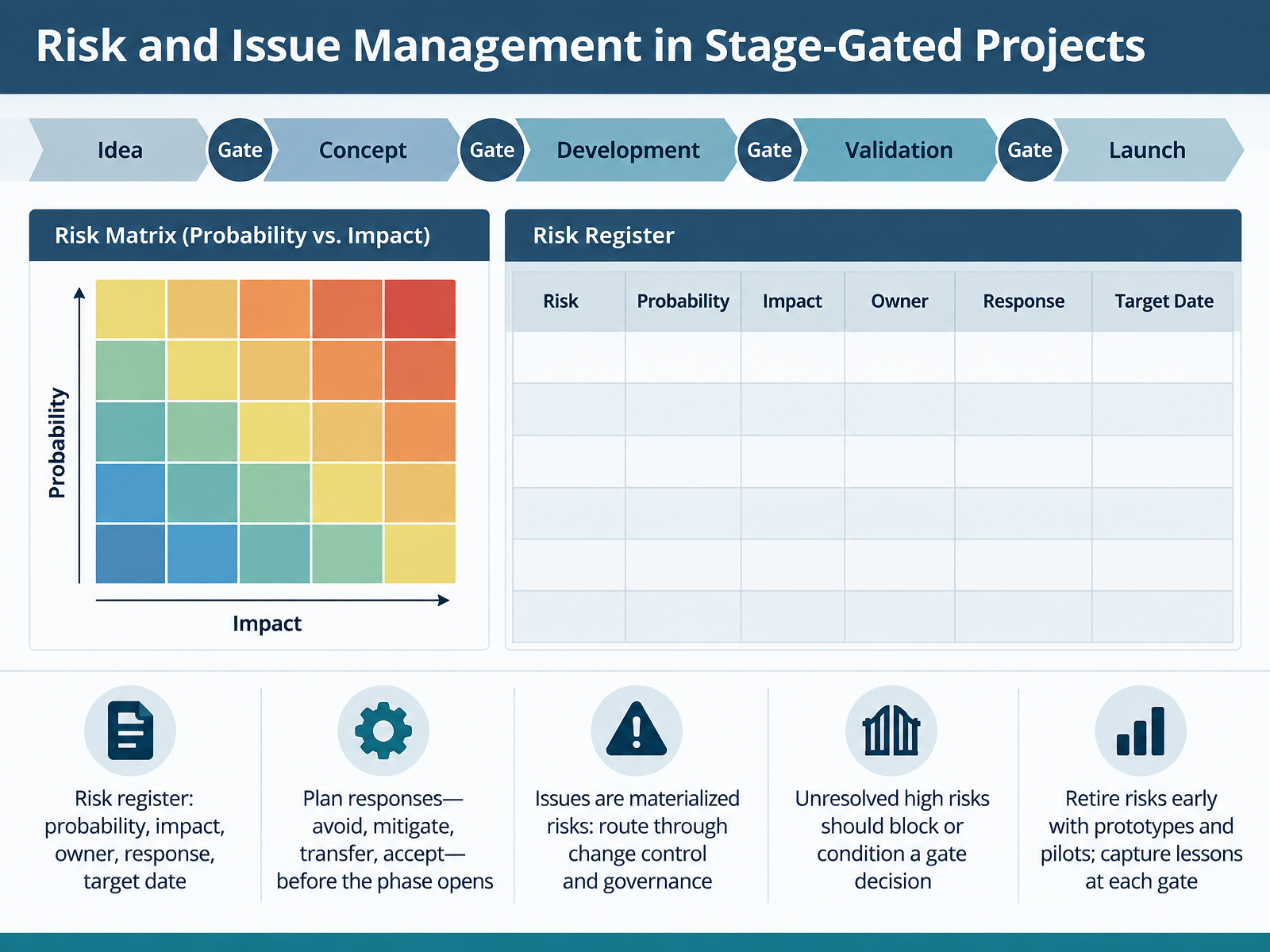
2 min - 09Risk and Issue Management in Stage-Gated ProjectsLet's talk about risk and issue management in stage-gated projects, because this is where a clean gate decision is either protected or quietly undermined. We keep a risk register, and every line carries a probability, an impact, a named owner, a planned response, and a target date. Before a phase opens, we agree on that response, whether we avoid the risk, mitigate it, transfer it, or simply accept it. Issues are materialized risks. Once a risk becomes real, it routes through change control and governance, not through a side conversation in the hallway. Here is the discipline that matters most. Unresolved high risks should block a gate or condition the decision, with explicit entry criteria attached. We also retire risks early with prototypes and pilots, and we capture lessons at every gate. So take one action this week. Pull your top three risks, confirm each has a real owner and a target date, and check whether any of them should be conditioning your next gate. Now let's move on to verification, testing, and user acceptance.
 1 min
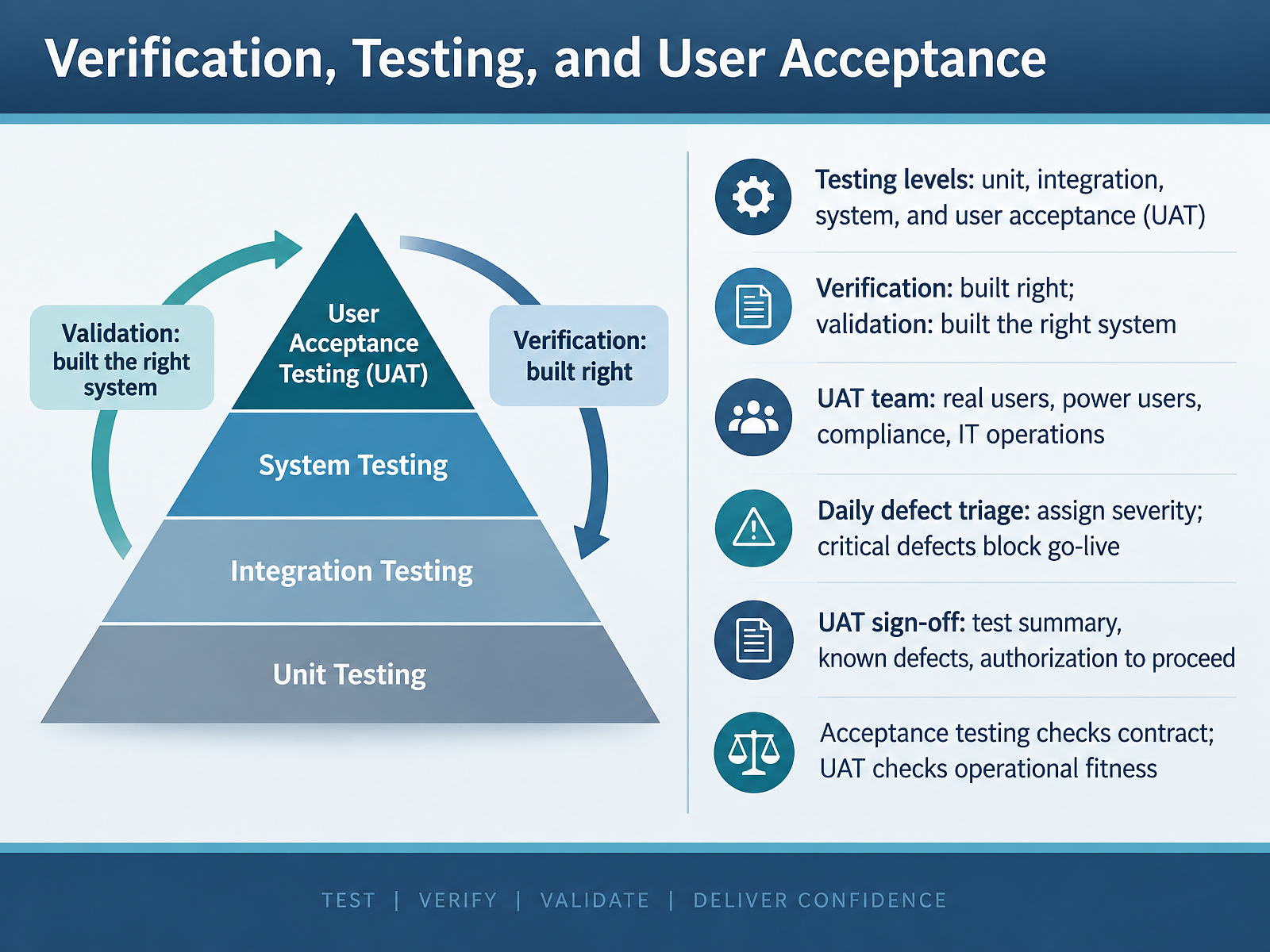
1 min - 10Verification, Testing, and User AcceptanceLet's walk through verification, testing, and user acceptance, the gate that decides whether we go live. On a recent banking rollout, UAT surfaced an incomplete approvals workflow. System testing passed, but real users could not complete month-end close under load. That is the difference between verification and validation. Verification asks whether we built the system right. Validation asks whether we built the right system. So we run four testing levels. Unit testing checks individual components. Integration testing checks how they connect. System testing checks end to end behavior against the design. User acceptance testing, or U A T, checks operational fitness with real business scenarios. Staff your U A T team deliberately. Include real users who do the daily work, power users who know the edge cases, compliance or risk, and IT operations who will support the system after go-live. Then hold daily defect triage. Review every logged defect, assign severity, and remember that critical defects block go-live. Medium and low defects get documented with a remediation plan. At the end, U A T sign-off is formal. It includes the test summary, the list of known defects with workarounds, and written authorization to proceed. Acceptance testing checks the contract. U A T checks operational fitness. On your current project, pull your U A T entry and exit criteria into one page and confirm who signs. Next, we move into deployment, cutover, and handover.
 2 min
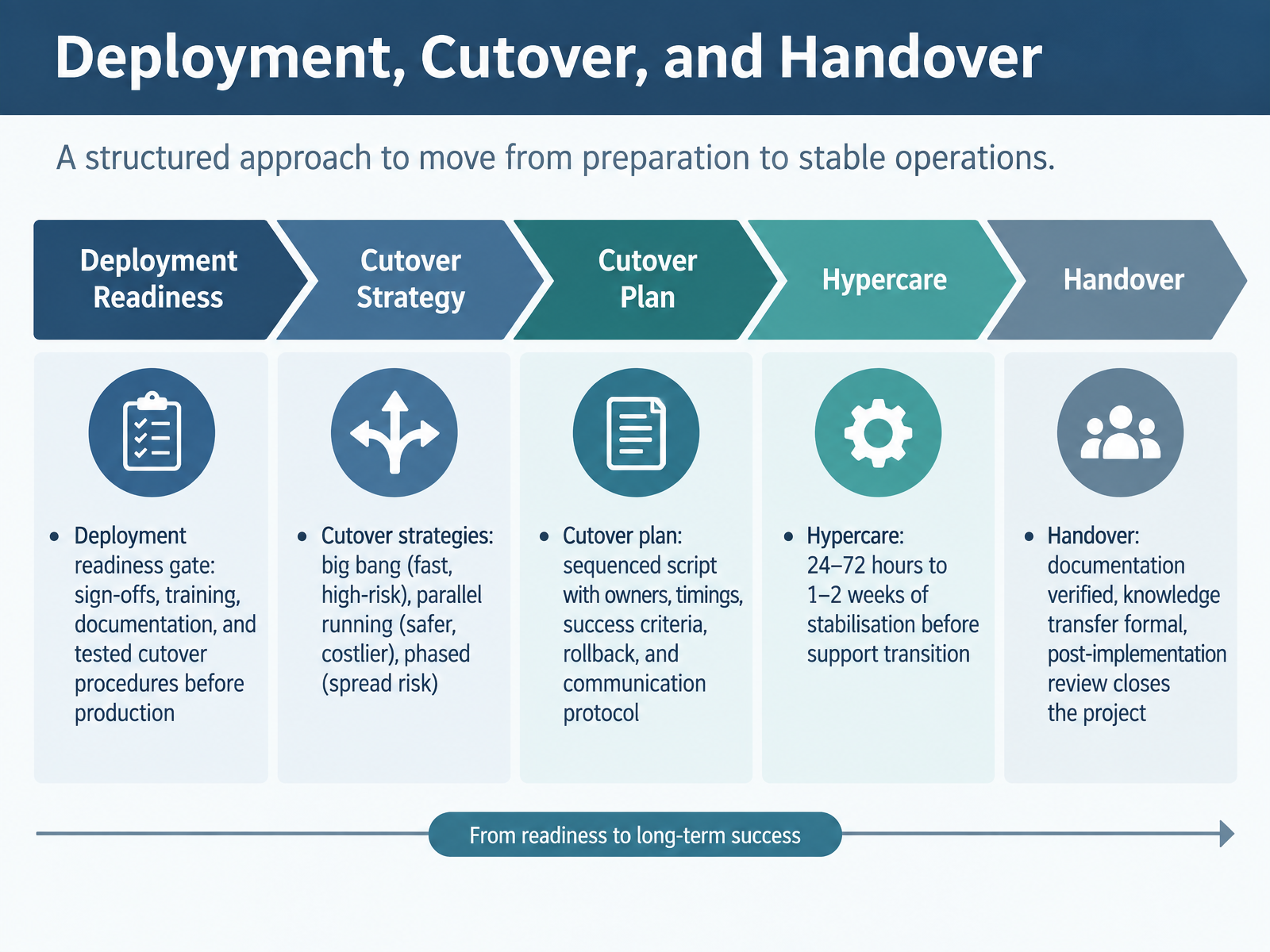
2 min - 11Deployment, Cutover, and HandoverNow let's talk about deployment, cutover, and handover. This is where the system leaves the test environment and real users start depending on it. We start with a deployment readiness gate. Before anyone touches production, we confirm sign-offs are complete, support teams are trained, documentation is ready, and cutover procedures have been reviewed and rehearsed. Then we choose a cutover strategy. Big bang is fast but high risk. Parallel running is safer but more expensive. Phased spreads the risk across smaller events. Whatever we choose, the cutover plan is a detailed script with owners, timings, success criteria, rollback steps, and a communication protocol. After go-live, hypercare keeps the team on standby, usually from twenty four to seventy two hours, sometimes one to two weeks. We close with handover. Documentation is verified, knowledge transfer is formal, and a post-implementation review closes the project. On your current project, check that your cutover plan has named owners and a tested rollback. Next, we'll look at when to choose waterfall, fit criteria, and trade-offs.
 2 min
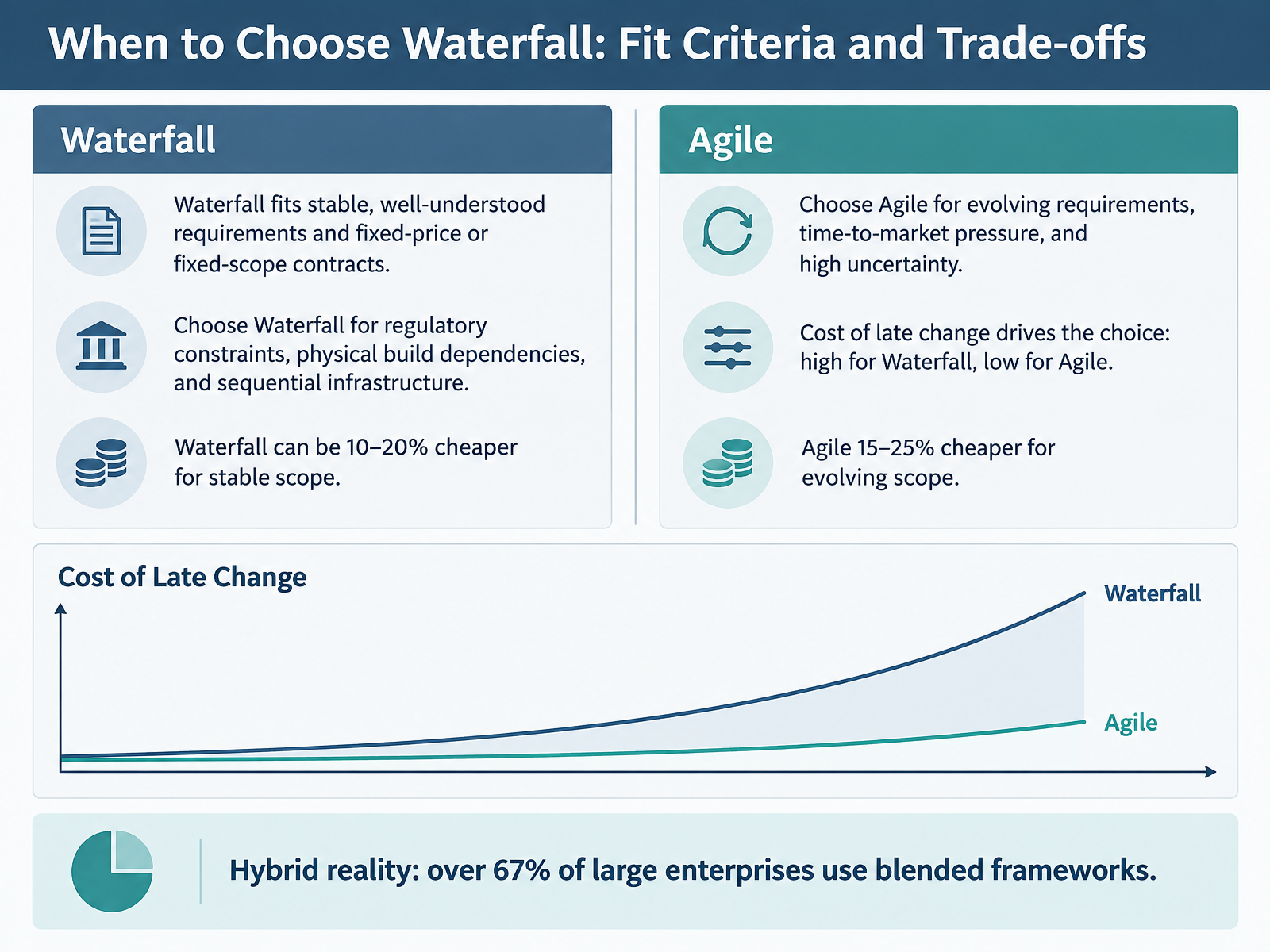
2 min - 12When to Choose Waterfall: Fit Criteria and Trade-offsLet's talk about when Waterfall is genuinely the right call. Picture a fixed-price contract with a locked scope and a detailed statement of work. Late changes mean formal change requests and rework, so upfront planning pays off. That is the core test: how expensive is late change on your project? Heavy regulatory requirements, physical build dependencies, and sequential infrastructure all favor Waterfall. Evolving requirements, time-to-market pressure, and high uncertainty favor Agile. The economics matter too. For truly stable scope, Waterfall can run ten to twenty percent cheaper, largely because it carries less ceremony overhead. Agile is often fifteen to twenty-five percent cheaper when requirements keep moving, because issues surface earlier. Here is the nuance. Over sixty-seven percent of large enterprises now blend both. So use these criteria as inputs, not absolutes. On your current project, list your top three change drivers and score each one. That score tells you where the real risk sits. Next, let's look at how to combine both approaches in a hybrid model.
 2 min
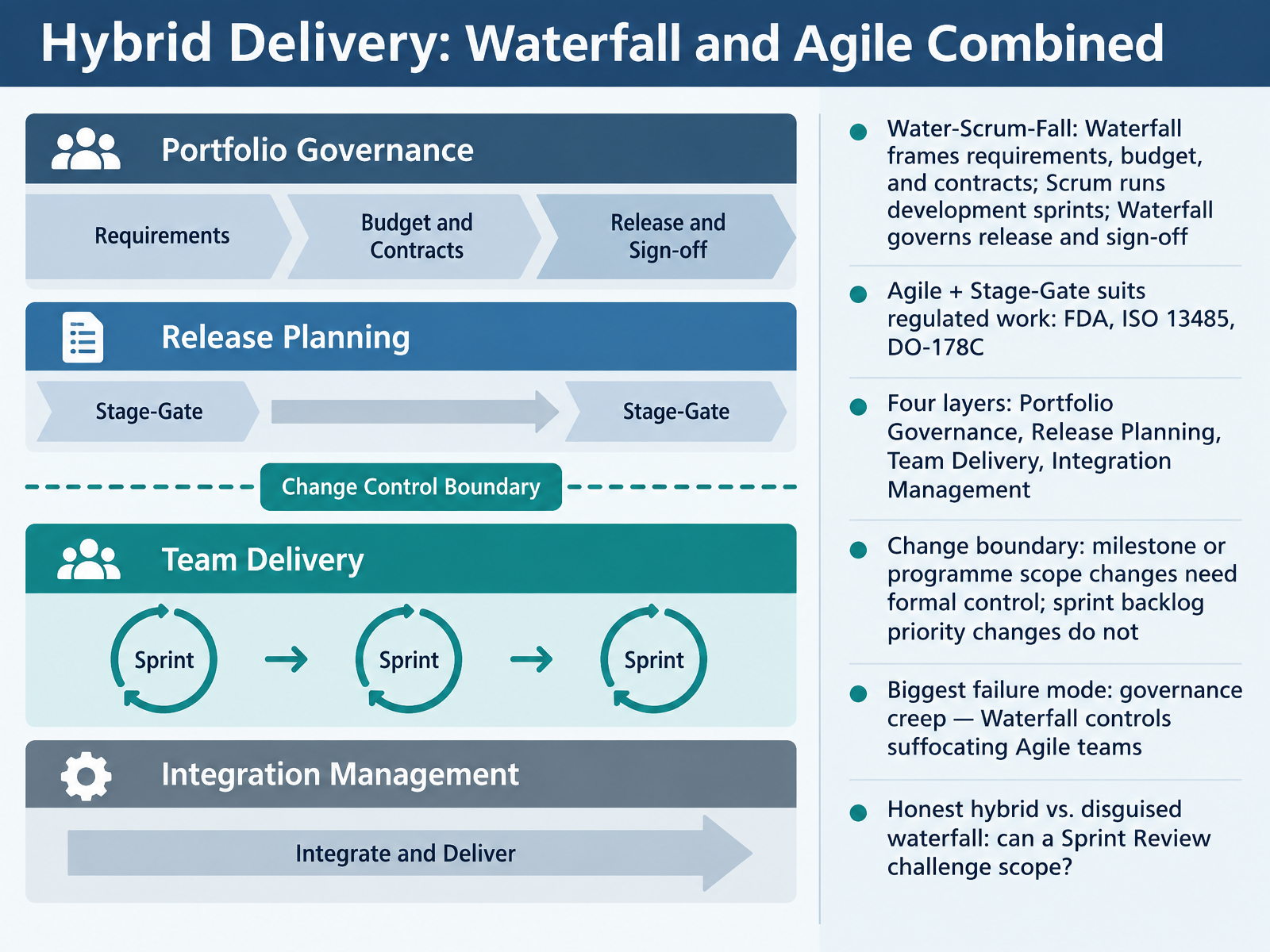
2 min - 13Hybrid Delivery: Waterfall and Agile CombinedLet us look at hybrid delivery, where Waterfall and Agile genuinely combine. Water-Scrum-Fall is the most common pattern we see. Waterfall frames the requirements, budget, and contracts. Scrum runs development sprints. Then Waterfall governs release and sign-off. It suits software projects inside traditionally managed organizations. But hybrid is not one size fits all. Work is organized in four layers. Portfolio Governance sets milestones and stage gates. Release Planning translates commitments into work. Team Delivery runs sprints with real autonomy. Integration Management connects the two vocabularies. Here is the most useful rule we can give you. Changes to milestone dates or programme scope follow formal change control. Changes to sprint backlog priority do not. Write that boundary down at kickoff. The biggest failure mode is governance creep. Waterfall controls designed for the portfolio layer slowly move down into team delivery, suffocating the Agile teams underneath. So ask an honest question. Can a Sprint Review actually challenge scope? If the answer is no, you have disguised Waterfall, not honest hybrid. On your current project, map one workstream to Waterfall, one to Agile, and name the change boundary explicitly. That single act prevents months of confusion. Next, we move to Case Practice, Failure Modes, and Key Takeaways.
 2 min
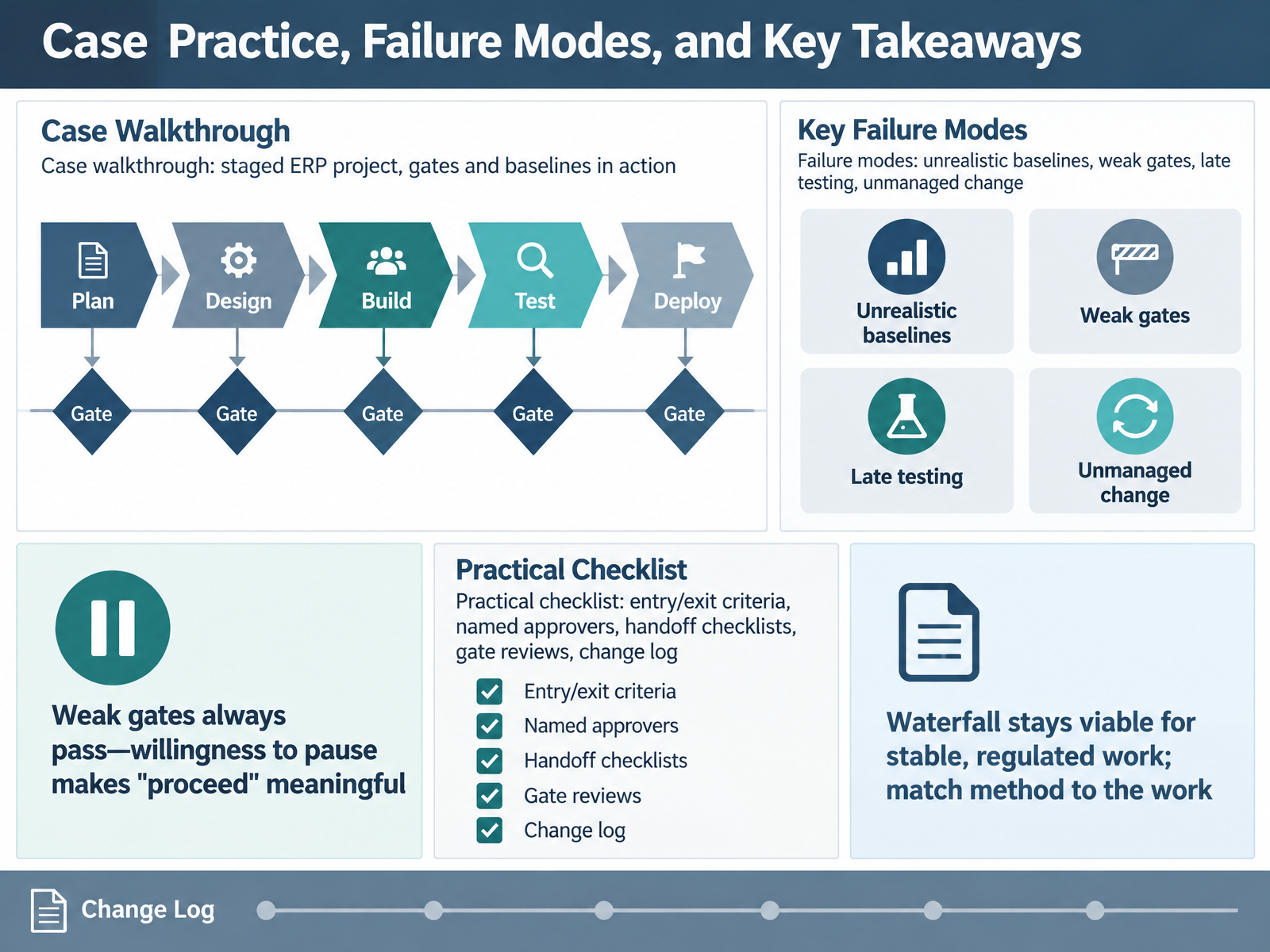
2 min - 14Case Practice, Failure Modes, and Key TakeawaysLet's close with a real case. On a staged ERP rollout, we set gates and baselines before build started. The first gate revealed the finance scope was still unclear, so we paused and reset the baseline. That pause saved us from a late, costly rebuild. Now the failure modes. Unrealistic baselines, weak gates, late testing, unmanaged change. Remember: weak gates always pass. The willingness to pause is what makes proceed meaningful. Use the checklist: entry and exit criteria, named approvers, handoff checklists, gate reviews, and a change log. Waterfall stays viable for stable, regulated work. Match the method to the work. Thanks for joining this course. You now have the tools to run staged delivery with discipline and confidence. Go apply one checklist item on your current project this week.
 1 min
1 min
Take the deck with you
Download this course as a file — free, no sign-up needed.
- PDF handoutEvery slide page, ready to print or share.15 pages · 3.4 MBDownload
- Narrated PowerPointThe deck that presents itself — every slide carries the digital human's narration video.15 pages · 16.4 MBDownload
- PowerPoint slidesThe full deck as a .pptx — open it in PowerPoint, Keynote, or Google Slides.15 pages · 3.2 MBDownload
Free to use in your own training — please keep the PersonWise credit page at the end.
Have your own deck? Turn it into a course
Sources consulted
Web sources consulted while building this course.
- Managing the Development of Large Software Systems — cs.huji.ac.il
- Waterfall Process — martinfowler.com
- MANAGING THE DEVELOPMENT OF LARGE SOFTWARE SYSTEMS — holub.com
- Waterfall model — en.wikipedia.org
- A Brief History of the Waterfall Model: Past, Present, and Future | Proceedings of the 2025 18th International Conference on Computer Science and Information Technology — dl.acm.org
- Project Lifecycle & Phases Advanced Topic 9972 – Project Management Formula — projectmanagementformula.com
- Waterfall Lifecycle – Project Management Formula — projectmanagementformula.com
- Waterfall Project Management Methodology: Phases & Guide — asana.com
- Ultimate Guide to the Phase Gate Process - Smartsheet — smartsheet.com
- Phases of Waterfall Methodology: A Practical Guide - Lark — larksuite.com
- What are the key roles and responsibilities of a change control board in waterfall? — linkedin.com
- Waterfall RACI Matrix Template – Project Management Formula — projectmanagementformula.com
- Project Roles and Responsibilities — resources.finalsite.net
- RACI matrix for Change Management — docs.microfocus.com
- Project Governance Explained: Structures, Roles & Benefits — plprojects.co.uk
- SWE-059 - Bidirectional Traceability Between Software Requirements and Software Design - NASA Software Engineering Handbook Ver B - Global Site — swehb.nasa.gov
- Requirements Traceability Matrix | Demystified — business-analysis-excellence.com
- https://quicksearch.dla.mil/Transient/CBAF3F2A11D04B72B65C4CD4AC127932.pdf — quicksearch.dla.mil
- What is a Traceability Matrix? Guide + Example - Jama Software — jamasoftware.com
- PPI-005696-6 Page 1 of 11 © Copyright Project Performance International (PPI) 2012-2020 PPI-005696-6 Page 2 of 11 © Copyright Project Performance International (PPI) 2012-2020 — ppi-int.com