Nationalism and the Modern Nation-State
Begin
14 pages · ~28 min
Nationalism and the Modern Nation-State
Explores the origins, ideologies, and evolution of nationalism and its role in shaping modern nation-states.
What you’ll learn
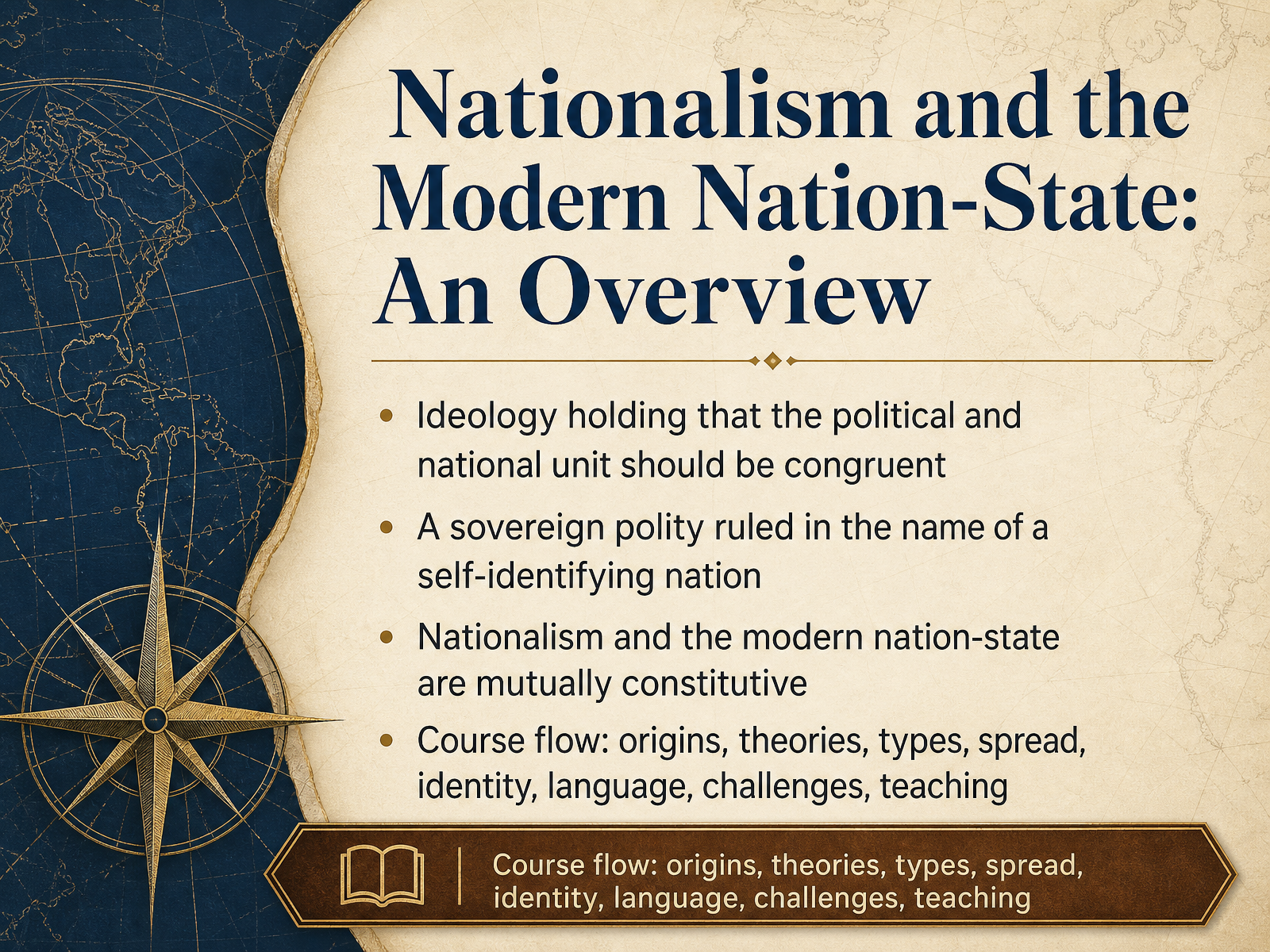
- 01Nationalism and the Modern Nation-State: An OverviewWelcome to this course on Nationalism and the Modern Nation-State. Over the next few sessions, we will explore one of the most powerful, and most contested, forces in modern political history. At its core, nationalism is an ideology holding that the political unit and the national unit should be congruent. In other words, a nation, a people who share a common identity, should also have a sovereign state of their own. This gives us the modern nation-state: a sovereign polity ruled in the name of a self-identifying nation. What makes this relationship so fascinating is that nationalism and the nation-state are mutually constitutive. Each one helps to create and sustain the other. To understand how, we will trace the historical origins of these ideas, examine the major theories that explain their rise, and compare different types, from civic to ethnic nationalism. We will also consider how national identity spreads through language and culture, the challenges facing nation-states today, and what all of this means for how we teach history. Now, let us begin by looking at where the modern system of states first emerged. From Empires and Dynasties to Territorial States.britannica.complato.stanford.eduannualreviews.org+22 min
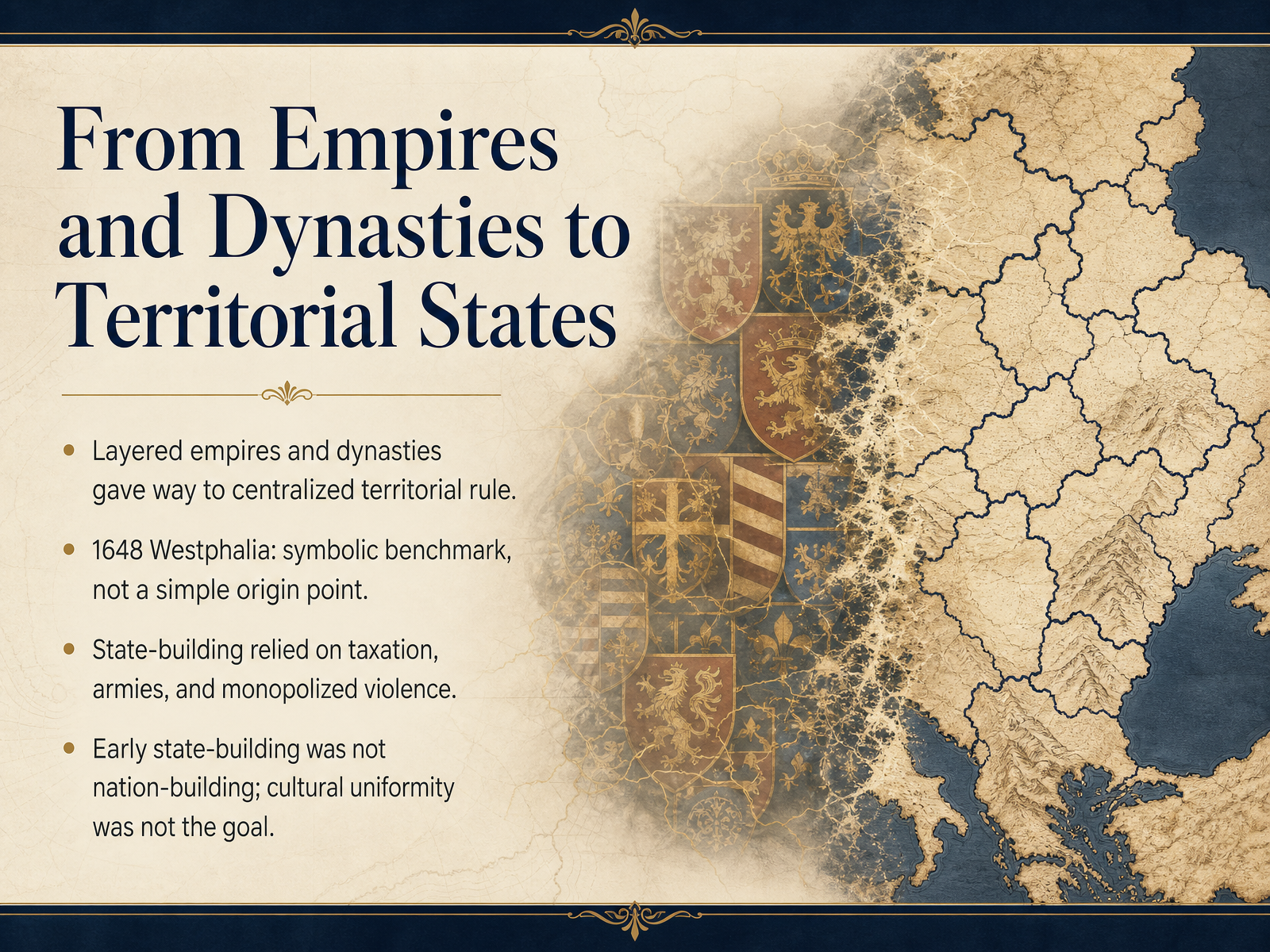
- 02From Empires and Dynasties to Territorial StatesFor centuries, political authority in Europe looked less like a clean map and more like a layered patchwork. Emperors, kings, local lords, and church officials all held overlapping claims over the same people and the same land. The shift away from that world was gradual. And 1648, the Peace of Westphalia, is often cited as the turning point. It is a useful symbolic benchmark because it marks the end of decades of religious war. But it is not a simple origin story. Modern historians often call the idea of Westphalia as a clean break the Westphalian myth. The treaties were really about redistributing authority within the Holy Roman Empire, not about creating equal, sovereign states in the way we think of them today. So what actually drove state-building? It was far more practical. Rulers needed reliable taxation to fund standing armies. In turn, those armies allowed them to monopolize violence within a defined territory. It is also crucial to note what early state-building was not. It was not nation-building. Kings and princes were not trying to create a single, culturally uniform people. Their goal was control over territory and resources, not shared language or shared identity. That deeper connection between state and nation would come from a very different source. So let us turn next to the revolutionary turn, when sovereignty was claimed not by a monarch, but by the nation itself.
 cambridge.orgjstor.orgen.wikipedia.org+22 min
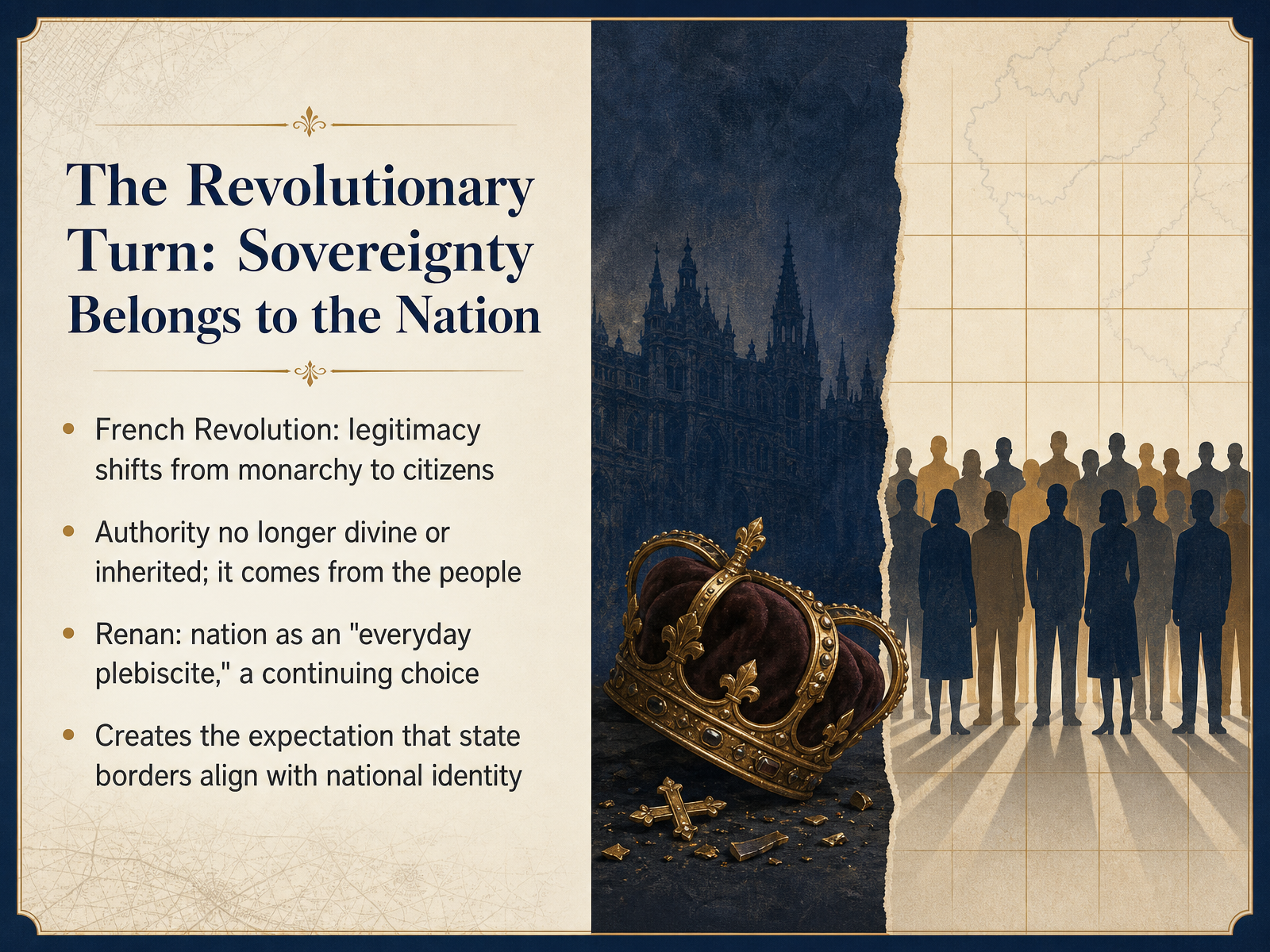
 - 03The Revolutionary Turn: Sovereignty Belongs to the NationNow let us turn to the moment when this idea truly becomes revolutionary. The French Revolution marks a decisive shift in the source of political legitimacy. Before this, authority flowed downward from a monarch, often justified by divine right or inherited bloodline. After it, authority is imagined as rising upward from the citizens themselves. The nation is no longer the king's domain; it is a body of people who claim collective sovereignty. Consider how radical that is. Legitimacy no longer rests on tradition or heaven, but on the will of a people. The French thinker Ernest Renan captured this perfectly in the nineteenth century when he called the nation an everyday plebiscite. He meant that national belonging is not a one-time contract or a fixed genetic inheritance. It is a continuing choice, a daily reaffirmation of the desire to live together under shared rules. This creates a powerful new expectation. If sovereignty belongs to the nation, then the borders of the state should align with the boundaries of national identity. Political maps and cultural communities are suddenly supposed to match. This idea, simple to state but extraordinarily complex in practice, sets the stage for the classic theories that try to explain how nationalism actually works.
 britannica.complato.stanford.eduannualreviews.org+21 min
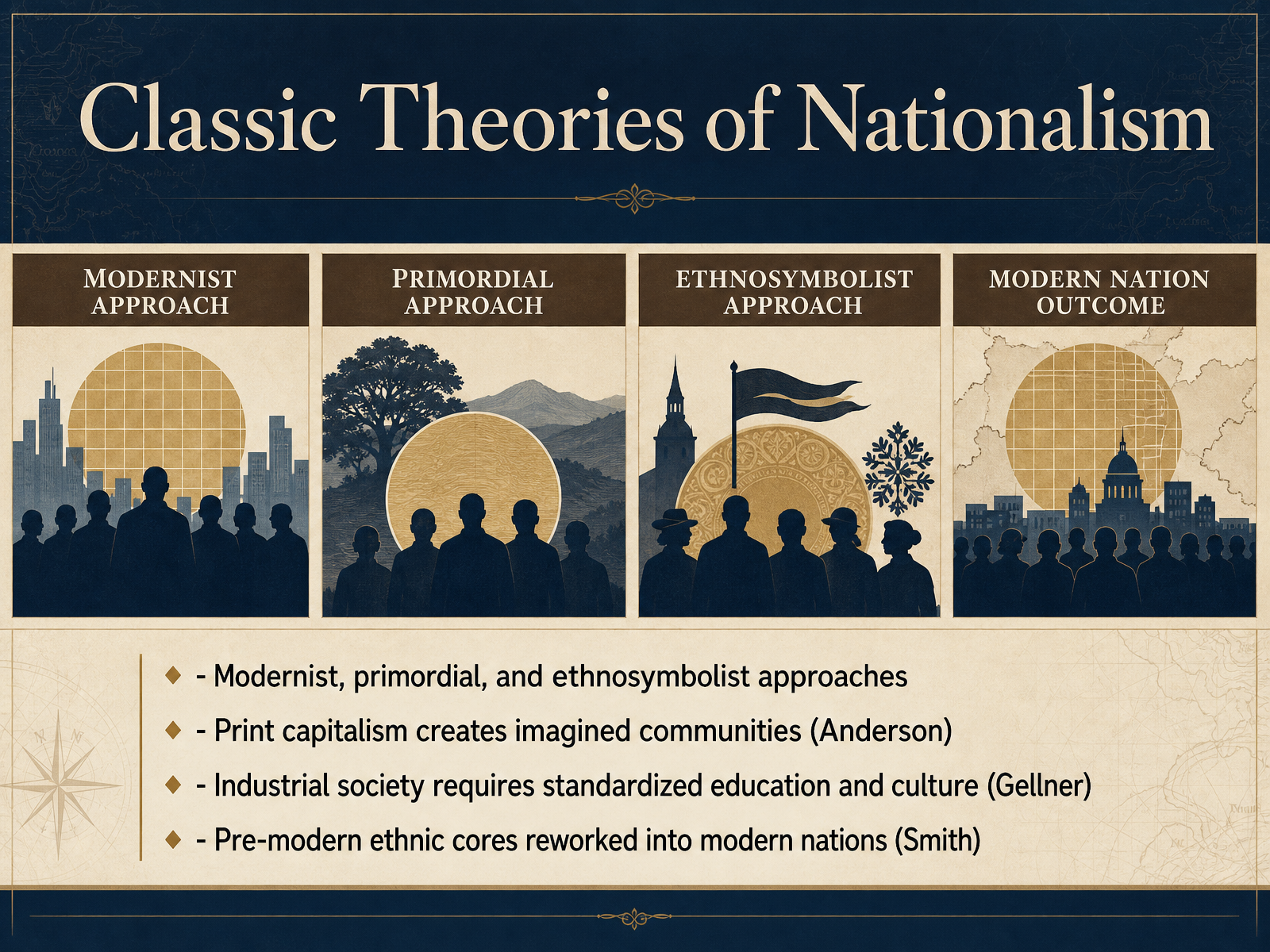
 - 04Classic Theories of NationalismLet us now turn to the classic theories that try to explain where nations actually come from. Broadly speaking, scholars have grouped these into modernist, primordial, and ethnosymbolist approaches, though the strongest and most influential debates have centered on the first and the third of these. Benedict Anderson offers a compelling image. He argues that the rise of print capitalism, meaning newspapers, novels, and other publications written in shared vernacular languages, allowed people who would never meet one another to feel connected through a common language and shared daily reading. In his famous phrase, nations are imagined communities, not because they are false, but because their members cannot know everyone in the nation yet still carry an image of their shared communion. Ernest Gellner shifts our attention from print to industry. In his view, modern industrial societies need a mobile, literate workforce and standardized forms of communication. As a result, states build universal education systems that spread a common high culture, and this process turns people into fellow members of a nation, almost as an unintended consequence of modernization. Anthony D. Smith adds an important qualification. He agrees that modern nations are shaped by contemporary forces, but he insists they do not emerge from nothing. Nations draw on pre-modern ethnic cores, such as shared myths, symbols, memories, and traditions, which elites then rework into modern national identities. This helps explain why some nations feel deeply rooted even when their political forms are recent. Next, we will use these theoretical tools to examine civic and ethnic nationalism as analytical lenses.
 plato.stanford.educambridge.orgcambridge.org+22 min
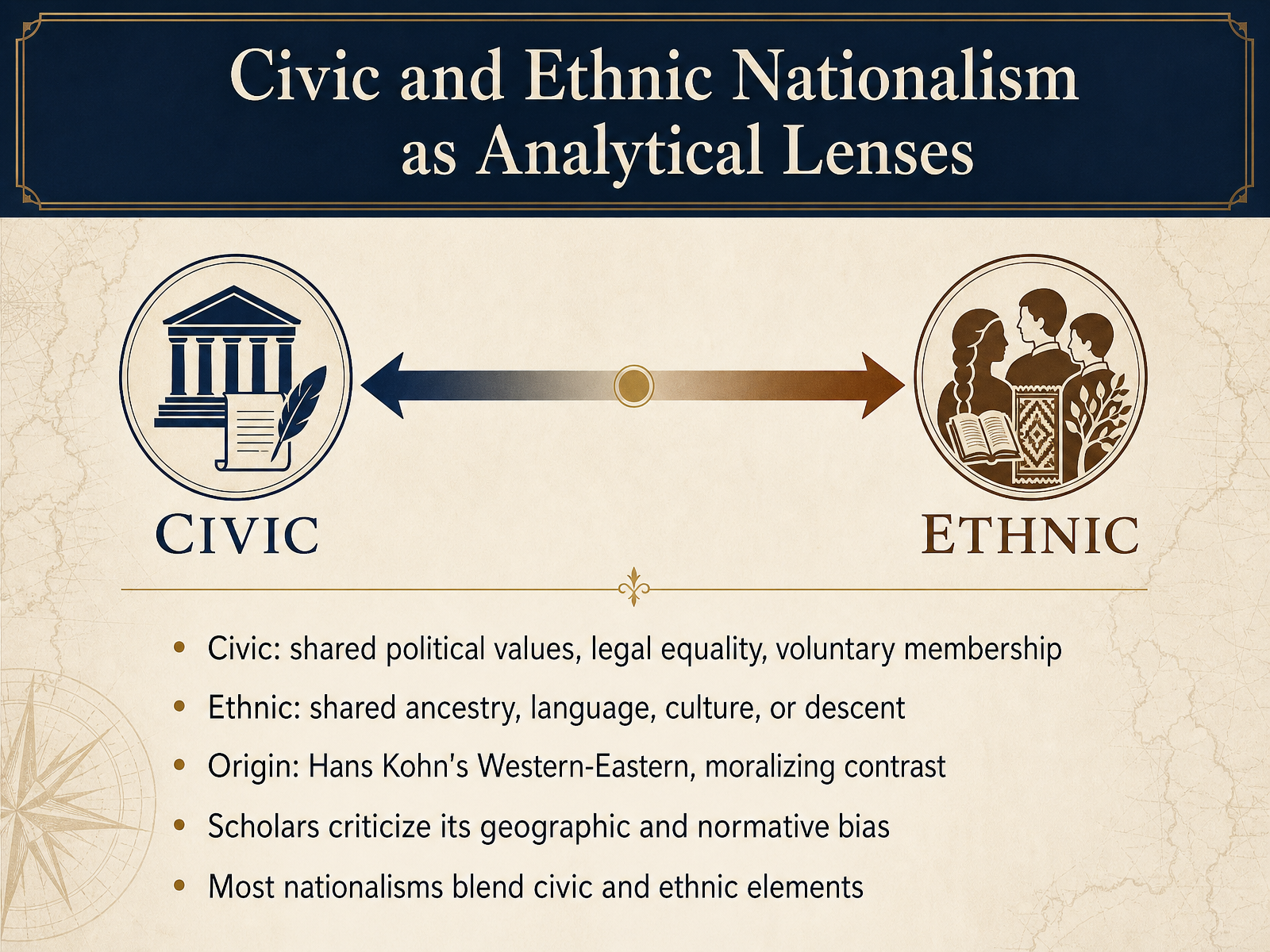
 - 05Civic and Ethnic Nationalism as Analytical LensesNow, let us turn to two analytical lenses that scholars have long used to make sense of nationalism: the civic and the ethnic. In its ideal form, civic nationalism is built on shared political values, legal equality, and a sense of voluntary membership. Think of a national community defined by adherence to a constitution, rather than by the ancestry of its members. Ethnic nationalism, by contrast, draws its strength from shared ancestry, language, culture, or presumed descent. This distinction is usually traced to Hans Kohn, who framed it as a moral contrast between a rational West and an emotional East. But that framing has drawn serious criticism for carrying a geographic and normative bias. In practice, as historians have repeatedly shown, most nationalisms blend civic and ethnic elements. Even nations that celebrate citizenship also rely on language, memory, and cultural assumptions about belonging. So it is often more helpful to treat this as a spectrum than as a clean split. With that caution in mind, we can now shift to the historical question behind the spread of these ideas, as nationalism travels across the globe.
 annualreviews.orgcambridge.orgjournals.sagepub.com+22 min
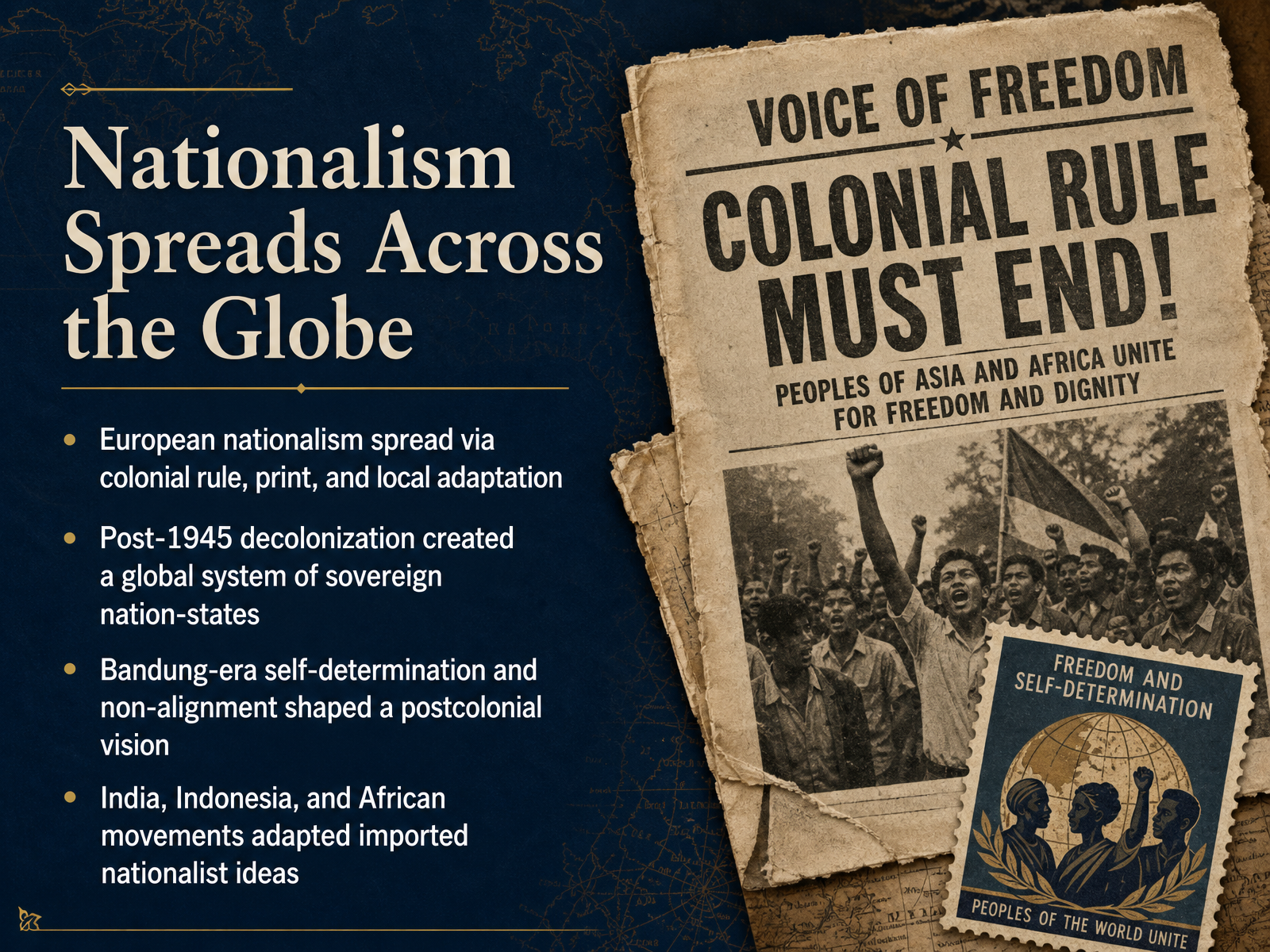
 - 06Nationalism Spreads Across the GlobeLet’s turn now to the moment when nationalism went global. European ideas about the nation did not simply stay in Europe. They traveled through colonial administrations, through print culture, and through local interpreters who reshaped them in their own contexts. What emerged was not a copy. It was a creative adaptation. After 1945, this process accelerated dramatically. The era of formal empires gave way to a world of sovereign states. Between 1945 and 1960 alone, dozens of new states in Asia and Africa achieved independence. Some transitions were peaceful. Others came through long and violent struggle. The result was a new international landscape. At the Bandung Conference in 1955, leaders from Asia and Africa articulated a shared vision of self-determination and non-alignment. They sought a path that was neither tied to Western colonial powers nor absorbed into Cold War blocs. In India, Indonesia, and across African movements, nationalism arrived as an imported framework. But local actors gave it new meanings. They tied it to anti-colonial mobilization, to pan-African solidarity, and to the practical work of building new states. So the global spread of nationalism was not a simple diffusion. It was a process of translation, contestation, and reinvention. That creative reinvention set the stage for the symbols and collective memories that would anchor these new nations.
 cambridge.org2 min
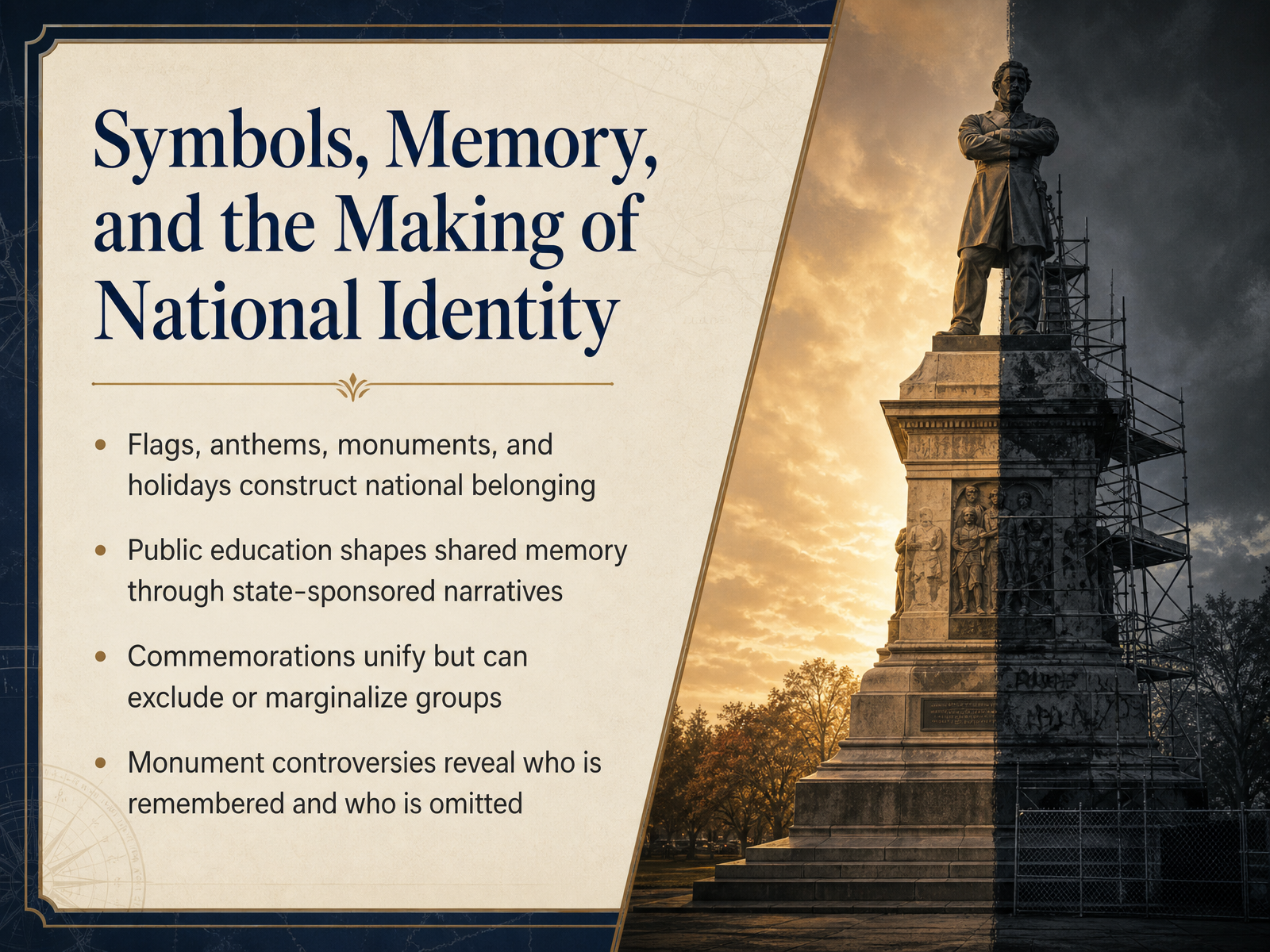
 - 07Symbols, Memory, and the Making of National IdentityLet's turn now to the symbols and rituals that make a nation feel tangible in daily life. Flags, anthems, monuments, and national holidays are not simply decorative. They deliberately construct a sense of belonging. Consider the quiet presence of a flag outside a public building or the shared silence during a national anthem. These moments create emotional bonds that political documents alone rarely achieve. Public education plays a central role in this process. Through textbooks, school ceremonies, and field trips to memorials, students are introduced to a state-sponsored story of the shared past. Research from contexts such as Poland and Turkey shows that teachers actively transmit narratives of national unity and sacrifice precisely because these lessons are meant to shape identity, not just impart facts. Yet commemorations have a double edge. While they unify a majority, they can also exclude groups whose histories do not fit the official narrative. This is why monument controversies are so revealing. Debates over who deserves a statue expose the tensions between public memory and historical truth. As we will see next, these debates are deeply connected to language, print, and mass media in nation-building.
 2 min
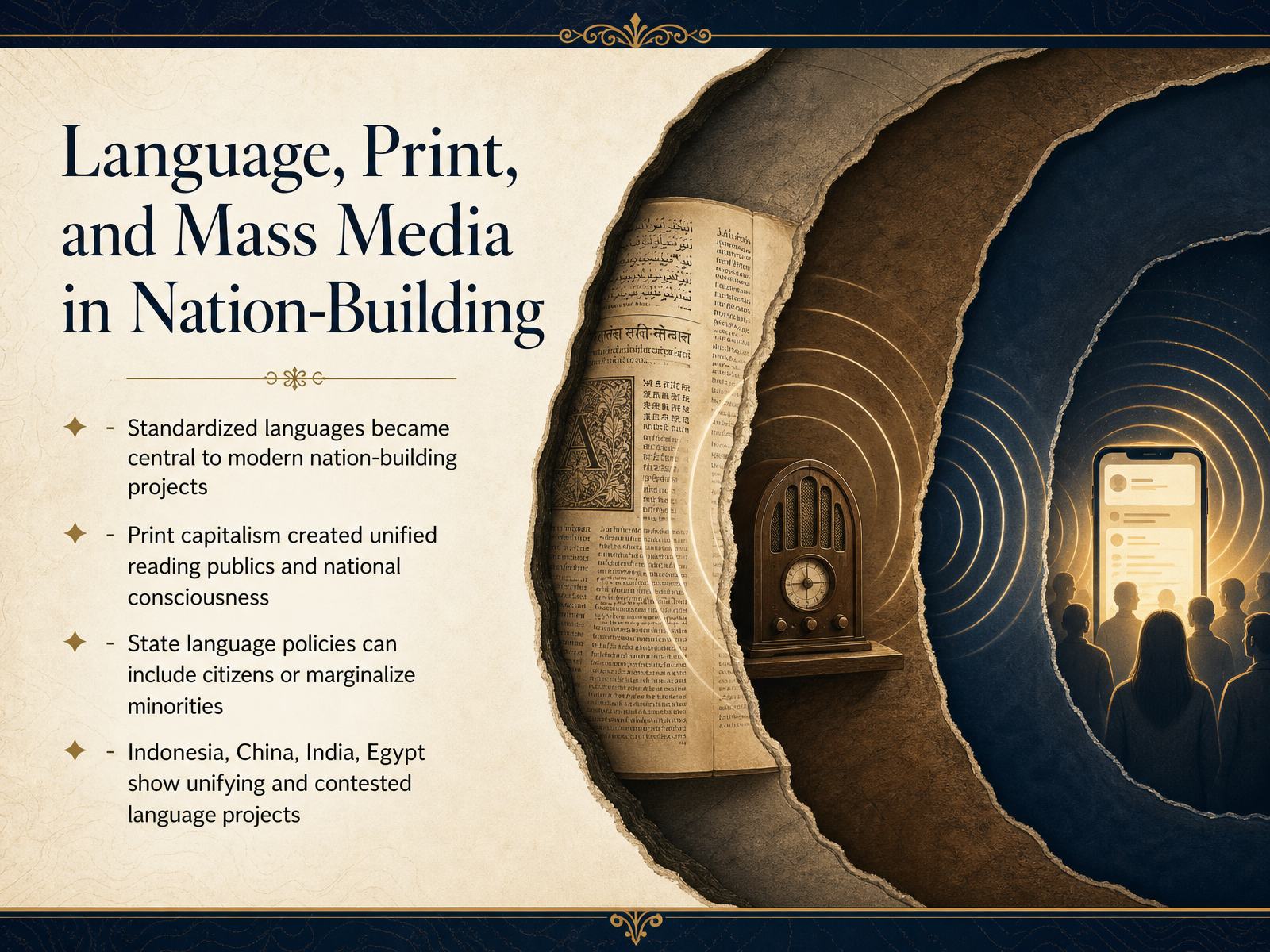
2 min - 08Language, Print, and Mass Media in Nation-BuildingLanguage does more than communicate. In the modern era, it became a central tool for building nations. Standardized languages helped create unified reading publics, groups of strangers who shared the same newspapers, books, and ideas. This process, often called print capitalism, turned local dialects into national tongues and gave people a sense of belonging to a larger community. But language policy cuts both ways. While states have used it to include citizens, they have also used it to marginalize minorities. Consider Indonesia, where Malay, the language of trade, was transformed by the press into a unifying national language. In China, the early republican state designed Mandarin as an accessible standard for a new kind of society. India saw a sharp debate over Hindi and Urdu, reflecting deeper cultural divisions. In Egypt, colloquial mass media helped forge a broader national identity. In each case, language was not simply a reflection of the nation. It helped to create it, often through struggle. Next, we examine what happens when these national projects come under strain in the nation-state under pressure.
 2 min
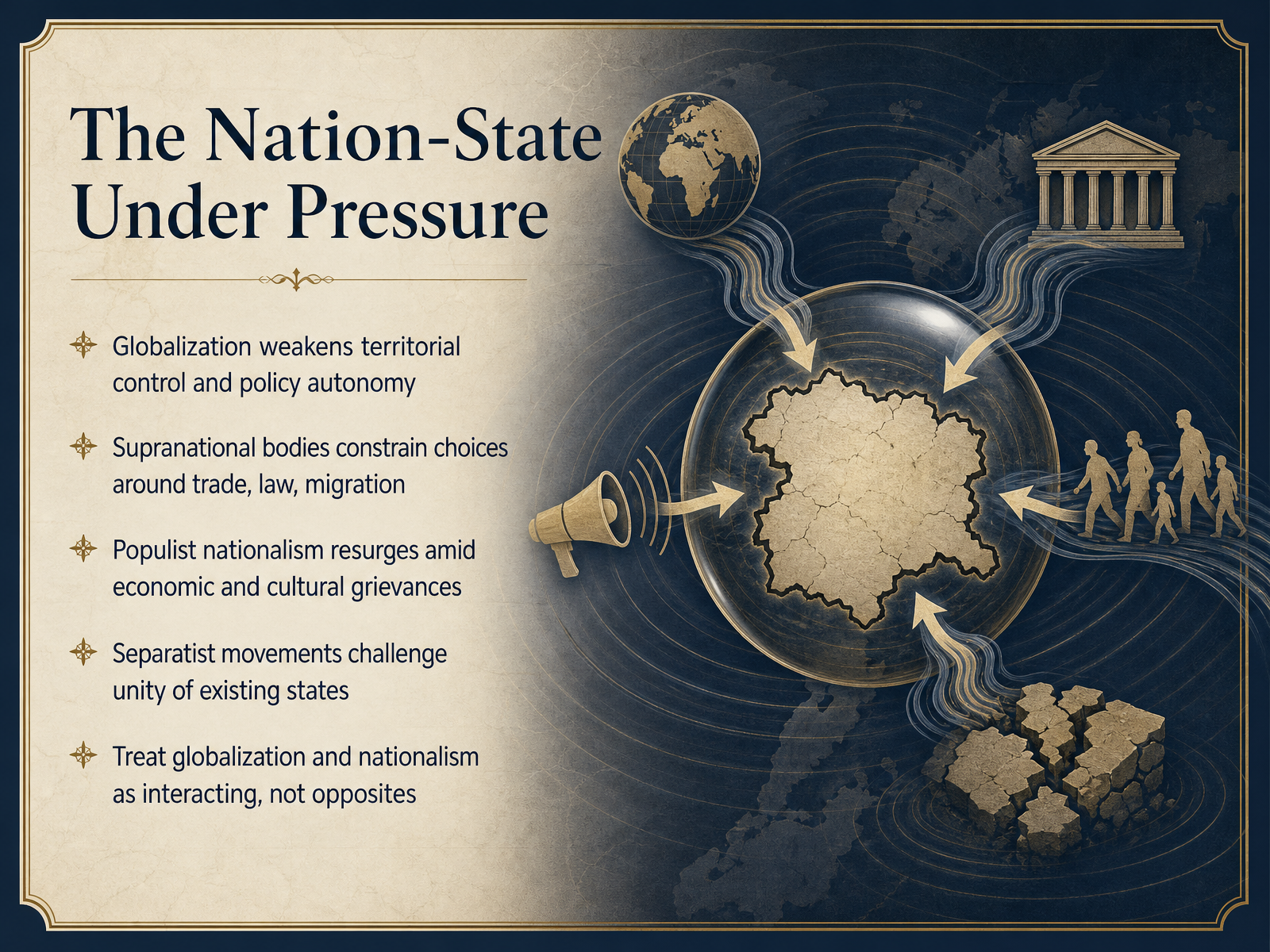
2 min - 09The Nation-State Under PressureNow we come to the forces placing the modern nation-state under real pressure. Globalization has steadily thinned the boundary between domestic policy and the wider world. Governments may still claim sovereignty, but in practice their control over trade, migration, and even law is increasingly constrained by supranational bodies and shared economic dependencies. This helps explain a striking political reaction. Since the early twenty tens, data on ethnic power relations shows a reversal of inclusive politics, and right-wing populist parties have become regular fixtures across Europe and beyond. Their appeal often rests on economic and cultural grievances, especially among people who feel left behind by liberal interdependence. At the same time, separatist movements continue to test the internal unity of established states. It would be misleading, however, to treat globalization and nationalism as simple opposites. They often feed each other. Nationalist movements operate through global networks, while globalization itself can deepen the desire for cultural and political control. The challenge for today's states is not choosing one side of this tension, but learning to manage it. Next, we turn to nationalism in the digital and post-neoliberal era.
 2 min
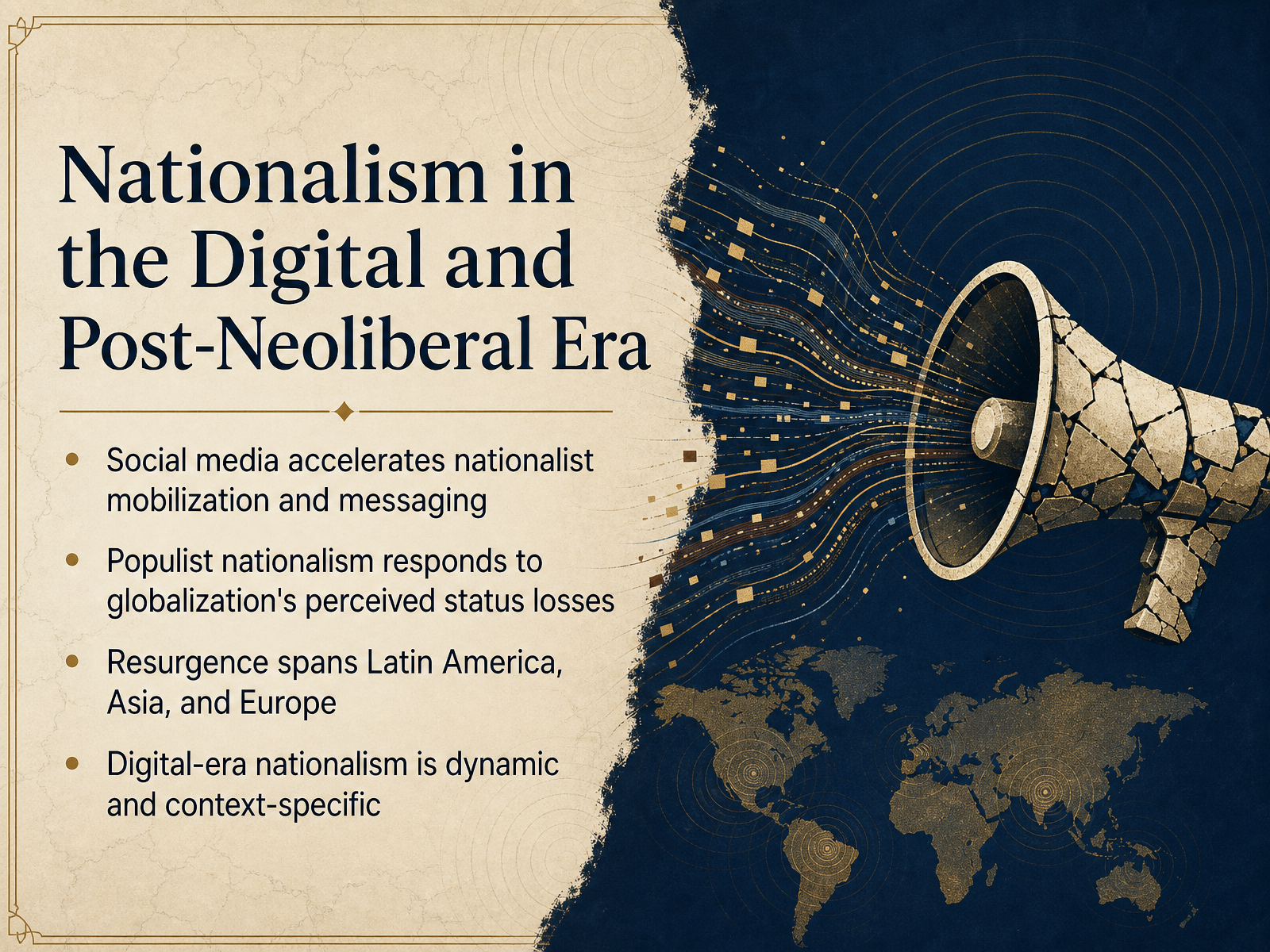
2 min - 10Nationalism in the Digital and Post-Neoliberal EraBuilding on that foundation, let's consider how nationalism operates in our current digital and post-neoliberal era. The most visible change is speed. Social media platforms have dramatically accelerated nationalist mobilization and messaging. Ideas and grievances that once took months to organize around can now ignite overnight, crossing regional boundaries with a share or a retweet. This digital acceleration feeds into a broader political shift. Populist nationalism often responds directly to the perceived status losses caused by decades of globalization. Many working and middle-class communities feel that the economic gains of global integration bypassed them entirely, a sentiment documented across eighteen countries. What makes this resurgence so striking is its geographic breadth. We are not seeing a single regional exception, but a dynamic pattern spanning Latin America, Asia, and Europe simultaneously. The specific grievances and symbols differ, yet the underlying call to restore national dignity is remarkably consistent. So, as we move forward, we must avoid treating this nationalism as a static, monolithic force. It is dynamic and highly context-specific, shaped by local histories and digital environments. With that complexity in mind, let's turn to how we might teach and communicate nationalism today.
 2 min
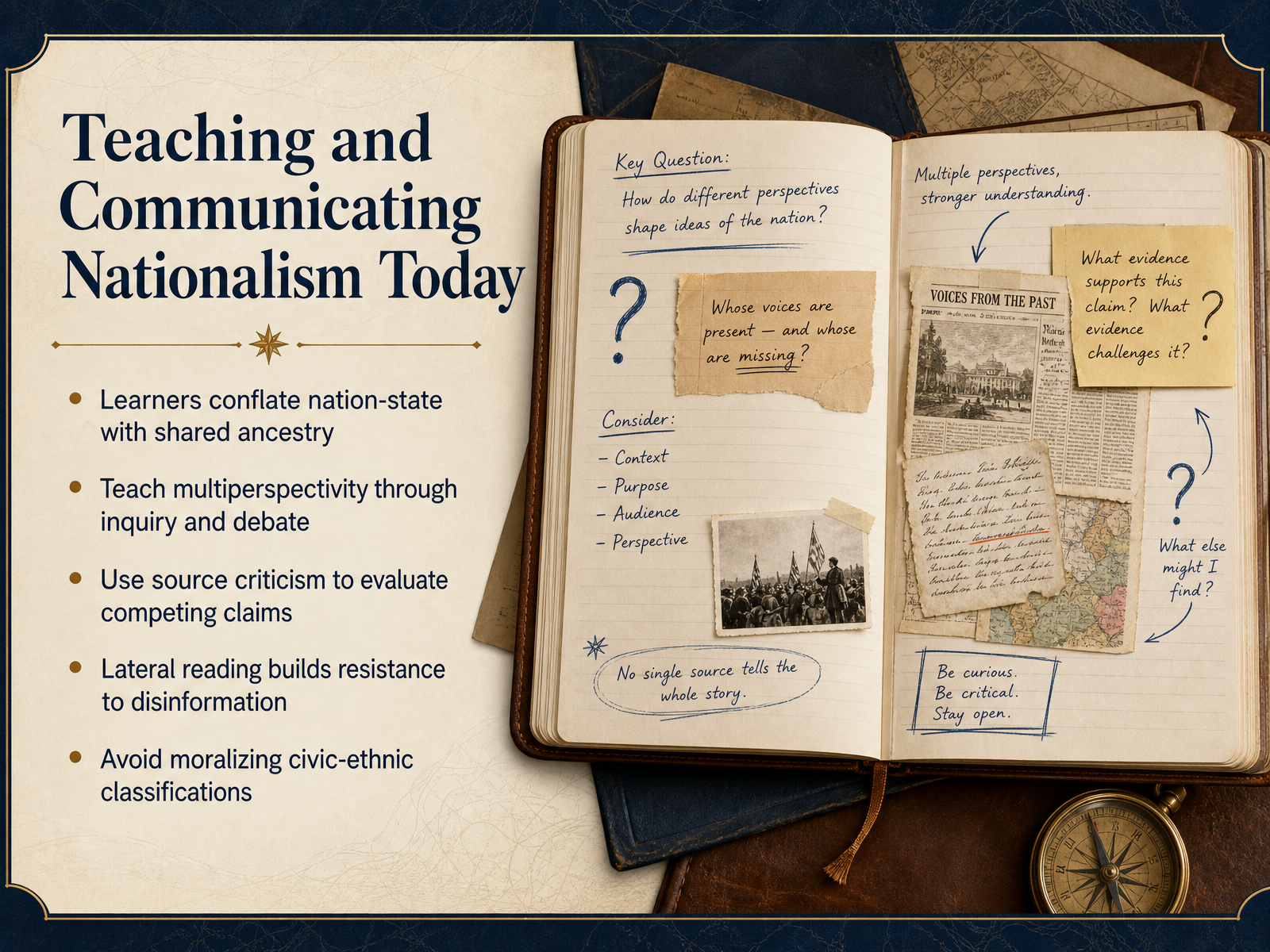
2 min - 11Teaching and Communicating Nationalism TodayNow let's turn to what this means for teaching and communicating these ideas today. One of the most persistent challenges is the common assumption that a nation-state is simply a community of shared ancestry. In the classroom, that can quietly exclude civic forms of belonging, migration, and multiethnic realities. A more productive approach is to teach multiperspectivity through structured inquiry and debate, so learners see national identity as contested and continuously rebuilt. Source criticism is equally important. When students evaluate competing claims by asking who produced a source, for whom, and for what purpose, they begin to distinguish evidence from justification. Practical strategies like lateral reading help here, because students learn to leave a page and investigate the author, organization, and context rather than simply trusting the site itself. This builds real resistance to disinformation. Finally, we should avoid moralizing the familiar civic versus ethnic distinction. The point is not to label one as good and the other as bad, but to understand how both logics have shaped institutions, exclusions, and belonging. With that in mind, let's move next to evidence, sources, and responsible framing.
 2 min
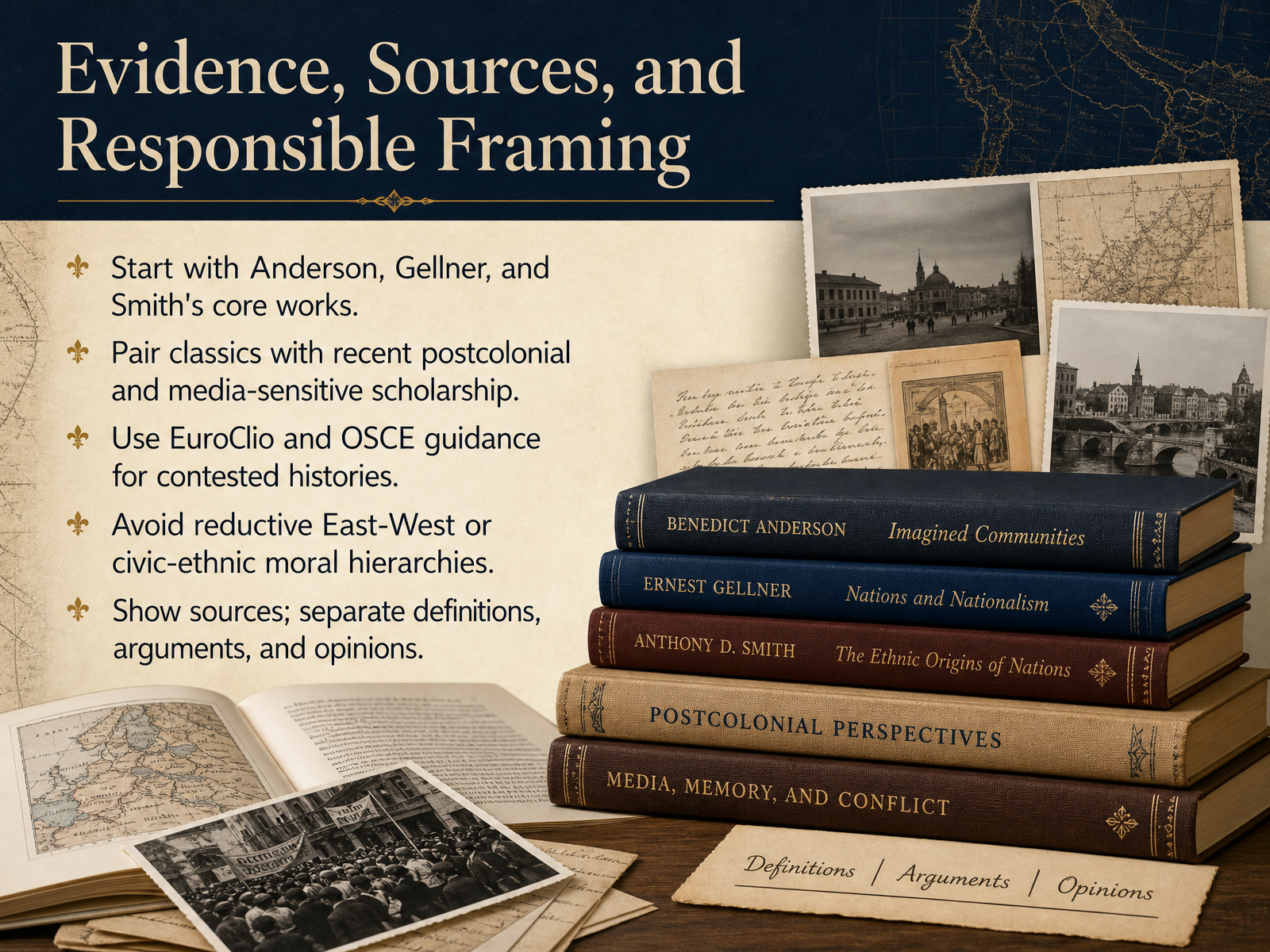
2 min - 12Evidence, Sources, and Responsible FramingLet’s turn to how we handle evidence responsibly in this field. Begin with the core theoretical works: Benedict Anderson’s Imagined Communities, Ernest Gellner’s Nations and Nationalism, and Anthony D. Smith’s work on ethnic origins and national identity. These texts remain foundational, but they also carry assumptions worth testing. Pair them with more recent scholarship that addresses postcolonial experiences and media-saturated societies. When you work with contested histories, consult practical guidance from bodies like EuroClio and the OSCE High Commissioner on National Minorities. Their frameworks emphasize multiperspectivity and the recognition of uncertainty in historical inquiry. Be cautious about framing arguments as a simple East versus West or civic versus ethnic contrast. Nationalism is richer and messier than those binaries suggest. In both your writing and your teaching, show your sources explicitly. Make it clear where a definition ends, where an argument begins, and where you are offering an interpretation. If students see that distinction modeled clearly, they are more likely to practice it themselves. Next, we’ll apply that discipline directly through structured case exercises.
 plato.stanford.educambridge.orgcambridge.org+22 min
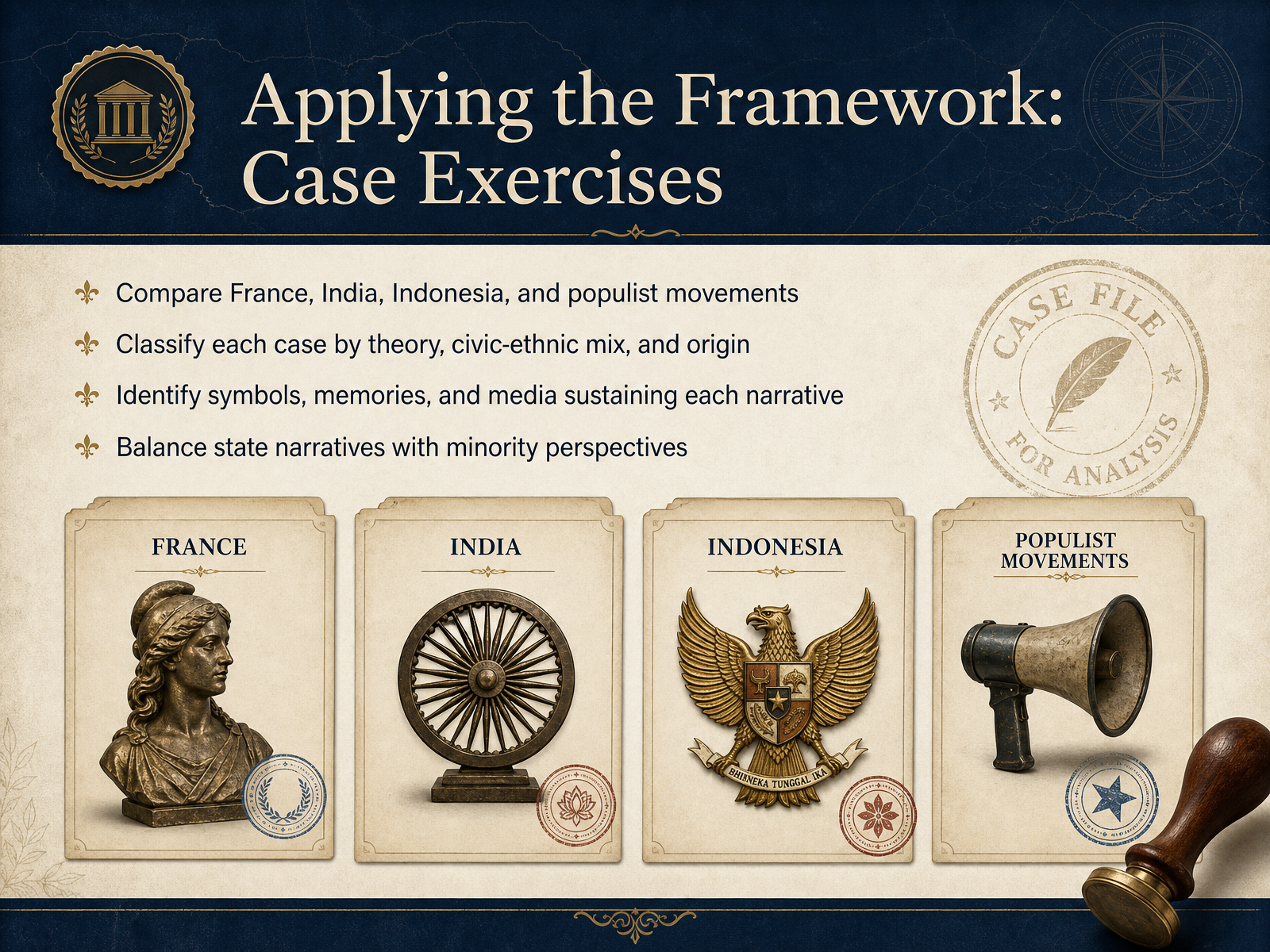
 - 13Applying the Framework: Case ExercisesLet us apply this framework through a set of comparative exercises. First, place France, India, Indonesia, and contemporary populist movements side by side. Ask which theoretical lens best explains each case, whether the civic or ethnic dimension dominates, and how each national story originally took shape. France offers a long civic tradition grounded in revolution and republicanism. India and Indonesia emerged from decolonization with explicitly plural, civic commitments designed to hold together multi ethnic societies. Populist movements, in contrast, often push toward a more ethnic and exclusionary register. Then, look for the cultural infrastructure. What symbols, historical memories, and media forms carry each narrative? Consider revolutionary anniversaries in France, anti colonial struggle in Indonesia, or founding myths in India. Finally, weigh official state narratives against minority perspectives. Where do these accounts reinforce one another, and where do they collide? This balance prevents the framework from becoming a tool that only legitimizes the dominant story.
 cambridge.org1 min
 - 14Key Takeaways and Further LearningAs we come to the end of this course, let's step back and consider the larger picture. Nationalism and the nation-state are not finished products. They continue to shape one another, sometimes openly, sometimes quietly, in laws, schools, media, and public rituals. When you use the civic and ethnic lens, try not to treat the two as sealed boxes. Most real cases blend them, and even civic nations carry cultural inheritances built over long periods of nation building. For educators and content creators, that insight is directly useful. It means the goal is not to replace one neat story with another, but to show how membership, memory, and political identity are negotiated. As you move forward, compare cases across regions, question singular national narratives, verify the origin and purpose of any source, and intentionally diversify the voices you bring into your teaching or creative work. That critical habit is what turns theory into something usable. Thank you for joining this course. I hope it leaves you better equipped to think and communicate about nationalism with rigor and care.
 britannica.complato.stanford.eduannualreviews.org+22 min
Take the deck with you
Download this course as a file — free, no sign-up needed.
- PDF handoutEvery slide page, ready to print or share.15 pages · 5.9 MBDownload
- Narrated PowerPointThe deck that presents itself — every slide carries the digital human's narration video.15 pages · 19.5 MBDownload
- PowerPoint slidesThe full deck as a .pptx — open it in PowerPoint, Keynote, or Google Slides.15 pages · 5.9 MBDownload
Free to use in your own training — please keep the PersonWise credit page at the end.
Have your own deck? Turn it into a course
Sources consulted
Web sources consulted while building this course.
- Nation-state | Definition, Characteristics, & Politics — britannica.com
- Nationalism (Stanford Encyclopedia of Philosophy) — plato.stanford.edu
- Nationalism: What We Know and What We Still Need to Know | Annual Reviews — annualreviews.org
- Nation state — en.wikipedia.org
- 8.4 Modern Nation-States - Introduction to Anthropology | OpenStax — openstax.org
- Rethinking the sovereign state model — cambridge.org
- THE WESTPHALIA LEGACY AND THE MODERN NATION- ... — jstor.org
- Peace of Westphalia — en.wikipedia.org
- The Peace of Westphalia (1648) as a Secular Constitution - Institute for International Law and Justice — iilj.org
- ‘Colonial reflection’ and territoriality: The peripheral origins of sovereign statehood — journals.sagepub.com
- Theories and types of nationalism — cambridge.org
- Rethinking Benedict Anderson and Anthony Smith's ... — cambridge.org
- Anthony D. Smith on nations and national identity: a critical assessment — onlinelibrary.wiley.com
- Two Perspectives on the Relationship of Ethnicity to Nationalism: Comparing Gellner and Smith - Alternatives: Turkish Journal of International Relations — dergipark.org.tr
- Not So Civic: Is There a Difference Between Ethnic and Civic Nationalism? | Annual Reviews — annualreviews.org
- National identity and the “Kohn dichotomy” — cambridge.org
- Decolonizing the civic/ethnic binary — journals.sagepub.com
- Civic Nationalism vs. Ethnic Nationalism — study.com
- Civic and Ethnic Nationalism in European Union Identity Creation — sv.uio.no
- Decolonizing Decolonization | Comparative Studies in Society and History | Cambridge Core — cambridge.org