Why Earth Has Seasons: Tilt & Orbit
Begin
15 pages · ~30 min
Why Earth Has Seasons: Tilt & Orbit
This training explains how Earth's axial tilt, sunlight variation, and orbital path create the four seasons for a general audience.
What you’ll learn
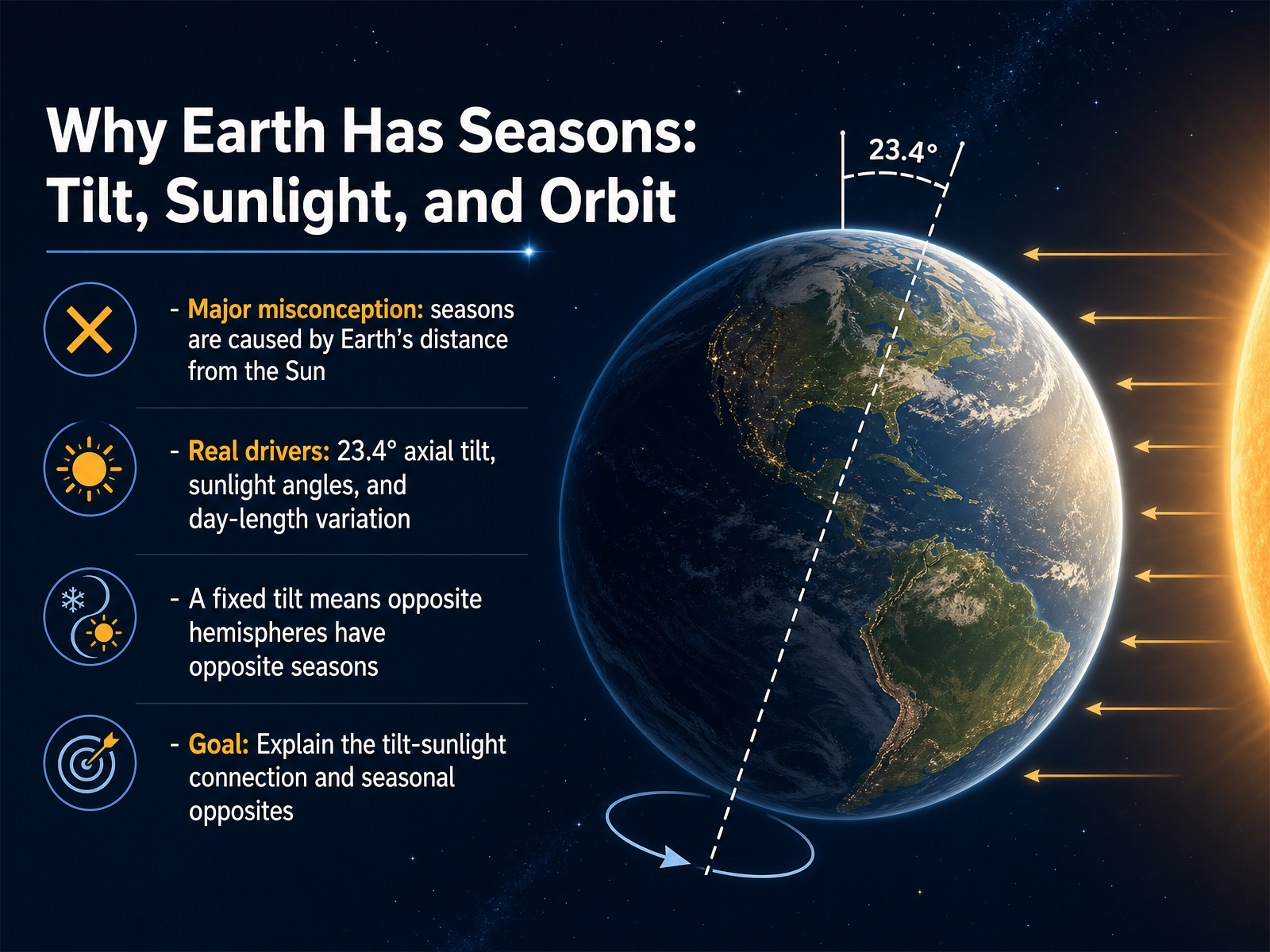
- 01Why Earth Has Seasons: Tilt, Sunlight, and OrbitWelcome. Have you ever heard that summer happens because Earth is closer to the Sun? It sounds logical, but it is actually one of the most common misunderstandings in science. Today we are going to explore the real reasons for our seasons. The true story is built around three ideas: a steady tilt of about twenty-three point four degrees in Earth’s axis, the angle at which sunlight strikes our planet, and how the length of our days changes throughout the year. Because that tilt stays fixed in direction, the Northern and Southern Hemispheres experience opposite seasons. Our goal is to clearly understand that tilt-sunlight connection and why, when one part of the world enjoys summer, another part is deep in winter. By the end, the patterns of our planet will feel perfectly logical. Now, let’s begin by addressing that powerful myth about distance. We will do a simple reality check.lpi.usra.edubeyondpenguins.ehe.osu.educdn.oceanservice.noaa.gov+22 min
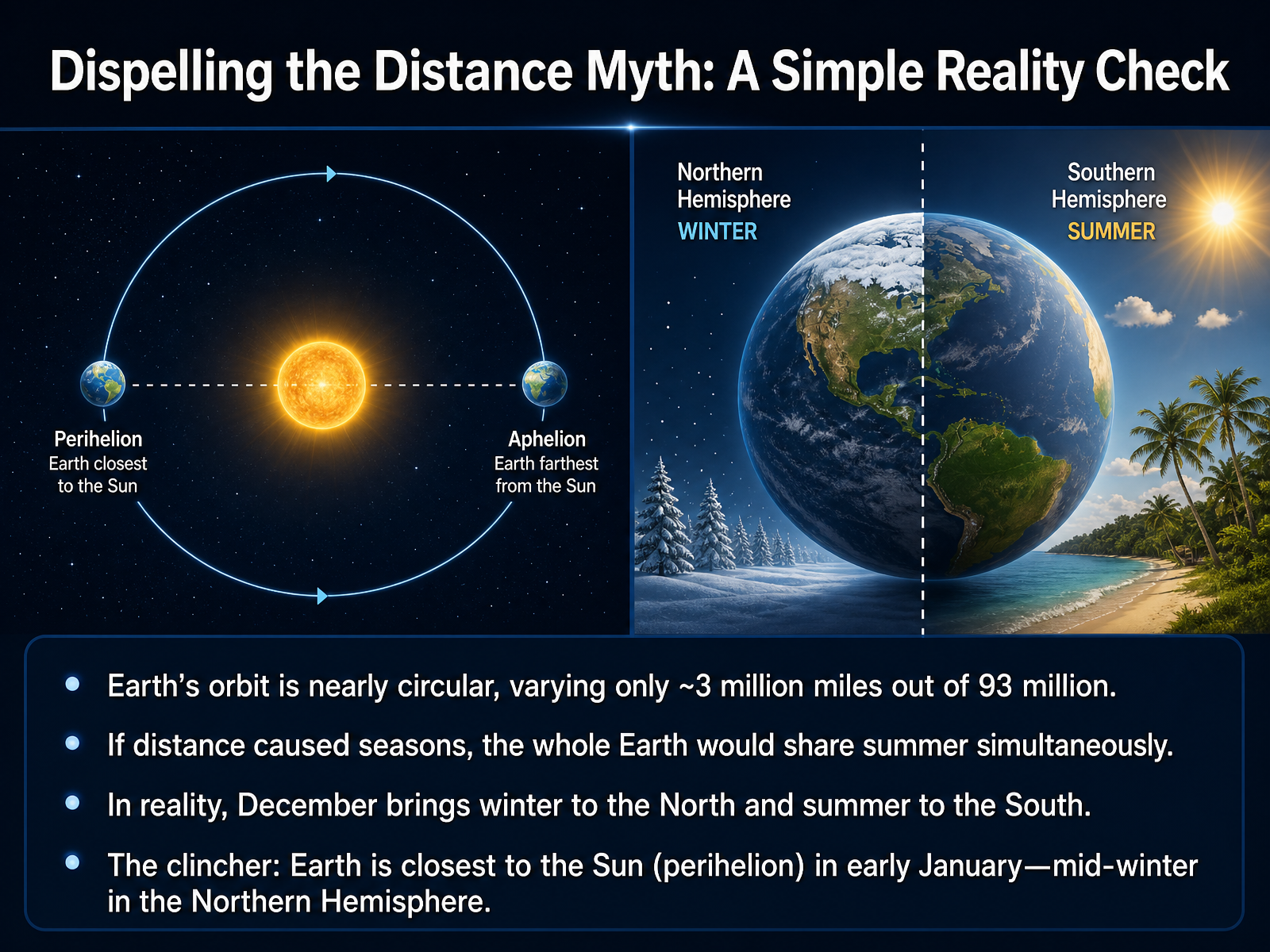
- 02Dispelling the Distance Myth: A Simple Reality CheckLet’s tackle one of the most common explanations people reach for when they think about the seasons: the idea that we get winter because the Earth moves farther from the sun. It sounds reasonable on the surface, but we have a very simple way to check. If our distance from the sun really controlled the seasons, then the entire planet should experience the same season at the same time. When it’s cold here, it should be cold everywhere. But we know that’s not what happens. December brings winter to the Northern Hemisphere, yet in the Southern Hemisphere, it is the height of summer. And here is the real clincher. The Earth actually reaches its closest point to the sun, what we call perihelion, in early January. That’s right in the middle of winter for the Northern Hemisphere. So, we are literally closest to the sun during our coldest months. This reality check shows us that distance is not the driver of our seasons; the true answer must lie elsewhere. Let’s dig deeper into the actual numbers with our next look at perihelion and aphelion.
 timeanddate.comaa.usno.navy.milneoprogrammics.com+21 min
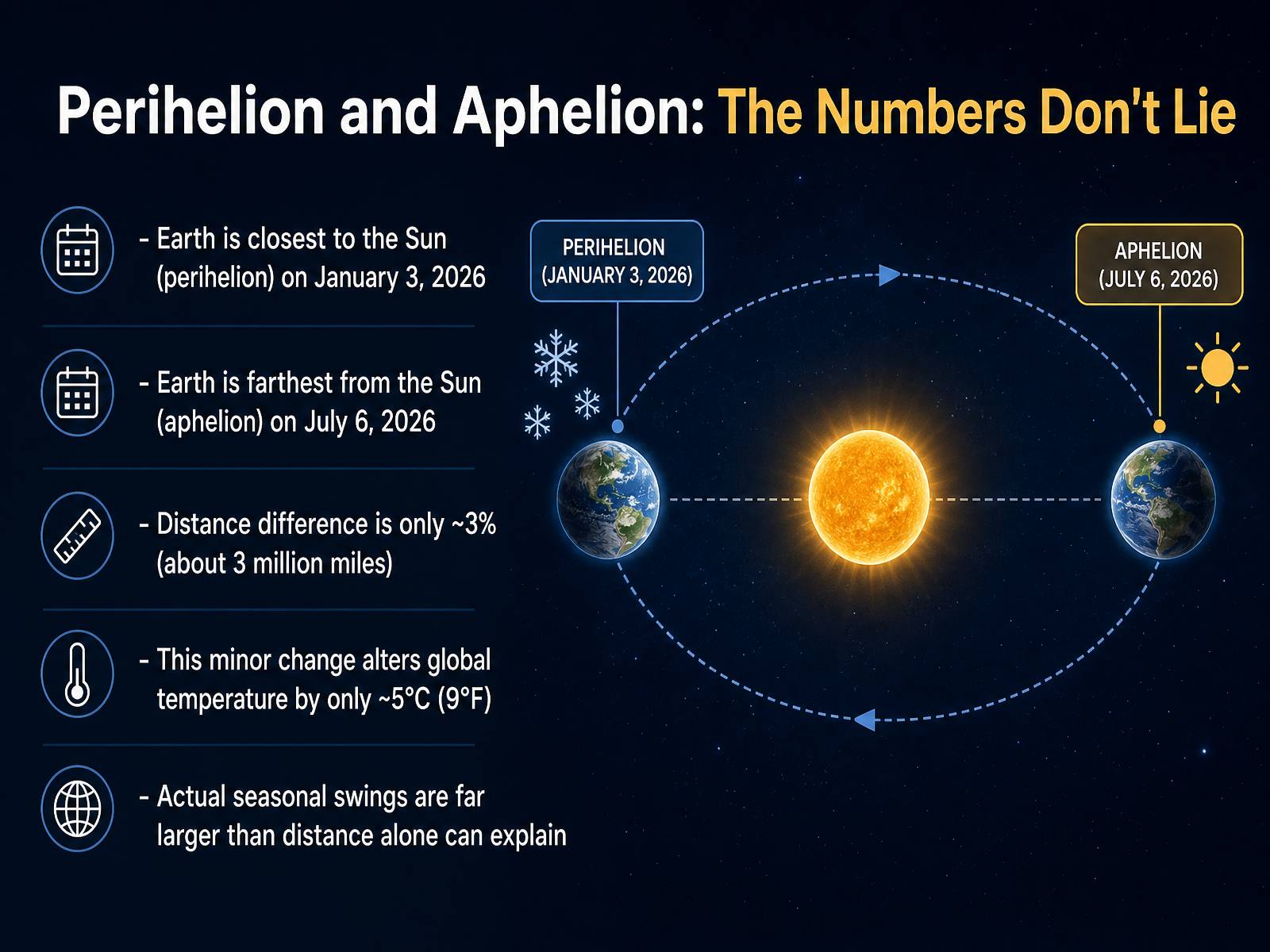
 - 03Perihelion and Aphelion: The Numbers Don't LieNow, let's test that distance idea with some hard numbers. You might think summer happens because our planet is closer to the Sun. But the facts tell a different story. In 2026, Earth reaches its closest point to the Sun, called perihelion, on January third. That is right in the middle of the Northern Hemisphere's winter. We are actually farthest from the Sun, at a point called aphelion, on July sixth, during the peak of our summer. The difference between these two distances is only about three percent, or roughly three million miles. How much can three million miles really change things? As it turns out, not much. This small shift in distance changes our global temperature by only about five degrees Celsius, or nine degrees Fahrenheit. But actual seasonal swings are enormous, often forty degrees or more. So, the numbers just don't add up. Distance alone falls far short of explaining summer and winter. It's time to look at the real reason for our seasons: the Earth's tilt.
 timeanddate.comaa.usno.navy.milneoprogrammics.com+22 min
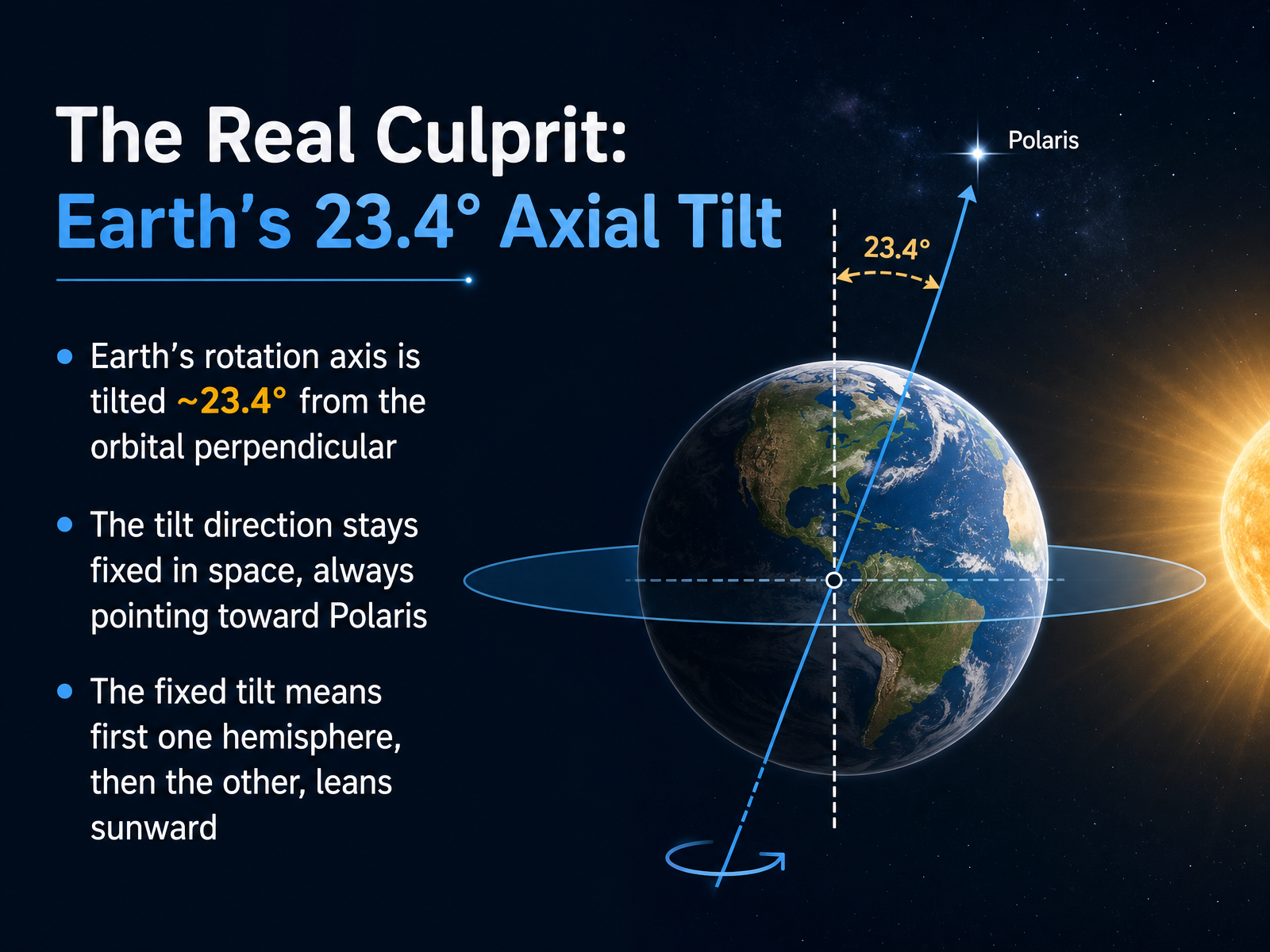
 - 04The Real Culprit: Earth's 23.4° Axial TiltSo, if Earth’s distance isn’t the cause, then what is? The real culprit comes down to a single, elegant detail: our planet leans. Earth’s axis of rotation isn’t straight up and down relative to its path around the Sun. Instead, it’s tilted at an angle of about twenty-three point four degrees. To visualize this, imagine Earth’s orbit as a flat tabletop. If the planet stood perfectly upright, its axis would be perpendicular to that table. But it doesn’t. It leans back, as if permanently nodding toward a distant point in space. Right now, that point is very close to Polaris, the North Star. This tilt direction stays remarkably fixed as Earth journeys around the Sun. The planet doesn’t wobble toward the Sun and then away from it over the course of a year. Because the lean always points the same way, first one hemisphere angles toward the Sun, and then, six months later on the opposite side of the orbit, the other hemisphere gets its turn to lean sunward. This steady, off-kilter posture is what creates our seasons. Next, let’s give this tilt its scientific name and see how this angle shapes our climate.
 timeanddate.comshabasports-odds.comdinosaurse.com+22 min
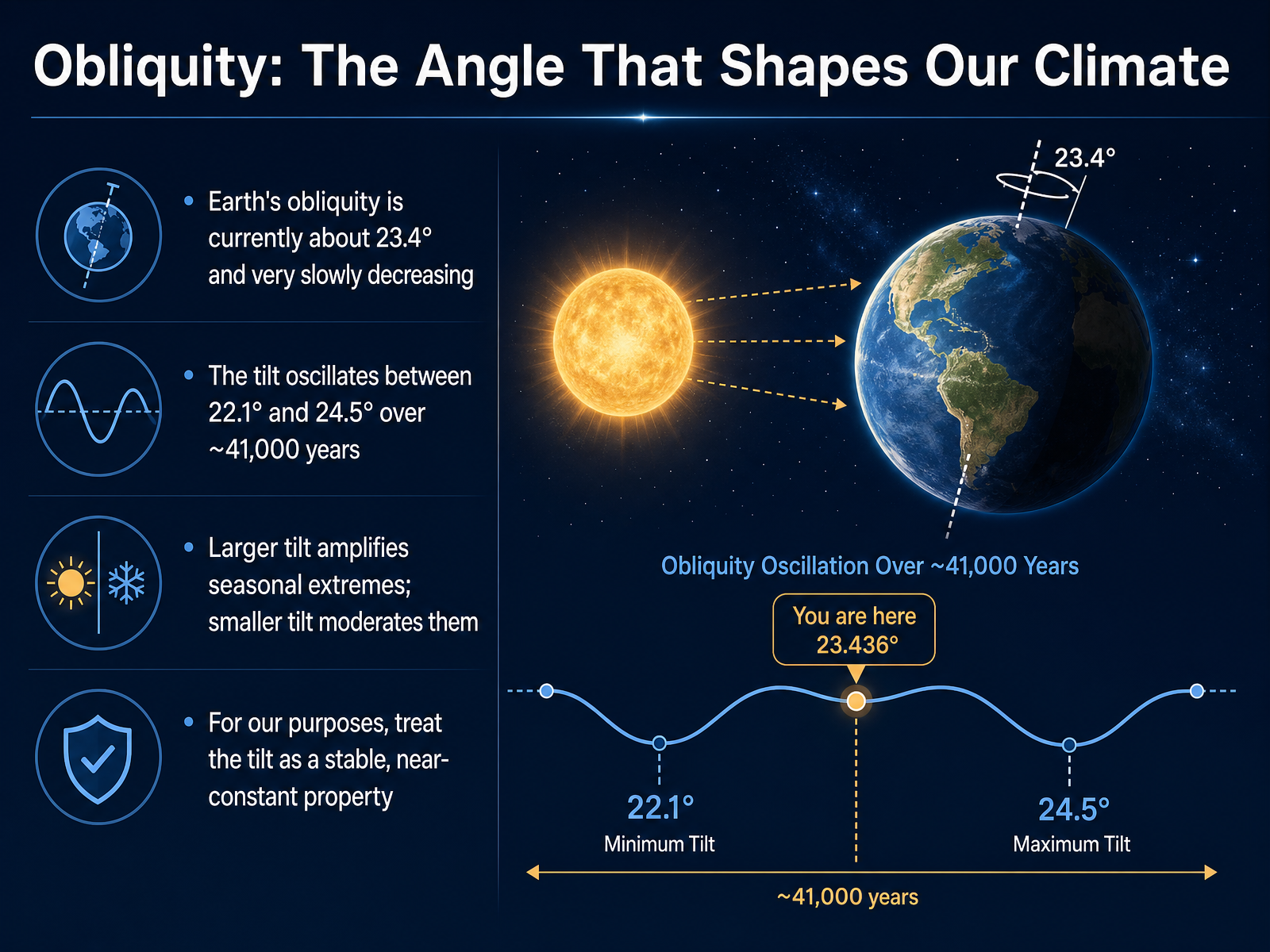
 - 05Obliquity: The Angle That Shapes Our ClimateNow that we understand the tilt is the key to our seasons, let's look at the tilt itself. We call this angle obliquity. Right now, Earth's obliquity is about twenty-three point four degrees. Imagine a line going straight up and down, perfectly perpendicular to our orbit. Earth's axis leans away from that line by about twenty-three point four degrees. But this angle is not completely fixed. Over a very long cycle of roughly forty-one thousand years, the tilt slowly rocks back and forth between twenty-two point one degrees and twenty-four point five degrees. What does this mean for us? Think of it this way: a larger tilt makes the seasons more extreme, with hotter summers and colder winters. A smaller tilt makes the seasons milder. For our purposes in understanding the seasons today, we can treat this twenty-three point four degree angle as a stable, near-constant property. It's not changing enough in our lifetime for us to notice. Next, we'll connect this tilt directly to sunlight and see the geometry that transforms an angled Earth into our yearly cycle of seasons.
 timeanddate.comshabasports-odds.comdinosaurse.com+22 min
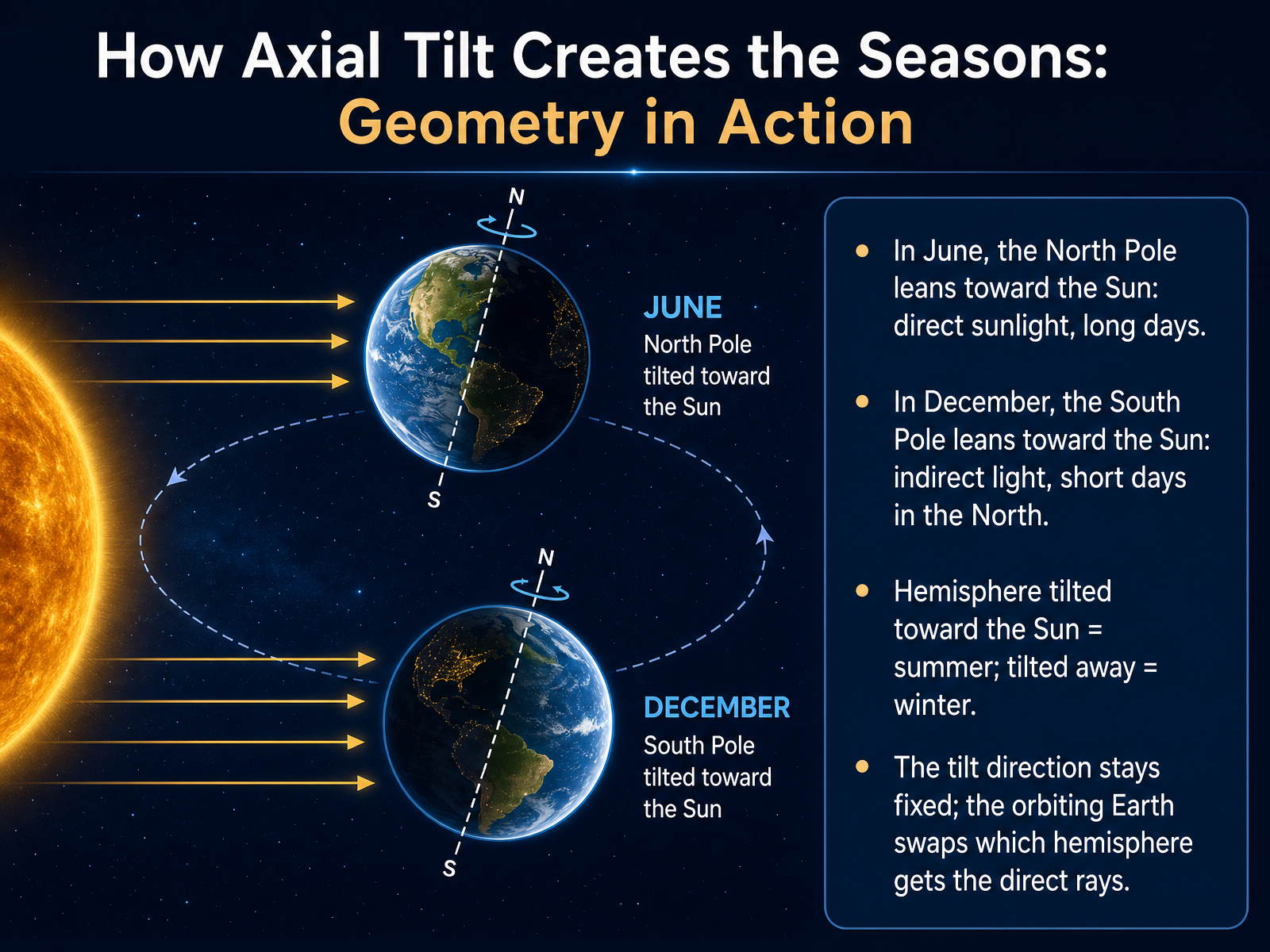
 - 06How Axial Tilt Creates the Seasons: Geometry in ActionNow, let’s see how that fixed tilt creates our seasons. Imagine it is June. The North Pole leans toward the Sun, like a face turned toward a warm lamp. This gives the Northern Hemisphere direct sunlight and long days. The Sun’s rays hit at a steep angle, concentrating their energy. Meanwhile, the Southern Hemisphere leans away, receiving indirect sunlight spread out across the surface. Fast forward to December. Our planet has orbited to the other side, but the tilt direction never changed. Now, the South Pole leans toward the Sun, bathing the Southern Hemisphere in direct, summer light. Up north, we are tilted away, so the Sun hangs low and days grow short. Here is the simple rule: whichever hemisphere leans toward the Sun experiences summer. Whichever leans away has winter. The magic is that Earth swaps the hemispheres for us just by circling the Sun once a year. Next, we will explore this geometry with a simple, illuminating tool. Let’s move to the flashlight analogy for direct versus indirect sunlight.
 lpi.usra.edubeyondpenguins.ehe.osu.educdn.oceanservice.noaa.gov+22 min
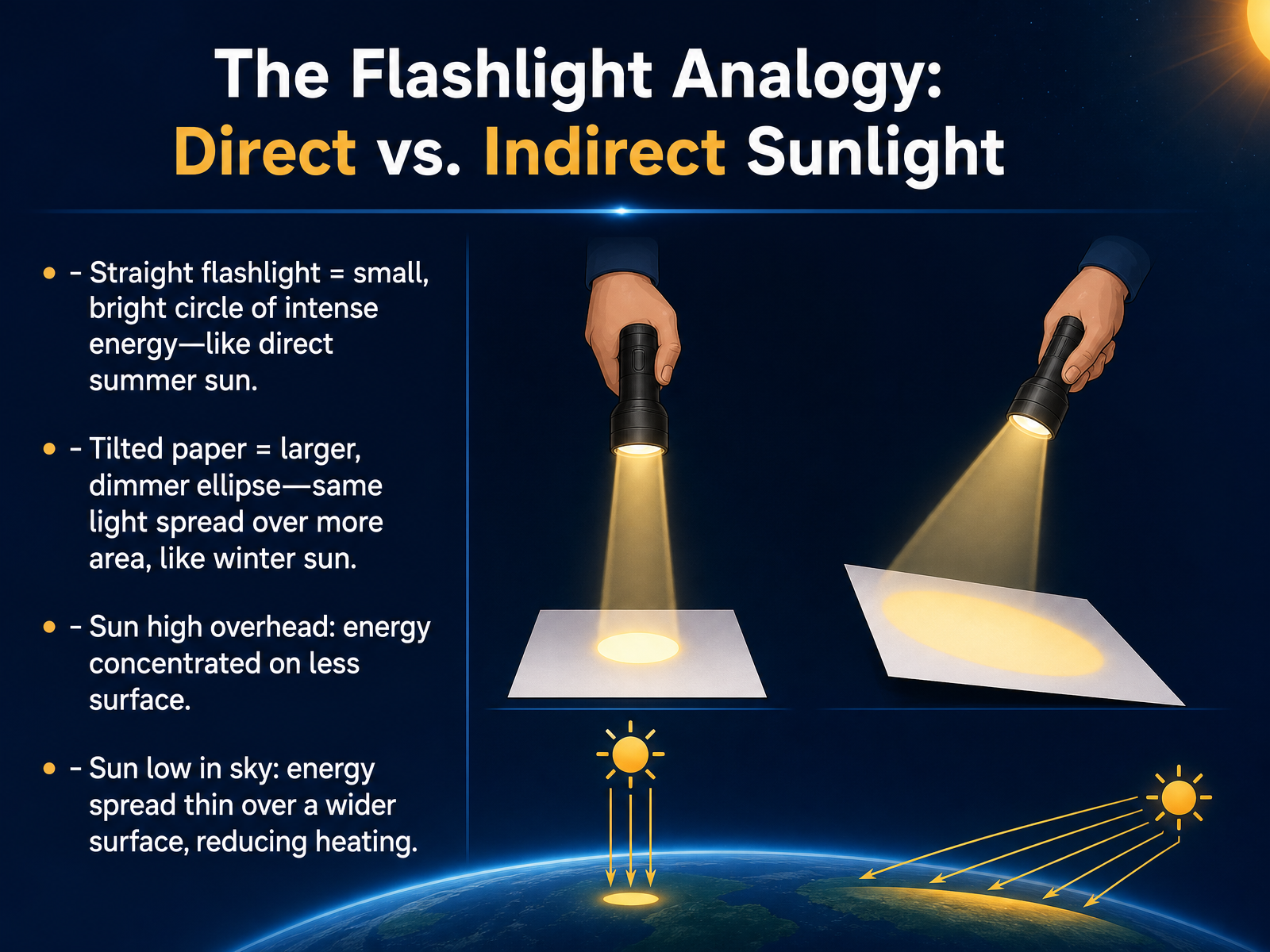
 - 07The Flashlight Analogy: Direct vs. Indirect SunlightHaving established that the Earth's tilt is the main driver, let's break down how sunlight itself makes a difference. Imagine you're holding a flashlight in a dark room, pointing it straight down at a sheet of paper. You get a small, bright, perfectly round circle of light. That concentrated spot is full of intense energy—much like the direct summer sun when it's high overhead. Now, slowly tilt that same paper. The single beam of light stretches into a larger, dimmer ellipse, spreading the exact same amount of energy across a much wider surface. This is the gentle, indirect sunlight of winter, where the Sun hangs low in the sky. The crucial point is that the Sun's energy doesn't disappear; it's simply spread thinner. Direct rays deliver a powerful, concentrated punch of heat to a smaller area, while indirect rays dilute that warmth, reducing the heating effect. Up next, we'll explore another factor that cools this slanted sunlight even more: its longer journey through our atmosphere.
 lpi.usra.edubeyondpenguins.ehe.osu.educdn.oceanservice.noaa.gov+21 min
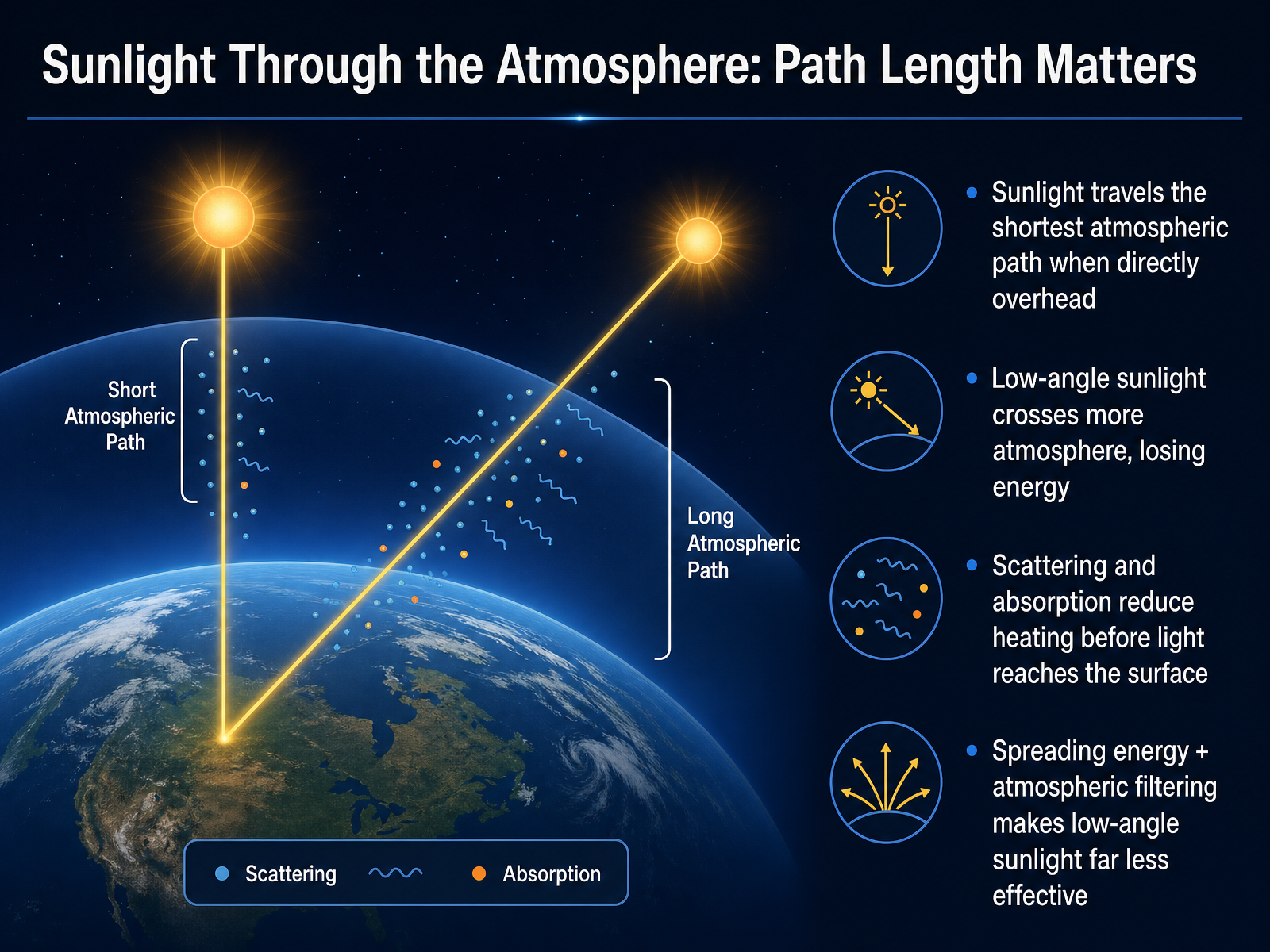
 - 08Sunlight Through the Atmosphere: Path Length MattersNow let's look at what happens to sunlight as it travels through our atmosphere. The title of this slide says it all: path length matters. Imagine the Sun is directly overhead. Its light takes the shortest possible route to reach you, slicing straight down through the air. But when the Sun is low in the sky, that same light enters the atmosphere at a shallow angle, and suddenly it has a much longer journey. Think of it like skipping a stone across a pond versus dropping it straight in. As sunlight travels that longer, angled path, it collides with more air molecules, dust, and water vapor. These tiny particles scatter some of the light away and absorb some of its energy. By the time the light finally reaches the ground, it has lost a lot of its heating power. So, a low-angle sun not only spreads its energy over a wider area, like we saw earlier, but it also gets filtered and weakened by the atmosphere. This double effect is why a sun low in the sky feels so much weaker than one blazing overhead. Now, keep this filtering effect in mind, because next we'll explore another major reason summer days are warmer. Let's talk about Day Length: The Second Powerhouse Factor.
 lpi.usra.edubeyondpenguins.ehe.osu.educdn.oceanservice.noaa.gov+22 min
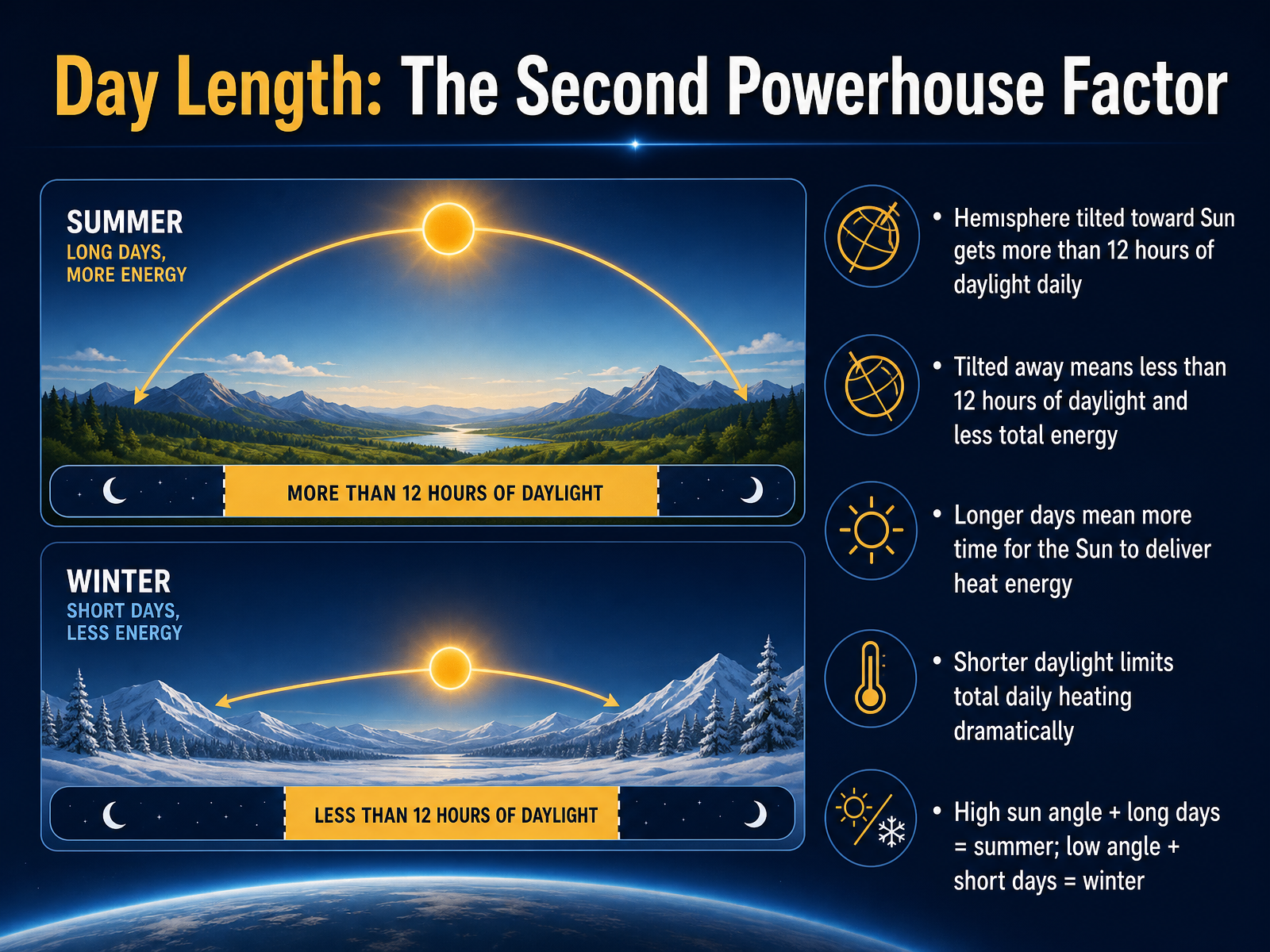
 - 09Day Length: The Second Powerhouse FactorNow, let's add a second powerhouse factor: the length of the day. When a hemisphere tilts toward the Sun, it gets more than just direct rays. It also enjoys more than twelve hours of daylight. That longer day gives the Sun extra time to deliver heat energy, like leaving a pot on the stove for a longer period. In contrast, the hemisphere tilted away receives less than twelve hours of daylight, which dramatically limits its total daily heating. So, you have two things working together. A high sun angle and long days combine to produce summer. A low sun angle combined with short days brings winter. Next, let's explore the four key moments when these patterns peak: the solstices and equinoxes.
 lpi.usra.edubeyondpenguins.ehe.osu.educdn.oceanservice.noaa.gov+21 min
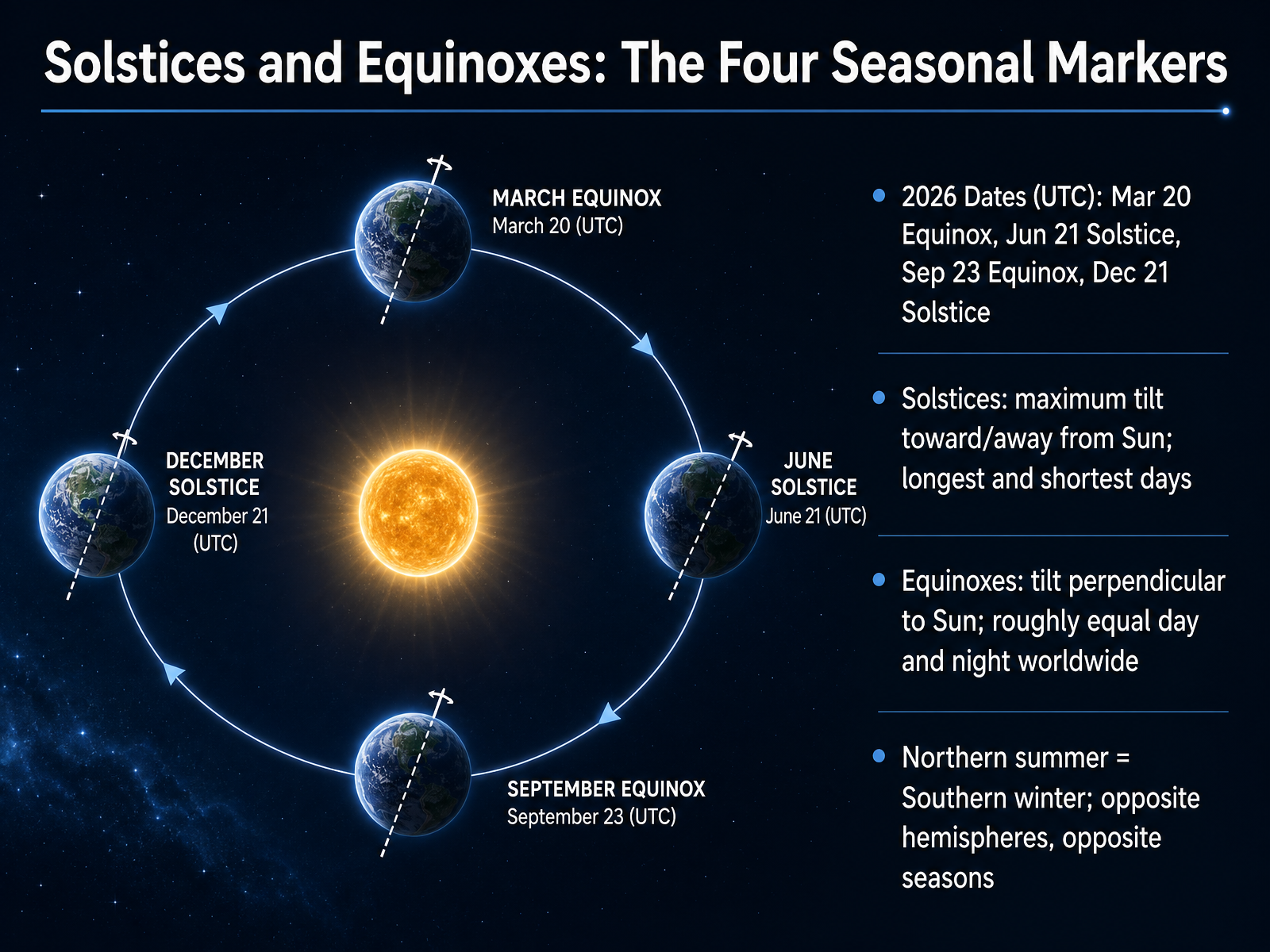
 - 10Solstices and Equinoxes: The Four Seasonal MarkersNow let’s look at the four major markers of our seasonal journey: the solstices and equinoxes. In twenty twenty-six, these special moments fall on March twentieth, June twenty-first, September twenty-third, and December twenty-first—all given here in Universal Time, so the exact date may shift slightly depending on your time zone. A solstice is when one hemisphere reaches its maximum tilt toward the Sun or away from it. In June, the North Pole leans in and the Northern Hemisphere enjoys its longest day and the start of summer, while the Southern Hemisphere has its shortest day and the start of winter. An equinox is the midpoint between the solstices, when the tilt is perpendicular to the Sun. On those days, both hemispheres receive roughly equal daylight and nighttime. This is why the September equinox brings autumn to the north and spring to the south, and the March equinox does the reverse. Remember, opposite hemispheres always experience opposite seasons. Next, we will explore how these astronomical markers compare to the calendar-based seasons in ‘Understanding the Calendar: Astronomical vs. Meteorological Seasons.’
 aa.usno.navy.milaa.usno.navy.milweather.gov+22 min
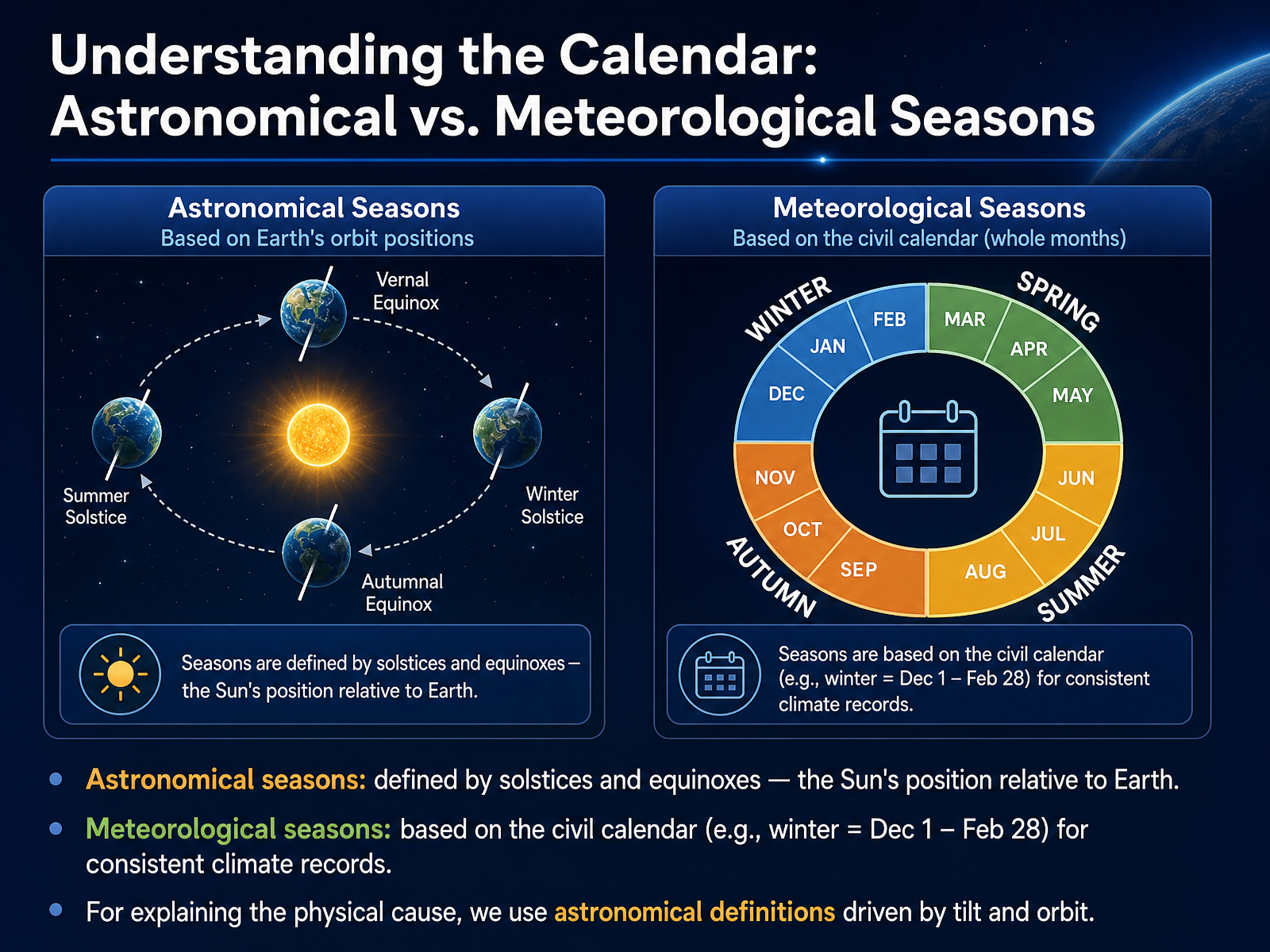
 - 11Understanding the Calendar: Astronomical vs. Meteorological SeasonsNow, when we talk about seasons on a calendar, we’re actually choosing between two different systems. It’s like picking which clock to use for the year. The astronomical seasons are defined purely by the Sun’s position—the exact moments of solstices and equinoxes we just discussed. For example, in 2026, summer in the Northern Hemisphere begins at the June solstice, and winter begins at the December solstice. This definition is perfect for explaining the physical cause, because it’s driven directly by Earth’s tilt and orbit. However, for keeping consistent climate records, meteorologists use a different calendar. They simplify things by grouping seasons into neat three-month blocks: winter is December first through February twenty-eighth, and summer is June first through August thirty-first. This makes it much easier to track and compare weather patterns year after year. So, for understanding why we have seasons, we’ll stick with the astronomical definitions. Think of it this way: astronomers tell us when the seasons start based on the sky, and meteorologists tell us what the seasons feel like based on the ground. Now let’s apply this and see how these astronomical events create completely opposite seasons in the two hemispheres in our next slide, 'A Tale of Two Hemispheres: Opposite Seasons Explained.'
 aa.usno.navy.milaa.usno.navy.milweather.gov+22 min
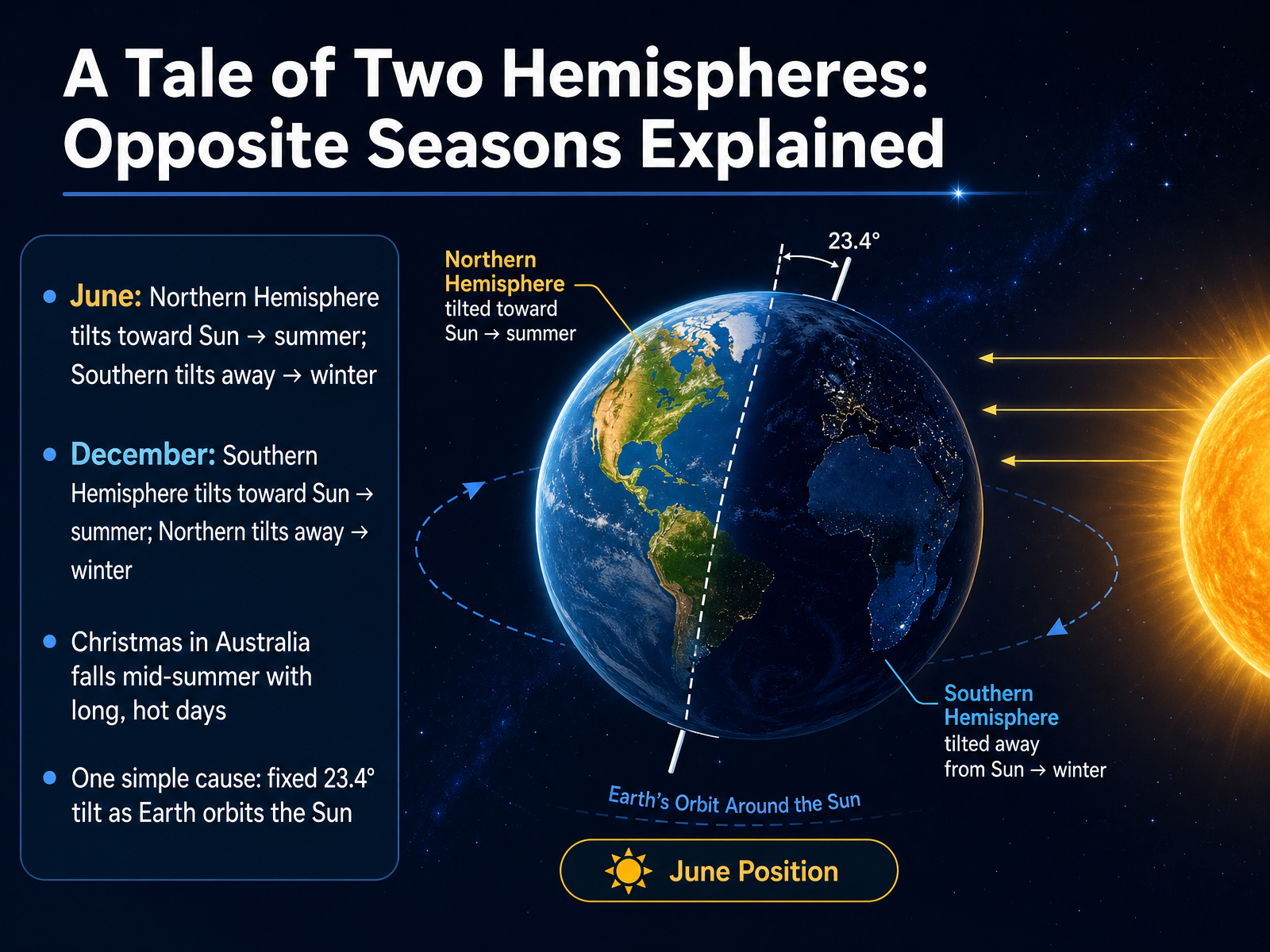
 - 12A Tale of Two Hemispheres: Opposite Seasons ExplainedNow, let's explore how this single, fixed tilt creates opposite stories in the two halves of our planet. In June, the Northern Hemisphere leans toward the Sun. That means it receives more direct rays and enjoys long, warm summer days. But at that exact same time, the Southern Hemisphere is tilted away. Sunlight strikes at a glancing angle, bringing shorter, cooler winter days. Fast forward to December, and the situation is completely reversed. Now the Southern Hemisphere takes its turn leaning toward the Sun, soaking up the summer heat. Meanwhile, the Northern Hemisphere leans away, settling into winter. This is why Christmas in Australia falls right in the middle of summer, with long, hot days perfect for the beach. The cause isn't a change in distance, but one simple, elegant fact: Earth’s axis stays fixed at about twenty-three point four degrees as we journey around the Sun. Next, let’s build on this and see why latitude matters, as we examine the poles, the tropics, and the mid-latitudes.
 lpi.usra.edubeyondpenguins.ehe.osu.educdn.oceanservice.noaa.gov+22 min
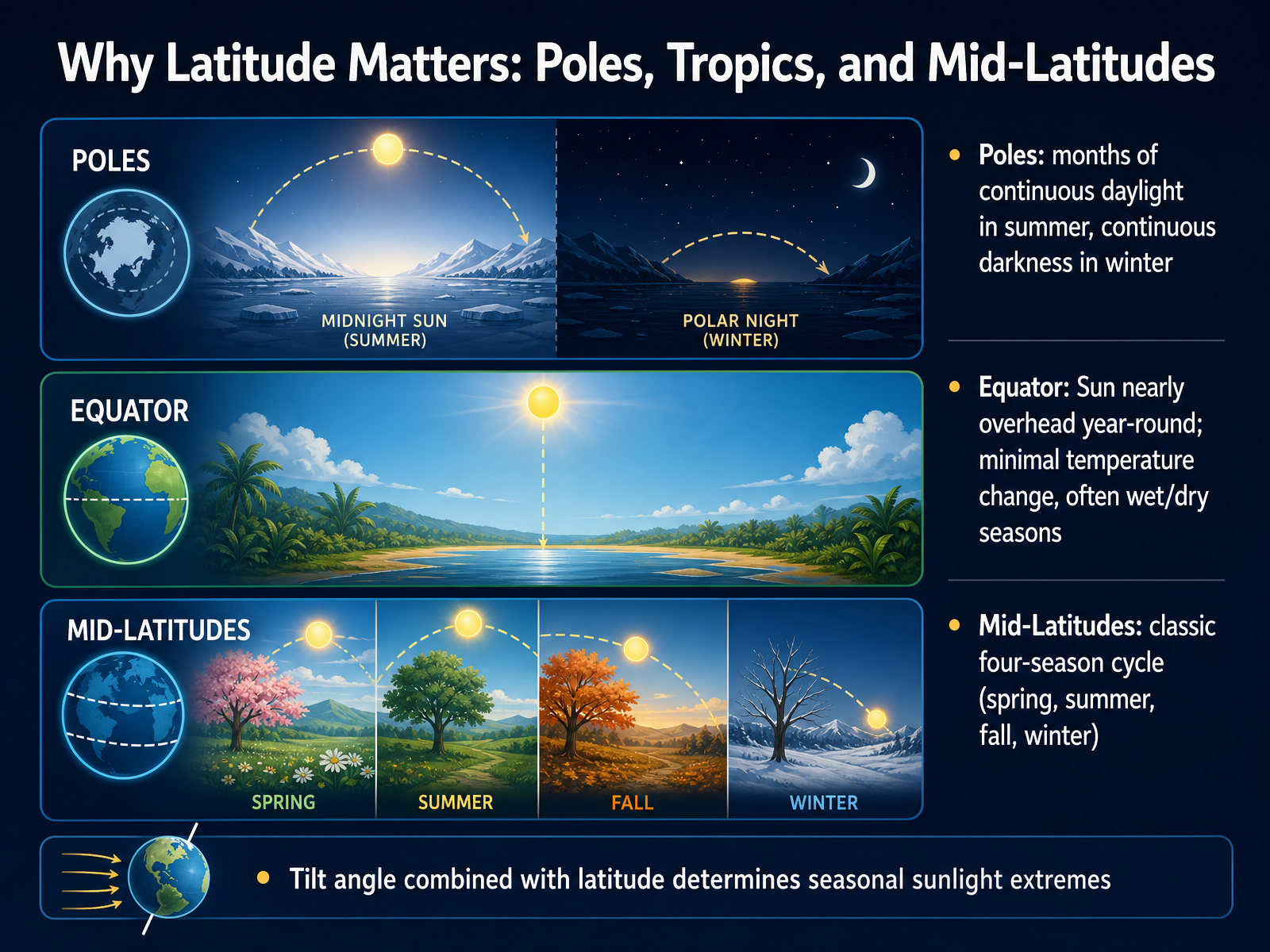
 - 13Why Latitude Matters: Poles, Tropics, and Mid-LatitudesNow, let's see how our planet's tilt interacts with where you are standing on the globe. Latitude is what really controls the type of sunlight a place receives. Think about the two poles. Because of the tilt, each pole gets months of continuous daylight during its summer, followed by months of continuous darkness in its winter. Imagine a day that lasts half a year, and a night just as long. Next, picture the equator. Here, the Sun is nearly overhead at noon all year round. That is why temperatures are consistently warm, and instead of a hot and cold season, many equatorial regions experience wet and dry seasons. Finally, the mid-latitudes, where many of us live, receive sunlight at a moderate angle. This gives us the classic four-season cycle of spring, summer, fall, and winter. The key idea is this: the tilt angle of the Earth combines with your specific latitude to determine the extreme difference in sunlight you receive throughout the year. In our next slide, we will bring all these pieces together and walk through the complete cause-and-effect chain.
 lpi.usra.edubeyondpenguins.ehe.osu.educdn.oceanservice.noaa.gov+22 min
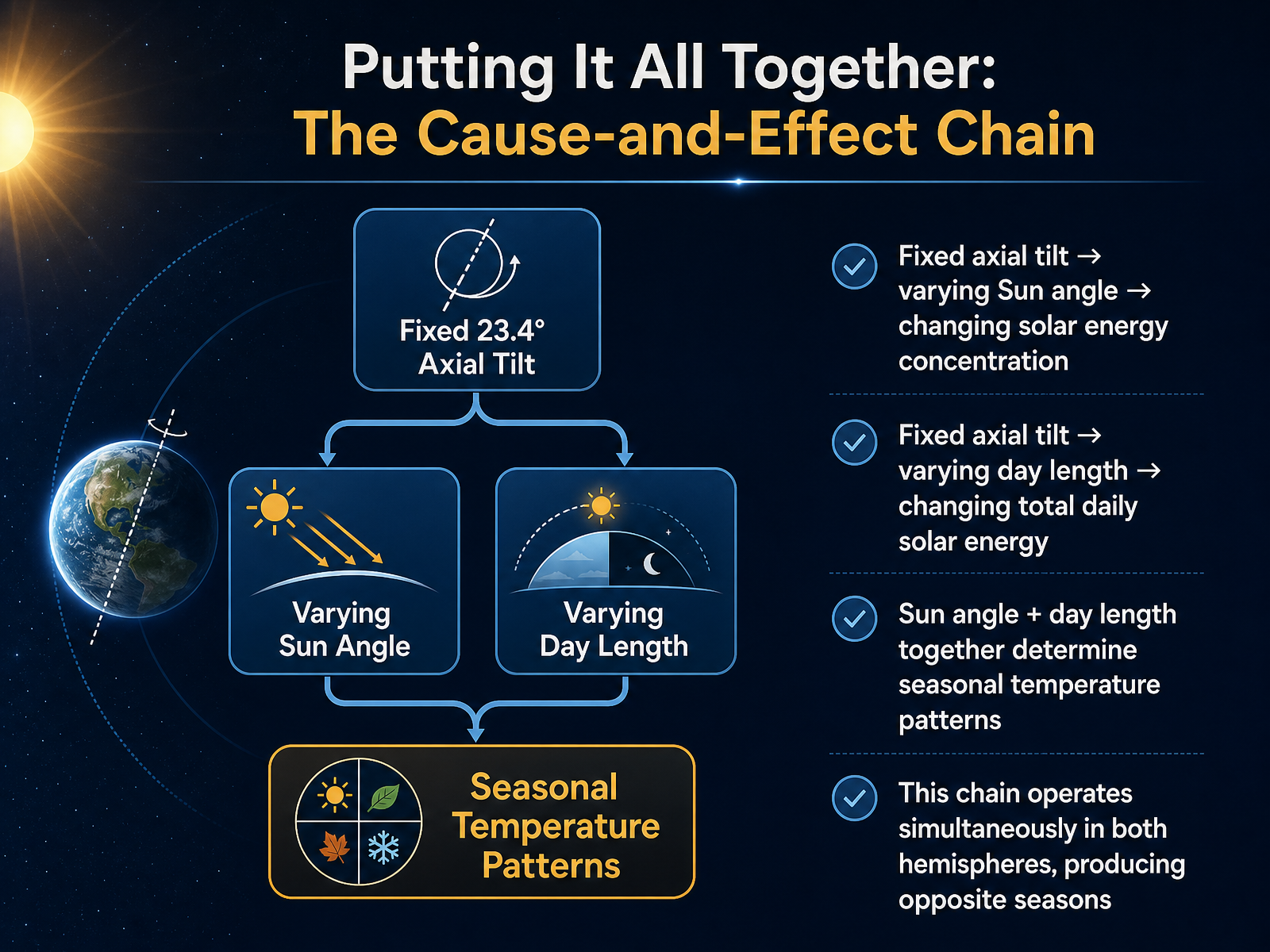
 - 14Putting It All Together: The Cause-and-Effect ChainNow we can follow the chain of cause and effect from a single, fixed tilt all the way to opposite seasons on a shared planet. Our planet holds its axis steady, tilted at about twenty-three point four degrees. Because that tilt direction stays the same as Earth orbits, the angle of sunlight hitting any spot keeps changing. When the sun’s rays strike at a steep, near-vertical angle, the solar energy is concentrated over a smaller area, like a flashlight beam aimed straight down. When the same hemisphere tilts away, the light spreads out, delivering less intense warmth. At the same time, the fixed tilt changes how long the sun stays above the horizon. Longer days in summer mean more total solar energy accumulating each day, while shorter winter days provide less. Sun angle and day length work together, and their combined effect shapes the temperature patterns we call seasons. And here is the wonderful twist: this same chain operates in the Southern Hemisphere at the same time, but in reverse. While the north enjoys direct rays and long days, the south experiences indirect light and shorter days. So opposite seasons are really two sides of one elegant mechanism. Next, let’s test your understanding in our final slide: Check Your Understanding: Can You Explain the Seasons?
 lpi.usra.edubeyondpenguins.ehe.osu.educdn.oceanservice.noaa.gov+22 min
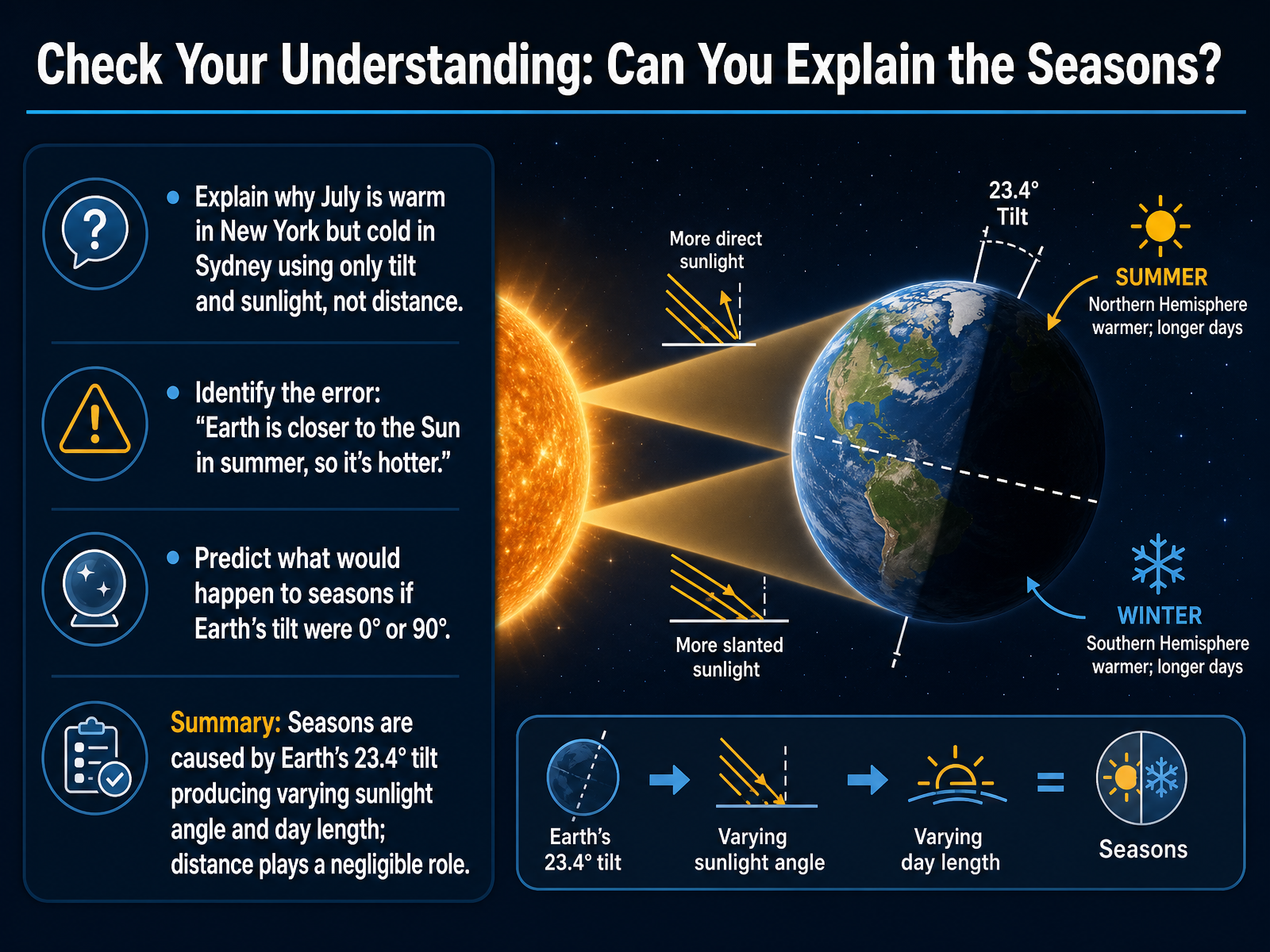
 - 15Check Your Understanding: Can You Explain the Seasons?Let's check your understanding by putting the pieces together. First, consider this puzzle. Why is July warm in New York but cold in Sydney? Try to answer using only tilt and sunlight, not distance. Think about where the Sun's rays are most direct during that month. Next, spot the error in a very common claim. Some say, 'Earth is closer to the Sun in summer, so it is hotter.' But remember, Earth actually reaches its closest point to the Sun in January, during Northern Hemisphere winter. The real driver is tilt, not distance. Now, imagine changing the tilt itself. What would happen to the seasons if Earth’s tilt were zero degrees? Or what if it were a full ninety degrees? Pause and predict the outcomes. A zero-degree tilt would remove seasons as we know them, while a ninety-degree tilt would create wild extremes. In summary, seasons are caused by Earth’s twenty-three-point-four-degree tilt, which changes the angle of sunlight and the length of days throughout the year. The role of our changing distance from the Sun is truly negligible. Thank you for exploring the real reason for the seasons. You can now explain this natural rhythm with clarity.
 lpi.usra.edubeyondpenguins.ehe.osu.educdn.oceanservice.noaa.gov+22 min
Take the deck with you
Download this course as a file — free, no sign-up needed.
- PDF handoutEvery slide page, ready to print or share.16 pages · 4.2 MBDownload
- Narrated PowerPointThe deck that presents itself — every slide carries the digital human's narration video.16 pages · 15.7 MBDownload
- PowerPoint slidesThe full deck as a .pptx — open it in PowerPoint, Keynote, or Google Slides.16 pages · 4.2 MBDownload
Free to use in your own training — please keep the PersonWise credit page at the end.
Have your own deck? Turn it into a course
Sources consulted
Web sources consulted while building this course.
- SeasonsMisconceptions — lpi.usra.edu
- Common Misconceptions about Day and Night, Seasons — beyondpenguins.ehe.osu.edu
- Earth Science Misconceptions — cdn.oceanservice.noaa.gov
- The Reason for the Seasons — education.nationalgeographic.org
- Phil Plait's Bad Astronomy: Misconceptions — badastronomy.com
- Perihelion and Aphelion 2026 — timeanddate.com
- Earth's Seasons - Equinoxes, Solstices, Perihelion, and Aphelion — aa.usno.navy.mil
- Earth - Perihelion and Aphelion Calculator — neoprogrammics.com
- Perihelion and Aphelion: How Far Is the Sun from Earth? | The Old Farmer's Almanac — almanac.com
- Earth's Perihelion and Aphelion 2026-2035 Dates - Farmers' Almanac — farmersalmanac.com
- Earth's Axial Tilt – Obliquity — timeanddate.com
- Earth's Axial Tilt – Obliquity-沙巴体育 — shabasports-odds.com
- Obliquity Axial Tilt – DinosaurSE — dinosaurse.com
- Milutin Milankovitch — science.nasa.gov
- 1.3. Earth's Tilted Axis and the Seasons | EME 811 — courses.ems.psu.edu
- Equinoxes, Solstices, Perihelion, and Aphelion — aa.usno.navy.mil
- The Seasons (Equinoxes and Solstices) Page — weather.gov
- Equinoxes and Solstices 2026: Exact Dates, Times & Complete Guide - Your Complete Guide to Events — universaltimedate.com
- Seasons: Dates of spring, summer, fall and winter — timeanddate.com