Begin
14 pages · ~28 min
Sales Enablement Content Types and Examples
This training helps sales enablement and marketing teams identify effective sales enablement material types and patterns, and apply proven examples to create content that better supports sales conversations.
A digital instructor presents all 14 pages. Hold “Ask” at any point and ask out loud — the answer comes from this course. No sign-up needed.
What you’ll learn
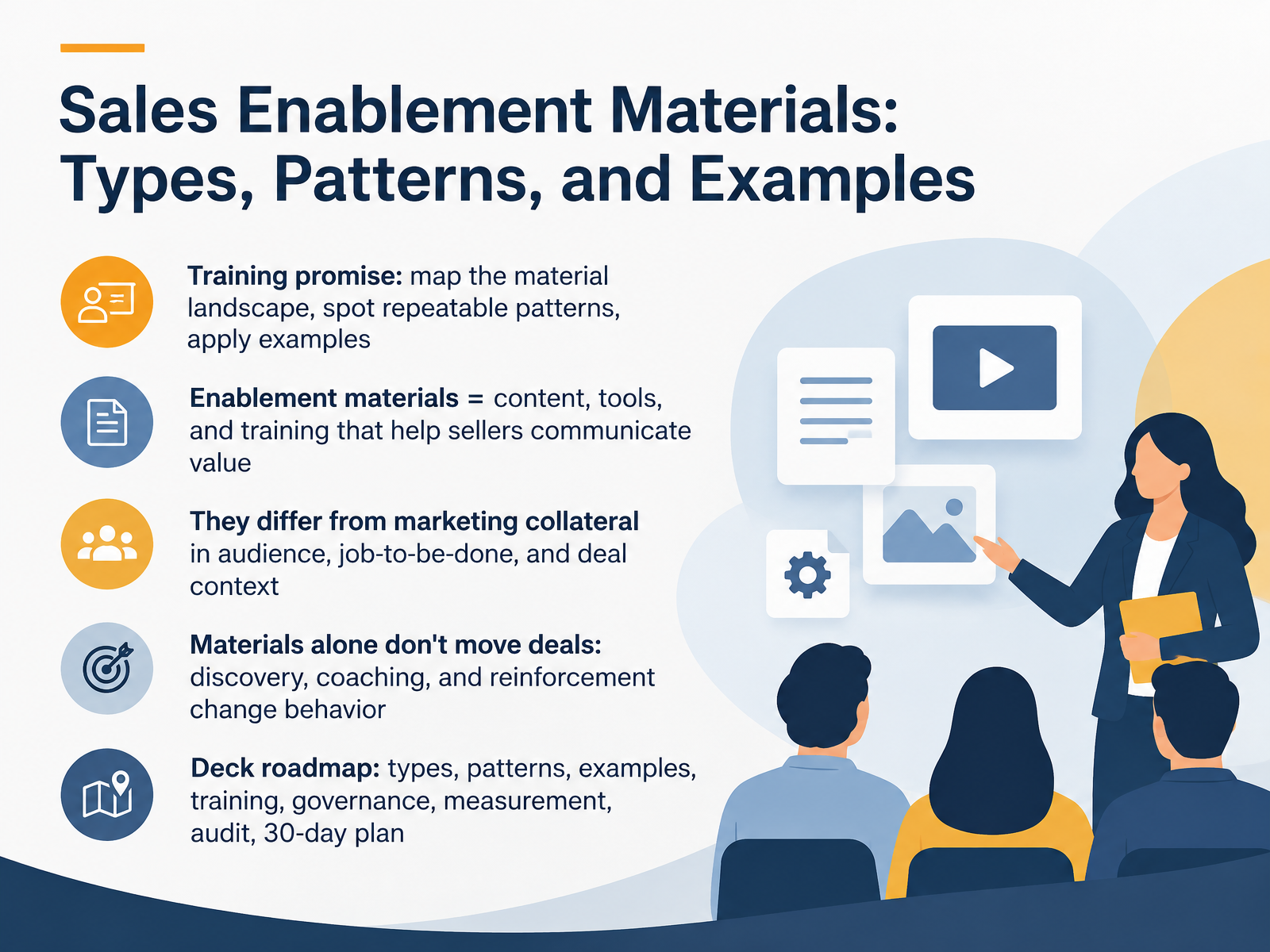
- 01Sales Enablement Materials: Types, Patterns, and ExamplesWelcome. I'm glad you're here. This course is about the materials we put in sellers' hands, and how to build them well. Here's our promise for the session. We'll map the material landscape, spot repeatable patterns, and apply real examples you can reuse.
Let's start with a working definition. Enablement materials are the content, tools, and training that help sellers communicate value. That is a wide net, so we need a boundary. They differ from marketing collateral in three ways: the audience, the job to be done, and the deal context. A brand campaign speaks to a market. A battlecard speaks to a rep, mid-deal, in the next ten minutes.
One honest tradeoff. Materials alone do not move deals. Discovery, coaching, and reinforcement are what change seller behavior. Content sets the stage, but behavior closes the gap.
Over the next slides, we'll move through types, patterns, examples, training, governance, measurement, an audit, and a thirty day plan. A next step before we continue. Write down one asset your team keeps rebuilding from scratch, and keep it in view.
Next, we'll define what counts as sales enablement material.salesforce.comg2.comhubspot.com+22 min
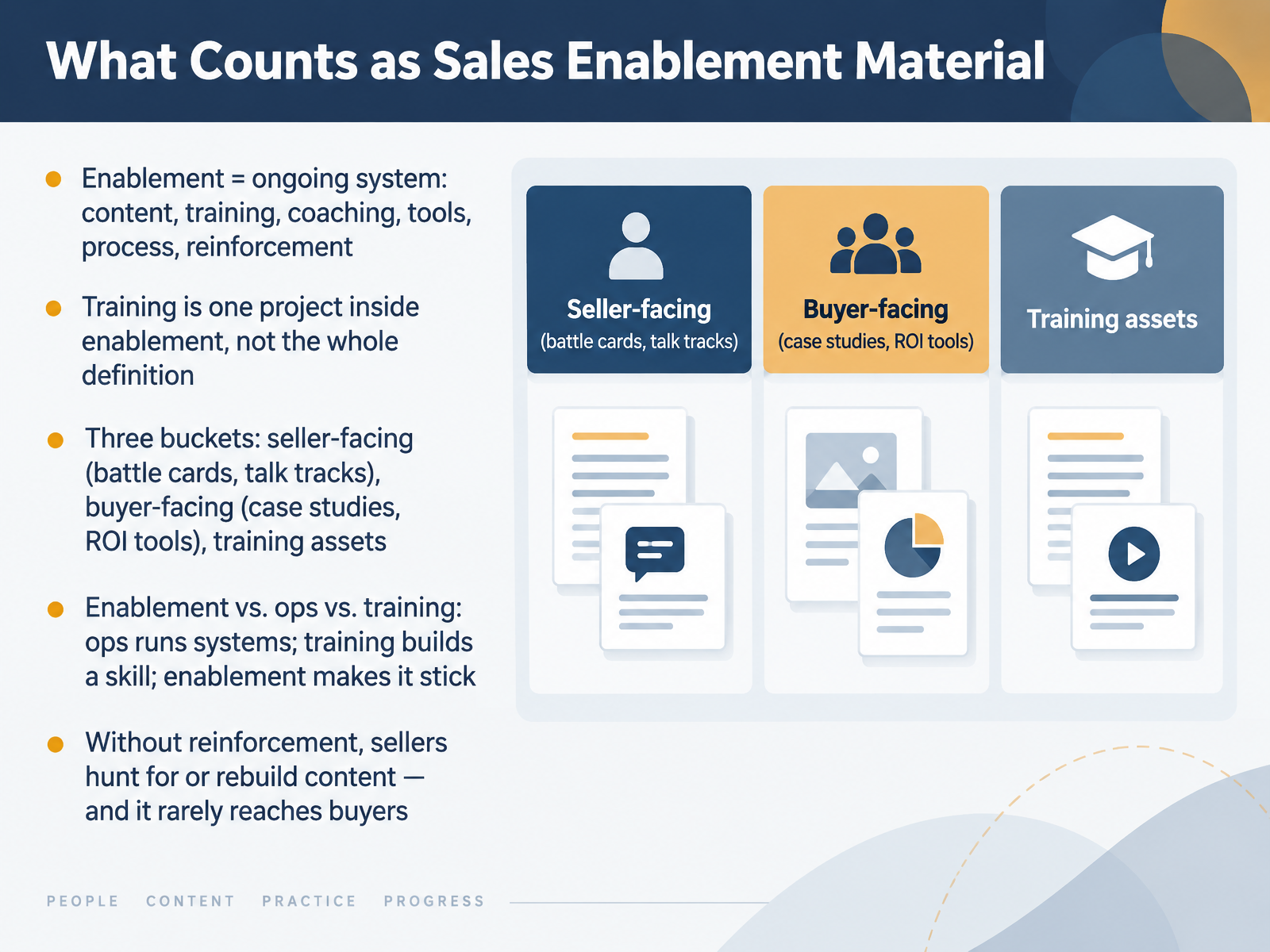
- 02What Counts as Sales Enablement MaterialLet's get precise about what actually counts as sales enablement material. Enablement is an ongoing system. That means content, training, coaching, tools, process, and reinforcement, all working together. Training is one project inside that system, not the whole definition. It builds a skill, then enablement makes it stick. We usually sort the material into three buckets: seller-facing assets like battle cards and talk tracks, buyer-facing assets like case studies and ROI tools, and training assets themselves. One quick contrast helps. Operations runs the systems, training builds a skill, and enablement reinforces it in the flow of work. Here's the tradeoff. Without reinforcement, sellers either hunt for content or rebuild it themselves, and it rarely reaches buyers. So pick one piece of content this week and check whether it lives where sellers actually work. Next, we'll map materials by buyer stage and seller moment.
 salesforce.comg2.comhubspot.com+22 min
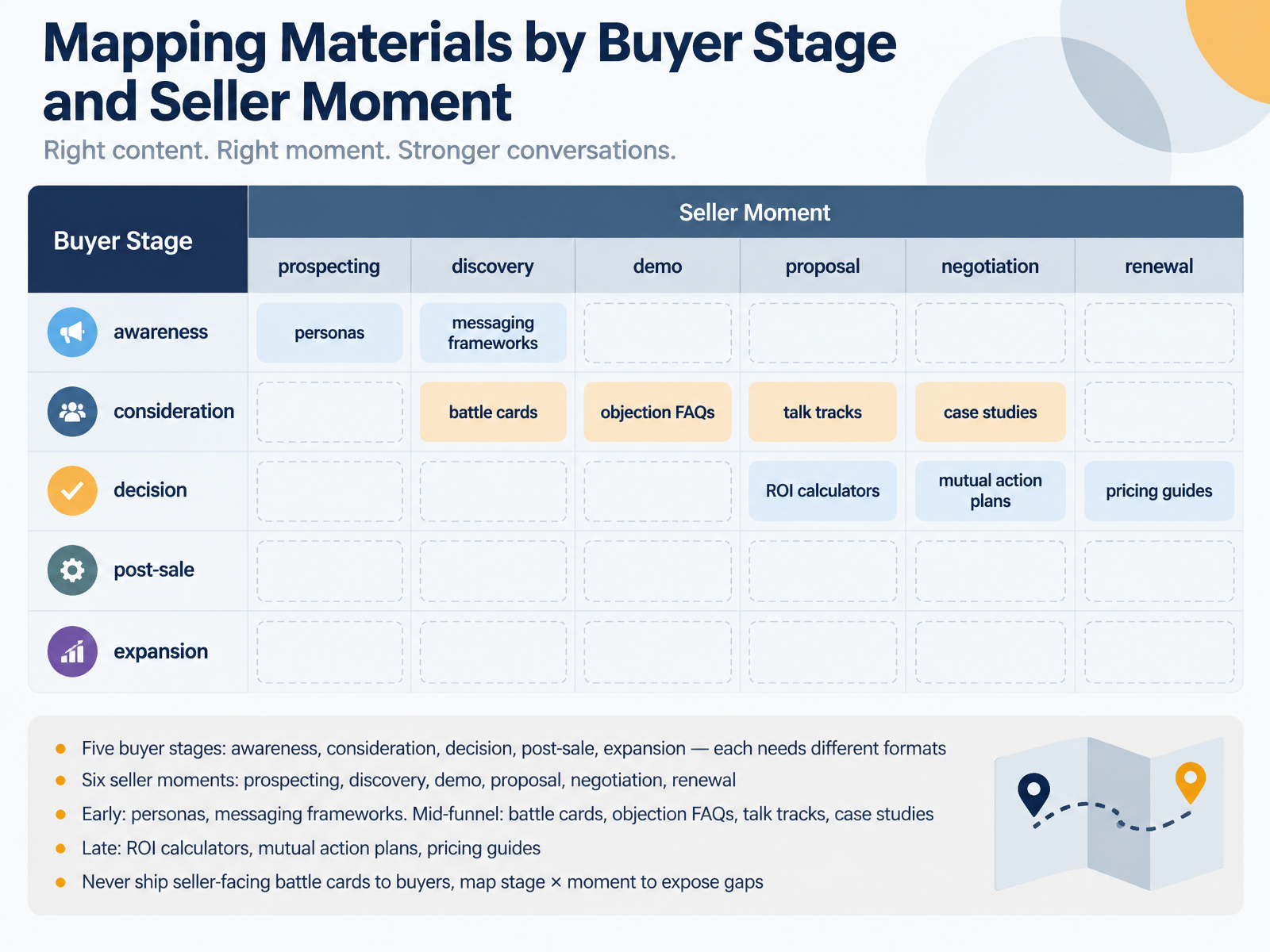
- 03Mapping Materials by Buyer Stage and Seller MomentNow let's map our materials by buyer stage and seller moment. There are five buyer stages: awareness, consideration, decision, post-sale, and expansion. Each one needs different formats. Alongside those, we have six seller moments: prospecting, discovery, demo, proposal, negotiation, and renewal. Early on, think personas and messaging frameworks. Mid-funnel, that's where battle cards, objection FAQs, talk tracks, and case studies earn their keep. Late in the deal, you'll want ROI calculators, mutual action plans, and pricing guides. One hard rule here: never ship seller-facing battle cards to buyers. They're internal tools, not customer assets. Map stage against moment on a simple grid, and the gaps show up fast. You'll see which moment has no ready asset before the rep is standing in it. So take one stage and one moment from your own funnel this week, and check what actually exists for each cell. Next, we'll look at content patterns that make materials usable.
 atlassian.comflowla.comemt.gartnerweb.com+22 min
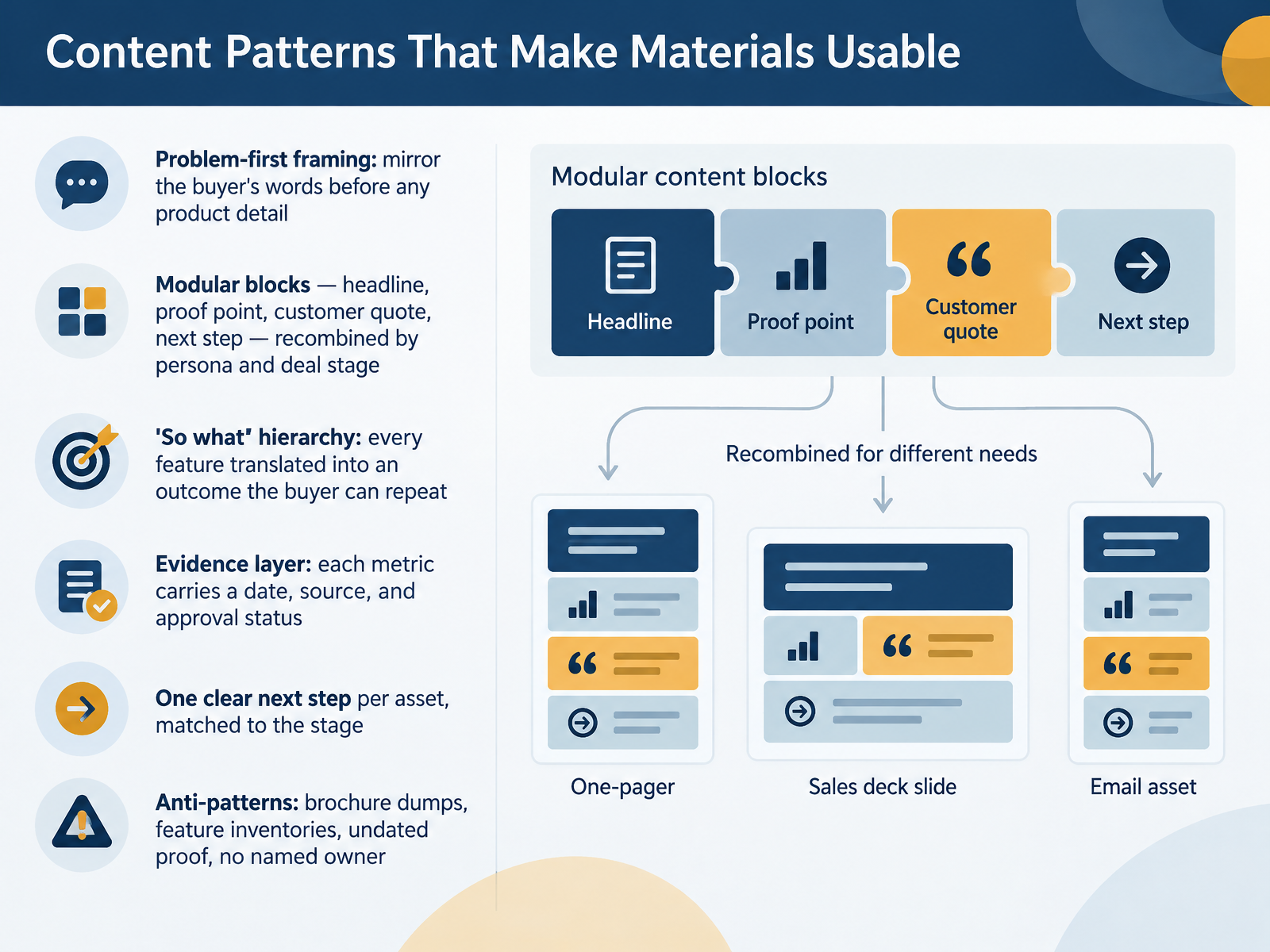
- 04Content Patterns That Make Materials UsableNow let's look at the content patterns that make enablement materials actually usable. Start with problem-first framing. Mirror the buyer's own words before you mention any product detail. Next, build in modular blocks: a headline, a proof point, a customer quote, and a next step. Those recombine by persona and deal stage. Then apply the so-what hierarchy. Translate every feature into an outcome the buyer can repeat back. Add an evidence layer, so each metric carries a date, a source, and an approval status. And give each asset one clear next step, matched to the stage. Watch for the anti-patterns: brochure dumps, feature inventories, undated proof, and no named owner. Pick one asset you own and check it against these patterns this week. Next, we move to the anatomy of a battle card.
 octavehq.complaybooks.commarketbetter.ai+22 min
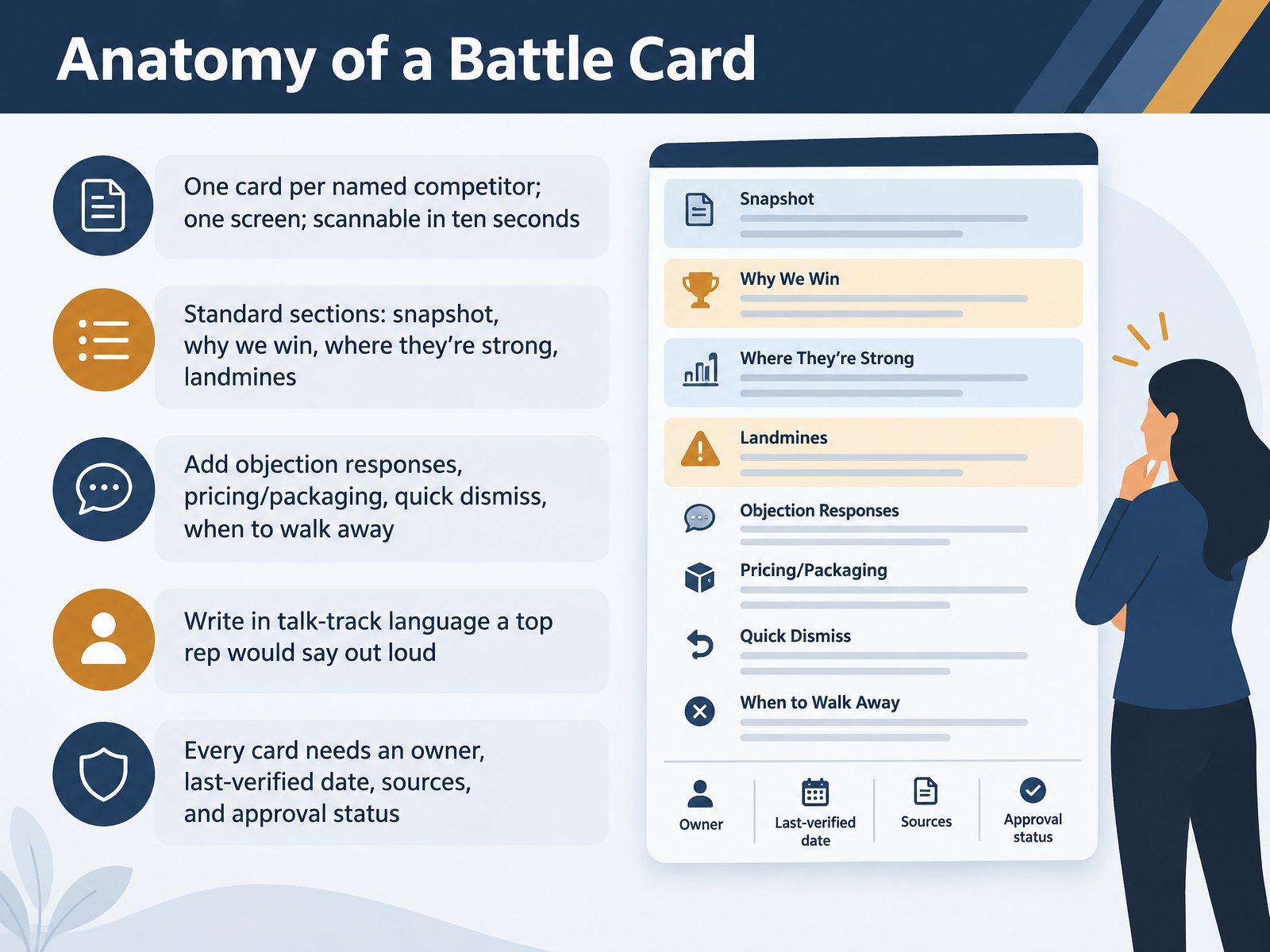
- 05Anatomy of a Battle CardLet's look at the anatomy of a battle card. The rule is simple. One card per named competitor, one screen, scannable in ten seconds. If a rep has to scroll or search mid-call, the card is already too long.
Every card follows the same sections. A snapshot, then why we win, then where they're strong, then landmines. Keep that order consistent. When a rep learns the layout once, they can find an objection response in seconds, no matter which competitor is on the table.
Then layer in the deal-time content. Objection responses, pricing and packaging, a quick dismiss line for when the rival is mentioned in passing, and an honest note on when to walk away. That last part matters. Telling reps when a deal is not worth pursuing builds trust in the whole card.
Write it in talk-track language. Use the words a top rep would actually say out loud, not analyst prose. For example, instead of saying our integration is comprehensive, write the line the rep can repeat and the question they can ask.
Finally, every card needs an owner, a last-verified date, its sources, and an approval status. No owner means no updates, and stale competitive data is worse than none. So here's your next step. Pick one competitor card you own, and check that all six sections are there, in order, with a named owner and a verified date.
Next, we'll move into talk tracks and objection-handling guides.
 octavehq.complaybooks.commarketbetter.ai+22 min
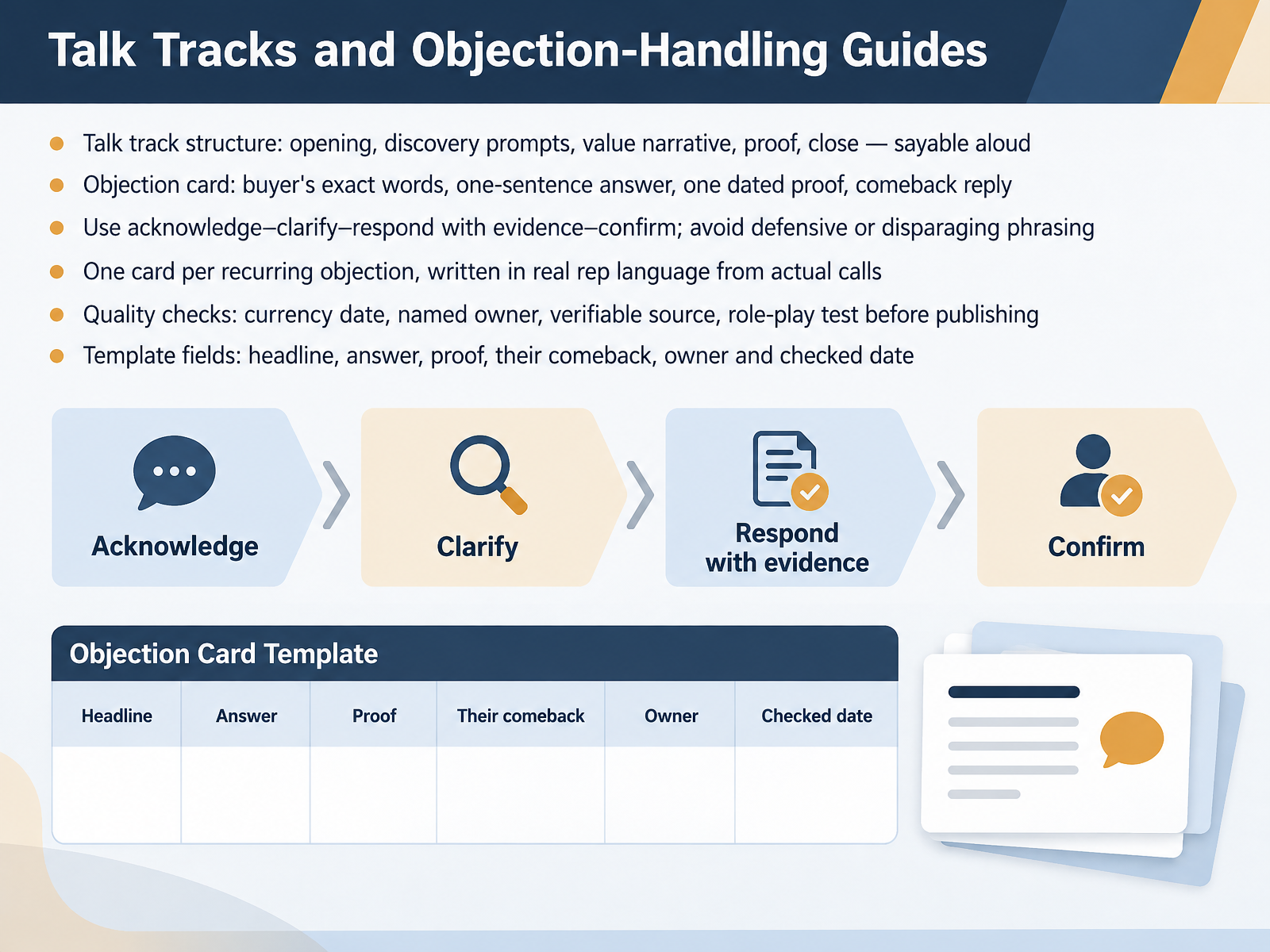
- 06Talk Tracks and Objection-Handling GuidesLet's move on to the assets reps reach for mid-conversation: talk tracks and objection-handling guides. A talk track follows a simple arc. Opening, discovery prompts, value narrative, proof, and close. The test is whether you can say it aloud without reading. If it sounds like a brochure, rewrite it. An objection card is smaller: the buyer's exact words, a one-sentence answer, one dated proof point, and their likely comeback with your reply. Handle pushback with four steps. Acknowledge, clarify, respond with evidence, then confirm. Skip the defensive tone. One card per recurring objection, written in the language reps actually use on real calls. Before publishing, run four checks. Is the date current. Is there a named owner. Is the source verifiable. And has someone role-played it out loud. Next, let's look at case studies and customer proof that sell.
 salesforce.comringover.comgong.io+22 min
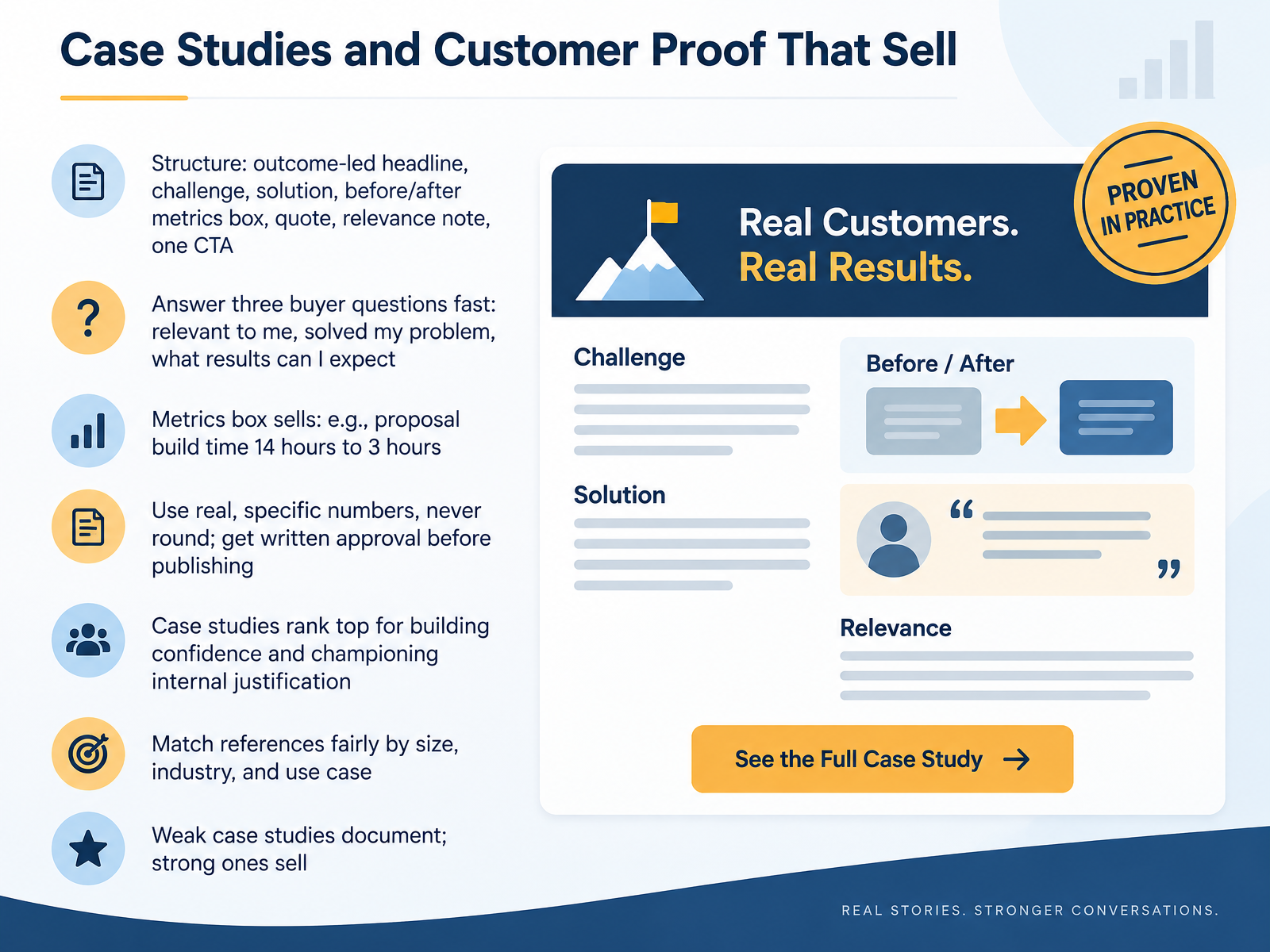
- 07Case Studies and Customer Proof That SellNow let's look at case studies and customer proof that actually sell. The structure is straightforward. Lead with an outcome headline, then the challenge, the solution, a before and after metrics box, a customer quote, a relevance note, and one call to action. A well-built case study answers three buyer questions fast: is this relevant to me, did you solve my problem, and what results can I expect. The metrics box does the heavy lifting. For example, proposal build time dropping from fourteen hours to three. Use real, specific numbers, never round them, and get written approval before publishing. Case studies rank at the top for building confidence and for helping a champion justify the decision internally. Match references fairly by size, industry, and use case. Weak case studies document. Strong ones sell. Your next step: pick one existing case study and check whether it answers those three buyer questions in the first few paragraphs. Next, we'll move on to ROI calculators and business cases.
 atlassian.comflowla.comemt.gartnerweb.com+22 min
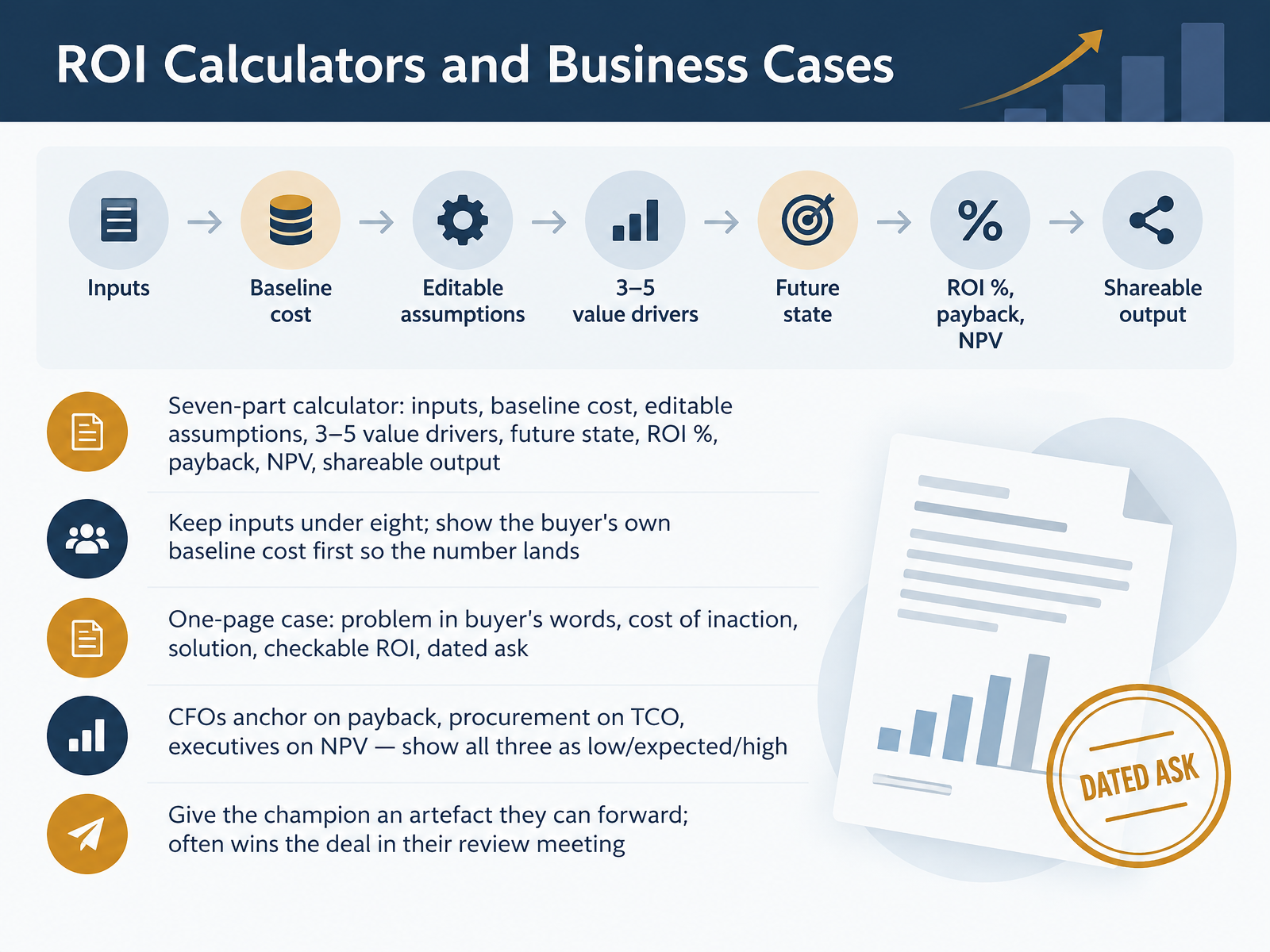
- 08ROI Calculators and Business CasesNow let's look at ROI calculators and one-page business cases. A credible calculator has seven parts: buyer inputs, their baseline cost, editable assumptions, three to five value drivers, the future state, headline metrics like ROI, payback, and NPV, and a shareable output. Keep inputs under eight, and show the buyer's own baseline cost first, so the number lands. For the one-page case, lead with the problem in the buyer's words, then the cost of inaction, the solution, checkable ROI, and a dated ask. Remember who reads what. CFOs anchor on payback, procurement on total cost of ownership, executives on NPV, so show all three as low, expected, and high. The real goal is to give your champion an artefact they can forward, because that often wins the deal in their review meeting. Next up: playbooks, onboarding paths, and certification.
 2 min
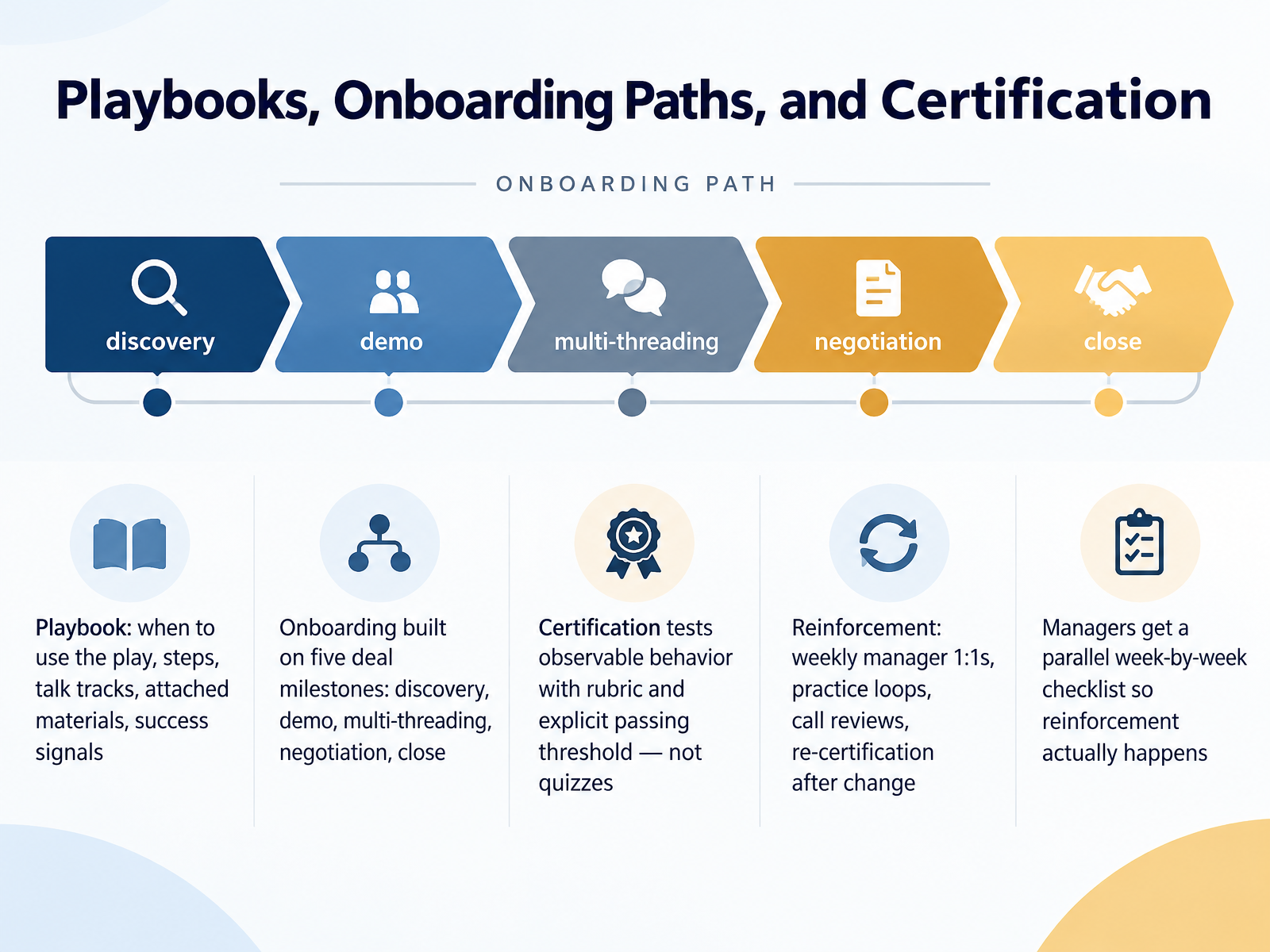
- 09Playbooks, Onboarding Paths, and CertificationNow let's look at the assets that carry learning past the classroom: playbooks, onboarding paths, and certification. Each play in a playbook answers five questions. When do we use it, what are the steps, what do we say, which materials attach, and what signals tell us it worked. Onboarding follows five deal milestones: discovery, demo, multi-threading, negotiation, and close. Build one certification per milestone so the curriculum prepares people to pass in sequence. Certification should test observable behavior against a rubric with an explicit passing threshold, not a quiz. Then reinforce it, through weekly manager one-to-ones, practice loops, call reviews, and re-certification after any major change. Give managers a parallel week-by-week checklist so reinforcement actually happens. Next, we'll walk through example kit one: new product launch.
 1 min
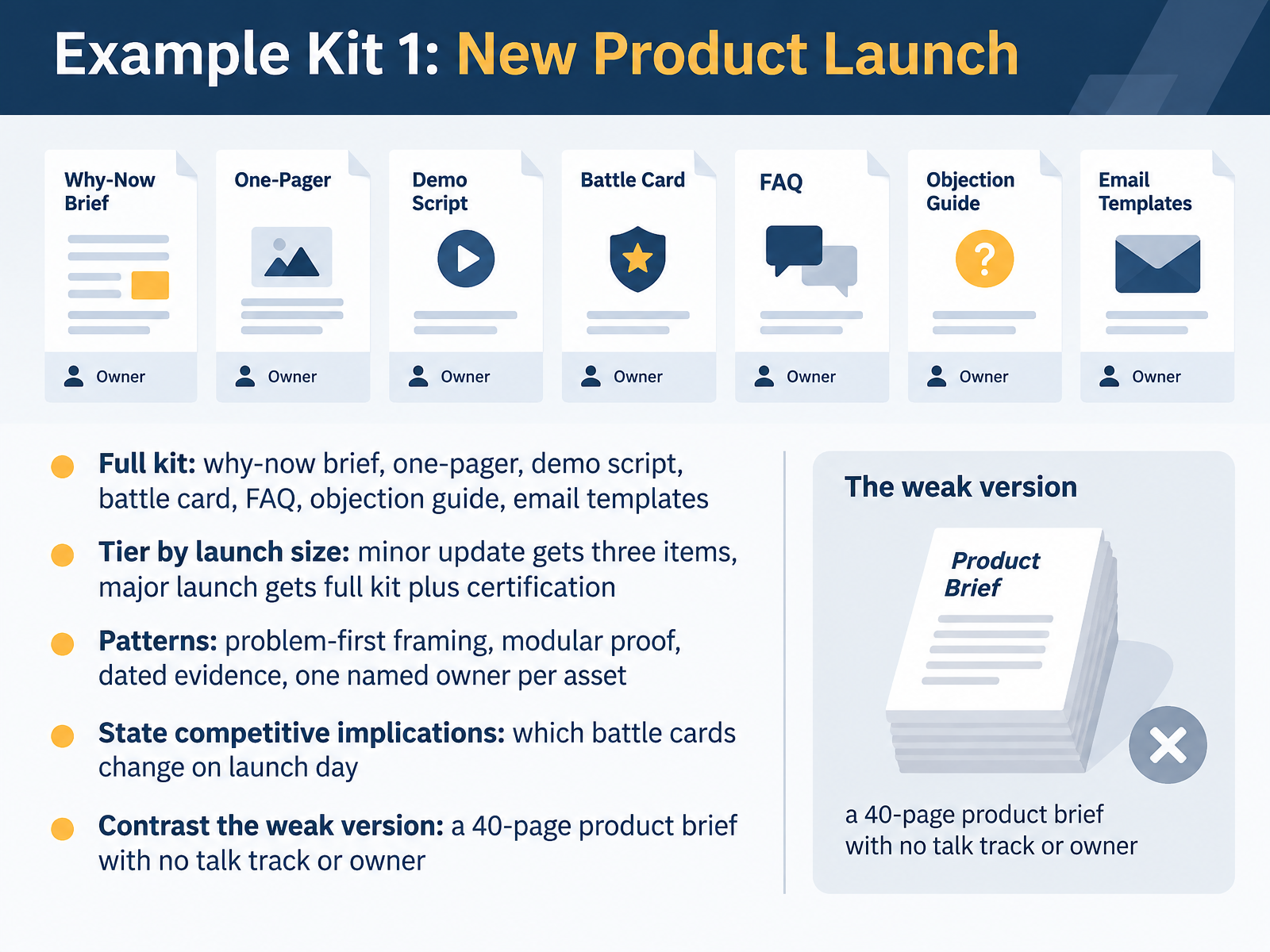
- 10Example Kit 1: New Product LaunchHere is a full kit for a new product launch. At major launch tier, it includes seven core assets: a why-now brief, a one-pager, a demo script, a battle card, an FAQ, an objection guide, and email templates. Tier the kit by launch size. A minor update gets three items. A major launch gets the full kit plus certification reps must complete before selling.
Four patterns make the kit work. Problem-first framing leads with the buyer's pain. Modular proof lets reps pull a single case study or metric. Dated evidence shows when each proof point was verified. And one named owner per asset keeps things current.
State the competitive implications directly. Name which battle cards change on launch day, so reps are not caught using stale positioning.
Contrast that with the weak version: a forty-page product brief with no talk track and no owner. Nobody reads it, and nobody owns fixing it.
Your next step is to pick your launch tier and name one owner for each asset before the brief is written. Next, we look at example kits for competitive displacement and expansion and renewal.
 2 min
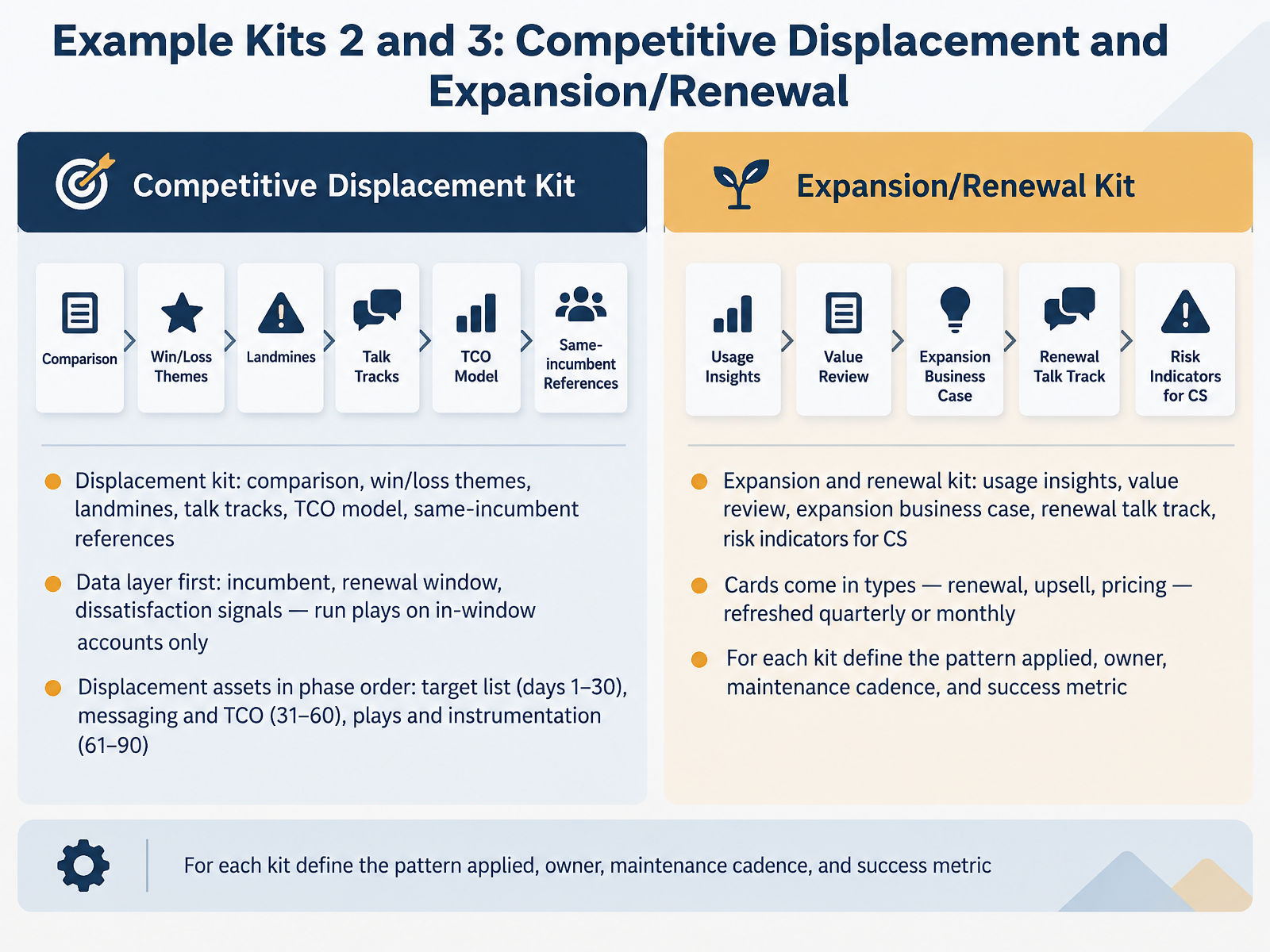
- 11Example Kits 2 and 3: Competitive Displacement and Expansion/RenewalLet's look at two more example kits. First, competitive displacement. That kit holds a comparison, win and loss themes, landmines, talk tracks, a total cost of ownership model, and references from customers who came over from the same incumbent.
Start with the data layer. Capture the incumbent and the renewal window, then run displacement plays only on in-window accounts. Sequence the assets in phases: the target list in the first thirty days, messaging and the cost model by day sixty, and plays with instrumentation after that.
Second, the expansion and renewal kit. It covers usage insights, value reviews, the expansion business case, a renewal talk track, and risk indicators for customer success. Cards come in types, such as renewal, upsell, and pricing, refreshed quarterly or monthly.
For each kit, define the pattern applied, the owner, the maintenance cadence, and the success metric. Pick one kit and write those four lines this week.
Next, we move to finding, governing, and retiring materials.
 salesforce.comringover.comgong.io+22 min
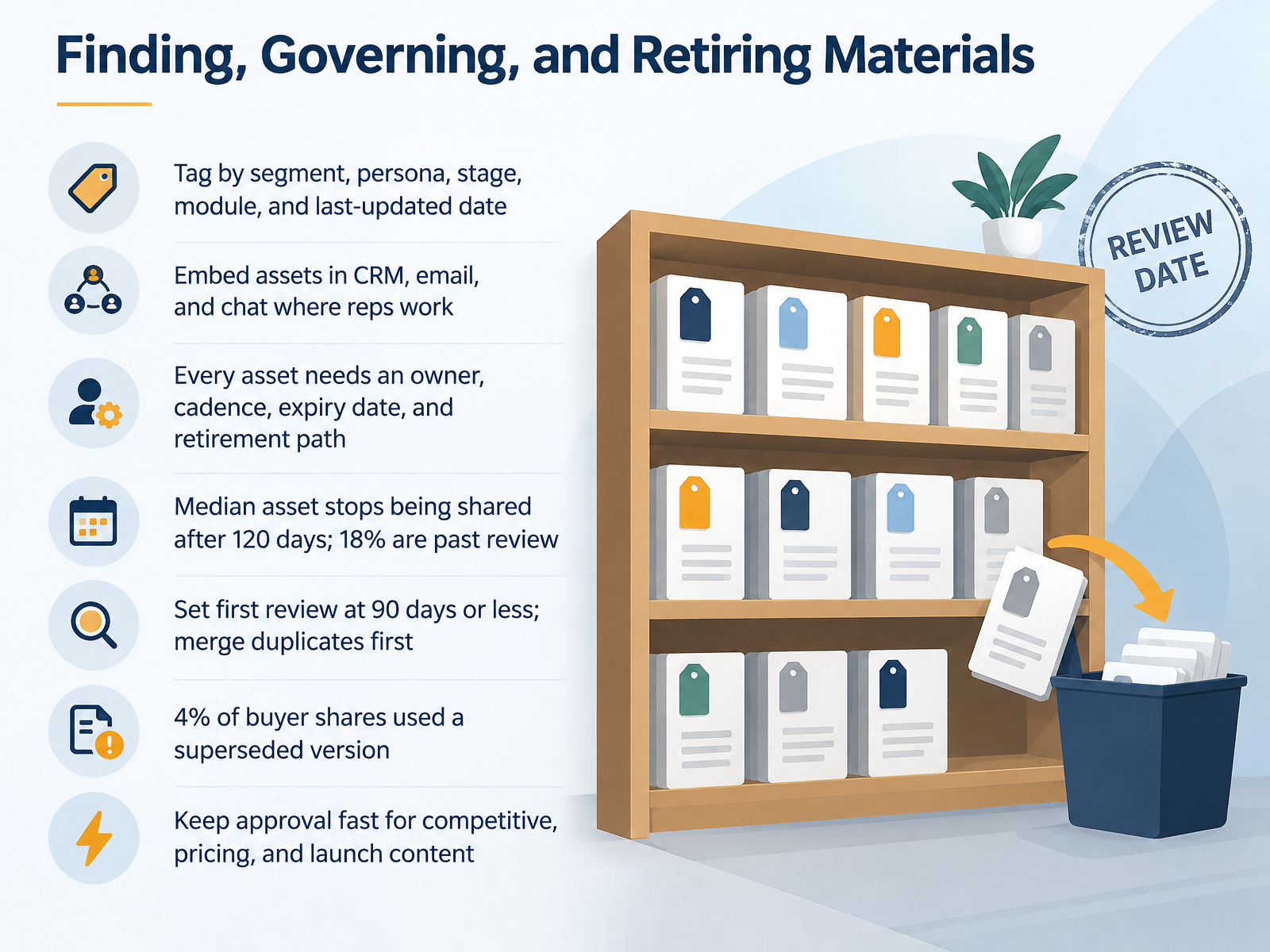
- 12Finding, Governing, and Retiring MaterialsNow let's look at finding, governing, and retiring materials. Finding starts with tagging. Tag every asset by segment, persona, deal stage, module, and last-updated date. Then embed assets in the CRM, email, and chat, so reps find them where they already work. Governance needs four fields on every asset: an owner, a review cadence, an expiry date, and a retirement path. The reason is shelf life. In benchmark data, the median asset stopped being shared 120 days after publication. And 18% of active assets were past their review or expiry date. So set the first review at 90 days or less, while sellers are still using the asset.
Retirement matters too. About 4% of buyer shares used a superseded version, roughly one in twenty-five. Merge duplicates first, because two copies of a deck are one common route to an old version. Approval usually isn't the bottleneck at a median of 4 days, but keep it fast for competitive, pricing, and launch content.
Your next step: pick one content area, assign owners and expiry dates, and run a 90-day review. That leads us into measuring adoption and deal impact.
 2 min
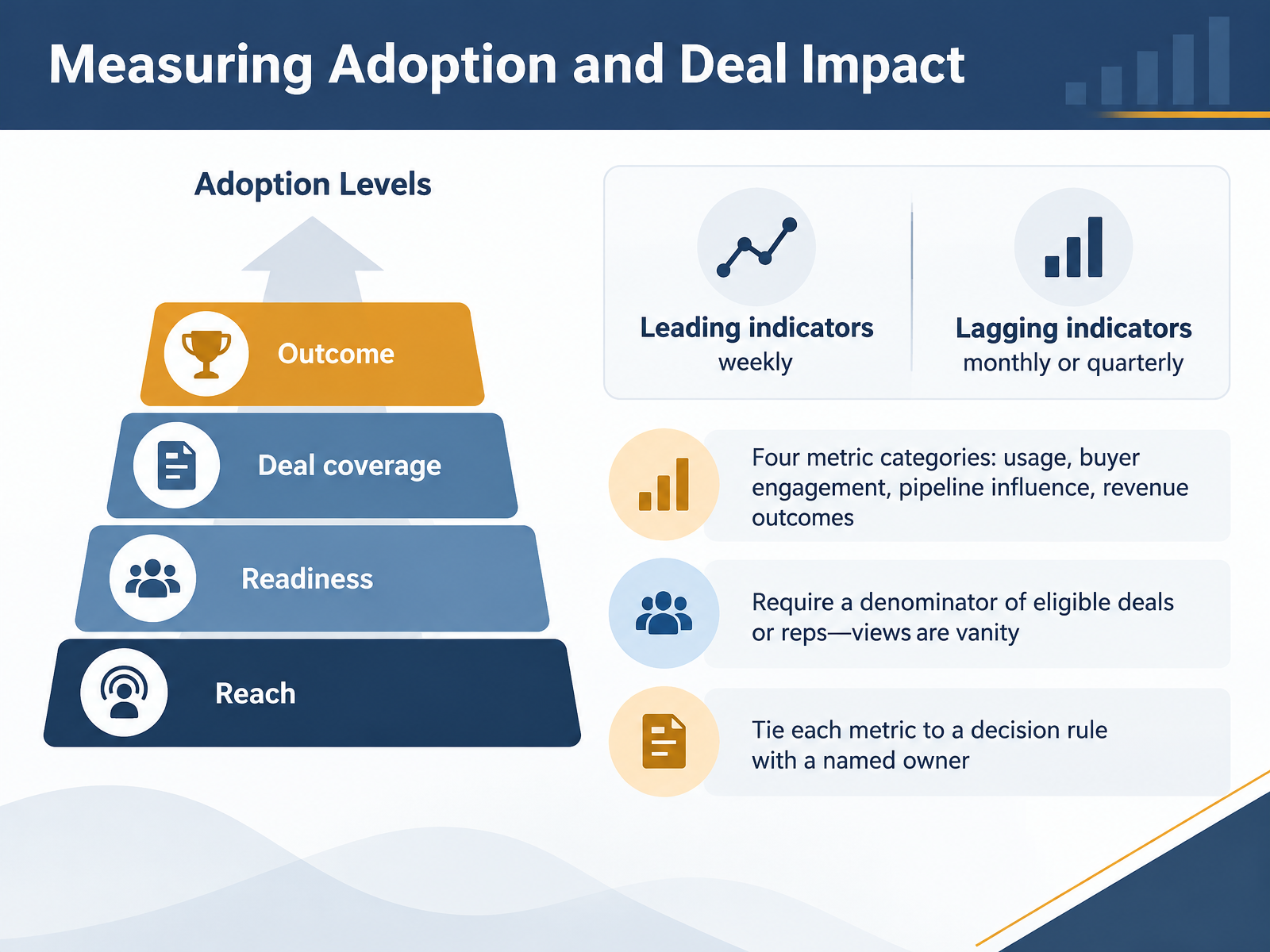
- 13Measuring Adoption and Deal ImpactLet's look at how we measure whether this material is actually working. Start with four metric categories: usage, buyer engagement, pipeline influence, and revenue outcomes. Each answers a different question, so report all four, not just the easy ones.
Adoption moves through levels: reach, readiness, deal coverage, and outcome. Reach is easy to count. A play everyone opened and nobody ran in a deal has full reach and no adoption. Deal coverage is the number that matters.
Pace this deliberately. Review leading indicators weekly and lagging indicators monthly or quarterly. And always require a denominator of eligible deals or reps. Views without a denominator are vanity.
Finally, tie each metric to a decision rule with a named owner. For example, if a new battlecard shows low coverage after sixty days, someone triggers training or promotion. A dashboard nobody acts on is just expensive reporting.
Next, we move into the workshop: audit your material set and build a thirty day plan.
 salesforce.comg2.comhubspot.com+22 min
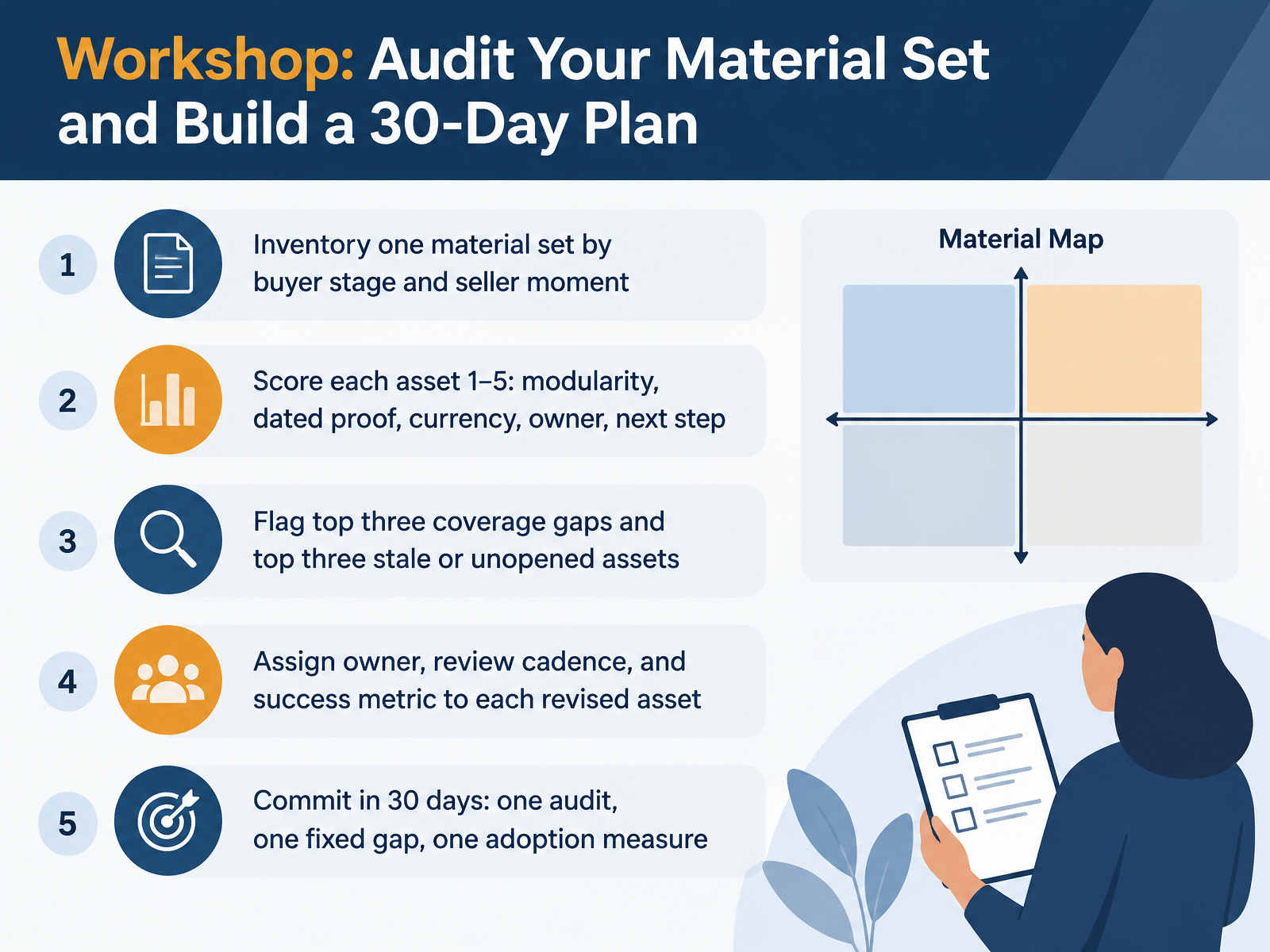
- 14Workshop: Audit Your Material Set and Build a 30-Day PlanLet's finish with a working session, because an audit only pays off if it changes something. Start by picking one material set. Inventory it two ways, by buyer stage and by seller moment. Then score each asset from one to five on five things. Modularity. Dated proof. Currency. A named owner. And whether it ends in a clear next step. Keep the scoring boring and consistent. Next, flag your top three coverage gaps and your top three stale or unopened assets. That last flag matters, because sellers never opened thirty-two percent of playbook assets in ninety days. For each asset you revise, assign an owner, a review cadence, and one success metric. Then commit to three things in thirty days. One audit, one fixed gap, and one adoption measure, such as weekly share rate by team. A good practice is to set the first review date at ninety days, since the median asset stops being shared after about one hundred twenty. Thank you for working through this course with us. You now have the patterns. Pick one set this week and run the audit. Small, owned changes compound, and your sellers will notice.
 octavehq.complaybooks.commarketbetter.ai+22 min
Take the deck with you
Download this course as a file — free, no sign-up needed.
- PDF handoutEvery slide page, ready to print or share.15 pages · 3.3 MBDownload
- Narrated PowerPointThe deck that presents itself — every slide carries the digital human's narration video.15 pages · 13.4 MBDownload
- PowerPoint slidesThe full deck as a .pptx — open it in PowerPoint, Keynote, or Google Slides.15 pages · 3.2 MBDownload
Free to use in your own training — please keep the PersonWise credit page at the end.
Have your own deck? Turn it into a course
Sources consulted
Web sources consulted while building this course.
- What is Sales Enablement? A Complete Strategy Guide | Salesforce — salesforce.com
- Sales Enablement Guide: Strategy, Metrics, and Software (2026) — g2.com
- What is Sales Enablement? | HubSpot — hubspot.com
- What Is Sales Enablement? | Articulate — articulate.com
- Ultimate Guide to Sales Enablement Success in 2026 | Seismic — seismic.com
- 10 Types of Sales Enablement Content and How to Create Them — atlassian.com
- 20+ Sales Content Types for Every Stage of the Buying Cycle | Flowla — flowla.com
- Develop Marketing Content to Drive Conversion Across the Buying Journey — emt.gartnerweb.com
- 20 sales enablement examples in 2026 - Guideflow Blog — guideflow.com
- 10 Sales Enablement Content Types Every Revenue Team Needs - Aligned — alignedup.com
- Octave | The GTM Engineer's Guide to Battlecards — octavehq.com
- battlecard-library skill by gtmagents/gtm-agents — playbooks.com
- AI Sales Enablement Content Generation with Codex [2026] | Blog | MarketBetter — marketbetter.ai
- How to use battle cards in your sales process [+ templates] — blog.hubspot.com
- Single-Page vs. Multi-Page Battlecards: Which Works Better? — playwisehq.com
- Sales Battle Cards: Templates, Tips, & Strategies for 2026 | Salesforce — salesforce.com
- 12 Examples to Create Winning Battle Cards in 2026 | Ringover — ringover.com
- The Sales Battle Card Template For Ultra-Competitive Deals — gong.io
- Sales Battlecards: Examples To Inspire B2B Sellers — highspot.com
- Sales Battlecard Template — contentcamel.io