Data Engineering Workflow Optimization
Begin
14 pages · ~28 min
Data Engineering Workflow Optimization
Learn the end-to-end data engineering workflow, including key steps, handoffs, and improvement strategies for efficient data pipelines.
What you’ll learn
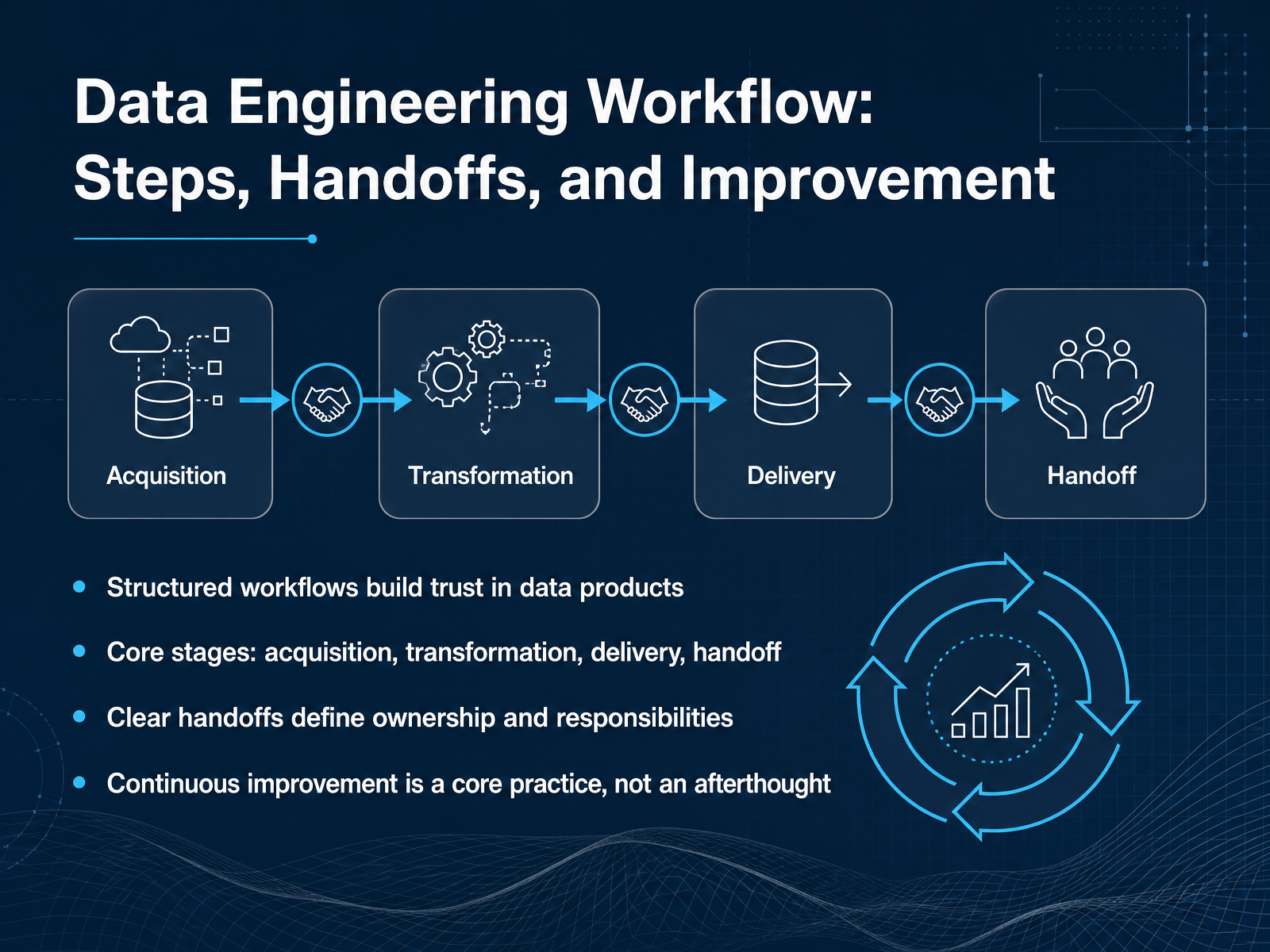
- 01Data Engineering Workflow: Steps, Handoffs, and ImprovementWelcome. This session is about the data engineering workflow. We will walk through the steps, the handoffs, and where to improve. A structured workflow builds trust in your data products. Without it, people lose confidence in the numbers. We will cover four core stages. Acquisition, transformation, delivery, and handoff. Each stage has a clear owner. Clear handoffs define who is responsible for what. This prevents confusion and dropped work. Continuous improvement is a core practice, not an afterthought. You review the process, find the bottleneck, and fix it. Treat it like a regular maintenance task. Now, let us look at why undefined workflows fail. That is where most teams run into trouble.2 min
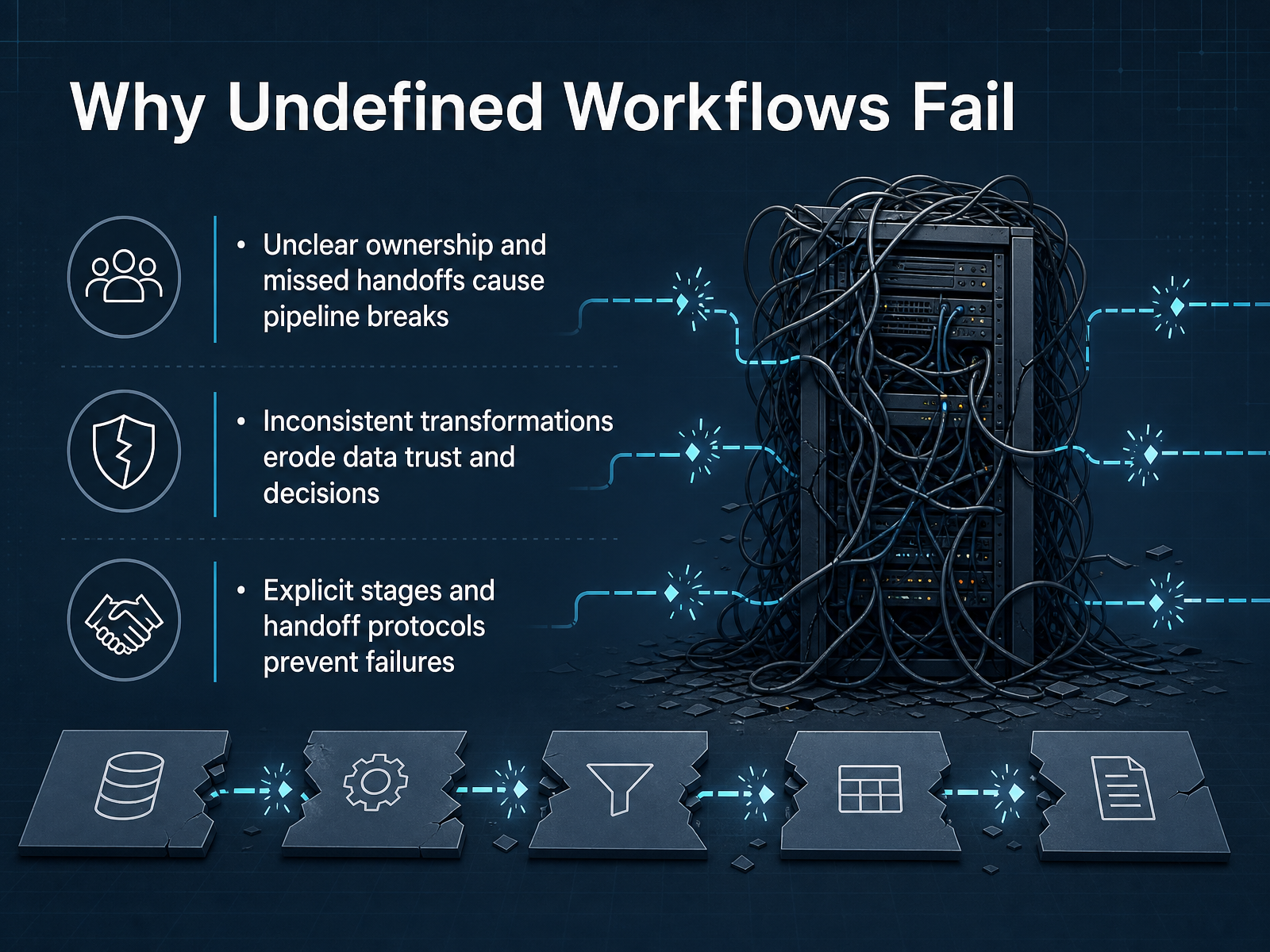
- 02Why Undefined Workflows FailLet’s look at why undefined workflows fail. When ownership is unclear, handoffs get missed, and the pipeline breaks. For example, if the ingestion team assumes the transformation team will handle data validation, bad data slips through. Inconsistent transformations are another failure point. If one batch rounds revenue numbers and the next one doesn’t, the data loses trust, and decisions suffer. Explicit stages and handoff protocols prevent these failures. Define who does what at each step. Document the expected output format. Set a validation gate before the next stage begins. These are simple, concrete measures that keep the pipeline stable. Next, we’ll look at the three core pipeline stages that give this workflow its structure.
 1 min
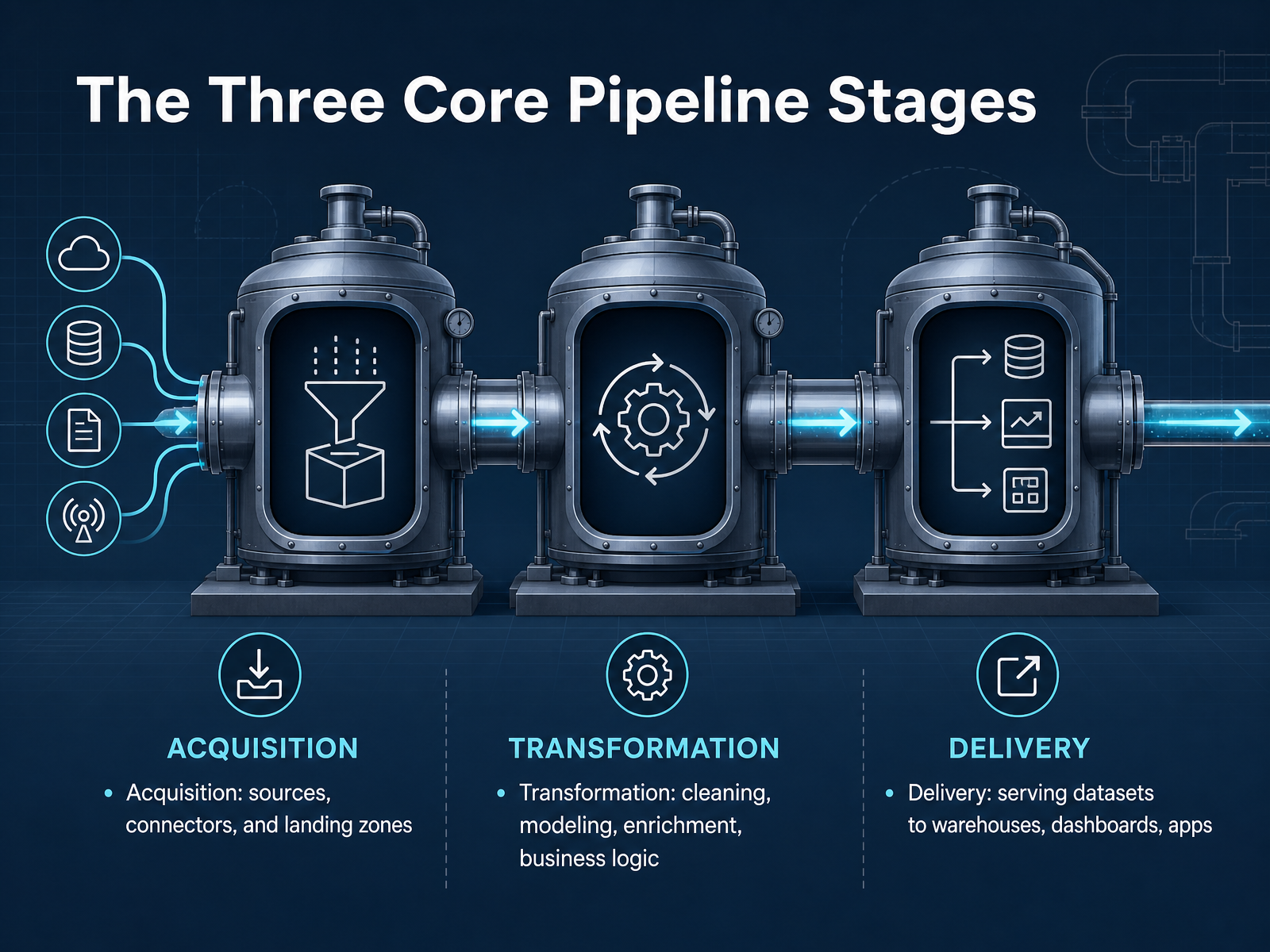
1 min - 03The Three Core Pipeline StagesLet's break down the three core pipeline stages. Acquisition comes first. This is where you pull data from source systems, using connectors, and land it in a staging area. Think of it as bringing raw material into the building. Transformation is the second stage. This is where the real work happens: cleaning the data, shaping its model, enriching it with additional context, and applying the business logic that makes it usable. Finally, delivery. This is the output stage, where you serve the prepared data to its consumers: data warehouses, dashboards, or applications. Each stage has a clear owner, and that clarity is what prevents confusion. With that in mind, let's look at why the boundaries between these stages matter so much for ownership and accountability.
 1 min
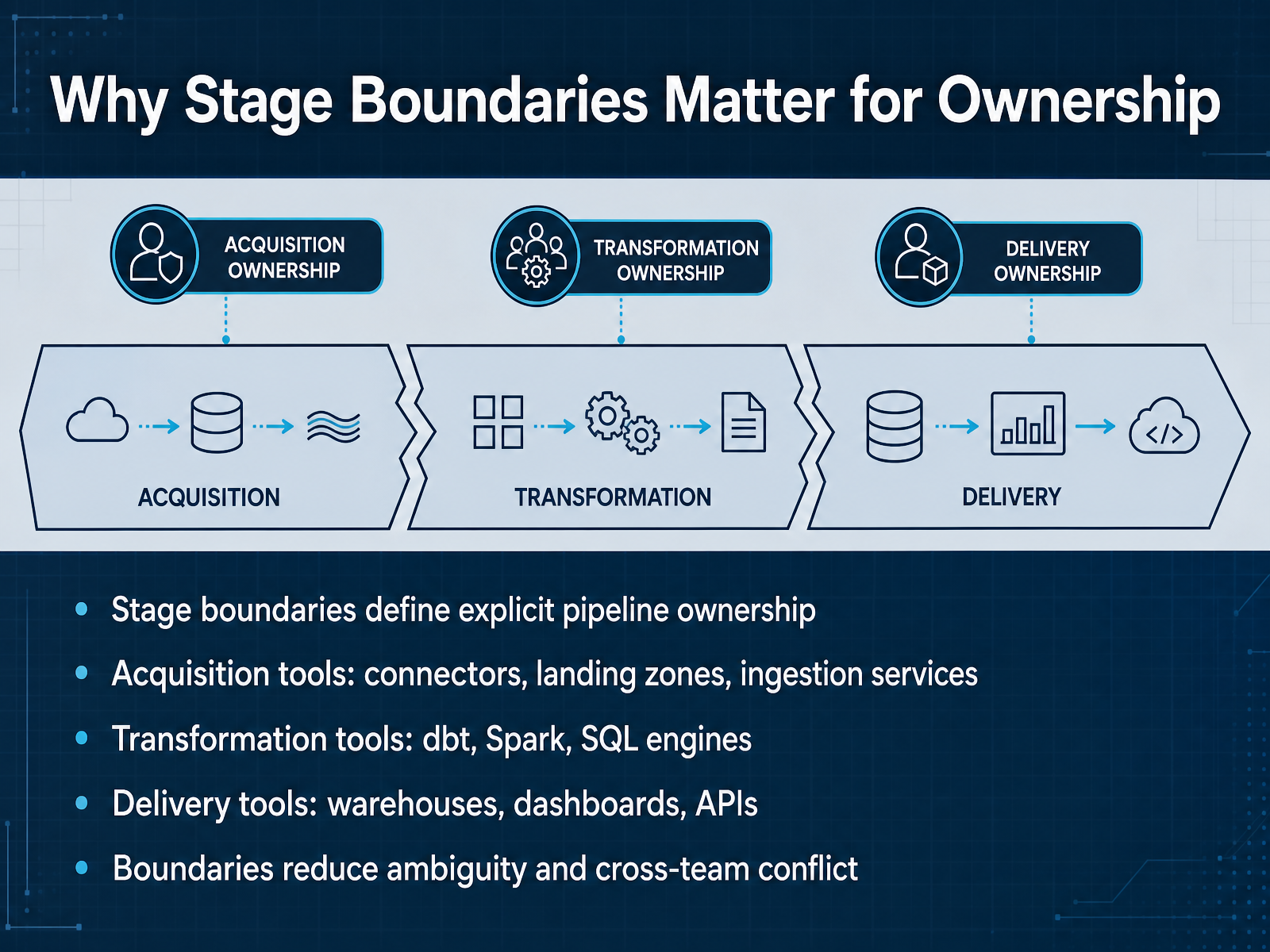
1 min - 04Why Stage Boundaries Matter for OwnershipNow let's talk about why stage boundaries matter for ownership. When you clearly separate acquisition, transformation, and delivery, you also separate responsibility. The acquisition stage uses connectors, landing zones, and ingestion services. That team owns getting data in. The transformation stage uses tools like dbt, Spark, or SQL engines. That team owns shaping the data. The delivery stage uses warehouses, dashboards, and APIs. That team owns making data available. Clear boundaries reduce ambiguity. They also reduce cross-team conflict, because everyone knows exactly where their responsibility starts and ends. If something breaks, you know which team to look at first. So the practical takeaway is simple. Define the edge between each stage explicitly. Write it down. This prevents blame-shifting and keeps the pipeline moving. Next, we'll look at defining handoffs and responsibilities in more detail.
 1 min
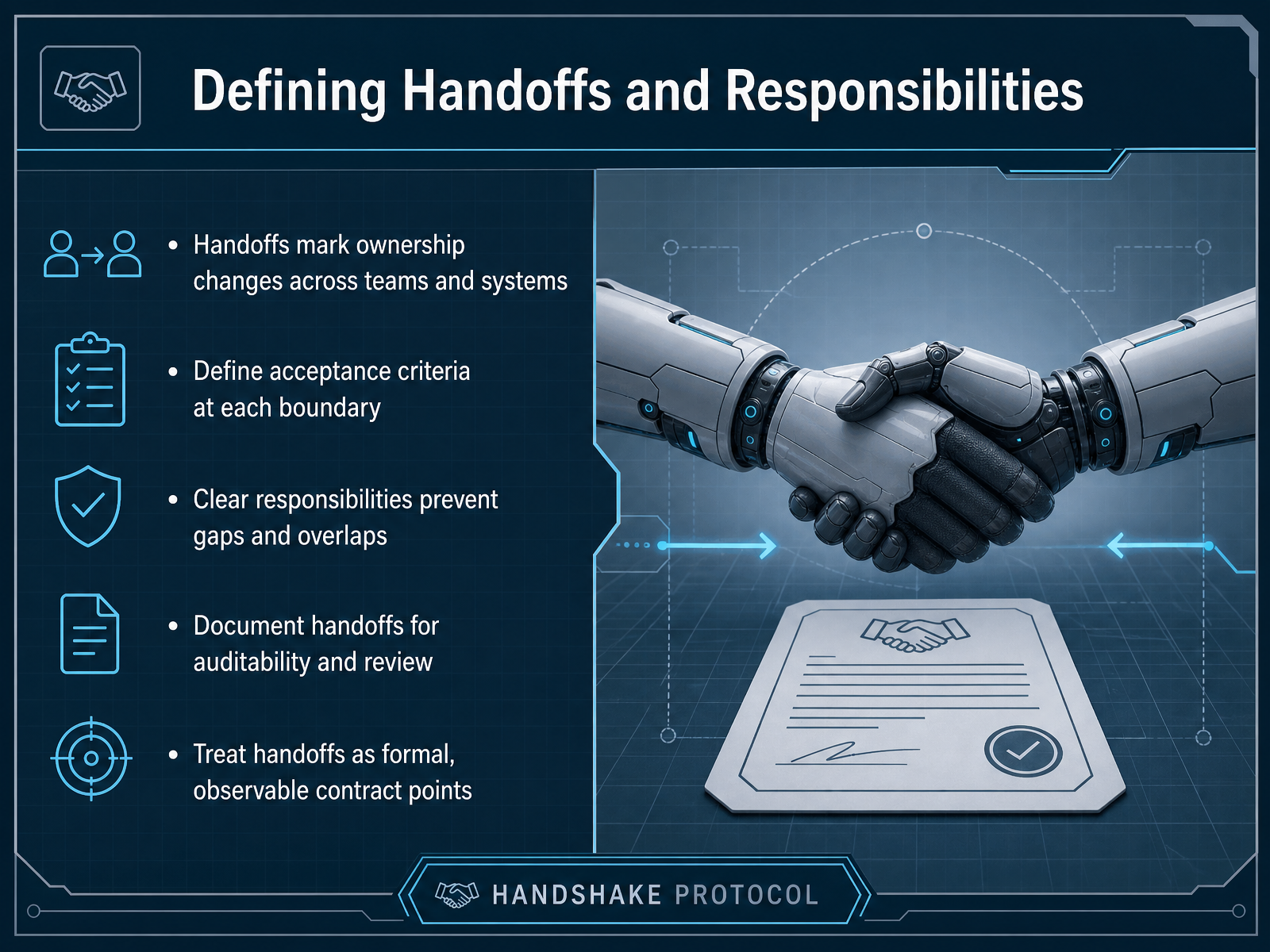
1 min - 05Defining Handoffs and ResponsibilitiesNow let's talk about handoffs and responsibilities. Every time data moves from one team or system to another, that boundary is a handoff. Treat it as a formal contract point, not just a file transfer. At each boundary, define clear acceptance criteria. For example, the ingestion team hands off raw files only when schema checks pass and record counts match the source manifest. The transformation team accepts only when those conditions are met. This prevents gaps where nobody owns a failed load, and it prevents overlaps where two teams both fix the same issue. Document every handoff. Note the time, the owner, the version, and the result. That documentation becomes your audit trail and your review material. When something breaks, you can look back and see exactly where responsibility shifted and whether the acceptance criteria were actually enforced. Keep the handoff explicit, measurable, and observable. A well-defined handoff is the difference between a pipeline that self-corrects and one that silently degrades. Now let's look at common handoff mistakes and how a RACI matrix can clarify ownership in real data contexts.
 2 min
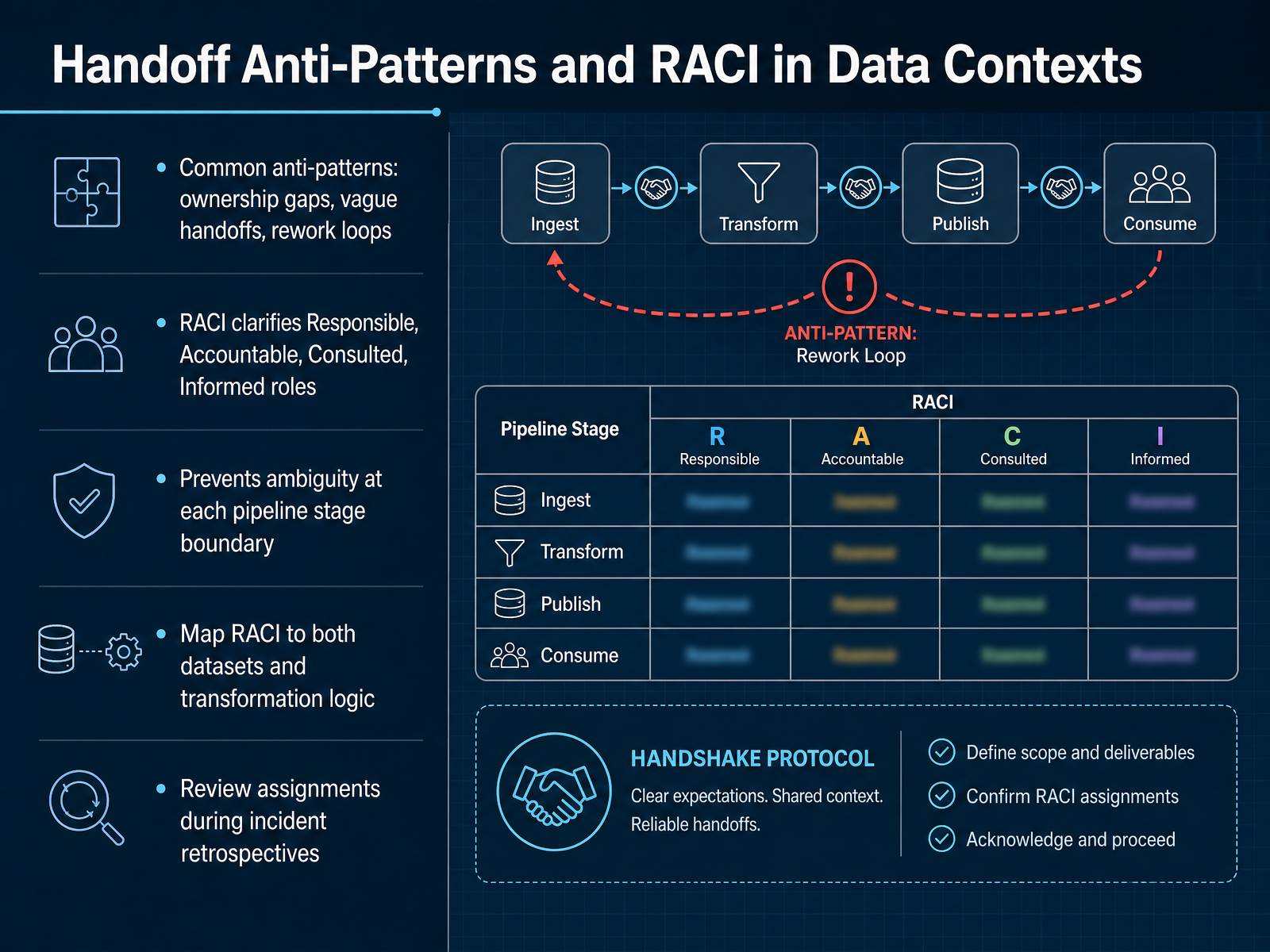
2 min - 06Handoff Anti-Patterns and RACI in Data ContextsNow let's talk about handoff anti-patterns and how RACI helps prevent them. Common problems include ownership gaps, vague handoffs, and rework loops. An ownership gap happens when no one is clearly responsible for a dataset after it leaves the extraction stage. A vague handoff is when the receiving team isn't sure what transformations have been applied. Rework loops occur when the downstream team discovers issues late and sends the data back. RACI clarifies roles for each pipeline stage boundary. Responsible is the person doing the work. Accountable is the one who answers for the result. Consulted provides input, and Informed is kept in the loop. Map RACI to both datasets and transformation logic. For example, mark who is accountable for the raw data schema and who is accountable for the cleaning rules. Review assignments during incident retrospectives. If a failure took too long to resolve, check the RACI for that stage. A clear owner speeds up decisions. For your next handoff, write down the four roles for each boundary. Keep the list visible and update it when the team changes. That simple step removes most ambiguity. Now, we move to quality gates at handoff points.
 2 min
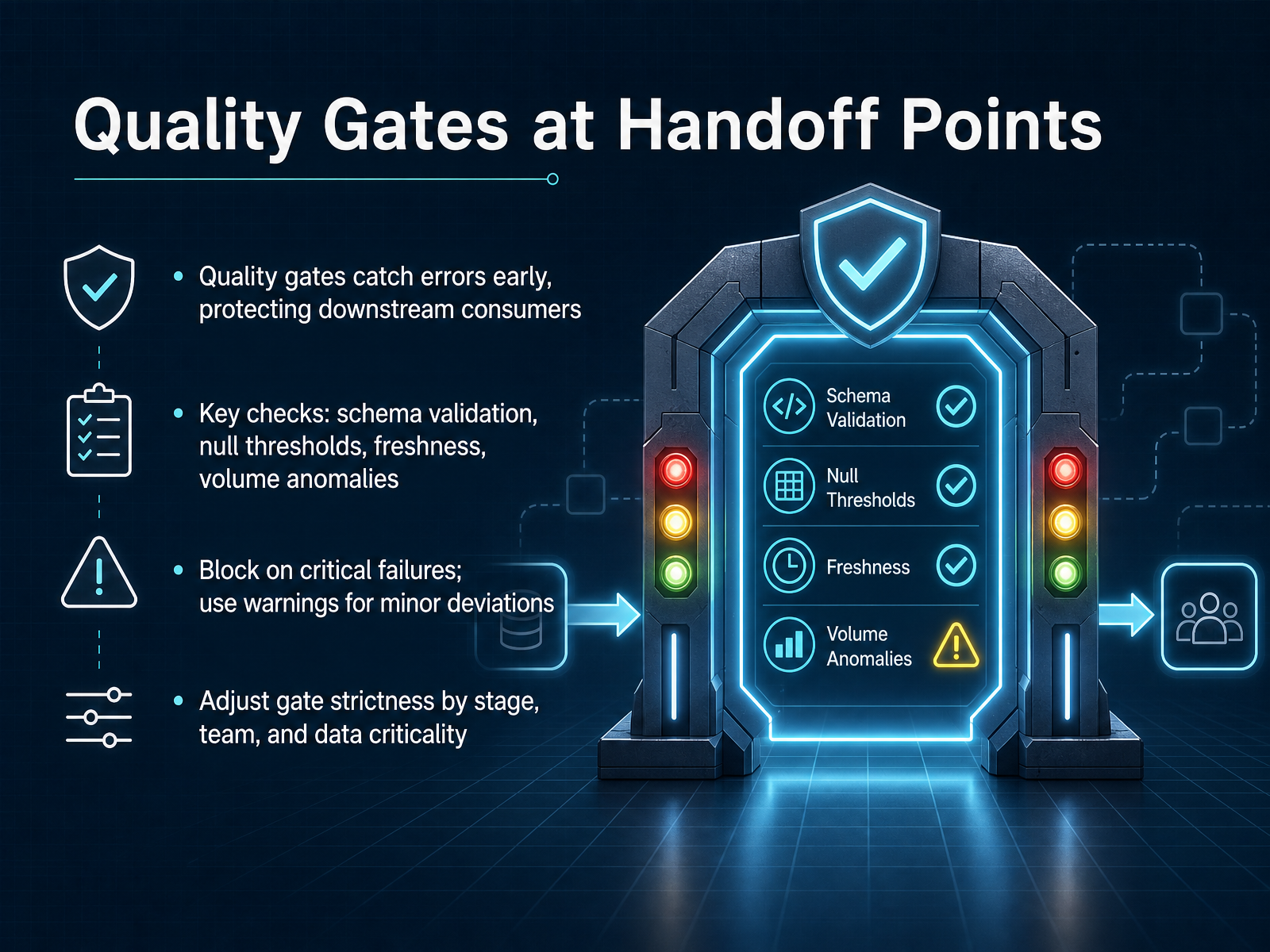
2 min - 07Quality Gates at Handoff PointsNow let’s look at quality gates, which are the checkpoints we place at every handoff. Their job is to catch errors early, before they reach downstream consumers. Each gate runs a few core checks. Schema validation confirms the data still matches the agreed structure. Null thresholds make sure missing values stay within acceptable limits. Freshness checks confirm the data arrived on time, and volume anomaly checks flag sudden drops or spikes. When a critical failure appears, the gate blocks the pipeline and the owning team fixes the issue before anything moves forward. Minor deviations get a warning, so the pipeline continues but someone logs and reviews it. The strictness of these gates should not be uniform. Adjust them by stage, by team, and by how critical the data is. A high-impact financial feed needs tighter thresholds than a low-priority analytics table. The takeaway is simple: quality gates protect downstream work, but they must be tuned to the risk. Now, let’s talk about balancing strict gates with delivery speed.
 2 min
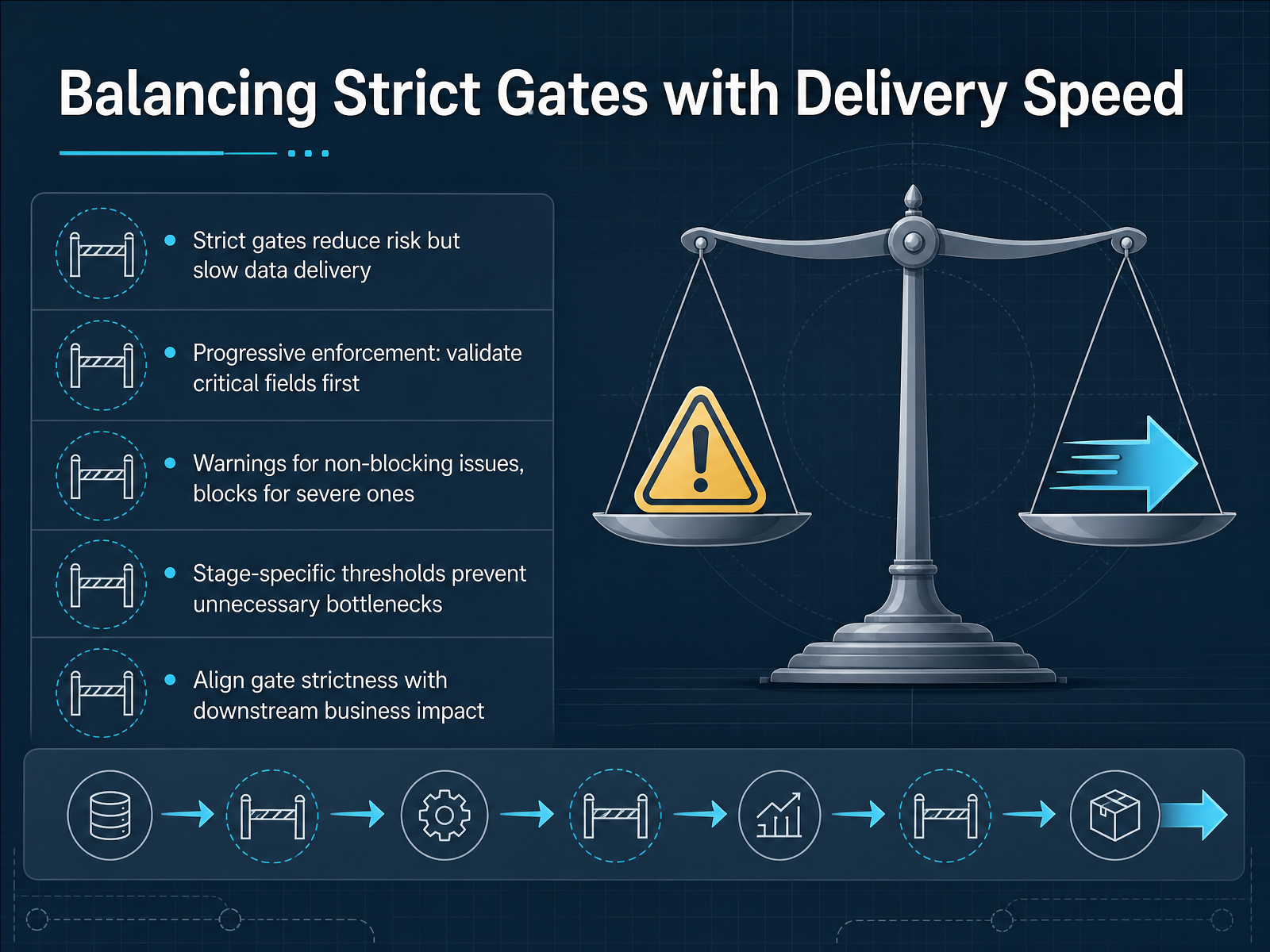
2 min - 08Balancing Strict Gates with Delivery SpeedNow let’s talk about balancing strict gates with delivery speed. Validation gates are essential, but if every check is a hard stop, your data arrives late. The fix is progressive enforcement. Start by validating only the critical fields that determine whether the data can be consumed at all. Then issue warnings for non-blocking issues, like missing optional metadata, and reserve hard blocks for severe problems, such as missing primary keys or schema mismatches. Set stage-specific thresholds so you don’t block an entire pipeline over a minor issue in a low-impact table. Remember, the strictness of each gate should match the downstream business impact. For example, a revenue report might block on a null customer ID, while a clickstream log can proceed with a warning. Review your error logs to see which blocks were false alarms, and adjust thresholds accordingly. This keeps your pipeline both safe and fast. Next, we’ll cover data contracts and lightweight documentation.
 1 min
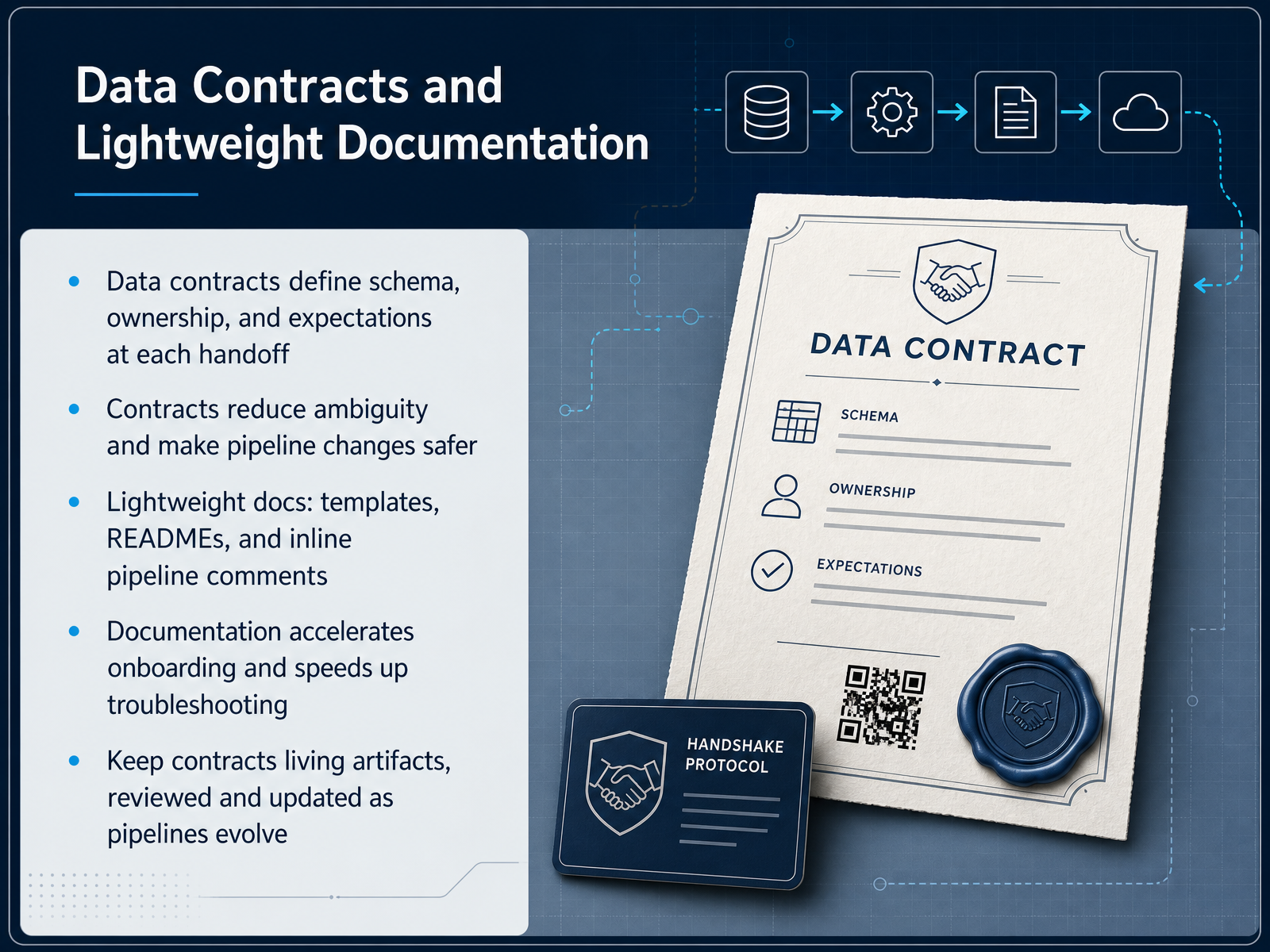
1 min - 09Data Contracts and Lightweight DocumentationLet us talk about data contracts and lightweight documentation. A data contract is a formal agreement at each handoff point. It defines the schema, the data owner, and the expectations for the data being passed along. This reduces ambiguity. When everyone knows the structure and the rules, pipeline changes become safer because you can see exactly what might break. Keep the documentation light. Use templates for standard schemas, maintain a short README for each pipeline, and add inline comments in the code where the logic is not obvious. This kind of documentation speeds up onboarding and makes troubleshooting much faster. Treat these contracts as living artifacts. They should be reviewed and updated as the pipeline evolves. A contract that is outdated is just another source of confusion. Review your error logs against your contracts regularly to confirm they still match reality. Next, let us look at how to find improvement opportunities.
 2 min
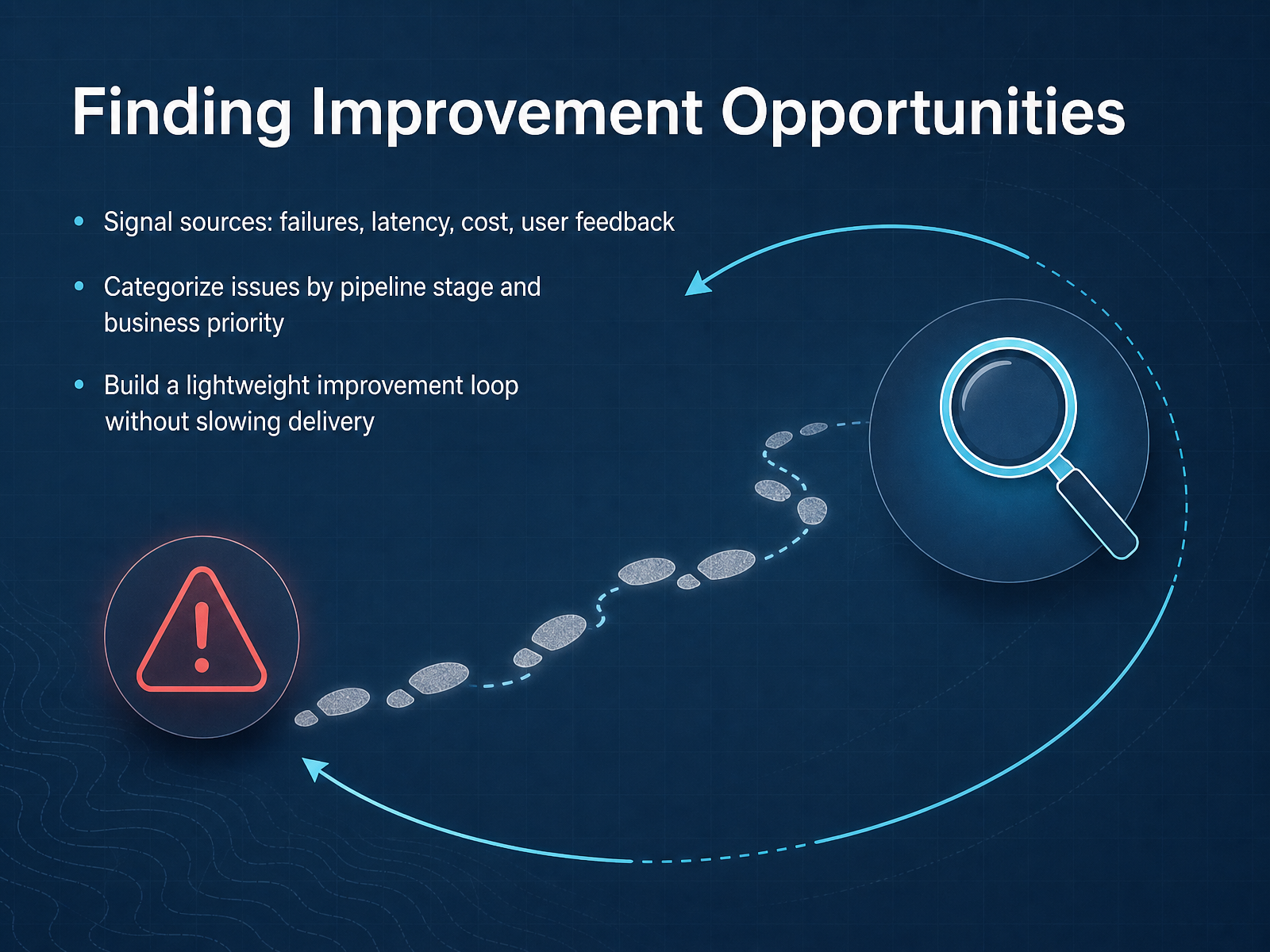
2 min - 10Finding Improvement OpportunitiesNow let’s talk about finding improvement opportunities. Improvement doesn’t come from guessing. It comes from signals. Look at four main sources. Failures, latency, cost, and user feedback. Failures show you where the pipeline breaks. Latency shows you where it slows down. Cost shows you where efficiency drops. User feedback shows you where expectations are not met. Once you have these signals, categorize them. Group issues by pipeline stage first. Is it in source extraction, transformation, or delivery? Then rank by business priority. A small delay in a daily report matters less than a failed load for a customer-facing dashboard. This ordering helps you focus on what actually matters. Then build a lightweight improvement loop. Keep it simple. Log the issue, fix the root cause, and verify the fix. Do not create a heavy process. The goal is to improve without slowing delivery. For example, if a validation gate fails repeatedly, review the error log at that stage. Identify the pattern. Adjust the rule or the source mapping. Then monitor the next run. That loop takes minutes, not weeks. The key is to make improvement a routine part of operations, not a separate project. Treat every failure as data. Use it to tighten the next iteration. Now, let’s look at pipeline health metrics and how to build a sustainable improvement loop from them.
 2 min
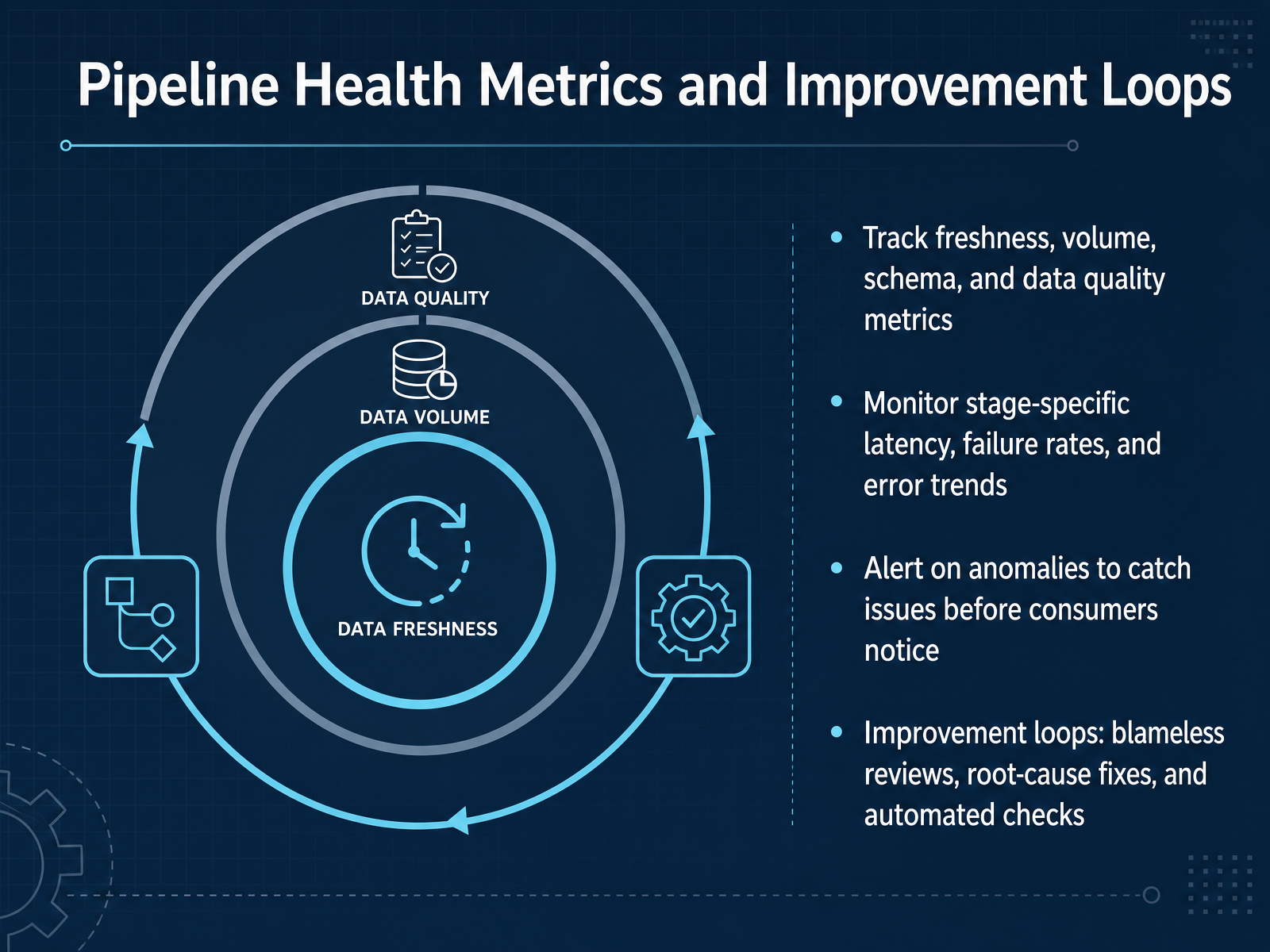
2 min - 11Pipeline Health Metrics and Improvement LoopsNow let’s talk about how we keep the pipeline healthy over time. We track four core metric groups: freshness, volume, schema, and data quality. Freshness tells us if data arrived on time. Volume flags missing or duplicate records early. Schema changes catch breaking modifications before they reach consumers. And data quality metrics cover null rates, value ranges, and business rule violations. Beyond those, monitor stage-specific latency and failure rates. A delay in extraction has a different impact than a delay in delivery. Break down errors by pipeline stage so trends become visible. Alert on anomalies automatically. The goal is to catch issues before consumers notice them. For example, if row counts drop by ten percent, you want an alert, not a support ticket. Improvement loops should be structured and blameless. When something breaks, review what happened, fix the root cause, and add automated checks to prevent recurrence. The loop is simple: measure, detect, respond, and harden. That discipline turns incidents into lasting reliability. Next, we’ll map this framework to your team’s roles and responsibilities.
 2 min
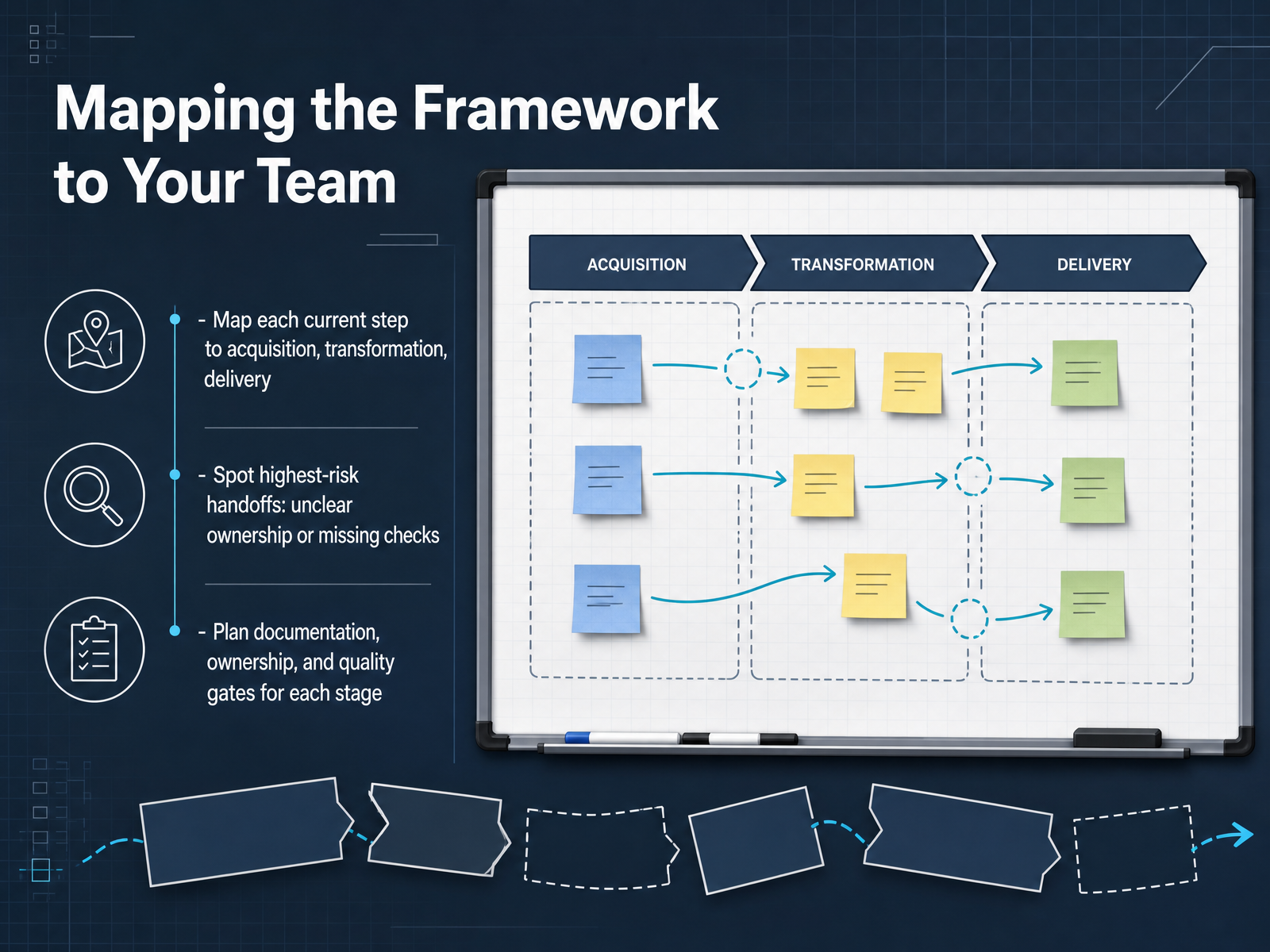
2 min - 12Mapping the Framework to Your TeamNow let's map this framework onto your actual team. Start by taking each step in your current workflow and labeling it as acquisition, transformation, or delivery. Be honest about the labels; a step that mostly moves raw data might still be acquisition, even if you add light formatting. Next, identify your highest-risk handoffs. These are the points where data passes from one person or system to another. Look for handoffs where ownership is unclear or where no validation check exists. For example, if a source extraction lands in a shared folder and nobody confirms it arrived complete, that is a risk. Finally, plan explicit documentation, ownership, and quality gates for every stage. Assign a single owner per stage. Define one clear check that must pass before data moves forward. Document these decisions in a shared runbook so the process survives staff changes. The goal here is simple: every handoff should have a named owner and a visible checkpoint. Do this mapping now, and you will know exactly where failures are most likely to occur before they actually happen. Next, we will look at common adoption challenges and how to adapt the framework in practice.
 1 min
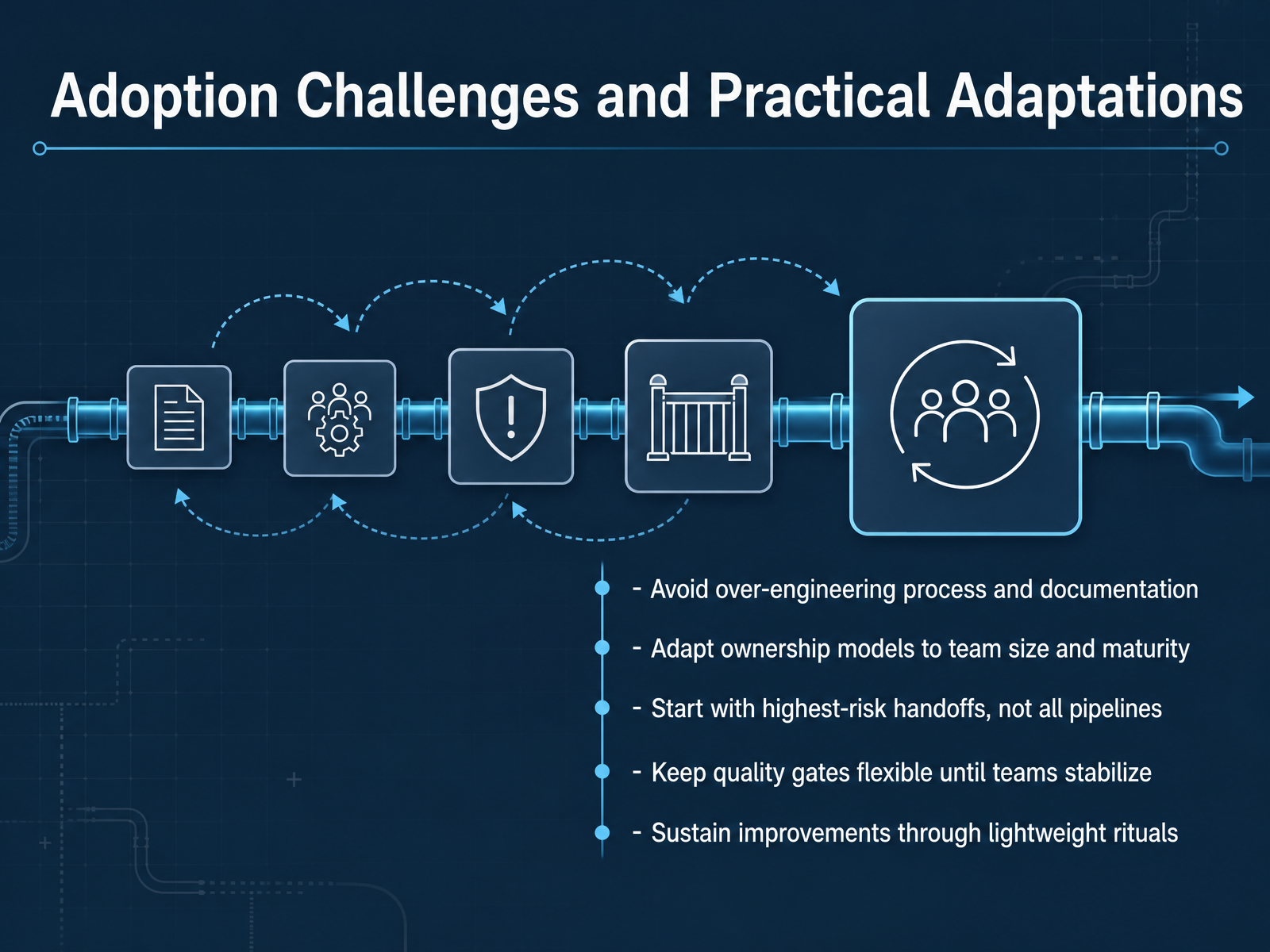
1 min - 13Adoption Challenges and Practical AdaptationsNow let's talk about adoption challenges and how to adapt in practice. The main risk is over-engineering the process and documentation. Start simple. Use a one-page checklist per pipeline instead of a full manual. Ownership models should match your team size and maturity. A three-person team can share responsibilities informally. A larger team needs clear owners for each stage. Don't try to fix all pipelines at once. Pick the handoffs with the highest risk of data loss or corruption. Fix those first. Quality gates should stay flexible until your team stabilizes. You can tighten them later as you learn where errors actually appear. Sustain improvements with lightweight rituals. A fifteen-minute weekly review of error logs and handoff timestamps is enough. This keeps the workflow visible without burning anyone out. In summary, start minimal, target the weak points, and keep your process adjustable. Next, we'll wrap up with a summary and an immediate action plan you can take back to your team.
 2 min
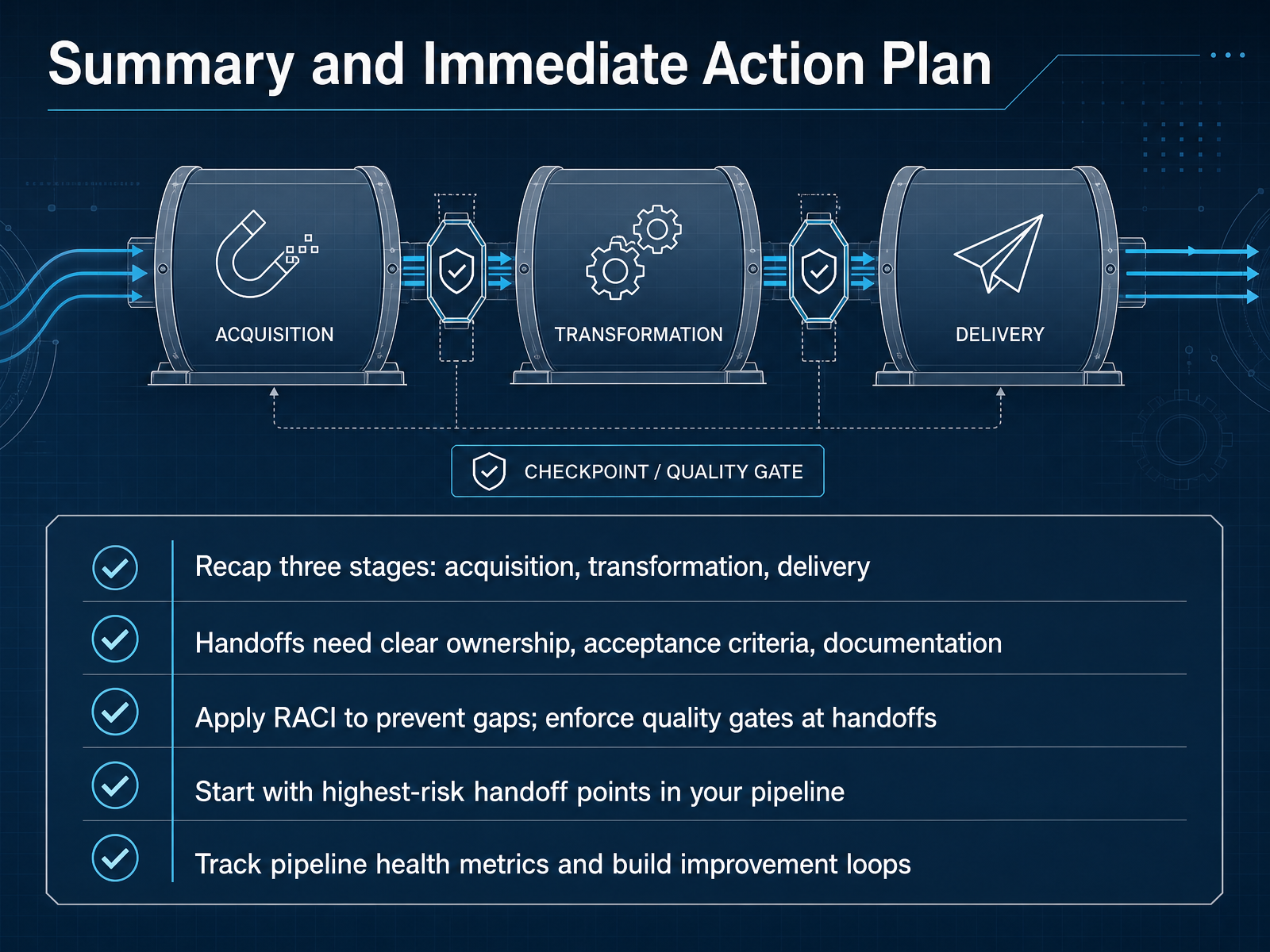
2 min - 14Summary and Immediate Action PlanLet's bring everything together. The workflow has three stages: acquisition, transformation, and delivery. Each handoff needs clear ownership, acceptance criteria, and documented expectations. If a step isn't defined, it will be skipped. Apply RACI to assign responsibility and prevent gaps. Enforce quality gates at every handoff so issues surface early, not after delivery. Start with your highest-risk handoff points first. Those are where failures cost the most. Then track pipeline health metrics like latency, error rates, and data freshness. Use those numbers to build improvement loops. Review the error log weekly and turn recurring issues into action items. Thank you for working through this. Take one handoff in your pipeline today and clarify its ownership. That is a solid first step.
 1 min
1 min
Take the deck with you
Download this course as a file — free, no sign-up needed.
- PDF handoutEvery slide page, ready to print or share.15 pages · 3.6 MBDownload
- Narrated PowerPointThe deck that presents itself — every slide carries the digital human's narration video.15 pages · 15.7 MBDownload
- PowerPoint slidesThe full deck as a .pptx — open it in PowerPoint, Keynote, or Google Slides.15 pages · 3.6 MBDownload
Free to use in your own training — please keep the PersonWise credit page at the end.
Have your own deck? Turn it into a course