Begin
14 pages · ~28 min
NIST Cybersecurity Framework Application
Learn to apply the NIST Cybersecurity Framework's core components to assess and improve your organization's security posture.
A digital instructor presents all 14 pages. Hold “Ask” at any point and ask out loud — the answer comes from this course. No sign-up needed.
What you’ll learn
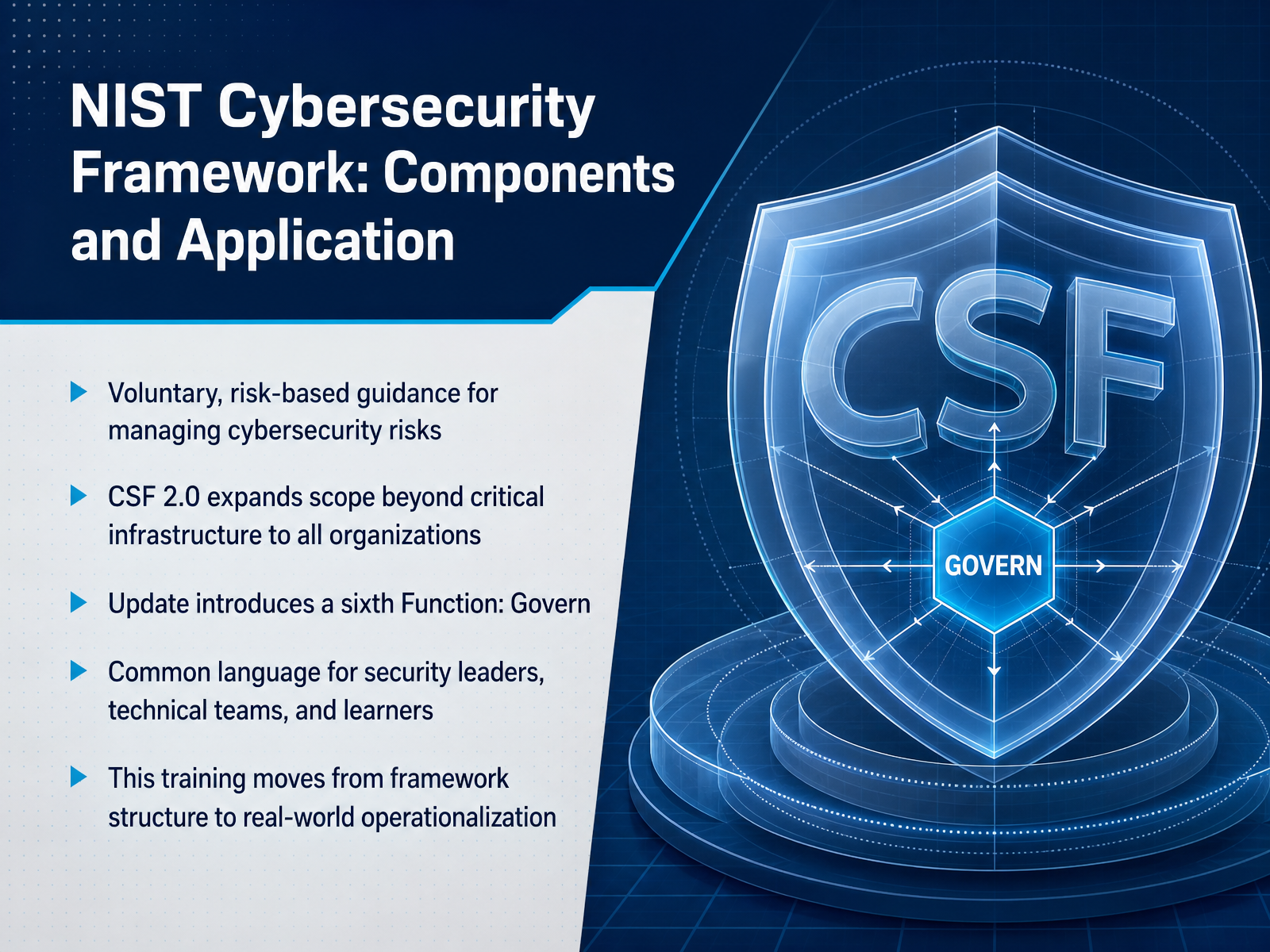
- 01NIST Cybersecurity Framework: Components and ApplicationWelcome, everyone. If you are leading security, working in a technical team, or building your cybersecurity expertise, you know the challenge: managing risk in a way that actually connects with business decisions. That is exactly what the NIST Cybersecurity Framework is designed to help you do. In this course, we will work through the components of version two point zero and how to apply them operationally. The key shift you need to know up front is that CSF two point zero is no longer limited to critical infrastructure. It is voluntary, risk based guidance for any organization, in any sector. And it introduces a sixth function called Govern, which elevates cybersecurity governance to the enterprise level. Throughout this training, we will map these concepts directly to practical outcomes, like how your incident response plan and risk decisions fit into the framework. Let's start by establishing what the NIST CSF is and why it matters.nist.govnvlpubs.nist.govnist.gov+22 min
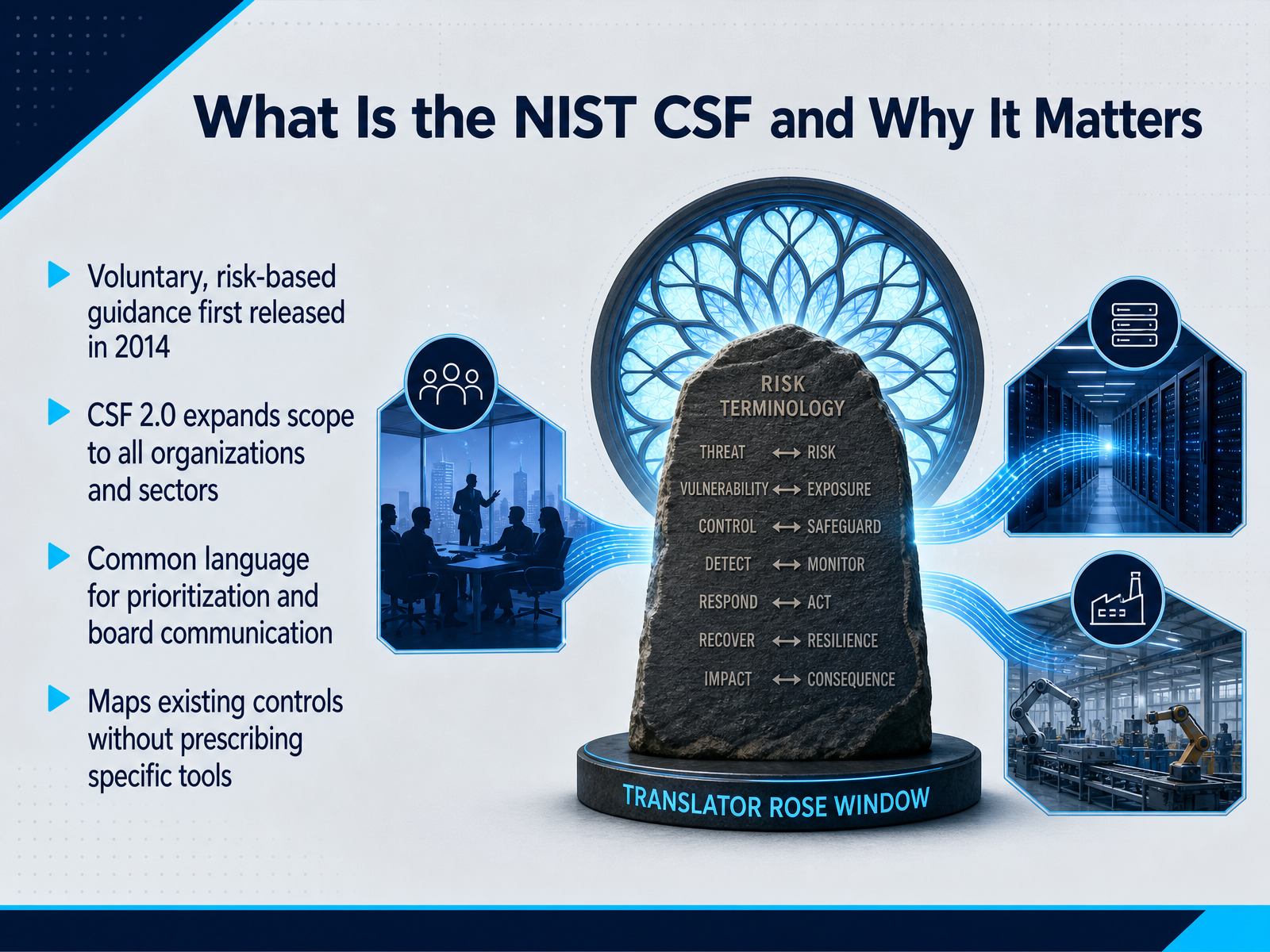
- 02What Is the NIST CSF and Why It MattersLet's ground ourselves in what the NIST Cybersecurity Framework actually is. First released in twenty fourteen, it is voluntary and risk based guidance. That means it is not a regulation, and it is not a compliance checklist. It gives you a structured way to manage cyber risk on your own terms. The first version was built for critical infrastructure. But the two point zero update, released in twenty twenty four, expands that scope. It is now designed for any organization, in any sector, of any size. The real value here is a common language. You can use it to prioritize investments and, more importantly, to communicate risk to your board. Instead of getting lost in technical jargon, you can talk about capabilities and outcomes. And here is the key: it maps existing controls. It does not prescribe specific tools or vendors. So you are not ripping out your current stack. You are organizing what you have, and identifying gaps against a proven set of outcomes. Next, we will look at the three components that make this practical.
 nist.govnvlpubs.nist.govnist.gov+21 min
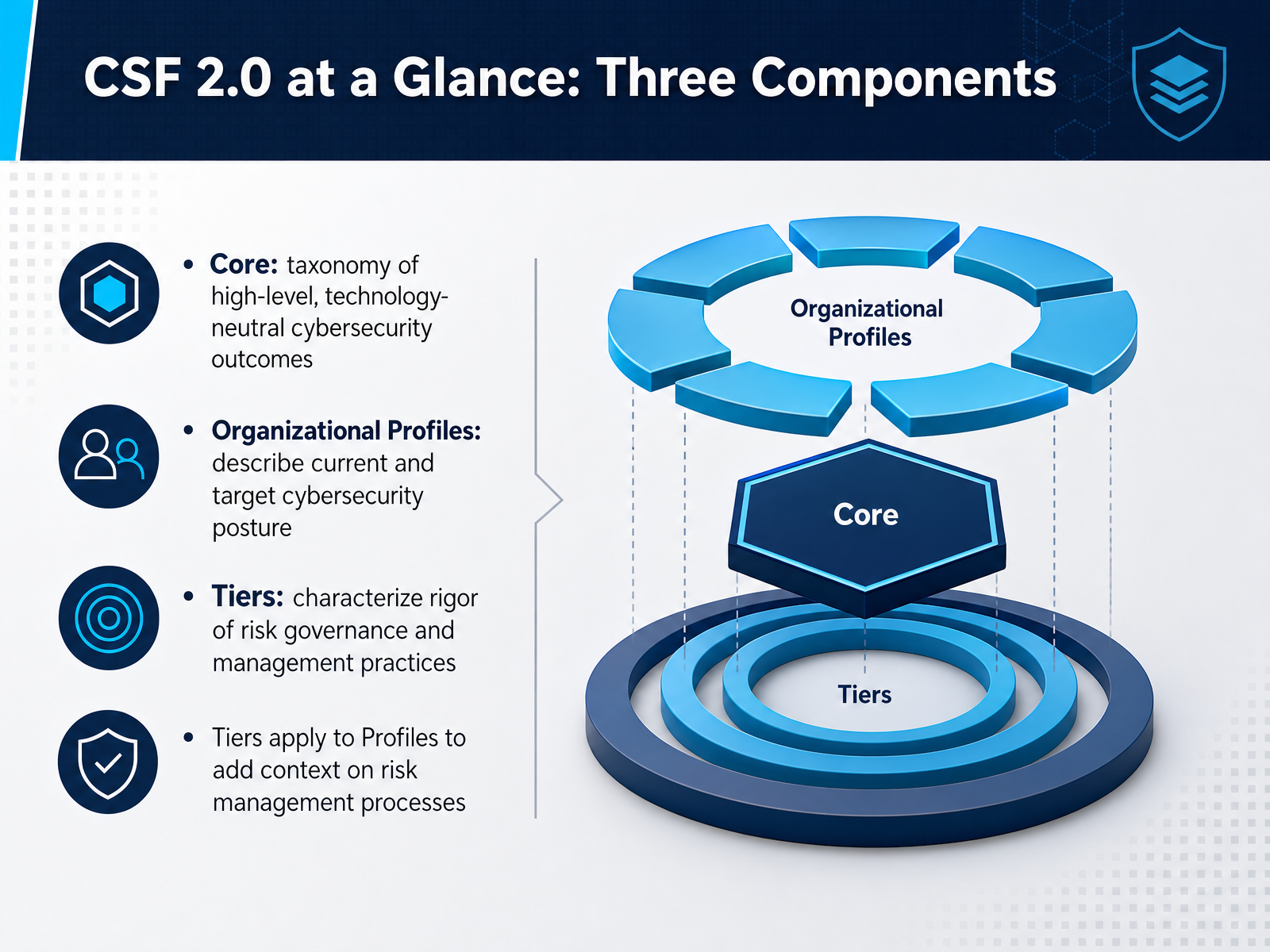
 - 03CSF 2.0 at a Glance: Three ComponentsLet's look at the three components that make up the NIST Cybersecurity Framework two point zero. First, the Core. Think of it as a taxonomy of high-level cybersecurity outcomes. It's technology-neutral, which means it describes what you want to achieve without prescribing specific tools or vendors. Next, Organizational Profiles. These describe your current and target cybersecurity posture in terms of those Core outcomes. So a current profile shows where you are today, while a target profile shows where you need to be. Finally, Tiers. Tiers characterize the rigor of your risk governance and management practices. They range from partial to adaptive. The key point here is how these components work together. You apply Tiers to your Profiles to add context on how mature and disciplined your risk management processes actually are. That context matters when you compare current and target states. Next, let's break down the Core itself into its three layers: Functions, Categories, and Subcategories.
 nvlpubs.nist.govnvlpubs.nist.govnvlpubs.nist.gov+22 min
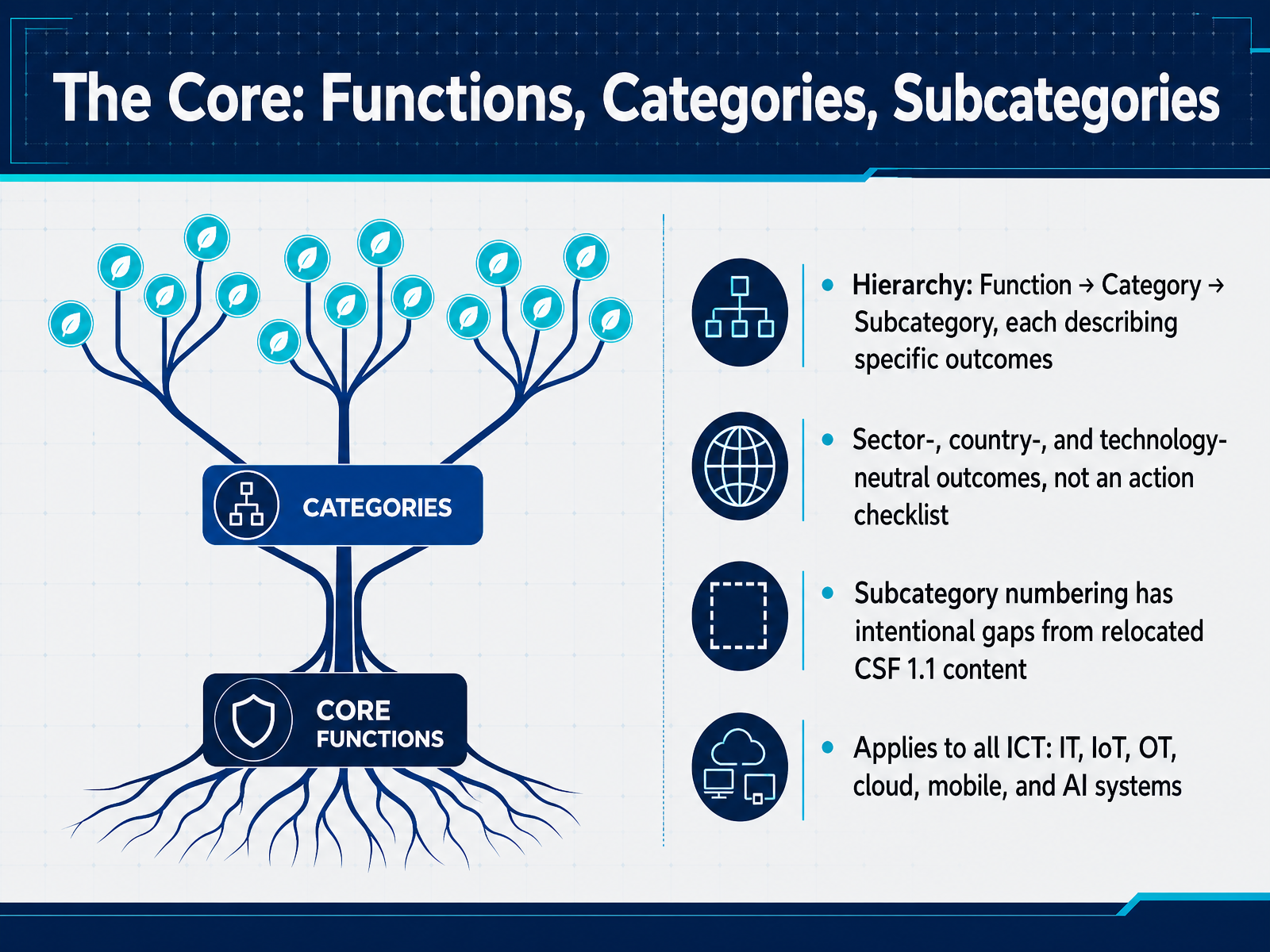
 - 04The Core: Functions, Categories, SubcategoriesLet's take a closer look at the structure of the Core itself. It is a hierarchy. You have Functions at the top, which break down into Categories, and then into Subcategories. Each level describes a specific outcome you want to achieve, not a box to check. Think of it as the what, not the how. These outcomes are deliberately neutral. They apply across sectors, countries, and technology types. That is why the Core can guide your cloud strategy, your OT environment, and your AI initiatives with the same language. You will notice the subcategory numbering is not always sequential. The gaps are intentional. They account for content from version one point one that was relocated in version two point zero, so the meaning is preserved, just better organized. The key decision point for you is this: the Core gives you a stable, technology-neutral target. Your action plan, your controls, and your tools are how you get there. Next, we will break down the six Core Functions themselves, starting with Govern.
 nist.govnvlpubs.nist.govnist.gov+21 min
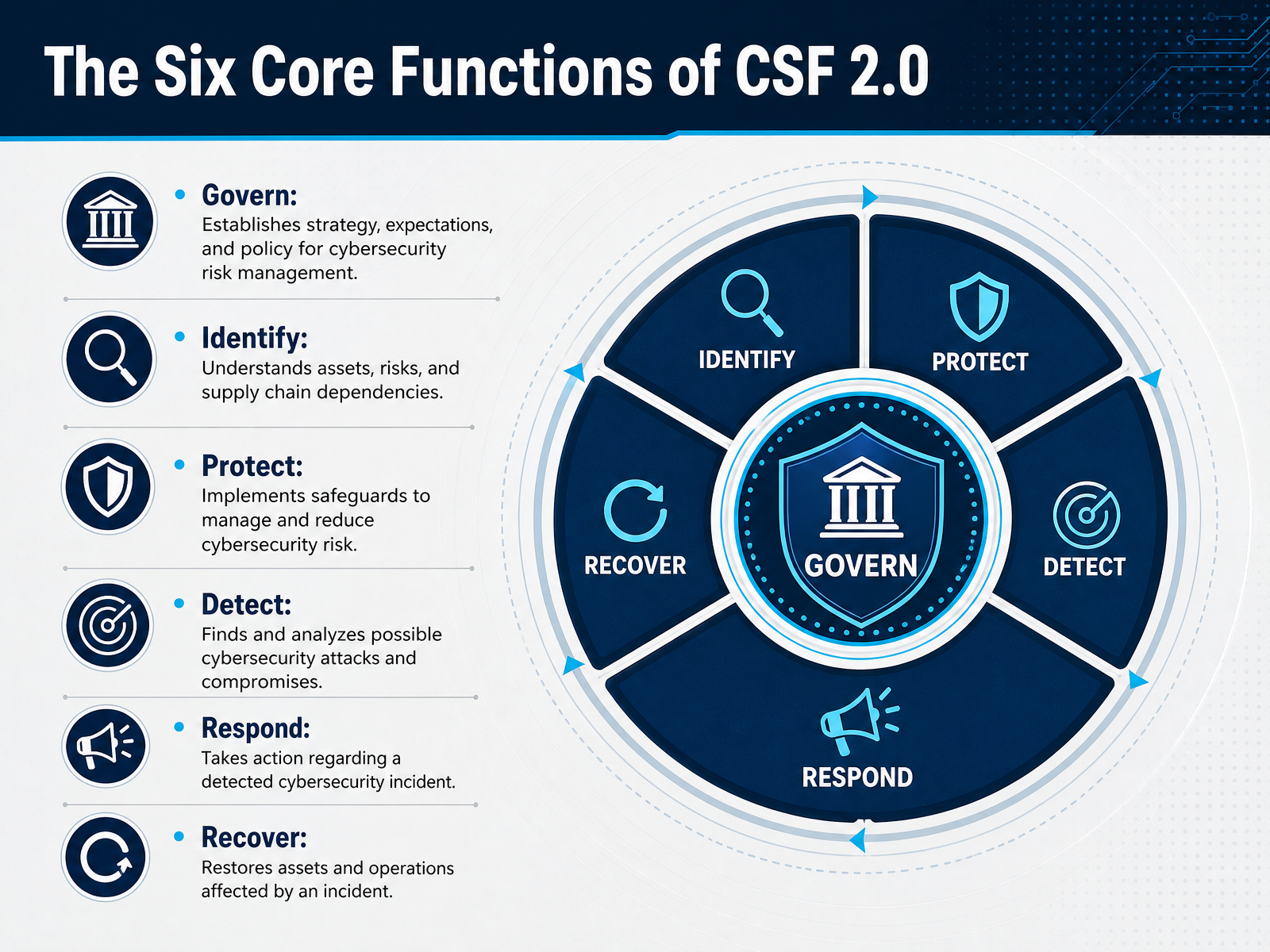
 - 05The Six Core Functions of CSF 2.0Now let's look at the six core functions that make up CSF two point oh. Think of them as the full lifecycle of managing cybersecurity risk, starting with Govern. Govern sits at the center and sets your strategy, expectations, and policy. It's the function that answers, who is accountable and how do we make risk decisions. Identify is about understanding what you have, your assets, your risks, and your supply chain dependencies. You can't protect what you don't know exists. Protect is where you implement safeguards like access control, data security, and training to reduce risk. Detect focuses on finding and analyzing possible attacks or compromises. And when detection works, Respond takes over, with actions to contain, analyze, and communicate about the incident. Finally, Recover restores your assets and operations, and captures lessons learned. These functions are not a strict sequence. Govern, Identify, Protect, and Detect run continuously, while Respond and Recover need to be ready to activate the moment an incident is declared. Next, let's go deeper into the newest addition, Govern as the new foundation.
 nvlpubs.nist.govnvlpubs.nist.govnist.gov+22 min
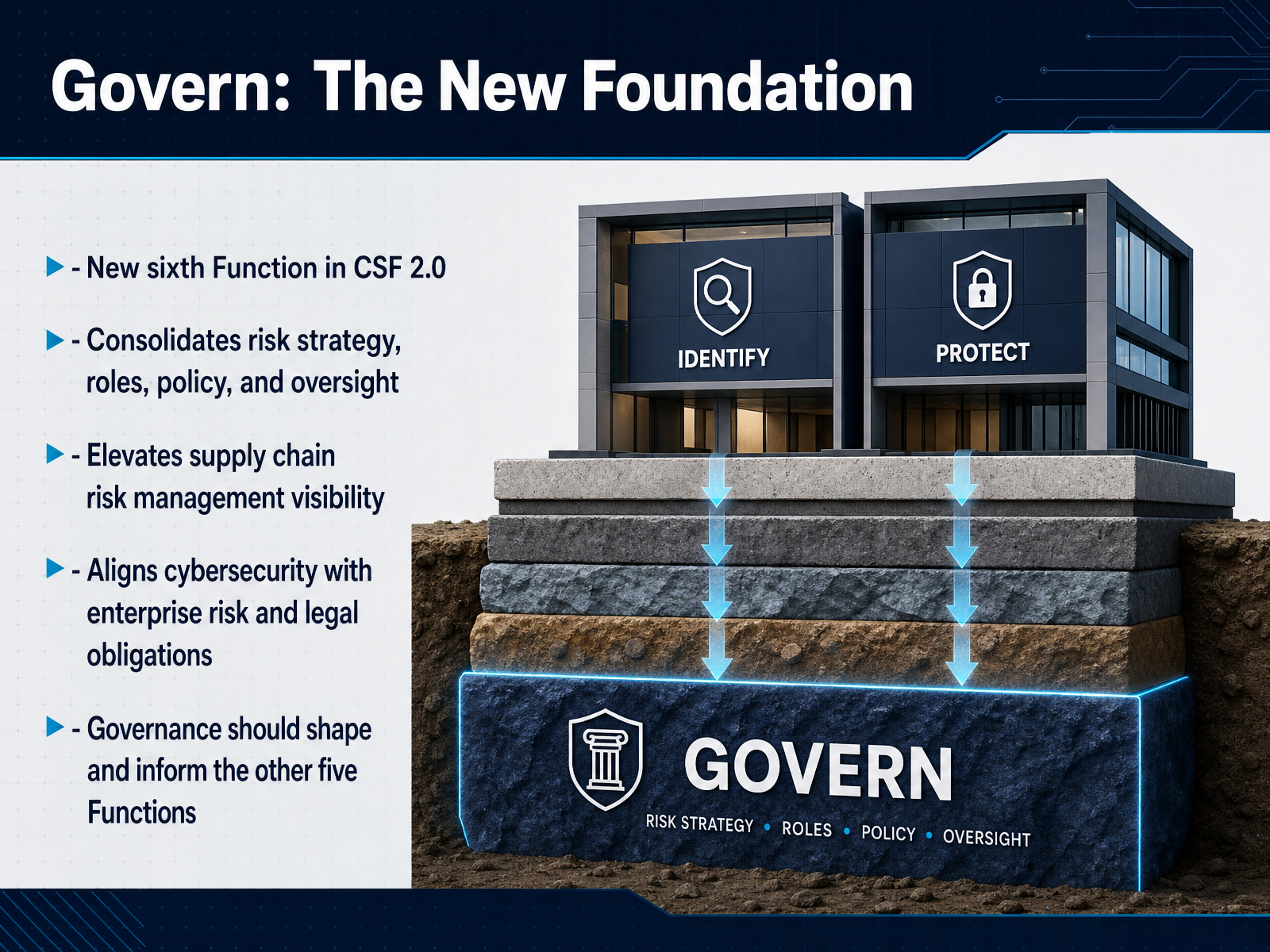
 - 06Govern: The New FoundationNow let\u2019s turn to the most significant structural change in CSF 2.0: the new Govern function. Govern has been elevated from a supporting element into a full sixth function. It consolidates your organization\u2019s cybersecurity risk strategy, roles, responsibilities, policy, and oversight into a single visible layer. In practice, this means senior leadership owns cybersecurity as an enterprise risk, not just a technical issue. One important result is that supply chain risk management now gets explicit visibility. Decisions about third party access, cloud providers, or embedded software move from a procurement side note into governance. This function also aligns cyber risk with legal, regulatory, and contractual obligations. So when your team declares an incident, there is already a defined authority, a policy, and an escalation path. Govern shapes and informs the other five functions. It sets the priorities that Identify, Protect, Detect, Respond, and Recover operate against. Think of it as the layer that determines which risks you accept and which ones you spend money to reduce. Next, we will break down how Govern moves from a high level function into practical work through categories and subcategories.
 nvlpubs.nist.govnvlpubs.nist.govnist.gov+21 min
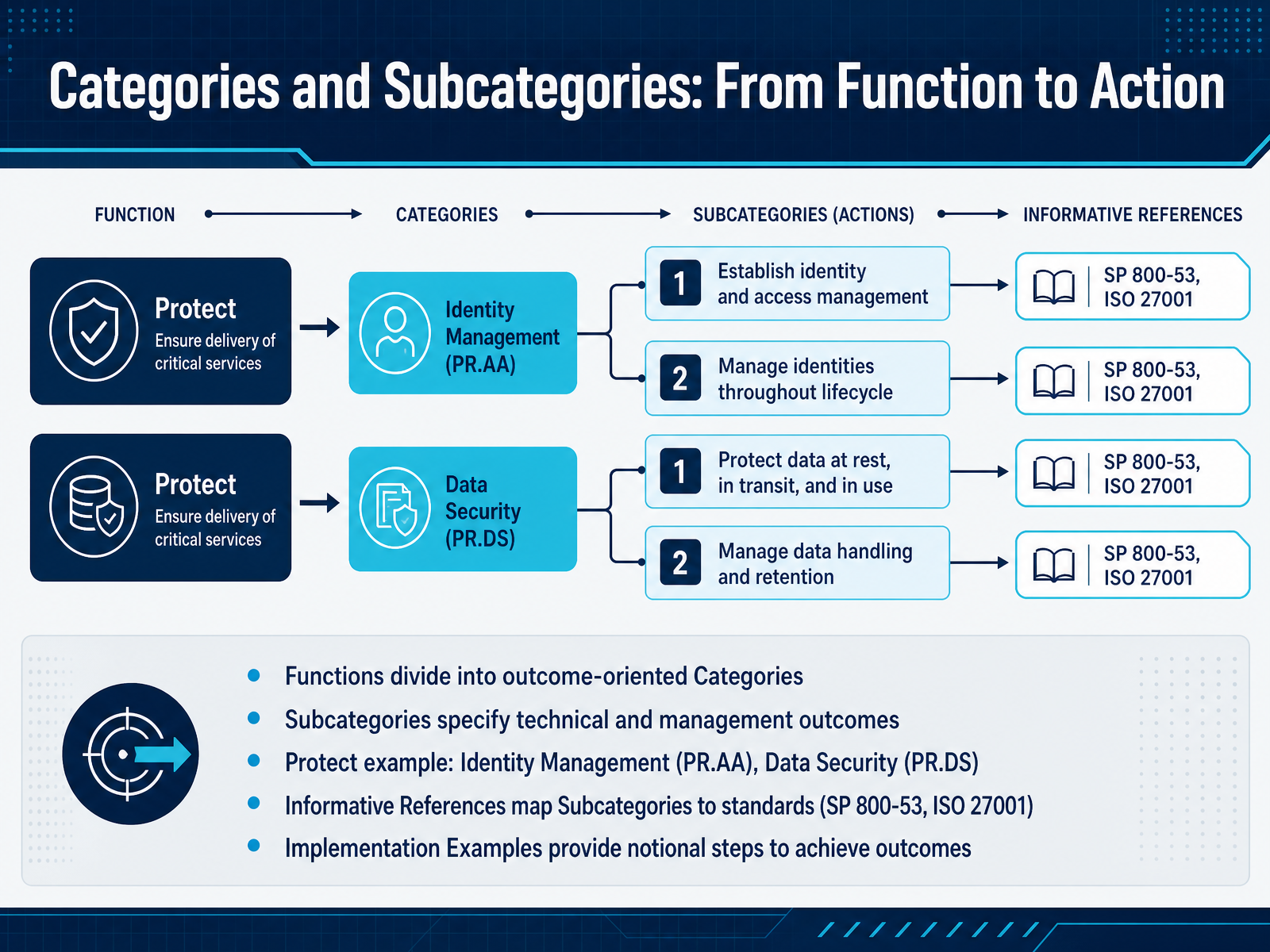
 - 07Categories and Subcategories: From Function to ActionNow, let's move from the high-level Functions into the details of Categories and Subcategories. This breakdown is where the Framework turns intent into measurable action. Functions divide into Categories. Think of these as groups of related outcomes. Then, Subcategories get even more specific, describing the technical and management results you're aiming for. For example, under the Protect Function, Identity Management and Access Control, identified as PR dot AA, and Data Security, PR dot DS, are two distinct Categories. Each one is further broken down into Subcategories with clear outcome statements. To connect these outcomes to your existing environment, Informative References map each Subcategory to established standards like NIST SP eight hundred dash fifty three, or ISO twenty seven thousand one. And Implementation Examples point you toward concrete action steps, so you know what achieving that outcome could actually look like in practice. This is how you move from a strategic goal, like protecting data, to specific, auditable practices. Next, we'll dive deeper into how to use those Informative References and Implementation Examples effectively.
 nist.govnvlpubs.nist.govnist.gov+22 min
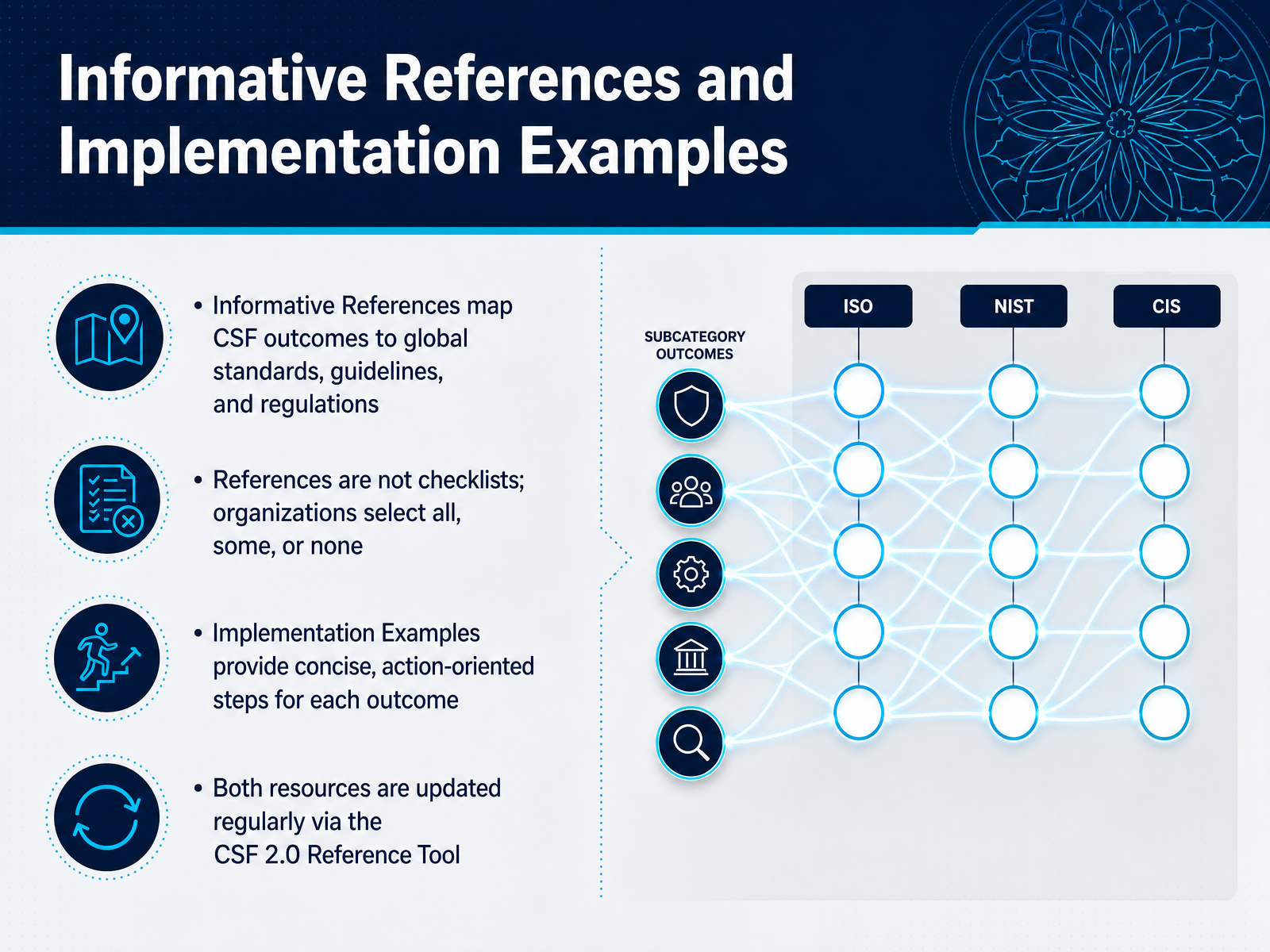
 - 08Informative References and Implementation ExamplesNow let's talk about actionable guidance—specifically, Informative References and Implementation Examples. Informative References map CSF outcomes to global standards, guidelines, and regulations you may already use, like ISO 27001 or NIST SP 800-53. The key point here is that these are mapping tools, not checklists. You select all, some, or none of them based on your specific compliance and operational needs. To make outcomes more tangible, Implementation Examples provide concise, action-oriented steps for each Subcategory, using verbs like share, document, and assess. Think of Informative References as showing you where your existing controls align, and Implementation Examples as suggesting what you could actually do. Both are kept current through the CSF 2.0 Reference Tool, so you're working with the latest mappings. Next, let's examine Implementation Tiers and how to assess your program's maturity.
 nist.govnvlpubs.nist.govnist.gov+21 min
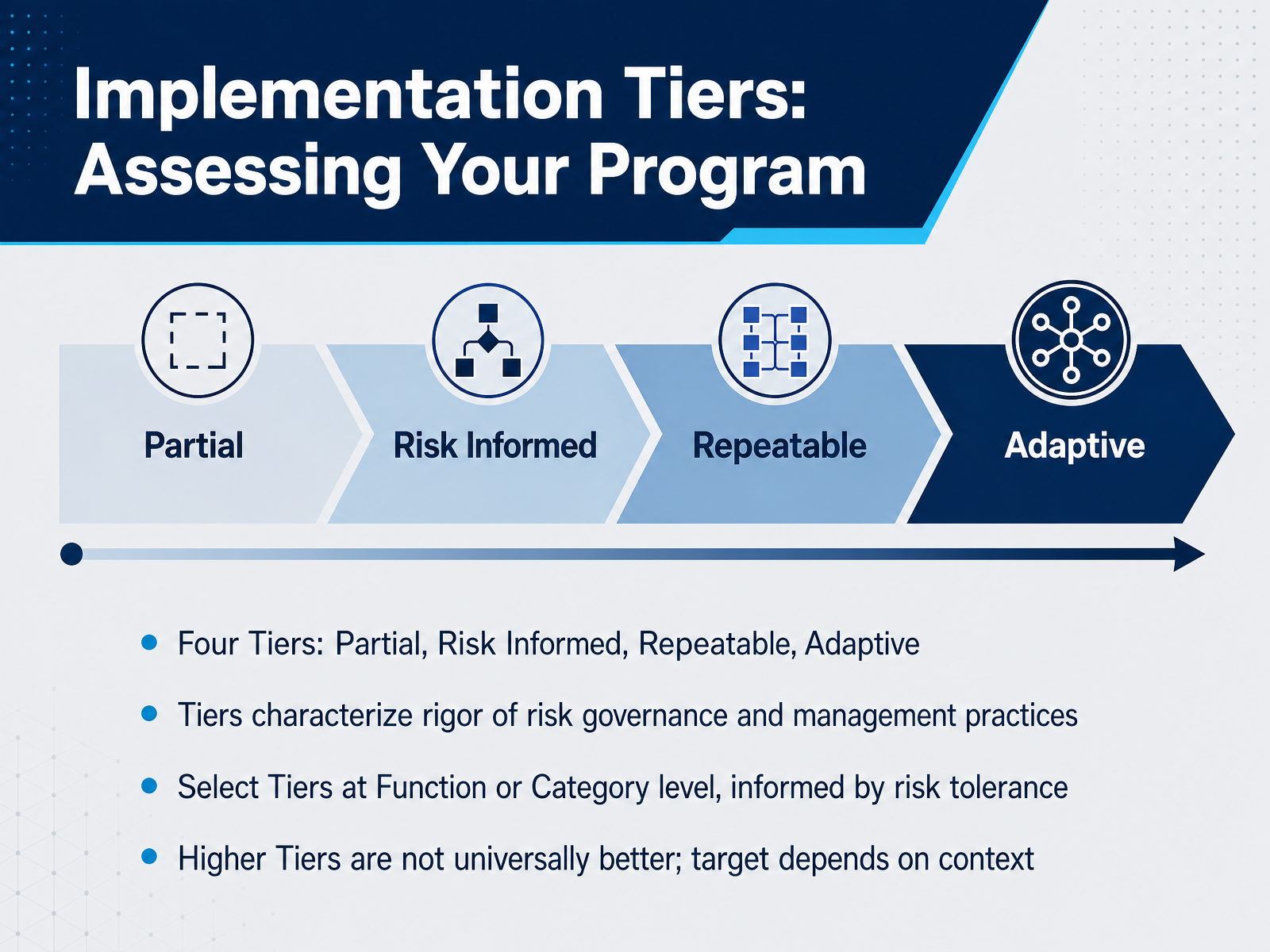
 - 09Implementation Tiers: Assessing Your ProgramNow, let's talk about how you assess the rigor of your program using Implementation Tiers. These tiers range from Partial at Tier one, through Risk Informed and Repeatable, to Adaptive at Tier four. Think of them not as a scorecard, but as a way to characterize how deeply cybersecurity risk management is woven into your organization's governance and operational practices. You select a target tier based on your risk tolerance, and you can do this for the framework as a whole or for specific functions. Here's a key point that often gets missed: a higher tier is not automatically better. For example, a critical infrastructure provider dealing with sophisticated threats might need Tier four, Adaptive, practices. But a smaller organization with a stable threat environment might find that Tier two, Risk Informed, is the appropriate and cost-effective target. The decision should always be driven by your business context and the level of risk you are willing to accept. Ultimately, these tiers give you a common language to set expectations and communicate your program's posture. Next, we'll explore how these tier selections feed directly into building your organizational profiles.
 nist.govnvlpubs.nist.govnvlpubs.nist.gov+21 min
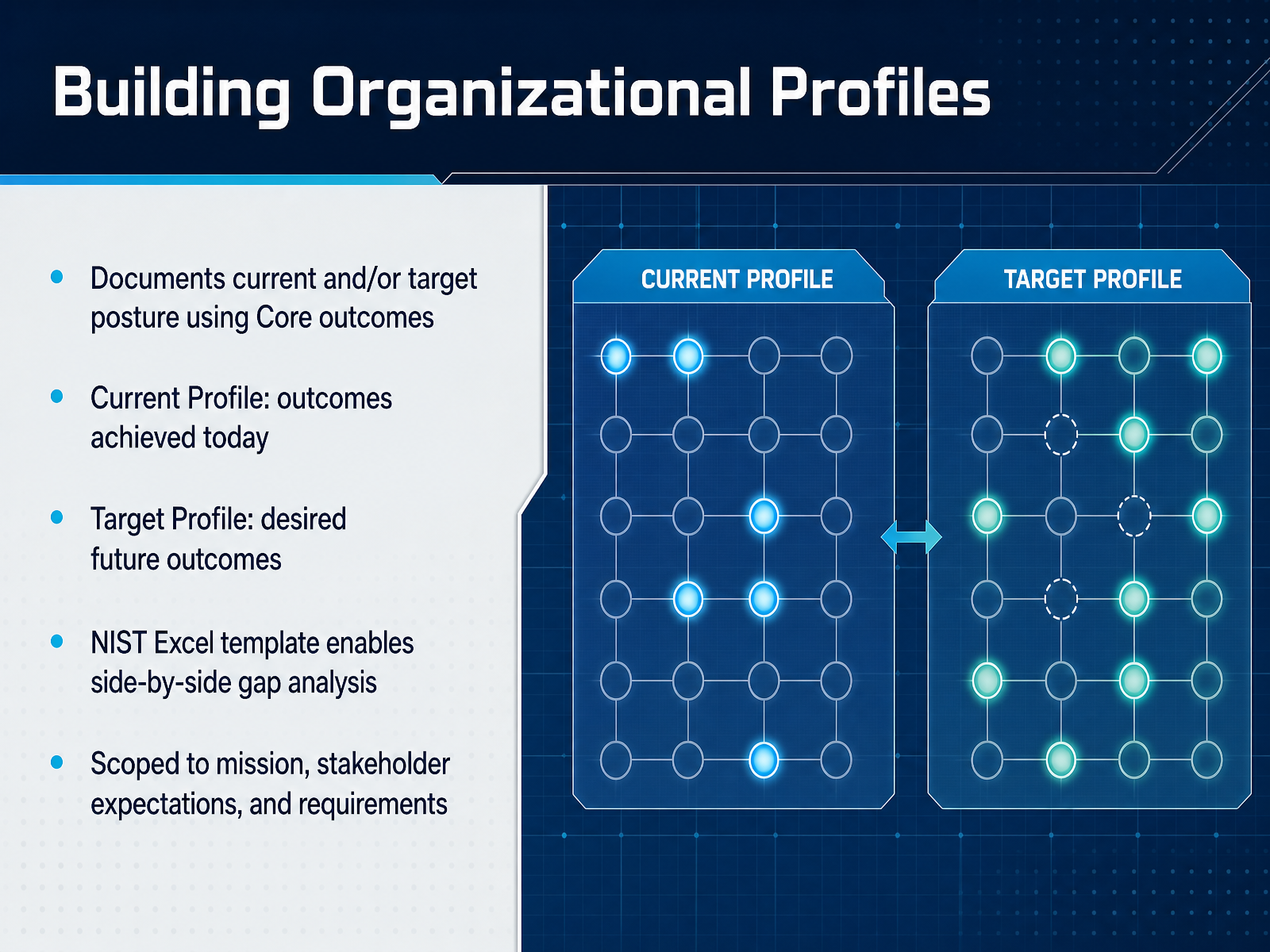
 - 10Building Organizational ProfilesLet's put the Core into practice by building Organizational Profiles. An Organizational Profile documents your current or target cybersecurity posture using the Core's outcomes. Your Current Profile captures the outcomes you are achieving today. Your Target Profile defines the outcomes you want to achieve in the future. NIST provides an Excel template that lets you place these two profiles side by side. This view is crucial for gap analysis. It shows you exactly where your current state falls short of your goals. Remember, a profile is not meant to cover everything. You scope it to your mission, stakeholder expectations, and specific requirements. That keeps your gap analysis focused and relevant to your risk decisions. Up next, we'll look at Community Profiles for shared outcomes.
 nist.govnvlpubs.nist.govnccoe.nist.gov+11 min
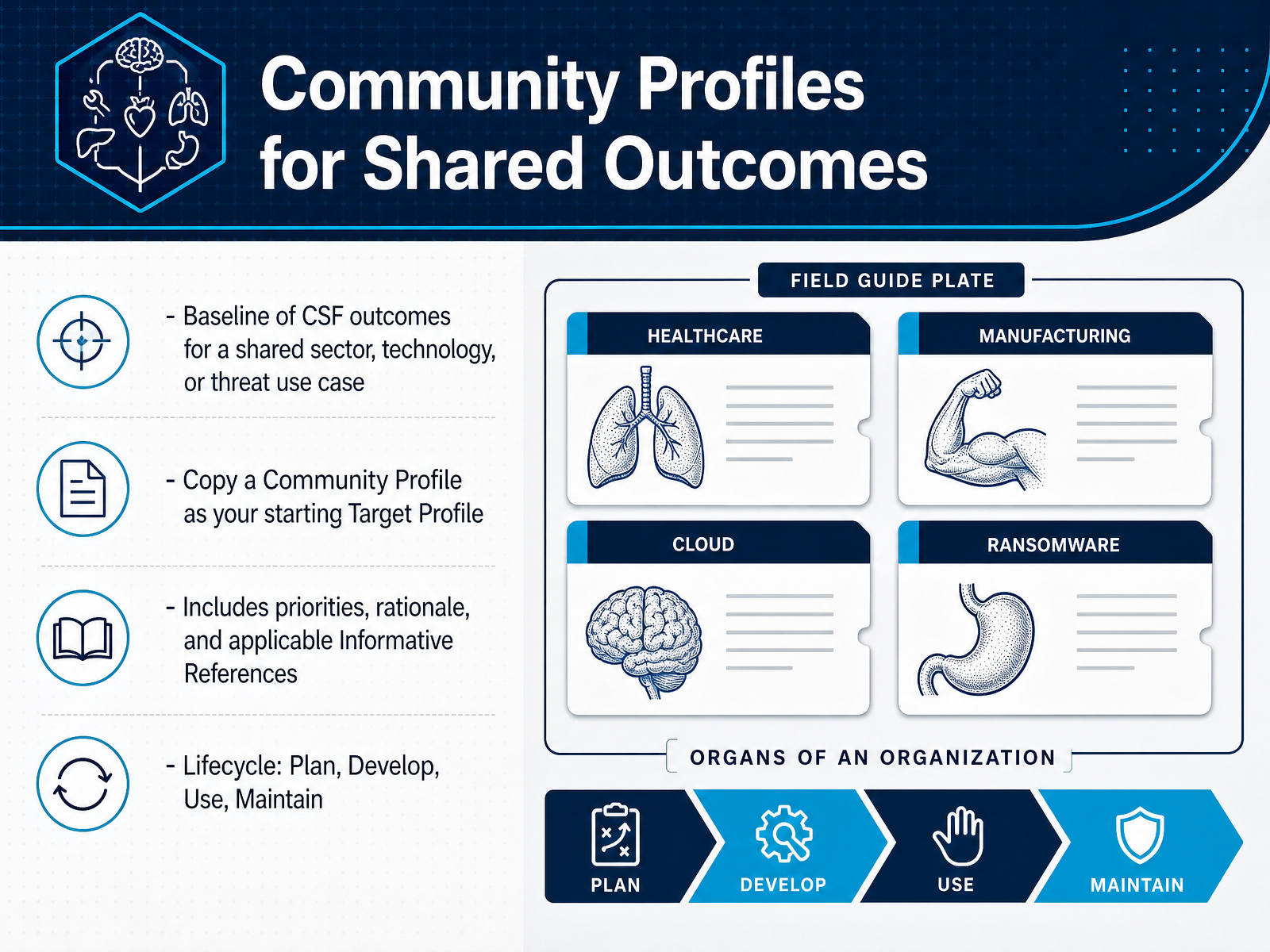
 - 11Community Profiles for Shared OutcomesNext, let's translate the concepts of Current and Target Profiles into a broader, shared context with Community Profiles. Think of a Community Profile as a consensus baseline. It captures CSF outcomes that matter to a group facing the same sector demands, technology stack, or specific threat. When you're building your own Target Profile, you don't have to start from scratch. You can copy an existing Community Profile as your starting point, then adjust the priorities to fit your unique risk appetite and mission. What makes this especially useful is the embedded rationale. It explains why certain outcomes are prioritized, and lists applicable Informative References you can map to your own controls. This work is also governed by its own lifecycle. Communities move through a cycle of planning, development, use, and maintenance. This ensures the profile stays relevant as threats and technologies evolve, keeping your baseline from becoming stagnant. Now that we have a solid anchor for our desired state, let's shift gears and cover Applying the CSF: Step-by-Step Approach.
 nist.govnvlpubs.nist.govnccoe.nist.gov+11 min
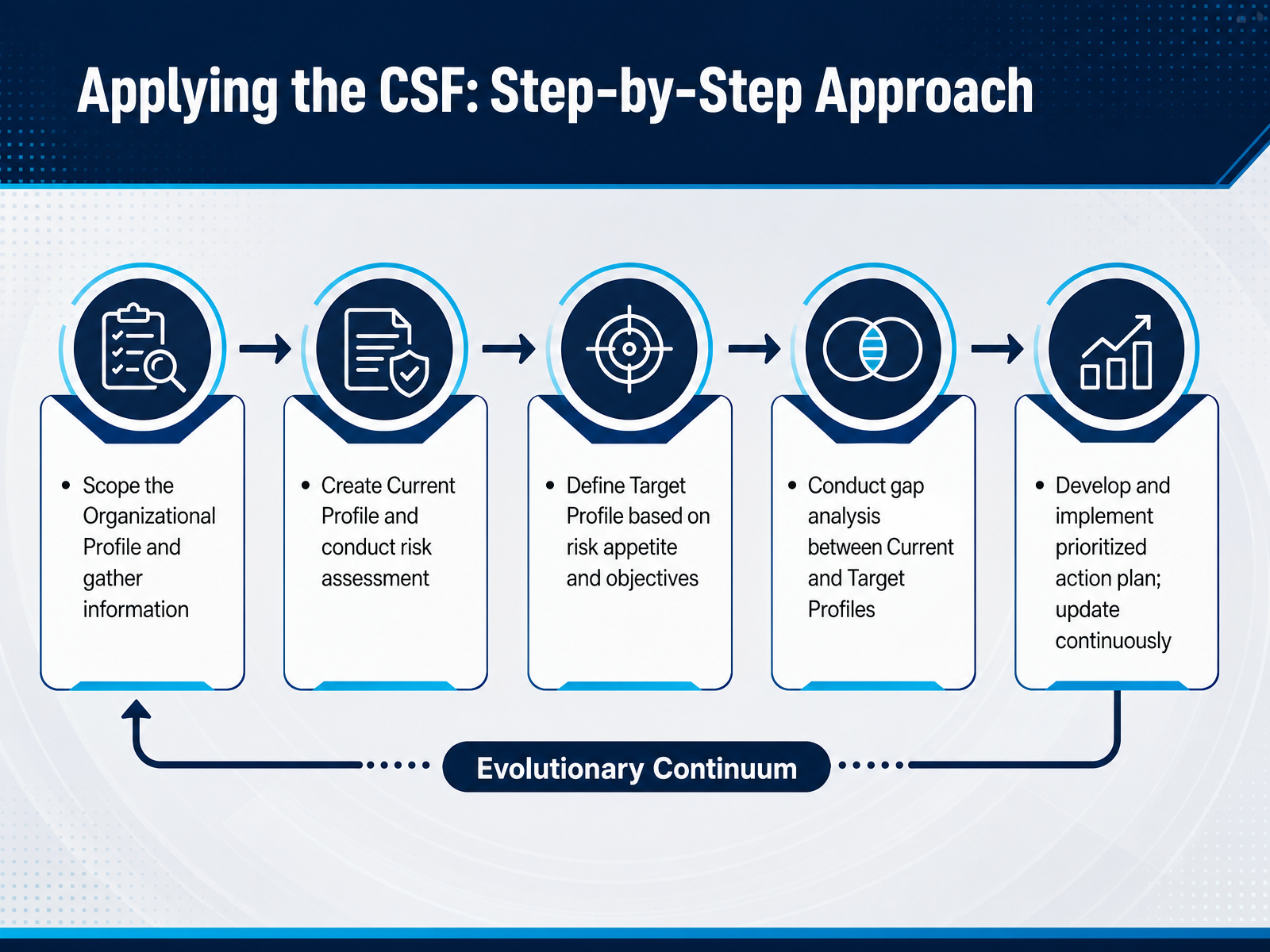
 - 12Applying the CSF: Step-by-Step ApproachNow we move from understanding the framework to actually applying it. The five-step process in NIST CSF 2.0 uses Organizational Profiles. You start by scoping your Organizational Profile and gathering information about your mission, regulatory requirements, and critical assets. Then, you create your Current Profile. This is an honest assessment of what cybersecurity outcomes you are actually achieving today. Run a risk assessment against this baseline. Next, based on your risk appetite and business objectives, you define your Target Profile. This represents the outcomes you need to achieve. The fourth step is where the real decision-making happens. You conduct a gap analysis between the Current and Target Profiles. This shows you where you must invest. Finally, you develop a prioritized action plan to close those gaps. The cycle continues as you implement controls, monitor progress with key risk indicators, and update the profiles. Now that you can apply the CSF internally, next we will look at how to map it to other standards you may already use.
 nvlpubs.nist.govnist.gov2 min
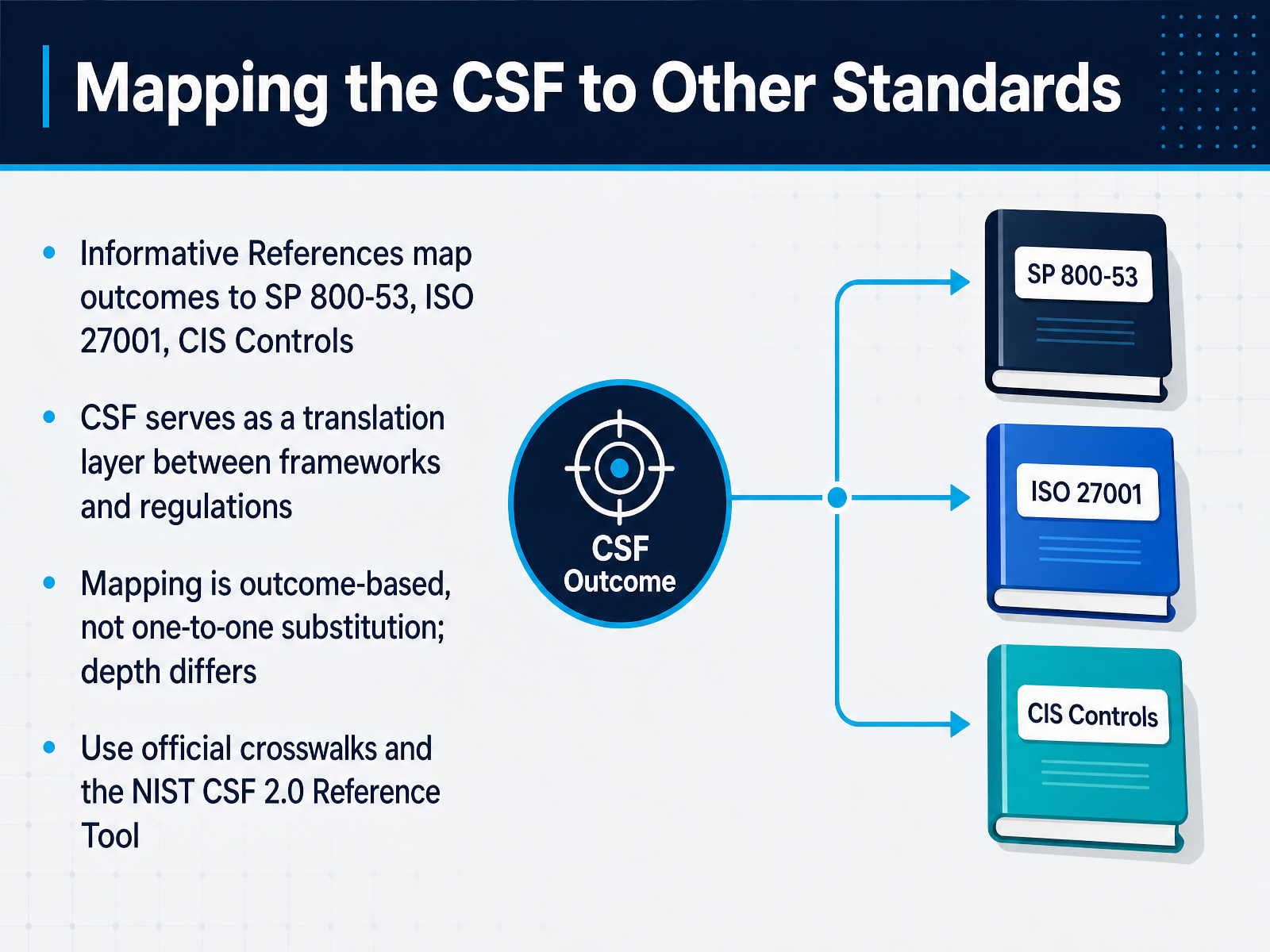
 - 13Mapping the CSF to Other StandardsAt this point, you have established your internal priorities, so let's talk about how the CSF connects to the standards you are already using. You should treat the CSF, specifically its informative references, as a translation layer. It maps the strategic outcomes we just discussed to the specific controls in NIST SP 800-53, ISO 27001, and the CIS Controls. This is how you reuse your existing evidence instead of starting from scratch. But be careful here. These mappings represent outcome alignment, not a direct one to one substitution. The depth of control differs. A CIS safeguard that specifies a technical configuration is much narrower than a broad CSF subcategory. If you assume satisfying one automatically satisfies the other, you will likely miss evidence during an audit. You should rely on the official crosswalks published by NIST and the NIST CSF 2.0 Reference Tool. Using authoritative sources ensures your mappings are defensible. Now that we understand how to map the framework, let's look at the obstacles you might face during implementation.
 1 min
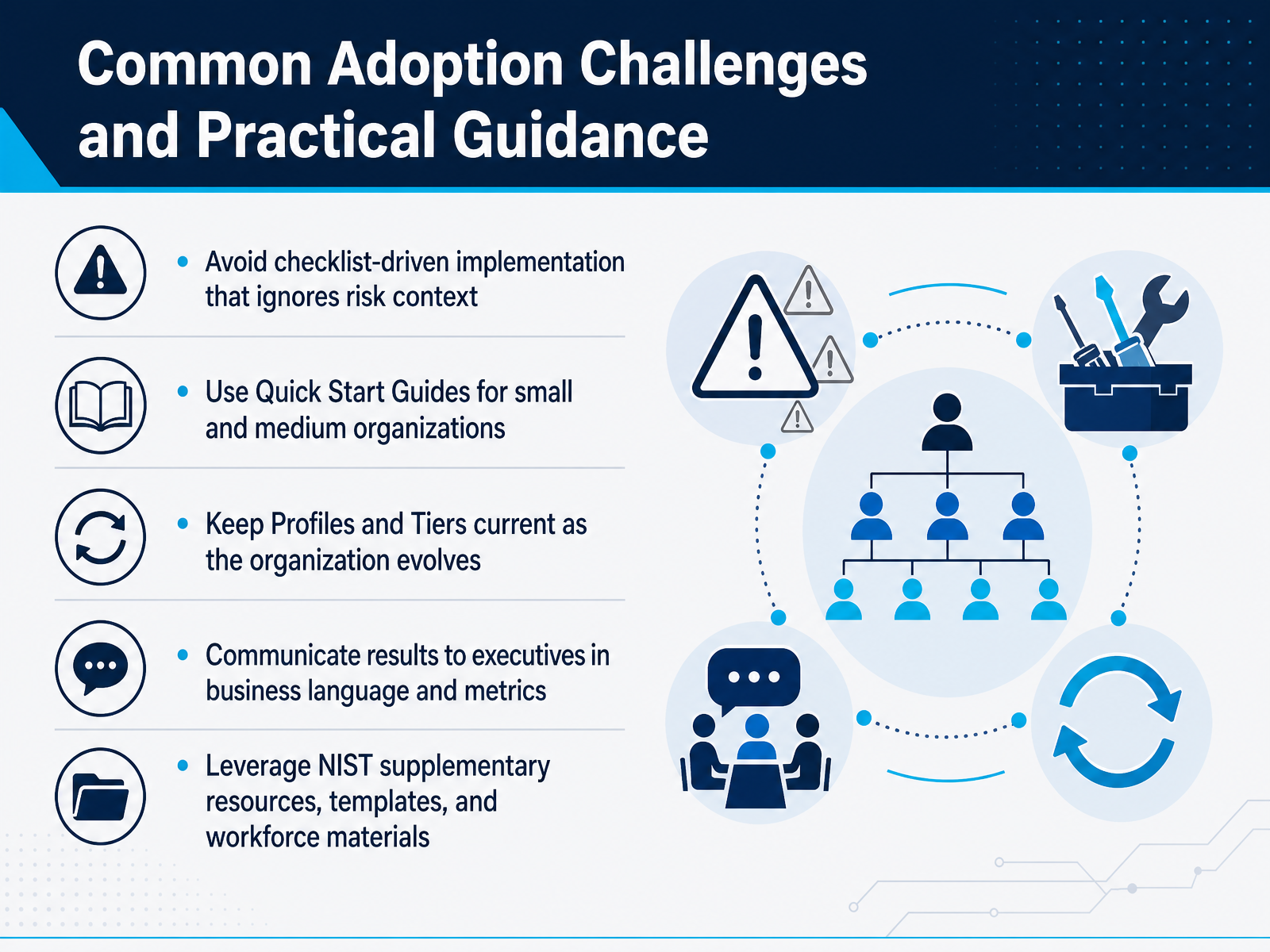
1 min - 14Common Adoption Challenges and Practical GuidanceAs we close out, let’s translate the framework into decisions you can act on. First, resist turning CSF adoption into a checklist. A check in the box without risk context creates false confidence. Instead, use Profiles to identify gaps against your own business priorities. For smaller organizations, NIST’s Quick Start Guides offer practical entry points without requiring a large security team. Keep those Profiles and Tiers current. They are living artifacts and should move as your organization evolves. When you report upward, translate framework outcomes into executive language: reduced likelihood, business impact, and resource requests tied to risk. And do not rebuild what NIST already provides. Leverage the implementation examples, templates, and workforce materials to accelerate your program. The organizations that get the most value treat CSF as a decision support tool, not a compliance artifact. Thank you for working through this with me, and I encourage you to start with one Profile, one gap, and one measurable action this week.
 nvlpubs.nist.govnist.govnvlpubs.nist.gov+11 min
Take the deck with you
Download this course as a file — free, no sign-up needed.
- PDF handoutEvery slide page, ready to print or share.15 pages · 4.0 MBDownload
- Narrated PowerPointThe deck that presents itself — every slide carries the digital human's narration video.15 pages · 16.6 MBDownload
- PowerPoint slidesThe full deck as a .pptx — open it in PowerPoint, Keynote, or Google Slides.15 pages · 3.9 MBDownload
Free to use in your own training — please keep the PersonWise credit page at the end.
Have your own deck? Turn it into a course
Sources consulted
Web sources consulted while building this course.
- Frequently Asked Questions — nist.gov
- The NIST Cybersecurity Framework (CSF) 2.0 — nvlpubs.nist.gov
- The NIST Cybersecurity Framework (CSF) 2.0 | NIST — nist.gov
- NIST Releases Version 2.0 of Landmark Cybersecurity Framework | NIST — nist.gov
- NIST Cybersecurity Framework 2.0: Resource & Overview Guide — nvlpubs.nist.gov
- CSF 1.1 Uses and Benefits of the Framework | NIST — nist.gov
- Cybersecurity Framework FAQs Using The Framework | NIST — nist.gov
- Cybersecurity and the NIST Framework: A Systematic Review of its Implementation and Effectiveness Against Cyber Threats — thesai.org
- NIST Cybersecurity Framework 2.0: Quick-Start Guide for Using the CSF Tiers — nvlpubs.nist.gov
- CSF 2.0 Informative References — nist.gov
- Informative References: What are they, and how are ... — nist.gov
- Public Draft: Implementation Examples for the NIST Cybersecurity Framework 2.0 — nist.gov
- NIST Cybersecurity Framework 2.0: Small Business Quick-Start Guide — nvlpubs.nist.gov
- NIST Cybersecurity Framework 2.0: Quick-Start Guide for Using the CSF Tiers | NIST — nist.gov
- NIST Cybersecurity Framework 2.0: Quick-Start Guide for Using the CSF Tiers — nvlpubs.nist.gov
- The NIST Cybersecurity Framework (CSF) 2.0 — nvlpubs.nist.gov
- NIST CSF Implementation Tiers Explained | Armorstack — armorstack.ai
- CSF 2.0 Profiles — nist.gov
- NIST Cybersecurity Framework 2.0: Quick-Start Guide for Creating and Using Organizational Profiles — nvlpubs.nist.gov
- A Guide to Creating Community Profiles - NCCoE — nccoe.nist.gov