Begin
15 pages · ~30 min
Customer Education Roles and Handoffs
This training defines customer education roles, responsibilities, and handoff processes for cross-functional teams to ensure smooth transitions and accountability.
A digital instructor presents all 15 pages. Hold “Ask” at any point and ask out loud — the answer comes from this course. No sign-up needed.
What you’ll learn
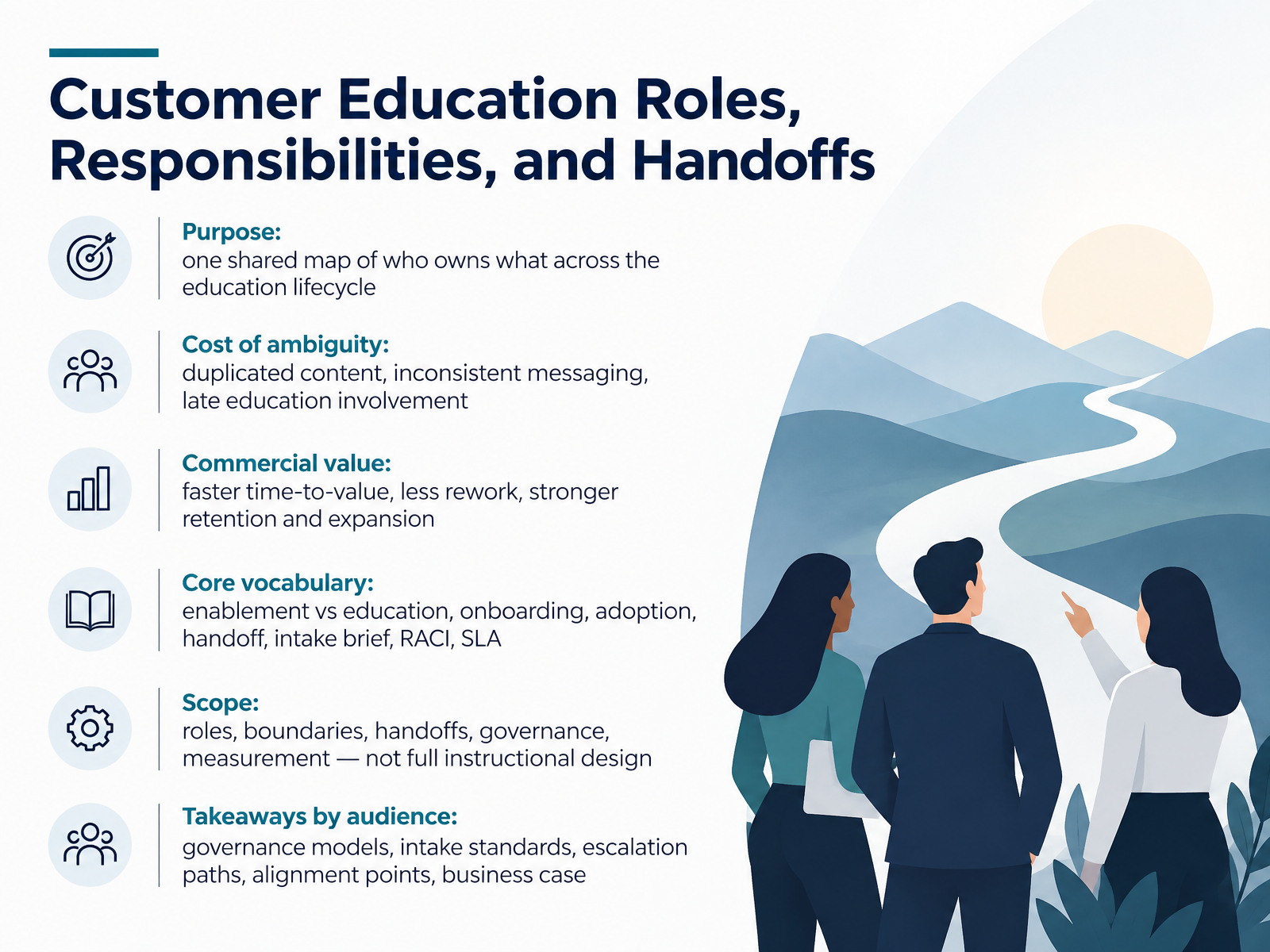
- 01Customer Education Roles, Responsibilities, and HandoffsWelcome. This course gives you one shared map of who owns what across the customer education lifecycle, so peers in customer success, support, product marketing, and operations can stop guessing and start handing off cleanly. Our goal is a working agreement you can apply to your own programme.
First, the cost of ambiguity. When ownership is unclear, you see duplicated content, inconsistent customer messaging, and education pulled in late, usually after decisions are locked. The commercial upside is concrete: faster time to value, less rework, stronger retention and expansion.
We will use a shared vocabulary: enablement versus education, onboarding, adoption, handoff, intake brief, RACI, and service-level agreements. Our scope covers roles, boundaries, handoffs, governance, and measurement. It does not cover full instructional design.
By the close, each audience has something specific: leaders get governance models, designers get intake standards, customer success gets escalation paths, and sponsors get alignment points and a business case. As you listen, map each responsibility to your own workflow and note where a handoff is missing today.
Next, we will look at how the education function has changed, and why these role boundaries matter more now. Background: How the Education Function Has Changed.2 min
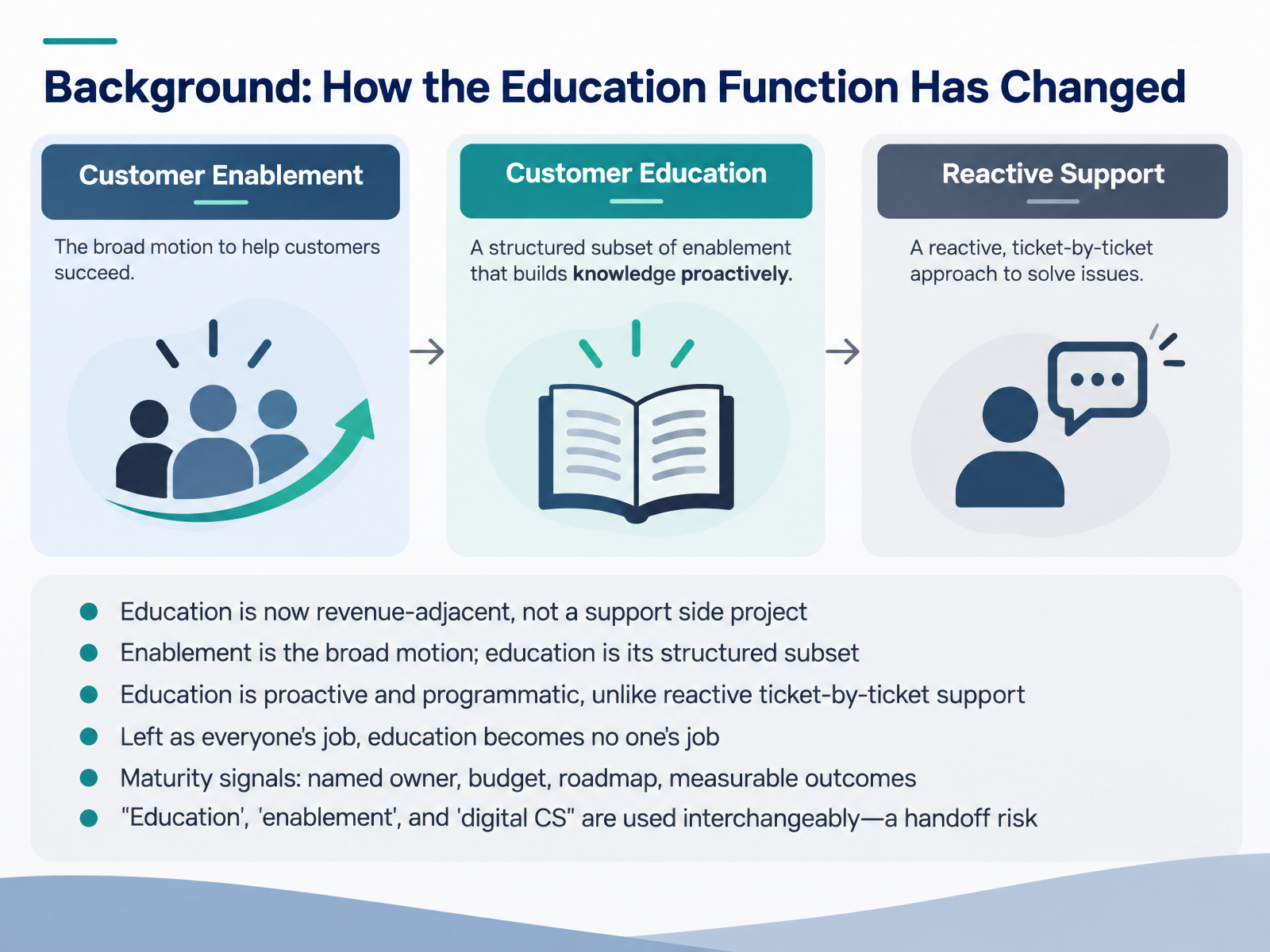
- 02Background: How the Education Function Has ChangedLet's ground this in how the education function has actually changed. Education is now revenue-adjacent. It influences retention, expansion, and adoption, so it is not a support side project. Enablement is the broad motion. Education is its structured subset, with defined curricula, milestones, and outcomes. Education is also proactive and programmatic, unlike reactive ticket-by-ticket support. Think of a structured onboarding path that anticipates where customers get stuck, instead of answering the same question forty times. But left as everyone's job, education becomes no one's job. So maturity shows up in concrete signals: a named owner, a funded budget, a published roadmap, and measurable outcomes. One more risk to watch. Teams often use education, enablement, and digital customer success interchangeably. That blur creates confusion at handoff points. Clarify which function owns the asset, which team approves the message, and who escalates gaps. Next, we will look at operating models and where education sits.
 2 min
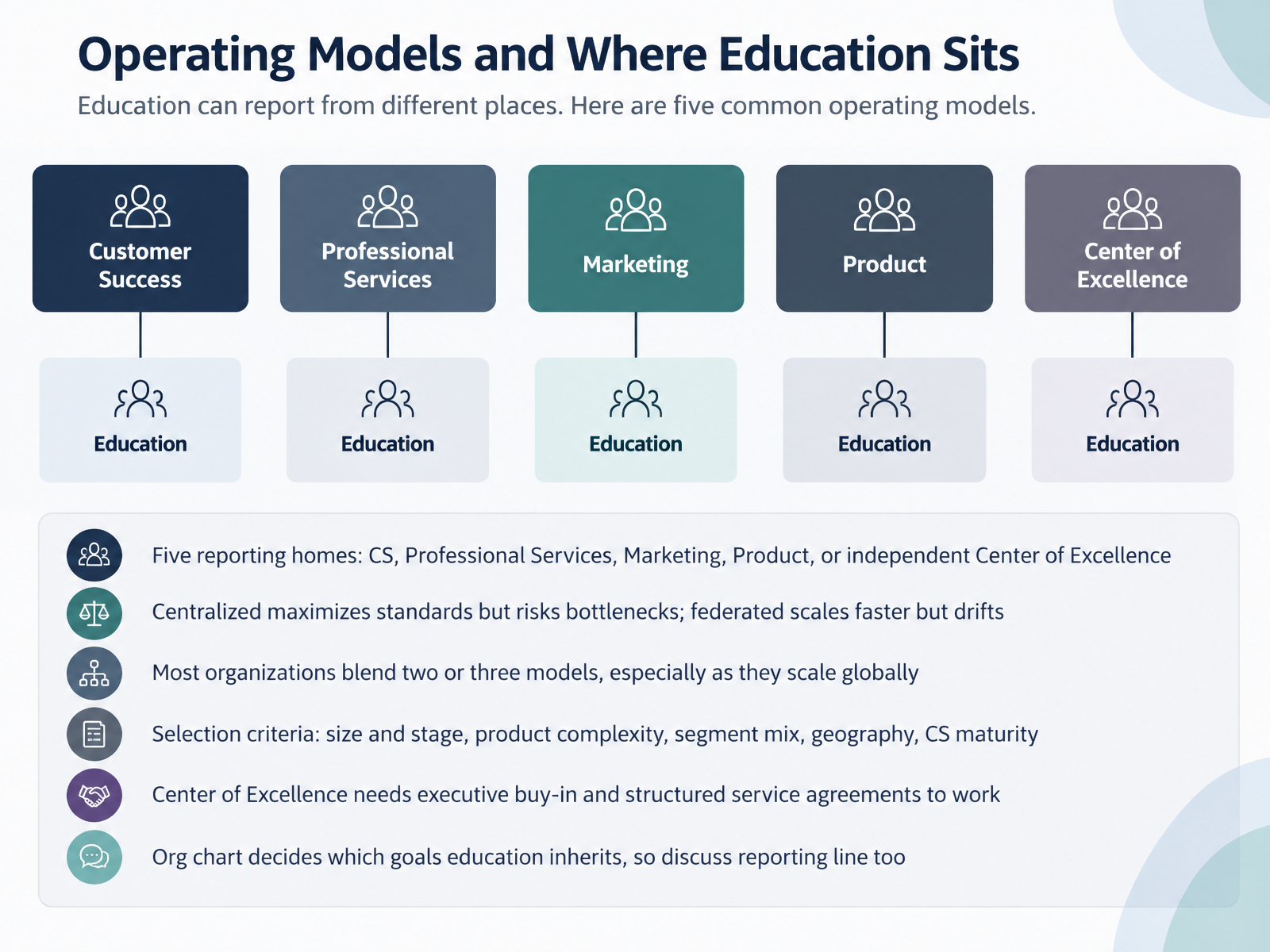
2 min - 03Operating Models and Where Education SitsLet us look at where education sits in the organization, and why that choice matters.
There are five common reporting homes: Customer Success, Professional Services, Marketing, Product, or an independent Center of Excellence.
Each model has tradeoffs. Centralized teams maximize standards, but they risk becoming bottlenecks. Federated teams scale faster, but quality drifts without shared guardrails.
In practice, most organizations blend two or three models, especially as they scale globally. A core team might own standards, while embedded specialists support regional product launches.
So how do you choose? Weigh your size and stage, product complexity, segment mix, geography, and CS maturity.
If you pursue a Center of Excellence, secure executive buy-in and structured service agreements. Without both, the model stalls.
One more thing. The org chart decides which goals education inherits. So when you debate reporting lines, discuss the goals you are signing up for.
Next, we move inside the function to the core roles on a customer education team.
 2 min
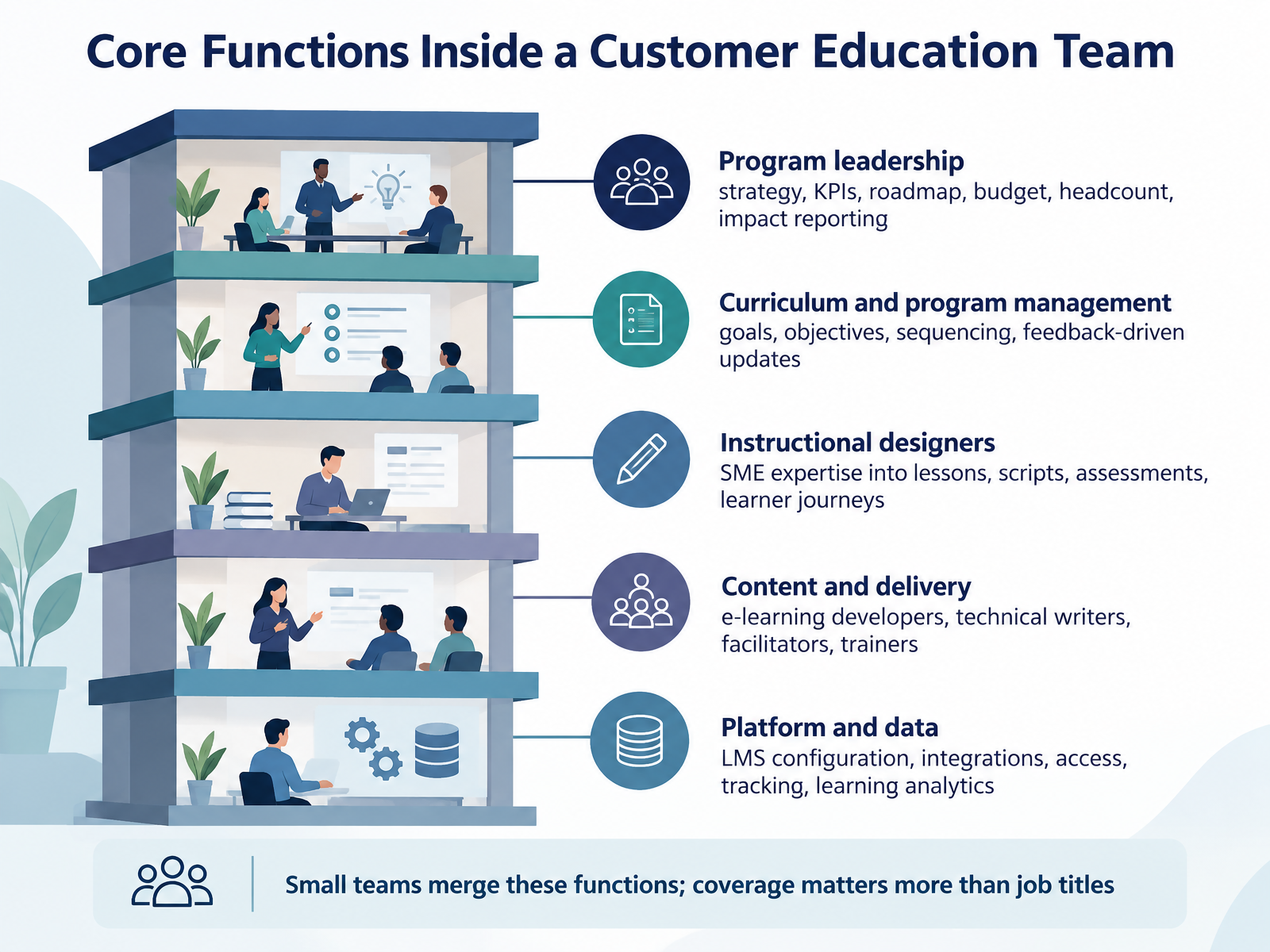
2 min - 04Core Functions Inside a Customer Education TeamLet's look at the core functions inside a customer education team. Think of these as lanes of ownership, not a fixed org chart. Program leadership owns strategy, KPIs, the roadmap, budget, headcount, and impact reporting. Curriculum and program management turns goals into objectives, sequencing, and feedback-driven updates. Instructional designers convert subject-matter expertise into lessons, scripts, assessments, and learner journeys. Content and delivery covers e-learning developers, technical writers, facilitators, and trainers, who build and run the experience. Platform and data owns LMS configuration, integrations, access, tracking, and learning analytics. On small teams, one person may cover several lanes. That is fine, as long as every lane has a named owner. When a lane is unowned, decisions stall and work gets re-done. So clarify who owns, who approves, and who escalates before the work starts. Next, we'll map those ownership lines in Core Roles and Responsibility Boundaries.
 2 min
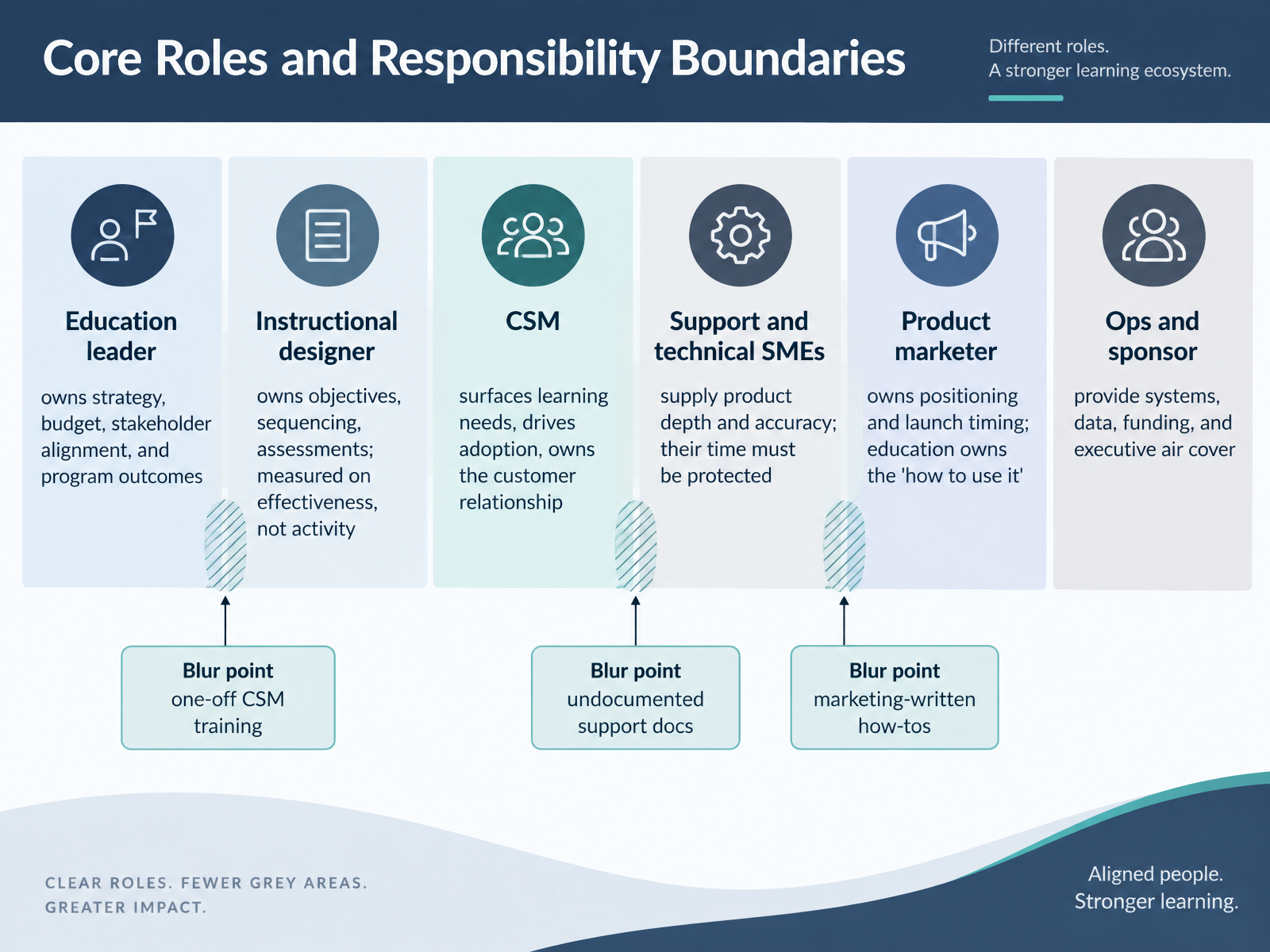
2 min - 05Core Roles and Responsibility BoundariesLet's draw clear boundaries between the core roles. Education leader owns strategy, budget, stakeholder alignment, and program outcomes. Instructional designer owns objectives, sequencing, and assessments, and is measured on effectiveness, not activity. The Customer Success Manager surfaces learning needs, drives adoption, and owns the customer relationship. Support and technical subject-matter experts supply product depth and accuracy, so protect their time. The product marketer owns positioning and launch timing, while education owns the how-to-use-it. Operations and the sponsor provide systems, data, funding, and executive air cover. Now name the blur points out loud. One-off CSM training, marketing-written how-tos, and undocumented support docs. When you spot one, assign the owner. Next, we'll look at adjacent functions that overlap with education.
 1 min
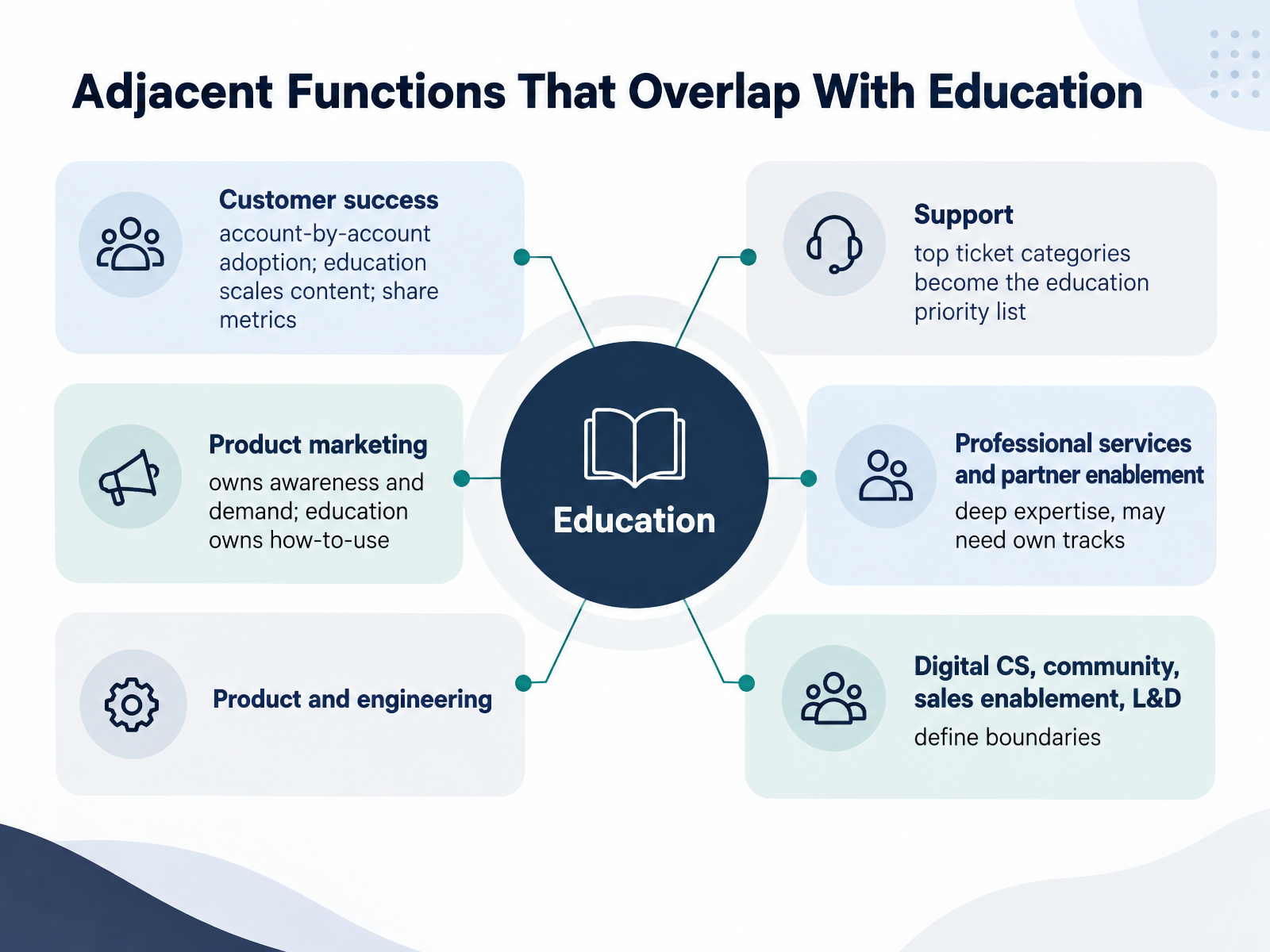
1 min - 06Adjacent Functions That Overlap With EducationLet's map the adjacent functions that overlap with education, and decide who owns what. Customer success owns account-by-account adoption. Education scales content across many customers, so share adoption metrics both ways and agree on one source of truth. Support reveals demand: review your top ticket categories each quarter, and let those categories set the education priority list. Product marketing owns awareness and demand generation. Education owns how-to-use, so split the message: product marketing brings people in, education shows them how to succeed. Professional services and partner enablement carry deep expertise, and they may need their own tracks with separate certification paths. Then define boundaries with product, engineering, digital customer success, community, sales enablement, and learning and development. For each one, name who owns the roadmap, who approves content, and who you escalate to. Write those decisions down. Clear boundaries prevent duplicate work and dropped handoffs, so make ownership explicit before the next project starts. Next, let's look at the Customer Lifecycle and Its Handoff Points.
 2 min
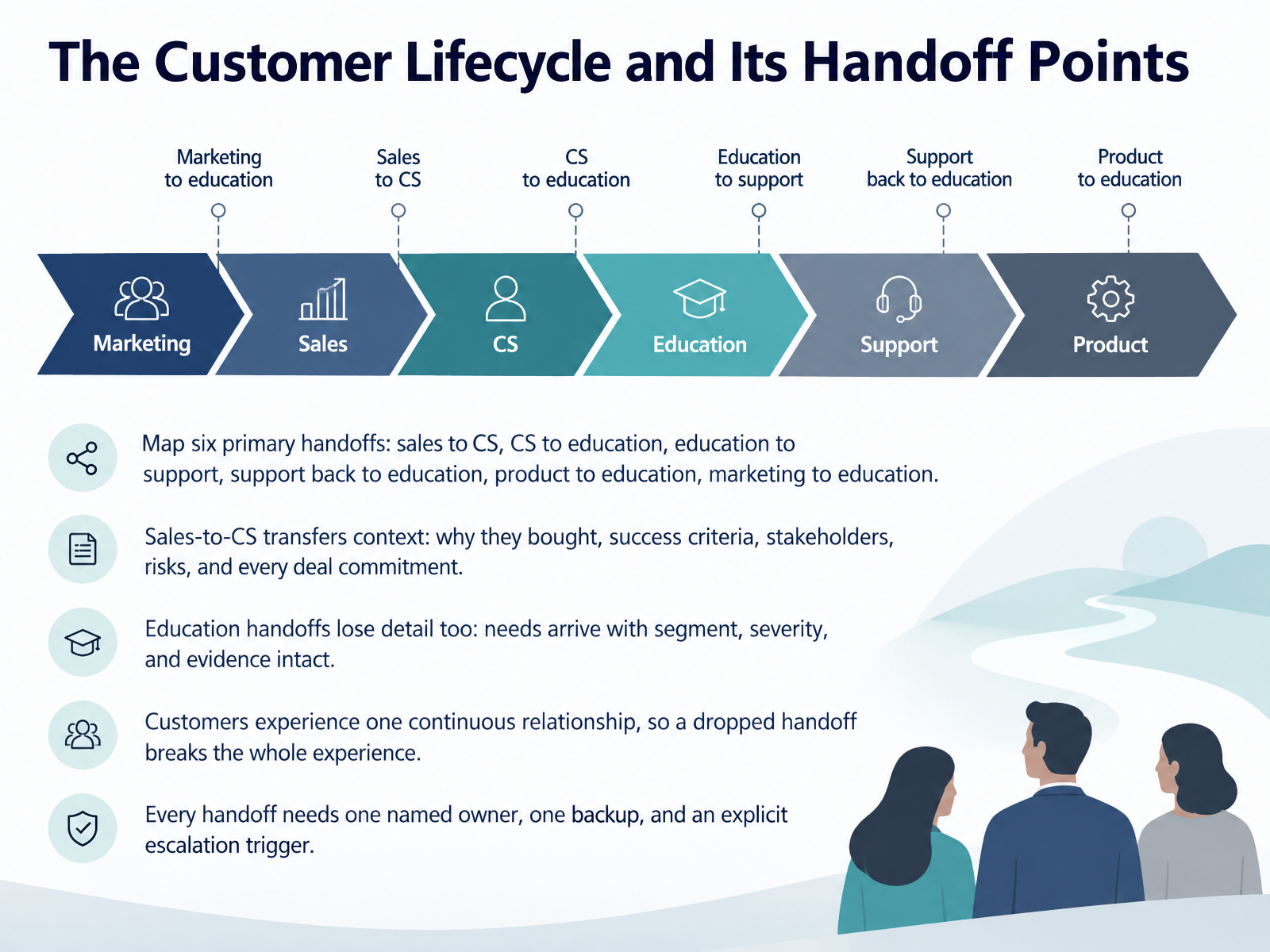
2 min - 07The Customer Lifecycle and Its Handoff PointsLet's map where the customer lifecycle actually changes hands. There are six primary handoffs to name: sales to customer success, customer success to education, education to support, support back to education, product to education, and marketing to education. Each one is a point where context either survives or disappears. Take sales to customer success. That handoff must carry why they bought, their success criteria, key stakeholders, known risks, and every commitment made during the deal. If those details do not transfer, customer success starts from scratch. Education handoffs lose detail too. A need should arrive with its customer segment, its severity, and the evidence intact, so you can prioritize without guessing. Remember, the customer experiences one continuous relationship with your company. They do not see internal team boundaries. So a dropped handoff does not just inconvenience one team. It breaks the whole experience. That is why every handoff needs three things: one named owner, one backup, and an explicit escalation trigger. No owner means it stalls. No backup means it stalls when someone is out. No trigger means issues sit unresolved. Make those three items non-negotiable. Next, we will design these handoffs in detail, looking at triggers, artifacts, and feedback loops.
 2 min
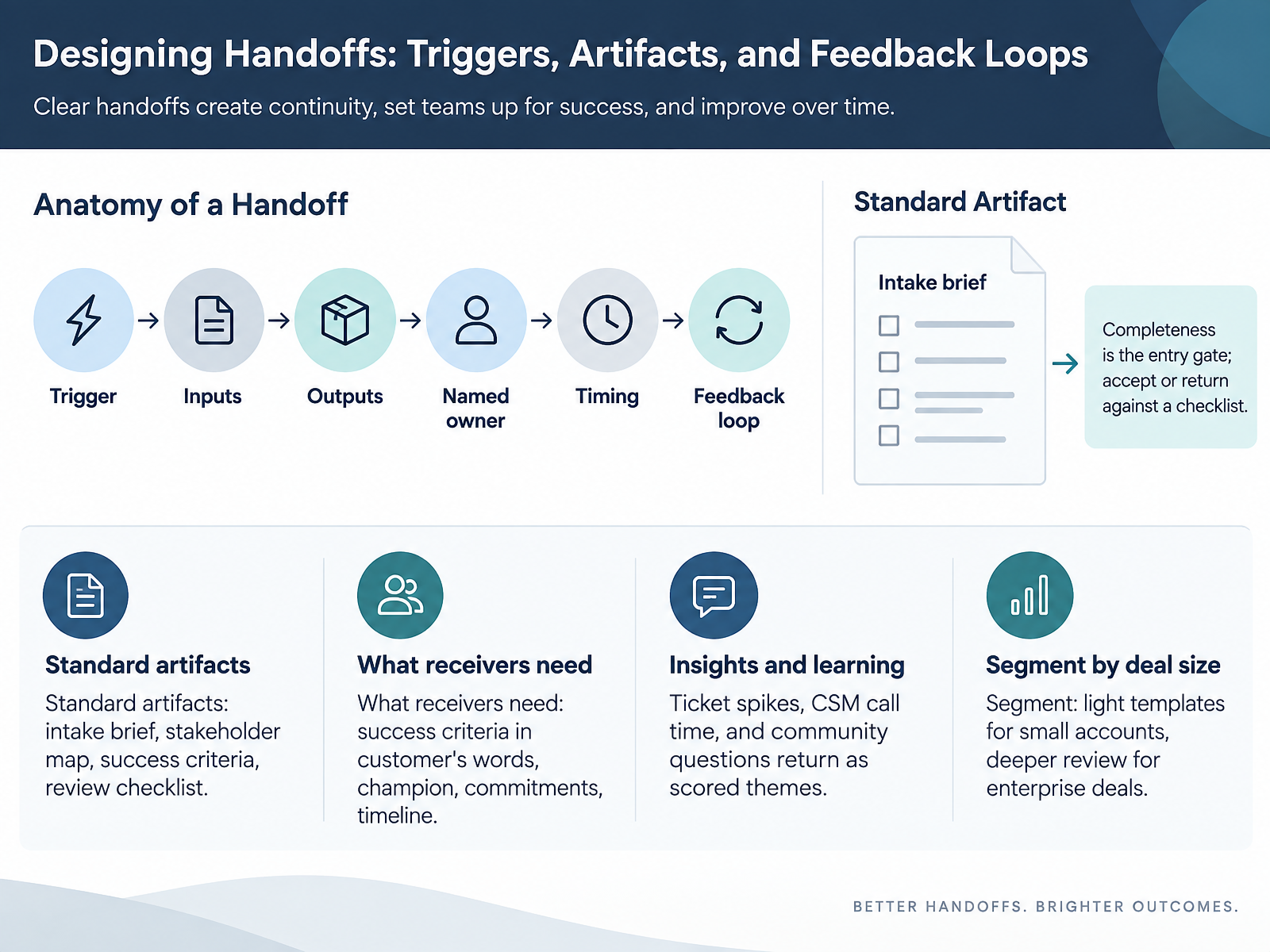
2 min - 08Designing Handoffs: Triggers, Artifacts, and Feedback LoopsNow let's look at how to design handoffs that actually hold up. Every handoff has the same anatomy: a trigger, inputs, outputs, a named owner, timing, and a feedback loop. Miss any one of those and work stalls.
Start with standard artifacts. An intake brief, a stakeholder map, success criteria, and a review checklist. Receivers need success criteria in the customer's own words, plus the champion, commitments, and timeline. Completeness is the entry gate. The receiver accepts or returns against the checklist, not against goodwill.
Then close the loop. Ticket spikes, CSM call time, and community questions come back as scored themes, so the sending team sees the cost of an incomplete handoff. Finally, match depth to segment: light templates for small accounts, deeper review for enterprise deals.
Next, we'll walk through common handoff failure modes and lightweight SLAs.
 2 min
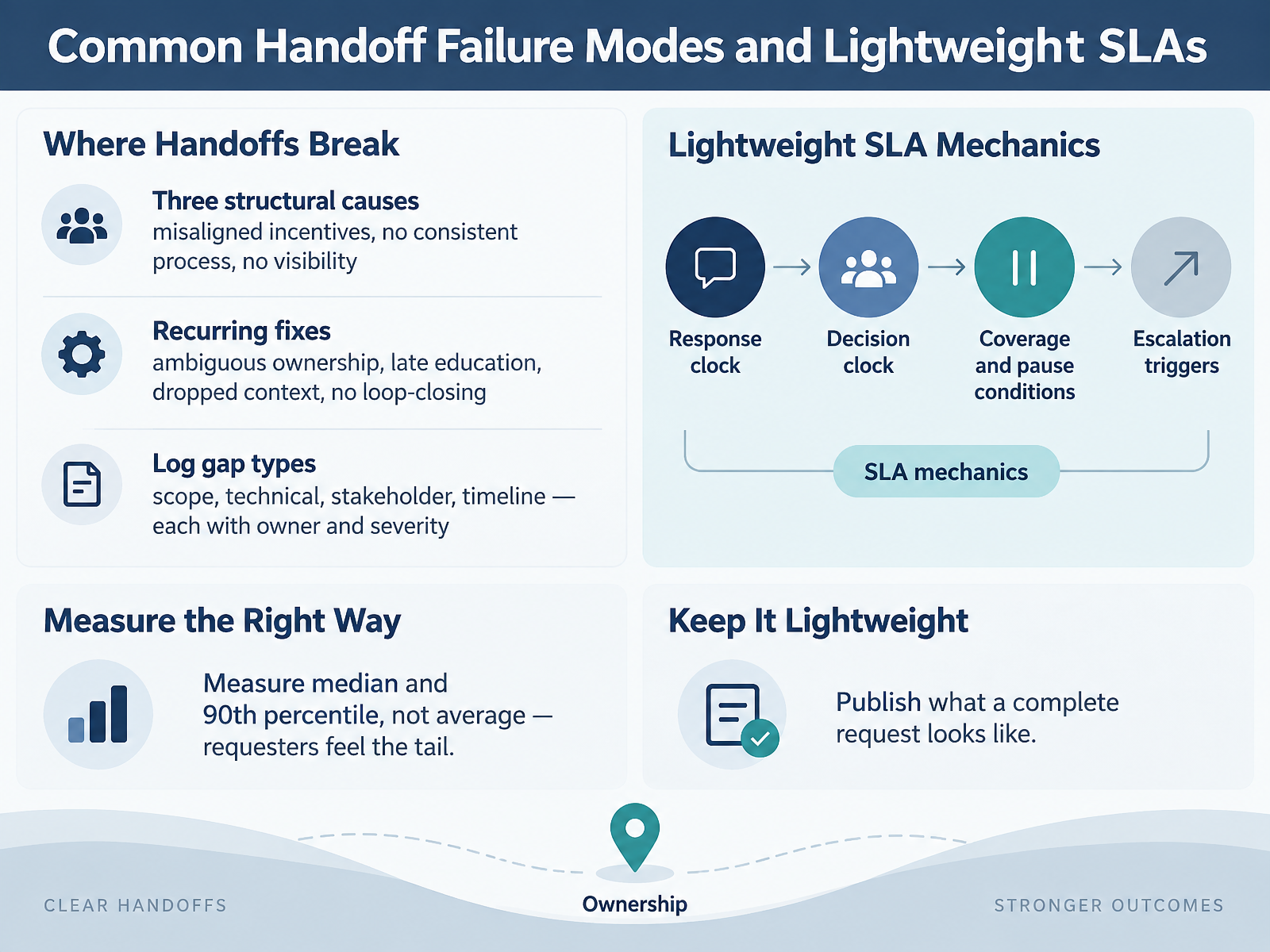
2 min - 09Common Handoff Failure Modes and Lightweight SLAsLet's turn to what happens when handoffs break, and how lightweight service level agreements keep them honest. Most failures trace back to three structural causes: misaligned incentives, no consistent process, and no visibility into where a request stands. You will also see recurring fixes like ambiguous ownership, education arriving too late, dropped context, and no one closing the loop.
For log gaps, name the type, scope, technical, stakeholder, or timeline, then assign an owner and a severity. That single habit removes most guessing.
On SLA mechanics, keep four things clear: response clocks, decision clocks, coverage, and pause conditions, plus escalation triggers when a clock runs out. Measure median and ninetieth percentile, not average, because requesters feel the tail.
Above all, keep it lightweight. Publish what a complete request looks like, and hold that standard.
Next, let's make this concrete with Role Clarity in Practice: Five Cross-Functional Scenarios.
 2 min
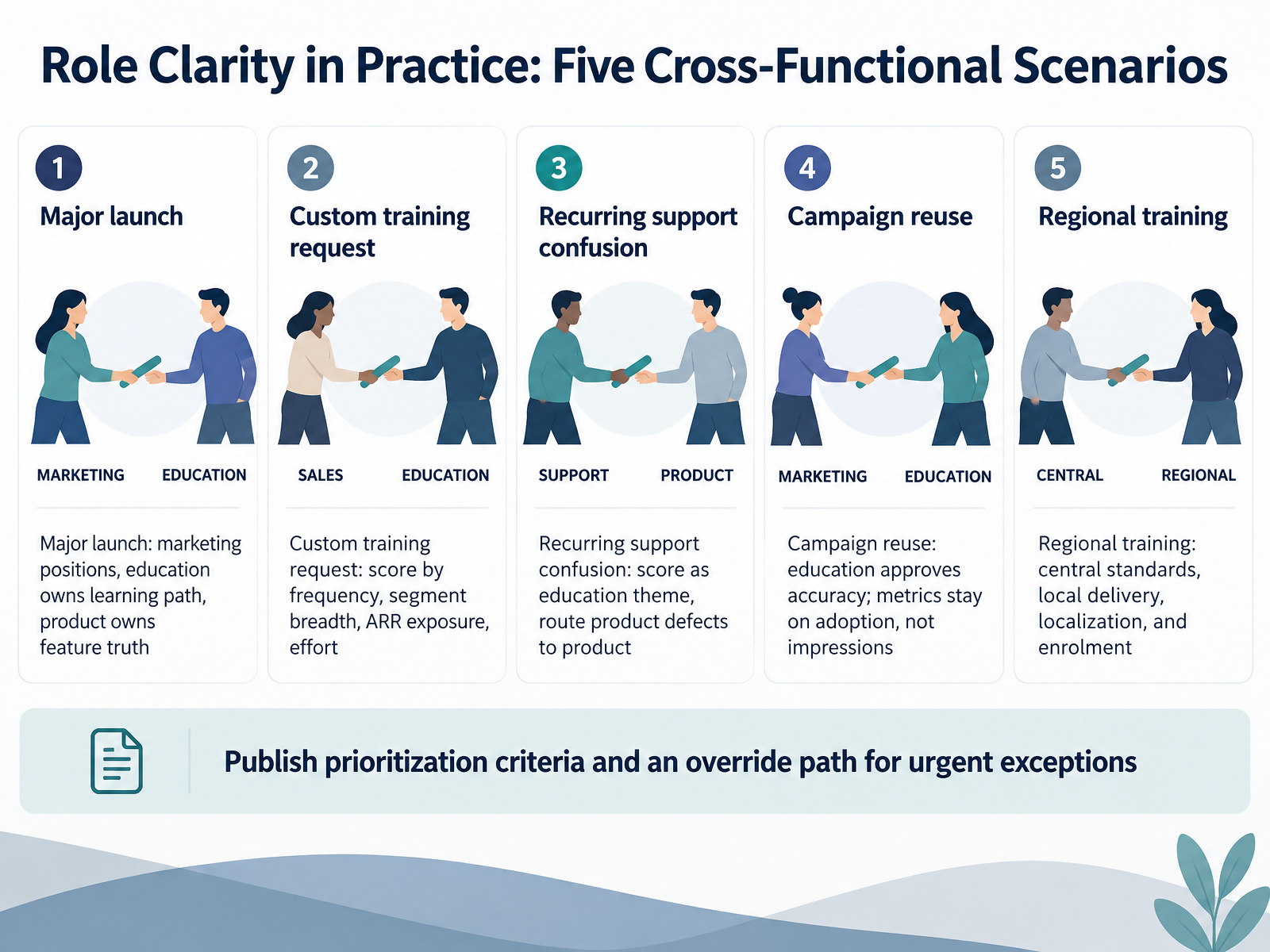
2 min - 10Role Clarity in Practice: Five Cross-Functional ScenariosLet's make role clarity concrete with five cross-functional scenarios. In a major launch, marketing positions the offer, education owns the learning path, and product owns feature truth. When a custom training request arrives, score it by frequency, segment breadth, annual recurring revenue exposure, and effort. For recurring support confusion, score the issue as an education theme and route product defects back to product. With campaign reuse, education approves accuracy, but metrics stay on adoption, not impressions. For regional training, central teams set standards while local teams handle delivery, localization, and enrolment. The key is to publish your prioritization criteria and an override path for urgent exceptions, so everyone knows who decides and where the handoff happens. Next, we'll look at governance: RACI, intake, and decision rights.
 1 min
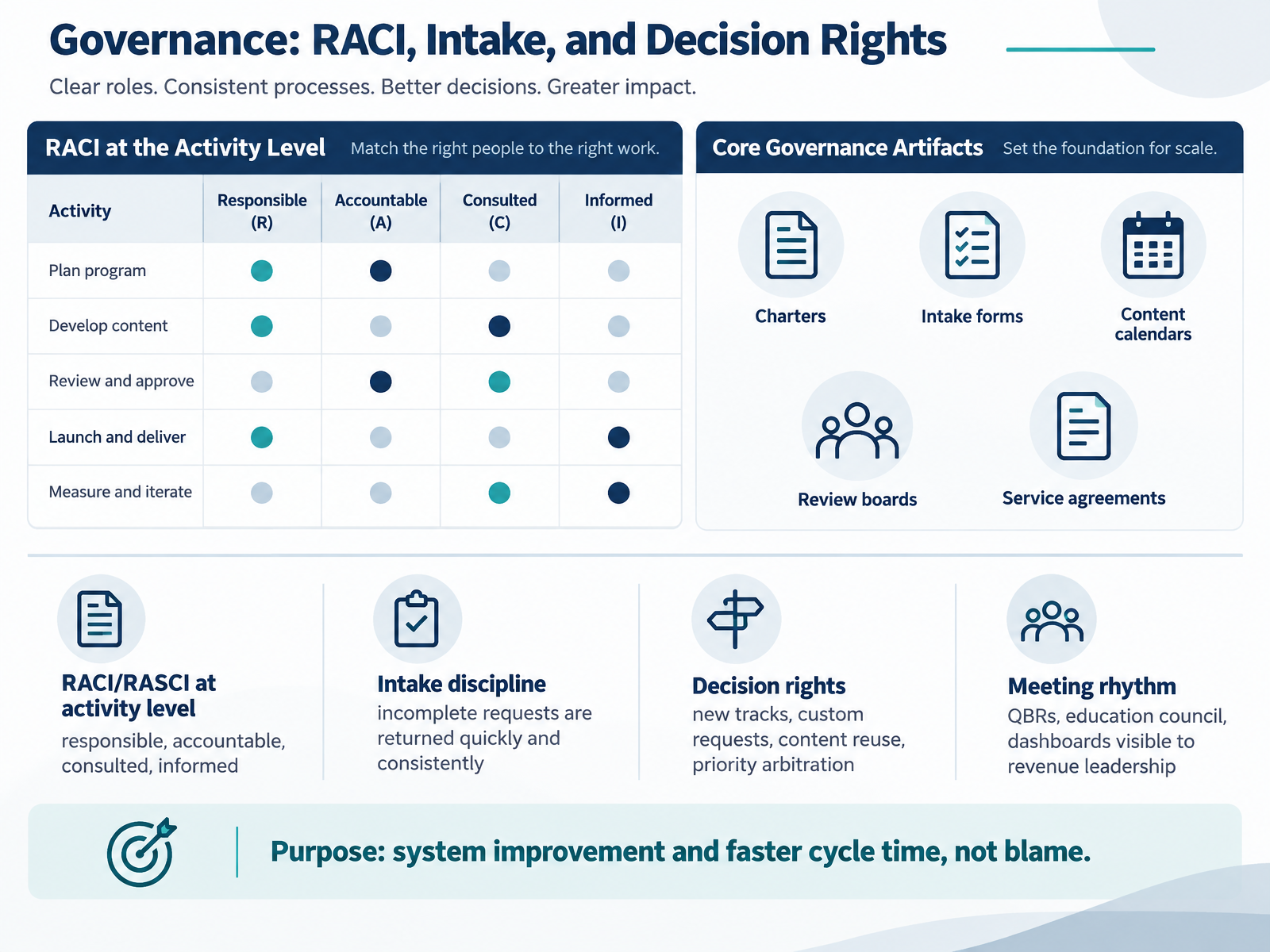
1 min - 11Governance: RACI, Intake, and Decision RightsNext, let's talk about governance, because ownership without decision rights tends to stall. Start with RACI or RASCI at the activity level. For each activity, name who is responsible, who is accountable, who is consulted, and who is informed. Then anchor that in core artifacts: charters, intake forms, content calendars, review boards, and service agreements. Intake discipline matters. If a request is incomplete, return it quickly and consistently, with the missing fields called out. That single habit protects your designers and shortens cycle time. Decision rights need to be explicit too. Who approves a new track, a custom request, content reuse, or priority arbitration? Write it down, and name the escalation path when there is disagreement. Keep a steady meeting rhythm: quarterly business reviews, an education council, and dashboards visible to revenue leadership. The purpose here is system improvement and faster cycle time, not blame. So take a moment and map one activity you own to a clear decision right. Now let's look at metrics and shared accountability across teams.
 2 min
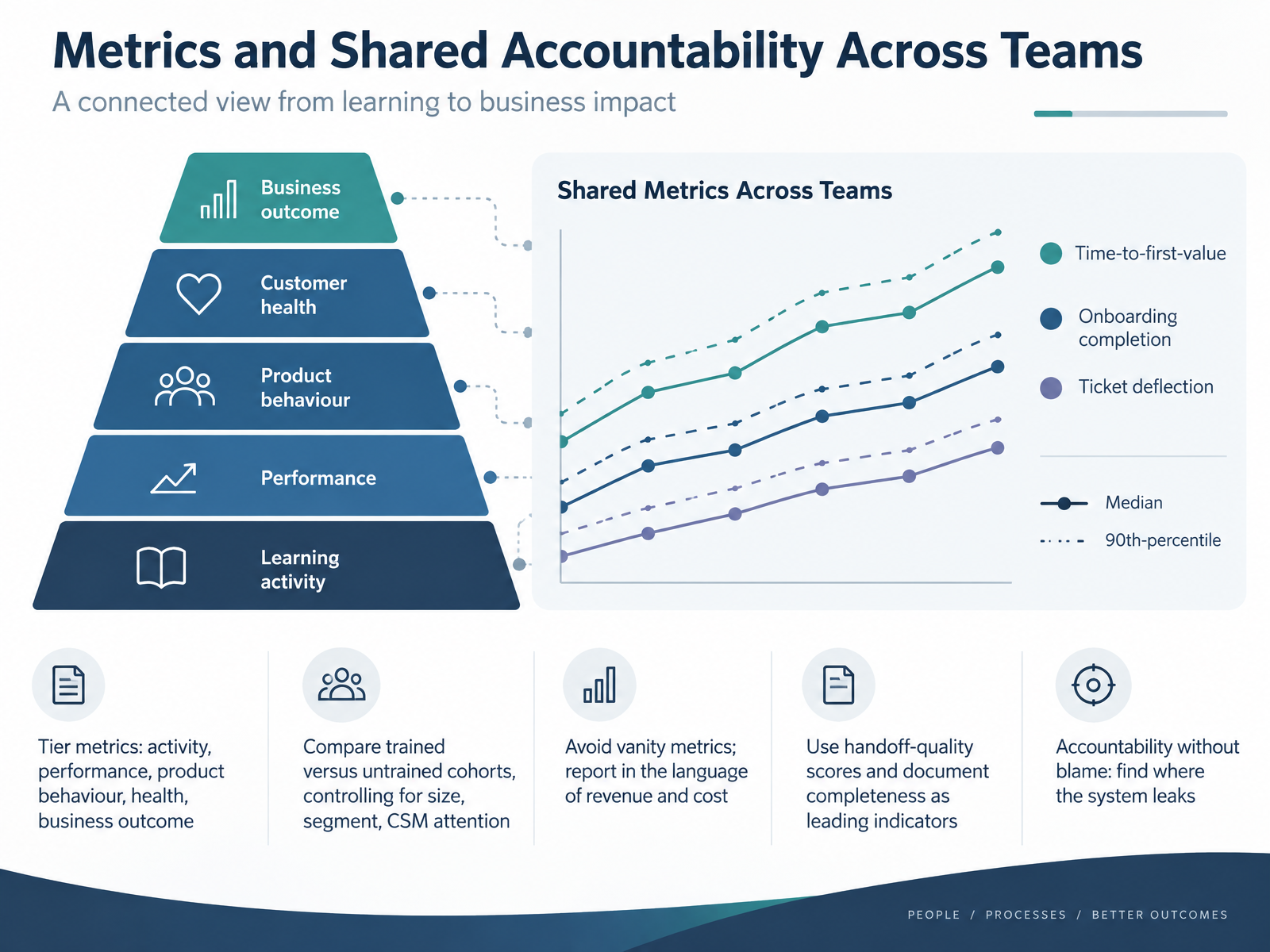
2 min - 12Metrics and Shared Accountability Across TeamsNext, let us look at metrics and shared accountability across teams. Use tiered metrics so everyone knows what to watch. Activity metrics show effort. Performance metrics show whether onboarding and enablement actually work. Product behaviour shows how customers use what they learn. Health metrics track adoption and engagement. Business outcome metrics connect education to retention, expansion, and cost. Shared metrics expose handoff breakdowns. Track time-to-first-value, onboarding completion, and ticket deflection across the whole journey, not just inside one team. When you compare trained and untrained cohorts, control for size, segment, and CSM attention. Otherwise you cannot trust the result. Avoid vanity metrics. Report in the language of revenue and cost, because that is what sponsors approve. Use handoff-quality scores and document completeness as leading indicators. They warn you before outcomes slip. And keep accountability without blame. Find where the system leaks and fix the handoff. That is what shared accountability means in practice. Coming up next, tooling, content operations, and AI support.
 2 min
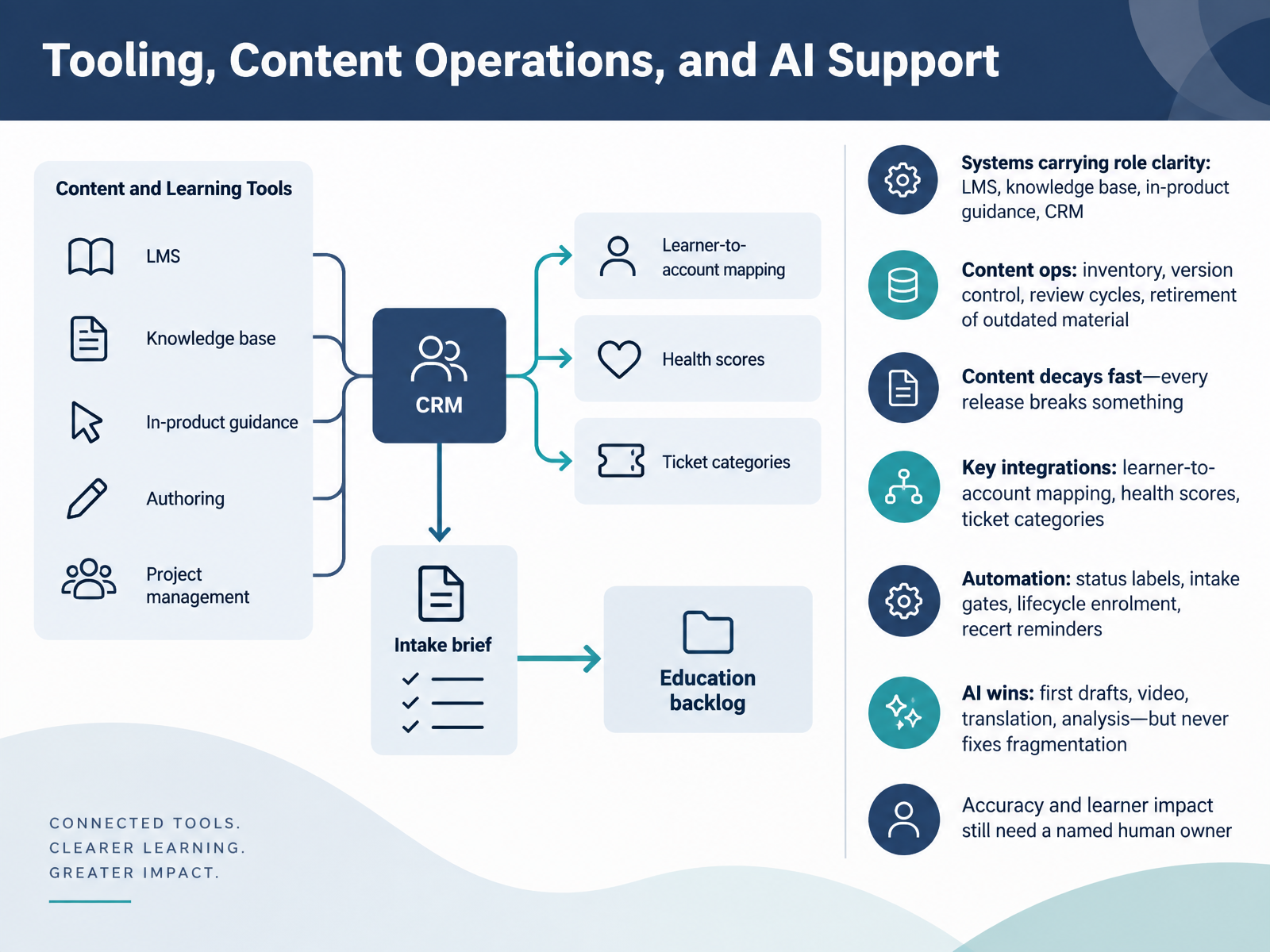
2 min - 13Tooling, Content Operations, and AI SupportLet's turn to tooling, content operations, and where AI genuinely helps.
Your systems are where role clarity becomes real. The learning management system, the knowledge base, in-product guidance, and the CRM each carry a piece of ownership. Put names against each one.
Content operations keep that material trustworthy. Someone owns inventory, version control, review cycles, and retiring outdated material. Content decays fast: every product release breaks something, whether that's a screenshot, a step, or an entire lesson.
Integrations matter too. Learner-to-account mapping tells you who needs what. Health scores and ticket categories tell you when to act.
Use automation for status labels, intake gates, lifecycle enrolment, and recertification reminders. That removes coordination drag.
AI works well for first drafts, video, translation, and analysis. But be clear: AI never fixes fragmentation. It only scales whatever structure you already have.
So name a human owner for accuracy and learner impact. That person approves what ships and escalates what doesn't.
Next, we'll look at building role clarity into onboarding and team development.
 2 min
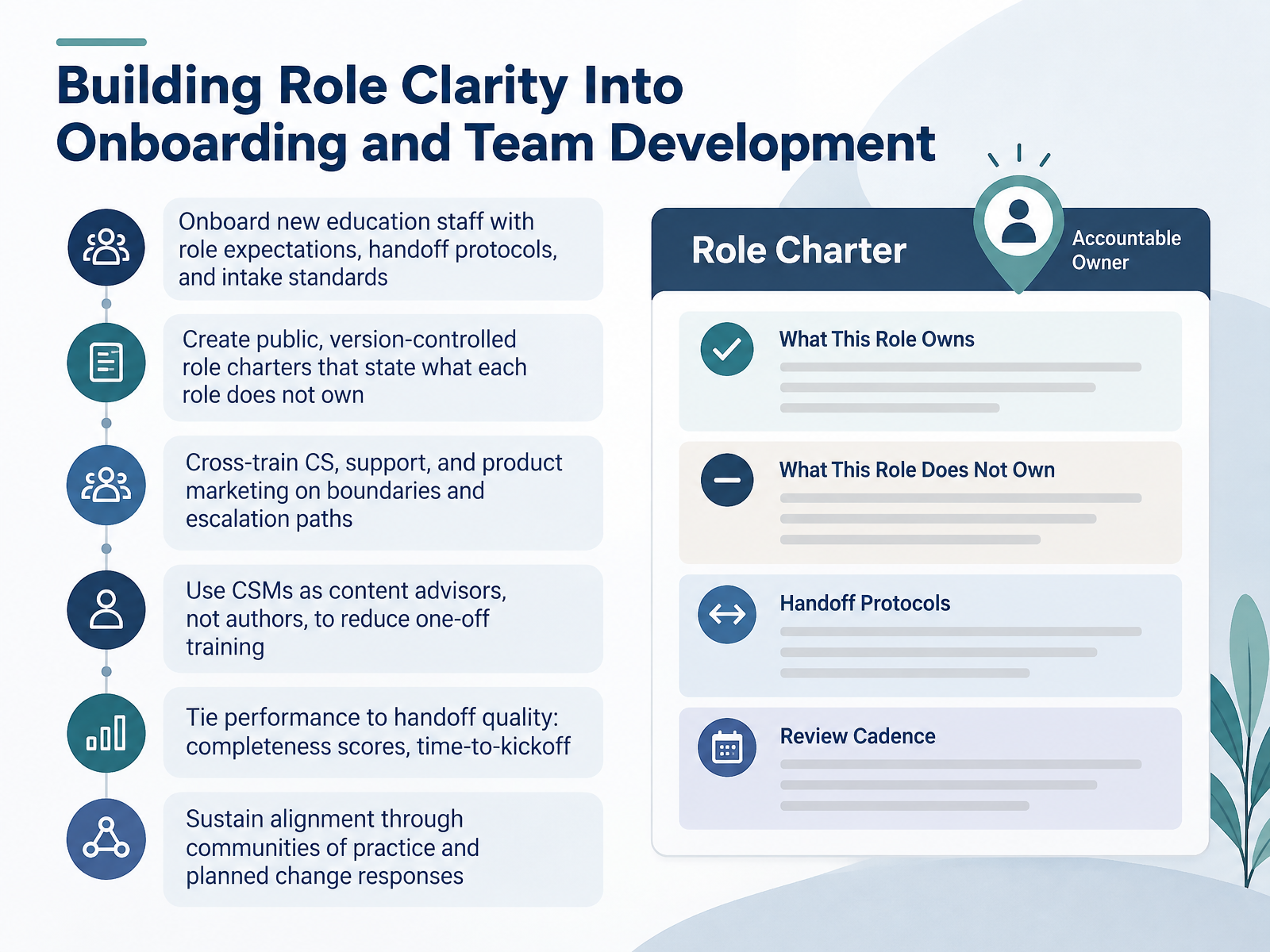
2 min - 14Building Role Clarity Into Onboarding and Team DevelopmentNow let's build role clarity into onboarding and team development. Start new education staff with three things: role expectations, handoff protocols, and intake standards. On day one, they should know what they own and how work reaches them.
Create public, version-controlled role charters. Make each one state what the role does not own. That prevents quiet scope creep.
Cross-train customer success, support, and product marketing on boundaries and escalation paths. Use CSMs as content advisors, not authors. They flag gaps and review drafts; they do not write one-off training. That reduces duplication.
Tie performance to handoff quality. Track completeness scores and time-to-kickoff. If a handoff arrives incomplete, the receiving team escalates it, and that signal feeds the review.
Sustain alignment through communities of practice and planned change responses. When priorities shift, revisit charters and escalation paths together. Next, action planning, from clarity to handoff improvement.
 2 min
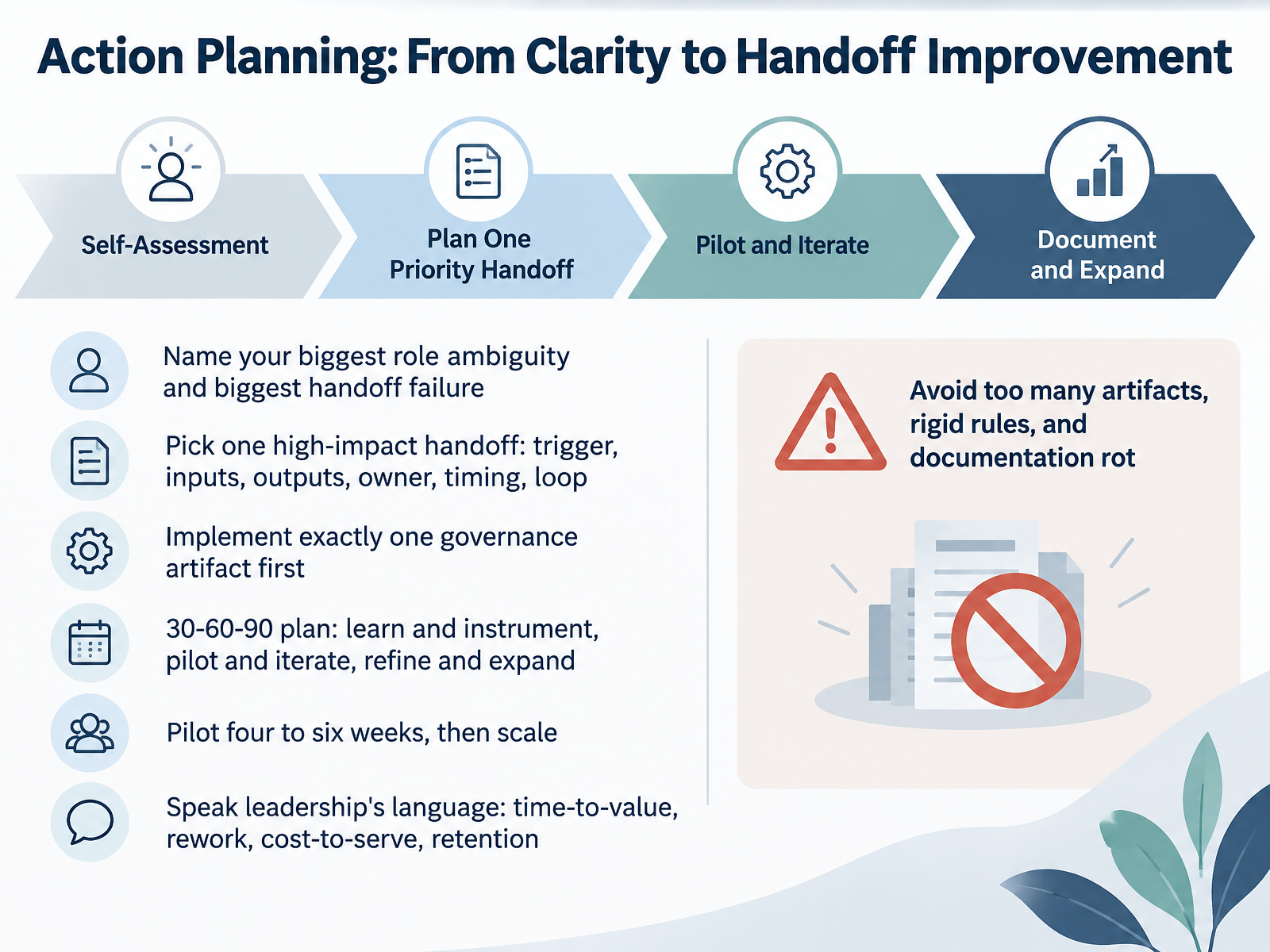
2 min - 15Action Planning: From Clarity to Handoff ImprovementLet's close by turning all of this into an action plan. Start by naming two things: your biggest role ambiguity, and your biggest handoff failure. Be honest. That gap is your starting point.
Then pick one high-impact handoff. Define its trigger, inputs, outputs, owner, and timing. Finally, add the loop, meaning how the receiver closes the loop back to the sender.
Implement exactly one governance artifact first. One. Too many artifacts create confusion, rigid rules create workarounds, and documentation rots fast. Build a thirty, sixty, ninety day plan: first learn and instrument, then pilot and iterate, then refine and expand. Pilot for four to six weeks before you scale.
And speak leadership's language: time-to-value, rework, cost-to-serve, and retention. Tie every change to those numbers.
So, name the ambiguity, fix one handoff, add one artifact, and measure the result. Thank you for your attention, and good luck putting this into practice.
 2 min
2 min
Take the deck with you
Download this course as a file — free, no sign-up needed.
- PDF handoutEvery slide page, ready to print or share.16 pages · 3.5 MBDownload
- Narrated PowerPointThe deck that presents itself — every slide carries the digital human's narration video.16 pages · 15.8 MBDownload
- PowerPoint slidesThe full deck as a .pptx — open it in PowerPoint, Keynote, or Google Slides.16 pages · 3.4 MBDownload
Free to use in your own training — please keep the PersonWise credit page at the end.
Have your own deck? Turn it into a course