Stellar Life Cycles
Begin
16 pages · ~32 min
Stellar Life Cycles
This training explores the life cycle of stars, from formation to death, for astronomy enthusiasts and students.
What you’ll learn
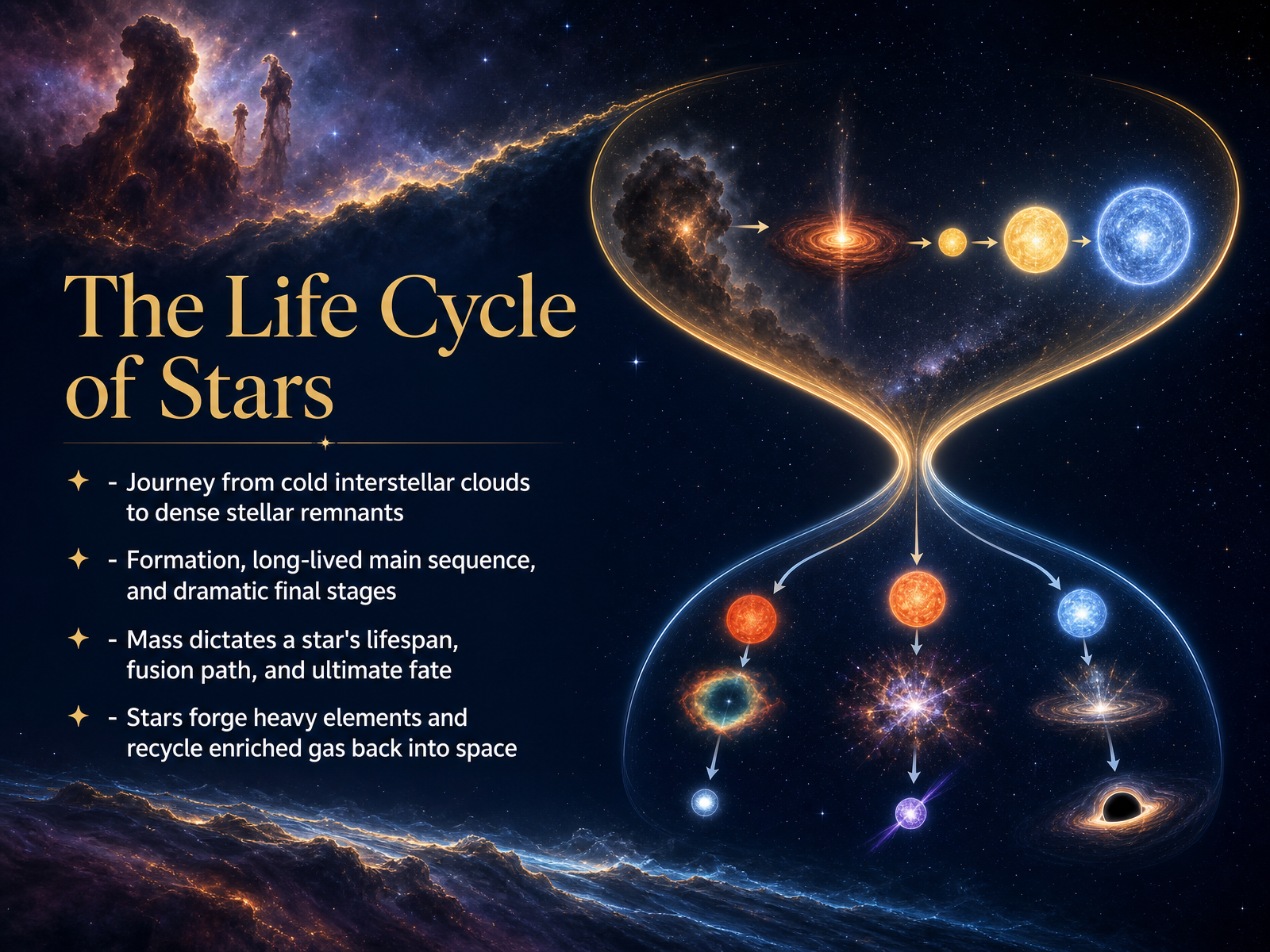
- 01The Life Cycle of StarsWelcome. In this course, we're going to explore the life cycle of stars—the full journey from their quiet beginnings in cold, dark clouds to the dense remnants they leave behind. We'll follow a star through its long, stable main sequence phase and into its dramatic final stages. Along the way, you'll see how one simple property—mass—controls a star's lifespan, its inner fusion reactions, and its ultimate fate. You'll also discover that stars are the universe's great forges, creating heavy elements and recycling enriched gas back into space. Let's begin our journey by looking at the path ahead, starting with our learning objectives and roadmap.1 min
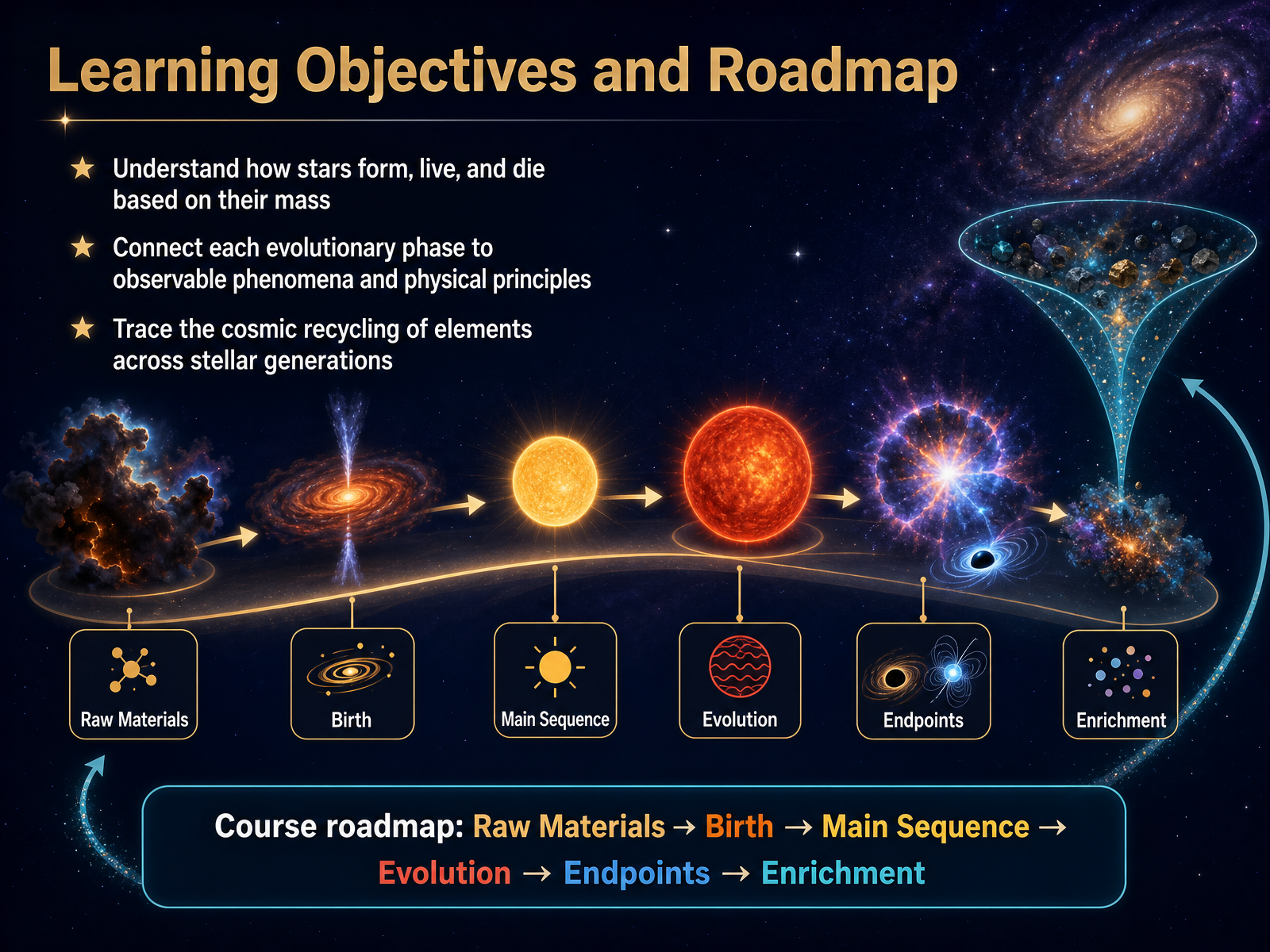
- 02Learning Objectives and RoadmapNow, let's look at where we're heading. This course will walk you through the complete life cycle of a star, step by step. We'll start by understanding how stars form from vast clouds of gas and dust, how they live their long lives on what's called the main sequence, and finally how they die. A key idea is that a star's mass determines its entire life story, from its lifetime to its dramatic final moments. We'll connect each phase to things we can actually observe in the night sky and to the basic physics that drives them. Most importantly, we'll trace how stars forge heavy elements and recycle them back into space, seeding the cosmos with the raw materials for new stars, planets, and even life. Next, we'll begin at the very start with the raw materials: giant molecular clouds.
 1 min
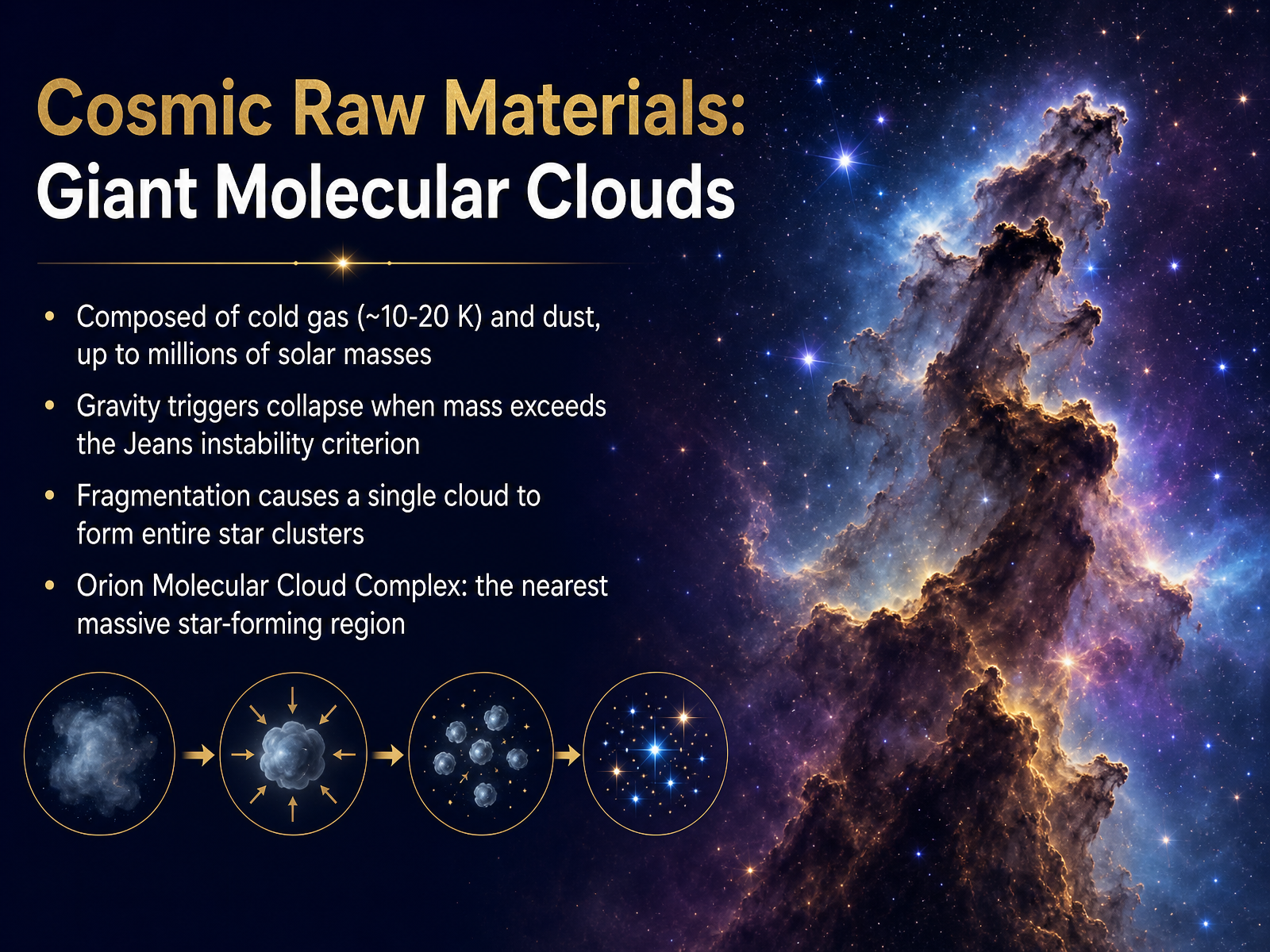
1 min - 03Cosmic Raw Materials: Giant Molecular CloudsNow let’s zoom in on the starting point of a star’s life: the giant molecular cloud. These are vast, cold regions of gas and dust, with temperatures around ten to twenty Kelvin. To picture that, ten Kelvin is just ten degrees above absolute zero. Some of these clouds contain millions of times the mass of our Sun. For a cloud like this to begin collapsing into stars, gravity must overcome the internal pressure. That tipping point is called the Jeans instability. Once it’s crossed, the cloud doesn’t form just one star. It fragments into many dense cores, eventually lighting up an entire cluster. The nearest major star-forming region is the Orion Molecular Cloud Complex, a real laboratory for studying these early stages. In fact, recent James Webb observations have mapped ices and complex molecules inside its dense cores, revealing a rich chemistry even before the first star ignites. So a star’s raw materials are far from simple. Let’s continue into the heart of this stellar nursery and explore the latest discoveries inside Orion.
 google.iopscience.iop.orgiopscience.iop.orgiopscience.iop.org+22 min
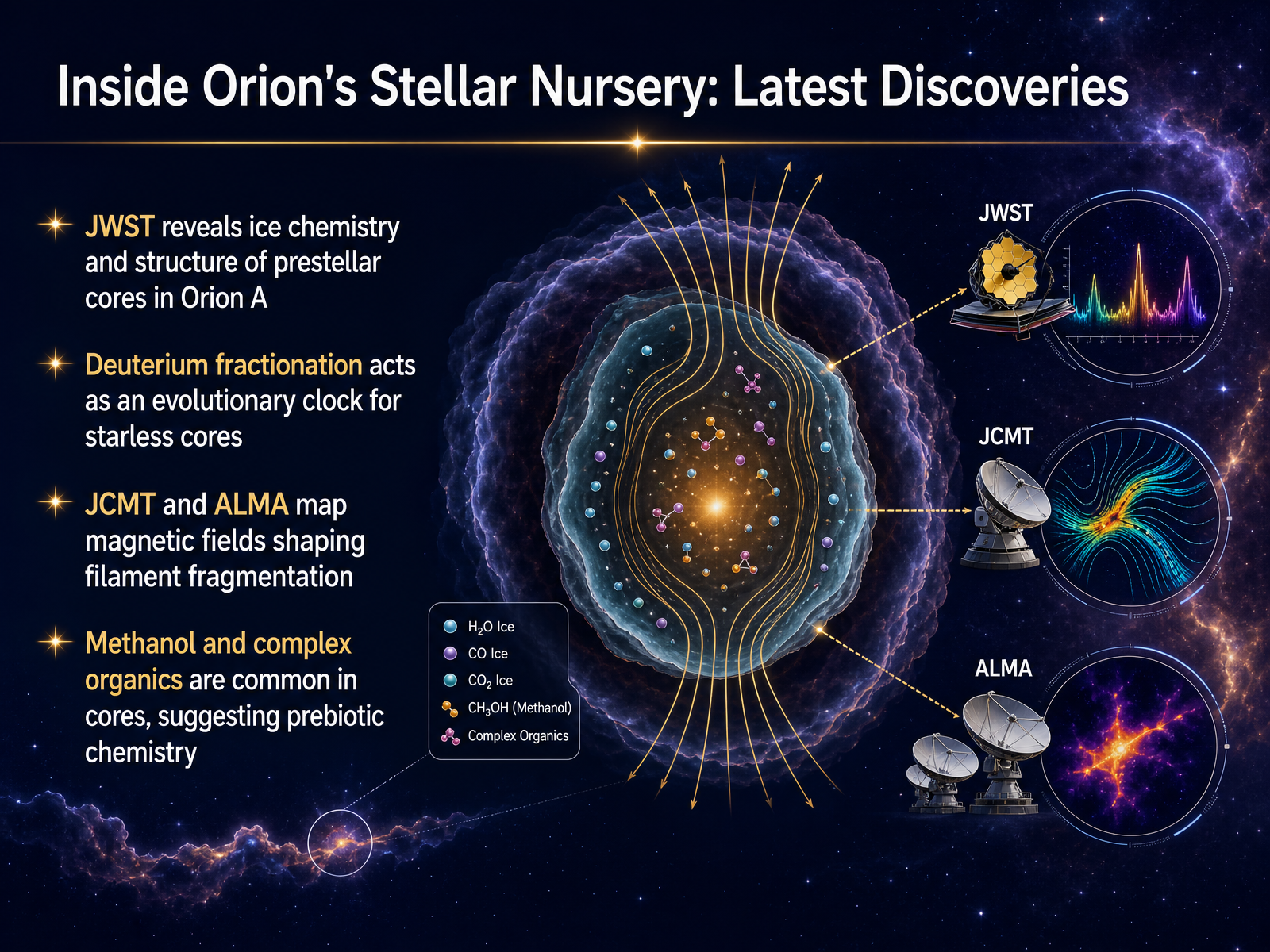
 - 04Inside Orion's Stellar Nursery: Latest DiscoveriesNow let's zoom into one of the most famous stellar nurseries, the Orion Nebula, and see what our latest telescopes have uncovered. The James Webb Space Telescope has peered deep into the dense, cold cores of Orion A, revealing the rich chemistry of the ices coating dust grains within these prestellar cores. Even before a star is born, these frozen molecules are already present. Scientists use a clever tool called deuterium fractionation, which essentially acts like an evolutionary clock, measuring how long a starless core has been evolving. Meanwhile, instruments like the JCMT and ALMA are mapping out magnetic fields. These invisible lines of force shape the very structure of the gas filaments, guiding how these clouds break apart and eventually collapse. And perhaps most thrilling, molecules like methanol and other complex organics are surprisingly common in these cores. This suggests that the seeds of prebiotic chemistry, the building blocks needed for life, may be sown long before a star or its planets ever form. It paints a picture of a cosmic cradle already rich with chemical potential. Next, we'll witness the moment gravity wins as we move into protostars and the actual birth of a star.
 2 min
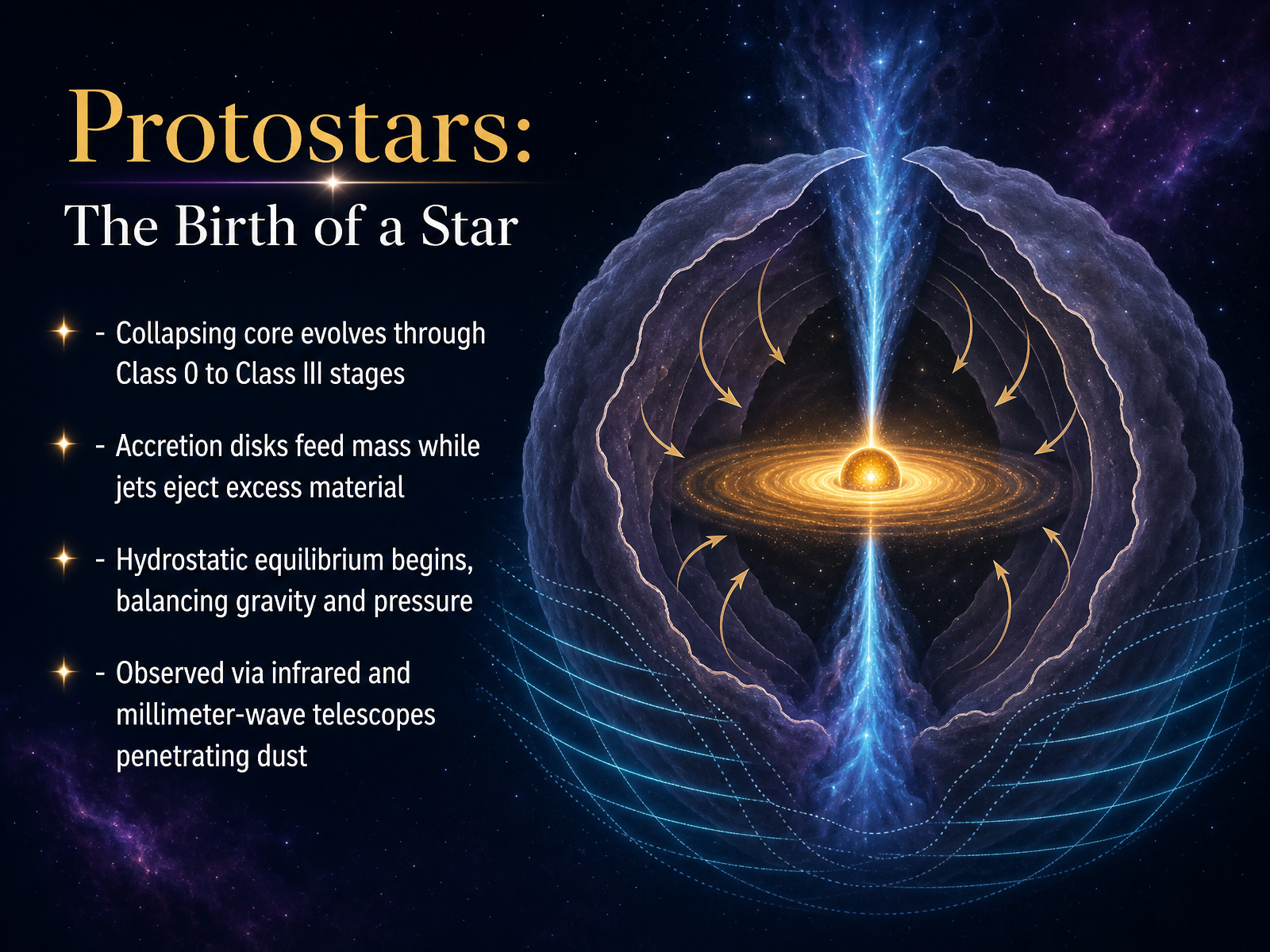
2 min - 05Protostars: The Birth of a StarNow we move into the earliest phase of a star's life: the protostar stage. Imagine a dense core within a cloud that begins to collapse under its own gravity. We classify this emerging object through several stages—Class 0, Class I, Flat Spectrum, Class II, and Class III—each marking a step in its evolution. During these stages, a flattened accretion disk forms, feeding mass onto the growing center while powerful jets eject excess material from the poles. Eventually the core becomes hot and dense enough for a crucial milestone. The inward crush of gravity and the outward push of thermal pressure find a balance. This is hydrostatic equilibrium, the fundamental balancing act that defines a stable star. Because these baby stars are deeply embedded in dusty clouds, we can't see them with ordinary visible light. Instead, we observe them with infrared and millimeter-wave telescopes that can peer through the dust. Let's follow this newborn star as it settles into the longest and most stable chapter of its life, the main sequence.
 2 min
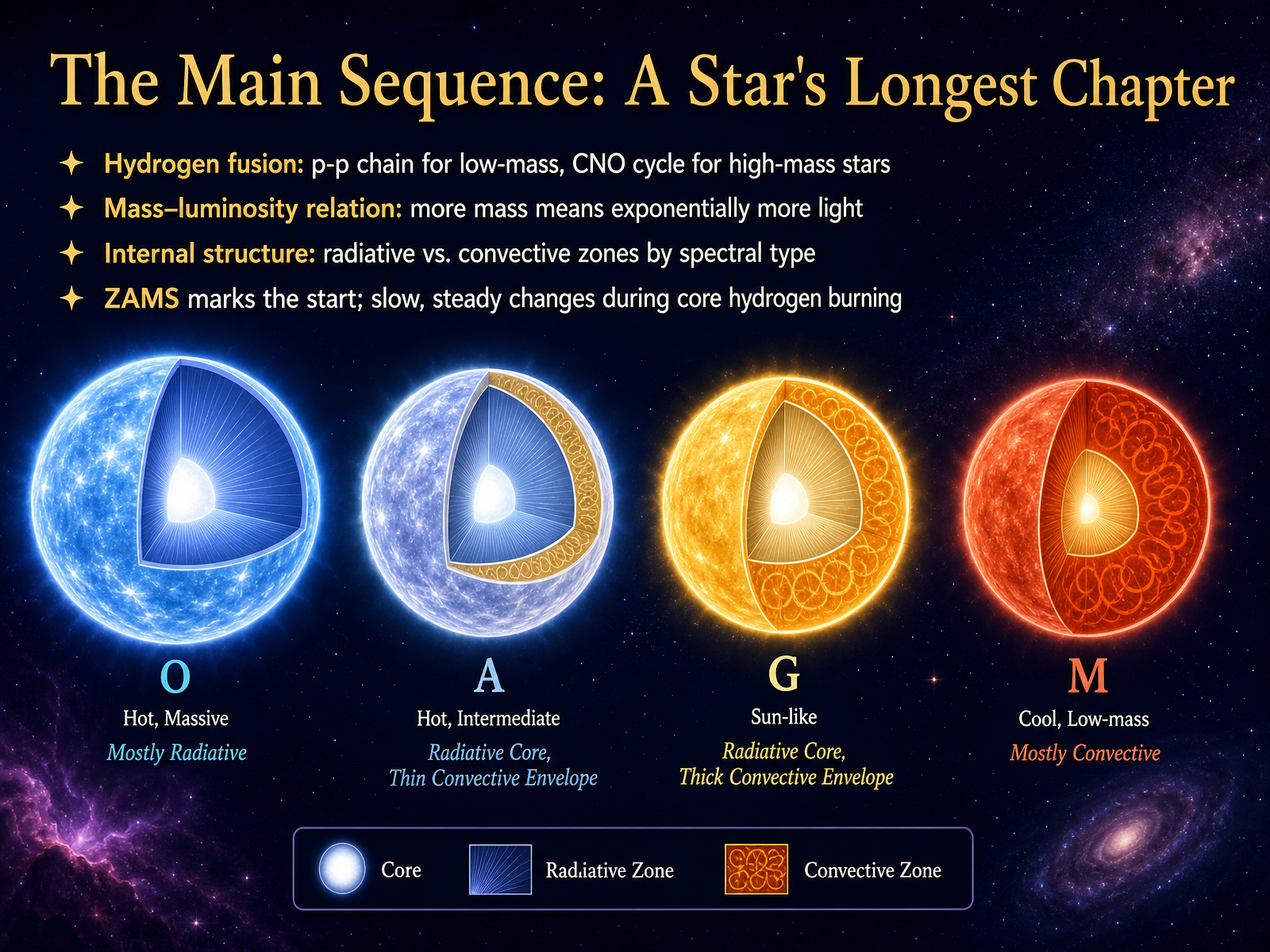
2 min - 06The Main Sequence: A Star's Longest ChapterNow we arrive at the main sequence, the longest and most stable chapter in a star's life. Think of it as the star's adult phase, where a perfect, long-lasting balance is finally achieved. In the core, stars are fusing hydrogen into helium, but the process isn't the same for everyone. Lower-mass stars like our Sun use a direct chain reaction called the proton-proton chain. More massive stars use a faster, catalytic process known as the CNO cycle. A star's mass really dictates its life. The mass-luminosity relation tells us that even a small increase in mass leads to an exponentially brighter star. A star just twice the mass of our Sun can shine more than ten times as brightly. This happens because the internal structure changes. High-mass stars have convective cores and radiative envelopes, while stars like the Sun have a radiative core and a convective outer layer. A star's position on the Zero-Age Main Sequence, or ZAMS, marks this official start of hydrogen burning. Over time, it will heat up and expand very slowly, making these steady changes for most of its life. Up next, we'll learn to map this grand stellar evolution on the Reading the H-R Diagram.
 2 min
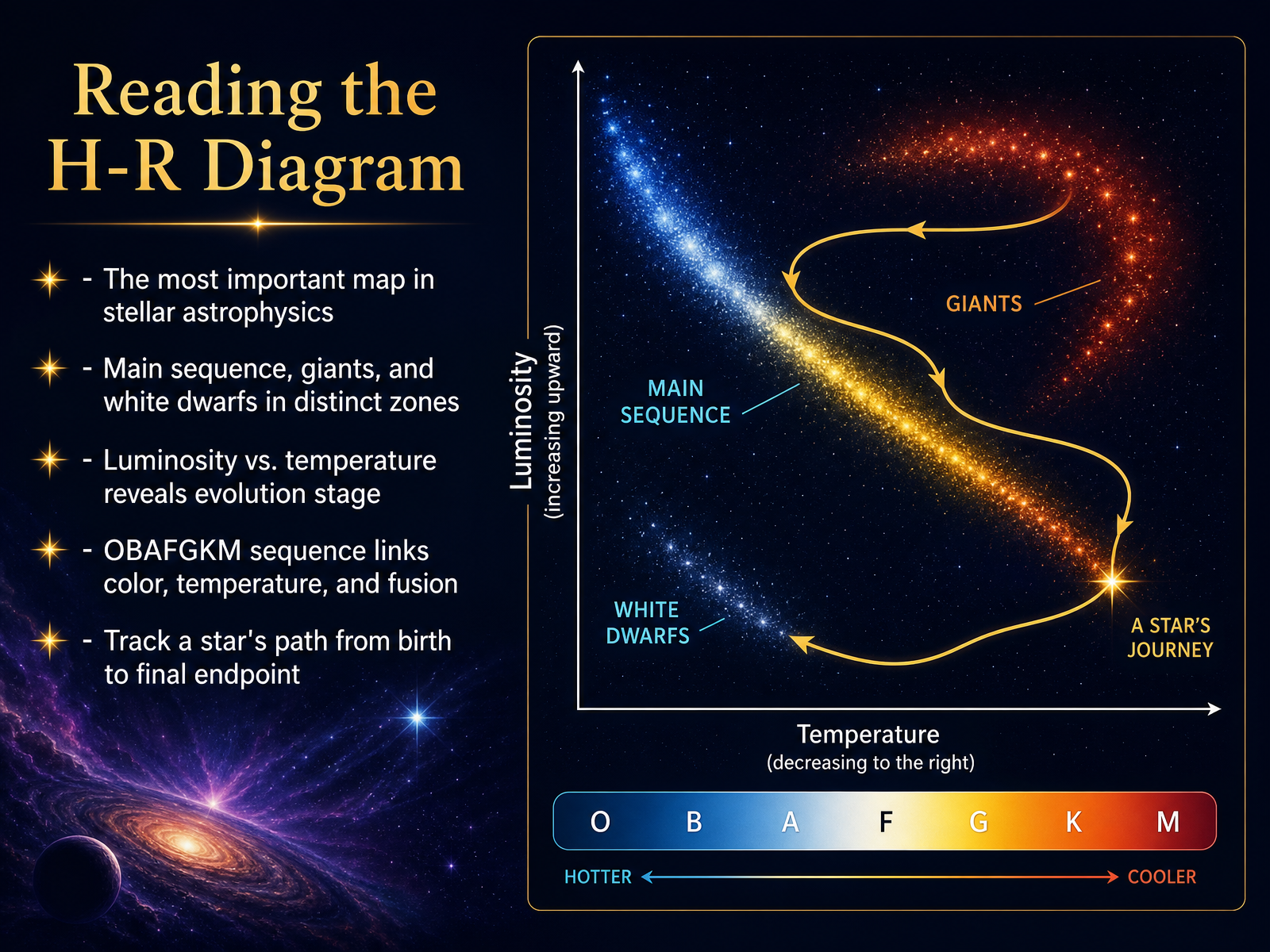
2 min - 07Reading the H-R DiagramMoving on, let's explore the most important map in stellar astrophysics: the Hertzsprung-Russell diagram, or H-R diagram. It organizes stars by their luminosity, how bright they truly are, against their surface temperature. When you plot them this way, stars don't scatter randomly. They fall into distinct zones. The long diagonal band is called the main sequence, where stars spend most of their lives fusing hydrogen. Above that, you see the giants, which are much more luminous but cooler. And in the lower left sit the white dwarfs, hot but very faint because they are so small. The sequence of spectral types, O, B, A, F, G, K, M, runs from the hottest, bluest stars to the coolest, reddest ones. This sequence directly ties a star's color to its temperature and tells you what kind of fusion is happening inside. What makes this diagram truly powerful is tracking a star's path across it. A star's position isn't fixed; it tells you exactly where it is in its life story, from its formation all the way to its final endpoint. Let's see what happens when the core runs out of fuel, as we move into post-main-sequence evolution.
 2 min
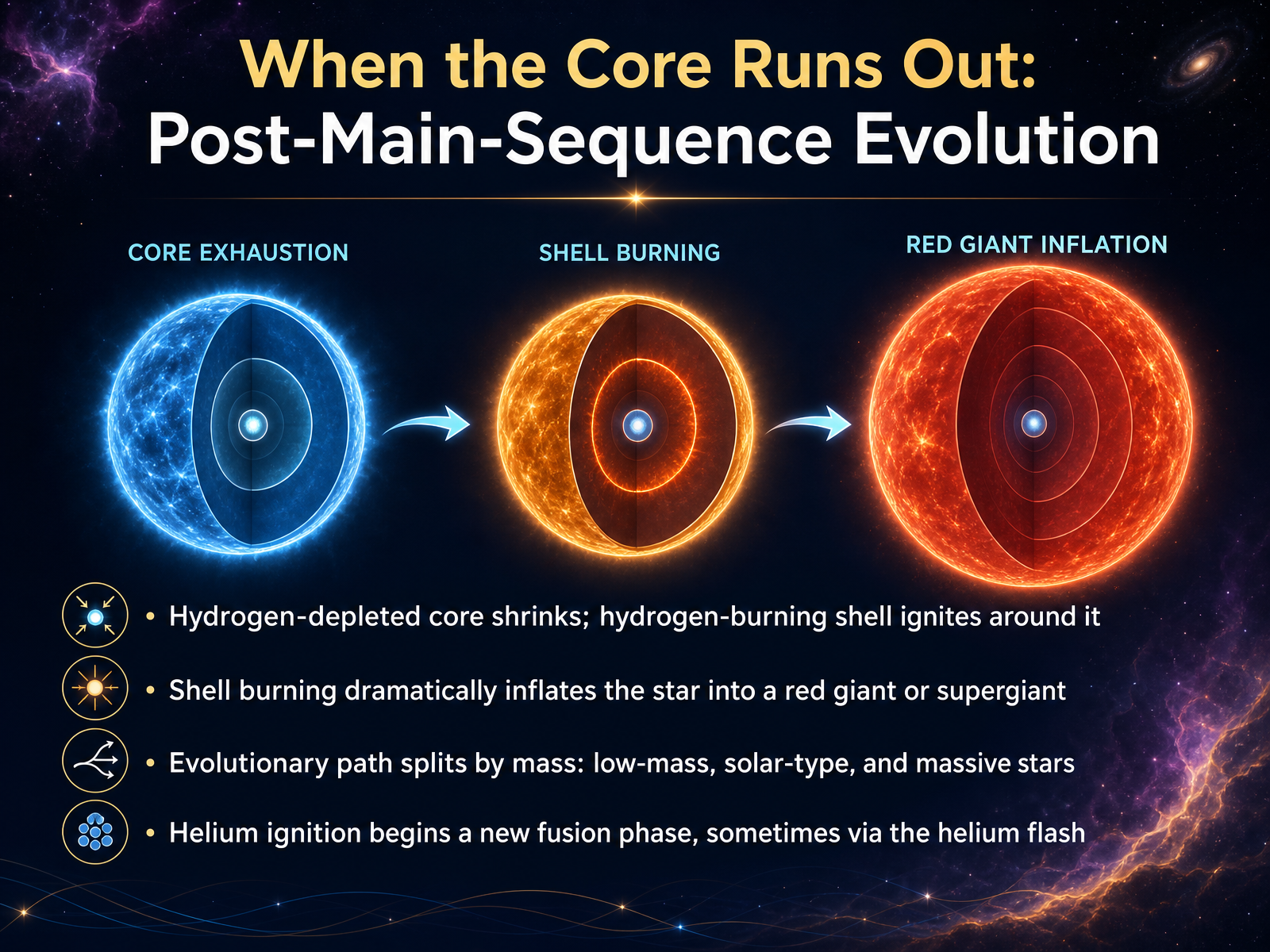
2 min - 08When the Core Runs Out: Post-Main-Sequence EvolutionNow we arrive at a major turning point. Once the core has converted all its hydrogen into helium, fusion there simply stops. Without energy pushing outward, the core begins to shrink under its own gravity. But this compression heats up a thin shell of hydrogen just outside the core, igniting a new layer of fusion. That shell burning is incredibly powerful, and it pumps so much energy into the outer layers that the star dramatically inflates. A star like our Sun will balloon into a red giant, while more massive stars become enormous supergiants. From here, the star’s path splits based on its mass. Lower-mass stars and solar-type stars will begin burning helium in the core, sometimes through a sudden, explosive event called the helium flash. Massive stars, on the other hand, fuse helium more gradually. Each path leads to a very different fate. Next, we will explore one of those graceful endings: planetary nebulae.
 2 min
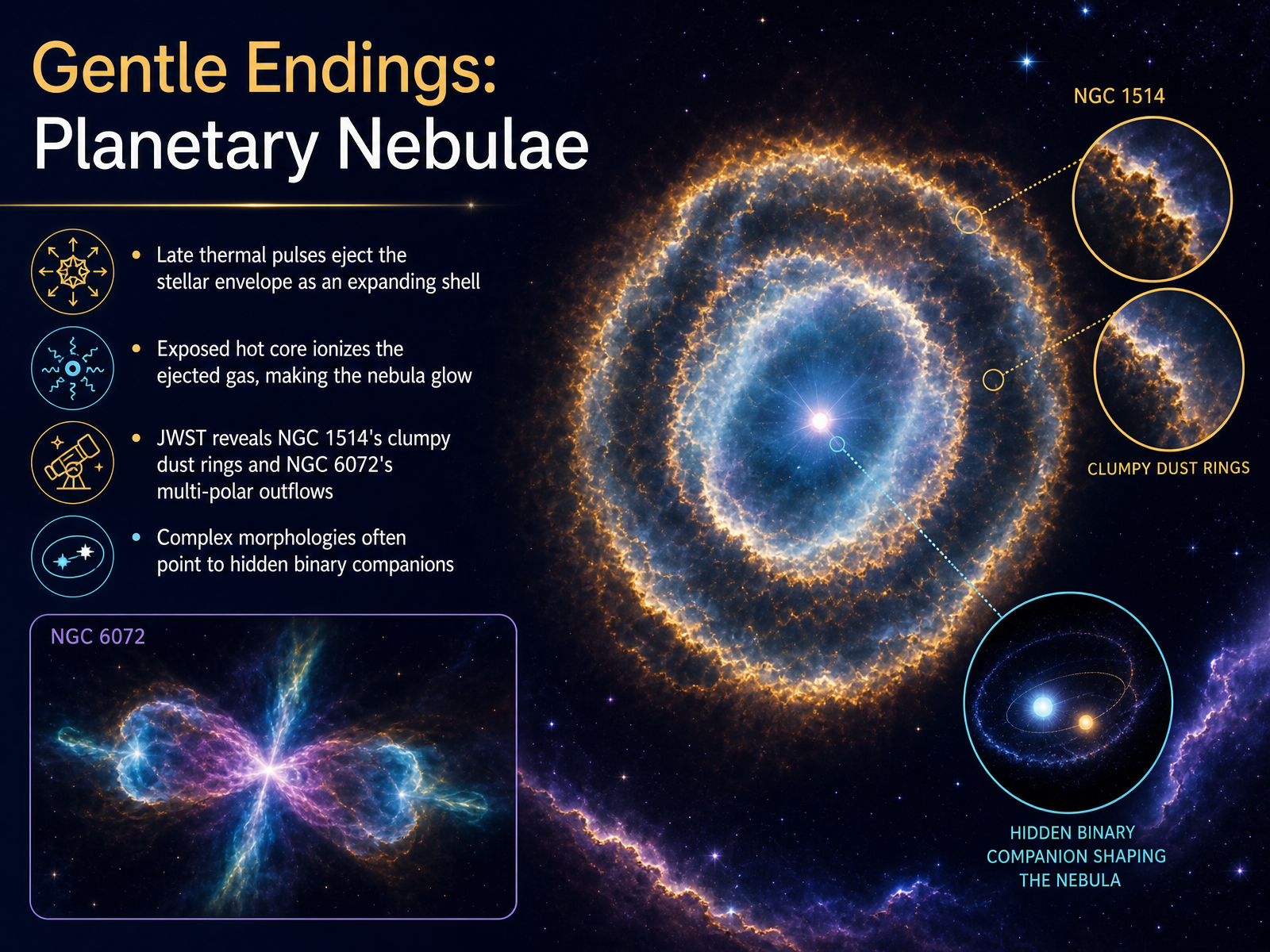
2 min - 09Gentle Endings: Planetary NebulaeBefore a star fades completely, it often creates one last breathtaking display. These are planetary nebulae—glowing shells of gas that mark a gentle, rather than explosive, stellar ending. Late in a star’s life, thermal pulses cause the outer layers to lift away and expand into space. What remains is a hot, exposed core. This core emits intense ultraviolet radiation that ionizes the ejected gas, making the entire nebula glow like a cosmic light bulb. Recent images from the James Webb Space Telescope have revealed stunning new details in these structures. In the nebula NGC 1514, Webb’s infrared vision shows intricate clumps of dust arranged in tangled rings, with holes punched through the center by faster material. Another nebula, NGC 6072, displays a chaotic, multi-polar shape. Its outflows expand in several different directions at once. Such complex morphologies often hint at a hidden companion star, whose gravity shapes the outflow into these asymmetric patterns. In this way, a star’s final breath returns enriched gas and dust back into the galaxy. Next, let’s look at what remains at the very center of these beautiful nebulae: White Dwarfs: The Fading Embers.
 science.nasa.govscience.nasa.govscience.nasa.gov+22 min
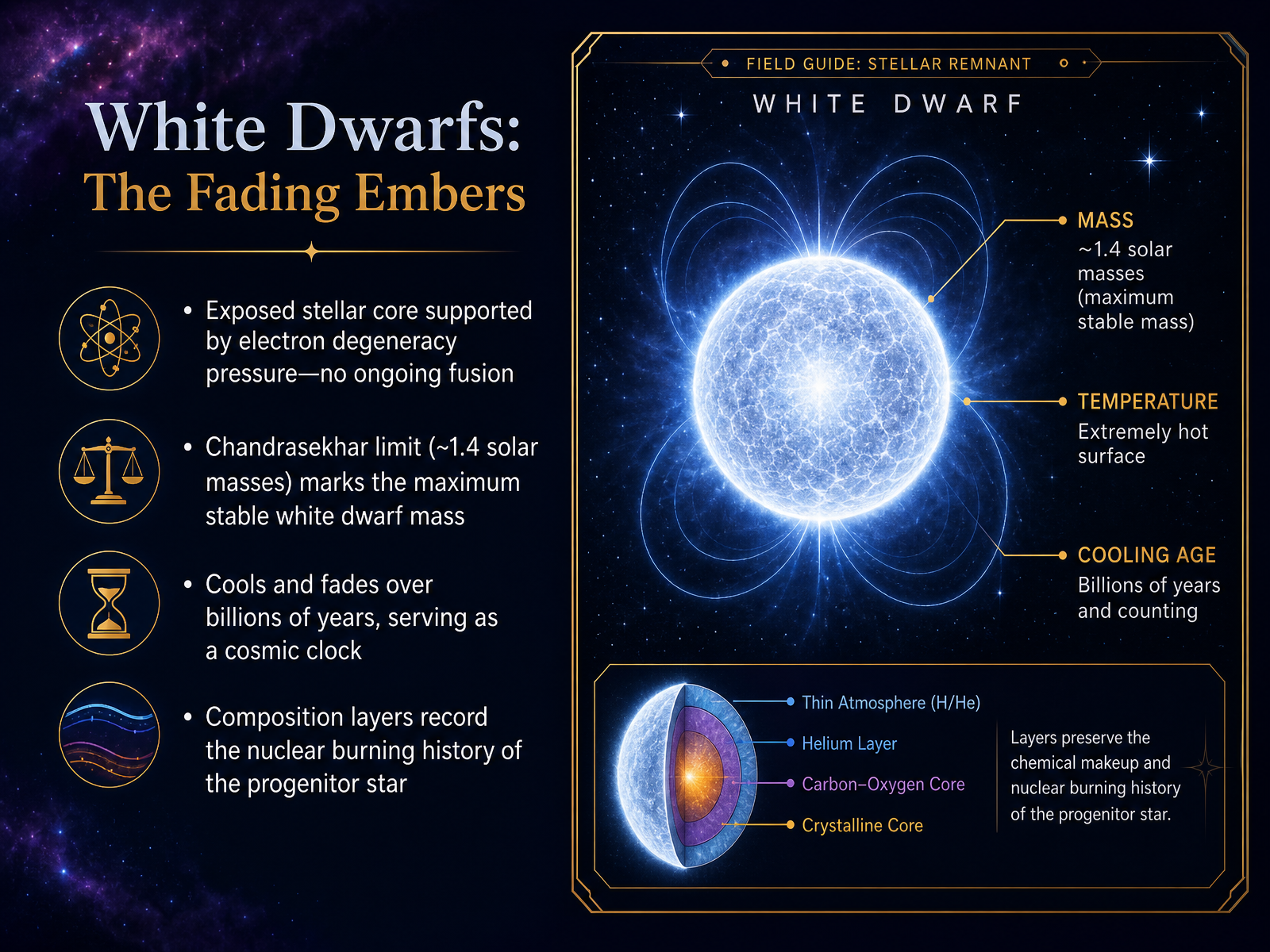
 - 10White Dwarfs: The Fading EmbersAfter the planetary nebula disperses, what remains at the center is a white dwarf. Think of it as the exposed, incredibly dense core of the old star, now roughly the size of Earth. No more fusion happens here. The white dwarf shines only from residual heat. What holds it up against complete collapse is a quantum effect—electron degeneracy pressure, where particles resist being squeezed any further. This stability has a hard limit called the Chandrasekhar limit, about one point four solar masses. If a white dwarf somehow gains mass and exceeds this, it faces a dramatic end. Because they cool at a predictable rate for billions of years, astronomers use these fading embers as cosmic clocks to measure the age of stellar neighborhoods. The layers within a white dwarf even preserve the nuclear burning history of its parent star. Next, we will explore what happens when a star’s core is too massive to become a white dwarf, leading us to catastrophic finales: core-collapse supernovae.
 2 min
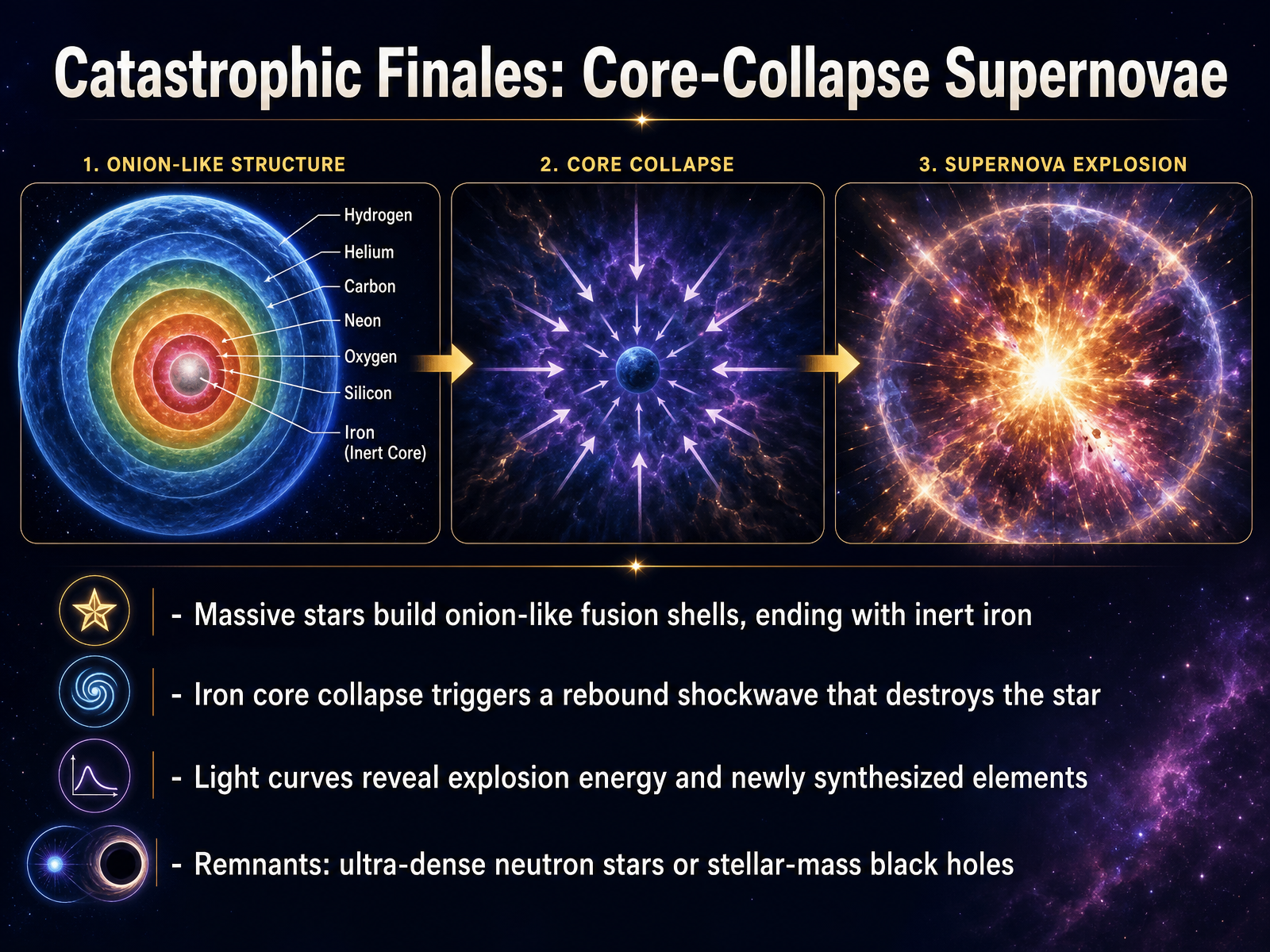
2 min - 11Catastrophic Finales: Core-Collapse SupernovaeNow we arrive at one of the most violent events in the universe: the core-collapse supernova. Think of a massive star as having an onion-like structure inside. Around its core, it burns lighter elements into heavier ones, creating distinct shells of fusion. But this process stops at iron. Fusing iron does not release energy, so the iron core simply grows until it becomes unstable. When it reaches a critical mass, the core collapses in a fraction of a second. This collapse triggers a powerful rebound shockwave that rips through the star, completely destroying it. The light curve we observe tells us about the energy of the explosion and reveals newly synthesized elements like gold and silver being scattered into space. What remains behind is an ultra-dense neutron star or, if the original star was massive enough, a stellar-mass black hole. Next, we will explore how these explosions seed the galaxy in Supernova Remnants: Shocks and Enrichment in Action.
 2 min
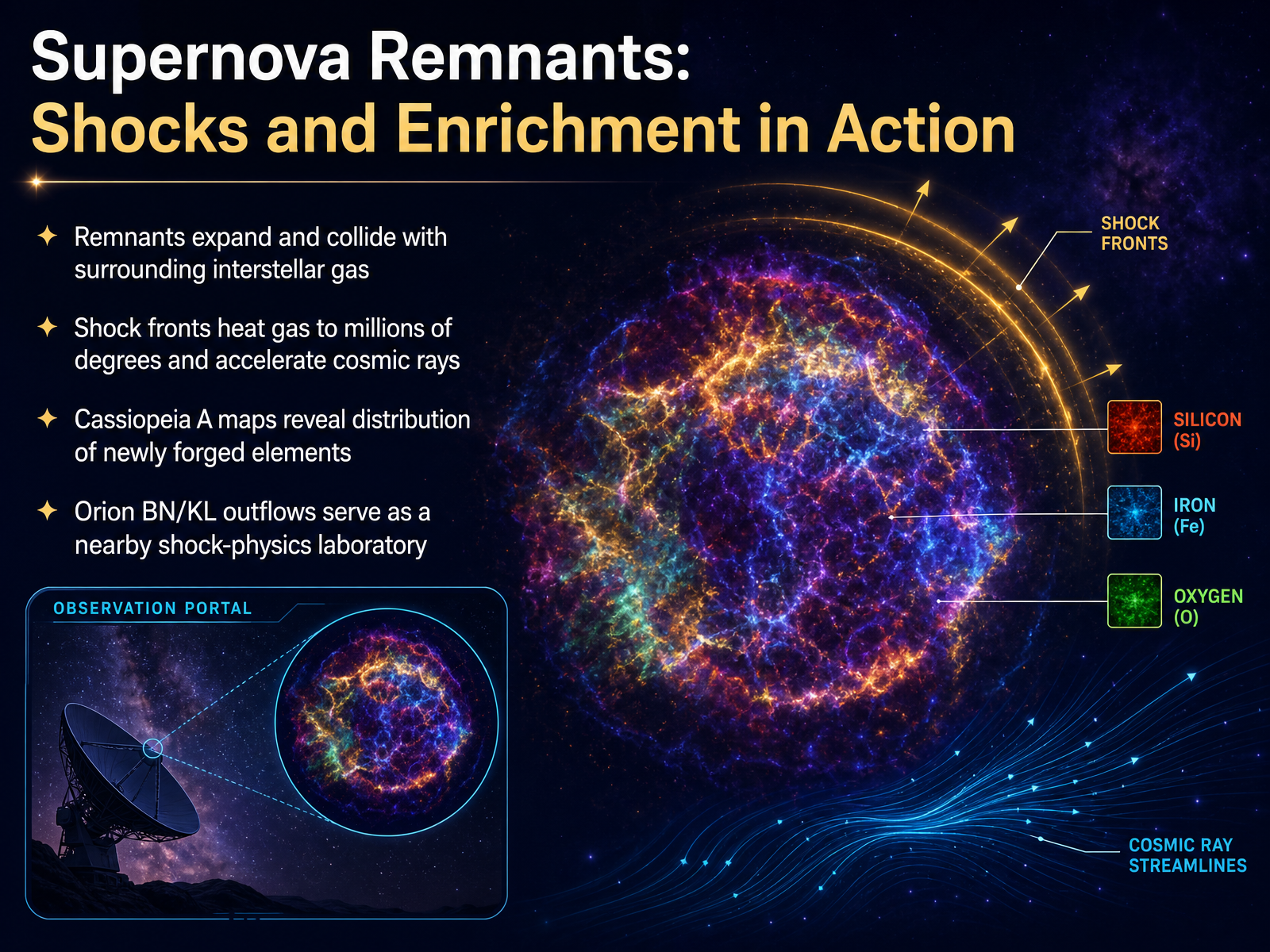
2 min - 12Supernova Remnants: Shocks and Enrichment in ActionWhen a star explodes, the story doesn't end. It transforms. The debris races outward as a supernova remnant, a vast, expanding shell that slams into the surrounding interstellar gas. This collision creates a shock front, like a sonic boom of cosmic proportions. These shocks heat the gas to millions of degrees, making it glow in X-rays, and act as natural particle accelerators, launching cosmic rays across the galaxy. Take Cassiopeia A, for example. Detailed maps of this remnant let us trace the distribution of freshly made elements like silicon, sulfur, and iron, revealing how the explosion scattered them. We can even study shock physics up close by observing regions like the Orion BN/KL outflow, a nearby stellar drama that serves as a perfect laboratory for understanding these powerful waves. Next, we will build on this idea of enrichment to explore exactly how stars forge the elements in the first place.
 2 min
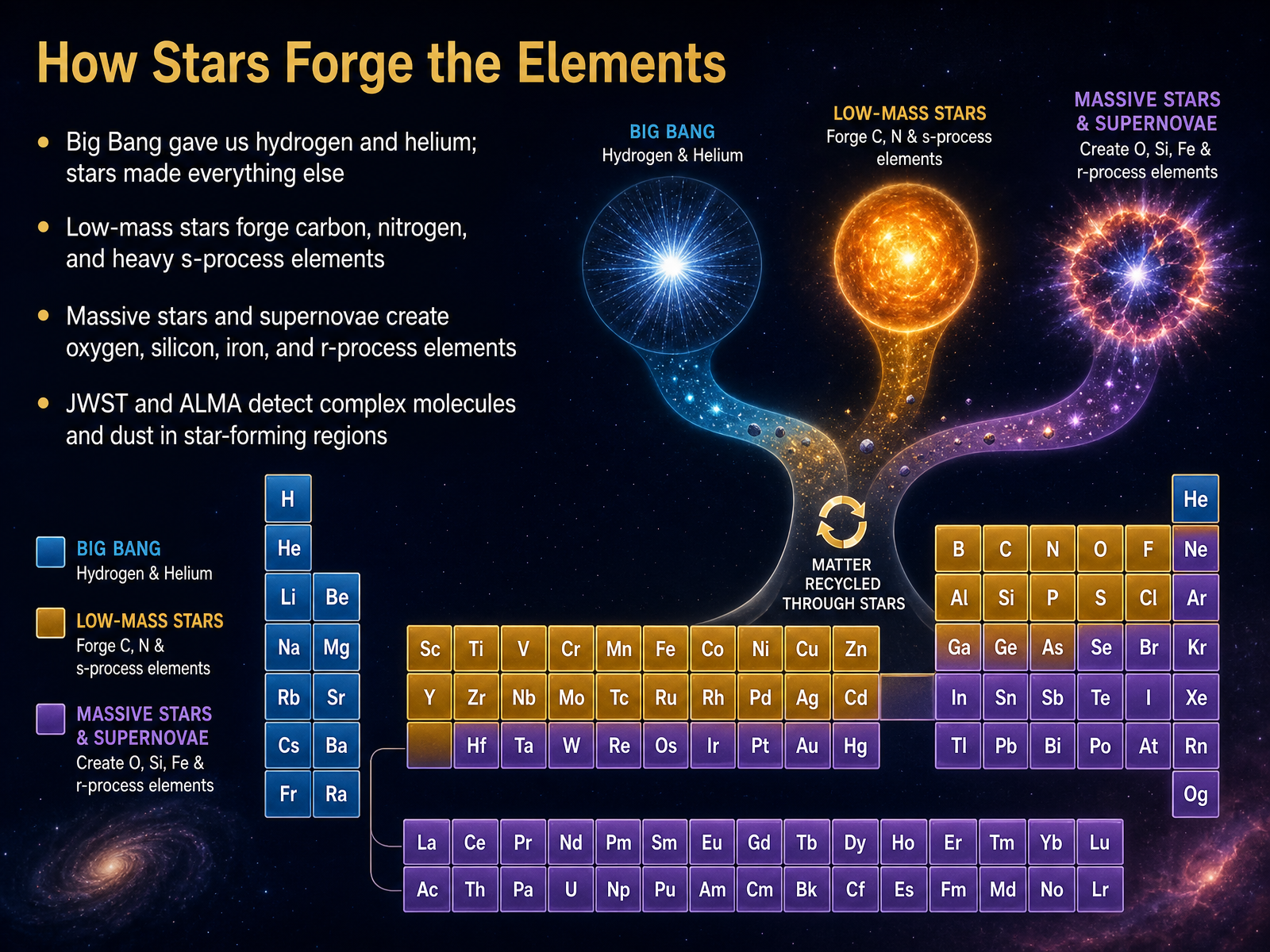
2 min - 13How Stars Forge the ElementsNow let's turn to one of astronomy's most profound ideas: the origin of the elements themselves. The Big Bang gave the universe hydrogen and helium, but almost everything else was forged inside stars. Low-mass stars spend their long lives building elements like carbon and nitrogen, and slowly release them through gentle stellar winds. Massive stars work faster and hotter, cooking up oxygen, silicon, and iron in their cores, then scattering them across space in a supernova explosion. Modern observatories like the James Webb Space Telescope and ALMA let us see this cosmic recycling in action, detecting complex molecules and dust in distant stellar nurseries. In the next slide, we will see how this enriched material returns to space and seeds the next generation of stars and planets.
 1 min
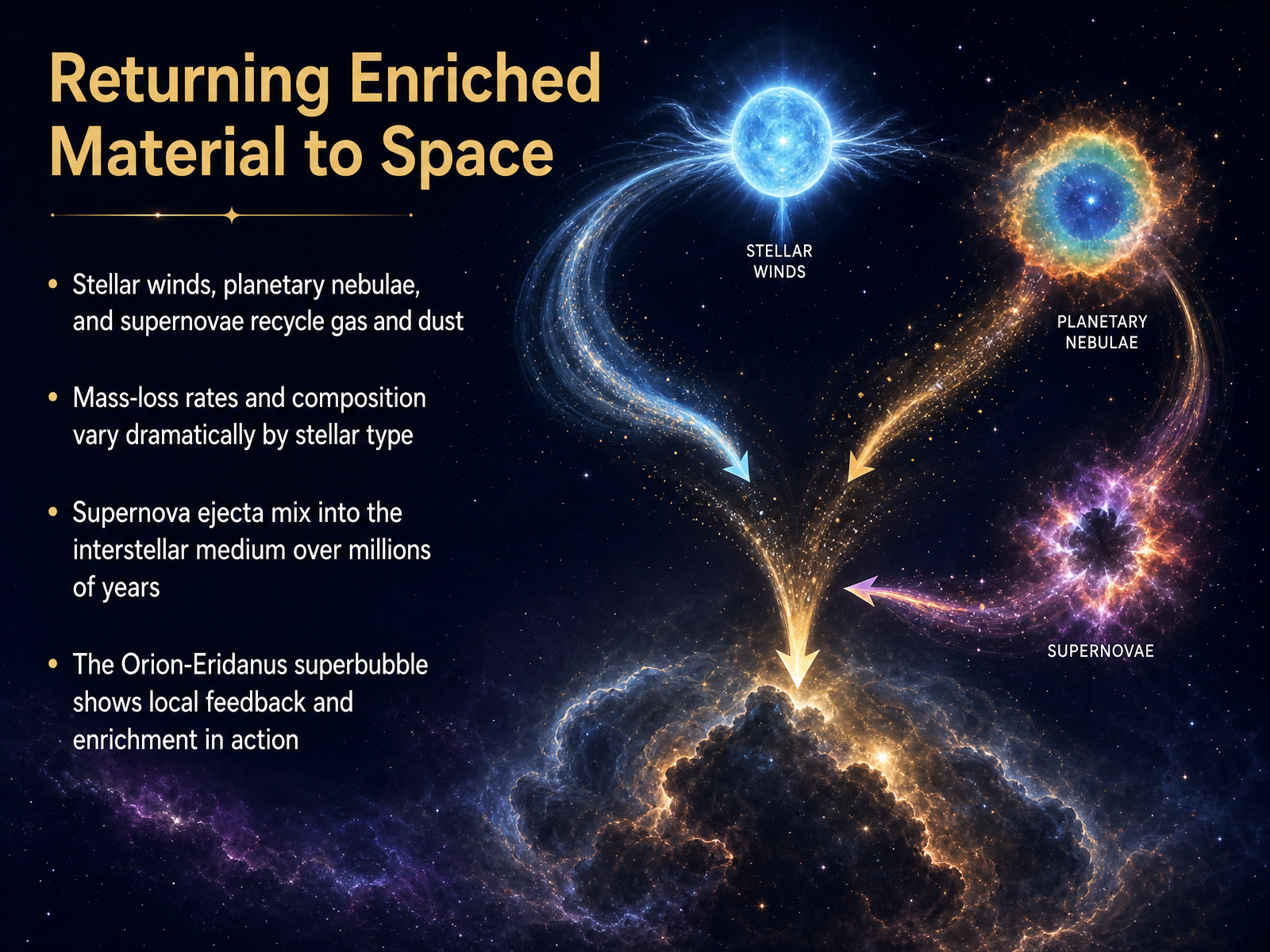
1 min - 14Returning Enriched Material to SpaceNow let's look at how stars return enriched material to space. A star does not keep its heavy elements locked away forever. Through stellar winds, planetary nebulae, and powerful supernova explosions, stars recycle gas and dust back into their surroundings. The amount of mass lost and the chemical composition released vary dramatically depending on the type of star. A massive star sheds material in violent bursts, while a low-mass star puffs off its outer layers more gently. Over millions of years, the debris from supernovae mixes into the vast interstellar medium. A beautiful example of this feedback in action is the Orion-Eridanus superbubble, a huge shell carved by stellar winds and supernovae that enriches nearby clouds. This process directly sets the stage for our final topic: the grand cycle, from stardust to stardust.
 1 min
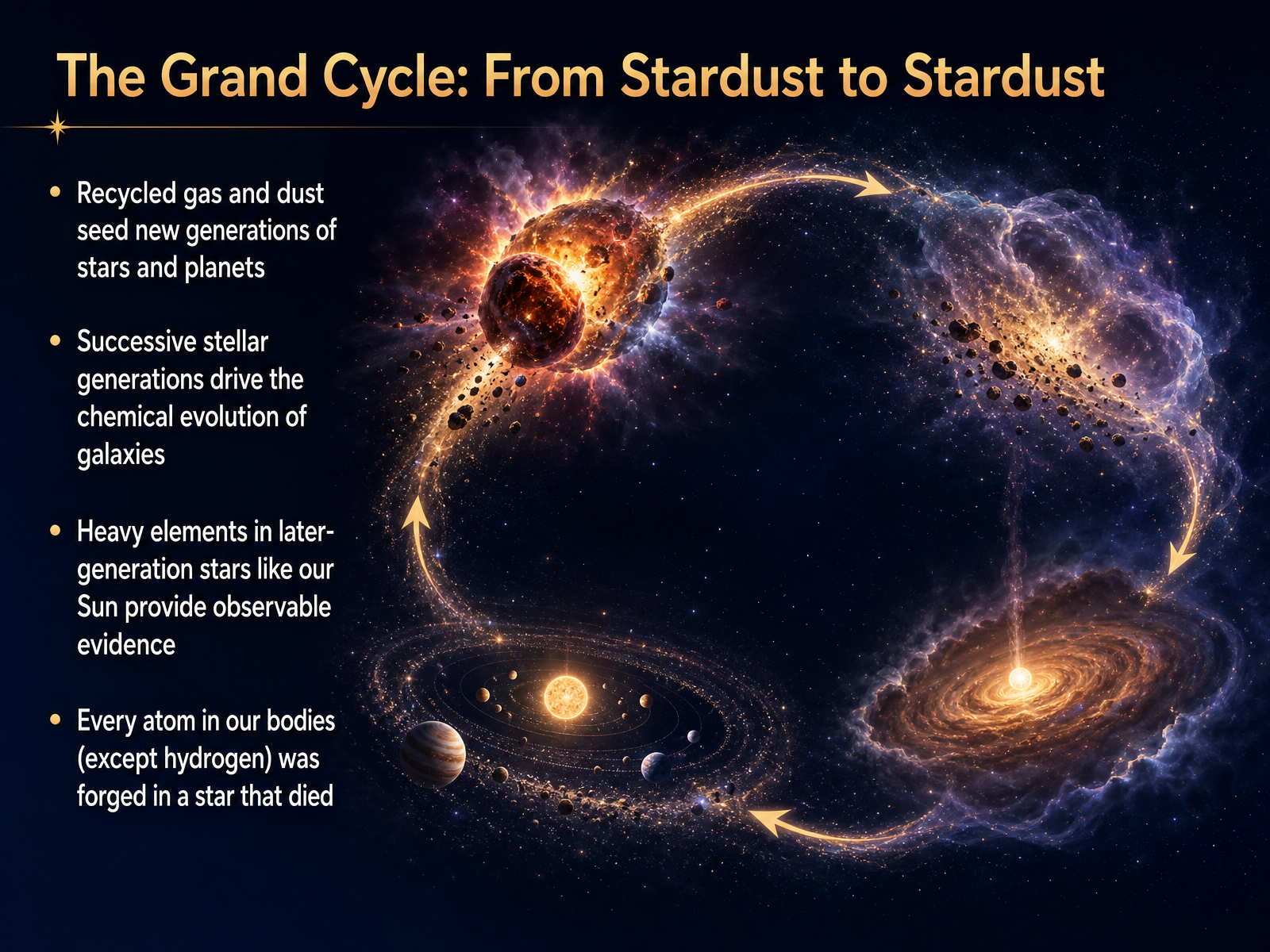
1 min - 15The Grand Cycle: From Stardust to StardustSo, where does all this material go after a star dies? It doesn't vanish. The expelled gas and dust spread out across space, mixing with the interstellar medium. Over immense time, gravity pulls this enriched material back together, seeding brand new generations of stars and their planets. This grand cycle drives what we call the chemical evolution of galaxies. Each successive wave of stars is born with a richer mix of heavy elements than the ones before. Our own Sun is a perfect example. It's a later-generation star, formed from recycled material that already contained carbon, oxygen, and iron. Here's a thought that connects this directly to you and me. Nearly every atom in your body, except for the hydrogen, was forged in the core of a star that died long ago. We are, in a very real sense, made of stardust. This continuous cycle of stardust to stardust is the engine of cosmic renewal. Now let's bring all of these concepts together in our final summary.
 2 min
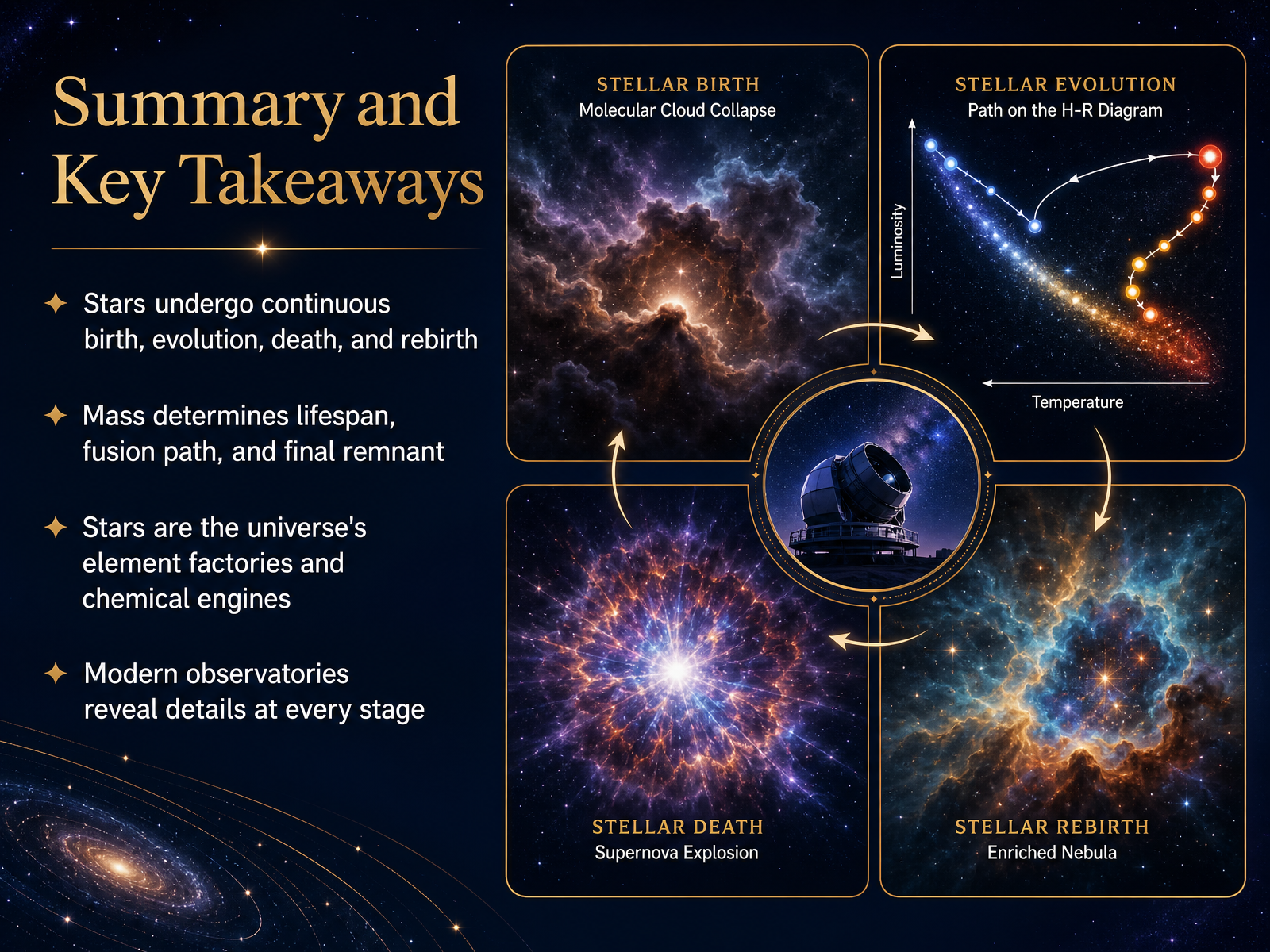
2 min - 16Summary and Key TakeawaysWe have reached the end of our journey through the stellar life cycle, so let's take a moment to bring together the key insights. First, remember that the universe is a dynamic cycle of continuous birth, evolution, death, and rebirth. The material expelled by dying stars becomes the raw material for new generations of stars and planets. Second, a star’s entire destiny is written by its mass. Mass determines how long it lives, how it fuses elements, and whether it ends as a white dwarf, a neutron star, or a black hole. Third, stars are the universe's element factories. Their cores forge the carbon in our bodies and the oxygen we breathe, scattering these elements across space when they die. Finally, thanks to modern observatories, we can now witness every stage of this grand cycle in extraordinary detail, from collapsing clouds of gas to the glowing remnants of supernovae. You have built a strong foundation for understanding how the cosmos works on its grandest scale. Thank you for joining me, and keep looking up.
 2 min
2 min
Take the deck with you
Download this course as a file — free, no sign-up needed.
- PDF handoutEvery slide page, ready to print or share.17 pages · 5.6 MBDownload
- Narrated PowerPointThe deck that presents itself — every slide carries the digital human's narration video.17 pages · 17.0 MBDownload
- PowerPoint slidesThe full deck as a .pptx — open it in PowerPoint, Keynote, or Google Slides.17 pages · 5.6 MBDownload
Free to use in your own training — please keep the PersonWise credit page at the end.
Have your own deck? Turn it into a course
Sources consulted
Web sources consulted while building this course.
- Mapping Interstellar Ice Inventory toward Class 0 Protostars in Star-forming Region Orion A with JWST Data - IOPscience — google.iopscience.iop.org
- Observations of DNC and DCO+ toward the ∫-shaped Filament and Starless Cores in the Orion Molecular Clouds - IOPscience — iopscience.iop.org
- Q/W-band Observations toward Starless Cores in Orion (QWOSCO). I. Overview, Isotopologues, Isomers, and Complex Organics - IOPscience — iopscience.iop.org
- Velocity-resolved [O I] 63 145 µm, [C II] 158 µm, and OH mapping along the Orion BN/KL explosive outflow and irradiated shocks | Astronomy & Astrophysics (A&A) — aanda.org
- The Neutral Atomic Hydrogen in the solar neighborhood (NeAtHood) project - I. Ghost in the shell: Neutral atomic hydrogen in the extended Orion nebula | Astronomy & Astrophysics (A&A) — aanda.org
- With NASA's Webb, Dying Star's Energetic Display Comes Into Full Focus - NASA Science — science.nasa.gov
- Planetary Nebula NGC 1514 (WISE and Webb Images Side by Side) - NASA Science — science.nasa.gov
- NASA's Webb Traces Details of Complex Planetary Nebula - NASA Science — science.nasa.gov
- JWST/MIRI Study of the Enigmatic Mid-Infrared Rings in the Planetary Nebula NGC 1514 — arxiv.org
- JWST/NIRCam Imaging of the Bipolar Planetary Nebula NGC 6537: The (Infra)red Spider, Revealed - IOPscience — iopscience.iop.org