Begin
14 pages · ~28 min
How Mathematical Proof Works
This training introduces the fundamentals of mathematical proof, helping learners understand how proofs are constructed and why they establish mathematical truth.
A digital instructor presents all 14 pages. Hold “Ask” at any point and ask out loud — the answer comes from this course. No sign-up needed.
What you’ll learn
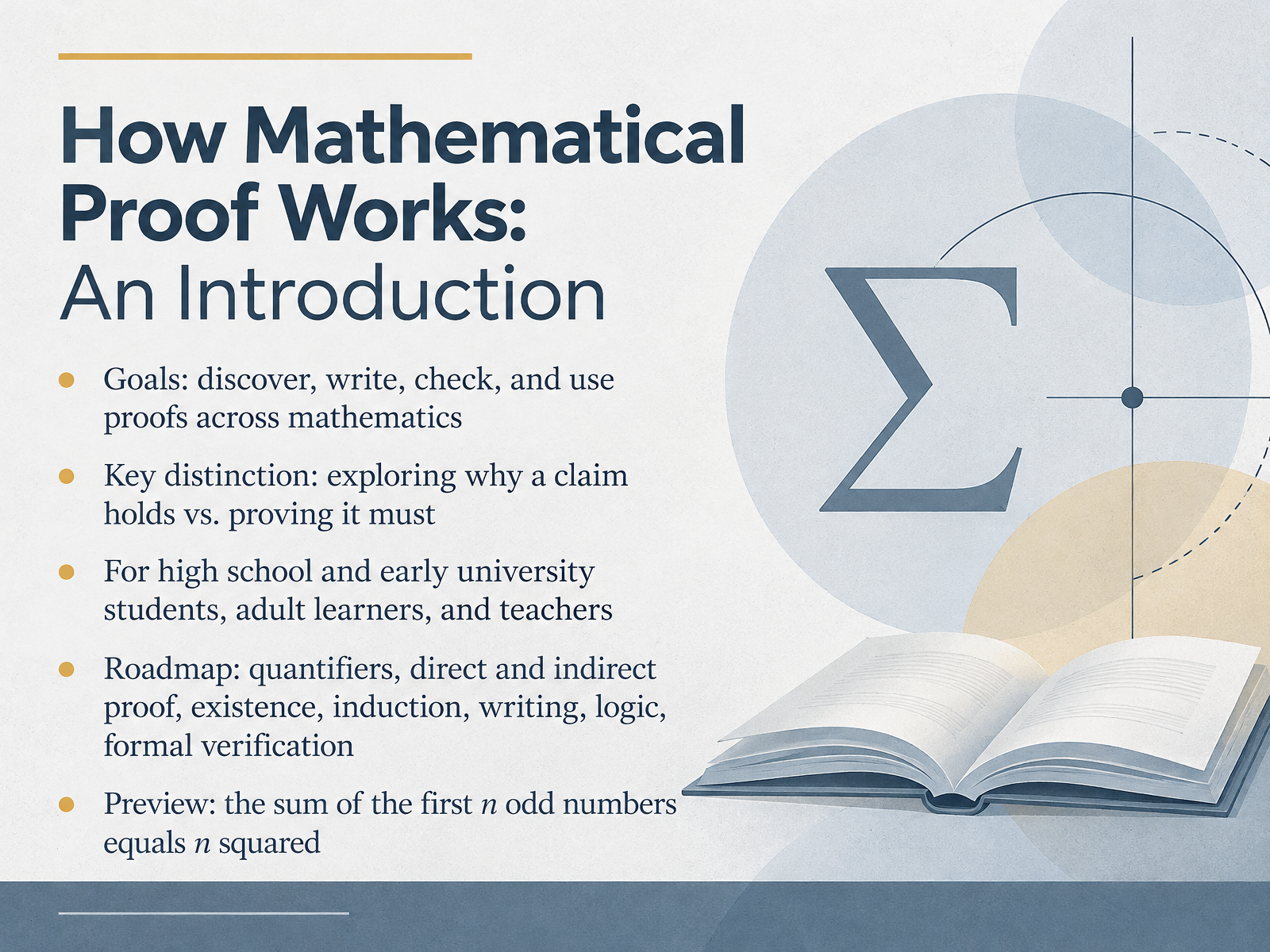
- 01How Mathematical Proof Works: An IntroductionWelcome. This course is about how mathematical proof works. Our goals are simple to state. You will learn to discover proofs, write them, check them, and use them across mathematics. One key distinction runs through everything here: exploring why a claim seems to hold is not the same as proving it must hold. This course is designed for high school and early university students, adult learners returning to fundamentals, and teachers. Along the way, we will cover quantifiers, direct and indirect proof, existence, induction, writing proofs, logic, and formal verification. Here is a preview. The sum of the first n odd numbers equals n squared. For example, one plus three plus five equals nine, which is three squared. Later, we will prove that pattern always holds. Next, we look at why proof matters, including evidence, reasoning, and curriculum expectations.thecorestandards.orgcambridgeinternational.orgoecd.org+21 min
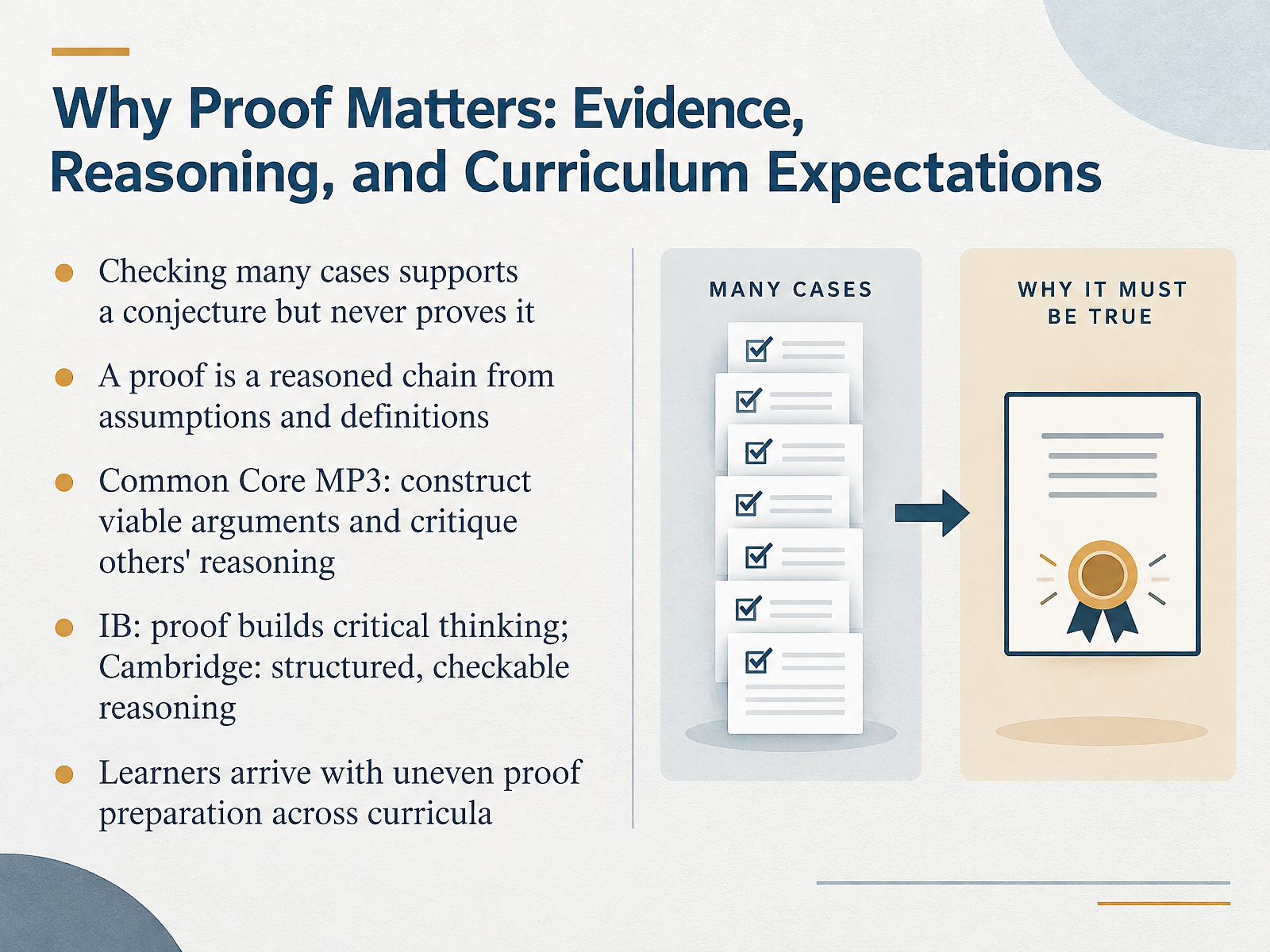
- 02Why Proof Matters: Evidence, Reasoning, and Curriculum ExpectationsSo let's ask why proof actually matters. Suppose you check a statement for many examples, say n squared plus n plus forty one being prime for dozens of values of n. That supports a conjecture. But checking cases, however many, never proves it. A proof is different. It is a reasoned chain that starts from stated assumptions and definitions, and moves step by step to a conclusion. In the Common Core, practice standard three asks students to construct viable arguments and critique the reasoning of others. The International Baccalaureate describes proof as essential for critical thinking. Cambridge emphasizes structured reasoning that others can follow and check. And learners arrive with uneven preparation, so we take nothing for granted. Next, we look at statements, quantifiers, and truth conditions.
 thecorestandards.orgcambridgeinternational.orgoecd.org+22 min
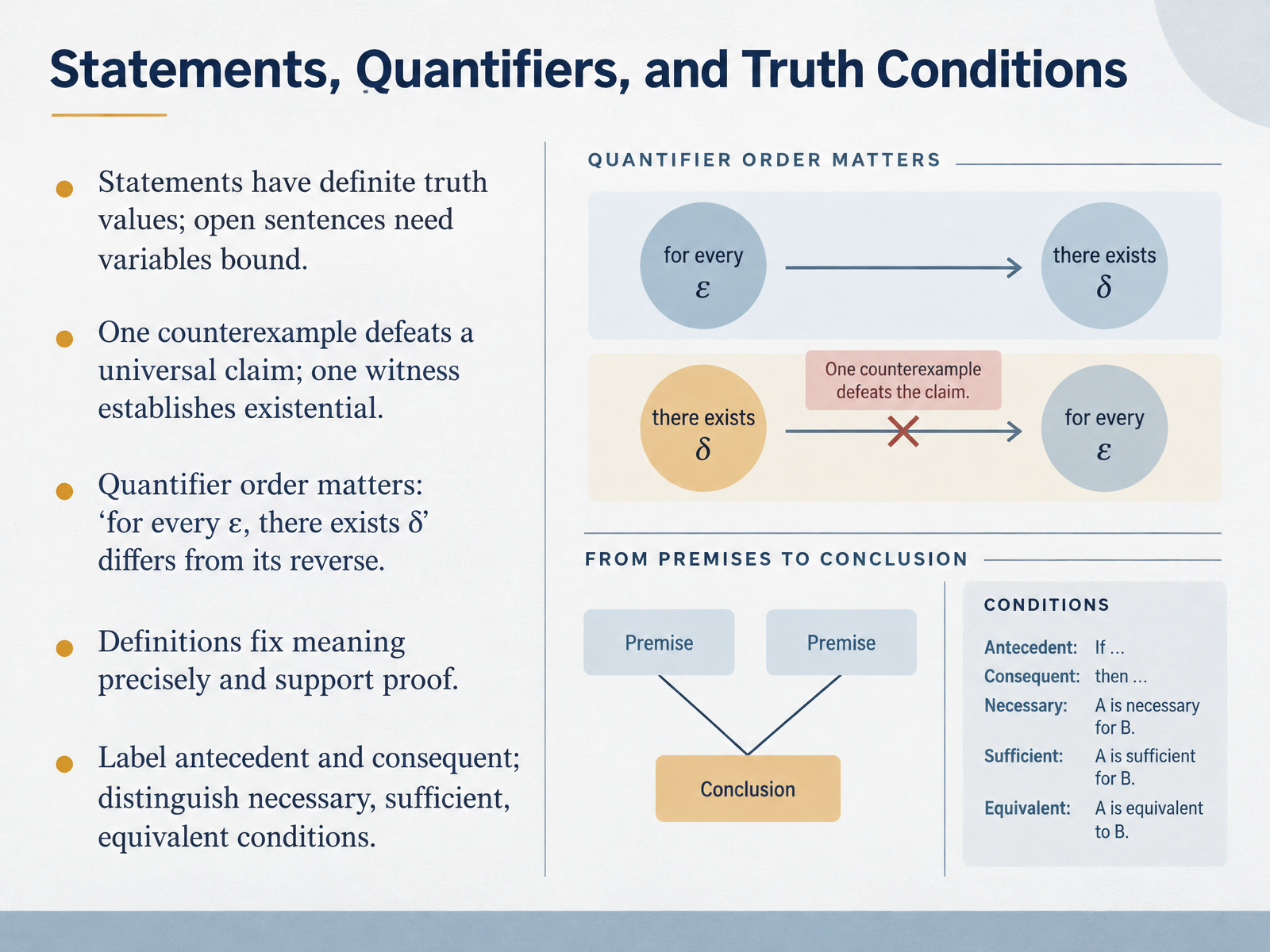
- 03Statements, Quantifiers, and Truth ConditionsLet's look at the building blocks of any proof: statements, quantifiers, and truth conditions. A statement is a sentence with a definite truth value. It is either true or false. An open sentence, like x plus three equals seven, has no truth value until the variable is bound. Now, quantifiers. One counterexample defeats a universal claim. To show that all primes are odd, you only need the single example of two. In contrast, one witness establishes an existential claim. Order matters, too. For every epsilon, there exists delta is not the same as there exists delta, for every epsilon. Next, definitions fix meaning precisely, and they give a proof something solid to stand on. Finally, label the parts of a conditional: the antecedent and the consequent. Then distinguish necessary, sufficient, and equivalent conditions. Keep these tools in mind as we move into direct proof and proof by cases.
 thecorestandards.orgcambridgeinternational.orgoecd.org+22 min
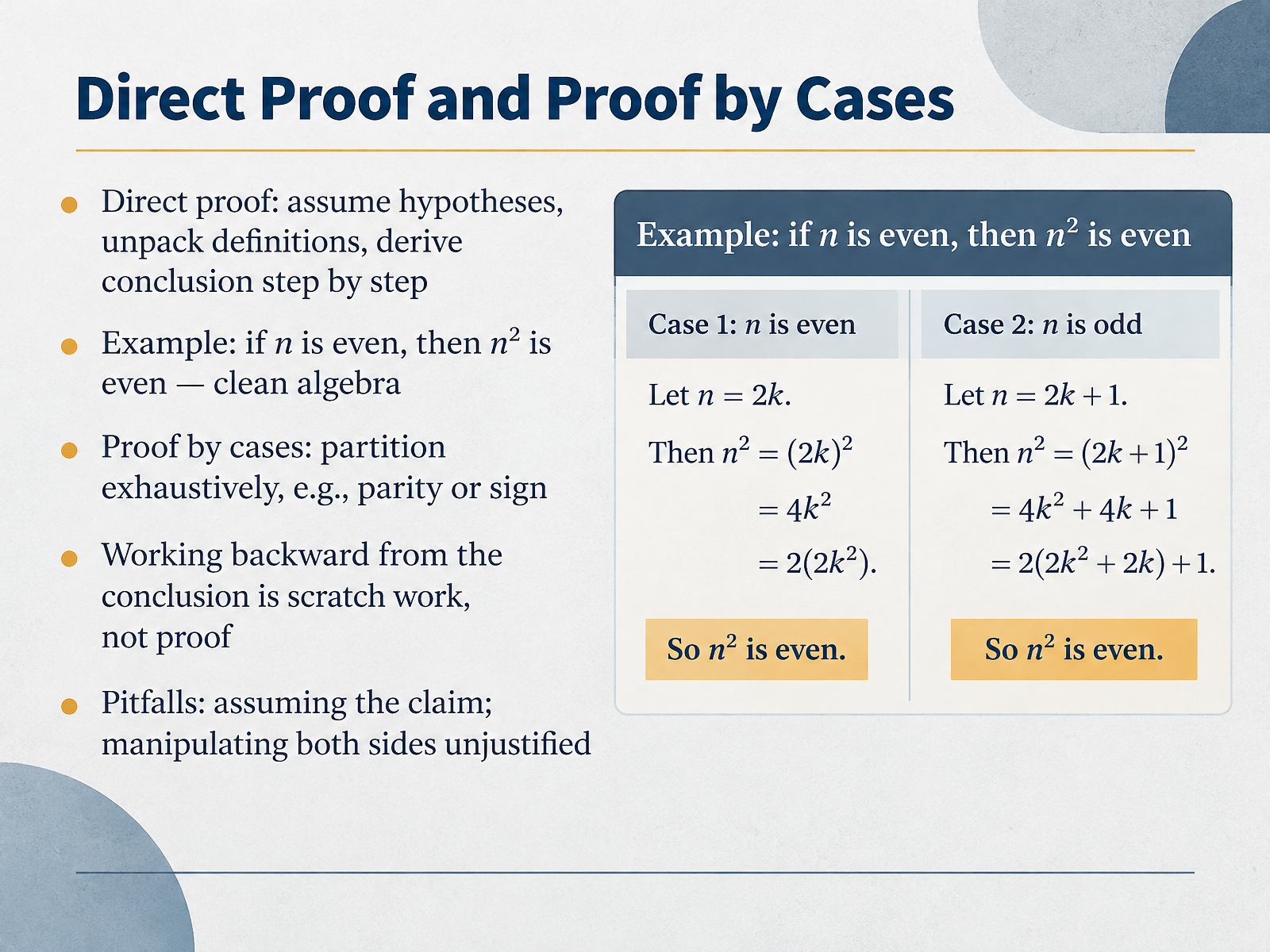
- 04Direct Proof and Proof by CasesNext, let's look at two core proof techniques: direct proof and proof by cases. A direct proof works like this. Assume the hypotheses are true. Unpack the definitions into clear, usable statements. Then derive the conclusion step by step. For example, suppose n is even. By definition, n equals two times k for some integer k. Then n squared equals four k squared, which equals two times two k squared. So n squared is even. That is clean algebra. Proof by cases splits the situation into parts that cover every possibility. For instance, separate by parity, even or odd, or by sign, positive, negative, or zero. Two cautions. Working backward from the conclusion is scratch work, not proof. And avoid pitfalls: do not assume the claim, and do not manipulate both sides without justification. Next, we turn to indirect reasoning: contrapositive and contradiction.
 1 min
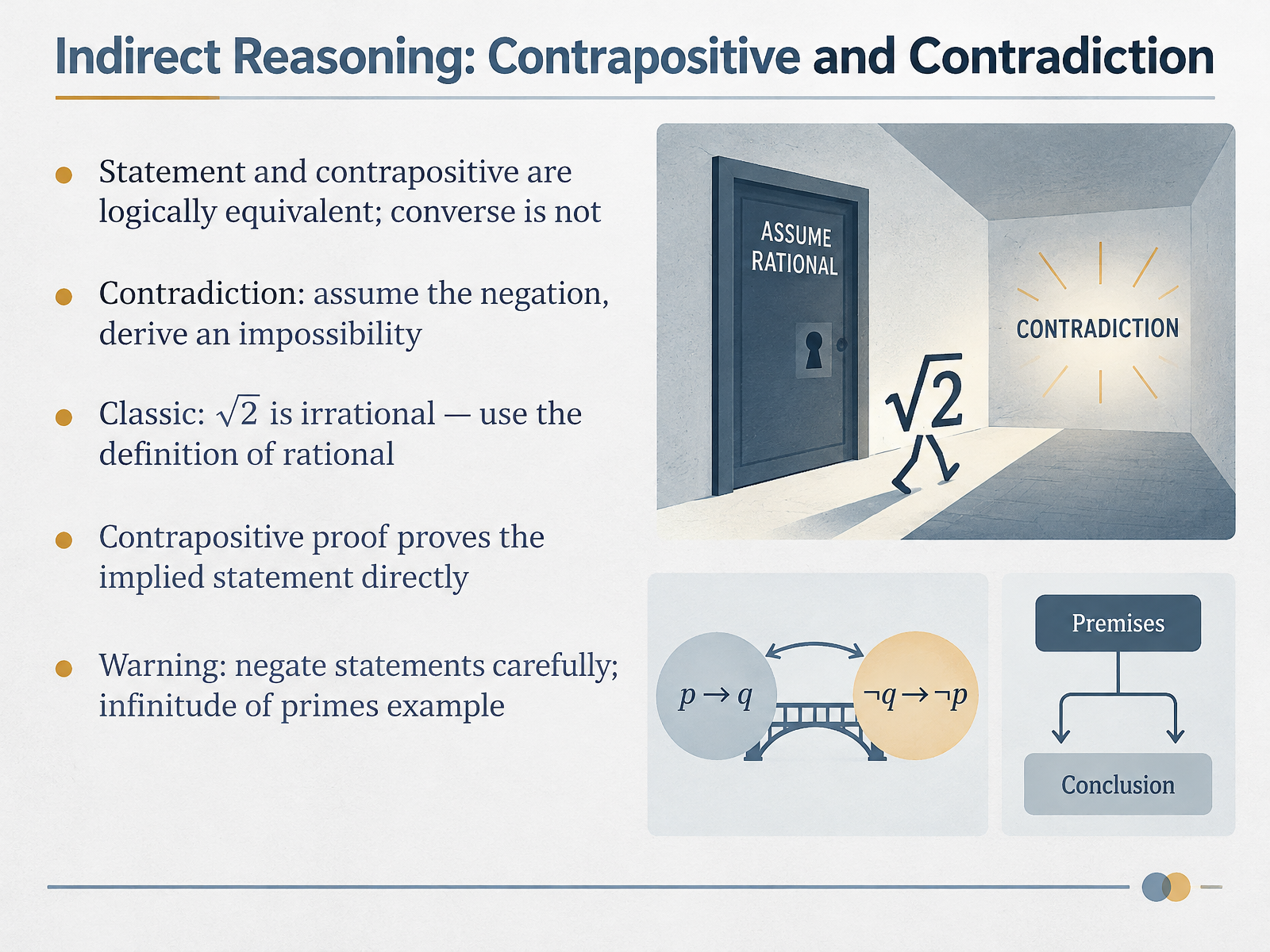
- 05Indirect Reasoning: Contrapositive and ContradictionNext, we turn to indirect reasoning. This covers two tools: proof by contrapositive, and proof by contradiction. First, remember that a conditional statement and its contrapositive are logically equivalent. If you prove the contrapositive, you have proven the original. But the converse is not equivalent to the original. For example, if a shape is a square, then it is a rectangle. The converse, if it is a rectangle then it is a square, is false. Second, proof by contradiction. You assume the negation of what you want to prove, then derive an impossibility. A classic example is proving that the square root of two is irrational. You begin with the definition of rational. Assume the square root of two equals a divided by b, with no common factors. Squaring gives two equals a squared divided by b squared, so a squared equals two times b squared. That makes a squared even, so a is even. Write a equals two times k. Substituting gives two times b squared equals four times k squared, so b squared equals two times k squared. Then b is also even. But a and b share the factor two, which contradicts having no common factors. One warning. Negate statements carefully. For instance, to prove there are infinitely many primes, the correct negation is that there are finitely many. That sets up the contradiction. So, contrapositive proofs work by proving the implied statement directly, and contradiction proofs reveal hidden impossibilities. Coming up next, Existence, Construction, and Counterexample.
 2 min
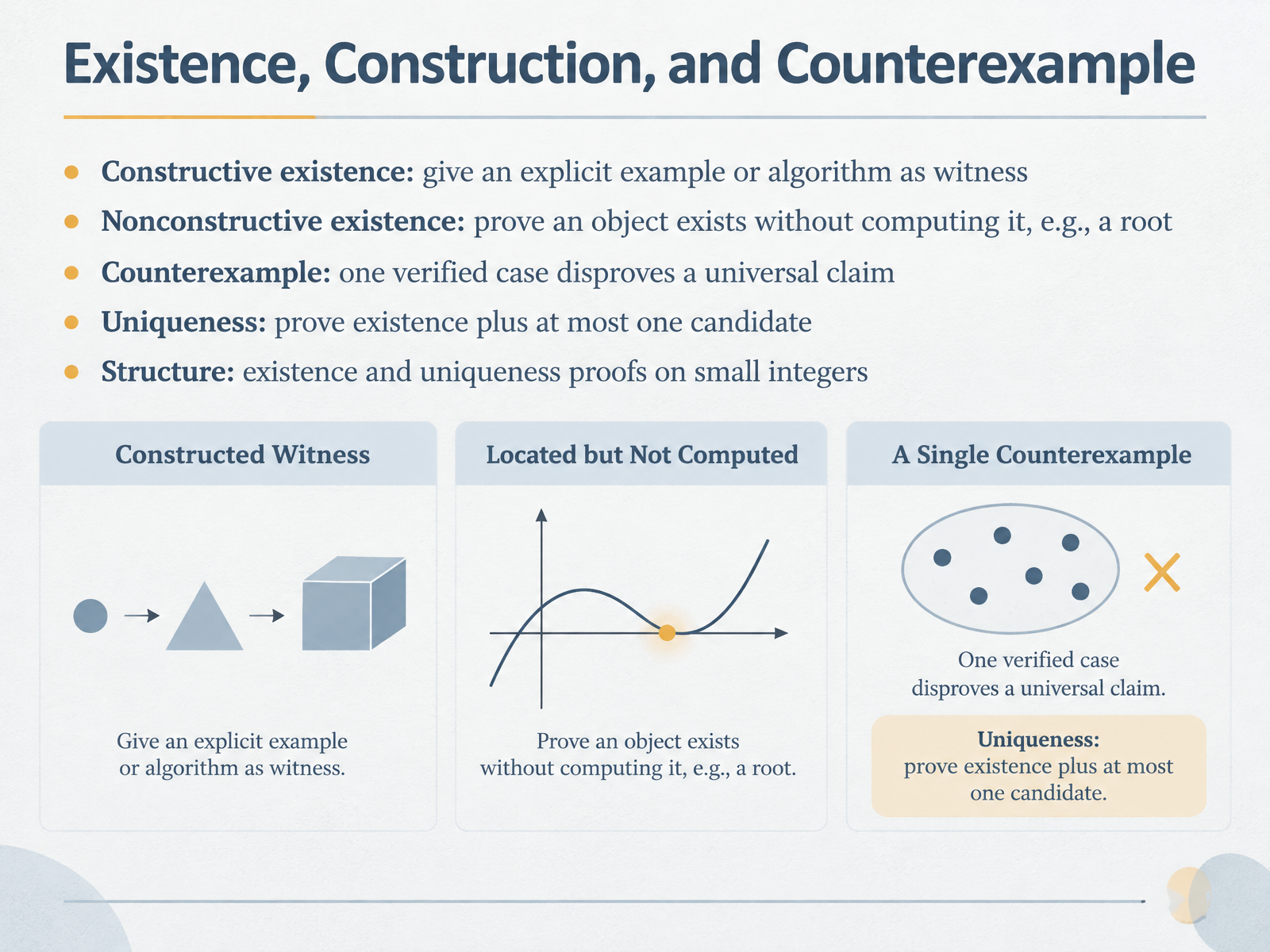
- 06Existence, Construction, and CounterexampleLet's turn to existence, construction, and counterexample. An existence claim says that at least one object of a certain kind exists. A constructive proof does more: it gives an explicit example, or an algorithm, as a witness. For instance, to show a quadratic has an integer solution, you can simply exhibit one. A nonconstructive proof shows an object must exist without computing it, for example by arguing that a root must lie between two values. Next, a counterexample is a single verified case that disproves a universal claim. To disprove the statement that every odd number is prime, note that nine is odd and equals three times three. A uniqueness proof has two parts: show existence, then show there is at most one candidate. For example, on small integers, prove that a linear equation has exactly one solution by producing it and showing any two solutions must be equal. Keep this structure in mind: existence first, then uniqueness.
 thecorestandards.orgcambridgeinternational.orgoecd.org+21 min
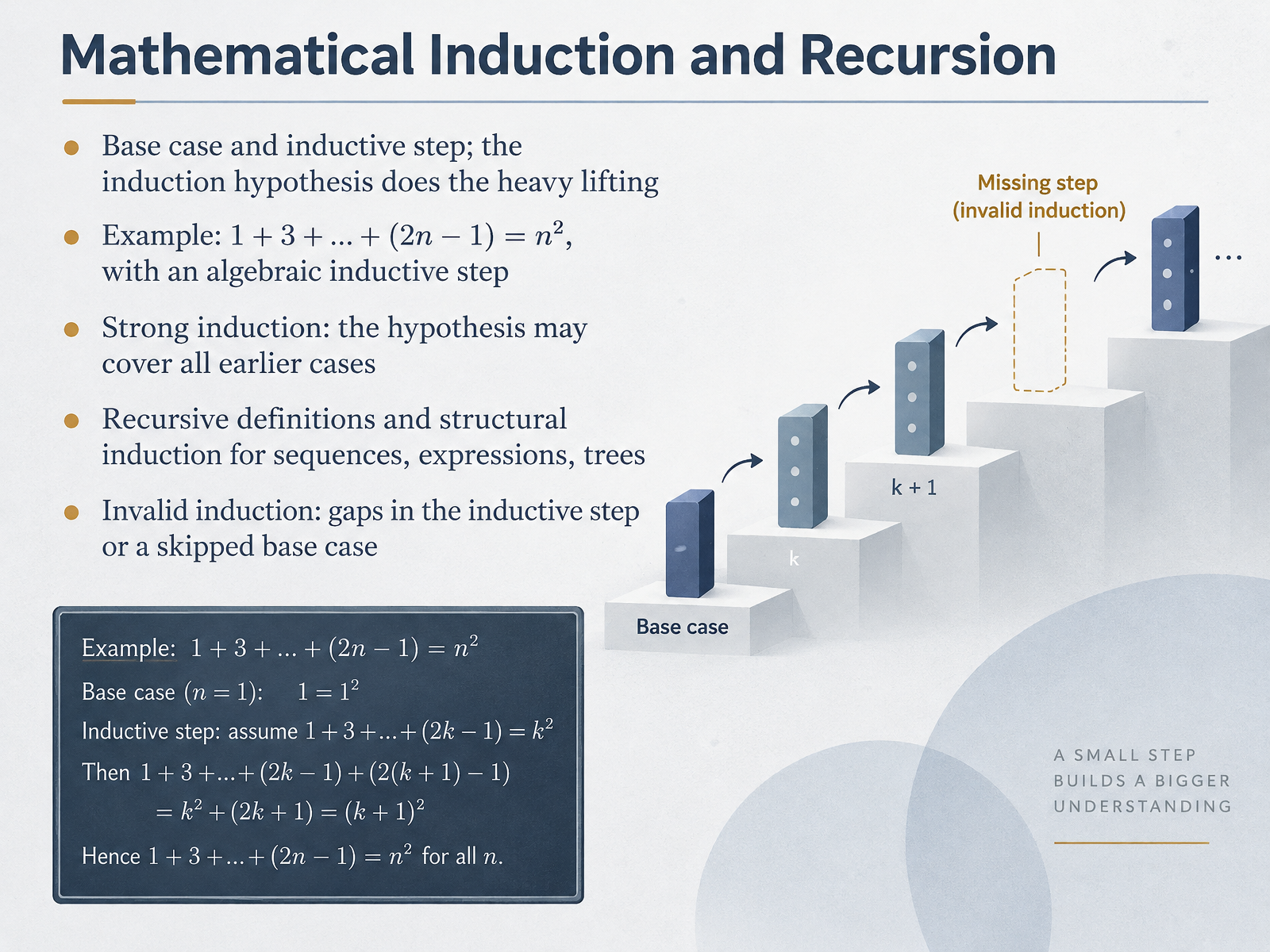
- 07Mathematical Induction and RecursionNext, we look at mathematical induction and recursion. Induction is a proof technique for showing that a statement holds for every natural number. It has two parts. First, the base case: you prove the statement for the smallest number. Second, the inductive step: you assume it holds for some number n, called the induction hypothesis, and use that assumption to prove it holds for n plus one. The induction hypothesis does the heavy lifting. Consider the sum one plus three plus five, up to two n minus one, equals n squared. The base case, n equals one, gives one equals one, which is true. For the inductive step, add two n plus one to both sides. The left side becomes the sum up to n plus one, and the right side becomes n squared plus two n plus one, which equals n plus one squared. That completes the proof. Strong induction lets the hypothesis cover all earlier cases, not just n. Recursive definitions build sequences, expressions, and trees in terms of smaller parts. Structural induction follows that structure. And beware invalid induction: a gap in the inductive step, or a skipped base case, breaks the proof. Next, we turn to choosing a proof strategy.
 2 min
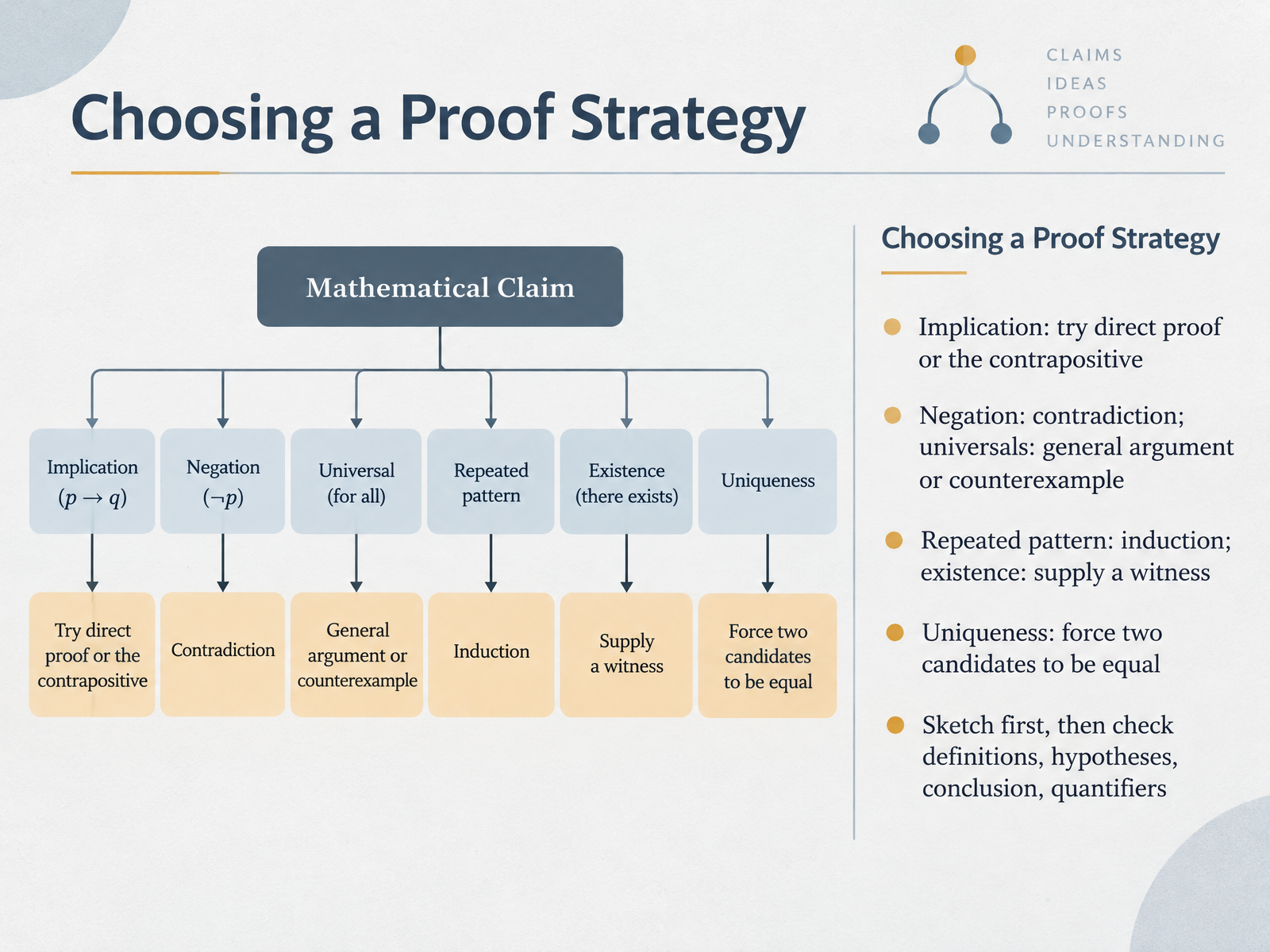
- 08Choosing a Proof StrategyNow let's talk about choosing a proof strategy. Your first question should always be: what kind of statement am I proving? For an implication, if then, try a direct proof, or prove the contrapositive. For example, to show that if n squared is even then n is even, the contrapositive is often easier. To prove a negation, use contradiction. To prove a universal statement, give a general argument or find a counterexample. If you see a repeated pattern, induction is usually the tool. To prove existence, supply a witness, a specific object that works. For uniqueness, assume two candidates and force them to be equal. Always sketch your plan first, then check definitions, hypotheses, conclusion, and quantifiers. Next, we'll see how to read and write proofs like a mathematician.
 1 min
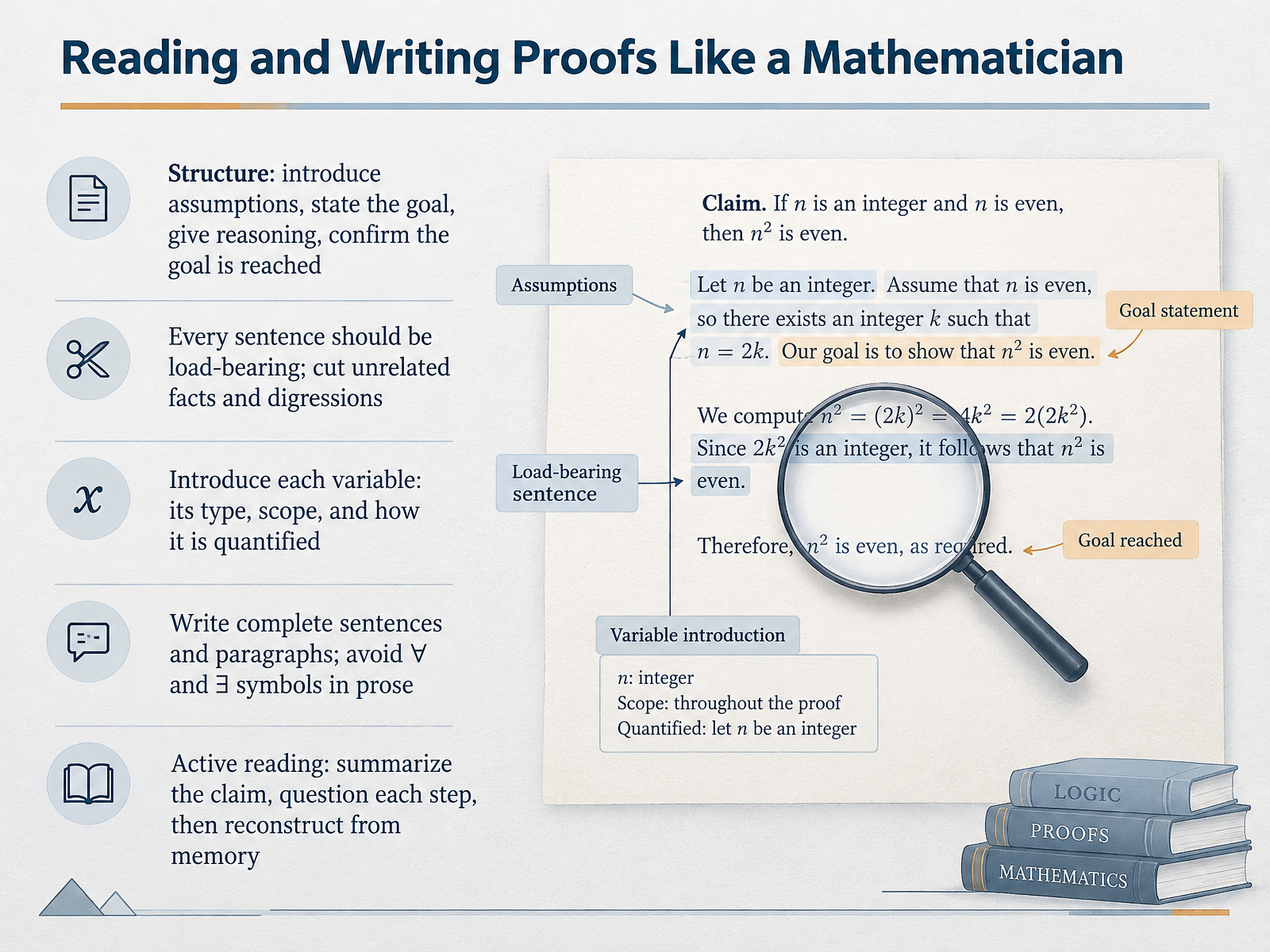
- 09Reading and Writing Proofs Like a MathematicianNow let's look at how to read and write proofs the way a mathematician does. A proof has a simple frame. First, introduce your assumptions. Second, state the goal clearly. Third, give the reasoning that connects them. And finally, confirm that the goal has been reached. Every sentence should be load-bearing. If a fact is not used in the argument, cut it. When you introduce a variable, say what type it is, where it is in scope, and how it is quantified. Write in complete sentences and paragraphs, and avoid symbols like for all and there exists inside prose. For active reading, do three things. Summarize the claim in your own words. Question each step and ask why it follows. Then close the text and reconstruct the proof from memory. That is how reading becomes real understanding. Next, we turn to proof styles that communicate clearly.
 2 min
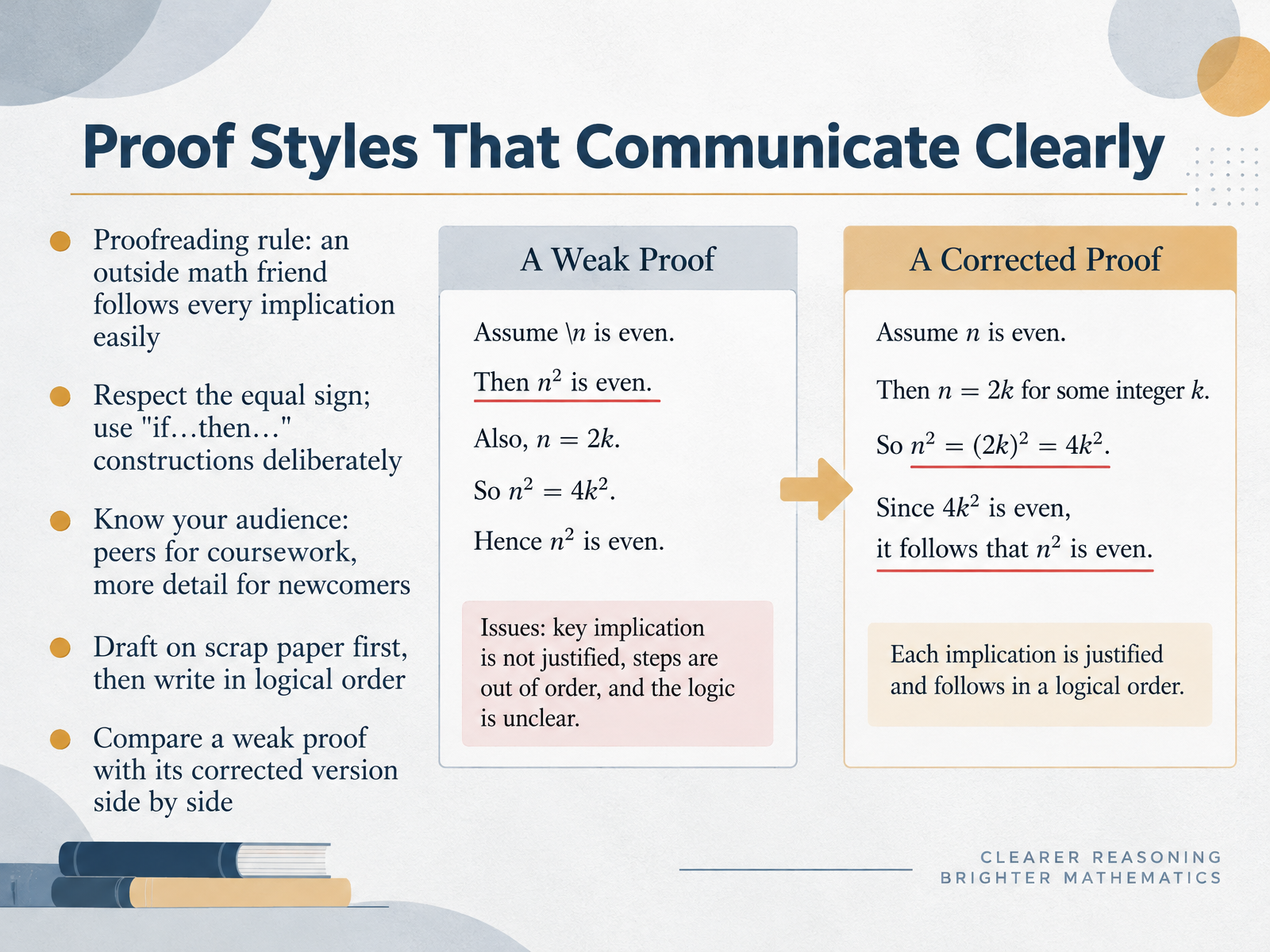
- 10Proof Styles That Communicate ClearlyLet's turn now to proof styles that communicate clearly. A useful proofreading rule is this. Hand your proof to a math friend outside the problem. If they follow every implication easily, the writing is clear. Respect the equal sign. In algebra, writing x plus three equals seven means the two sides are the same value. Never use it as a casual connector. Use if then constructions deliberately, so each implication has a clear hypothesis and conclusion. Know your audience. For peers in coursework, you can be concise. For newcomers, add more detail and define each term. Draft on scrap paper first, then rewrite in logical order. Finally, compare a weak proof with its corrected version side by side. Seeing the two together makes the improvement concrete. Next, we move to verifying logic, common errors, and fallacies.
 2 min
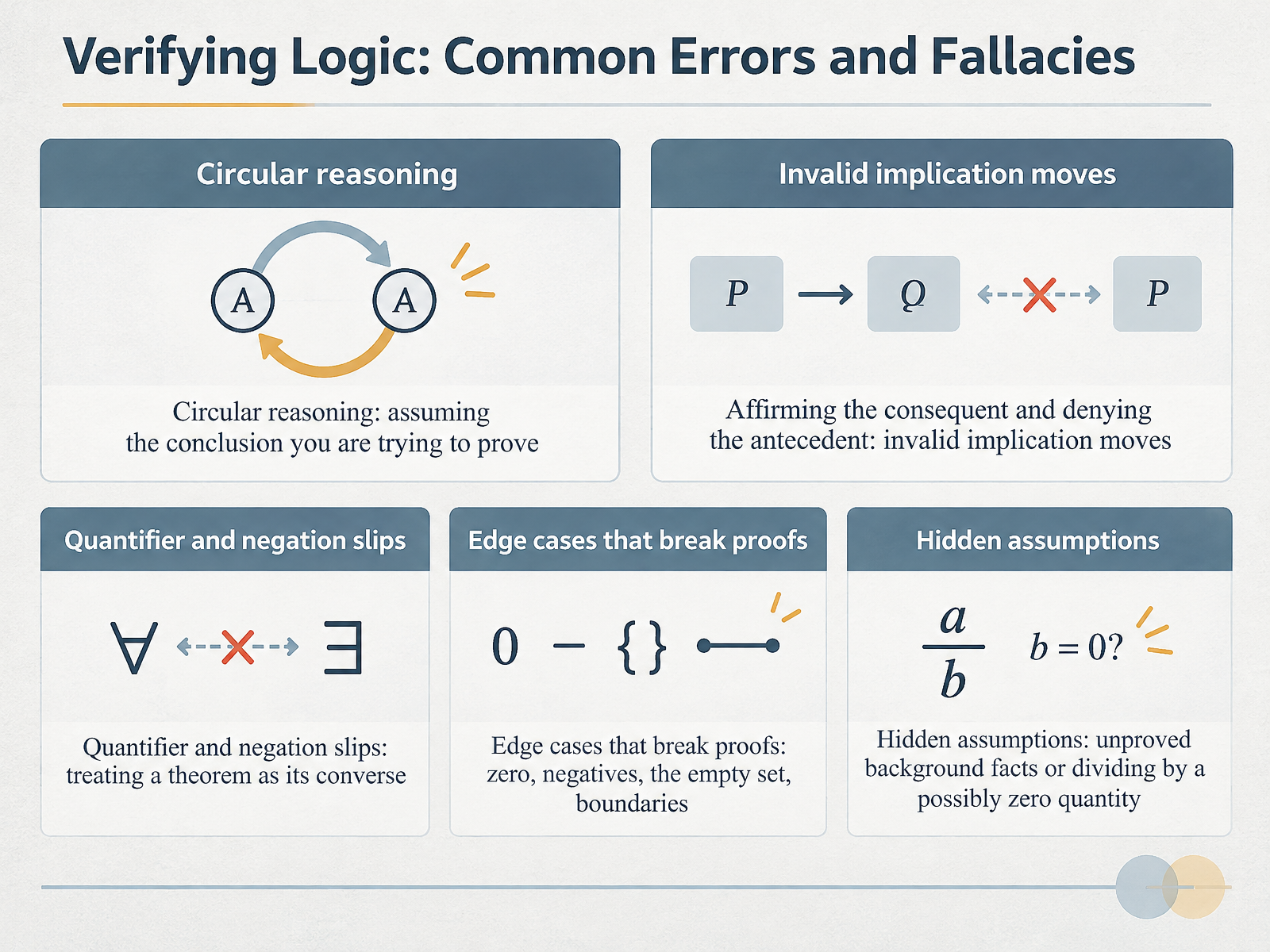
- 11Verifying Logic: Common Errors and FallaciesLet's turn from building proofs to checking them, with a short list of errors worth watching for. First, circular reasoning. This means assuming the conclusion you are trying to prove. You use the fact you want to establish as if it were already known. Second, invalid implication moves. Affirming the consequent and denying the antecedent both confuse a true statement with its converse. For example, if it rains the ground is wet, and the ground is wet, does it follow that it rained? No. Third, quantifier and negation slips. A theorem and its converse are not the same claim. Every square is a rectangle, but not every rectangle is a square. Fourth, edge cases. Zero, negative numbers, the empty set, or an endpoint can break a proof that works only in the middle. And fifth, hidden assumptions, such as dividing by a quantity that might be zero. Read your own proof like a skeptic. Find each assumption before you call it done. Next, we'll put this into practice with a proof audit.
 2 min
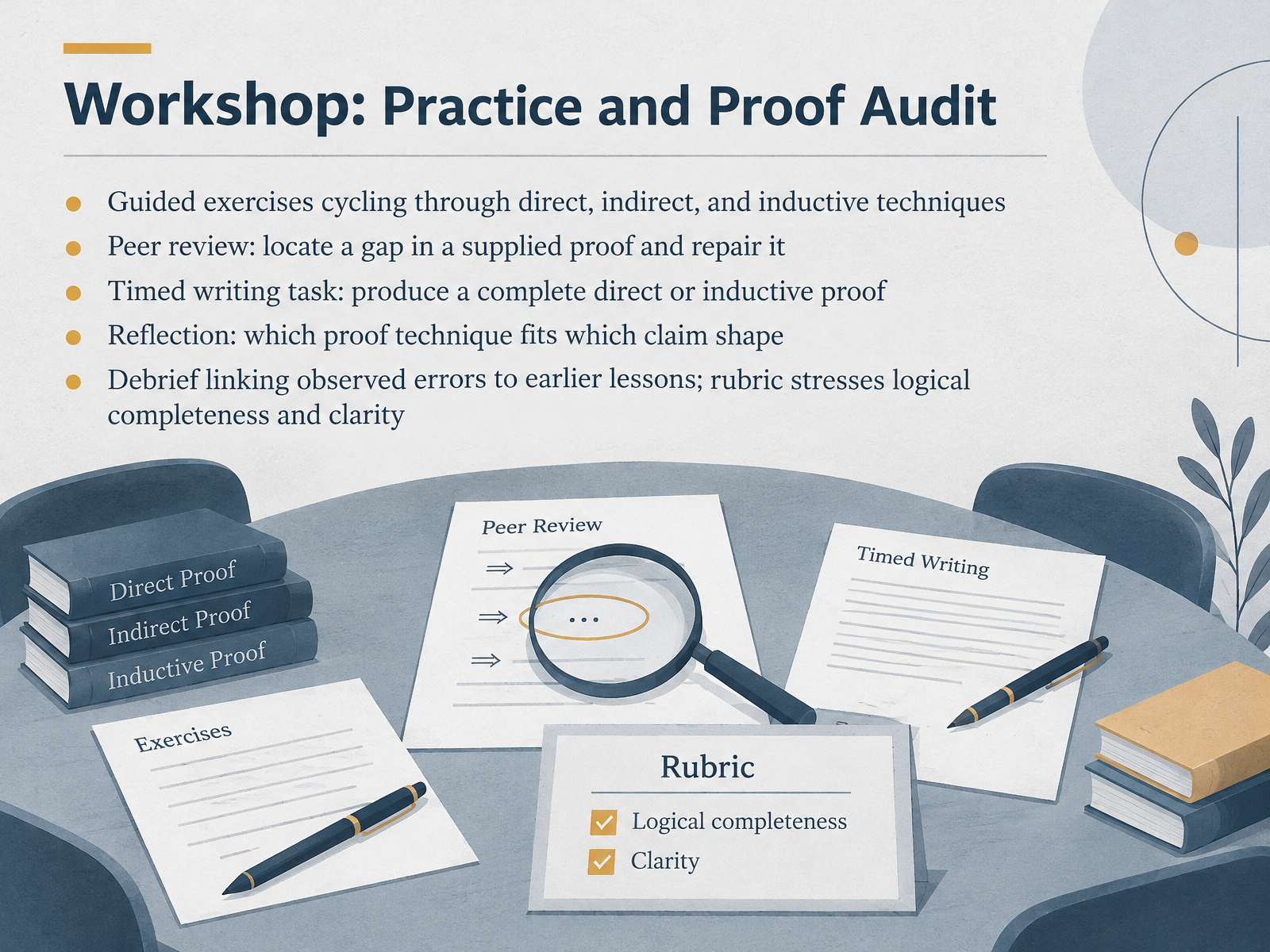
- 12Workshop: Practice and Proof AuditNow it is time to put these techniques into practice. This workshop cycles through three exercises. First, guided problems that alternate between direct proof, indirect proof, and induction. Second, peer review: you receive a supplied proof, locate a gap, and repair it. Third, a timed writing task where you produce a complete direct or inductive proof on your own. Afterward, reflect on which technique fits which claim shape. A claim about all natural numbers often invites induction. A claim that something is impossible often suits contradiction. During the debrief, we will link the errors you observed to the earlier lessons, and the rubric will stress logical completeness and clarity. Aim for every step to follow from a stated reason. That habit is what makes a proof trustworthy, and it is exactly what we will examine as we move toward formal proof and proof assistants.
 thecorestandards.orgcambridgeinternational.orgoecd.org+21 min
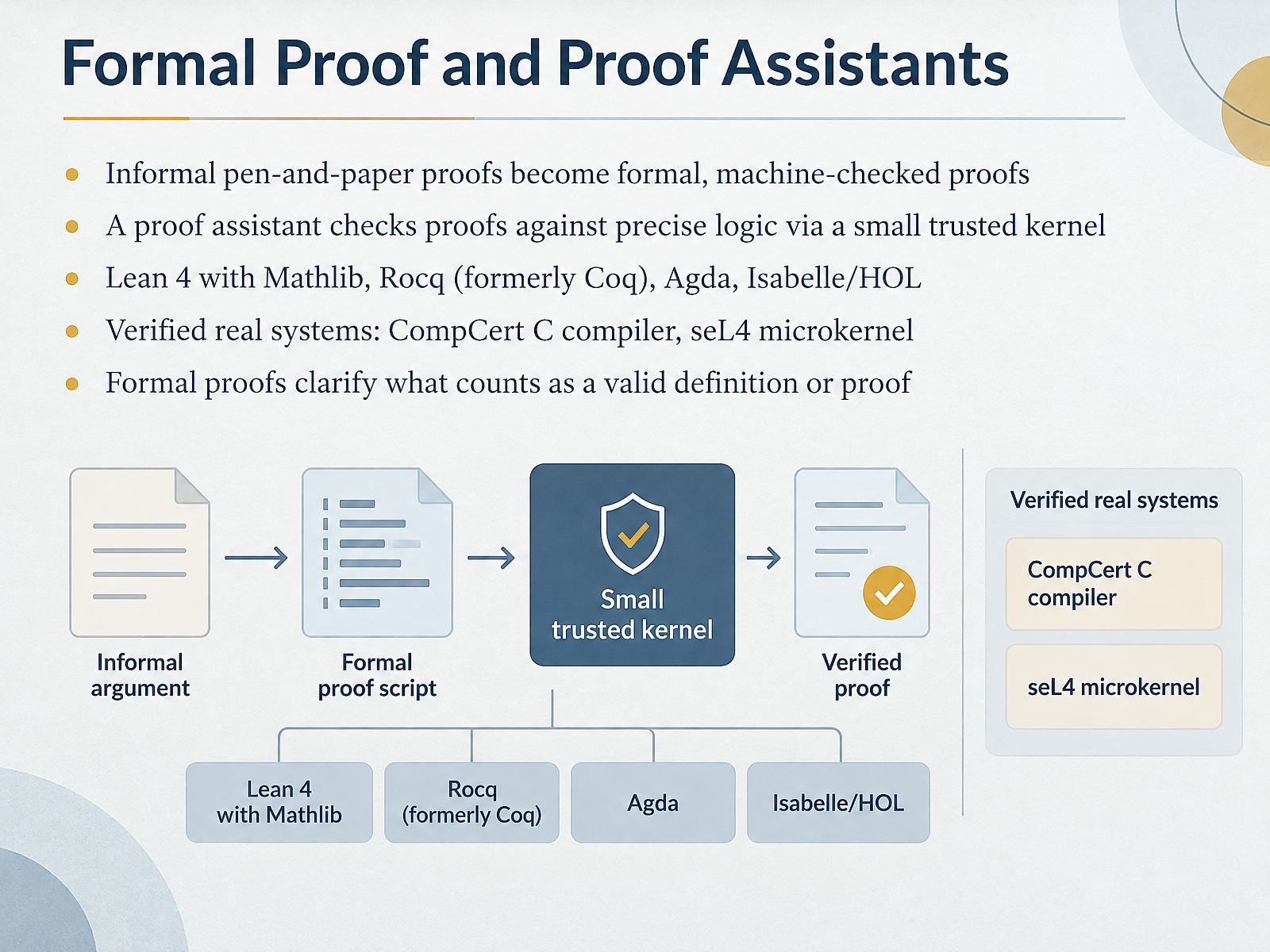
- 13Formal Proof and Proof AssistantsNow let's connect informal proofs to formal, machine-checked proofs. In a formal proof, every step is expressed in precise logic, and a proof assistant checks it against that logic using a small trusted kernel. The kernel only verifies finished proof terms; it does no searching. You can think of it like a strict referee who checks the final rulebook, not how you found the move. Main systems include Lean 4 with Mathlib, Rocq, formerly Coq, Agda, and Isabelle HOL. Formal proof also verifies real systems, such as the CompCert C compiler and the seL4 microkernel. Ultimately, formal proofs clarify what counts as a valid definition or proof. Next, we'll look at habits and resources for continued practice.
 rocq-prover.orgclasses.cs.uchicago.edupistack.xyz+21 min
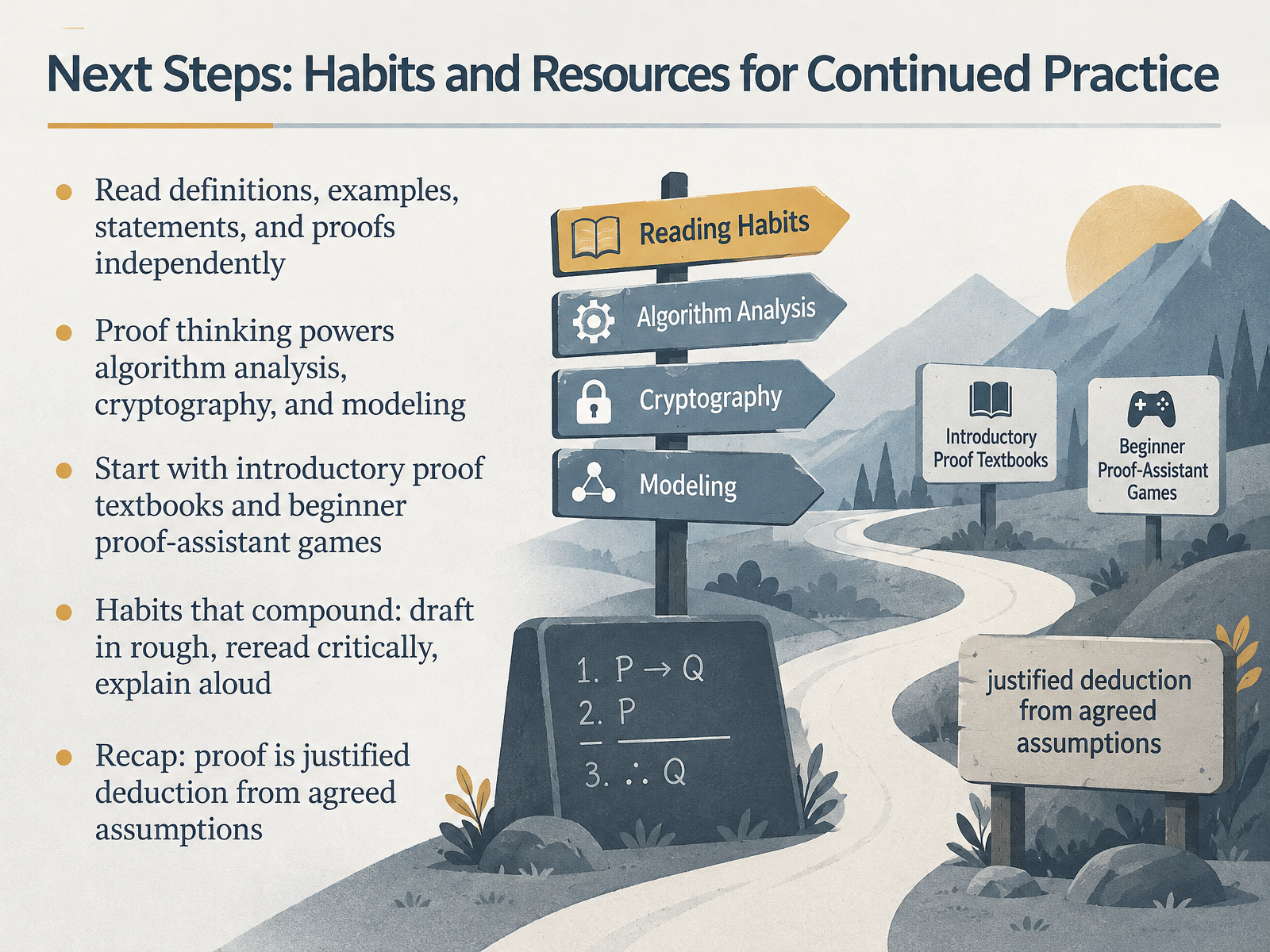
- 14Next Steps: Habits and Resources for Continued PracticeLet's close by turning proof thinking into a habit. First, read proofs independently. When you meet a theorem, read the definitions, the examples, the statement, and the proof separately, so you see how each part does its job. Second, remember where this skill travels. The same careful reasoning supports algorithm analysis, cryptography, and mathematical modeling. For practice, start with an introductory proof textbook, or try a beginner proof-assistant game such as the Natural Number Game for Lean. Three habits compound over time. Draft in rough, reread critically, and explain the argument aloud. If you can explain a proof to a friend, you probably understand it. And the recap: a proof is justified deduction from agreed assumptions. Every step must follow from what came before. Thank you for working through this course with me. Keep reading, keep questioning, and trust that regular practice will make formal proof feel natural.
 rocq-prover.orgclasses.cs.uchicago.edupistack.xyz+21 min
Take the deck with you
Download this course as a file — free, no sign-up needed.
- PDF handoutEvery slide page, ready to print or share.15 pages · 4.3 MBDownload
- Narrated PowerPointThe deck that presents itself — every slide carries the digital human's narration video.15 pages · 14.4 MBDownload
- PowerPoint slidesThe full deck as a .pptx — open it in PowerPoint, Keynote, or Google Slides.15 pages · 4.2 MBDownload
Free to use in your own training — please keep the PersonWise credit page at the end.
Have your own deck? Turn it into a course
Sources consulted
Web sources consulted while building this course.
- Standards for Mathematical Practice — thecorestandards.org
- Cambridge International AS & A Level 9709 Mathematics syllabus for examination in 2026 and 2027 — cambridgeinternational.org
- The knowledge and skills profile across mathematics programmes internationally: Mathematics for Life and Work | OECD — oecd.org
- Mathematics: analysis and approaches guide — ibmathematics.org
- Curricula for Mathematics: A comparative study of the United States, China, and International Baccalaureate — doi.org
- Welcome to a World of Rocq — rocq-prover.org
- The Hitchhiker's Guide to Logical Verification — classes.cs.uchicago.edu
- Rocq (Coq) vs Lean 4 vs Agda in 2026: Which Proof Assistant Should You Actually Learn? | Pi Stack — pistack.xyz
- A Comprehensive Survey of the Lean 4 Theorem Prover: Architecture, Applications, and Advances — arxiv.org
- Lean vs. Rocq (Coq) vs. Isabelle: How to Choose — macmyths.com