Begin
14 pages · ~28 min
Ethics and Responsible UX Design Practice
This training teaches UX designers how to apply ethics and responsible practice in their work, covering key principles for building trustworthy, user-centered products.
A digital instructor presents all 14 pages. Hold “Ask” at any point and ask out loud — the answer comes from this course. No sign-up needed.
What you’ll learn
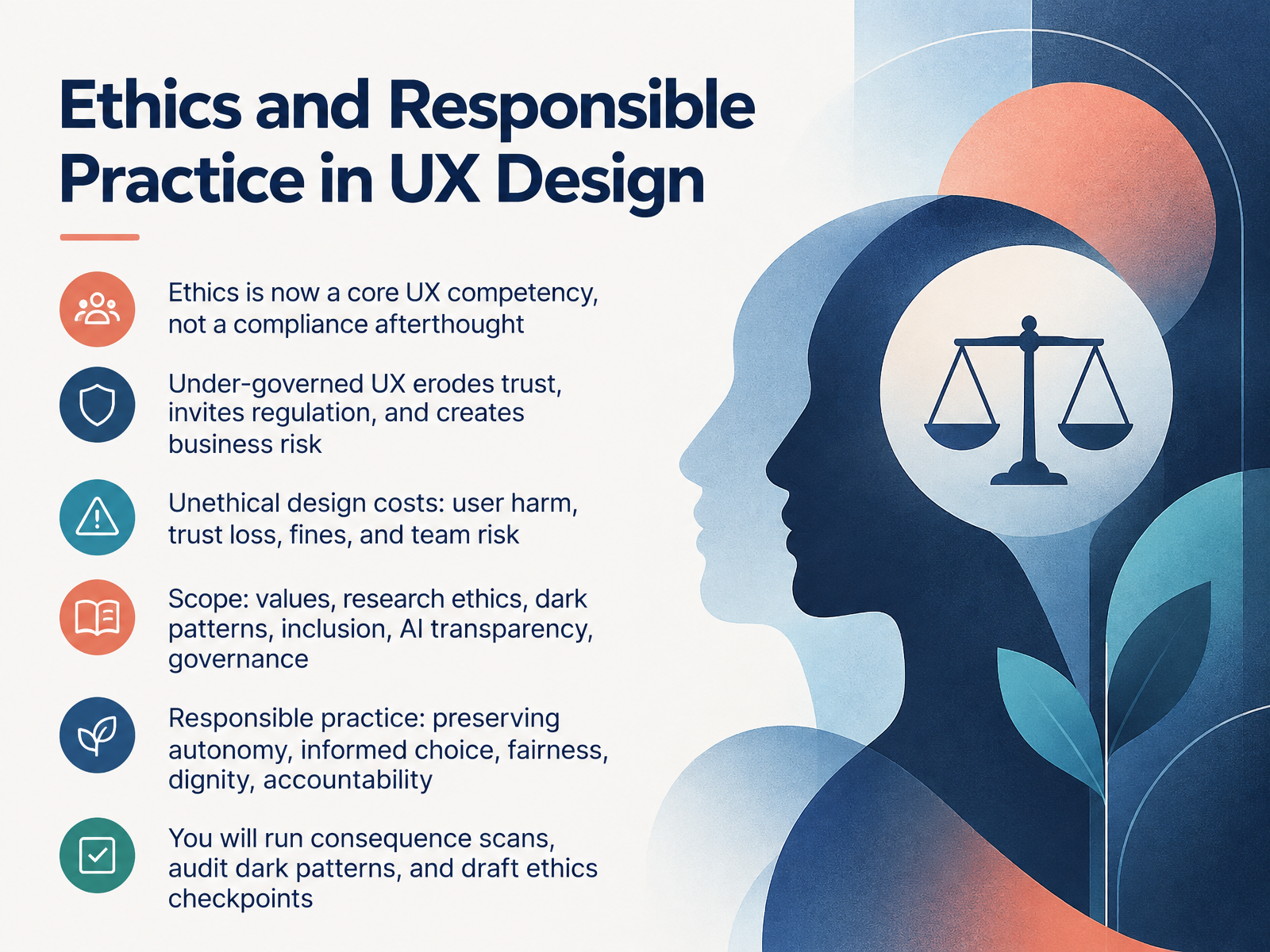
- 01Ethics and Responsible Practice in UX DesignWelcome. I'm glad you're here. This course is about ethics and responsible practice in UX design. Our goal is simple: to treat ethics as a working skill, not a compliance checkbox. Let's start with a shift many of you have already noticed. Ethics is now a core UX competency. When UX is under-governed, trust erodes. Regulation follows. And business risk grows. We've seen this play out. The FTC's case against Amazon centers on Prime cancellation flows that were intentionally hard to navigate. India's consumer authority fined SpiceJet for pre-ticked loyalty enrollment. Fines, trust loss, and user harm add up. So what's in scope here? Values, research ethics, dark patterns, inclusion, AI transparency, and governance. Responsible practice comes down to preserving autonomy, informed choice, fairness, dignity, and accountability. Over these slides, you'll practice consequence scans, audit dark patterns, and draft ethics checkpoints. Consider how your own process handles these moments. As we go, notice what's uncertain, and test your assumptions. Next, let's look at how UX ethics moved from values talk to enforceable practice.npr.orgnewkerala.comdl.acm.org+22 min
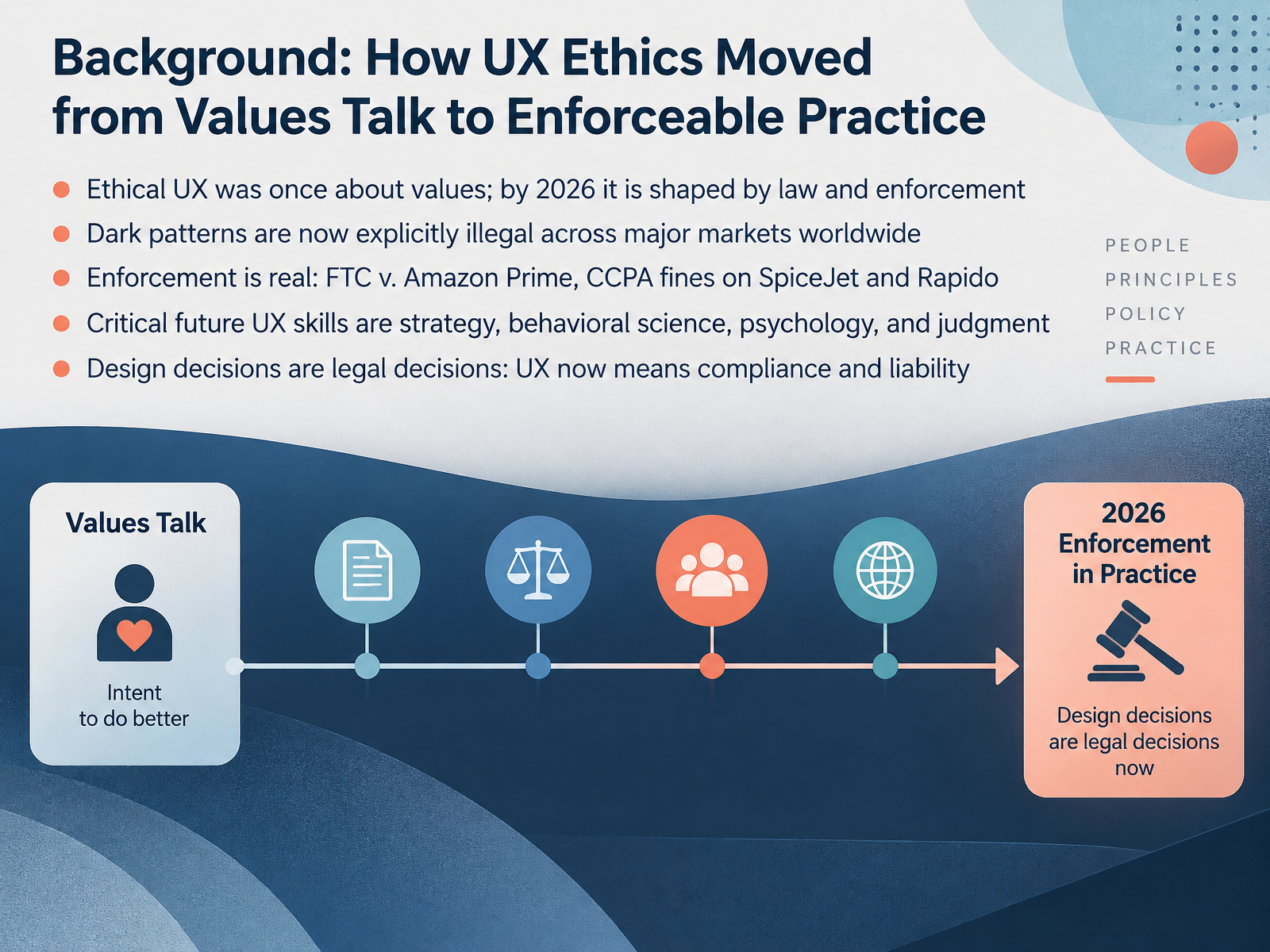
- 02Background: How UX Ethics Moved from Values Talk to Enforceable PracticeSo let's set some context. Ethical UX used to be a conversation about values. Good intent, better judgment, that sort of thing. By 2026, that conversation has moved. Law and enforcement are now shaping it. Dark patterns, which many teams treated as a growth tactic, are explicitly illegal across major markets. And enforcement is real. The FTC's case against Amazon over Prime cancellation is the well-known example. In India, the consumer regulator fined SpiceJet and Rapido over pre-ticked boxes and pressure messaging. So what does that mean for us? The critical skills are shifting. Strategy, behavioral science, psychology, and judgment matter more than polished screens. Consider a checkout flow you shipped last quarter. Could you explain why each default was set the way it was? That question is now both a design question and a legal one. Design decisions are legal decisions. UX now carries compliance and liability. Next, let's look at core ethical concepts and shared vocabulary.
 worldusabilitycongress.comemerald.comsloanreview.mit.edu+22 min
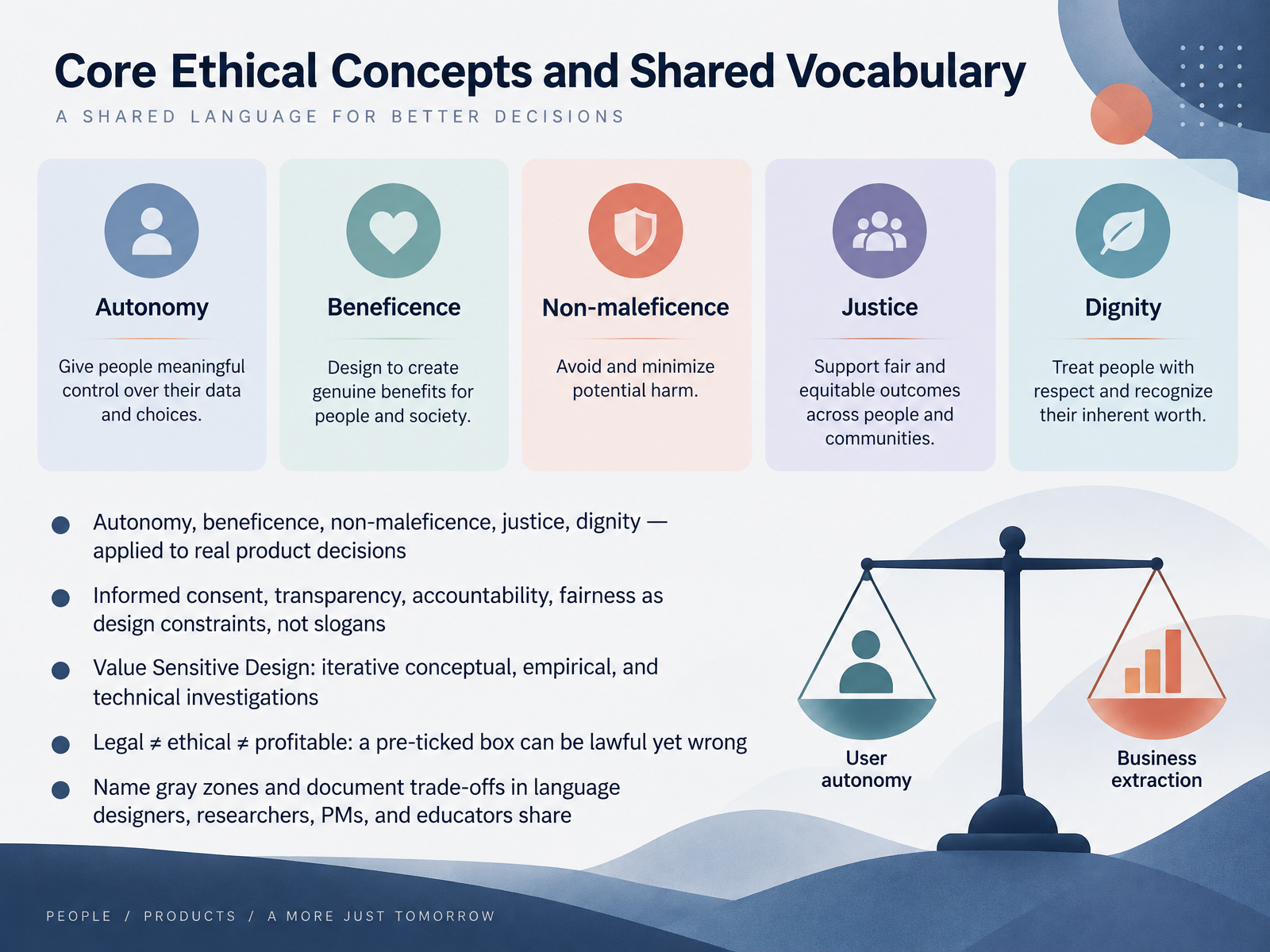
 - 03Core Ethical Concepts and Shared VocabularyLet's build a shared vocabulary for the ethics work we already do. Autonomy, beneficence, non-maleficence, justice, and dignity sound abstract, but they show up in product decisions every day. So do informed consent, transparency, accountability, and fairness. Treat them as design constraints, not slogans. Value Sensitive Design gives us a practical habit here: iterative conceptual, empirical, and technical investigations, revisited as the product changes. One more distinction worth holding: legal, ethical, and profitable are not the same thing. A pre-ticked consent box can be lawful and still be wrong. That is why gray zones matter. Name them early, and document tradeoffs in language designers, researchers, product managers, and educators all share. Ask yourself: where in my current project is the gap between compliant and right? Next, we look at Stakeholders, Power, and Impact Mapping.
 vsd.ccs.neu.eduvsdesign.orgvsd.ccs.neu.edu+21 min
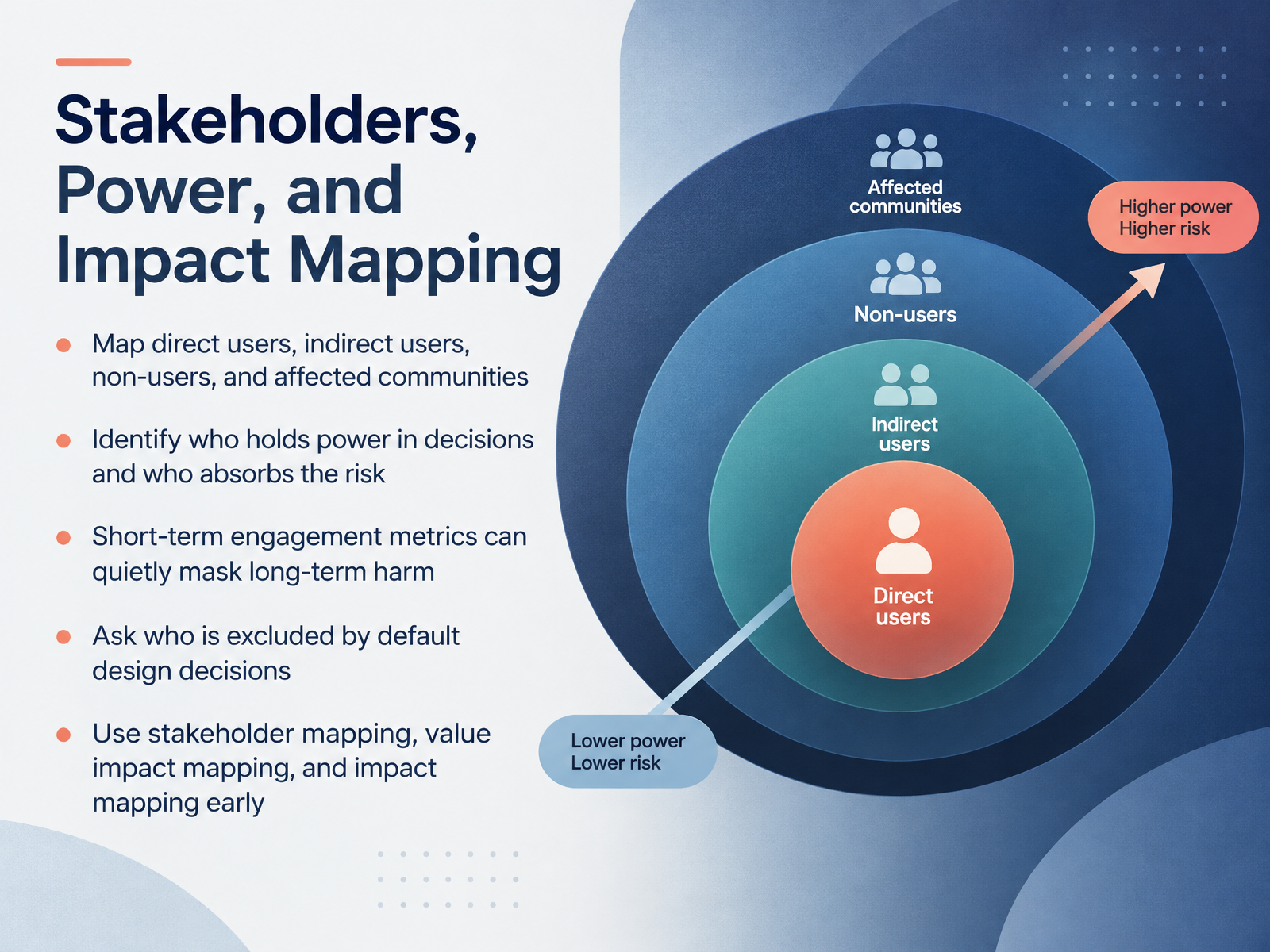
 - 04Stakeholders, Power, and Impact MappingLet's turn to stakeholders, power, and impact mapping. Start by mapping four groups: direct users, indirect users, non-users, and affected communities. Then ask who holds power in the decisions, and who absorbs the risk. Those are often different people. A quick example: a delivery app improves for shoppers, while drivers and local shops carry the consequences. Notice how short-term engagement metrics can quietly mask long-term harm. So check who is excluded by default. Which defaults did we set without asking? Consider using stakeholder mapping, value impact mapping, and impact mapping early, while changes are still cheap. Try a thirty-minute session: list actors, mark power and risk, and note one assumption to test. Next, we look at ethics in user research and data handling.
 ethical-se.github.ioethical-se.github.iolifecentereddesign.school+21 min
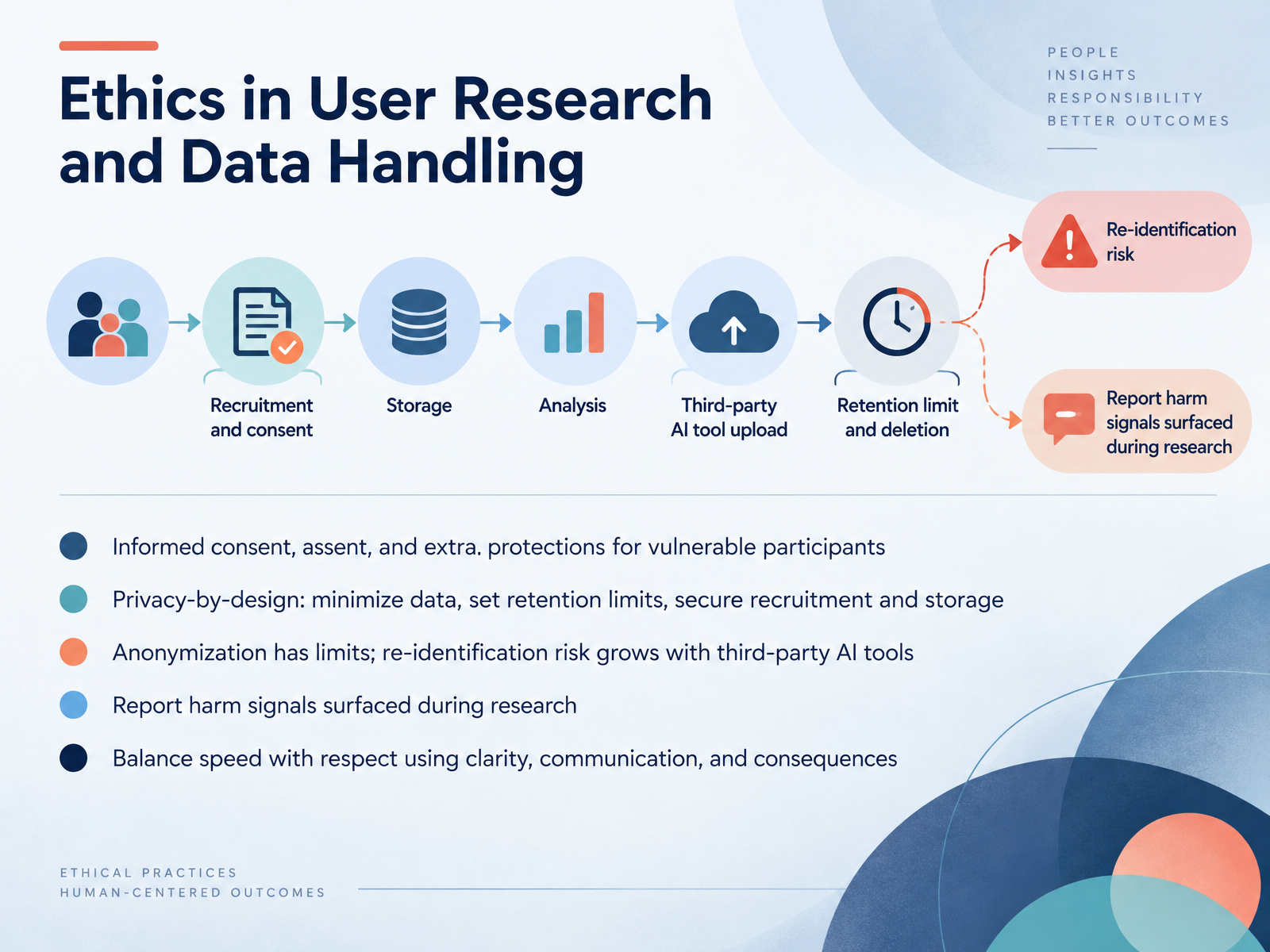
 - 05Ethics in User Research and Data HandlingLet's move into ethics in user research and data handling. Start with consent. People can only choose freely if they understand what they are agreeing to. Consider a quick call you plan to quote in a deck. If you never said you would share it, that is misuse of their data, even with good intentions. For vulnerable participants, or minors, you need extra protections. Caregiver consent, plus verbal assent from the child before activities begin. Next, privacy by design. Collect only what you need, set a retention limit, and secure how you recruit and store data. Ask yourself, do we really need income or exact age, or would a participant code work just as well? Anonymization has limits. Re-identification risk grows as more work passes through third party AI tools, so test what those tools do with transcripts before you upload. During sessions, watch for harm signals, distress, discomfort, a disclosure, and report them, even if it feels awkward. Balance speed with respect through clarity, communication, and consequences. You will not always have complete data, and deadlines are real. What matters is noticing, documenting, and revisiting decisions as a habit. Coming up next, dark patterns, persuasion, and deceptive design.
 2 min
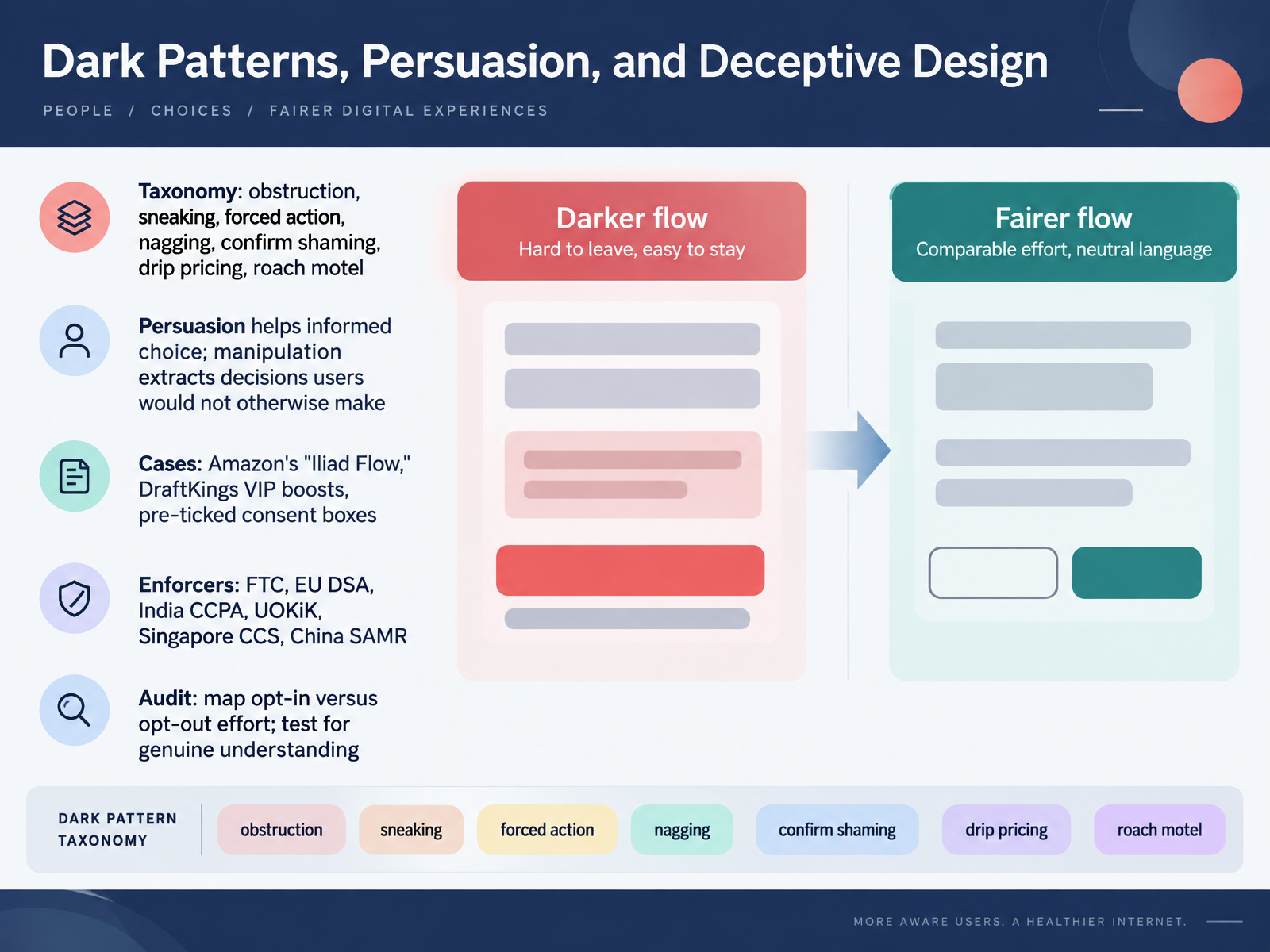
2 min - 06Dark Patterns, Persuasion, and Deceptive DesignNow let's talk about dark patterns. You'll also hear them called deceptive patterns. The taxonomy is useful shorthand. Obstruction, sneaking, forced action, nagging, confirm shaming, drip pricing, and the roach motel. That last one is easy to remember. Easy to get in, hard to get out. Here's the distinction that matters. Persuasion supports informed choice. Manipulation extracts decisions people wouldn't otherwise make. Take Amazon's so-called Iliad Flow. The FTC alleged a four-page, six-click, fifteen-option cancellation journey. Or consider pre-ticked consent boxes. A default selection isn't consent. And DraftKings VIP boosts, where promotions kept reaching users whose behavior flagged risk. Enforcers are watching. The FTC, the EU Digital Services Act, India's CCPA, Poland's UOKiK, Singapore's CCS, and China's SAMR. So here's a practical habit. Map the effort to opt in versus opt out. Then test whether users genuinely understand what they agreed to. Ask yourself, would I be comfortable explaining this flow out loud to the person who just signed up? Hold that thought, because next we look at inclusive, accessible, and culturally responsible design.
 npr.orgnewkerala.comdl.acm.org+22 min
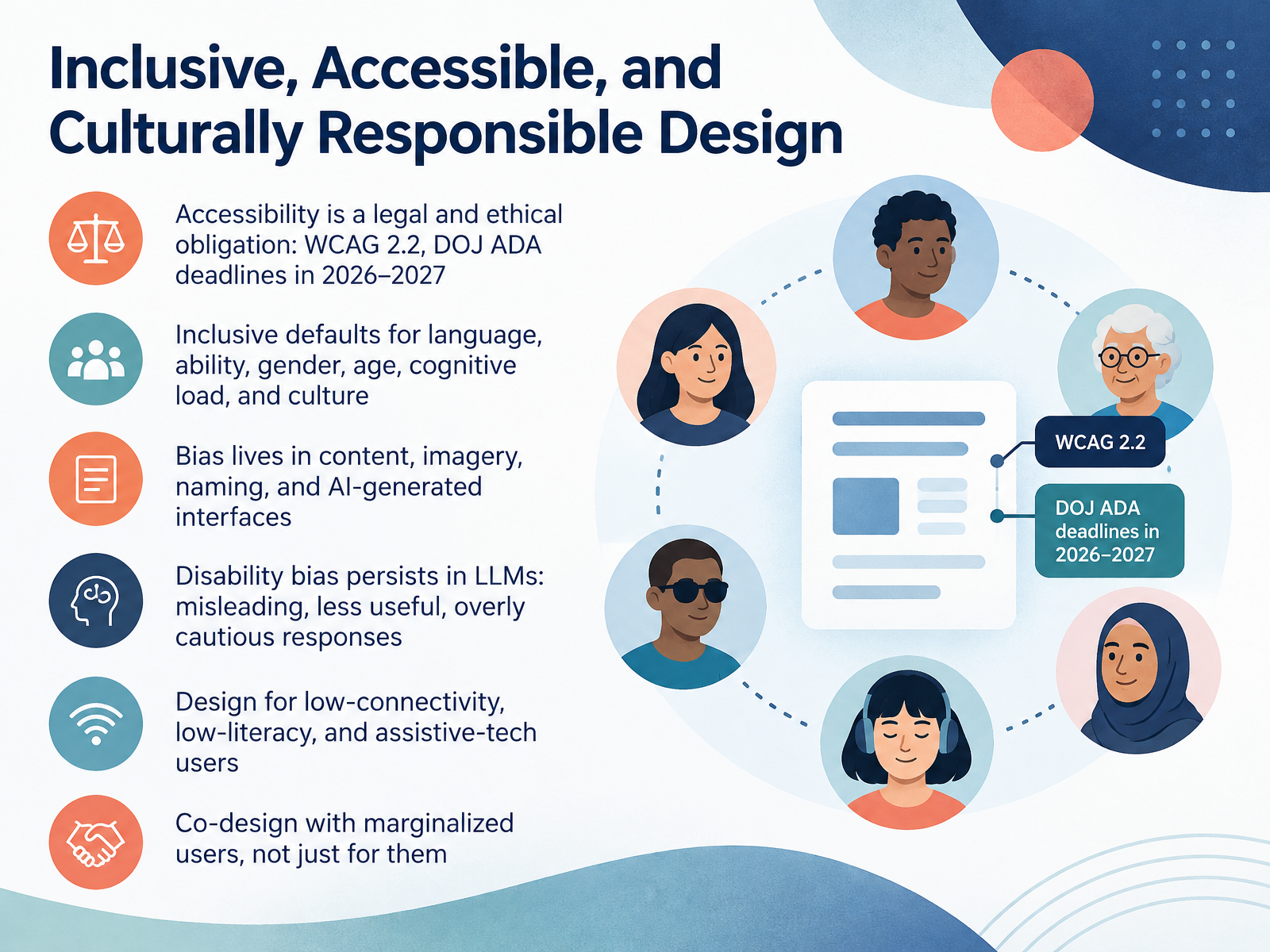
 - 07Inclusive, Accessible, and Culturally Responsible DesignLet's talk about inclusive, accessible, and culturally responsible design. Accessibility is both a legal and an ethical obligation. WCAG 2.2 is the reference point, and Department of Justice ADA deadlines land in 2026 and 2027. So this is worth planning for now, not later. Consider your defaults. Language, ability, gender, age, cognitive load, and culture all show up in small choices. Bias lives in content, imagery, naming, and AI generated interfaces. And research shows disability bias persists in large language models, often producing misleading, less useful, or overly cautious responses. So check your AI outputs with a disability lens, not just gender or race. Test for low connectivity, low literacy, and assistive tech users. And where you can, co-design with marginalized users, not just for them. Which of your defaults deserves a second look this week? Next, we move into AI, automation, and responsible product behavior.
 worldusabilitycongress.comemerald.comsloanreview.mit.edu+22 min
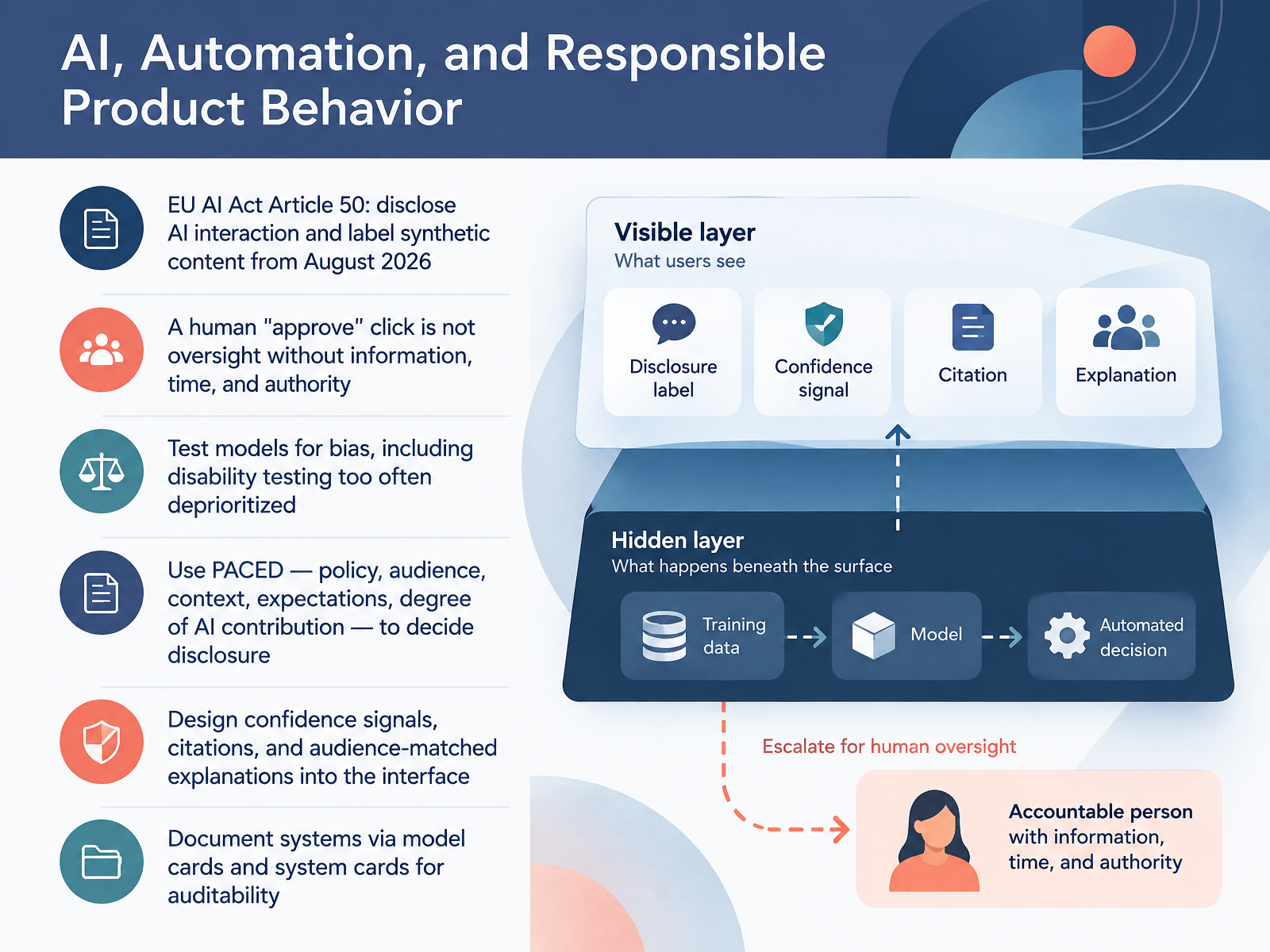
 - 08AI, Automation, and Responsible Product BehaviorNow let's talk about AI, automation, and responsible product behavior. In the EU, Article Fifty transparency duties began applying in August twenty twenty-six. So if your system interacts with people or generates content, disclosure and labeling need to be designed in, not bolted on later. Here's a hard one. A human clicking approve is not oversight. Not unless that person has the information, the time, and the authority to actually override the output. Otherwise it's a checkbox, and it can create real liability. So before you count on a review step, check those three things. Test your models for bias, and include disability testing. That one gets deprioritized often. And it matters, because these biases are subtle and they compound quietly. When you decide how much to disclose, use the P A C E D factors. Policy, audience, context, expectations, and degree of AI contribution. It's a judgment call, not a rule. Then design the signals people need. Confidence indicators, citations, and explanations matched to who's reading. Document the system through model cards and system cards, so someone can audit it later. One question to sit with. If your model fails next month, could you explain why, and who would you ask? Next, we'll look at decision-making tools for teams.
 2 min
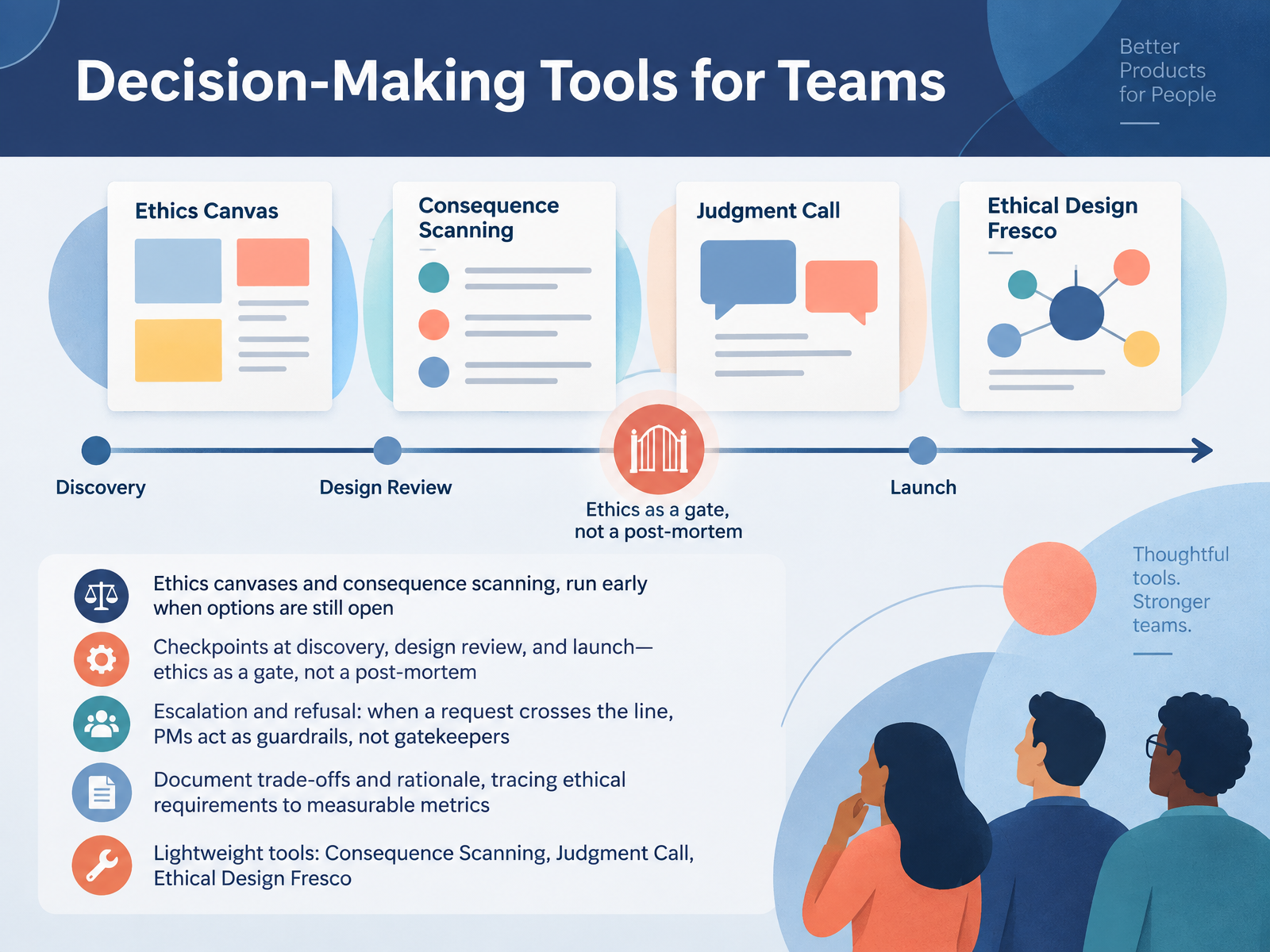
2 min - 09Decision-Making Tools for TeamsLet's look at decision-making tools for teams. The key idea here is timing. Run ethics canvases and consequence scanning early, while options are still open. Once something is fully built, asking whether it should exist is much harder. Think of these tools as checkpoints at discovery, design review, and launch, so ethics acts as a gate rather than a post-mortem. Consequence Scanning, for example, deliberately inserts friction, a short pause to ask what could go wrong and for whom. It helps teams catch unintended consequences in categories like erosion of trust or unforeseen uses. These tools are lightweight. Consequence Scanning, Judgment Call, and the Ethical Design Fresco can all fit into a normal workshop. Keep the scope narrow, bring diverse perspectives, and ask people to prepare a few consequences in advance. Then document the trade-offs and the rationale, and trace each ethical requirement to a measurable metric, so it does not stay abstract. One more piece: escalation and refusal. When a request crosses the line, product managers often act as guardrails, not gatekeepers. That means upholding shared standards and knowing when to escalate. So as you plan your next sprint, ask yourself where your checkpoints live, and what would trigger a pause. Next, we will look at governance, accountability, and organizational culture.
 2 min
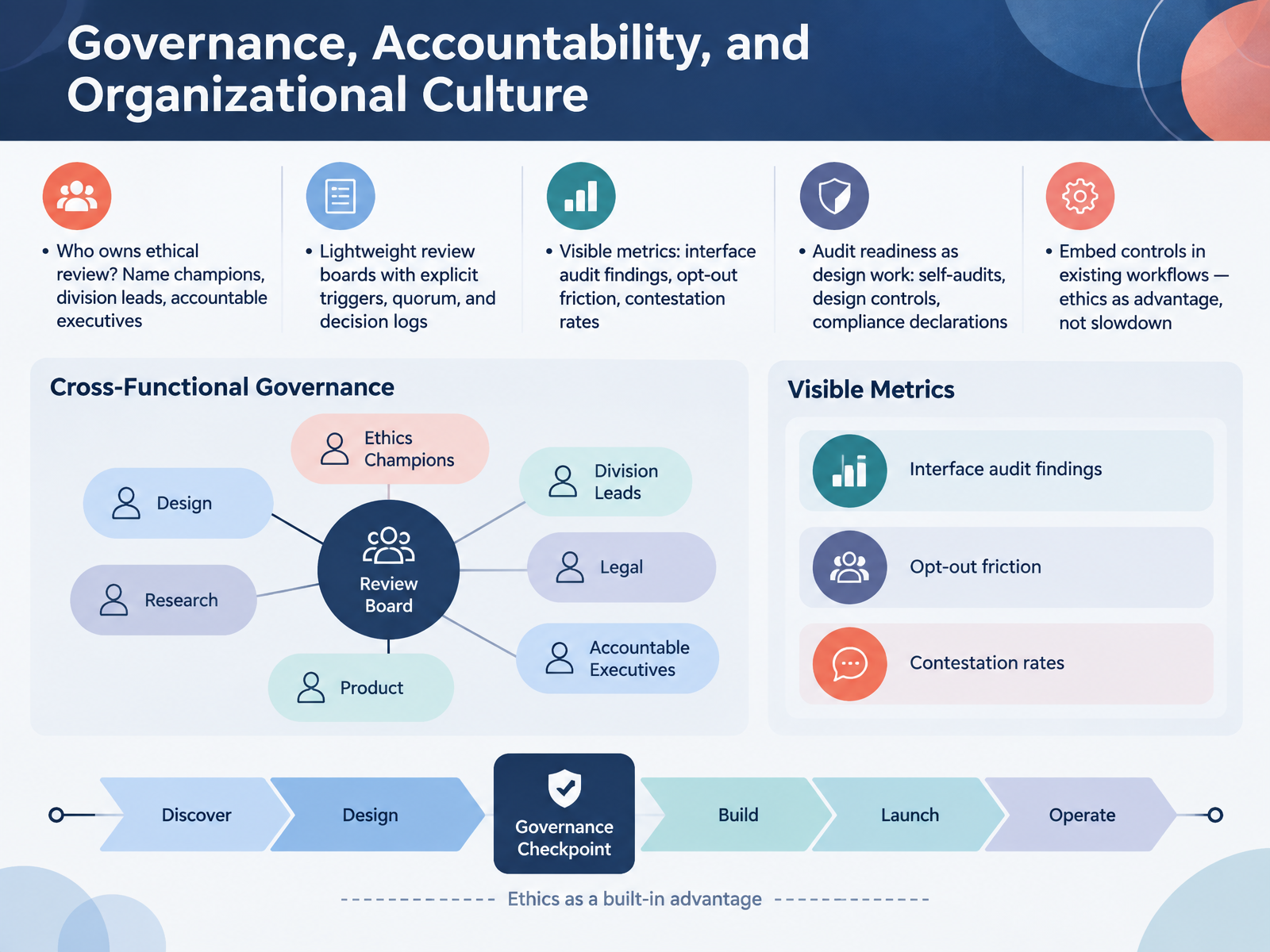
2 min - 10Governance, Accountability, and Organizational CultureLet's turn to governance, accountability, and organizational culture. Start with a simple question: who owns ethical review here? Name the champions, the division leads, and the executive who is genuinely accountable. Then keep the process lightweight. A small review board with clear trigger points, a defined quorum, and a decision log is usually enough. Think of the Sprint Ethics Board model: it ties review to product milestones and captures outcomes in a one-page brief. Consider visible metrics too, like interface audit findings, opt-out friction, and contestation rates. Audit readiness is design work: self-audits, design controls, declarations. And embed controls in existing workflows, so ethics becomes an advantage, not a slowdown. Ask yourself: where does accountability live on your current project? Next, we move from principles to guardrails, and what it takes to operationalize ethics in product work.
 worldusabilitycongress.comemerald.comsloanreview.mit.edu+22 min
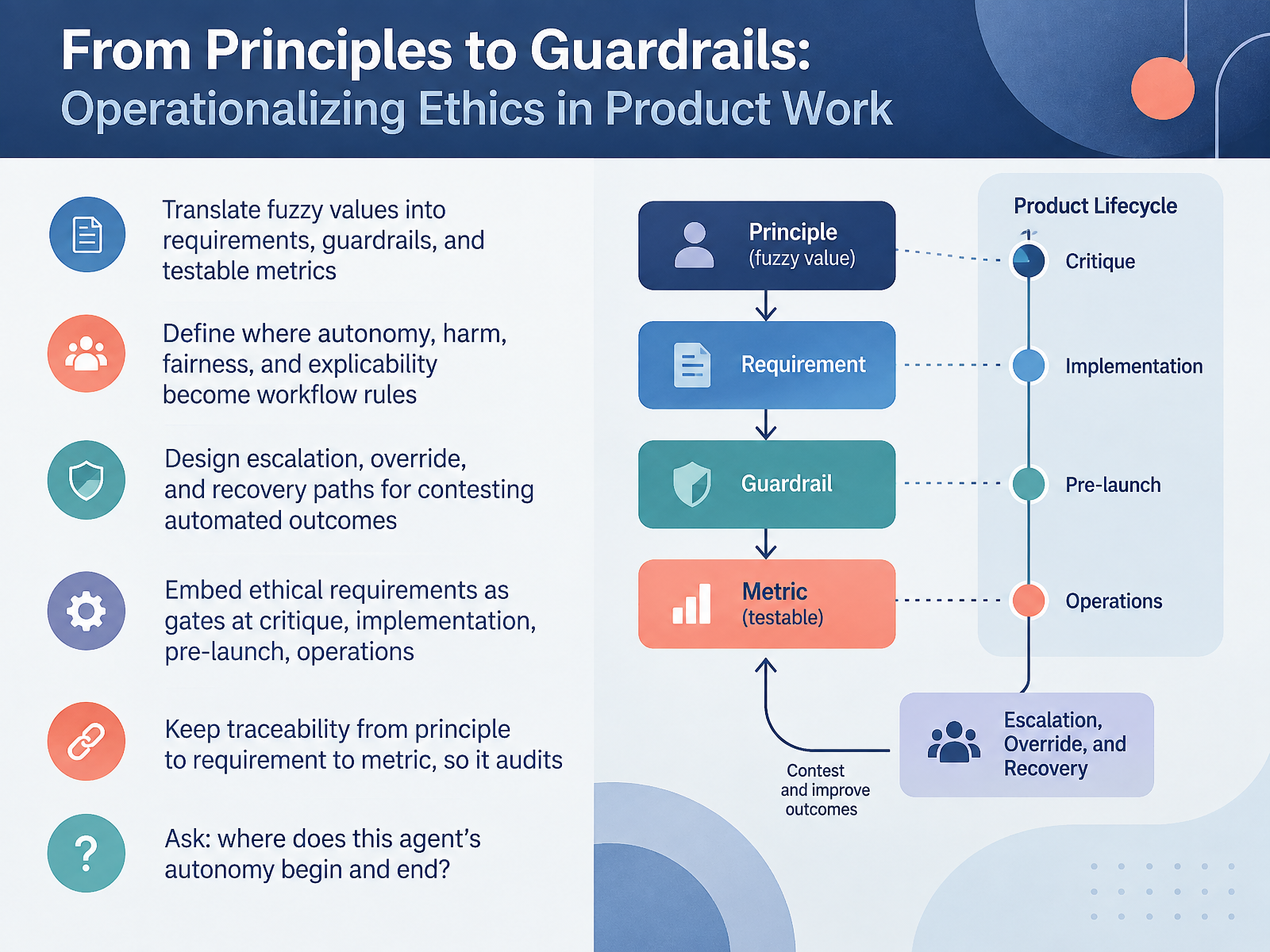
 - 11From Principles to Guardrails: Operationalizing Ethics in Product WorkLet's talk about moving from principles to guardrails. This is where ethics stops being a poster and becomes something your team can build against. Start by translating fuzzy values into requirements, guardrails, and testable metrics. Take fairness. That could become a requirement: every blocked transaction shows a plain-language reason and an appeal path. The metric might be contest rate and reversal rate. Then define where autonomy, harm, fairness, and explicability become workflow rules. So, where does this agent's autonomy begin and end? What must it never do, even if a metric improves? Next, design escalation, override, and recovery paths, so a real person can contest an automated outcome. And embed these as gates at critique, implementation, pre-launch, and operations. Yes, deadlines and stakeholder pressure make this hard. Incomplete data makes it harder. So keep traceability from principle to requirement to metric. That way, it audits. Consider one workflow this week and test that chain. Next, we'll put this into practice in our guided case workshop.
 2 min
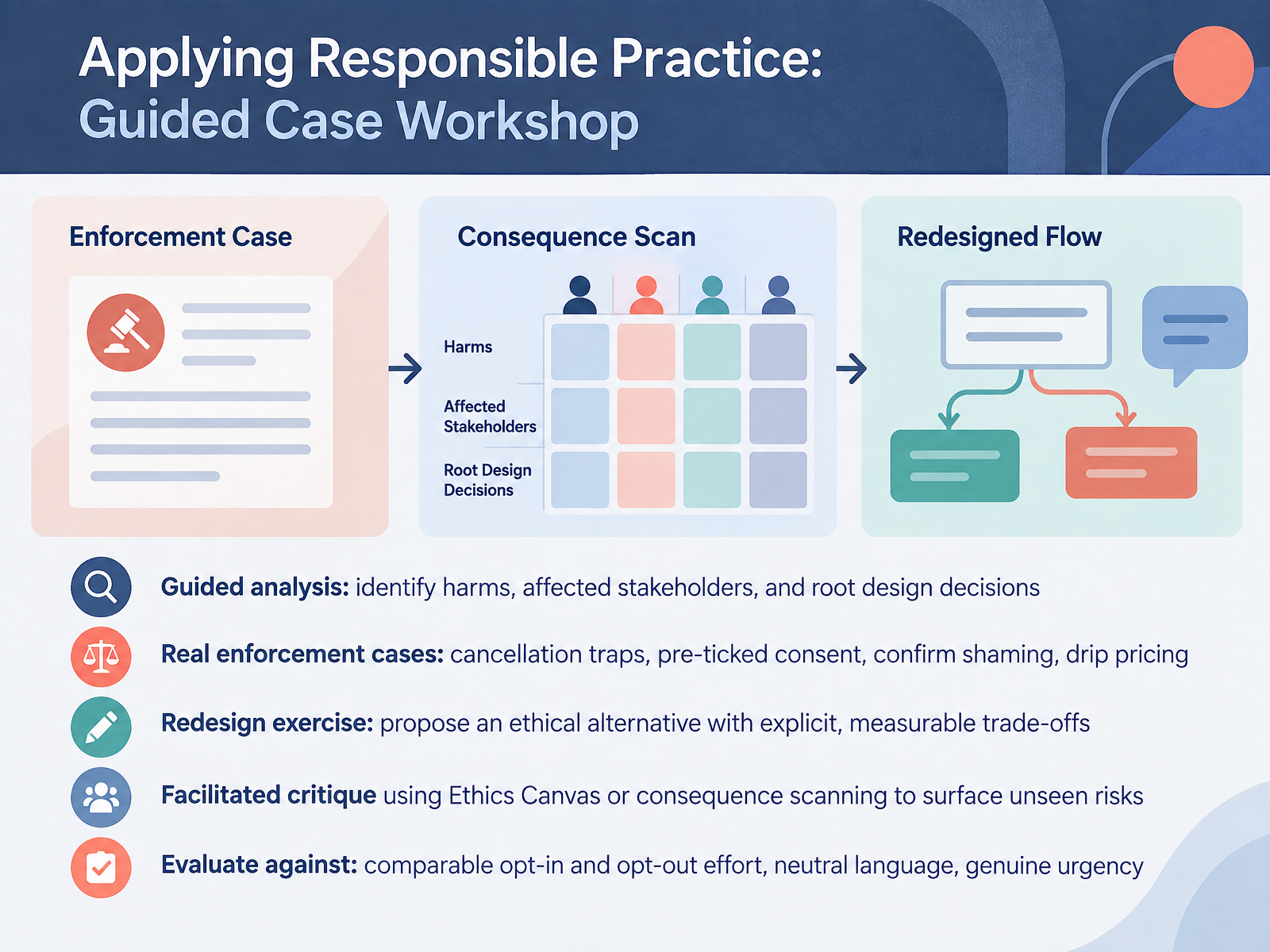
2 min - 12Applying Responsible Practice: Guided Case WorkshopLet's put this into practice with a guided case workshop. We'll start by analyzing a flow together and naming three things: the harms, who is affected, and which design decisions caused those harms. Then we'll look at real enforcement cases. Think cancellation traps, pre-ticked consent, confirm shaming, and drip pricing. In each, ask yourself where the design quietly removed a genuine choice. Next, you'll redesign one flow and state your trade-offs explicitly and measurably. For example, equal clicks to opt in and opt out, or neutral button labels. Then we critique together using an Ethics Canvas or consequence scanning to surface risks nobody spotted yet. Test your redesign against three checks. Is opt-in effort comparable to opt-out effort? Is the language neutral? Is the urgency real? Remember, this is judgment work. Time pressure and incomplete data are normal. Document what you decided and why, then revisit it later. That habit matters more than any single answer. Up next, Role-Specific Commitments and Team Action Planning.
 npr.orgnewkerala.comdl.acm.org+22 min
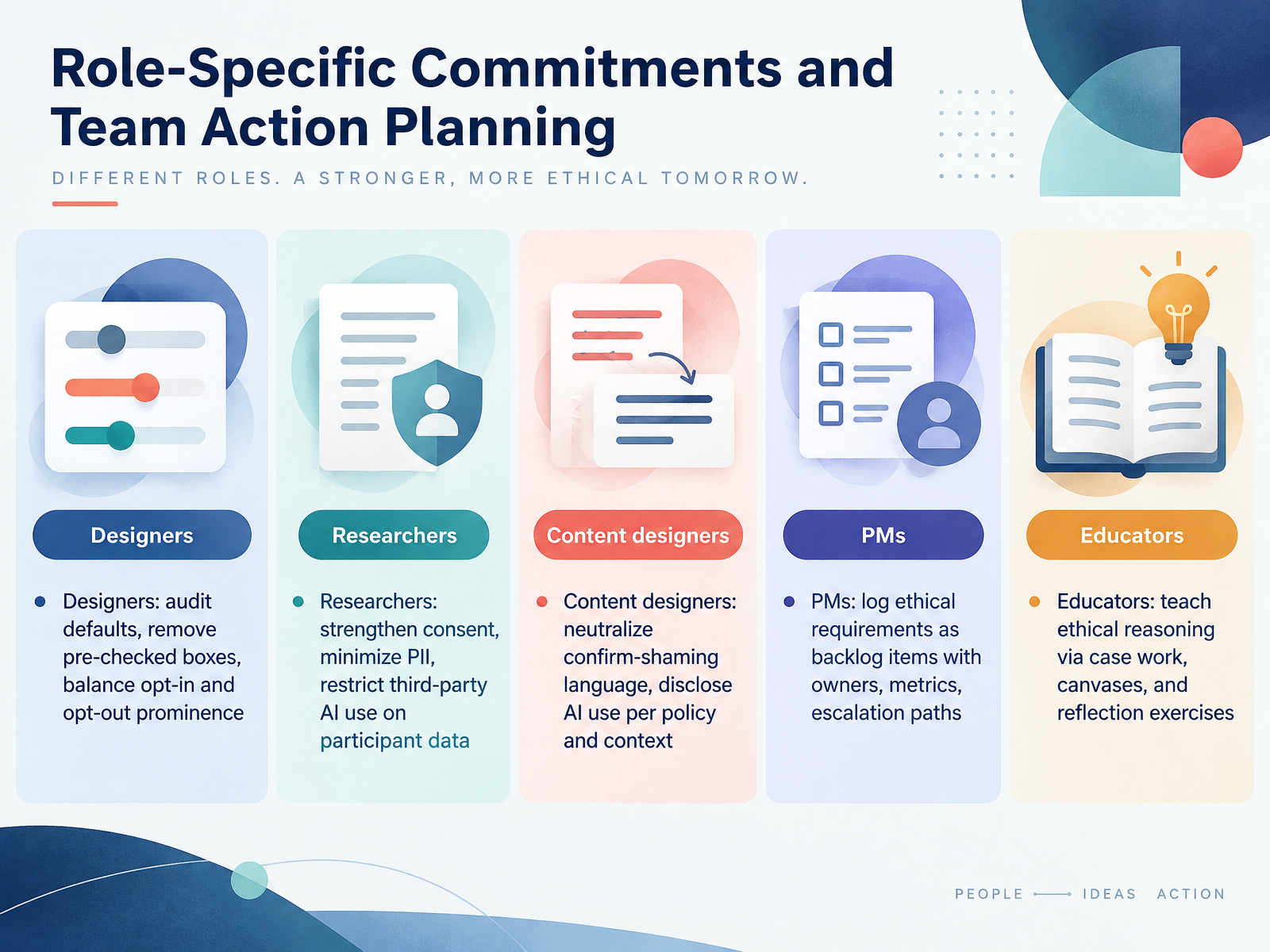
 - 13Role-Specific Commitments and Team Action PlanningNow let's make this concrete by role. Think of these as commitments you can actually keep. Designers, consider auditing your defaults. Remove pre-checked boxes, and check whether opt-in and opt-out are equally prominent. If the opt-out is buried in gray text, that is a design decision, so test it. Researchers, strengthen consent beyond the signature. Minimize personally identifiable information, and restrict third-party AI use on participant data unless it is covered by your consent. Check what leaves your tool before you paste a transcript. Content designers, neutralize confirm-shaming language, like "no thanks, I don't want to save money." And disclose AI use according to policy and context. Product managers, log ethical requirements as backlog items with an owner, a metric, and an escalation path. Otherwise they stay intentions. Educators, teach ethical reasoning through case work, canvases, and reflection exercises, not just principles. Here is a quick reflective question. Which one of these is closest to your daily work, and what would you change this week? Next, we look at checkpoints, accountability, and a closing reflection.
 2 min
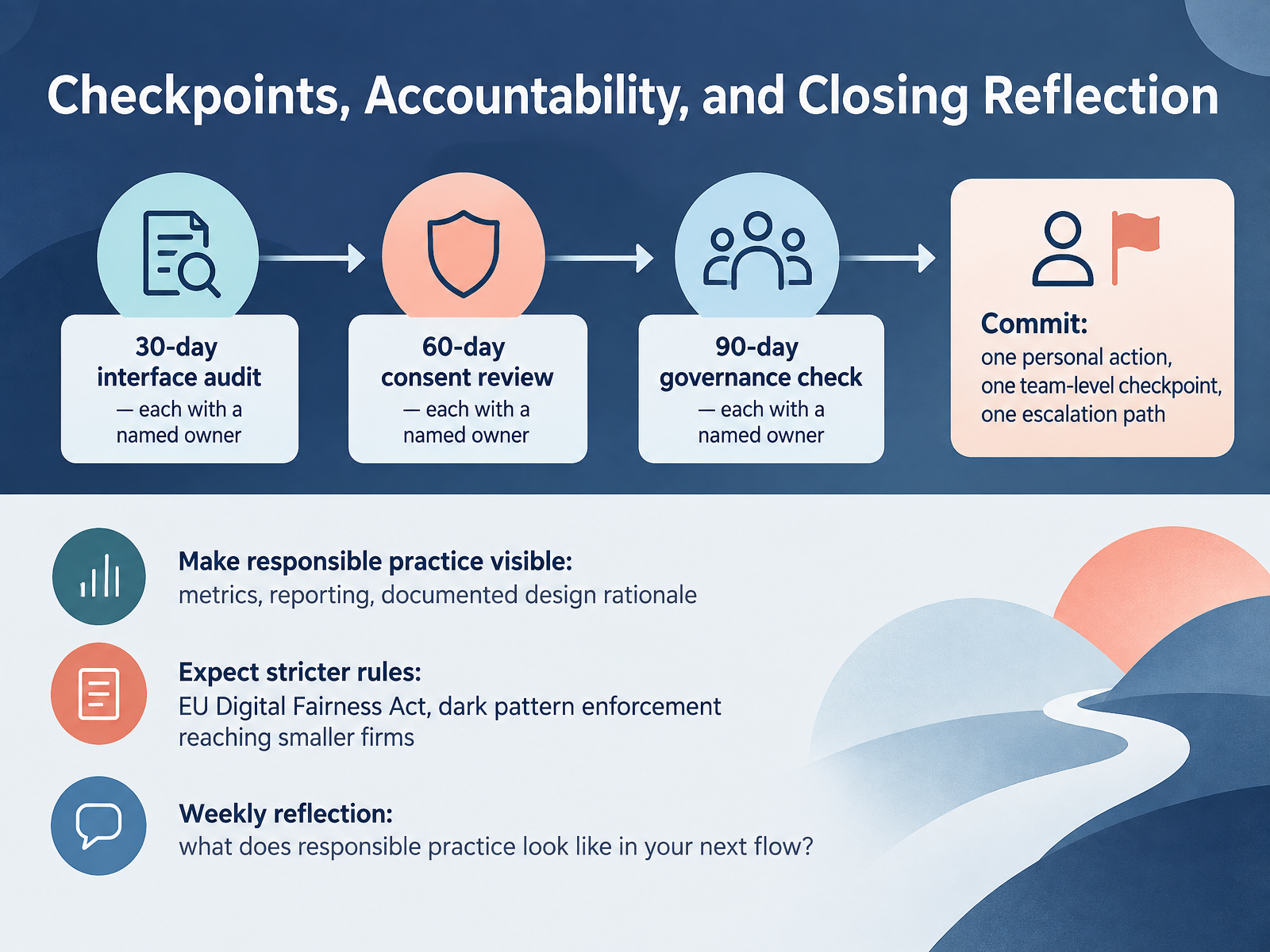
2 min - 14Checkpoints, Accountability, and Closing ReflectionLet's close with something practical. Set checkpoints with named owners. A thirty day interface audit. A sixty day consent review. A ninety day governance check. Ownership matters here, because shared responsibility usually means no responsibility. Make the work visible too, through metrics, reporting, and documented design rationale. And expect stricter rules. The EU's Digital Fairness Act is coming, and dark pattern enforcement is reaching smaller firms, not just the large platforms. So keep a weekly reflection going. Ask yourself, what does responsible practice look like in my next flow? Then commit to one personal action, one team level checkpoint, and one escalation path for when something feels wrong. Ethics is a habit of noticing, documenting, and revisiting. Thank you for your attention, and good luck.
 worldusabilitycongress.comemerald.comsloanreview.mit.edu+21 min
Take the deck with you
Download this course as a file — free, no sign-up needed.
- PDF handoutEvery slide page, ready to print or share.15 pages · 3.6 MBDownload
- Narrated PowerPointThe deck that presents itself — every slide carries the digital human's narration video.15 pages · 16.3 MBDownload
- PowerPoint slidesThe full deck as a .pptx — open it in PowerPoint, Keynote, or Google Slides.15 pages · 3.5 MBDownload
Free to use in your own training — please keep the PersonWise credit page at the end.
Have your own deck? Turn it into a course
Sources consulted
Web sources consulted while building this course.
- The 'dark patterns' at the center of FTC's lawsuit against Amazon : NPR — npr.org
- CCPA Fines SpiceJet Rs 1 Lakh for Dark Patterns — newkerala.com
- The Dark Patterns Knowledge Stack: Exploring New Ways ... — dl.acm.org
- I Posed as a Problem Gambler. DraftKings Made Me a VIP. — ProPublica — propublica.org
- CCPA Fines Rapido Rs 10 Lakh for Dark Patterns in Ride-Booking Interface - Supreme Today AI — supremetoday.ai
- 2026 UX TRENDS REPORT — worldusabilitycongress.com
- Strategic governance through ethics-by-design: aligning UI/UX practices with ESG accountability | Journal of Information, Communication and Ethics in Society | Emerald Publishing — emerald.com
- Why Design Thinking Needs a Responsibility Reboot — sloanreview.mit.edu
- Designing the Right to Resist. Beyond Ethical Design Guidelines: Experimental Insights and Implications for Education and Regulation | Design, User Experience, and Usability — dl.acm.org
- State of UX in 2026 - NN/G — nngroup.com
- INTRO TO VALUE SENSITIVE DESIGN — vsd.ccs.neu.edu
- About VSD — vsdesign.org
- What Is VSD - Value Sensitive Design @ Khoury College — vsd.ccs.neu.edu
- A systematic review of almost three decades of value sensitive design (VSD): what happened to the technical investigations? | Ethics and Information Technology | Springer Nature Link — link.springer.com
- Twenty years of value sensitive design: a review of methodological practices in VSD projects | Ethics and Information Technology | Springer Nature Link — link.springer.com
- Practice: Stakeholder Mapping | Value-Driven Analysis and Design (VDAD) — ethical-se.github.io
- Practice: Value Impact Mapping | Value-Driven Analysis and Design (VDAD) — ethical-se.github.io
- BETA: The Impact Mapping Method — Life-Centered Design School — lifecentereddesign.school
- The Art of Impact Mapping: 4 Steps to Create Your Own Map — amplitude.com
- Fuzzy cognitive maps to implement corporate social responsibility in product planning: A novel approach — exa.ai