Belief Systems and Social Change
Begin
15 pages · ~30 min
Belief Systems and Social Change
Explore how belief systems have driven social change throughout world history, examining their role in shaping societies and movements for learners of global history.
What you’ll learn
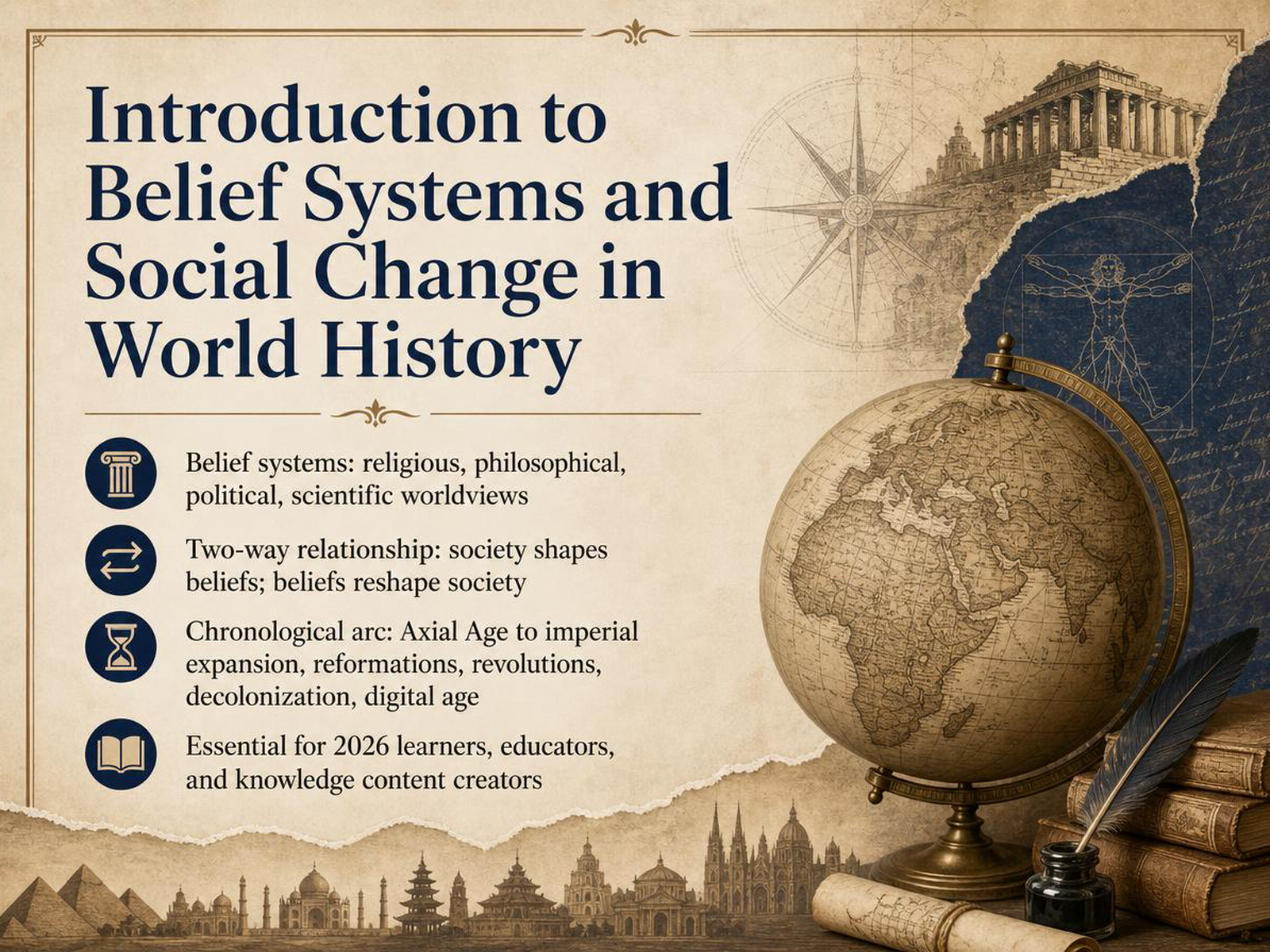
- 01Introduction to Belief Systems and Social Change in World HistoryWelcome. This course explores how belief systems have shaped world history, and in turn, how historical forces have shaped belief systems. We often think of beliefs as private or timeless, but in reality, they are dynamic. Religious traditions, philosophical schools, political ideologies, and scientific worldviews have all evolved in constant dialogue with the societies that carried them. That relationship runs both ways. A society's structure, its rulers, its economy, and its anxieties influence which ideas take hold. Once they take hold, those ideas can transform laws, institutions, and everyday life. We will trace this arc from the Axial Age, when new moral and transcendental ideas emerged across Eurasia, through imperial expansion, reformations, and revolutions, up to decolonization and our current digital age. Along the way, we will see how ideas travel, why some diffuse and others fade, and how power and networks shape their fate. This matters not just for historians, but for educators and content creators in 2026, who must understand the roots of today's global conversations. Let us begin with a clear framework for classifying belief systems and the key concepts we will use throughout.researchonline.lse.ac.ukberkleycenter.georgetown.educambridge.org+21 min
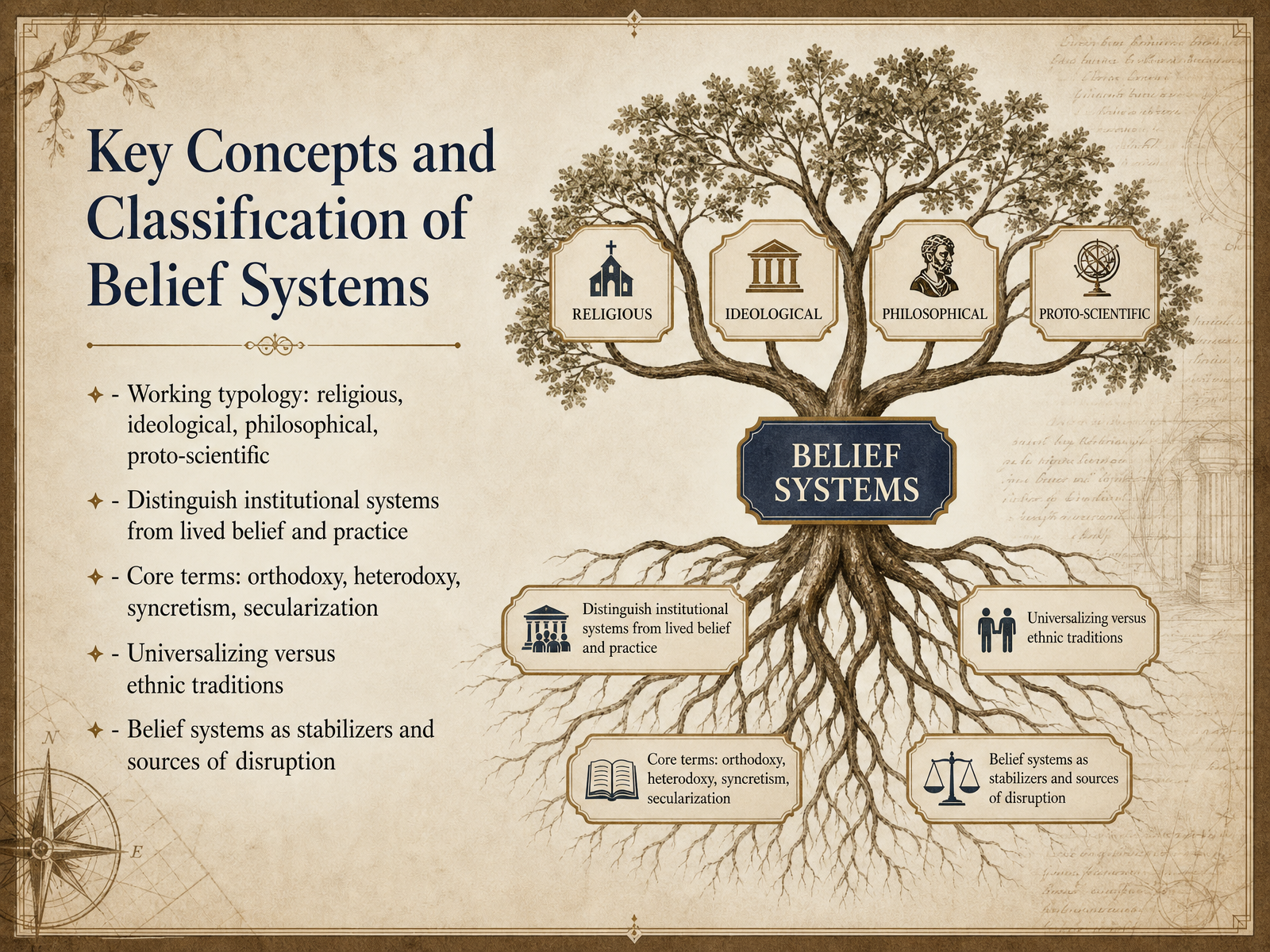
- 02Key Concepts and Classification of Belief SystemsLet’s begin by clarifying what we mean when we talk about belief systems. In this course, we’ll use a working typology that sorts them into four broad types: religious, ideological, philosophical, and proto-scientific. These categories overlap, but they help us compare traditions across time and place. It’s also important to distinguish between institutional systems—the formal structures, doctrines, and hierarchies—and lived belief and practice, what ordinary people actually do and think on the ground. History is full of cases where the two diverge. Now for some core terms. Orthodoxy means the officially accepted teachings of a tradition. Heterodoxy refers to beliefs that deviate from that standard. Syncretism occurs when different traditions blend, often through contact or conquest. And secularization names the process by which religious authority and institutions lose social influence. Another useful distinction is between universalizing religions, which seek converts across cultures, like Christianity, Buddhism, and Islam, and ethnic traditions, which are tied to particular peoples, like Judaism and Hinduism. Keep this framework in mind. Throughout history, belief systems have served as stabilizers, reinforcing social order and political legitimacy. But they have also been powerful sources of disruption, inspiring reform, resistance, and revolution. With these categories in hand, we can now explore how belief systems both drive and respond to social change.
 researchonline.lse.ac.ukberkleycenter.georgetown.educambridge.org+22 min
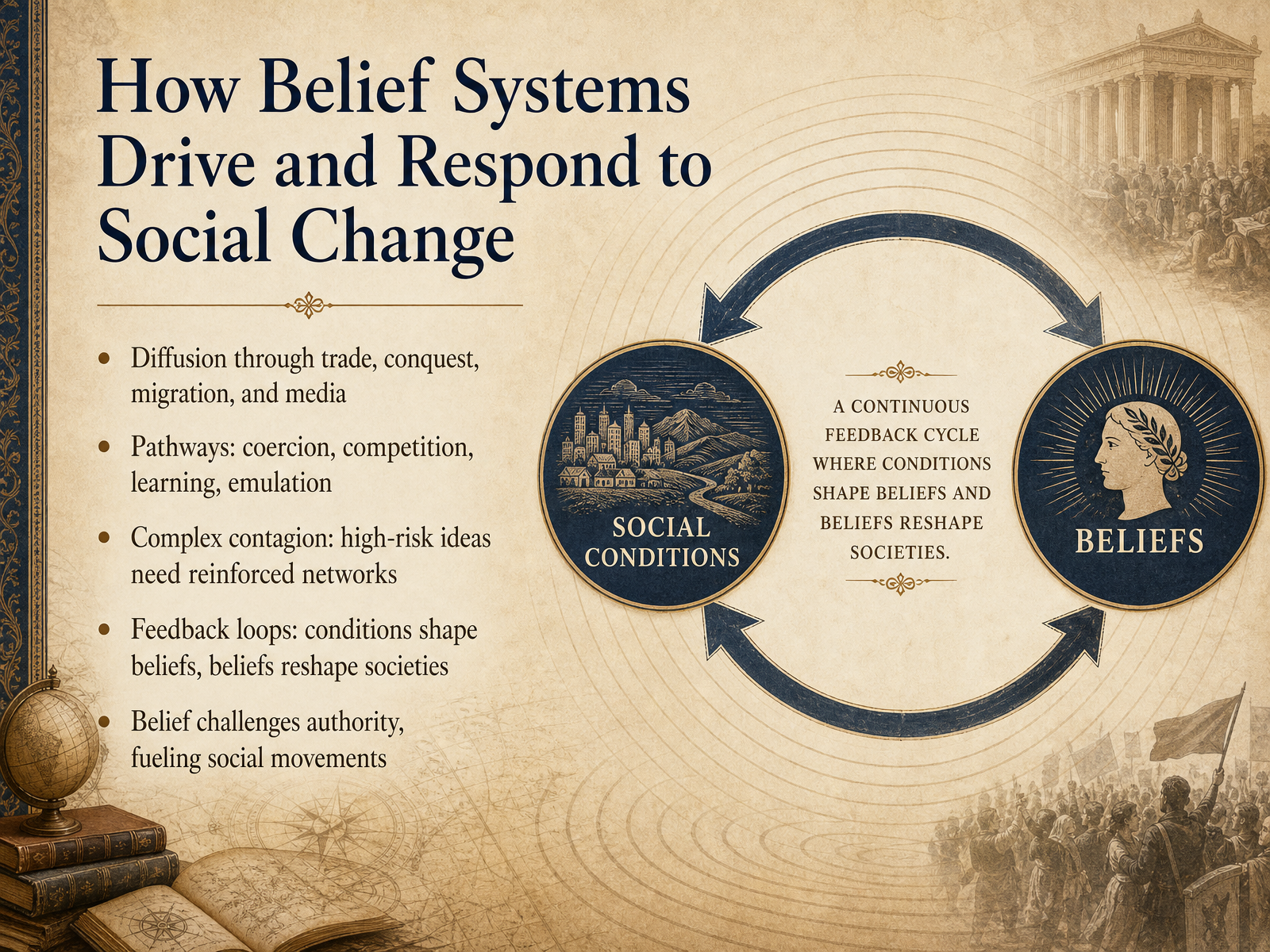
 - 03How Belief Systems Drive and Respond to Social ChangeSo let’s look at how belief systems actually spread and change societies. Ideas move through trade, conquest, migration, and, in modern times, media. But the pathways matter as much as the message. Sometimes beliefs are imposed by force—what scholars call coercion. Other times they spread through competition, as groups adopt more efficient ideas to survive. Learning plays a role too, when people study successful examples elsewhere. And often, beliefs spread through emulation, when communities copy what seems prestigious or modern. Now, here’s a key insight: high-risk ideas don’t spread like simple information. They require what researchers call complex contagion. That means people need repeated, reinforced contact from multiple trusted sources before they adopt costly or dangerous beliefs. The Reformation in Europe is a perfect example—it spread fastest through tightly connected trade networks where merchants and preachers reinforced the message again and again. And this process feeds back. Beliefs emerge from social conditions, but they also reshape those conditions. When a belief challenges authority, it can fuel social movements that redraw the entire social order. This is how ideas become history. Now, let’s take a step back and look at a pivotal era where belief systems themselves were transformed—the Axial Age, and its parallel breakthroughs in morality and philosophy.
 cambridge.orgcolumbia.eduannualreviews.org+22 min
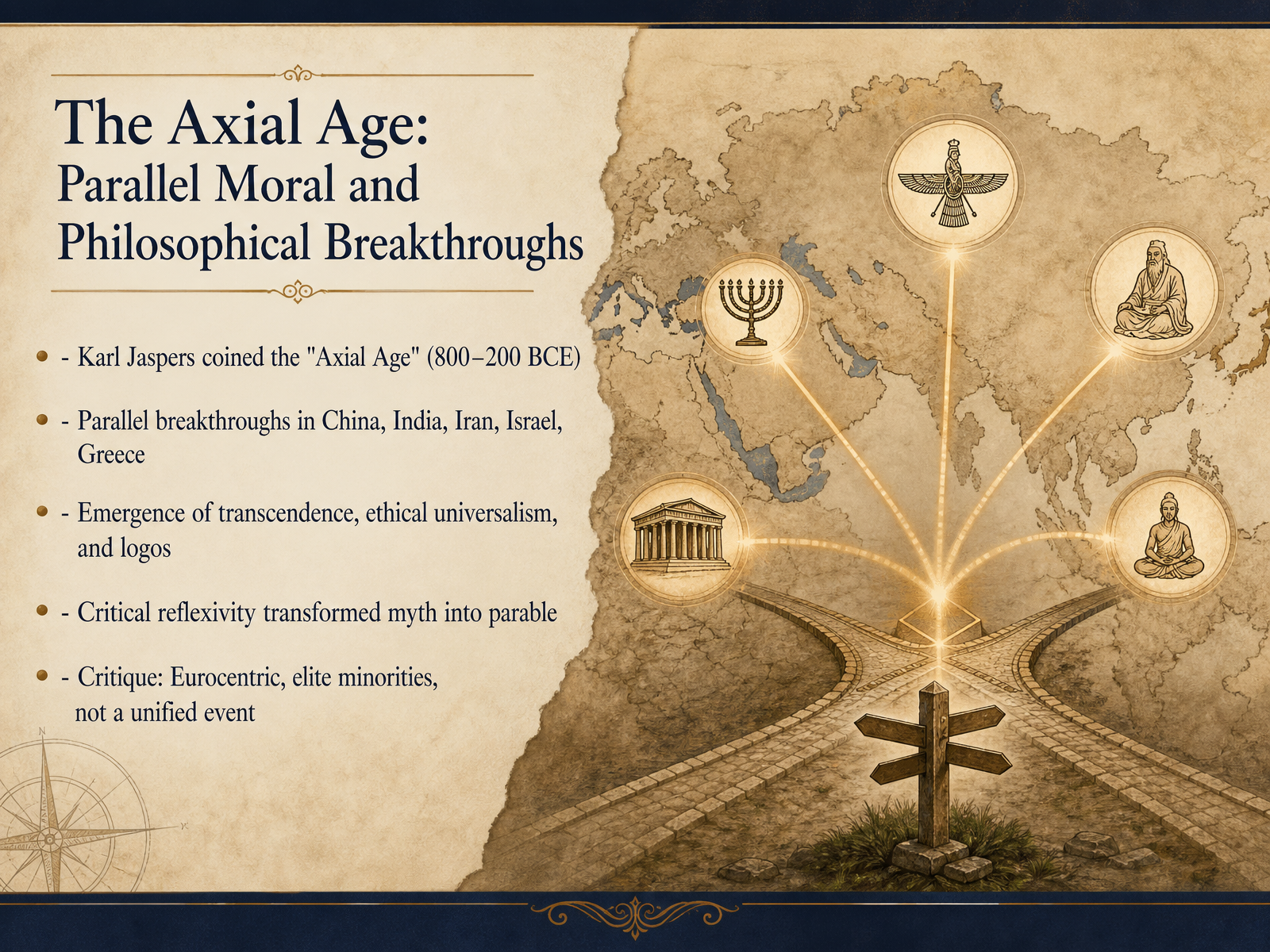
 - 04The Axial Age: Parallel Moral and Philosophical BreakthroughsNow we come to a concept that has shaped how historians think about this entire era, the Axial Age. The philosopher Karl Jaspers coined this term to describe a remarkable period between 800 and 200 BCE. During these centuries, something unprecedented happened. In China, India, Iran, Israel, and Greece, independently and without contact, parallel breakthroughs occurred in human thought. Thinkers began to reach beyond local myths and traditions. They started to ask universal questions about ethics, justice, and the nature of existence. A new sense of transcendence emerged, a belief that there is a reality beyond the immediate world. With this came ethical universalism, the idea that moral rules apply to everyone. And in Greece, this developed into logos, reasoned inquiry into the nature of things. This was a shift toward what scholars call critical reflexivity. Old myths were not simply discarded; they were reexamined and turned into parables that carried deeper moral meaning. But we must be careful. This concept is not without its critics. For one, it can appear Eurocentric, placing Western traditions at the center of a story that is truly global. And these breakthroughs were driven by small, elite groups of intellectuals and prophets, not by the masses of ordinary people. The Axial Age is less a single event and more a lens for understanding how diverse cultures independently pushed human thought in a new, more reflective direction. This brings us to how these ideas transformed into universalizing religions and drove imperial expansion.
 tandfonline.comcolumbia.eduexistenz.us+22 min
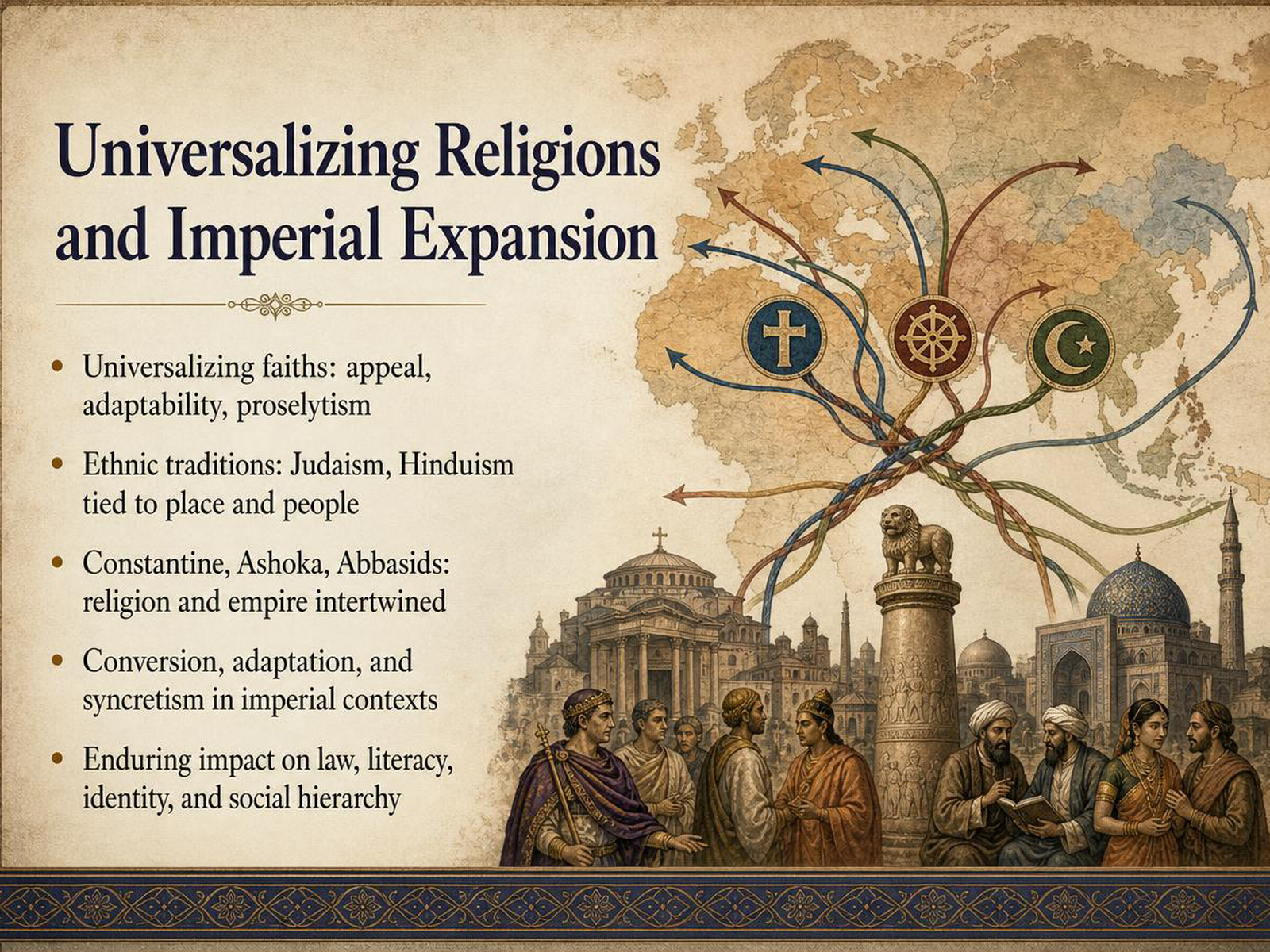
 - 05Universalizing Religions and Imperial ExpansionLet's now turn to the relationship between universalizing religions and imperial expansion. Universalizing faiths like Christianity, Buddhism, and Islam share key features: they appeal across social divides, adapt to new cultures, and actively seek converts. Ethnic traditions such as Judaism and Hinduism, by contrast, are tied to specific peoples and places and don't typically proselytize. Empires and these new religions often reinforced each other. Constantine's adoption of Christianity gave the faith imperial backing, while Ashoka's patronage spread Buddhism across South Asia. Later, the Abbasid caliphs built Baghdad as both a political capital and a center for Islamic learning. In imperial settings, conversion could be top-down, but local populations also blended new beliefs with existing customs, creating syncretic practices. This dynamic left lasting marks on law, literacy, identity, and social hierarchy—from canon law and Buddhist monastic schools to a shared sense of belonging across diverse subjects. So remember: when a universalizing religion and an empire aligned, they could transform entire regions, but the encounter was always a two-way process. Next, we'll consider how reformations and the printing press reshaped political order in early modernity.
 nerd.wwnorton.comnerd.wwnorton.comcambridge.org+21 min
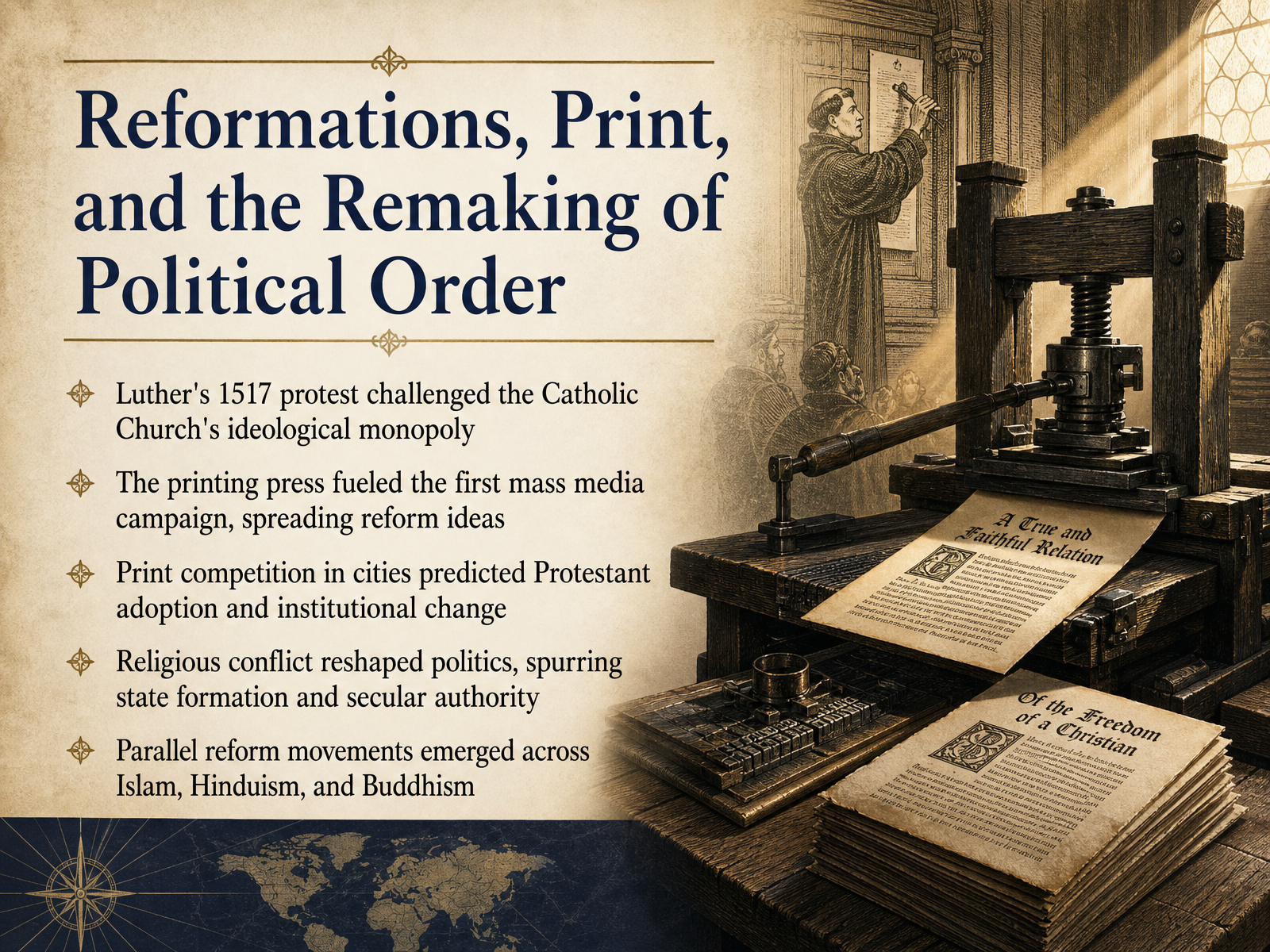
 - 06Reformations, Print, and the Remaking of Political OrderNow let's look at the Reformation, perhaps the clearest example of how new media and ideology can fracture an established order. When Martin Luther posted his protest in 1517, he directly challenged the Catholic Church's monopoly on interpreting scripture. But his words alone would not have been enough. The printing press turned a theological dispute into the first mass media campaign. Pamphlets and broadsheets spread reform ideas across German-speaking Europe within months. Economic historians have shown that competition mattered here. Cities with multiple printing firms produced far more Protestant content than towns where printing was controlled by a single publisher. And those competitive cities were significantly more likely to adopt Protestant institutions. The religious conflict that followed did not just change theology; it reshaped politics. As the Church's authority fragmented, territorial rulers consolidated control over their own churches, and this process accelerated the formation of sovereign states. Importantly, Europe was not alone in experiencing reform movements. Parallel efforts emerged within Islam, Hinduism, and Buddhism, each challenging established religious authority. The Reformation reminds us that when institutional monopolies meet new communication technologies, political order rarely remains intact. Up next, we will see how the Enlightenment turned this dynamic toward secular ideologies and revolutionary rupture.
 2 min
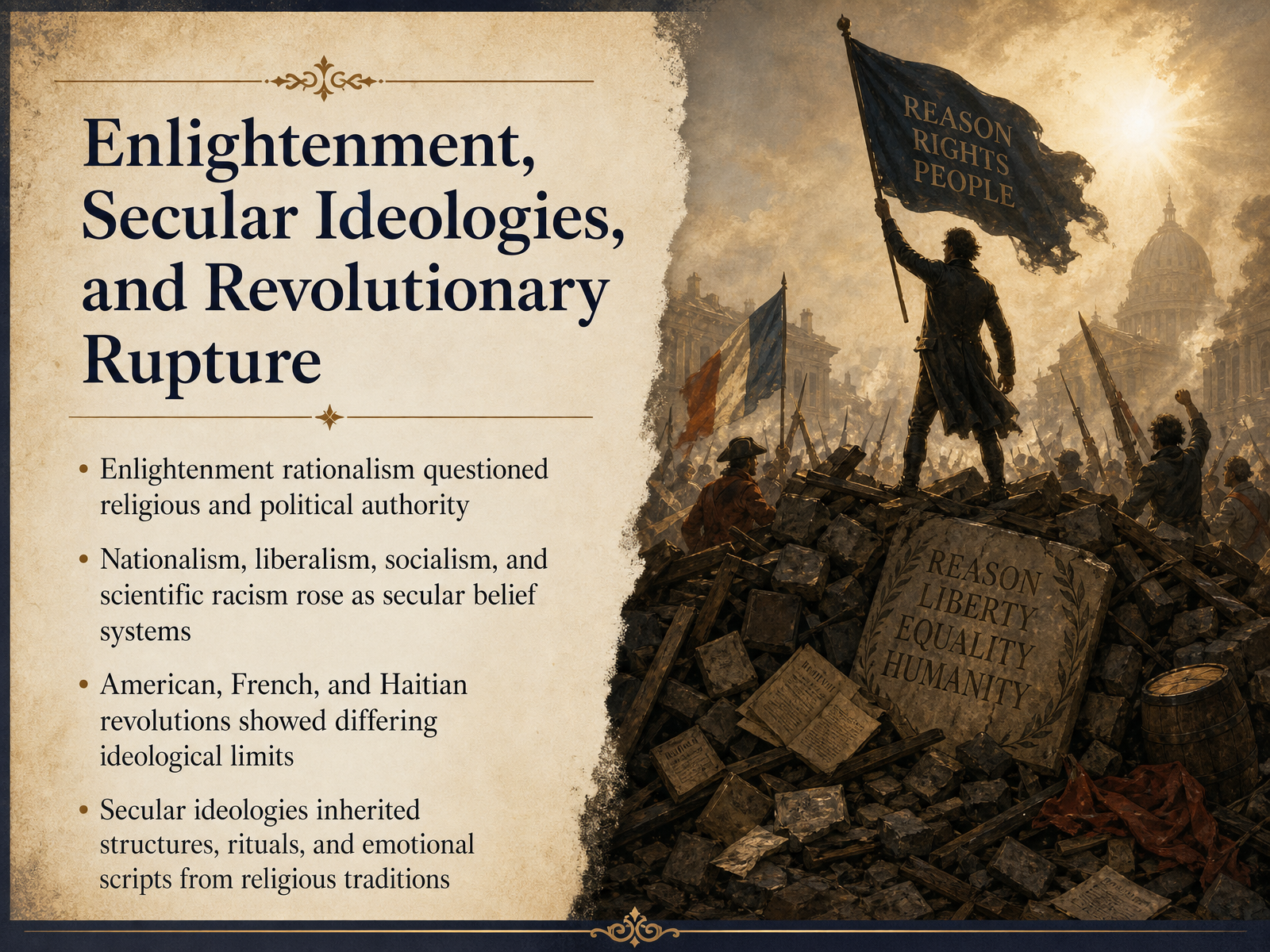
2 min - 07Enlightenment, Secular Ideologies, and Revolutionary RuptureNow we turn to the Enlightenment and the rise of secular belief systems. Enlightenment thinkers applied reason and empirical inquiry to religion, politics, and society. They questioned the divine right of kings and the authority of the Church. In place of tradition, they proposed that legitimate government rests on the consent of the governed. This sparked new secular ideologies: nationalism, liberalism, and socialism each offered a vision of how society should be organized, grounded in human reason rather than revelation. The American, French, and Haitian revolutions put these ideas into practice in starkly different ways. Americans sought a limited revolution, a change of government that preserved the existing social order. The French pursued something more total, an attempt to remake society from the ground up, which ultimately led to the Terror. The Haitian Revolution went furthest in its radical implications, asserting the equality of enslaved people and founding the first Black republic. Yet for all their novelty, these secular ideologies did not simply replace religion. They inherited its structures, its rituals, and its emotional scripts. Nationalism demanded sacrifice and devotion like a faith. Revolutionary festivals borrowed from religious processions. Marxism predicted a coming millennium. This continuity matters. Secular belief systems did not abolish the religious impulse; they channeled it into new forms of collective identity and political action. Later, we'll see how this interplay continues in decolonization, religious nationalism, and revival movements.
 2 min
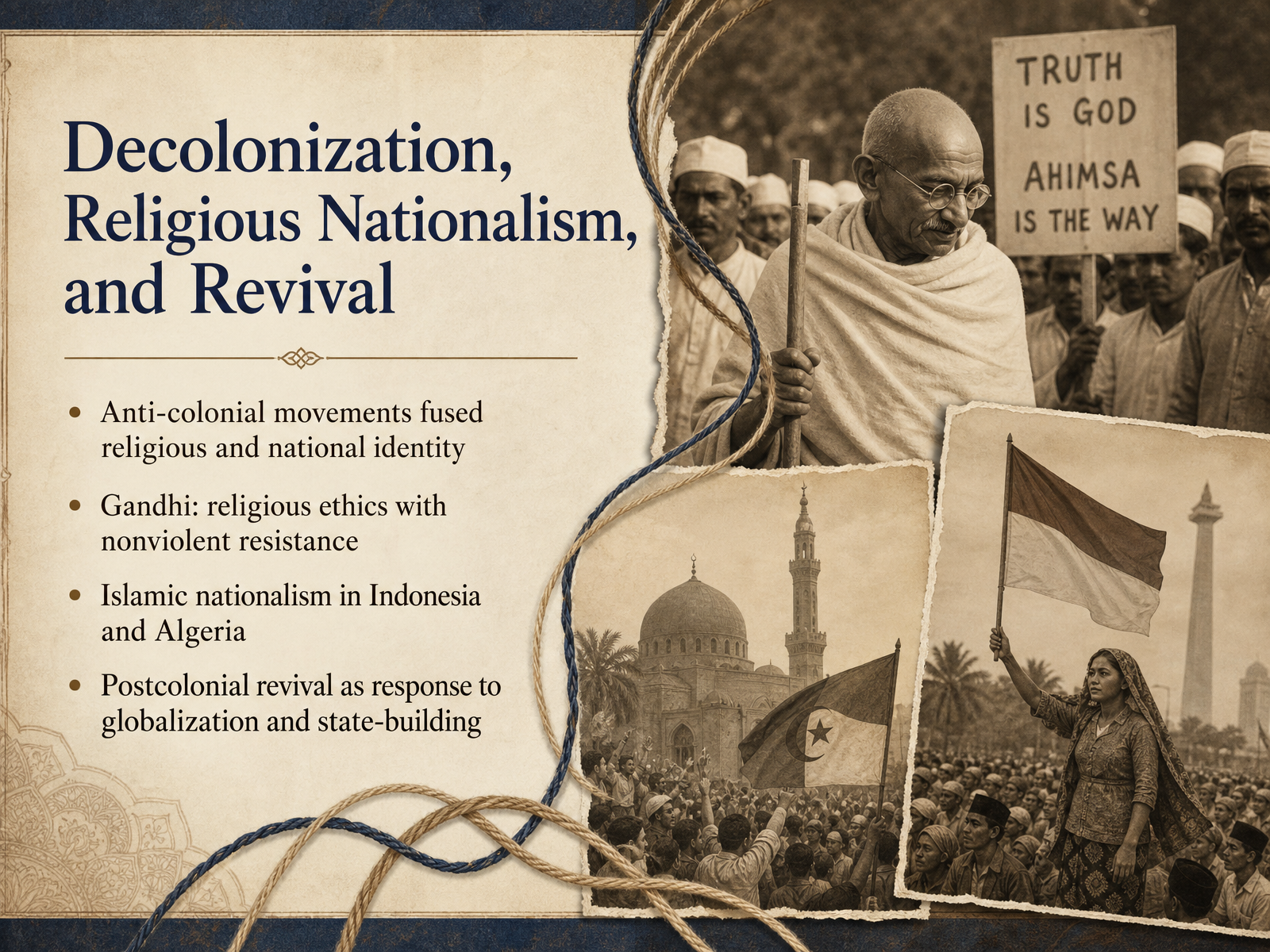
2 min - 08Decolonization, Religious Nationalism, and RevivalNow let’s look at how belief systems fueled decolonization and religious revival. Anti-colonial movements often fused religious and national identity, making faith a source of unity and resistance. In India, Gandhi combined religious ethics, drawn from Hinduism and Jainism, with nonviolent resistance, turning spirituality into a political strategy that inspired millions. In Indonesia, Islamic nationalism brought together diverse ethnic groups through organizations like the Sarekat Islam and Nahdlatul Ulama, giving people a shared identity in their struggle for independence. Similarly, in Algeria, Islamic reform movements and nationalist parties both claimed religious heritage, though they disagreed on whether political leadership should be spiritual or institutional. After independence, many postcolonial states faced the challenge of building new nations while responding to globalization. Religious revival often served as a way to reassert cultural identity and moral order in the face of rapid change. These examples show that belief systems were not just background but active forces in shaping political destinies. This brings us to how belief systems continue to evolve in the digital age.
 2 min
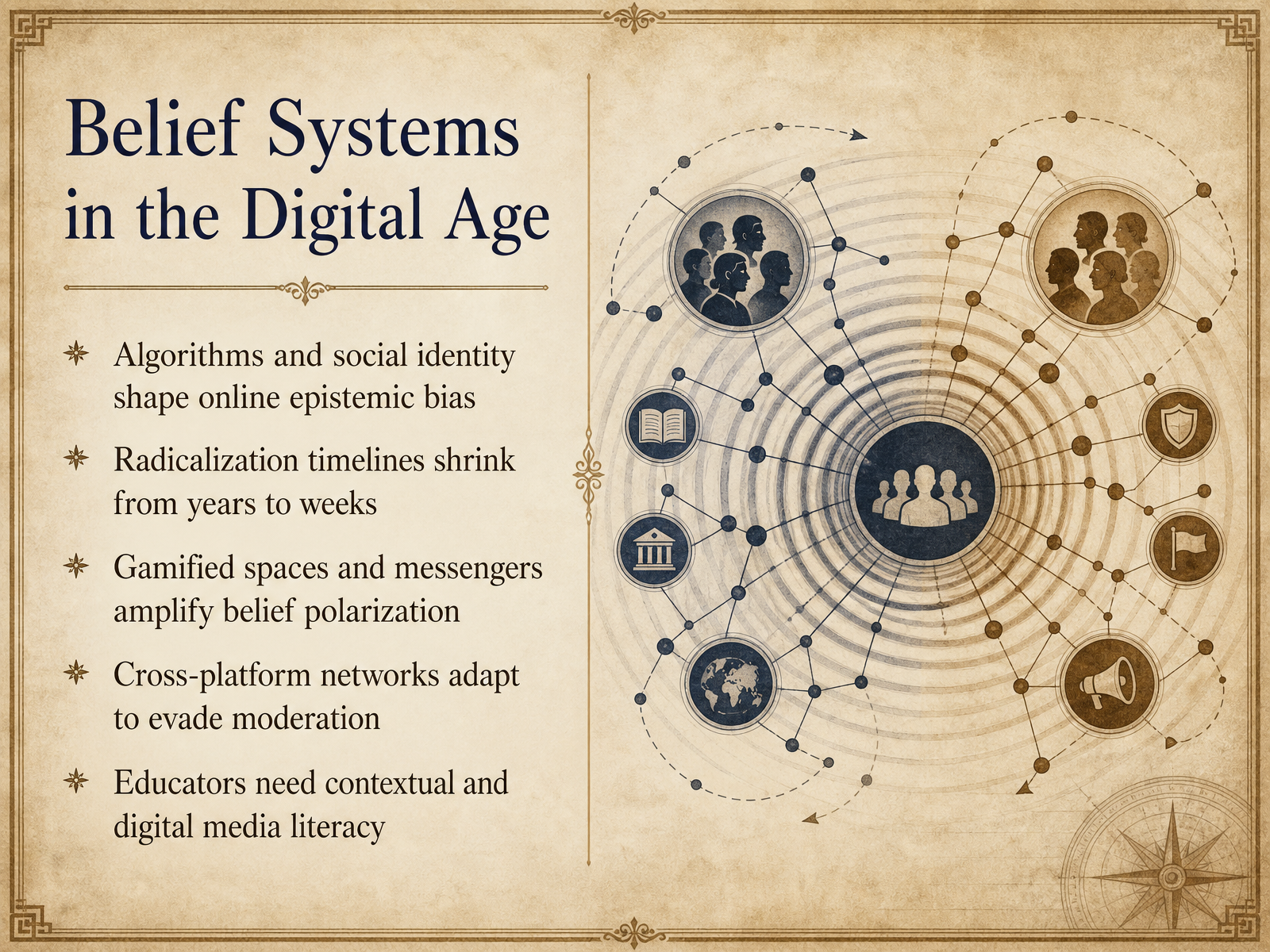
2 min - 09Belief Systems in the Digital AgeLet’s now consider how belief systems operate in the digital age. The online environment is not simply a neutral channel for ideas; it actively shapes how beliefs form, spread, and harden. Algorithms curate what we see, and when they amplify content that aligns with our existing identity, they create what researchers call identity-scaffolded bias. This means that the way we validate information becomes a group process, privileging coherence and social belonging over factual accuracy. One of the most striking findings is that the process of radicalization, which once took over a year, can now occur in a matter of weeks. This acceleration is particularly pronounced in less moderated, community-driven spaces, such as gaming platforms and messaging apps, where strong social ties and homophily create fertile ground for extreme views. Furthermore, extremist networks have adapted. They move across platforms, use coded language and emojis to evade moderation, and exploit under-moderated languages to survive takedowns. For educators, this landscape demands more than simply teaching people to spot misinformation. It requires a contextual digital media literacy that explains how platform design, social identity, and emotional rewards interact. Understanding these mechanisms is the first line of defense. This brings us to the question of how we can teach belief-driven change without falling into oversimplification, which we will explore next.
 2 min
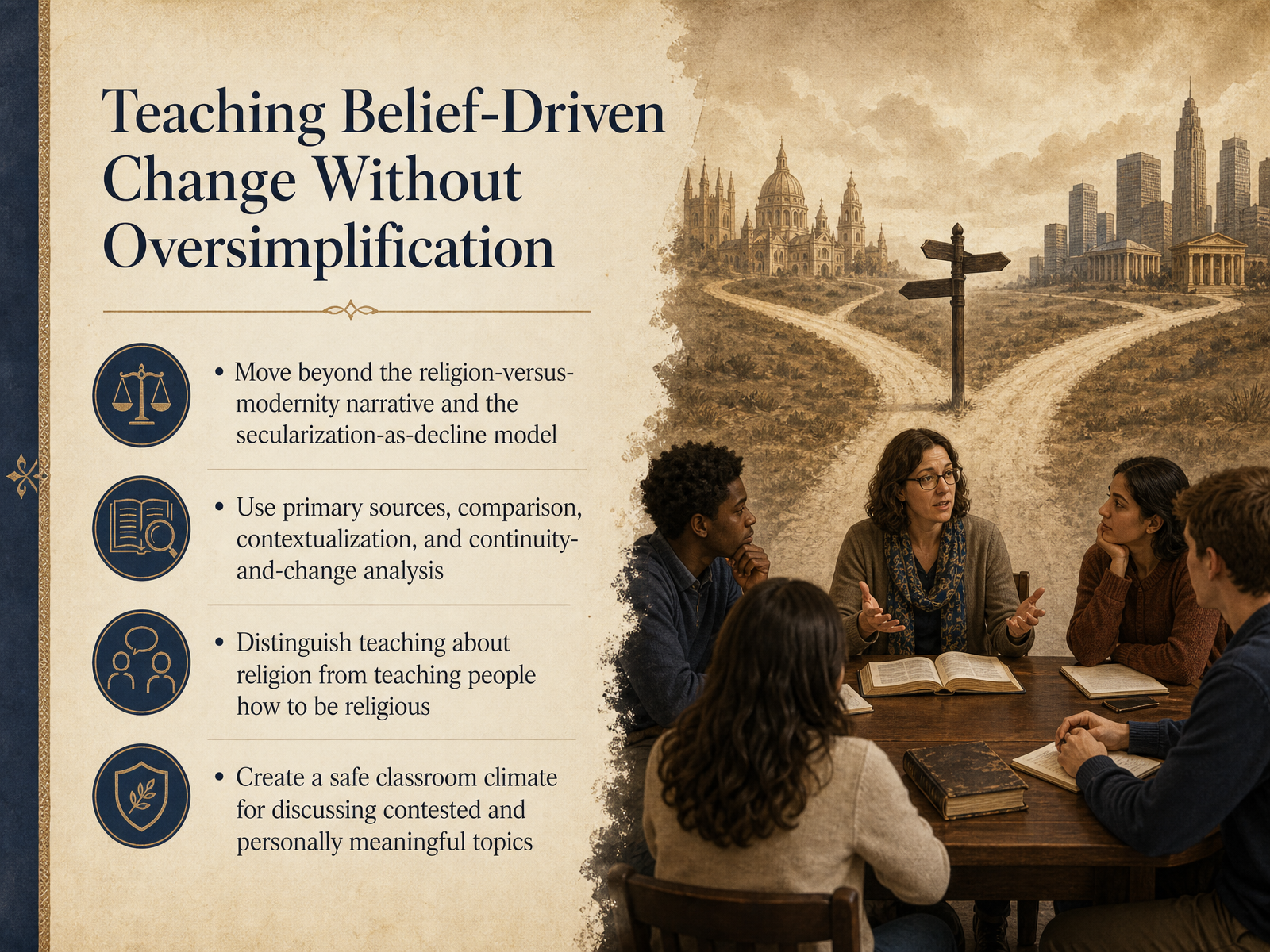
2 min - 10Teaching Belief-Driven Change Without OversimplificationNow, let's turn to how we actually teach this material without oversimplifying. The first step is to move beyond the comfortable narrative that opposes religion to modernity, or that treats secularization as the only path forward. Those models don't hold up to historical scrutiny. Instead, we want to equip students with the tools historians actually use. That means working directly with primary sources, comparing traditions across regions and eras, contextualizing beliefs within their specific social and political circumstances, and tracing continuity and change over time. As you design your lessons, keep a clear distinction in mind. Teaching about religion means helping students understand how belief systems function in history. It does not mean teaching them how to be religious. The classroom should be a space for academic inquiry, not proselytizing. Finally, create a climate where students feel safe discussing contested and personally meaningful topics. Establish norms for respectful disagreement, and be clear that all views are welcome for examination, even as you maintain academic standards. When students feel secure, they can wrestle with complexity instead of retreating to comfortable stereotypes. This approach lays the groundwork for our next discussion on selecting and verifying evidence for historical narratives.
 1 min
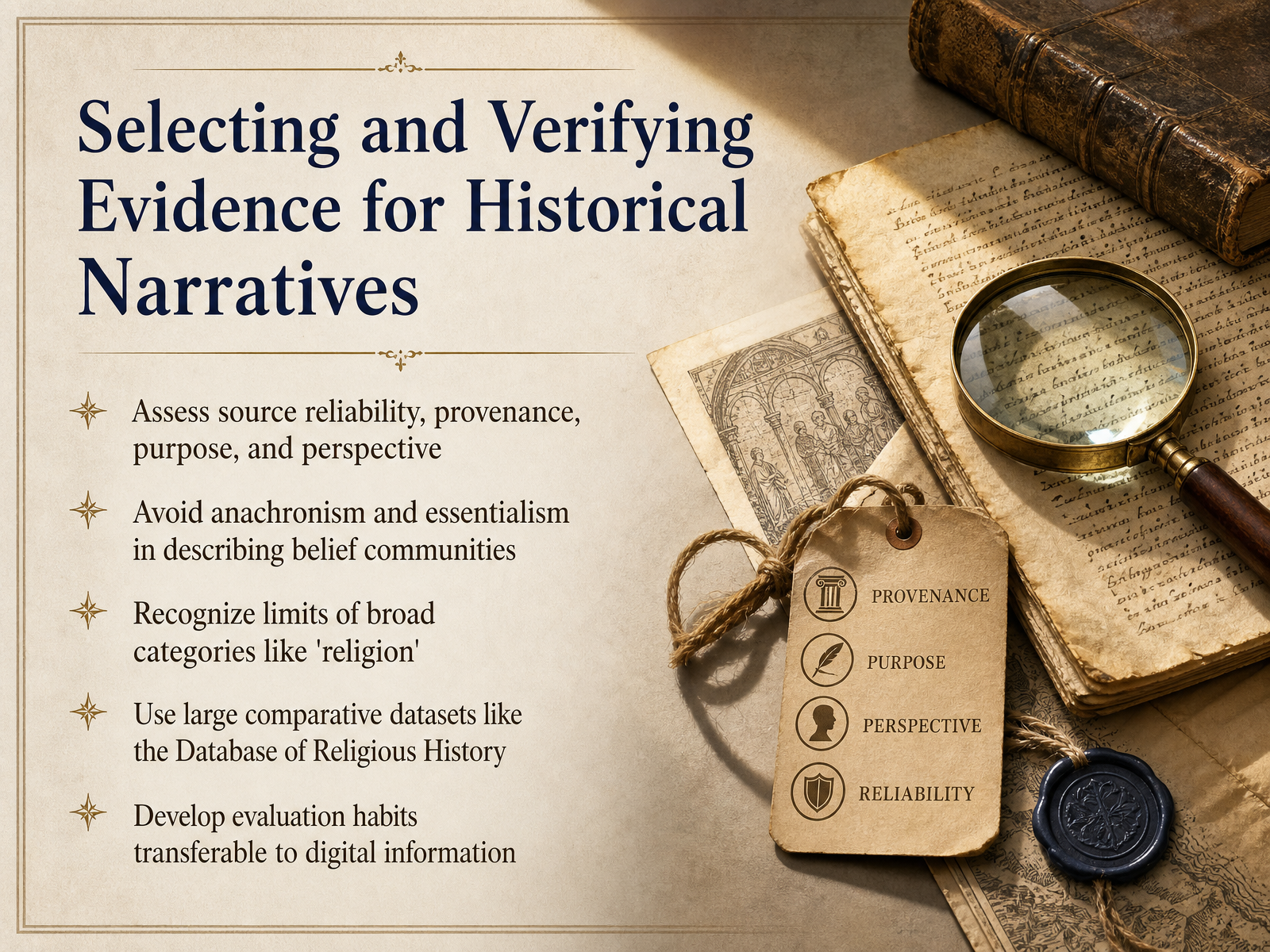
1 min - 11Selecting and Verifying Evidence for Historical NarrativesNow let's turn to the practical work of selecting and verifying evidence. When you encounter a historical source, ask four questions immediately. Who created it, and what was their purpose? Where does it come from, and whose perspective does it represent? These are not just academic exercises; they are essential habits for any serious investigator of the past. We must also guard against anachronism, which means projecting our modern ideas onto historical communities. Avoid essentialism too; do not assume that a belief community was monolithic or unchanging. Even terms like religion can be misleading, because that broad category may not have existed in the way we understand it. Large comparative projects, such as the Database of Religious History, help scholars test these categories and find real patterns. Internalize these evaluation habits and you will find they transfer directly to navigating digital information today.
 researchonline.lse.ac.ukberkleycenter.georgetown.educambridge.org+21 min
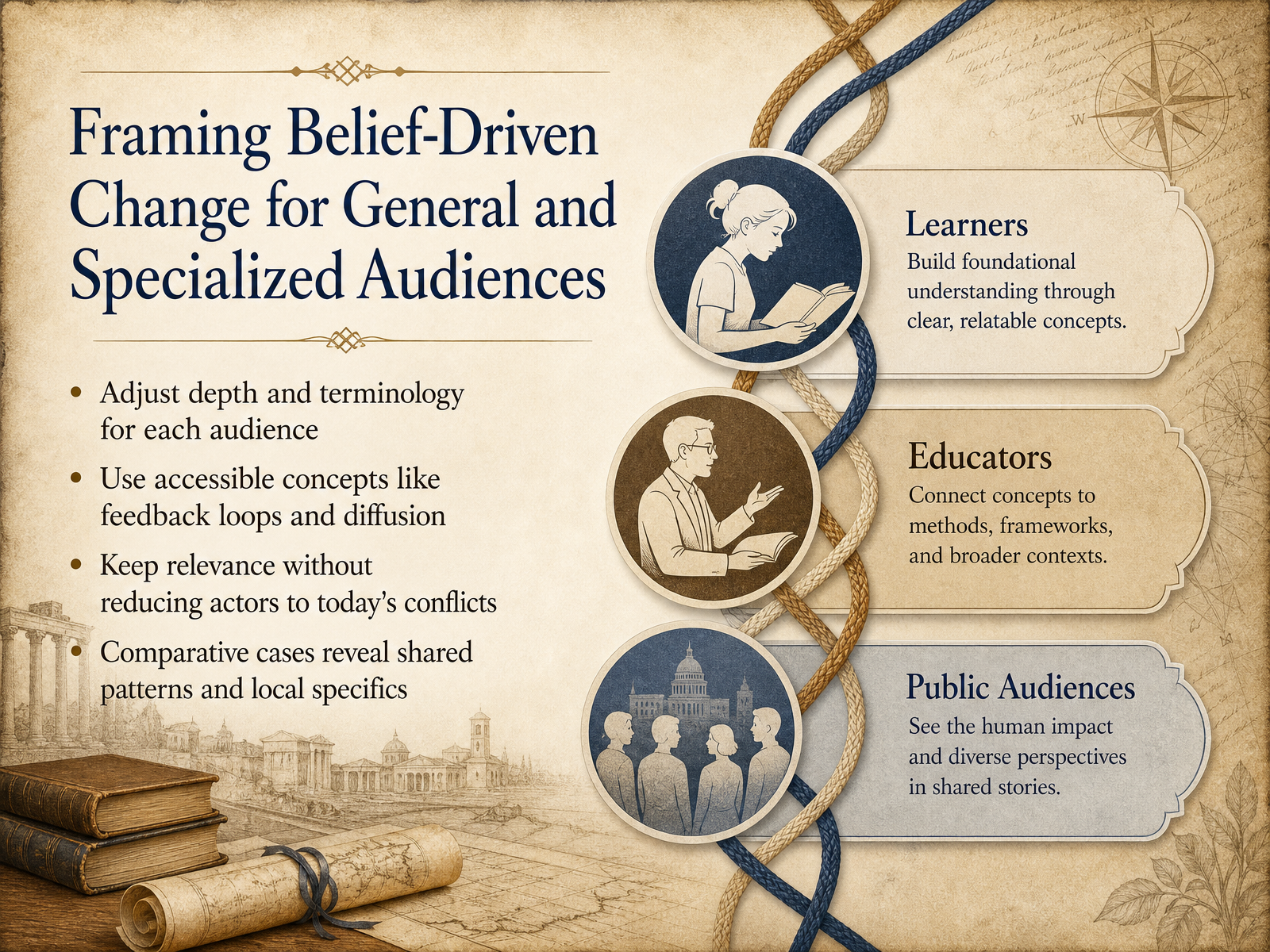
 - 12Framing Belief-Driven Change for General and Specialized AudiencesNow let’s turn to how we frame belief-driven change for different audiences. The key is adjusting depth and terminology without losing accuracy. For a general audience, use accessible concepts like feedback loops and diffusion — these translate across cultures and avoid insider jargon. For specialists, you can introduce more precise mechanisms, such as coercion, competition, learning, and emulation, which historians and social scientists use to explain how ideas travel. But regardless of audience, keep the relevance clear without reducing historical actors to stand-ins for today’s conflicts. That is a common trap. Instead, let comparative cases do the work. When you place two or three cases side by side, shared patterns emerge, and so do local specifics. That comparison is what turns a list of facts into a genuine argument. As we move into the practical tools for content creators and coursebuilders, keep this framing principle in mind: adjust the language, preserve the complexity, and let comparison carry the insight.
 cambridge.orgcolumbia.eduannualreviews.org+21 min
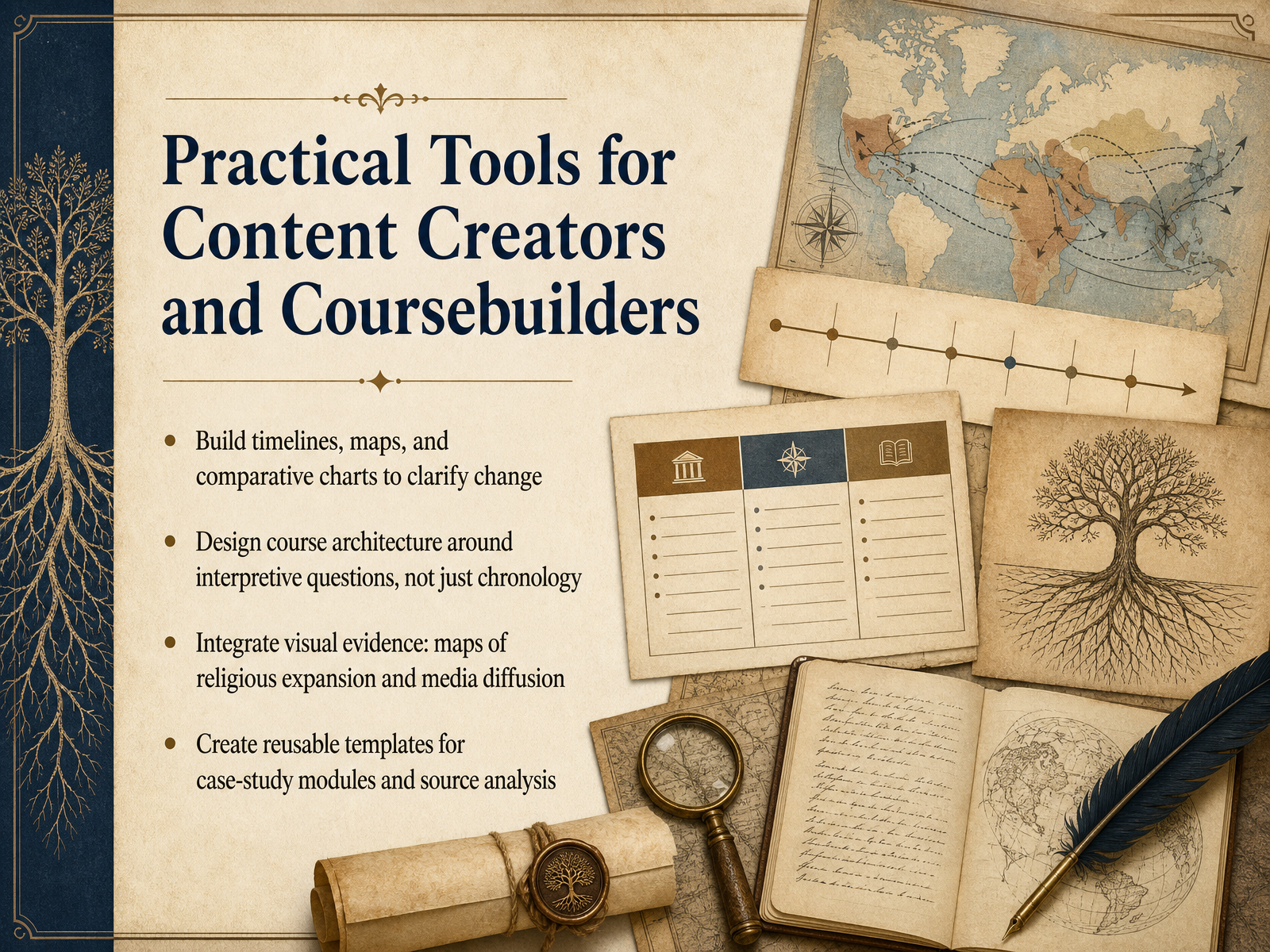
 - 13Practical Tools for Content Creators and CoursebuildersNow let's move from theory to practice. For content creators and coursebuilders, the goal is to make belief systems feel like living forces, not museum pieces. Start by building timelines, maps, and comparative charts. These tools help learners see change over time, not just a list of dates. They clarify how a religion moved along trade routes or how an empire's collapse reshaped a faith. Next, design your course architecture around interpretive questions, not just chronology. Ask why Buddhism spread so effectively along the Silk Roads, or how the Protestant Reformation changed the relationship between the individual and the state. These questions drive curiosity. Integrate visual evidence, such as maps of religious expansion or charts of media diffusion, to show how ideas travel. And finally, create reusable templates for case-study modules and source analysis. A consistent structure lets learners focus on the content, not the format. They can then compare a medieval pilgrimage with a modern online conversion. Keep these tools flexible. Your job is to build a scaffold for understanding, not a cage. Up next, we apply these tools in a case workshop, tracing the journey from axial transformation to algorithmic communities.
 nerd.wwnorton.comnerd.wwnorton.comcambridge.org+22 min
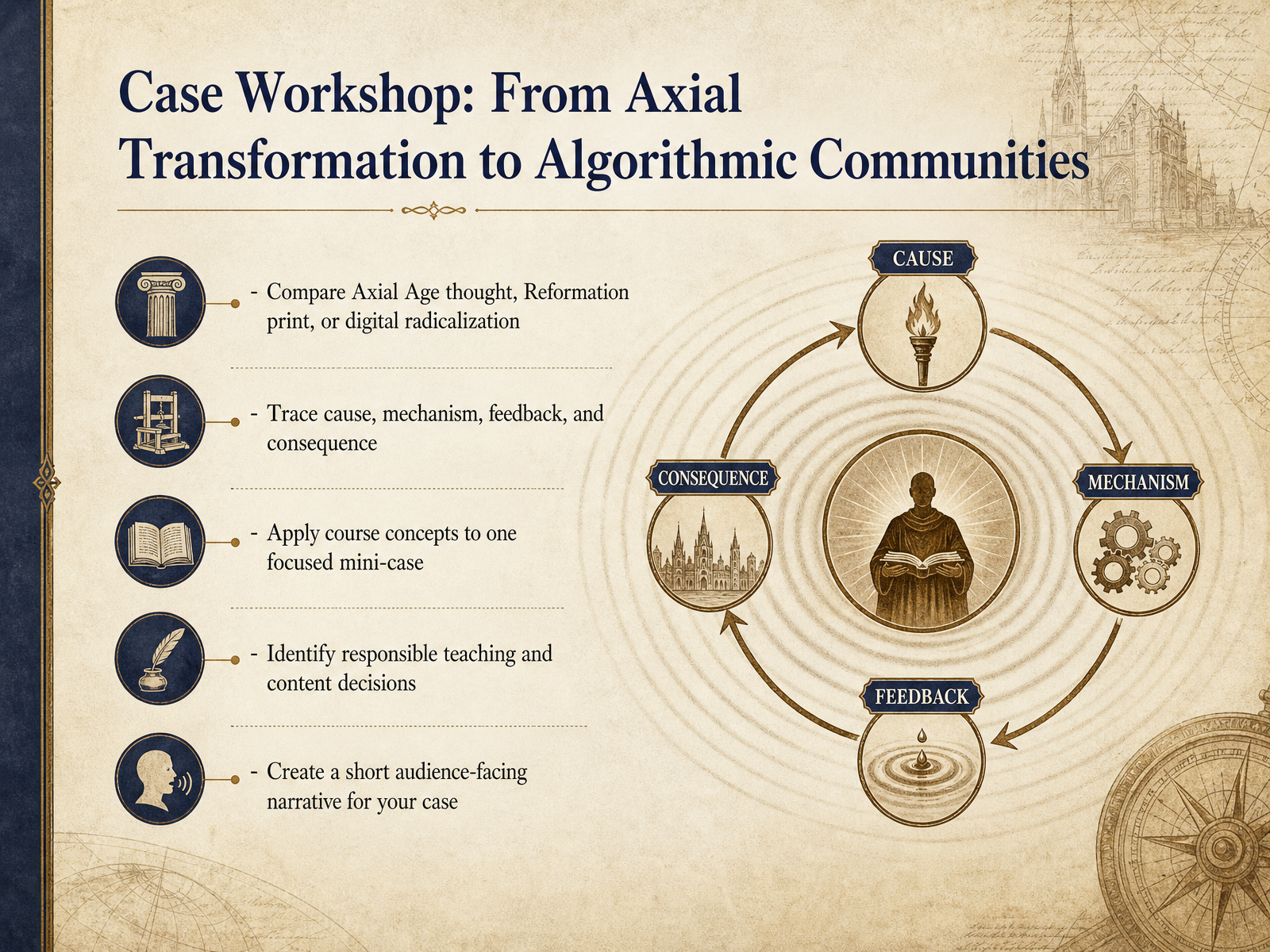
 - 14Case Workshop: From Axial Transformation to Algorithmic CommunitiesLet us now bring these patterns together in a workshop-style comparison. Consider three moments of belief-driven change: the Axial Age transformation, the Protestant Reformation with its printing presses, and today's digitally formed communities. For each, trace the same four elements: the cause that unsettled existing authority, the mechanism that carried the new ideas, the feedback loop that reinforced them, and the consequence for social order. Take as a mini-case the move from scroll to codex, from pulpit to pamphlet, or from forum to encrypted channel. In each, ask who gained interpretive power and who lost it. Then design a short, audience-facing narrative for your case that explains not just what changed but why it mattered. As educators and content creators, your role is not to take sides but to make the mechanics of belief visible. The goal is to help your audience see that belief systems are never static; they are living responses to the conditions of their time, and they will keep evolving. With that in mind, let us turn to synthesis and next steps for instructors and creators.
 tandfonline.comcolumbia.eduexistenz.us+22 min
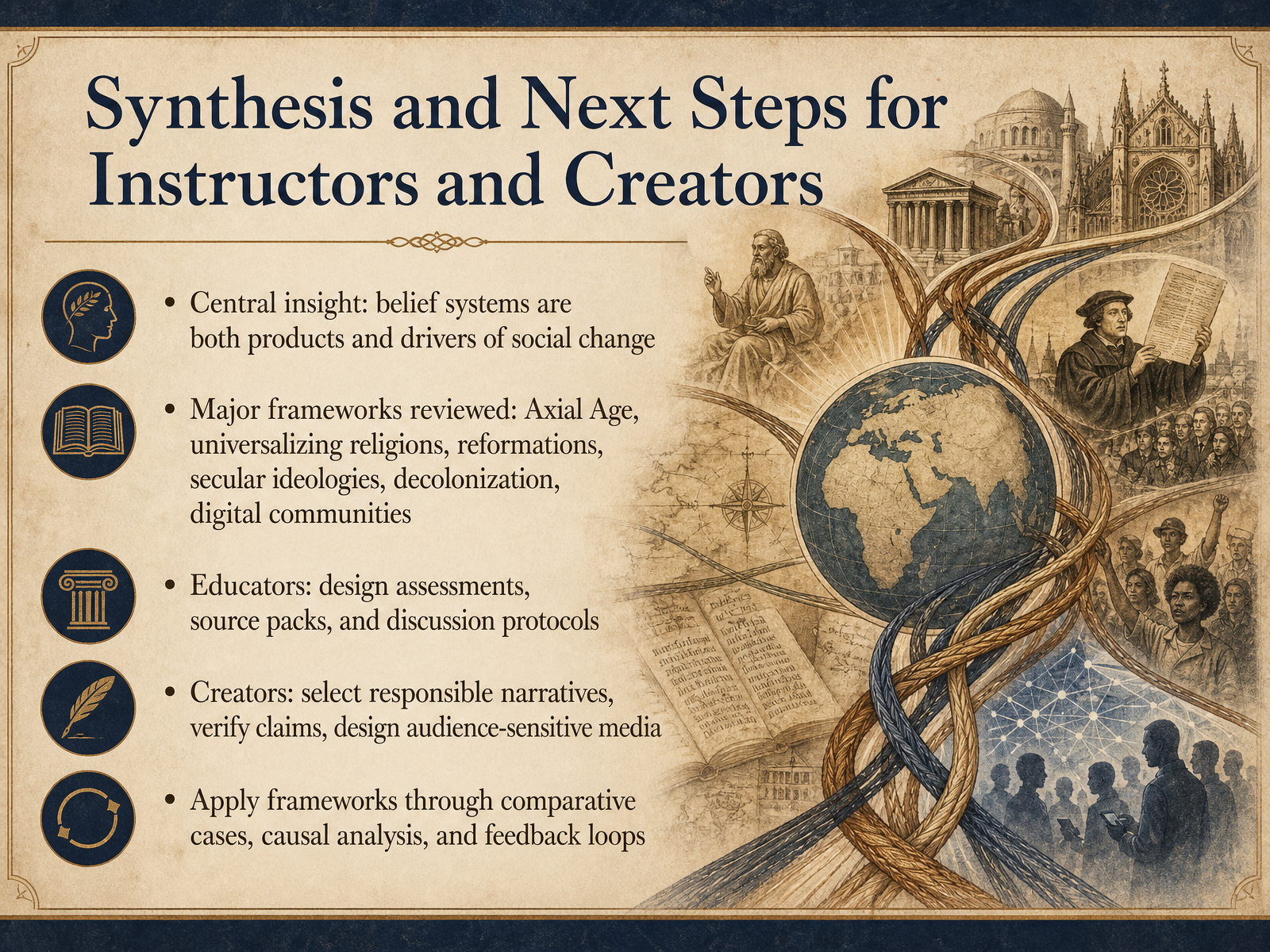
 - 15Synthesis and Next Steps for Instructors and CreatorsWe have reached the end of our journey, so let us pull the threads together. The central insight is this: belief systems are not just products of social change; they are also powerful drivers of it. We have reviewed the Axial Age, universalizing religions, reformations, secular ideologies, decolonization, and digital communities. Throughout, we have seen belief systems function as dynamic forces shaped by power, culture, and human agency. For educators, this means designing assessments and source packs that treat beliefs as living frameworks, not static trivia. Use discussion protocols that allow students to trace causality and change over time. For creators, the responsibility is to select narratives carefully, verify claims, and design media that respects audience sensitivity. Apply these frameworks through comparative cases, causal analysis, and feedback loops. You now have the tools to teach and create with nuance. Thank you for your attention, and I hope you carry this curiosity forward into your own work.
 researchonline.lse.ac.ukberkleycenter.georgetown.educambridge.org+22 min
Take the deck with you
Download this course as a file — free, no sign-up needed.
- PDF handoutEvery slide page, ready to print or share.16 pages · 7.0 MBDownload
- Narrated PowerPointThe deck that presents itself — every slide carries the digital human's narration video.16 pages · 21.0 MBDownload
- PowerPoint slidesThe full deck as a .pptx — open it in PowerPoint, Keynote, or Google Slides.16 pages · 7.0 MBDownload
Free to use in your own training — please keep the PersonWise credit page at the end.
Have your own deck? Turn it into a course
Sources consulted
Web sources consulted while building this course.
- (2023) On the category of religion: a taxonomic analysis of a large-scale database. Journal of the American Academy of Religion, https://doi.org/10.1093/jaarel/lfad065 https://researchonline.lse.ac.uk/id/eprint/121113/ — researchonline.lse.ac.uk
- Global Religious and Secular Dynamics: The Modern System of Classification — berkleycenter.georgetown.edu
- Unearthly Powers — cambridge.org
- The Evolution of Religions | Columbia University Press — cup.columbia.edu
- The World Religion Dataset, 1945–2010: Logic, Estimates, and Trends — doi.org
- Historical and Comparative Research on Social Diffusion: Mechanisms, Methods, and Data | Social Science History | Cambridge Core — cambridge.org
- [PDF] Domains of Diffusion: How Culture and Institutions Travel around the ... — columbia.edu
- The Global Diffusion of Public Policies: Social Construction, Coercion, Competition, or Learning? | Annual Reviews — annualreviews.org
- The World-Cultural Origins of Revolutionary Waves — cambridge.org
- Historical and Comparative Research on Social Diffusion: Mechanisms ... — cambridge.org
- Between facts and myth: Karl Jaspers and the actuality of ... — tandfonline.com
- CHAPTER ONE — columbia.edu
- Context and Meaning of the Axial Age Concept — existenz.us
- The “Axial Period”: What Was It and What Does It Signify? — cambridge.org
- Karl Jaspers (Stanford Encyclopedia of Philosophy) — plato.stanford.edu
- Chapter 1: The Rise of Universalizing Religions, 300–600 CE — nerd.wwnorton.com
- Religious Change and Empire in Western Afro-Eurasia — nerd.wwnorton.com
- From cakravartin to bodhisattva: Buddhist models for globalization | Journal of Global History | Cambridge Core — cambridge.org
- Kingdoms of This World - Baylor University Press — baylorpress.com
- Kuṣāṇa Emperors and Indian Buddhism: Political, Economic and Cultural Factors Responsible for the Spread of Buddhism through Eurasia — tandfonline.com