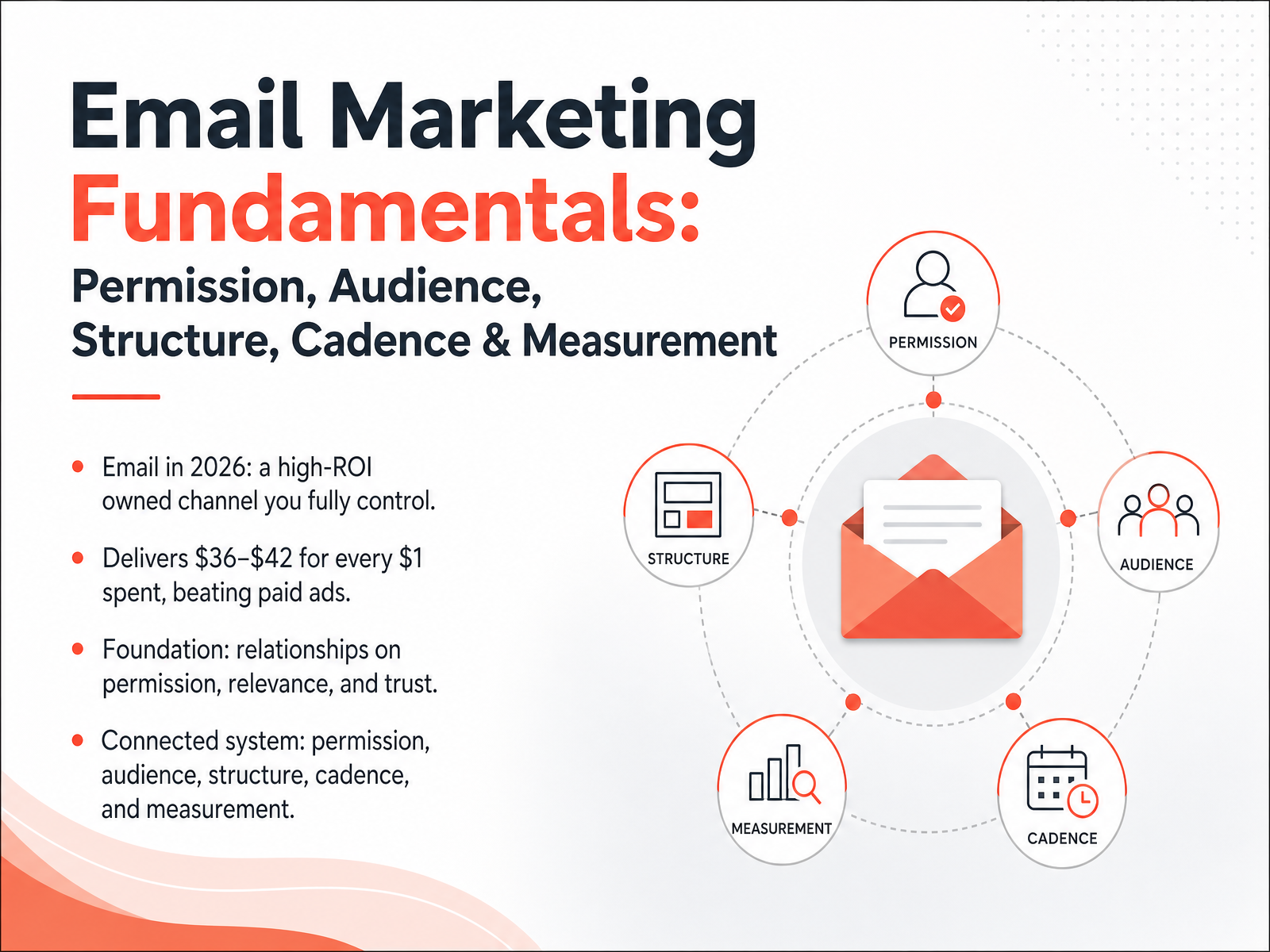
Email Marketing Fundamentals
Begin
11 pages · ~22 min
Email Marketing Fundamentals
Learn the fundamentals of email marketing, including building subscriber lists, crafting effective campaigns, and analyzing performance to drive engagement.
What you’ll learn
- 01Email Marketing Fundamentals: Permission, Audience, Structure, Cadence & MeasurementWelcome. This course is about bringing together the five elements you already know are essential: permission, audience, structure, cadence, and measurement. Our goal is to help you see them as a single connected system and make sharper strategic decisions. Let’s start by framing the opportunity. Email in 2026 remains a high return channel that you fully own. It consistently delivers thirty six to forty two dollars for every dollar spent, outperforming paid ads. That performance rests on a foundation of relationships built through permission, relevance, and trust. Throughout this session, we will treat permission, audience, structure, cadence, and measurement not as separate checklists but as a linked system where each choice shapes the others. Up next, we explore why email holds its place as the highest return channel in 2026.1 min
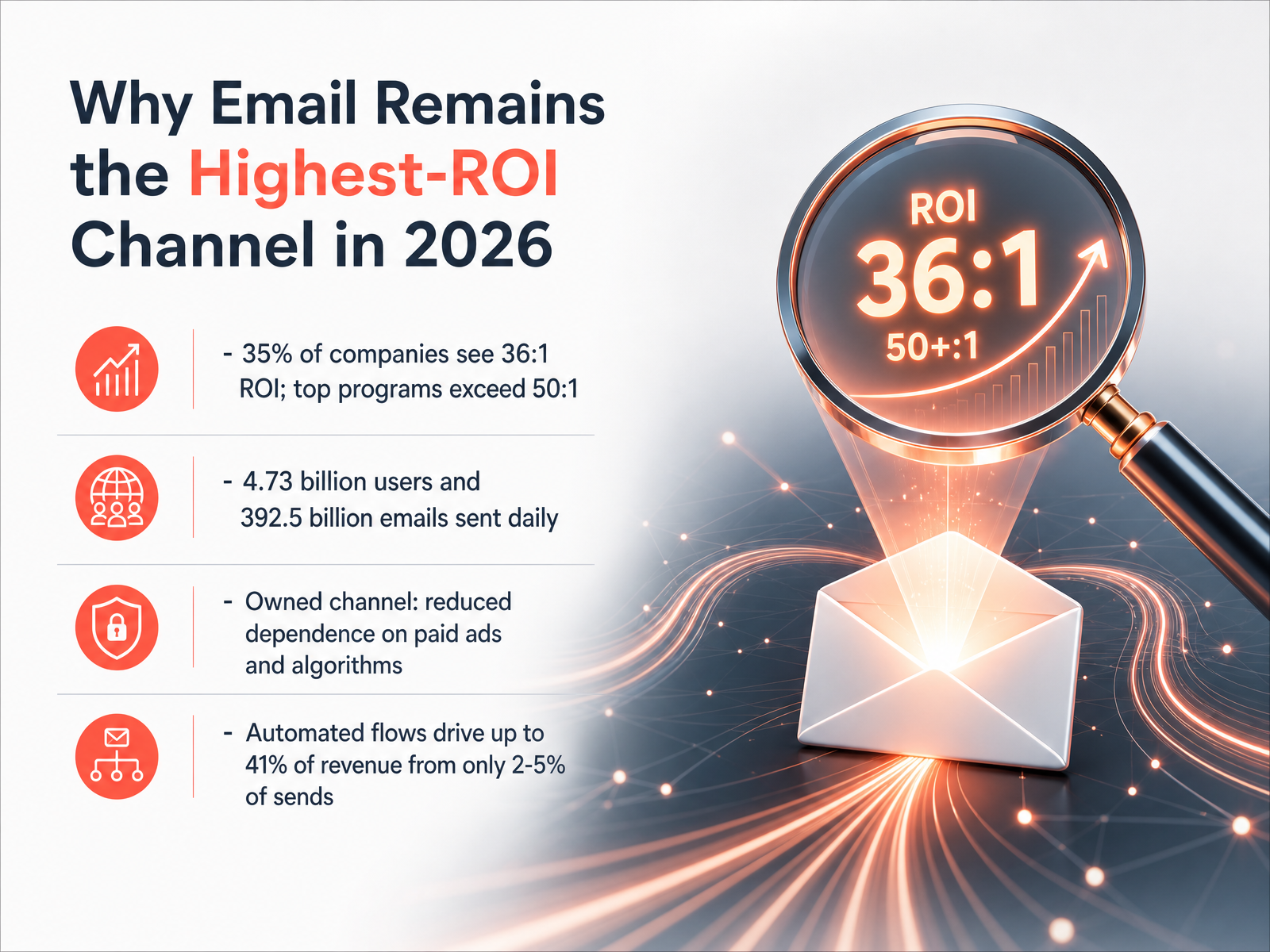
- 02Why Email Remains the Highest-ROI Channel in 2026Let's ground our strategic discussion with a look at why email's strength continues to compound. We're not just working with a high-performing channel; we're working with the highest-ROI channel, and the data for twenty twenty-six makes this clear. Consider that thirty-five percent of companies consistently see a thirty-six-to-one return. The top programs are now driving returns exceeding fifty-to-one. This performance is fueled by massive, active reach. We're talking about four point seven three billion users generating over three hundred ninety-two billion emails every single day. More strategically, email is an owned channel, which means every optimization you make reduces our dependence on rising paid ad costs and opaque algorithm changes. It's an asset we fully control. And this control becomes powerful profit when we apply automation. Automated flows, which may represent only two to five percent of total sends, are routinely driving up to forty-one percent of total email revenue. It's a clear signal to align our audience segmentation and send cadence precisely with these automated triggers. Now, none of this performance is possible without a solid foundation. Let's move into that critical first layer: Permission one-oh-one, the foundation of everything.
 2 min
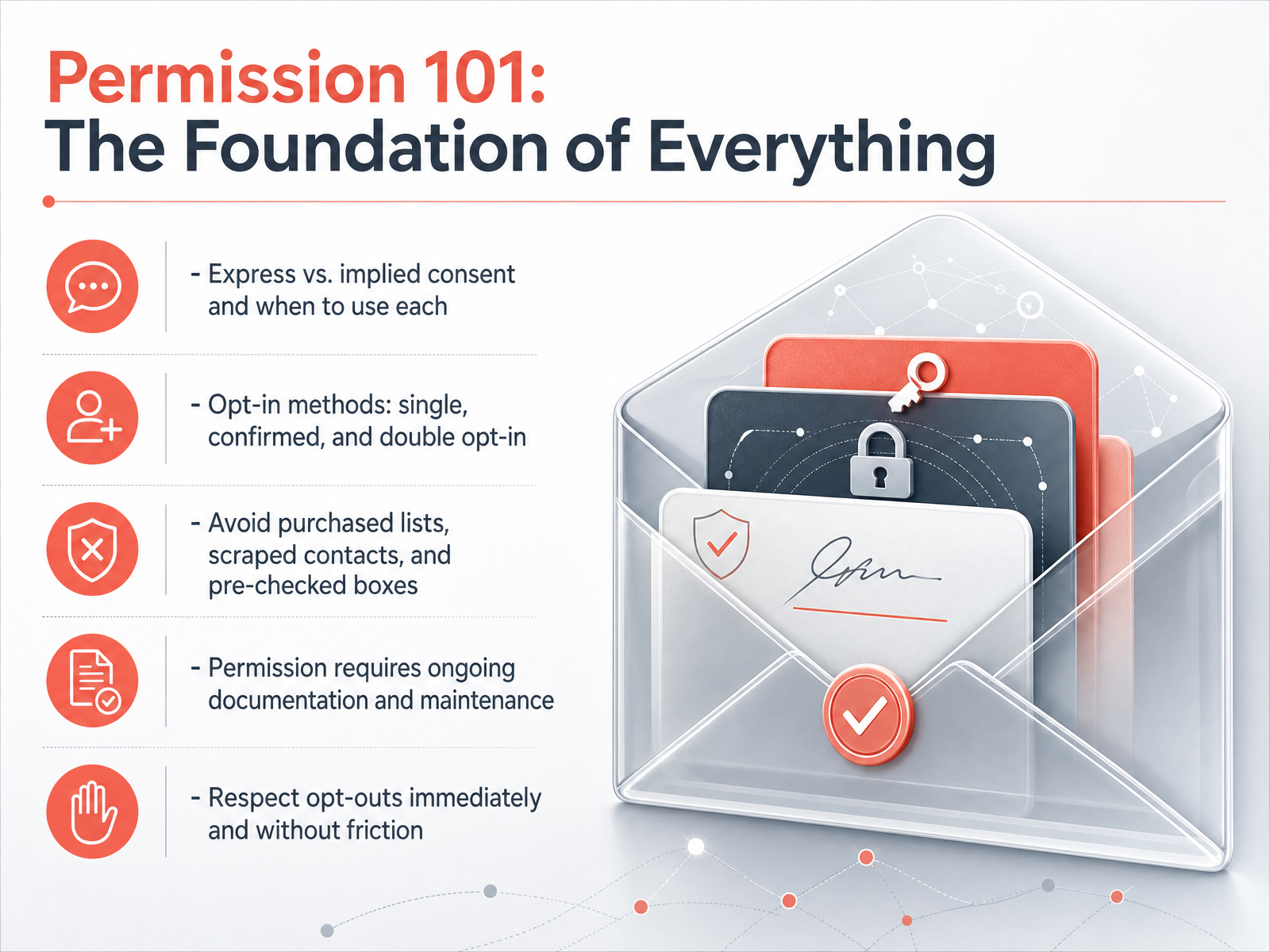
2 min - 03Permission 101: The Foundation of EverythingLet's solidify the very foundation of our email program—permission. Think of it as a spectrum. On one end, express consent is given directly and clearly, such as when someone fills out a form specifically to receive your newsletter. It's the gold standard. Implied consent exists where there's a logical business relationship, like a customer who just made a purchase. You need to know when each applies by regulation and when only express consent will do. That decision then shapes your opt-in method. A single opt-in is simple but risky. Confirmed opt-in sends a welcome message to verify interest, while double opt-in requires that extra click, actively trading some list growth for maximum hygiene and engagement. Above all, we avoid shortcuts. Purchased lists and scraped contacts carry no permission and immediately damage your sender reputation. Always stay clear of pre-checked boxes in your forms; they may add numbers, but they do not add willing subscribers. And once permission is granted, it is an ongoing asset you must document and maintain, cleaning inactive subscribers and honoring every unsubscribe request instantly and without friction. Now, let's align these permission principles with the legal frameworks that enforce them in the next slide, The Legal Landscape: GDPR, CAN-SPAM, CCPA, and Beyond.
 2 min
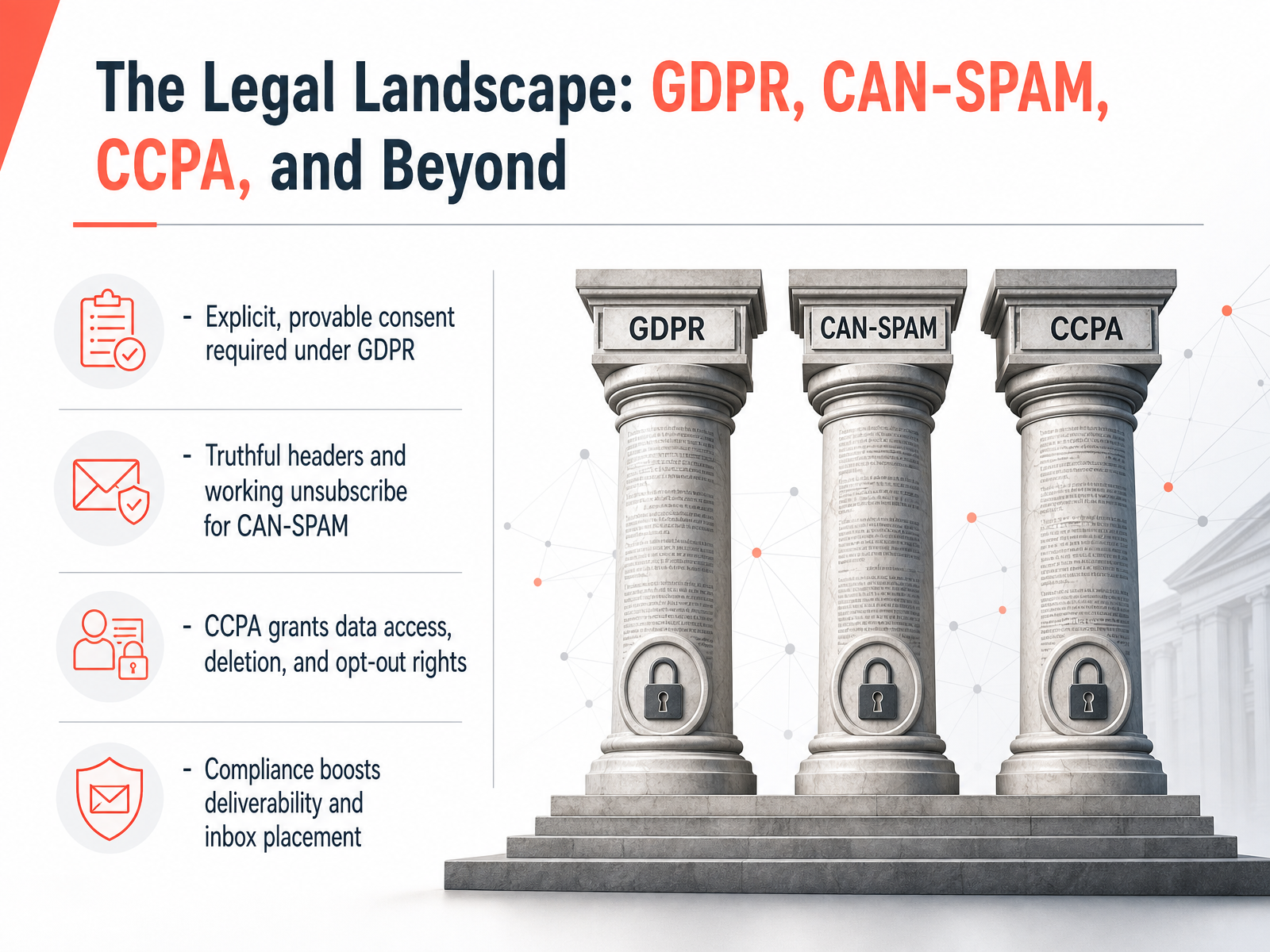
2 min - 04The Legal Landscape: GDPR, CAN-SPAM, CCPA, and BeyondNow let's align your sending practices with the legal frameworks that shape modern email marketing. Under GDPR, the core requirement is explicit, provable consent. This means you need a clear record of what a subscriber agreed to, when they agreed, and through which method. It moves you beyond simple permission into evidence-based permission. For CAN-SPAM compliance, focus on two non-negotiables: truthful header information and a working unsubscribe mechanism that processes opt-outs within ten business days. CCPA adds another layer, giving users the right to know what data you hold, request deletion, and opt out of having their information sold. Treat these regulations not as obstacles but as alignment tools. Compliance directly improves your sender reputation, which raises deliverability and strengthens inbox placement. When your consent practices are clean, mailbox providers trust your traffic and your messages reach the primary inbox more reliably. Let's carry that principle forward into list hygiene. Up next, we will cover how to move from consent to clean lists, managing unsubscribes effectively to protect deliverability.
 2 min
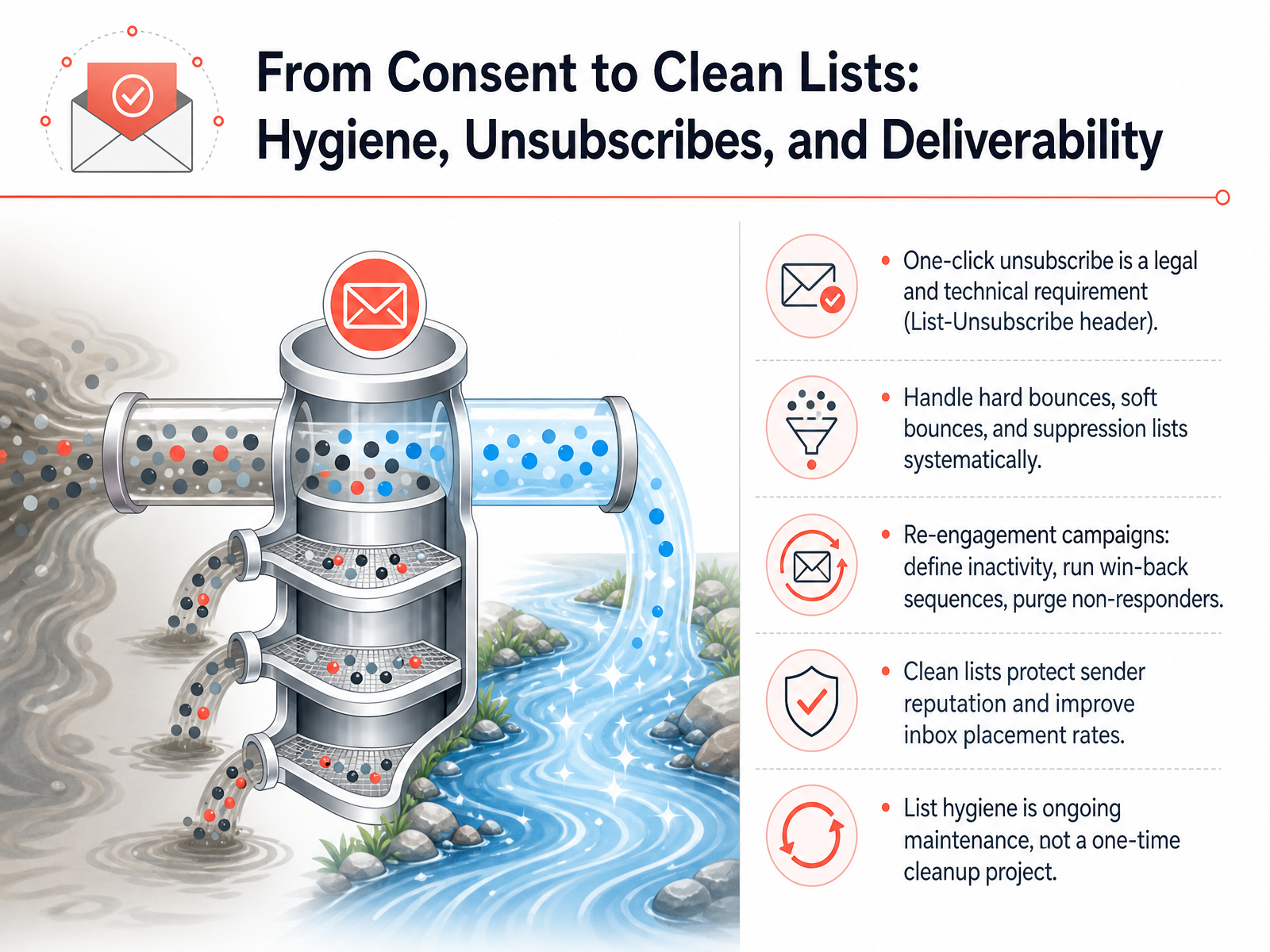
2 min - 05From Consent to Clean Lists: Hygiene, Unsubscribes, and DeliverabilityYou already know that subscriber consent is just the starting point. Now we align that permission with ongoing list hygiene to protect your sender reputation. Begin with the technical baseline: the one-click unsubscribe and List-Unsubscribe header aren’t optional, they’re legal requirements and signals to mailbox providers that you respect recipient choice. Next, manage bounces systematically. Separate hard bounces for immediate suppression, and monitor soft bounces before you decide to remove. Then, define what inactivity means for your program and run targeted win-back sequences. For subscribers who stay silent, purge them. This isn’t a one-time cleanup; it’s continuous maintenance that directly improves inbox placement. When you’re ready, we’ll move into email authentication essentials, where we’ll optimize SPF, DKIM, and DMARC to further safeguard deliverability.
 1 min
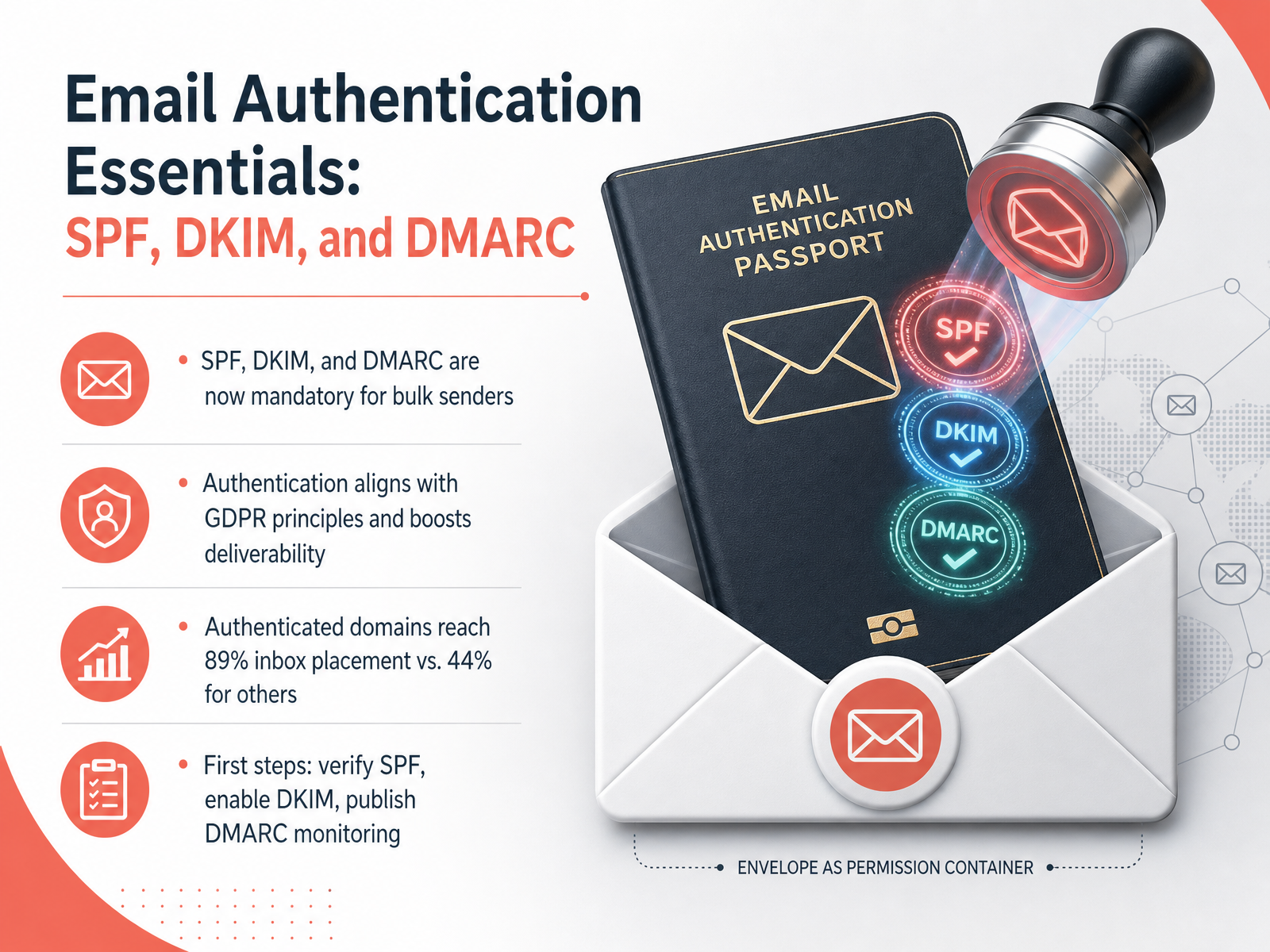
1 min - 06Email Authentication Essentials: SPF, DKIM, and DMARCLet's now align your delivery infrastructure with authentication essentials. SPF, DKIM, and DMARC have shifted from optional best practices to mandatory requirements for bulk senders. This isn't just about compliance. Proper authentication directly reflects the GDPR principle of data protection by design and signals mailbox providers that your mail is legitimate. The business impact is clear. Authenticated domains achieve around eighty-nine percent inbox placement, compared to just forty-four percent for unauthenticated senders. Think of that difference as nearly half your list never seeing your message. As a starting point, verify your SPF record includes all authorized sending services, enable DKIM signing for your domain, and publish a DMARC record set to monitoring mode so you can observe authentication results before enforcing a strict policy. Once this foundation is in place, you can turn your attention to how you organize your recipients. Let's move into audience segmentation and why you should stop sending the same email to everyone.
 2 min
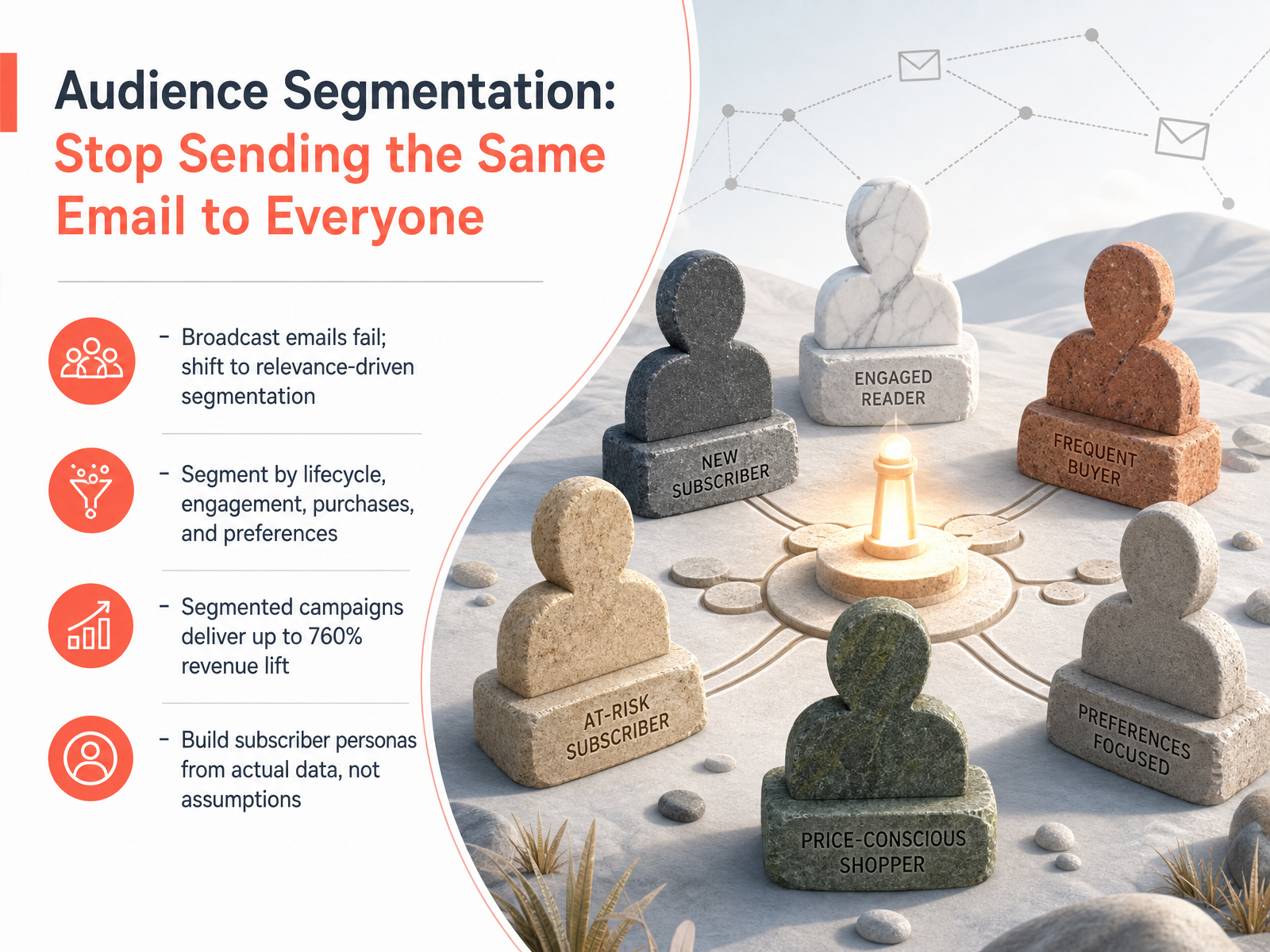
2 min - 07Audience Segmentation: Stop Sending the Same Email to EveryoneLet's move on to a critical shift: moving from broadcast emails to relevance-driven segmentation. Sending the same message to your entire list simply doesn't work anymore. Instead, we need to align content with specific subscriber groups. You can segment by lifecycle stage, engagement level, purchase history, or stated preferences. The impact here is substantial; segmented campaigns have been shown to drive up to a seven hundred and sixty percent increase in revenue. To do this well, build subscriber personas from actual data, not assumptions. Use your metrics to define real behavioral clusters, then tailor your strategy for each one. Up next, we'll explore message structure, specifically the anatomy of an email that gets opened and clicked.
 1 min
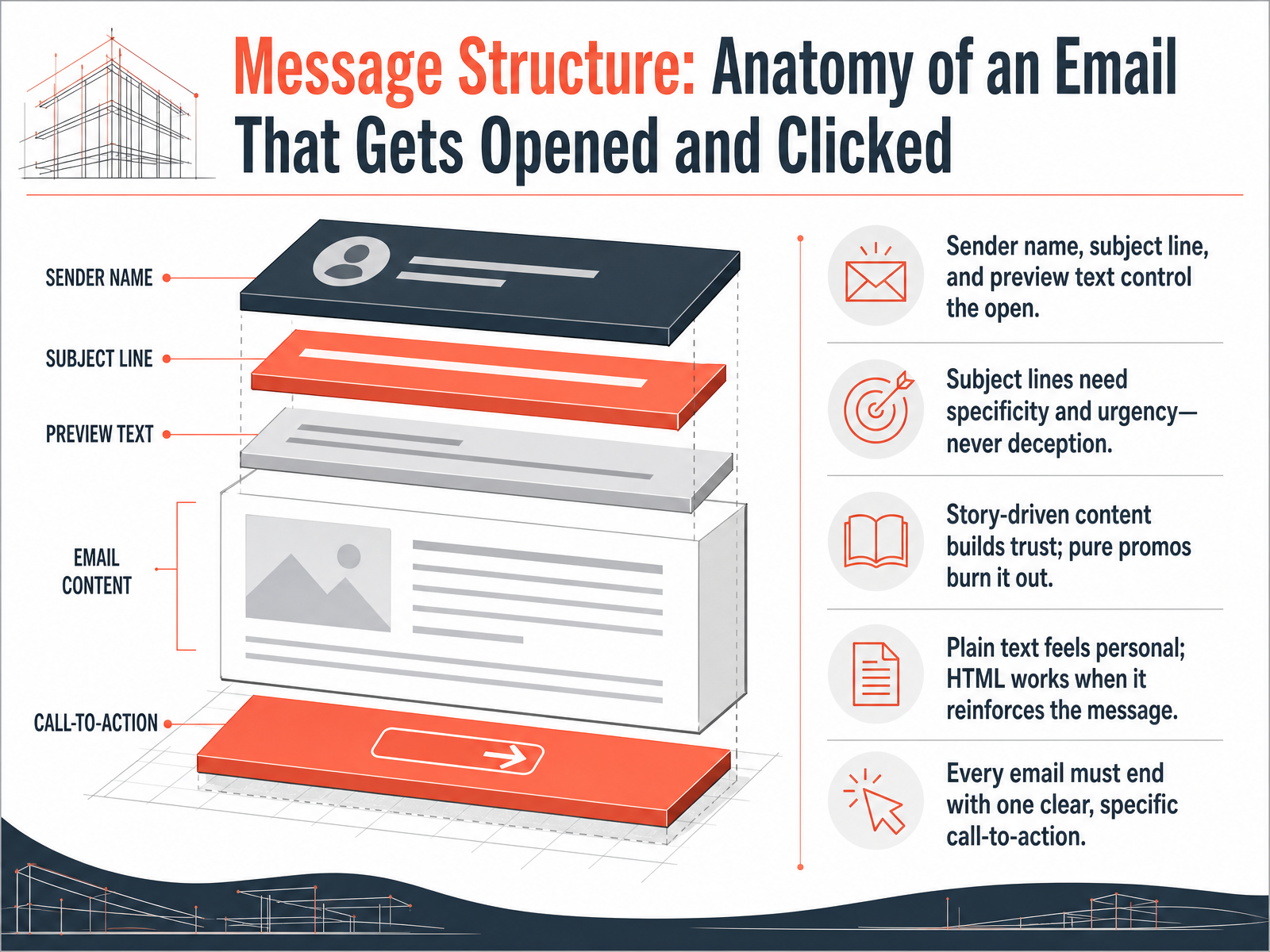
1 min - 08Message Structure: Anatomy of an Email That Gets Opened and ClickedMoving into message structure, let's align the elements that directly control whether your email gets opened and acted on. The sender name, subject line, and preview text work together as the open team. A subject line earns the click when it combines specificity with genuine urgency, never deception. Once the email is open, story-driven content builds trust over time, while nonstop promotional blasts burn it out. Choose plain text when you want the message to feel personal and one-to-one. Use HTML deliberately to reinforce the message, not distract from it. And here is a non-negotiable discipline: every email closes with one clear, specific call to action. Now, let's optimize for the device most of your readers are already holding. In the next slide, we will tackle mobile-first design, because between forty-one and sixty-eight percent of opens happen on phones.
 1 min
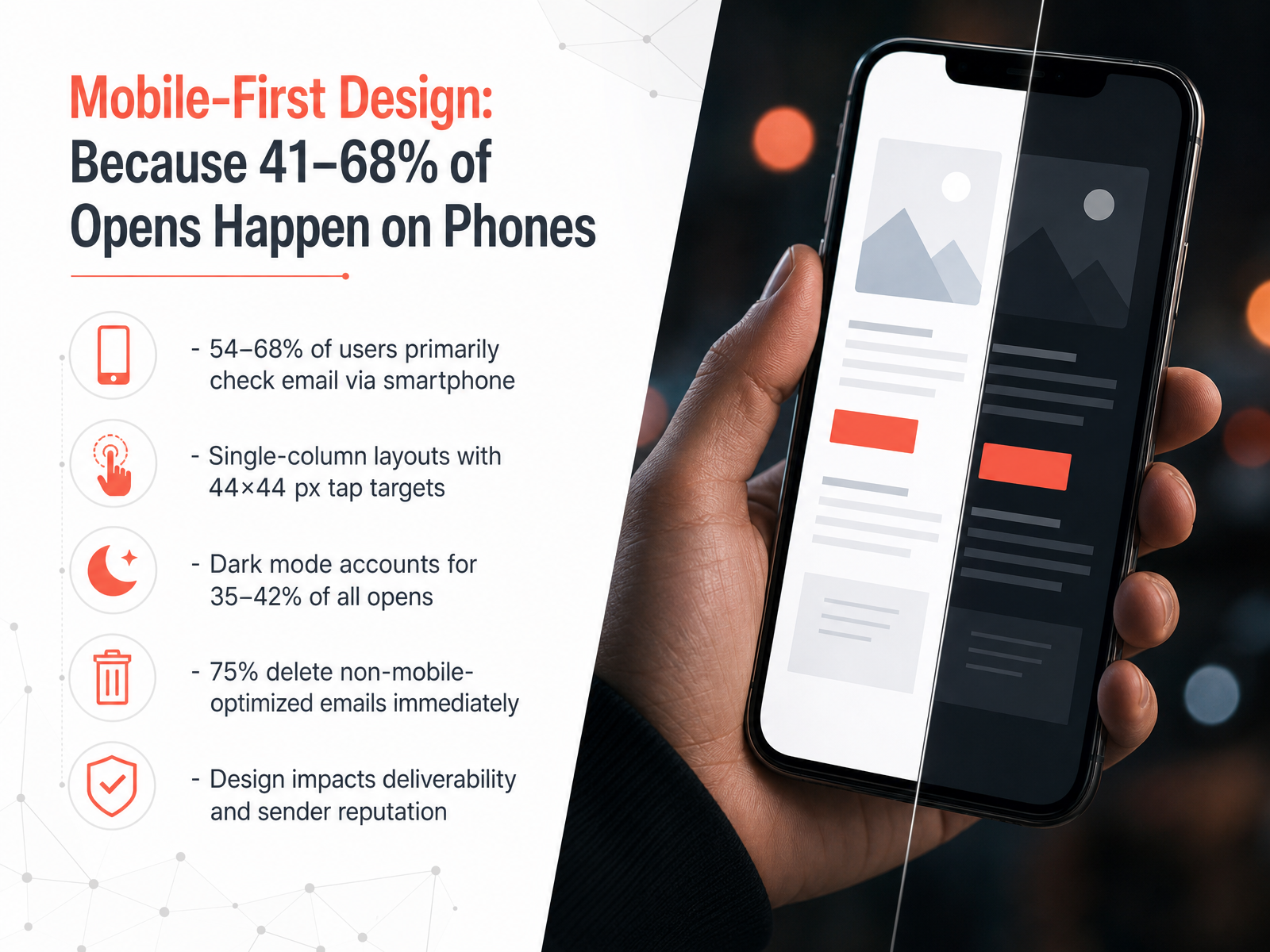
1 min - 09Mobile-First Design: Because 41–68% of Opens Happen on PhonesNow let's move to where your audience actually experiences your message: the mobile screen. With fifty-four to sixty-eight percent of users primarily checking email on a smartphone, optimizing for mobile isn't an add-on — it's the core design requirement. Adopt a single-column layout and ensure interactive elements are at least forty-four by forty-four pixels. This isn't just a visual preference; it directly prevents frustrating mis-taps. You also need to account for dark mode, which now represents thirty-five to forty-two percent of all opens. Test your designs against both light and dark backgrounds to guarantee your brand assets and text remain legible. The consequence of ignoring this is immediate. Seventy-five percent of recipients will delete an email right away if it's not mobile-optimized. More critically, these poor user experiences feed into engagement signals that damage your sender reputation and deliverability. Align your design workflow to prioritize mobile rendering from the very first draft, and you protect both the subscriber experience and your sending infrastructure. Up next, we'll align these design decisions with the right send rhythm in our discussion on cadence, timing, and the preference center.
 2 min
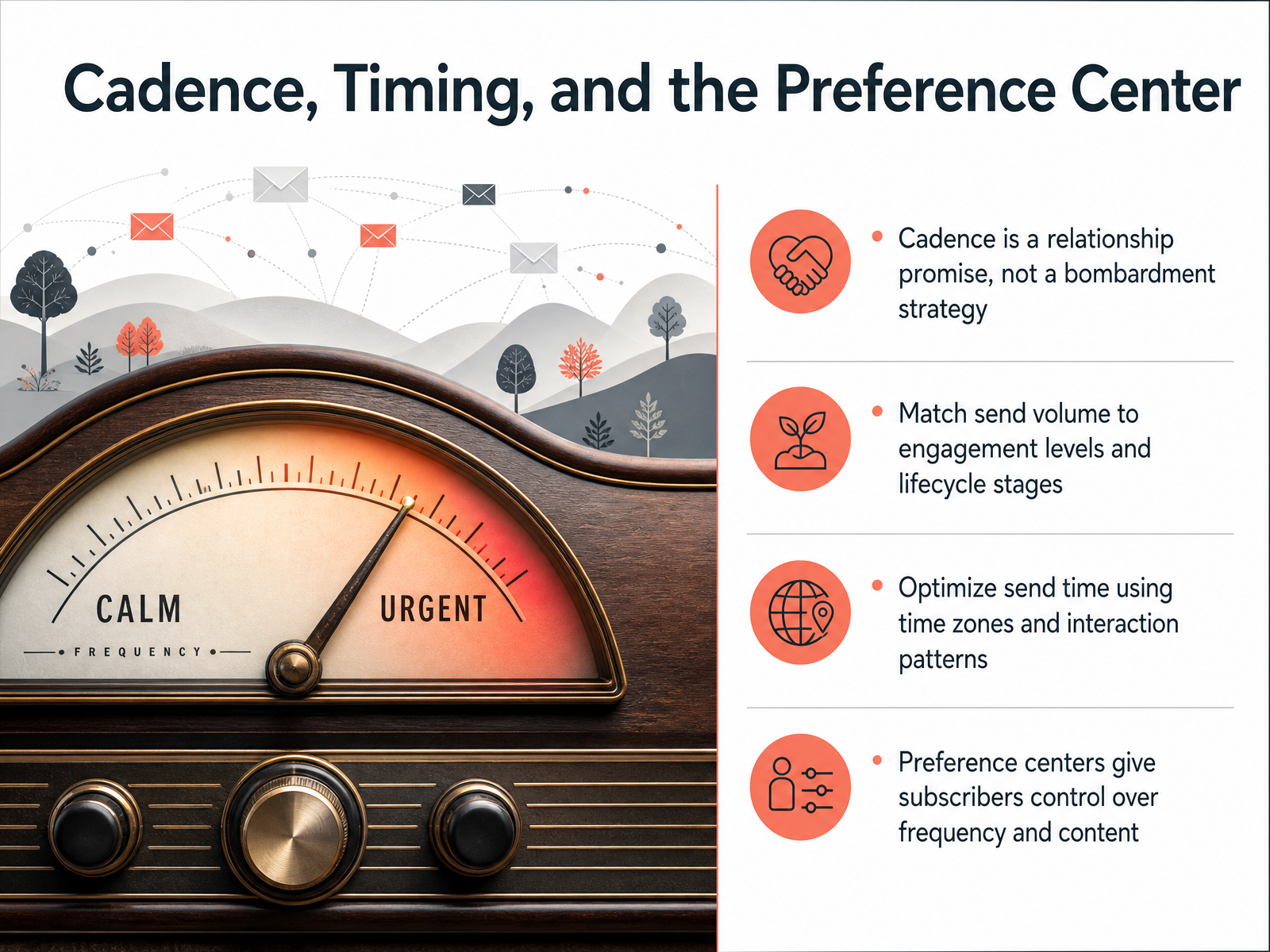
2 min - 10Cadence, Timing, and the Preference CenterLet's shift our focus to cadence, timing, and giving subscribers real control. Think of cadence as a relationship promise you make, not a bombardment strategy. When you respect that promise, engagement stays strong. To protect it, match your send volume to actual engagement levels and where someone is in their lifecycle. A new subscriber might welcome a short welcome series, while a lapsed user needs a much lighter touch. Next, optimize your send time. Align your delivery to the subscriber's local time zone and their past interaction patterns. Small shifts in timing often lead to meaningful lifts in open rates. Finally, a well-designed preference center is your strongest retention tool. It lets subscribers tell you exactly how often they want to hear from you and what topics matter to them. That self-selected control almost always outperforms a one-size-fits-all schedule. Up next, we'll connect these decisions to concrete results as we explore Core Email KPIs: Measuring What Actually Matters.
 2 min
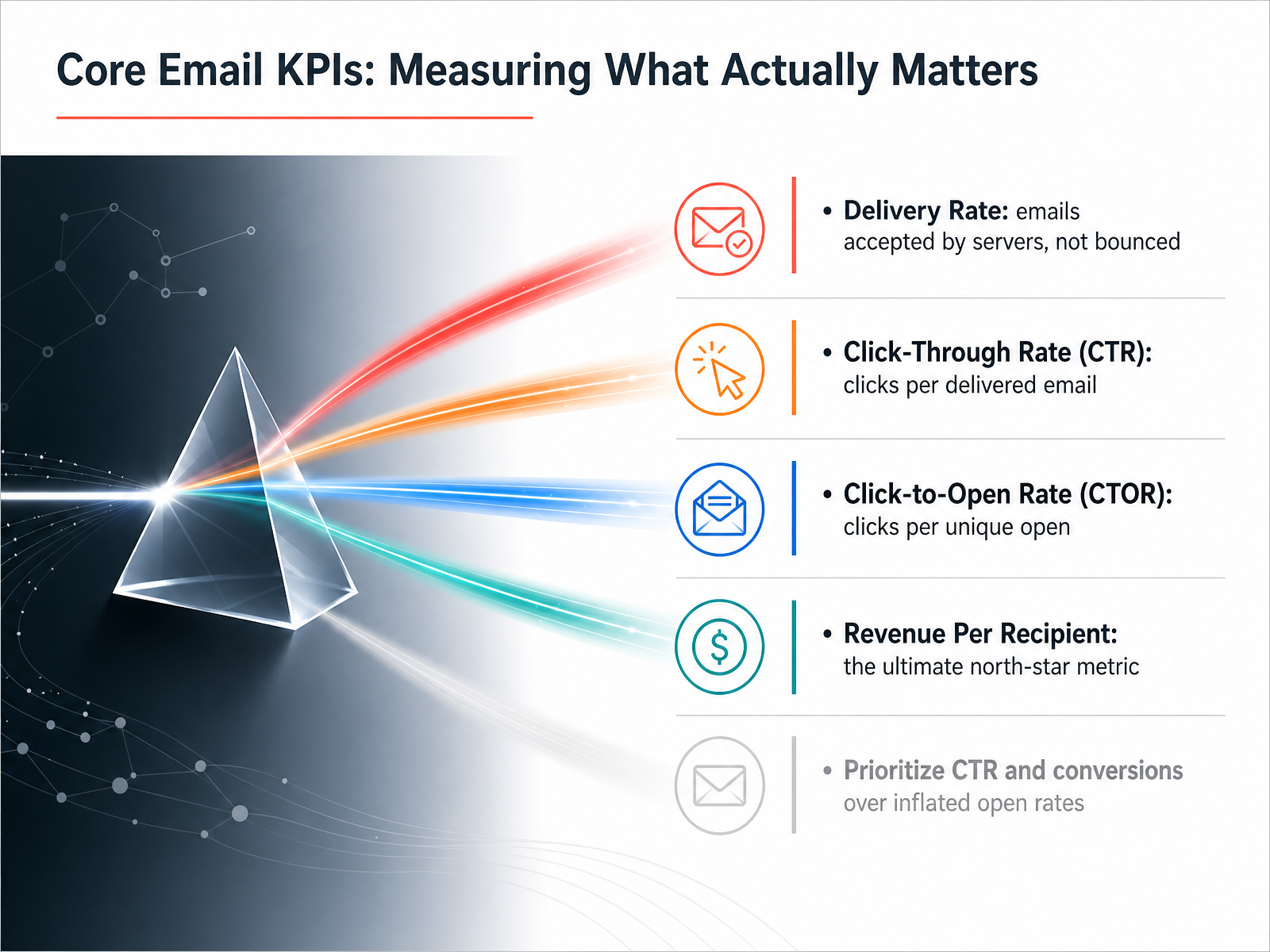
2 min - 11Core Email KPIs: Measuring What Actually MattersLet's close by anchoring our strategy in the metrics that truly matter. You already know the landscape, so we'll focus on application. Start with your delivery rate. A healthy rate, ideally above ninety-eight percent, means your reputation is intact and your infrastructure is solid. Next, move beyond opens. Prioritize your click-through rate per delivered email. To go deeper, use click-to-open rate, or CTOR, to gauge how compelling your message content and calls-to-action are for the readers who actually see them. The ultimate north star is revenue per recipient. Align this metric across all your segments to directly connect email activity to business outcomes. By optimizing for genuine engagement and conversions, rather than chasing inflated open rates, you turn your email program into a measurable growth engine. Thank you for investing this time to refine your framework. You now have a clear path to test, iterate, and scale with precision.
 2 min
2 min
Take the deck with you
Download this course as a file — free, no sign-up needed.
- PDF handoutEvery slide page, ready to print or share.12 pages · 3.0 MBDownload
- Narrated PowerPointThe deck that presents itself — every slide carries the digital human's narration video.12 pages · 11.1 MBDownload
- PowerPoint slidesThe full deck as a .pptx — open it in PowerPoint, Keynote, or Google Slides.12 pages · 2.9 MBDownload
Free to use in your own training — please keep the PersonWise credit page at the end.
Have your own deck? Turn it into a course