Begin
13 pages · ~26 min
Web Development Frameworks Comparison
This training compares web development frameworks, exploring different approaches and use cases to help developers select the right tool for their projects.
A digital instructor presents all 13 pages. Hold “Ask” at any point and ask out loud — the answer comes from this course. No sign-up needed.
What you’ll learn
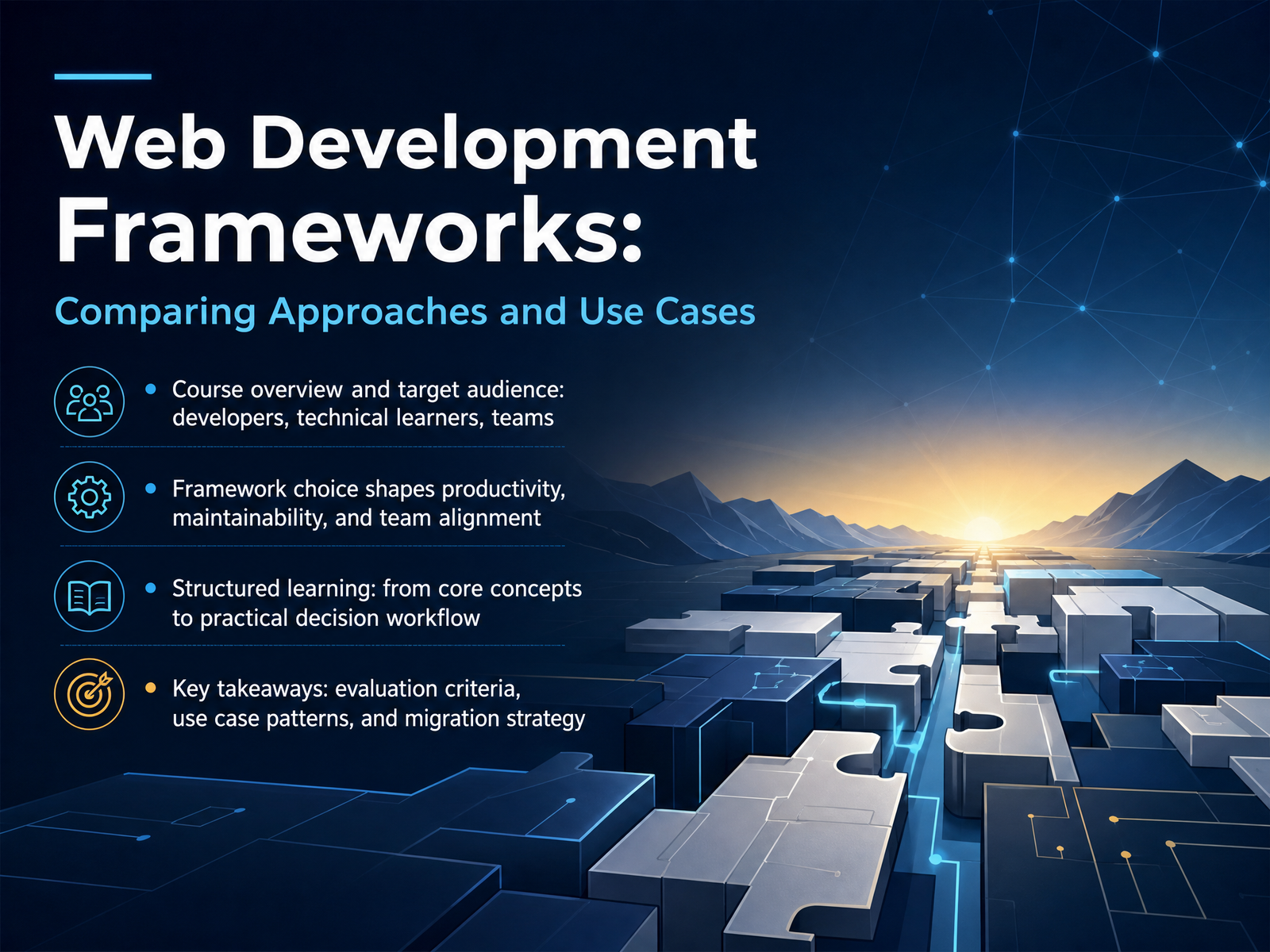
- 01Web Development Frameworks: Comparing Approaches and Use CasesWelcome. If you're a developer, a technical lead, or part of a team trying to make sense of the framework landscape, this course is for you. The choice of a framework isn't just about syntax—it shapes your team's productivity, how maintainable your codebase will be, and even how easy it is to align your team's efforts. We're going to structure this as a practical journey. We'll move from core architectural concepts—like how rendering works—to a clear, decision-oriented workflow you can actually apply. By the end, you'll have concrete evaluation criteria, a clear picture of common use case patterns, and a realistic strategy for migration if you ever need it. So let's move beyond the hype and start by understanding the context of why frameworks exist. Let's get started.web.devbenedikt-sperl.devercel.com+21 min
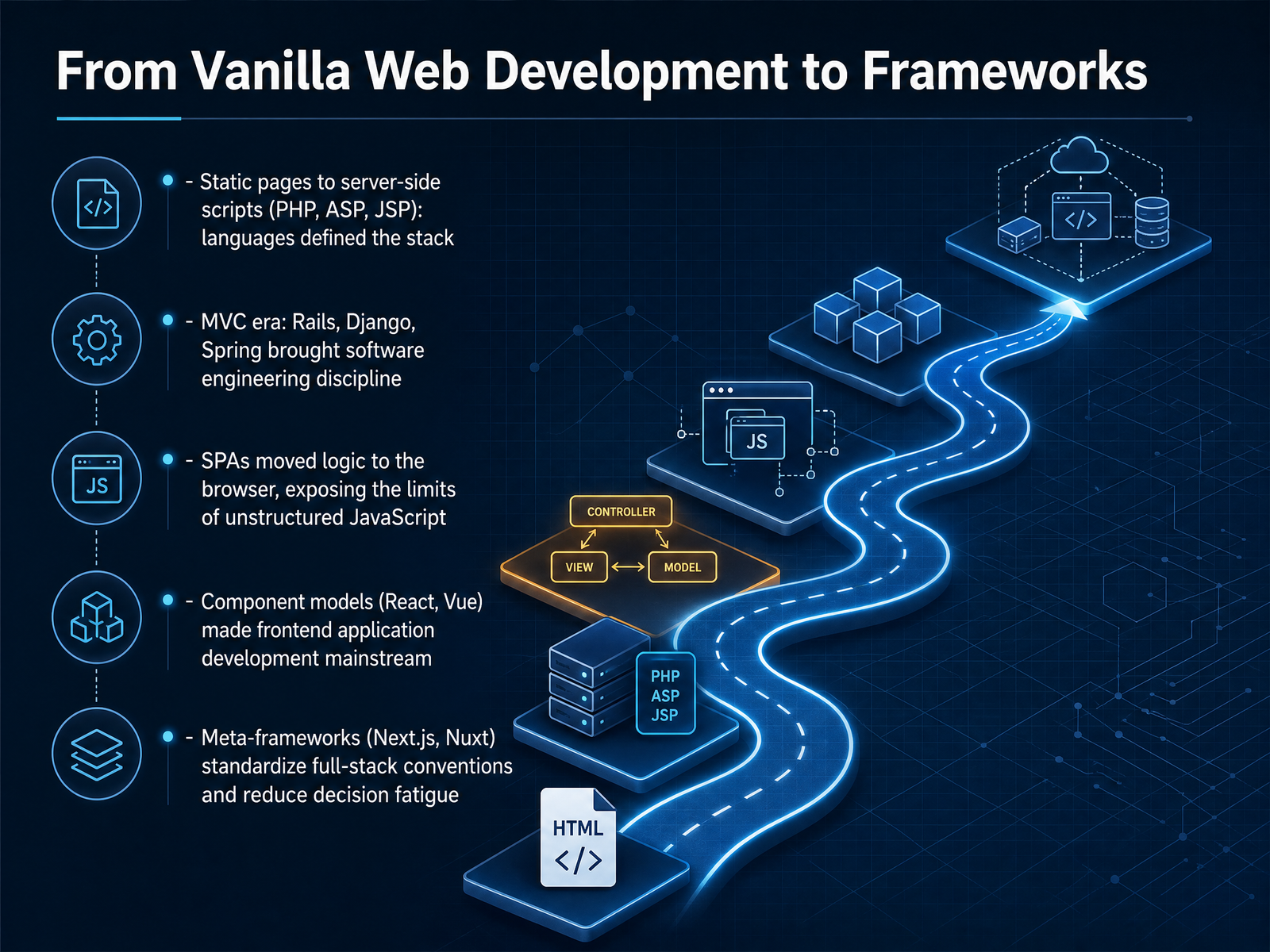
- 02From Vanilla Web Development to FrameworksLet’s take a quick step back and look at how we got here. Early web development was server-side scripting with languages like PHP and JSP, where the language itself defined your entire stack. Then came the MVC era, with Rails, Django, and Spring, which brought much-needed software engineering discipline to the web. As single-page applications moved more logic into the browser, we hit the limits of unstructured JavaScript. That’s when component models like React and Vue changed the game, making frontend development a serious engineering practice. And now we have meta-frameworks like Next.js and Nuxt, which standardize full-stack conventions and cut down on decision fatigue. Each wave solved the problems of the previous one. Keep that pattern in mind as we move into core concepts like rendering strategies.
 github.comcurotec.commdpi.com+21 min
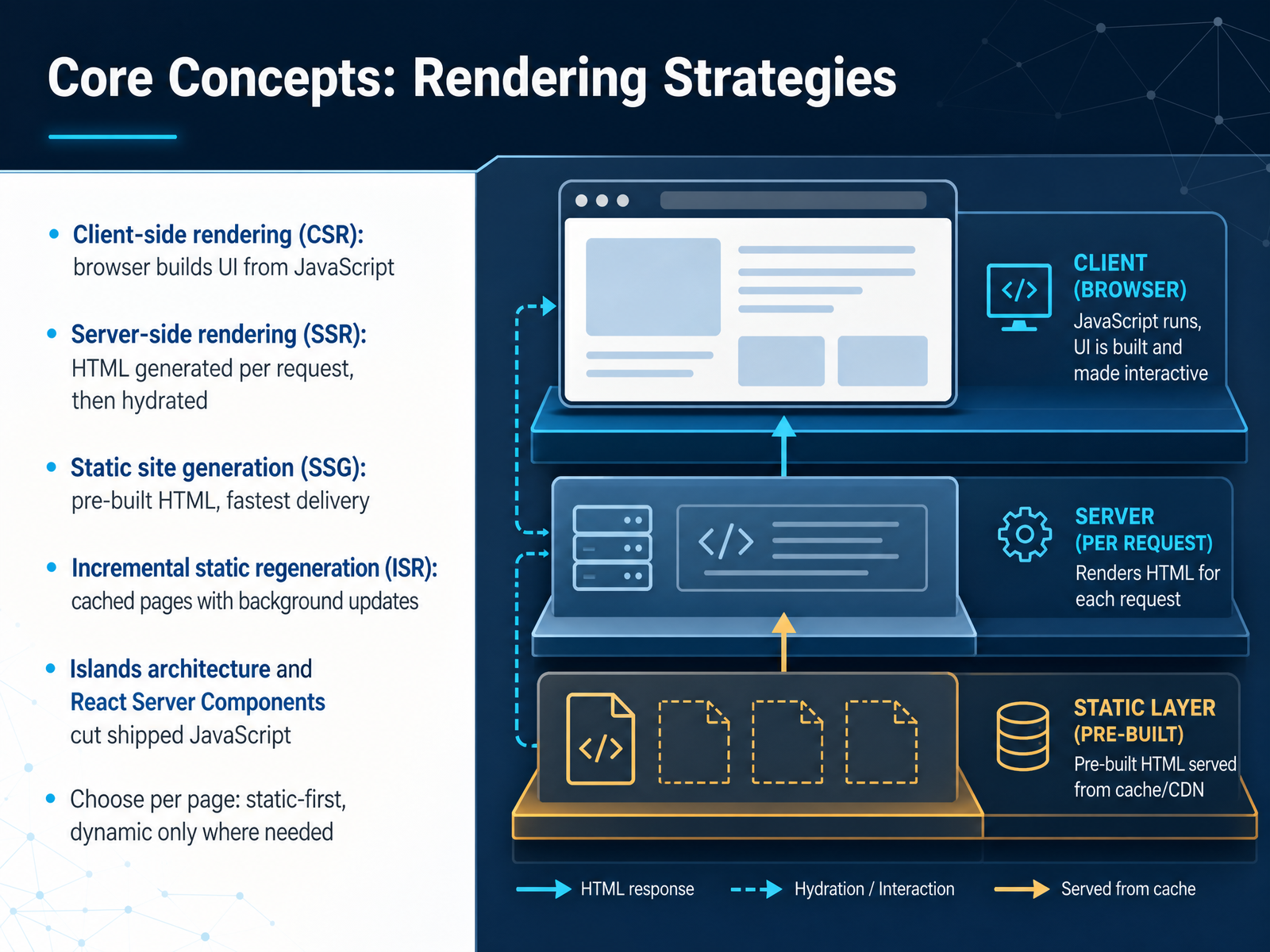
 - 03Core Concepts: Rendering StrategiesNow let's talk about rendering strategies. This is where a lot of framework decisions actually happen. There are five main approaches, and each one answers a different question about when and where your HTML gets built. Client-side rendering, or CSR, sends a blank shell to the browser, and JavaScript builds everything there. It is great for app-like experiences like dashboards, but the initial load can be slow and SEO suffers. Server-side rendering flips that. The server generates the full HTML on each request, so the first paint is fast and SEO is excellent. But the page looks ready before it actually is. Hydration has to attach event handlers, and on a slow device, that can take a while. Static site generation pre-builds all HTML at deploy time, serving it from a CDN. It is the fastest and cheapest option, but the content is frozen at build time. That is where incremental static regeneration comes in. ISR serves cached pages instantly, then regenerates them in the background after a set interval, giving you near-real-time freshness without the server cost. And then we have the newer patterns, islands architecture and React Server Components, both of which dramatically cut the amount of JavaScript you ship. They only send code for the components that are actually interactive. The key takeaway is simple. Do not pick one strategy for your whole site. Choose per page, static-first, and go dynamic only where you truly need it. Coming up, we will look at how architecture styles and classification dimensions shape the way we compare frameworks.
 web.devbenedikt-sperl.devercel.com+21 min
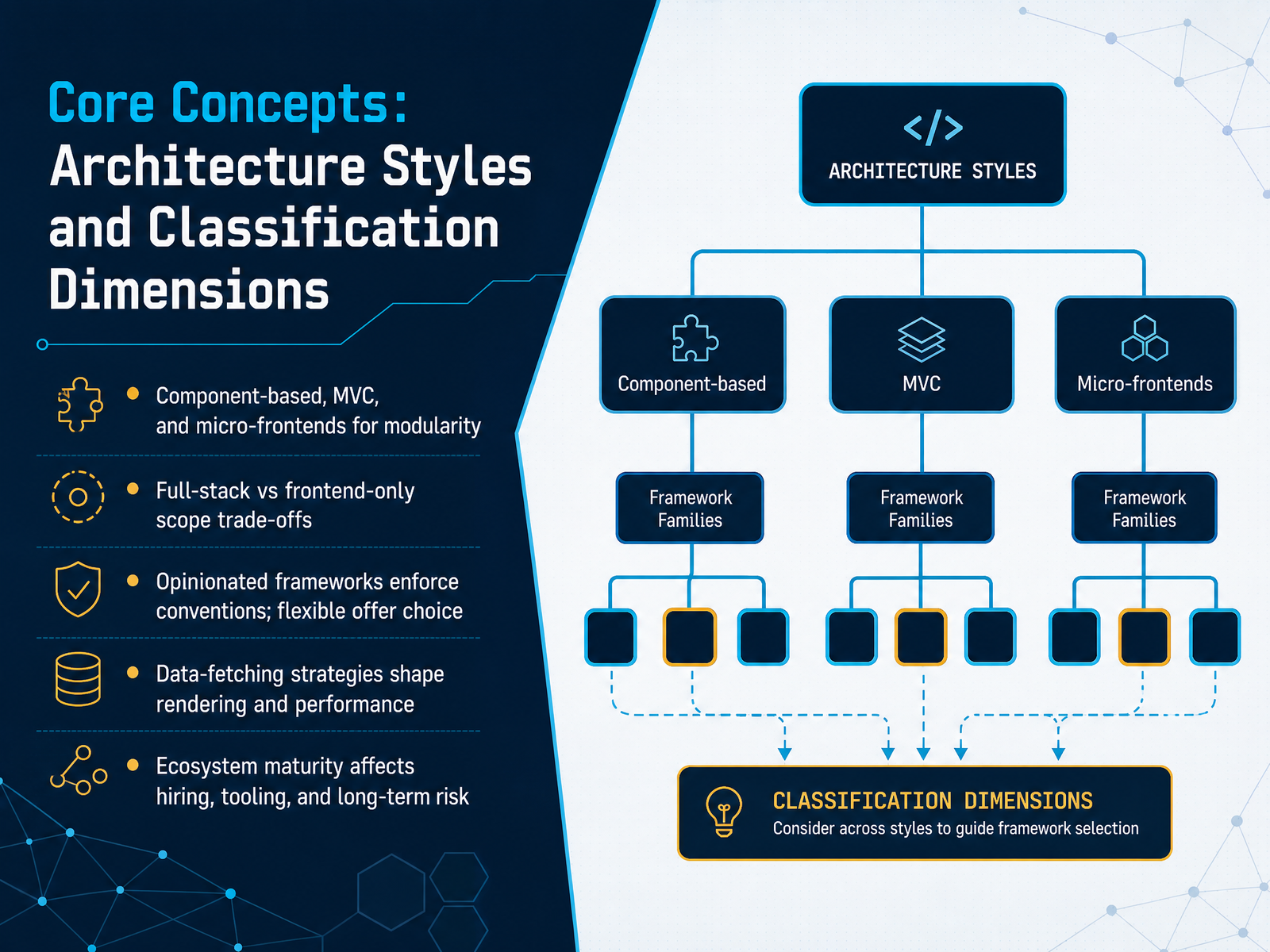
 - 04Core Concepts: Architecture Styles and Classification DimensionsLet's talk about core concepts and classification dimensions, because frameworks are not just different—they are different in specific, comparable ways. First, architecture style: component-based, classic MVC, or micro-frontends. These determine how you modularize code and how teams can work in parallel. Second, scope. Are you picking a full-stack meta-framework like Next.js or Nuxt, or just a frontend library like React? That choice dictates how much you own versus what you assemble. Third, philosophy. Opinionated frameworks enforce conventions and reduce decision fatigue; flexible ones give you freedom but demand discipline. Fourth, data-fetching strategy. This is where rendering and performance actually happen: client-side rendering, server-side rendering, static generation, or hydration—each shapes your Core Web Vitals and hosting costs. Finally, ecosystem maturity. It affects hiring, tooling depth, and long-term risk, so it is a business decision as much as a technical one. Keep these five dimensions in mind as we survey the major approaches and representative frameworks next.
 web.devbenedikt-sperl.devercel.com+21 min
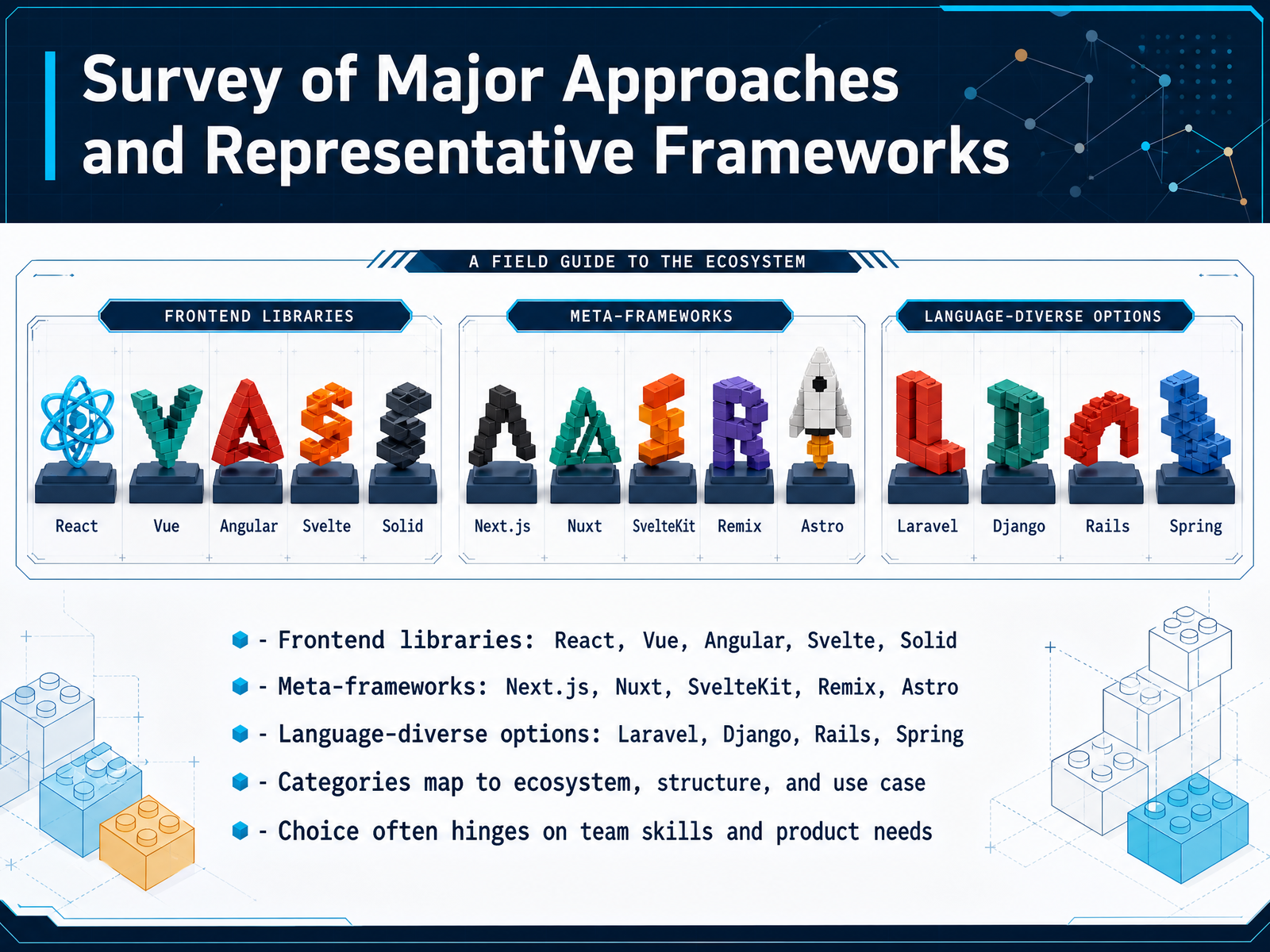
 - 05Survey of Major Approaches and Representative FrameworksLet's map the landscape. Broadly, we have three families. First, frontend libraries like React, Vue, Angular, Svelte, and Solid. These handle the view layer, and you typically assemble the rest of the stack yourself. Then we have meta-frameworks like Next.js, Nuxt, SvelteKit, Remix, and Astro. These wrap those libraries with routing, server-side rendering, and deployment patterns, turning them into full application platforms. The third family is language-diverse options like Laravel, Django, Rails, and Spring. These are backend frameworks that may include server-side templating, but they are not JavaScript-centric. Each category maps to a different ecosystem, structural philosophy, and use case. The choice rarely comes down to raw capability. In 2026, most major frameworks can handle complex applications. The real question is fit. What does your team already know, and what will your product need in two years? If you need the widest hiring pool, React is the safe default. If you need strong conventions for a large enterprise, Angular might be the better anchor. For performance-critical, lean products, Svelte's compiled output is hard to beat. Next let's break down the comparison criteria for choosing among these families.
 coderio.comprojectimmerse.comcamfirstsolutions.com+21 min
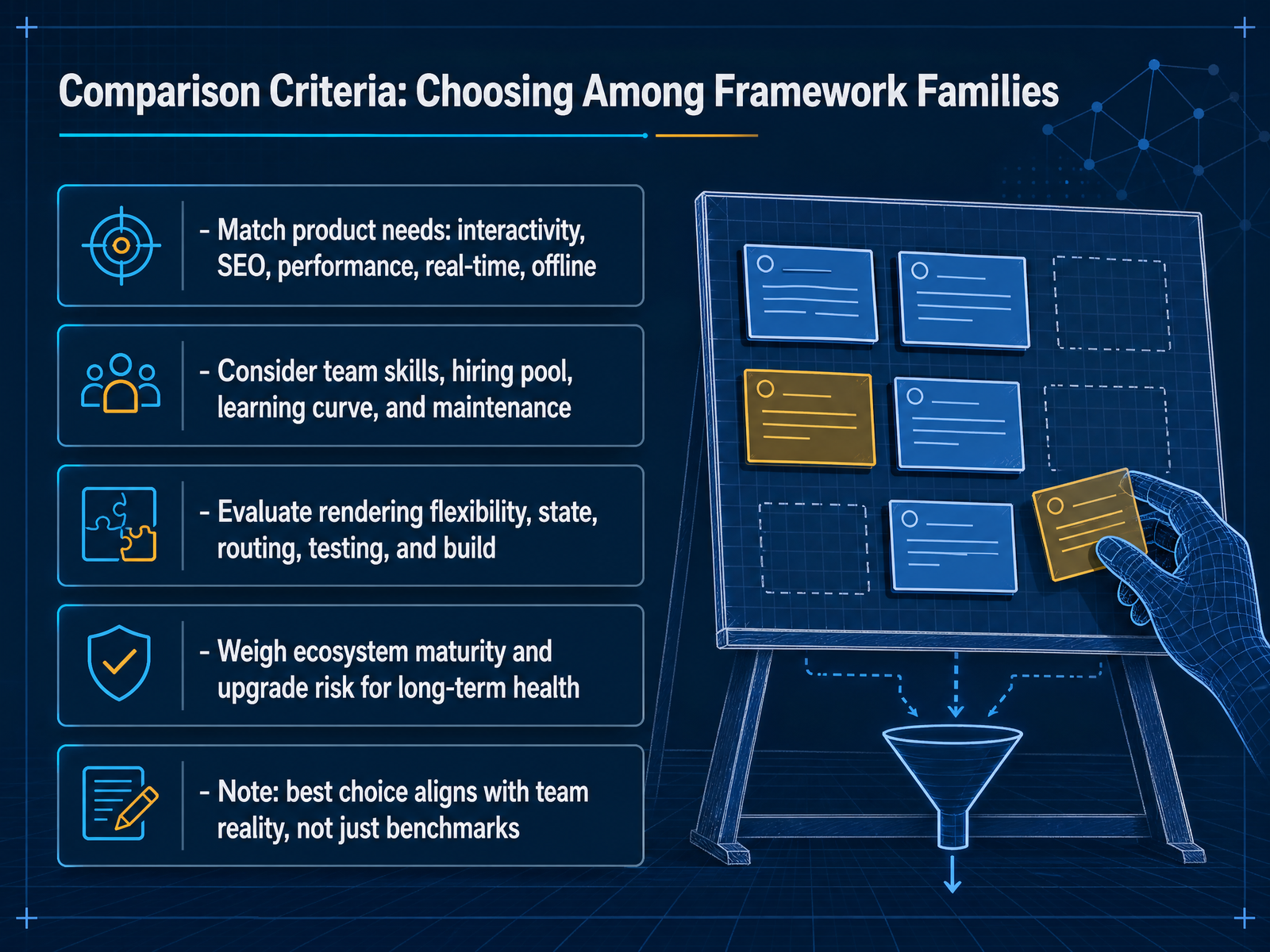
 - 06Comparison Criteria: Choosing Among Framework FamiliesNow let's look at how to choose among framework families. We're not comparing feature lists. We're matching the framework to your actual constraints. Start with your product needs: interactivity, SEO, performance, real-time updates, offline support. A content-heavy marketing site and a real-time dashboard demand different rendering models. Then be honest about your team's skills and the hiring pool in your area. A framework your team already knows deeply will ship faster and with fewer bugs than a theoretically better one they must learn from scratch. Evaluate technical dimensions—rendering flexibility, state management, routing, testing, and build tooling—but weight them according to your app's complexity. Ecosystem maturity and upgrade risk matter for long-term health. A smaller framework may feel elegant, but if future upgrades break dependencies, your costs rise. And remember, there's no single best framework. The best choice aligns with team reality, not just benchmarks. This contrast sets up our next discussion on real-world use cases. Let's move to those patterns now.
 docs.zkoss.orgfrontendpatterns.devwolf-tech.io+21 min
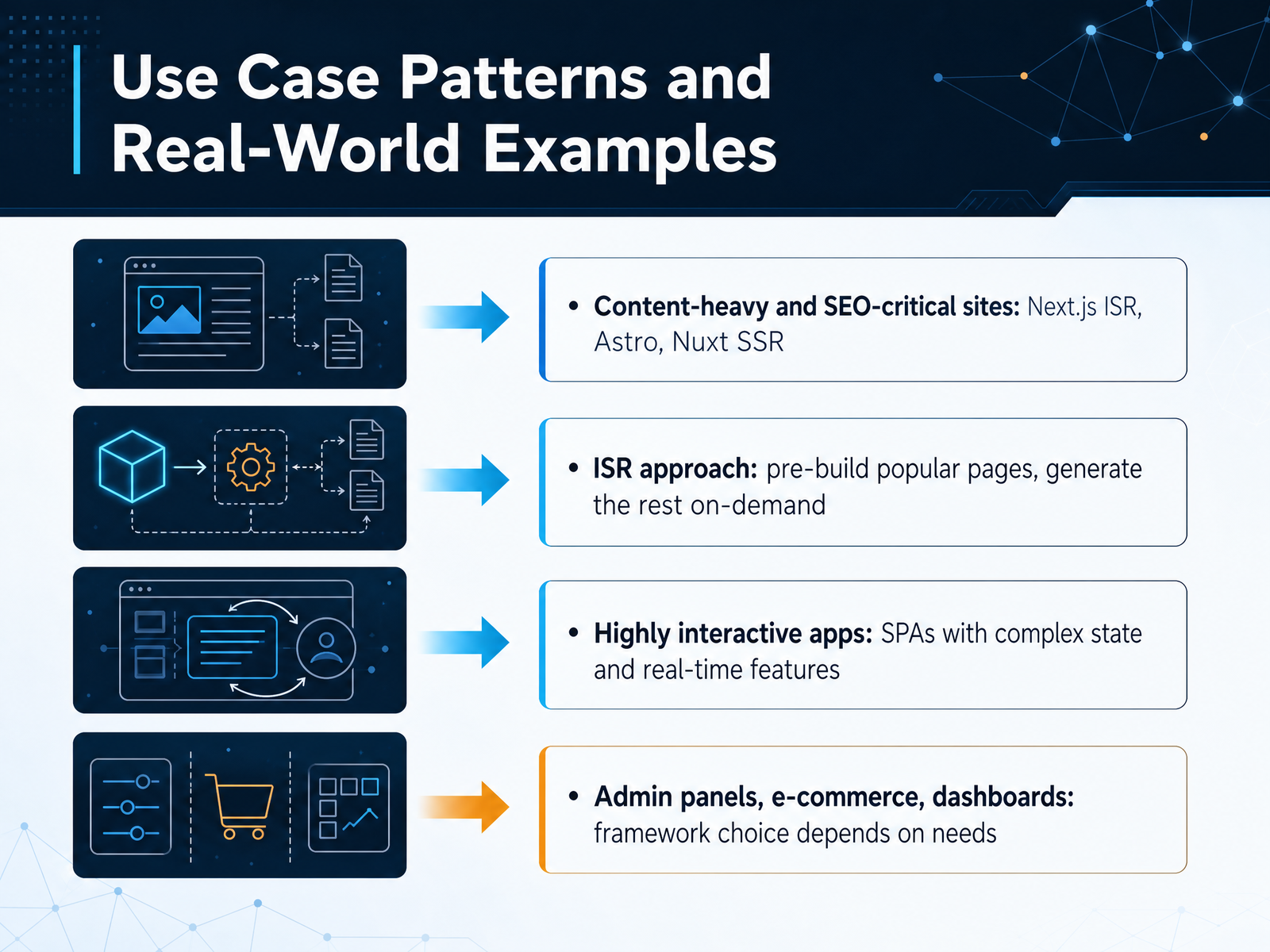
 - 07Use Case Patterns and Real-World ExamplesNow let's move from theory to practice and look at use case patterns and real-world examples. For content-heavy and SEO-critical sites, Next.js with ISR, Astro, and Nuxt with SSR are the go-to choices. Take the directory platform with 137,000 listings—pre-building just the top 2,000 popular pages and generating the rest on-demand cut build time from 52 minutes down to under 4 minutes, while keeping cache hit rates above 94 percent. That's the power of incremental static regeneration. For highly interactive applications, think SPAs with complex state and real-time features—sales dashboards, admin panels, booking flows. Here the choice depends on your team's strengths. The e-commerce comparison is telling: Vue got the project done fastest at 2.5 weeks, but Next.js scored 96 on performance and SEO. A marketplace on Nuxt 4 used edge ISR with explicit invalidation, so cached pages survive until the data actually changes. The pattern is simple: pre-build what's popular, generate the rest on demand, and invalidate only when data moves. Keep this hybrid mindset, and you'll balance speed, freshness, and cost. Next, let's talk about evaluation and migration strategy.
 2 min
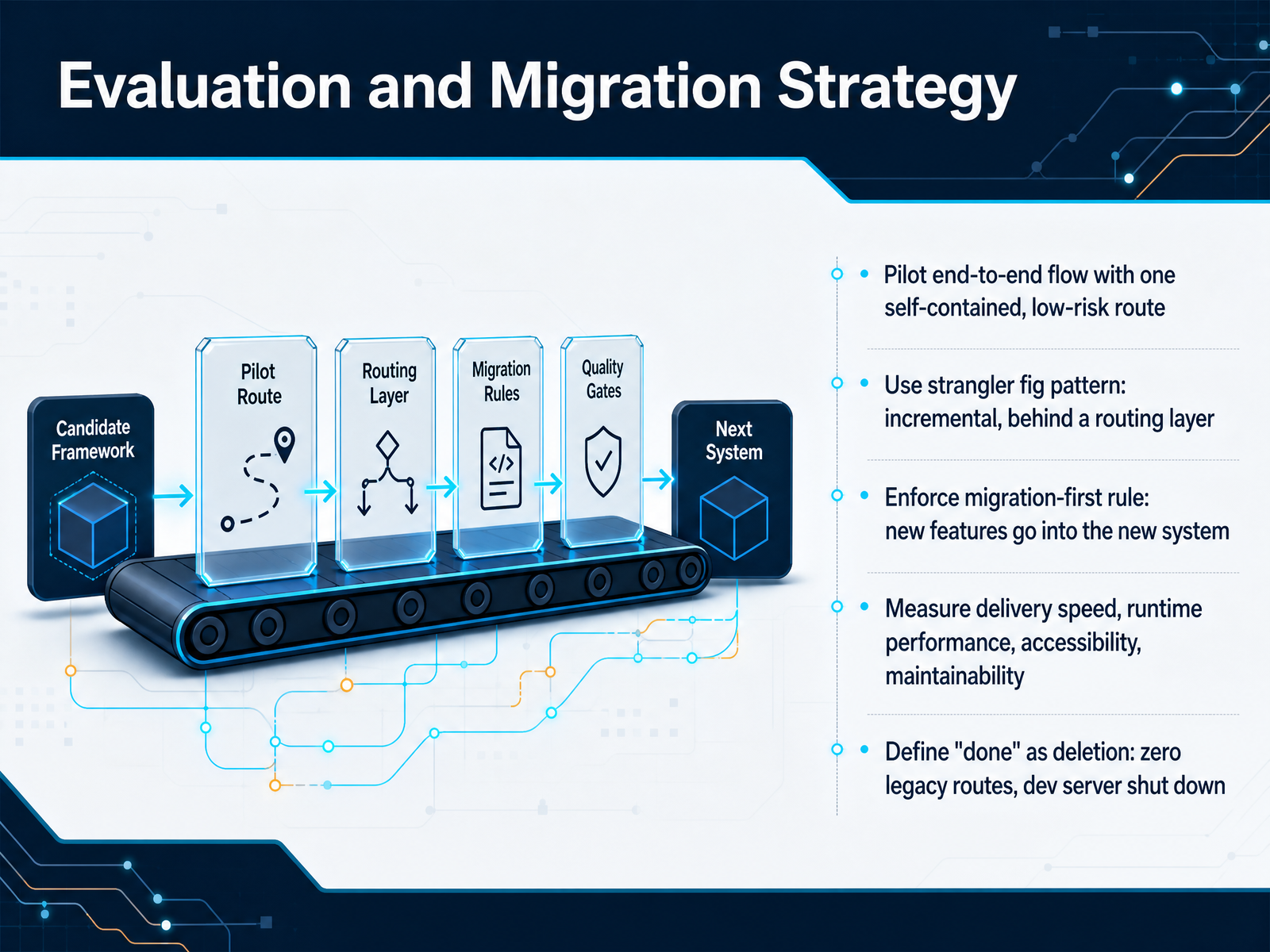
2 min - 08Evaluation and Migration StrategyNow let's talk about how you actually execute this migration. Start with a pilot: pick one self-contained, low-risk route — a settings page or an internal dashboard — and migrate it end to end, from development all the way through deployment and monitoring. That validates your bridge infrastructure before you commit to scale. Then apply the strangler fig pattern: put a routing layer in front, move routes incrementally, and delete the old path once the new one proves itself. Crucially, enforce the migration-first rule. New features go into the new system. If new work keeps landing in the legacy codebase, you are not strangling it — you are feeding it vitamins. Throughout the process, measure what matters: delivery speed, runtime performance, accessibility, and maintainability. And define done as deletion. The migration is not finished when the high-traffic routes work. It's finished when zero legacy routes remain, the dev server is shut down, and the old directory is deleted. If your definition of done doesn't include deletion, the deletion won't happen. One more thing to keep in mind: keep scope tight. Migrate the framework, but don't simultaneously modernize the architecture, the data model, or the deployment topology. Do those sequentially, or you'll build a system that's legacy before it launches. Next, let's look at ecosystem considerations: TypeScript, tooling, and deployment.
 2 min
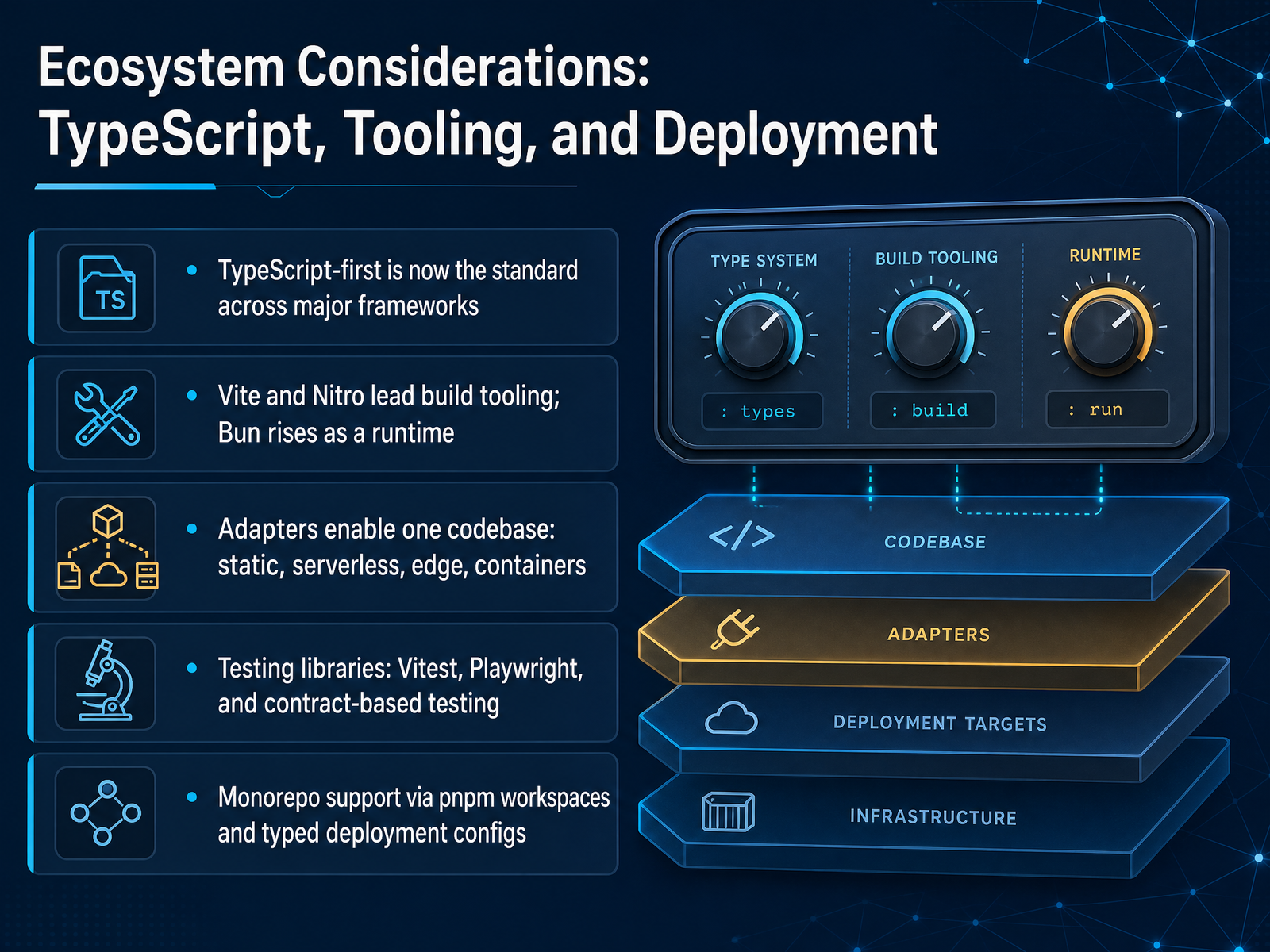
2 min - 09Ecosystem Considerations: TypeScript, Tooling, and DeploymentNow let's talk ecosystem. TypeScript-first is no longer a differentiator, it's the baseline. Every major framework assumes you're writing typed code from day one. The real decisions come downstream. Build tooling has consolidated around Vite for the client and Nitro for the server, with Bun emerging as a serious runtime contender. Here's the part that actually matters for your team: adapters. One codebase, deployed to static hosts, serverless functions, edge runtimes, or containers. Cloudflare Workers, Vercel Edge, Deno Deploy, they all speak the same language now. On the testing side, Vitest for unit tests, Playwright for end-to-end, and contract-based testing layered on top. And finally, monorepo support. pnpm workspaces are the standard, and deployment configs are increasingly typed, meaning your infrastructure is verified at compile time, not at three in the morning. One practical takeaway: when you evaluate a framework, don't just look at the API. Look at whether the ecosystem around it minimizes your deployment matrix, because that's where engineering time actually disappears.
 1 min
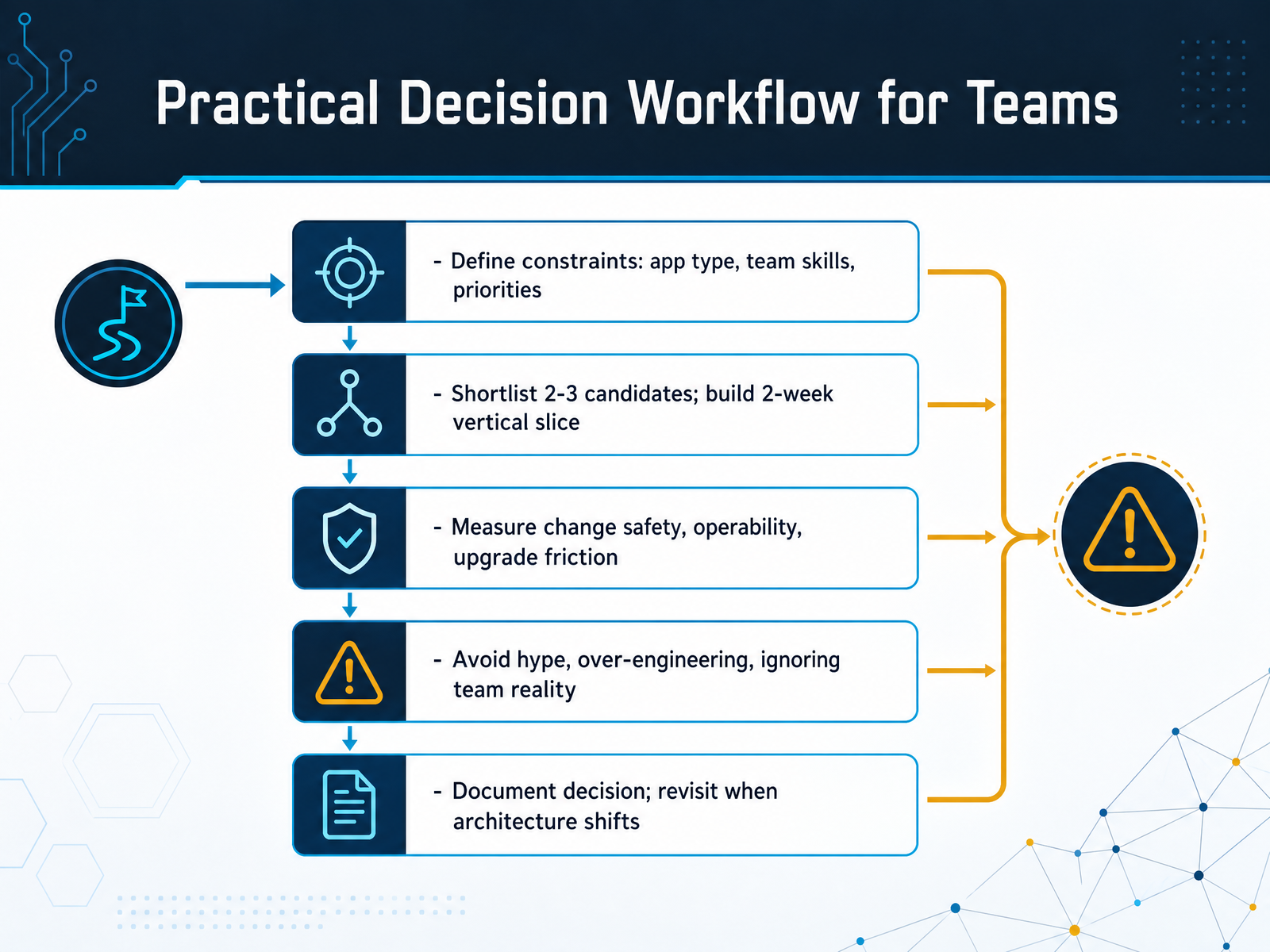
1 min - 10Practical Decision Workflow for TeamsSo how do you turn all these trade-offs into a decision your team can stand behind? Stop comparing frameworks in the abstract and start with hard constraints. Define your app type honestly: a content-heavy public site and a real-time internal dashboard are different problems, even if both are called web apps. Then look at your team. The framework you already know deeply will almost always ship faster and with fewer bugs than the theoretically ideal one you have to learn from scratch. Shortlist two or three candidates, no more, and commit to a two-week vertical slice. Build one core user journey end to end, with real authentication, one integration, and basic observability. While you build, measure what actually predicts success: change safety, meaning how easy it is to add a feature with tests; operability, meaning how fast you can debug a production failure; and upgrade friction, meaning how painful dependency bumps feel. Then make the call. Avoid hype, avoid over-engineering, and never ignore team reality. Write the decision down, including the constraints and metrics, so future refactors happen because the architecture shifted, not because someone read a blog post. Next, let's look at a rapid comparison of the major framework families.
 docs.zkoss.orgfrontendpatterns.devwolf-tech.io+22 min
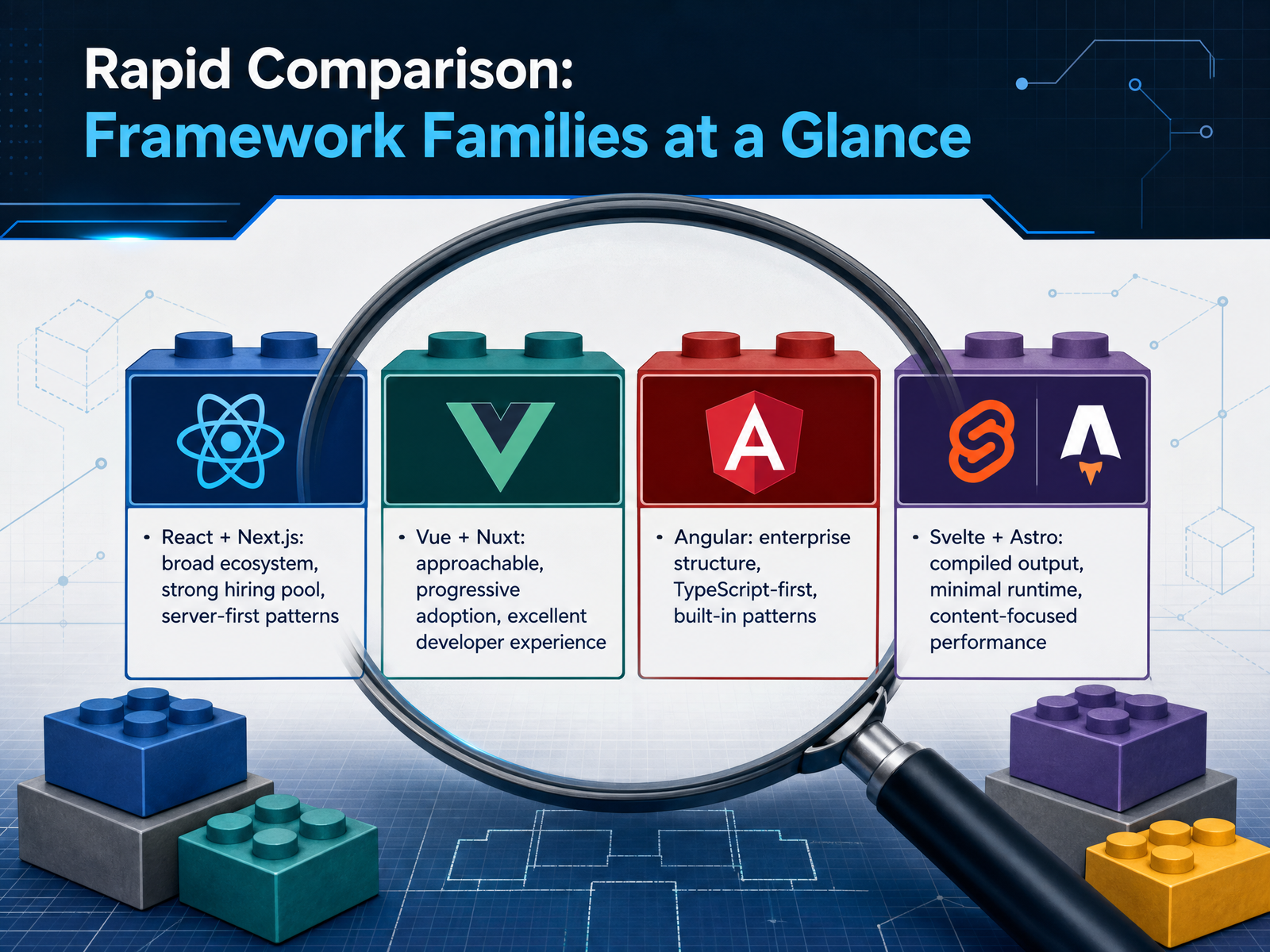
 - 11Rapid Comparison: Framework Families at a GlanceLet’s compress all of that into a single glance at the framework families. First, React with Next.js: this is the broad default. It gives you the biggest ecosystem, the deepest hiring pool, and now, server-first patterns baked in. Choose it when flexibility and talent availability are your top constraints. Next, Vue with Nuxt. This is the approachable path. Progressive adoption, a gentle learning curve, and an excellent developer experience make it a strong fit for smaller teams or projects modernizing older interfaces. Third, Angular. This is the enterprise structure play. It’s TypeScript-first, with dependency injection and built-in patterns that keep large, rotating teams consistent. The trade-off is a steeper learning curve and a heavier mental model. Finally, Svelte with Astro. This family wins on compiled output and minimal runtime, which makes it perfect for content-focused, performance-critical sites. But expect a smaller ecosystem. So the takeaway is this: match the framework to your constraints, not to the hype. Up next, we’ll pull all this together with a summary and cheat sheet to guide your final decision.
 coderio.comprojectimmerse.comcamfirstsolutions.com+22 min
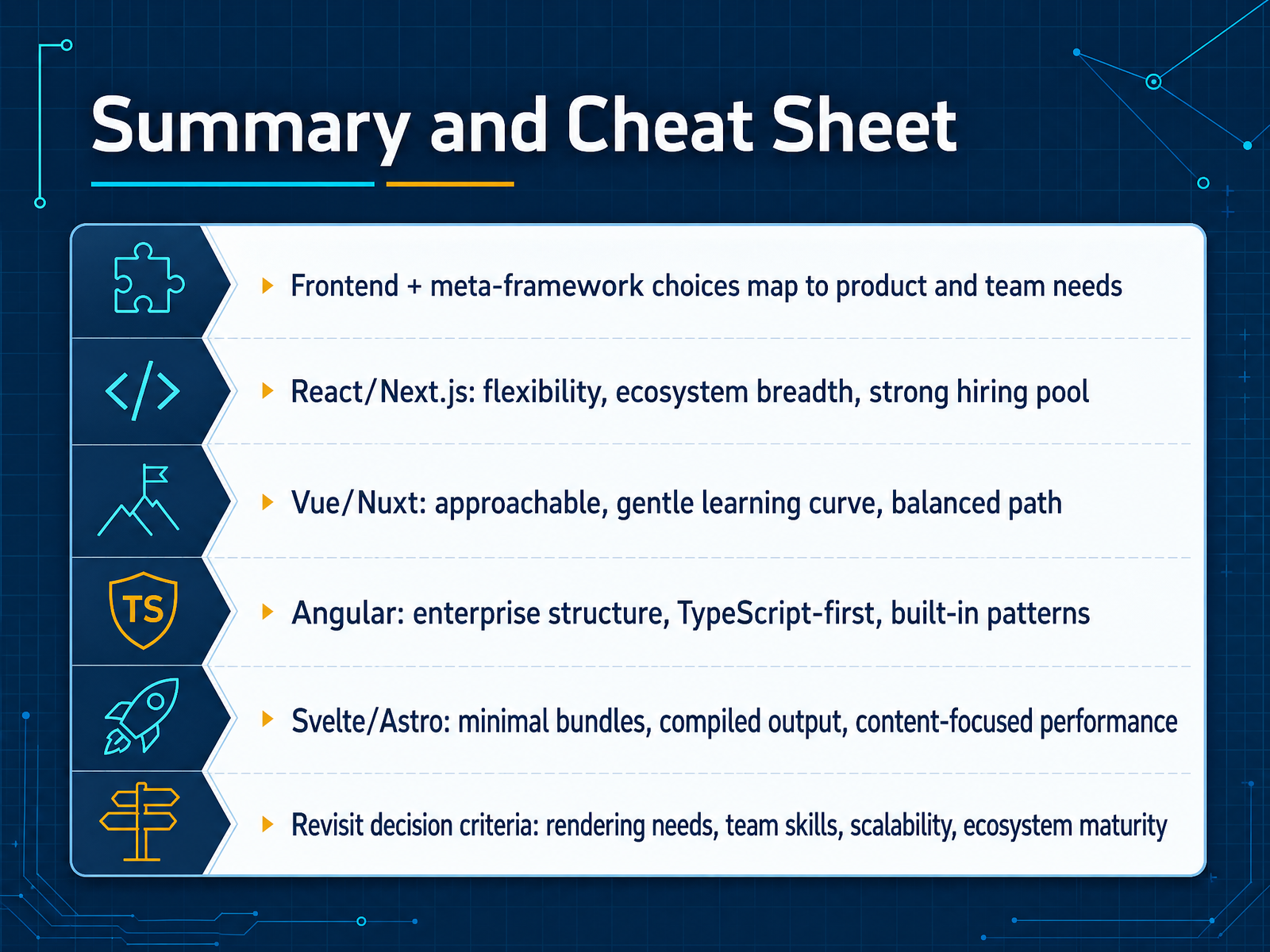
 - 12Summary and Cheat SheetLet’s bring everything together. No framework wins outright — the right choice maps to your product’s needs and your team’s strengths. React, especially with Next.js, gives you flexibility, ecosystem breadth, and the deepest hiring pool. If you need maximum flexibility and the largest talent pool, that’s your default. Vue, with Nuxt, offers an approachable, balanced path — a gentle learning curve and clean developer experience, ideal for small and mid-size teams modernizing existing interfaces. Angular is the enterprise choice: TypeScript-first, opinionated, and structured — it shines when consistency across large, rotating teams matters more than speed. And Svelte, with Astro for content-heavy sites, delivers minimal bundles and compiled output, perfect for performance-sensitive projects — just account for a smaller ecosystem and hiring pool. So before you commit, revisit the core decision criteria: your rendering needs, the team’s existing skills, your scalability roadmap, and ecosystem maturity. Choose based on fit and constraints, not hype. Up next: where to deepen your learning and plug into the community.
 coderio.comprojectimmerse.comcamfirstsolutions.com+22 min
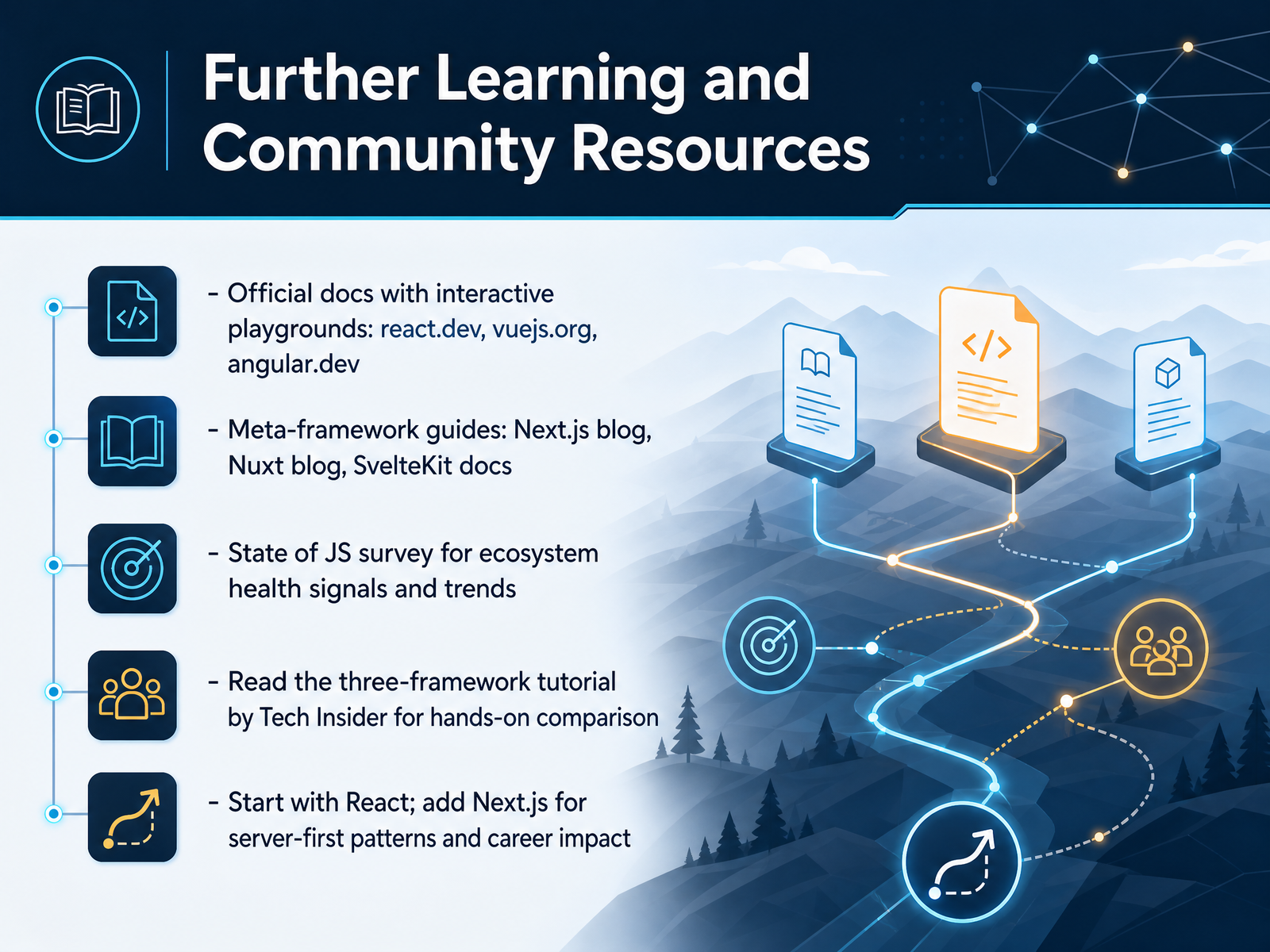
 - 13Further Learning and Community ResourcesWe've covered a lot of ground, and now it's time to talk about where you go from here. The best way to solidify this knowledge is to get your hands dirty. Start with the official documentation at react.dev, vuejs.org, and angular.dev. All three have interactive playgrounds, so you can experiment without setting up a local environment. For production thinking, read the meta-framework guides: the Next.js blog and the Nuxt blog are essential for understanding server-first patterns. To keep your finger on the pulse of the ecosystem, the State of JS survey is your go-to source for trends and health signals. And if you really want to feel the trade-offs, work through the three-framework tutorial by Tech Insider. It builds the same app in React, Vue, and Angular, which is the fastest way to make the comparisons concrete. My pragmatic recommendation is to start with React. Its ecosystem gives you the most leverage. Then add Next.js to learn server-side rendering and full-stack workflows, which will significantly boost your career impact. Thanks for joining, and happy building.
 coderio.compharosproduction.com2 min
Take the deck with you
Download this course as a file — free, no sign-up needed.
- PDF handoutEvery slide page, ready to print or share.14 pages · 3.5 MBDownload
- Narrated PowerPointThe deck that presents itself — every slide carries the digital human's narration video.14 pages · 14.9 MBDownload
- PowerPoint slidesThe full deck as a .pptx — open it in PowerPoint, Keynote, or Google Slides.14 pages · 3.4 MBDownload
Free to use in your own training — please keep the PersonWise credit page at the end.
Have your own deck? Turn it into a course
Sources consulted
Web sources consulted while building this course.
- Rendering on the Web | Articles - web.dev — web.dev
- Rendering Strategies on the Web: CSR, SSG, ISR, SSR, and RSC | Benedikt Sperl — benedikt-sperl.de
- How to choose the best rendering strategy for your app - Vercel — vercel.com
- Rendering Strategies: CSR, SSR, SSG, and ISR — Sujeet Jaiswal - Principal Software Engineer — sujeet.pro
- Rendering Spectrum | CSS-Tricks — css-tricks.com
- mraible/history-of-web-frameworks-timeline — github.com
- A Canonical History of Web Frameworks — curotec.com
- Evolution of Popularity and Multiaspectual Comparison of Widely Used Web Development Frameworks — mdpi.com
- andrelmlins/frontend-chronology — github.com
- History of front-end frameworks — blog.logrocket.com
- Best Frontend Frameworks 2026: React, Angular, Vue, Next.js and Svelte — coderio.com
- React vs Vue vs Angular vs Next.js vs Gatsby vs Astro vs Svelte: Which One Won't Ruin Your Weekend - Project Immerse — projectimmerse.com
- Best Web Development Frameworks in 2026: Complete Comparison | Camfirst Solutions Blog — camfirstsolutions.com
- Frontend Framework Comparison 2026 | Pharos Production — pharosproduction.com
- Choosing the Right JavaScript Framework in 2026 | Codably — codably.dev
- How to Choose a Web UI Framework - — docs.zkoss.org
- Choosing a Frontend Framework | Frontend Patterns — frontendpatterns.dev
- Web Application Framework Comparison: Beyond the Hype — wolf-tech.io
- Evaluator’s Guide: Choosing a Web UI Framework - — docs.zkoss.org
- 5 Criteria for Choosing a Frontend Framework - Xenia Tech — xenia.tech