Begin
14 pages · ~28 min
Small Talk in English: Start & Keep It Going
This training helps English learners start and sustain small talk with confidence. It covers practical phrases and strategies for opening conversations and keeping them going naturally.
A digital instructor presents all 14 pages. Hold “Ask” at any point and ask out loud — the answer comes from this course. No sign-up needed.
What you’ll learn
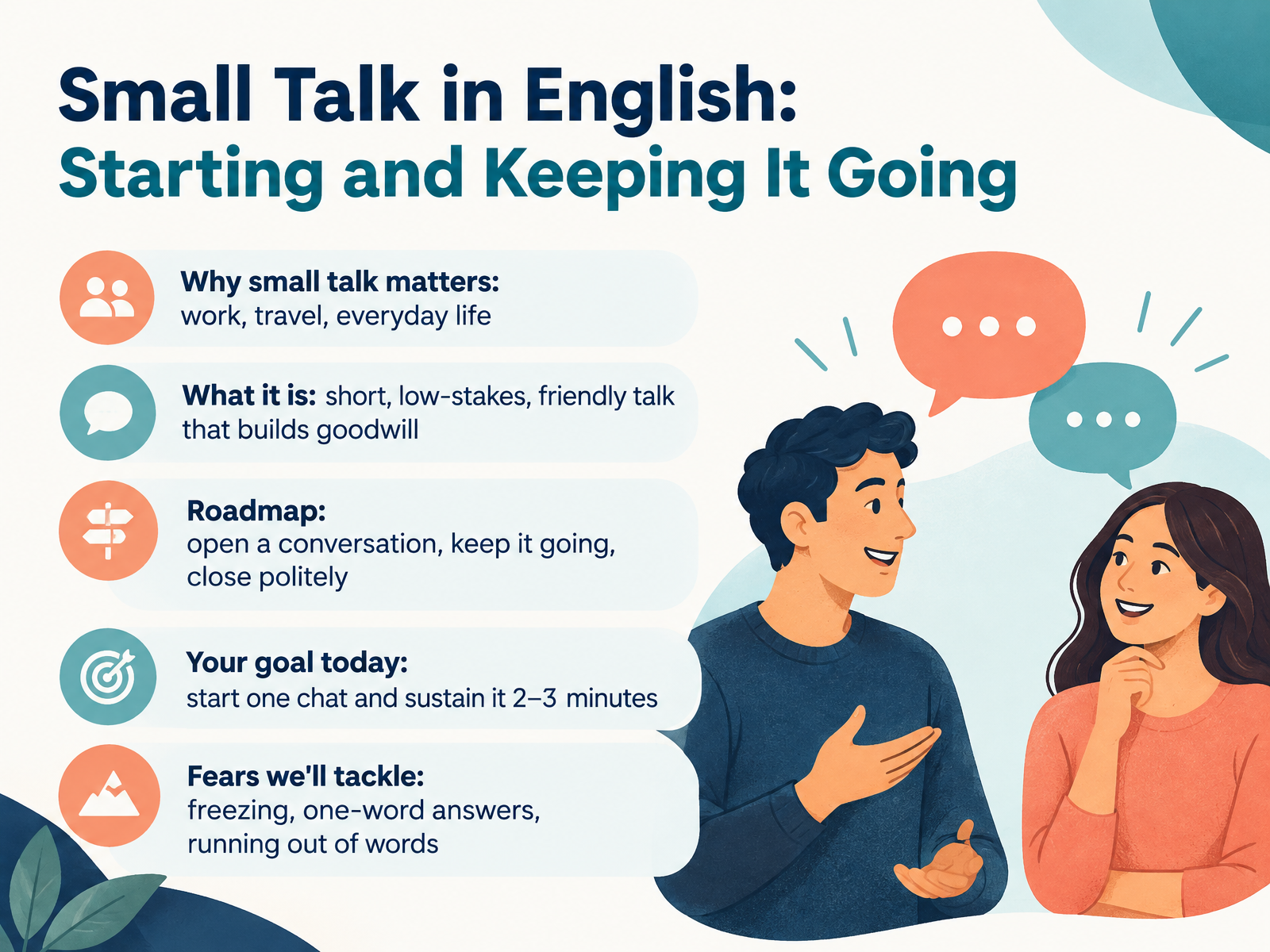
- 01Small Talk in English: Starting and Keeping It GoingWelcome. Today we're talking about small talk in English, and how to start it and keep it going. Here's the thing. Small talk isn't a personality gift. It's a skill, and you can learn it. It matters in everyday life, at work, and when you travel. It's just short, friendly talk that builds goodwill. No big pressure. Now, here's our roadmap. First, we open a conversation. Then we keep it going. Then we close it politely. Your goal today is simple. Start one chat and keep it going for two to three minutes. We'll also tackle the fears. Freezing up. One-word answers. Running out of words. You've got this. In the next slide, we'll look at why small talk feels hard, and why it really isn't.hdl.handle.netsage.cnpereading.comdoi.org+21 min
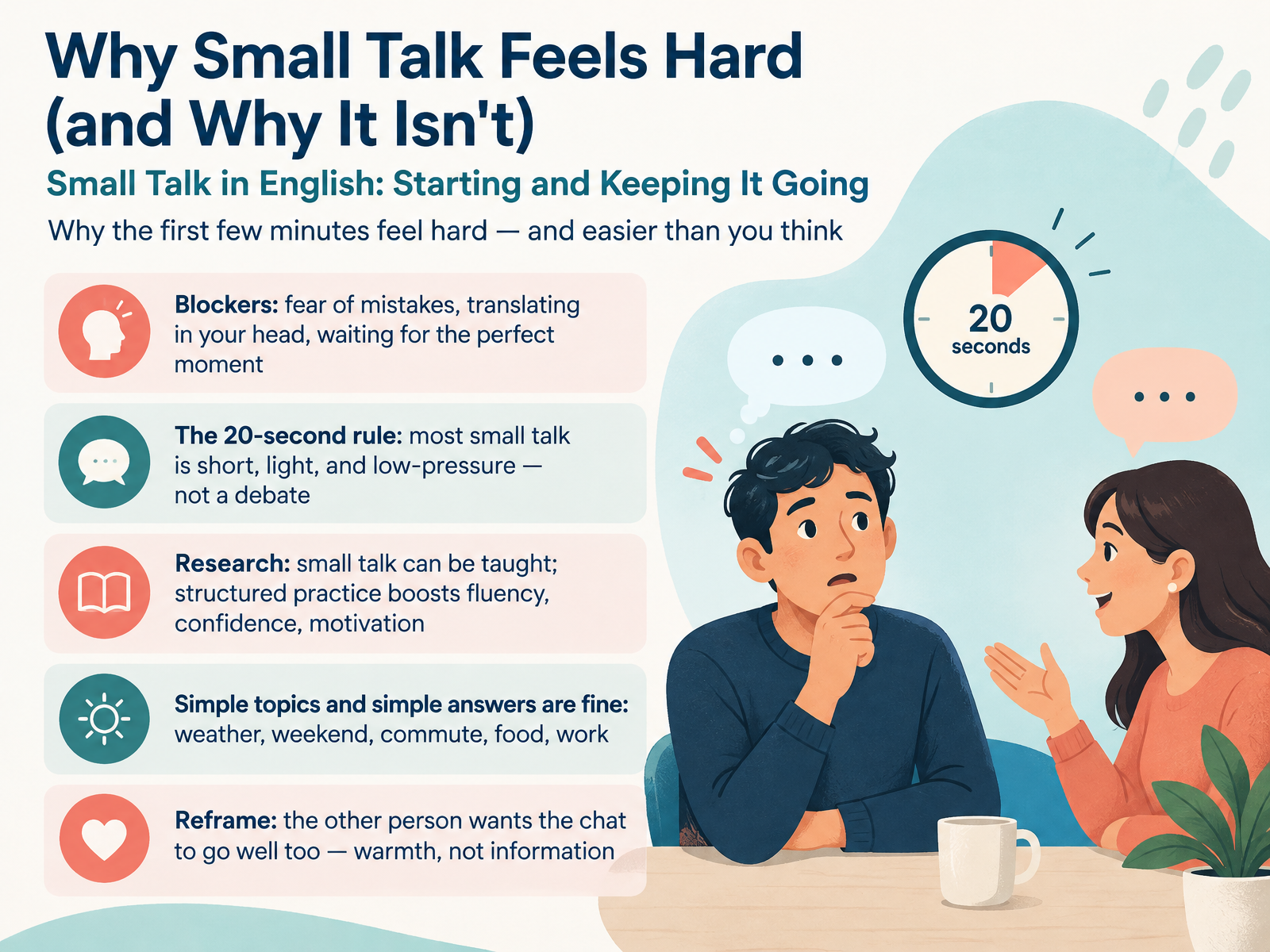
- 02Why Small Talk Feels Hard (and Why It Isn't)Let's talk about why small talk feels hard, and why it isn't. If you freeze in those first few minutes, you're not alone. Many learners worry about mistakes, or translate in their head, or wait for the perfect moment. But here's some good news. Small talk can be taught. And research shows that structured practice builds fluency, confidence, and motivation. Try the twenty-second rule. Most small talk is short, light, and low-pressure. It's not a debate. Simple topics are fine, like weather, the weekend, your commute, food, or work. And simple answers are fine too. Here's a reframe. The other person wants the chat to go well too. It's about warmth, not information. So give it one easy question and one short answer. That's already a win. Next, let's look at safe topics and topics to avoid.
 hdl.handle.netsage.cnpereading.comdoi.org+22 min
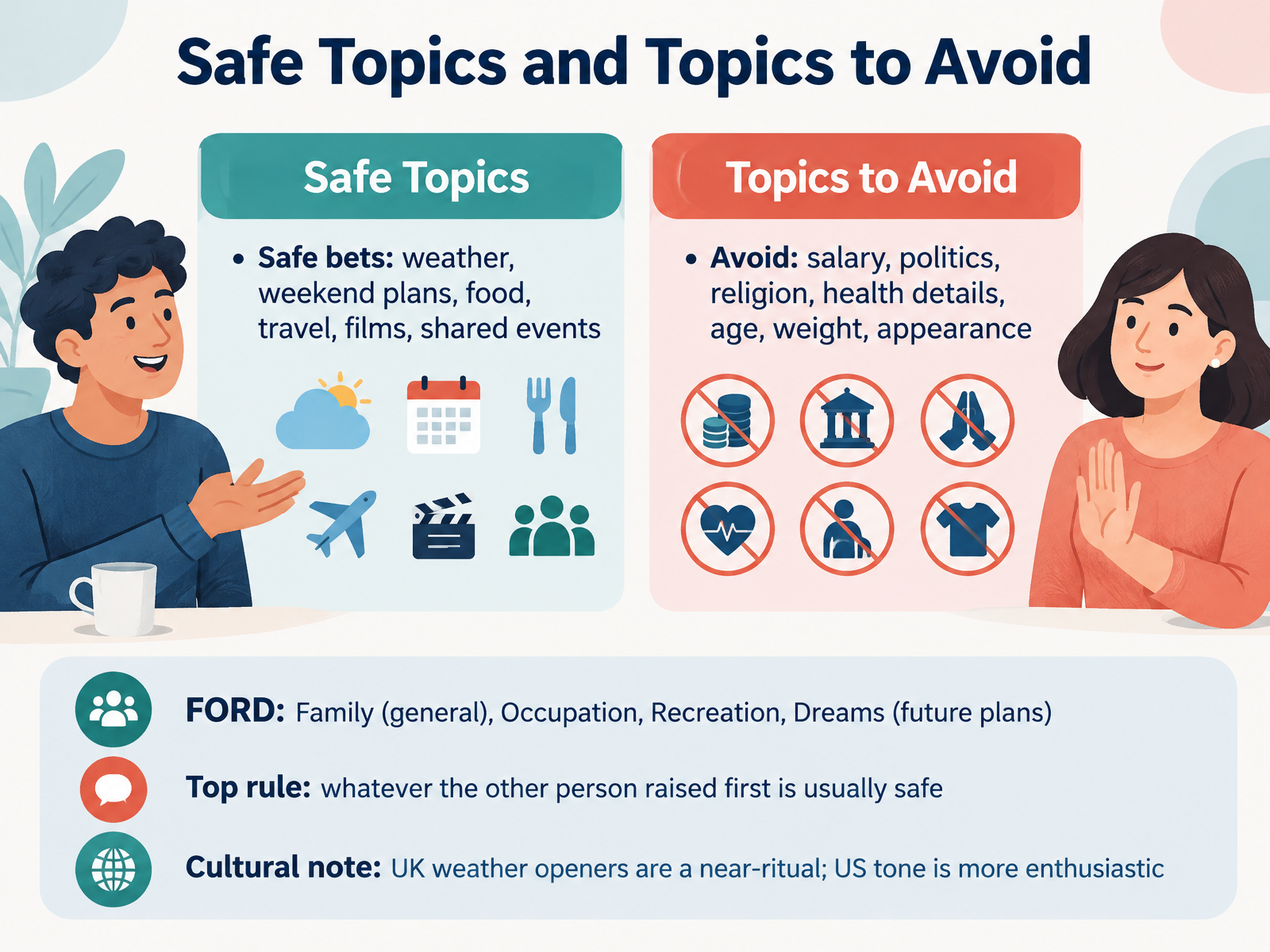
- 03Safe Topics and Topics to AvoidSo let's talk about what's safe to bring up. Safe bets are weather, weekend plans, food, travel, films, and events you both share. Try this one: "Any plans for the weekend?" That works almost anywhere. For a simple memory tool, remember FORD. Family in a general way. Occupation, meaning work. Recreation, like hobbies and sport. And Dreams, your future plans. Now the other side. Avoid salary, politics, religion, health details, age, weight, and appearance. These can make people uncomfortable fast. Here's the top rule. Whatever the other person brought up first is usually safe. Let them open the door. One cultural note. In the UK, a weather opener is almost a ritual. In the US, the tone is often more enthusiastic. Next, let's look at why greetings aren't real questions.
 globalcareers.brandeis.eduenglishonline.britishcouncil.orgttlab.hopto.org+22 min
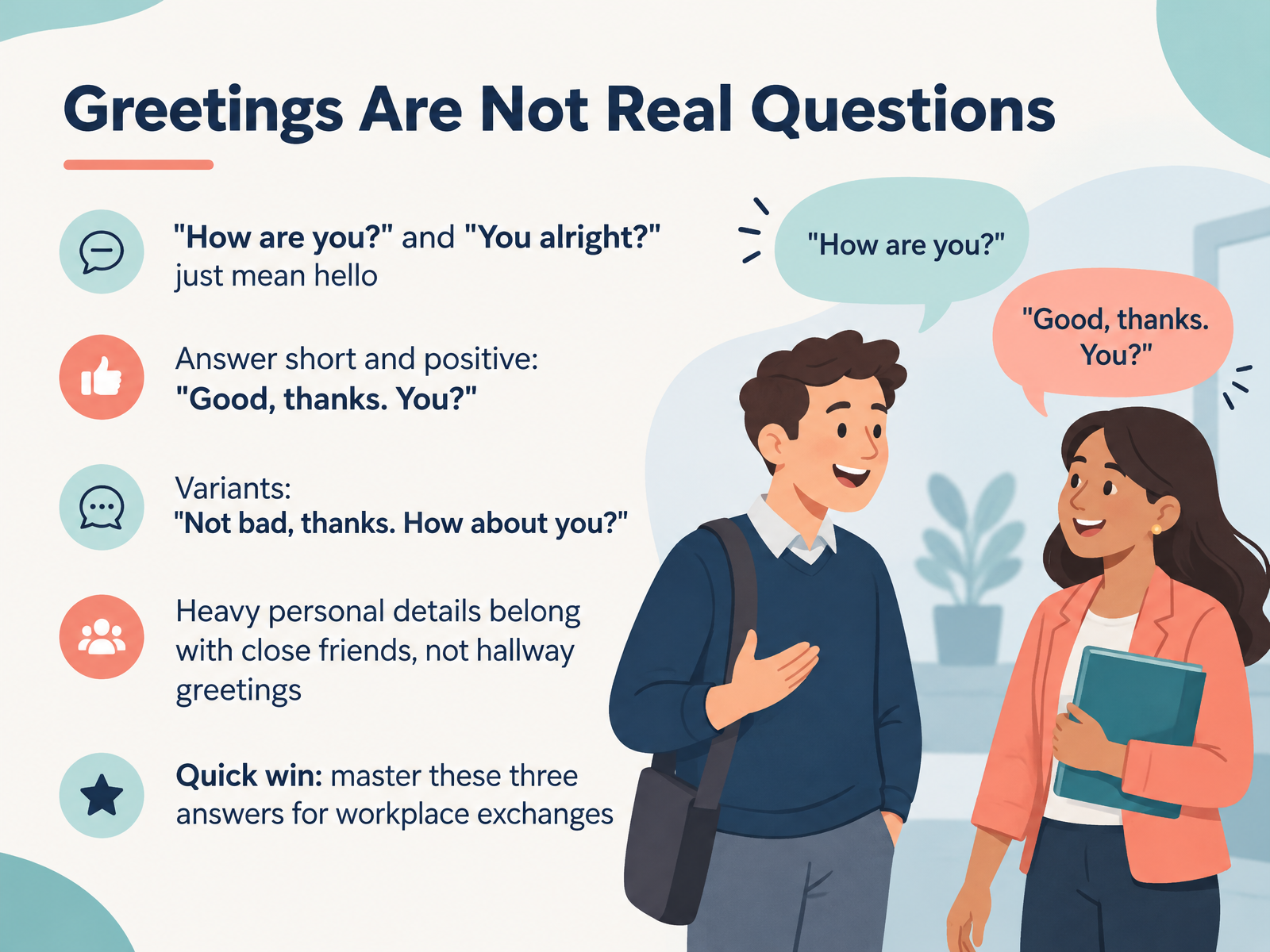
- 04Greetings Are Not Real QuestionsNow here's a small shift that makes greetings much easier. In English, "How are you?" is not really a question. It just means hello. The same goes for "You alright?" in the UK. So keep your answer short and positive. Try this: "Good, thanks. You?" Or you could say, "Not bad, thanks. How about you?" That's it. Heavy personal details belong with close friends, not hallway greetings. Save the long story for later. Here's your quick win. Master these three short answers for workplace exchanges. Practice them out loud until they feel automatic. You've got this. Next, let's look at openers that work, starting a conversation.
 globalcareers.brandeis.eduenglishonline.britishcouncil.orgttlab.hopto.org+21 min
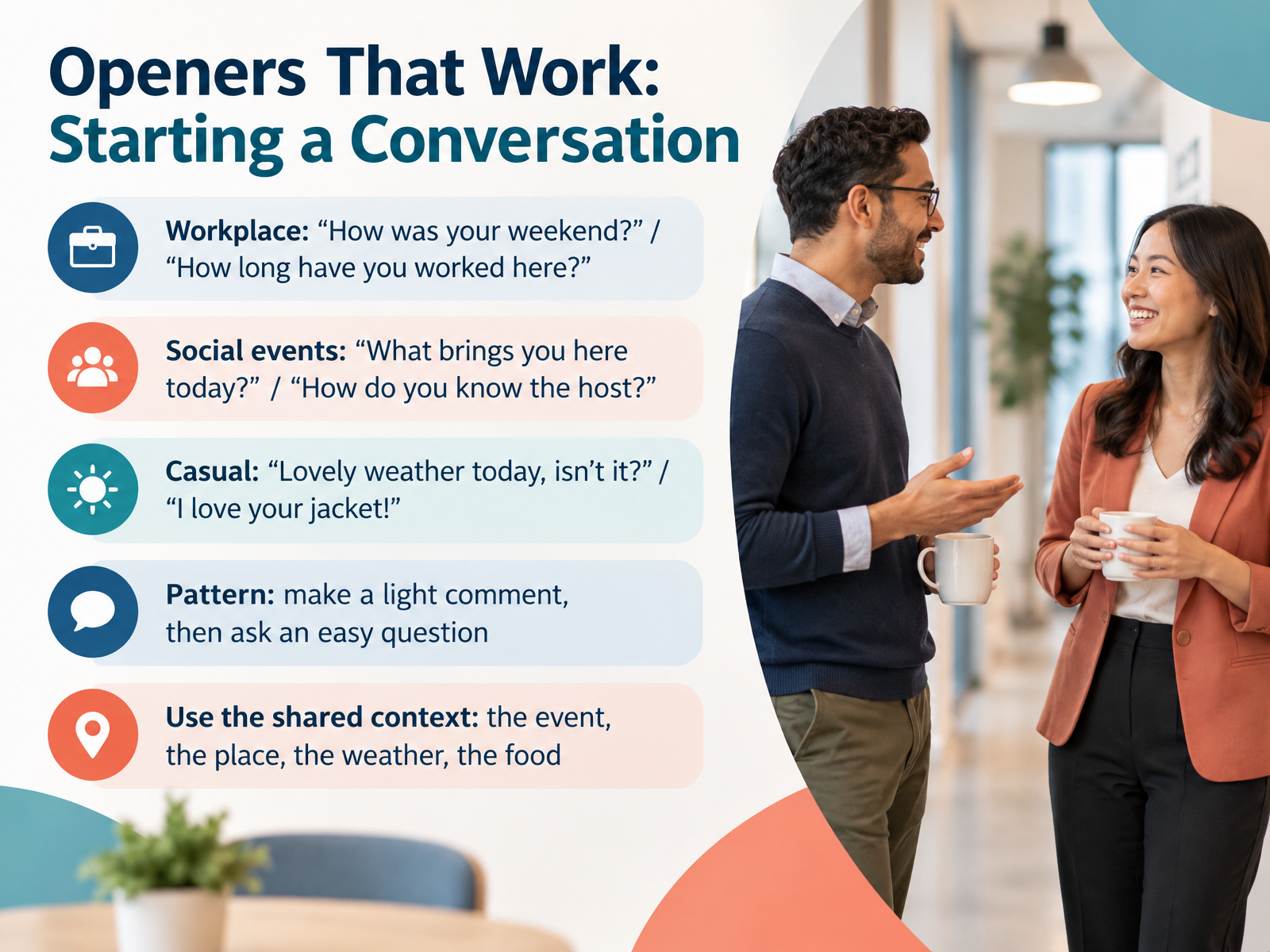
- 05Openers That Work: Starting a ConversationNow let's look at openers that work. A good opener doesn't need to be clever. It's usually one light comment plus one easy question. Start with a safe topic. At work, try this: "How was your weekend?" Or, "How long have you worked here?" At a party, you could say, "What brings you here today?" Or, "How do you know the host?" And in a casual moment, weather works well. Try, "Lovely weather today, isn't it?" A simple compliment also works, like, "I love your jacket!" Here's the pattern to remember. Make a light comment, then ask an easy question. And use the shared context around you. The event, the place, the weather, the food. Give it a try with one person today. So, what openers fit each setting best?
 englishonline.britishcouncil.orgenglishclub.comberlitz.com+21 min
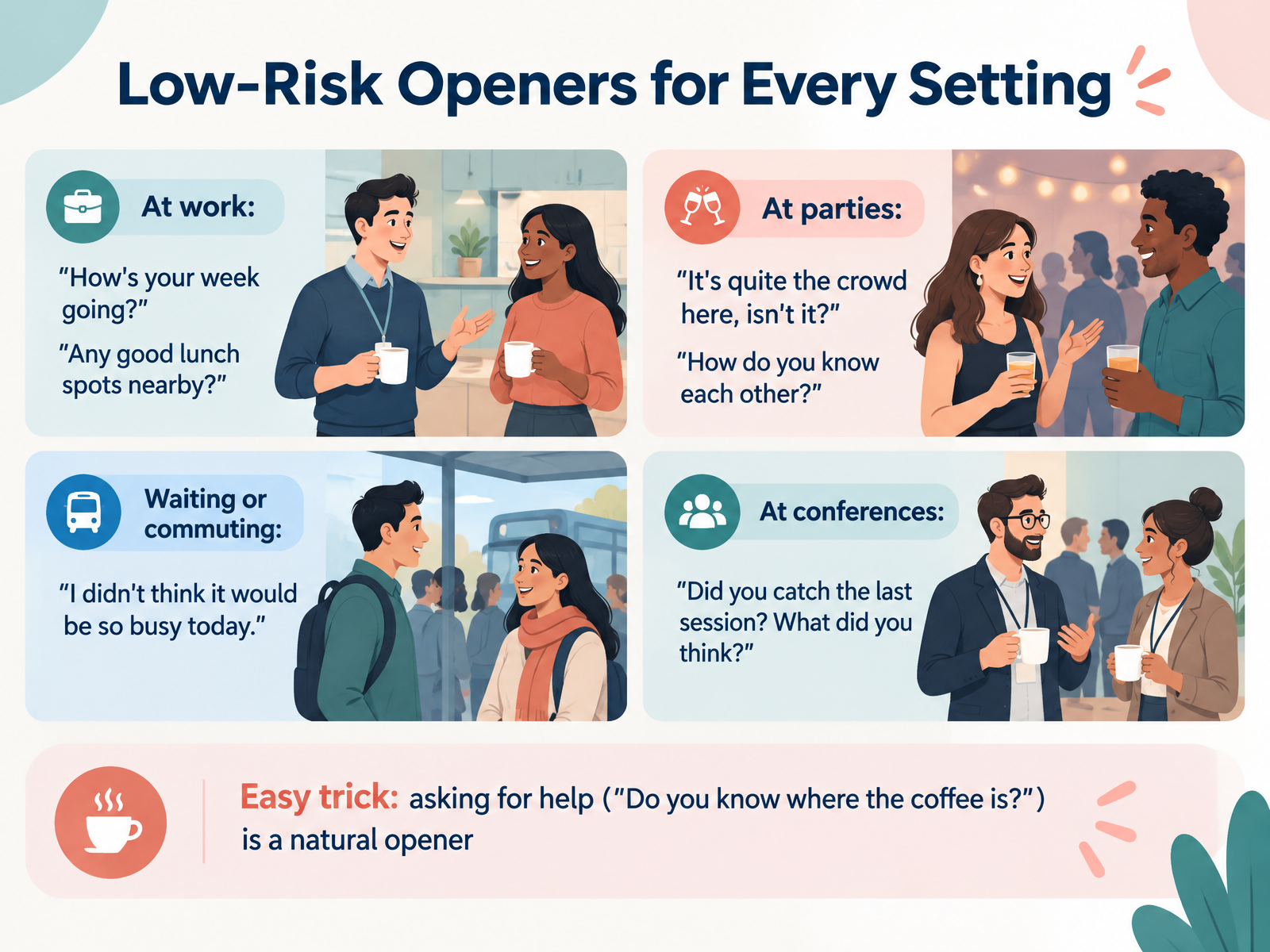
- 06Low-Risk Openers for Every SettingNow let's look at some low-risk openers you can use in different settings. The key word here is low-risk. You're not testing yourself. You're just making one small, friendly comment.
At work, try this. "How's your week going?" Or, "Any good lunch spots nearby?" Both are easy and safe.
At a party, you could say, "It's quite the crowd here, isn't it?" Or ask, "How do you know each other?"
While you're waiting or commuting, a simple comment works well. "I didn't think it would be so busy today."
At a conference, try, "Did you catch the last session? What did you think?"
Here's an easy trick. Asking for help is a natural opener. Something like, "Do you know where the coffee is?" It gives the other person a simple way to respond.
Pick one line and practice it out loud. That's your win for today.
Next, we'll look at keeping the conversation going with the question, answer, add formula.
 englishonline.britishcouncil.orgenglishclub.comberlitz.com+21 min
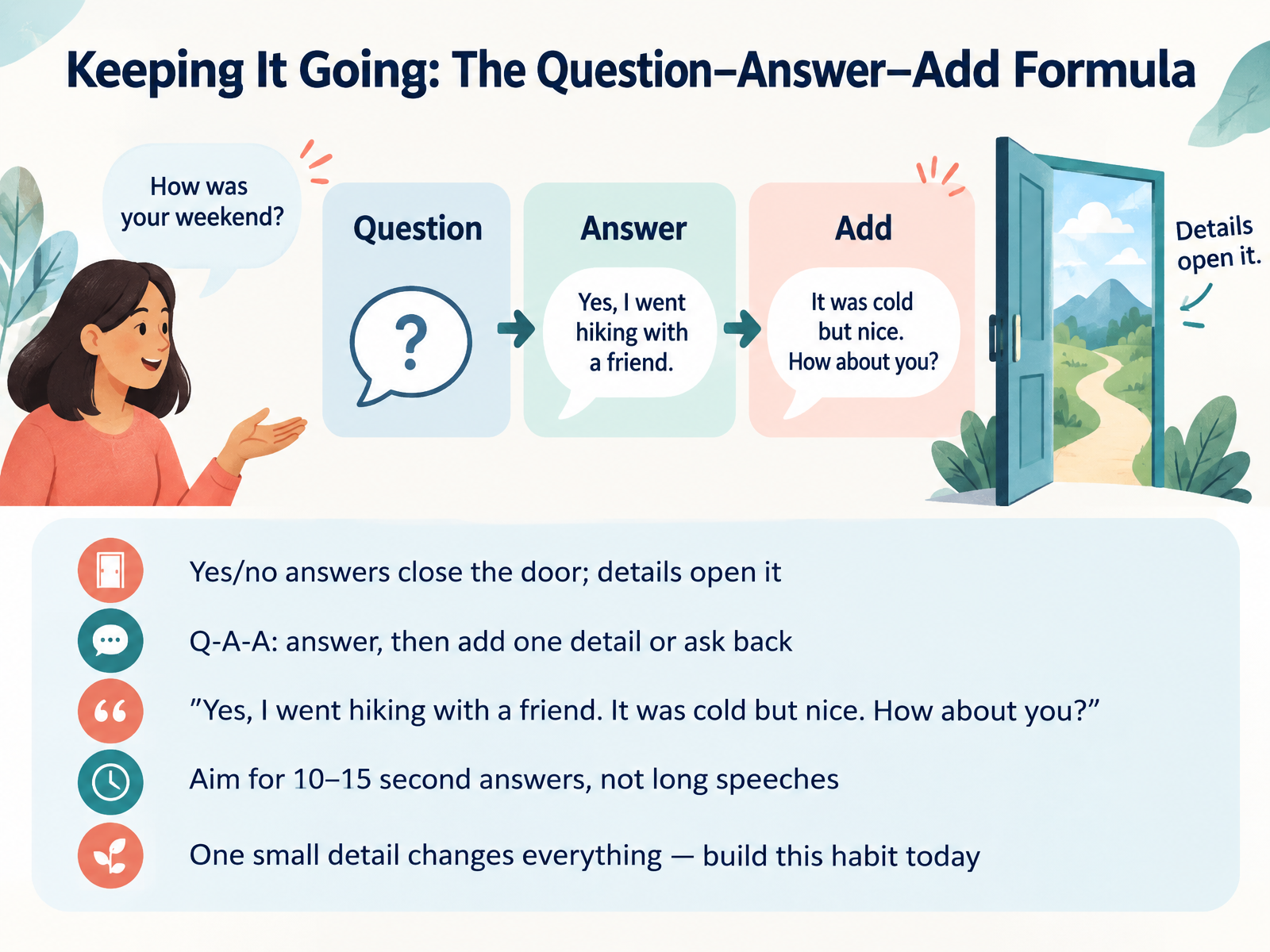
- 07Keeping It Going: The Question–Answer–Add FormulaNow here's a simple formula that keeps a conversation moving. It's called Question, Answer, Add. First, remember this. A yes or no answer closes the door. A small detail opens it. So answer the question, then add one detail or ask back. Try this example. Someone asks, did you do anything fun this weekend? You say, yes, I went hiking with a friend. It was cold but nice. How about you? That's short and natural. Aim for ten to fifteen second answers, not long speeches. One small detail changes everything. Build this habit today. Next, we'll look at follow up questions and building connection.
 englishonline.britishcouncil.orgenglishclub.comberlitz.com+21 min
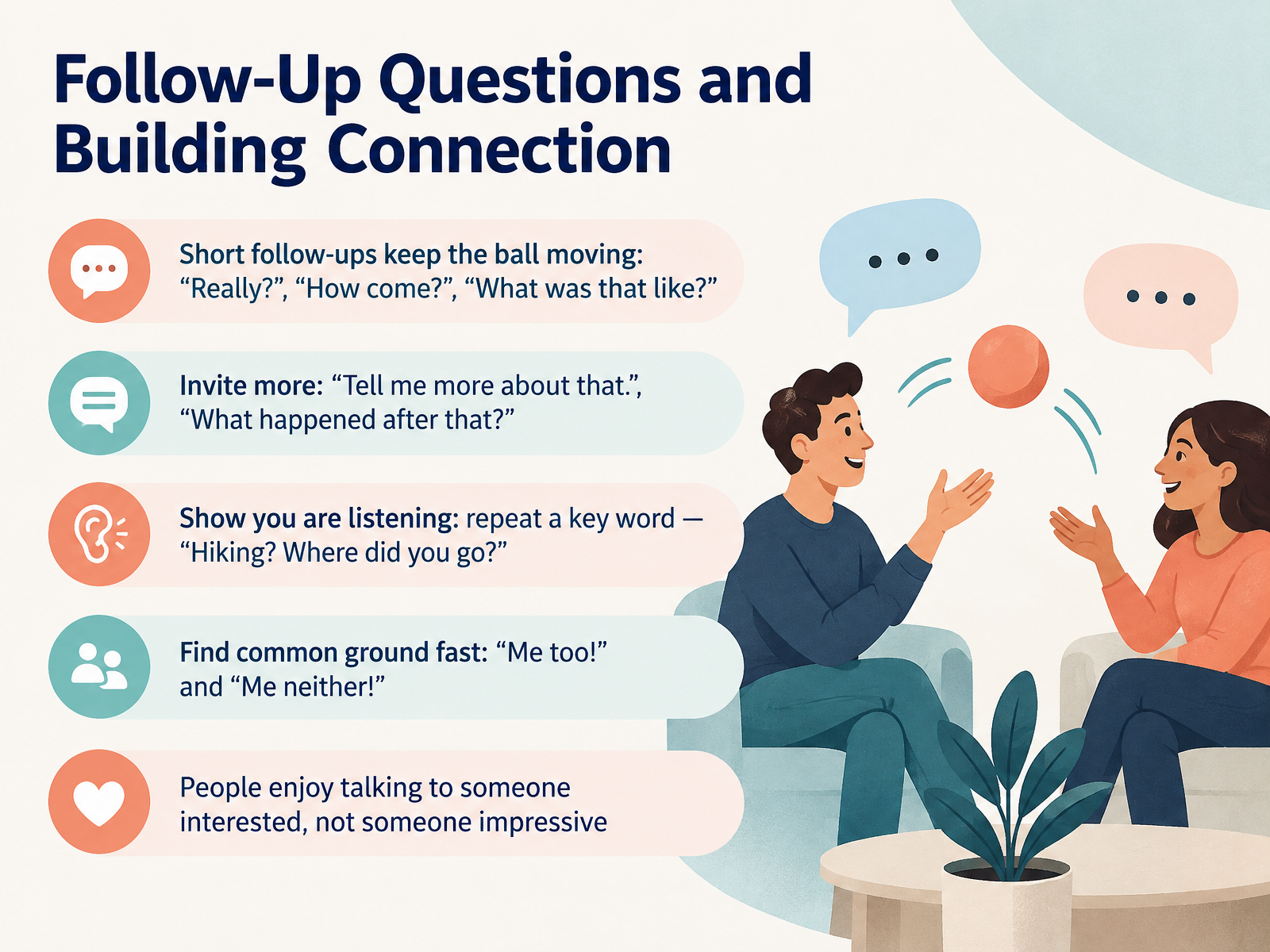
- 08Follow-Up Questions and Building ConnectionNow let's talk about keeping the conversation going. Short follow-up questions do most of the work. Try simple ones like, Really? Or, How come? Or, What was that like? You can also invite more with, Tell me more about that. Or, What happened after that? Here's a small trick. Repeat a key word to show you're listening. If someone says, I went hiking, you can say, Hiking? Where did you go? And when you find something in common, say it fast. Me too! Or, Me neither! Remember, people enjoy talking to someone who's interested, not someone impressive. So stay curious. You don't need clever words. You just need one small question. Next, let's look at useful phrases for natural flow.
 englishonline.britishcouncil.orgenglishclub.comberlitz.com+21 min
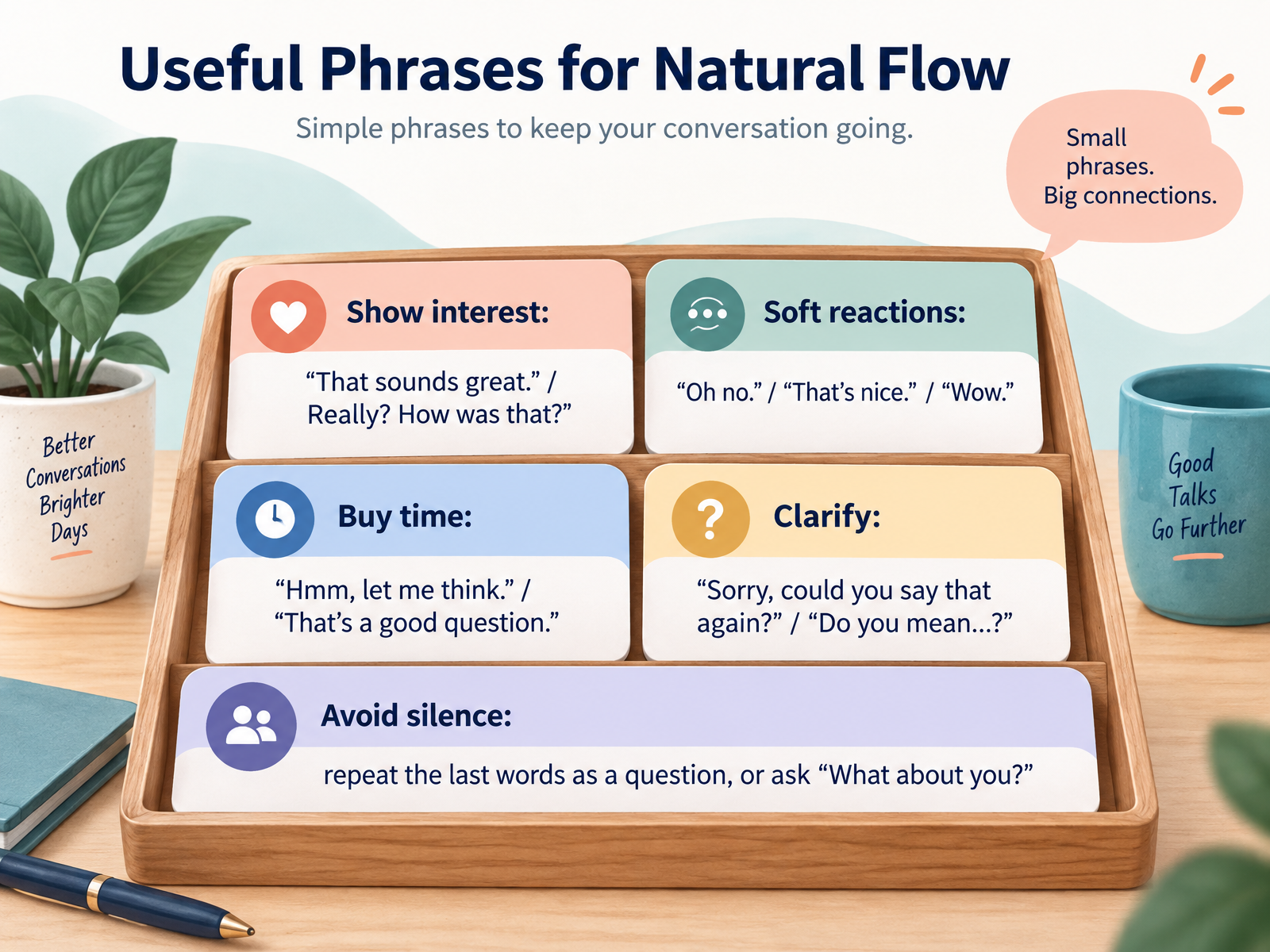
- 09Useful Phrases for Natural FlowNow let's look at some phrases that help a conversation flow. When someone shares news, show interest. Try, "That sounds great." Or ask, "Really? How was that?" For small reactions, keep it short. "Oh no." "That's nice." "Wow." If you need a moment, buy time. Say, "Hmm, let me think." Or, "That's a good question." If you didn't catch something, clarify. "Sorry, could you say that again?" Or, "Do you mean...?" And when there's silence, avoid it. Repeat their last words as a question. Or ask, "What about you?" Try one phrase today at the coffee break. Next, let's talk about ending a conversation politely.
 englishonline.britishcouncil.orgenglishclub.comberlitz.com+21 min
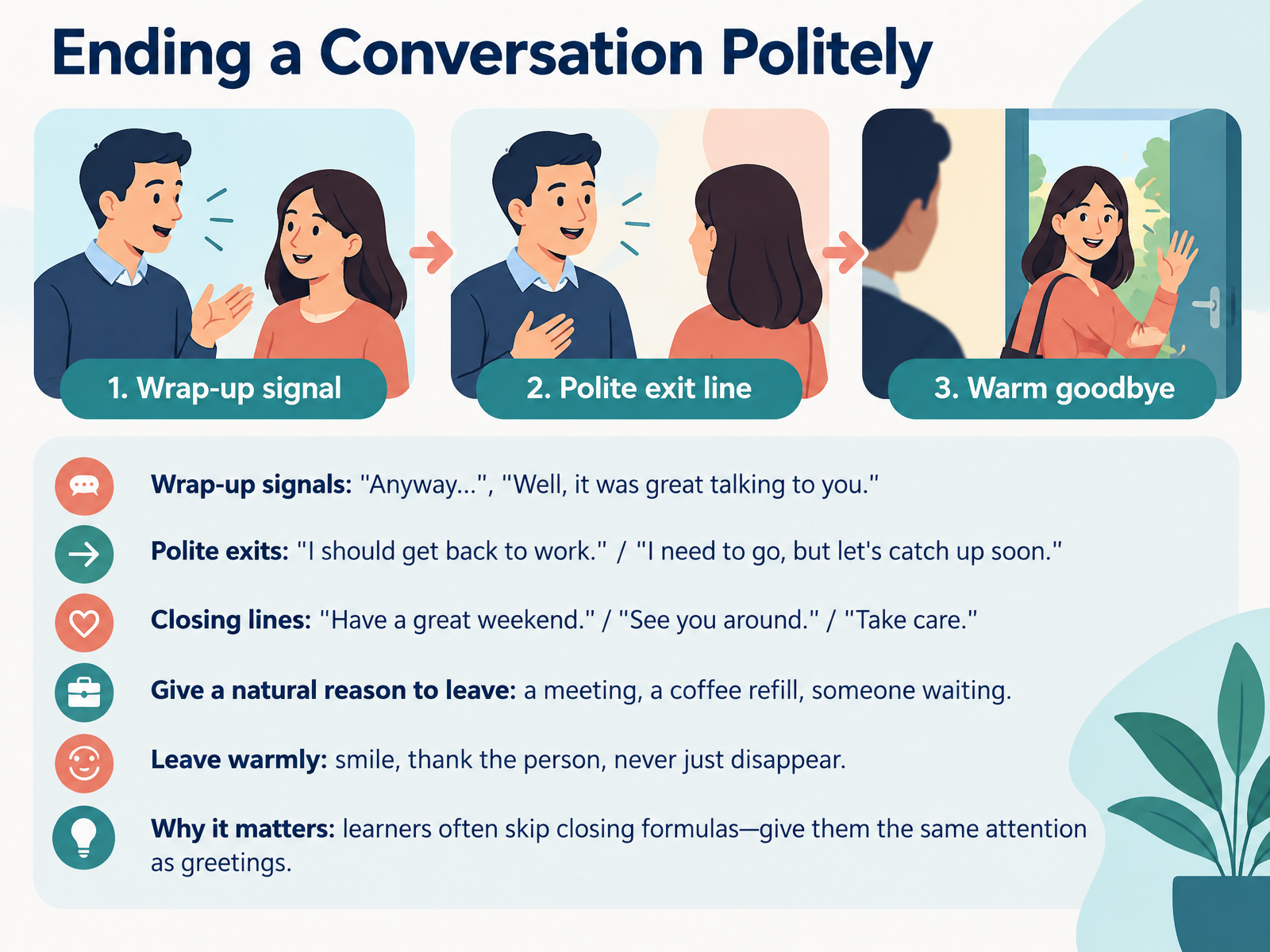
- 10Ending a Conversation PolitelyNow let's talk about ending a conversation politely. Many learners skip this part, but goodbyes matter just as much as greetings. So give them real attention. Here are some simple wrap-up signals. You can say, anyway, or, well, it was great talking to you. These words tell the other person the chat is winding down. Then use a polite exit. Try, I should get back to work, or, I need to go, but let's catch up soon. It helps to give a natural reason. Maybe you have a meeting, you want a coffee refill, or someone is waiting for you. Then close warmly. Try, have a great weekend, see you around, or take care. And please smile and thank the person. Don't just disappear. That small warm ending leaves a good feeling. So practice these closing lines until they feel easy. Next, in the Practice Lab, we'll put it all together: open, sustain, close.
 hdl.handle.netsage.cnpereading.comdoi.org+22 min
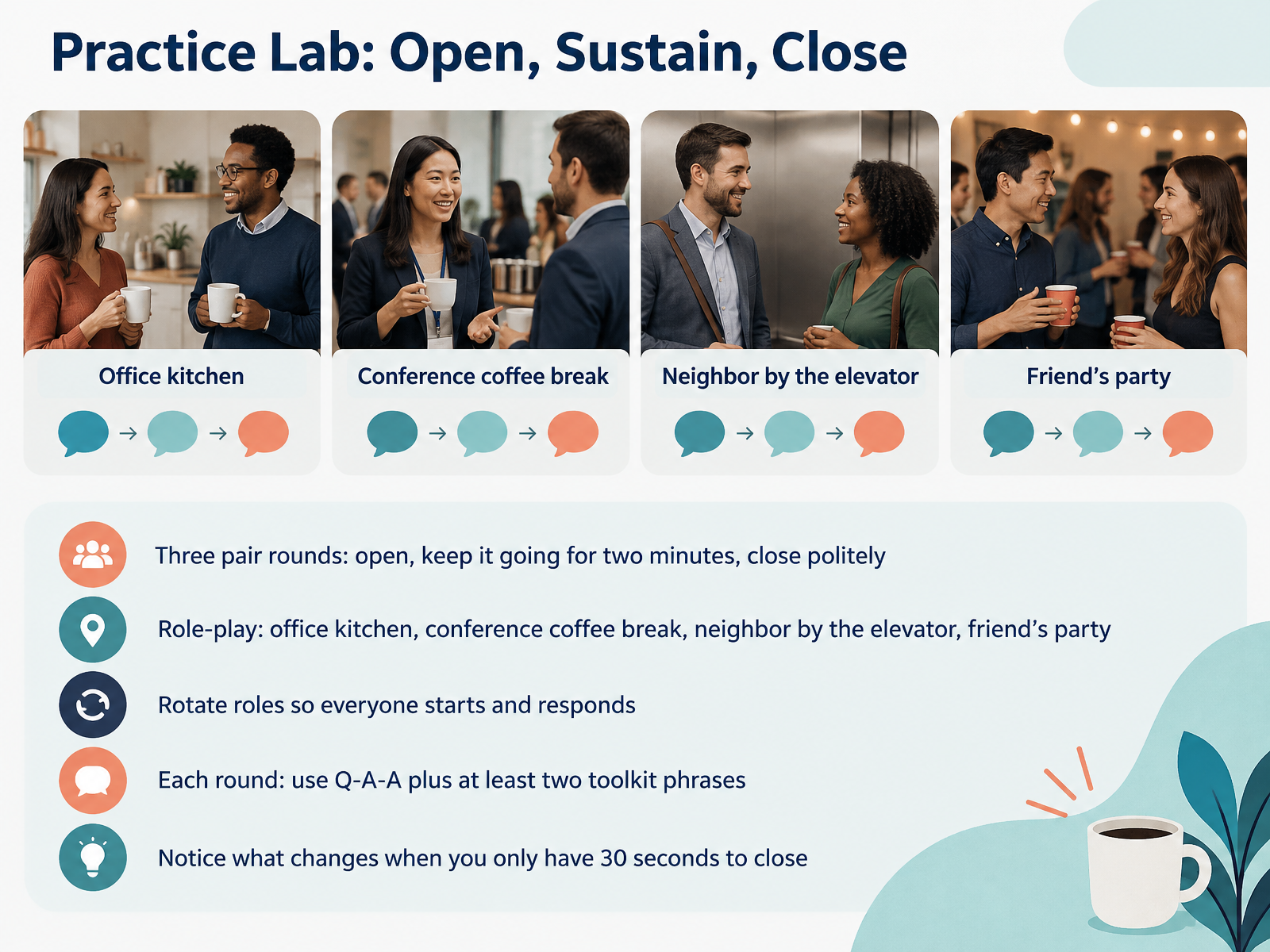
- 11Practice Lab: Open, Sustain, CloseNow let's put it all into practice. You'll do three pair rounds. In each round, you open, keep it going for two minutes, then close politely. Pick a setting: the office kitchen, a conference coffee break, a neighbor by the elevator, or a friend's party. Then rotate roles, so everyone gets a turn to start and a turn to respond. In every round, use question, answer, answer, plus at least two phrases from your toolkit. Here's a quick example. "How's your day going?" "Pretty busy, actually." "Same here. Lots of meetings." That's Q, A, A. Then close with something like, "Anyway, I should get back. Nice talking to you." For the last round, try closing with only thirty seconds left. Notice what changes. You get shorter, but you still finish warmly. Next, let's look at feedback and self-assessment.
 hdl.handle.netsage.cnpereading.comdoi.org+22 min
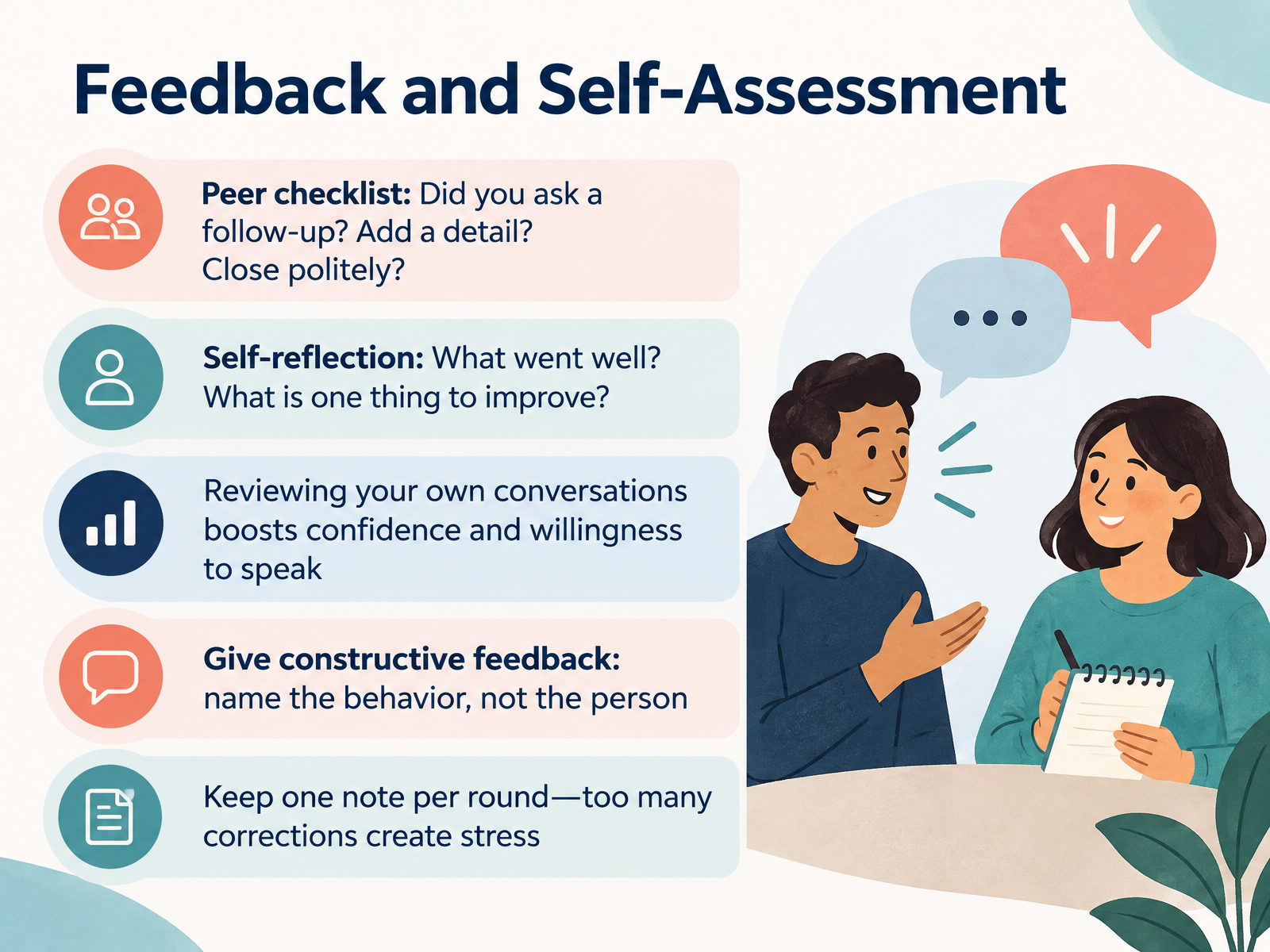
- 12Feedback and Self-AssessmentNow let's look at feedback and self-assessment. This isn't a test. It's a way to notice small wins. Try a simple checklist with a partner. Did you ask a follow-up? Did you add one small detail? Did you close politely? Then reflect on your own. Ask yourself, what went well? And what is one thing to improve? Reviewing your own conversations really helps. It builds confidence and makes you more willing to speak. When you give feedback, name the behavior, not the person. Say, you asked a great follow-up, instead of, you're good at this. And keep it light. Choose one note per round. Too many corrections create stress. One small step is enough. Next, we'll look at common snags and quick fixes.
 hdl.handle.netsage.cnpereading.comdoi.org+21 min
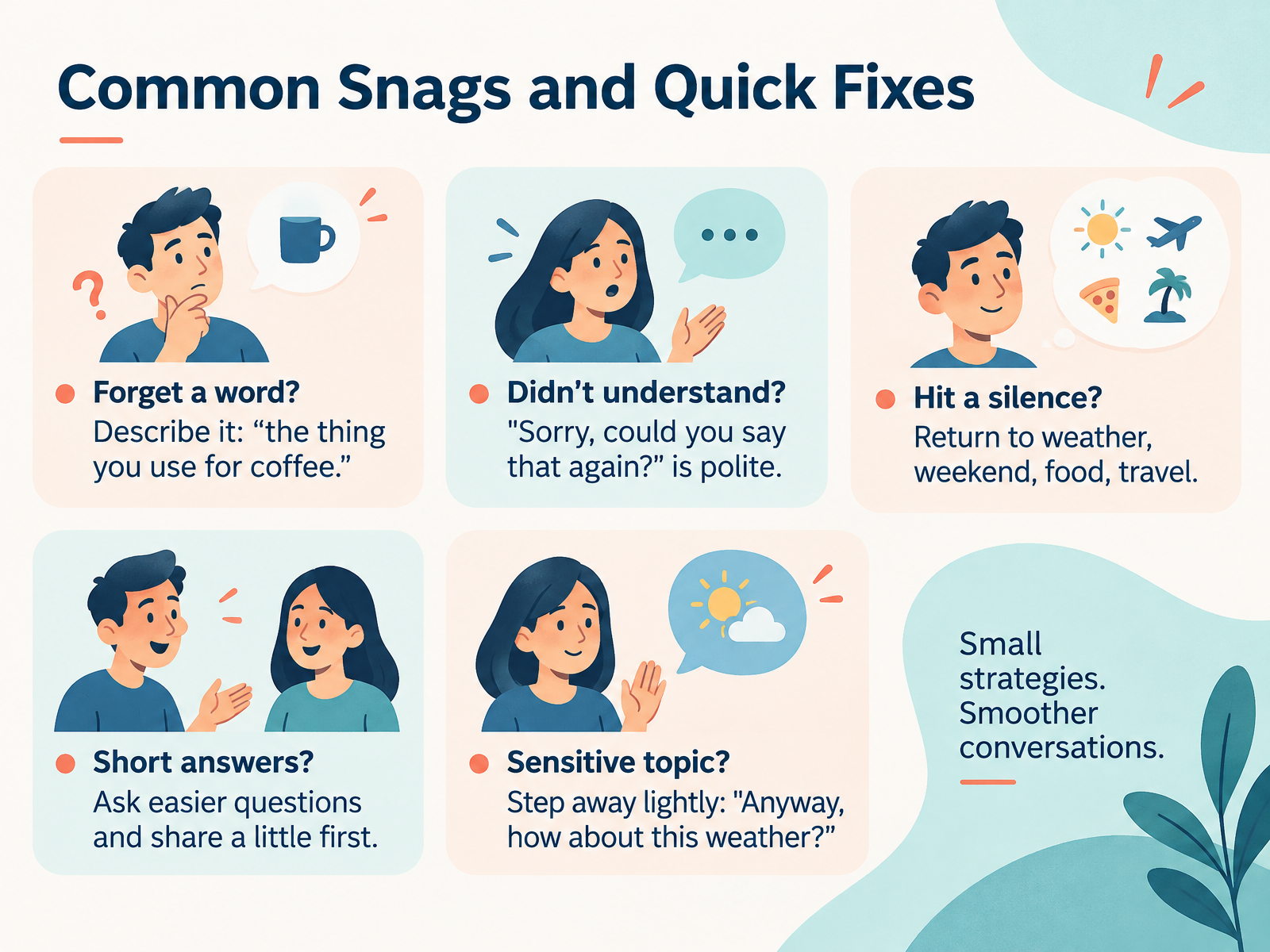
- 13Common Snags and Quick FixesNow let's look at common snags and quick fixes. Snags happen to everyone. They're not a sign that you're bad at English. First, if you forget a word, don't freeze. Describe it instead. Try this: it's the thing you use for coffee. Second, if you didn't understand, just say, sorry, could you say that again? That's polite, and people are happy to repeat. Third, if you hit a silence, return to a safe topic. Weather, weekend, food, or travel. Try this: how about this weather? Fourth, if you get short answers, make your questions easier. And share a little first. For example, I had a quiet weekend, how about you? Fifth, if a topic feels too personal, step away lightly. You can say, anyway, how about this weather? Keep these five fixes in your pocket, and small talk gets much easier. Let's bring it all together with your Small Talk Toolkit: Key Takeaways.
 globalcareers.brandeis.eduenglishonline.britishcouncil.orgttlab.hopto.org+22 min
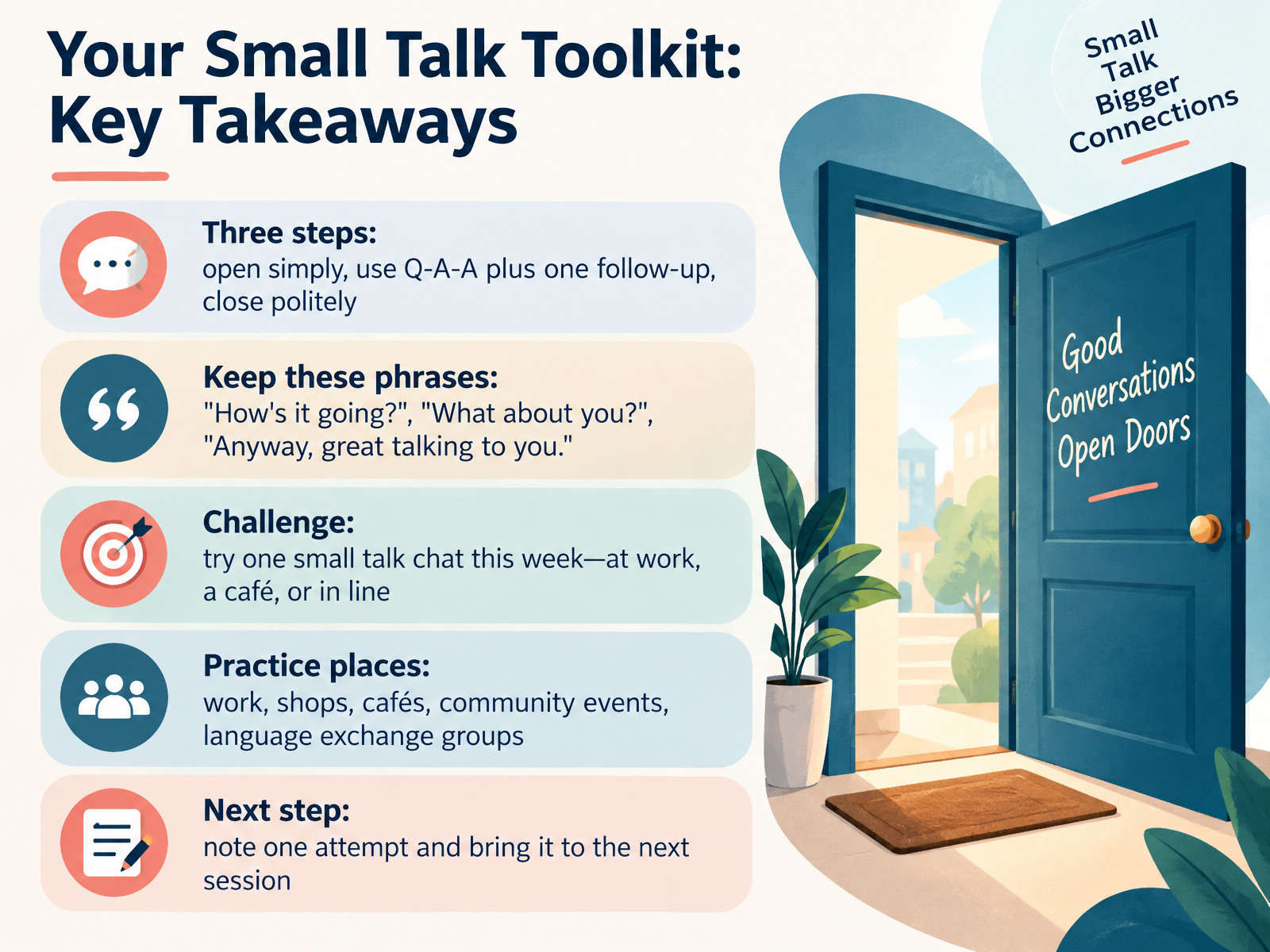
- 14Your Small Talk Toolkit: Key TakeawaysLet's bring it all together. You've got a simple three-step toolkit. Open simply, like "How's it going?" Keep it going with a question, an answer, another answer, then one follow-up, like "What about you?" Then close politely with "Anyway, great talking to you." That's it. You don't need to be perfect. You just need to try. So here's your challenge. This week, have one small talk chat. At work, in a café, or in line at a shop. Anywhere is fine. Keep it short. Two or three minutes is a win. You can also practice at community events or language exchange groups. Afterward, jot down one quick note about what happened. Then bring it to our next session. You did great work today. Be kind to yourself, and go say hello. See you next time.
 englishonline.britishcouncil.orgenglishclub.comberlitz.com+21 min
Take the deck with you
Download this course as a file — free, no sign-up needed.
- PDF handoutEvery slide page, ready to print or share.15 pages · 3.6 MBDownload
- Narrated PowerPointThe deck that presents itself — every slide carries the digital human's narration video.15 pages · 11.7 MBDownload
- PowerPoint slidesThe full deck as a .pptx — open it in PowerPoint, Keynote, or Google Slides.15 pages · 3.5 MBDownload
Free to use in your own training — please keep the PersonWise credit page at the end.
Have your own deck? Turn it into a course
Sources consulted
Web sources consulted while building this course.
- Revealing the Secrets of Small Talk: Can Adult Language Learners Be Taught This Sociolinguistic Skill? — hdl.handle.net
- Enhancing English Fluency Through Small Talk: A Controlled Study Among Adult Thai Learners with No Formal English Education — sage.cnpereading.com
- The effect of applying “Small talk as warming-up technique” in EFL classrooms on students’ improvement in English speaking skill — doi.org
- Phatic Competence: How L2 Understand and Engage in Phatic Communion — hdl.handle.net
- Small talk strategies card game for English language learners: Development and future directions — doi.org
- Oops! Small Talk Topics to Avoid – CSE Connect | Brandeis International Business School — globalcareers.brandeis.edu
- Your guide to small talk topics, phrases and openers in English — englishonline.britishcouncil.org
- Small Talk at Work in English: The Elevator, the Office Kitchen, and the Sixty Seconds Before a Remote Meeting — TT Lab Blog — ttlab.hopto.org
- Small Talk in English: Questions, Topics and Examples — yofluent.com
- What Topics Should Not Be Discussed at Work? Avoid Politics, Overly Personal Details and More | Fortune — fortune.com
- Small Talk: Conversation Starters | Speaking | EnglishClub — englishclub.com
- How to make small talk in English: 100 top questions & examples — berlitz.com
- 220 of the Best Conversation Starters | Grammarly — grammarly.com
- The 100 most useful social English phrases — usingenglish.com