Begin
14 pages · ~28 min
Python Roles and Handoffs
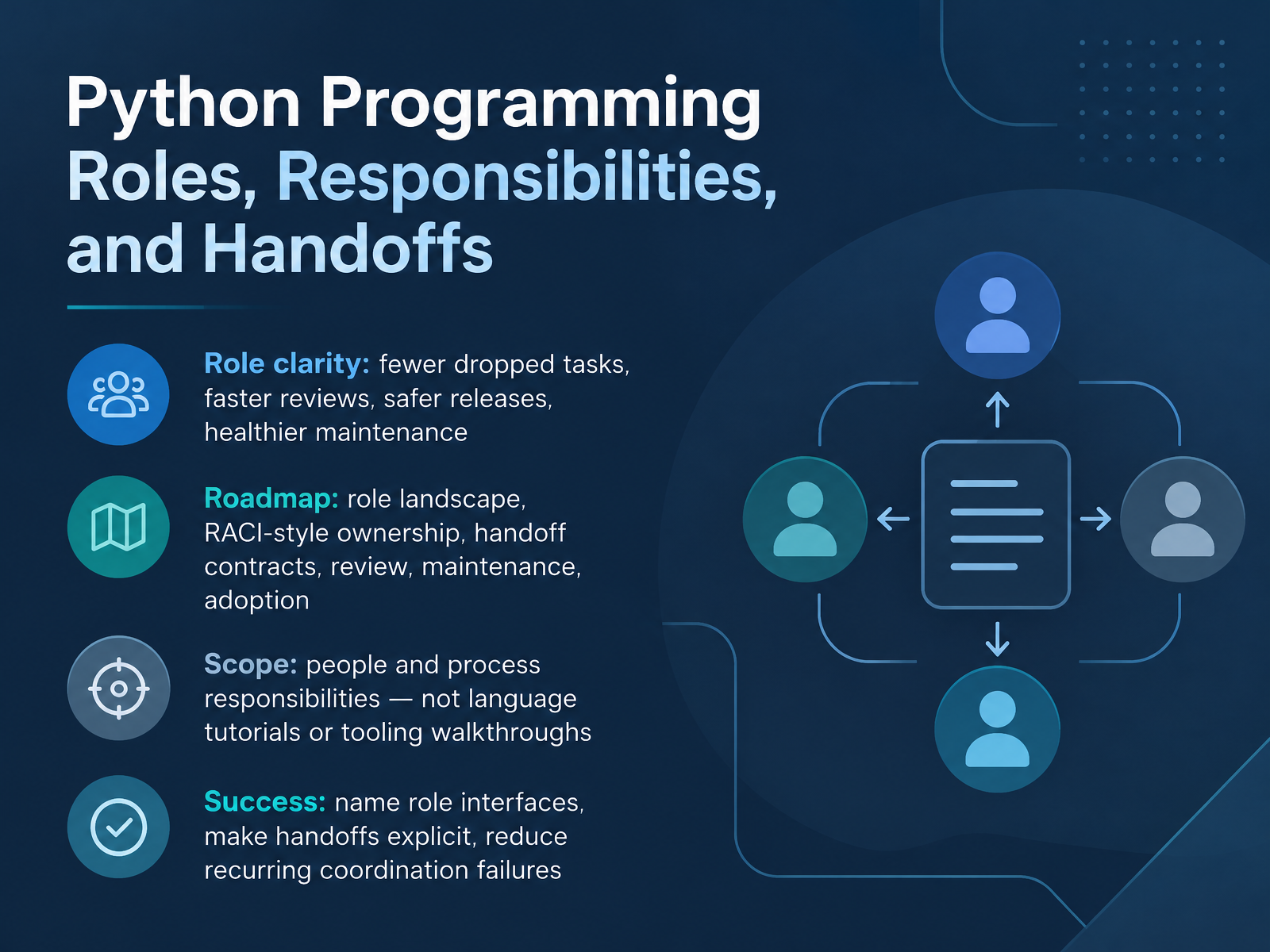
This training clarifies Python programming roles, responsibilities, and handoff processes for team members, helping learners collaborate effectively across development workflows.
A digital instructor presents all 14 pages. Hold “Ask” at any point and ask out loud — the answer comes from this course. No sign-up needed.
What you’ll learn
- 01Python Programming Roles, Responsibilities, and HandoffsWelcome. This course covers Python programming roles, responsibilities, and handoffs. The goal is practical: you will be able to name who decides, who reviews, and what artifact changes hands at each step of your team's workflow. Clear role interfaces reduce dropped tasks, speed up reviews, make releases safer, and keep maintenance healthy over time. Across the sessions we will move from the role landscape, to RACI-style ownership, to explicit handoff contracts, then through review, maintenance, and adoption. This is about people and process, not language tutorials or tooling walkthroughs. By the end, you should be able to name your role interfaces, make handoffs explicit, and reduce the coordination failures that keep recurring. Let's start by looking at why role ambiguity costs Python teams.devguide.python.orgpeps.python.orgscientific-python.org+21 min
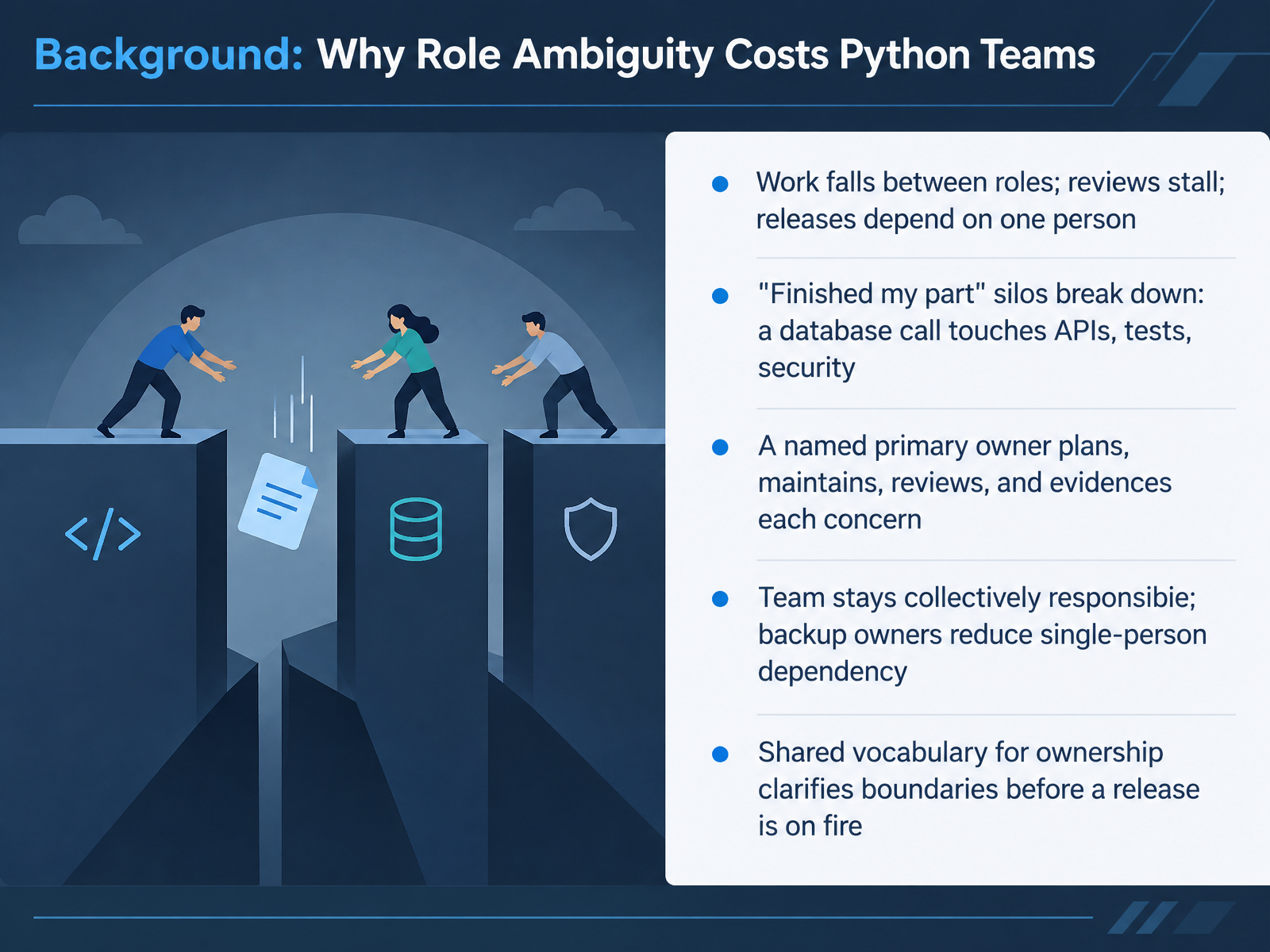
- 02Background: Why Role Ambiguity Costs Python TeamsLet's look at why role ambiguity costs Python teams. When ownership is unclear, work falls between roles, reviews stall, and releases quietly depend on one person. The phrase "finished my part" creates silos that software does not respect. A single database call touches APIs, tests, and security, so someone has to connect those concerns.
A named primary owner plans, maintains, reviews, and evidences each concern. That does not move the whole concern to one person. The team stays collectively responsible, and a backup owner reduces single-person dependency. You can test this before a release: who decides, who reviews, what artifact changes hands, and what does done mean.
Next, we'll map the role landscape across the Python lifecycle.
 handbook.gitlab.comdocs.gitlab.comgithub.com+21 min
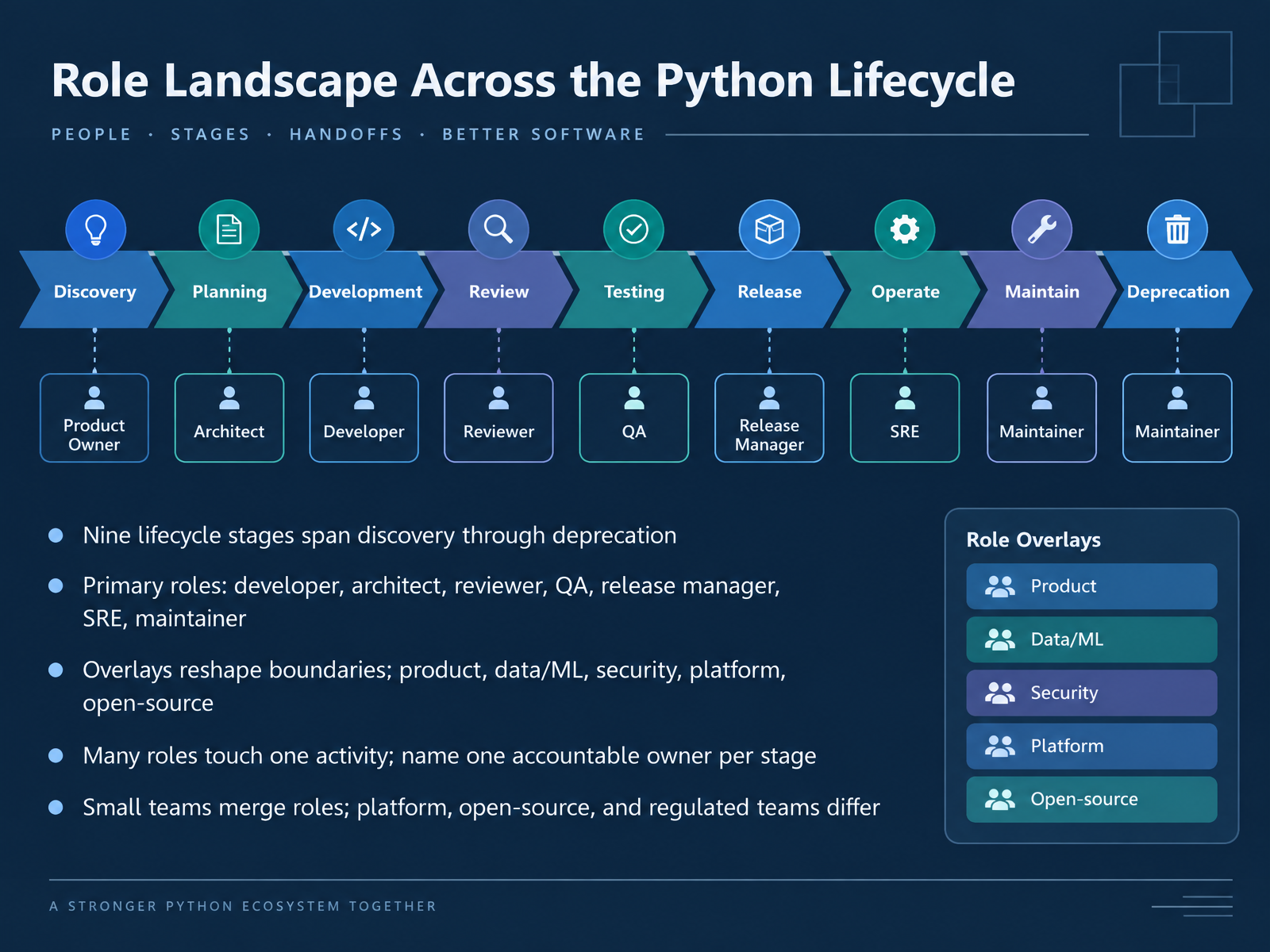
- 03Role Landscape Across the Python LifecycleLet's look at the role landscape across the Python lifecycle. Nine lifecycle stages span discovery through deprecation, and seven primary roles carry the work: developer, architect, reviewer, quality assurance, release manager, site reliability engineer, and maintainer. Overlays reshape the boundaries, including product, data and machine learning, security, platform, and open source. Many roles touch a single activity, yet you should name exactly one accountable owner per stage. That owner keeps decisions moving and knows when a handoff is complete. Small teams merge roles, while platform, open source, and regulated teams differ. Your job is to confirm who decides, who reviews, and what artifact changes hands. Next, we turn to responsibility ownership and RACI for Python work.
 netspective.comsoftware-engineering-guide.github.ioengineeringleadership.tech+21 min
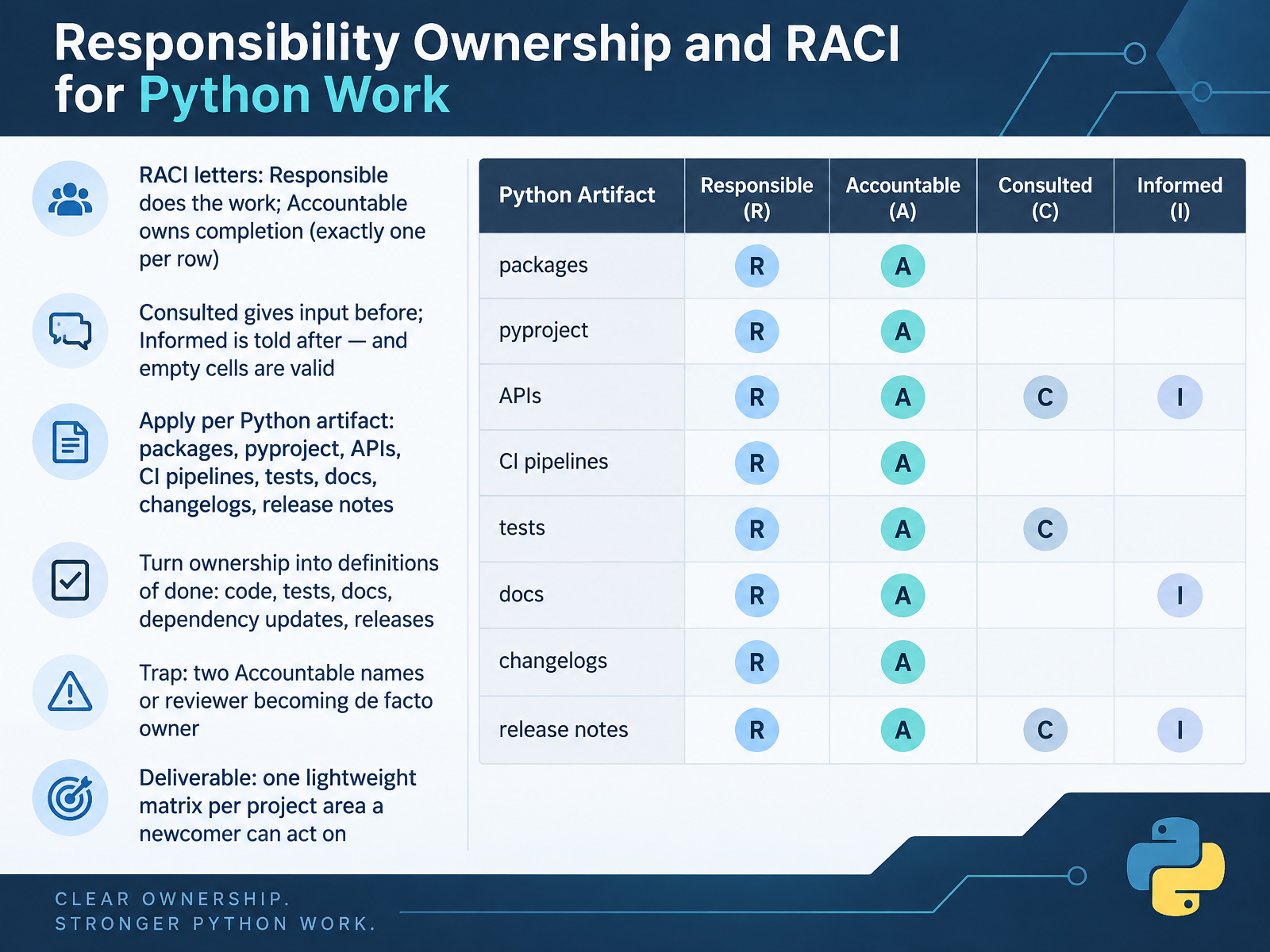
- 04Responsibility Ownership and RACI for Python WorkNow let's turn ownership into something explicit, using a RACI matrix. Responsible means the person doing the work. Accountable means one person owns completion, exactly one per row. Consulted gives input before the decision, and Informed is told after. Empty cells are valid, so do not fill the chart for appearance.
Apply the letters per artifact: packages, pyproject configuration, APIs, CI pipelines, tests, docs, changelogs, and release notes. Then turn ownership into definitions of done. For code, that means reviewed and merged. For tests, written, passing, and meaningful. For docs and changelogs, updated in the same change. For dependency updates and releases, the named owner signs off.
Watch two traps: two Accountable names on one row, and a reviewer quietly becoming the de facto owner. Also name backup owners so a single person is not the only point of failure.
The deliverable is one lightweight matrix per project area that a newcomer can act on. Next, we look at Handoff Points and Contracts Across the Lifecycle.
 netspective.comsoftware-engineering-guide.github.ioengineeringleadership.tech+22 min
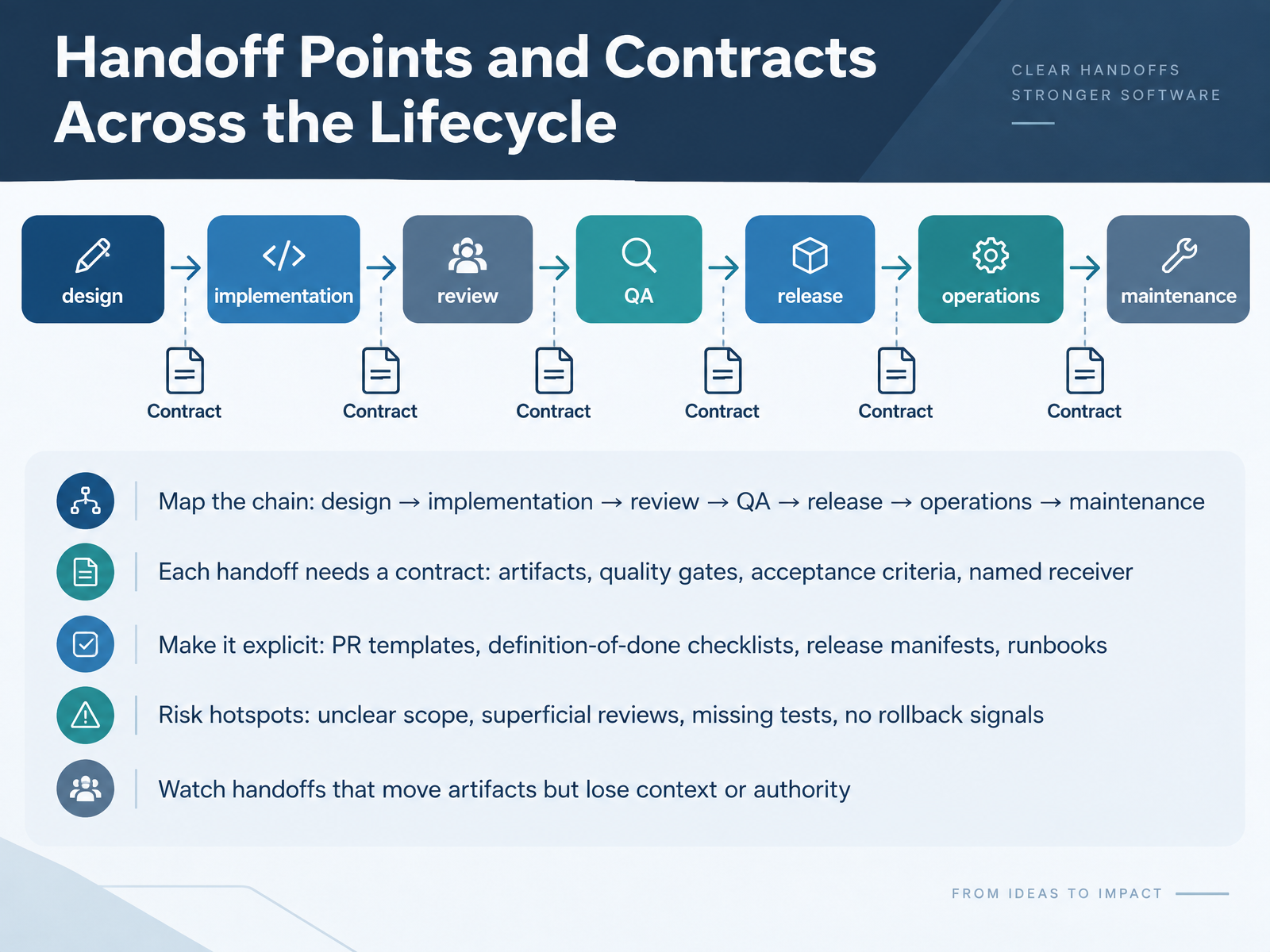
- 05Handoff Points and Contracts Across the LifecycleNow let's talk about handoff points and contracts. The lifecycle forms a chain: design, implementation, review, QA, release, operations, and maintenance. Work moves from one role to the next, and every handoff needs a contract. That contract names the artifacts that change hands, the quality gates and acceptance criteria, and one named receiver. Without it, a handoff is just a hope.
Make each contract explicit. Use a pull request template so authors state what changed, why, and how it was verified. Use a definition-of-done checklist, a release manifest, and runbooks that the receiving team can follow without asking you. And define done in testable terms, so the receiver can confirm they have what they need.
Be aware of the risk hotspots: unclear scope, superficial reviews, missing tests, and no rollback signals. The most damaging pattern is a handoff that moves artifacts but loses context or authority. The receiver has the files but cannot make a decision.
So check each handoff: who decides, who reviews, and what artifact moves. Next, we'll look at production handoffs: release, operations, and support.
 software-engineering-guide.github.iogithub.comcheckflow.io+22 min
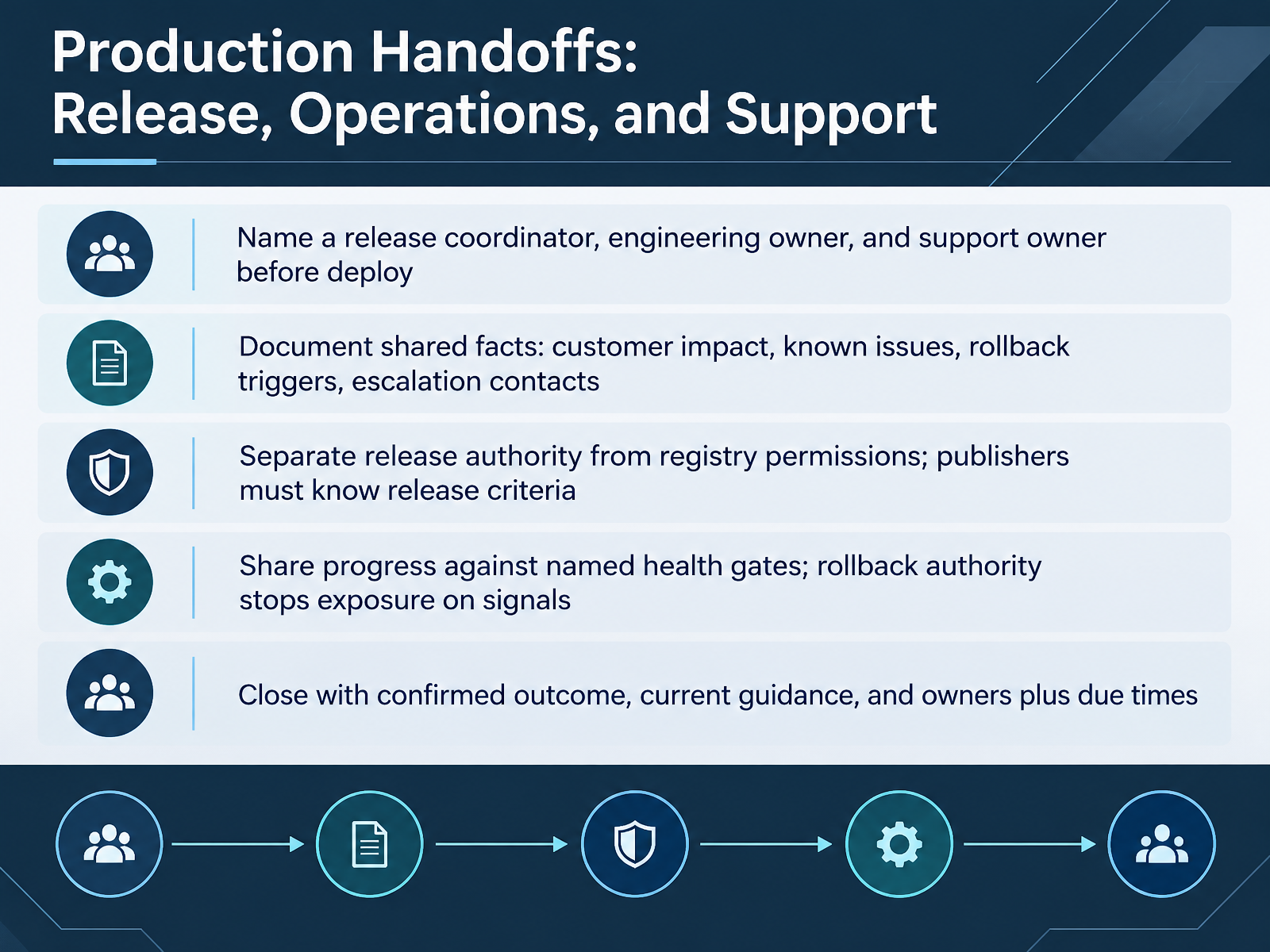
- 06Production Handoffs: Release, Operations, and SupportNow let's look at what happens after the code is merged: production handoffs for release, operations, and support. Before you deploy, name three people: a release coordinator, an engineering owner, and a support owner. Then document the shared facts both teams need: customer impact, known issues, rollback triggers, and escalation contacts. Separate release authority from registry permissions, so the people who publish packages understand the release criteria. During deployment, share progress against named health gates. Give one person the authority to roll back when a signal fires, and stop exposure until the cause is understood. Close the handoff with three things: the confirmed outcome, the current customer guidance, and the owners plus due times for every unresolved action. That closure is what makes done testable. Next, we move into code review, with author and reviewer responsibilities.
 software-engineering-guide.github.iogithub.comcheckflow.io+22 min
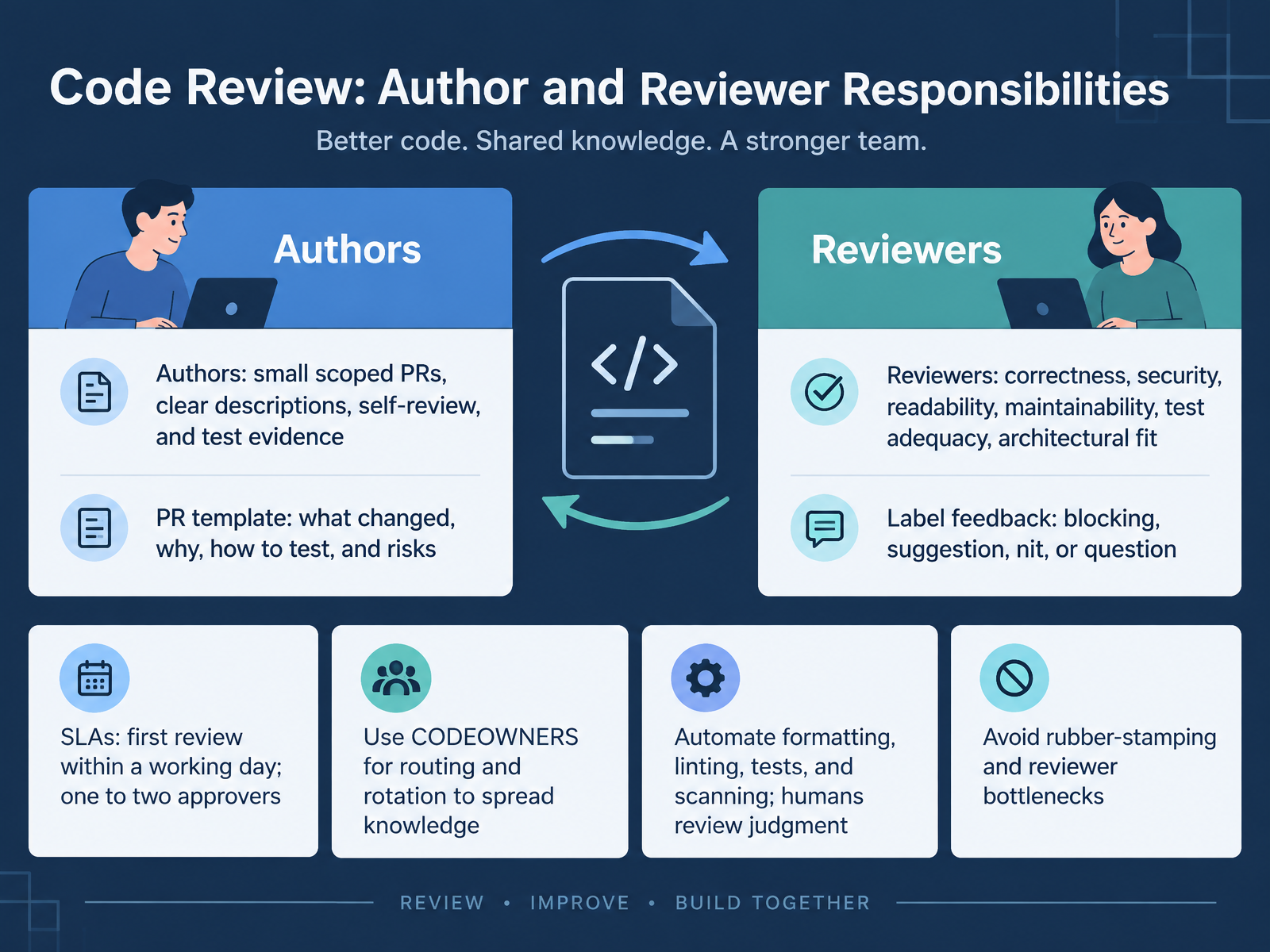
- 07Code Review: Author and Reviewer ResponsibilitiesNext, let's make code review responsibilities concrete. Authors carry the first duty. Keep pull requests small and scoped, write a clear description, review your own diff, and attach test evidence. Use a pull request template that states what changed, why, how to test it, and the risks. Reviewers then check correctness, security, readability, maintainability, test adequacy, and architectural fit. Label every comment as blocking, suggestion, nit, or question, so the author knows what must change before merge. On timing, the team aims for a first review within one working day, with one or two approvers. Use CODEOWNERS to route changes to the right owners and rotate reviewers to spread knowledge. Automate formatting, linting, tests, and security scanning, so humans review judgment, not style. Avoid rubber-stamping and reviewer bottlenecks. Next, we look at Maintenance and Dependency Stewardship.
 handbook.gitlab.comdocs.gitlab.comgithub.com+22 min
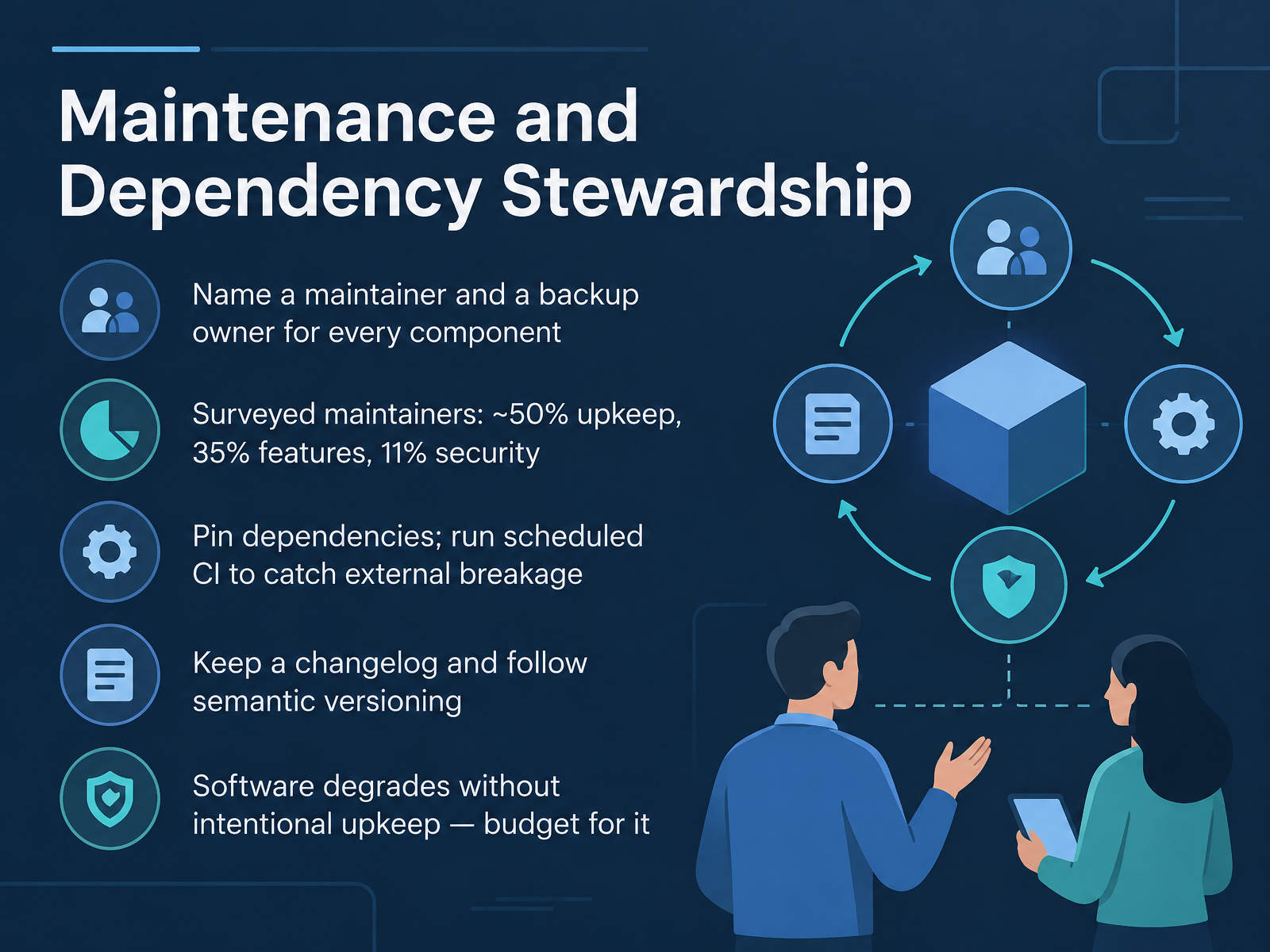
- 08Maintenance and Dependency StewardshipNext, let's talk about maintenance and dependency stewardship. The first decision is simple: name a maintainer and a backup owner for every component. Two people should be able to cut a release, and neither should be a stranger. In Tidelift's survey of maintainers, roughly half of their time went to upkeep, about thirty-five percent to features, and eleven percent to security. That split tells you upkeep is real work, so put it on the calendar. Pin your dependencies, and run scheduled CI weekly to catch external breakage. Keep a changelog and follow semantic versioning, so users can see what a release changes. Software degrades without intentional upkeep, so budget for it, not just for new features. Before we move on, check one component: does it have a named backup owner and a scheduled CI run? That is your concrete handoff from this slide. From there, we turn to operations, on-call, and escalation boundaries.
 devguide.python.orgpeps.python.orgscientific-python.org+22 min
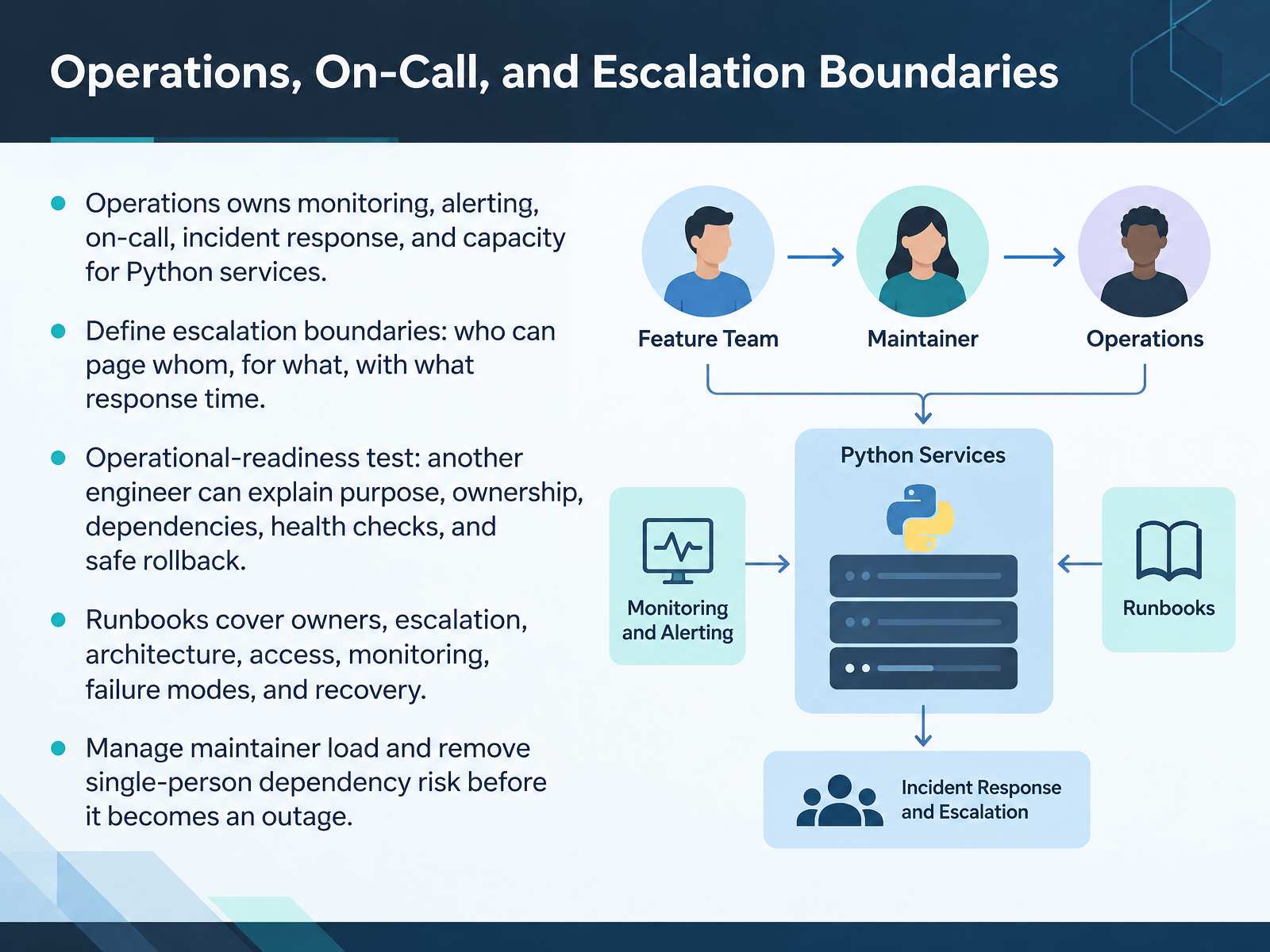
- 09Operations, On-Call, and Escalation BoundariesNext, we set the boundaries around operations and on-call. Operations owns monitoring, alerting, on-call, incident response, and capacity for Python services. You define escalation boundaries in written terms: who can page whom, for what reason, and with what response time. When an alert fires, the named responder knows whether to act, page the escalation contact, or wait.
Then apply the operational-readiness test. Another engineer should be able to explain the service's purpose, its owner, its dependencies, its health checks, and how to roll back safely. Runbooks must cover owners, escalation, architecture, access, monitoring, failure modes, and recovery. If those answers live only in one person's head, the service is not done.
Finally, manage maintainer load and remove single-person dependency risk before it becomes an outage. Two people should be able to publish a release and respond to a page. That shared coverage is what keeps on-call sustainable, and it leads us into collaboration norms and communication protocols.
 software-engineering-guide.github.iogithub.comcheckflow.io+22 min
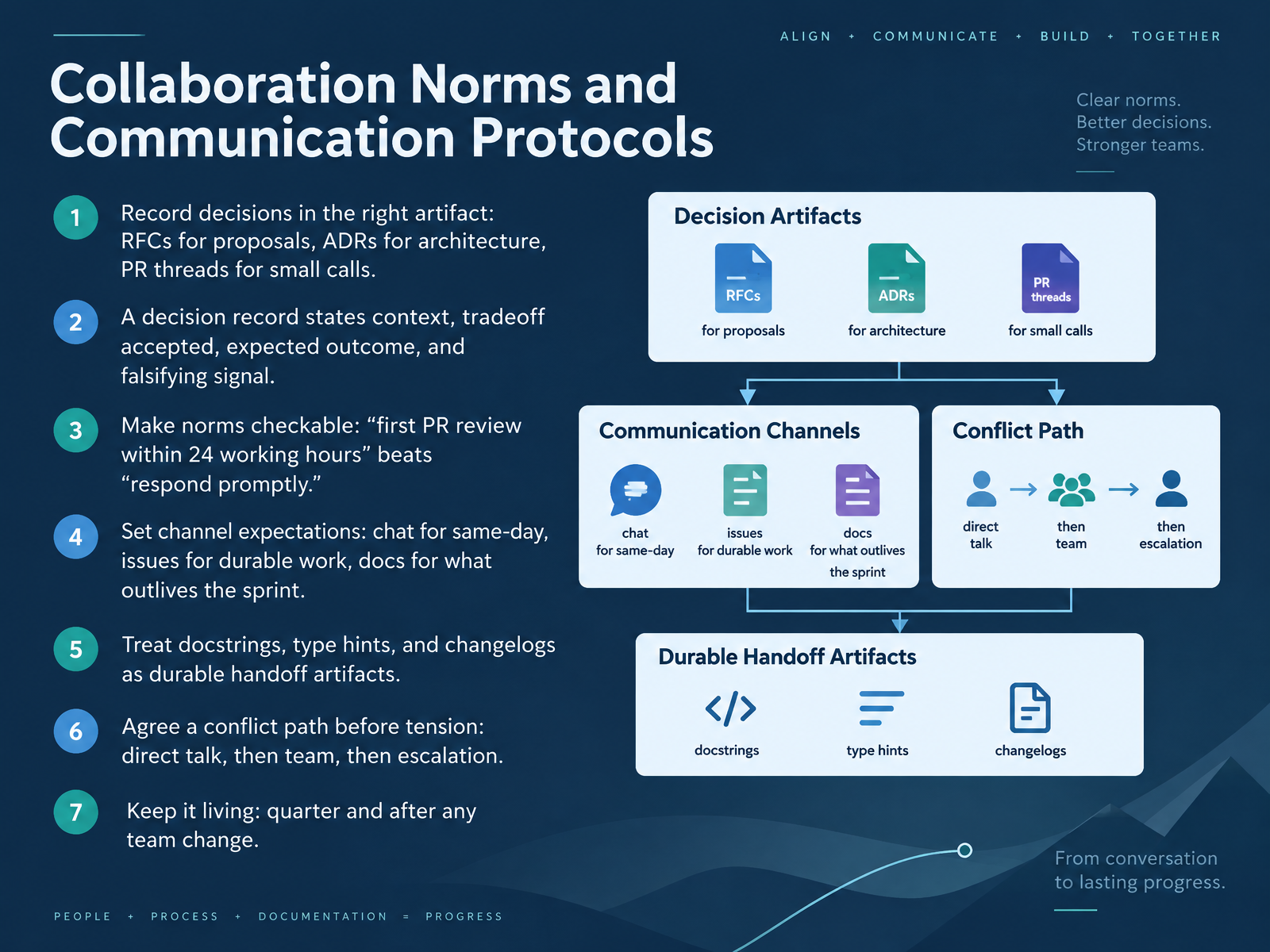
- 10Collaboration Norms and Communication ProtocolsNext, let's make collaboration norms concrete and testable. Record decisions in the right artifact. Use an RFC for a proposal, an ADR for an architecture call, and the pull request thread for small decisions. Every decision record states four things: the context, the tradeoff you accepted, the expected outcome, and the signal that would prove it wrong. Make norms checkable. "First pull request review within twenty-four working hours" is enforceable. "Respond promptly" is not. Set channel expectations too. Chat for same-day questions, issues for durable work, and docs for anything that outlives the sprint. Treat docstrings, type hints, and changelogs as durable handoff artifacts, so you write them for the next maintainer. Agree on a conflict path before tension arrives: direct talk first, then the team, then escalation. Keep the agreement living. Review it quarterly and after any team change. Let's turn to decision rights and anti-patterns to avoid.
 devguide.python.orgpeps.python.orgscientific-python.org+21 min
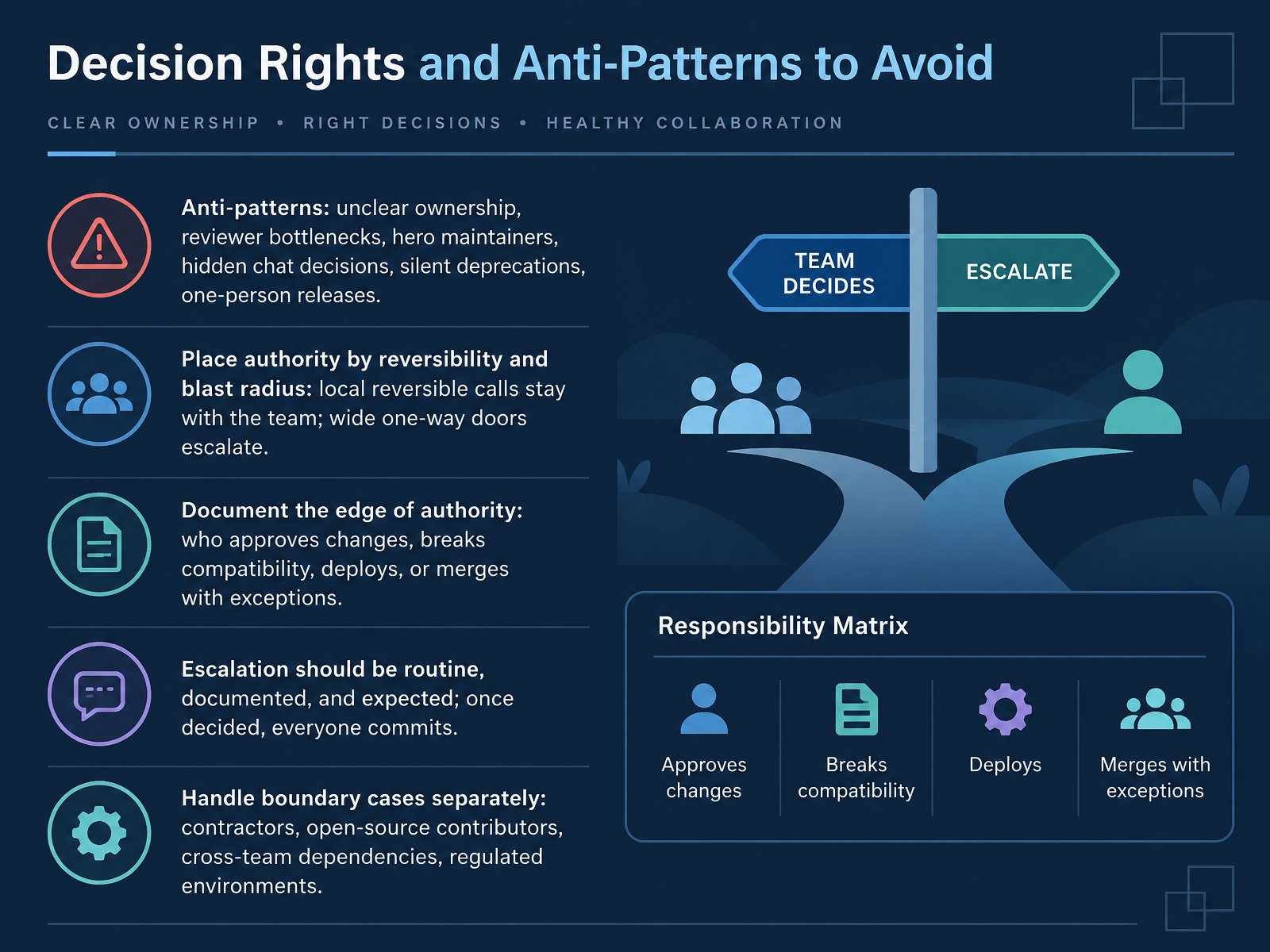
- 11Decision Rights and Anti-Patterns to AvoidLet's talk about where decision authority actually sits, and which anti-patterns erode it. Watch for unclear ownership, reviewer bottlenecks, hero maintainers, decisions buried in chat, silent deprecations, and one-person releases. Each one hides who decided, which makes the next handoff slower and riskier. Place authority by reversibility and blast radius. Local, reversible calls stay with the team. Wide one-way doors escalate. Write down the edge of authority: who approves changes, who can break compatibility, who deploys, and who merges with exceptions. A useful map also has an escalation column, so engineers know exactly when a decision changes owners. Escalation should be routine, documented, and expected. Once a decision is made, everyone commits to it. Handle boundary cases separately, including contractors, open-source contributors, cross-team dependencies, and regulated environments. That keeps every handoff testable, because you can name who decided, who reviewed, and what artifact changed hands. Next, we look at learning from incidents without blame.
 devguide.python.orgpeps.python.orgscientific-python.org+22 min
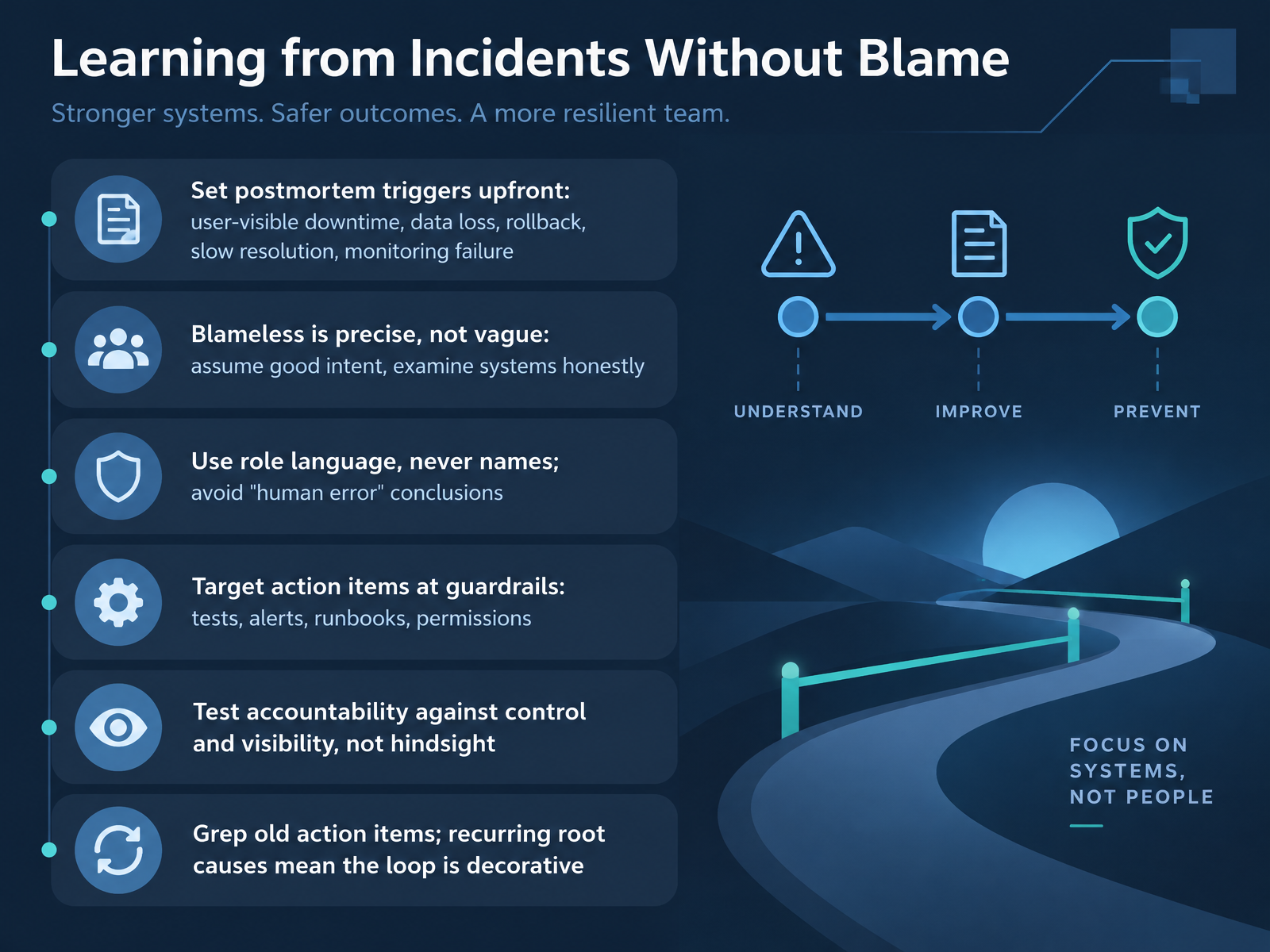
- 12Learning from Incidents Without BlameNow let's make incident review a learning loop, not a blame exercise. Set postmortem triggers before anything breaks. User-visible downtime, any data loss, a rollback, resolution time over threshold, or a monitoring failure that forced manual discovery. Write these criteria down so the team knows when a review is required, and anyone can request one.
Blameless means precise, not vague. Assume good intent, then examine the system honestly. Use role language, such as the on-call engineer or the deploying service, never names. And never conclude human error. Ask what made the error easy to make and hard to catch.
Target action items at guardrails: tests, alerts, runbooks, permissions. Never be more careful. Test accountability against control and visibility at the time, not hindsight. Did the team have authority, a usable signal, and a reasonable moment to act?
Finally, grep old action items during review. If a recurring root cause returns, the loop is decorative, and the governance gap belongs in front of leadership.
Next, we look at an adoption plan starting with lightweight first steps and workshops.
 2 min
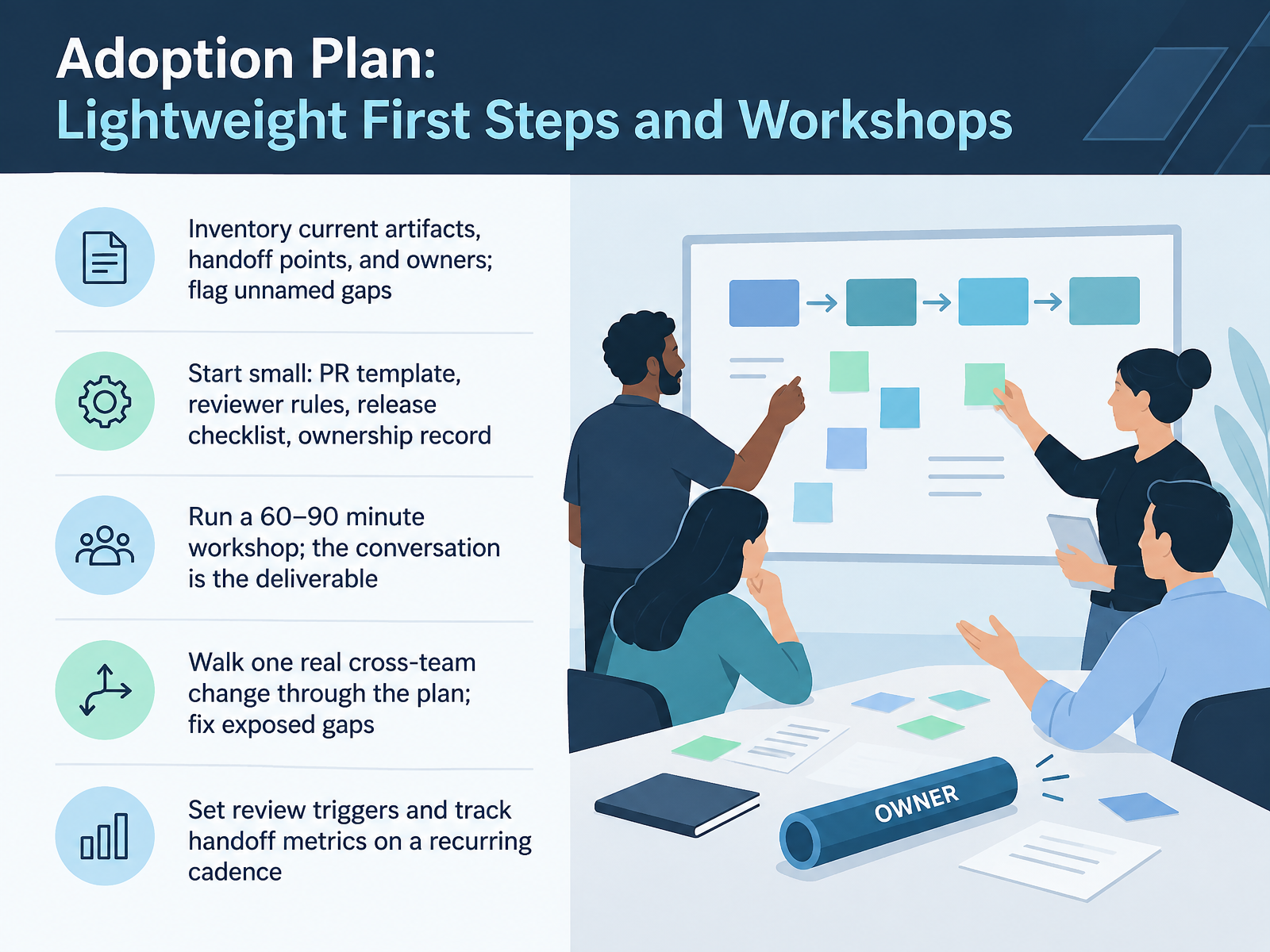
- 13Adoption Plan: Lightweight First Steps and WorkshopsHere is how to put these roles into practice without a big rollout. Start with an inventory: list the current artifacts, the handoff points between them, and the named owner for each. Flag every gap where no owner is named. Then start small. A pull request template, reviewer rules, a release checklist, and one ownership record are enough for the first pass.
Run a 60 to 90 minute workshop with the whole team. The conversation is the deliverable. The goal is agreement on who decides, who reviews, and what done means, not a perfect document. Next, walk one real cross-team change through the plan end to end, and fix the gaps it exposes. Finally, set review triggers and track handoff metrics on a recurring cadence, quarterly at minimum. Next, we will look at assessment and team application.
 netspective.comsoftware-engineering-guide.github.ioengineeringleadership.tech+21 min
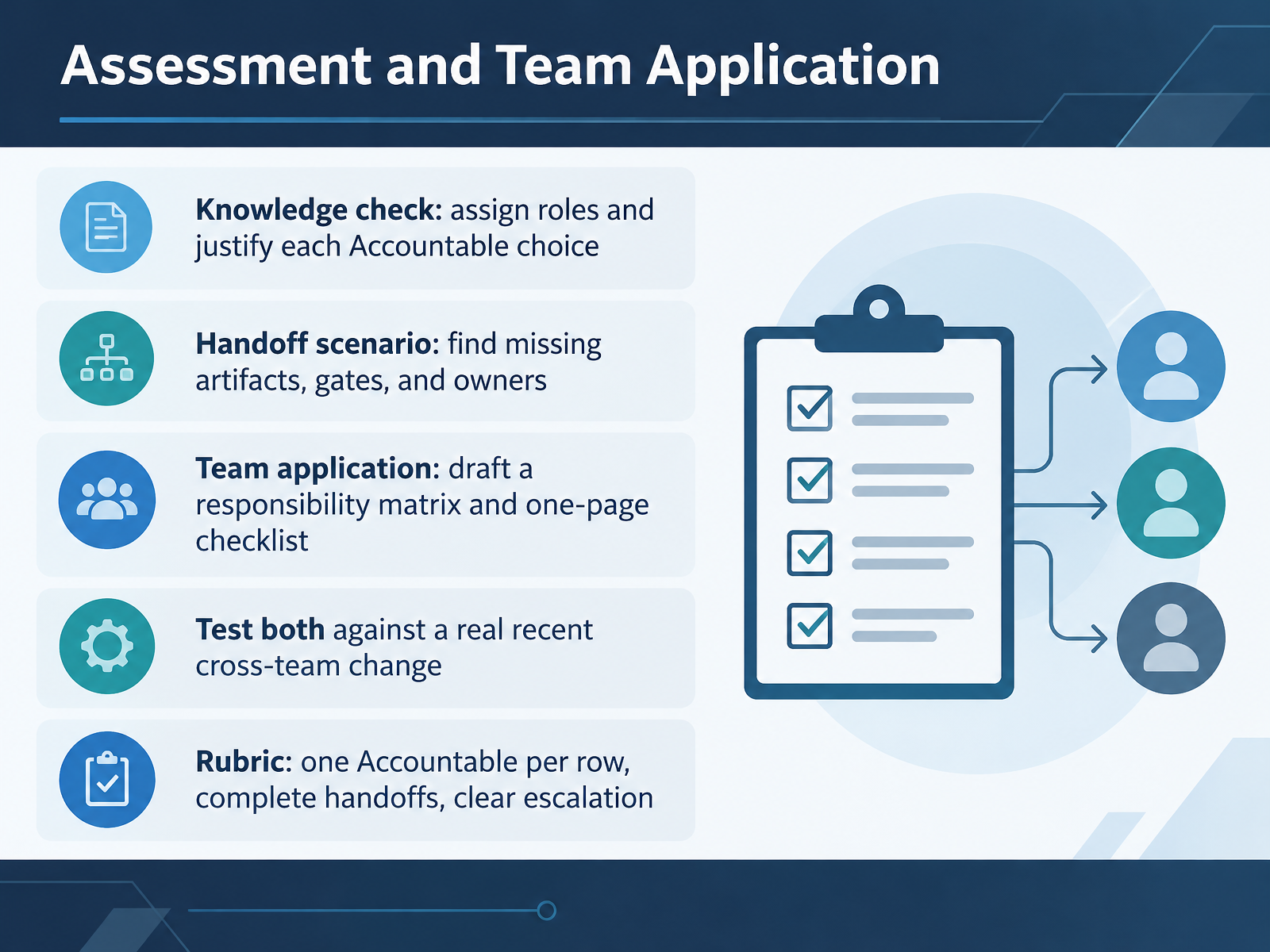
- 14Assessment and Team ApplicationLet's close with assessment and team application. Start with a knowledge check. Given a list of activities, you assign the roles, and then you justify each Accountable choice. One Accountable per row is the rule. If two people claim it, pause and split the decision. Next, a handoff scenario. Find the missing artifacts, the missing gates, and the missing owners. Ask who decides, who reviews, what artifact changes hands, and what done means. Then apply it to your team. Draft a responsibility matrix and a one-page checklist. Test both against a real recent cross-team change. Walk the change through the owner, the decision, the handoff, and the completion condition. Note where a decision has no owner or an approval adds no value. Update the matrix and rerun the scenario. Your rubric is simple. One Accountable per row, complete handoffs, and a clear escalation path. Thank you for working through this course. Write the matrix down, test it on a real change, and you will make ownership visible and handoffs predictable. Keep going.
 netspective.comsoftware-engineering-guide.github.ioengineeringleadership.tech+22 min
Take the deck with you
Download this course as a file — free, no sign-up needed.
- PDF handoutEvery slide page, ready to print or share.15 pages · 3.2 MBDownload
- Narrated PowerPointThe deck that presents itself — every slide carries the digital human's narration video.15 pages · 12.8 MBDownload
- PowerPoint slidesThe full deck as a .pptx — open it in PowerPoint, Keynote, or Google Slides.15 pages · 3.1 MBDownload
Free to use in your own training — please keep the PersonWise credit page at the end.
Have your own deck? Turn it into a course
Sources consulted
Web sources consulted while building this course.
- Development cycle ¶ — devguide.python.org
- PEP 101 – Doing Python Releases 101 | peps.python.org — peps.python.org
- Scientific Python - SPEC 8 — Securing the Release Process — scientific-python.org
- Release Management for Open Source Maintainers — fosshub.com
- https://devguide.python.org/core-team/ — devguide.python.org
- Merge Request Roles and Responsibilities | The GitLab Handbook — handbook.gitlab.com
- Python Merge Requests Guidelines | GitLab Docs — docs.gitlab.com
- GOVERNANCE.md — github.com
- Working Effectively on an Engineering Team — etisframework.org
- Python Code Review Checklist: 25 Things to Check in 2026 | Augment Code — augmentcode.com
- RACI Example | Netspective — netspective.com
- 2.5 Code review and collaboration - Software Engineering Guide — software-engineering-guide.github.io
- RACI Matrix for Engineering Teams: Release Example and Template – Engineering Leadership — engineeringleadership.tech
- Who is responsible for what in a secure SDLC? A simple RACI — safeguard.sh
- Sample RACI Matrix for Release Planning — Wrixle Ltd — wrixle.co.uk
- 12.2 Checklists - Software Engineering Guide — software-engineering-guide.github.io
- dschunk/build-it-like-you-wont-be-there — github.com
- Software Release Management Checklist Template | CheckFlow — checkflow.io
- Software Release Handoff Checklist for Engineering and Support Teams — ones.com
- Software Deployment Checklist Template | Playcode Blog — playcode.io