Begin
14 pages · ~28 min
Customer Service Roles and Handoffs
This training defines customer service roles, responsibilities, and handoff procedures to ensure clear accountability and seamless issue resolution for service teams.
A digital instructor presents all 14 pages. Hold “Ask” at any point and ask out loud — the answer comes from this course. No sign-up needed.
What you’ll learn
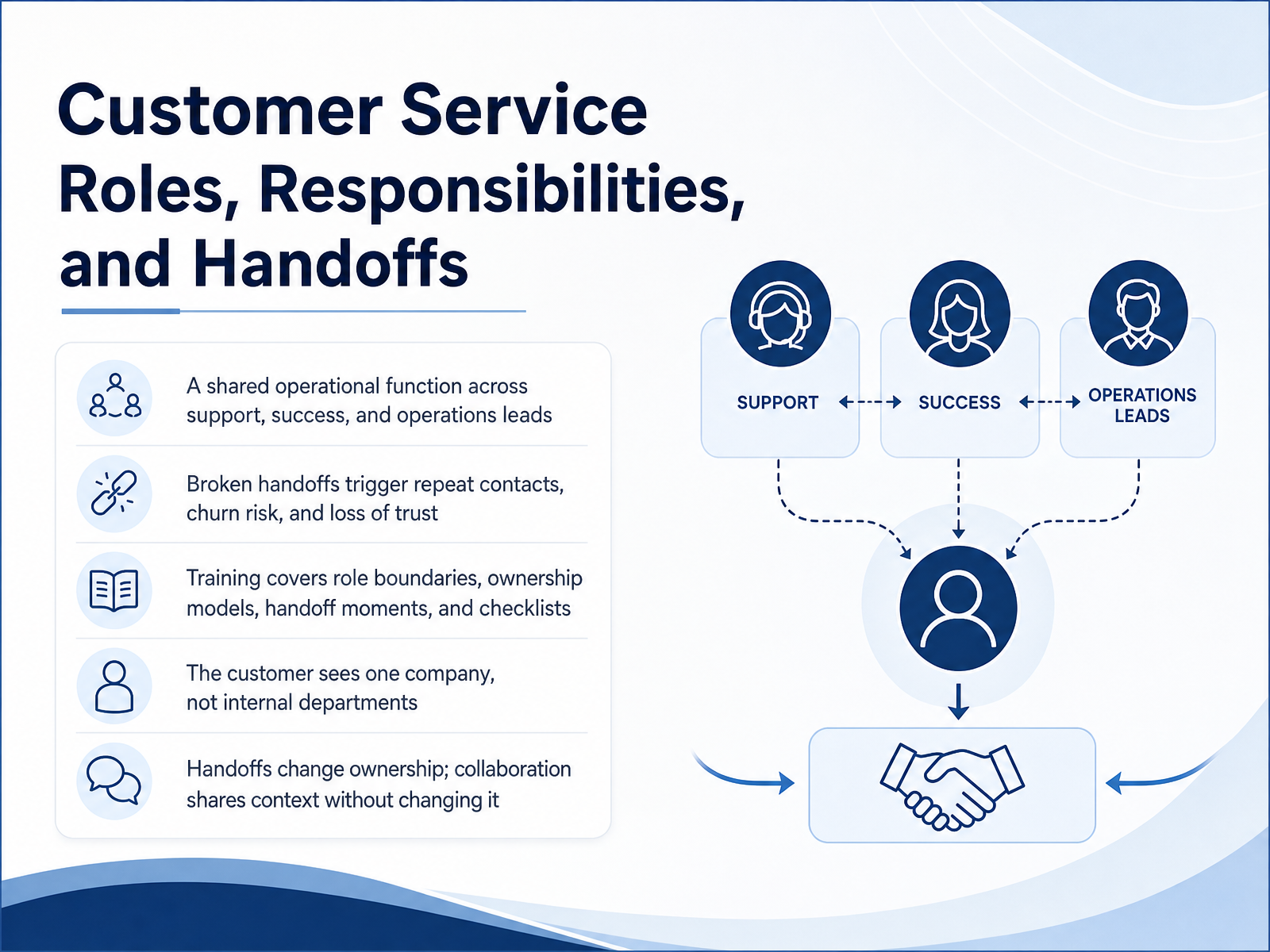
- 01Customer Service Roles, Responsibilities, and HandoffsWelcome, everyone. Whether you're on the front line of support, guiding customers through success, or leading the operations that tie it all together, this session is built for you. Today, we're going to look at how we work as one connected team, not separate departments. The reality is, when a customer moves between us, a broken handoff can trigger repeat contacts, put renewals at risk, and quietly erode the trust we've worked so hard to build. So, we'll cover clear role boundaries, practical ownership models, and the key moments where a smooth transfer matters most. We'll break down exactly what needs to change hands, and what stays put. Because here's the thing: when we collaborate, we share context without shifting ownership. When we hand off, we're changing who's accountable. Our customer sees one company. Our job is to make sure that experience feels seamless, no matter who they're talking to. Let's get started by looking at why handoffs fail and what that really costs us.customerscience.com.aurocketlane.comparloa.com+21 min
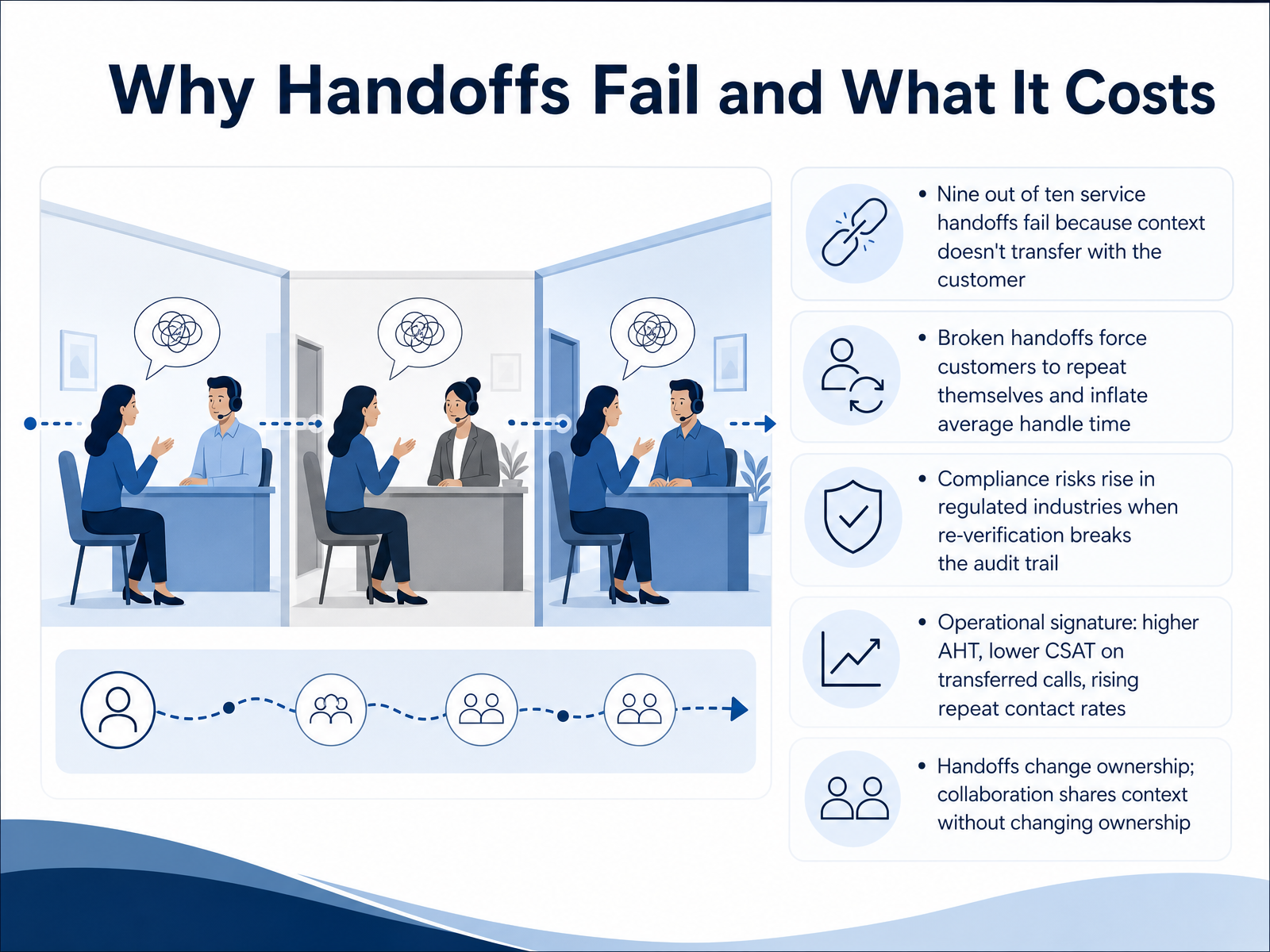
- 02Why Handoffs Fail and What It CostsLet's look at why handoffs fail and what that really costs us. Research shows that nine out of ten service handoffs break down because the context simply doesn't travel with the customer. When that happens, customers are forced to repeat themselves, which inflates our average handle time. In regulated industries, re-verification can even break the audit trail, creating real compliance exposure. You'll see the fingerprints of these failures in your metrics: higher handle times, lower satisfaction scores on transferred calls, and rising repeat contact rates. Here's the key distinction to remember: a handoff changes ownership, but collaboration shares context without changing who owns the outcome. When we collaborate effectively, the customer never feels like they're starting over. So as we move into defining clear role boundaries between support, success, and operations, keep this principle in mind: context is a shared responsibility, not a baton to be dropped.
 customerscience.com.aurocketlane.comparloa.com+22 min
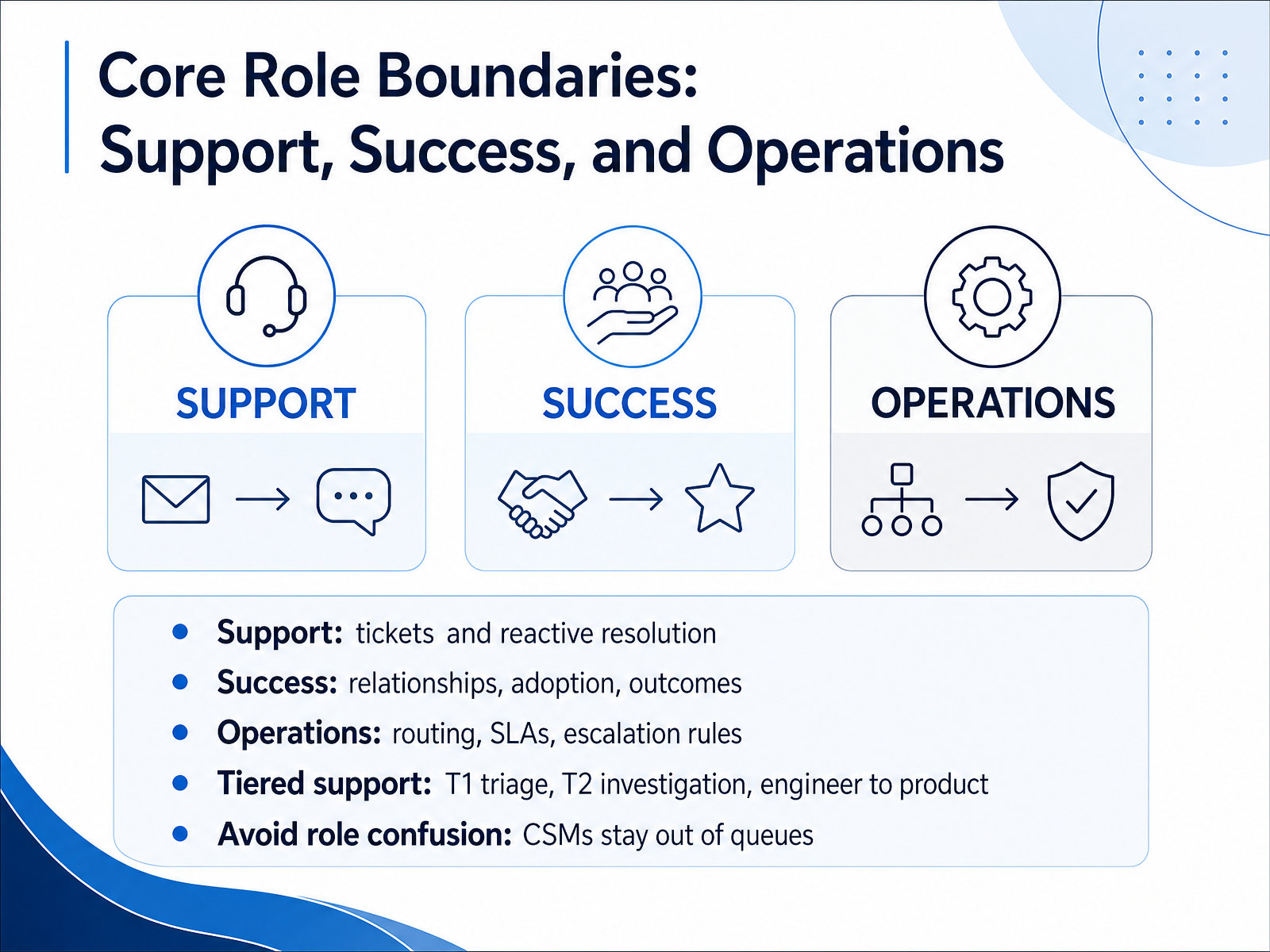
 - 03Core Role Boundaries: Support, Success, and OperationsLet's take a moment to clarify who does what, because role clarity is the foundation of smooth handoffs. Support owns tickets and reactive resolution. When a customer reports an issue, support responds fast, troubleshoots, and closes the loop. Customer success owns relationships, adoption, and outcomes. They focus on the customer achieving their goals, not on individual tickets. Operations keeps the engine running. They manage routing, SLAs, and escalation rules so every request lands in the right place at the right time. Within support, we use tiered escalation. Tier one triages and handles common issues. Tier two investigates deeper technical problems. And when needed, we escalate to engineering for product-level fixes. Here's the key boundary to protect: customer success managers stay out of the ticket queue. When they get pulled into reactive support, their proactive work on adoption and renewal suffers. Instead, define clear handoff points. If a support ticket reveals a risk to the account's goals, support flags it for the CSM, but the CSM doesn't take over the ticket. This keeps everyone focused and the customer experience seamless. Next, let's look at ownership models that reduce friction.
 avoma.comsupportbench.comsupplo.io+22 min
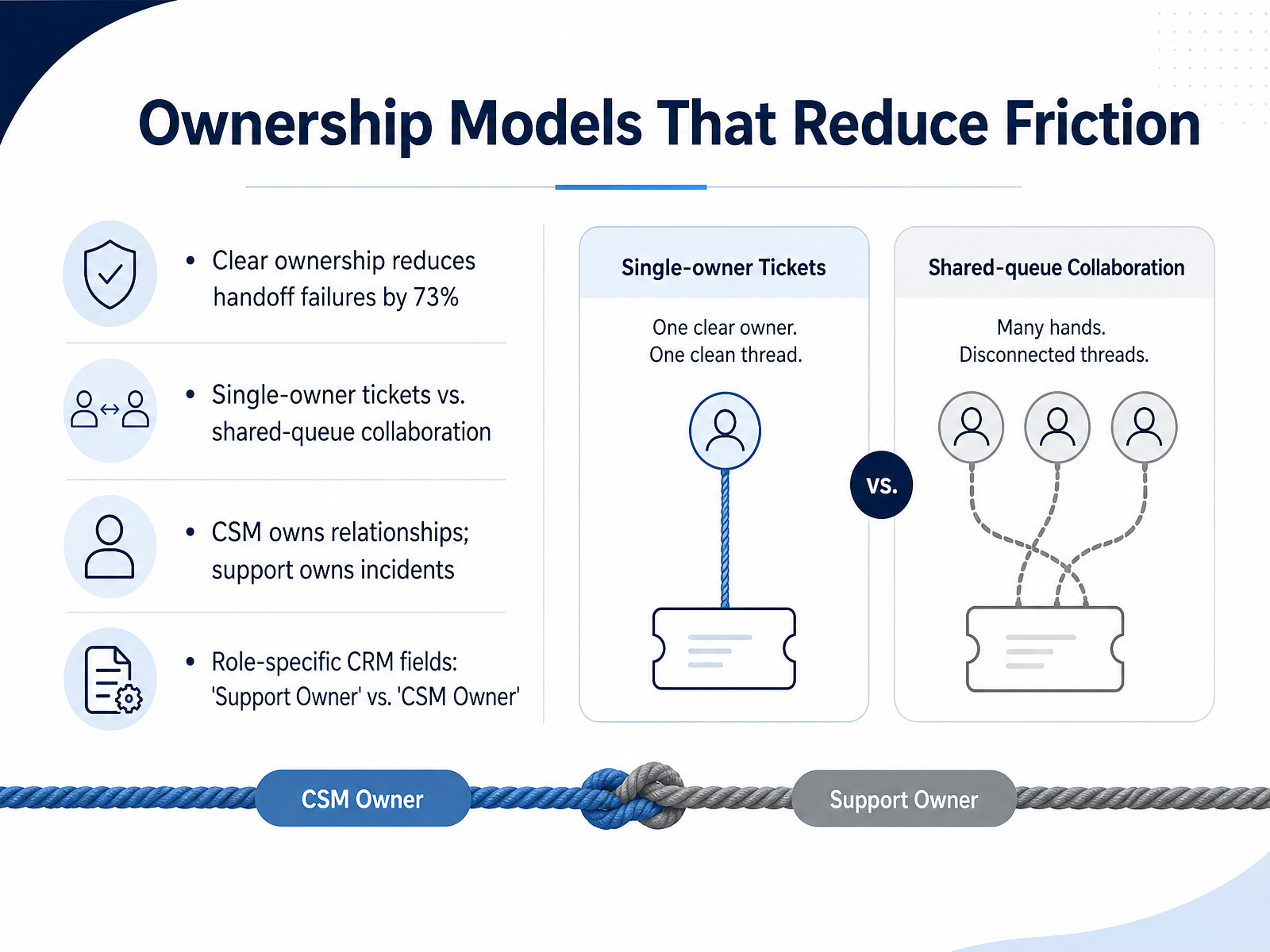
 - 04Ownership Models That Reduce FrictionLet's talk about ownership models, because this is where friction either gets created or gets eliminated. Here's a number that should grab your attention: clear ownership reduces handoff failures by seventy-three percent. That's not a small improvement. That's the difference between a customer who feels cared for and one who feels lost. So how do we get there? First, understand the difference between a single-owner ticket and shared-queue collaboration. A single-owner ticket means one person is accountable for seeing it through. That doesn't mean they do everything alone, but they are the one who ensures the next step happens. Shared queues are great for volume, but without a clear owner, tickets can slip through the cracks. So assign a name, not just a queue. Second, remember the golden rule: customer success owns relationships, support owns incidents. Support fixes the problem in the moment. Customer success ensures the relationship stays healthy over time. When a ticket touches an enterprise account, both the support agent and the CSM should have visibility, but they each know their lane. Third, make ownership visible in your CRM. Use role-specific fields like support owner and CSM owner instead of one generic owner field. This preserves history. When someone takes over, you know who did what before, and you avoid confusion. These small structural changes remove guesswork and build trust. Up next, we will look at the handoff moments that matter most, so you know exactly where to focus your energy.
 avoma.comsupportbench.comsupplo.io+22 min
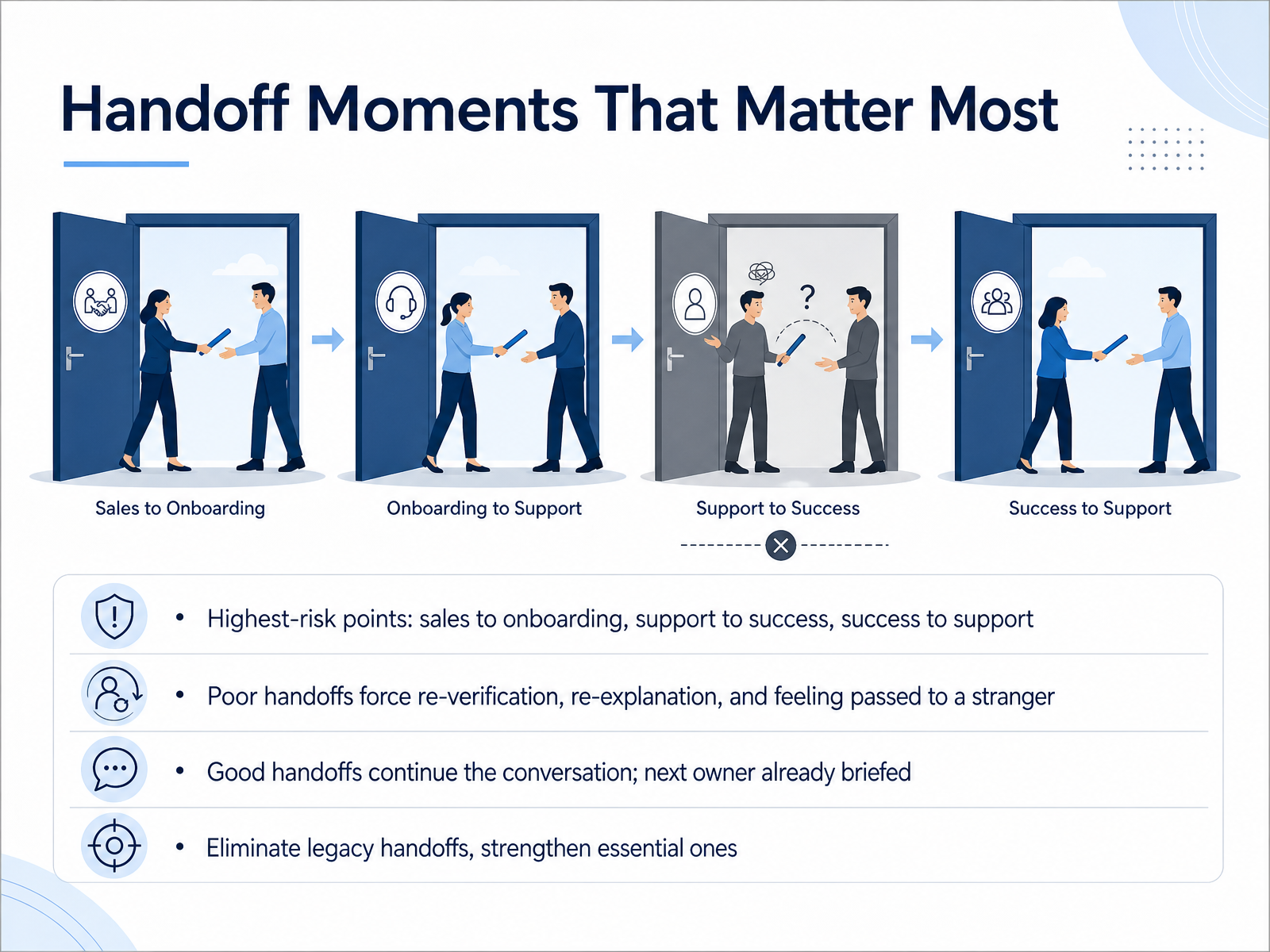
 - 05Handoff Moments That Matter MostLet’s talk about the moments where service experiences either shine or fall apart. The highest-risk handoffs in our operation are clear: from sales to onboarding, from support to customer success, and back again. These are the points where customers are most likely to feel like they’re being passed to a stranger. A poor handoff forces them to re-verify their identity, re-explain their history, and rebuild trust from zero. That’s exhausting for them, and it’s costly for us. But a good handoff feels like a continuation of the same conversation. The next owner is already briefed. They know the context, the promises made, and the next step. Our goal is to eliminate the handoffs that exist only because of legacy organizational design, while strengthening the ones that truly matter. We do this by building structured, reliable transitions that protect the customer’s momentum. So as we move forward, think about what information must travel with the work to make that possible.
 customerscience.com.aurocketlane.comparloa.com+22 min
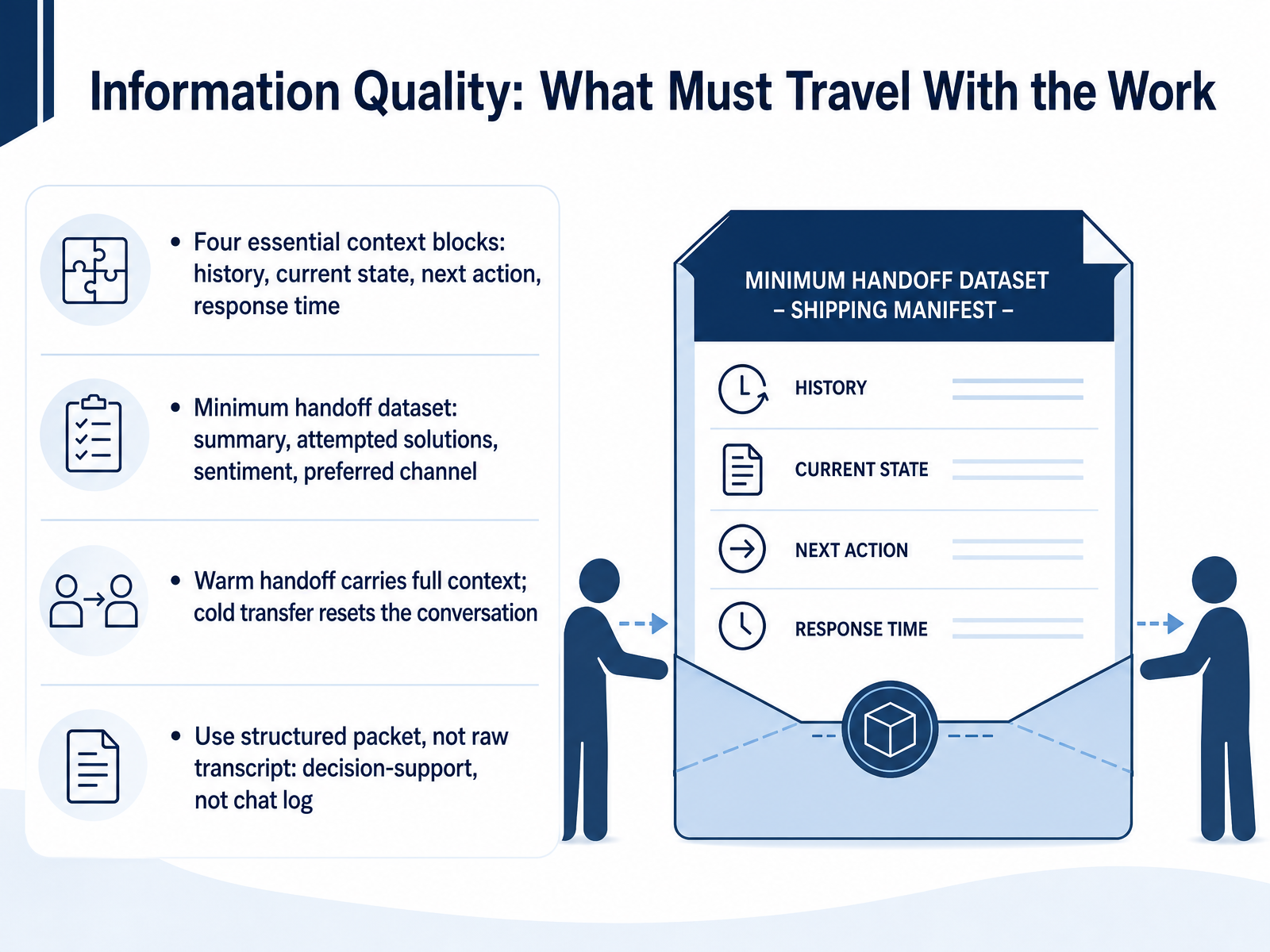
 - 06Information Quality: What Must Travel With the WorkNow let's talk about the information that must travel with the work itself. This is where most handoffs quietly fail. Think of it as four essential context blocks: the history of the issue, the current state, the next action, and the response time commitment. If any of these is missing, the receiving agent is working blind. The minimum handoff dataset should include a clear summary, the solutions already attempted, the customer's sentiment, and their preferred channel. And here's the key distinction: a warm handoff carries full context, so the customer never has to repeat themselves. A cold transfer resets the conversation, and that's where trust erodes. Always use a structured packet rather than a raw transcript. Your colleague needs decision support, not a chat log. They need to know what was tried, what failed, and what to do next. So when you prepare a handoff, ask yourself: if I received this, could I act immediately without asking the customer a single clarifying question? That's the standard we're aiming for. Next, let's look at how warm handoffs and customer communication bring this all together.
 customerscience.com.aurocketlane.comparloa.com+21 min
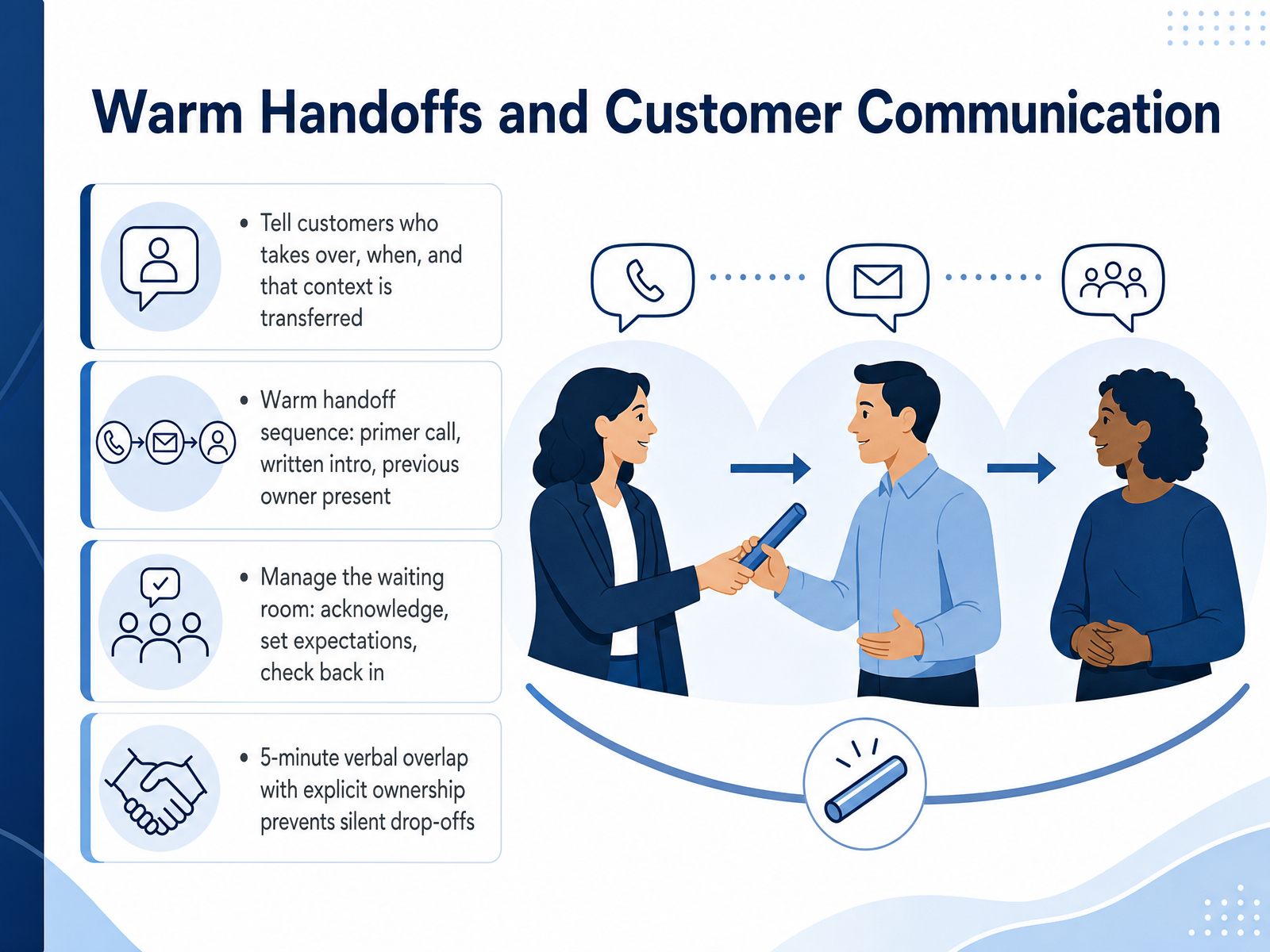
 - 07Warm Handoffs and Customer CommunicationNow let’s talk about what the customer actually experiences during a handoff. This is where trust is built or broken. First, always be transparent. Tell the customer who is taking over, when that will happen, and reassure them that all context has been transferred. They should never have to repeat themselves. Use a warm handoff sequence. Start with a primer call between the outgoing and incoming teammate. Follow it with a brief written introduction to the customer. Then have the previous owner present on the first call with the new owner before stepping away. While the customer waits, manage the waiting room. Acknowledge the change, set clear expectations about timing, and check back in if there is a delay. And here is a practical rule: build in a five minute verbal overlap with explicit ownership. The outgoing teammate says, I am handing this over to Sarah now. Sarah confirms, I own this from here. This prevents those silent drop-offs where nothing happens and the customer is left wondering. Remember, a handoff should feel like a relay race, not a game of hot potato.
 customerscience.com.aurocketlane.comparloa.com+21 min
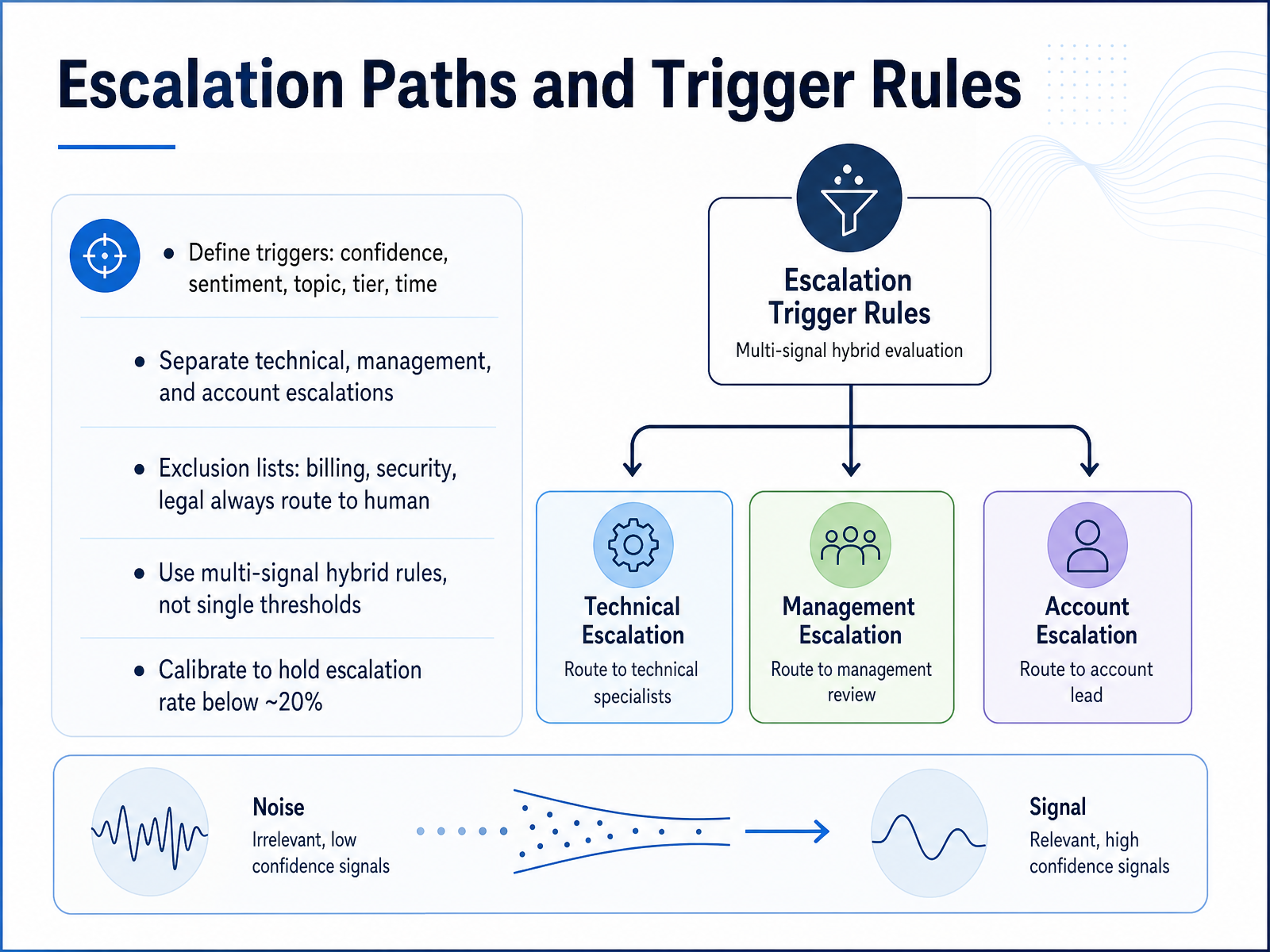
 - 08Escalation Paths and Trigger RulesNow let's talk about when a conversation should move to a person. Think of escalations as a decision, not a failure. You want to define clear triggers upfront. Watch for low confidence in the AI's answer, a drop in customer sentiment, sensitive topics, the customer's tier, and how long the conversation has been going. And remember, not all escalations are the same. Keep technical, management, and account issues on separate paths so the customer lands with the right expert. Some things should always go to a human. Billing, security, and legal are non-negotiable. Put them on an exclusion list so they route straight to a person, no matter what. Now, the real trick is to use multi-signal hybrid rules, not a single threshold. For example, escalate when confidence drops below a certain point or when sentiment turns sharply negative. One signal alone might be a false alarm, but combined, they tell a clearer story. Calibrate your triggers so your overall escalation rate stays under twenty percent. That prevents reviewer fatigue and keeps your team sharp. Coming up next, we'll look at how to prevent handoff failures before they happen.
 customerscience.com.aurocketlane.comparloa.com+21 min
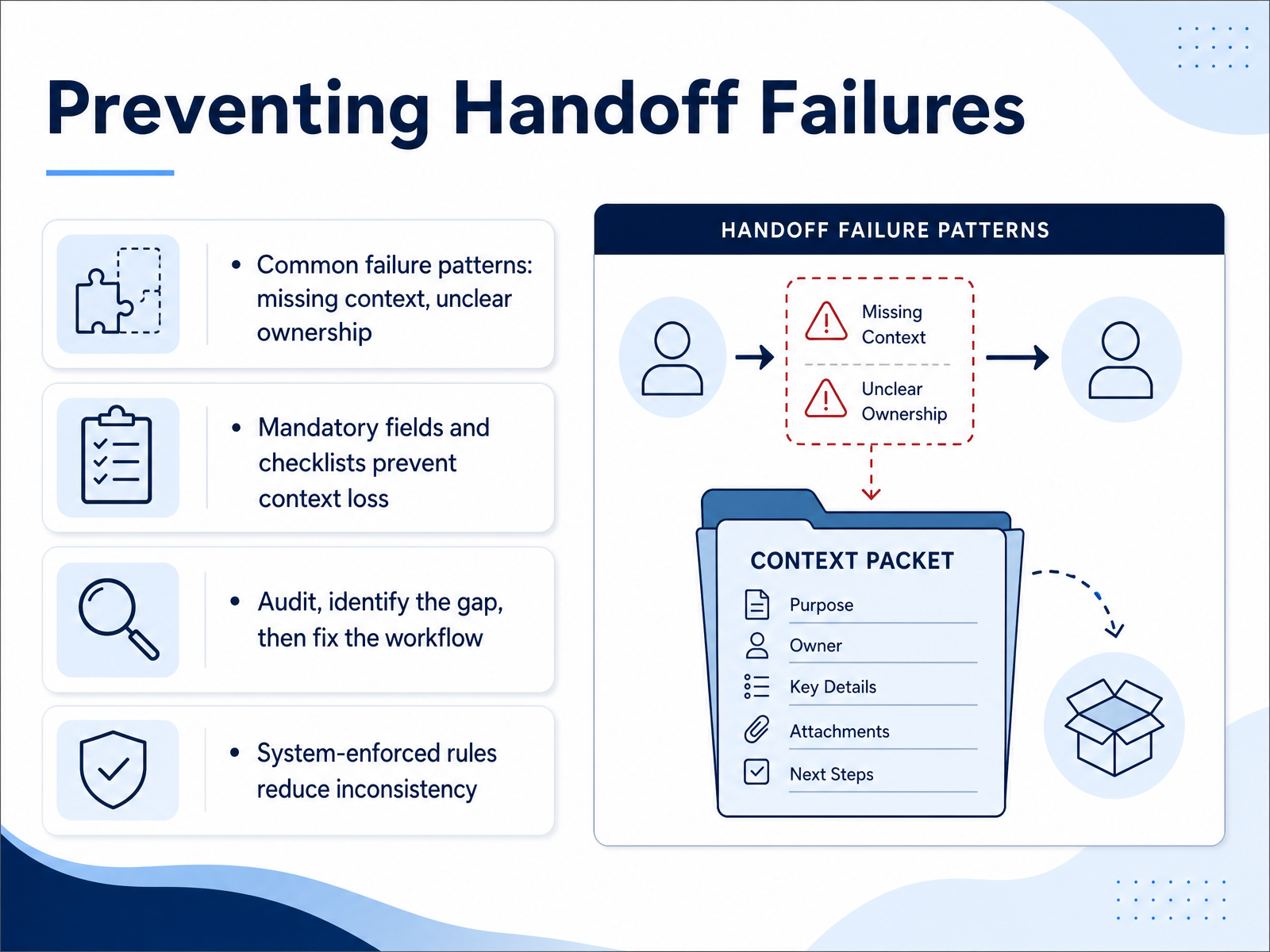
 - 09Preventing Handoff FailuresLet's look at why handoffs fail and how we can prevent that. Most breakdowns trace back to two things: missing context and unclear ownership. The customer has to repeat themselves, and the next agent starts from zero. The fix is structure. Mandatory fields and checklists make sure the critical context, like the issue summary, customer sentiment, and next action, travels with the ticket. But the process doesn't end there. It needs an owner. Audit the handoffs that went badly. Find the gap, whether it's a missing step, a confusing field, or a tool that doesn't share data. Fix the workflow itself, don't just remind people to try harder. Systems enforce rules far more reliably than memory. Use flags that block a transfer until required fields are complete. Use automated alerts when an escalation is triggered or an SLA is at risk. That consistency protects the customer and the entire team. When we remove the guesswork, we build trust in every single handoff. Now let's talk about how we share accountability without blame loops.
 customerscience.com.aurocketlane.comparloa.com+22 min
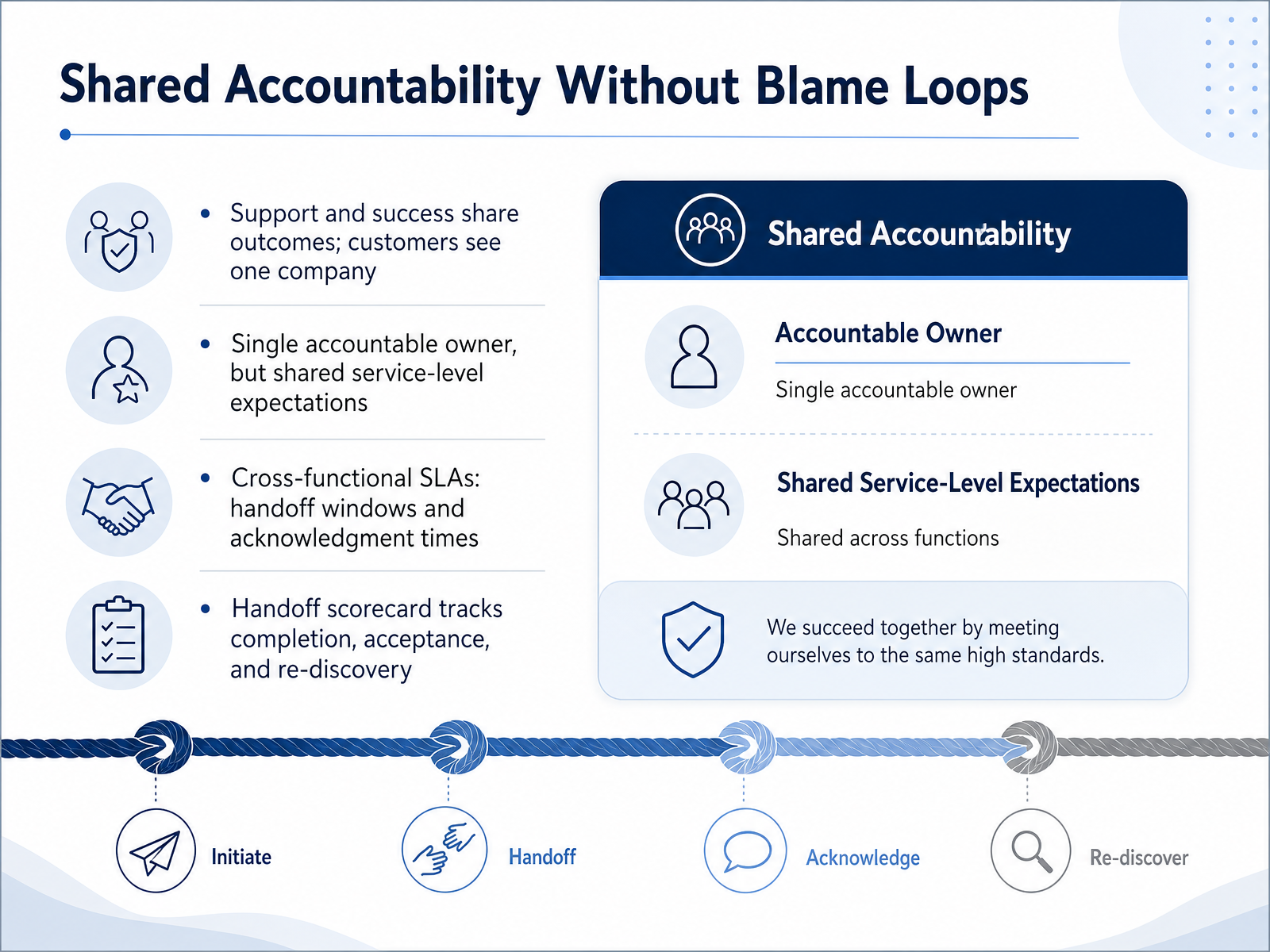
 - 10Shared Accountability Without Blame LoopsNow, let's talk about how we make sure shared accountability doesn't turn into a blame game. When support and success share outcomes, the customer sees one company, not two separate teams. That's the goal we're building toward. The key is to have a single accountable owner for each customer, while both teams share service-level expectations. This means we set clear cross-functional SLAs that define handoff windows, how quickly the receiving team acknowledges the transfer, and when a response is truly due. We track all of this on a handoff scorecard. This scorecard measures completion, whether the receiving team accepted the handoff, and how often we have to rediscover information the customer already shared. If a customer has to repeat themselves, that's a scorecard miss. Think of this as a shared scoreboard. Both teams see the same numbers, and both teams are invested in improving them together. It's not about finding fault, it's about finding the fix. A practical takeaway for you: when you design your scorecard, keep it simple and make the data visible to everyone involved. That transparency is what turns accountability from a buzzword into a daily habit. Now, let's move on to the practical checklist you'll need to make this work on the ground.
 customerscience.com.aurocketlane.comparloa.com+22 min
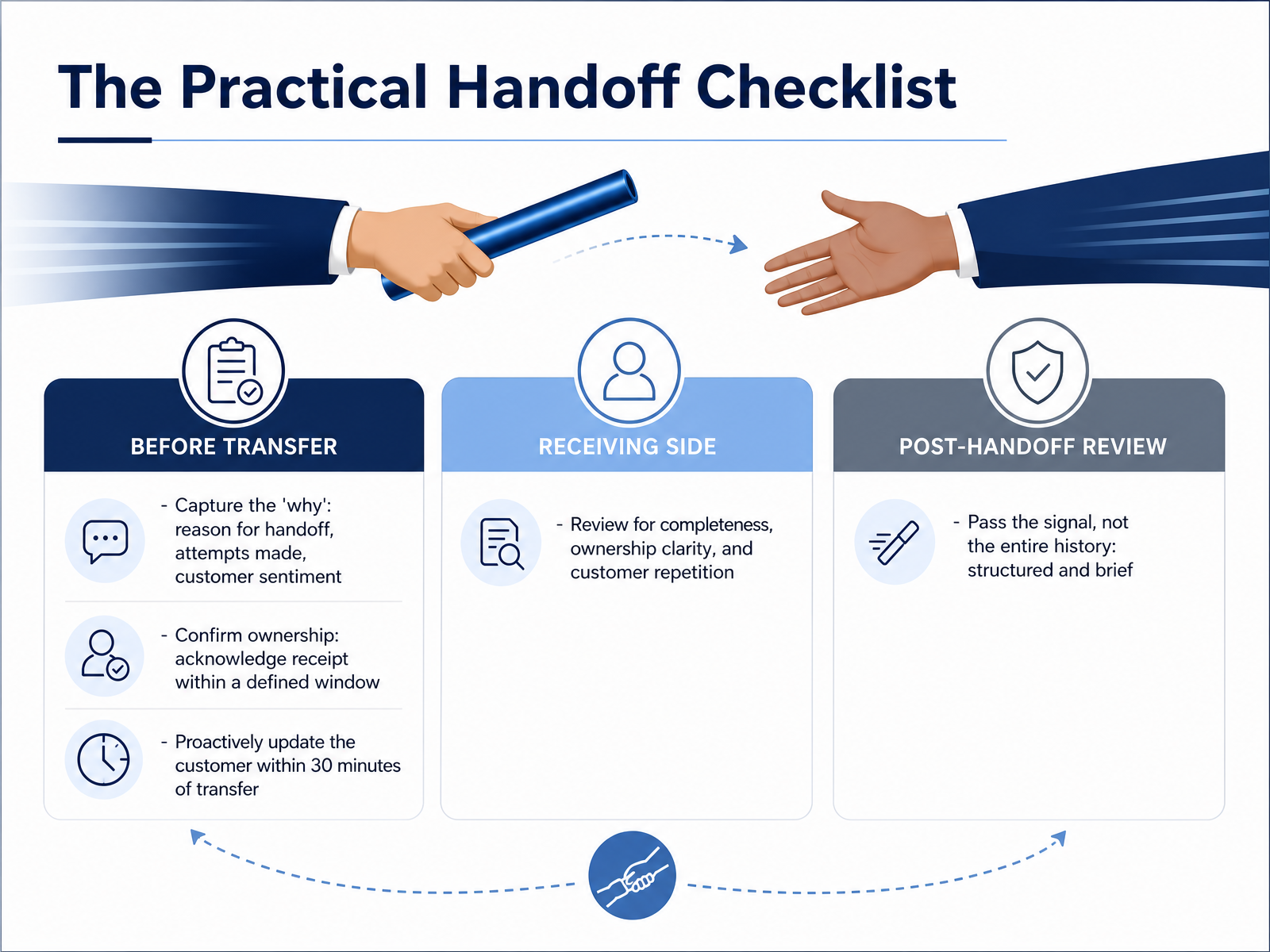
 - 11The Practical Handoff ChecklistLet's turn that framework into daily practice with a practical handoff checklist. First, capture the why. Be clear about the reason for the handoff, whether it's an escalation, a shift change, or a need for specialized expertise. Note what's already been tried and, critically, the customer's emotional state. Is she frustrated, calm, or in a hurry? This sets the tone for the next agent. Second, confirm ownership. The receiving agent must actively acknowledge within a set window, so the ticket never falls into a void. Third, update the customer. Within thirty minutes of the transfer, the new owner should reach out proactively, even just to say, I have your case and I'm reviewing it now. Fourth, review the handoff itself. Check for completeness, clear ownership, and whether the customer would have to repeat anything if they called back. And finally, pass the signal, not the entire history. Keep it structured and brief. At minimum, the problem summary, attempted solutions, customer sentiment, and the next action. That's the minimum viable data set. Everything else is noise. Next, we'll look at how AI can handle the first line and hand off to humans cleanly.
 avoma.comsupportbench.comsupplo.io+22 min
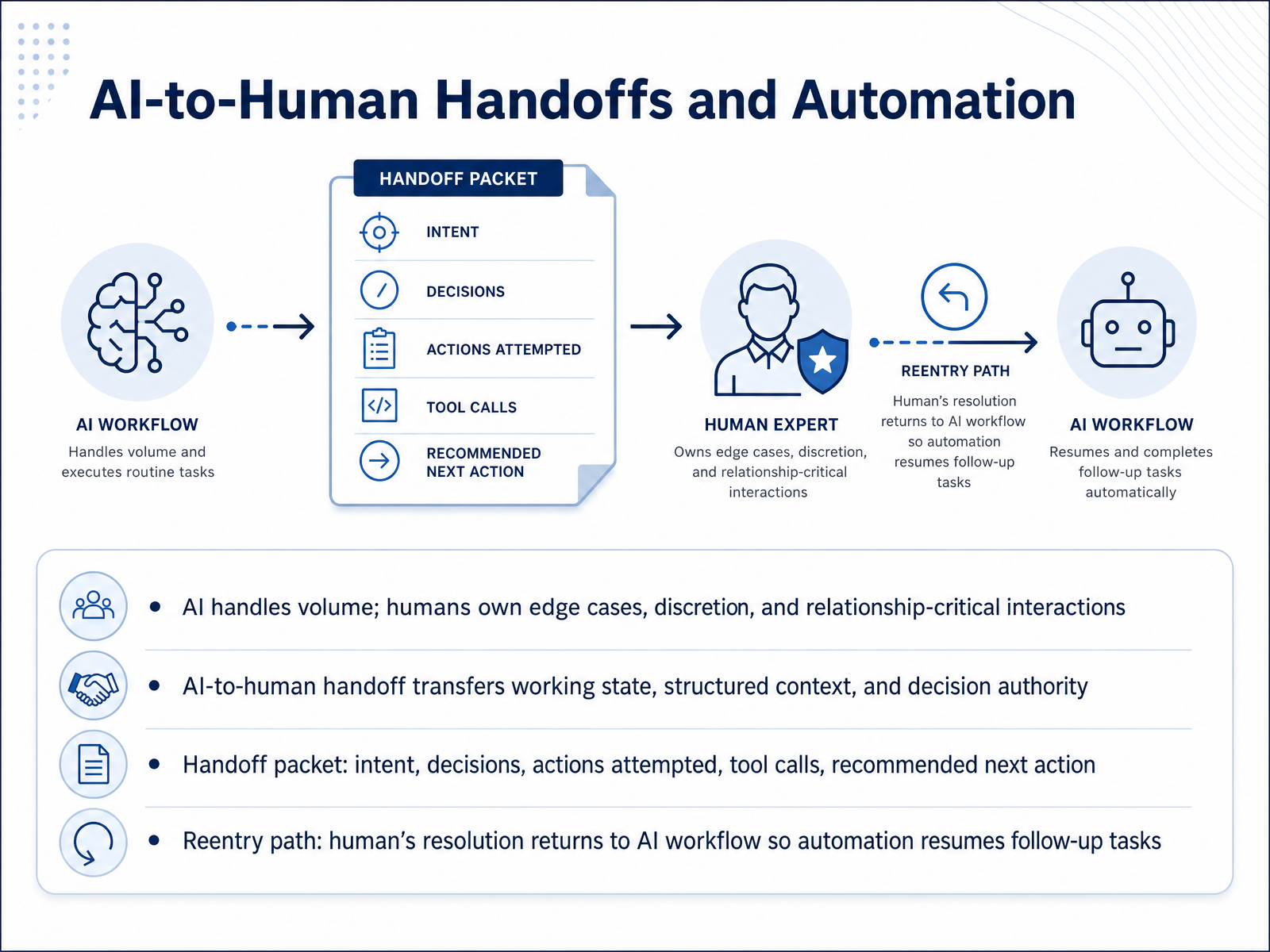
 - 12AI-to-Human Handoffs and AutomationLet’s talk about the AI-to-human handoff. The goal here is simple: AI handles the volume, and humans own the edge cases, the judgment calls, and the relationship-critical moments. But for that to work, the handoff has to carry more than just a transcript. It needs to transfer the working state, the structured context, and the decision authority in one clean packet. Think of it as a briefing folder that includes the customer’s intent, the decisions the AI already made, actions attempted, tool calls, and a recommended next step. The human agent should be able to pick up where the AI left off without re-reading everything or making the customer repeat themselves. And just as important is the reentry path. Once the human resolves the issue and posts that resolution back into the workflow, the AI can resume follow-up tasks automatically. That closes the loop and keeps automation working, not stuck in a dead end. So when you design your handoff, ask yourself: does the human have everything they need to act immediately, and can the AI pick up again once the human is done? Now let’s look at how we measure whether your handoffs are actually working.
 customerscience.com.aurocketlane.comparloa.com+22 min
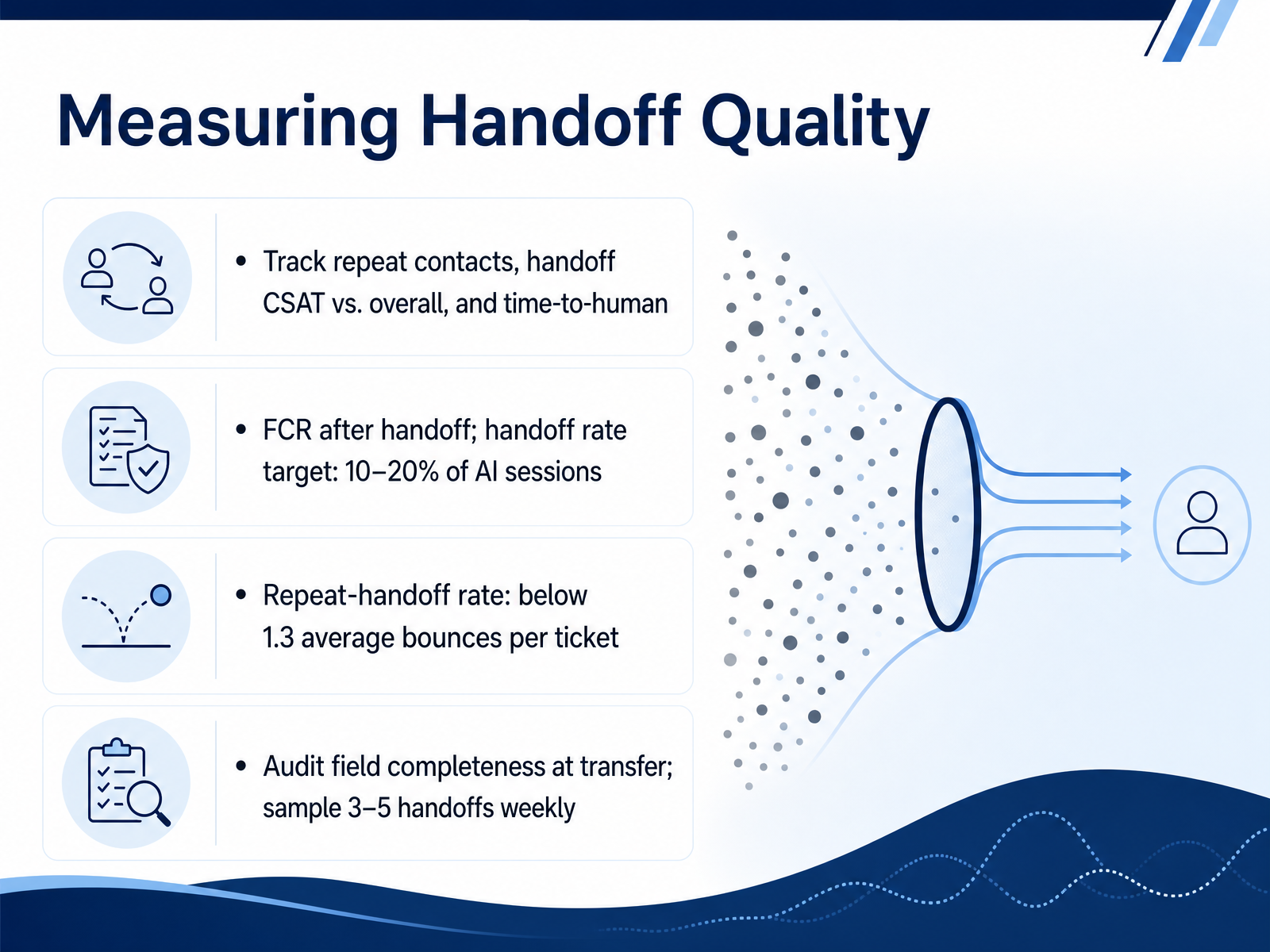
 - 13Measuring Handoff QualityNow that we've covered the mechanics of handoffs, let's talk about how to know if they're actually working. Measuring handoff quality isn't just about tracking numbers; it's about making sure the customer never feels the bumps. Start by watching repeat contacts and comparing handoff CSAT to your overall score. If customers who go through a transfer rate you lower, that gap is your warning light. Also keep an eye on time-to-human, that's how long it takes for a real person to pick up after the bot decides to escalate. Next, look at first contact resolution after a handoff, and aim for a handoff rate between ten and twenty percent of all AI sessions. If you're escalating more than that, your triggers may be too sensitive. And watch the repeat-handoff rate: if a single ticket bounces around on average more than 1.3 times, it's a red flag that context is getting lost. Finally, audit field completeness at every transfer. Pick three to five handoffs each week and check that all required details are there. That simple habit will catch gaps before they become customer frustration. Remember, what gets measured gets managed, and in this case, the metric that matters most is trust. Next, let's look at how to put these practices into action across your team.
 customerscience.com.aurocketlane.comparloa.com+21 min
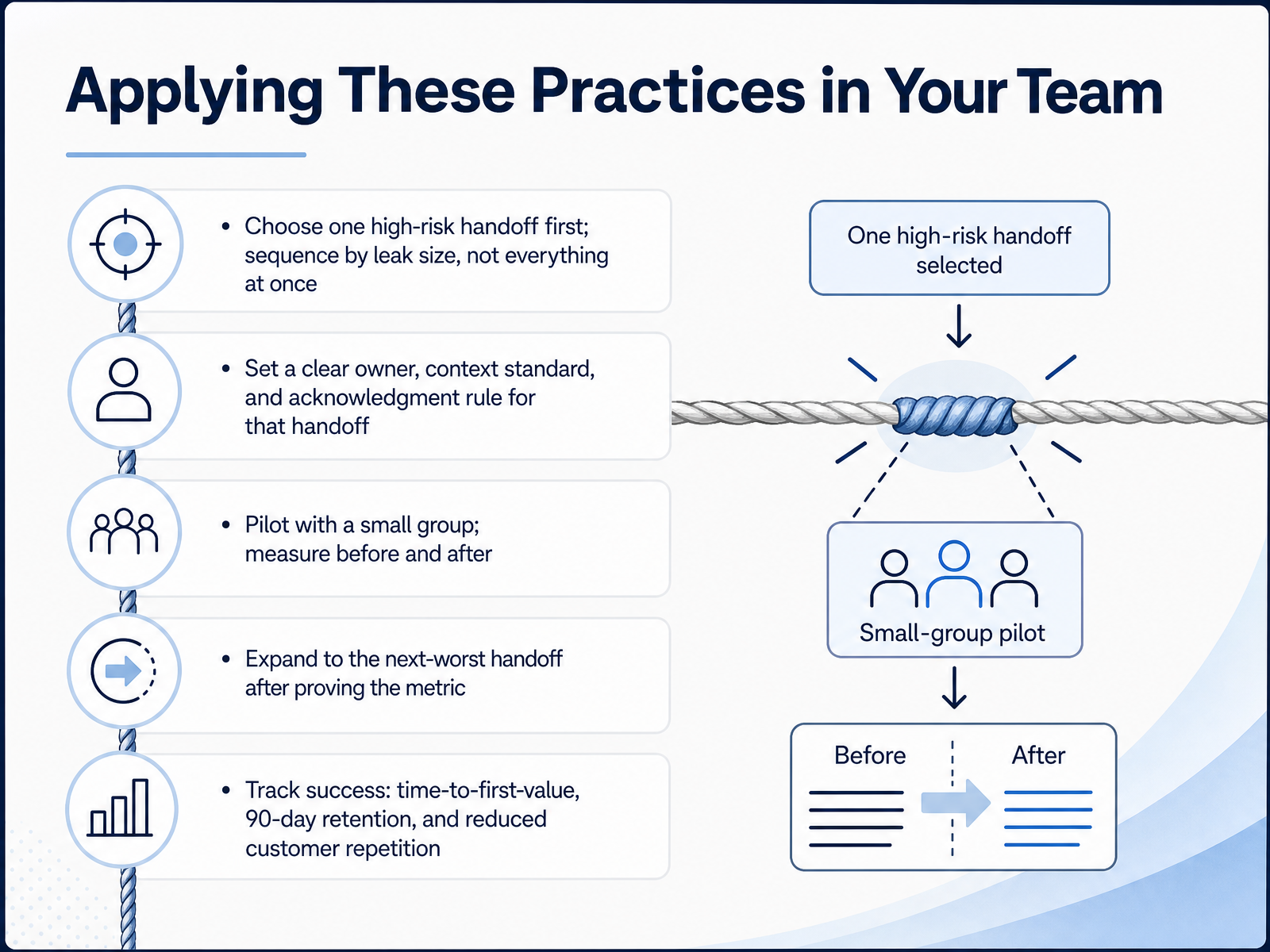
 - 14Applying These Practices in Your TeamLet's wrap up with a practical plan. Don't try to fix every handoff at once. You will lose momentum and burn out your team. Instead, choose the one handoff that leaks the most value. Sequence by leak size. That is your starting point. For that single handoff, define three things clearly. A named owner. A consistent context standard, meaning what information must always travel with the customer. And an explicit acknowledgment rule, so the receiver confirms they own the case. Pilot this with a small group. Measure time-to-first-value and 90-day retention before and after. Also track how often customers have to repeat themselves. If the numbers move in the right direction, expand to the next worst handoff. Keep the proof before you scale. That is how you build lasting change. Thank you for your commitment to serving customers better. You have the tools and the clarity. Now go make every transition feel seamless. You have got this.
 customerscience.com.aurocketlane.comparloa.com+22 min
Take the deck with you
Download this course as a file — free, no sign-up needed.
- PDF handoutEvery slide page, ready to print or share.15 pages · 3.2 MBDownload
- Narrated PowerPointThe deck that presents itself — every slide carries the digital human's narration video.15 pages · 13.9 MBDownload
- PowerPoint slidesThe full deck as a .pptx — open it in PowerPoint, Keynote, or Google Slides.15 pages · 3.1 MBDownload
Free to use in your own training — please keep the PersonWise credit page at the end.
Have your own deck? Turn it into a course
Sources consulted
Web sources consulted while building this course.
- Handoff Reduction Playbook - Customer Science — customerscience.com.au
- Sales to Customer Success Handoff: A Complete Guide (2026) - Rocketlane — rocketlane.com
- Why nine out of ten customer service handoffs fail - Parloa — parloa.com
- Sales to CS handoff: where most B2B teams drop the ball — ziellab.com
- Sales Handoff Governance: The 6-Handoff Framework | PILLAR — pillargtm.com
- Sales-to-CS handoff: Playbook, template, and checklist — avoma.com
- Handoff templates for global support teams (what to include every time) — supportbench.com
- Best Practices for Customer Support Handoffs — Supplo Blog — supplo.io
- Sales to Customer Success Handoff Template (2026) — cufinder.io
- Sales to customer success hand-off template — customersuccesscollective.com