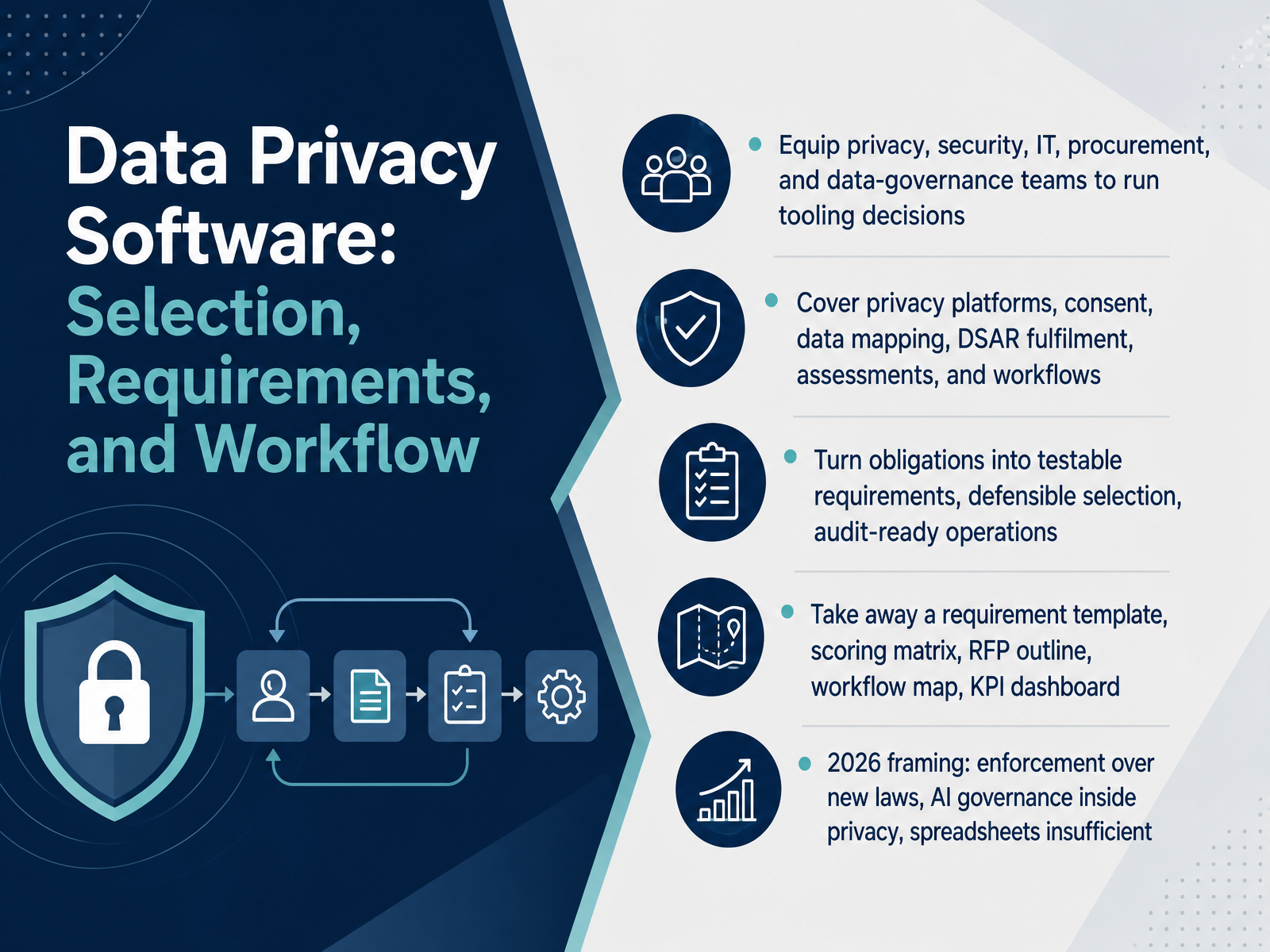
Data Privacy Software Selection and Workflow
Begin
13 pages · ~26 min
Data Privacy Software Selection and Workflow
This training guides professionals through selecting data privacy software, defining requirements, and building compliant workflows. Ideal for privacy, legal, and IT teams.
What you’ll learn
- 01Data Privacy Software: Selection, Requirements, and WorkflowWelcome. This course is about choosing data privacy software the way you would run any high-stakes procurement: with clear requirements, defensible scoring, and workflows that hold up under audit. It is built for privacy programme managers, security and IT teams, procurement partners, and data-governance leads working together. Across thirteen slides, we will cover privacy platforms, consent management, data mapping, DSAR fulfilment, and assessments. Our goal is to turn obligations into testable requirements, a defensible selection, and audit-ready operations. Along the way, you will get a requirement template, a scoring matrix, an RFP outline, a workflow map, and a KPI dashboard. Let me set the 2026 context. Enforcement now matters more than new laws. Fines are rising, AI governance sits inside privacy, and spreadsheets are no longer sufficient. So, let's begin with why this framing changes how you evaluate and buy. Next, Why Now: Enforcement Pressure, AI, and Programme Maturity.trustarc.comcms.lawonetrust.com+22 min
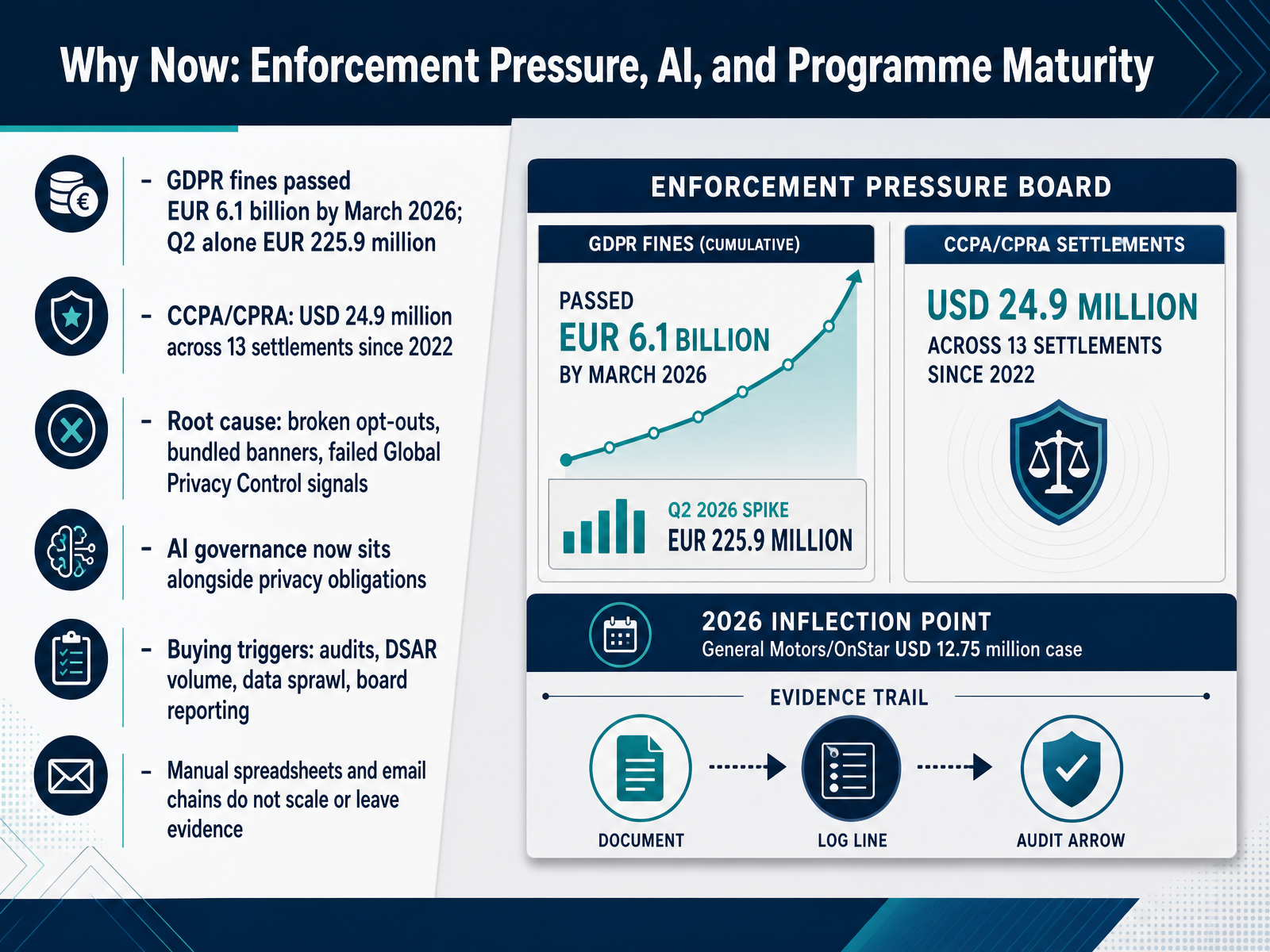
- 02Why Now: Enforcement Pressure, AI, and Programme MaturityLet's look at why this decision is landing on your desk right now. The pressure is real and it is measurable. GDPR fines passed six point one billion euros by March 2026, with roughly two hundred and twenty six million euros in the second quarter alone. California has collected about twenty four point nine million dollars across thirteen CCPA and CPRA settlements, and twenty twenty six already outpaced the previous three years combined. Look at the root causes, because they matter more than the totals. Broken opt-outs, bundled banners, and unhonoured Global Privacy Control signals drive most of these cases. These are mechanical failures, not judgment calls, which means they are preventable and testable. At the same time, AI governance now sits alongside privacy obligations. You are being asked to evidence training data, model oversight, and automated decision-making on the same dashboard as consent and retention. So what actually triggers a purchase? Audits, DSAR volume, data sprawl, and board reporting. If any of those are on your roadmap, you are in scope. And be honest about the current state. Manual spreadsheets and email chains do not scale, and they do not leave defensible evidence when a regulator asks how you knew. Keep that in mind as we move on. Using a Privacy Programme Maturity Model to Scope Tooling.
 trustarc.comcms.lawonetrust.com+22 min
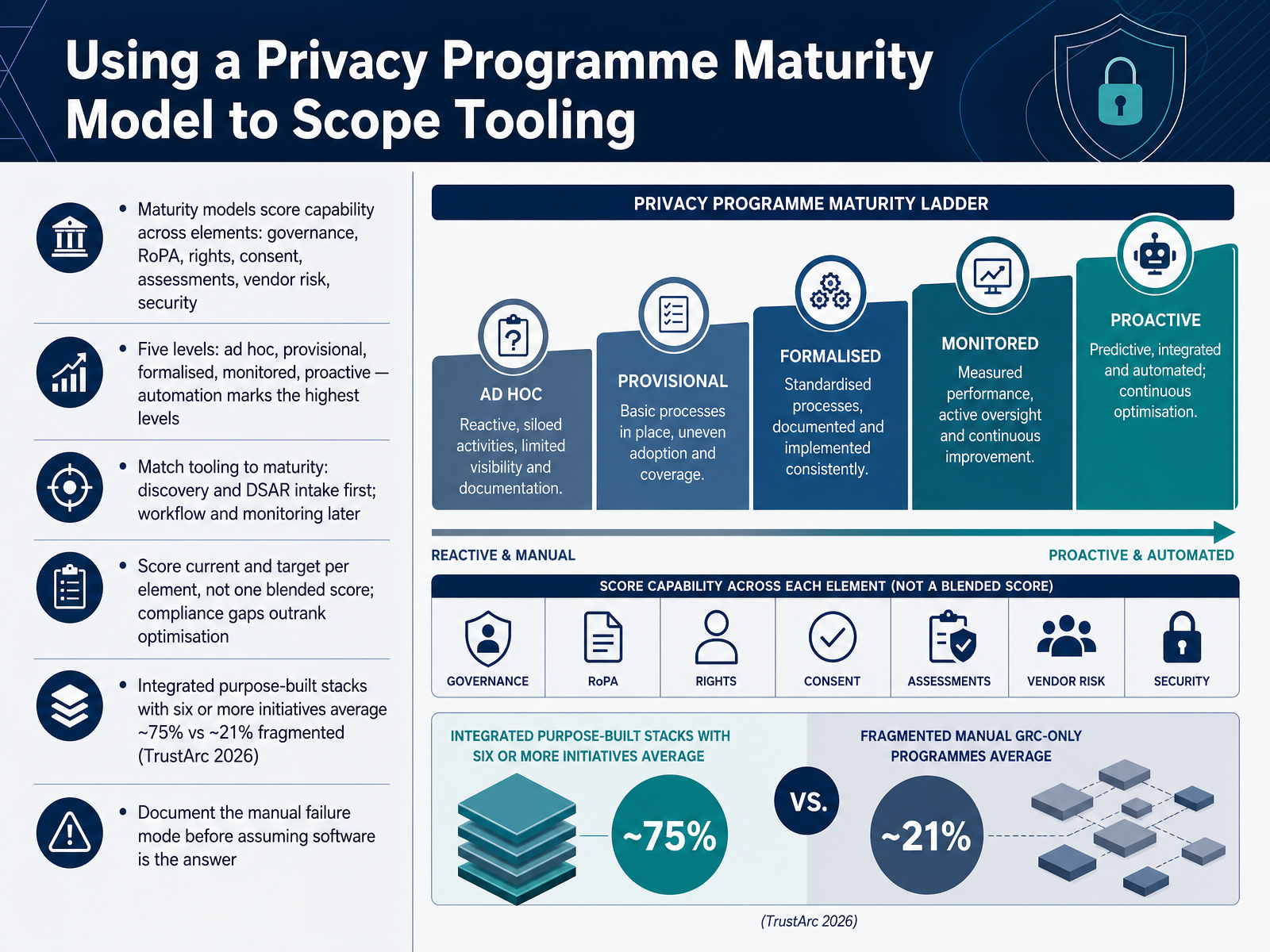
 - 03Using a Privacy Programme Maturity Model to Scope ToolingNow let's use a maturity model to scope your tooling, not just to score it. Start by scoring capability element by element. Governance, records of processing, rights, consent, assessments, vendor risk, and security. Then place each one on five levels: ad hoc, provisional, formalised, monitored, and proactive. Automation is what marks the highest levels. Match tooling to that reality. Discovery and DSAR intake usually come first. Workflow and monitoring come later. Score current and target maturity per element, not one blended score. Compliance gaps outrank optimisation every time. Here is the business case. Integrated purpose-built stacks with six or more initiatives average about seventy-five percent, against roughly twenty-one percent for fragmented programmes. That gap is four times the competence. So before you assume software is the answer, document the manual failure mode it addresses. That evidence is what gets cross-functional approval, sets procurement criteria, and holds up in audit.
Next, we'll look at solution categories and what each tool actually solves.
 mitre.orgonetrust.comoaic.gov.au+22 min
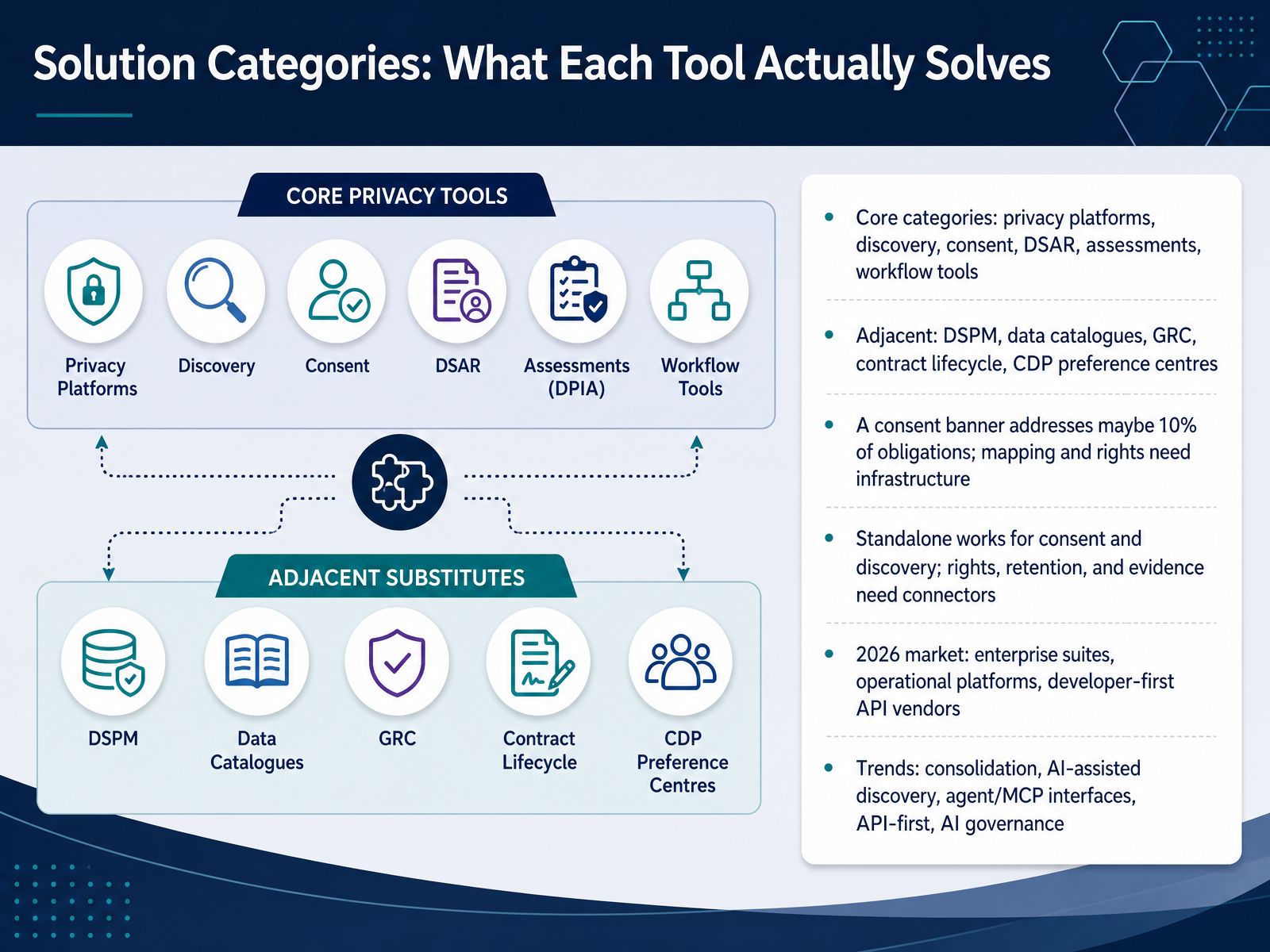
 - 04Solution Categories: What Each Tool Actually SolvesLet us break the market into solution categories, and what each one actually solves. The core set includes privacy platforms, data discovery, consent management, DSAR handling, assessments, and workflow tools. Adjacent to those, you will find DSPM, data catalogues, GRC platforms, contract lifecycle tools, and preference centres inside a CDP. Here is the point to anchor your evaluation. A consent banner addresses maybe ten percent of your obligations. Mapping and rights need real infrastructure behind them. Standalone tools can work well for consent and discovery, but rights, retention, and evidence require connectors into live systems. In 2026, the market splits into enterprise suites, operational platforms, and developer-first API vendors. Watch five trends: consolidation, AI-assisted discovery, agent and MCP interfaces, API-first design, and AI governance. Map each shortlisted tool to the obligations it genuinely solves before you compare price. Category Strengths, Limits, and Fit by Organisation Type.
 stealthcloud.aidataprivacytools.netlearn.g2.com+22 min
 - 05Category Strengths, Limits, and Fit by Organisation TypeNow let's move to category strengths, limits, and fit by organisation type. Broad enterprise suites give you unmatched breadth and deep regulatory libraries, but they are configuration heavy and carry a higher total cost of ownership. Plan for sustained admin effort. Discovery led tools offer the deepest classification across structured, unstructured, cloud, and on prem data. If you cannot find it, you cannot govern it. Consent specialists are strong on multi brand coverage, geo targeting, tag manager integration, and signal forwarding. Vet that module as carefully as your request engine. For rights and workflow vendors, connector breadth decides whether fulfillment actually executes against live systems. Governance adjacent suites collapse privacy and data governance into one budget, which can simplify approvals. A practical heuristic: verify the one or two categories that hurt most for your programme first. From Regulatory Obligations to Functional Requirements.
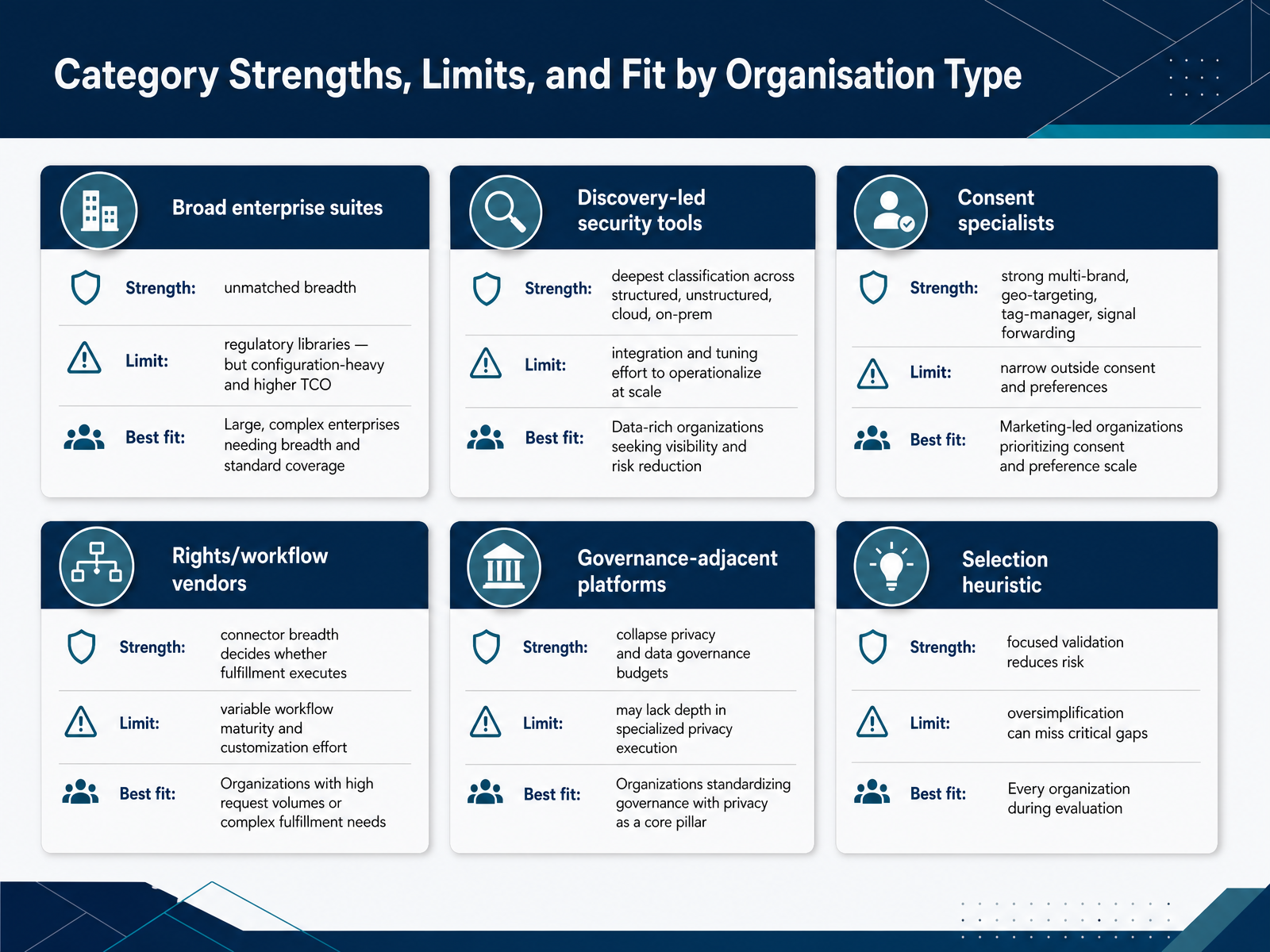 stealthcloud.aidataprivacytools.netlearn.g2.com+21 min
 - 06From Regulatory Obligations to Functional RequirementsLet's move to turning regulatory obligations into functional requirements. The goal is to convert regulatory duties into testable statements, not document language. For example, "RoPA reviewed quarterly" or "DSARs acknowledged within 48 hours." These are verifiable, owners can be assigned, and auditors can sample against them. Cover all functional domains: mapping, consent, rights, DPIAs, retention, and vendors. Then pressure-test RoPA depth with three checks: one-click export, field-level history, and a processor-side view. Before scoring, gate the deal-breakers first. Security, data residency, audit trail, and exit options are pass or fail. Only when those clear should you score differentiators like usability, integrations, and reporting. That sequence keeps cross-functional reviews focused and defensible. Next, we'll look at Non-Functional Requirements: Security, Residency, and Exit.
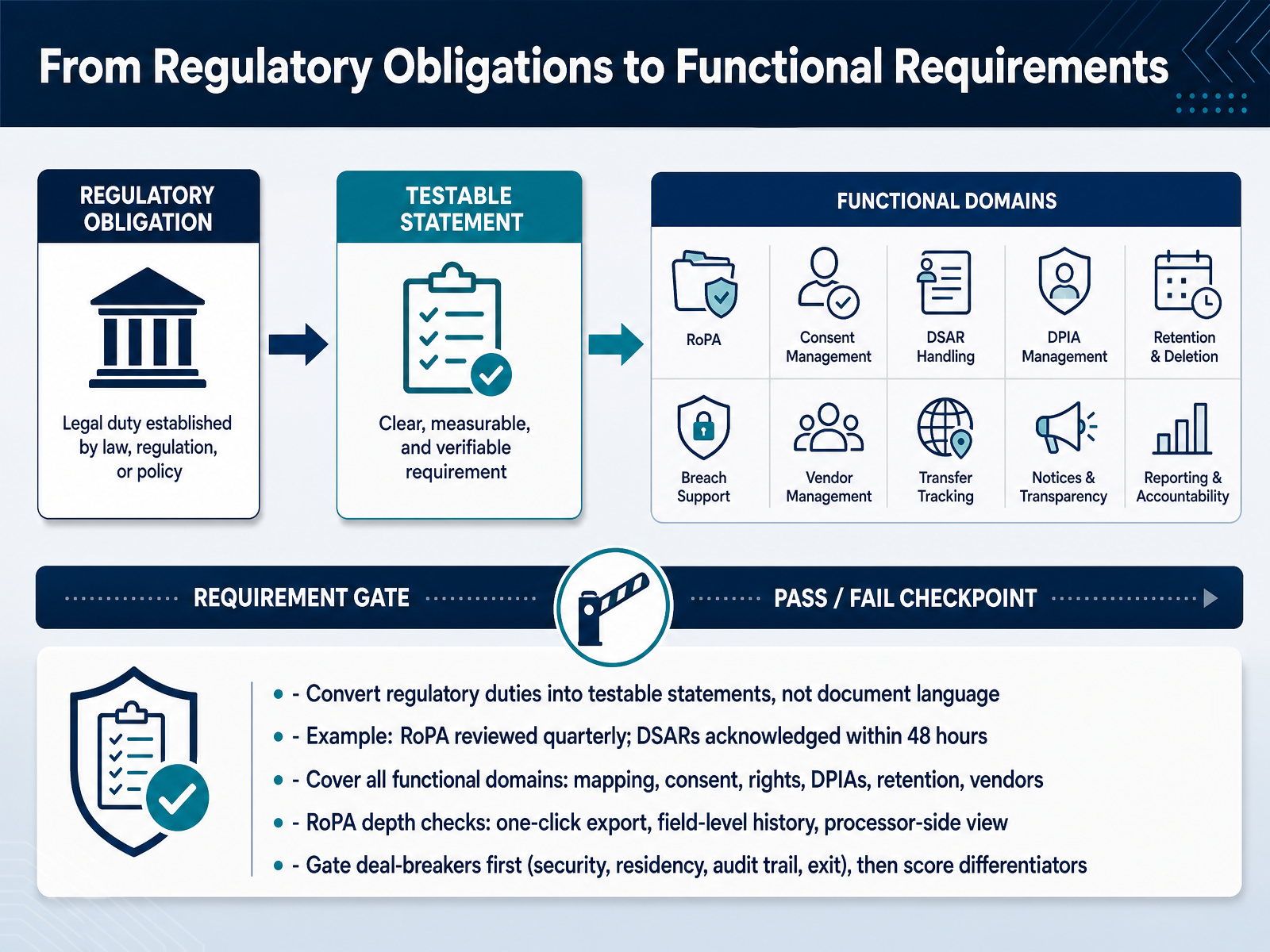 dictiva.comcaralegal.eusecuritywall.co+21 min
 - 07Non-Functional Requirements: Security, Residency, and ExitNow let's turn to the non-functional requirements that decide whether a vendor is actually safe to onboard. Start with evidence, not adjectives. Ask for a current SOC 2 Type II, ISO 27001 or 27701, a completed SIG or CAIQ, and a penetration test summary. Then read the SOC 2 properly. Check the Type II scope, the trust criteria, any carve-outs, and every exception with management's response. Next, access and encryption. Confirm SSO and SCIM, MFA on admin accounts, quarterly access reviews, TLS 1.2 or higher, AES-256 at rest, and documented key rotation. On residency, map storage and processing locations, tenant segregation, training opt-out, subprocessors, and SCCs or the IDTA with a transfer impact assessment. Finally, resilience and exit. Tested incident response and disaster recovery, breach-notification timelines, the right to audit, export format, and deletion proof. Treat each of these as a decision point, not a checkbox, because these are the terms you will live with after go-live. Running the Selection Process: Stakeholders, RFI/RFP, and Demos.
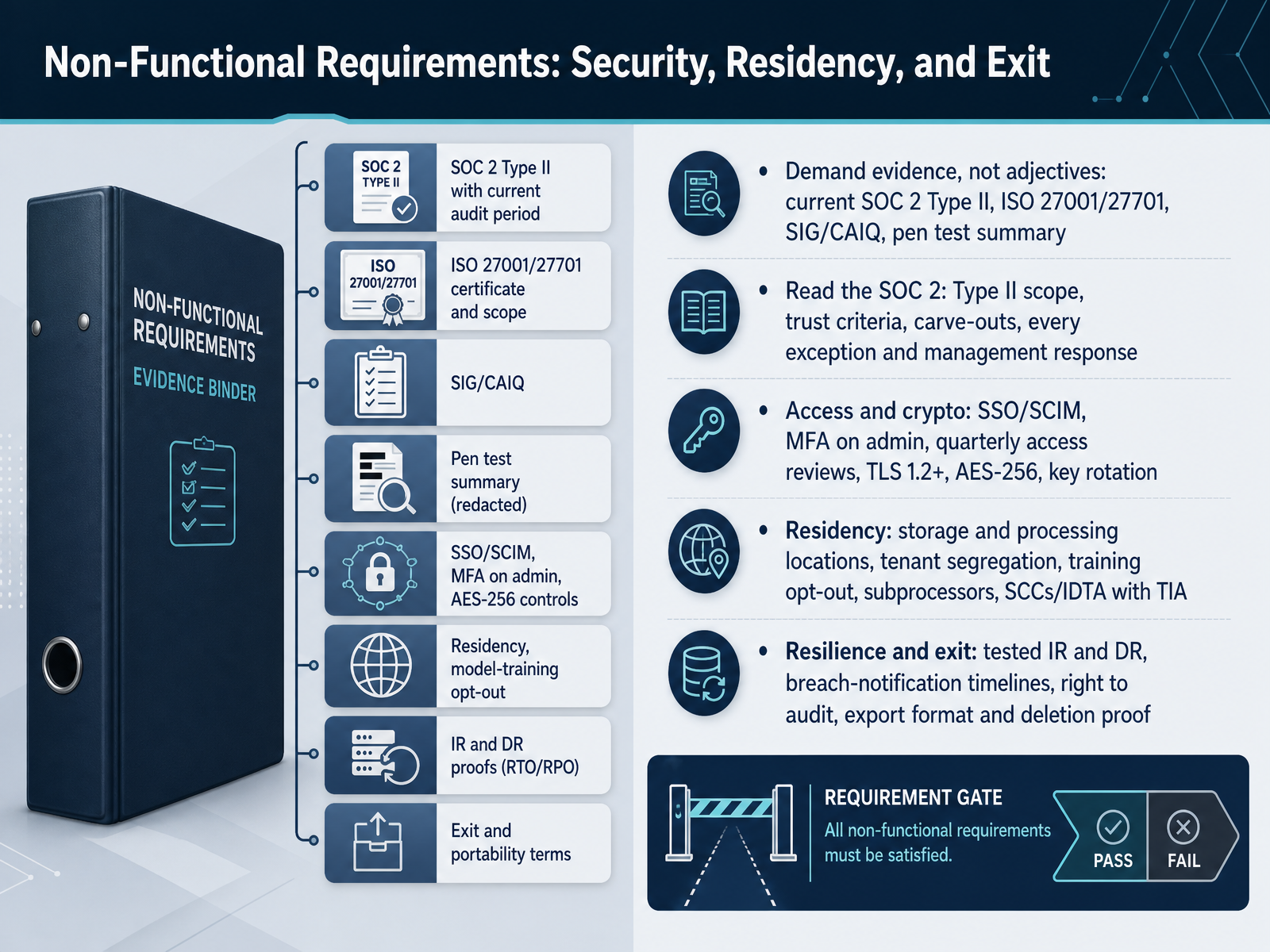 dictiva.comcaralegal.eusecuritywall.co+22 min
 - 08Running the Selection Process: Stakeholders, RFI/RFP, and DemosNow let's walk through running the selection process. Start by mapping your stakeholders and confirming a RACI before you issue anything. Identify who scores, who approves, and who signs off. Then stage the work: an R F I, a shortlist of three to five vendors, the R F P, demos, parallel proofs of concept, and reference calls. Plan for six to twelve weeks; compressing that timeline usually means skipping compliance and reference checks. Be strict on R F P answers. Every claim needs documentation, because an unsubstantiated yes scores zero. Score each response one to five on a weighted rubric, then cross-check the R F P answers against the demo and the references. Finally, test real scenarios and the boring things: configuration, upgrades, pricing, and service level agreements. If the R F P says thirty-day rollout and the reference says ninety, believe the reference and adjust your contract. Next, we'll look at designing rights and consent workflows that actually execute.
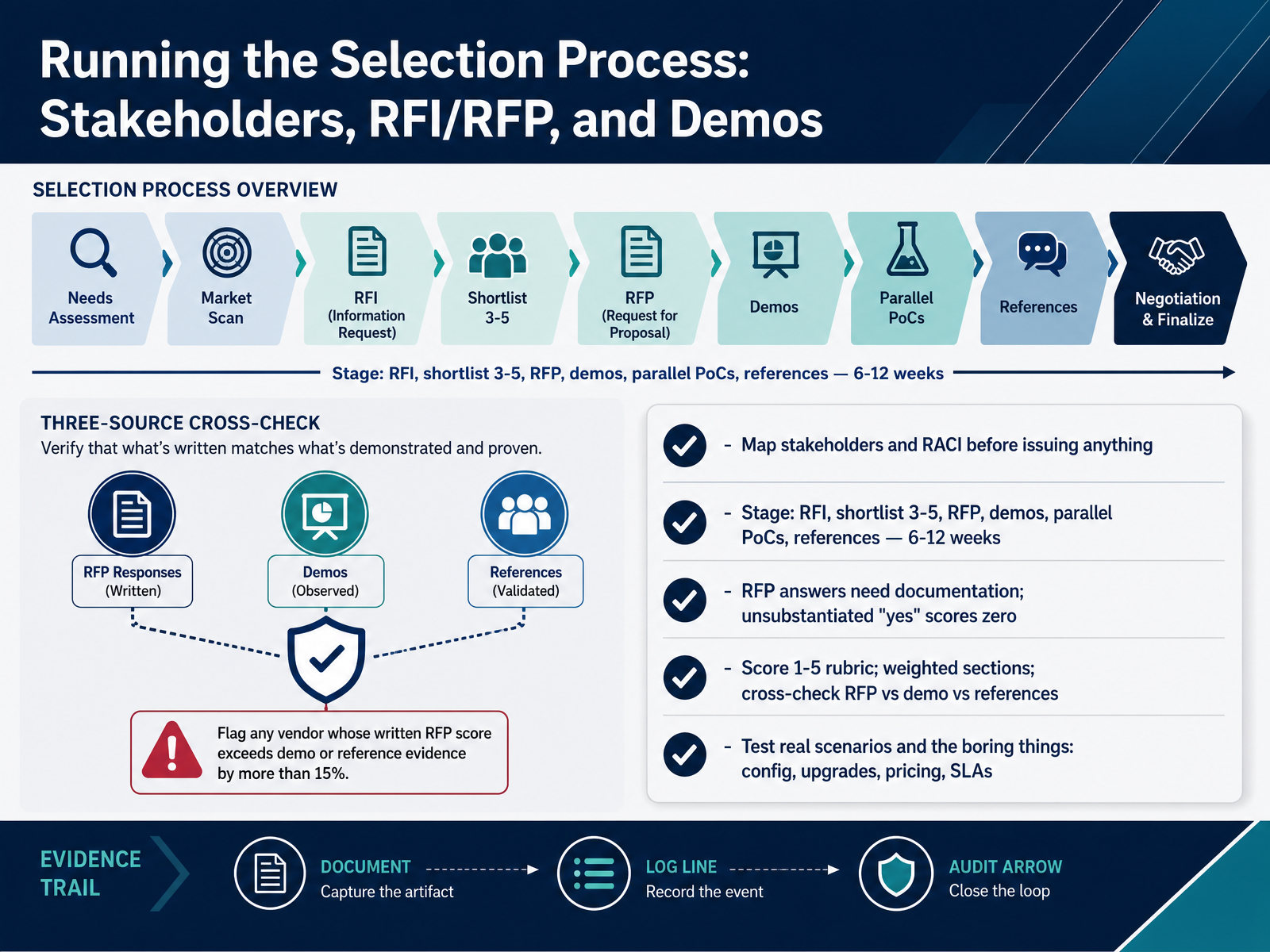 1 min
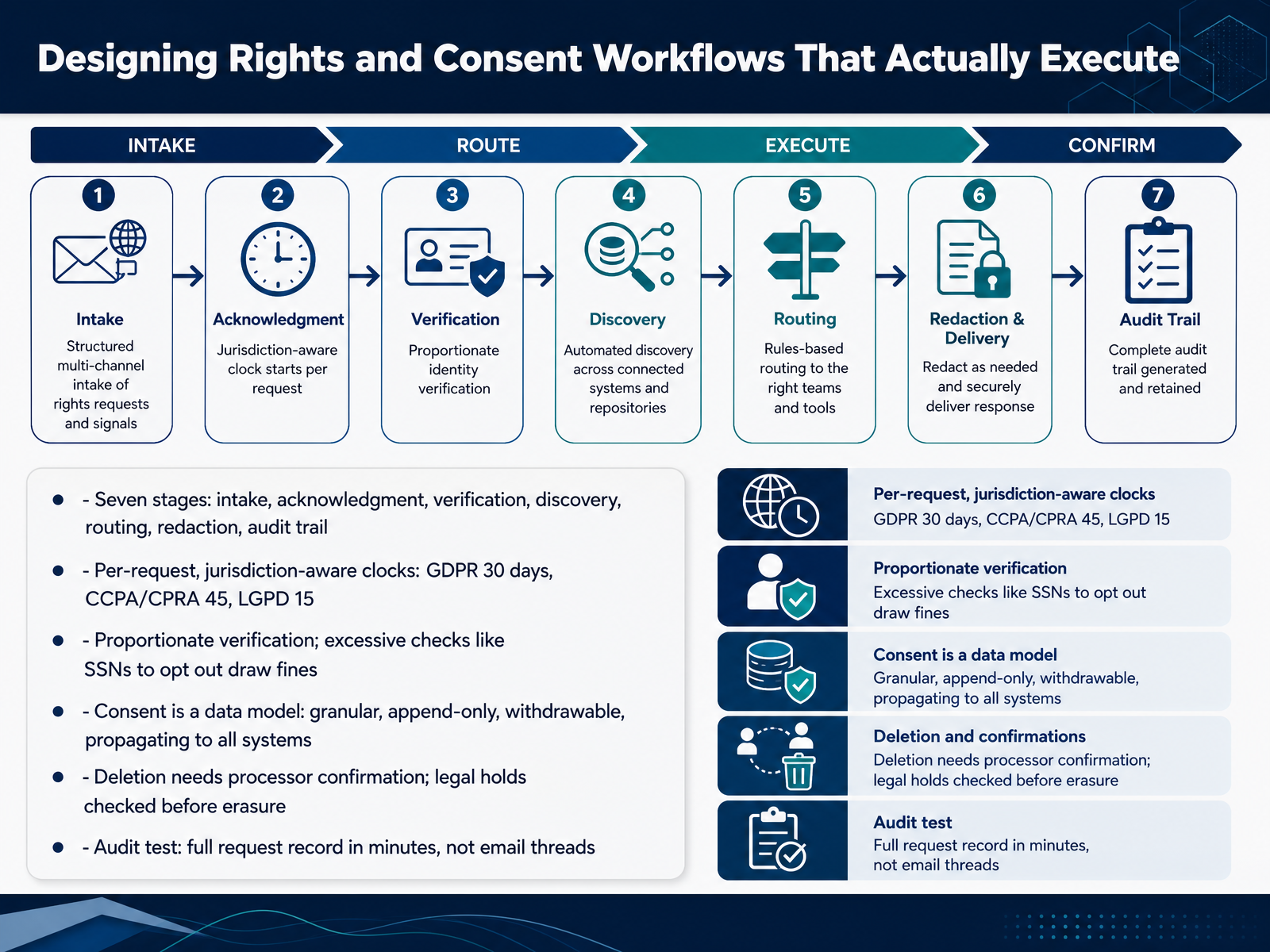
1 min - 09Designing Rights and Consent Workflows That Actually ExecuteNow let's focus on designing rights and consent workflows that actually execute. Seven stages define a reliable pipeline: intake, acknowledgment, verification, discovery, routing, redaction, and audit trail. Run jurisdiction-aware clocks per request. Thirty days under GDPR, forty-five under CCPA and CPRA, fifteen under LGPD. With 19 US state laws and multi-jurisdiction requesters, your platform must track deadlines per regulation, not per queue. Keep verification proportionate and tiered. Excessive checks, such as demanding a Social Security number to honor an opt-out, have drawn enforcement. Treat consent as a data model: granular by purpose, append-only, withdrawable, and propagating to every downstream system. Deletion is not complete until processors confirm removal, and legal holds must be checked before erasure. Your audit test is simple. Can you produce the full request record in minutes, not by searching email threads? If not, you are not audit-ready. Next, we move to assessments, retention, and vendor workflows.
 trustarc.comcms.lawonetrust.com+22 min
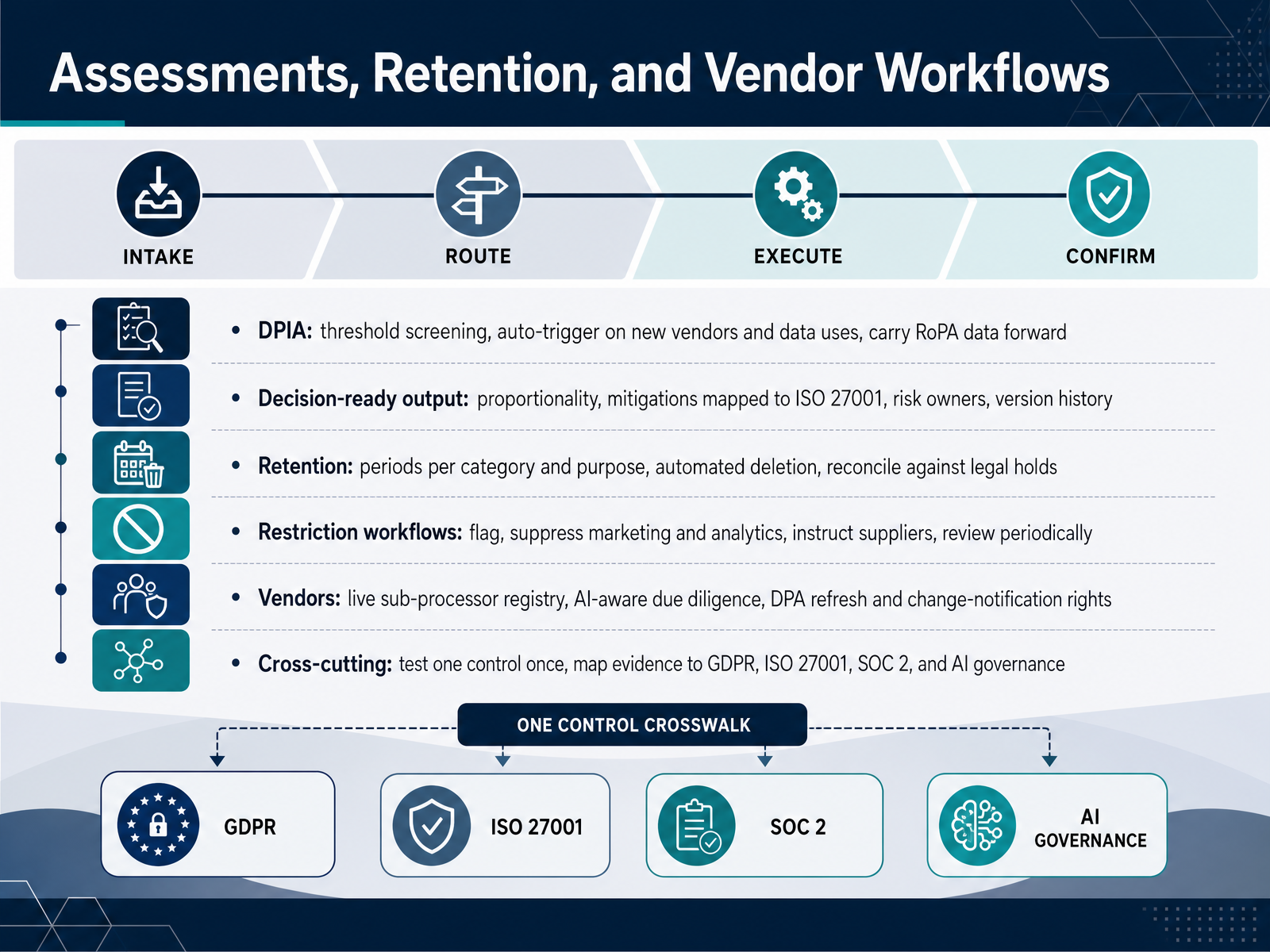
 - 10Assessments, Retention, and Vendor WorkflowsLet's move into assessments, retention, and vendor workflows. For DPIAs, automate threshold screening and trigger an assessment automatically whenever a new vendor or data use appears, carrying your RoPA data forward so teams never re-key it. The output should be decision-ready: proportionality, mitigations mapped to ISO 27001, named risk owners, and full version history. On retention, define periods by category and purpose, automate deletion, and reconcile against legal holds before anything is removed. For restriction workflows, flag the record, suppress marketing and analytics, instruct suppliers, and review periodically. Vendor oversight needs a live sub-processor registry, AI-aware due diligence, and DPA refresh rights with change notification. Above all, test one control once and map the evidence across GDPR, ISO 27001, SOC 2, and AI governance. That is how you move from requirements to defensible, repeatable workflows. Next, we will look at implementation, adoption, and change management.
 mitre.orgonetrust.comoaic.gov.au+22 min
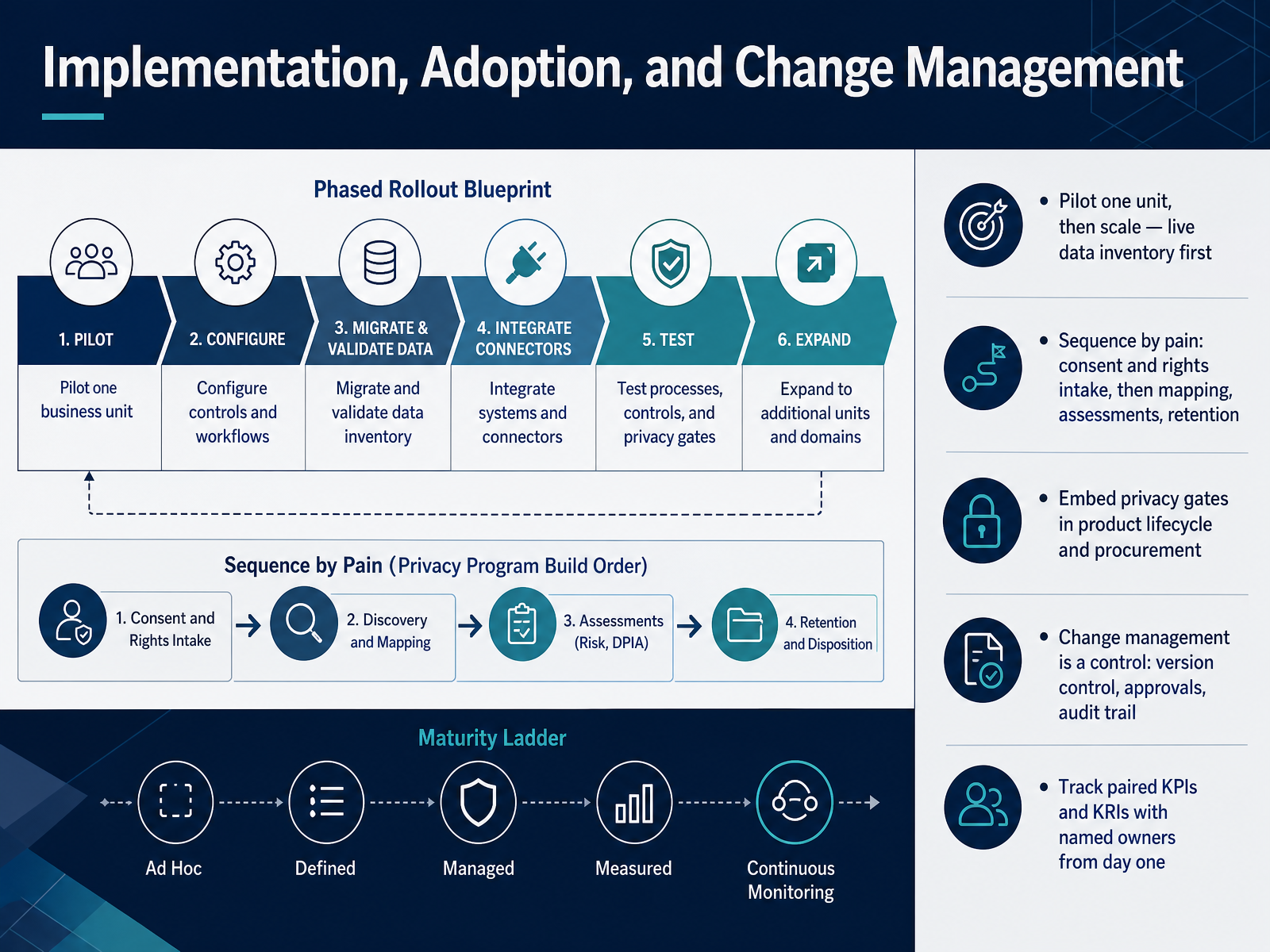
 - 11Implementation, Adoption, and Change ManagementNow let's talk about turning a selected platform into an operating capability. Implementation, adoption, and change management decide whether you get value from the software or just a license.
Start with a pilot in one business unit, and get a live data inventory running first. Everything downstream depends on it. Then sequence by pain. Consent and rights intake first, because those carry deadlines. Data mapping and assessments next. Retention last, once schedules are reliable.
Embed privacy gates directly in the product lifecycle and procurement, so reviews happen before code ships or contracts are signed. Treat change management as a control. Version control, documented approvals, and a complete audit trail are what auditors will ask to see.
Finally, track paired K P Is and K R Is with named owners from day one. For example, DSAR timeliness paired with backlog, or DPIA completion paired with overdue high-risk assessments.
Ongoing Governance, Vendor Management, and Emerging Risk.
 mitre.orgonetrust.comoaic.gov.au+22 min
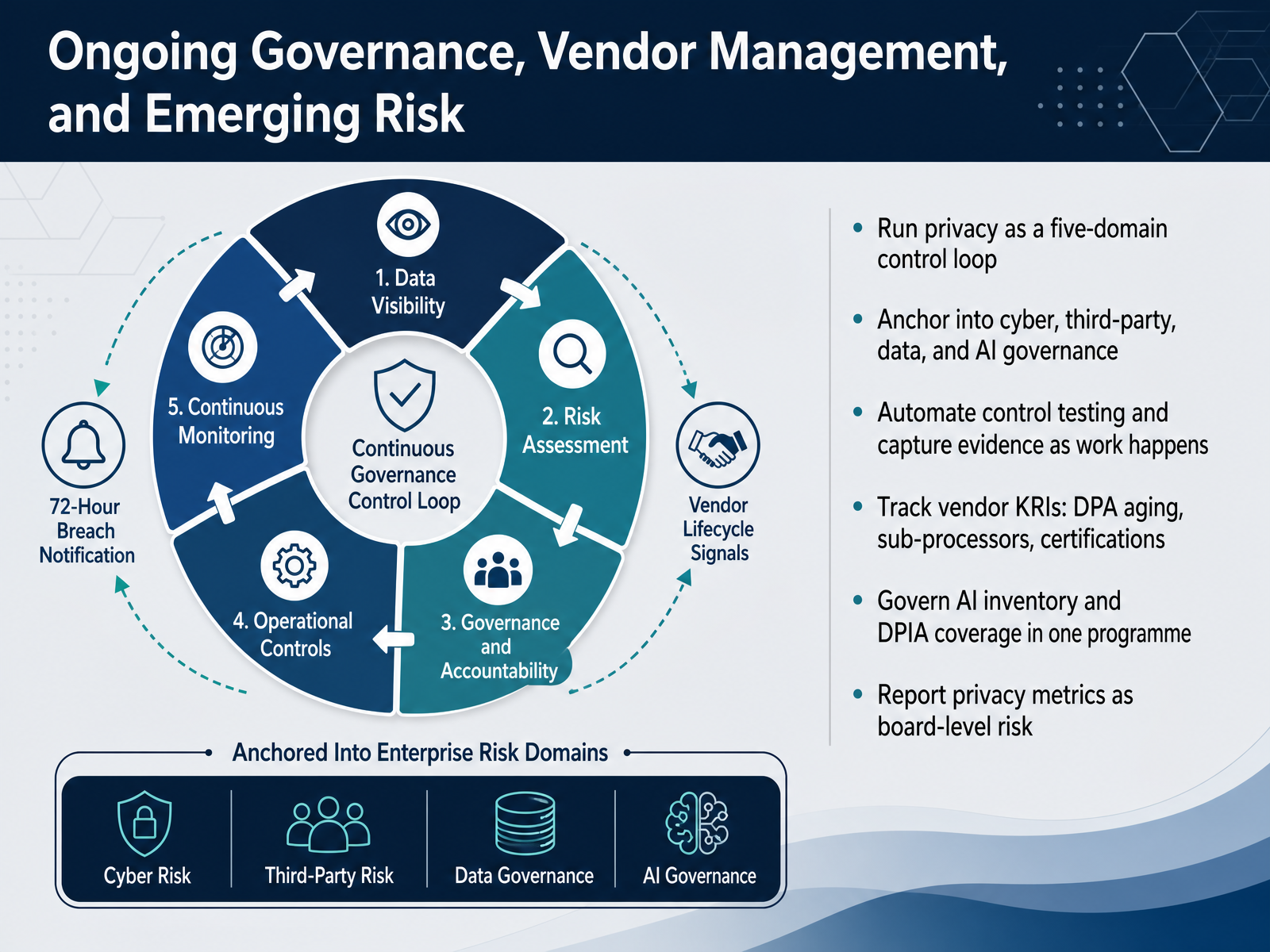
 - 12Ongoing Governance, Vendor Management, and Emerging RiskLet's close the loop on governance and ongoing risk. Run privacy as a five-domain control loop: data visibility, risk assessment, governance, operational controls, and continuous monitoring. Anchor that loop into cyber, third-party, data, and AI governance so you test a control once and satisfy multiple frameworks. Automate control testing and capture evidence as work happens, not weeks before an audit. Track vendor risk indicators continuously, such as DPA aging, sub-processor disclosure, and certification coverage. Remember, vendor DPA refreshes should run on a twenty-four month cycle. Govern AI inventory and DPIA coverage inside the same programme, since high-risk AI systems bring GDPR and AI Act obligations together. Finally, report privacy metrics as board-level risk, with red, amber, and green indicators beside your financial and cyber metrics. Next, we move into Practical Takeaways, Templates, and First 90 Days.
 trustarc.comcms.lawonetrust.com+22 min
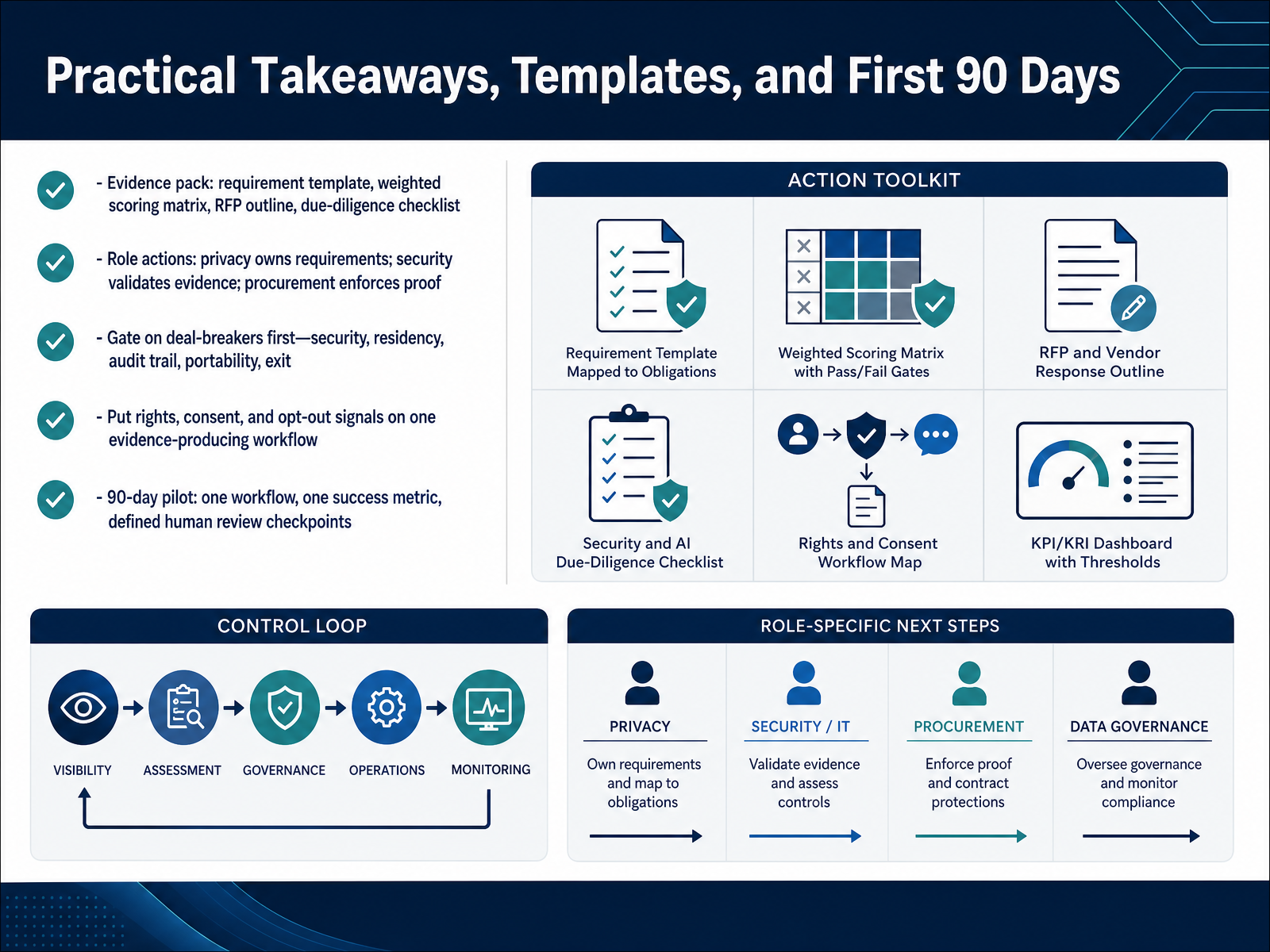
 - 13Practical Takeaways, Templates, and First 90 DaysLet's close with the practical takeaways and a first ninety days plan. First, build one evidence pack: a requirement template, a weighted scoring matrix, an RFP outline, and a due diligence checklist. Keep roles clean. Privacy owns the requirements. Security validates the evidence. Procurement enforces proof before any commitment. Gate on deal-breakers first: security, data residency, audit trail, portability, and defined exit options. Only score differentiating factors after those minimums are met. Then put rights, consent, and opt out signals onto one evidence producing workflow, so every request and preference leaves a timestamped record. Finally, run a ninety day pilot. Pick one workflow, one success metric, and defined human review checkpoints. You now have the templates, the gates, and the workflow to move from requirements to a defensible decision. Thank you for working through this course. Take the evidence pack, run your first pilot, and keep the momentum going.
 dictiva.comcaralegal.eusecuritywall.co+22 min
Take the deck with you
Download this course as a file — free, no sign-up needed.
- PDF handoutEvery slide page, ready to print or share.14 pages · 3.8 MBDownload
- Narrated PowerPointThe deck that presents itself — every slide carries the digital human's narration video.14 pages · 15.3 MBDownload
- PowerPoint slidesThe full deck as a .pptx — open it in PowerPoint, Keynote, or Google Slides.14 pages · 3.7 MBDownload
Free to use in your own training — please keep the PersonWise credit page at the end.
Have your own deck? Turn it into a course
Sources consulted
Web sources consulted while building this course.
- What Summer 2026 Revealed About Global Privacy Enforcement — trustarc.com
- GDPR Enforcement — cms.law
- The 5 trends shaping global privacy and enforcement in 2026 — onetrust.com
- CCPA Enforcement 2026: $24.9M in Fines, 13 Cases [Data] — privacyterms.io
- California Privacy Protection Agency's First Enforcement Action Against Data Broker Signals Industry Scrutiny — paulweiss.com
- Privacy Maturity Model Version 1 — mitre.org
- Privacy Automation Maturity Bracket: From Manual Compliance to AI-assisted Governance Interactive Tool | Resources | OneTrust — onetrust.com
- Interactive PMP Explained — oaic.gov.au
- U.S. States' Privacy Laws Capability Maturity Model — acc.com
- The Osano Privacy Program Maturity Model — osano.com
- Privacy Tech Vendor Landscape 2026 | Free Resource — stealthcloud.ai
- Best data privacy management software - Data Privacy Tools — dataprivacytools.net
- 8 Data Privacy Management Tools That Stood Out in My Review — learn.g2.com
- Best 7 Privacy Management Software (GDPR/CCPA) in 2026 | PickMySoft — pickmysoft.com
- Best Privacy Management Software | 2026 Verified Rankings — gitnux.org
- GDPR Compliance Software Guide for 2026 | Dictiva — dictiva.com
- Data protection management software checklist (2026) — caralegal.eu
- GDPR 2025 vs 2026 Comparison — securitywall.co
- The Complete GDPR Compliance Checklist for 2026 — privacycache.com
- GDPR Compliance Checklist 2026 — visioncompliance.eu