Begin
14 pages · ~28 min
DevOps vs Agile: Tradeoffs and Use Cases
This training compares DevOps and Agile methodologies, highlighting their key differences, tradeoffs, and ideal use cases to help professionals choose the right approach for their projects.
A digital instructor presents all 14 pages. Hold “Ask” at any point and ask out loud — the answer comes from this course. No sign-up needed.
What you’ll learn
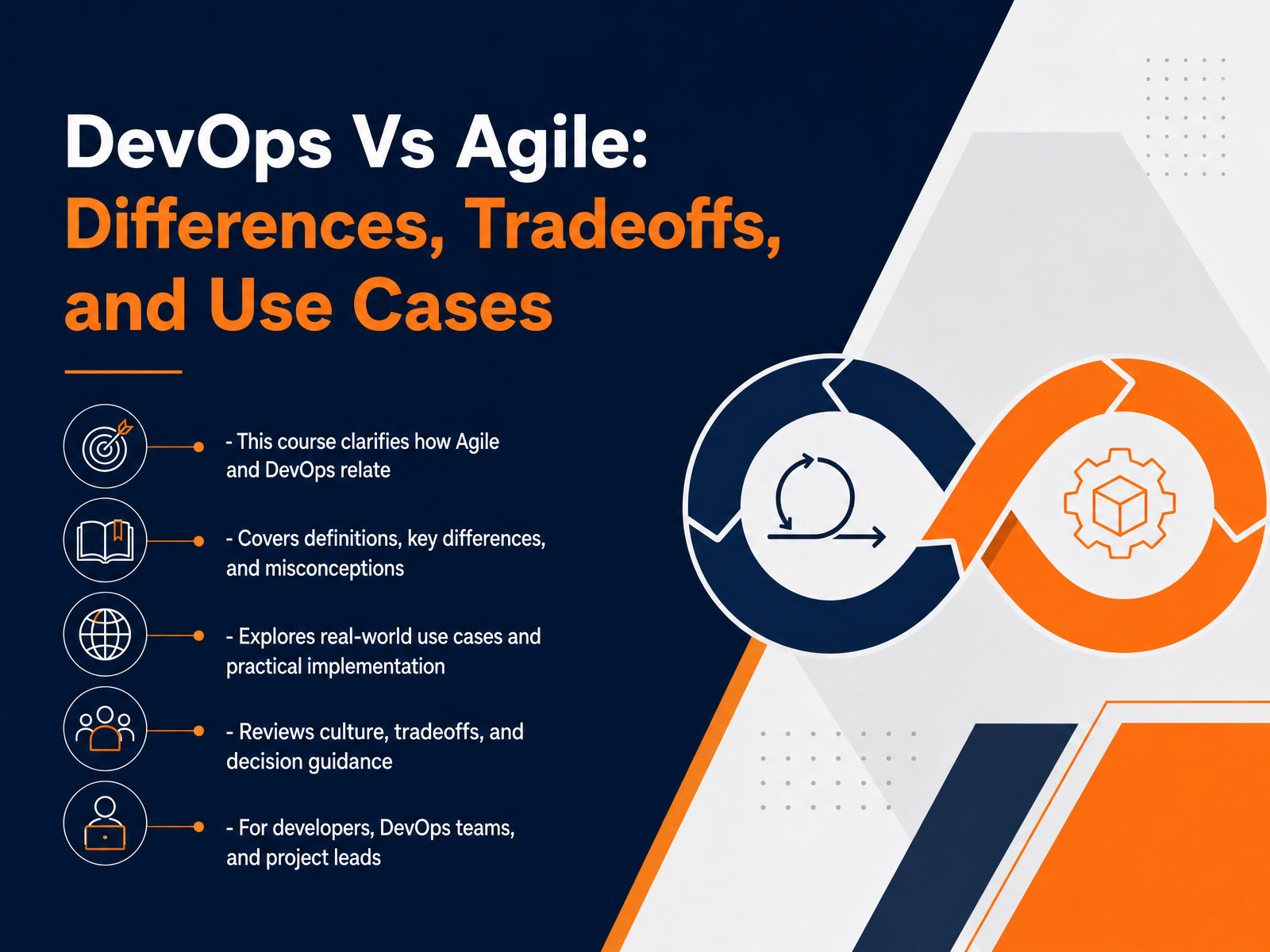
- 01DevOps Vs Agile: Differences, Tradeoffs, and Use CasesWelcome. This course cuts through the confusion between DevOps and Agile, which is something every developer, DevOps team, and project lead needs to handle clearly. We’ll start with solid definitions, then move into the key differences and the misconceptions—like the idea that one replaces the other, which isn’t true. You’ll see real-world use cases and practical implementation paths that work within your budget and delivery deadlines. We’ll dig into the culture shifts and the real tradeoffs you’ll face. By the end, you’ll have a clear decision framework: knowing that Agile helps you build the right thing through iterative planning and customer feedback, while DevOps focuses on delivering and operating that software reliably through automation and collaboration. You’ll learn how to spot which practice solves which bottleneck—whether you’re stuck in prioritization or stuck in slow, risky deployments. Most mature organizations need both, and we’ll show you how to make that work in practice. Let’s begin with the fundamentals of Agile.atlassian.combmc.comaws.amazon.com+21 min
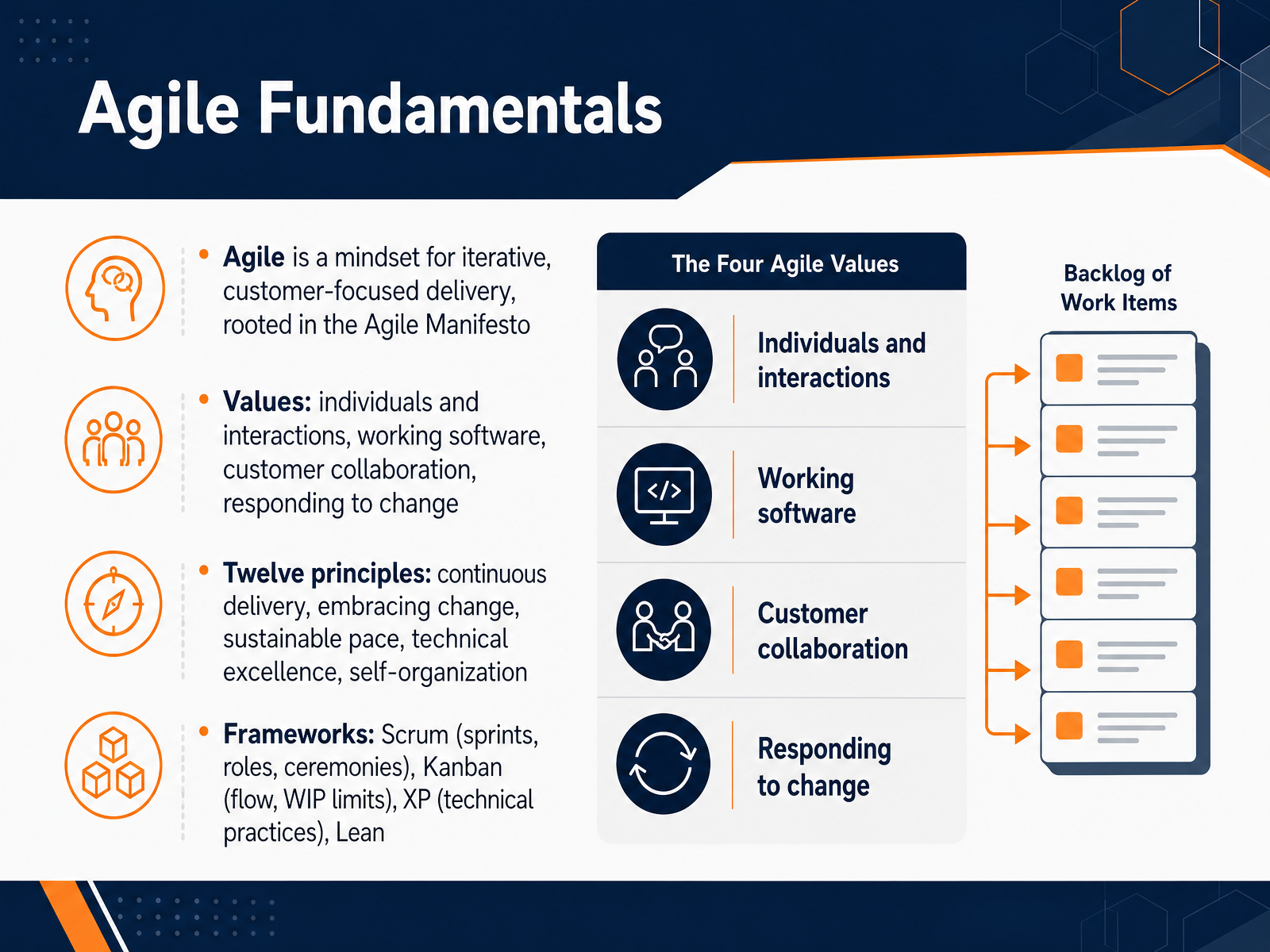
- 02Agile FundamentalsLet’s ground ourselves in Agile fundamentals before we contrast it with DevOps. Agile is a mindset, not a tool. It’s rooted in the Agile Manifesto, which prioritizes individuals and interactions over processes, working software over documentation, customer collaboration over contracts, and responding to change over following a fixed plan. The twelve principles push this further—frequent delivery, welcoming change, sustainable pace, technical excellence, and self-organization. The key is how you implement it. Scrum gives you sprints and defined roles like the Scrum Master and Product Owner. Kanban focuses on flow and limiting work in progress to expose bottlenecks. XP brings in technical practices like pair programming and test-driven development. Lean strips out waste to maximize value. A practical takeaway: if you’re facing complex requirements, Scrum’s inspection and adaptation is solid. For a support team with a continuous stream of requests, Kanban’s flow is probably a better fit. Now let’s move on to how Agile actually works in practice—the roles, artifacts, and daily workflow that make it run.
 atlassian.comagilemanifesto.orgagilemanifesto.org+22 min
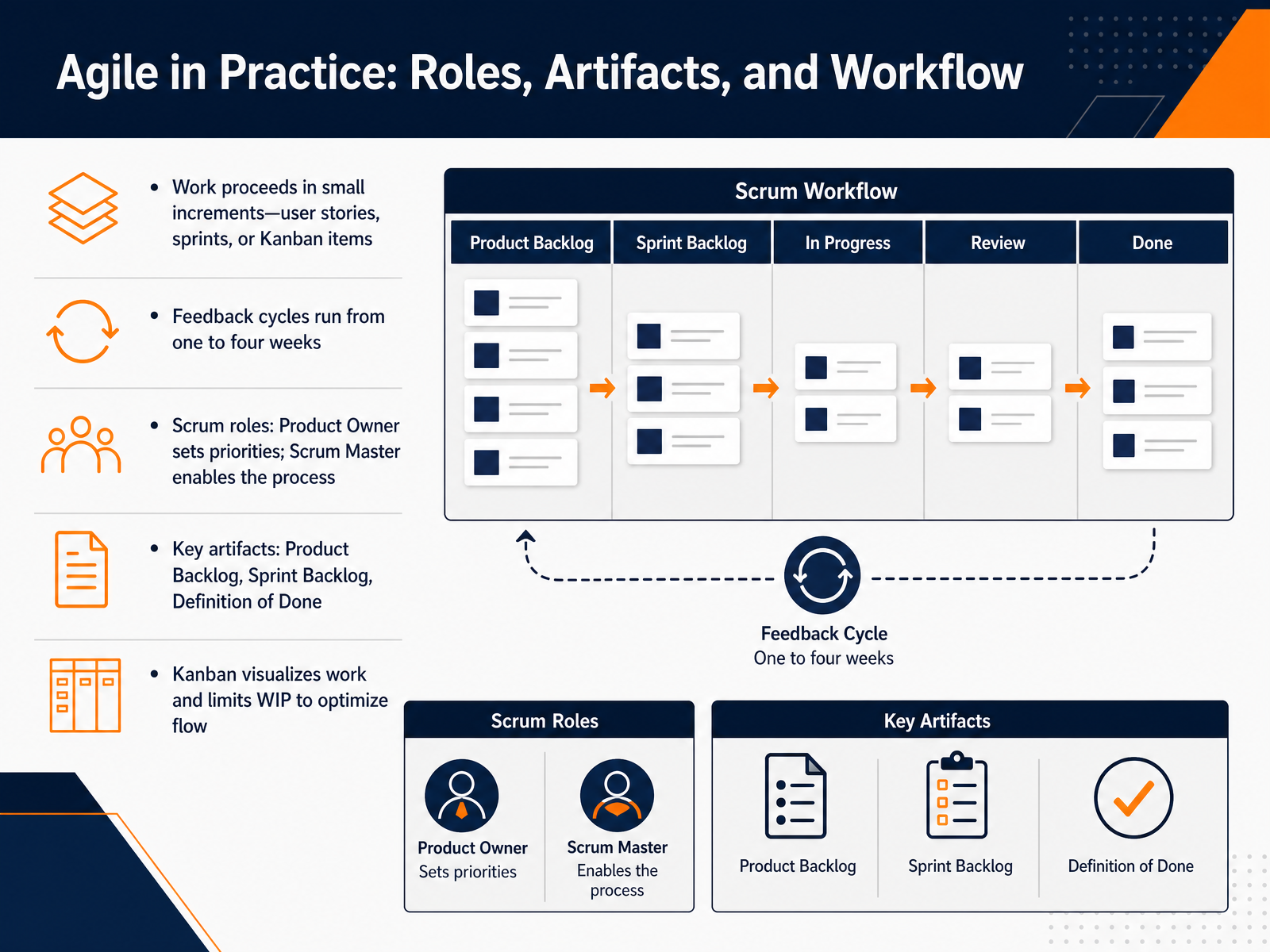
 - 03Agile in Practice: Roles, Artifacts, and WorkflowLet’s move from the philosophy to the mechanics of Agile. In practice, Agile is how teams turn the manifesto’s values into a daily rhythm. Work is broken into small increments, which might be user stories in Scrum or work items on a Kanban board. The key is that each increment is small enough to complete within a short feedback cycle, typically one to four weeks. That cadence forces you to integrate and validate early, rather than discovering problems at the end. In Scrum, the Product Owner decides priorities and the Scrum Master keeps the process running smoothly. You track everything through the Product Backlog, the Sprint Backlog, and a shared Definition of Done. If an item doesn’t meet that definition, it isn’t done, period. Kanban approaches the same goals differently. It visualizes work and limits work in progress to keep flow steady and predictable. Both frameworks get you the same place: fast feedback, continuous improvement, and a working product at the end of every cycle. Next, let’s look at how DevOps extends this mindset beyond development into operations and delivery.
 atlassian.comagilemanifesto.orgagilemanifesto.org+22 min
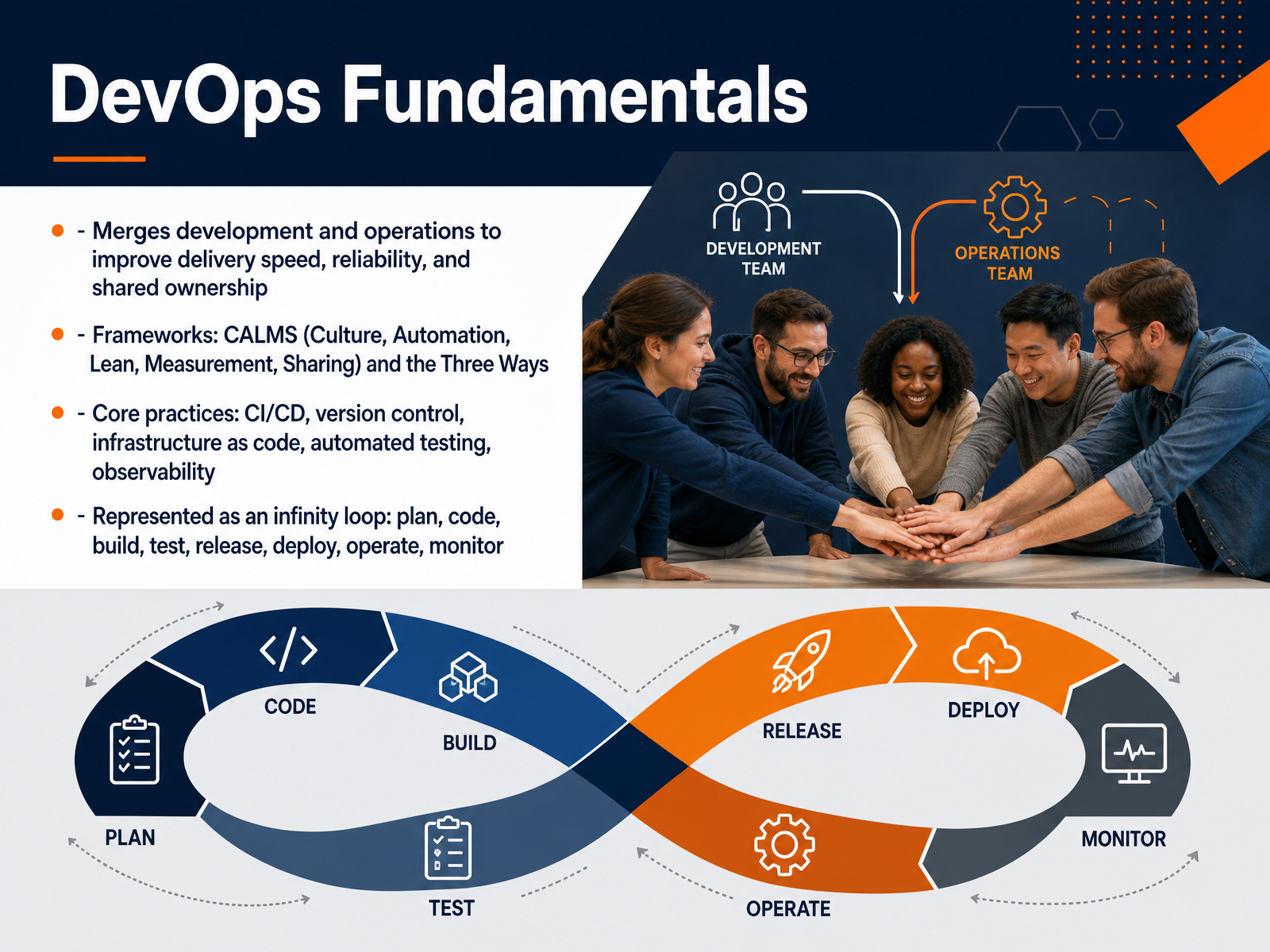
 - 04DevOps FundamentalsNow let's dig into the fundamentals of DevOps. At its core, DevOps merges development and operations to improve delivery speed, reliability, and shared ownership. It's not just about tools; it's a cultural shift. Two frameworks help us make sense of it: CALMS, which stands for Culture, Automation, Lean, Measurement, and Sharing, and the Three Ways, focusing on flow, feedback, and continual learning. The core practices should feel familiar: CI/CD, version control, infrastructure as code, automated testing, and observability. To visualize how these fit together, think of the infinity loop: plan, code, build, test, release, deploy, operate, monitor. It's continuous, not a one-way street. For example, when you see a spike in error rates during the monitor phase, that feeds back into planning the next fix. That closed loop is what makes DevOps powerful. Now, let's look at how this loop comes to life in practice with a closer look at the pipeline.
 atlassian.combmc.comaws.amazon.com+21 min
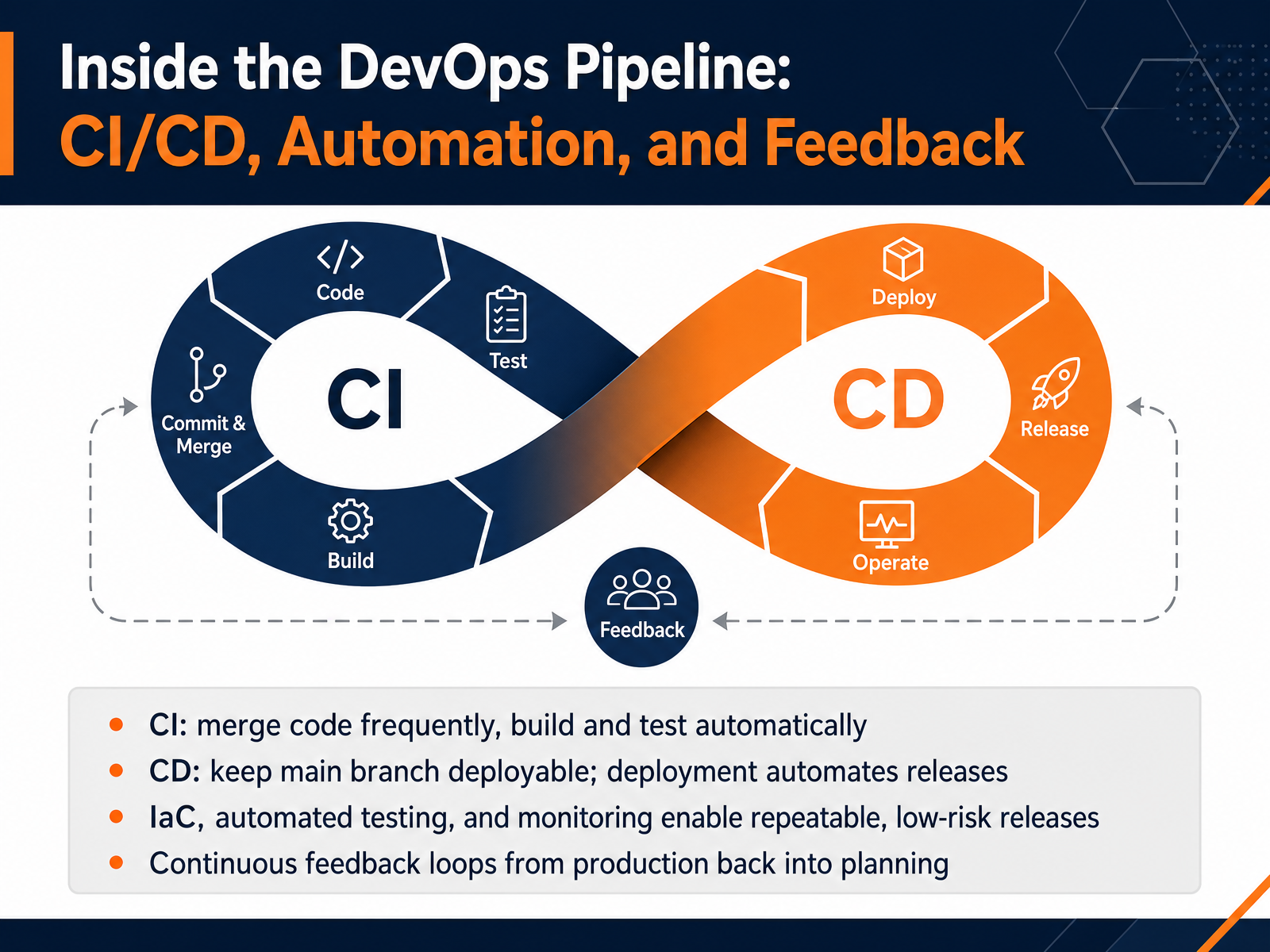
 - 05Inside the DevOps Pipeline: CI/CD, Automation, and FeedbackLet's break down what actually happens inside the DevOps pipeline. Start with continuous integration, or CI. The idea is simple: merge code into the main branch frequently, and let automated builds and tests validate every single commit. Say three developers are working on the same service. If they merge daily, conflicts surface early when they are cheap to fix, not on a painful merge day. That is the core value of CI: fast feedback on every change. Then comes continuous delivery, the CD side. Your main branch should always stay deployable. Every merge produces a tested artifact, ready to go. You might still have a manual approval gate before production, but the point is that releasing is a low-effort, routine step, not a project. To make that safe, you need infrastructure as code, automated testing, and monitoring. Infrastructure as code means your environments are reproducible, so staging looks like production. Automated tests catch regressions before users do. And monitoring gives you the third piece: continuous feedback. Production telemetry flows back into planning. Error rates spike, a latency regression appears, that becomes the next work item. That loop is what turns deployment from a risky event into a continuous, manageable process. Up next, we'll look at how Agile and DevOps overlap.
 ibm.comlearn.microsoft.comgithub.com+22 min
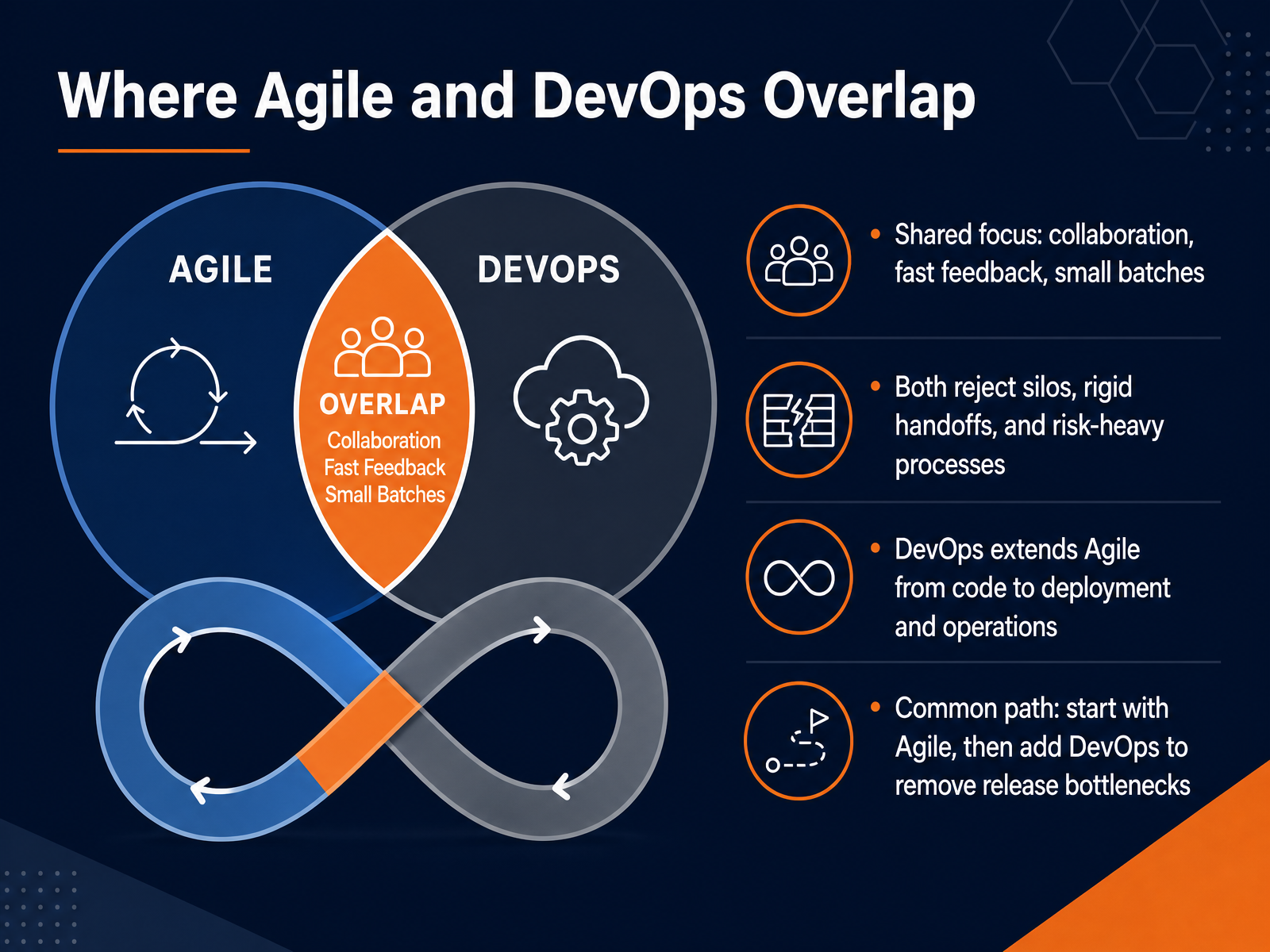
 - 06Where Agile and DevOps OverlapNow let's look at where Agile and DevOps actually overlap, because that's where most teams find the real value. Both approaches share a core focus on collaboration, fast feedback, and working in small batches. They both reject silos, rigid handoffs, and risk-heavy processes. The key distinction is scope. Agile focuses on the development cycle, from ideation to code completion. DevOps extends those same principles beyond code into deployment and operations. The most common path we see in practice is teams starting with Agile, getting their planning and iteration loop working, and then adding DevOps to remove the release bottleneck at the end. For example, a Scrum team might be great at delivering a shippable increment every two weeks, but if deployment is a manual process that takes days, that's a bottleneck. DevOps addresses exactly that gap. This is where the real synergy comes in. Next, we'll look at the key differences between these two approaches in more detail.
 atlassian.comaws.amazon.commdpi.com+21 min
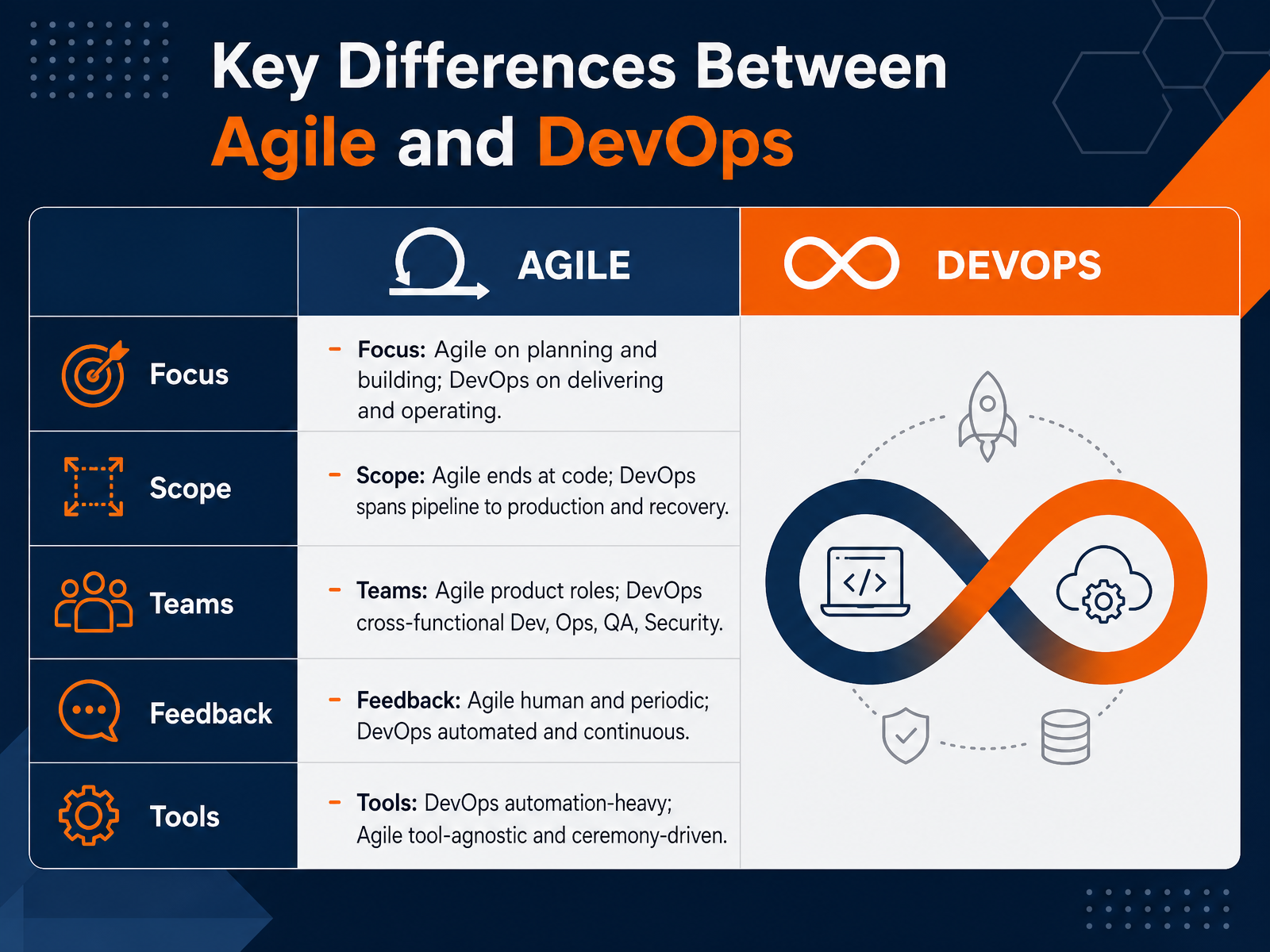
 - 07Key Differences Between Agile and DevOpsNow let's map out the key differences between Agile and DevOps. The first difference is focus. Agile centers on planning and building, making sure the team builds the right thing through iterative cycles and customer input. DevOps centers on delivering and operating, ensuring that whatever is built gets to production reliably and stays healthy once it's there. Second, scope. Agile scope ends at code handoff. DevOps scope starts there and extends through the pipeline, deployment, monitoring, and recovery. Third, teams. Agile teams are product-focused with roles like product owner, scrum master, and developers. DevOps teams are cross-functional, blending dev, ops, QA, and security into one shared ownership model. Fourth, feedback. Agile feedback is human and periodic, gathered at sprint demos and retrospectives. DevOps feedback is automated and continuous, driven by monitoring dashboards and production metrics like error rates and latency. Finally, tools. Agile is ceremony-driven and doesn't mandate specific tooling. DevOps is automation-heavy, built around CI/CD pipelines, infrastructure as code, and observability platforms. The real takeaway: Agile optimizes how you build the right product, while DevOps optimizes how you deliver and run it reliably. With that contrast clear, let's look at the tradeoffs and common misconceptions between these two approaches.
 tms-outsource.comatlassian.comsalesforce.com+22 min
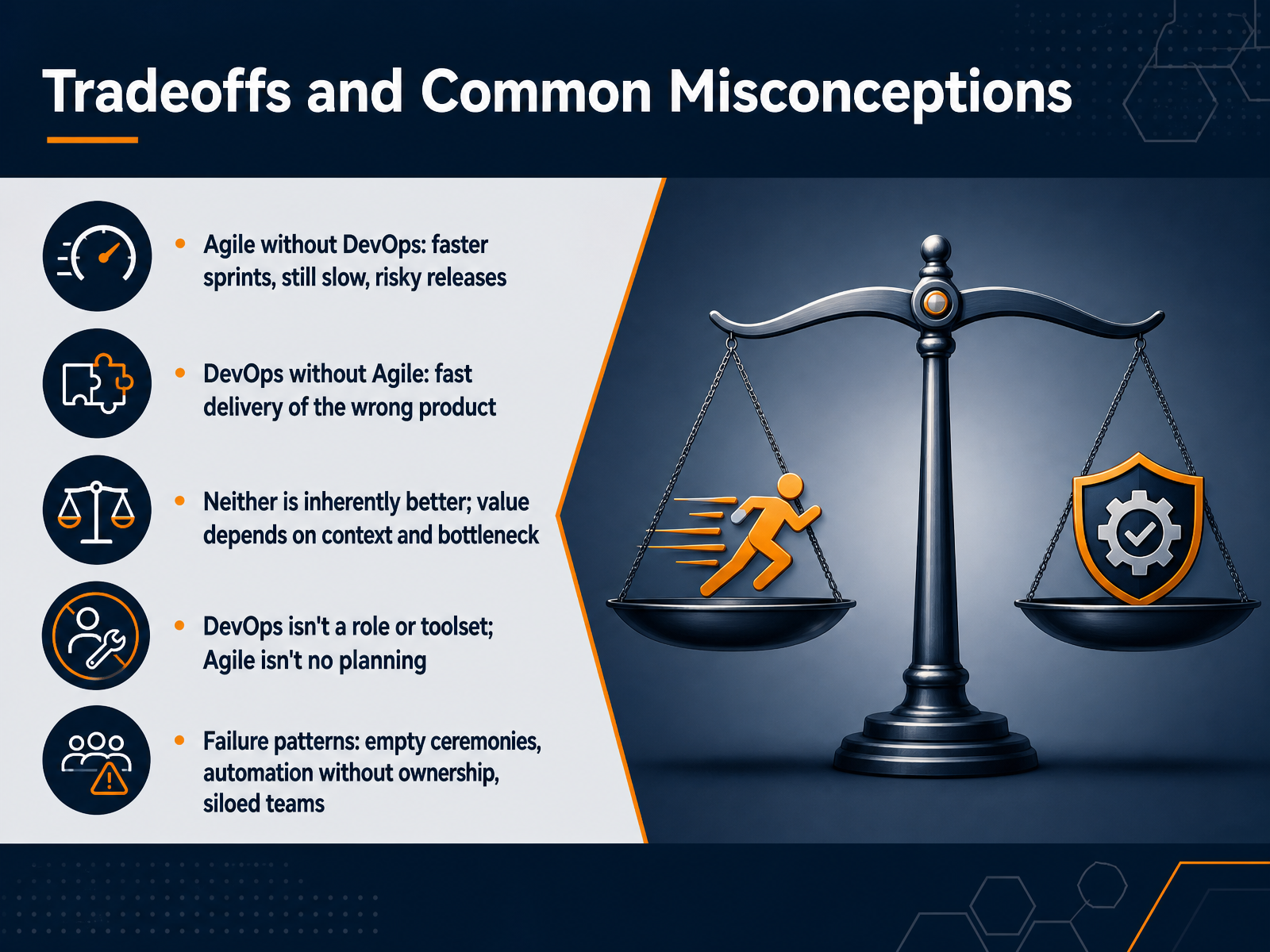
 - 08Tradeoffs and Common MisconceptionsLet's talk about tradeoffs and common misconceptions. Agile without DevOps gives you faster sprints but still slow, risky releases. You finish increments on time and then wait a quarter for a release window. That sprint cadence becomes internal theatre. DevOps without Agile means you deliver fast, but you might be automating the delivery of the wrong product. Efficiency at shipping the wrong thing is just faster waste. Neither approach is inherently better. Value depends entirely on your context and where your bottleneck actually sits. And let's clear up two things. DevOps is not a role or a toolset, it's a cultural shift toward shared ownership. Agile is not the absence of planning, it's adaptive planning. Watch for the common failure patterns. Empty ceremonies with no real feedback, automation without ownership, and teams that remain siloed despite the labels. If your stand-ups happen but decisions stay fixed, you have a project plan wearing Agile vocabulary. If you have pipelines but no shared responsibility, the wall just has a pipeline attached to it. The fix is always the same. Find the bottleneck, and measure outcomes, not activity. Up next, we'll look at use cases and when to prioritize one approach over the other.
 atlassian.com2 min
 - 09Use Cases: When to Prioritize AgileSo when should you make Agile the priority? The clearest signal is uncertainty. If requirements are shifting or the market is still validating what the product should even be, Agile gives you the structure to adapt without over-committing to a fixed plan. This is why Agile shines for new products, MVPs, and customer-facing applications where feedback loops directly shape the roadmap. The second signal is where your bottleneck actually sits. If planning, prioritization, or aligning engineering with product is what takes the most time and causes the most friction, then better Agile discipline is the higher-leverage move. Infrastructure automation won't help you ship the wrong product faster. Agile fits best on small to medium efforts where stakeholders can stay involved in a meaningful way. If you have the right feedback cadence and a team that can act on it, the iterative cycles keep risk low and value delivery high. But if you keep the same Agile process and the bottleneck moves to production—slow releases, long deployment cycles—that's your cue that the problem has shifted. That's when you start prioritizing DevOps.
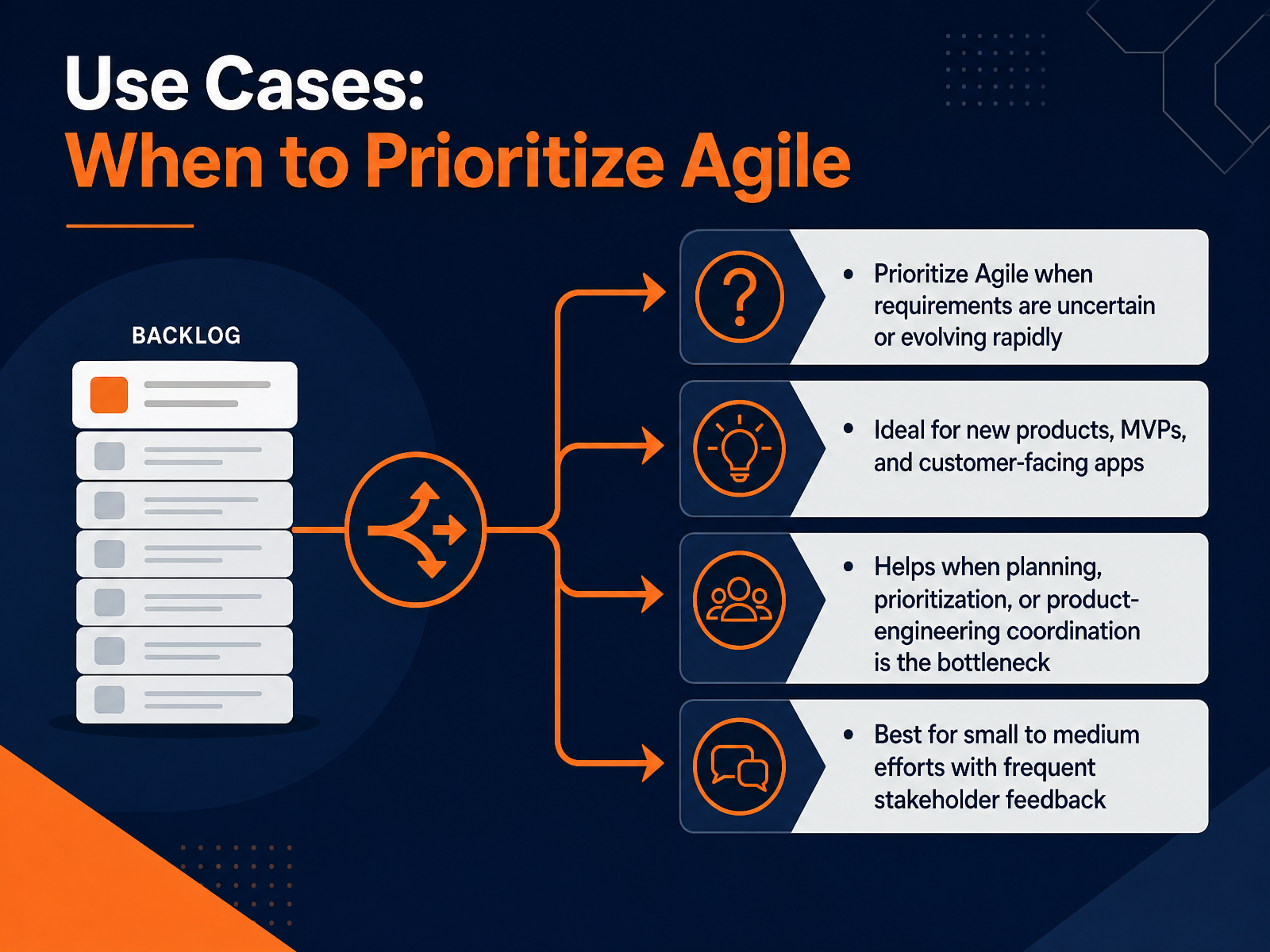 atlassian.comtms-outsource.comaws.amazon.com+11 min
 - 10Use Cases: When to Prioritize DevOpsLet’s talk about when DevOps should take priority. The clearest signal is pain in the release process. If your deployments are slow, manual, or unstable, that’s your bottleneck, and DevOps is the direct answer. This is especially true in cloud-native and microservices environments, where the sheer number of moving parts makes manual coordination impossible. And this is key: DevOps is not primarily about velocity. It’s about addressing the release flow, recovery speed, observability, and the handoffs between development and operations. You want to start with basic planning discipline, and then add automation incrementally, only as release pain grows. Don’t over-engineer the pipeline on day one; let the friction guide your next investment. So, if your team knows what to build but struggles to ship it safely, prioritize DevOps. If your pain is on the delivery side, this is where you focus your energy. Next, let’s look at some practical implementation strategies to make this happen.
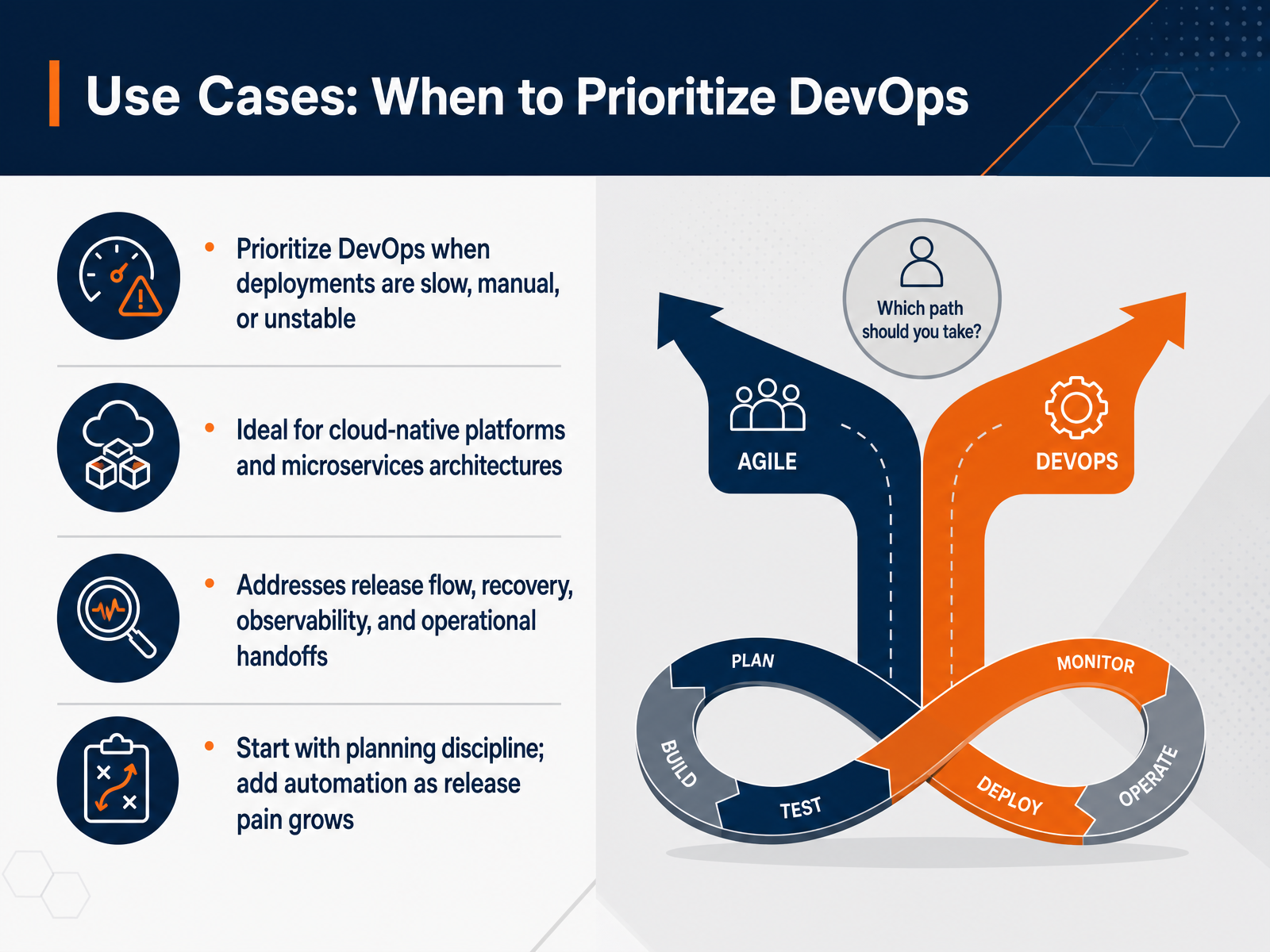 atlassian.comtms-outsource.comaws.amazon.com+11 min
 - 11Practical Implementation StrategiesNow, let’s turn to practical implementation strategies. This is where the tradeoffs between Agile and DevOps become real decisions. The first step is to find the actual bottleneck. Don’t guess. Trace one small change from request to production and record where it waits. If the delay is in planning or prioritization, that’s an Agile problem. If it’s in deployment, testing, or release, that’s DevOps territory. Invest where the queue is. Second, establish shared vocabulary and aligned goals before you buy any tooling. If your developers and operators define “done” differently, no pipeline will fix that. Third, use a phased roadmap. Stabilize first, automate second, shift quality left third, and scale last. Don’t automate a broken process. Add CI/CD, infrastructure as code, and monitoring only when delivery pain actually demands them. And finally, avoid a tool-first transformation. Buying Jenkins, Kubernetes, and Terraform won’t create shared ownership. And don’t silo DevOps into a separate team either; that just relocates the wall. A practical sequence is: one pipeline, one service catalog, one platform. That combination reduces friction and gives you measurable progress. Next, let’s look at how to measure success with the right metrics.
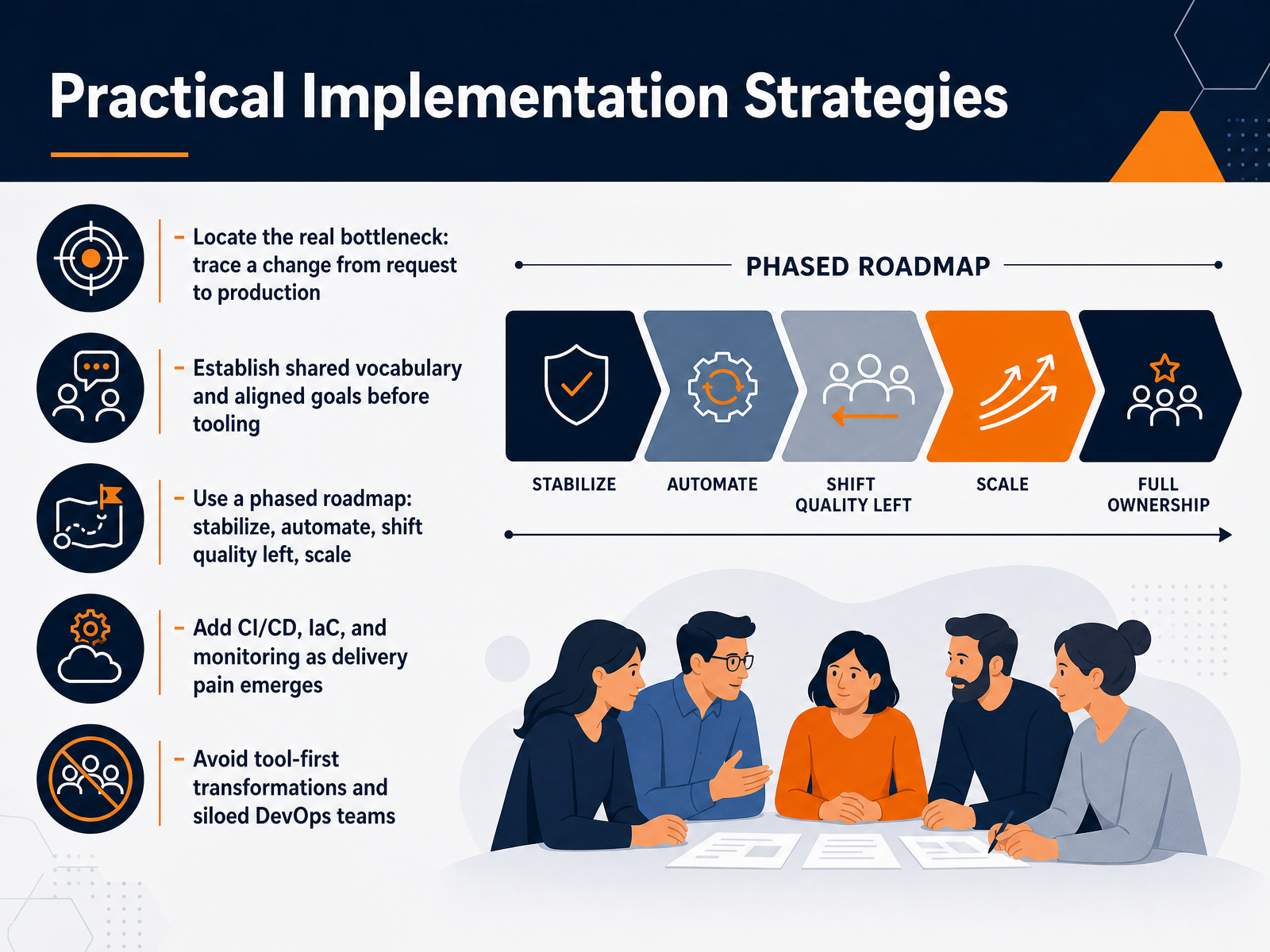 atlassian.com2 min
 - 12Measuring Success with the Right MetricsNow let's talk about how you actually measure success. The research-backed standard here is DORA metrics: deployment frequency, lead time for changes, change failure rate, and time to restore service. These four work because they balance throughput against stability. You can ship faster by skipping tests, but the change failure rate will expose that within a month. Start simple if you're early in the journey. Track cycle time, deployment frequency, and escaped defects. That gives you a solid baseline without drowning the team in dashboards. And one important caution: track these per service or per team, not just as organization-wide averages. An average hides the spread, and the spread is where the real work lives. Two teams can both score the same on paper yet need completely different interventions. Retire vanity metrics like lines of code or story points. They quietly incentivize the wrong behavior and tell you nothing about delivery performance. Instead, keep the metrics honest, resistant to gaming, and grounded in your actual pipeline. That data is what your improvement plan will move. Once you have that measurement foundation in place, the next question is what it means for your teams and your culture. Let's look at that now.
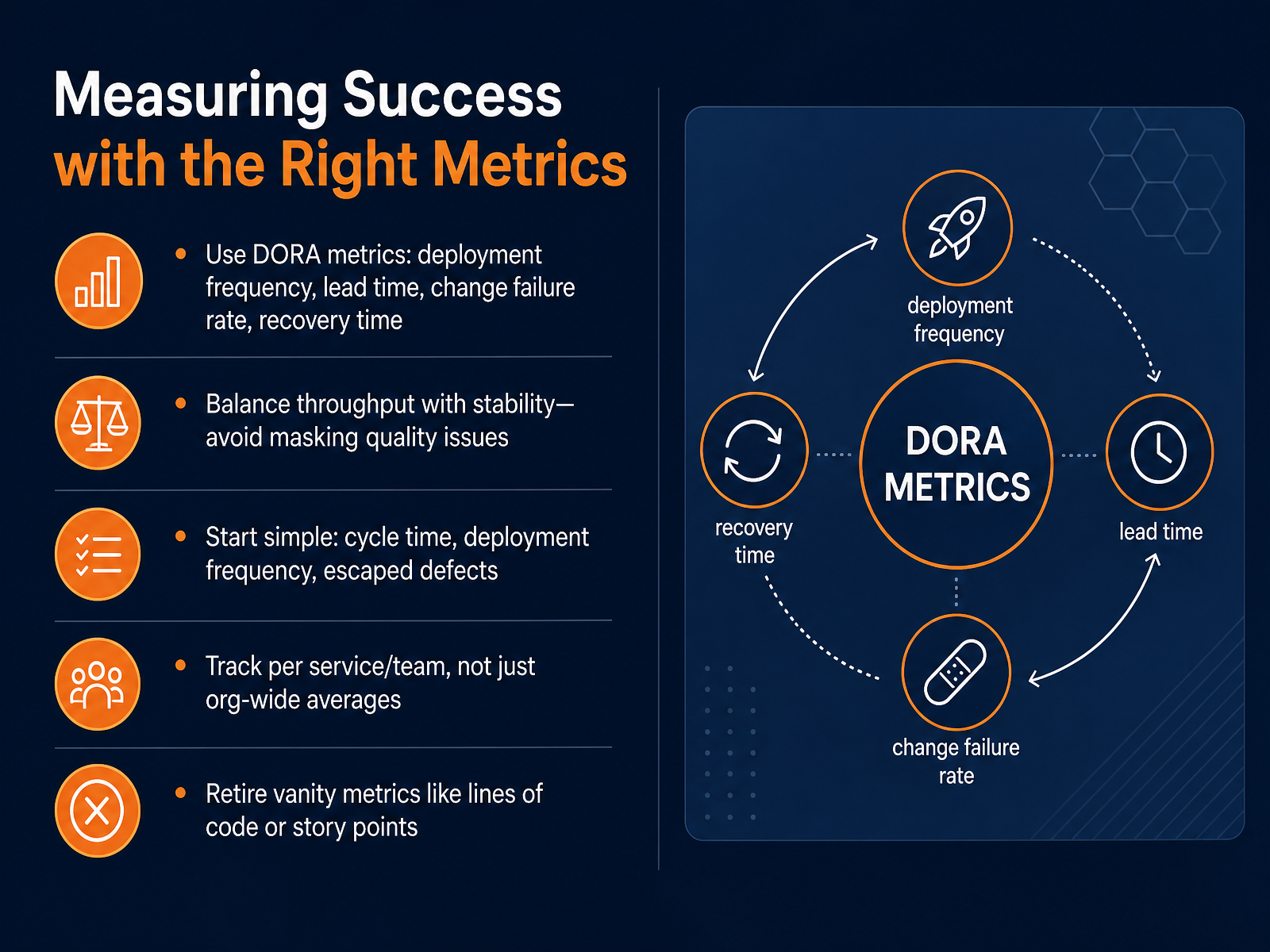 2 min
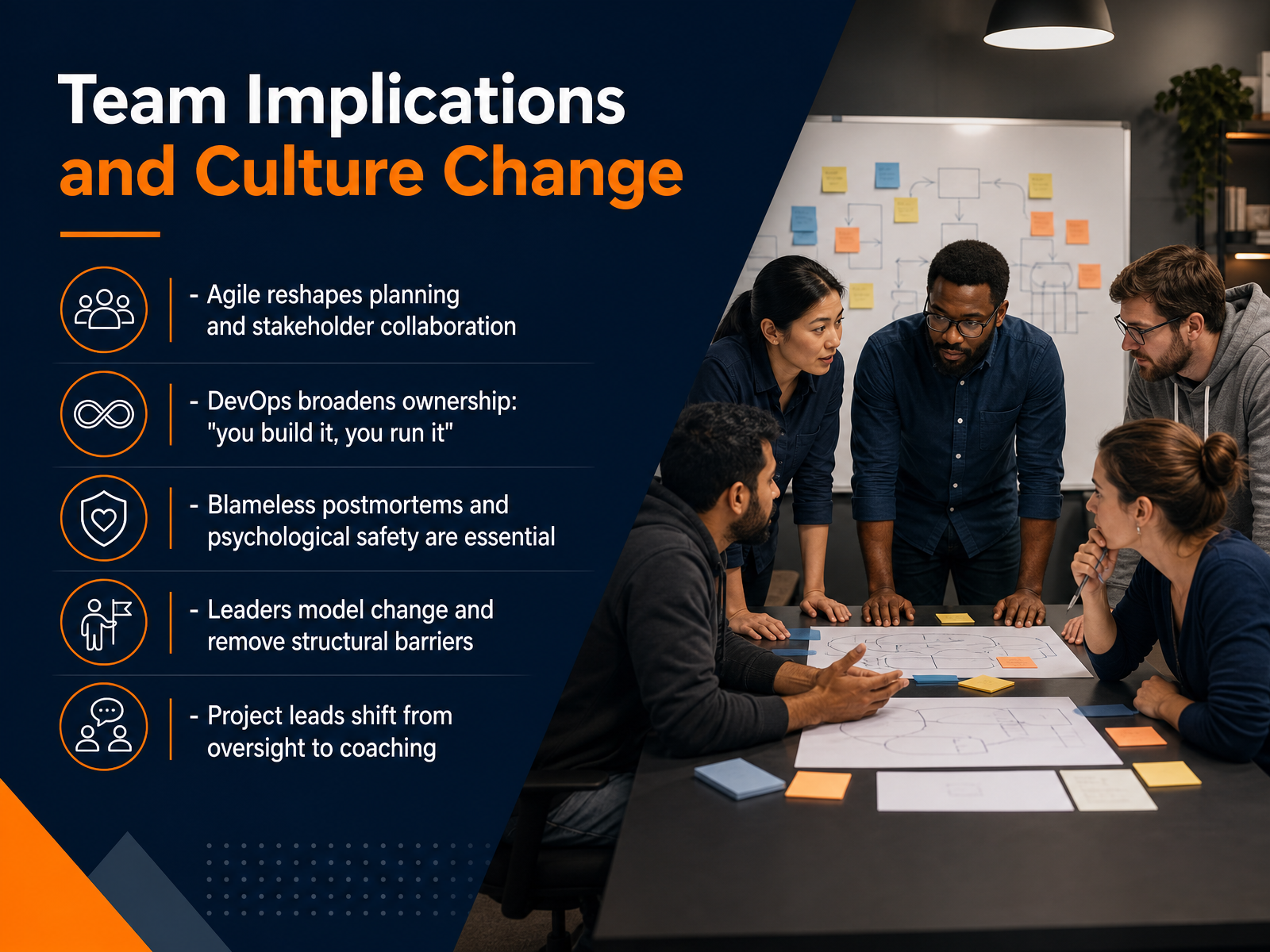
2 min - 13Team Implications and Culture ChangeNow let's talk about what this actually means for your team and your culture, because this is where most transformations get stuck. Agile reshapes how you plan and collaborate with stakeholders, but DevOps goes further. It broadens ownership. The principle is simple: you build it, you run it. That means developers take responsibility for their code in production, not just in the repo. That's a significant shift. The second piece is blameless postmortems. When something fails, you focus on the system, not the person. Without psychological safety, people will hide problems instead of surfacing them, and that kills continuous improvement. Leaders have a critical role here. They need to model the change themselves, not just announce it. And they need to remove structural barriers, like approval bottlenecks or conflicting incentives between dev and ops. Finally, project leads have to change their focus. Instead of overseeing tasks, they shift to coaching. Their job becomes helping teams self-organize and solve their own problems. This is hard, especially in legacy environments, but it's the only way the culture sticks. Let's summarize what we've covered so far and give you some clear guidance on what to do next.
 atlassian.com2 min
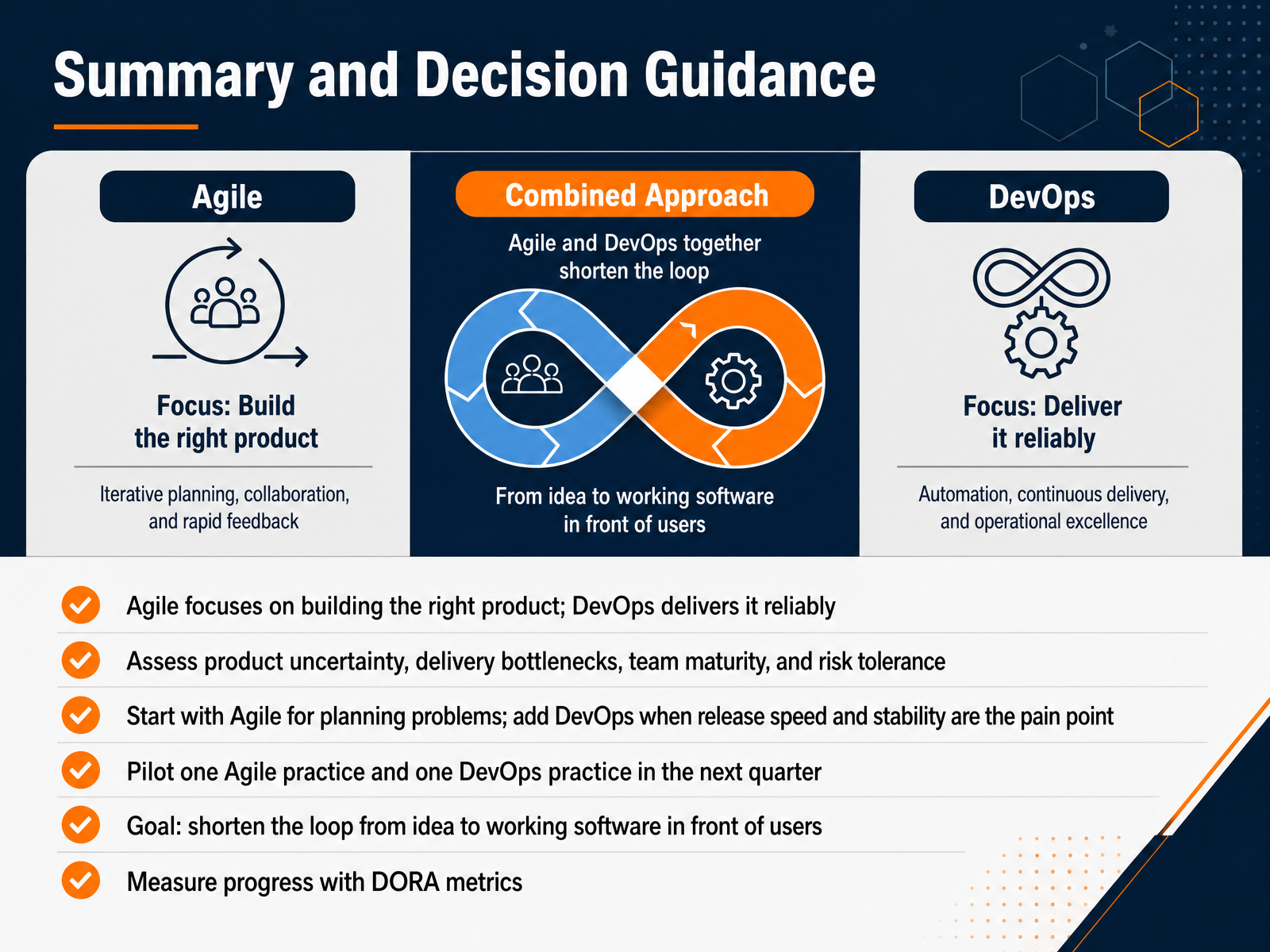
 - 14Summary and Decision GuidanceLet's bring everything together. Agile helps you build the right product. DevOps makes sure you deliver it reliably. The decision isn't about choosing one. It's about finding your bottleneck. If requirements are unclear and priorities keep shifting, start with Agile. If releases are slow, stressful, or fragile, invest in DevOps. For the next quarter, pick one practice from each and pilot them. Maybe backlog refinement plus a simple CI pipeline. The goal is to shorten the loop from idea to working software in front of users. Then measure your progress with DORA metrics. Deployment frequency, lead time, change failure rate, and recovery time. Those numbers will tell you whether you're actually improving. Thanks for your attention. You have a clear path forward now. Start small, measure honestly, and keep the feedback loop tight.
 atlassian.comtms-outsource.comaws.amazon.com+21 min
Take the deck with you
Download this course as a file — free, no sign-up needed.
- PDF handoutEvery slide page, ready to print or share.15 pages · 3.4 MBDownload
- Narrated PowerPointThe deck that presents itself — every slide carries the digital human's narration video.15 pages · 16.9 MBDownload
- PowerPoint slidesThe full deck as a .pptx — open it in PowerPoint, Keynote, or Google Slides.15 pages · 3.3 MBDownload
Free to use in your own training — please keep the PersonWise credit page at the end.
Have your own deck? Turn it into a course
Sources consulted
Web sources consulted while building this course.
- DevOps vs. Agile - Atlassian — atlassian.com
- Agile vs DevOps: A Full Comparison – BMC Software | Blogs — bmc.com
- Agile vs DevOps - Difference Between Software Development Practices — aws.amazon.com
- DevOps vs Agile: Understanding the Differences - Salesforce — salesforce.com
- DevOps vs. Agile | Copado — copado.com
- Agile Manifesto for Software Development | Atlassian — atlassian.com
- Manifesto for Agile Software Development — agilemanifesto.org
- Principles behind the Agile Manifesto — agilemanifesto.org
- 12 Principles Behind the Agile Manifesto — agilealliance.org
- Agile software development — en.wikipedia.org
- What are the phases of the DevOps lifecycle? - IBM — ibm.com
- What is DevOps? - Azure DevOps | Microsoft Learn — learn.microsoft.com
- What is a DevOps pipeline? A complete guide · GitHub — github.com
- What Is DevOps? | IBM — ibm.com
- The DevOps lifecycle explained: from planning to monitoring - Obsium — obsium.io
- How do Agile and DevOps interrelate? Article | Agile — atlassian.com
- Exploring the Benefits of Combining DevOps and Agile — mdpi.com
- Agile vs DevOps: Complementary or competing methodologies? — graphite.com
- Best Practices Evidenced for Software Development Based on DevOps and Scrum: A Literature Review — mdpi.com
- Agile vs DevOps: How They Work Together — tms-outsource.com