Begin
14 pages · ~28 min
Project Management Methodologies Comparison
Explore key project management methodologies and learn to select the right approach for diverse use cases. Ideal for professionals seeking practical frameworks to improve project efficiency and outcomes.
A digital instructor presents all 14 pages. Hold “Ask” at any point and ask out loud — the answer comes from this course. No sign-up needed.
What you’ll learn
- 01Project Management Methodologies: Comparing Approaches and Use CasesWelcome. If you're here, you've probably been in one of those conversations where the methodology debate eats up more time than the actual planning. Someone insists on pure Agile, someone else defends traditional stage-gate, and the real question gets lost: what does this specific project actually need? That's the question we're going to answer together. Today we're mapping out the real-world trade-offs between predictive, hybrid, and adaptive approaches. We'll skip the abstract theory and focus on what shifts when your timeline tightens, your client involvement changes, or your team size doubles. By the end, you'll have a practical lens for deciding which methodology fits your context, and why. We'll look at deep dives, a comparison model, real use cases, and a decision playbook you can apply immediately. Let's start by looking at why this choice matters more than it did even two years ago.planview.commdpi.comemerald.com+21 min
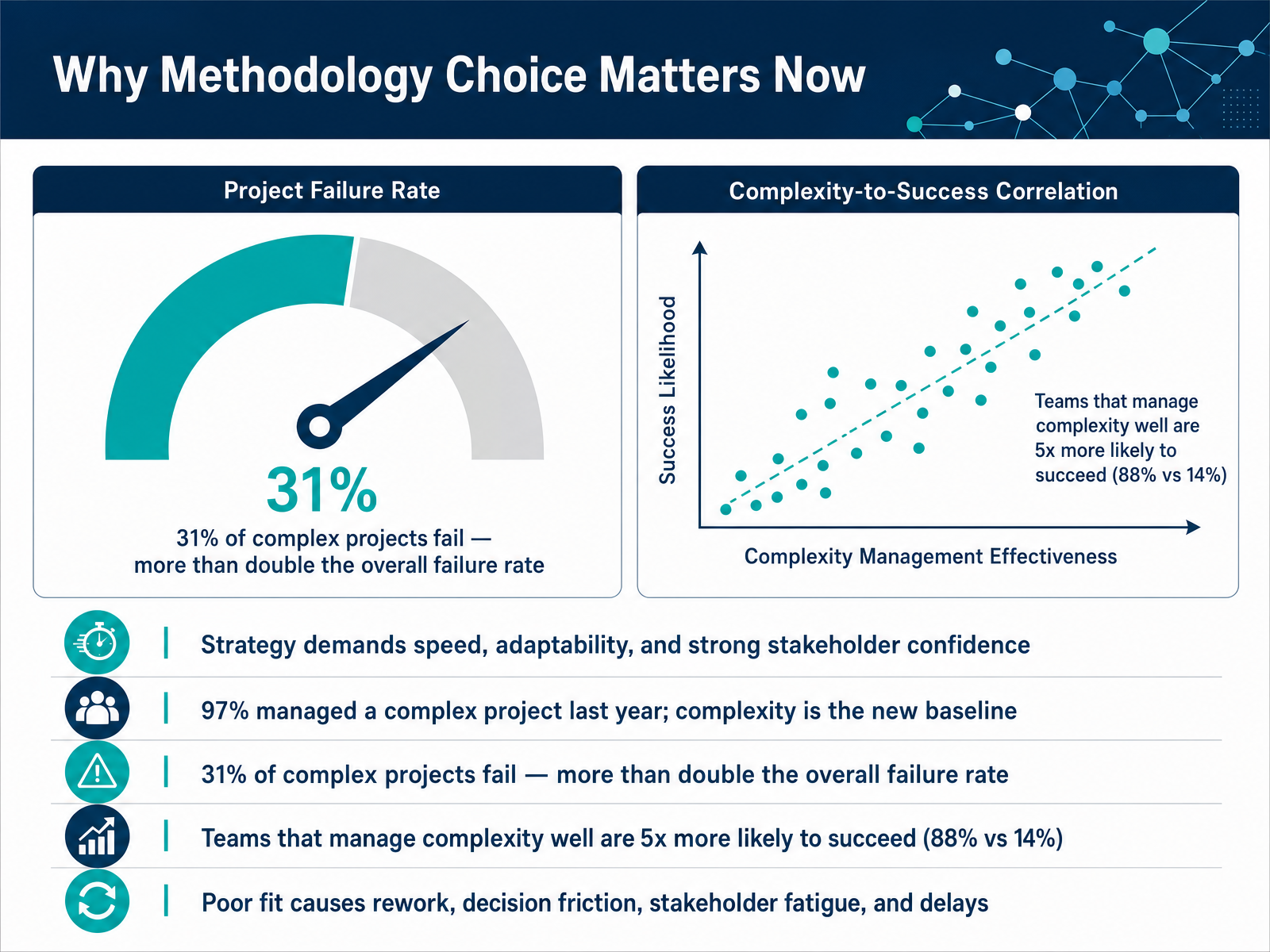
- 02Why Methodology Choice Matters NowSo strategy now demands speed, adaptability, and real stakeholder confidence. Those aren't just nice-to-haves anymore; they are the baseline. Look at the numbers from the latest PMI research. Ninety-seven percent of professionals managed at least one complex project last year. Complexity is no longer an occasional headache; it is the operating reality for most of us. And here is the hard truth: nearly one third of complex projects fail to achieve their intended benefits. That is more than double the failure rate for projects overall. But the data also reveals a clear advantage. Teams that navigate complexity effectively are five times more likely to succeed, delivering an eighty-eight percent success rate versus just fourteen percent for teams that struggle. When the methodology doesn't fit the work, you don't just get inefficiency. You get rework, decision friction, stakeholder fatigue, and delays that quietly erode value. So the decision you make about your approach isn't academic. It directly shapes whether you amplify complexity or cut through it. Let's look at what the adoption landscape actually tells us now in the next slide: The Methodology Landscape, Adoption Trends and Patterns.
 pmi.orgpmi.orgbusinesswire.com+22 min
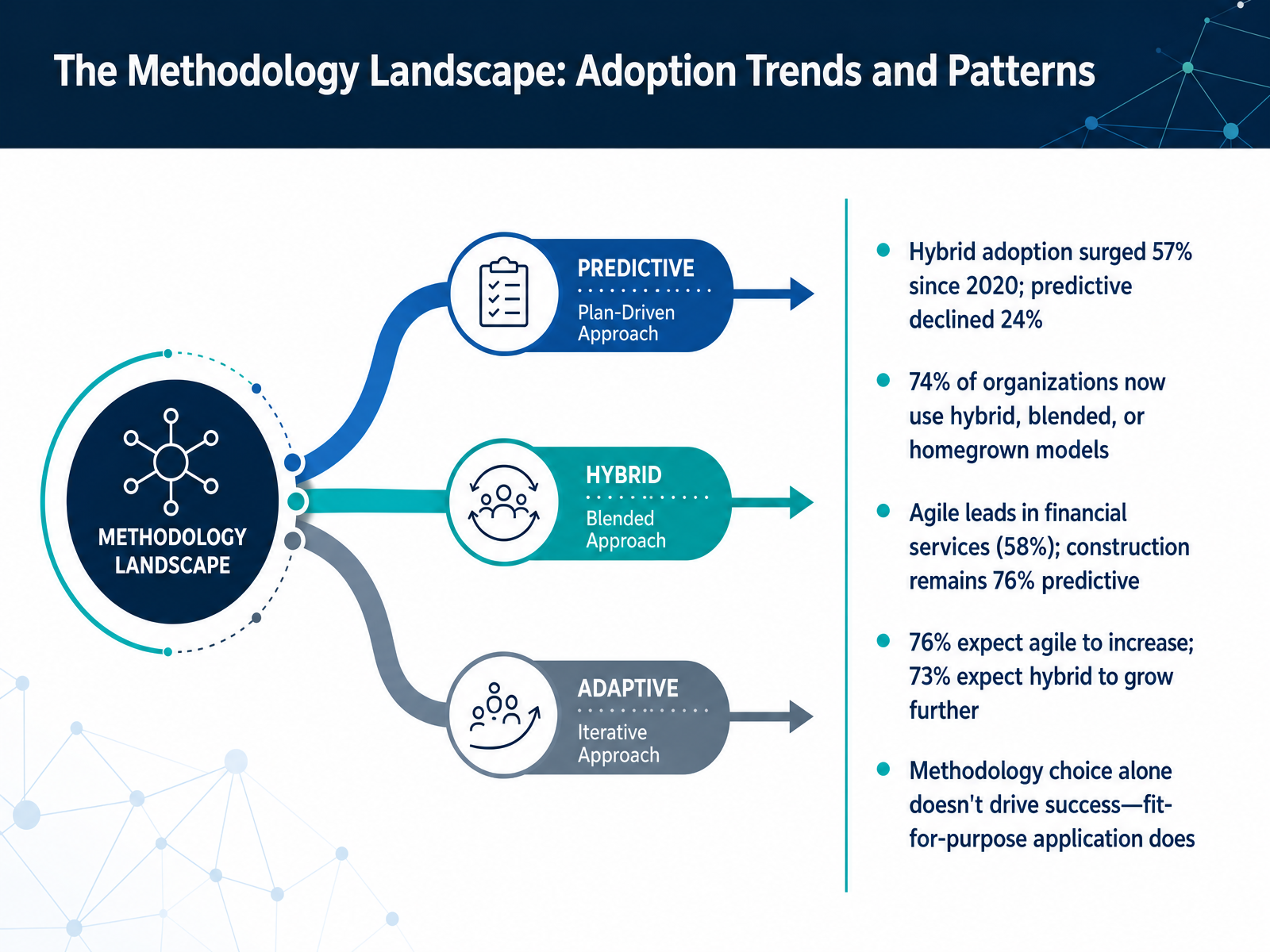
 - 03The Methodology Landscape: Adoption Trends and PatternsSo the numbers tell a clear story about how we're actually delivering work. Since twenty twenty, hybrid adoption has surged fifty-seven percent—that's a real shift—while predictive approaches have dropped twenty-four percent. Right now, seventy-four percent of organizations use some form of hybrid, blended, or homegrown model. We're firmly in the era of fit-for-purpose delivery. The interesting pattern is how this plays out by industry. Agile leads in financial services at fifty-eight percent, but construction remains seventy-six percent predictive. That's not because one sector is somehow behind. It's because the risk profile, the contract structures, and the cost of midstream change are completely different. Looking ahead, seventy-six percent of professionals expect agile to increase, and seventy-three percent expect hybrid to grow further. But here's what matters most. The research shows methodology choice alone doesn't drive success. Teams using predictive, agile, and hybrid approaches all achieve comparable performance rates. What separates high performers is how well they apply their chosen approach, not which approach they pick. Next, we'll look at predictive approaches—specifically waterfall and stage-gate models—and examine where they still make the most sense.
 pmi.orgmy.idc.compmsolutions.com+22 min
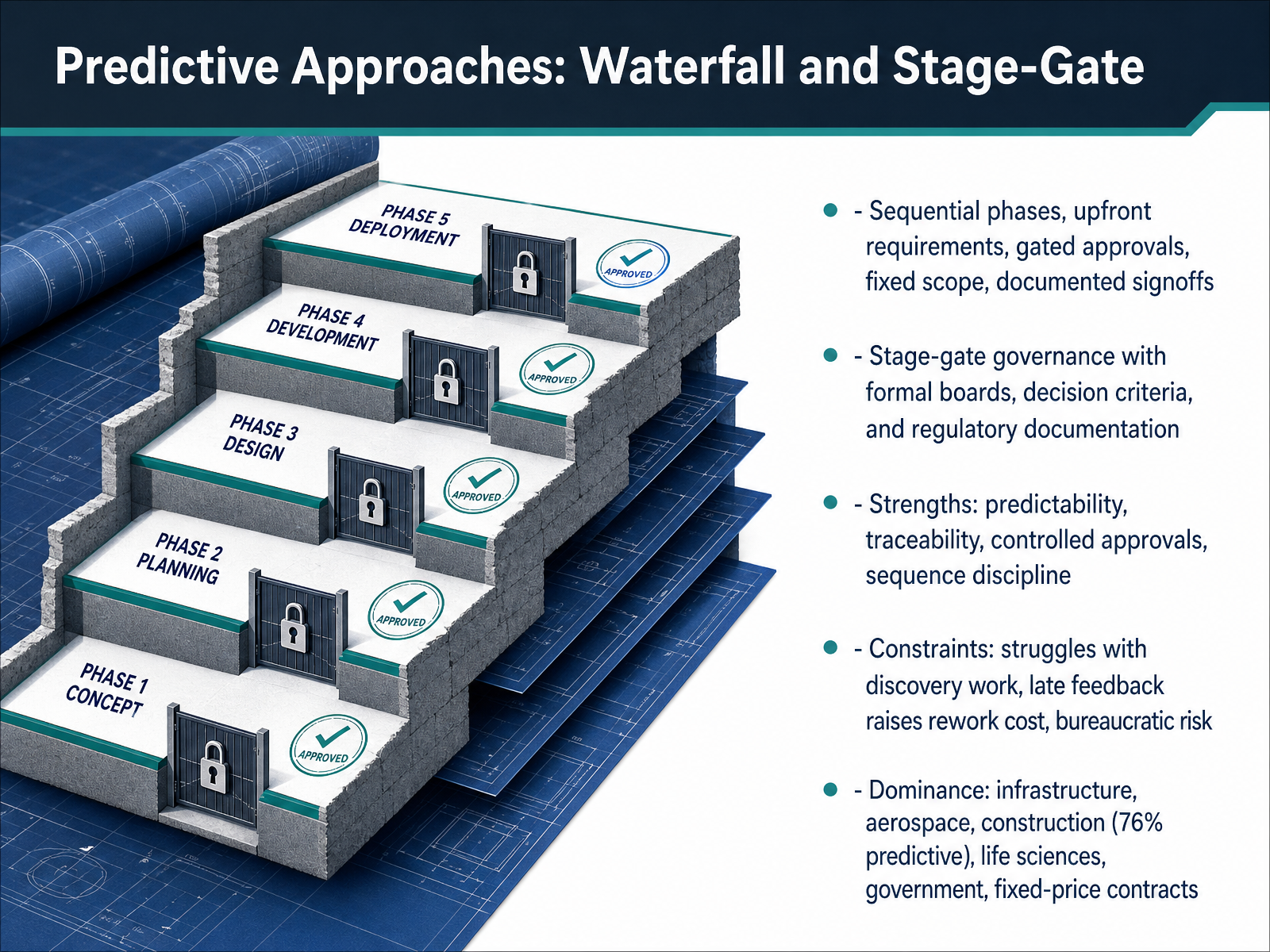
 - 04Predictive Approaches: Waterfall and Stage-GateLet's turn to the other end of the spectrum: predictive approaches, specifically Waterfall and stage-gate models. If your requirements are stable, your compliance burden is heavy, or contract terms are fixed, these methods aren't outdated. They're protective. They give you predictability, crystal-clear accountability, and an audit trail that regulators and procurement teams can trust. Think about infrastructure, aerospace, or life sciences. In construction, seventy-six percent of organizations still rely heavily on predictive approaches. When the cost of uncontrolled change is high, you need signed-off baselines before anyone pours concrete or cuts code. But no method is free of trade-offs. Predictive frameworks struggle with discovery work. If you learn a better approach late in the game, rework gets expensive fast. And too many formal gates can slide into bureaucracy, slowing decisions that don't need heavy governance. The key is recognizing when sequence discipline matters more than iteration. Next, we'll see where the balance tips and examine adaptive approaches: Agile and Lean in practice.
 pmi.orgmy.idc.compmsolutions.com+22 min
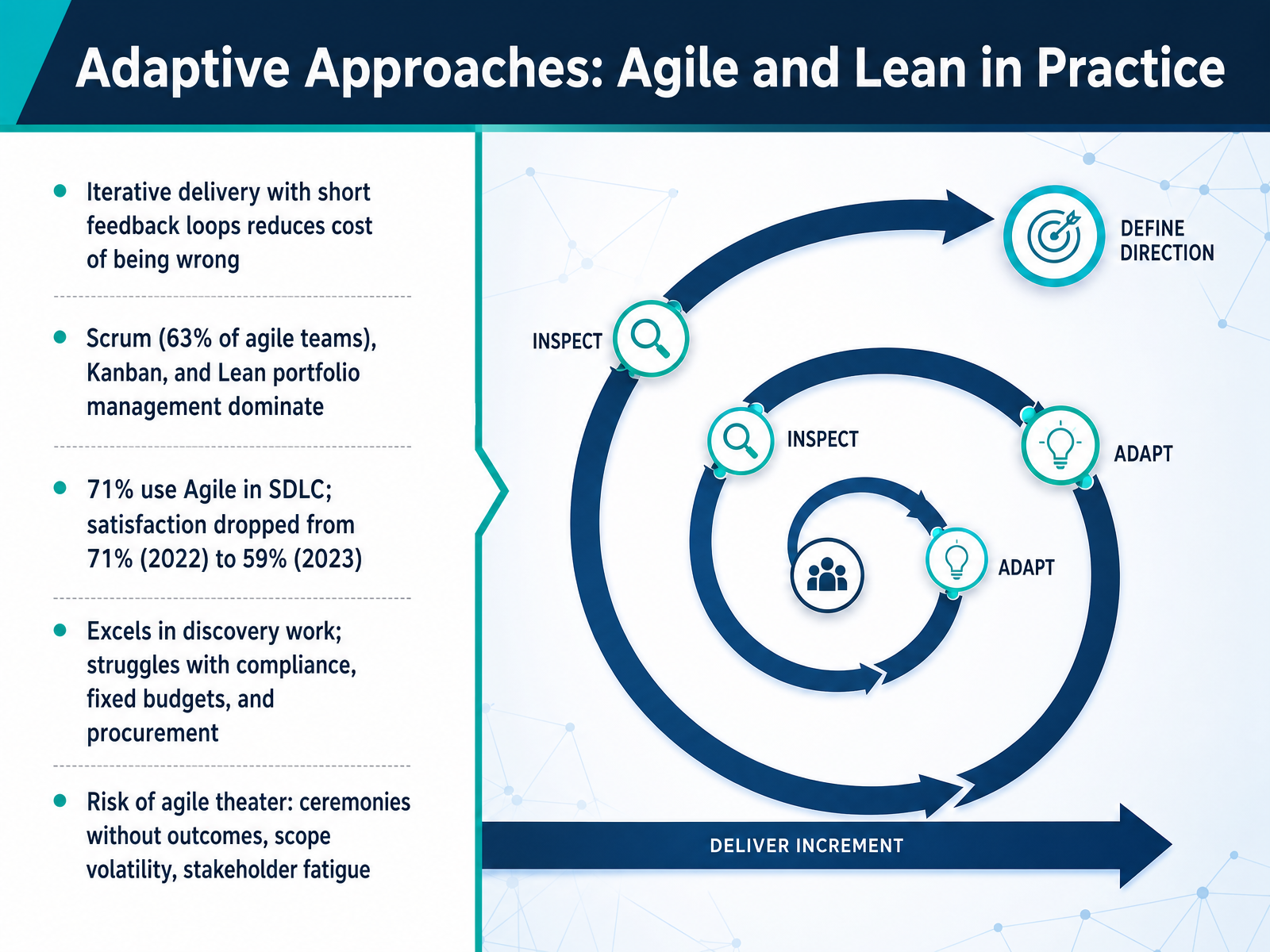
 - 05Adaptive Approaches: Agile and Lean in PracticeNow let's get practical with adaptive approaches. Agile and Lean aren't just frameworks; they're fundamentally about reducing the cost of being wrong through short feedback loops. You deliver a little, learn from real use, and adjust before making bigger investments. That's the core engine.
In practice, Scrum dominates. Sixty-three percent of Agile teams use it at the team level. Then you have Kanban for flow, and Lean for portfolio-level waste reduction. But here's a number worth pausing on: while seventy-one percent of organizations use Agile in their software development lifecycle, satisfaction dropped from seventy-one percent in twenty twenty-two to just fifty-nine percent in twenty twenty-three. That decline isn't about Agile failing; it's about where it's being misapplied.
Adaptive methods excel in discovery work—where you're figuring out what to build. They struggle when you hit fixed budgets, rigid procurement rules, or heavy compliance requirements. And the real risk isn't the methodology; it's what some call Agile theater: teams running the ceremonies without the outcomes, scope churning endlessly, and stakeholders burning out from constant reprioritization. The question isn't whether to use Agile, but where its short loops actually reduce your risk.
That trade-off leads us directly to why so many teams now blend approaches. Let's look at hybrid models as the new operating reality.
 pmi.orgmy.idc.compmsolutions.com+22 min
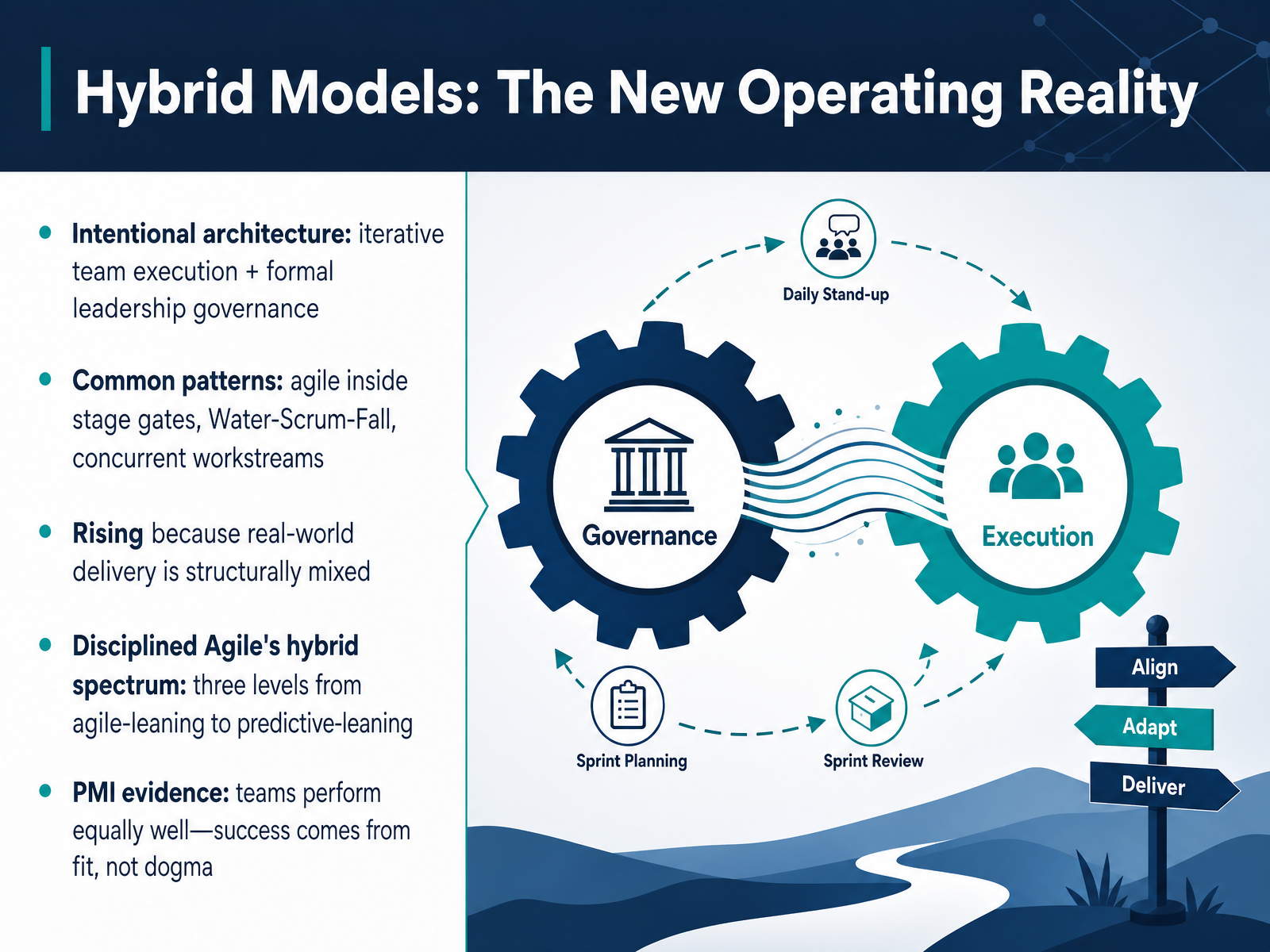
 - 06Hybrid Models: The New Operating RealityLet's unpack what's really driving the shift to hybrid models. It's not a compromise between agile and waterfall. In 2023, PMI reported that hybrid approaches grew to thirty-one point five percent of projects, a fifty-seven percent increase from 2020. The reason is simple: most real-world delivery is structurally mixed. You have teams that need iterative sprints to solve complex problems, while leadership still needs formal budget gates and milestone commitments. This is an intentional architecture. Common patterns include agile delivery inside predictive stage gates, sequential phases like Water-Scrum-Fall, or concurrent workstreams using different methods. Disciplined Agile helps frame this clearly, offering a spectrum from agile-leaning to predictive-leaning approaches. And here's the finding that matters most: PMI data shows that predictive, agile, and hybrid teams all perform equally well when the method fits the context. Success comes from fit, not dogma. Next, let's ground this in reality by looking at hybrid in action through real-world case studies.
 planview.commdpi.comemerald.com+22 min
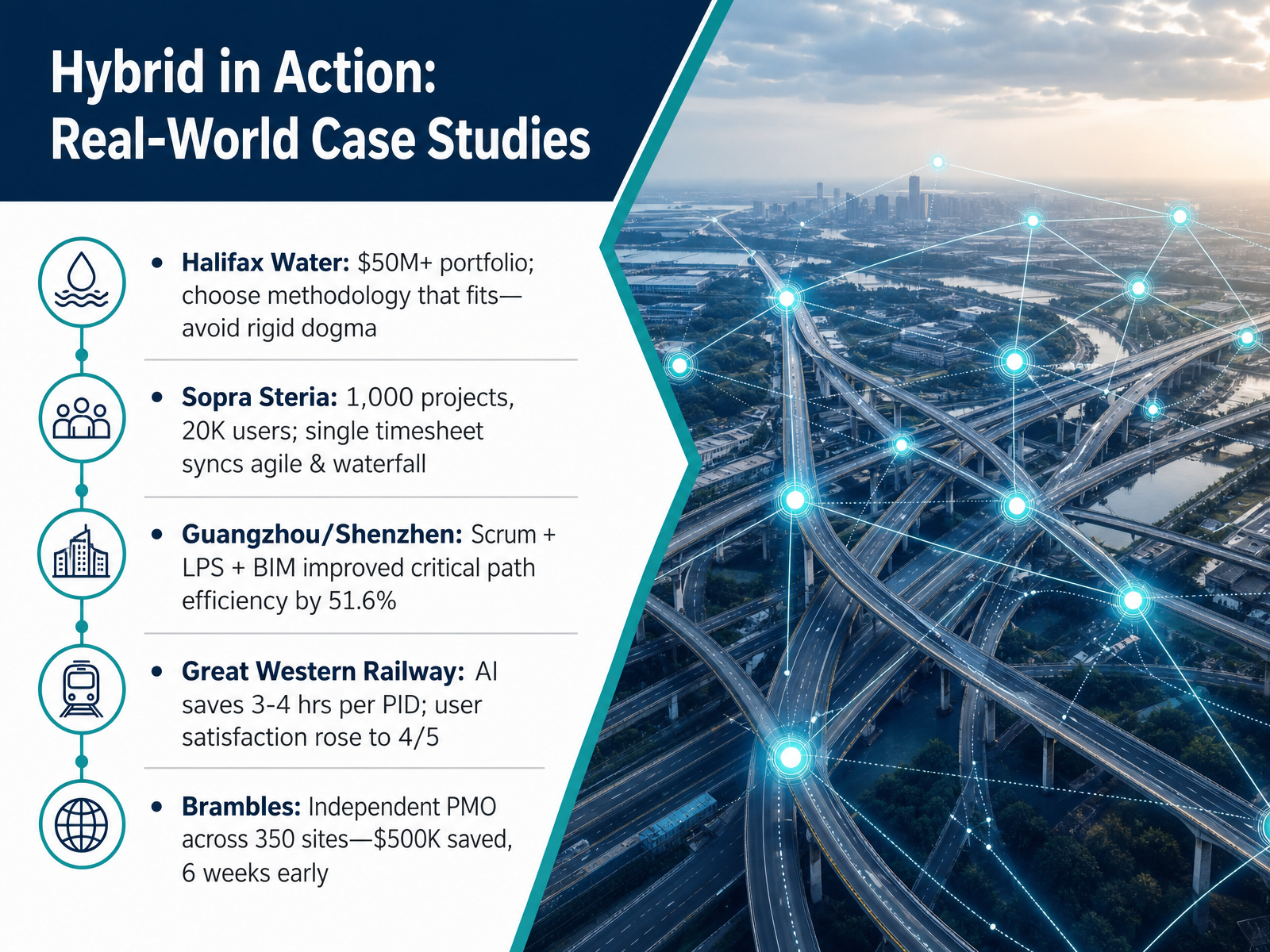
 - 07Hybrid in Action: Real-World Case StudiesLet’s look at how organizations are actually combining approaches—not in theory, but in practice. At Halifax Water, they manage a portfolio worth over 50 million dollars. Their rule is simple: choose the methodology that fits the project, and avoid rigid dogma. Most of their work is hybrid now, pulling in agile ceremonies only where they add value. At Sopra Steria, the challenge was scale—a thousand projects and 20,000 users. They adopted a single timesheet that syncs agile and waterfall tasks, giving project managers one unified Gantt view without forcing every team into the same workflow. In China, the Guangzhou and Shenzhen construction projects combined Scrum, the Last Planner System, and BIM. The result? Critical path efficiency improved by 51.6 percent, and schedule deviation dropped from 12.4 percent down to just 6 percent. Over at Great Western Railway, they used AI to automate the project initiation document—saving three to four hours per document—and user satisfaction climbed from 3 out of 5 to 4 out of 5. And Brambles set up an independent PMO across 350 sites, held every vendor to a single source of truth, saved 500,000 dollars through logistics optimization and contract management, and finished six weeks early with zero operational disruption. The takeaway is clear: when you design the framework around the work—not the other way around—you get faster delivery, lower cost, and happier stakeholders. Next, we’ll explore scaled frameworks like SAFe, LeSS, and Disciplined Agile, and how they address coordination across multiple teams.
 planview.commdpi.comemerald.com+22 min
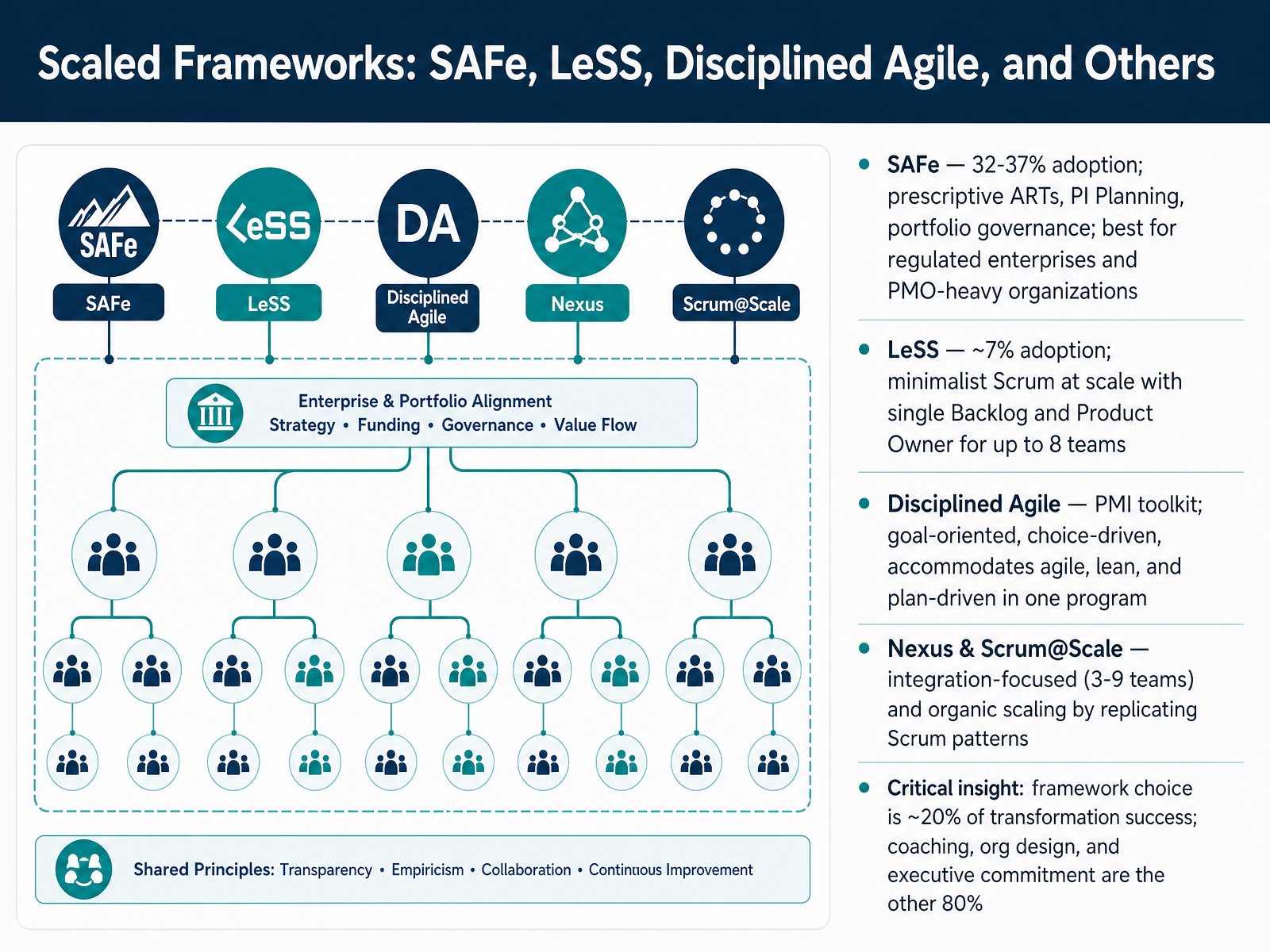
 - 08Scaled Frameworks: SAFe, LeSS, Disciplined Agile, and OthersNow let's look at the major scaled frameworks and where each one actually fits. SAFe is the dominant player, with roughly thirty-two to thirty-seven percent adoption among scaling enterprises. It gives you a prescriptive model—Agile Release Trains, PI Planning, portfolio governance—that maps well to how regulated industries and PMO-heavy organizations already operate. The trade-off is significant process overhead, and if you underinvest in coaching, the framework can calcify fast. On the opposite end sits LeSS, holding about seven percent adoption. It takes a minimalist stance: up to eight teams share one Product Backlog and one Product Owner. No new roles, very little added ceremony. It works beautifully in product-organized firms with strong Scrum maturity, but it struggles where projects and functional hierarchies still rule. Disciplined Agile, now part of PMI, is less a framework and more a toolkit. It lets you blend agile, lean, and plan-driven approaches under one program, which is useful in mixed-portfolio environments. Nexus and Scrum at Scale focus on smaller integration challenges—typically three to nine teams—keeping things closer to pure Scrum. But here's the critical insight that gets overlooked. The research is clear: framework choice accounts for roughly twenty percent of transformation success. The other eighty percent comes from coaching, organizational design, engineering practices, and genuine executive commitment. The framework is scaffolding, not the building. Next, we'll dig into choosing and using scaled frameworks effectively.
 agiletutor.comlearnersink.comconsulting-huber.com+22 min
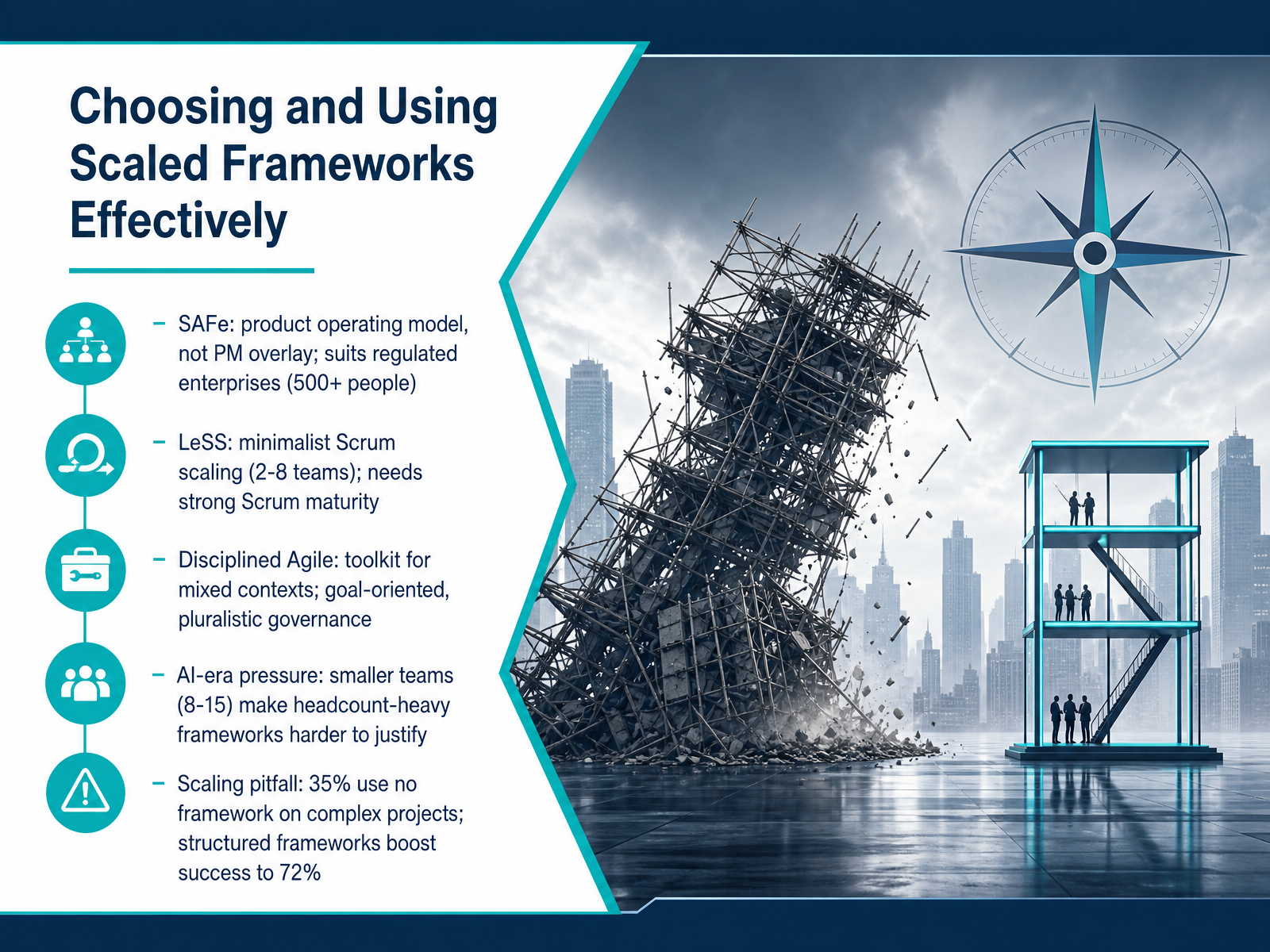
 - 09Choosing and Using Scaled Frameworks EffectivelyLet's look now at how to choose and actually use a scaled framework. You've heard names like SAFe, LeSS, and Disciplined Agile. Think of them less as methods and more as operating models. SAFe is a product delivery model, not a project management overlay. It fits large, often regulated enterprises with 500-plus people. If you have a mature PMO, annual budgeting, and need that program-level visibility, SAFe gives you a familiar structure—but it is a heavy one. On the other end, LeSS is minimalist Scrum scaling for two to eight teams. It keeps one backlog, one product owner, and no new roles. The trade-off? It demands genuine Scrum mastery and a product-oriented culture. Disciplined Agile sits in the middle as a goal-oriented toolkit, ideal for mixed contexts where some teams use Scrum, others Lean, and still others need plan-driven governance. But here's the AI-era pressure point: when generative AI lets eight to fifteen people do what used to take eighty, frameworks built on large headcounts—like a SAFe Agile Release Train of 50 to 125—become harder to justify. And here's a critical stat: PMI's 2026 Pulse of the Profession report found 35 percent of professionals used no framework on their last complex project. Those using a structured framework hit a 72 percent success rate, compared to 61 percent without one. That's not a trivial gap. Framework choice matters, even if no framework guarantees success. Coming up next, we'll use a structured decision model to compare these key dimensions.
 agiletutor.comlearnersink.comconsulting-huber.com+22 min
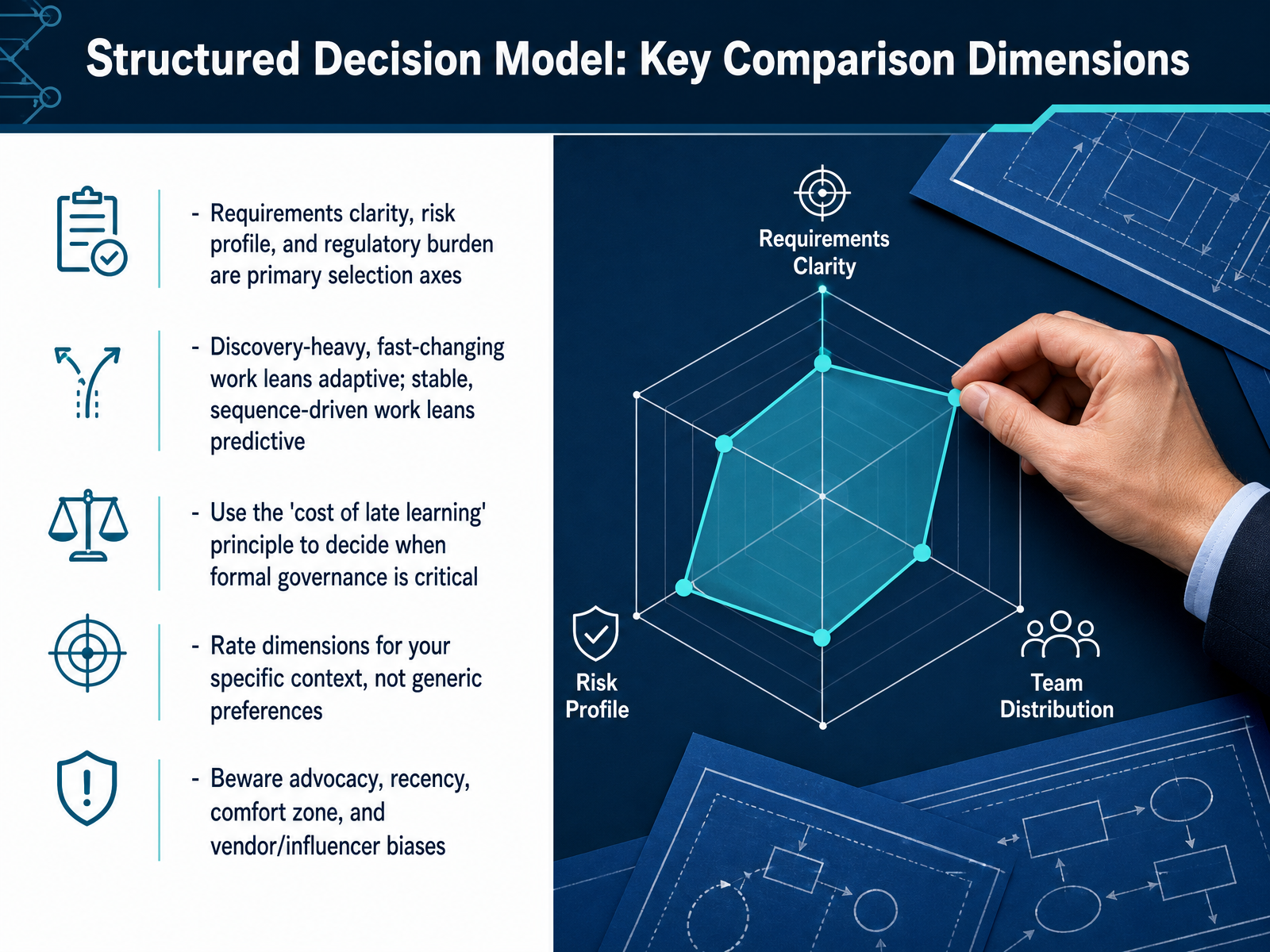
 - 10Structured Decision Model: Key Comparison DimensionsSo how do we move from theory to a decision? Let’s look at a structured model. We’re going to anchor our choice on three primary axes: requirements clarity, risk profile, and regulatory burden. If you’re in discovery-heavy, fast-changing work, you lean adaptive. If the work is stable and sequence-driven, you lean predictive. A useful litmus test here is the 'cost of late learning.' If discovering a requirement mistake six months from now will sink your budget, that’s a signal that more formal, upfront governance is critical. Rate these dimensions for your specific context, not just generic industry preferences. And a word of caution: watch out for biases. Advocacy bias, where someone oversells their favorite method. Recency bias, where you pick what worked last time. Comfort zone bias, sticking to what your team knows even when it doesn’t fit. And vendor or influencer bias, where tooling dictates process. Use this model to cut through that noise. Next, we’ll move from theory to practice by running a methodology-fit workshop.
 pmi.orgmy.idc.compmsolutions.com+22 min
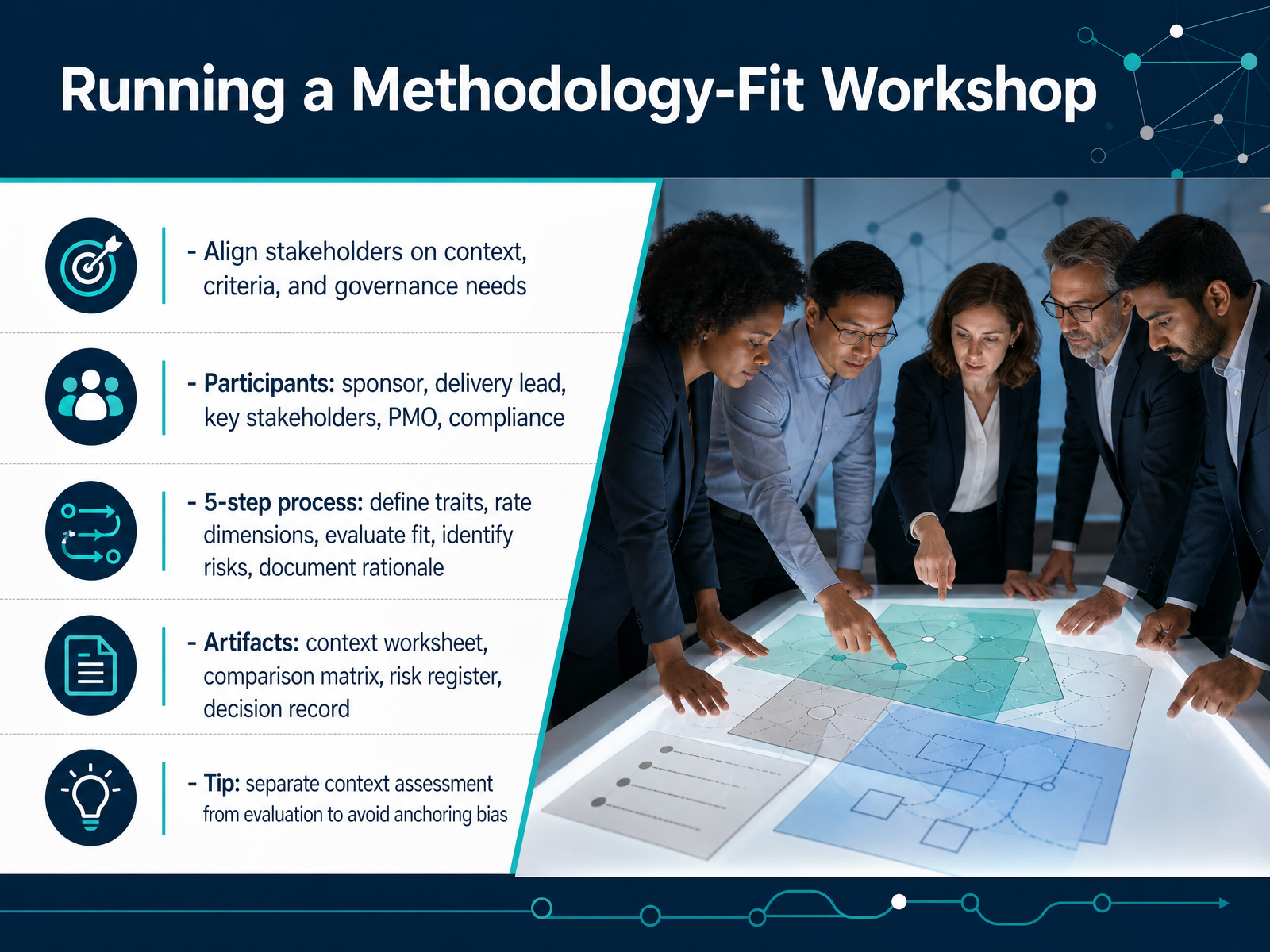
 - 11Running a Methodology-Fit WorkshopChoosing a methodology isn’t a solo decision. It’s a stakeholder alignment problem. And if you let one person’s favorite framework drive the conversation, you’ll end up with a decision that nobody else trusts. That’s why we use a methodology-fit workshop. The goal is to get the sponsor, delivery lead, key stakeholders, PMO, and compliance all in the same room, aligning on context, criteria, and governance needs before anyone picks a label. We run a five-step process here. First, define the traits that actually matter for this project—things like requirement stability, regulatory burden, or team distribution. Second, rate those dimensions honestly. Third, evaluate how well different approaches fit those rated dimensions. Fourth, identify the specific risks each approach would introduce. And fifth, document the rationale so you’re not relitigating the decision two months later. The artifacts are simple: a context worksheet, a comparison matrix, a risk register, and a decision record. One critical tip: separate the context assessment from the evaluation. If you do them in the same conversation, anchoring bias kicks in, and the loudest voice wins. This workshop turns methodology choice from a philosophical debate into a structured, defensible decision. Next, we’ll look at how these choices play out in specific sectors—public sector, financial services, and tech.
 pmi.orgpmi.orgbusinesswire.com+22 min
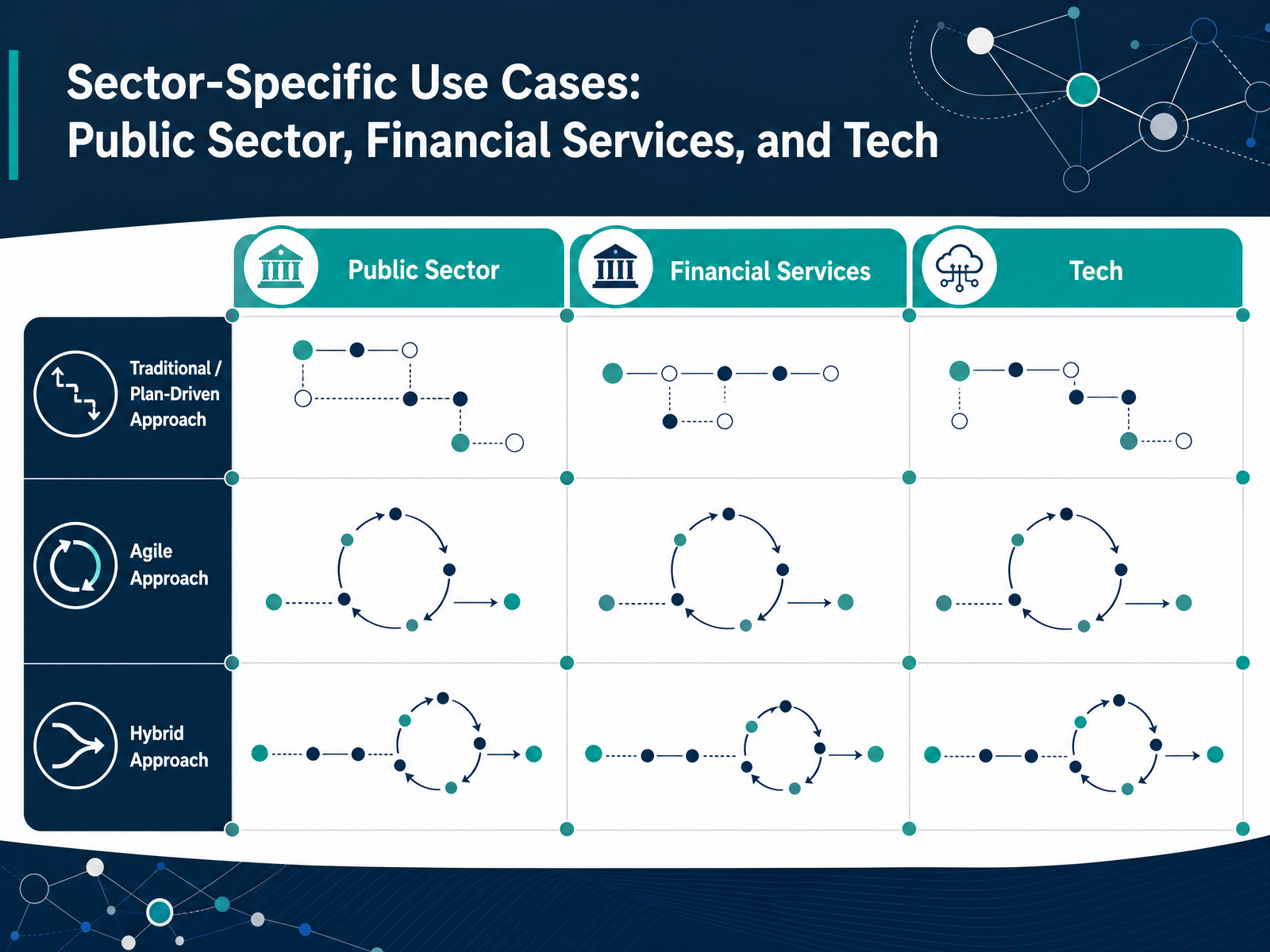
 - 12Sector-Specific Use Cases: Public Sector, Financial Services, and TechLet's now apply these methodology choices to three very different sectors, because how you deliver matters as much as what you deliver. In the public sector, think large-scale digital transformation like the NHS's six-hundred-million-pound digitization program. Here, PRINCE2 is often blended with agile, creating a hybrid at scale that maintains strict accountability while allowing iterative delivery. Programmatic governance, not just project control, is rising fast. Over in financial services, we see a two-speed governance model emerging. High-risk regulatory initiatives get structured gates, while lower-risk improvements take fast approval paths. PMOs here are shifting from reporting engines to genuine value engines, tracking measurable outcomes over activity. And in product-led tech, agile still dominates, but AI-native delivery is reshaping team size and workflow. We see hybrid models appear at scale, especially in enterprise rollouts. Meanwhile, healthcare is a fascinating crossover. Models like Water-Scrum-Fall and Agile-Stage-Gate are gaining real traction because they balance innovation with non-negotiable safety. In this context, regulatory fluency has become a core competency, not just a nice-to-have. The common thread across all sectors? The most successful teams pick the fit-for-purpose approach and then govern it with discipline. Next, we'll move from choosing the model to the practical work of implementing a methodology transition.
 pmsolutions.compmi.orgpmi.org+22 min
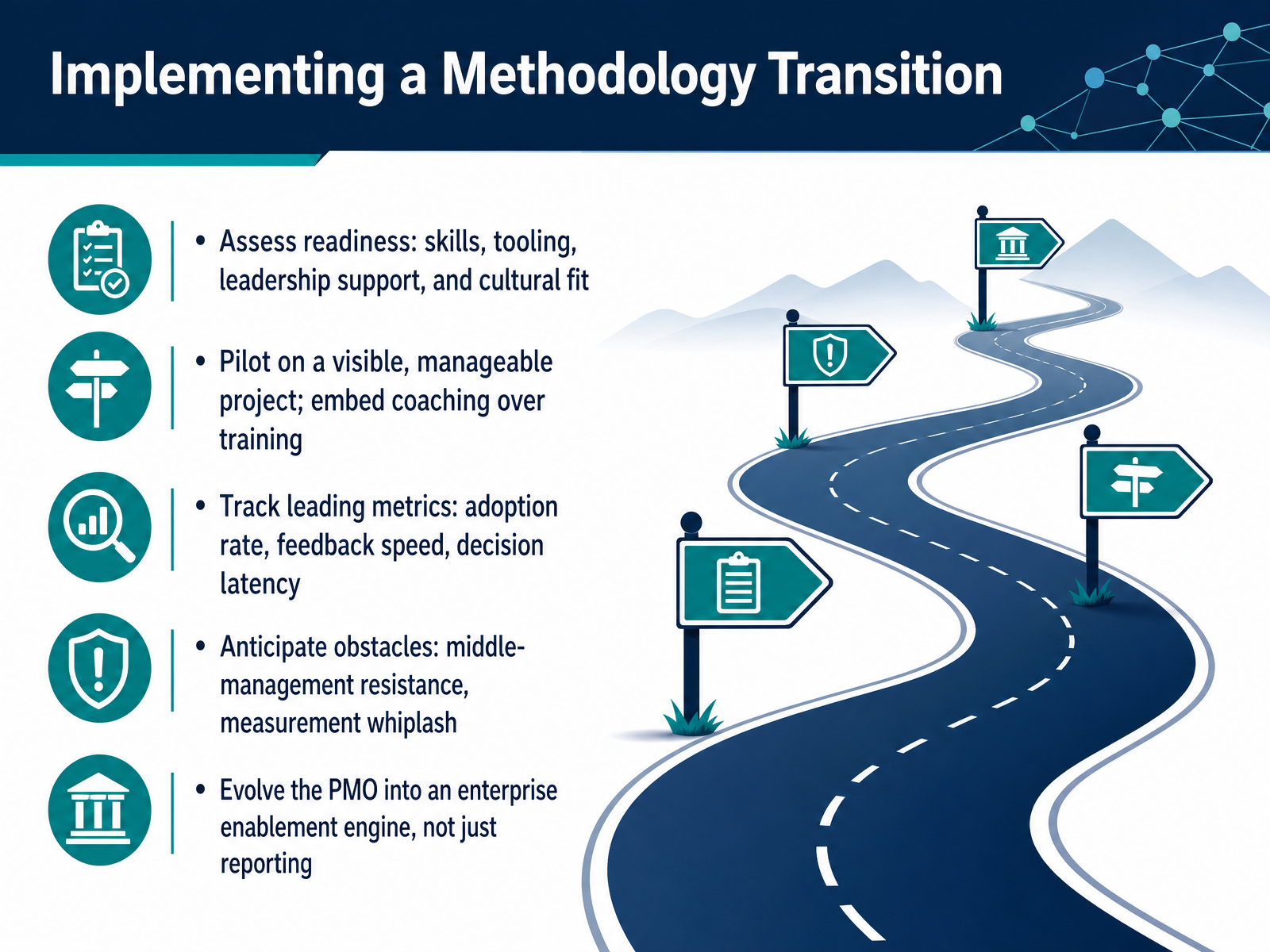
 - 13Implementing a Methodology TransitionLet's get practical about shifting how you deliver. A methodology transition is not a tools upgrade. It is an operating model change, and it fails more often from cultural rejection than from technical complexity. Start by honestly assessing readiness: do your teams have the skills, is your tooling flexible enough, and does leadership actually support a different way of working, not just a faster way. Your best chance of building momentum is to pilot on a visible but contained project. Embed coaching inside that real work, and resist the urge to just send people to training. Track leading indicators that reveal behavior change, things like how fast teams adopt the new ceremonies, the speed of feedback loops, and how quickly decisions get made, not just whether tasks are done. Expect and plan for middle management resistance. When you shift from tracking activity to tracking outcomes, it can feel like a loss of control. And watch out for measurement whiplash, where the old metrics and the new metrics contradict each other and confuse everyone. Over time, your P M O must evolve from a reporting engine into an enterprise enablement engine, one that focuses less on policing templates and more on clearing roadblocks and connecting strategy to execution. Next, we will pull all of this together with a decision playbook that maps context directly to approach.
 pmsolutions.compmi.orgpmi.org+22 min
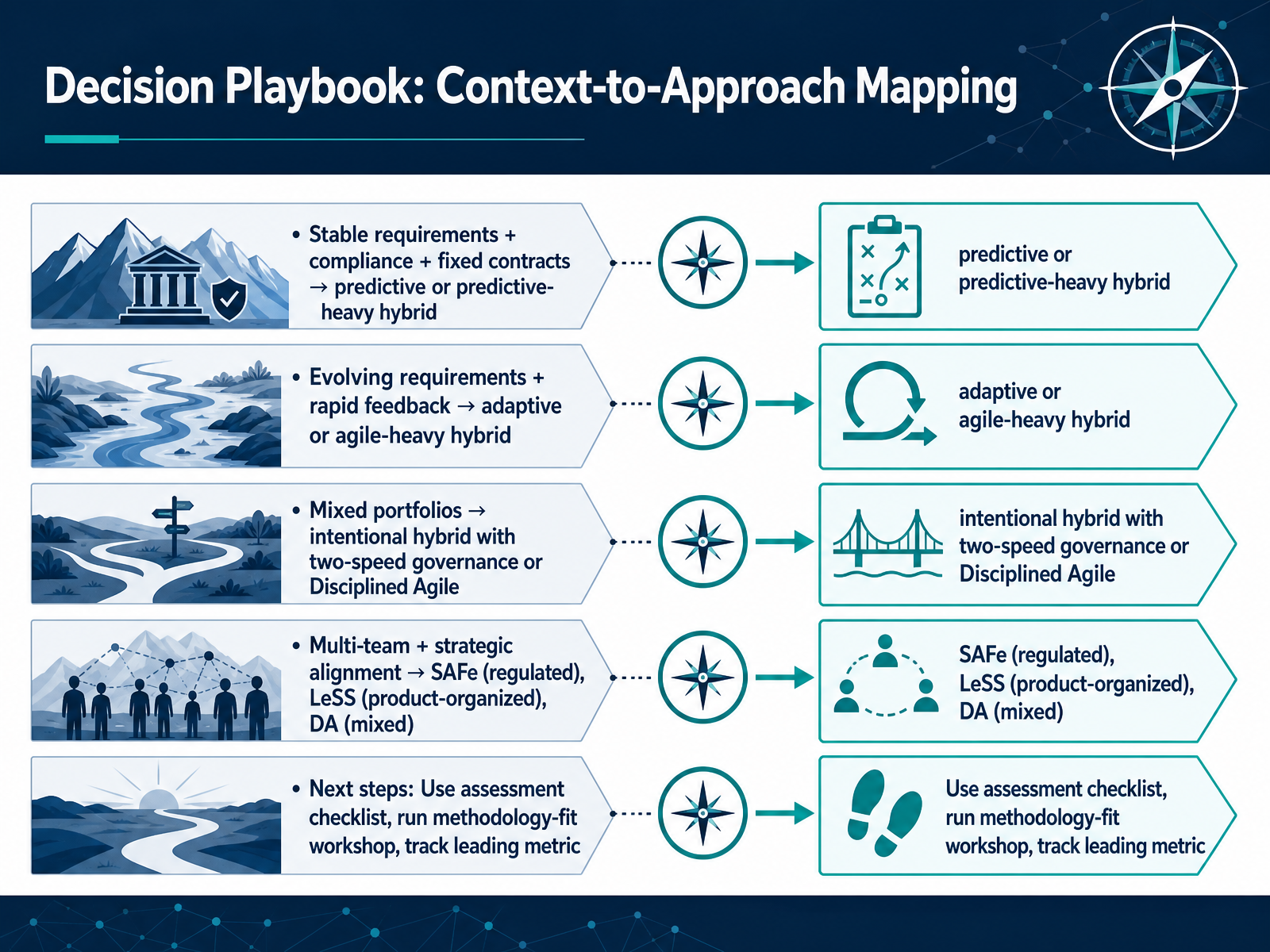
 - 14Decision Playbook: Context-to-Approach MappingLet’s pull this together into a decision playbook you can use on Monday morning. When your requirements are stable, compliance is heavy, and contracts lock scope, lean toward a predictive approach or a predictive-heavy hybrid. If requirements are evolving and you rely on rapid feedback, an adaptive or agile-heavy hybrid gives you the learning loops that protect value. For mixed portfolios, the right answer is an intentional hybrid. Think two-speed governance for regulated workstreams alongside fast-track deliveries, or a toolkit like Disciplined Agile that lets teams choose their way of working. Now when you need to align multiple teams around a shared strategy, match the framework to your operating model. SAFe maps well to regulated, PMO-heavy organizations. LeSS fits when you are genuinely product-organized with deep Scrum maturity. Disciplined Agile earns its keep when you have mixed delivery cultures under one roof. But a framework is only scaffolding. The real multiplier is what PMI calls M.O.R.E., managing perceptions, owning success, relentlessly reassessing, and expanding perspective. Complex projects that navigate this well are five times more likely to succeed. Your next step is practical. Start with a short assessment checklist, run a methodology-fit workshop with your sponsors, and pick one leading metric that tells you whether your approach is actually working. Thank you for walking through these comparisons. The goal is not finding the perfect methodology. It is honest and transparent decision-making on how your team should work. Trust your context, keep the conversation going with your stakeholders, and ship valuable outcomes.
 pmi.orgpmi.orgbusinesswire.com+22 min
Take the deck with you
Download this course as a file — free, no sign-up needed.
- PDF handoutEvery slide page, ready to print or share.15 pages · 4.2 MBDownload
- Narrated PowerPointThe deck that presents itself — every slide carries the digital human's narration video.15 pages · 17.3 MBDownload
- PowerPoint slidesThe full deck as a .pptx — open it in PowerPoint, Keynote, or Google Slides.15 pages · 4.1 MBDownload
Free to use in your own training — please keep the PersonWise credit page at the end.
Have your own deck? Turn it into a course
Sources consulted
Web sources consulted while building this course.
- Sopra Steria: Expanding Hybrid Project Management with ProjectAdvantage — planview.com
- Application of Lean–Agile Hybrid Methods in Complex Construction Project Management — mdpi.com
- Agile-hybrid delivery approaches for complex design and engineering ... — emerald.com
- How Structure gave real-time governance for Matogen Zebra | Tempo — tempo.io
- Innovating PMOs Through Agile and Hybrid Strategies — pmoevolution.com
- Pulse of the Profession® 2026: Driving Success in Complex Projects — pmi.org
- Project Success: Definition and Key Drivers | PMI Blog — pmi.org
- Why Complex Projects Fail: Best Practices Are Not Enough, System Thinking Gives Your Team the Edge — businesswire.com
- https://www.pmi.org/-/media/pmi/documents/public/pdf/learning/thought-leadership/project_success_report_2024.pdf — pmi.org
- Pulse of the Profession® 2026 by PMI: Driving Success in Complex Projects — pmwares.com
- Pulse of the Profession — pmi.org
- IDC Survey Spotlight: Has Agile Peaked as a Development Framework? — my.idc.com
- The State of Project Management 2026 — pmsolutions.com
- The Hybrid Era: Project Management Embraces the Fit-for-Purpose Approach — pmi.org
- The Future of Project Work: Pulse of the Profession® 2024 | PMI — pmi.org
- Scaling Agile: SAFe vs. LeSS vs. Disciplined Agile – Which One Wins? – AgileTutor — agiletutor.com
- https://www.learnersink.com/blog/safe-vs-less-scaling-frameworks-2026 — learnersink.com
- Big Consulting Agile Frameworks, Compared (2026) — consulting-huber.com
- Do Agile scaling approaches make a difference? an empirical comparison of team effectiveness across popular scaling approaches | Empirical Software Engineering | Springer Nature Link — link.springer.com
- 8.1.5: Scaling Agile- Scrum of Scrums, Nexus, LeSS, SAFe, and Disciplined Agile - Engineering LibreTexts — eng.libretexts.org