Quantum Machine Learning Essentials
Begin
14 pages · ~28 min
Quantum Machine Learning Essentials
An introduction to quantum machine learning, covering core quantum computing principles and their application to classical ML algorithms for technical professionals.
What you’ll learn
- 01Quantum Machine LearningWelcome. This course is a technical deep dive into quantum machine learning, for practitioners who already speak fluent classical ML and linear algebra. We will focus on the quantum-specific deltas: the models, the benchmarks, and above all, honest evaluation. As of 2026, the scorecard is precise. Quantum advantage on quantum data has been proven and experimentally demonstrated. On ordinary business data, it remains unproven. That is not a failure; it is the frontier. The practical norm is hybrid quantum-classical pipelines, where a classical outer loop orchestrates and a quantum device evaluates kernels or parameterized circuits in the inner loop. Our roadmap moves from foundations, through algorithms and applications, to adoption strategy. We will examine gate fidelity, qubit coherence, and kernel estimation as trade-offs to engineer, not obstacles to fear. Let's begin by establishing why this distinction matters now, in the current state of the field.link.springer.compostquantum.comsciencedirect.com+22 min
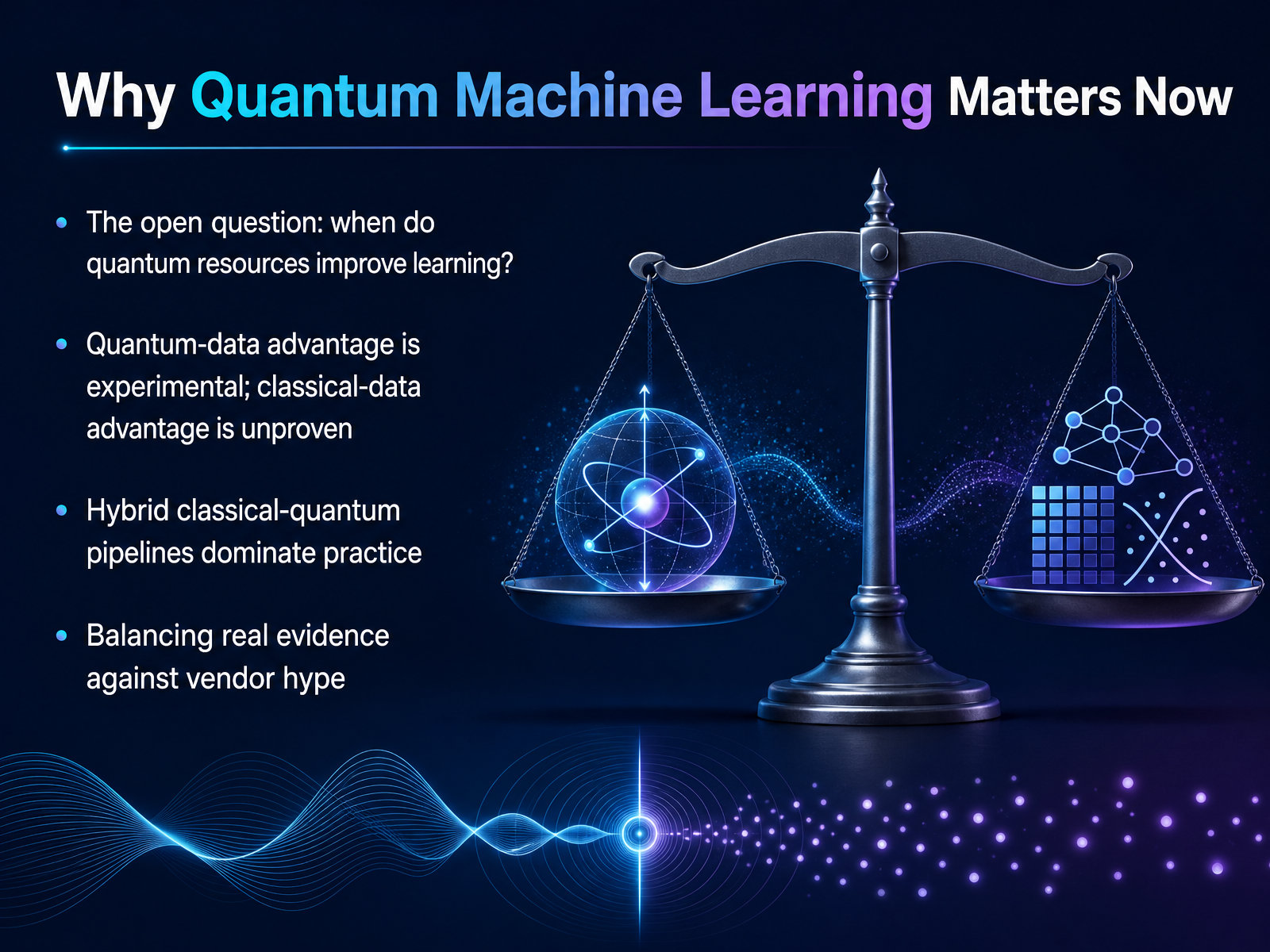
- 02Why Quantum Machine Learning Matters NowLet’s anchor this discussion in a precise, current question: not whether quantum computing will transform machine learning eventually, but when quantum resources provide a measurable learning advantage in practice. The most honest scorecard from 2026 shows a compelling experimental demonstration of a quantum-data advantage—a hundred-mode bosonic learning task completed with roughly twelve orders of magnitude fewer samples—but, critically, no broadly accepted, replicated end-to-end win on ordinary classical data once strong classical baselines and full hardware costs are counted. This asymmetry defines the practitioner’s landscape. Nearly all production-relevant QML is therefore hybrid, with quantum kernel evaluations or short-depth variational circuits executed inside classical optimization loops. Your task is to balance the real, maturing evidence with vendor signalling, and to route claims through filters: traceable primary papers, real hardware versus simulators, tuned classical baselines, and data-loading costs. With that framing in place, we turn to the hardware foundations that make those resource trade-offs concrete.
 link.springer.compostquantum.comsciencedirect.com+21 min
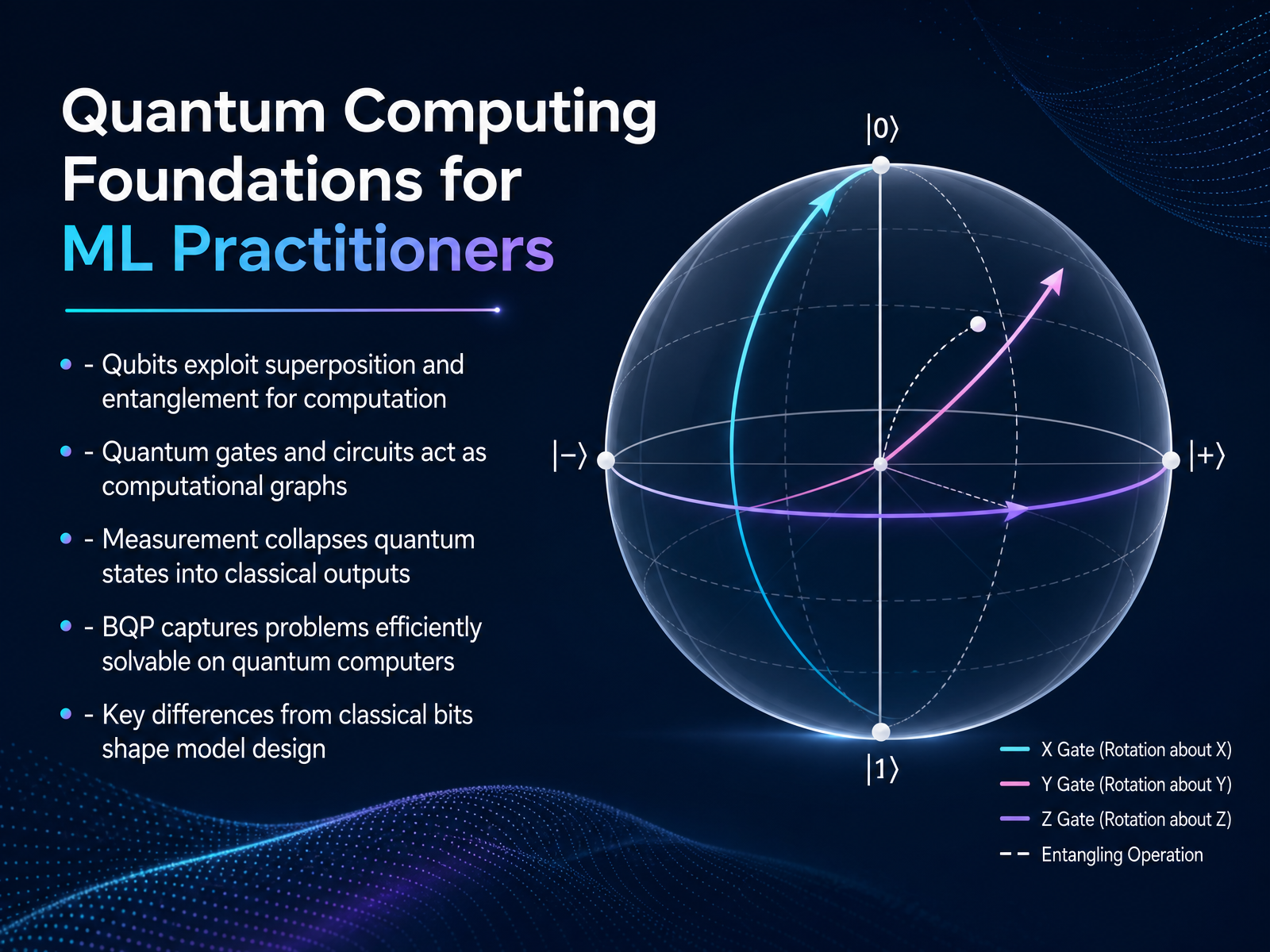
 - 03Quantum Computing Foundations for ML PractitionersLet’s anchor the quantum side of the equation. For machine learning practitioners, the relevant deltas come down to five ideas. First, qubits use superposition and entanglement; unlike a classical bit, a qubit’s state is a linear combination of zero and one, with complex amplitudes. Entanglement then creates joint correlations between qubits that cannot be factored into independent descriptions. Second, quantum gates and circuits act as your computational graph. Parameterized circuits, in particular, become the trainable models, analogous to neural network layers. Third, measurement is the readout. It collapses the quantum state into classical outputs, meaning every prediction ultimately reduces to sampling from a probability distribution. Fourth, the complexity class BQP captures what quantum computers solve efficiently; it is the quantum analogue to P, and understanding where your problem sits relative to BQP informs whether a quantum model is even worth pursuing. Finally, remember these principles change model design: data loading, circuit depth, and noise tolerance become first-class design constraints, not afterthoughts. The key difference from classical bits is not raw speed, but a fundamentally different representational space. Keep this framing in mind as we translate classical concepts into quantum models.
 link.springer.compostquantum.comsciencedirect.com+22 min
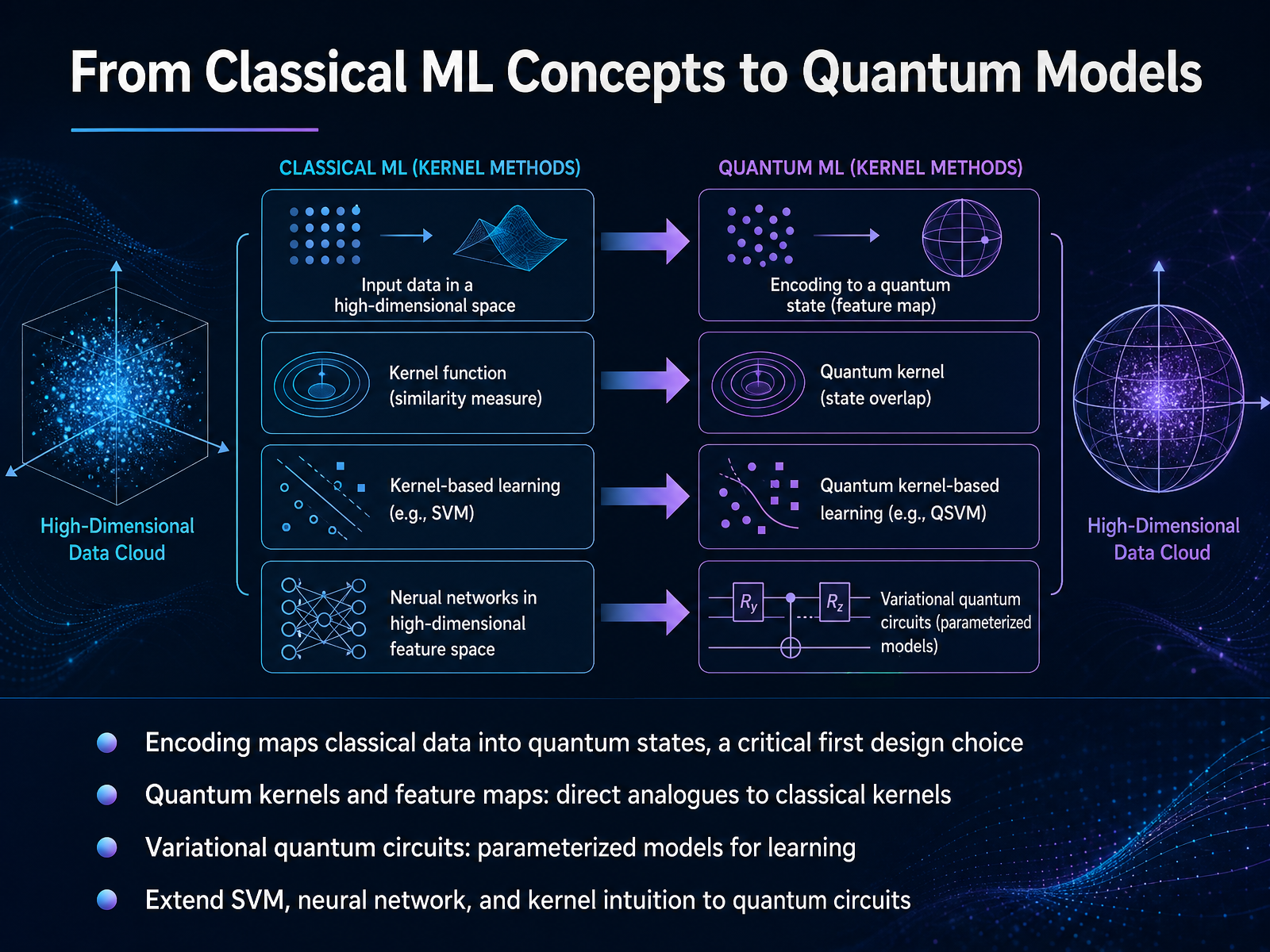
 - 04From Classical ML Concepts to Quantum ModelsNow we bridge those classical intuitions into the quantum picture. In QML, the encoding map, which turns your classical vector x into a quantum state, is not a preprocessing afterthought; it is the first design choice because it determines the entire function class your model can express. For a kernel-based approach, the data encoding induces a quantum kernel, which then plugs directly into a classical support vector machine. For parameterized models, the same encoding layer feeds into a variational quantum circuit, whose trainable gates play the role of weights in a neural network. So your intuition from SVMs, kernels, and networks still guides you, but the bottleneck shifts. The expressive power lives in the encoding, and the trainability is governed by gate fidelity, qubit coherence, and the cost-expressivity-robustness trade-offs across different encoding families. This mapping from classical components to quantum circuits is the conceptual foundation we will build on when we design feature maps next.
 arxiv.orgdoi.orgnature.com+22 min
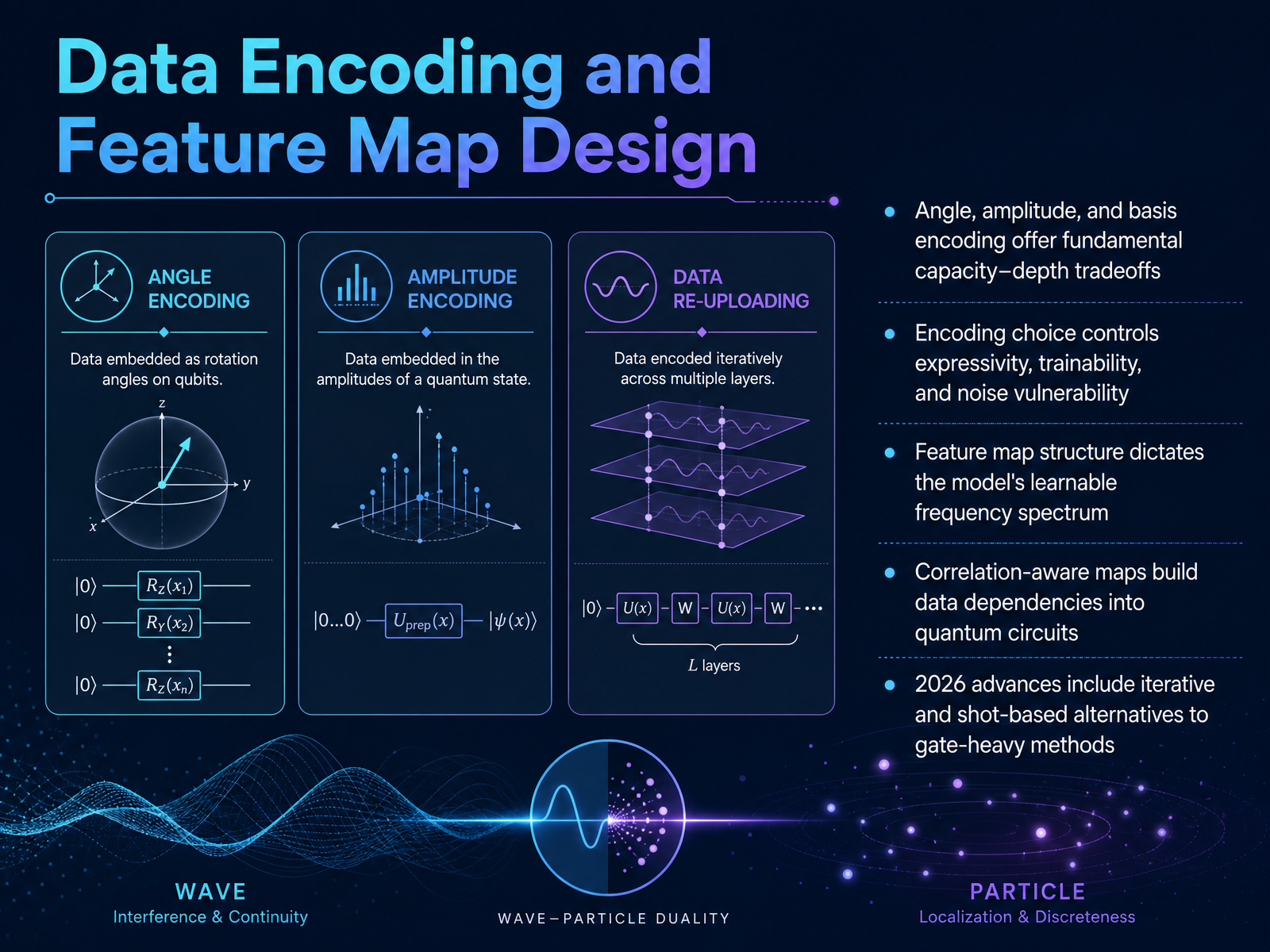
 - 05Data Encoding and Feature Map DesignEncoding choice is the silent driver of everything that follows in a quantum model. The fundamental capacity-depth tradeoff starts here: angle encoding gives you shallow circuits but a finite Fourier spectrum, while amplitude encoding accesses the full Hilbert space at the cost of exponential gate depth. A useful rule of thumb from the 2026 survey literature: amplitude encoding becomes viable only below a per-gate error rate around ten to the minus three. Above that, decoherence erases its advantage. Feature map structure also fixes your learnable frequencies and, critically, your trainability. Correlation-aware maps now build statistical dependencies directly into circuits using controlled rotations, which outperforms fixed entanglement topologies on structured data. The newest direction is hybrid: iterative and shot-based encodings that shift the workload from coherent gates to classical control and measurement statistics. Shot-based encoding matched amplitude encoding accuracy on image benchmarks with zero encoding gates, within NISQ depth budgets. The takeaway: treat encoding as a hyperparameter tied to hardware reality. Now let us turn to the actual algorithm families built on these maps.
 arxiv.orgdoi.orgnature.com+22 min
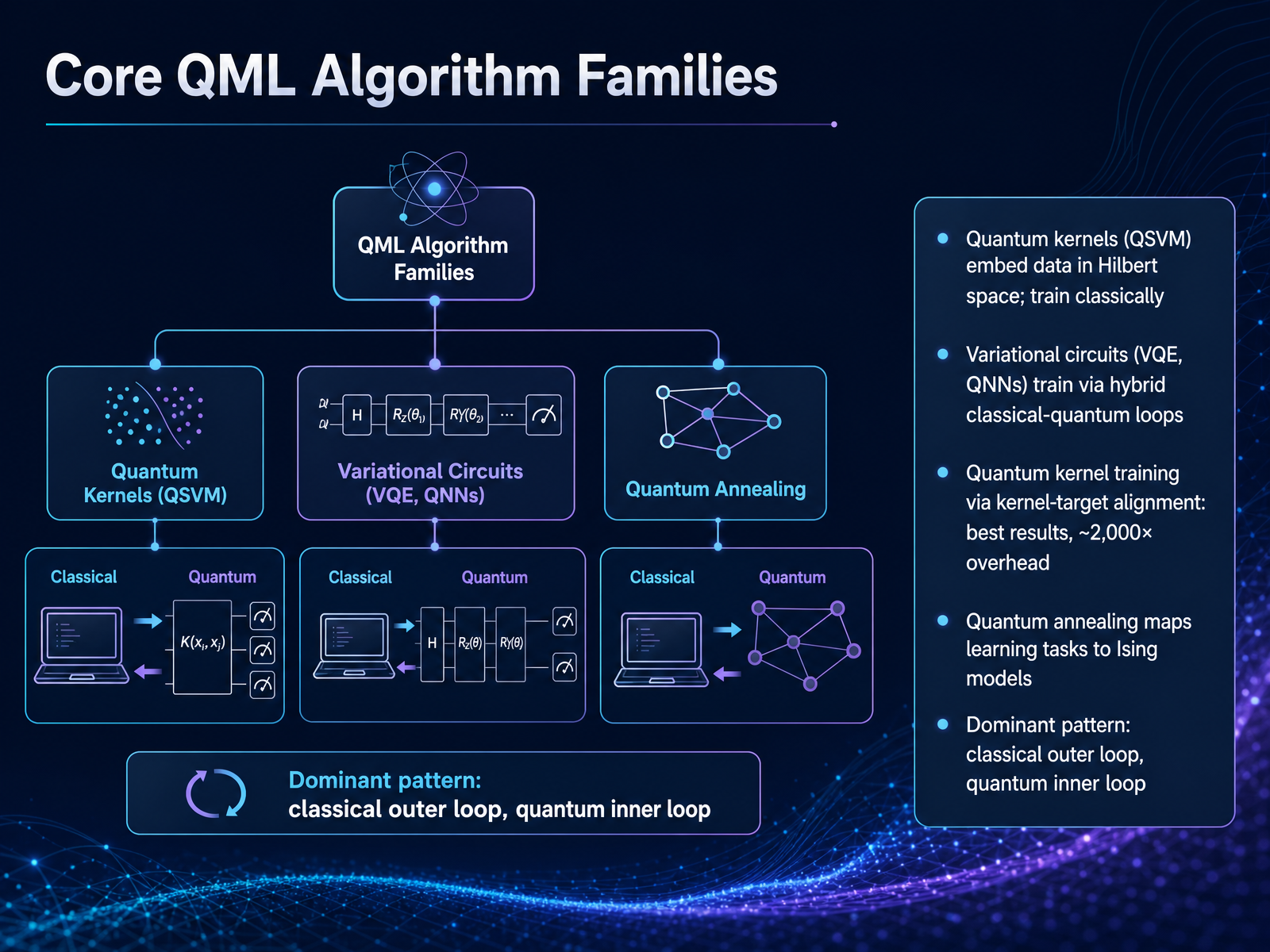
 - 06Core QML Algorithm FamiliesLet’s turn to the main architectural families that define the QML landscape. We can group them into four broad approaches. Quantum kernel methods, such as quantum support vector machines, embed classical data into a high-dimensional Hilbert space, then train a classical SVM on the resulting kernel matrix. The quantum device is only used to estimate pairwise similarities; the learning itself is classical. Variational circuits, which include variational quantum eigensolvers and quantum neural networks, take a different route. Here, parameterized circuits are trained in a hybrid loop, with a classical optimizer updating circuit parameters based on quantum measurements. Both are active research areas, and neither has a decisive win on standard benchmarks. Quantum kernel training, where you optimize the feature map itself via kernel-target alignment, has produced competitive results, but at a cost. One rigorous study reported roughly two-thousand-fold computational overhead. Quantum annealing offers a third path, mapping learning tasks to Ising models, though deployment is more specialized. Across all families you see a dominant pattern: a classical outer loop driving the optimization, with a quantum inner loop providing the core computation. Keep that architecture in mind as we look at what these models actually deliver in practice. Next, we’ll examine benchmarks and realistic performance expectations.
 arxiv.orgdoi.orgarxiv.org+22 min
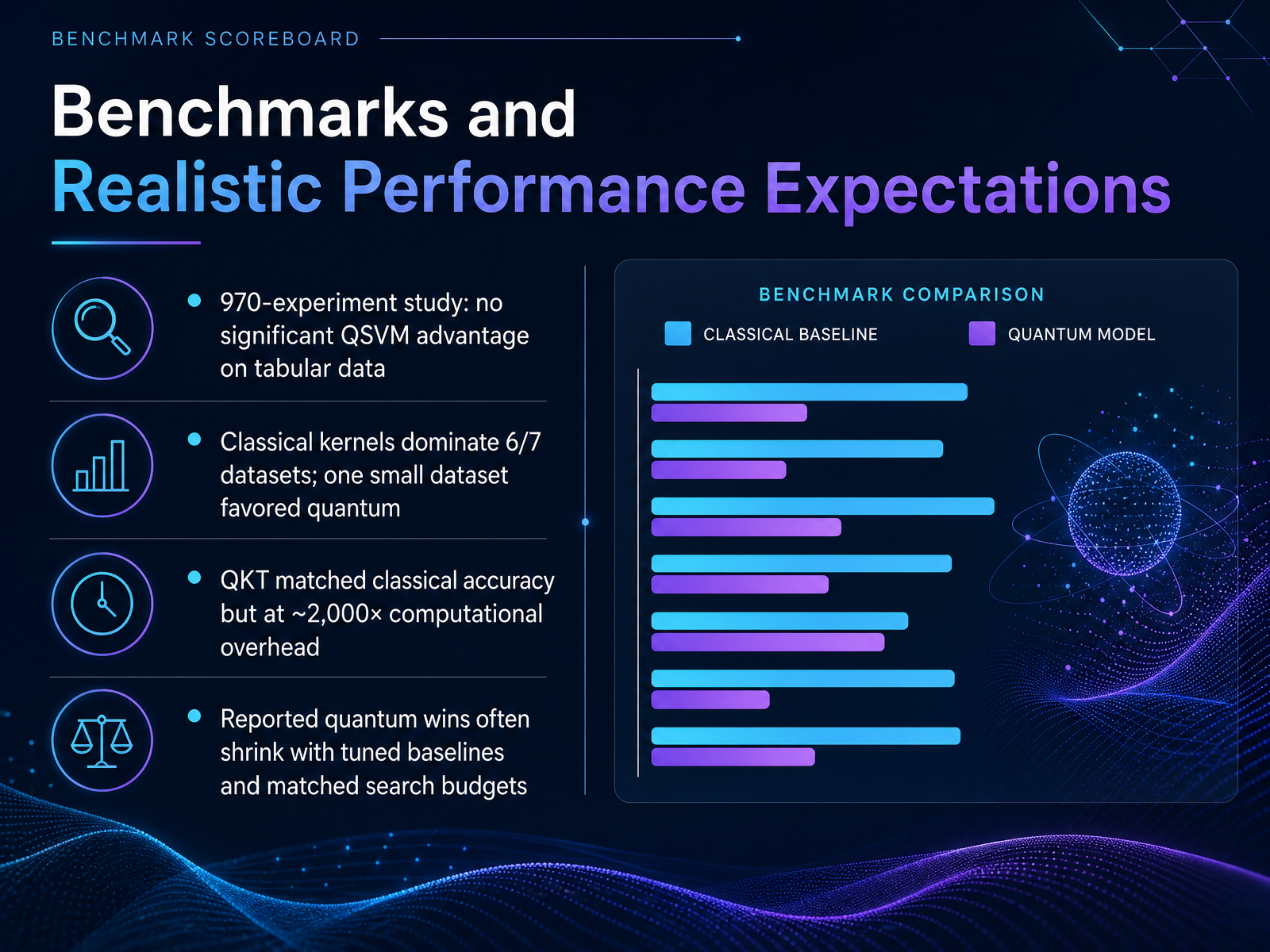
 - 07Benchmarks and Realistic Performance ExpectationsNow let's turn to what the benchmark literature actually tells us. The most rigorous study to date ran nearly a thousand experiments, comparing quantum kernel support vector machines against strong classical baselines on tabular data. The result is unambiguous: no significant advantage. Classical kernels dominated on six of seven datasets, with only one small, difficult dataset favoring the quantum approach. Even the most competitive quantum result, a kernel trained via target alignment, reached classical accuracy only at a staggering two-thousand-fold computational overhead. The deeper pattern here, confirmed by spectral analysis, is that current quantum feature maps produce eigenspectra that are either too flat or too concentrated compared to the intermediate profile of the classical RBF kernel. And a critical methodological lesson emerges: reported quantum wins often shrink or vanish entirely when baselines are properly tuned and search budgets are matched. This is not a failure of the field, but a calibration of expectations. Quantum advantage is a narrower, more conditional claim than early enthusiasm suggested. With that evidence in hand, we can now examine the core training and optimization challenges these models confront.
 arxiv.orgdoi.orgarxiv.org+22 min
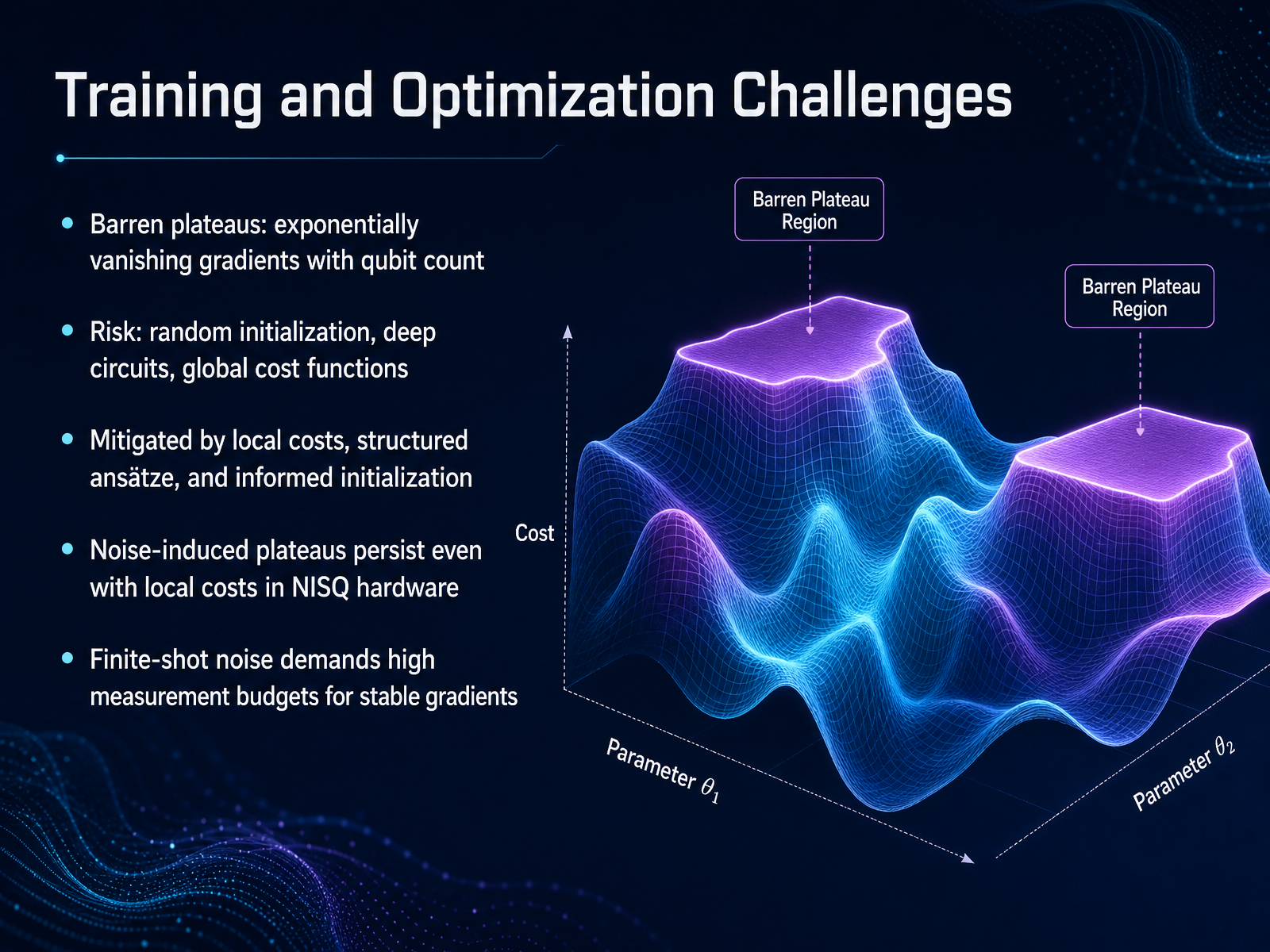
 - 08Training and Optimization ChallengesLet’s turn to the central obstacle in variational training: barren plateaus. As you scale qubit count, gradient variance can vanish exponentially. This means your cost landscape flattens into a featureless desert, and parameter updates become statistically indistinguishable from noise. The usual suspects are random initialization, overly deep circuits, and global cost functions. The standard mitigations—local costs, structured ansatze, and informed initialization—push the onset of these plateaus to larger system sizes. But there is a critical nuance from recent work: noise-induced barren plateaus persist even with local costs on NISQ hardware. Depolarizing noise alone can suppress gradients exponentially with depth, regardless of your cost function's locality. And even in a noiseless simulation, finite-shot noise imposes a hard floor. To resolve a gradient that has shrunk polynomially, you need a measurement budget that grows correspondingly. So, treat trainability as a resource constraint, not just an architectural choice. You must budget for gate fidelity, qubit coherence, and shot count together. With that landscape in mind, let's examine the practical tooling available, from simulation environments to hardware SDKs, in the next section.
 arxiv.orgarxiv.orgarxiv.org+22 min
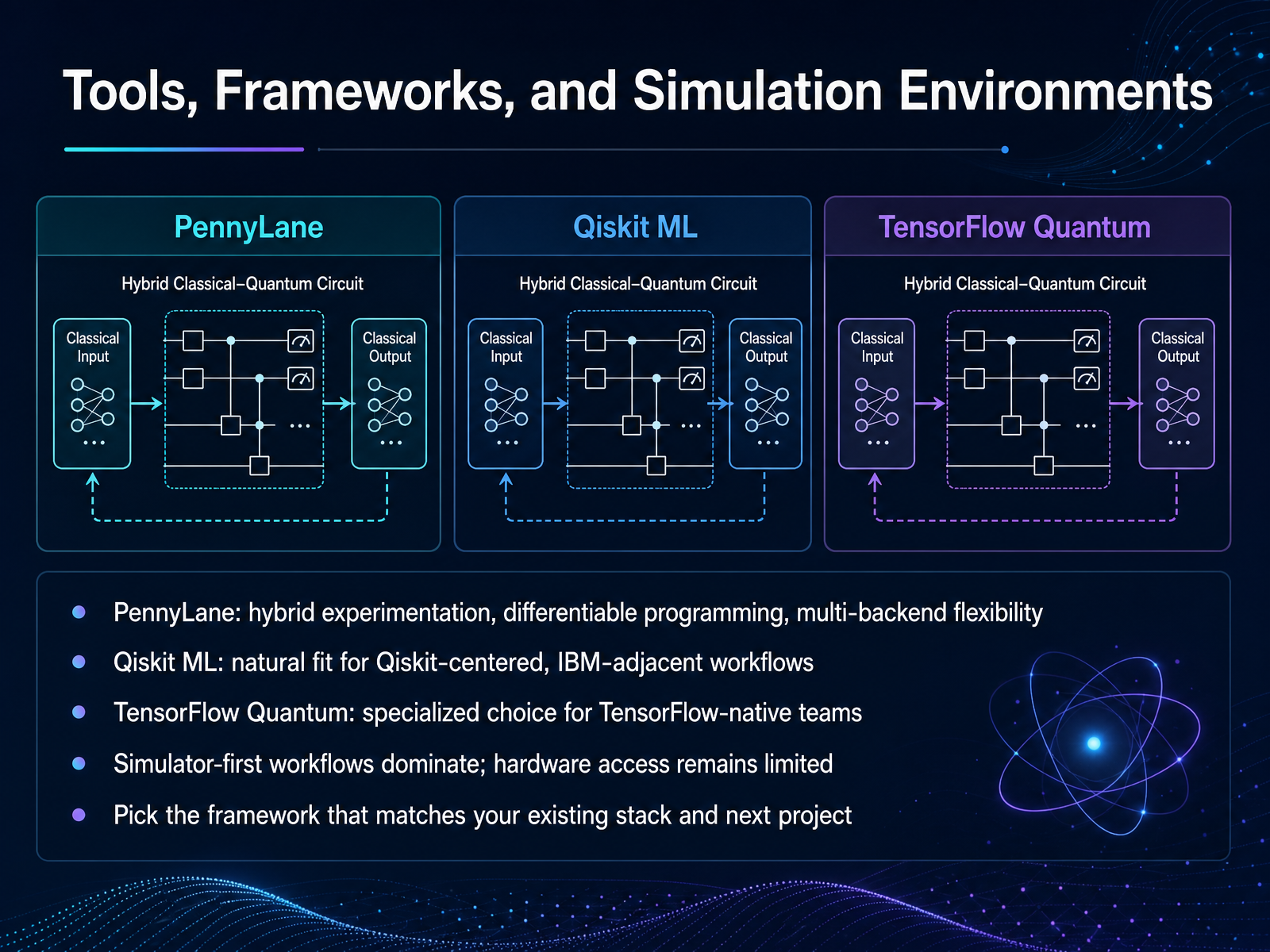
 - 09Tools, Frameworks, and Simulation EnvironmentsNow let’s talk about tooling. Three frameworks dominate the conversation: PennyLane, Qiskit Machine Learning, and TensorFlow Quantum. PennyLane is your clearest path into hybrid quantum-classical experimentation. It emphasizes differentiable programming, which means you can treat quantum circuits as trainable components inside your existing autodiff workflows, and it supports multiple backends, so you are not locked into one vendor. Qiskit ML is the natural fit if your workflows already live inside the Qiskit ecosystem. If you are building circuits, simulating them, and expecting to move to IBM hardware, it reduces context switching. TensorFlow Quantum is the most specialized option. It makes sense only if your team's infrastructure and mindset are already deeply TensorFlow-centric. Otherwise, it tends to add friction. One practical reality to keep in mind: simulator-first workflows will dominate your initial iterations. Hardware access is still limited, which means your choice of framework should prioritize simulation ergonomics and maintainability. Pick the framework that best matches the stack you already have and the next project you're planning. The strongest recommendation is usually PennyLane for hybrid model exploration, Qiskit ML for ecosystem continuity, and TFQ for TensorFlow-native teams. Before you commit, test your shortlist on a small, repeatable prototype. Next, we'll examine concrete case studies and application patterns to see these trade-offs in action.
 1 min
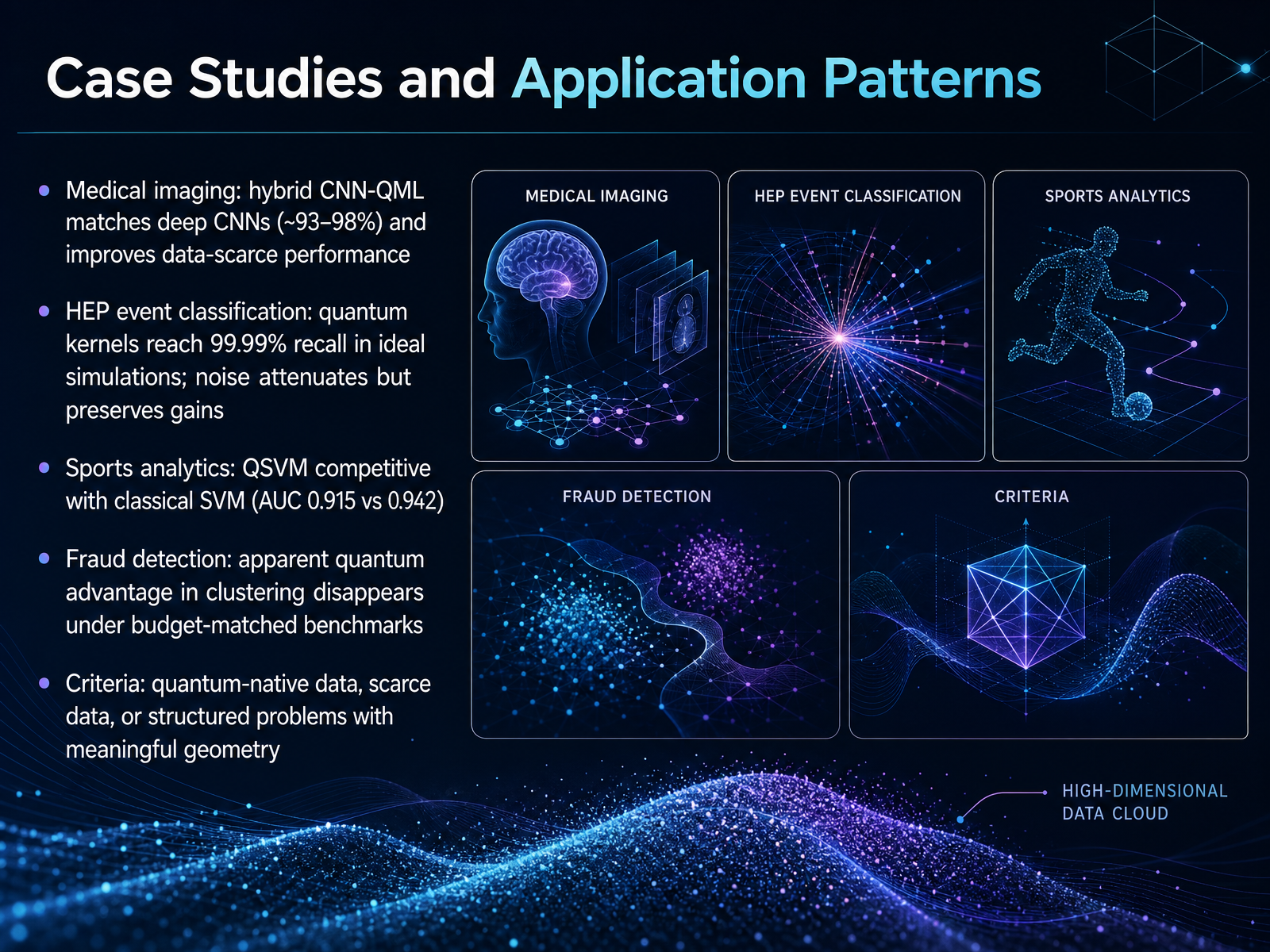
1 min - 10Case Studies and Application PatternsLet's turn these principles into practice by examining concrete case studies and the application patterns that emerge from them. In medical imaging, hybrid CNN quantum models match deep convolutional networks at roughly ninety-three to ninety-eight percent accuracy, but their real strength appears in data-scarce regimes where classical backbones degrade. For high-energy physics event classification, quantum kernels in ideal simulations reach ninety-nine point nine nine percent recall. Noise attenuates that advantage, but notably, it does not eliminate it. In sports analytics, a quantum support vector machine achieves an AUC of zero point nine one five against zero point nine four two for a classical SVM. Competitive, though not superior. Perhaps the most instructive case is fraud detection. An apparent quantum advantage in clustering vanishes entirely under budget-matched benchmarks. The lesson is methodological, not commercial. Across these domains, patterns for when QML helps are emerging: quantum-native data, scarce data, or structured problems with meaningful geometry. Use these criteria as your first filter when evaluating new problems. In our next section, we will examine reproducibility and the experimental discipline needed to validate such claims.
 sciencedirect.comlink.springer.compostquantum.com+22 min
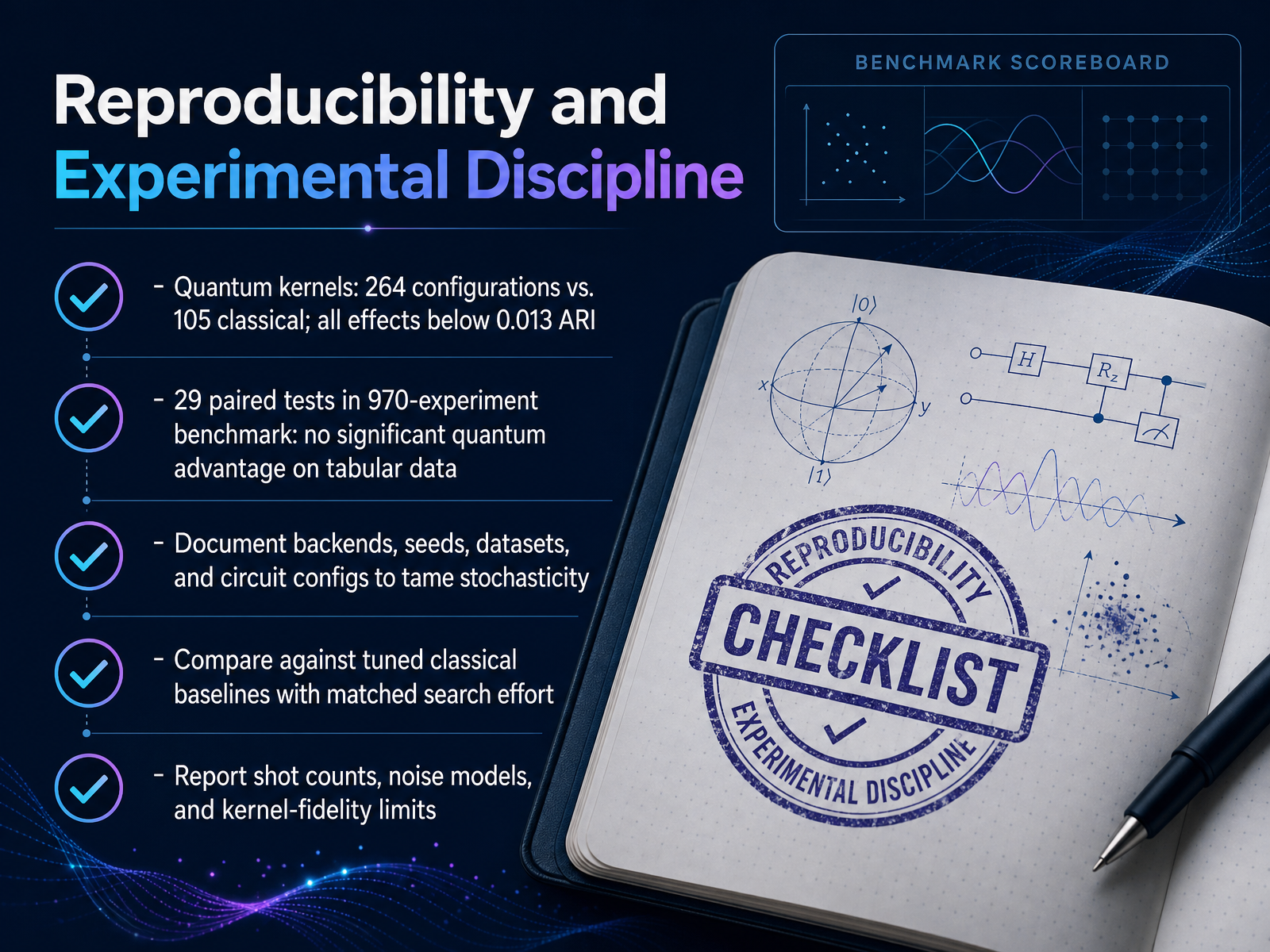
 - 11Reproducibility and Experimental DisciplineLet's be honest about what the evidence shows. In a wide-ranging benchmark, quantum kernels were tested across two hundred sixty-four feature-map configurations against one hundred five classical ones. Every effect fell below zero point zero one three on the adjusted Rand index. Across nine hundred seventy experiments and twenty-nine paired comparisons, no significant quantum advantage emerged on tabular data. The details matter. Document your backends, seeds, datasets, and circuit configurations. Stochasticity is real, and reproducibility is the only defense. Always compare against tuned classical baselines with matched search effort, because an untuned baseline will manufacture a false advantage. Report shot counts, noise models, and kernel-fidelity limits. These numbers define what your result actually means. The goal is not to defend a quantum claim, but to make it testable. Now, let's look at the practical adoption strategies that turn this discipline into roadmap decisions.
 arxiv.orgdoi.orgarxiv.org+22 min
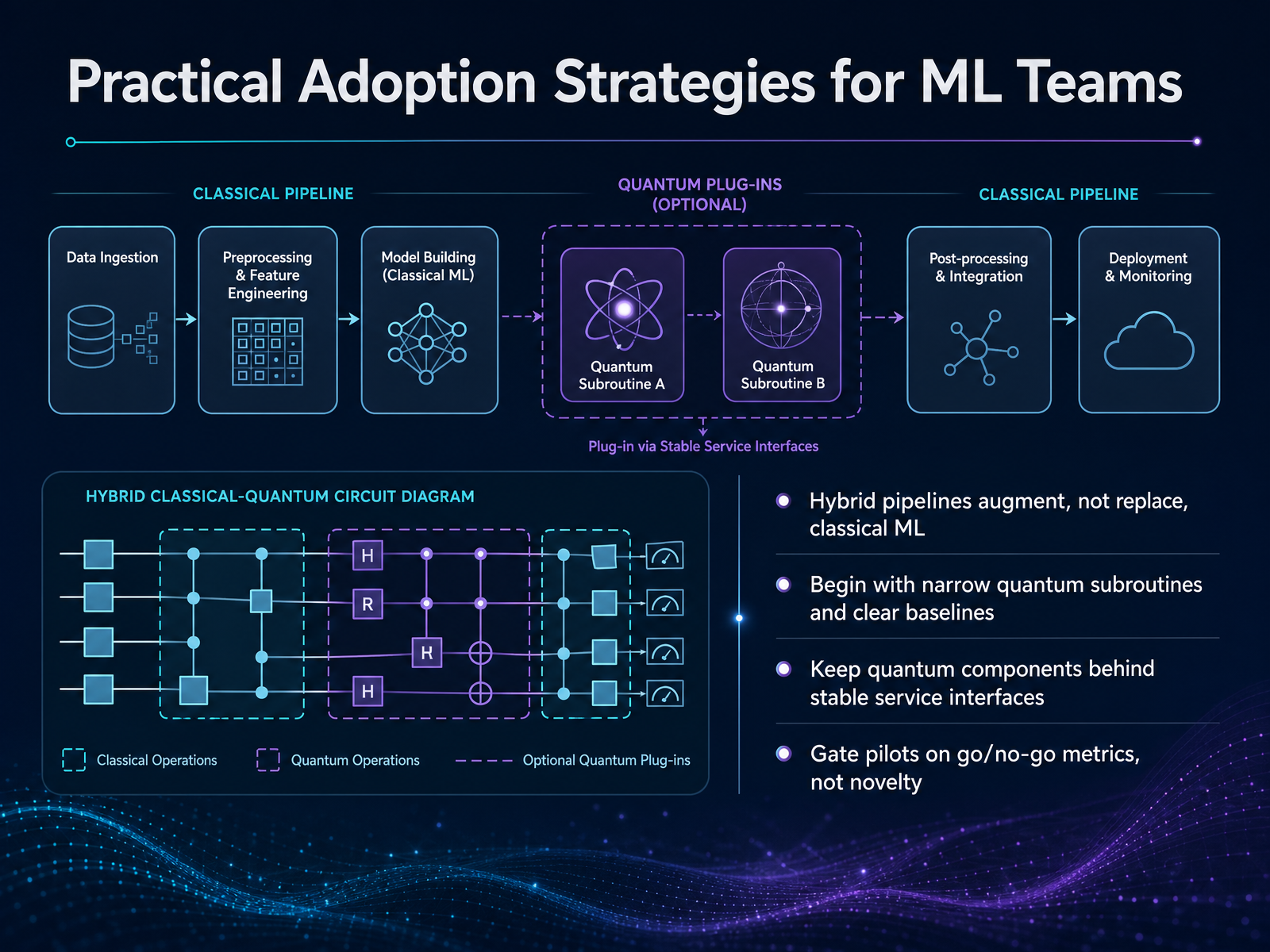
 - 12Practical Adoption Strategies for ML TeamsNow let's turn to adoption strategy. The framing matters more than the hardware. These are hybrid pipelines that augment classical ML, not replace it. Start with narrow quantum subroutines. Pick a bounded experiment with a clear baseline, a limited feature dimension, and an evaluation criterion that is meaningful even if the quantum gain is marginal. Keep the quantum component behind a stable service interface, one that accepts encoded samples and returns kernel matrices or embeddings. That way you can swap a simulator for real hardware without rewriting the pipeline. Crucially, do not gate the pilot on novelty. Define go or no-go metrics upfront, measurable thresholds for accuracy uplift, cost per run, or operational latency. If the quantum component does not beat a strong classical baseline, shelve it and write the learning report. From there, we move to the open problems and the research directions the field is actively confronting.
 link.springer.compostquantum.comsciencedirect.com+21 min
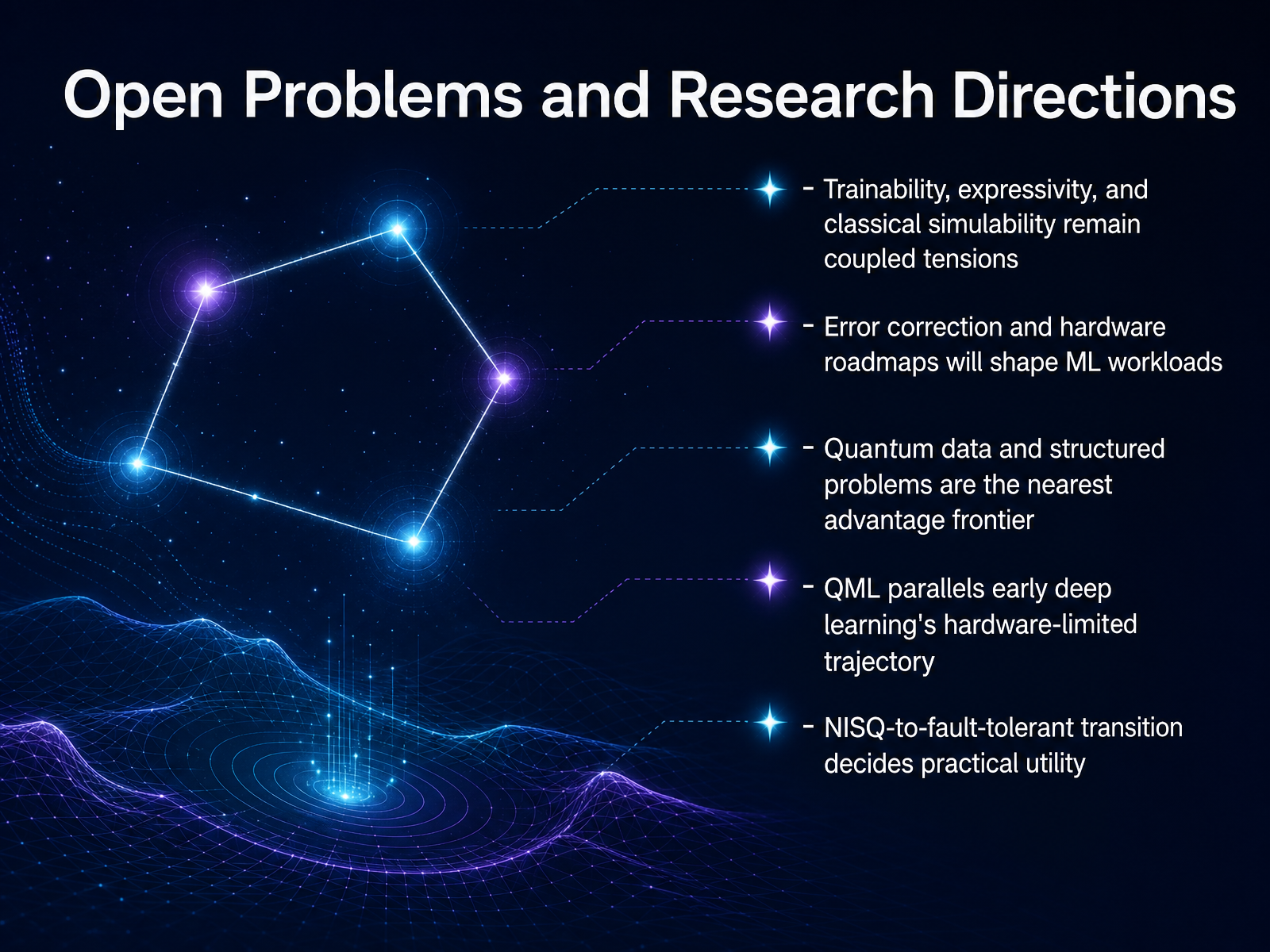
 - 13Open Problems and Research DirectionsLet’s step back and look at where the field actually stands. The core tension you will keep encountering is between expressivity, trainability, and classical simulability. Push one, and the other two push back. A circuit expressive enough to promise advantage often becomes untrainable through barren plateaus, or classically simulable, which silently erases that advantage. Recent work on particle-number-preserving architectures shows we can navigate this, but it remains a delicate balancing act. Next, error correction. The transition from NISQ devices to fault-tolerant machines is not just a hardware milestone; it will dictate which learning workloads become economically viable. Gate fidelities today, around ninety-nine to ninety-nine point nine percent, still cap useful circuit depth. Finally, the clearest near-term wins are on quantum data and structured problems. Learning from quantum states, or exploiting algebraic structure classical methods cannot shortcut, is where advantage is experimentally demonstrated. This trajectory mirrors early deep learning: hardware-limited, but with clear theoretical signals. The NISQ-to-fault-tolerant leap is what decides whether QML becomes transformative or remains specialized. Keep this context in mind as we move to the key takeaways and decision framework.
 sciencedirect.comlink.springer.compostquantum.com+22 min
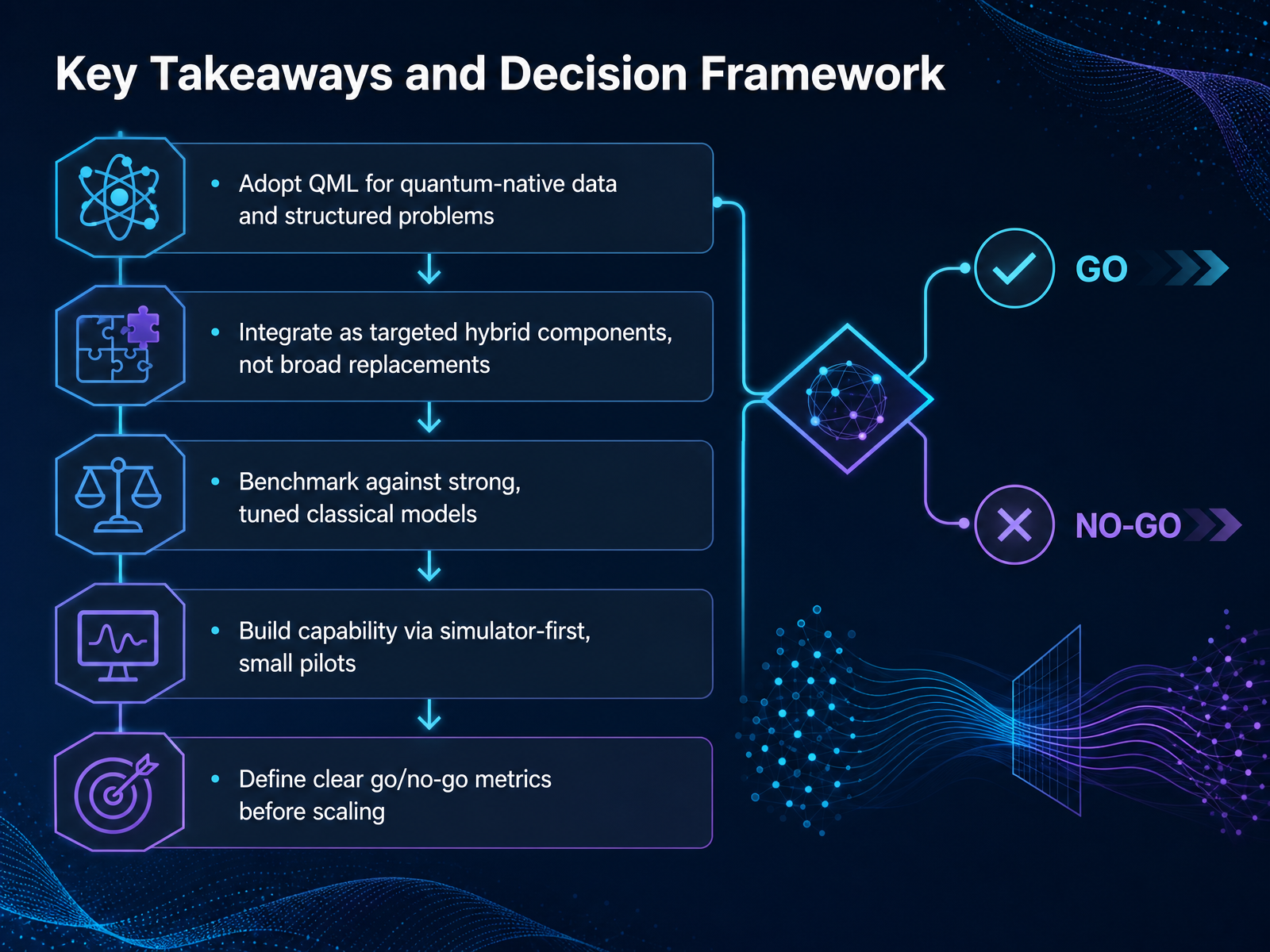
 - 14Key Takeaways and Decision FrameworkSo, where does this leave you as a practitioner? Adopt QML where the problem is quantum-native, or where structure aligns with what quantum circuits naturally compute. Treat it as a targeted hybrid component, the inner-loop accelerator, not a broad replacement. Benchmark relentlessly against tuned classical models. Many claimed wins disappear once a proper baseline enters the fight. Build capability simulator-first. Prototype on small pilots before touching hardware. And above all, define sharp go or no-go metrics before you scale. These decisions separate credible engineering from costly exploration. Thanks for engaging with this material. You now have a solid map of the quantum landscape. Keep your baselines strong, and your experiments honest.
 link.springer.compostquantum.comsciencedirect.com+21 min
Take the deck with you
Download this course as a file — free, no sign-up needed.
- PDF handoutEvery slide page, ready to print or share.15 pages · 4.1 MBDownload
- Narrated PowerPointThe deck that presents itself — every slide carries the digital human's narration video.15 pages · 16.8 MBDownload
- PowerPoint slidesThe full deck as a .pptx — open it in PowerPoint, Keynote, or Google Slides.15 pages · 4.0 MBDownload
Free to use in your own training — please keep the PersonWise credit page at the end.
Have your own deck? Turn it into a course
Sources consulted
Web sources consulted while building this course.
- A review of quantum machine learning algorithms, applications, and emerging advantages | Discover Computing | Springer Nature Link — link.springer.com
- Quantum Machine Learning in 2026: State of the Field — postquantum.com
- Quantum Machine Learning: A Comprehensive Survey of Models, Challenges, and Future Directions - ScienceDirect — sciencedirect.com
- Quantum Machine Learning: Where Are We and What Is ... — dl.acm.org
- Quantum Machine Learning Explained 2026: 8 Essential Algorithms — quantumzeitgeist.com
- Feature Encoding in Quantum Machine Learning: A Survey and Practical Guidelines — arxiv.org
- A Correlation Aware Quantum Feature Map for Variational Quantum Classification — doi.org
- Comparative performance analysis of quantum feature maps for ... — nature.com
- Shot‑Based Quantum Encoding: A Data‑Loading Paradigm for Quantum Neural Networks — arxiv.org
- A Correlation Aware Quantum Feature Map for Variational Quantum Classification — arxiv.org
- [2604.18837] Benchmarking Quantum Kernel Support Vector Machines Against Classical Baselines on Tabular Data: A Rigorous Empirical Study with Hardware Validation — arxiv.org
- Do We Really Need Quantum Machine Learning?: A Multidimensional Empirical Study — doi.org
- Performance Analysis of Quantum Support Vector Classifiers and Quantum Neural Networks This work has been supported by the State Research Agency of the Spanish Government (Grant PID2023-147422OB-I00) and by the Xunta de Galicia (Grant ED431C 2022/44), supported by the EU European Regional Developmen — arxiv.org
- Quantum-enhanced predictive analytics in healthcare: benchmarking QSVM and QNN on medical datasets - ADS — ui.adsabs.harvard.edu
- Hybrid Quantum Machine Learning for Intrusion Detection: A Comparative Study of QNN and QSVM Models — inspirehep.net
- https://arxiv.org/pdf/2604.09957 — arxiv.org
- Challenges in Barren Plateau Mitigation with Dynamic Parameterized Quantum Circuits — arxiv.org
- Overcoming Barren Plateaus in Variational Quantum Circuits using a Two-Step Least Squares Approach — arxiv.org
- Mitigating Noise-Induced Barren Plateaus Using a Non-Unitary Ansatz: Application to Molecular Electronic Transport — doi.org
- Q-LINK: Quantum Layerwise Information Residual Network via a Messenger Qubit for Barren Plateaus Mitigation - arXiv.gg — arxiv.gg