Begin
14 pages · ~28 min
AI Literacy Roadmap and Communication
This training helps teams and leaders plan AI literacy initiatives by defining priorities, milestones, and communication strategies for successful adoption.
A digital instructor presents all 14 pages. Hold “Ask” at any point and ask out loud — the answer comes from this course. No sign-up needed.
What you’ll learn
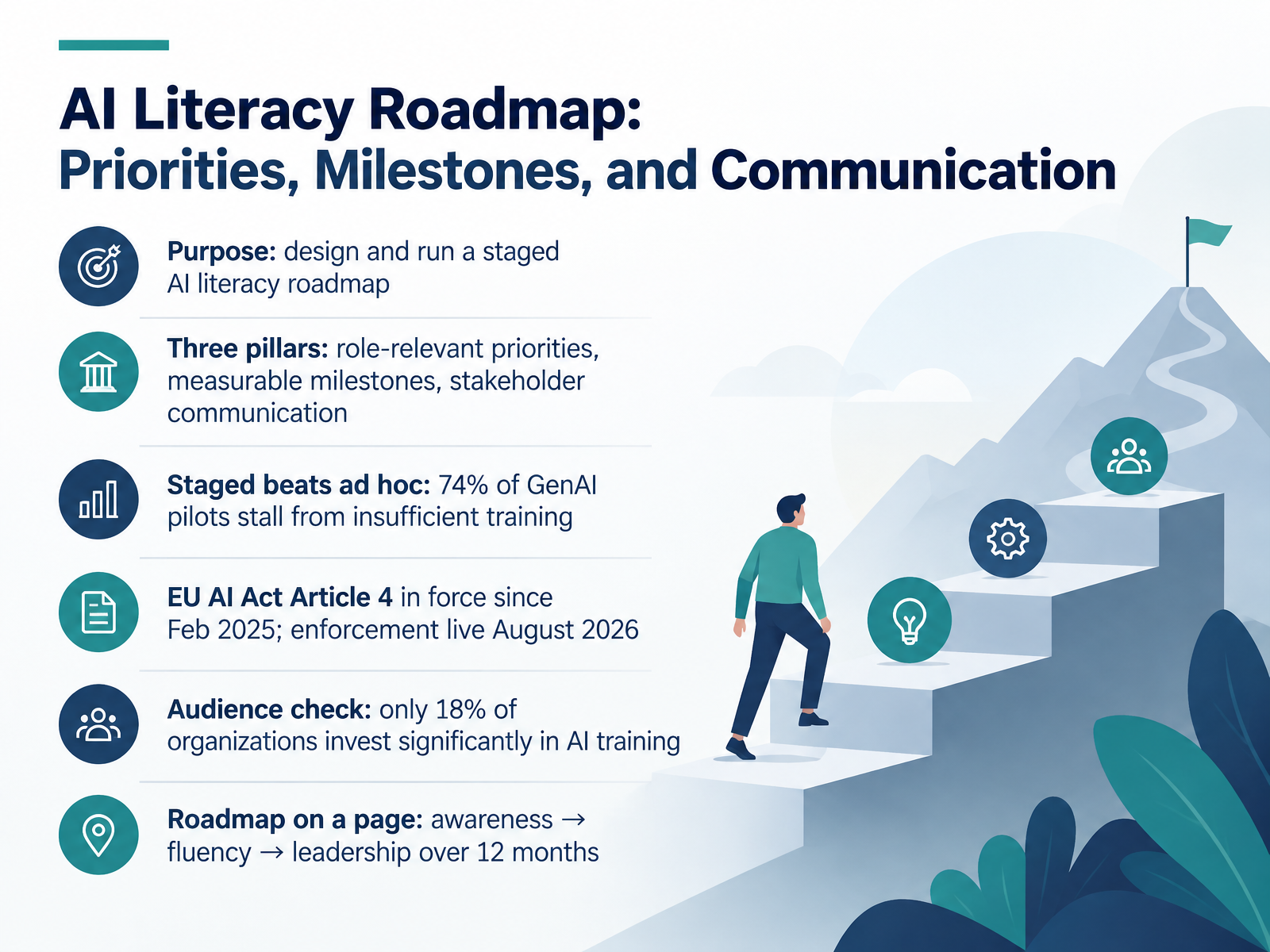
- 01AI Literacy Roadmap: Priorities, Milestones, and CommunicationWelcome to AI Literacy Roadmap: Priorities, Milestones, and Communication. Over the next few minutes, we'll give you a practical framework for designing and running a staged AI literacy roadmap across your organization. This is built on three pillars. First, role-relevant priorities, because a finance director and an engineer need very different things. Second, measurable milestones, so you can prove progress rather than assume it. And third, stakeholder communication, so your sponsors stay aligned and your teams understand the why. Here's the case for staging this deliberately. Research shows that seventy-four percent of generative AI pilots stall, and the top driver is insufficient workforce training. Regulation adds urgency too. The EU AI Act's Article 4 has been in force since February twenty twenty-five, with enforcement live from August twenty twenty-six. Yet only eighteen percent of organizations invest significantly in AI training, so you're likely ahead of the curve if you're planning this now. On this slide, we've captured a roadmap on a page: awareness, then fluency, then leadership, sequenced across twelve months. Let's look at why AI Literacy Is Now a Business Priority.deloitte.comctaio.devagentic-ai-solutions.com+22 min
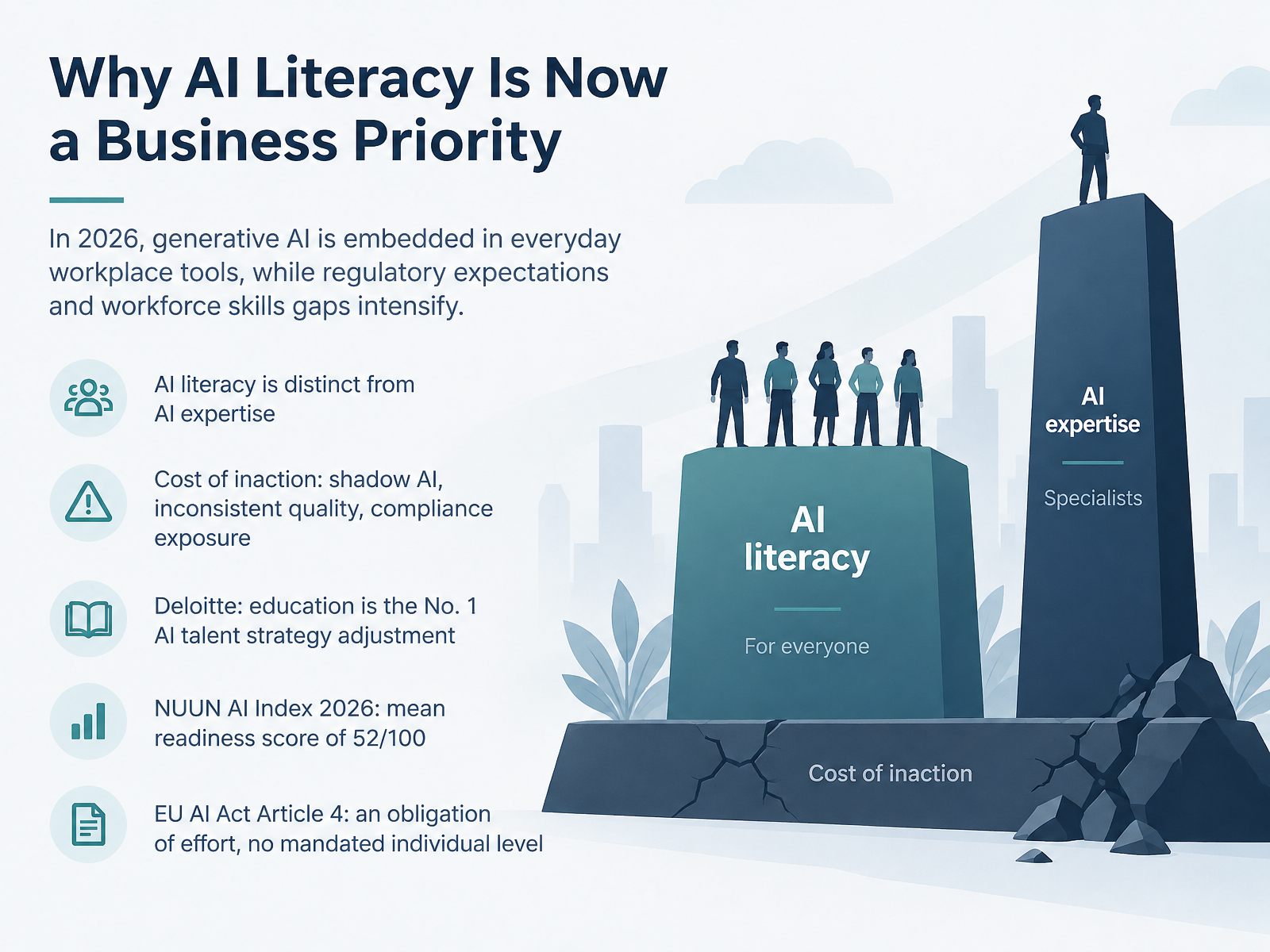
- 02Why AI Literacy Is Now a Business PriorityLet us start with the case you will need to make. In 2026, generative AI is already inside your everyday tools, regulatory expectations are tightening, and skills gaps are widening. So how do you frame AI literacy as a business priority rather than a training nice-to-have? First, separate literacy from expertise. You are not building a workforce of engineers. You are building people who know when to trust an output, when to question it, and where the guardrails sit. The cost of inaction is concrete: shadow AI, inconsistent quality, and compliance exposure. The evidence backs the urgency. Deloitte found that educating the broader workforce was the number one AI talent strategy adjustment, cited by fifty-three percent of leaders. And the NUUN AI Index 2026 puts average enterprise readiness at just fifty-two out of one hundred. On regulation, EU AI Act Article 4 is an obligation of effort, not a mandated individual level. Now let us move from the why to the how. Defining Priorities: From Generic to Role-Relevant AI Literacy.
 deloitte.comctaio.devagentic-ai-solutions.com+22 min
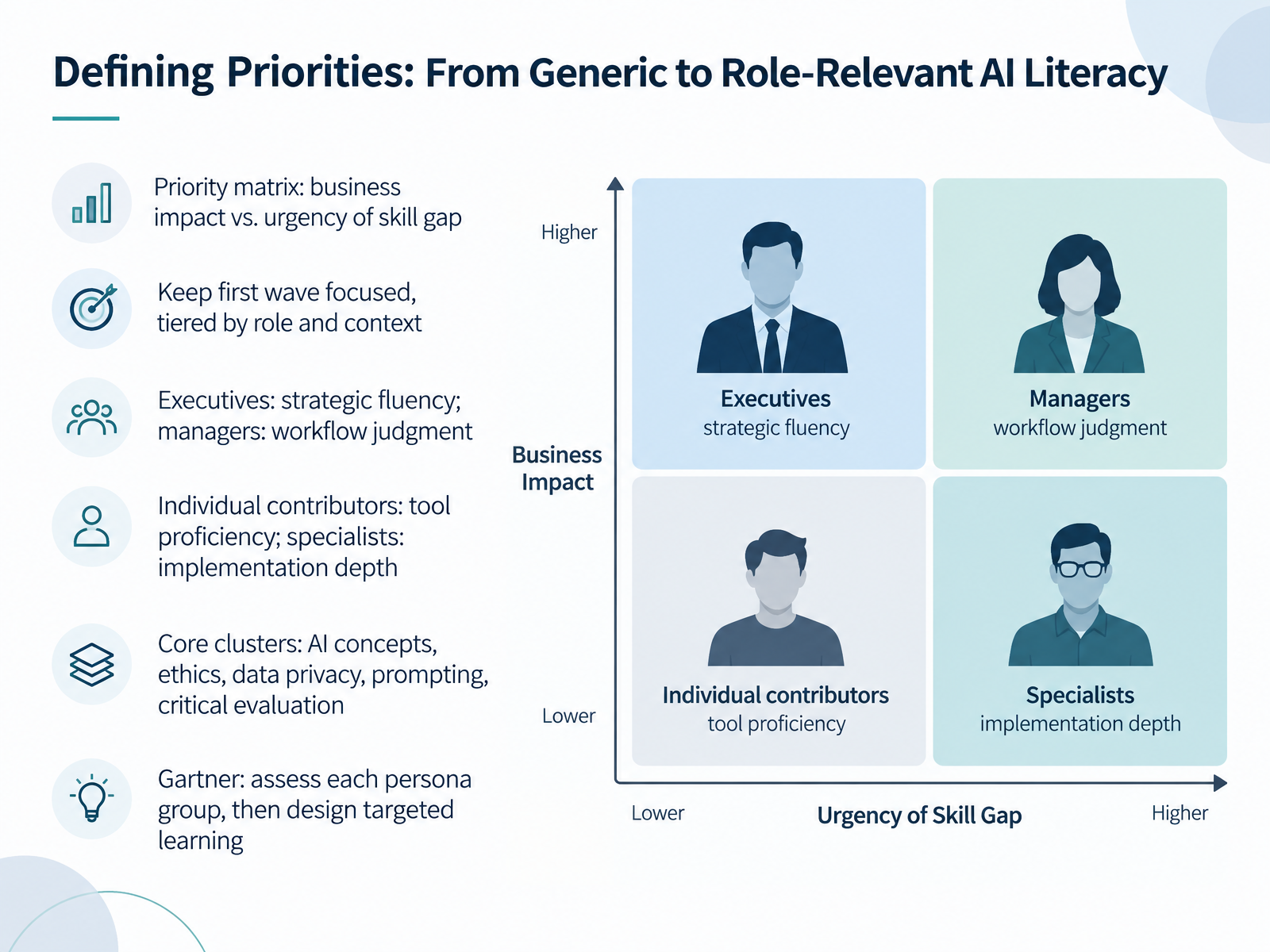
 - 03Defining Priorities: From Generic to Role-Relevant AI LiteracyNow let's move from the case for AI literacy to the practical question. Which priorities come first? The core principle is simple. Move from generic to role-relevant. Start with a priority matrix. Map business impact against the urgency of the skill gap, and invest where both are high. Keep your first wave deliberately focused, tiered by role and context. Executives need strategic fluency, understanding what AI means for decisions and risk. Managers need workflow judgment, so they can coach their teams and evaluate AI-assisted output. Individual contributors need tool proficiency. Specialists need implementation depth. Across every tier, cover the same core clusters: AI concepts, ethics, data privacy, prompting, and critical evaluation, with depth matched to the role. Gartner's guidance is direct here. Assess each persona group first, then design targeted learning. One-size-fits-all misses everyone. Next, we'll look at designing milestones and a staged learning journey.
 deloitte.comctaio.devagentic-ai-solutions.com+22 min
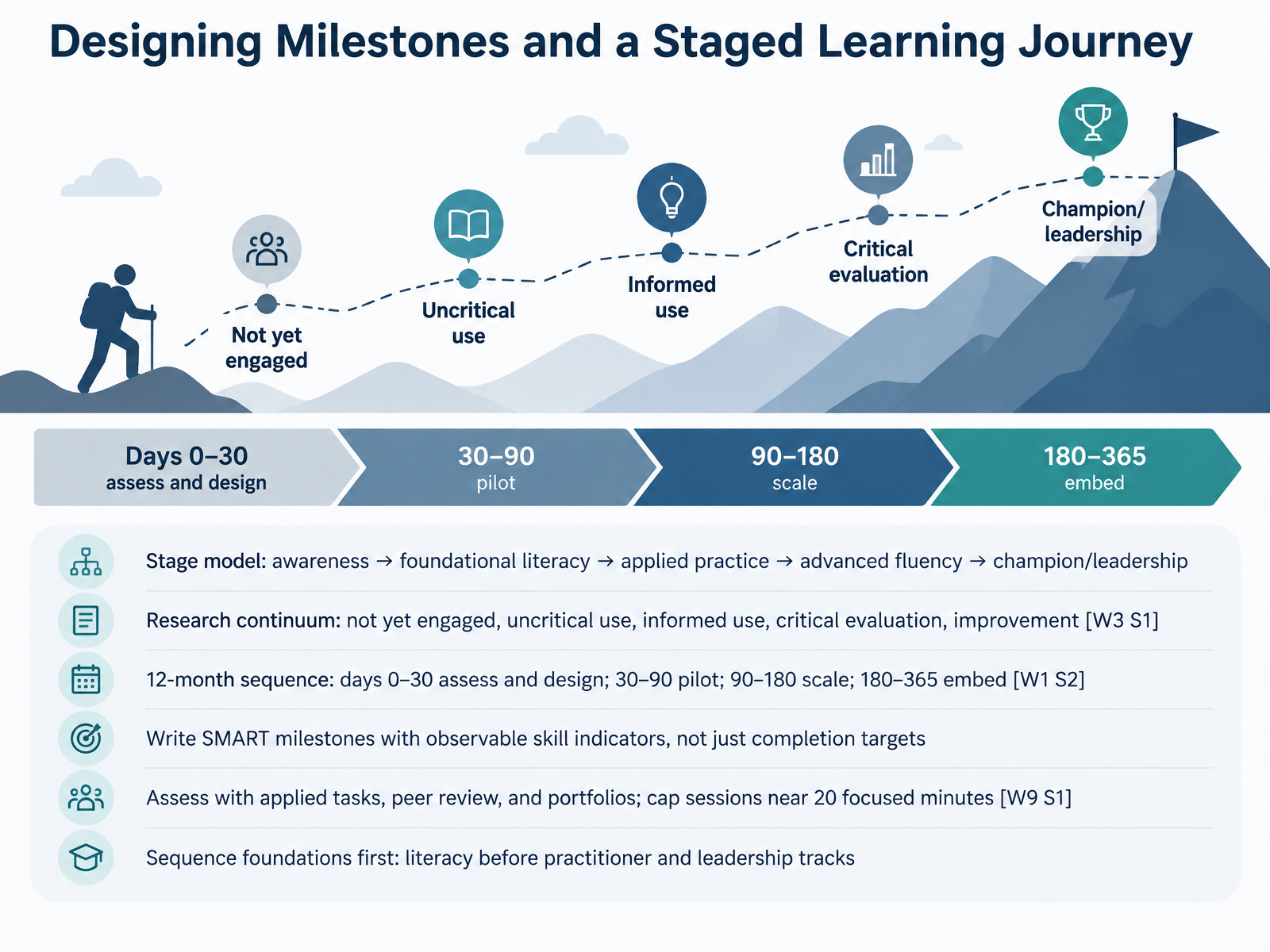
 - 04Designing Milestones and a Staged Learning JourneyNow let's talk about designing milestones and a staged learning journey your people can actually follow. Think in stages: awareness, foundational literacy, applied practice, advanced fluency, and champion or leadership. Alongside that, diagnose where people start, using a continuum from not yet engaged and uncritical use, through informed use and critical evaluation, to improvement. Sequence it over twelve months. Days zero to thirty, assess and design. Thirty to ninety, pilot. Ninety to one eighty, scale. One eighty to three sixty five, embed. Write SMART milestones with observable skill indicators, not just completion targets. A weak milestone says finish the module. A strong one says identify three failure modes of a drafting assistant and describe the verification step for each. Assess with applied tasks, peer review, and portfolios, and cap sessions near twenty focused minutes. And sequence foundations first. Literacy before practitioner and leadership tracks. The trade-off is real: skipping foundations to reach specialists faster produces confident users who cannot verify output. So treat your milestone map as a governing document you revisit each quarter, not a one-time plan. Next, a practical roadmap template.
 arxiv.orgailiteracyframework.orgopenrepository.aut.ac.nz+22 min
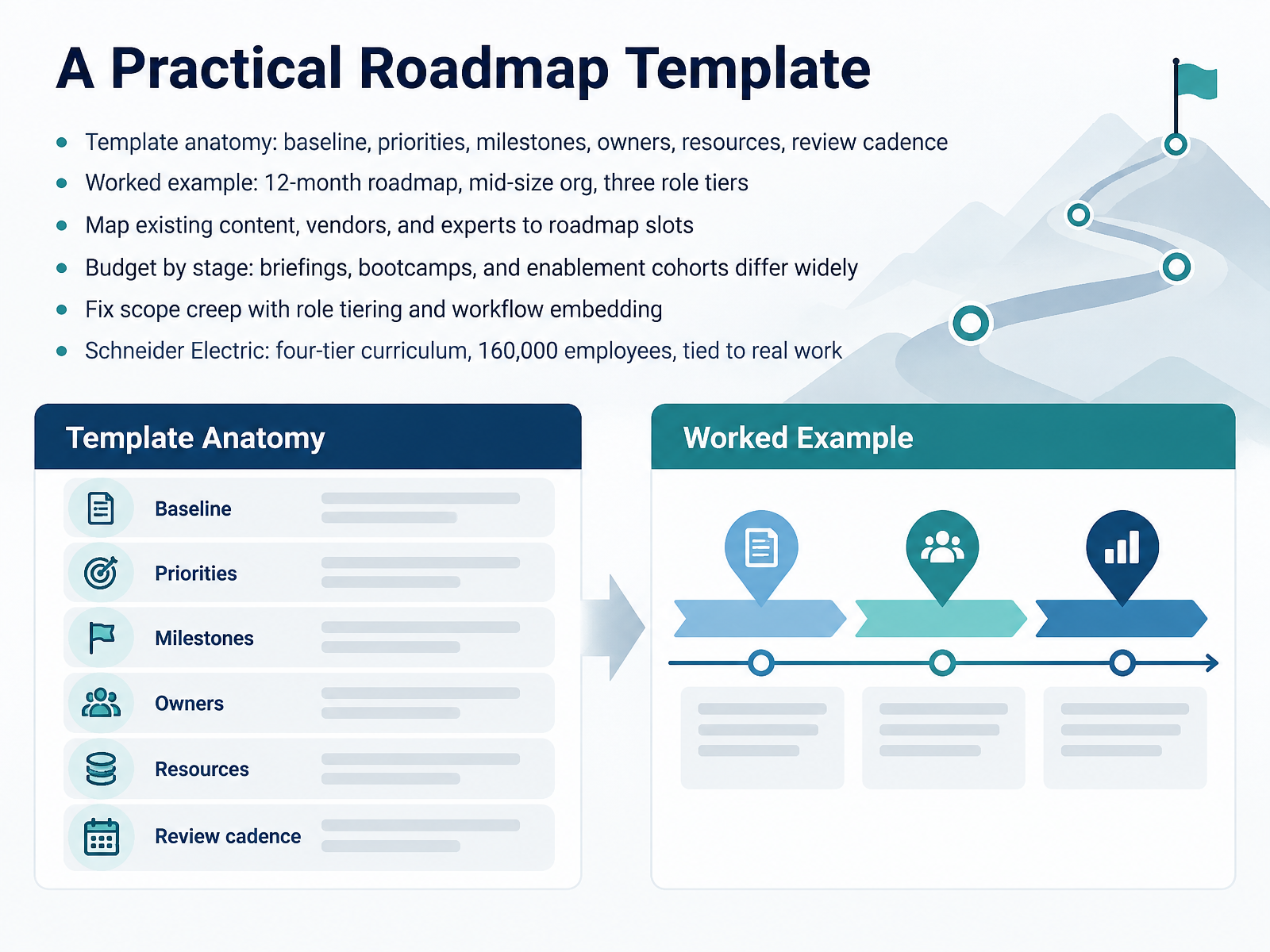
 - 05A Practical Roadmap TemplateNow, let's look at the template itself. The anatomy is simple: baseline, priorities, milestones, owners, resources, and a review cadence. Six sections, one page, and it fits a twelve-month horizon for a mid-size organization with three role tiers. When you fill it in, do not build content from scratch. Map what you already have. An existing vendor module might cover foundational literacy, so that slot is done. A respected engineer can lead the practitioner tier. Those decisions save you months. Budget by stage, because formats differ sharply. An executive briefing might cost fifteen to thirty thousand euros for a half day, while a multi-month enablement cohort runs well into six figures. And to control scope creep, let role tiering and workflow embedding do the work. Focus each tier on what that role actually does. A strong example is Schneider Electric. They built a four-tier curriculum for one hundred sixty thousand employees, tied directly to real work. So the takeaway is this: a roadmap is a staffing and budgeting document, not a course catalog. Next, we'll cover communicating the roadmap to stakeholders.
 deloitte.comctaio.devagentic-ai-solutions.com+22 min
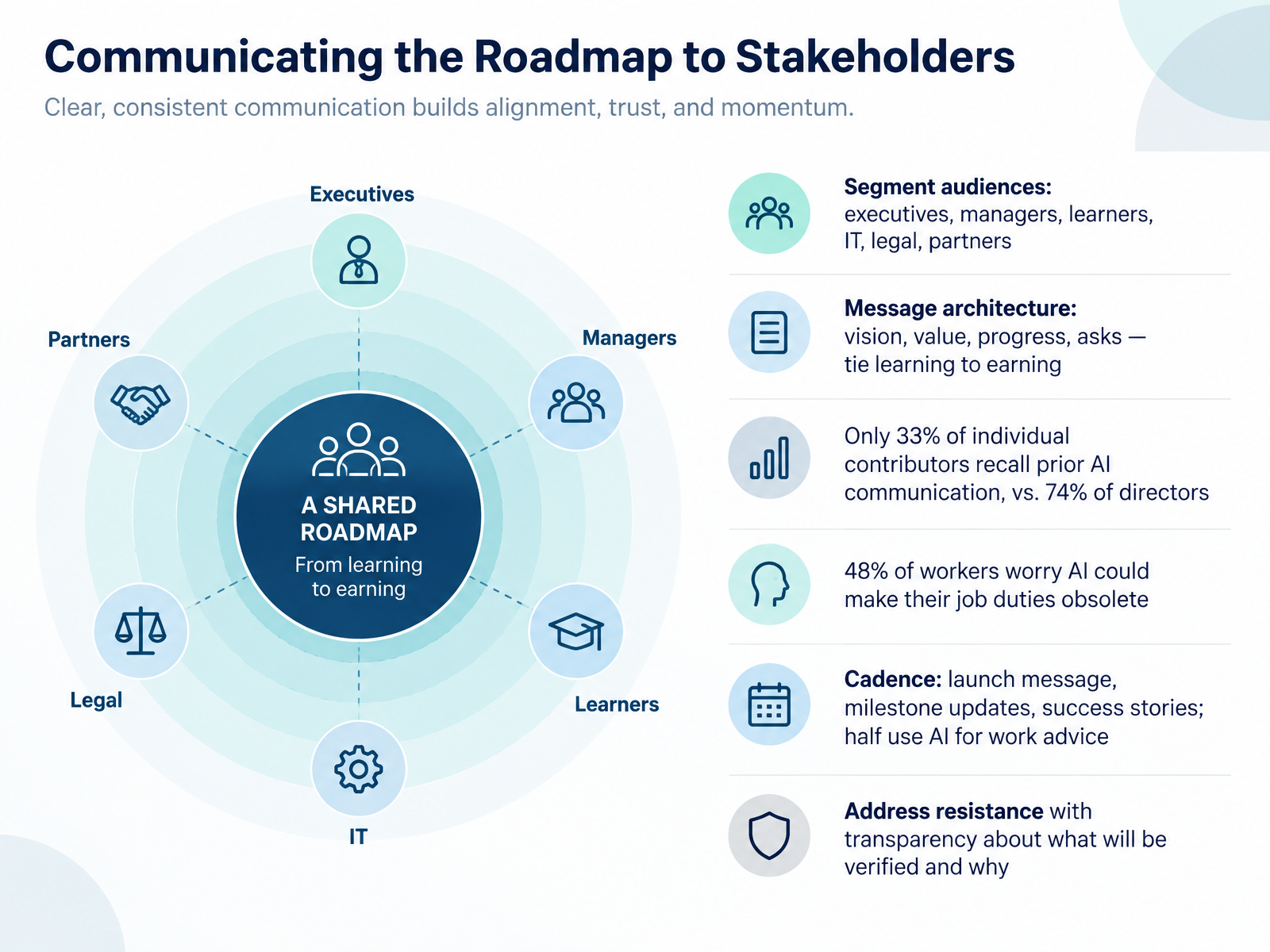
 - 06Communicating the Roadmap to StakeholdersLet's turn to communicating the roadmap to your stakeholders. The same message will not work for everyone, so segment deliberately: executives want vision and return, managers want workflow guidance, learners want clarity on what changes for them, and IT, legal, and partners need governance and guardrails. Build one message architecture around four elements: vision, value, progress, and asks. Tie learning to earning. Here's why this matters. In SHRM's 2026 data, seventy-four percent of directors recalled prior AI communication, but only thirty-three percent of individual contributors did. Meanwhile, APA found forty-eight percent of workers worry AI could make their job duties obsolete. That gap is a communication failure, not a motivation failure. So set a cadence: a launch message, milestone updates, and real success stories. Remember that half of employees now ask AI for work advice instead of their manager. Address resistance directly, with transparency about what will be verified and why. Your takeaway: communicate by audience, sequence by milestone, and lead with transparency. Next, we look at measuring progress and demonstrating impact.
 deloitte.comctaio.devagentic-ai-solutions.com+22 min
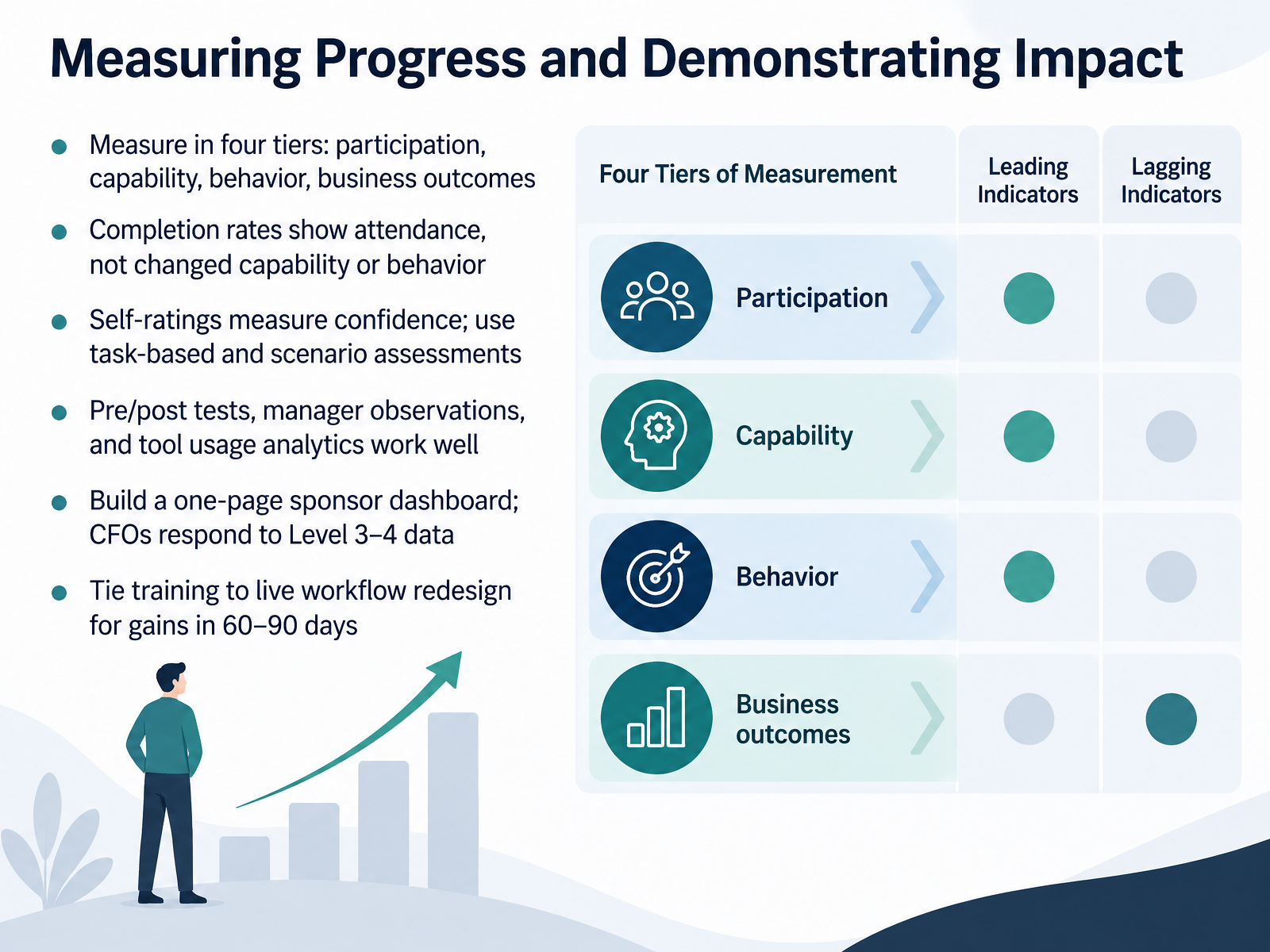
 - 07Measuring Progress and Demonstrating ImpactLet's turn to measuring progress and demonstrating impact. This is where many programs lose credibility, so get the four tiers right: participation, capability, behaviour, and business outcomes. Completion rates only show attendance, not changed capability or behaviour. Self-ratings measure confidence, so pair them with task-based and scenario assessments. Pre and post tests, manager observations, and tool usage analytics give you reliable signals. Build a one-page sponsor dashboard: CFOs respond to Level Three and Level Four data, not satisfaction scores. And embed training in live workflow redesign rather than running it separately. Organizations that do this typically see measurable efficiency gains within sixty to ninety days, roughly twice as fast as standalone training. That 60-to-90-day window is where your credibility with sponsors is made. Next, we'll look at governance, ethics, and risk guardrails.
 deloitte.comctaio.devagentic-ai-solutions.com+21 min
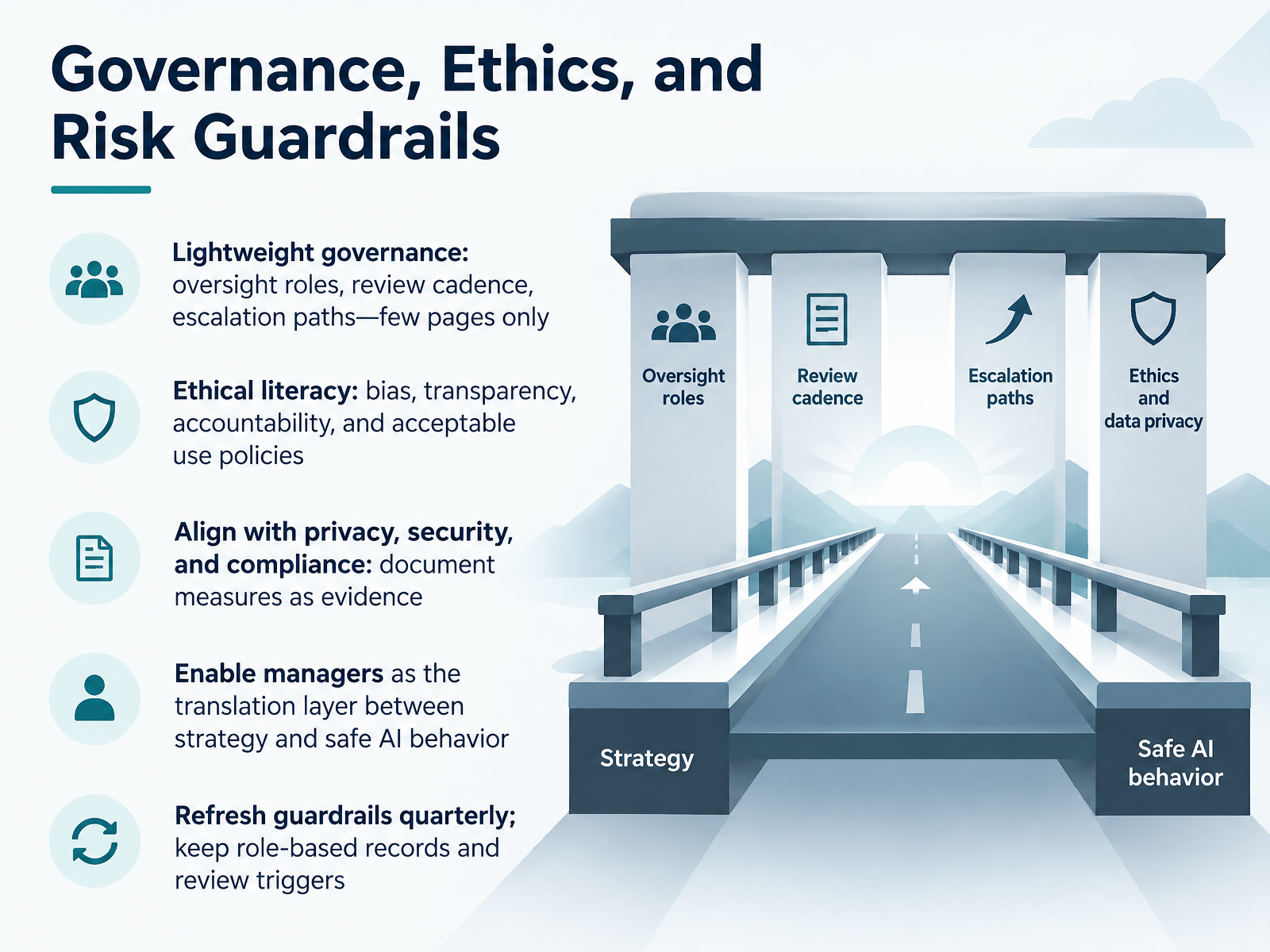
 - 08Governance, Ethics, and Risk GuardrailsNow let us look at the guardrails that keep your program defensible. Governance here should be lightweight: named oversight roles, a review cadence, and a clear escalation path, all captured in a few pages, not a binder. Next, ethical literacy, which means bias, transparency, accountability, and an acceptable use policy your people can actually apply. Then align with privacy, security, and compliance, and document your measures as evidence. Remember, under Article 4, the obligation is one of effort, not a guaranteed level, so records are what demonstrate you acted. Your managers are the translation layer between strategy and safe behavior, so equip them to coach, not just cascade. Finally, refresh guardrails quarterly, and keep role-based records with clear review triggers. In short, small, documented, and current beats comprehensive and ignored. Coming next, Common Pitfalls and Course Corrections.
 digital-strategy.ec.europa.euai-act-service-desk.ec.europa.eudigital-strategy.ec.europa.eu+22 min
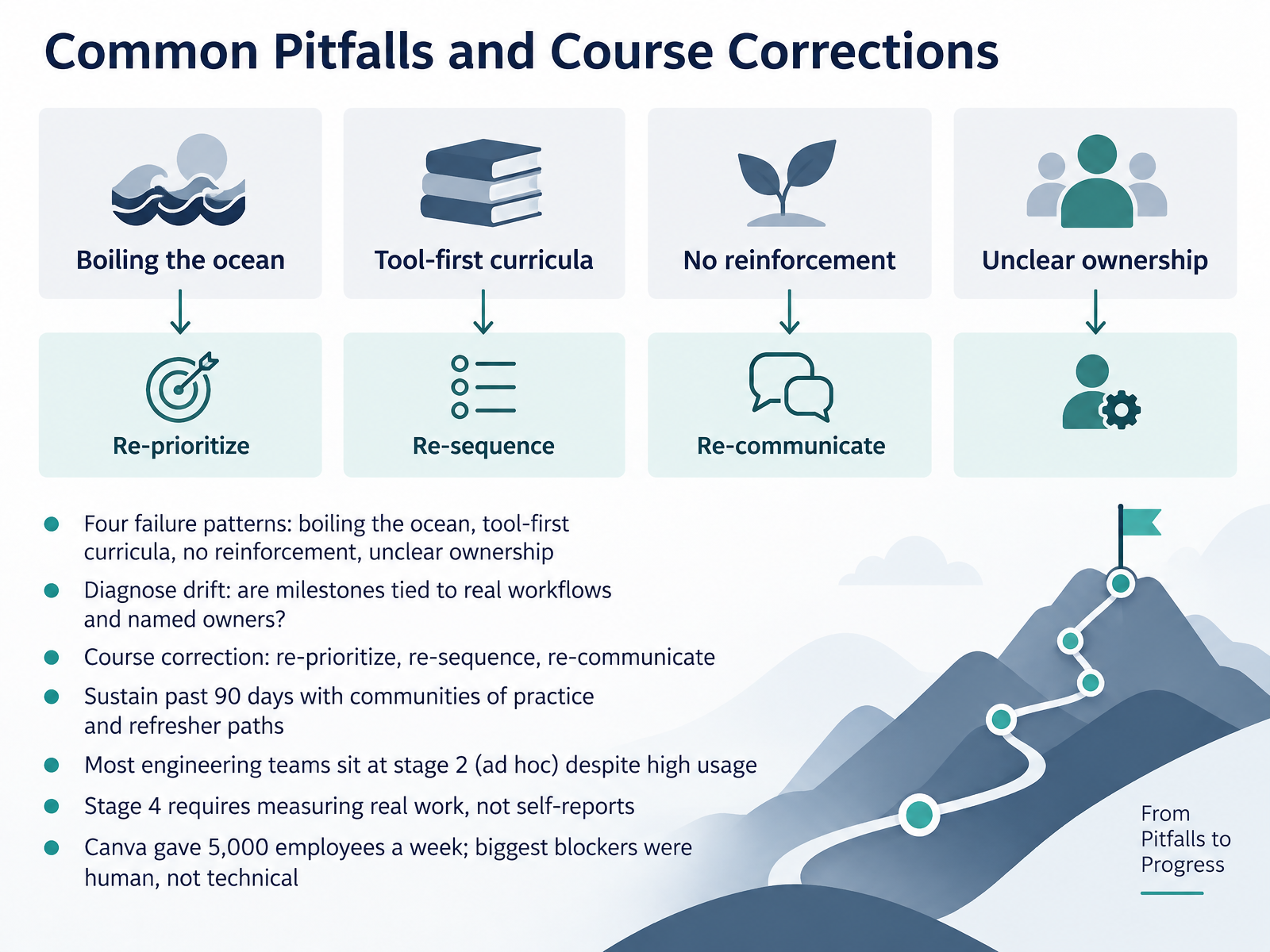
 - 09Common Pitfalls and Course CorrectionsLet's turn to the pitfalls that derail AI literacy programs, because recognizing them early saves you months. Four patterns come up again and again. Boiling the ocean, trying to train everyone on everything. Tool-first curricula that teach button clicks instead of judgment. No reinforcement, so skills fade within weeks. And unclear ownership, where nobody can say who is accountable. So how do you diagnose drift? Ask two questions. Are milestones tied to real workflows? And does every milestone have a named owner? If the answer is no, it's time to course correct. Re-prioritize, re-sequence, and re-communicate. One caution from the research: most engineering teams sit at stage two, ad hoc, with high usage but inconsistent verification. Reaching stage four means measuring real work, not self-reports. And remember Canva's lesson. They gave five thousand employees a full week to explore AI, and the biggest blockers turned out to be human, not technical. Sustaining momentum past ninety days takes communities of practice and regular refresher paths. Next, let's build your action plan for the next ninety days.
 deloitte.comctaio.devagentic-ai-solutions.com+22 min
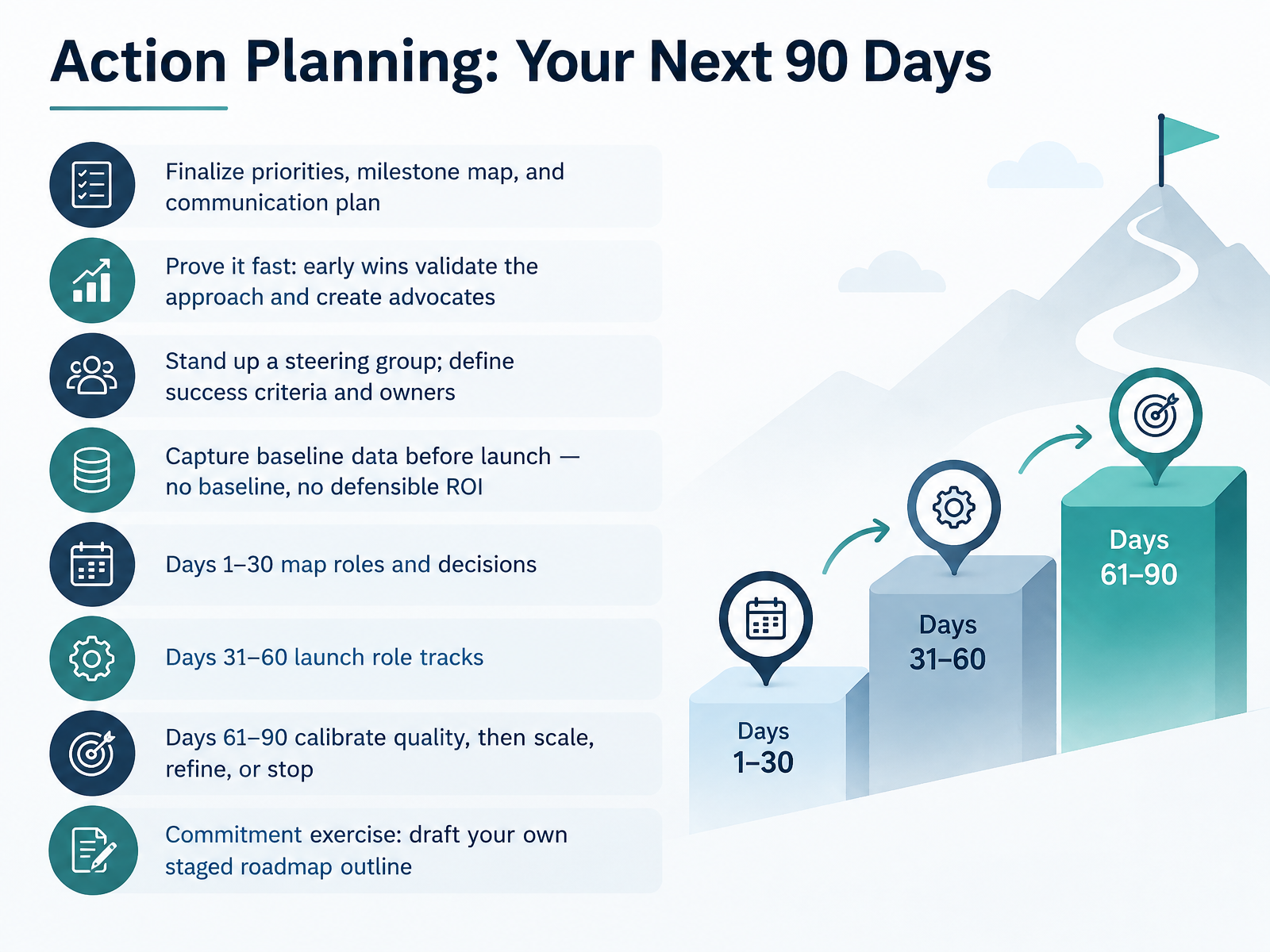
 - 10Action Planning: Your Next 90 DaysLet's put this into an action plan for your next ninety days. Lock down three things first: your finalized priorities, your milestone map, and your communication plan. Then prove it fast. Early wins validate the approach and create advocates who speak credibly to their peers. Stand up a steering group, and define success criteria with named owners. And capture baseline data before launch, because no baseline means no defensible return on investment. Now the sequence. Days one to thirty, map roles and decisions. Days thirty-one to sixty, launch your role tracks. Days sixty-one to ninety, calibrate quality, then decide: scale, refine, or stop. One caution: don't measure completion alone. Track behavior and efficiency at thirty, sixty, and ninety days, because adoption plateaus around day sixty before it becomes habit. So here's your commitment exercise: draft your own staged roadmap outline, with owners and metrics attached to each phase. That outline is your plan to defend. Next, let's look at aligning the roadmap with regulatory expectations.
 deloitte.comctaio.devagentic-ai-solutions.com+22 min
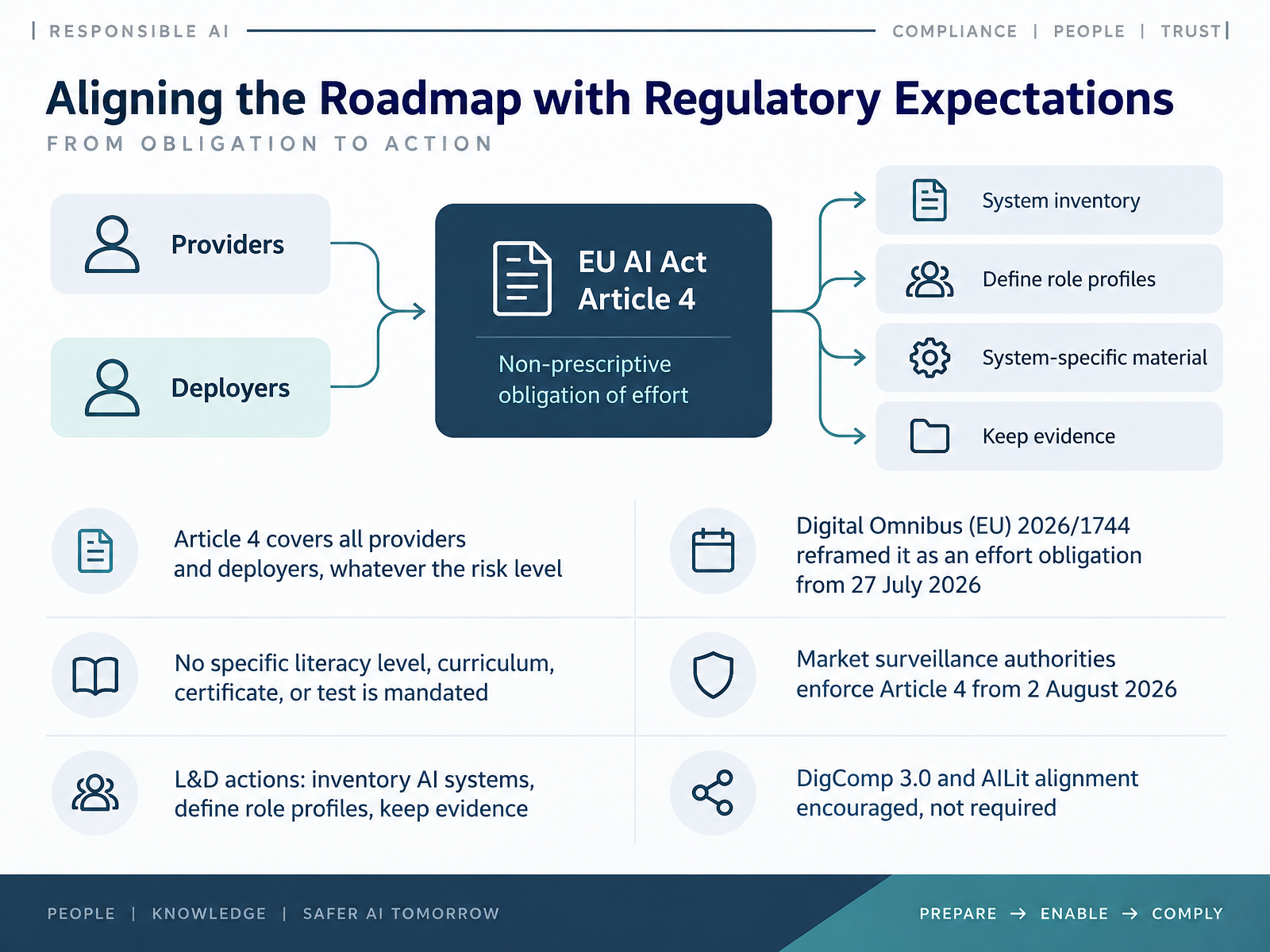
 - 11Aligning the Roadmap with Regulatory ExpectationsLet's now align your roadmap with regulatory expectations, because this is where sequencing really matters. Article 4 of the AI Act applies to every provider and deployer, whatever the risk level. Since the Digital Omnibus, Regulation 2026 slash 1744, it is an effort obligation from the twenty-seventh of July, 2026. No specific literacy level, curriculum, certificate, or test is mandated. Market surveillance authorities begin enforcing Article 4 from the second of August, 2026. So your L and D actions are clear: inventory the AI systems in use, define role profiles, and keep evidence of what you delivered. DigComp 3.0 and AILit alignment is encouraged, not required. Treat this as a defensible effort, not a box to tick. Next, we look at sourcing and building learning content.
 digital-strategy.ec.europa.euai-act-service-desk.ec.europa.eudigital-strategy.ec.europa.eu+21 min
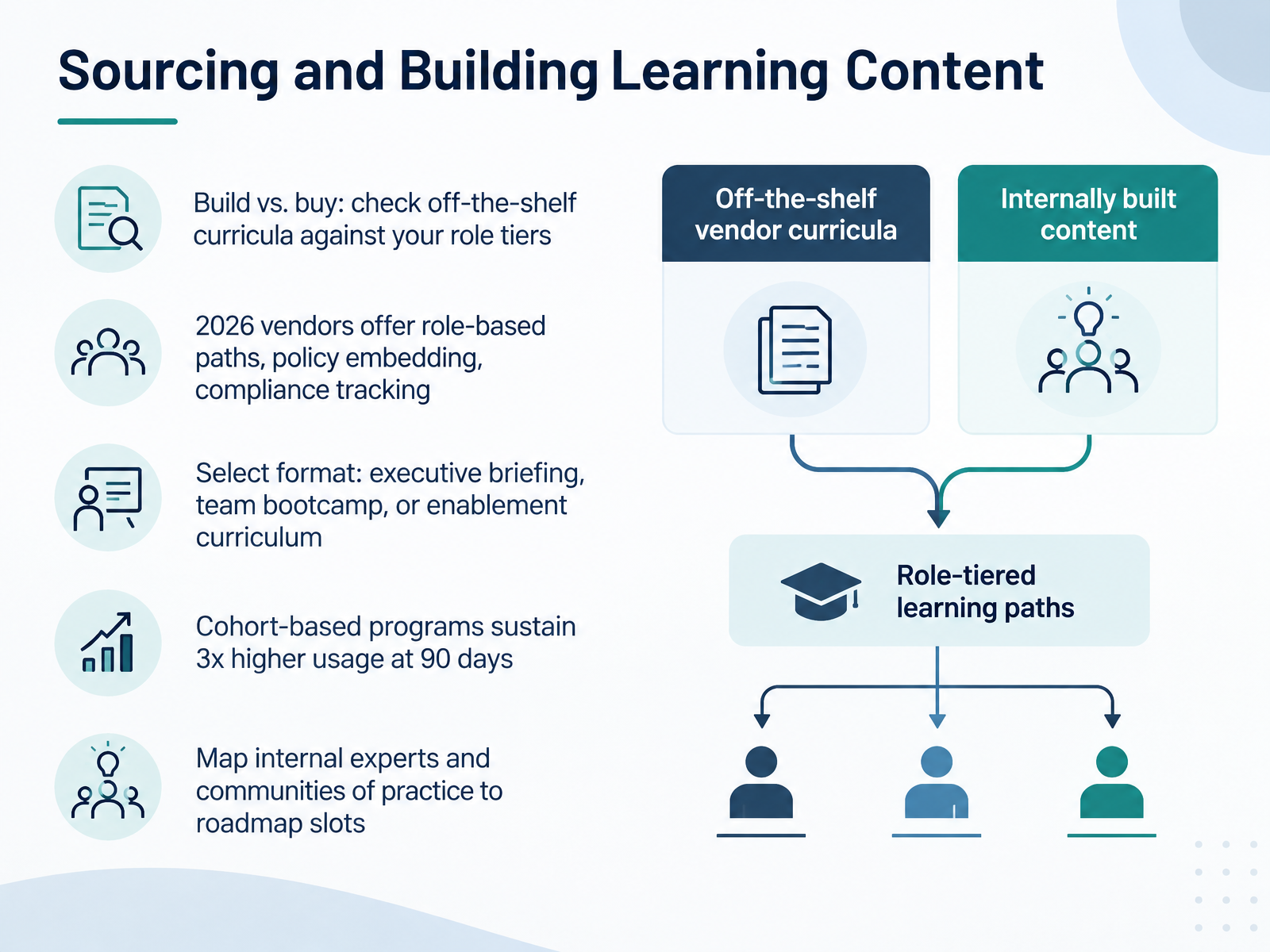
 - 12Sourcing and Building Learning ContentNow let's talk about sourcing and building your learning content. The first decision is build versus buy. Off-the-shelf curricula have matured, so before you commission anything custom, check what vendors already offer against your role tiers. In twenty twenty-six, most credible providers ship role-based paths, policy embedding, and compliance tracking, so you can often buy the foundation and build only the differentiated layer. Next, choose your format deliberately. An executive briefing, a team bootcamp, and an enablement curriculum serve very different purposes and budgets. One benchmark worth holding onto: cohort-based programs sustain roughly three times higher active usage at ninety days than self-paced alternatives. Finally, map your internal experts and communities of practice to specific roadmap slots. Your best content is often already inside the building. That sets up the next question: Building the Business Case for Sponsors.
 deloitte.comctaio.devagentic-ai-solutions.com+22 min
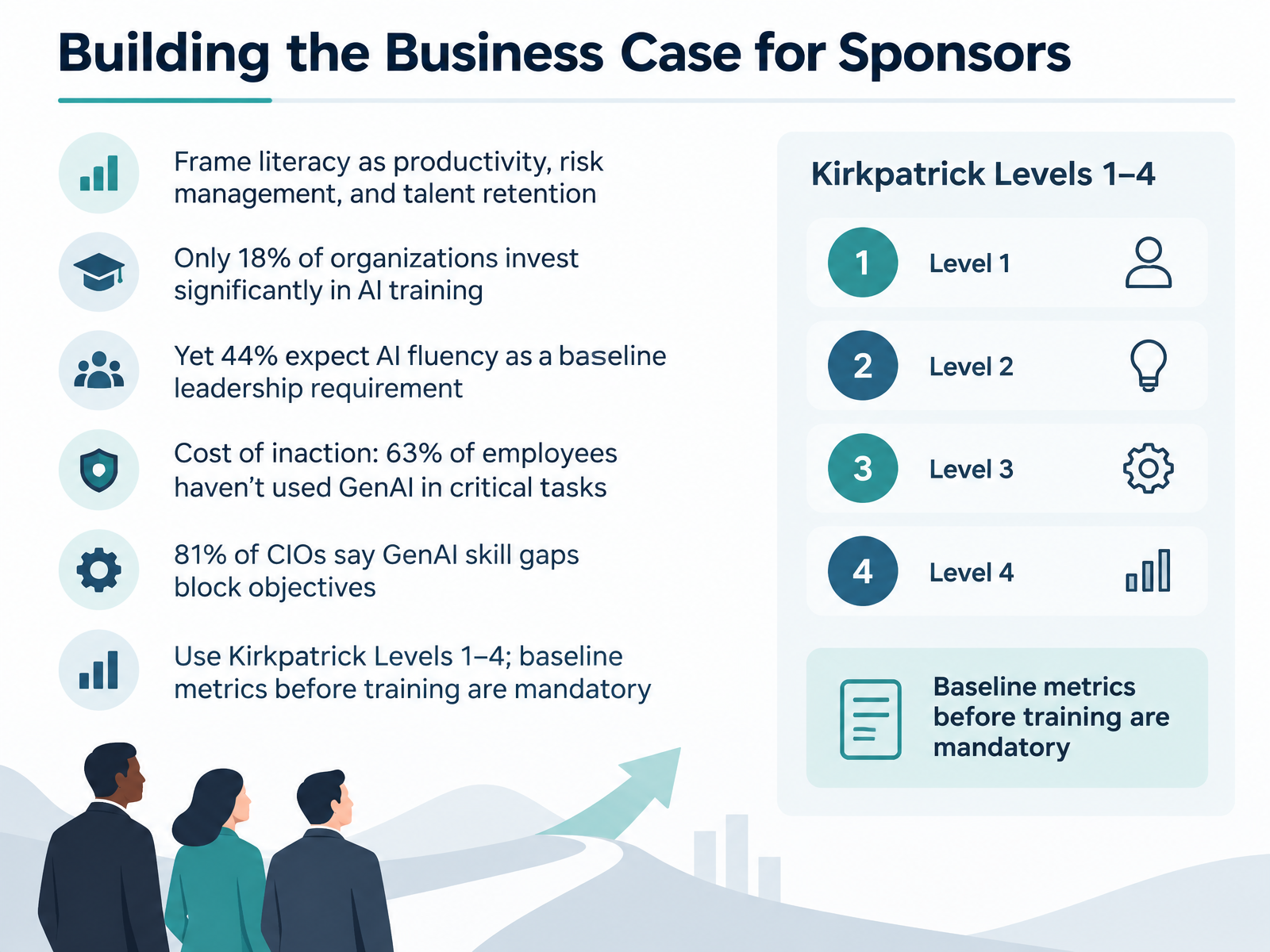
 - 13Building the Business Case for SponsorsNow, let's build the business case you'll take to your sponsors. Frame AI literacy three ways: productivity, risk management, and talent retention. That's the language executives fund. And the numbers make the argument for you. Only eighteen percent of organizations invest significantly in AI training, yet forty-four percent of leaders now expect AI fluency as a baseline leadership requirement. That gap is your opening. Then make the cost of inaction concrete. Sixty-three percent of employees haven't used generative AI in critical tasks, and eighty-one percent of CIOs say GenAI skill gaps are blocking their objectives. Finally, commit to evidence. Use Kirkpatrick Levels one through four, and capture baseline metrics before training starts. Without that baseline, no Level four claim is defensible, and CFOs fund what they can measure. That's the case. Next, we look at Sustaining Momentum and Next Steps.
 deloitte.comctaio.devagentic-ai-solutions.com+22 min
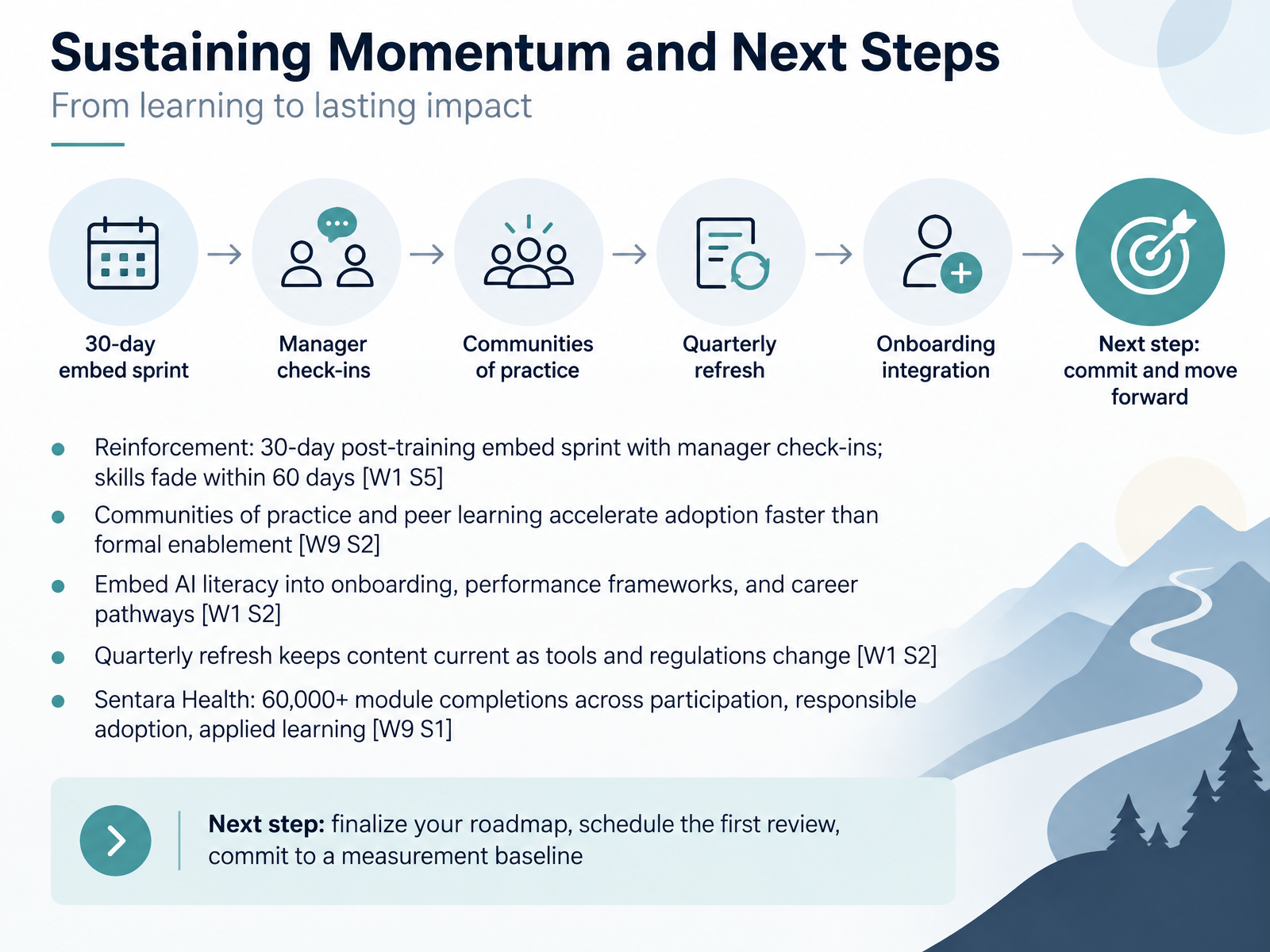
 - 14Sustaining Momentum and Next StepsSo let's bring this roadmap home. The launch is not the finish line. Without reinforcement, skills fade within sixty days, so plan a thirty-day embed sprint with manager check-ins from the start. Communities of practice and peer learning tend to accelerate adoption faster than formal enablement alone. And to make literacy durable, embed it into onboarding, performance frameworks, and career pathways, with a quarterly refresh as tools and regulations change. Sentara Health shows what scale looks like: more than sixty thousand module completions across participation, responsible adoption, and applied learning. So your next step is concrete. Finalize your roadmap, schedule the first review, and commit to a measurement baseline, because you cannot demonstrate progress you never measured. Thank you for working through this with me. You now have the priorities, the milestones, and the communication plan. Go build something your teams can sustain, and keep the momentum going.
 deloitte.comctaio.devagentic-ai-solutions.com+22 min
Take the deck with you
Download this course as a file — free, no sign-up needed.
- PDF handoutEvery slide page, ready to print or share.15 pages · 3.2 MBDownload
- Narrated PowerPointThe deck that presents itself — every slide carries the digital human's narration video.15 pages · 14.5 MBDownload
- PowerPoint slidesThe full deck as a .pptx — open it in PowerPoint, Keynote, or Google Slides.15 pages · 3.1 MBDownload
Free to use in your own training — please keep the PersonWise credit page at the end.
Have your own deck? Turn it into a course
Sources consulted
Web sources consulted while building this course.
- The State of AI in the Enterprise - 2026 AI report | Deloitte US — deloitte.com
- AI Literacy: The Enterprise Rollout Guide for 2026 | CTAIO — ctaio.dev
- Enterprise AI Literacy Program: A Practical Roadmap | Agentic AI Solutions — agentic-ai-solutions.com
- Without AI Literacy, ROI From AI Investments Plummets — gartner.com
- Corporate AI Training: Programs, Costs & Formats 2026 — alicelabs.ai
- [2606.00038v3] Beyond Tool Adoption: A Practical Five-Stage Developmental Continuum for AI Literacy in Higher Education — arxiv.org
- Empowering Learners for the Age of AI — ailiteracyframework.org
- The Scaffolded AI Literacy (SAIL) Framework: Results of a Delphi Study for Equitable AI Literacy Framework Design in Education — openrepository.aut.ac.nz
- AI Literacy Maturity Model: How to Tell Which Stage Your Engineering Team Is Really In — easyenv.io
- AI Literacy Framework — paradoxlearning.com
- AI talent, skills and literacy | Shaping Europe's digital future — digital-strategy.ec.europa.eu
- Article 4: AI literacy | AI Act Service Desk — ai-act-service-desk.ec.europa.eu
- AI Literacy - Questions & Answers — digital-strategy.ec.europa.eu
- An operational framework for AI literacy in the workplace — interface-eu.org
- EU workplace AI: employer obligations under the AI Act and GDPR, including high-risk HR tools, prohibited emotion recognition, GPAI, discrimination safeguards, AI literacy and practical compliance steps - Legal Guidance - LexisNexis UK — lexisnexis.com