Machine Learning vs Business Intelligence: Tradeoffs
Begin
13 pages · ~26 min
Machine Learning vs Business Intelligence: Tradeoffs
Learn to differentiate machine learning and business intelligence, examining their tradeoffs and real-world use cases to select the right approach for data-driven decisions.
What you’ll learn
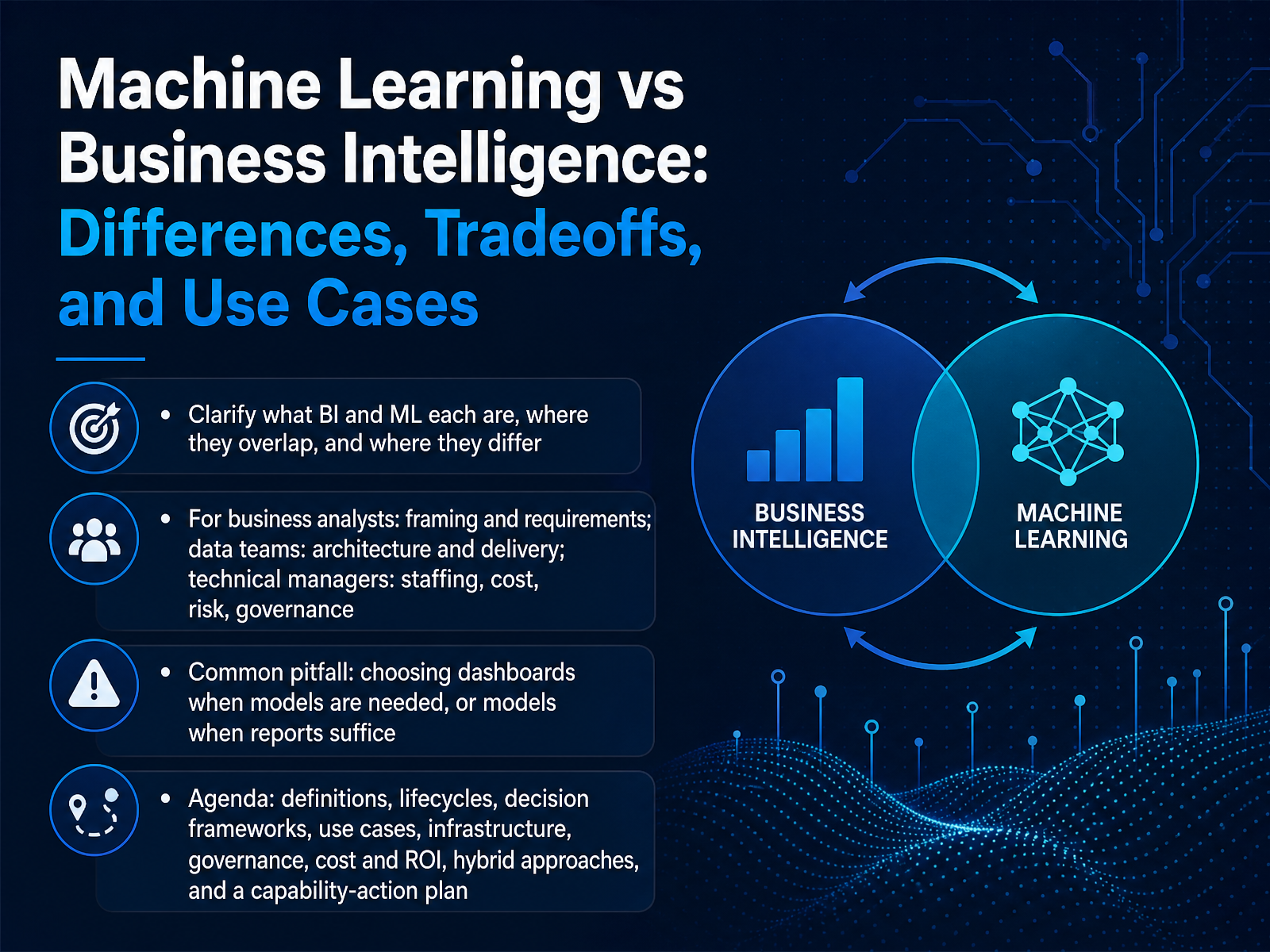
- 01Machine Learning vs Business Intelligence: Differences, Tradeoffs, and Use CasesWelcome. If you work with data, you've probably felt the tension between building a dashboard and building a model. This session cuts through that confusion. We'll clarify what business intelligence and machine learning each do best, where they overlap, and where they diverge. For business analysts, that means getting the framing and requirements right. For data teams, it's about the architecture and delivery. For technical managers, it's about staffing, cost, risk, and governance. Here's the pitfall we see most often: teams build dashboards when they actually need models, or they spin up complex models when a simple report would do. Both mistakes are expensive. Over the next few minutes, we'll cover definitions, lifecycles, decision frameworks, use cases, infrastructure, governance, cost, and the hybrid approaches that most mature organizations end up adopting. You'll leave with a clear capability-and-action plan. Let's start with the fundamentals: the core concepts of BI, machine learning, and the analytics continuum that ties them together.aws.amazon.comtechrepublic.comenable.com+22 min
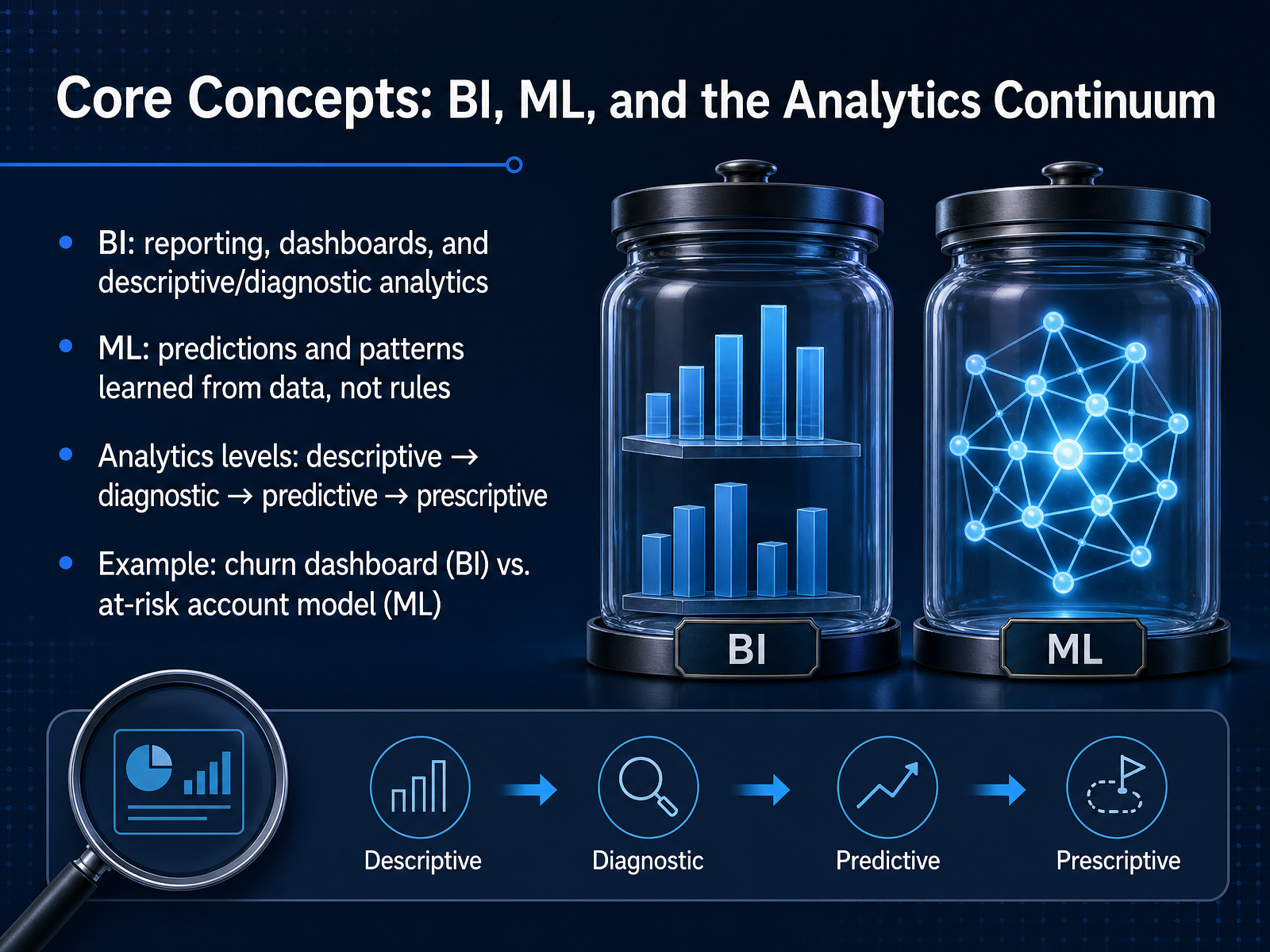
- 02Core Concepts: BI, ML, and the Analytics ContinuumNow let’s establish where BI and ML each fit in the analytics continuum. Business intelligence is primarily descriptive and diagnostic. It answers what happened, how it happened, and why it happened—typically through dashboards and structured reports. Machine learning, by contrast, learns patterns from data rather than following fixed rules. It uses those patterns to generate predictions and sometimes recommendations. The move from BI to ML maps directly to the analytics maturity levels: descriptive, diagnostic, predictive, and prescriptive. Most teams are already strong in the first two. ML investment is what unlocks the last two. To make this concrete, consider customer churn. A churn dashboard in BI shows you historical monthly churn rates—percentage lost, trend lines, segment breakdowns. That is descriptive. An ML at-risk account model, on the other hand, scores each customer individually, predicting which accounts are likely to churn in the next ninety days based on purchase history, engagement, and support tickets. That is the difference between seeing the burn and knowing which fires to fight. With that distinction clear, let’s look at the key differences in orientation, data, and skills.
 aws.amazon.comtechrepublic.comenable.com+22 min
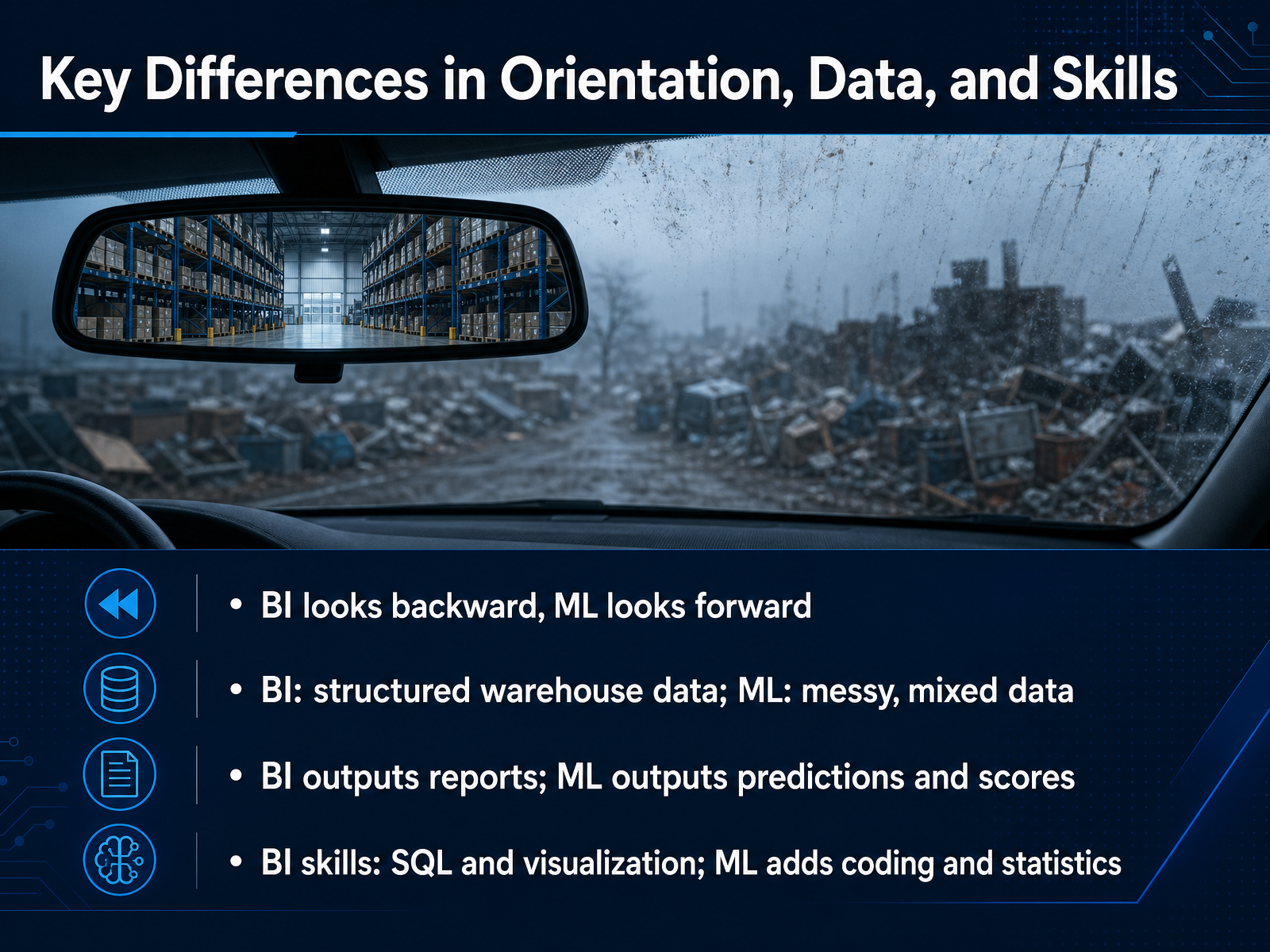
 - 03Key Differences in Orientation, Data, and SkillsNow let's get to the practical differences. First, direction. BI is fundamentally backward-looking. It answers what happened, how it happened, and why. ML is forward-looking. It uses what has happened to predict what will happen next. Second, data. BI thrives on clean, structured warehouse data. ML, on the other hand, is built to handle messy, mixed data. Think text from emails, call transcripts, or even images. A churn model, for example, can pull from purchase history, support tickets, and demographics to score risk, while a standard BI report simply charts historical churn percentages. Third, output. BI produces reports and dashboards for human interpretation. ML produces predictions, probabilities, and scores that can trigger automated actions or feed directly into those dashboards. Finally, skills. BI requires strong SQL and visualization skills. ML adds coding and statistics to that foundation. This doesn't mean you need a data science team for every project; no-code tools are closing that gap. But the core distinction stays: BI describes the past, ML forecasts the future. That's the fundamental tradeoff you'll weigh. Now, let's look at how the work and lifecycle of these two disciplines actually differ.
 aws.amazon.comtechrepublic.comenable.com+22 min
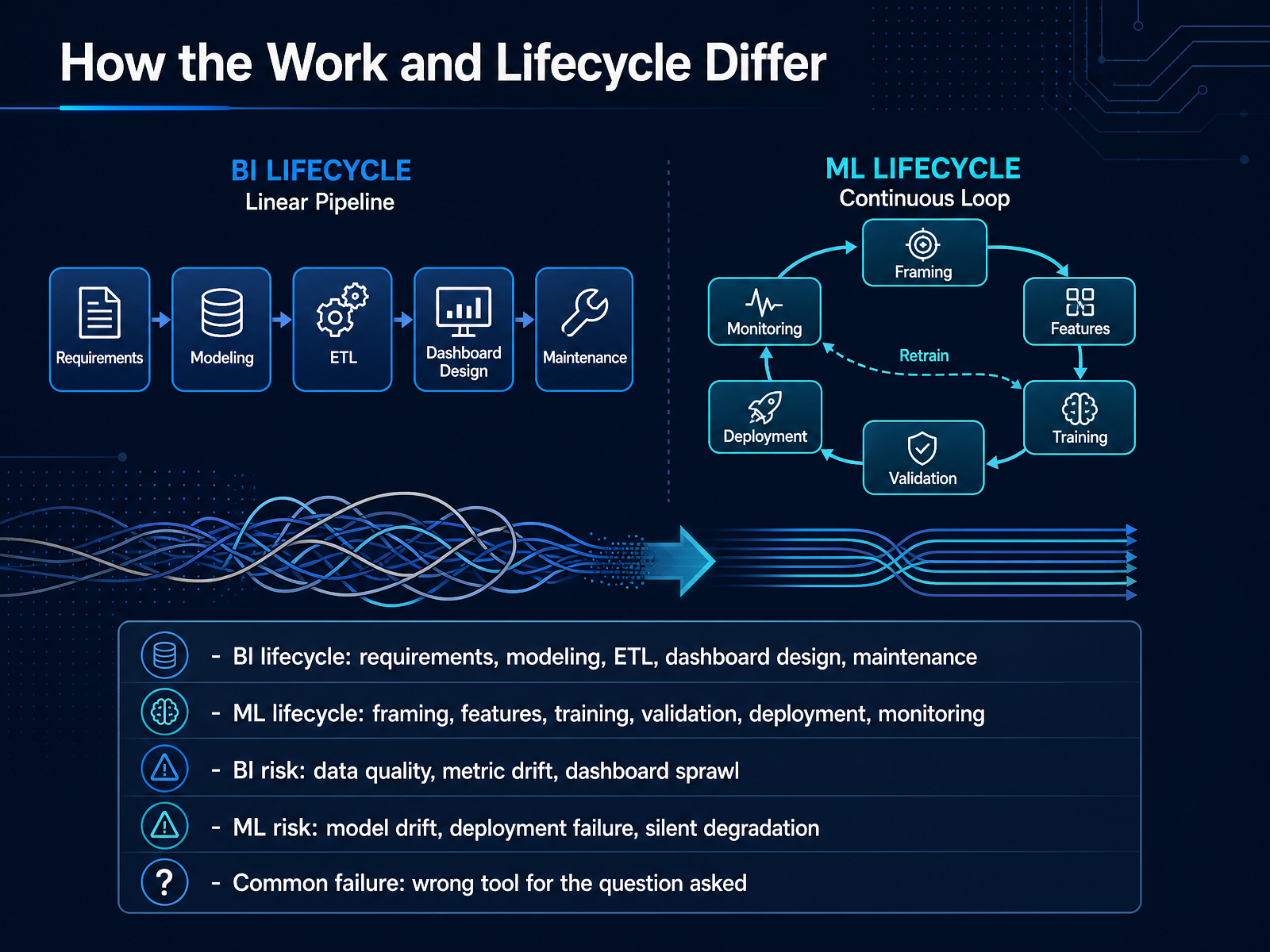
 - 04How the Work and Lifecycle DifferNow let's look at how the work actually differs. The BI lifecycle is built around requirements, data modeling, ETL, dashboard design, and ongoing maintenance. Your team defines what to measure, builds the pipeline, and keeps the reports credible. Machine learning follows a different path: framing the problem, engineering features, training, validation, then deployment, and continuous monitoring. The risk profiles also diverge. With BI, you worry about data quality, metric drift, and dashboard sprawl. With ML, the risks are model drift, deployment failure, and silent degradation. Both can fail quietly. A dashboard reporting the wrong number and a model returning bad predictions look similar until the business acts on them. The most common failure we see is using the wrong tool for the question asked. You don't need a churn model to answer what happened last quarter, and you can't track prediction accuracy with a KPI card. Match the tool to the decision you're making. So when you choose, consider your timeline and your team. This leads us to a framework for when to choose BI, ML, or both.
 kore1.comituonline.comtogglehire.com+22 min
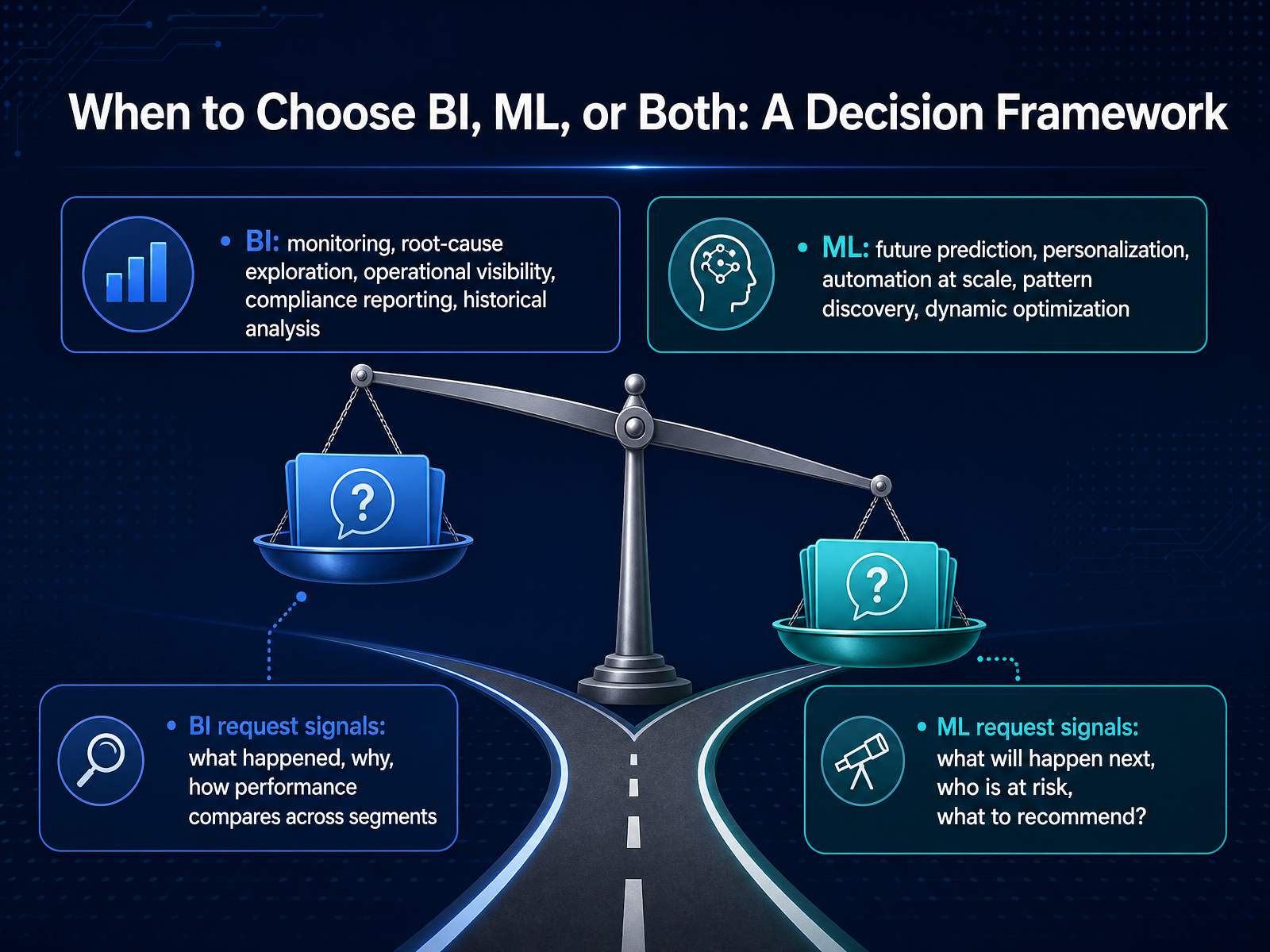
 - 05When to Choose BI, ML, or Both: A Decision FrameworkNow let's turn this into a practical framework. If your question starts with "what happened," "why did it happen," or "how does performance compare across segments," that's BI territory. You need dashboards, drill-downs, and compliance reporting. If your question is "what will happen next," "who is at risk," or "what should we recommend," that's where ML earns its keep. Machine learning is for prediction, personalization, automation at scale, and pattern discovery that's too complex for manual rules. When in doubt, look at the decision timeline. BI supports ongoing monitoring and root-cause exploration. ML drives future predictions and dynamic optimization. In many cases, you'll use both—say, BI to identify a churn trend, then ML to score individual customer risk. The best analytics strategies layer ML on top of BI, not instead of it. Up next, we'll look at specific use cases by business function.
 aws.amazon.comthoughtspot.comdatapoem.ai+21 min
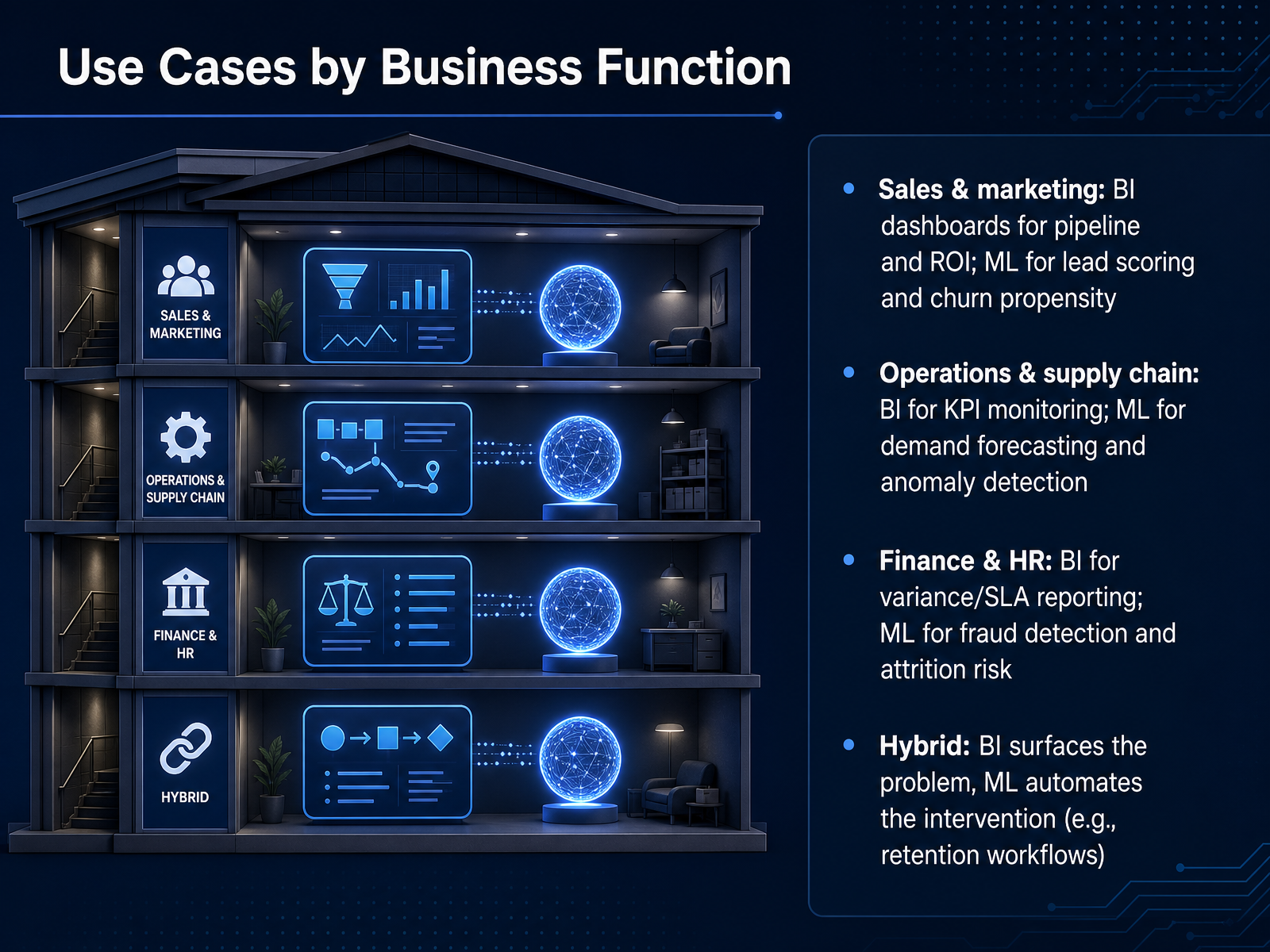
 - 06Use Cases by Business FunctionLet’s ground this in specific functions. In sales and marketing, BI gives you pipeline dashboards and ROI tracking. ML moves you forward — lead scoring, churn propensity. Operations: BI monitors your KPIs, while ML handles demand forecasting and anomaly detection. Finance and HR: BI covers variance and SLA reporting; ML flags fraud and attrition risk. Now here’s the key pattern to remember. It’s hybrid. BI surfaces the problem; ML automates the intervention. Think retention workflows. Your dashboard shows a churn spike. Your model identifies exactly who is at risk. Then the system triggers the outreach automatically. You don’t choose one over the other. You layer them. Use BI for visibility and accountability, and use ML where you need prediction at scale. That combination is where you get real leverage. Next, let’s look at the data, infrastructure, and team requirements that make this work.
 domo.comsnowflake.comnetsuite.com+22 min
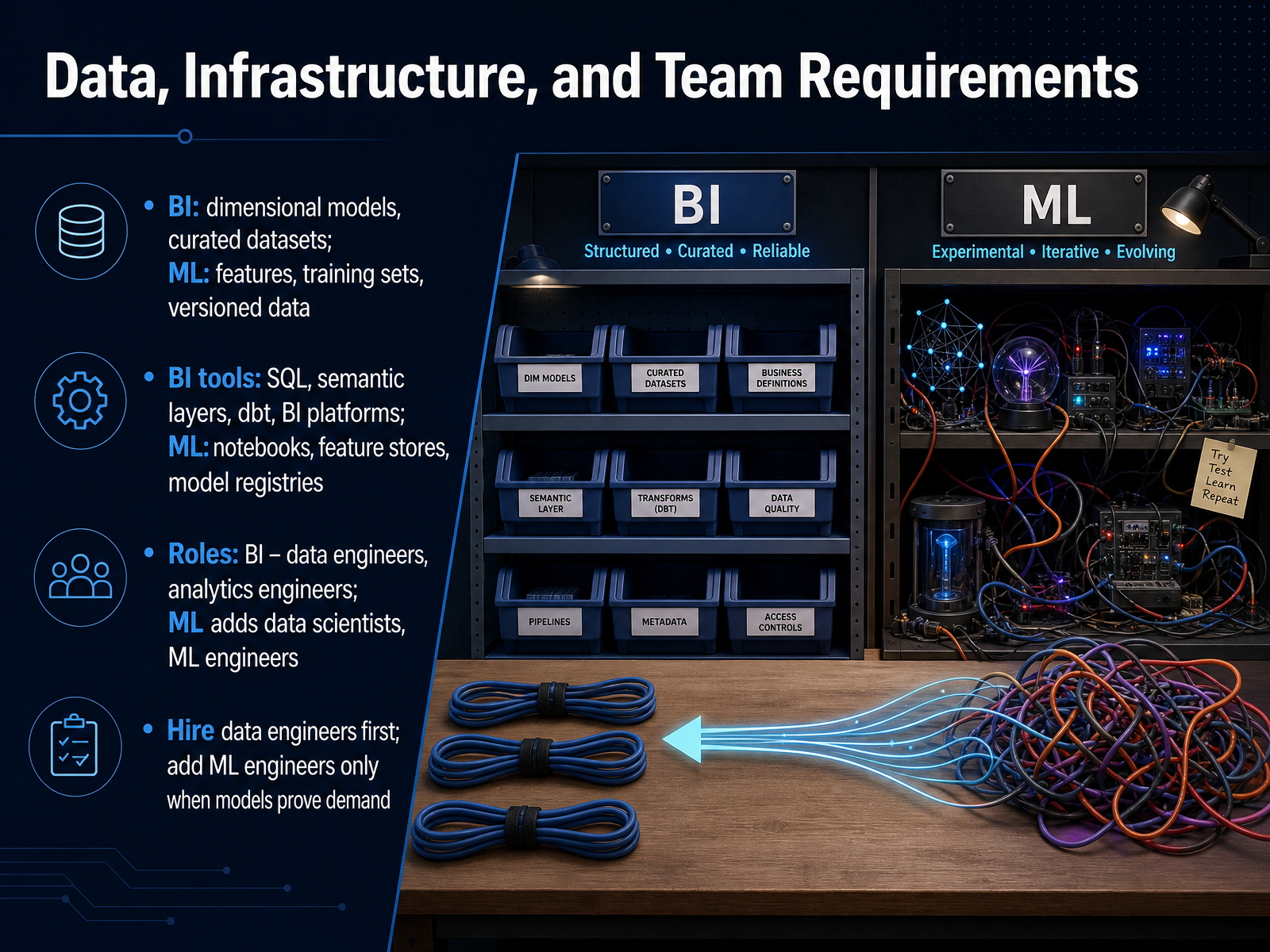
 - 07Data, Infrastructure, and Team RequirementsNow let’s talk about what this difference actually costs you in data, infrastructure, and people. BI runs on dimensional models and curated datasets, built for reporting. Machine learning needs features, training sets, and versioned data, because a model trained on last quarter’s definitions won’t hold up in production. For tools, BI is SQL, semantic layers, dbt, and your BI platform. ML brings notebooks, feature stores, and model registries. The team mix shifts too. BI requires data engineers and analytics engineers. ML adds data scientists and ML engineers. But don’t hire them all at once. Hire data engineers first to build a solid foundation. Most organizations don’t need ML engineers until models have proven real demand. A model that lives in a notebook is a science project. A model in production is a product. Build the data layer first, then add ML talent when the business case is clear. In the next section, we’ll cover interpretability, governance, and organizational trust.
 kore1.comituonline.comtogglehire.com+21 min
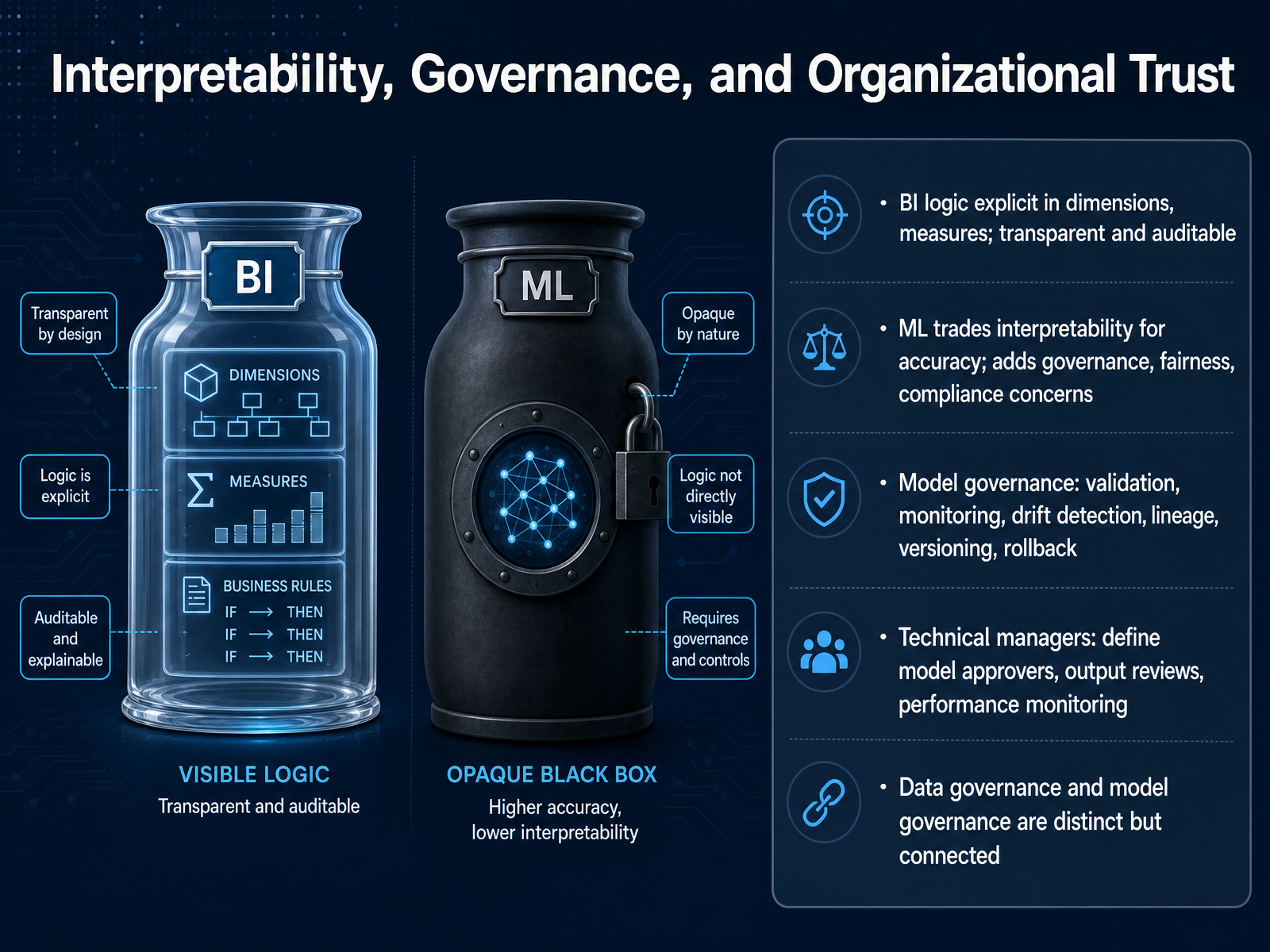
 - 08Interpretability, Governance, and Organizational TrustNow let's talk about trust and governance, because this is where ML and BI really diverge. In BI, the logic is explicit. You can trace a measure back to its dimensions and filters, and that makes it auditable. Anyone can review it. ML, on the other hand, often trades interpretability for accuracy, which adds governance concerns around fairness, compliance, and accountability.
So what do you actually need to manage? Model governance covers the full lifecycle: validation, monitoring, drift detection, lineage, versioning, and rollback. For technical managers, that means defining who approves a model, how outputs are reviewed, and how performance is tracked over time.
Here's the key distinction: data governance focuses on the data itself, its quality, lineage, and usage. Model governance focuses on the decision the model makes, whether it's conceptually sound, tested, and fit for purpose. They are connected, but they are not the same. In practice, a dataset can pass data governance and still fail model governance, because the label is unstable or the features degrade over time.
That's why the handoff between the two needs to be explicit. Data governance attests that inputs are trustworthy. Model governance challenges whether those inputs are sufficient for the intended use. And once the model is in production, monitoring is not optional. Input drift, label drift, and concept drift all need to be visible before they cause damage.
So when you're evaluating ML versus BI, remember: BI gives you transparency out of the box, but ML requires you to build it. The governance investment is real, but it's also what makes the accuracy gains trustworthy enough to act on.
Next, let's look at the cost, ROI, and value comparison between the two approaches.
 umbrex.com2 min
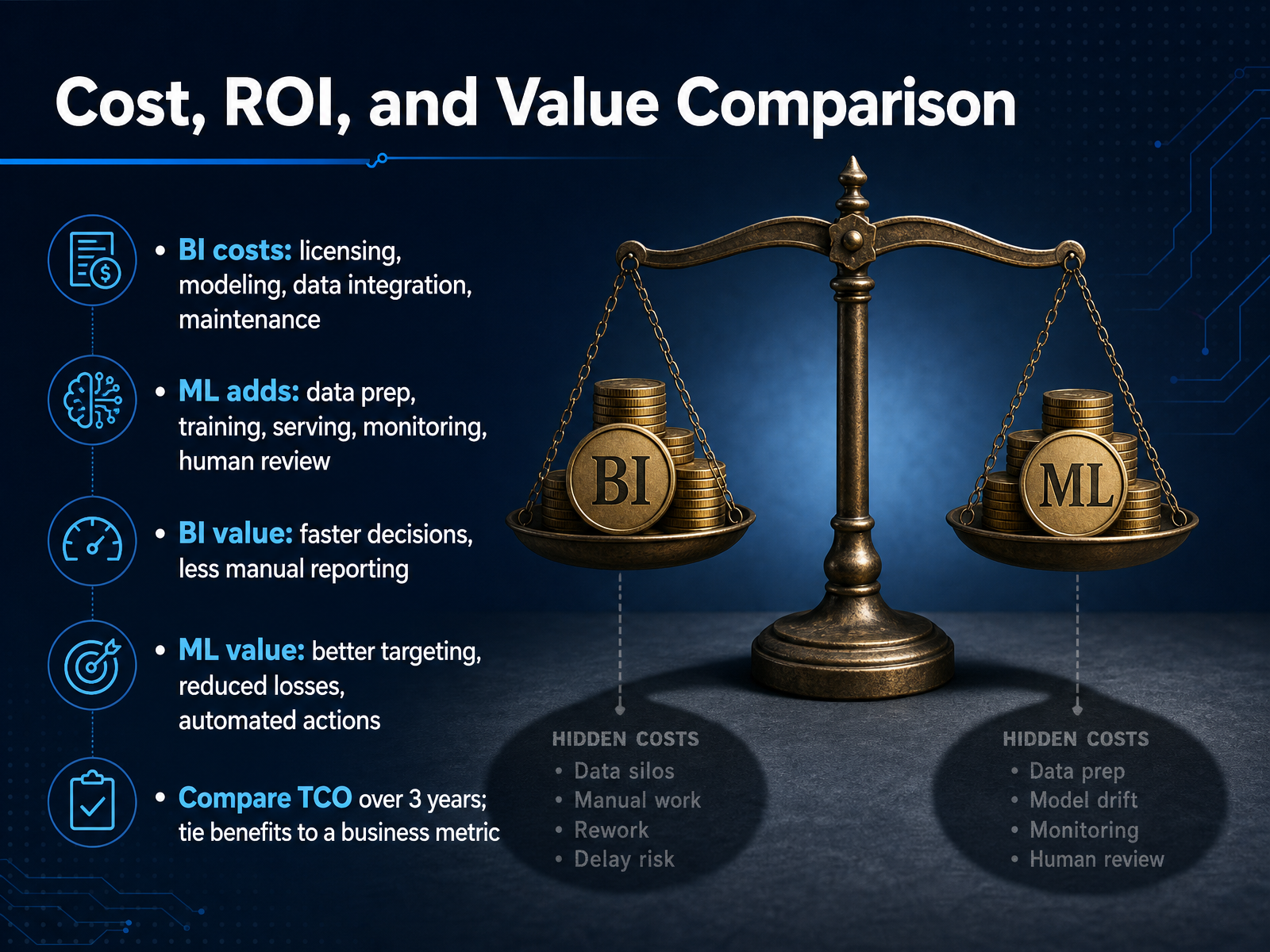
 - 09Cost, ROI, and Value ComparisonNow let's talk about cost, return on investment, and value. When you compare BI and machine learning, start with the total cost of ownership over three years. For BI, you're looking at licensing, data modeling, integration, and maintenance. A typical cloud BI deployment for a hundred users can easily run four hundred to nine hundred thousand dollars over that period. Machine learning adds significant costs on top of that: data preparation, model training, serving infrastructure, monitoring, and human review. These are not one-time expenses. They recur every year as data drifts and models need retraining. The value profiles are different too. BI delivers faster decisions and less manual reporting. Machine learning delivers better targeting, reduced losses, and automated actions. Here's the practical takeaway. Don't compare these tools on features. Compare them on a single business metric. Calculate your cost per outcome, whether that's cost per prevented churn or cost per approved loan. A three-year horizon matters because the first year of any ML project pays for learning and infrastructure. The tenth use case becomes dramatically cheaper because you've already built the pipeline. The question is not which technology is cheaper. It's which one delivers the outcome you need at a cost you can defend. Now let's look at how you combine both approaches in practice.
 kore1.comituonline.comtogglehire.com+22 min
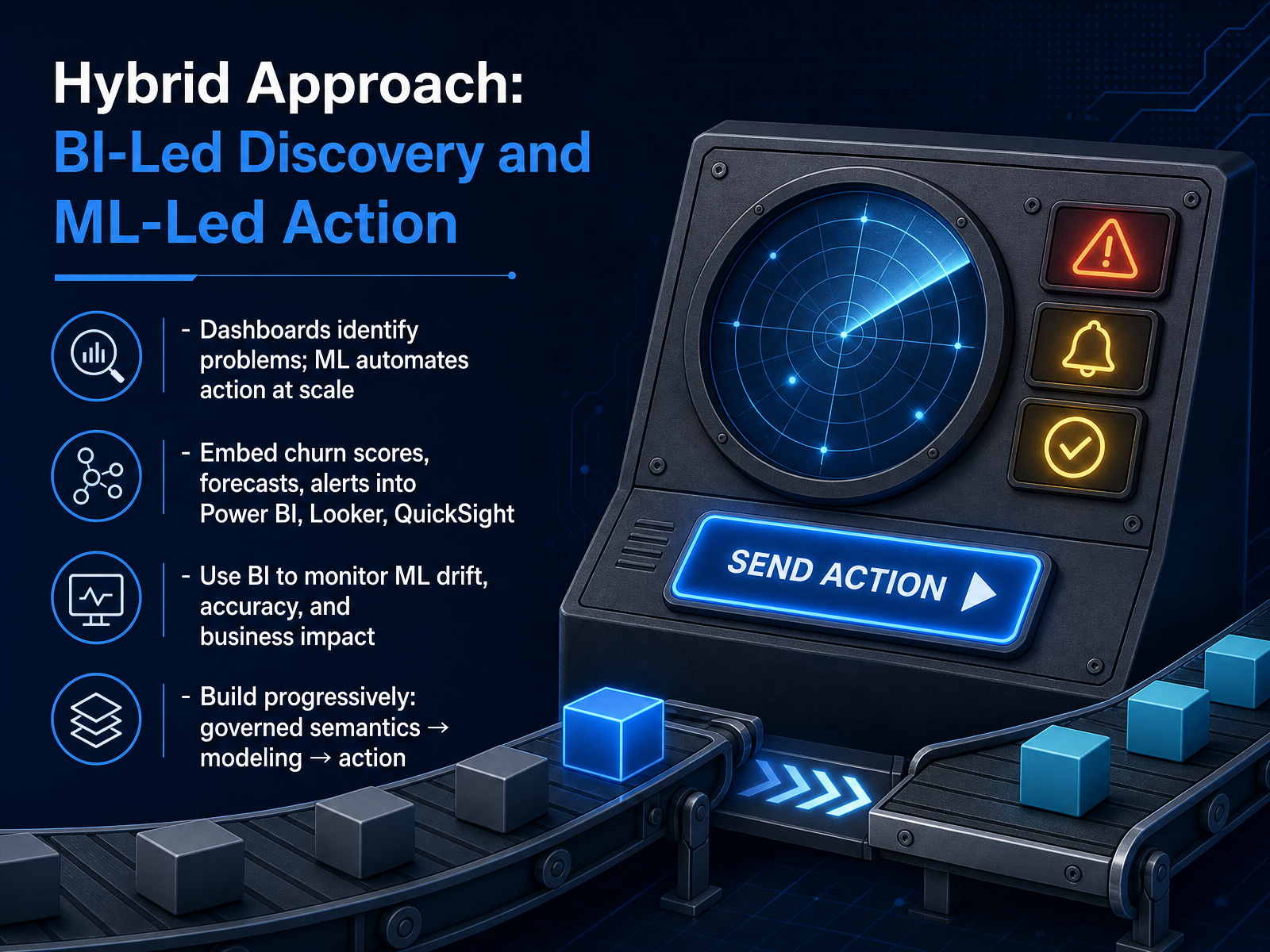
 - 10Hybrid Approach: BI-Led Discovery and ML-Led ActionSo where does this leave us in practice? The answer is a hybrid approach: use BI for discovery and ML for action. Your dashboards remain the tool for identifying problems, but machine learning handles the heavy lifting of automating decisions at scale. Rather than exporting data to a separate environment, embed churn scores, forecasts, and alerts directly into the tools your teams already use, whether that is Power BI, Looker, or QuickSight. This is not about replacing your reporting stack. It is about letting BI monitor the model itself, tracking accuracy and business impact over time. The key is to build progressively. Start with your governed semantic model, where business definitions stay consistent, then add modeling and finally automation. This sequencing ensures your predictions are aligned with the metrics your stakeholders trust. The goal is that a churn score appears in a report as a trusted, filterable metric, ready for your account teams to act on. With that foundation in place, we need to consider how to govern this combined environment, which brings us to the bridge between BI and ML.
 domo.comsnowflake.comnetsuite.com+21 min
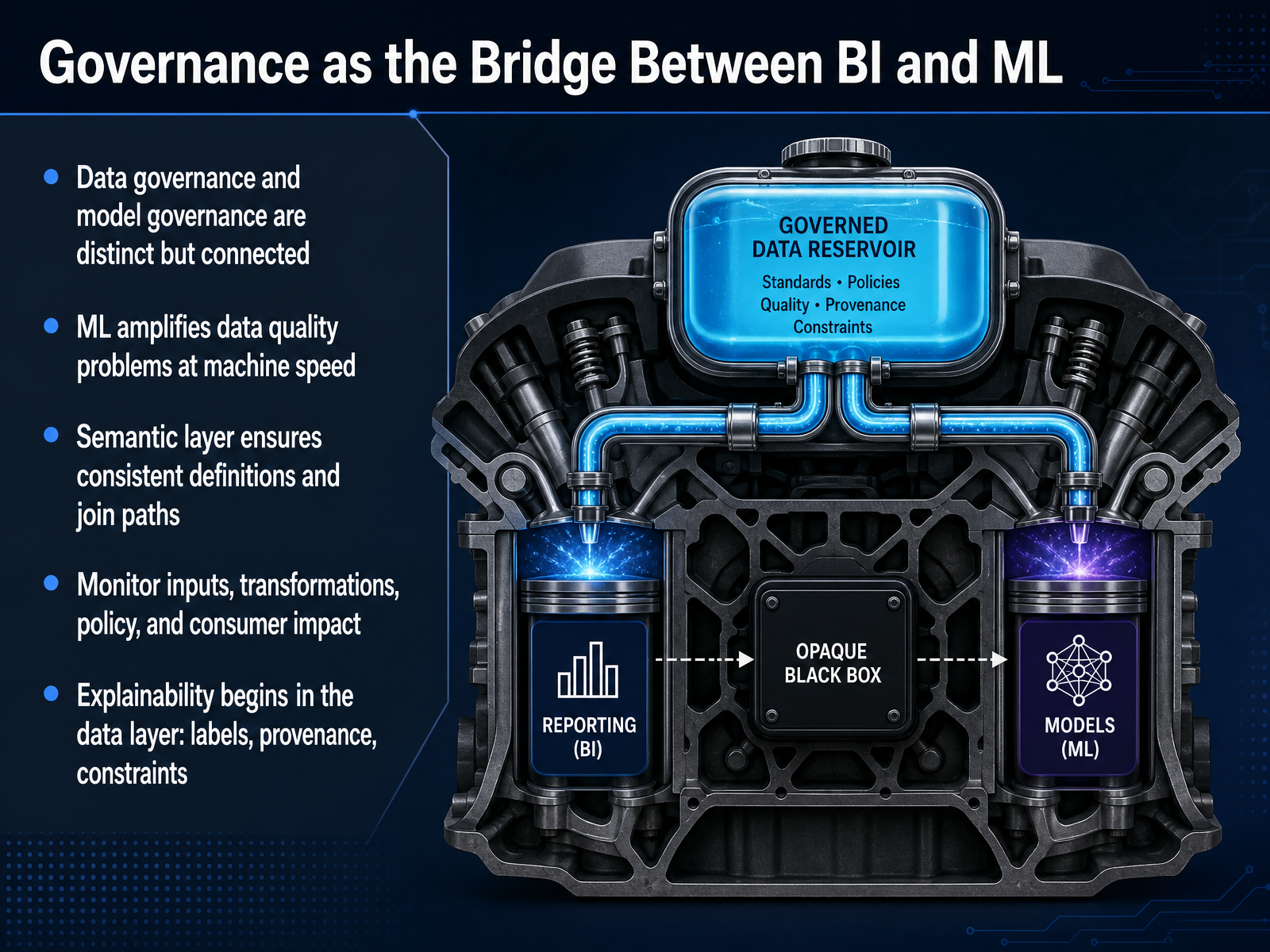
 - 11Governance as the Bridge Between BI and MLGovernance is the bridge connecting BI discipline to ML velocity. Data governance and model governance are related, but they are not the same discipline. Data governance owns the meaning, quality, and lineage of your assets. Model governance owns how a model is designed, validated, and monitored. The practical boundary is simple: data governance governs the asset, model governance governs the decision. This distinction matters because machine learning amplifies data problems. A weak field in a report gets challenged and fixed manually. A model trained on that same weak field encodes the flaw into thousands of decisions before anyone notices. That is why the semantic layer becomes mission-critical. It ensures consistent definitions and join paths so agents do not reconstruct logic from raw tables. Monitor across multiple layers: inputs, transformations, policy, and consumer impact. And remember, explainability starts in the data layer. Labels, provenance, and constraints form the groundwork. A decision is not explainable if the input definitions themselves are ambiguous. Now, let us move to the capability assessment and decision checklist.
 umbrex.com1 min
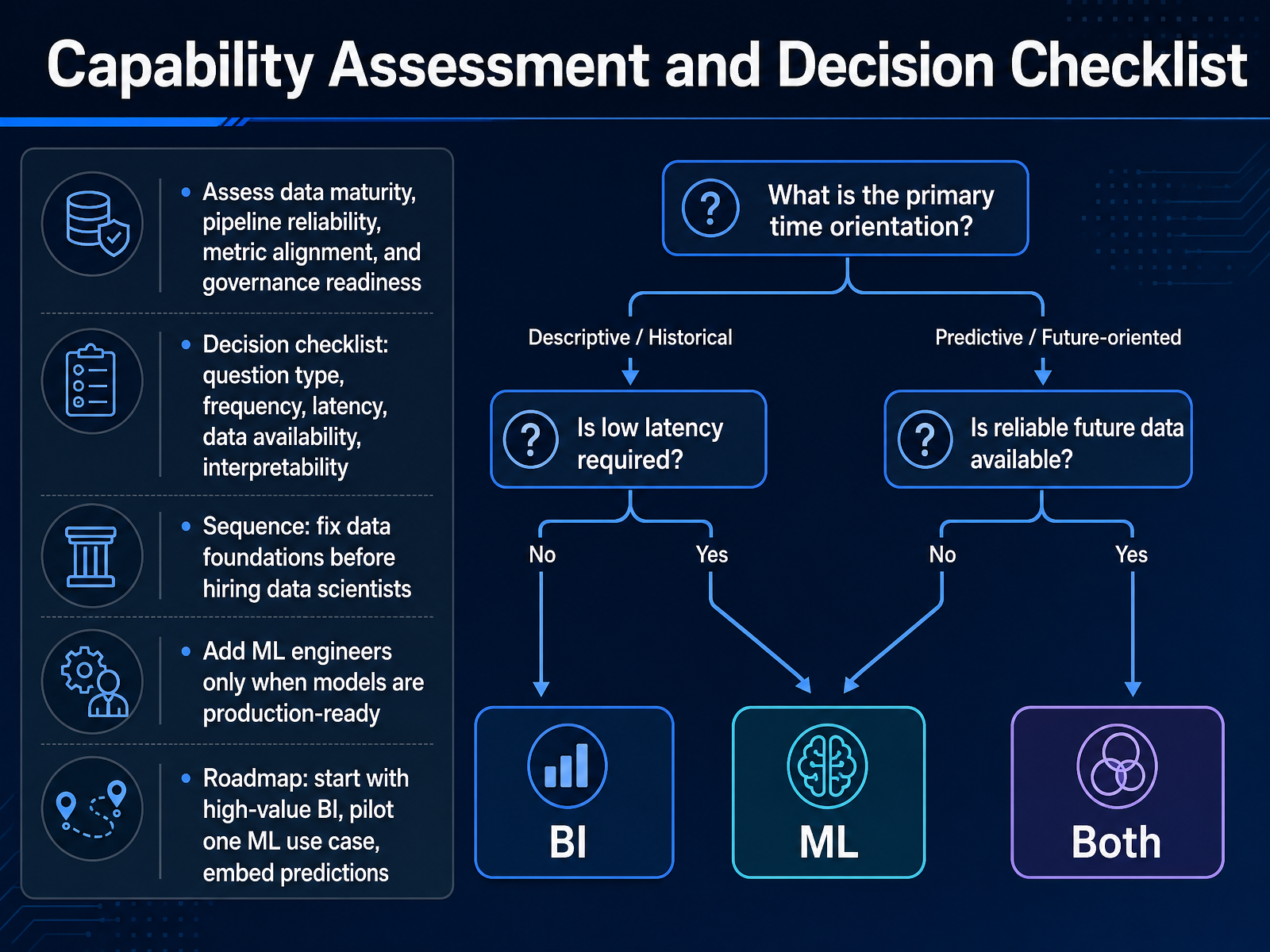
 - 12Capability Assessment and Decision ChecklistNow, let's turn that comparison into a concrete decision process. Start with a capability assessment across four dimensions. First, data maturity. Is your data pipeline reliable, and are your definitions consistent across teams? Second, metric alignment. Does the business actually agree on what success looks like? Third, pipeline reliability. And fourth, governance readiness. If you're unsure on any of these, that's your answer. Fix those foundations before you even think about hiring data scientists. When the foundations are solid, add ML engineers only when you have models that are production-ready, not when you have a hypothesis. As you evaluate each candidate use case, run it through a simple checklist. What type of question are you answering? How frequently does a decision need to be made? What is the required latency, a daily batch or real-time? Is the historical data available and clean enough to train on? And crucially, can you interpret and explain the result to stakeholders? If a decision is high-frequency, high-volume, and repeatable, that favors machine learning. If it's strategic, low-volume, and requires human judgment, business intelligence is likely the better investment. Here's a pragmatic roadmap that works. Start by solidifying high-value BI capabilities, then pilot a single machine learning use case that leverages existing infrastructure, and only then embed predictions into operational workflows. This sequencing keeps costs manageable and builds credibility gradually.
 kore1.comituonline.comtogglehire.com+22 min
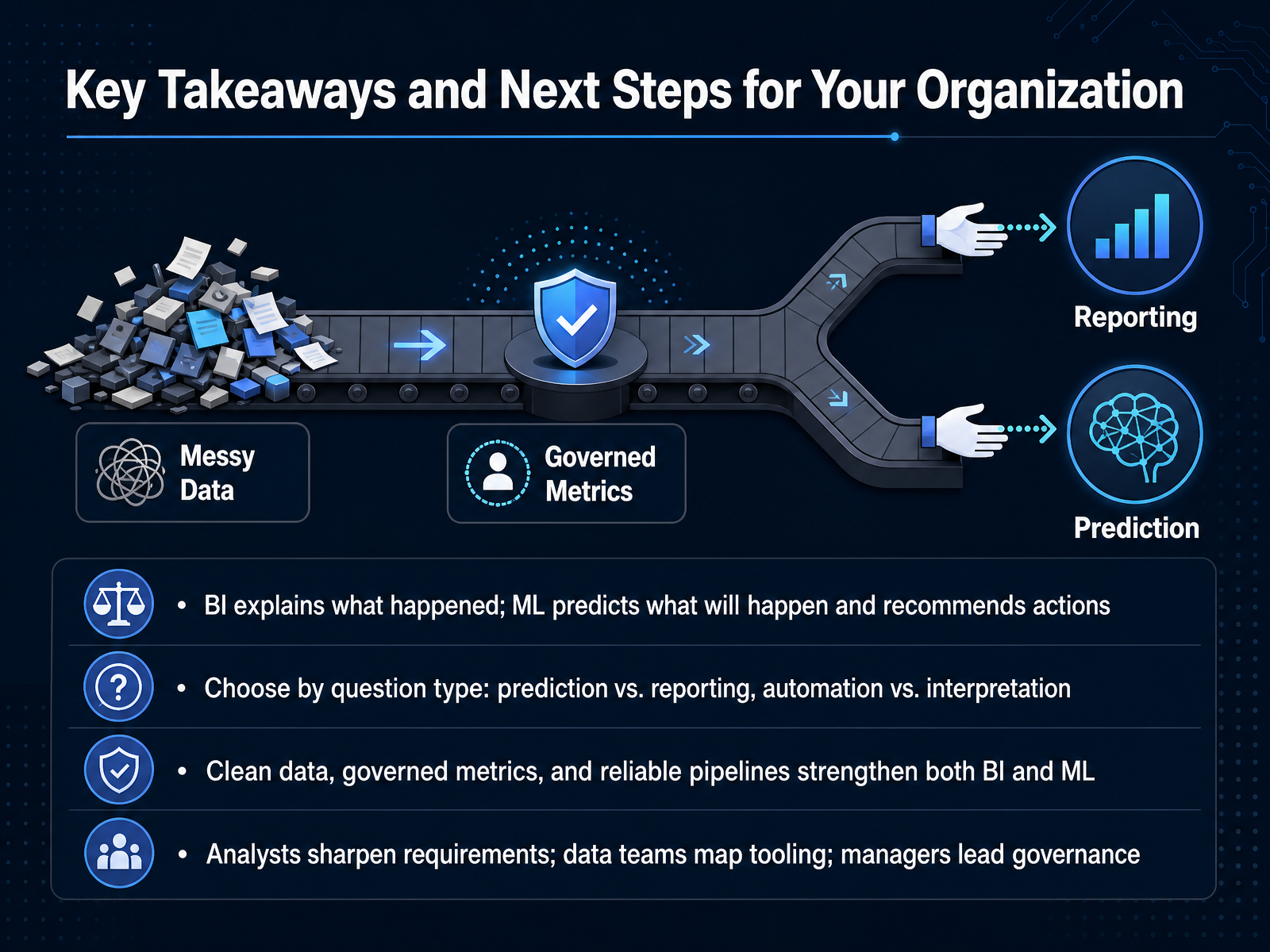
 - 13Key Takeaways and Next Steps for Your OrganizationLet's pull the key takeaways together. Business intelligence tells you what happened; machine learning predicts what will happen next and recommends actions. So choose by the question you're asking. Need prediction, automation, or a recommendation? That's machine learning. Need reporting, monitoring, and interpretation? That's business intelligence. And remember, both depend on the same foundation: clean data, governed metrics, and reliable pipelines. If that foundation is weak, neither dashboards nor models will deliver value. You have clear roles here too. Analysts sharpen the requirements and define the questions. Data teams map the tooling and build the pipelines. And managers lead the governance that keeps everything trustworthy. Start with one high-value use case. Get it right, measure the outcome, and scale from there. You have the framework now to make the right calls. Thank you for your time, and good luck putting these principles to work.
 kore1.comituonline.comtogglehire.com+22 min
Take the deck with you
Download this course as a file — free, no sign-up needed.
- PDF handoutEvery slide page, ready to print or share.14 pages · 3.9 MBDownload
- Narrated PowerPointThe deck that presents itself — every slide carries the digital human's narration video.14 pages · 15.5 MBDownload
- PowerPoint slidesThe full deck as a .pptx — open it in PowerPoint, Keynote, or Google Slides.14 pages · 3.8 MBDownload
Free to use in your own training — please keep the PersonWise credit page at the end.
Have your own deck? Turn it into a course
Sources consulted
Web sources consulted while building this course.
- Business Intelligence vs Machine Learning - Difference ... — aws.amazon.com
- Business Intelligence vs Data Analytics vs AI: What Are the Differences? — techrepublic.com
- AI vs. BI: What’s the Difference? — Enable — enable.com
- What is Business Intelligence - AI use in BI explained - AWS — aws.amazon.com
- What Is Business Intelligence (BI)? | IBM — ibm.com
- AI Team Structure: Roles, Reporting & Headcount (2026) - KORE1 — kore1.com
- Deep Dive Into The Technical Architecture Of AI Business Intelligence Systems – ITU Online IT Training — ituonline.com
- What a Modern Data Team Actually Looks Like in 2026 | ToggleHire — togglehire.com
- What Do Data Teams Actually Look Like in 2026? A Large LinkedIn Benchmark – Luca Fiaschi — lucafiaschi.com
- Data Engineer vs. Analytics Engineer vs. Data Scientist: · Primis — primis-talent.com
- Evaluating decision intelligence tools vs BI solutions — thoughtspot.com
- Decision Intelligence versus Business Intelligence — datapoem.ai
- System of Intelligence: A Decision Intelligence Layer | Teradata — teradata.com
- Machine Learning vs. Traditional Analytics: When to Use Which? - MachineLearningMastery.com — machinelearningmastery.com
- 17 Business Intelligence Examples Across Industries — domo.com
- AI in Business Intelligence: Benefits and Use Cases — snowflake.com
- 23 Real-World Examples of Business Intelligence — netsuite.com
- AI Business Intelligence: How It Works and What It Does — monday.com
- Transforming retail strategies with advanced consumer insights | Databricks — databricks.com
- Govern Analytics, AI, and Model Risk With Confidence — umbrex.com