Begin
14 pages · ~28 min
Public Speaking Practice Workflow
A practical workflow for developing public speaking skills, teaching techniques to prepare, practice, and deliver confident presentations.
A digital instructor presents all 14 pages. Hold “Ask” at any point and ask out loud — the answer comes from this course. No sign-up needed.
What you’ll learn
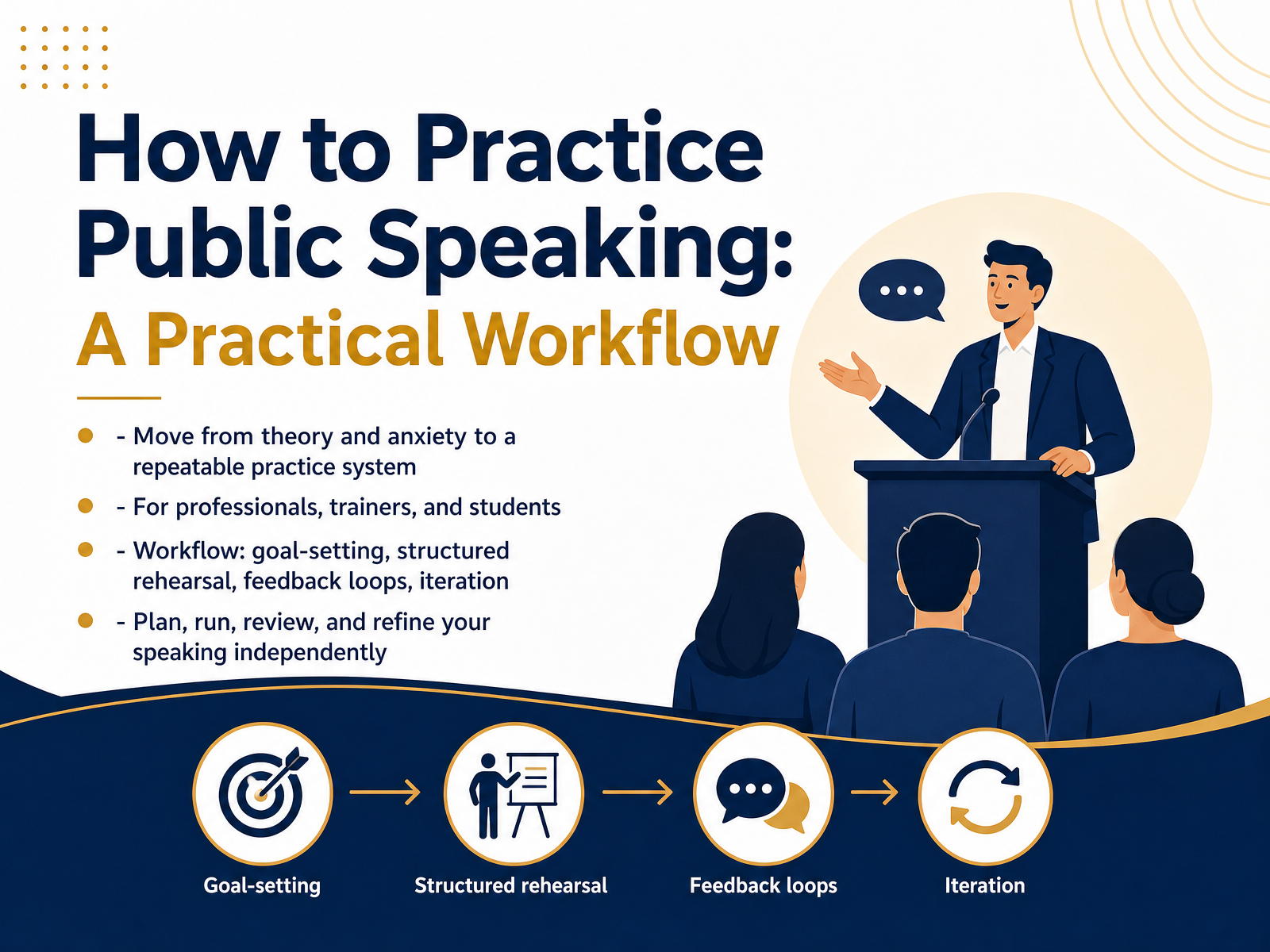
- 01How to Practice Public Speaking: A Practical WorkflowWelcome. If you've ever felt your heart race before a presentation, you're in good company. The good news is that public speaking isn't magic. It's a skill, and it responds beautifully to the right kind of practice. This course moves you from theory and anxiety into a repeatable practice system. It's designed for professionals, trainers, and students alike. Over the next few minutes, we'll build a simple workflow together: setting goals, structuring your rehearsal, creating feedback loops, and refining your delivery through iteration. You'll learn to plan, run, review, and refine your speaking independently. No need for a coach in the room. Just you, a clear process, and your own commitment. Let's start by exploring why a structured approach beats raw talent every single time.winningpresentations.comsecondnatureuk.co.ukwustl.pressbooks.pub+21 min
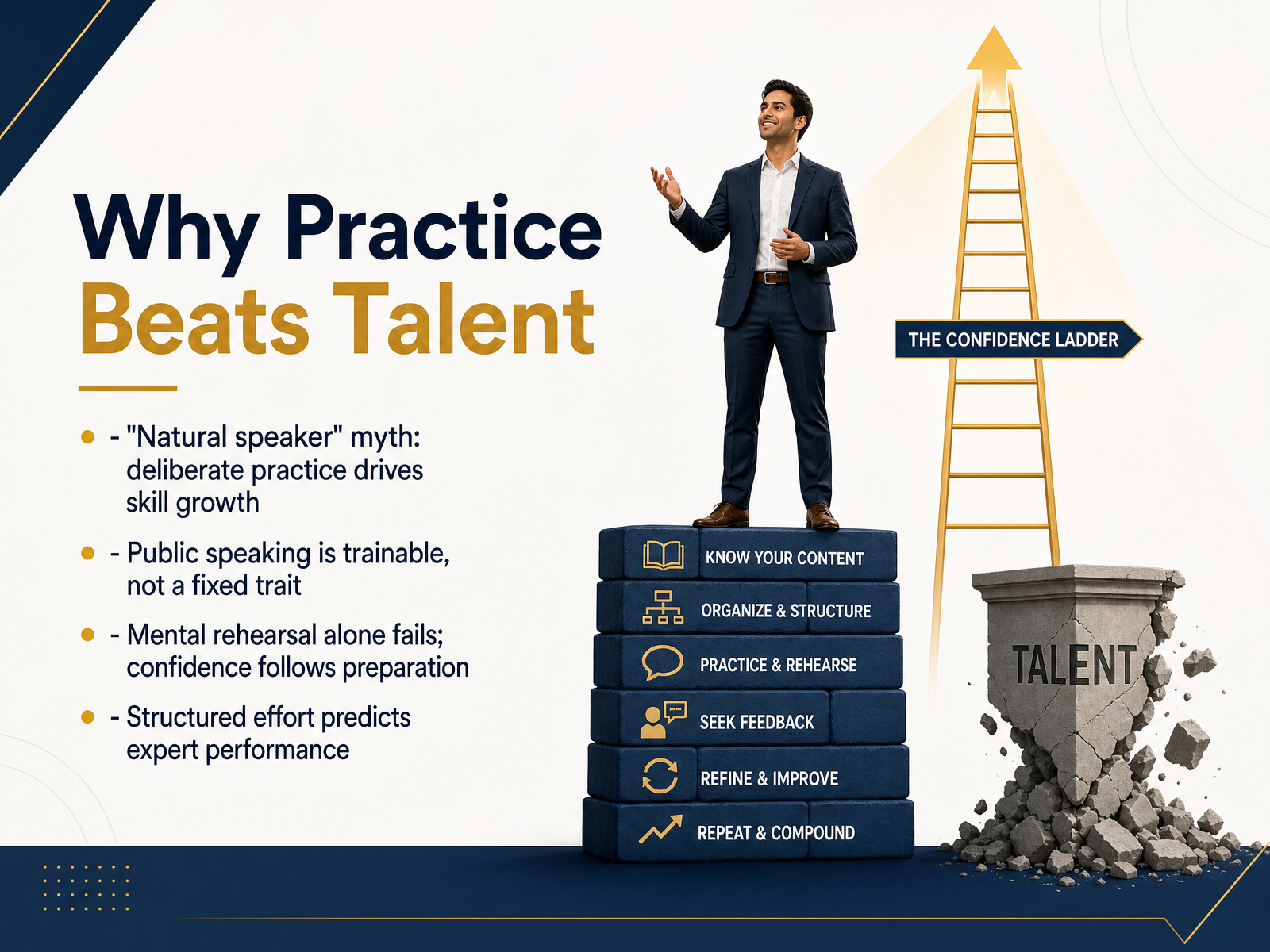
- 02Why Practice Beats TalentLet’s tackle a common myth right away: the idea that some people are just natural speakers. Research says otherwise. Public speaking is not a fixed trait you’re born with. It’s a trainable skill. What separates confident speakers from the rest is not talent—it’s deliberate practice. That means structured, focused effort on specific skills, not just repeating the same speech or rehearsing silently in your head. In fact, mental rehearsal alone often fails because it doesn’t challenge your delivery under real conditions. Confidence doesn’t come first. It follows preparation. When you put in structured effort—practicing out loud, recording yourself, getting feedback—you build the kind of skill that predicts expert performance. One study of professional speakers found they consistently engaged in deliberate practice activities like rehearsal, self-monitoring, and seeking feedback. So let go of the “natural speaker” idea, and lean into the fact that you can get better. Next, we’ll look at the core principles of effective rehearsal.
 doi.orgrepository.usfca.eduonlinelibrary.wiley.com+21 min
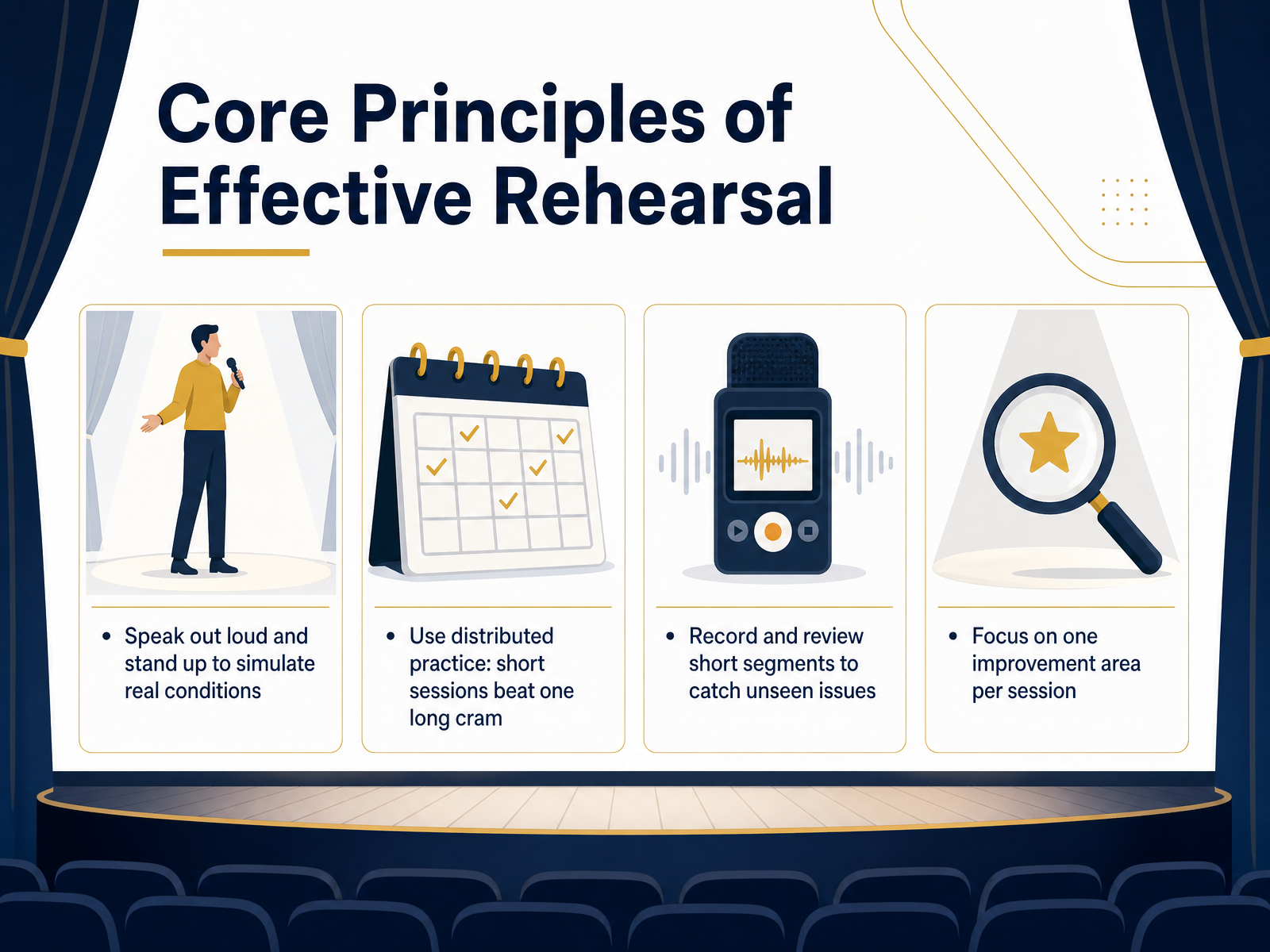
 - 03Core Principles of Effective RehearsalLet's talk about the core principles of effective rehearsal. First, always speak out loud and stand up. Reading silently in your head is not practice. Your body needs to rehearse too, so simulate the real conditions as closely as you can. Second, use distributed practice. Short, focused sessions spread across several days beat one long cramming session every time. Your brain consolidates learning while you sleep, so three twenty-minute sessions will serve you far better than a single long marathon the night before. Third, record and review short segments. Your phone camera is your best rehearsal partner. Watch yourself to catch habits you simply cannot see from the inside, like filler words or distracting gestures. Fourth, focus on just one improvement area per session. Do not try to fix your pacing, your gestures, and your filler words all at once. Pick one thing, work on it, and move on. That focused approach is what builds real progress. And this leads us naturally into our next topic: the rehearsal loop of write, record, review, and revise.
 winningpresentations.comsecondnatureuk.co.ukwustl.pressbooks.pub+21 min
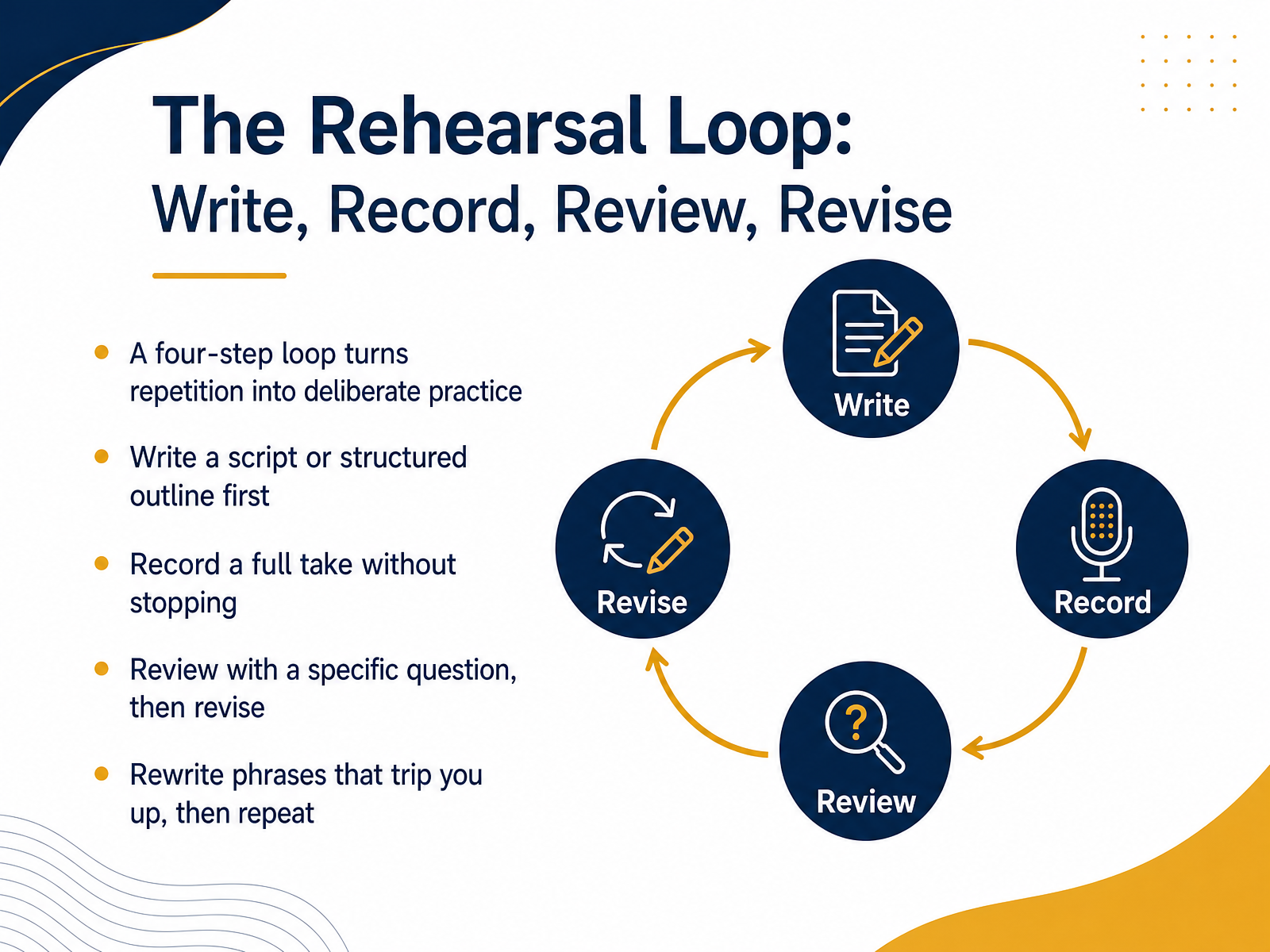
 - 04The Rehearsal Loop: Write, Record, Review, ReviseNow let's turn that preparation into a simple, repeatable cycle. I call it the Rehearsal Loop: Write, Record, Review, Revise. This is how you turn repetition into deliberate practice, not just mindless repetition. First, write a script or, even better, a structured outline. You need your opening line, your key points, and your closing statement written down. That gives your brain something reliable to hold onto under pressure. Next, hit record and deliver a full take from start to finish without stopping. If you stumble, recover and push through. Do not restart. That habit of stopping and restarting is exactly what makes speakers freeze on stage. Then, review the recording with a specific question in mind. Watch it once with the sound off to check your body language. Then watch again focusing on one thing, like your pacing or filler words. Finally, revise. Rewrite any phrases that trip you up. If a sentence gives you trouble twice, simplify it. Then repeat the loop. Each cycle gets you closer to a delivery that sounds natural and confident. Up next, we'll look at a structured way to focus each of those rehearsals: the Three-Pass Method.
 winningpresentations.comsecondnatureuk.co.ukwustl.pressbooks.pub+21 min
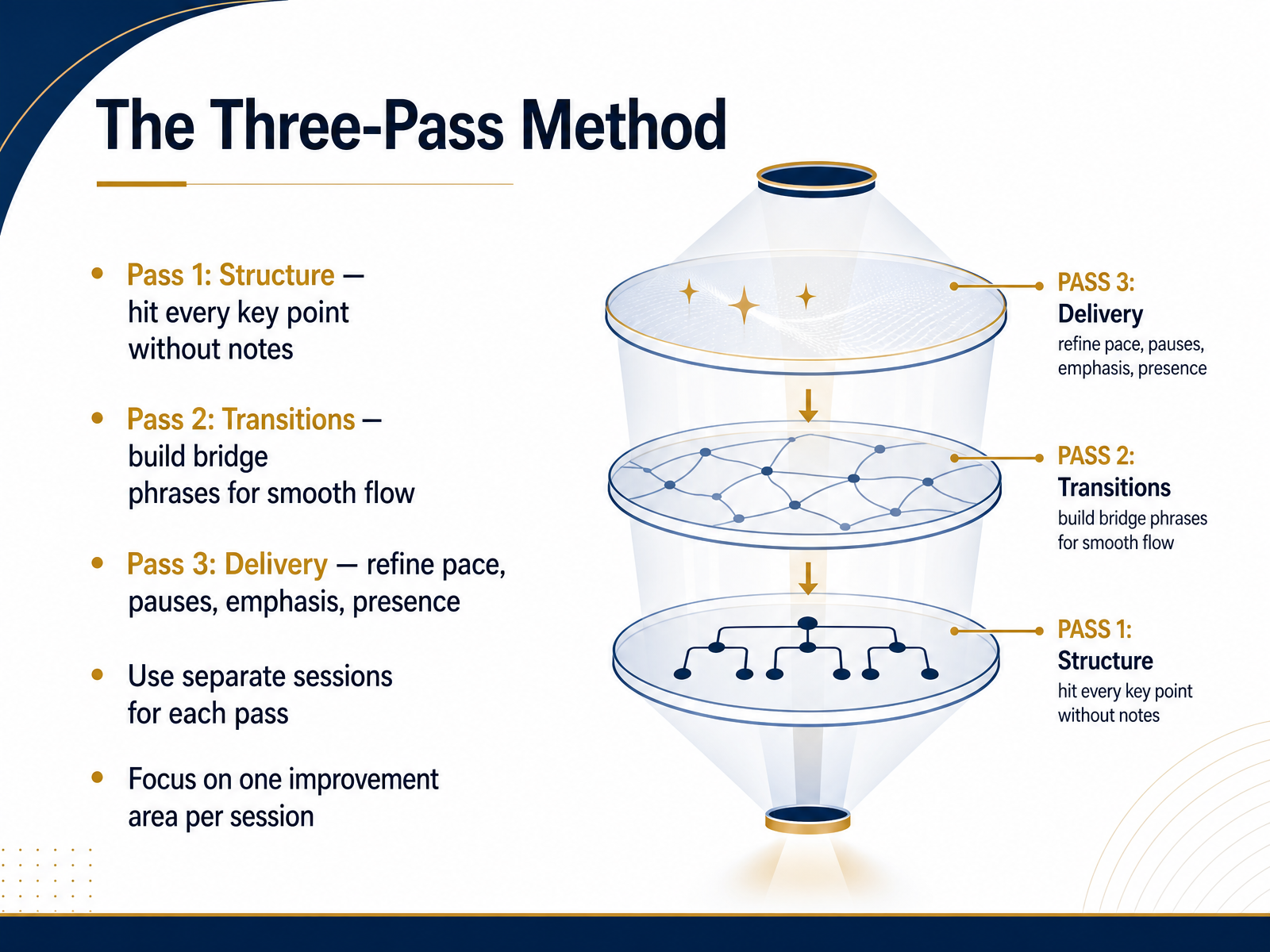
 - 05The Three-Pass MethodNow let’s talk about how to structure your practice time—not with random run-throughs, but with a focused method called the Three-Pass Method. The idea is simple: don’t try to fix everything at once. Instead, give each practice session one clear job. Pass one is structure. Can you hit every key point without looking at your notes? If someone interrupted you, could you find your place again? This pass builds the skeleton of your talk. Pass two is transitions. This is where most presentations stumble. Build bridge phrases that connect one section to the next. Something like, “That’s the problem—here’s what we’re proposing.” Memorize those bridges exactly; they’re your guardrails. Pass three is delivery. Now refine your pace, your pauses, your emphasis, and your presence. Record yourself and watch it later. Give each pass its own session, spread across different days. One focus per session. This beats one long marathon rehearsal every time.
 winningpresentations.comsecondnatureuk.co.ukwustl.pressbooks.pub+21 min
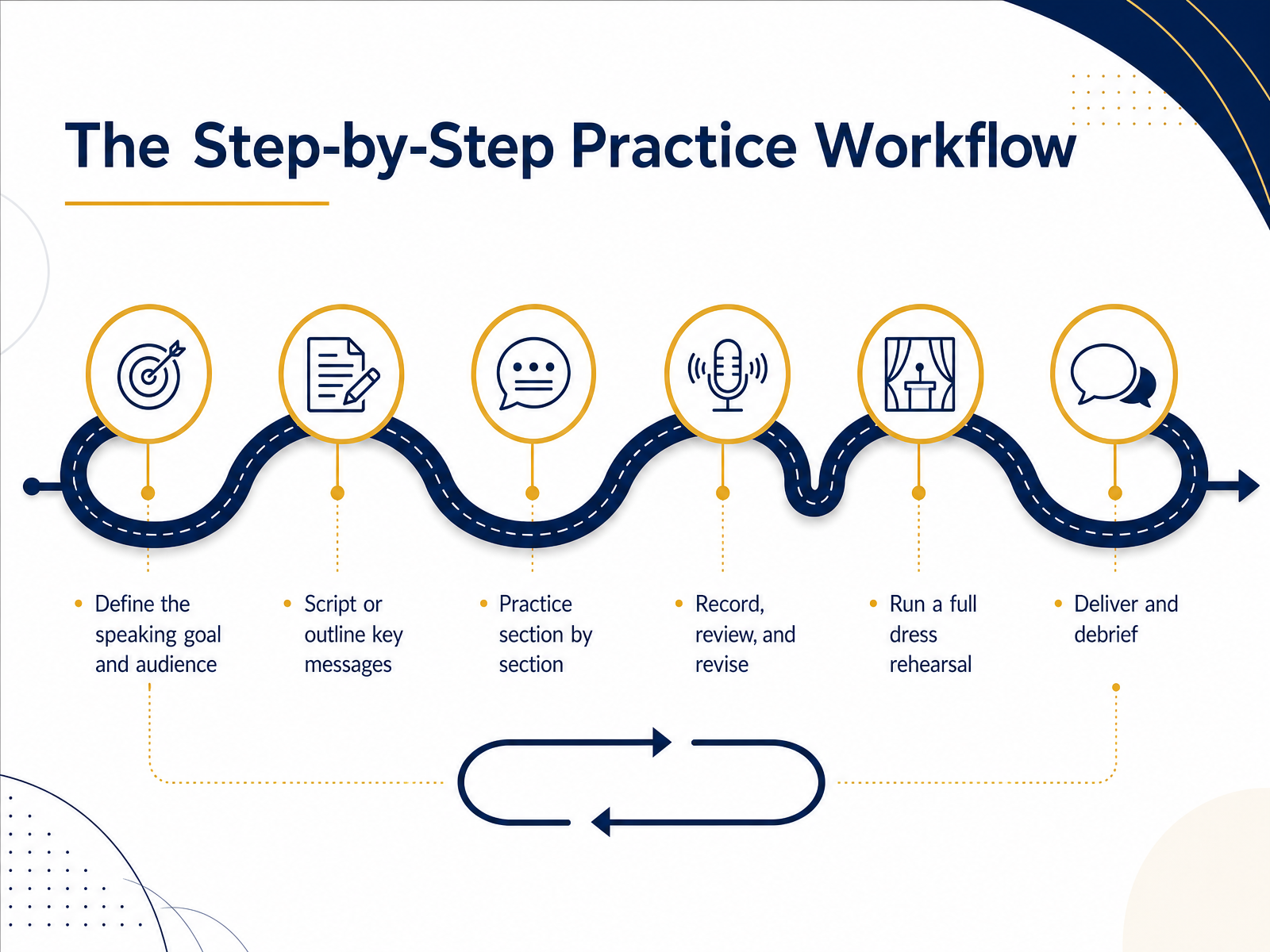
 - 06The Step-by-Step Practice WorkflowNow let's put the whole process together. This is the workflow you'll use every time you prepare a talk. Six steps. First, define your speaking goal and know your audience. Ask yourself: What should they remember, and what should they do after you finish? Second, build a simple outline. Don't memorize a script word for word. A structured outline with your opening, key points, and a strong close gives you a clear path while keeping you flexible. Third, practice section by section. This is where the real work happens. Break your talk into small chunks, and drill the weak spots until they feel smooth. Fourth, record yourself. Watch the playback and look for one thing at a time: pacing, filler words, or body language. Then revise your outline if a section trips you up. Fifth, run a full dress rehearsal. Stand up, speak out loud, use your slides, and time yourself. Make it as close to the real performance as you can. Finally, deliver with confidence, and after you're done, take a moment to debrief. Ask what worked, what you'll change next time. Remember, quality beats quantity, so spread your practice over a few days instead of cramming. Next, let's look at practice techniques for different speaking contexts.
 winningpresentations.comsecondnatureuk.co.ukwustl.pressbooks.pub+21 min
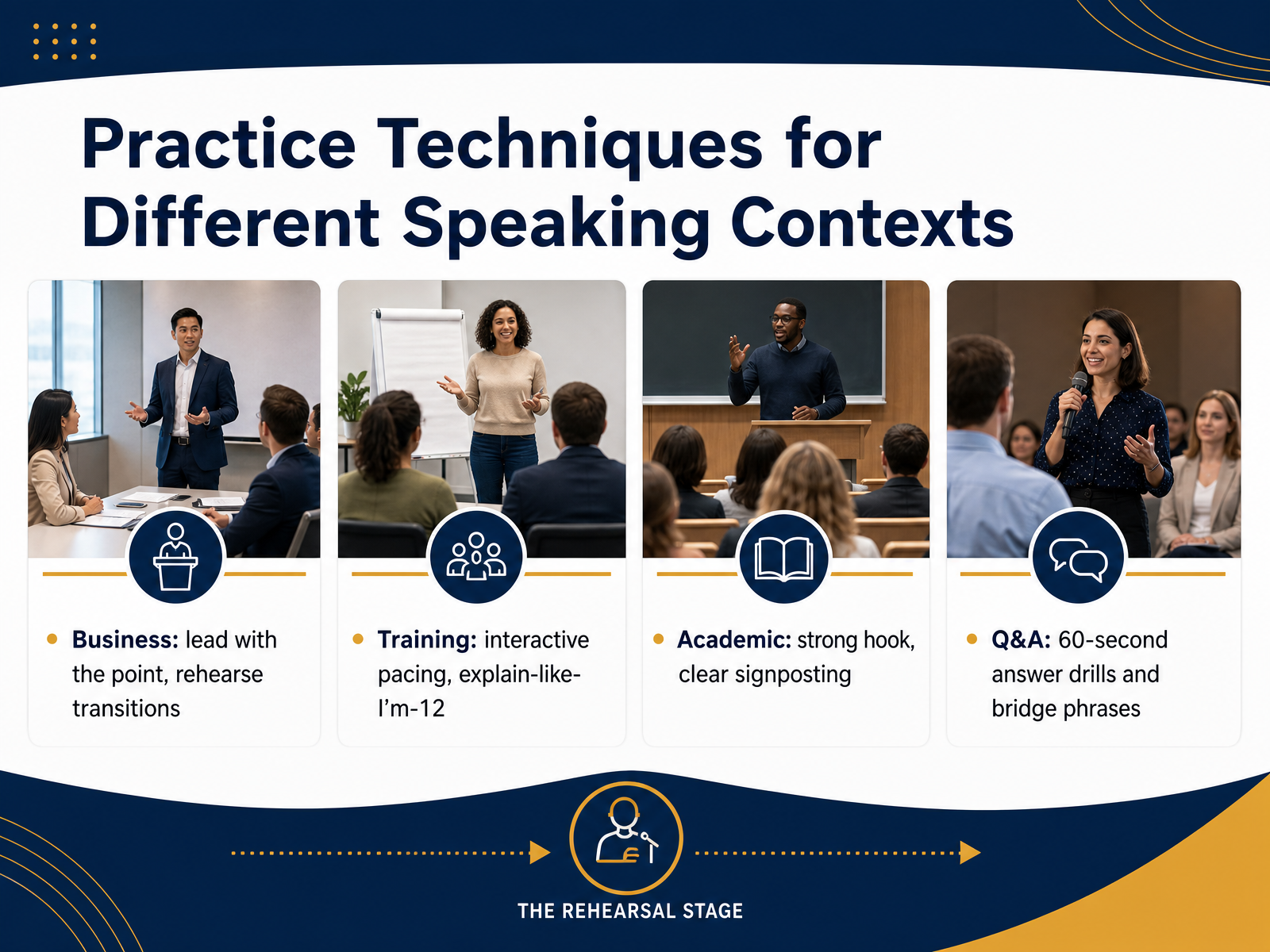
 - 07Practice Techniques for Different Speaking ContextsNow let's tailor your rehearsal to the speaking situation. In business, lead with your point right away, and rehearse the transitions between topics until they feel seamless. For training, focus on interactive pacing, pause to check understanding, and practice explaining complex ideas simply, as if you're talking to a twelve-year-old. In academic settings, start with a strong hook and use clear signposting to guide your audience through your argument. And for Q&A, run sixty-second answer drills, so you can respond concisely, and prepare bridge phrases to buy yourself time while you gather your thoughts. Remember, the context shapes your preparation. Pick the techniques that fit your setting, and you'll walk in ready for anything. Coming up, we'll look at how to evaluate your performance honestly, without losing confidence.
 winningpresentations.comsecondnatureuk.co.ukwustl.pressbooks.pub+21 min
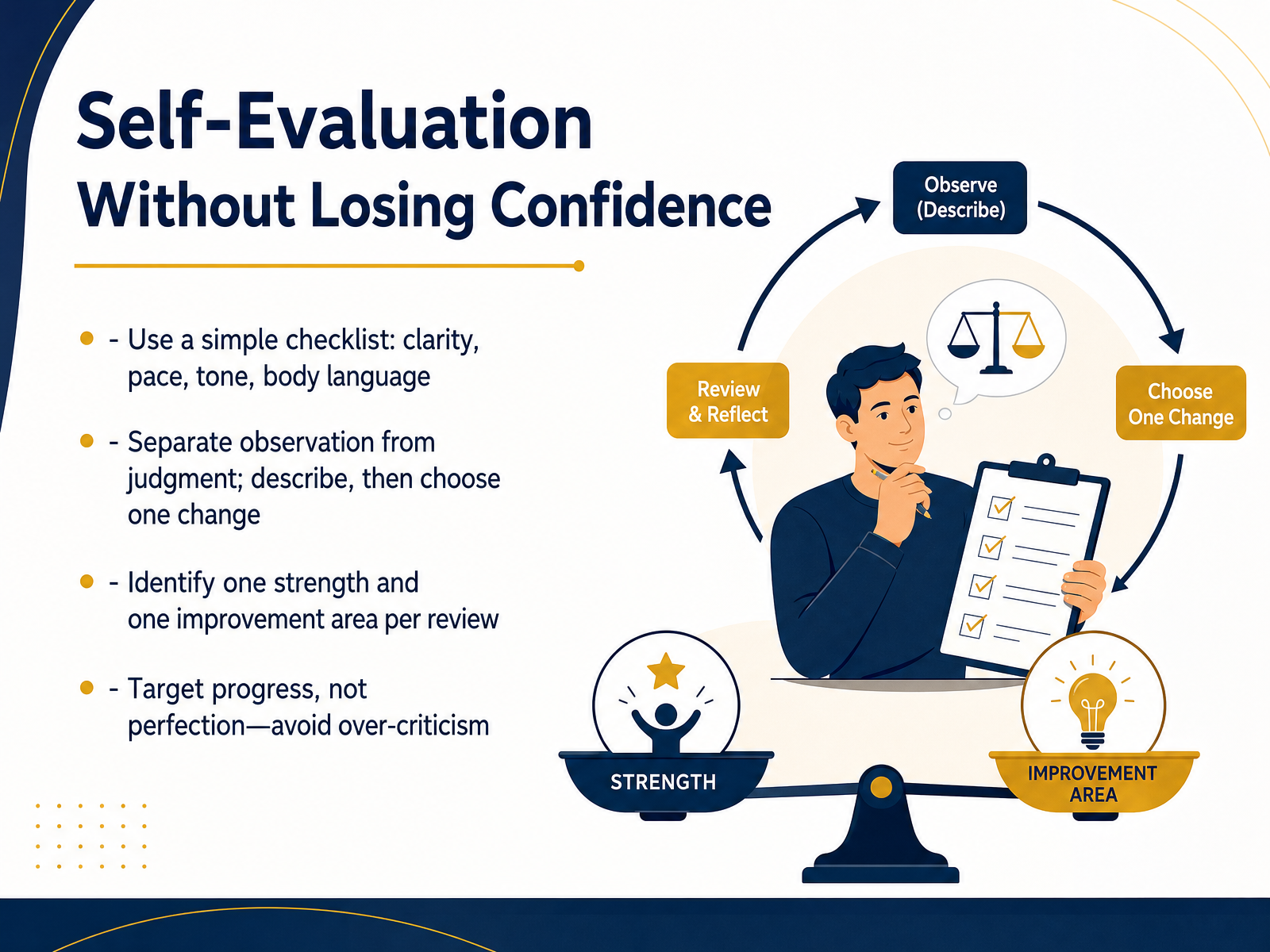
 - 08Self-Evaluation Without Losing ConfidenceNow let’s talk about how to review your own practice without damaging your confidence. Use a simple checklist: clarity, pace, tone, and body language. These four areas cover most of what matters in delivery. When you watch or listen to yourself, separate observation from judgment. Describe what you see, then choose just one change. For example, you might notice you speak too quickly in the middle section. That’s an observation. The change is to pause after key points. Don’t pile on criticism. Instead, identify one strength and one area to improve each time you review. This keeps your growth steady and positive. Remember, the goal is progress, not perfection. If you over-criticize, you’ll lose the confidence you’re trying to build. So next time you practice, review yourself like a supportive coach would—specific, kind, and focused on one step forward. Up next, we’ll look at how to get useful feedback from others.
 winningpresentations.comsecondnatureuk.co.ukwustl.pressbooks.pub+22 min
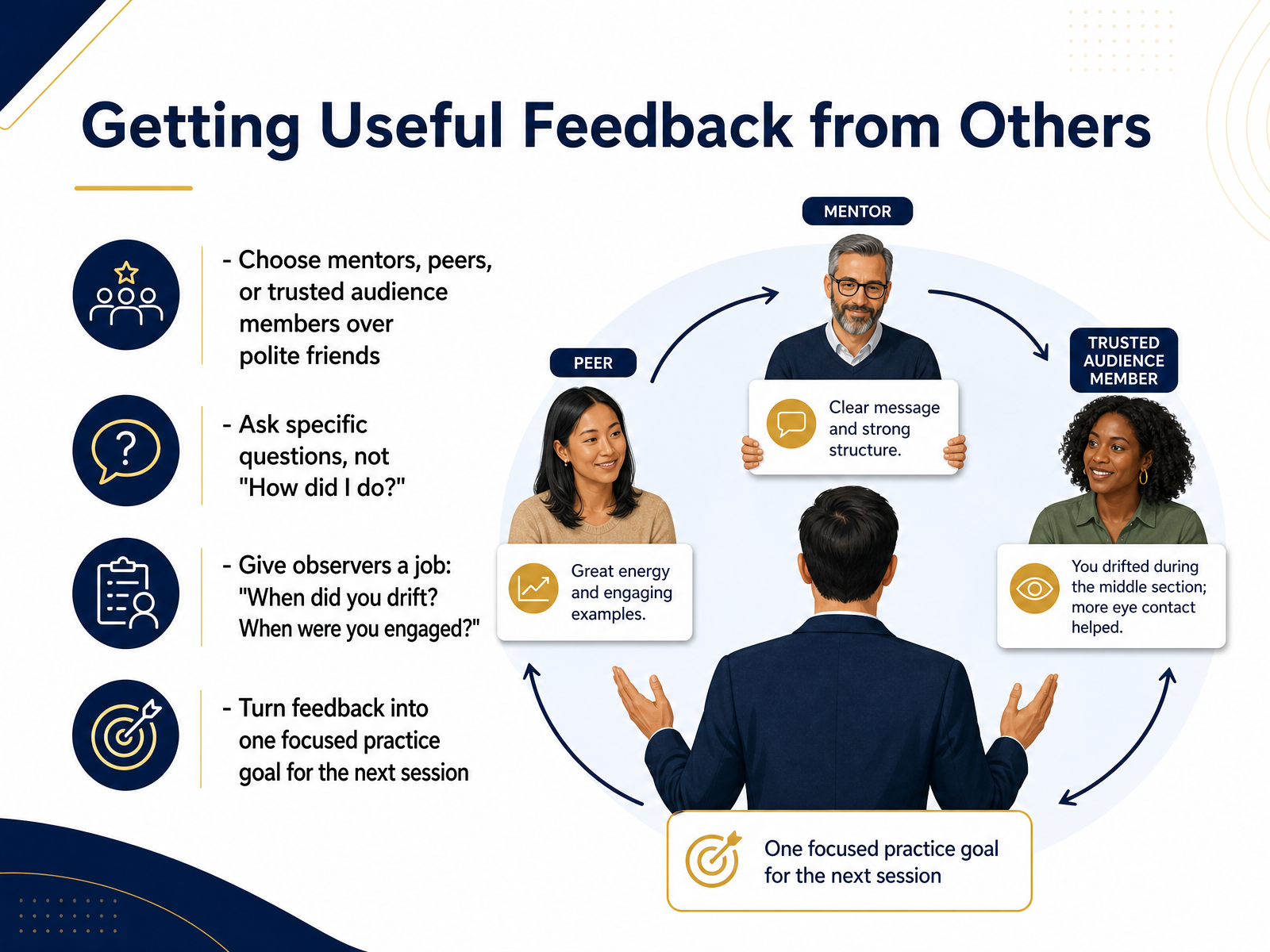
 - 09Getting Useful Feedback from OthersLet's talk about feedback, because this is where practice truly turns into progress. The first rule is to choose your listeners wisely. Skip the friends who will tell you it was great no matter what. Instead, look for mentors, peers, or people who represent your actual audience. Their observations will be far more honest and useful. Next, never ask, "How did I do?" That invites a generic compliment. Instead, give your observer a specific job. Ask them, "When did you drift off? When were you fully engaged?" Or ask, "What was the clearest sentence I said? What was the muddiest?" These targeted questions produce comments you can actually use. Finally, resist the urge to fix ten things at once. From each session, pick just one focused goal for your next rehearsal. That single point of attention is what turns practice into genuine improvement. So remember: choose the right people, ask precise questions, and act on one piece of feedback at a time. Next, let's look at the common practice mistakes that hold speakers back, and how to avoid them.
 rhetoriq.ioallisonshapira.comnosweatpublicspeaking.com+21 min
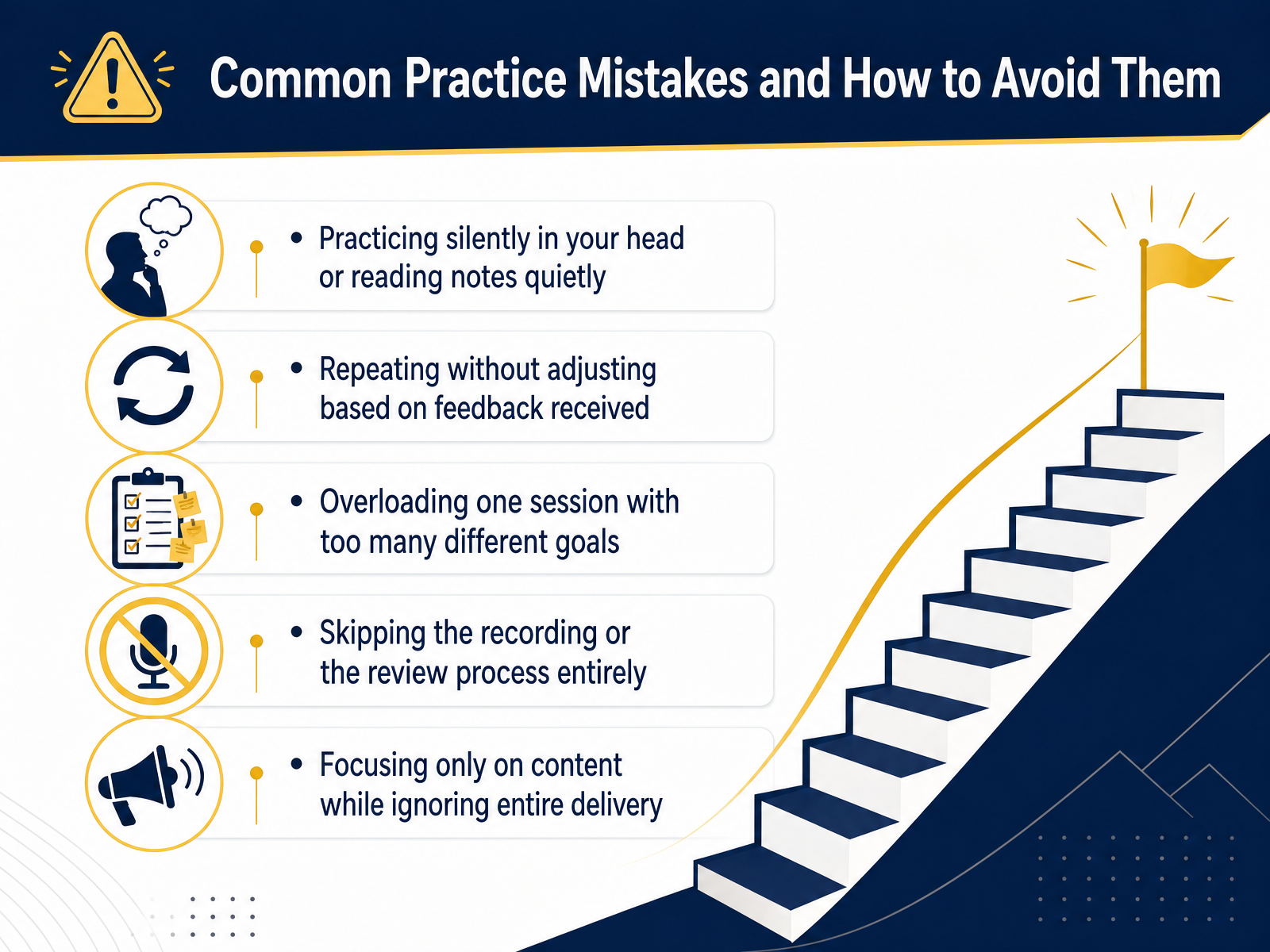
 - 10Common Practice Mistakes and How to Avoid ThemLet’s talk about the mistakes we all make when practicing—and more importantly, how to avoid them. The first one? Practicing silently in your head. That doesn’t build the muscle memory your voice and body need. Always rehearse out loud, at full energy. The second mistake is repeating the same run-through without adjusting based on feedback. If you don’t change anything between reps, you’re just cementing the same habits—including the bad ones. Another common trap is trying to fix everything in one session. That overloads your brain. Instead, pick one focus per session: structure, transitions, or delivery. And if you’re skipping the recording and review step entirely, you’re missing your most honest coach. The camera shows you what you actually do, not what you think you do. Finally, don’t only polish your content while ignoring your delivery. How you say it matters just as much as what you say. So, as you refine your practice, keep these pitfalls in mind. Up next, we’ll look at building a sustainable practice habit that actually sticks.
 winningpresentations.comsecondnatureuk.co.ukwustl.pressbooks.pub+21 min
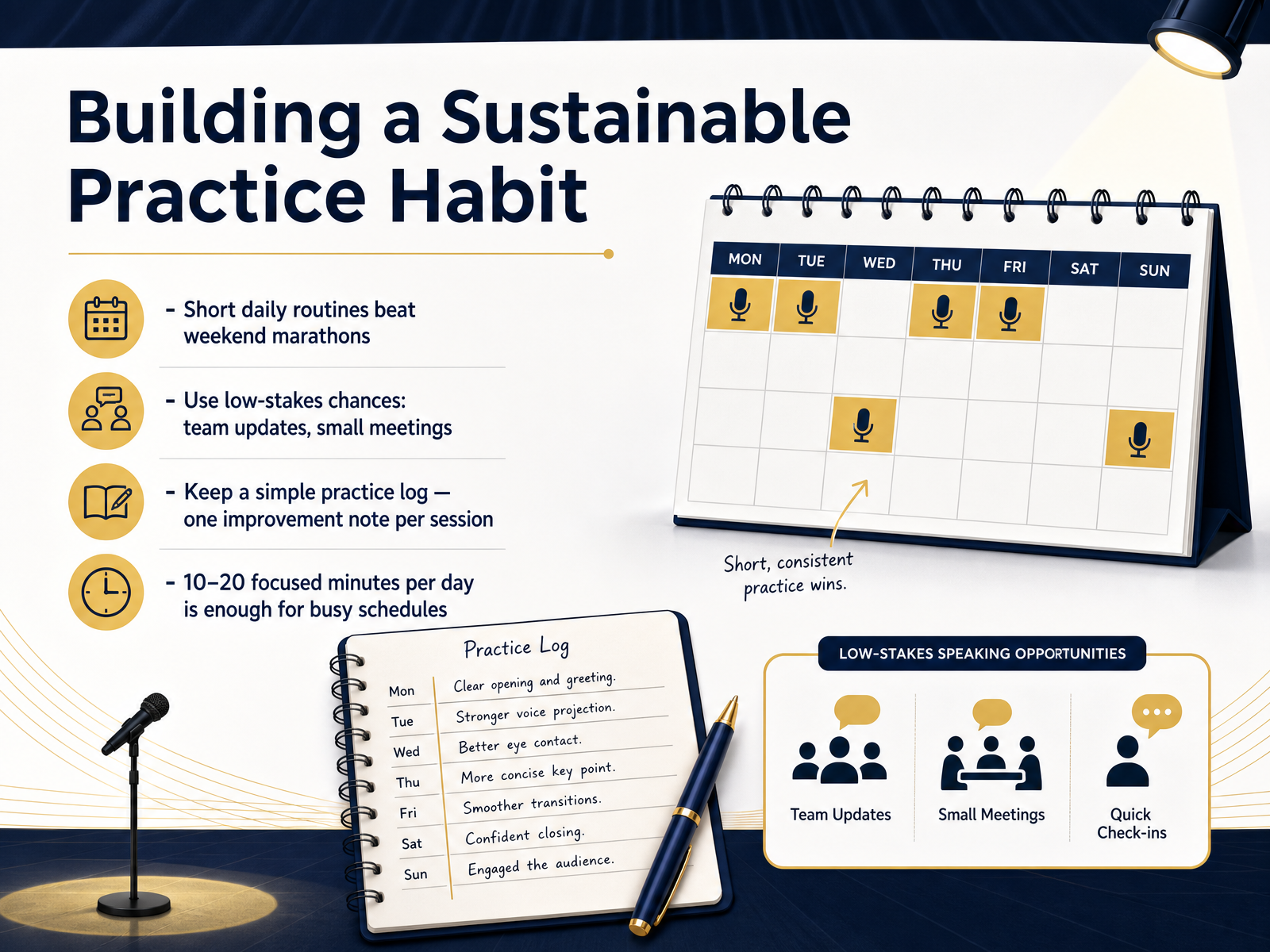
 - 11Building a Sustainable Practice HabitLet's talk about building a sustainable practice habit, because consistency truly beats intensity here. Short, daily routines will always outperform weekend marathons. Think of it like brushing your teeth, just a few minutes each day compounds into something solid. Look for low-stakes chances to practice, like giving a team update or speaking up in a small meeting. These are perfect, safe testing grounds. Keep a simple practice log, and after each session, jot down just one improvement note. That's it. One thing to work on next time. For busy schedules, ten to twenty focused minutes a day is genuinely enough. It's not about the volume of time, it's about the quality of focus. So find your small window, protect it, and watch your progress build. Next, let's see how to apply this entire workflow to a real speech.
 goodhabitsforlife.comsaynow.aiechopitch.io+22 min
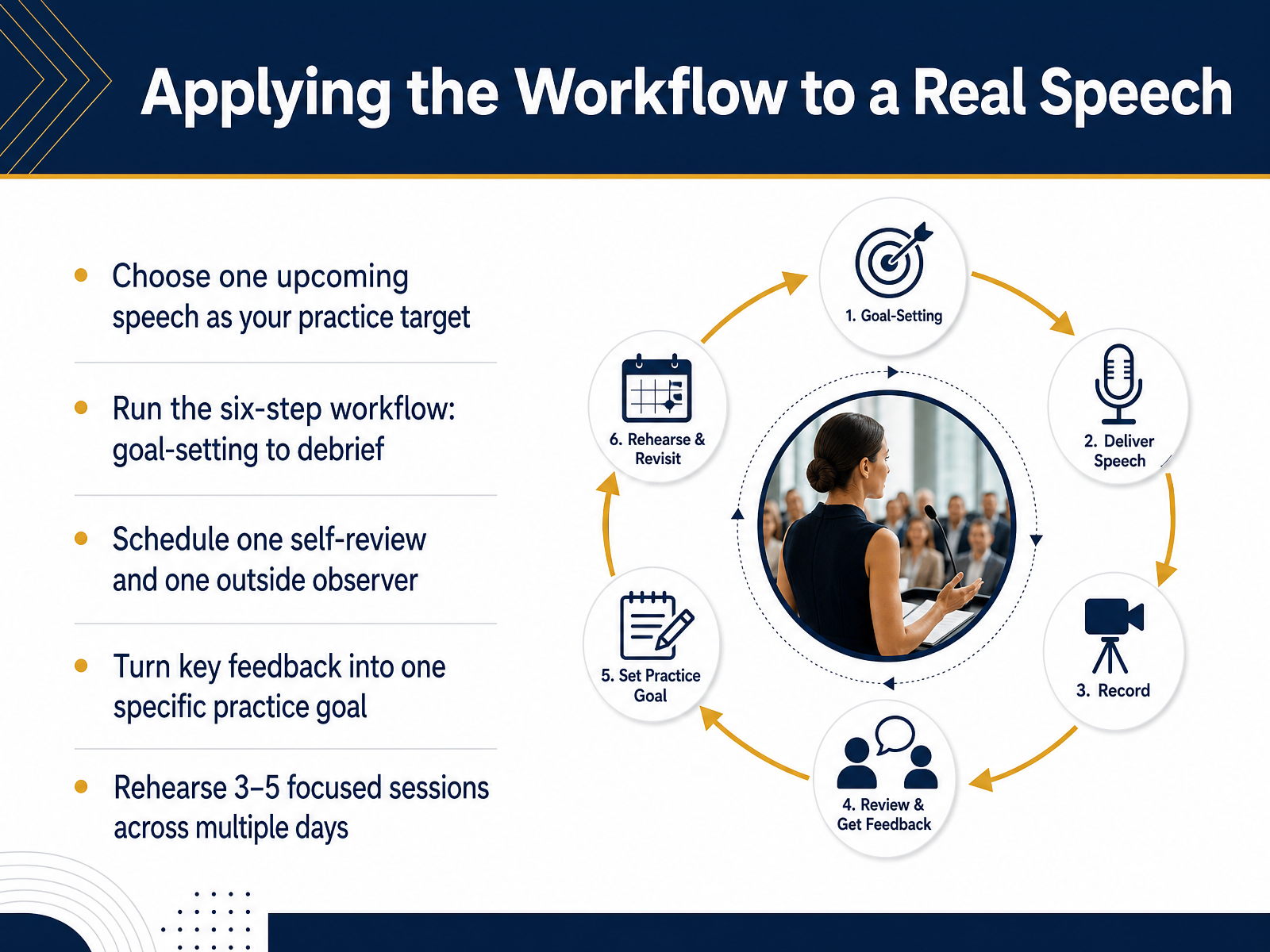
 - 12Applying the Workflow to a Real SpeechNow it's time to put the work into practice. Choose one upcoming speech as your training ground — a meeting update, a class presentation, anything real. Run the six-step workflow from start to finish: goal-setting, preparation, rehearsal, delivery practice, feedback, and debrief. Schedule two specific checkpoints. One is a self-review where you watch your own recording. The other is an outside observer, a colleague or friend who gives you honest feedback. From that feedback, pick just one specific goal to work on — not three, not five. One clear target, like reducing filler words or improving your transitions. Then rehearse three to five focused sessions spread across multiple days. Remember, three twenty-minute practices beat one long cram session every time. Distributed practice sticks. Focused practice improves. This is how a real speech becomes your best training tool. Now, let's look at the key takeaways from this entire workflow.
 winningpresentations.comsecondnatureuk.co.ukwustl.pressbooks.pub+22 min
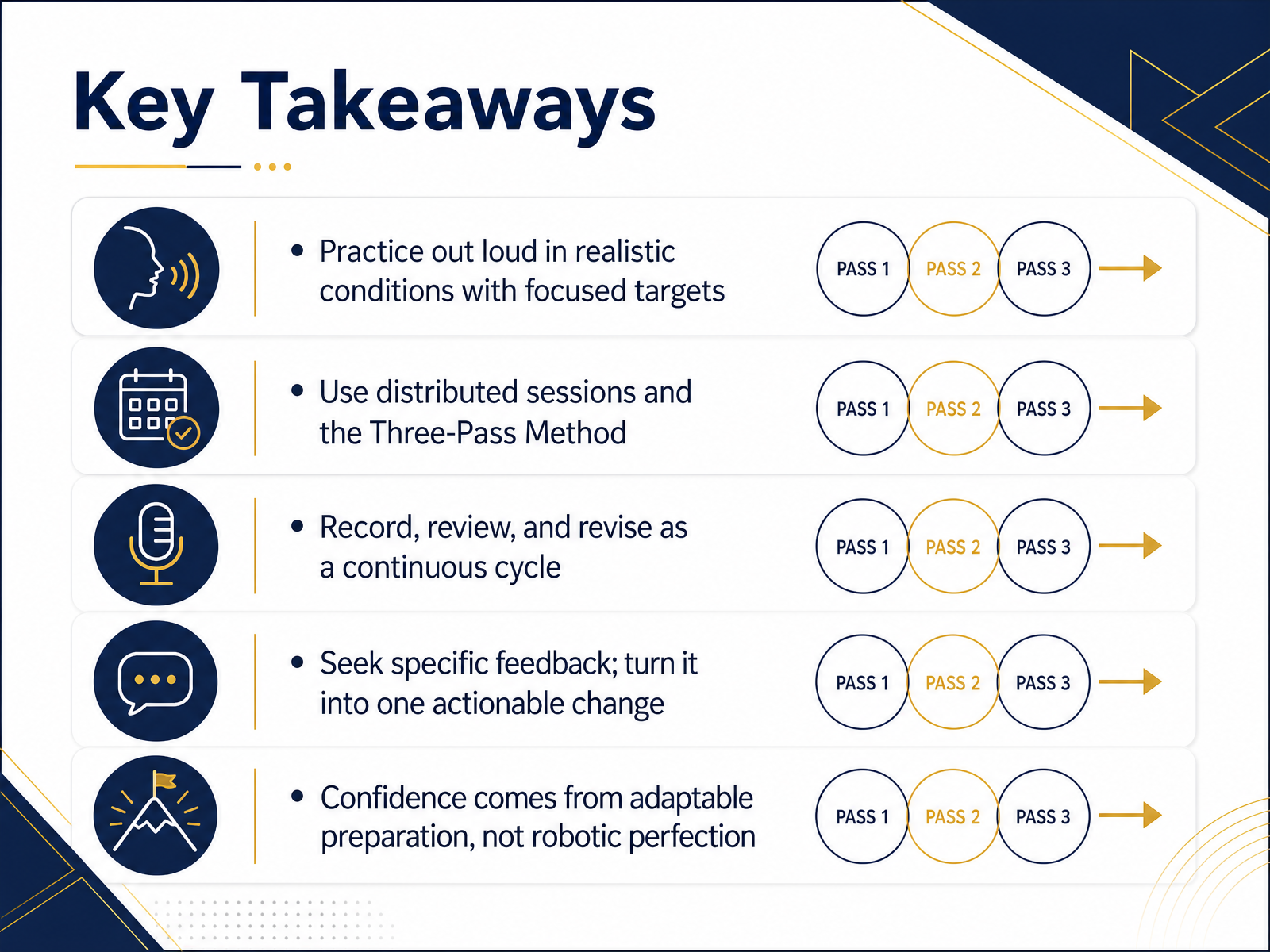
 - 13Key TakeawaysLet’s bring everything together in a few key takeaways. First, practice out loud in realistic conditions with focused targets. Reading silently in your head doesn’t build the confidence you need—stand up, speak out, and give each session one clear goal. Second, use distributed practice and the Three-Pass Method. Spread short sessions across several days, and focus each one on structure, transitions, then delivery. Next, make recording, review, and revision a continuous cycle. Record yourself, watch with a specific question in mind, and make one small improvement each time. Fourth, seek specific feedback and turn it into one actionable change. Ask your observer, “What was the clearest part, and where did you drift?” Then work on that single point in your next practice. Finally, remember that confidence comes from adaptable preparation, not robotic perfection. The goal is to know your structure so well you can handle interruptions and still connect with your audience. That’s the real power of rehearsal. Now, let’s look at your action plan and the first concrete steps you can take tomorrow.
 winningpresentations.comsecondnatureuk.co.ukwustl.pressbooks.pub+21 min
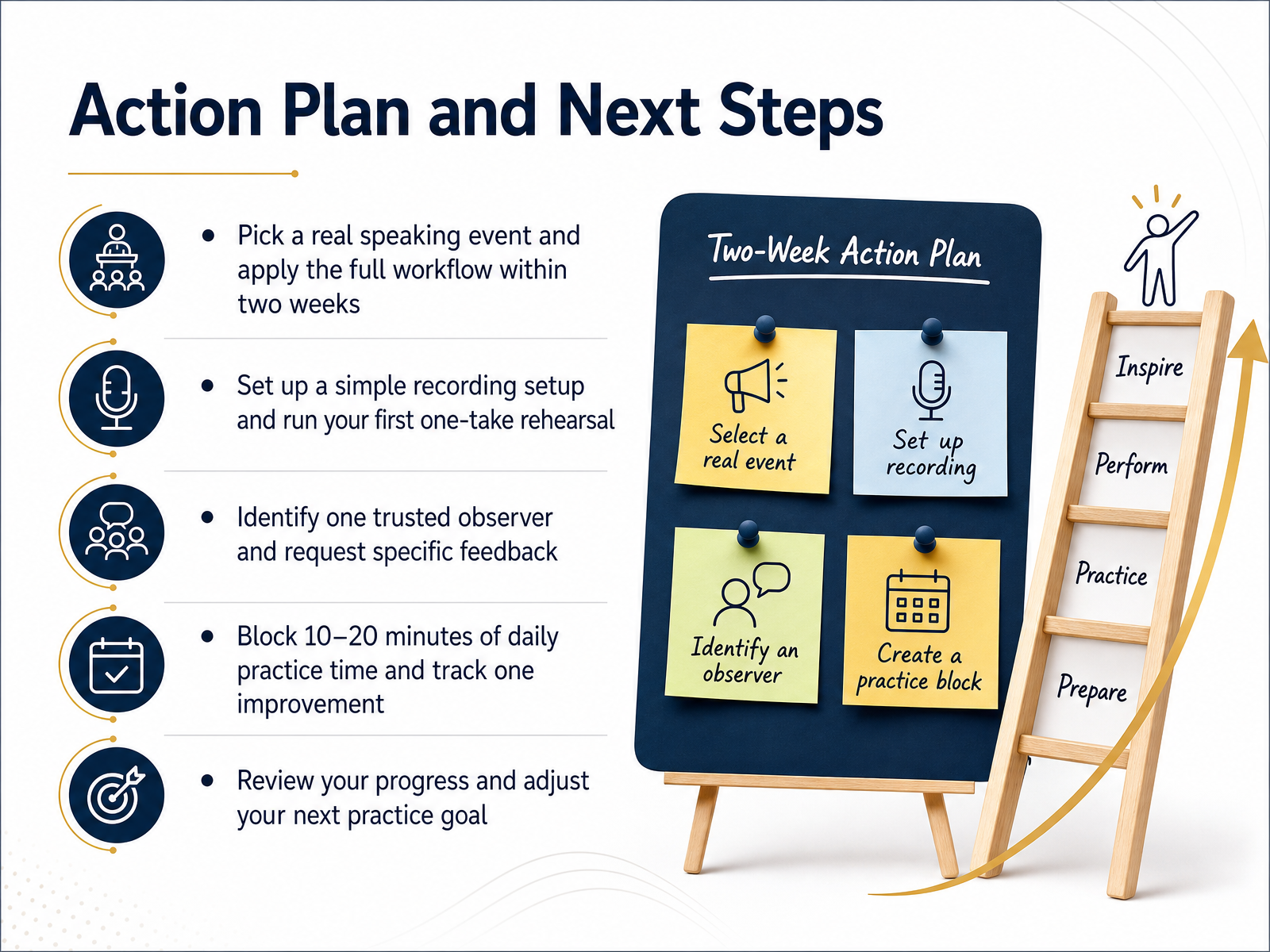
 - 14Action Plan and Next StepsWe've covered a lot of ground today. Now it's time to put it all into action. Here's your plan for the next two weeks. First, pick a real speaking event and commit to applying the full workflow to it. Second, set up a simple recording setup and run your first one-take rehearsal. Remember, don't stop, just recover and keep going. Third, identify one person you trust and ask them for specific feedback on just one thing, like your pacing or your opening. Fourth, block out ten to twenty minutes a day for practice. After each session, track just one improvement you want to see. Finally, review your progress and adjust your practice goal for the next week. That's how you turn a single session into a continuous improvement cycle. Thank you for your focus and commitment today. You now have a practical plan. The only step left is to begin. Schedule your first practice session tonight. You've got this.
 goodhabitsforlife.comsaynow.aiechopitch.io+22 min
Take the deck with you
Download this course as a file — free, no sign-up needed.
- PDF handoutEvery slide page, ready to print or share.15 pages · 3.4 MBDownload
- Narrated PowerPointThe deck that presents itself — every slide carries the digital human's narration video.15 pages · 24.0 MBDownload
- PowerPoint slidesThe full deck as a .pptx — open it in PowerPoint, Keynote, or Google Slides.15 pages · 3.3 MBDownload
Free to use in your own training — please keep the PersonWise credit page at the end.
Have your own deck? Turn it into a course
Sources consulted
Web sources consulted while building this course.
- Presentation Rehearsal: Why 3 Hours of Practice Backfires — winningpresentations.com
- A Proven Method to Rehearse Effectively — secondnatureuk.co.uk
- Rehearsing and Delivering Your Speech – Public Speaking for Modern Learners: Self-Assurance, Adaptability, and Professional Growth — wustl.pressbooks.pub
- Rehearsal Is the Work: Why Mastery Creates Your Presentation Confidence | Patricia Fripp — fripp.com
- How to Practice a Presentation — elenikelakos.com
- Deliberate practice activities of communication professionals and implications for training and consulting — doi.org
- Deliberate Practice in Professional Speaking Expertise — repository.usfca.edu
- The added benefit of an extra practice session in virtual reality on the development of presentation skills: A randomized control trial — onlinelibrary.wiley.com
- E-learning and deliberate practice for oral case presentation skills: A randomized trial - R Discovery — discovery.researcher.life
- Training public speaking with virtual social interactions: effectiveness of real-time feedback and delayed feedback | Journal on Multimodal User Interfaces | Springer Nature Link — link.springer.com
- Public Speaking Feedback: Getting Notes Worth Acting On — Rhetoriq — rhetoriq.io
- How to get feedback on speeches - Allison Shapira — allisonshapira.com
- Feedback Matters: How to Ask for and Use Speaking Critiques — nosweatpublicspeaking.com
- Speaker Success Tips on Giving and Receiving Feedback — brainzmagazine.com
- Feedback That Fuels | Taking Your Stage — takingyourstage.com
- Public Speaking with Deliberate Practice – Good Habits for Life — goodhabitsforlife.com
- How to Practice Public Speaking: A Structured Daily Plan | SayNow AI — saynow.ai
- How to Practise a Presentation: A Step-by-Step Guide | EchoPitch — echopitch.io
- How to Become a Better Public Speaker in 90 Days: A Focused Practice Plan — Topher Keene | Vocal Coach — topherkeene.com
- How to Get Better at Public Speaking: A Practical 2026 Guide for Confidence, Clear Delivery, and Better Presentations - Jason Redman | Navy SEAL, Speaker & Leadership Expert — jasonredman.com