Email Marketing Platform Selection & Architecture
Begin
14 pages · ~28 min
Email Marketing Platform Selection & Architecture
This training guides marketers and product owners through choosing and architecting an email marketing platform, covering key selection criteria and tradeoffs.
What you’ll learn
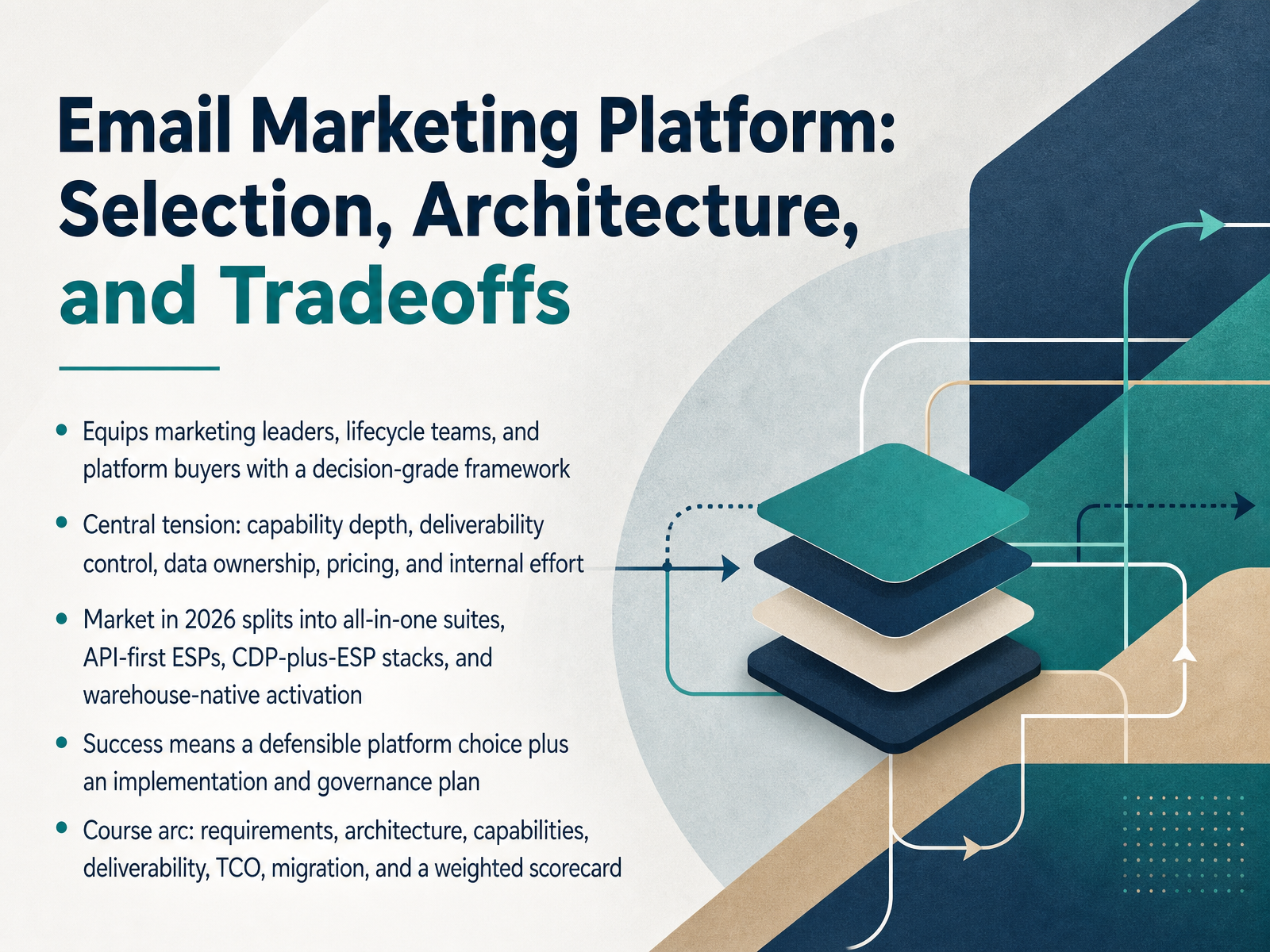
- 01Email Marketing Platform: Selection, Architecture, and TradeoffsWelcome. This course is about selecting an email marketing platform, and it's built for marketing leaders, lifecycle teams, and anyone evaluating a replacement.
Here's our goal: give you a decision-grade framework, not a vendor ranking. The central tension is capability depth, deliverability control, data ownership, pricing, and the internal effort each choice demands. Those five forces pull against each other, and every platform trades one for another.
In twenty twenty-six, the market splits into four paths. All-in-one suites, API-first ESPs, CDP-plus-ESP stacks, and warehouse-native activation. Each is defensible for the right team and the wrong team. Success isn't picking the best product on paper. It's a defensible choice plus a real implementation and governance plan.
So we'll work through requirements, architecture, capabilities, deliverability, total cost of ownership, migration, and finish with a weighted scorecard you can actually run. Let's start by framing why platform choice is an architecture decision.netcorecloud.comgitnux.orgtop-5-solutions.com+21 min
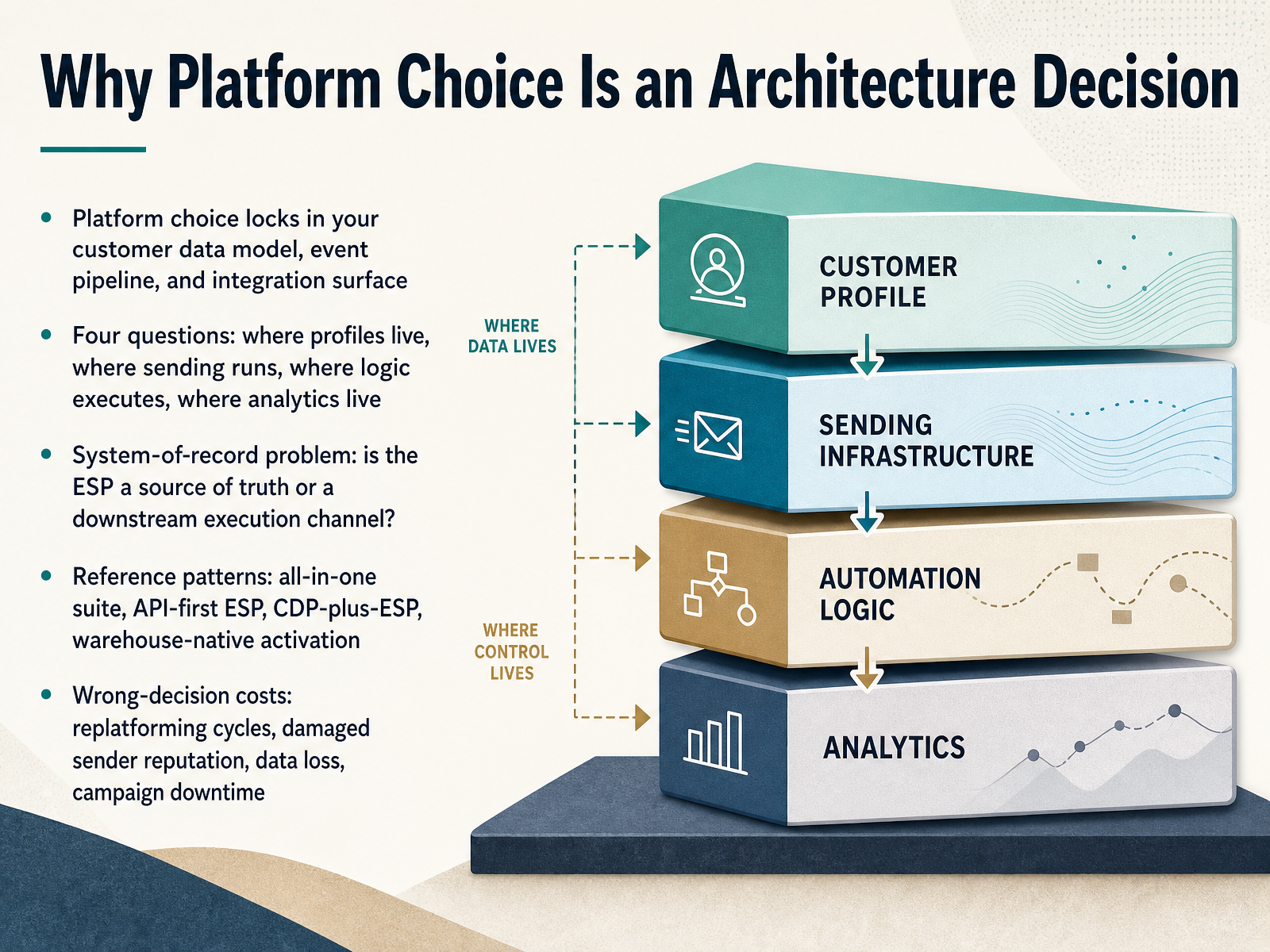
- 02Why Platform Choice Is an Architecture DecisionLet's frame why platform choice is really an architecture decision. When you pick an email platform, you lock in three things: your customer data model, your event pipeline, and your integration surface. Changing any of those later is expensive. So before you compare features, answer four questions. Where do profiles live? Where does sending run? Where does logic execute? And where does analytics live? Those answers expose the system-of-record problem. Is your ESP the source of truth for customer state, or a downstream execution channel that receives data from somewhere else? Most teams find the honest answer is the second. From there, four reference patterns appear: the all-in-one suite, the API-first ESP, the CDP plus ESP, and warehouse-native activation. Each one assigns ownership differently, and each carries a different cost. The wrong decision shows up as replatforming cycles, damaged sender reputation, data loss, and campaign downtime. None of those are abstract. They are budget, revenue, and team capacity. So treat this as an architecture decision first, and a vendor decision second. Next, we'll look at translating business goals into platform requirements.
 wiredmessenger.commartech360.comandrea.veggiani.com+21 min
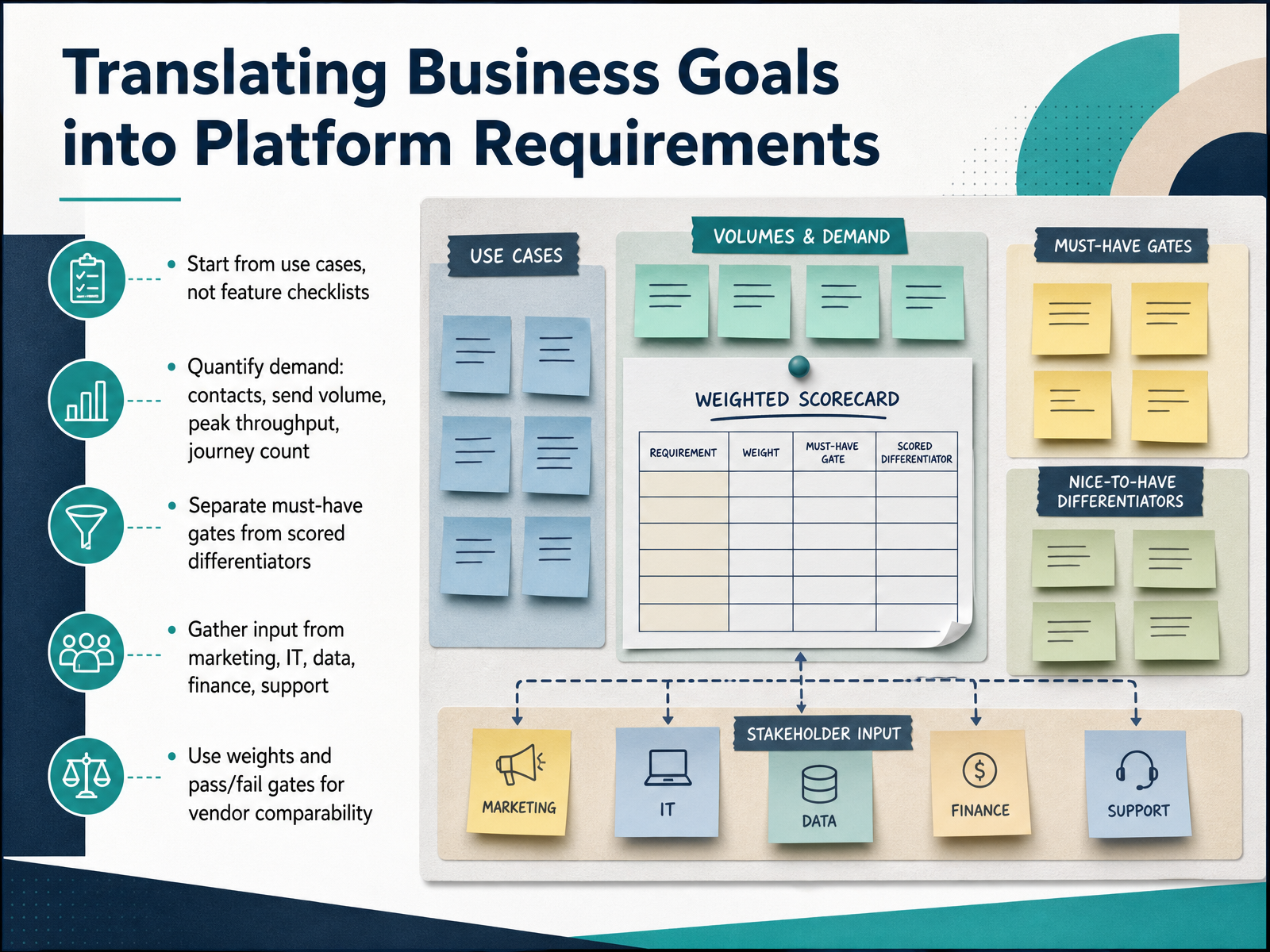
 - 03Translating Business Goals into Platform RequirementsLet's translate those business goals into platform requirements you can actually evaluate. Start with use cases, not feature checklists. The question isn't whether a vendor has artificial intelligence; it's whether your team can launch a cart-abandonment journey in three days without engineering help. Next, quantify demand in hard numbers. How many contacts do you hold today, and how many will you hold in two years? What's your monthly send volume, your peak throughput during a holiday launch, and how many concurrent journeys must run at once? These numbers drive both price and architecture. Then separate must-have gates from scored differentiators. If single sign-on or regional data residency is missing, the vendor leaves the shortlist, period. Everything else gets weighted and scored. Gather input from marketing, IT, data, finance, and support, because each sees a different risk. Finally, apply weights and pass or fail gates so every vendor is compared on the same basis. That's how scoring becomes defensible, not subjective. Next, let's look at core capability comparison, and what actually differentiates platforms.
 globalitresearch.comemarsys.combloomreach.com+22 min
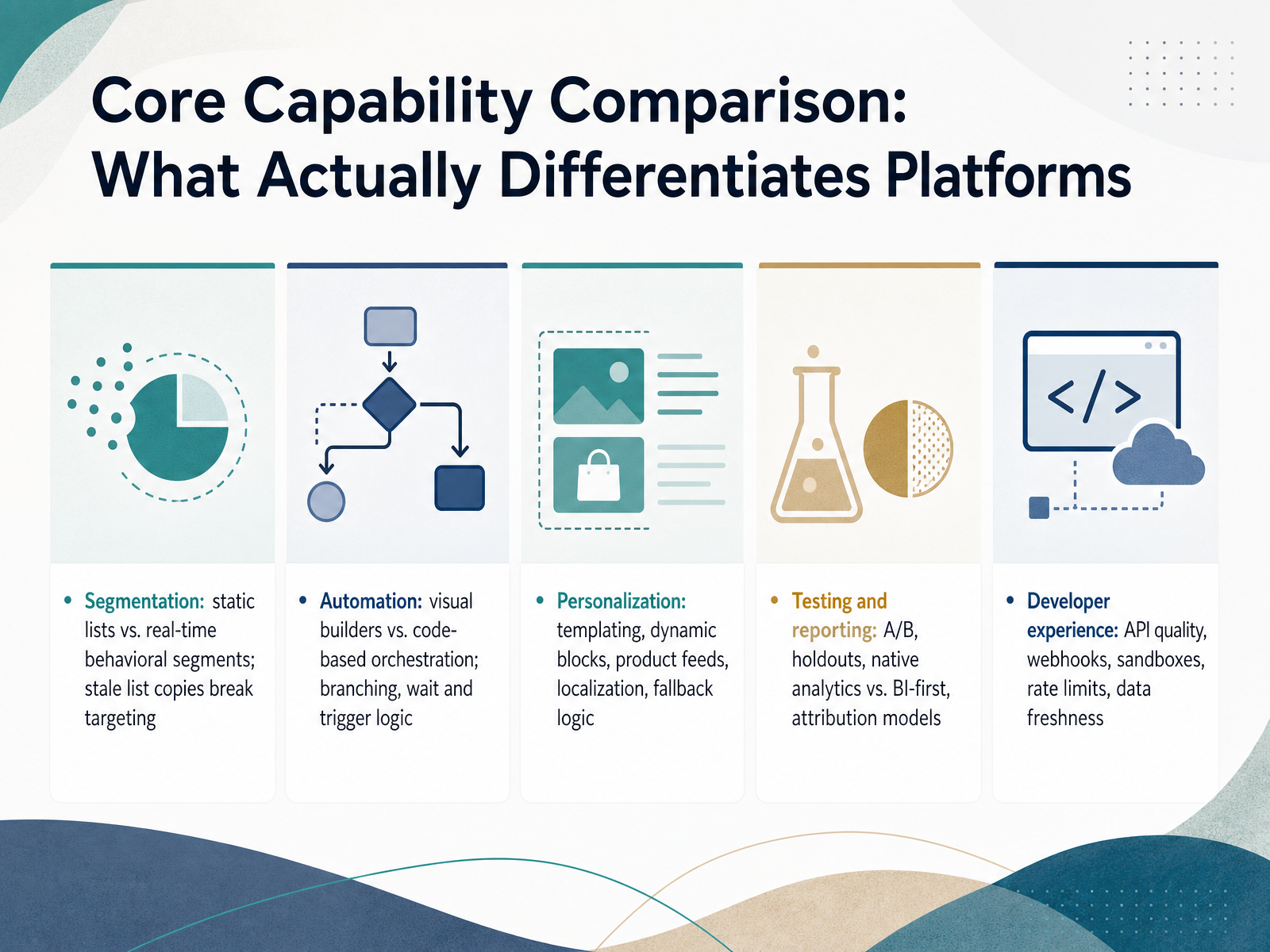
 - 04Core Capability Comparison: What Actually Differentiates PlatformsLet's look at what actually separates platforms, starting with segmentation. Static lists are snapshots, and stale copies quietly break your targeting. Real-time behavioral segments recompute as behavior changes, so the audience you approved is the audience that receives the send. Next, automation. Visual builders get marketers to production faster, while code-based orchestration buys flexibility and version control. In practice, the depth of your branching, wait steps, and trigger logic matters more than the builder's polish. Then personalization, which is really templating plus dynamic blocks, product feeds, and localization, with a defined fallback when data is missing. Testing and reporting come next. Some platforms ship native A and B testing, holdouts, and attribution; others assume your business intelligence stack owns that layer. Finally, developer experience: API quality, webhooks, sandboxes, rate limits, and data freshness determine how fast your team can ship. Weigh these five as a set. A platform that wins on one can quietly cost you on another.
That tradeoff leads directly into the next topic: Deliverability, Compliance, and Sending Infrastructure.
 propicked.commailneo.cotop-5-solutions.com+22 min
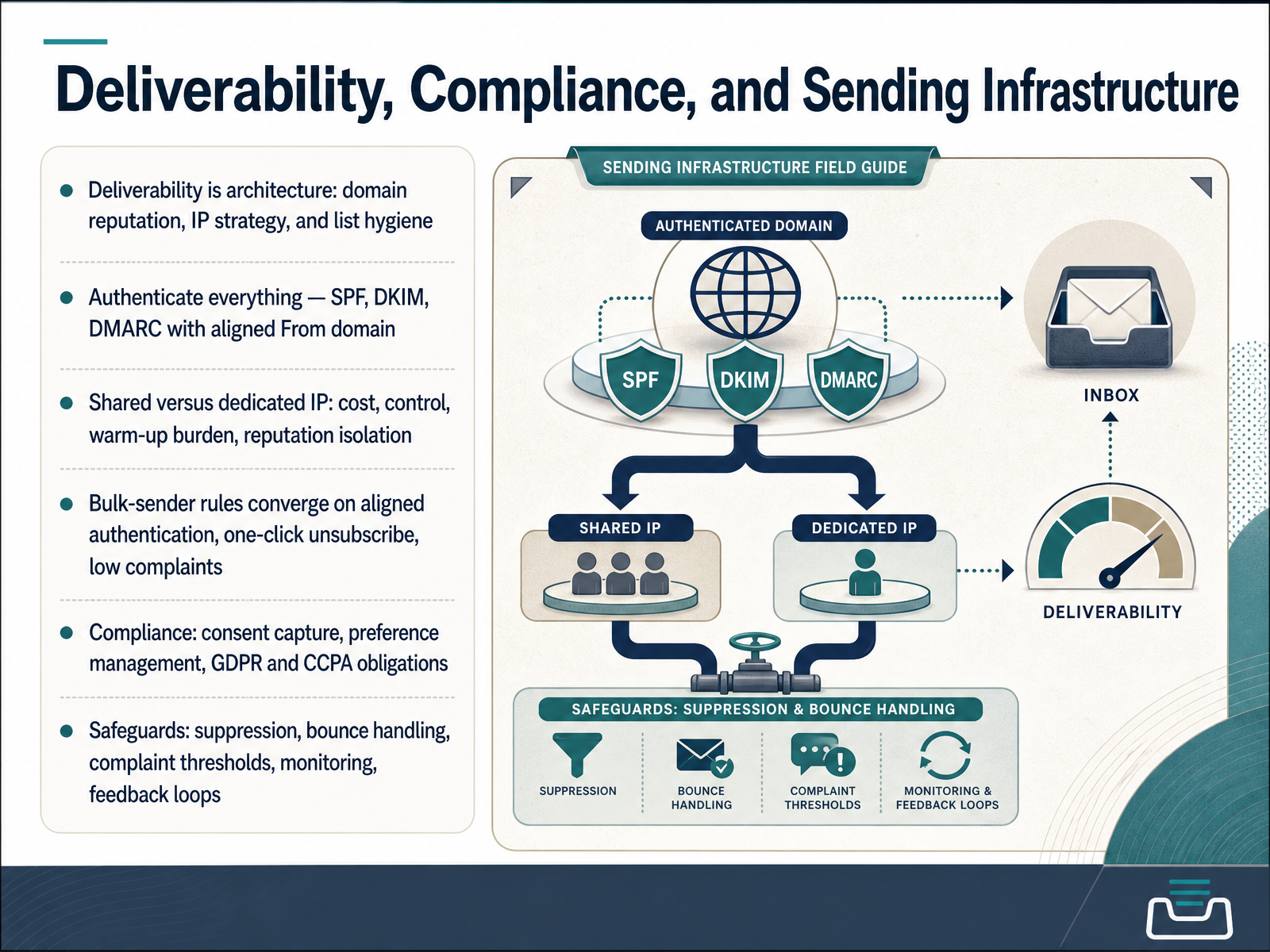
 - 05Deliverability, Compliance, and Sending InfrastructureLet's talk about the layer that decides whether any of this actually reaches an inbox. Deliverability is architecture, not a checkbox. It rests on domain reputation, IP strategy, and list hygiene. Authenticate everything: SPF, DKIM, and DMARC with an aligned From domain. Alignment is the detail teams miss, and passing but unaligned mail fails DMARC. On the infrastructure side, shared IPs are cheaper and arrive pre-warmed, but your reputation is tied to strangers. Dedicated IPs give isolation and control, yet you own the warm-up burden and the cold start. Note that Gmail, Yahoo, and Microsoft now converge on the same bulk-sender baseline: aligned authentication, one-click unsubscribe, and complaint rates under zero point three percent, ideally well below zero point one. Compliance is the other half. Capture clear consent, manage preferences, and honor GDPR and CCPA obligations. Then build safeguards: suppression lists, bounce handling, complaint thresholds, monitoring, and feedback loops. Poor compliance breaks loudly and fast. A damaged complaint rate recovers slowly, which makes it far cheaper to prevent than to repair. Next, we compare pricing models, total cost of ownership, and the contract traps that decide your real budget.
 techcommunity.microsoft.comsupport.google.com2 min
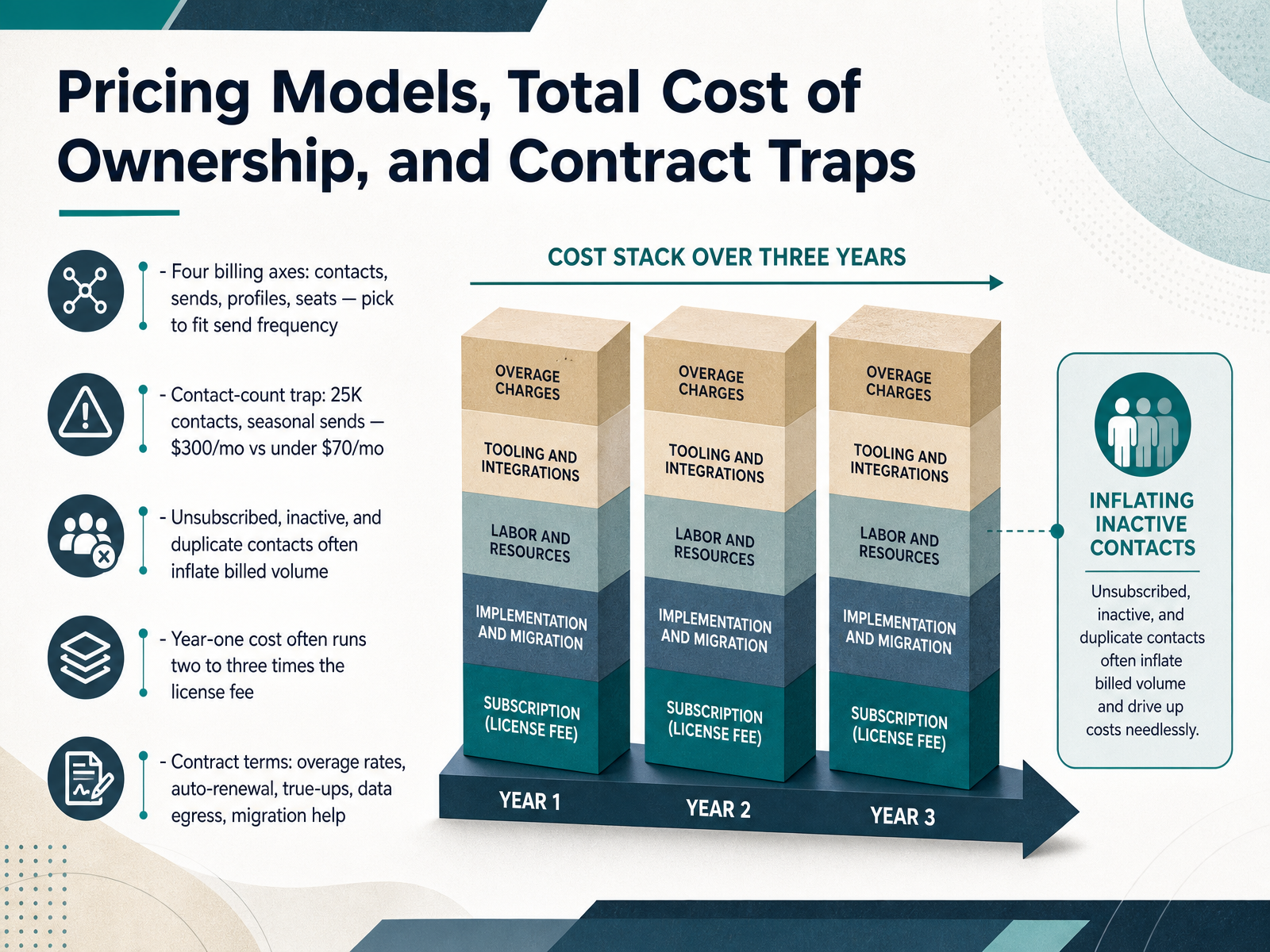
 - 06Pricing Models, Total Cost of Ownership, and Contract TrapsNow let's talk about the money, because pricing is where most of these decisions are actually won or lost. There are four billing axes: contacts, sends, profiles, and seats. Pick the one that matches your send frequency. Here's a concrete example. A list of twenty-five thousand contacts emailed seasonally costs roughly three hundred dollars a month on a per-contact model, versus under seventy dollars a month on a per-send model. Same audience, four times the cost, and no feature checklist will surface that. Watch the contact-count trap too. Unsubscribed, inactive, and duplicate contacts often inflate your billed volume, so you pay for people who never hear from you. And remember, year-one cost typically runs two to three times the license fee once you add implementation, migration, and internal time. So before you sign, negotiate the terms that bite later: overage rates, auto-renewal, true-ups, data egress, and migration help. Next, we'll look at migration and implementation, and how to sequence the replatform.
 emarsys.comglobalitresearch.comemarsys.com+22 min
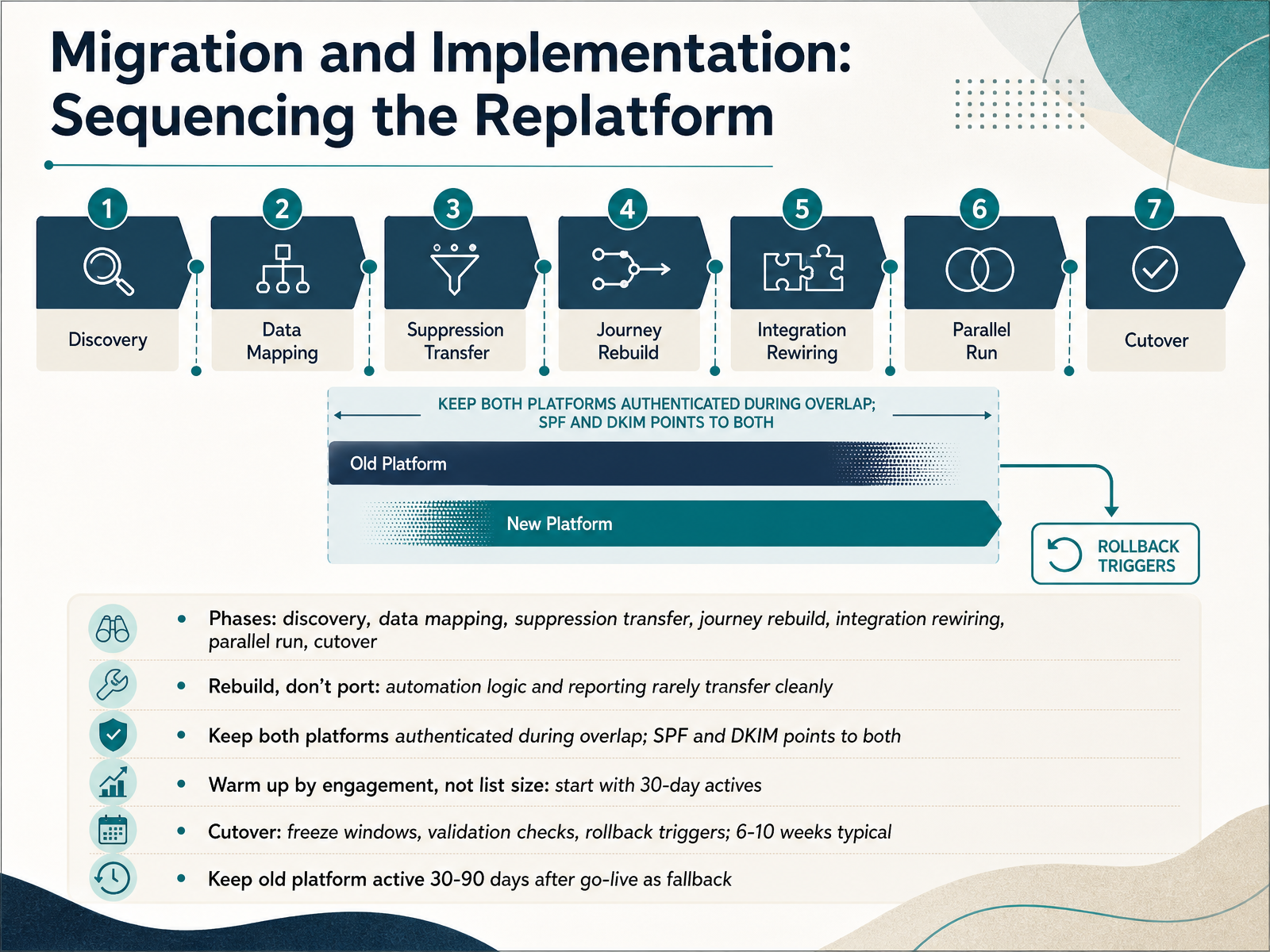
 - 07Migration and Implementation: Sequencing the ReplatformNow let's talk about sequencing the replatform. A safe migration runs in phases: discovery, data mapping, suppression transfer, journey rebuild, integration rewiring, a parallel run, and finally cutover. Plan on six to ten weeks.
Two principles drive the schedule. First, rebuild, don't port. Automation logic and reporting rarely transfer cleanly, so budget that as its own project, not a footnote. Second, stay in overlap. Keep both platforms authenticated during the switch, with SPF and DKIM pointing to both, so either path can deliver.
Warm up by engagement, not list size. Start with your thirty-day actives, then expand to sixty and ninety-day contacts as placement holds. Before cutover, define freeze windows, validation checks, and rollback triggers in advance. And keep the old platform active for thirty to ninety days after go-live as a fallback.
Let's move on to Governance, Operations, and Operating Model.
 wiredmessenger.commartech360.comandrea.veggiani.com+22 min
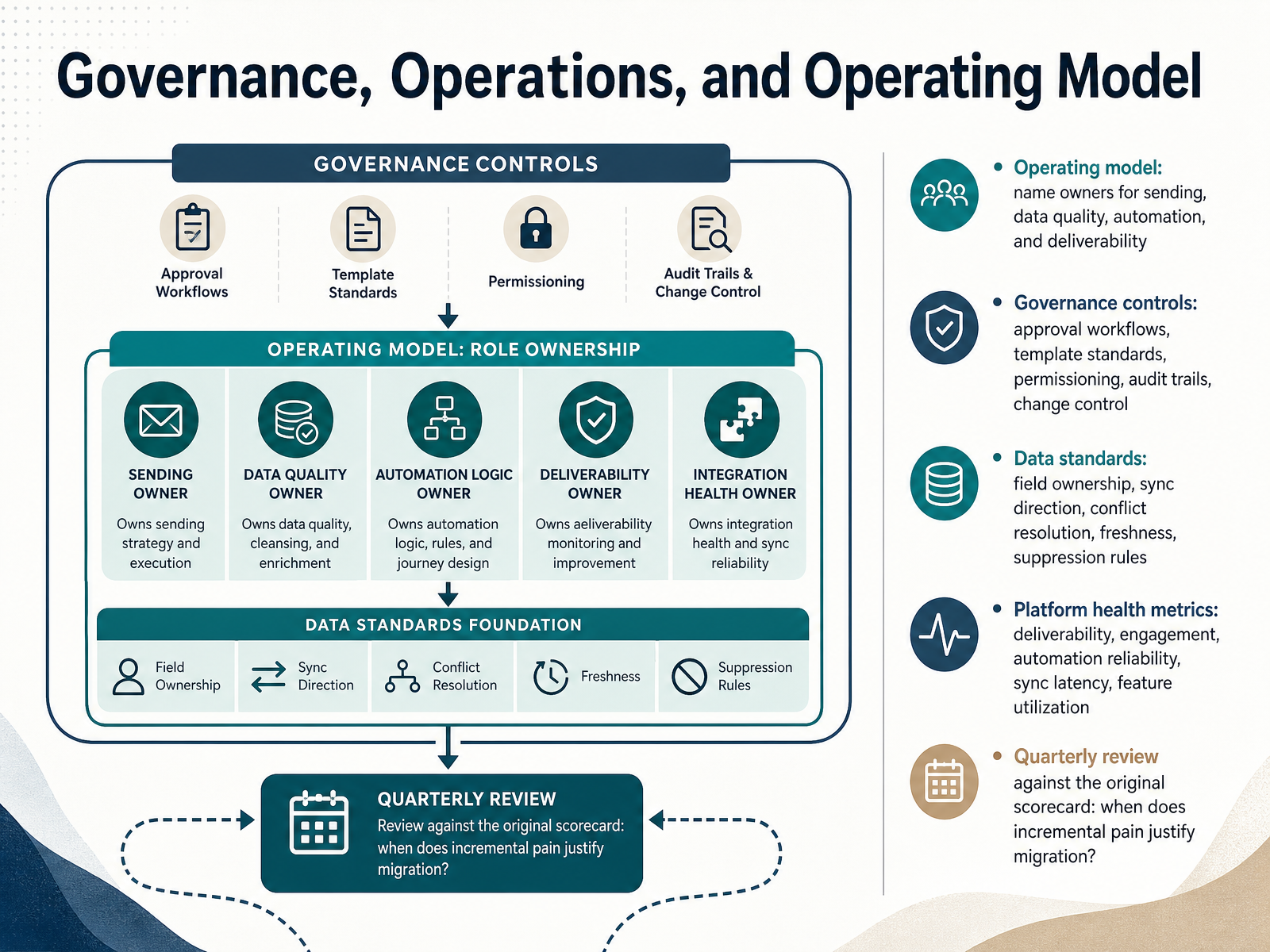
 - 08Governance, Operations, and Operating ModelLet's talk about governance, operations, and the operating model that keeps an email platform healthy. First, name real owners. One person owns sending, another owns data quality, another owns automation, and another owns deliverability. Without names, accountability is nobody's job. Governance controls come next. Approval workflows, template standards, permissioning, audit trails, and change control. These prevent a broken template from reaching fifty thousand people on a Tuesday morning. Then data standards. Decide who owns each field, which direction data syncs, how conflicts get resolved, how fresh data must be, and who maintains suppression rules. Poor data hygiene is a data problem, not a platform problem. Track platform health with a small set of metrics. Deliverability, engagement, automation reliability, sync latency, and feature utilization. Review quarterly against your original scorecard. Ask a direct question. When does incremental pain justify migration? If failures are ownership or process issues, fix those before you buy a new platform. Next, we look at Measuring Platform Value and Business Impact.
 emarsys.comglobalitresearch.comemarsys.com+22 min
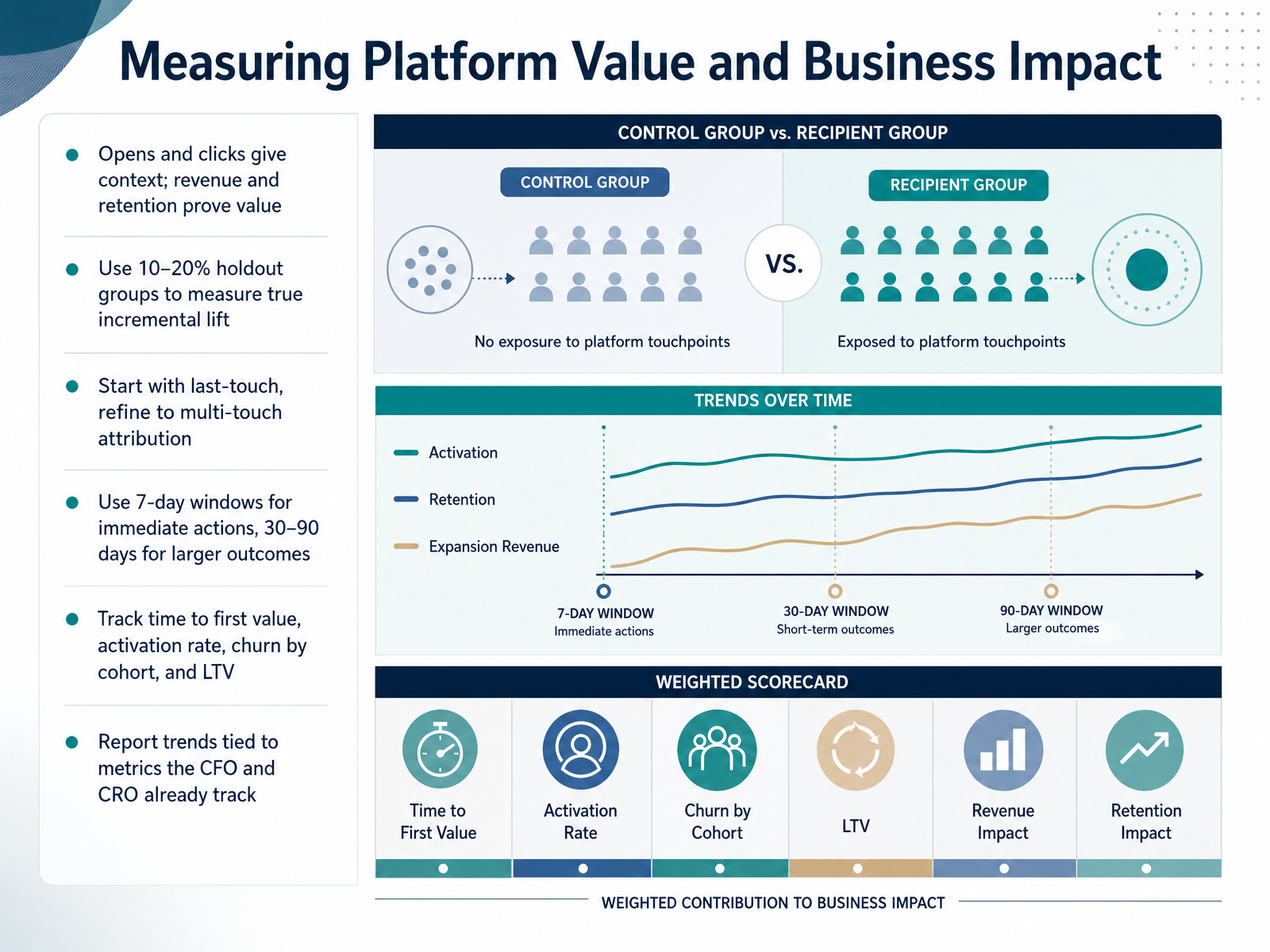
 - 09Measuring Platform Value and Business ImpactNow let's talk about measuring platform value and business impact. Opens and clicks give you context, but revenue and retention prove value. To measure true incremental lift, use holdout groups of ten to twenty percent. Start with last-touch attribution, then refine to multi-touch as your data matures. Use seven-day windows for immediate actions, and thirty to ninety days for larger outcomes like upgrades or retention. Track time to first value, activation rate, churn by cohort, and lifetime value. And report trends tied to metrics your CFO and CRO already track, so the conversation stays about the business, not the channel. Next, we'll walk through the decision framework, scorecard, and common pitfalls.
 globalitresearch.comemarsys.combloomreach.com+21 min
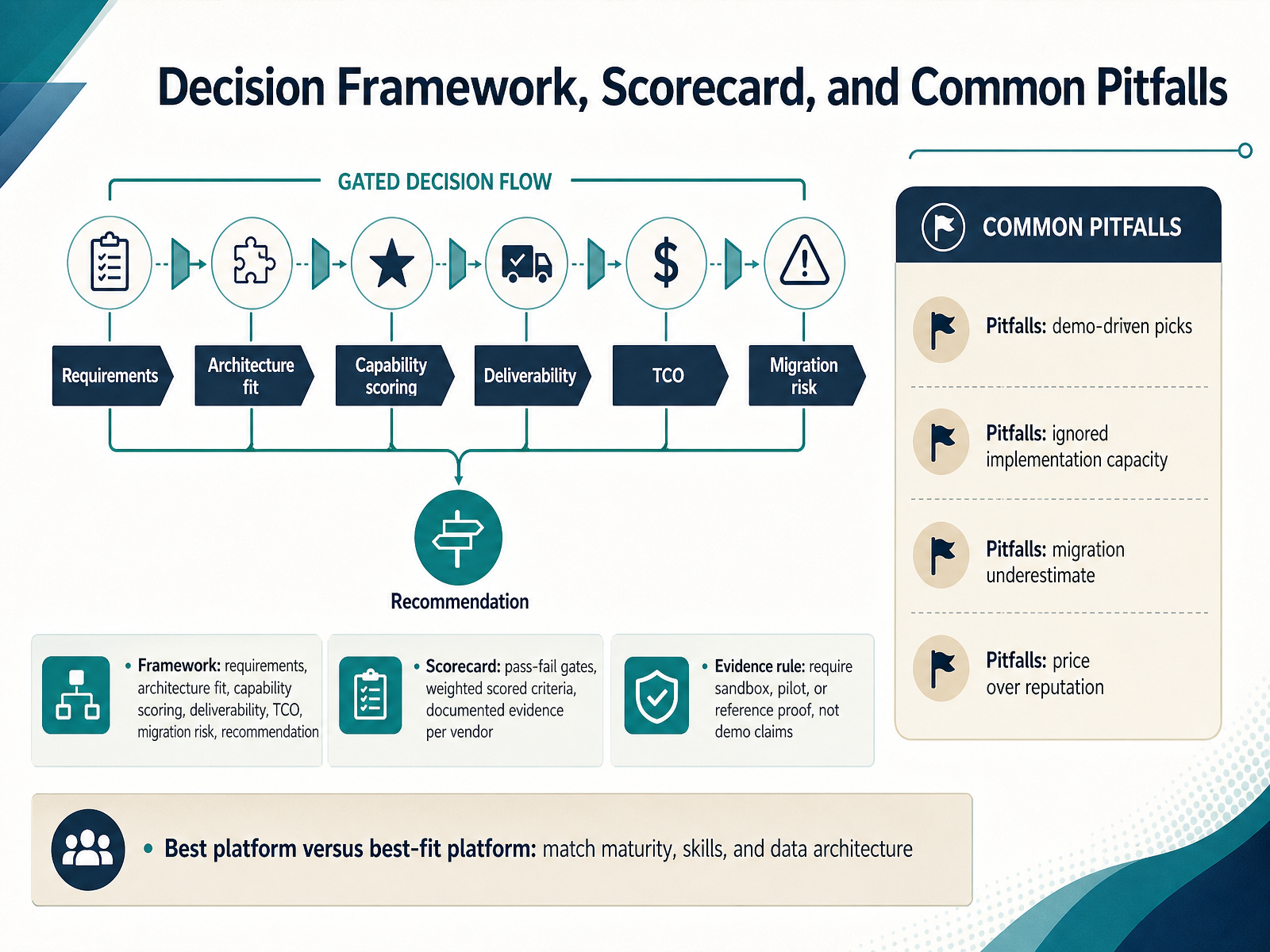
 - 10Decision Framework, Scorecard, and Common PitfallsLet's put everything into a decision framework you can actually run. Start with seven steps: requirements, architecture fit, capability scoring, deliverability, total cost of ownership, migration risk, and a written recommendation.
Then build a scorecard. Use pass fail gates for anything non negotiable, like consent management or data residency. Score everything else with weights. And document evidence for every vendor, so the decision survives leadership review.
Here is the evidence rule. Require a sandbox, a paid pilot, or a reference call, not demo claims. Vendors configure demos to hide latency and messy admin work. A pilot against your own data exposes that fast.
Watch for four common pitfalls. Demo driven picks. Ignoring implementation capacity. Underestimating migration. And choosing on price over reputation.
Finally, separate best platform from best fit. Match maturity, skills, and data architecture. A composable stack rewards engineering depth; a unified suite rewards lean teams.
Next, let's make this concrete with Scenario A: Small Creator or E-commerce Team.
 emarsys.comglobalitresearch.comemarsys.com+22 min
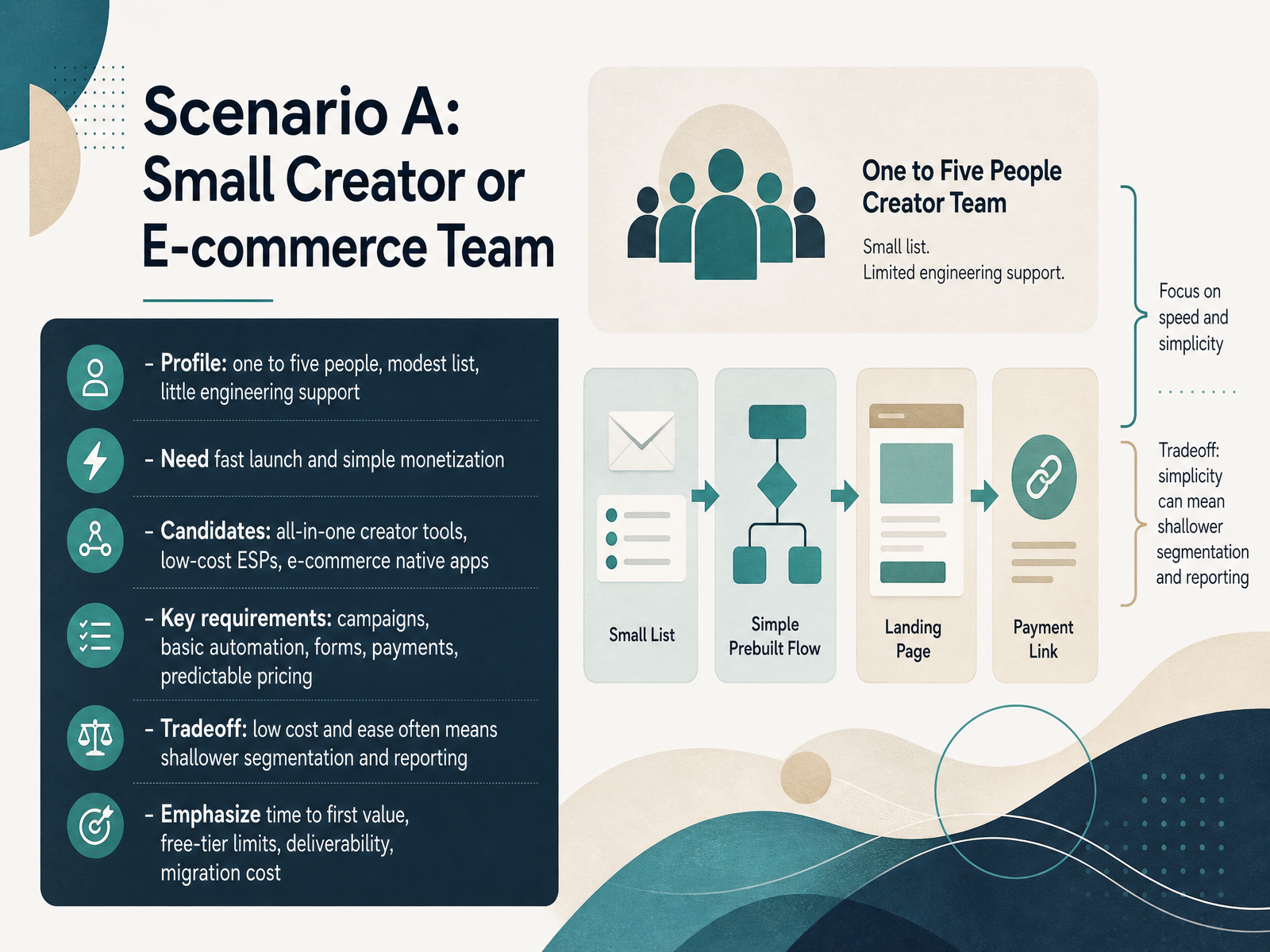
 - 11Scenario A: Small Creator or E-commerce TeamNow let's make that concrete, starting with the smallest team. This is your classic small creator or e-commerce operation: one to five people, a modest list, and very little engineering support. The job is to launch fast and monetize simply, so the real candidates are all-in-one creator tools, low-cost email service providers, and e-commerce native apps. What you actually need is campaigns, basic automation, forms, payments, and predictable pricing. Here's the tradeoff you have to accept: low cost and ease of use usually mean shallower segmentation and reporting. So when you evaluate, lead with time to first value and free-tier limits. Check what the free plan actually allows, not just the subscriber count. Verify deliverability, because a cheap platform that lands in spam costs more than it saves. And model the migration cost, since switching later always means rebuilding flows and templates. Balance speed and price against the depth you may want in a year. Next, we'll look at the opposite scenario: Scenario B: Mid-Market Lifecycle Team Outgrowing an ESP.
 propicked.commailneo.cotop-5-solutions.com+22 min
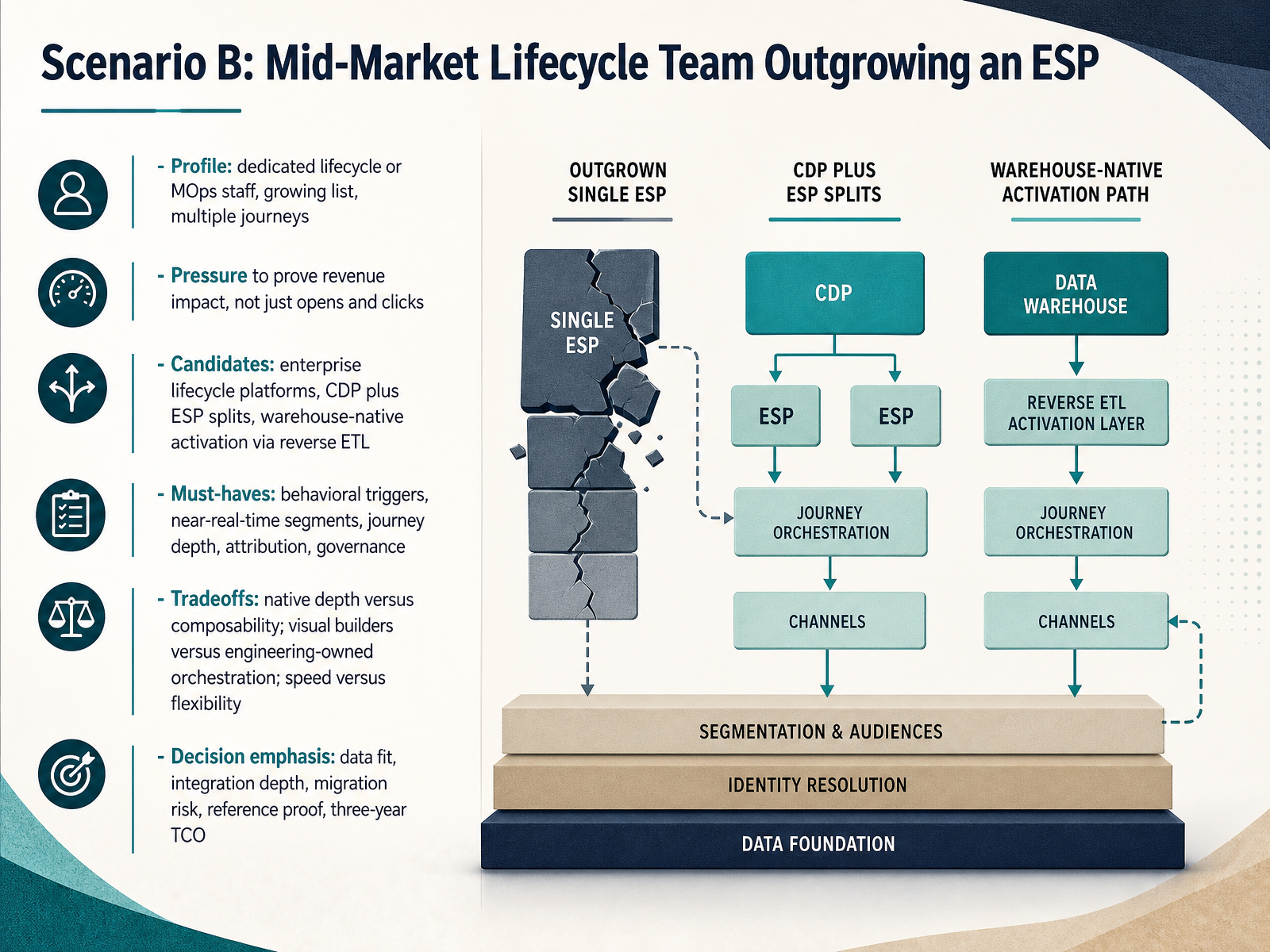
 - 12Scenario B: Mid-Market Lifecycle Team Outgrowing an ESPNow let's look at a common inflection point. Scenario B is a mid-market lifecycle team that has outgrown its ESP. You have dedicated lifecycle or marketing ops staff, a list that keeps growing, and several journeys running at once. And you're under pressure to prove revenue impact, not just opens and clicks. You're typically weighing three paths: an enterprise lifecycle platform, a CDP plus ESP split, or warehouse-native activation through reverse ETL. Your must-haves are behavioral triggers, near-real-time segments, journey depth, attribution, and governance. The tradeoffs are consistent: native depth versus composability, visual builders versus engineering-owned orchestration, and speed versus flexibility. So anchor the decision on data fit, integration depth, migration risk, reference proof, and three-year total cost of ownership. Not just the sticker price on the license. Let's move on to Scenario C: Enterprise Consolidation and High-Volume Sending.
 propicked.commailneo.cotop-5-solutions.com+21 min
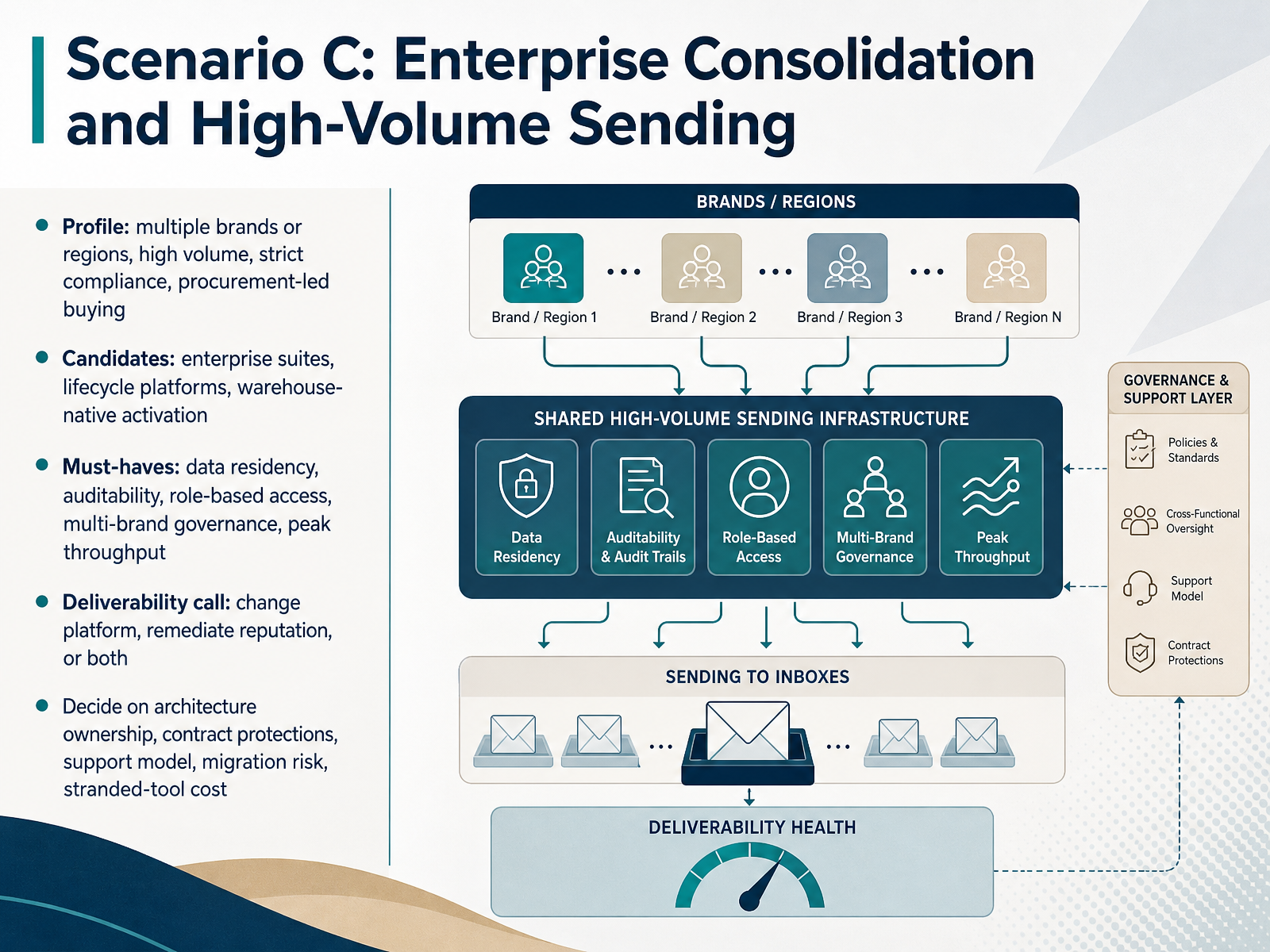
 - 13Scenario C: Enterprise Consolidation and High-Volume SendingNow let's look at the enterprise consolidation scenario. Here, you're running multiple brands or regions, sending at very high volume, under strict compliance, and procurement is leading the buying process. Your realistic candidates are enterprise suites, modern lifecycle platforms, and warehouse-native activation tools. The must-haves are non-negotiable. Data residency, auditability, role-based access, multi-brand governance, and proven peak throughput. On deliverability, you face a real fork. Change platform, remediate your reputation in place, or do both. Each carries a different cost and timeline. Then decide deliberately on architecture ownership, contract protections, your support model, migration risk, and the cost of stranded tools. The core tradeoff here is simple. Consolidation reduces integration overhead and governance complexity, but it concentrates vendor risk and shifts leverage to procurement. Write those decisions down before negotiation begins. Next, we'll turn to the action plan for your first ninety days and next steps.
 globalitresearch.comemarsys.combloomreach.com+22 min
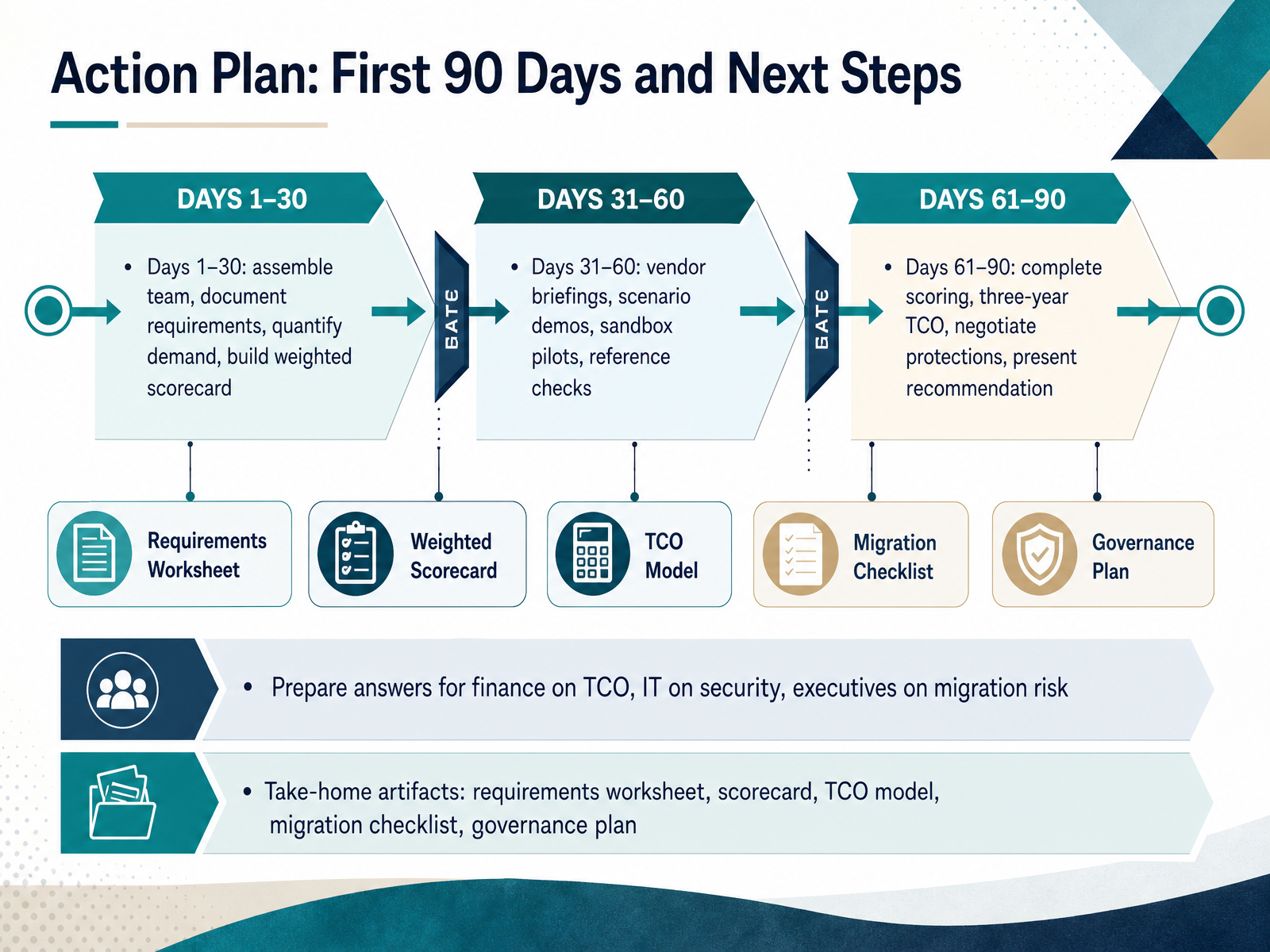
 - 14Action Plan: First 90 Days and Next StepsLet's close with a practical ninety-day action plan, because a selection decision only holds up when it is run as a project, not a series of demos. In the first thirty days, assemble your cross-functional team early, including IT, finance, and security. Document requirements, quantify demand, and build your weighted scorecard before any vendor sees it. On days thirty-one through sixty, run vendor briefings, scenario-based demos tied to your actual workflows, sandbox pilots, and reference checks you select yourself, not the vendor's favorites. Then, days sixty-one through ninety: complete scoring, build a three-year total cost of ownership model, negotiate protections like a data export clause and a price cap, and present one clear recommendation. Prepare separate answers for finance on T-C-O, I-T on security, and executives on migration risk. And take the artifacts with you: the requirements worksheet, scorecard, T-C-O model, migration checklist, and governance plan. That rigor turns a platform decision into a defensible business case. Thank you for working through this with me. You now have the framework, so go run a process you can stand behind.
 emarsys.comglobalitresearch.comemarsys.com+22 min
Take the deck with you
Download this course as a file — free, no sign-up needed.
- PDF handoutEvery slide page, ready to print or share.15 pages · 4.2 MBDownload
- Narrated PowerPointThe deck that presents itself — every slide carries the digital human's narration video.15 pages · 16.0 MBDownload
- PowerPoint slidesThe full deck as a .pptx — open it in PowerPoint, Keynote, or Google Slides.15 pages · 4.1 MBDownload
Free to use in your own training — please keep the PersonWise credit page at the end.
Have your own deck? Turn it into a course
Sources consulted
Web sources consulted while building this course.
- 9 Best Enterprise Email Marketing Solutions Compared (2026) — netcorecloud.com
- Best Enterprise Email Marketing Software: 2026 Comparison — gitnux.org
- Top 5 Lifecycle Email Solutions in 2026 — top-5-solutions.com
- 10 Best Email Tools for SaaS Lifecycle Marketing — editorialge.com
- Best Email Marketing Platforms 2026: Ranked | ProPicked — propicked.com
- Warehouse-Native Lifecycle Marketing: Reverse ETL from Snowflake/BigQuery to ESP — wiredmessenger.com
- The Composable Warehouse-Native Marketing Stack Playbook — martech360.com
- Zero-Copy Engagement: The Warehouse as Campaign Brain — andrea.veggiani.com
- CRM Email + Customer Segmentation: Architecture That Scales | Mailflow Authority — mailflowauthority.com
- Growth Runs on the Warehouse Now | Why the Growth Stack Is Consolidating Into the Data Warehouse — yakir.ai
- Email Marketing Platform RFP Template - Global IT Research — globalitresearch.com
- Email Automation Solution Checklist: 30 Questions to Ask New Vendors in 2026 - SAP Engagement Cloud — emarsys.com
- Email Marketing Platform RFP Template | Bloomreach — bloomreach.com
- 2026 Martech RFP Guide — emarsys.com
- Email Marketing Requirements Guide | SoftwareGlimpse — softwareglimpse.com
- The best email marketing tools in 2026 (compared) — mailneo.co
- Marketing Automation Platform Comparison Guide 2026 — digitalapplied.com
- 21 Best Email Tools for SaaS Lifecycle Marketing (2026) — sequenzy.com
- Outlook's New Requirements for High‐Volume Senders — techcommunity.microsoft.com
- Email sender guidelines - Gmail Help — support.google.com