Assumption Log Creation
Begin
15 pages · ~30 min
Assumption Log Creation
Learn to create and maintain an assumption log to track project uncertainties and validate assumptions effectively.
What you’ll learn
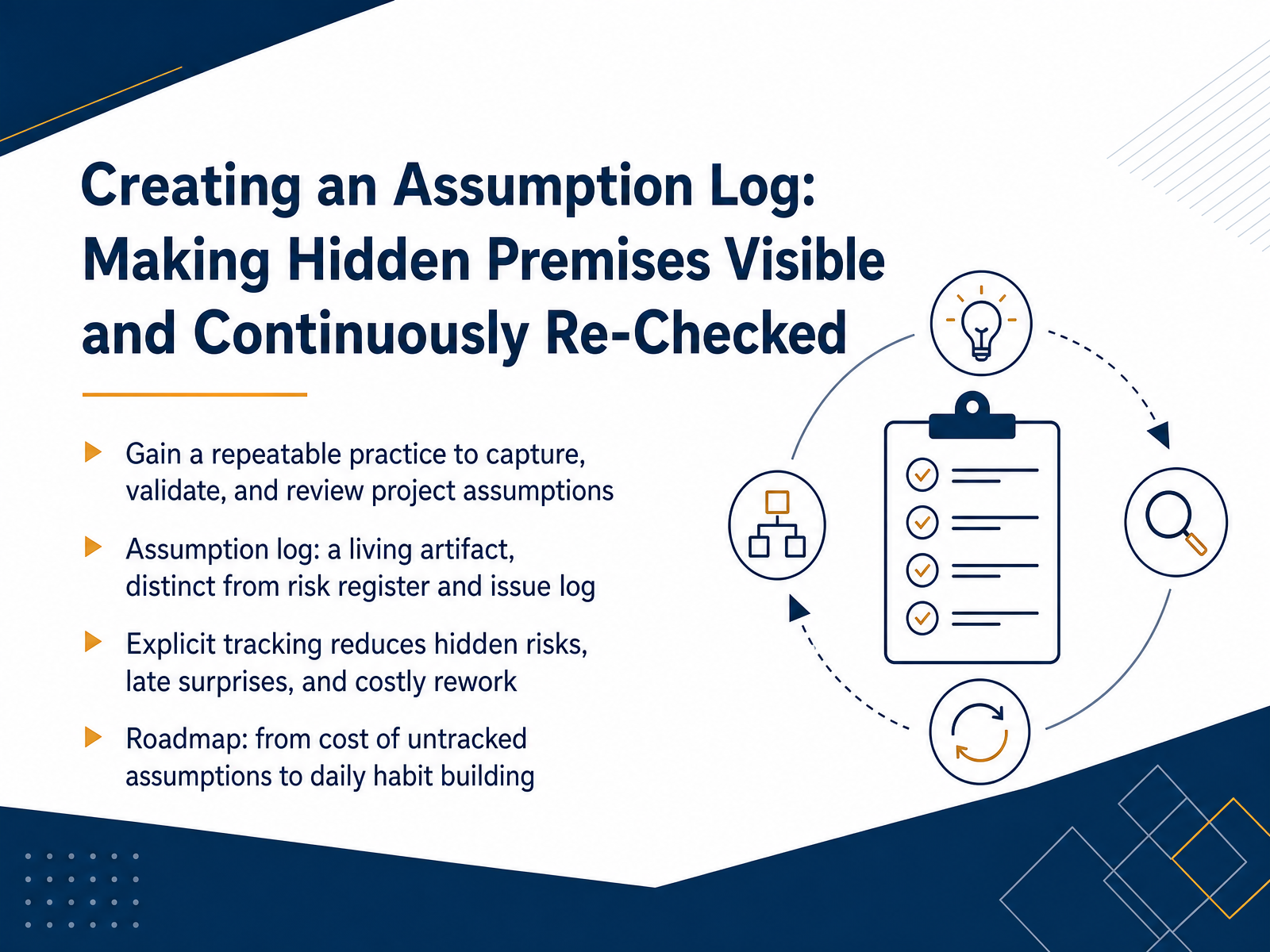
- 01Creating an Assumption Log: Making Hidden Premises Visible and Continuously Re-CheckedWelcome. In this session, we’re going to build a habit that turns hidden premises into visible, manageable facts: the assumption log. This isn’t about adding paperwork. It’s about capturing the beliefs your project depends on, validating them early, and continuously re-checking them so you’re not caught off guard. The log is a living artifact, separate from your risk register and issue log. It reduces late surprises, hidden risks, and the costly rework that comes from acting on guesses. We’ll start by looking at the real cost of untracked assumptions, then move step by step toward a simple daily practice that saves time and protects your milestones. Let’s begin with a look at why untracked assumptions fail projects.project-analysis.comacethepmpexam.comproject-management-knowledge.com+21 min
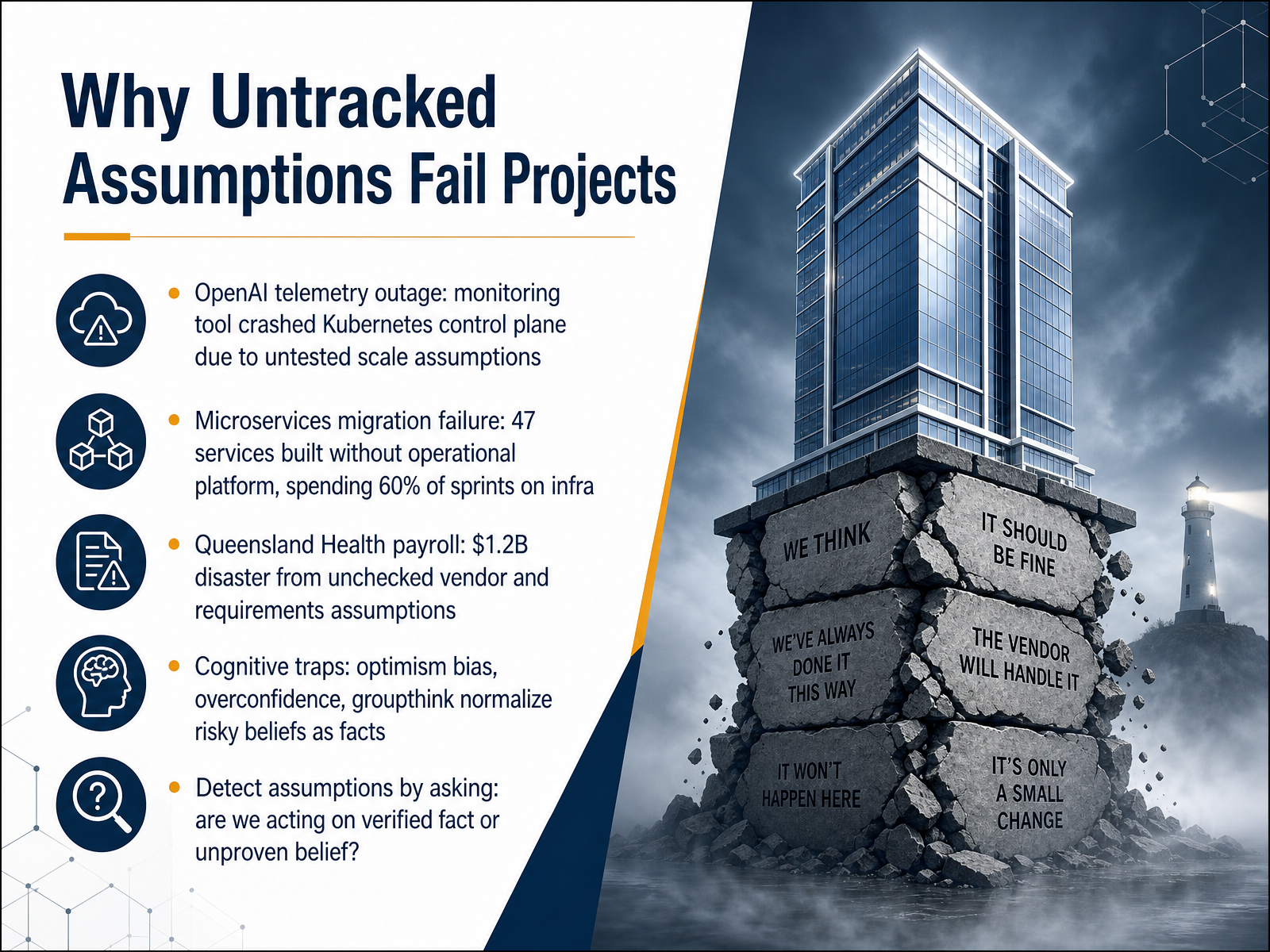
- 02Why Untracked Assumptions Fail ProjectsLet's look at what happens when assumptions go untracked. These aren't small slips. They're cases where unchecked beliefs turned into project-ending events. Take the OpenAI telemetry outage: a monitoring tool crashed the Kubernetes control plane because no one tested how the service scaled in production-size clusters. The rollback path required the same control plane that just failed. That assumption about the rollback path being always available was never challenged, and a four-hour outage followed. Or consider the microservices migration where a team built forty-seven clean services and then spent sixty percent of every sprint fighting infrastructure fires. The assumption was the architecture alone would solve things. The platform to operate those services was missing. Then there's Queensland Health payroll, a one-point-two-billion-dollar disaster fueled by unchecked vendor and requirements assumptions. These failures are rooted in cognitive traps: optimism bias, overconfidence, and groupthink normalize risky beliefs until they feel like facts. So ask yourself regularly: are we acting on verified fact or unproven belief? That simple question is your first defense. Next, we'll map out how the assumption log differs from the risk register and the issue log so you know exactly where each belongs.
 medium.comfailure-modes.devlinkedin.com+22 min
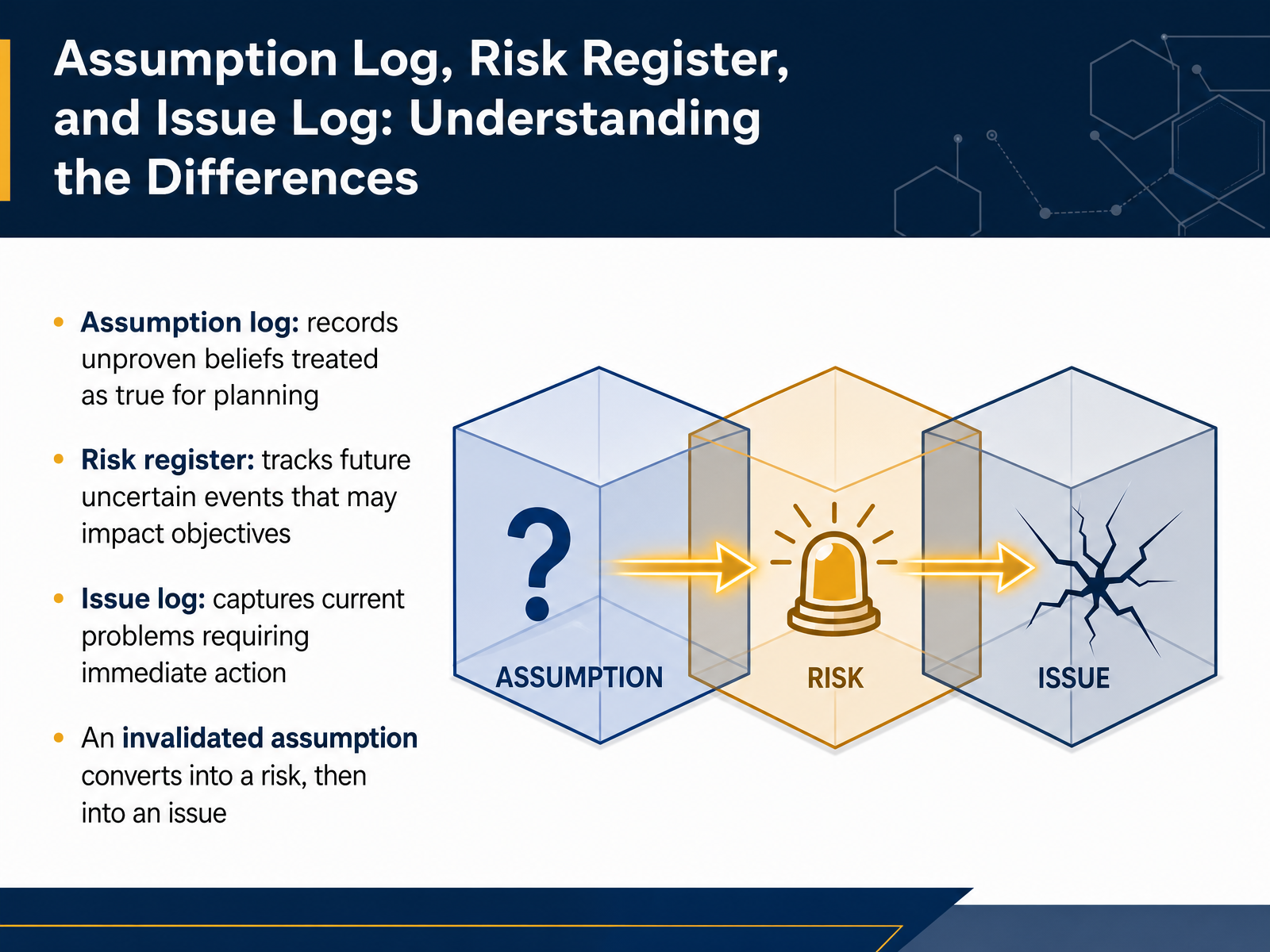
 - 03Assumption Log, Risk Register, and Issue Log: Understanding the DifferencesLet’s place the assumption log where it belongs—side by side with the risk register and the issue log. They are related but they serve very different purposes. An assumption log records unproven beliefs we treat as true just to move planning forward. A risk register tracks future uncertain events that may affect our objectives. An issue log captures current problems that need immediate action. The critical link is the flow between them. An invalidated assumption doesn’t just sit in the log—it converts into a risk. And if that risk materializes, it becomes an issue. By keeping them connected, you catch a wrong belief before it becomes a real problem. Up next, we’ll look at the core fields that make the assumption log genuinely actionable.
 project-analysis.comacethepmpexam.comproject-management-knowledge.com+21 min
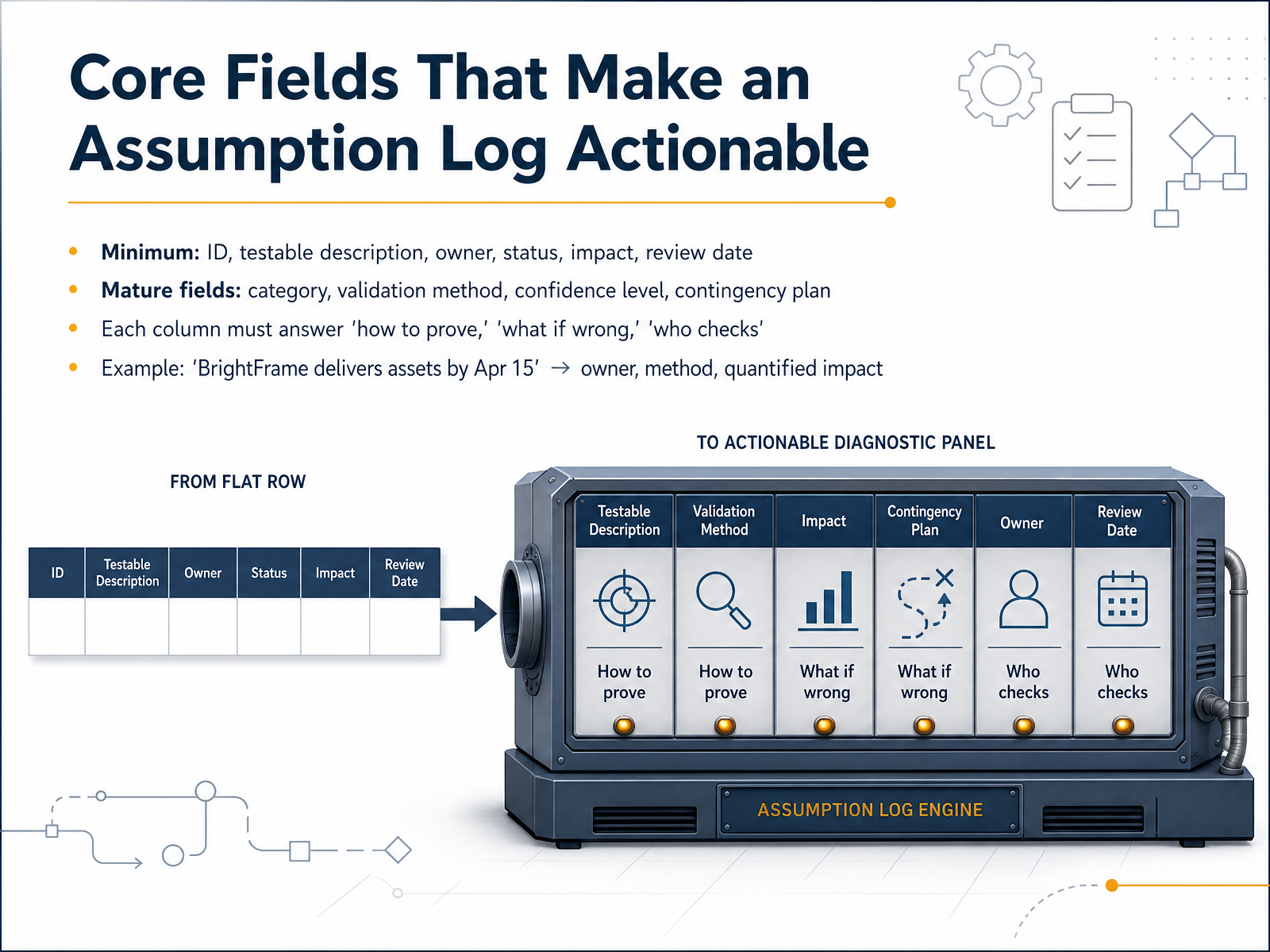
 - 04Core Fields That Make an Assumption Log ActionableLet's look at the core fields that turn a simple list into an actionable tool. Think of each column as answering a specific question about the belief you are tracking. At a minimum, every entry needs an ID, a testable description, an owner, a status, an impact rating, and a target review date. As your log matures, you should add richer fields like category, a specific validation method, a confidence level, and a clear contingency plan. This isn't about filling cells for the sake of it. Every column must serve a purpose: articulating exactly how you plan to prove the assumption true, describing what happens if you're wrong, and identifying precisely who is responsible for checking. For example, consider an assumption like 'BrightFrame delivers assets by April fifteenth.' The log must name the owner who will confirm that delivery, define the method they'll use to check, and quantify the schedule and budget impact if BrightFrame misses the date. That's the difference between documenting a hope and managing a risk. Now, let's explore how to actually find these hidden assumptions in the first place: 'Surfacing Hidden Assumptions: Elicitation Techniques That Work'.
 pmresourcehub.comprojectmanagement.com.brprojectmanagementformula.com+22 min
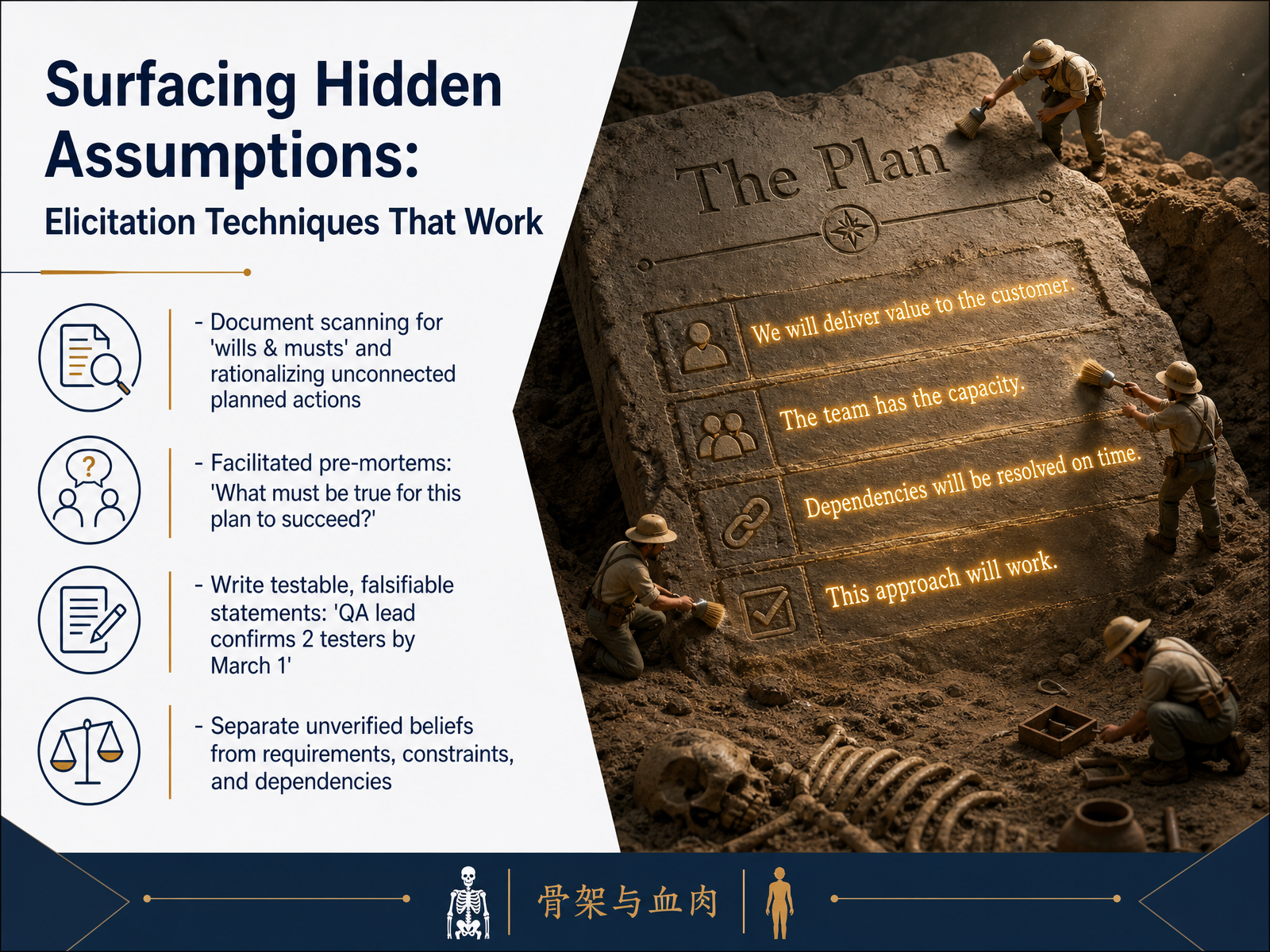
 - 05Surfacing Hidden Assumptions: Elicitation Techniques That WorkLet's move from why we log assumptions to how we actually uncover the hidden ones. To do this well, you need some elicitation techniques that go beyond simple brainstorming. First, try document scanning. Search your project plans and charters for words like 'will' and 'must'. These terms often signal a belief about the future that hasn't been verified. Then, look for rationalizing unconnected planned actions. If a task exists in the plan but doesn't clearly link to a stated goal, you've probably found an unstated assumption driving that work. Another powerful tool is the facilitated pre-mortem. Before you start execution, ask the team a simple question: 'What must be true for this plan to succeed?' This flips the conversation and surfaces critical dependencies you might otherwise miss. Once surfaced, convert these beliefs into testable, falsifiable statements. Instead of 'enough testers available,' write 'QA lead confirms two dedicated testers by March first.' This clarity is key. Finally, make a hard distinction. Separate your unverified beliefs from confirmed requirements, solid constraints, and known dependencies. This keeps your assumption log sharp and actionable. In the next section, we'll put these statements to the test and talk about validating assumptions, turning those guesses into facts.
 pmi.orgprojectmanagertemplate.comtrustedinstitute.com+22 min
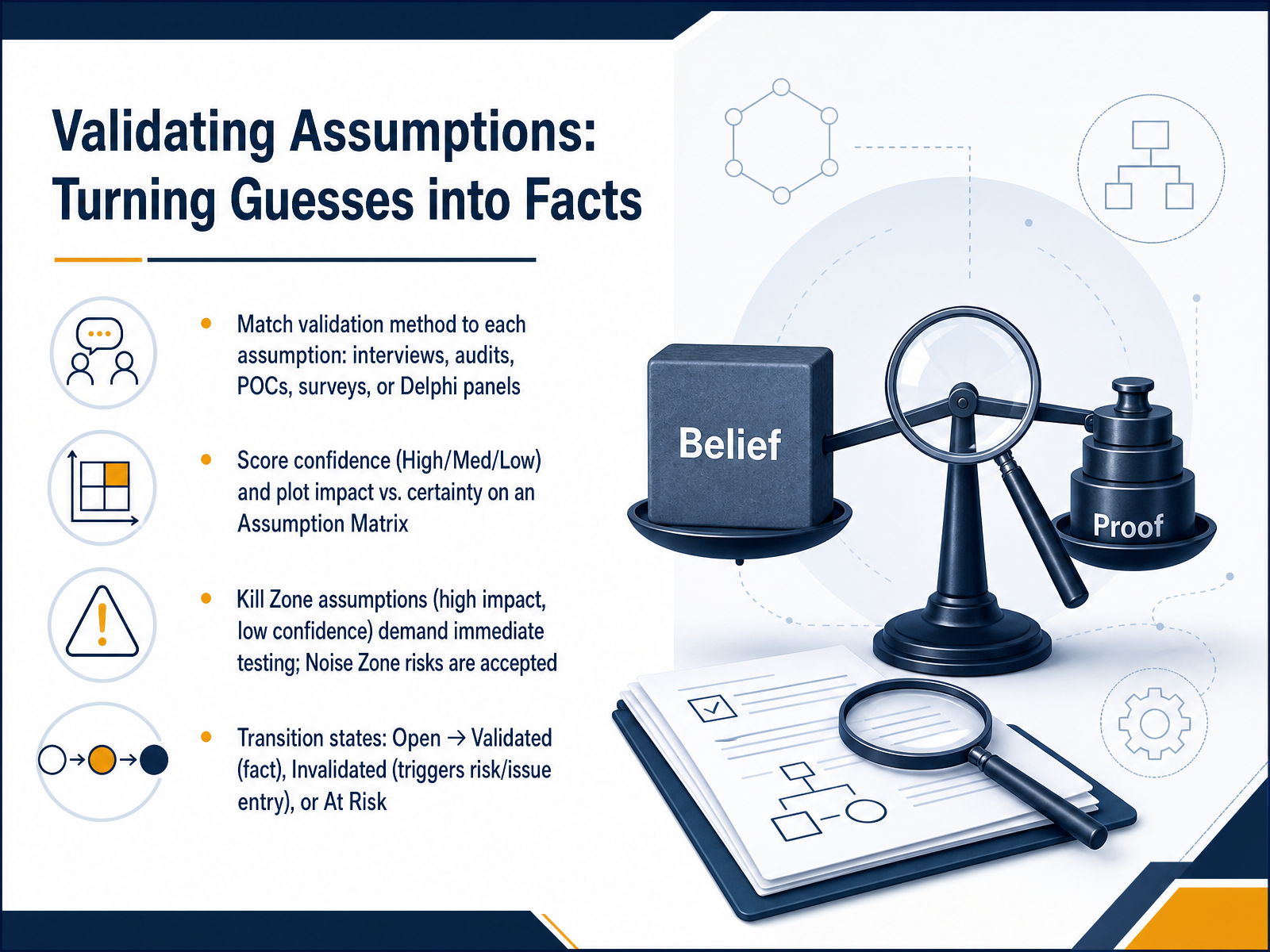
 - 06Validating Assumptions: Turning Guesses into FactsSo, how do we actually turn those logged guesses into facts? The key is matching the right validation method to each assumption. A stakeholder interview works well for political or alignment questions. For technical unknowns, you might run a quick proof-of-concept or an audit. If you need broader input, surveys or even a structured Delphi panel can deliver real evidence. Once you choose a method, score your confidence in the assumption as high, medium, or low. Then, plot it on an Assumption Matrix with impact on one axis and certainty on the other. Pay close attention to the Kill Zone—assumptions with high impact but low confidence. These demand immediate testing before they derail a milestone. Assumptions in the Noise Zone—low impact items—you can simply accept and monitor. As you test, every assumption moves through a lifecycle. It starts as Open, then becomes Validated as a proven fact, Invalidated if proven false—which should trigger a risk or issue entry—or flagged as At Risk. This turns validation from a one-time event into a continuous, manageable habit. Next, we’ll explore confidence scoring and the validation workflow in practice.
 pmresourcehub.compmi.org2 min
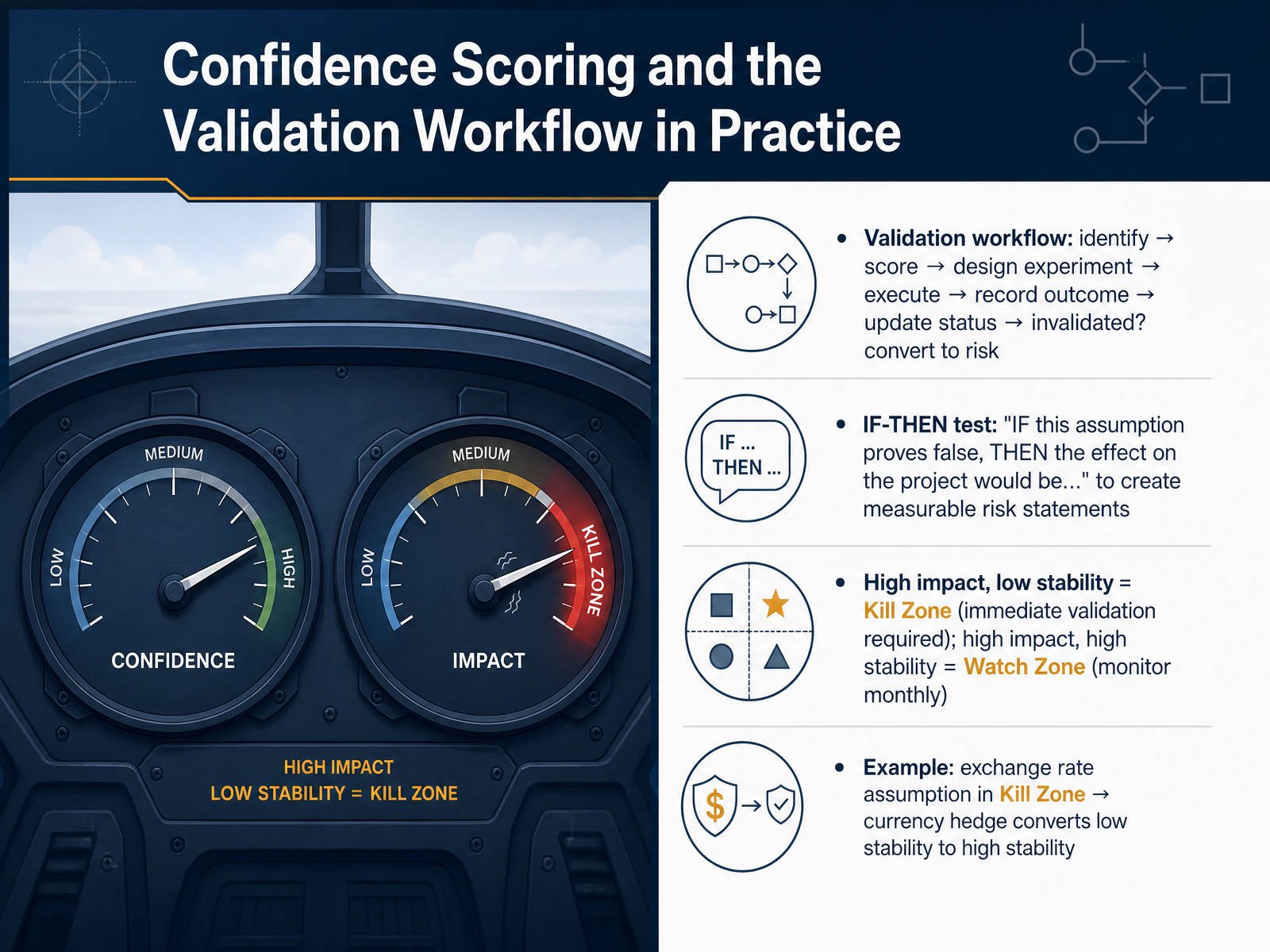
 - 07Confidence Scoring and the Validation Workflow in PracticeLet's put the confidence scoring workflow into practice. It follows a clear path: first, identify the assumption. Then, assign a confidence score representing how stable you believe it to be. Next, design a small experiment to test it. Execute that experiment, record the actual outcome, and update the status. If an assumption is invalidated, you immediately convert it into a risk. A practical tool for this is the IF-THEN test. Ask yourself: IF this assumption proves false, THEN the effect on the project would be blank. This creates a measurable risk statement you can act on. To prioritize, we use an impact-versus-stability grid. High impact combined with low stability creates what we call the Kill Zone. These assumptions demand immediate validation before major spending continues. High impact but high stability falls into the Watch Zone, where monthly monitoring is sufficient. Consider an exchange rate assumption for a project buying materials in Euros. The impact is high, and currency markets are volatile, placing it in the Kill Zone. The validation action isn't just to wait and see; it's to purchase a currency hedge, a financial instrument that locks the rate and effectively moves that assumption from low to high stability. Next, we'll explore the regular review loop that prevents your log from becoming stale.
 pmresourcehub.compmi.org2 min
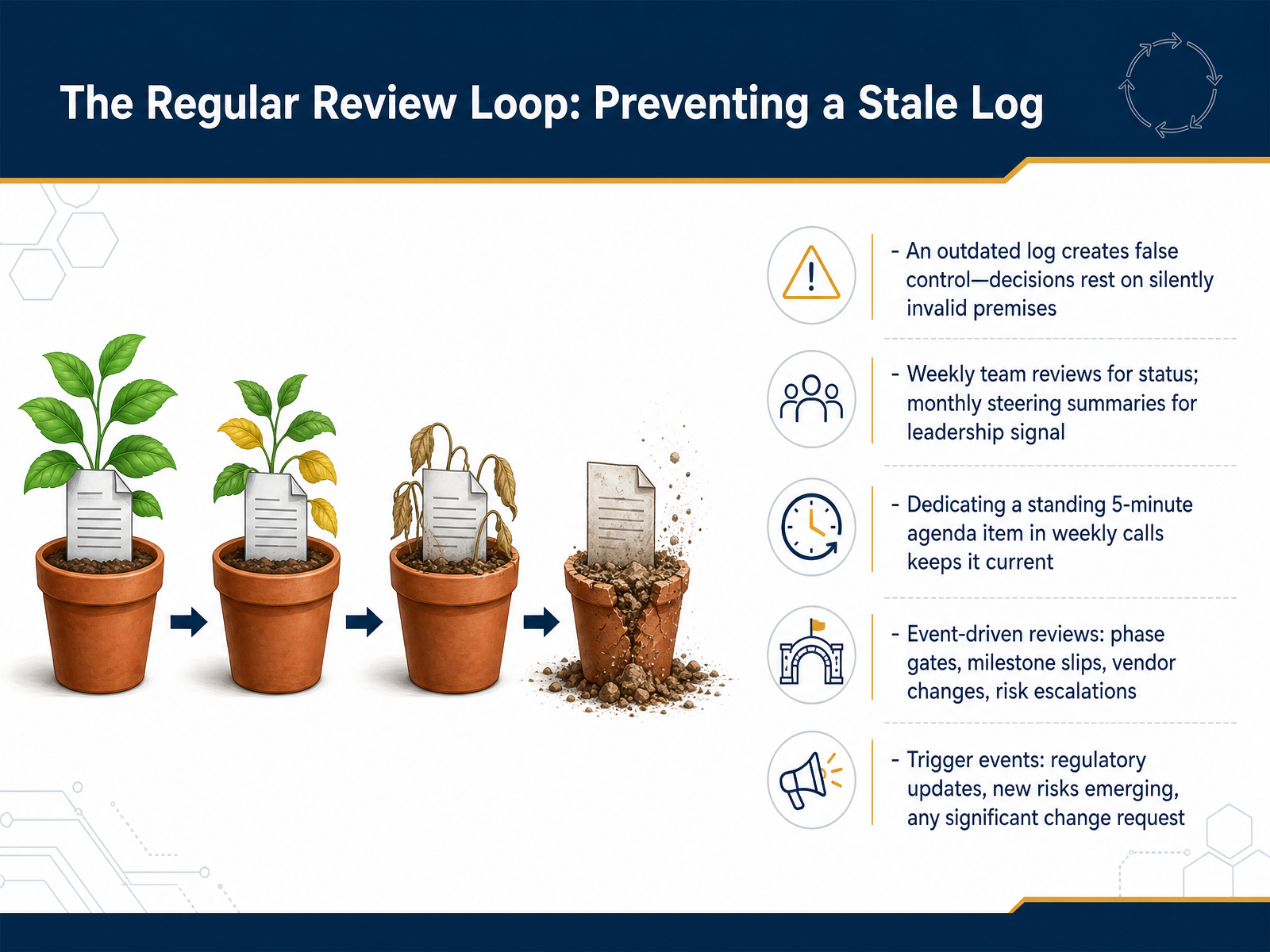
 - 08The Regular Review Loop: Preventing a Stale LogA stale assumption log is worse than no log at all. It creates a false sense of control, because decisions start resting on beliefs that may already be invalid. The fix is a regular review loop that keeps the log alive. At the team level, dedicate a standing five-minute agenda item in your weekly calls. Walk through open assumptions, flag anything approaching its validation deadline, and confirm recent changes haven't broken what you're counting on. For leadership, a monthly steering summary surfaces only the critical signal: which key assumptions have changed, what's at risk, and what adjustments are needed. Reviews should also be event-driven. Trigger a spot-check at phase gates, whenever a milestone slips, when a vendor changes, or when a regulatory shift or significant change request lands. The principle is simple: if something big moves, challenge your assumptions before they derail the next milestone. Now let's look at how ownership, accountability, and governance turn this discipline into a team habit.
 projectmanagementformula.com2 min
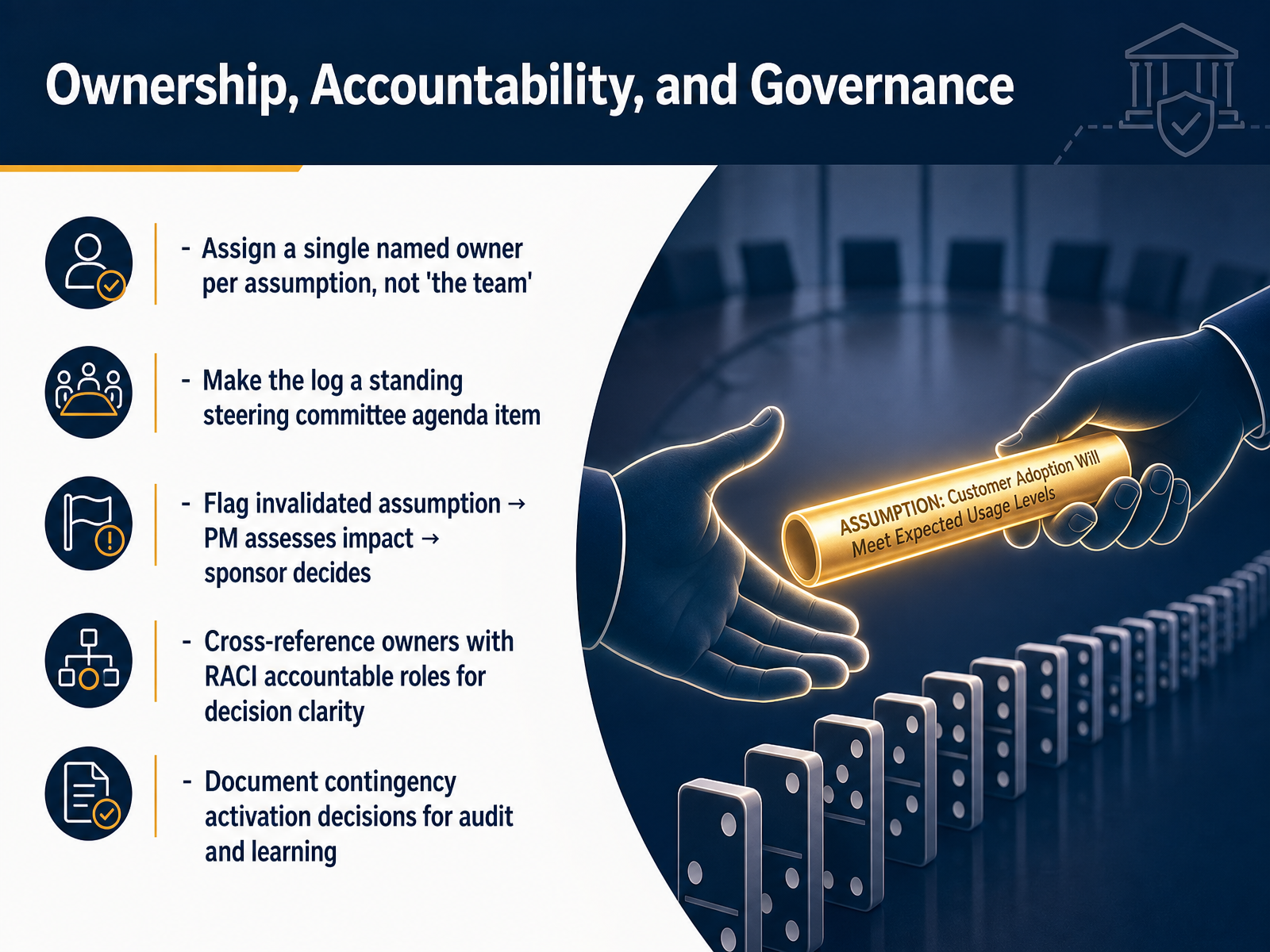
 - 09Ownership, Accountability, and GovernanceLet’s get specific about ownership, accountability, and how governance makes the assumption log real. First, name a single owner for every assumption you log. Not ‘the team’—one person responsible for monitoring and validating that entry. Second, make the log a standing agenda item in your steering committee meetings, treated as rigorously as budget reviews. When an assumption gets invalidated, follow a clear path: the owner flags it, the project manager assesses the schedule and cost impact, and the sponsor decides whether to activate the contingency or accept a revised course. To remove ambiguity, cross-reference your assumption owners with the accountable roles in your RACI chart. That way, decision rights are crystal clear when something needs quick escalation. And whenever you activate a contingency, document the decision and the rationale. That record becomes invaluable for audit trails and for lessons learned at project closure. Up next, we’ll look at tools and collaboration for shared assumption visibility.
 projectmanagementformula.com2 min
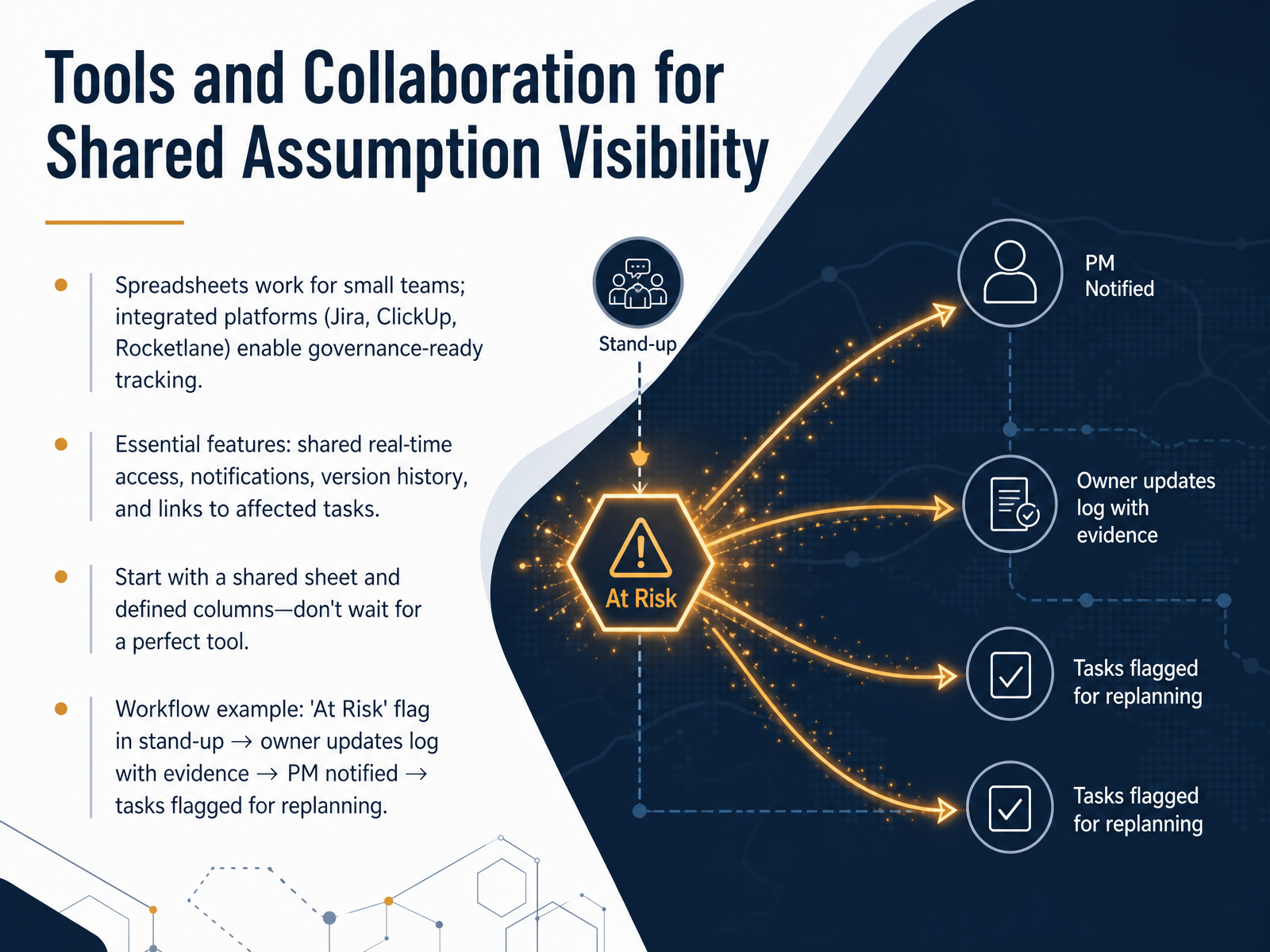
 - 10Tools and Collaboration for Shared Assumption VisibilityNow, let's talk about the tools and collaboration patterns that make assumption tracking a team habit, not a solo chore. Spreadsheets work well for small teams just starting out, but integrated platforms like Jira, ClickUp, or Rocketlane give you governance-ready tracking by connecting assumptions directly to the tasks they affect. Whether you choose a simple shared sheet or a dedicated tool, make sure it offers real-time access, automatic notifications, version history, and links to impacted work items. Don't wait for the perfect system. Begin with a shared sheet and clearly defined columns for the assumption, owner, validation method, and status. That alone moves assumptions out of people's heads and into the open. Consider a practical daily workflow. During stand-up, a team member flags an assumption as at risk. The assigned owner updates the log with the new evidence. A notification reaches the project manager, and connected tasks are automatically flagged for replanning. This loop catches a false assumption before it derails a milestone, not after. Next, we will look at adapting the log to Agile, Hybrid, and Waterfall contexts.
 projectmanagementformula.com2 min
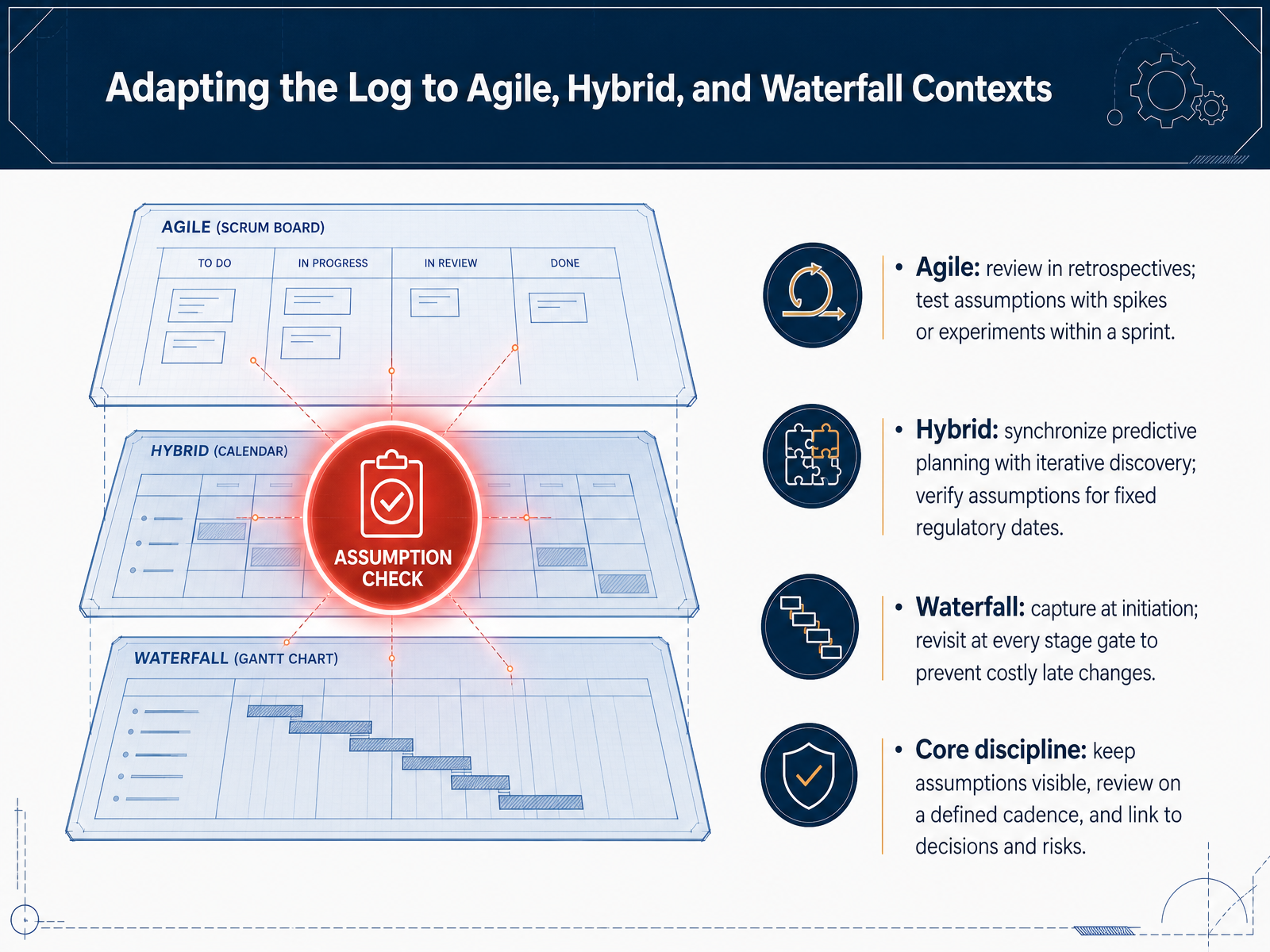
 - 11Adapting the Log to Agile, Hybrid, and Waterfall ContextsOne strength of the assumption log is that it adapts to how your project actually runs. In an agile context, review assumptions during each sprint retrospective. Use time-boxed spikes or quick experiments within the sprint to test a technical assumption before it derails the next increment. For hybrid delivery, synchronize predictive planning with iterative discovery by flagging assumptions tied to fixed regulatory dates. Verify those early so governance milestones stay safe. In a waterfall model, capture assumptions at initiation and revisit them at every stage gate. A false assumption caught late can trigger costly rework, so this gate check protects your critical path. Across all three approaches, the core discipline stays the same. Keep assumptions visible, review them on a defined cadence, and always link an assumption to the decisions and risks it affects. The methodology is less important than the habit of validation. Now let’s look at common mistakes that undermine assumption management.
 projectmanagementformula.com2 min
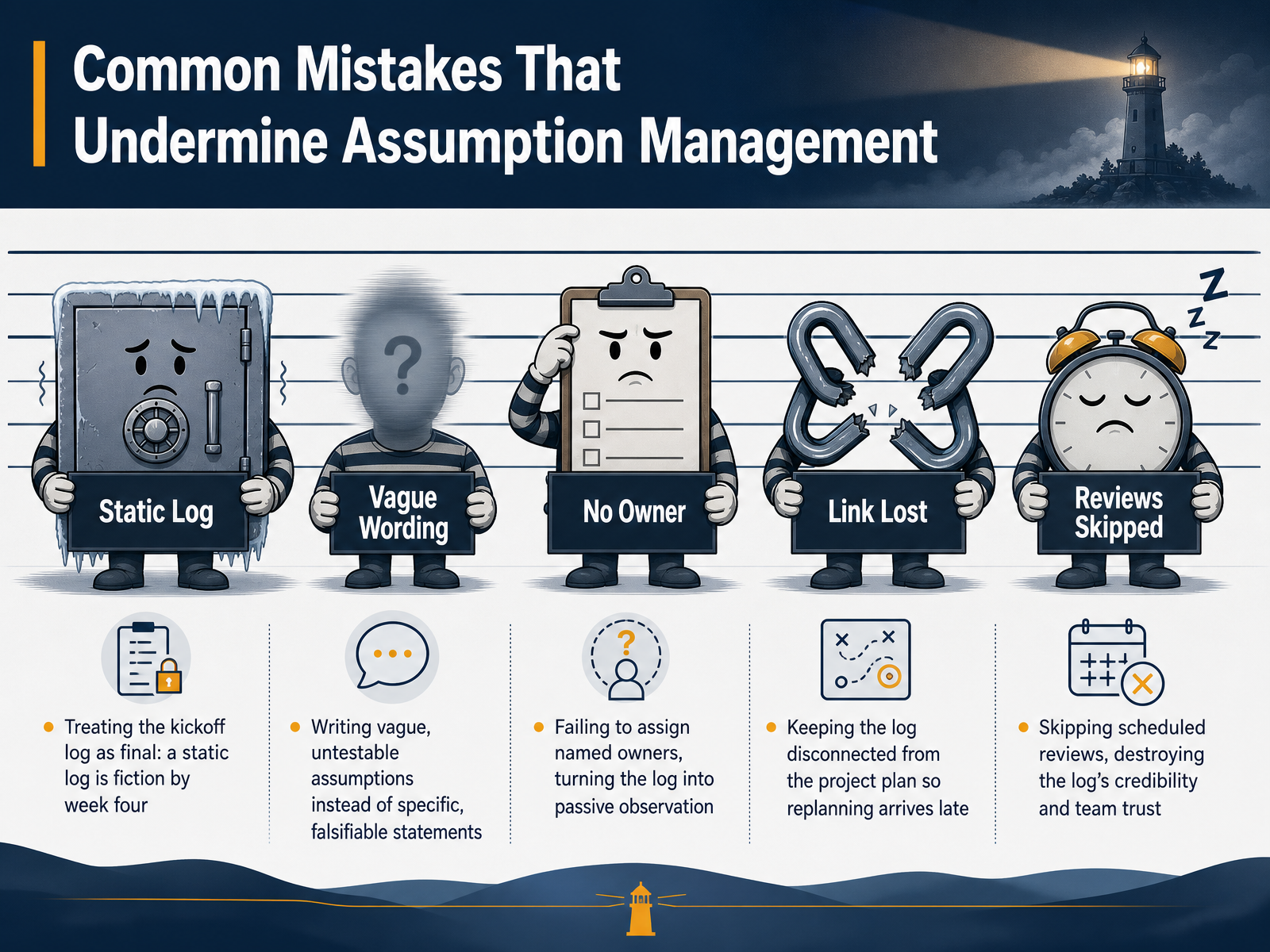
 - 12Common Mistakes That Undermine Assumption ManagementEven with the right structure in place, a few common mistakes can quietly undo your assumption management. Let’s walk through them so you can spot them before they cause damage. The first mistake is treating the kickoff log as the final version. A static log becomes fiction by week four because conditions change constantly. If you are not reviewing it weekly, you are planning against outdated beliefs. The second is writing vague, untestable assumptions like “the client will be cooperative.” That is not an assumption; it is a hope. Instead, be specific: “The client will assign a named technical contact within five business days of kickoff.” A specific statement can be validated; a vague one cannot. The third is failing to assign named owners. Without a single person accountable for validation, the log becomes passive observation. Every assumption needs an owner, not a team. Fourth, do not keep the log disconnected from the project plan. When an assumption is invalidated and no task gets flagged, replanning arrives too late. Connect each assumption directly to the milestones it affects. And finally, skipping scheduled reviews destroys the log’s credibility. If the team sees the log ignored week after week, they will stop trusting it. Protect those five-minute review slots. Now that we have covered what to avoid, let’s look at how to build an assumption-aware team culture.
 projectmanagementformula.com2 min
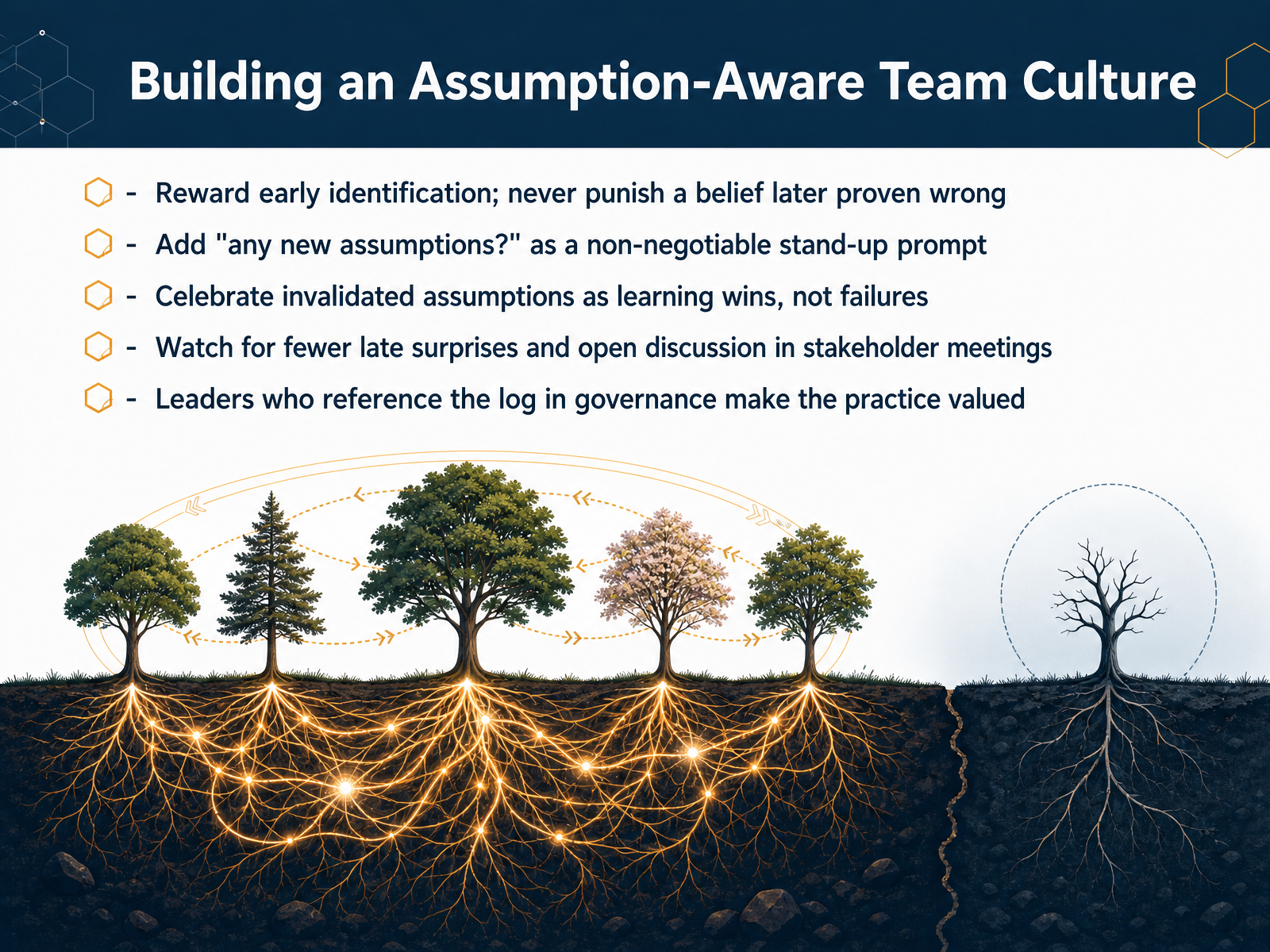
 - 13Building an Assumption-Aware Team CultureNow let's talk about building a team culture that actually sees assumptions coming. This starts with one simple rule: reward early identification. Never punish someone for a belief that later turns out wrong. When a team member flags a shaky assumption, that's proactive behavior, not a mistake. Next, make it a non-negotiable prompt in every stand-up: 'Any new assumptions?' Just that one question surfaces hidden beliefs before they harden into the plan. And here's a shift that changes everything: celebrate invalidated assumptions as learning wins, not failures. Every assumption you prove wrong is a future crisis you just avoided. When this practice sticks, you'll notice fewer late surprises and more open discussion in stakeholder meetings. Finally, leadership makes this real. When leaders reference the assumption log during governance reviews, the whole team sees it as a valued practice, not paperwork. Next, we'll integrate the assumption log into your daily practice and existing workflows.
 medium.comfailure-modes.devlinkedin.com+22 min
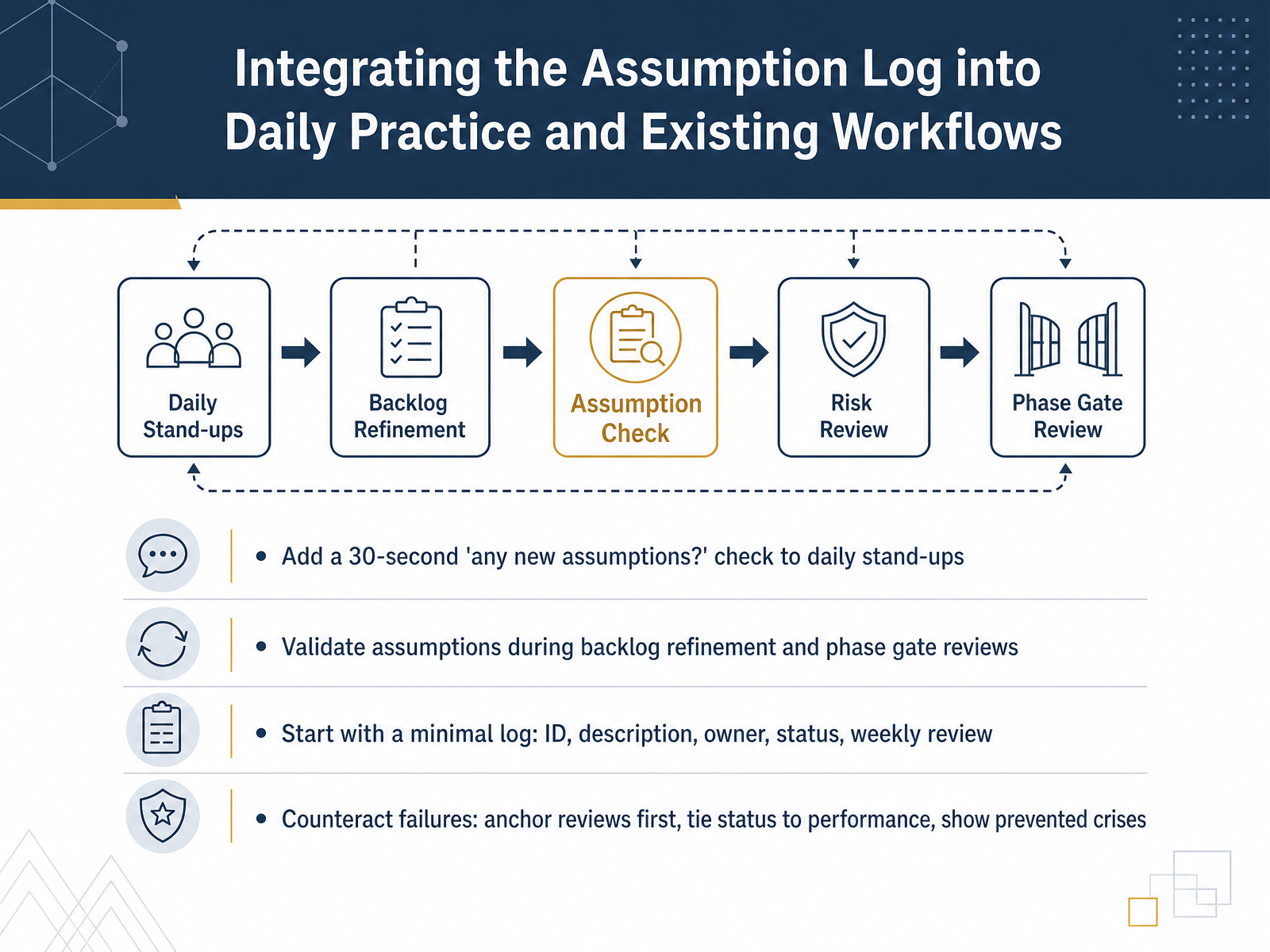
 - 14Integrating the Assumption Log into Daily Practice and Existing WorkflowsLet's talk about how to move the assumption log from a one-time document to a daily habit that actually protects your project. First, anchor it into meetings you already have. Add a quick thirty-second check to your daily stand-up. Just ask, "Any new assumptions since yesterday?" If something surfaces, log it immediately. Second, build validation into your existing ceremonies. When you refine the backlog or reach a phase gate review, take two minutes to confirm the status of top-priority assumptions before you move forward. Start with a minimal log to avoid over-engineering: a unique ID, the description, a named owner, the current status, and a weekly review date. That is enough to create traction. Finally, to prevent this from becoming forgotten paperwork, counter common failures head-on. Anchor reviews to existing meetings so they don't get skipped, tie the status directly to project performance so the team sees how validating an assumption early prevents a milestone crisis, and share real examples where this habit saved the schedule. Next, we'll translate these practices into your personal thirty, sixty, and ninety-day action plan and key takeaways.
 projectmanagementformula.com2 min
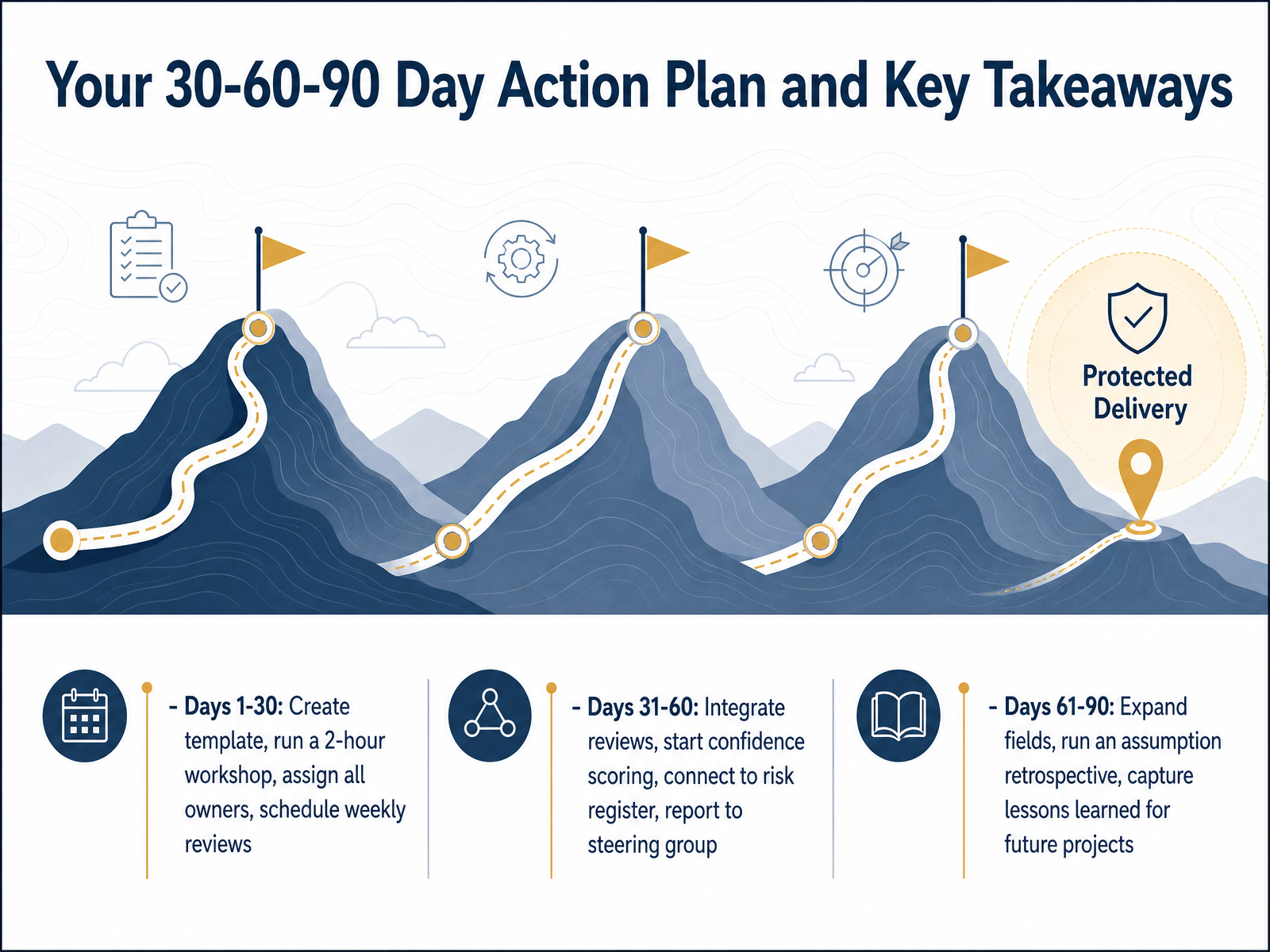
 - 15Your 30-60-90 Day Action Plan and Key TakeawaysLet's turn this into a concrete plan that takes about ninety days. In the first thirty days, create your basic template, run a two-hour workshop to capture everything, assign an owner to each assumption, and schedule those weekly reviews. The goal here is to get the habit started. During days thirty-one to sixty, connect your assumption reviews to your risk register, start scoring how confident you actually are in each item, and report key findings to your steering group. This is where you move from logging to governing. In days sixty-one to ninety, expand your fields based on what you've learned, run an assumption retrospective, and capture the lessons for future projects. This habit doesn't add overhead; it saves you from the late nights spent repairing damage from an assumption you didn't see coming. Thank you for your time. Start small, review weekly, and watch your projects become more predictable.
 projectmanagementformula.com2 min
Take the deck with you
Download this course as a file — free, no sign-up needed.
- PDF handoutEvery slide page, ready to print or share.16 pages · 4.3 MBDownload
- Narrated PowerPointThe deck that presents itself — every slide carries the digital human's narration video.16 pages · 15.3 MBDownload
- PowerPoint slidesThe full deck as a .pptx — open it in PowerPoint, Keynote, or Google Slides.16 pages · 4.2 MBDownload
Free to use in your own training — please keep the PersonWise credit page at the end.
Have your own deck? Turn it into a course
Sources consulted
Web sources consulted while building this course.
- Assumption log ~ PMP TIPS | PMBOK 7 STUDY — project-analysis.com
- Assumption log — acethepmpexam.com
- Assumptions Log - Project Management Knowledge — project-management-knowledge.com
- What is the Assumption Log ? — examera.org
- PM Templates, Checklists & Documents: Assumptions Log – Project Management Formula — projectmanagementformula.com
- Lessons Learned from a Failed Project: What Went Wrong and How to Do Better | by Cuong Tran | Medium — medium.com
- The Telemetry Rollout That Took Down ChatGPT — OpenAI incident case study — Failure Modes — failure-modes.dev
- Case Study: Lessons Learned from a Failed Project — linkedin.com
- OpenAI Global Outage Postmortem: K8S Circular Dependencies · Vonng — vonng.com
- The Microservices Migration That Nearly Killed the Company | Clouditive Blog | Clouditive — dxclouditive.com
- Assumptions Log Template - Free Word Download - PM Resource Hub - The Center Of Excellence For Project Professionals — pmresourcehub.com
- Assumption Log Template — Free Download (PMBOK 8) — projectmanagement.com.br
- Assumption Log Example – Website Launch Project | PMBOK 8 — projectmanagement.com.br
- Assumption Log - Template | IPM — instituteprojectmanagement.com
- Don't make an ass out of you and me--using assumptions ... — pmi.org
- Techniques for Identifying Project Assumptions — projectmanagertemplate.com
- Assumptions Analysis test - Qualitative Risk Analysis - PMI Risk Management Professional questions | TrustEd Institute — trustedinstitute.com
- Risk Identification in Project Management - Project Management Academy Resources — projectmanagementacademy.net
- Assumptions Analysis [Technique] – Knowledge Base — projectvictor.com
- Strategic Assumption Validation Template - Free Word Download - PM Resource Hub - The Center Of Excellence For Project Professionals — pmresourcehub.com