Begin
14 pages · ~28 min
Learning & Development Career Entry Workflow
This training guides aspiring and transitioning professionals through a practical workflow for entering the learning and development field, from building core skills to landing their first role.
A digital instructor presents all 14 pages. Hold “Ask” at any point and ask out loud — the answer comes from this course. No sign-up needed.
What you’ll learn
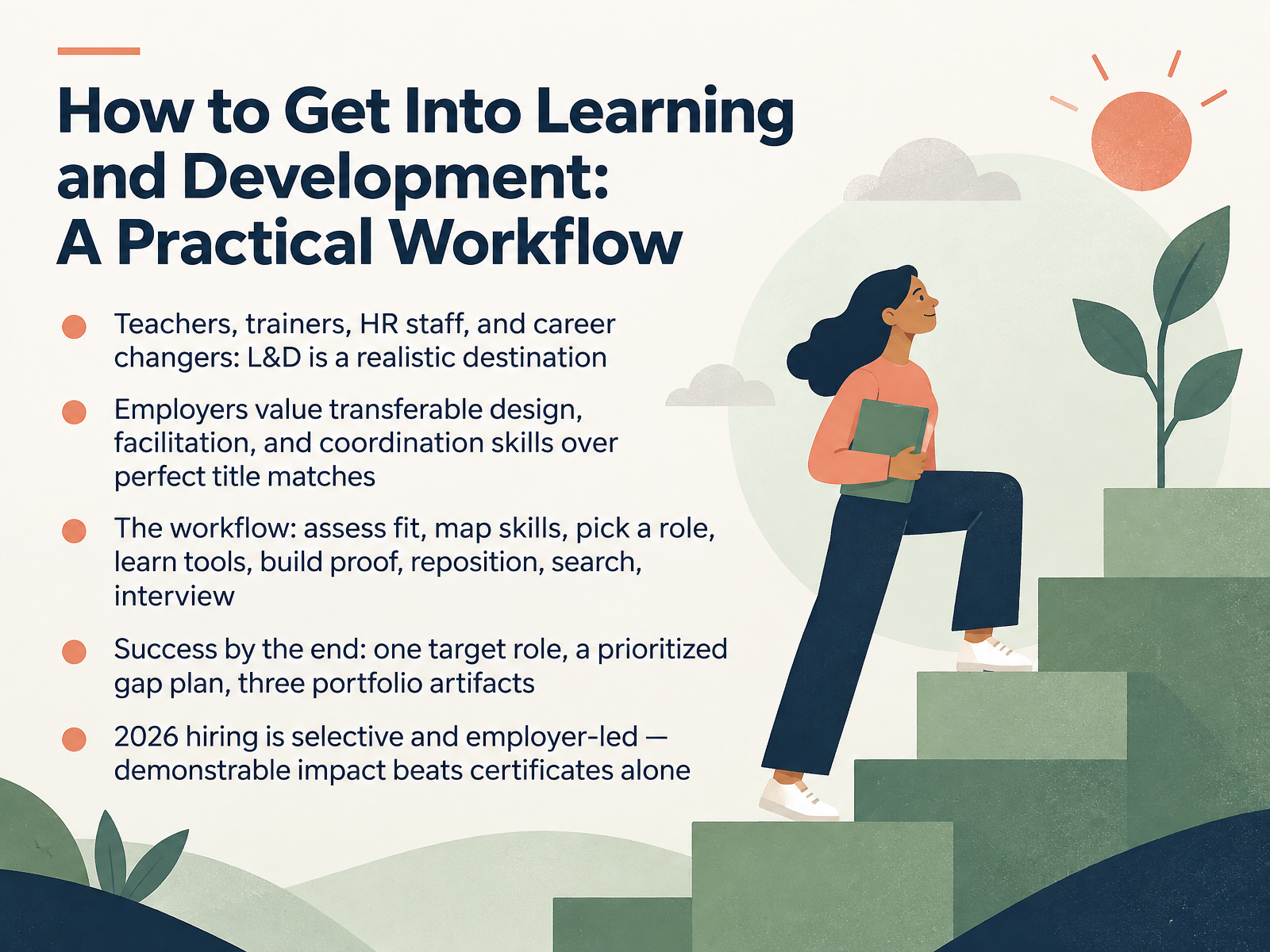
- 01How to Get Into Learning and Development: A Practical WorkflowWelcome. This course is about moving into learning and development, and it is written for teachers, training coordinators, HR practitioners, and anyone changing roles. You are not starting from zero. Employers here value design, facilitation, and coordination skills more than a perfect title match. By the end, you will have one target role, a prioritized gap plan, and three portfolio artifacts. Be aware that hiring in two thousand twenty-six is selective and employer led. Demonstrable impact beats certificates alone. For example, a teacher who shows a redesigned onboarding unit with assessment data will outshine a stack of badges. So expect a practical workflow: assess fit, map skills, pick a role, learn tools, build proof, reposition, search, and interview. Takeaway for now: treat this as translation, not reinvention. Next, let us look at what L and D work actually looks like.doi.orgresearchportal.ulisboa.ptmtfinstitute.com+22 min
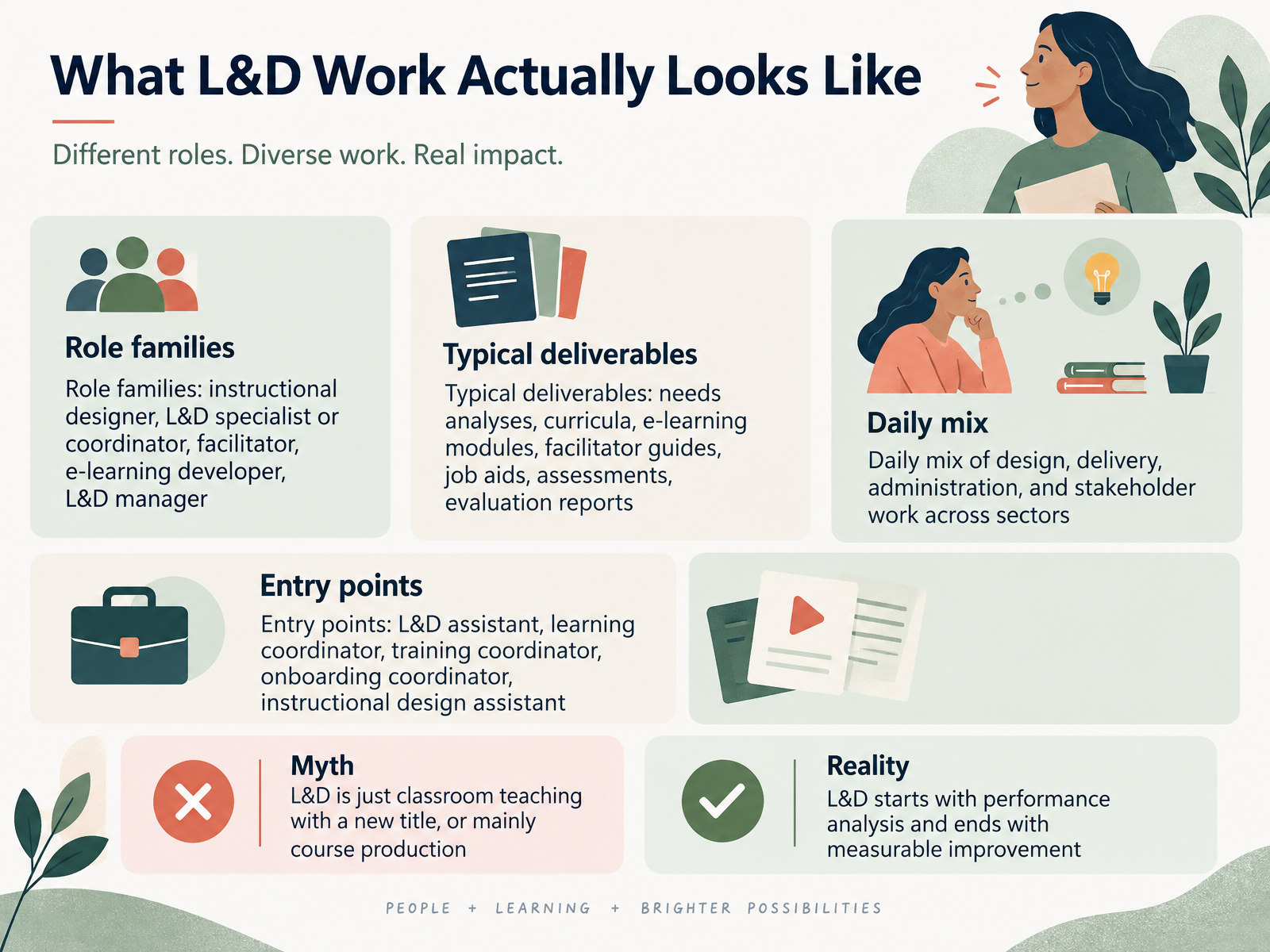
- 02What L&D Work Actually Looks LikeLet's look at what L&D work actually looks like day to day. You will be able to name the main role families and the entry points open to you. The roles include instructional designer, L&D specialist or coordinator, facilitator, e-learning developer, and L&D manager. Typical deliverables include needs analyses, curricula, e-learning modules, facilitator guides, job aids, and evaluation reports. A coordinator might spend a morning booking facilitators, then an afternoon reviewing a needs analysis. Common entry points include learning coordinator, training coordinator, onboarding coordinator, and instructional design assistant. Here is a myth worth retiring. L&D is not just classroom teaching with a new title, and it is not mainly course production. The reality is that L&D starts with performance analysis and ends with measurable improvement. Your first action is to pick one entry point and map your current skills to it. Next, we look at what 2026 employers actually ask for.
 careercenter.natsap.orgboards.greenhouse.ioemployment.utah.edu+22 min
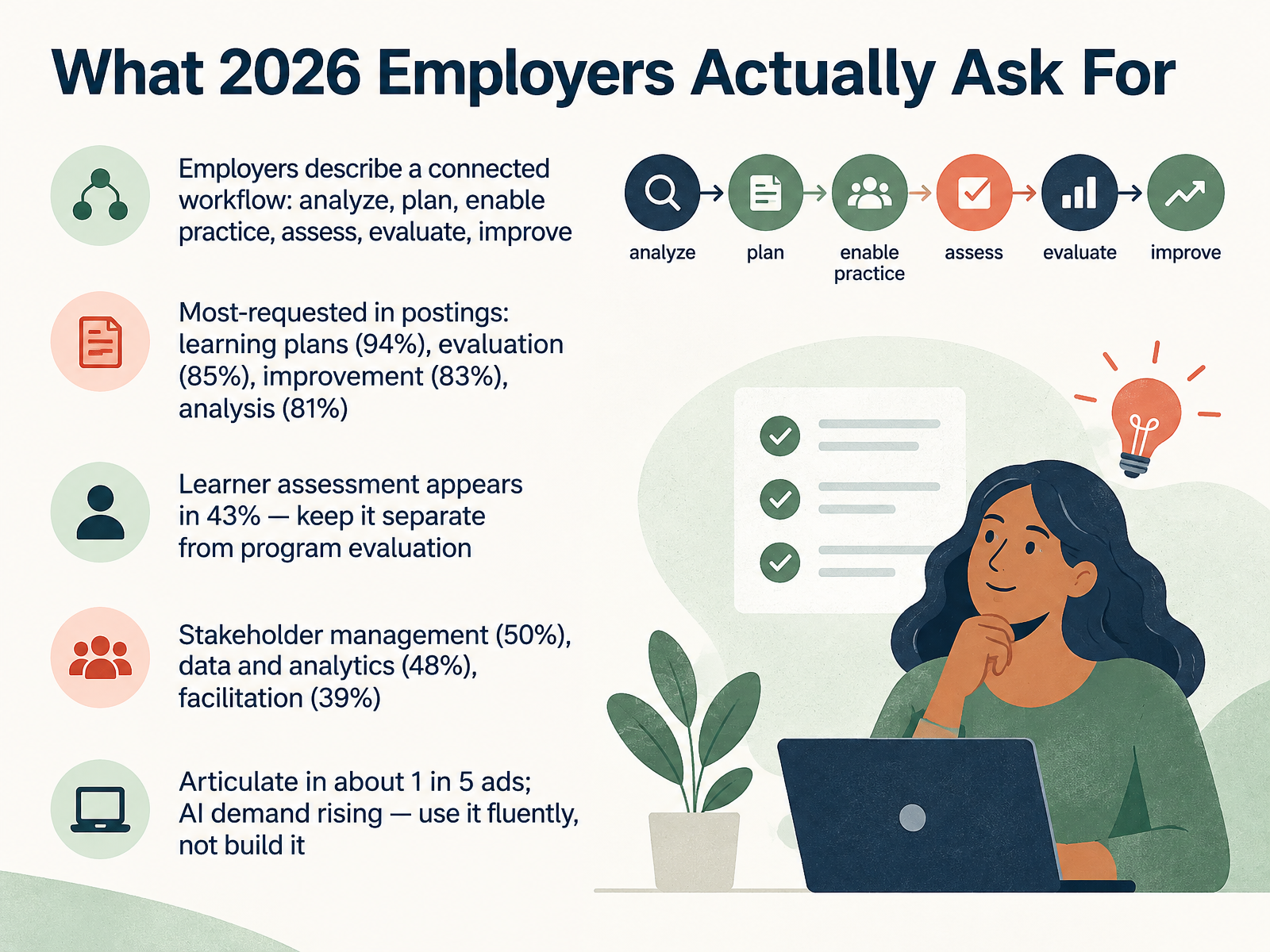
- 03What 2026 Employers Actually Ask ForSo what do employers actually ask for in 2026? The strongest signal is that they describe one connected workflow. Analyze the gap, plan the learning, enable practice, assess learners, evaluate the program, then improve it. In one hundred ten U.S. postings, learning plans appeared in ninety-four percent. Evaluation, eighty-five percent. Improvement, eighty-three. Analysis, eighty-one. Learner assessment showed up in only forty-three percent, so keep it separate from program evaluation. A knowledge check proves a person learned something. It does not prove the program improved the work. Stakeholder management sits at fifty percent, data and analytics forty-eight, facilitation thirty-nine. Articulate appears in about one in five ads. AI demand is rising, but employers mostly want you to use it fluently, not build it. So read postings as workflow descriptions, not skill lists. Next, we will assess your fit and translate your strengths.
 doi.orgresearchportal.ulisboa.ptmtfinstitute.com+22 min
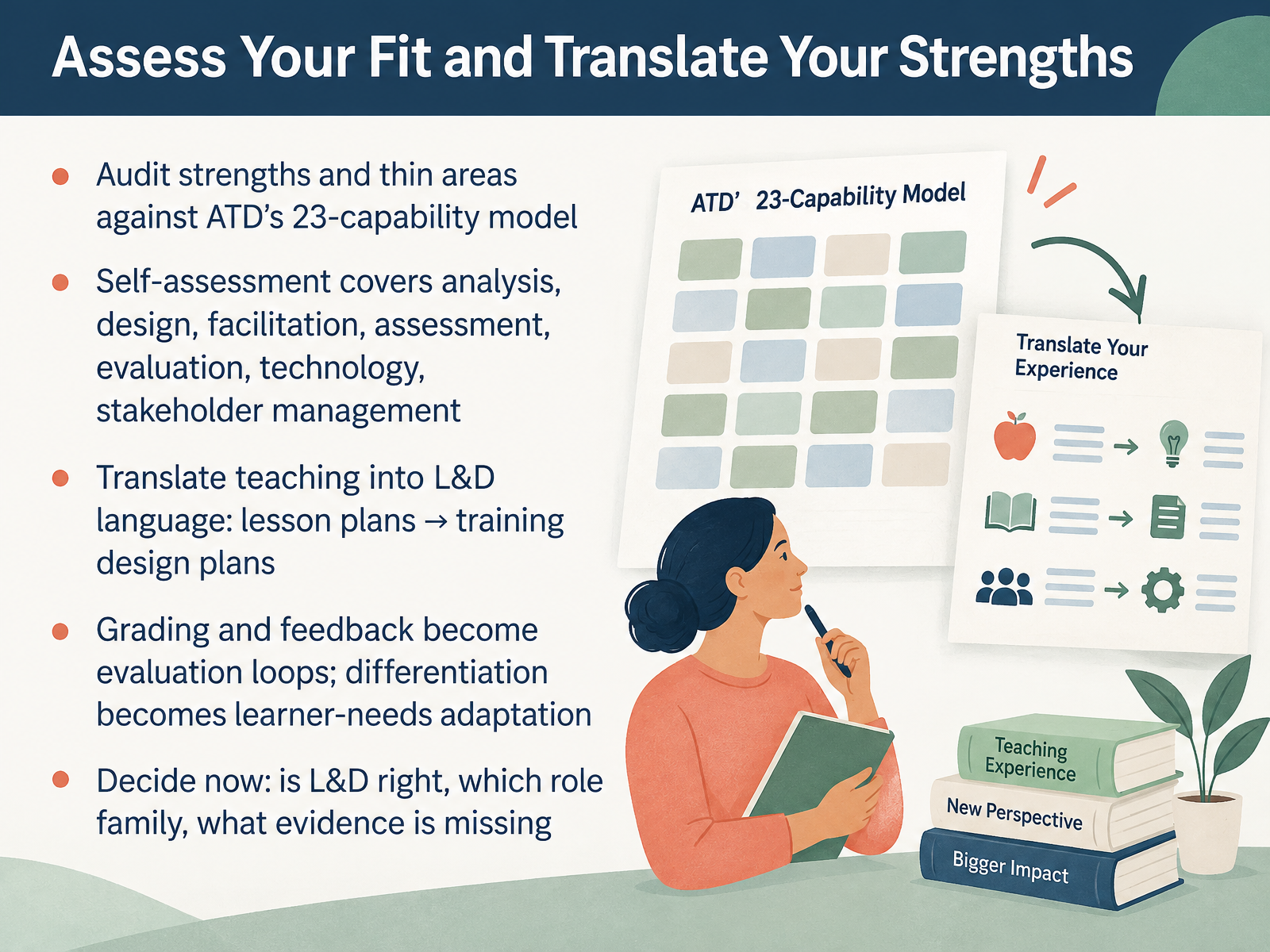
- 04Assess Your Fit and Translate Your StrengthsNow let's assess your fit and translate your strengths. Start with a capability audit using ATD's Talent Development Capability Model. It names twenty-three capabilities, and its self-assessment shows where you're strong and where you're thin. It covers analysis, design, facilitation, assessment, evaluation, technology, and stakeholder management. Then translate your experience into L&D language. Lesson plans become training design plans. Grading and feedback become evaluation loops. Differentiation becomes learner-needs adaptation. For example, a coordinator who tracked attendance can describe that as measuring participation data. Decide now: is L&D right for you, which role family fits, and what evidence is missing. Your takeaway: audit honestly, translate deliberately, and name your gaps.
 help.td.orgtd.orgcapability.td.org+22 min
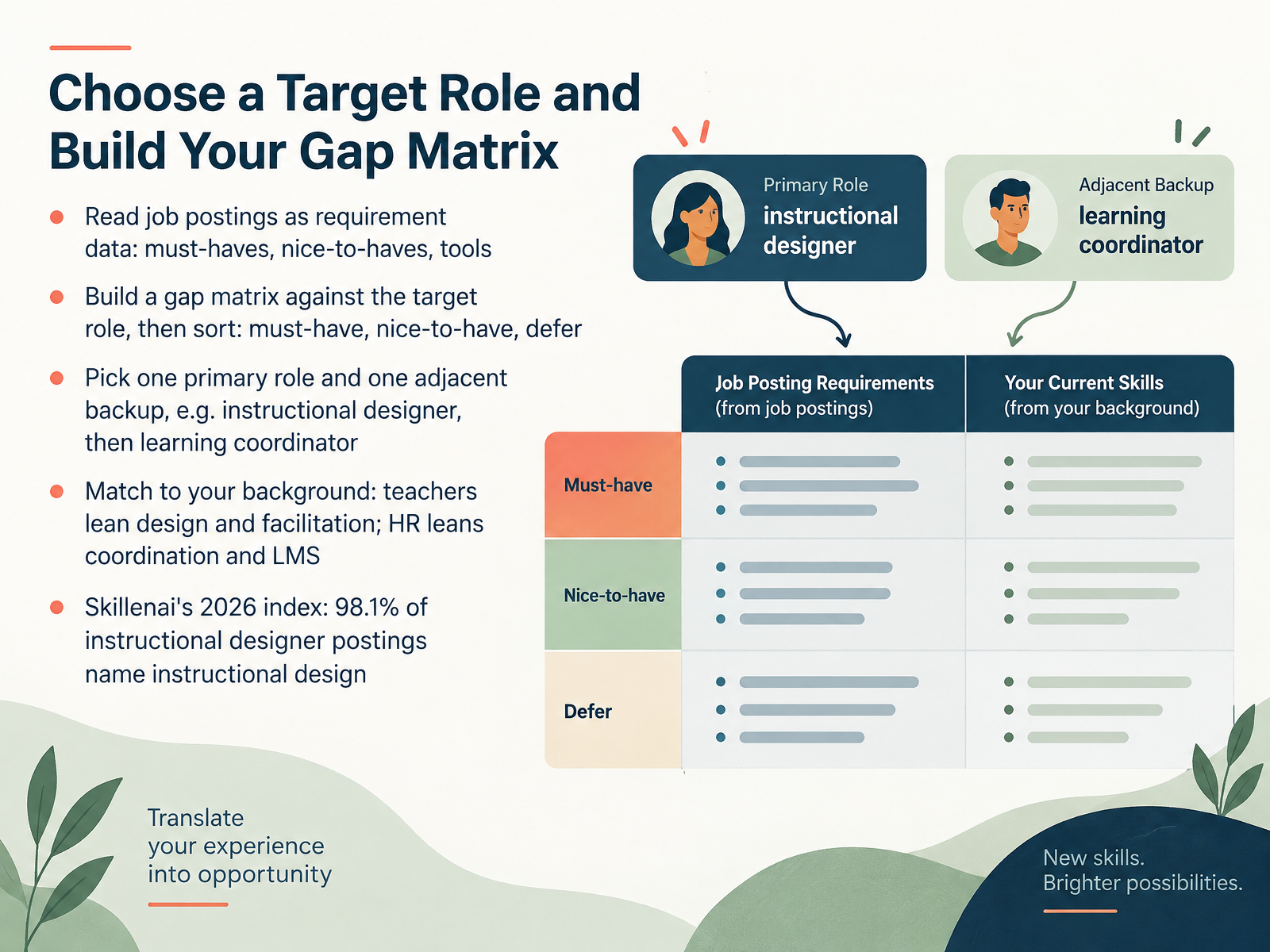
- 05Choose a Target Role and Build Your Gap MatrixNext, choose a target role and build a gap matrix. Start by reading job postings as requirement data. Sort each posting into must-haves, nice-to-haves, and tools. For example, a teacher applying for instructional design will see that design and facilitation skills appear constantly. Then build a gap matrix against your target role. List each requirement beside your current evidence, and mark it must-have, nice-to-have, or defer. Pick one primary role and one adjacent backup, such as instructional designer first, then learning coordinator. Match the list to your background. Teachers lean toward design and facilitation. HR practitioners lean toward coordination and learning management systems. HR practitioners lean toward coordination and LMS work. One number shows why focus matters. Skillenai's 2026 index reports that ninety-eight point one percent of instructional designer postings name instructional design. Your takeaway is this. Choose one primary role, build the matrix this week, and let evidence set your learning priorities. Now let's look at the frameworks behind this work: ADDIE, adult learning, and evaluation.
 doi.orgresearchportal.ulisboa.ptmtfinstitute.com+22 min
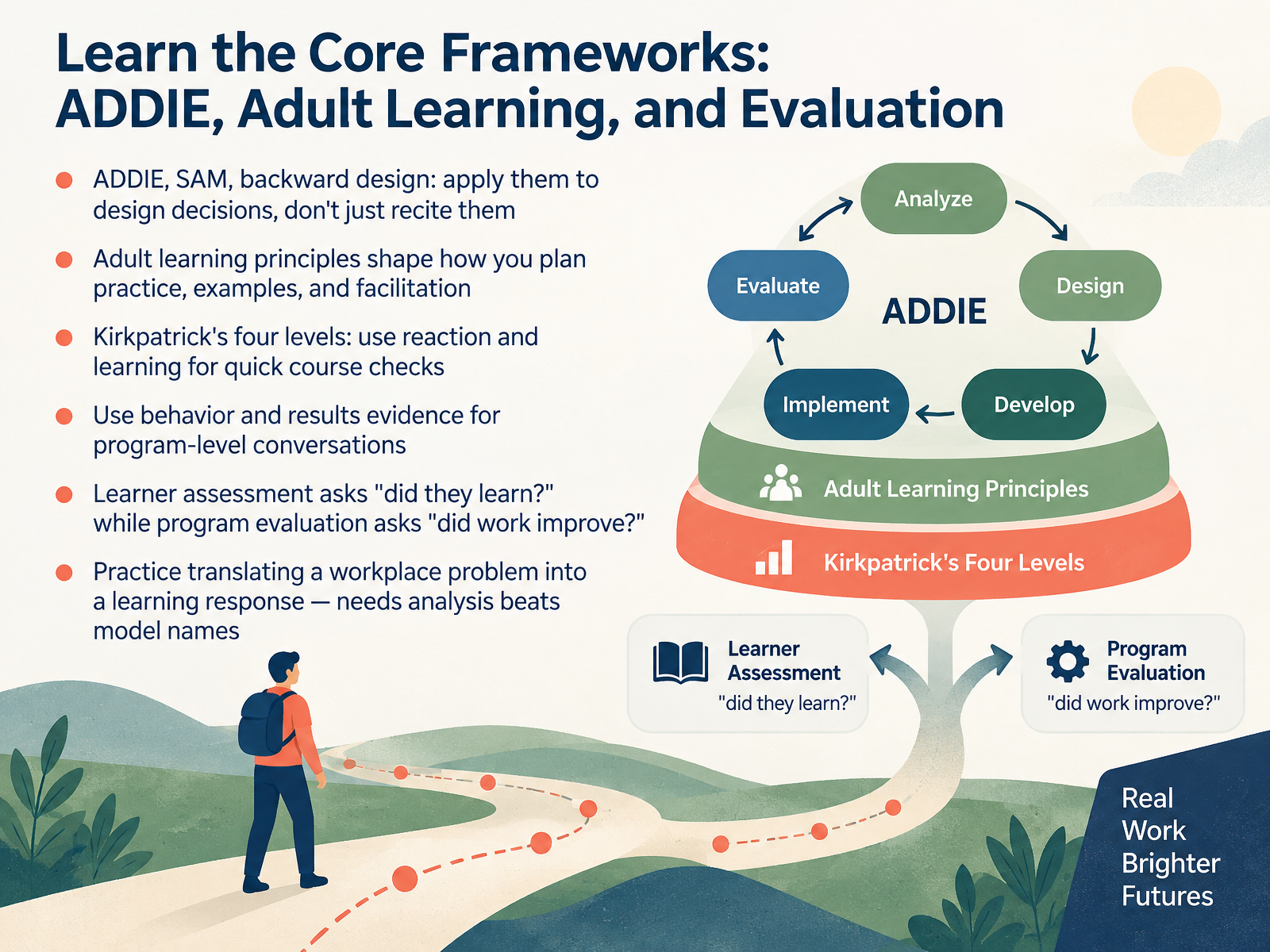
- 06Learn the Core Frameworks: ADDIE, Adult Learning, and EvaluationNow let's look at the frameworks you'll actually use. Learn ADDIE, SAM, and backward design as decision tools, not vocabulary. When a manager asks for a two-hour workshop, use the model to ask what gap you're closing first. Adult learning principles then shape your practice and examples. For instance, a teacher moving into L&D plans real tasks from the learners' own workdays. Use Kirkpatrick's four levels deliberately. Reaction and learning checks suit quick course reviews. Save behavior and results evidence for program-level conversations with sponsors. Keep one line clear: learner assessment asks did they learn, while program evaluation asks did work improve. A coordination example makes this concrete. A team misses handover deadlines. Needs analysis shows unclear procedures, not missing knowledge. So you might recommend a job aid instead of a course. Here is your takeaway. Practise translating one workplace problem into a learning response, because needs analysis beats model names. Next, choose and learn the right tools first.
 doi.orgresearchportal.ulisboa.ptmtfinstitute.com+22 min
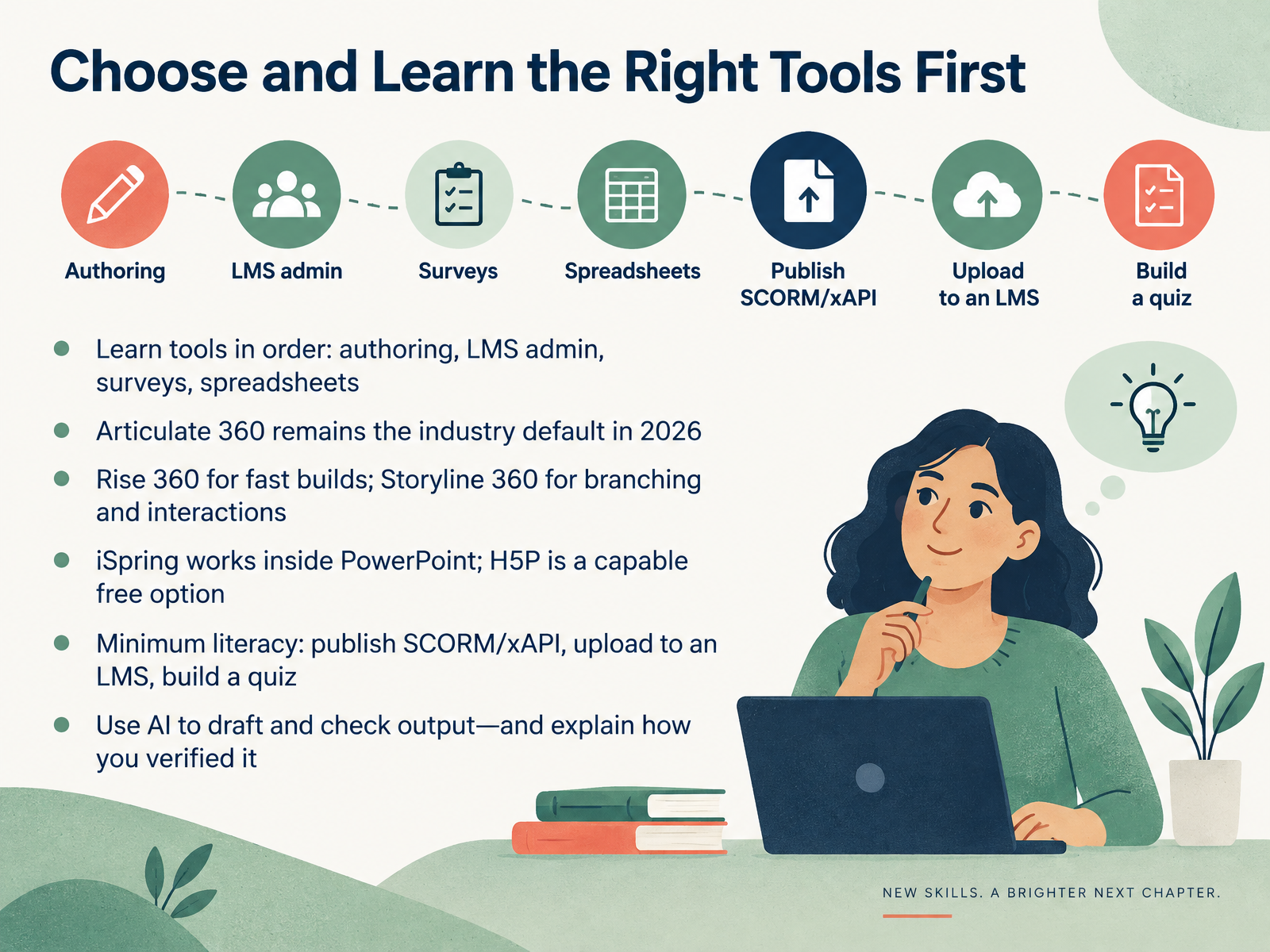
- 07Choose and Learn the Right Tools FirstNext, let's talk about tools, and where to start. Learn them in this order: authoring, LMS admin, surveys, then spreadsheets. Articulate 360 is still the industry default in 2026. Rise 360 gives you fast, responsive builds, while Storyline 360 handles branching and interactions. If your team lives in PowerPoint, iSpring Suite works inside it. H5P is a capable free option for the budget-conscious. Aim for minimum literacy: publish a SCORM or xAPI package, upload it to an LMS, and build a quiz. And use AI to draft and check your output. Then be ready to explain how you verified it. For example, a trainer converting a slide deck can build the course in Rise, and document the accuracy check on AI-drafted quiz items. Your takeaway: build one small course end to end, then show your verification notes. That naturally sets up the next step: build portfolio evidence without a job.
 gartner.comd2l.comsoftwareadvice.com+22 min
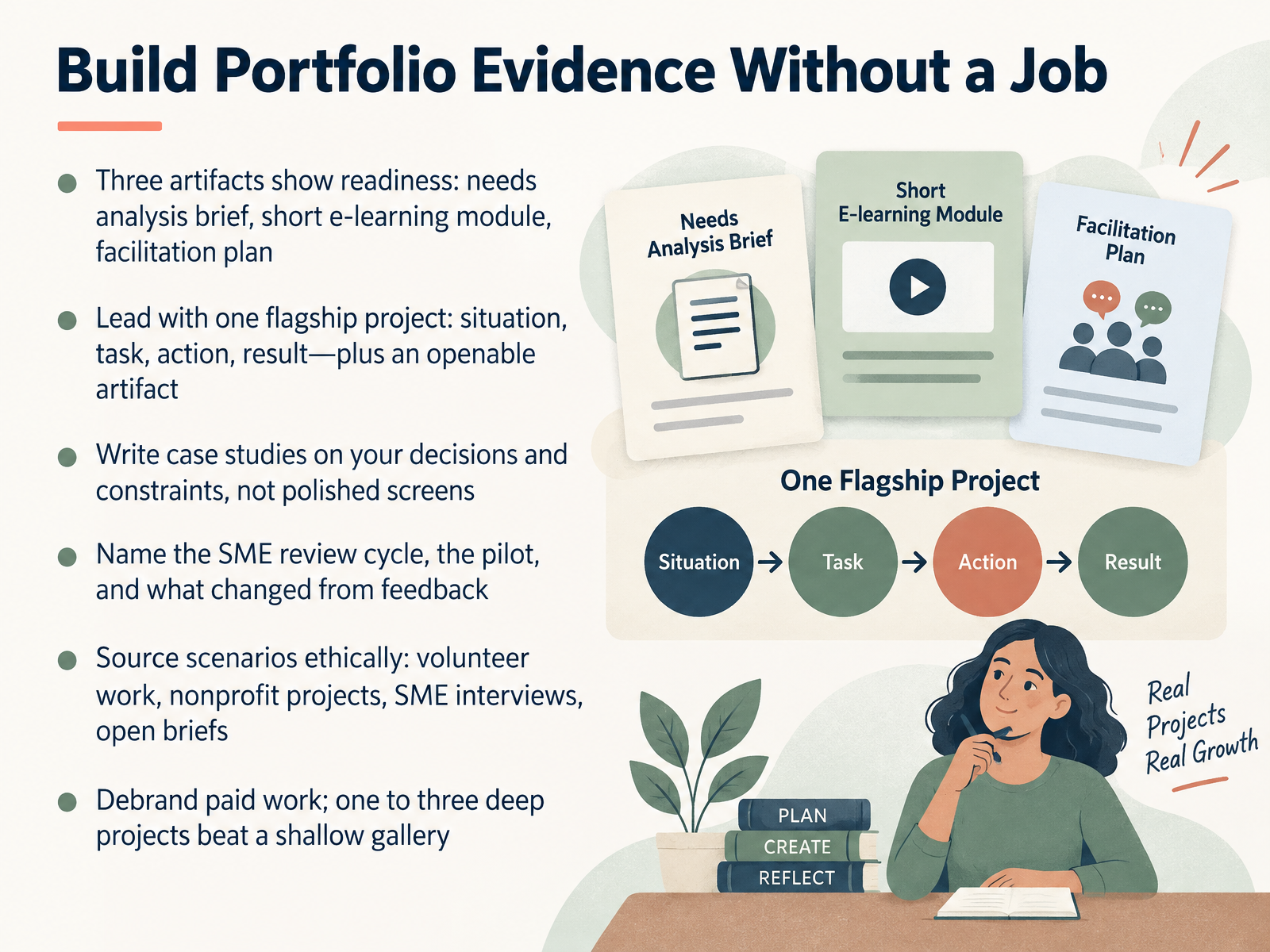
- 08Build Portfolio Evidence Without a JobNow let's talk about building portfolio evidence when you don't yet have an L and D job. Three artifacts show readiness: a needs analysis brief, a short e-learning module, and a facilitation plan. Lead with one flagship project. Use situation, task, action, result, and attach something a hiring manager can open, like a hosted module or storyboard. Write about your decisions and constraints, not polished screens. For example, a former teacher can document the SME review cycle, the pilot with twenty learners, and what changed after feedback. Source scenarios ethically through volunteer work, nonprofit projects, or SME interviews. Debrand paid work, and remember that one to three deep projects beat a shallow gallery. Your action step is to pick one project and draft its case study this week. Next, let's reposition your resume and profile.
 2 min
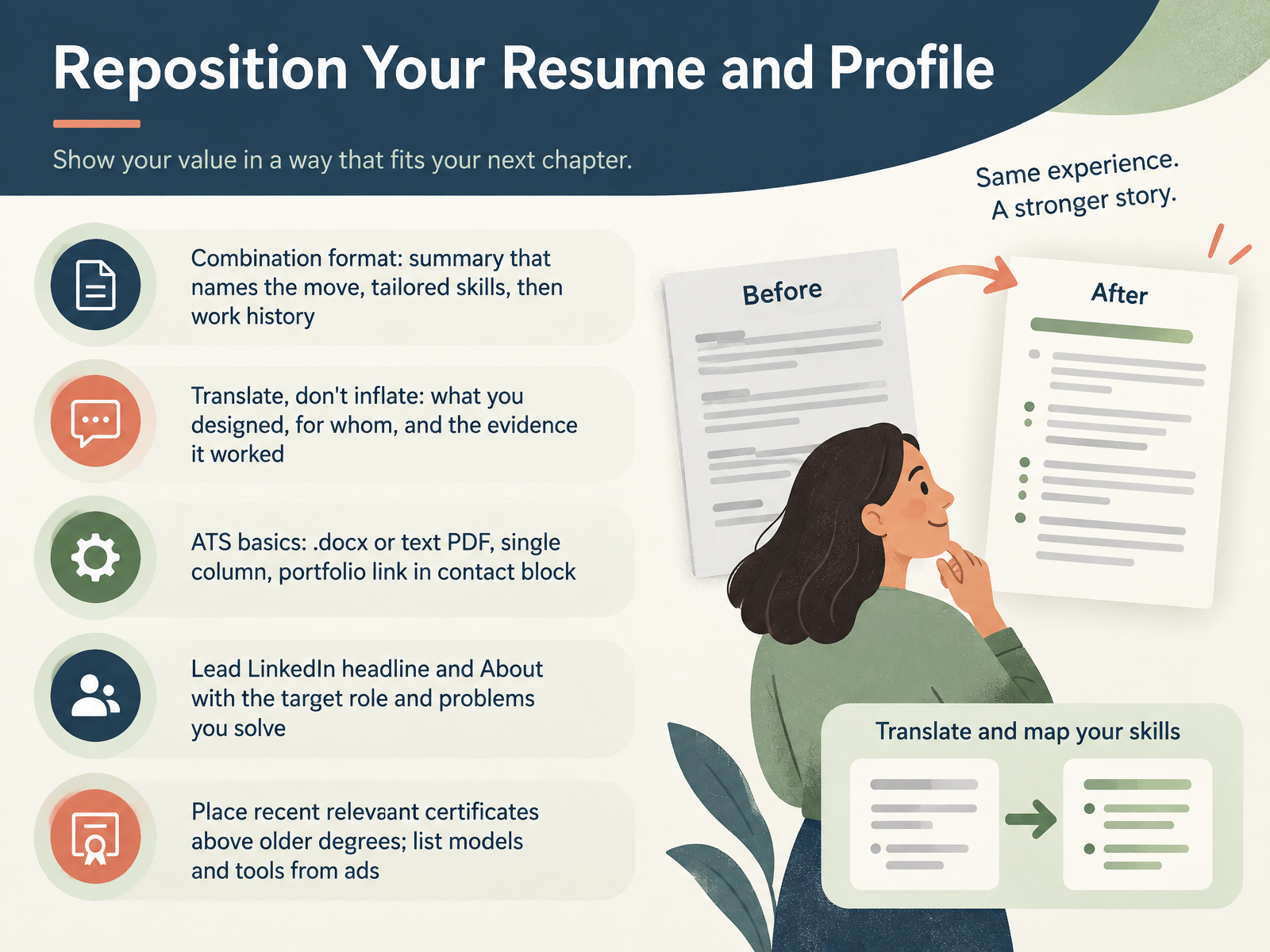
- 09Reposition Your Resume and ProfileNow let's reposition your resume and profile. Use a combination format. Open with a summary that names the move, follow with tailored skills, then your work history. Translate, don't inflate. Say what you designed, for whom, and the evidence it worked. For example, a teacher might write, designed a six-week learning unit with aligned assessments, then adjusted instruction using learner data. For applicant tracking systems, submit a docx file or a text-based PDF. Keep it single column, and put your portfolio link in the contact block. On LinkedIn, lead your headline and About section with the target role and the problems you solve. Place recent relevant certificates above older degrees, and list the models and tools that appear in job ads, such as ADDIE and Articulate Rise. One takeaway: translate your experience into L&D language, and tailor the tools and keywords to each posting. Next, we'll run a targeted job search.
 careercenter.natsap.orgboards.greenhouse.ioemployment.utah.edu+22 min
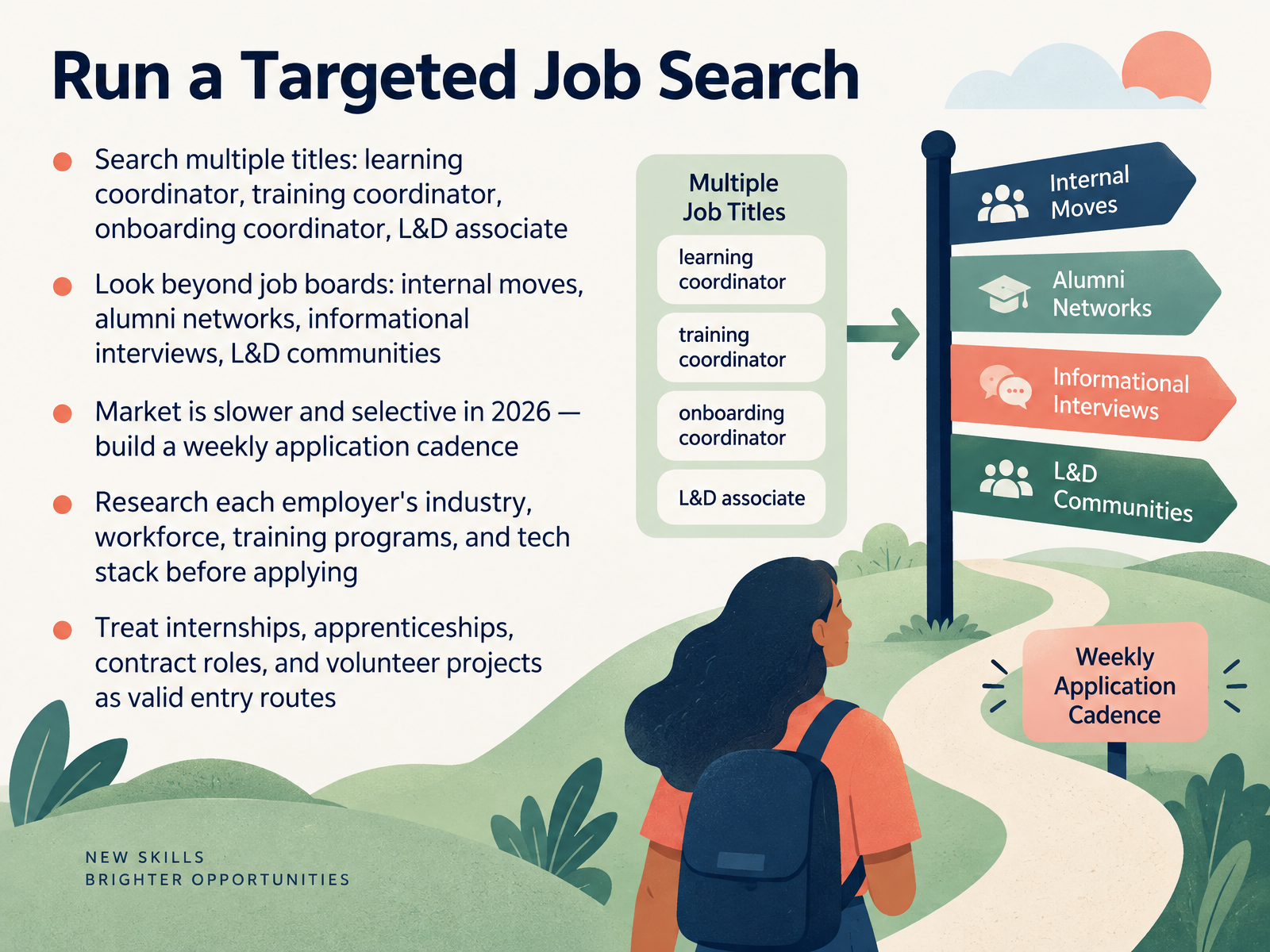
- 10Run a Targeted Job SearchNow let's turn your preparation into a targeted job search. First, search several titles, because employers label similar work differently. Try learning coordinator, training coordinator, onboarding coordinator, and L and D associate. Second, look beyond job boards. Internal moves, alumni networks, informational interviews, and L and D communities often surface roles earlier. For example, a teacher can ask a district HR contact about internal training openings. Third, plan for a slower, more selective market in twenty twenty-six. Build a weekly application cadence and stick to it. Fourth, research each employer's industry, workforce, training programs, and tech stack before you apply. Fifth, treat internships, apprenticeships, contract roles, and volunteer projects as valid entry routes. Your action is simple. Block one hour this week and apply to three roles using at least two different titles. Next, we will look at how to interview with evidence and handle the career-changer question.
 mtfinstitute.com2 min
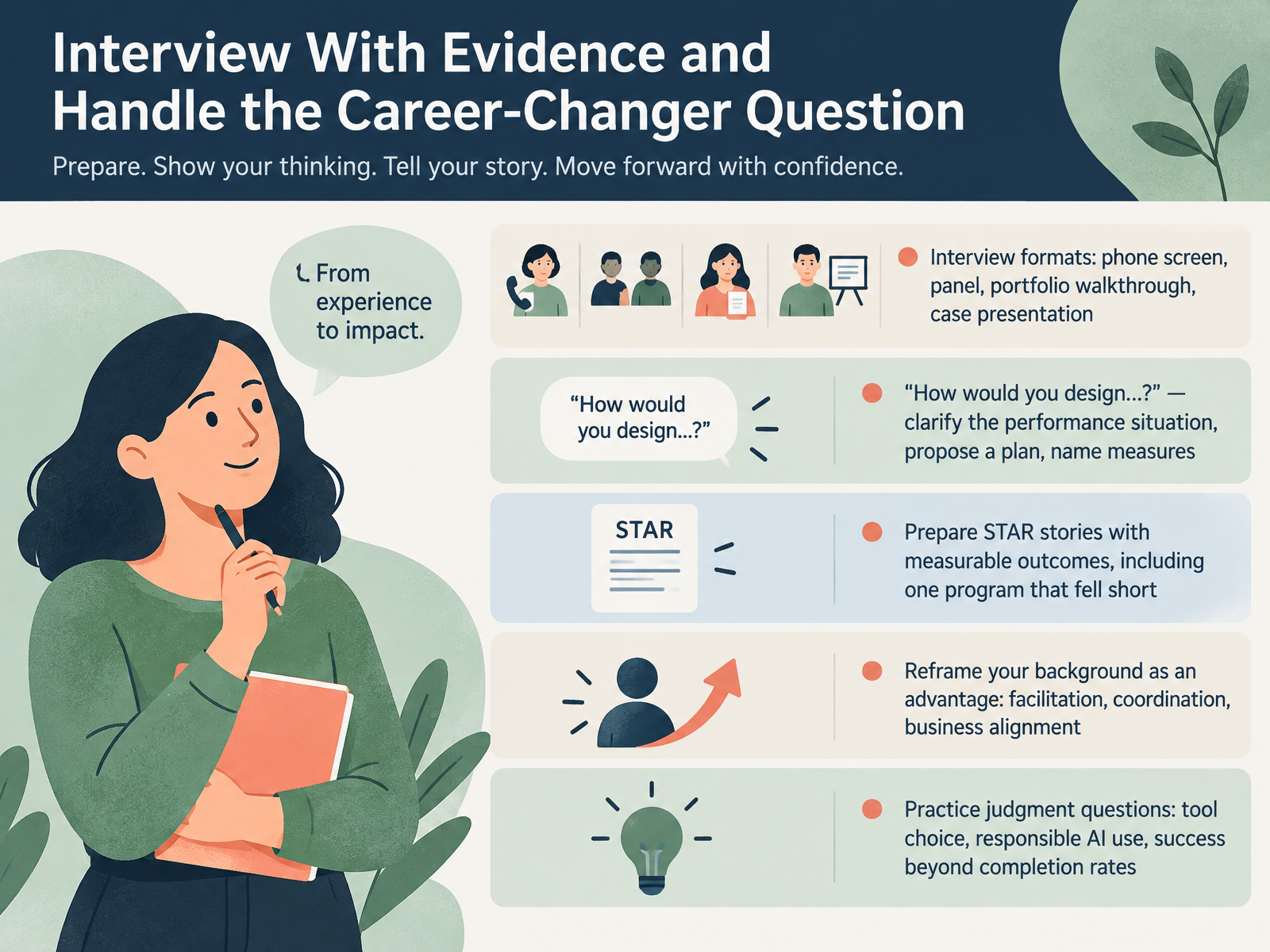
- 11Interview With Evidence and Handle the Career-Changer QuestionNow let's talk about the interview itself. Expect several formats: a phone screen, a panel, a portfolio walkthrough, and a case presentation. When you hear, how would you design this, don't jump to a course. Clarify the performance situation, propose a plan, and name your measures. Prepare STAR stories with measurable outcomes. STAR means situation, task, action, result. Include one program that fell short and what you changed. Reframe your background as an advantage: facilitation, coordination, and business alignment are exactly what L&D teams need. Practice judgment questions too, such as tool choice, responsible AI use, and success beyond completion rates. Your takeaway: bring evidence, not enthusiasm alone. Next, your first ninety days and long-term growth.
 doi.orgresearchportal.ulisboa.ptmtfinstitute.com+22 min
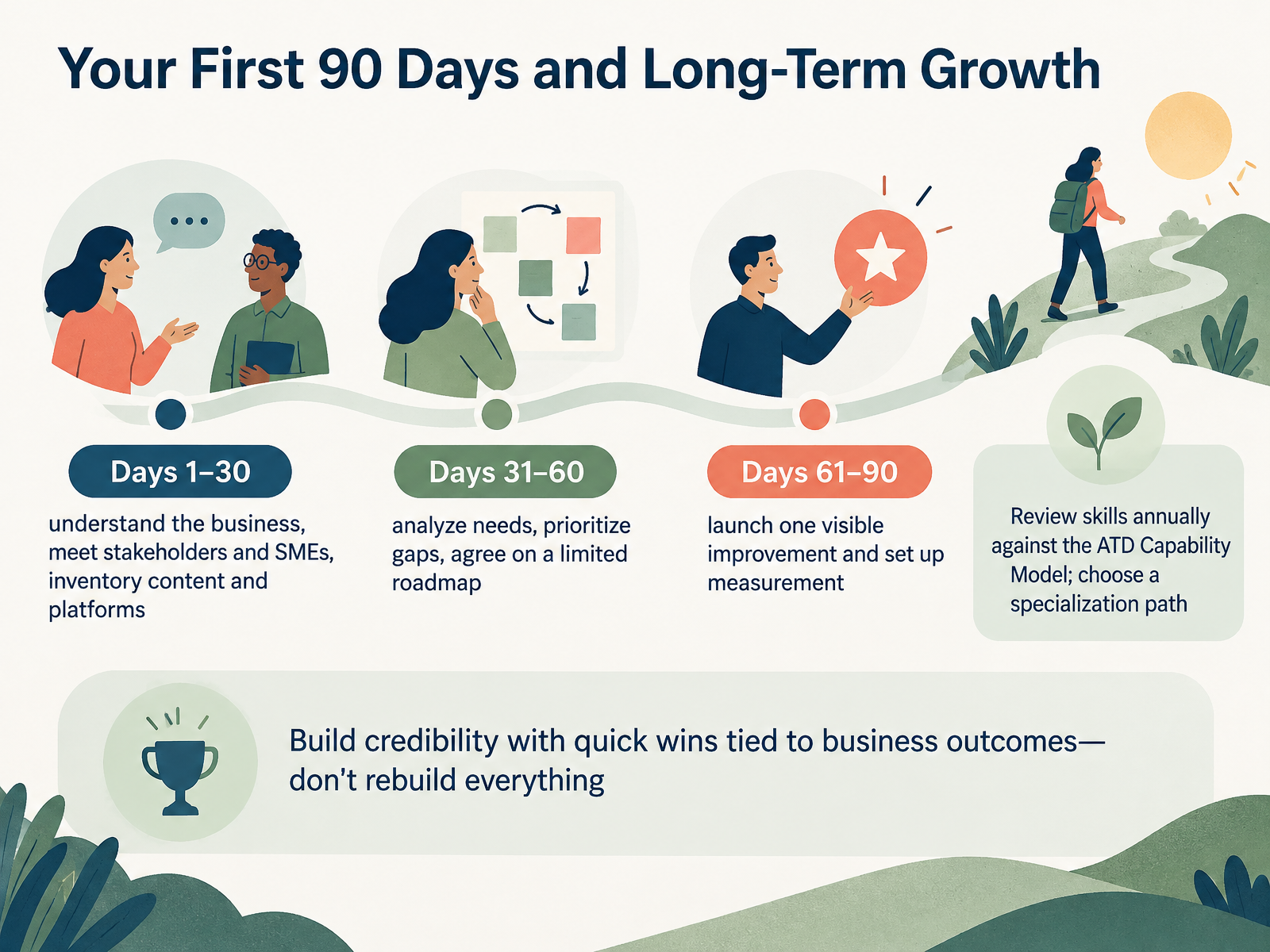
- 12Your First 90 Days and Long-Term GrowthNow let's map your first ninety days, and how to keep growing after them. In days one to thirty, focus on understanding the business. Meet stakeholders and subject matter experts, and inventory existing content and platforms. For example, a former teacher should learn which teams request training, and what already sits in the learning system. In days thirty one to sixty, analyze needs, prioritize the gaps, and agree on a limited roadmap. Keep it narrow. In days sixty one to ninety, launch one visible improvement and set up measurement. Build credibility with quick wins tied to business outcomes. Don't rebuild everything at once. Then review your skills annually against the ATD Capability Model, and choose a specialization path. One takeaway: win trust early with small, measured improvements. Next, let's build Your Action Plan: What to Do in the Next 30 Days.
 help.td.orgtd.orgcapability.td.org+22 min
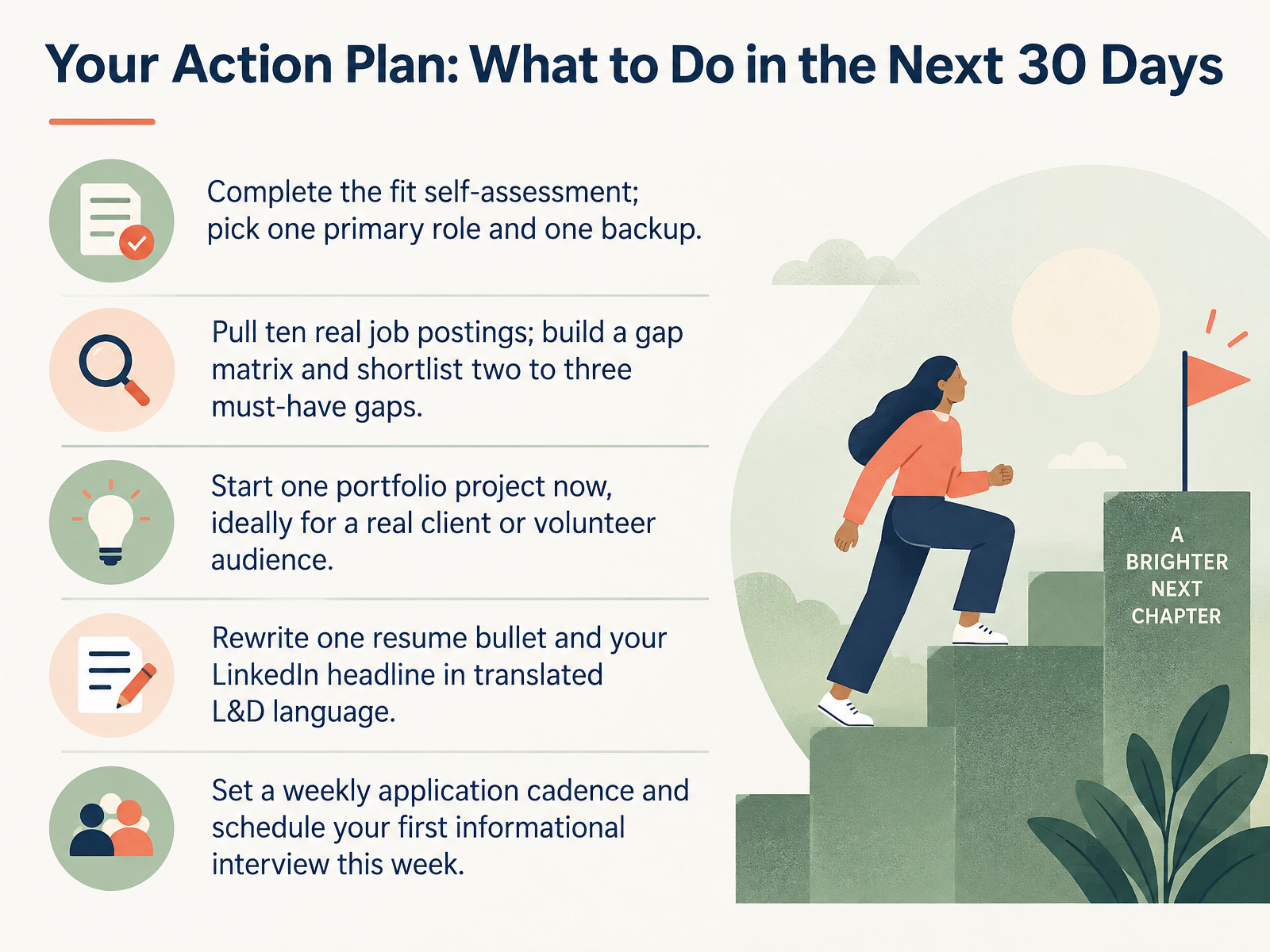
- 13Your Action Plan: What to Do in the Next 30 DaysNow let's turn all of this into a thirty-day action plan you can actually follow. First, complete the fit self-assessment. Pick one primary role and one backup, because a single target keeps your effort focused. Second, pull ten real job postings and build a simple gap matrix. From that, shortlist two or three must-have gaps, not twenty. Third, start one portfolio project now. Ideally it's for a real client or a volunteer audience. For example, a teacher could redesign a colleague's onboarding session and document the result. Fourth, rewrite one resume bullet and your LinkedIn headline in translated L and D language. Instead of created lesson plans, write designed structured learning experiences aligned to measurable objectives. Fifth, set a weekly application cadence, and schedule your first informational interview this week. The takeaway is this: small, scheduled actions beat sporadic bursts. Then, each week, adjust your plan based on what you learn. Next, we'll recap the seven-step workflow and the key takeaways.
 2 min
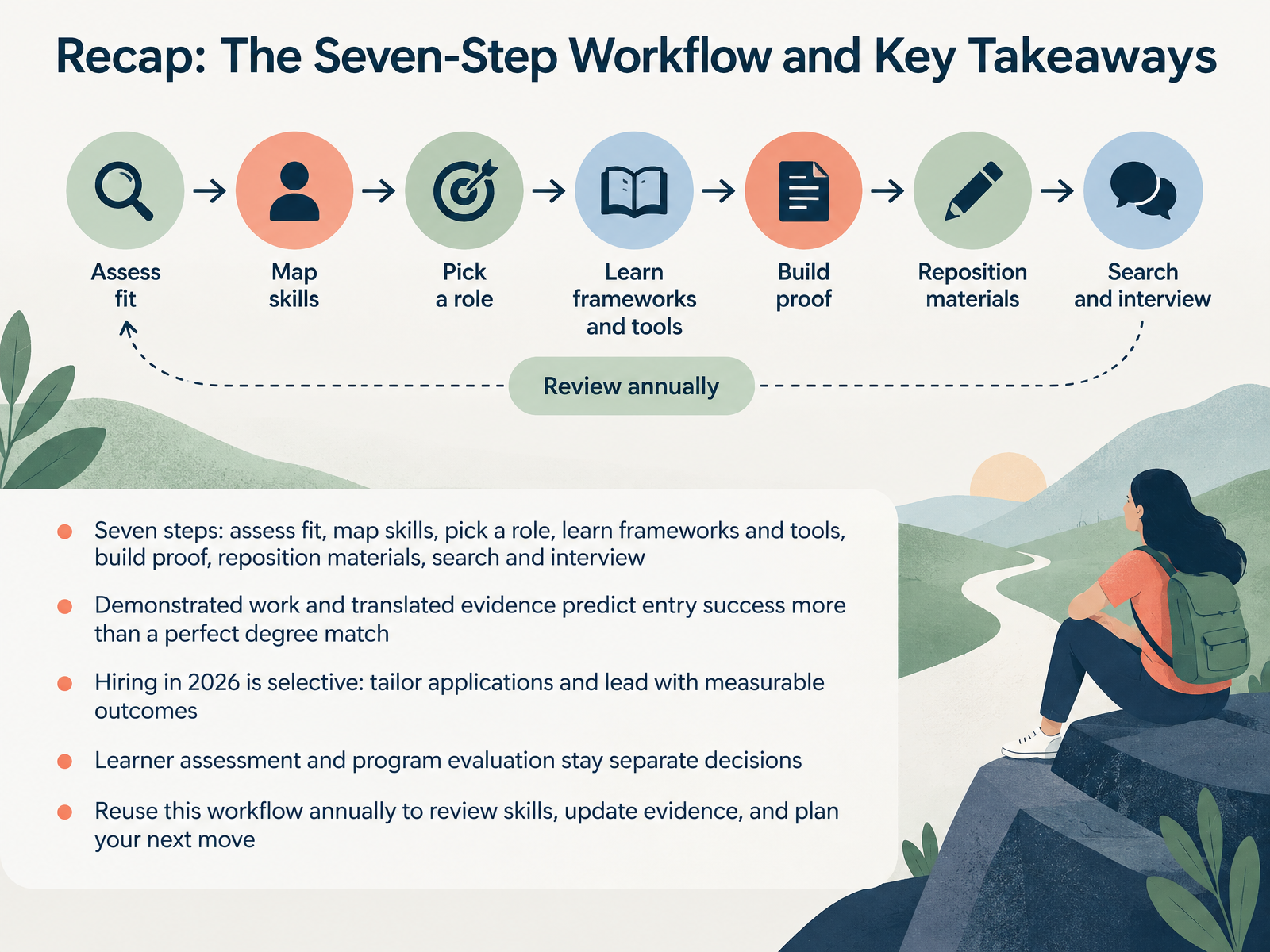
- 14Recap: The Seven-Step Workflow and Key TakeawaysLet's bring the whole workflow together. The seven steps are: assess fit, map your skills, pick a role, learn the frameworks and tools, build proof, reposition your materials, and then search and interview. Two things predict entry success more than a perfect degree match: demonstrated work, and evidence translated into L&D language. Hiring in 2026 is selective, so tailor every application and lead with measurable outcomes. Keep learner assessment and program evaluation as separate decisions, because a knowledge check does not prove the program improved work. Finally, reuse this workflow every year to review your skills, update your evidence, and plan your next move. You now have a practical path, so take the first step this week. Thank you for your attention, and good luck.
 doi.orgresearchportal.ulisboa.ptmtfinstitute.com+22 min
Take the deck with you
Download this course as a file — free, no sign-up needed.
- PDF handoutEvery slide page, ready to print or share.15 pages · 3.9 MBDownload
- Narrated PowerPointThe deck that presents itself — every slide carries the digital human's narration video.15 pages · 13.2 MBDownload
- PowerPoint slidesThe full deck as a .pptx — open it in PowerPoint, Keynote, or Google Slides.15 pages · 3.8 MBDownload
Free to use in your own training — please keep the PersonWise credit page at the end.
Have your own deck? Turn it into a course
Sources consulted
Web sources consulted while building this course.
- Trends in Post-pandemic Instructional Design: An Exploratory Analysis of Job Ads Using Textual Analysis — doi.org
- Instructional Designer Competencies: A Content Analysis of Job Advertisements Based on the IBSTPI Model - University of Lisbon — researchportal.ulisboa.pt
- Learning and Development: U.S. Employer Demand in 2026 — mtfinstitute.com
- instructional design jobs in 2026 — demand, top roles hiring, and related skills — Skillenai — skillenai.com
- 46% of new L&D jobs mention AI. — linkedin.com
- Learning Development Specialist Job Description (Updated 2026 With Examples) | NATSAP — careercenter.natsap.org
- Learning and Development Instructional Designer, Quality at Andurilindustries — boards.greenhouse.io
- Training and Development Specialist | University of Utah — employment.utah.edu
- Learning and Development Specialist Journey (Limited Term) Job Details | SMUD — careers.smud.org
- Instructional Designer at Arcodb — job-boards.greenhouse.io
- When will the ATD Competency Model be updated? – ATD National — help.td.org
- Talent Development Capability Model — td.org
- ATD's Talent Development Capability Model — capability.td.org
- TDBoK™ Guide: Talent Development Body of Knowledge — td.org
- 2026 Education Course Catalog — assets.td.org
- Best eLearning Authoring Tools Reviews 2026 — gartner.com
- eLearning Authoring Tools 2026: Uncover the Top 8 Options — d2l.com
- Best eLearning Authoring Tools Software - 2026 Reviews & Pricing — softwareadvice.com
- Best Instructional Design Software in 2026: Top 10 Tools (AI Included) — smartcat.com
- 11 Best Course Authoring Software On G2: My Top Picks for 2026 — learn.g2.com